The crystal glass beside my plate was still trembling when I realized my son had been waiting years for the courage to humiliate me.
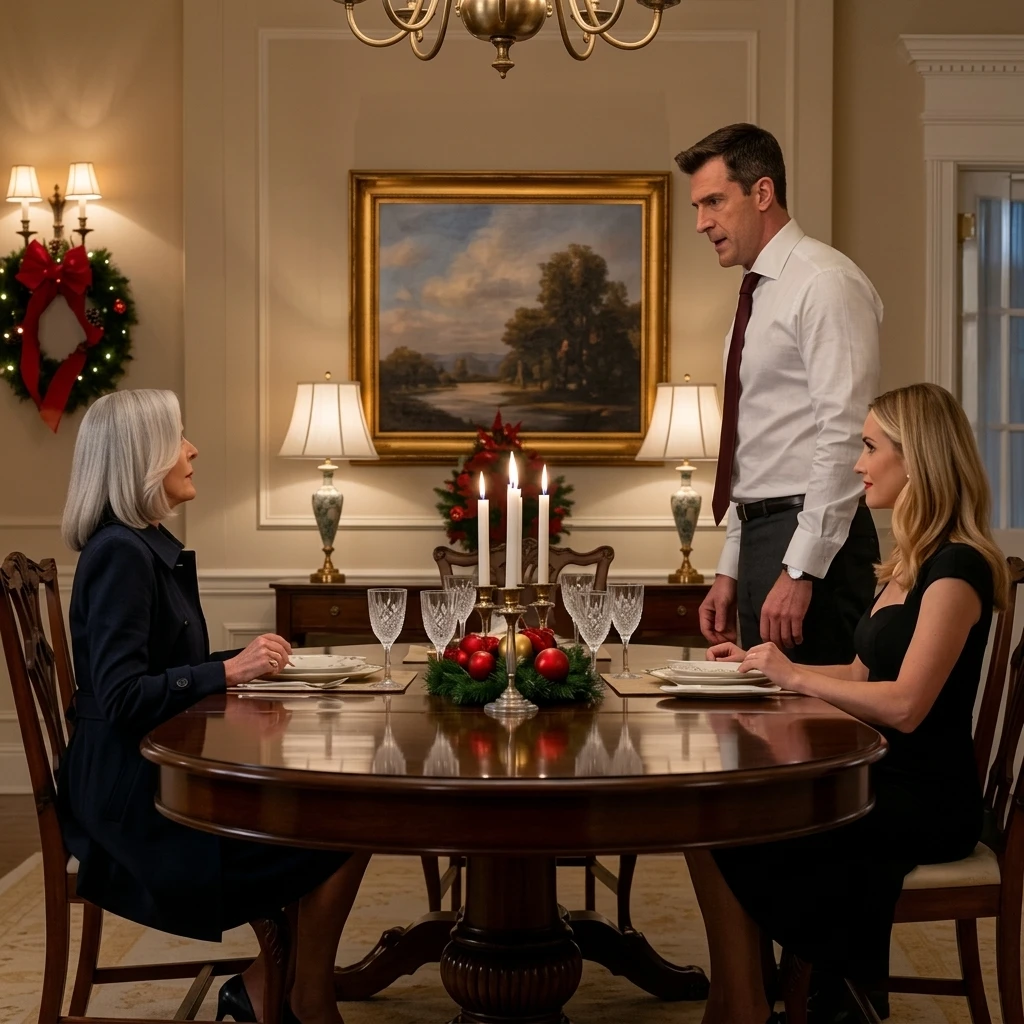
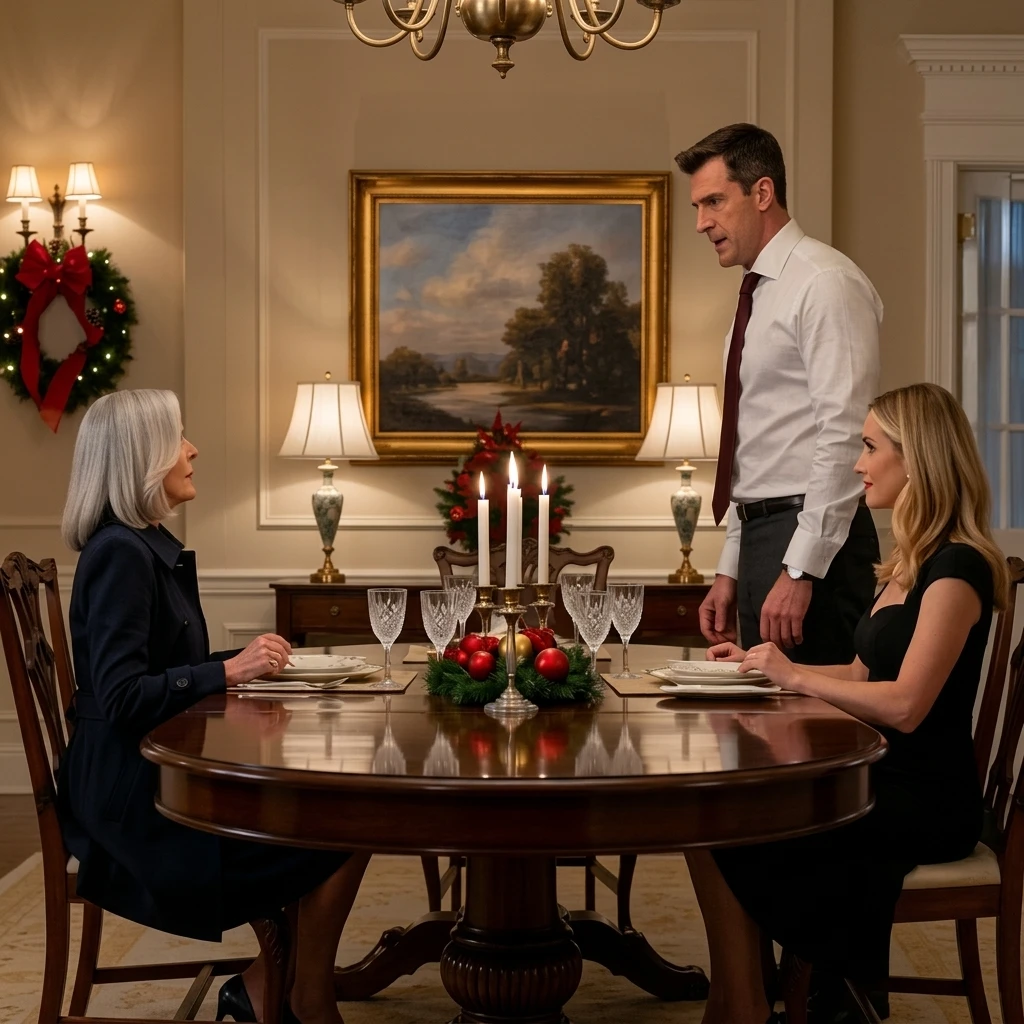
Daniel Whitaker stood at the head of my Christmas table, his palm flattened against the polished walnut as though he had just claimed the house by force.
“Pay the rent or get out!”
His voice struck harder than his hand.
Twenty-two people stopped breathing.
My sisters sat frozen beneath the chandelier. Their husbands stared into their plates. Daniel’s cousins suddenly found the centerpiece fascinating. Three teenagers lowered their phones. My youngest grandson, Noah, held a forkful of mashed potatoes halfway to his mouth, while his older brother, Ethan, looked at his father with an expression I could not yet name.
It was not surprise.
It was shame.
Outside, snow tapped gently against the tall windows of the home where I had celebrated thirty-one Christmases. The tree beside the fireplace glowed with gold ribbon and white lights. Robert’s old wooden angel stood at the top, one wing slightly crooked because Daniel had dropped it when he was eight.
The turkey had been carved.
The candles were burning.
My dead husband’s chair was empty beside me.
And my only son had just ordered me out of my own house.
“Daniel,” I said, folding my napkin with deliberate care, “sit down.”
“No.”
His cheeks were dark with anger. He had removed his suit jacket before dinner, and his burgundy tie hung loose beneath his open collar. At forty-three, he had Robert’s height but none of his stillness. Robert could command a room without raising his voice. Daniel had learned to mistake volume for authority.
“You sit there acting like some wounded queen,” he continued, “but this is real life. Melissa and I can’t keep floating you.”
A chair creaked somewhere near the far end of the table.
Floating me.
For one wild second, I wondered whether I had misheard him.
I looked toward my daughter-in-law.
Melissa sat with one arm resting across the back of her chair, her red lips curved into a patient, pitying smile. She wore the black dress I had bought her for her fortieth birthday, along with diamond earrings I had given her after she cried about feeling invisible next to the younger mothers at her sons’ school.
“Daniel is right,” she said. “This situation has gone on long enough.”
“What situation?” my sister Linda asked.
Melissa turned toward her as though addressing a confused child.
“Margaret living here without contributing.”
A low sound escaped my brother-in-law Frank. It might have been disbelief. It might have been a laugh he had swallowed too late.
Daniel’s eyes moved toward him.
“Something funny?”
Frank looked at me, then at Daniel. “I’m trying to understand what you’re saying.”
“I’m saying Mom needs to start paying her share.”
“Her share of what?” Frank asked. “Her own house?”
Daniel’s jaw tightened.
Melissa gave another slow smile. “It may be in Margaret’s name, technically, but Daniel handles everything. The taxes, maintenance, bills, repairs—”
“I paid the property taxes in October,” I said.
Melissa’s smile flickered.
“I also paid for the new furnace in February,” I continued. “And the roof three years ago. And the plumbing repair after Daniel’s friend installed the upstairs bathroom incorrectly.”
Daniel’s hand curled against the table.
“This isn’t about keeping score.”
“No,” I agreed. “It rarely is when the score becomes inconvenient.”
My sister Linda whispered, “Margaret…”
I looked at her.
She was sixty-eight, four years younger than me, with the same pale eyes our mother had possessed. Her face seemed strangely tense. She had opened her mouth once already, just after Daniel’s outburst, but I had raised a finger.
At the time, I thought I was protecting her from being drawn into ugliness.
Later, I would understand that Linda had not been preparing to defend me.
She had been afraid Daniel might say too much.
Melissa lifted her wineglass.
“You see?” she said to the table. “This is what we deal with. Every conversation becomes a performance.”
My grandson Ethan shifted in his chair.
“Mom, stop.”
Melissa turned toward him. “Excuse me?”
He stared at his plate.
Daniel pointed down the hallway.
“You have until New Year’s, Mom. Start paying rent, or find somewhere else to be dramatic.”
The room seemed to tilt.
I heard the fire crackle behind me. I heard Noah place his fork down carefully. I heard wind press snow against the windows.
Then Melissa laughed softly.
“Let’s see how you survive,” she said. “You don’t even understand online banking without Daniel.”
That was when the pain changed.
Until then, I had felt wounded.
Afterward, I felt awake.
For six years, I had paid the mortgage on Daniel and Melissa’s townhouse after his construction company supposedly collapsed. I covered their car insurance and Noah’s dental surgery. I paid Ethan’s school fees, soccer uniforms, music lessons, summer camps, and the credit card debt that appeared every January like an annual illness.
When Melissa’s mother needed a new refrigerator, I bought it.
When Daniel said he required a truck to restart the business, I signed the check.
When they took the boys to Florida because the children “needed something normal after all the stress,” I paid for the flights without being asked directly. Daniel had simply left the travel website open on my kitchen computer and sighed until I offered.
I had spent years confusing rescue with love.
But I was not confused anymore.
I pushed my chair back.
The wooden legs scraped across the floor with a sound so sharp that several people flinched.
At seventy-two, I was expected to collapse gracefully. I was supposed to cry, plead, tremble, remind Daniel of sacrifices he had already chosen to forget.
Instead, I walked to the coat closet.
“Where are you going?” he demanded.
I removed my dark wool coat from its hanger and slipped my hand into the pocket.
My fingers closed around a small brass key.
Not to this house.
To another one.
A single-story brick home in Lancaster, Pennsylvania, with a red front door, a stone fireplace, three bedrooms, and a garden that would bloom with white hydrangeas in spring. I had purchased it three months earlier using part of Robert’s life-insurance money and savings Daniel believed had disappeared into medical bills.
Only two people knew.
My attorney, Claire Reeves.
And my grandson Ethan.
I returned to the dining room and held up the key.
“I won’t wait until New Year’s,” I said.
Daniel frowned. “What are you talking about?”
“I’ll leave tonight.”
Melissa’s smile returned, but it looked less certain.
“With what?” she asked. “Your pension check?”
I looked at her.
“With my name on every account you’ve been living from.”
Silence fell so completely that I heard wax dripping down one of the candles.
Daniel’s face changed first.
Not much.
Just enough.
A small loss of color. A tightening around the mouth. His eyes flicking toward Melissa before returning to me.
That glance told me everything.
They had never believed I would say no.
I walked upstairs and packed two suitcases.
I took my medicine, my jewelry box, Robert’s framed photograph, six sweaters, three pairs of trousers, and the blue ceramic bird Noah had made for me in second grade.
Nobody helped.
Nobody stopped me.
When I came downstairs, the guests were still seated around the table. Some stared openly. Others pretended to eat. Frank stood as if to carry my bags, but I shook my head.
Daniel waited near the front door.
“This is ridiculous,” he said. “You’re proving my point.”
“What point is that?”
“That you’re unstable.”
The word landed softly.
Too softly.
Prepared words often did.
Melissa appeared behind him, arms folded.
“You shouldn’t be driving in this weather,” she said. “At your age.”
“At my age, I know how to slow down when the road is dangerous.”
I met Daniel’s eyes.
“And how to stop when the people beside me are worse.”
Ethan followed me onto the porch without his coat.
Snow caught in his dark hair.
“Grandma.”
Daniel called from inside. “Ethan, get back in here.”
The boy ignored him.
At seventeen, Ethan was already nearly as tall as his father, but he had Robert’s quiet way of standing. He held himself carefully, as though every movement might reveal too much.
“Did you bring it?” I asked.
His face went pale.
“Not here.”
I nodded once.
He hugged me quickly, fiercely, then stepped away.
Into my gloved hand, he pressed a small black flash drive.
“Don’t trust Aunt Linda,” he whispered.
The front door opened behind him.
Ethan turned and went inside before Daniel could see what he had given me.
I stood on the porch with snow gathering on my shoulders, the flash drive hidden in my fist.
Then I looked through the glass at my family.
Daniel beside the tree.
Melissa behind him.
Linda at the dining table, watching me with fear in her eyes.
By nine-thirty that night, I was driving toward Lancaster.
By midnight, I had changed every password.
By morning, I had canceled every automatic payment, every favor, and every dollar they had ever received from me.
And before noon on December twenty-sixth, my son had called thirty-seven times.
1
The new house smelled of cedar, fresh paint, and emptiness.
I arrived shortly after eleven that night. Snow covered the front path, but someone had salted the steps. Claire had arranged for the heat to be turned on and groceries placed in the refrigerator. A lamp glowed in the front window, casting a soft amber circle across the living-room floor.
For the first time since Robert died, I entered a house where no memory was waiting to ambush me.
There was no dent in the hallway wall from Daniel’s bicycle.
No mark on the kitchen doorway measuring Ethan’s height.
No worn patch beside the fireplace where Robert’s chair had stood.
I should have felt homeless.
Instead, I felt as though I had been holding my breath for six years and had finally remembered how to release it.
I placed Robert’s photograph on the mantel.
In it, he was sixty-five and laughing at something beyond the camera. His hair had gone silver at the temples, and his blue shirt was open at the collar. The picture had been taken during our last summer at Cape May, eight months before the stroke.
“What did I miss?” I asked him.
His smile offered no answer.
I made tea, opened my laptop, and began.
The first call was to the bank’s emergency line.
The second was to the insurance company.
The third was to the credit-card provider.
By 12:43 a.m., Daniel no longer had authorized access to my primary checking account.
At 12:51, Melissa’s supplemental card was frozen.
At 1:06, the automatic payment for their townhouse mortgage was canceled.
At 1:12, the insurance payment for Daniel’s truck was stopped.
At 1:19, the monthly transfer into their household account disappeared from my schedule.
At 1:34, I removed Daniel as emergency financial contact and replaced him with Claire.
Then I opened the folder where I had recorded every dollar I had given them since Robert’s death.
The total sat at the bottom of the spreadsheet.
$486,220.17.
I stared at the number until it blurred.
That amount did not include gifts for the boys.
It did not include Christmases, birthdays, meals, or the smaller emergencies that came wrapped in phrases like We hate to ask and Just until next month.
Nearly half a million dollars.
Robert and I had built our savings slowly. He taught high-school history for thirty-eight years. I managed payroll for a medical-supply company. We lived carefully, paid debts early, and never bought a car we could not keep for a decade.
Daniel knew this.
He had watched us save.
He had also watched me become lonelier after Robert died.
Loneliness, I had learned, was visible to people who intended to use it.
My phone vibrated across the table.
DANIEL.
I let it ring.
A message appeared.
Where are you?
Then another.
This has gone too far.
Then:
The mortgage payment didn’t go through.
I almost laughed.
Not Are you safe?
Not I’m sorry.
Not even Merry Christmas.
The mortgage payment.
My tea had gone cold by the time I inserted Ethan’s flash drive into the computer.
There were seven folders.
BANK.
HOUSE.
COMPANY.
MELISSA.
LINDA.
RECORDINGS.
READ FIRST.
I opened the final one.
Inside was a single document.
Grandma, I’m sorry I didn’t tell you sooner. I didn’t understand at first. Dad said he was helping with your bills because you were forgetting things. Mom said the house would be ours soon and you had agreed. I heard them talking about having you declared unable to manage money. Aunt Linda is helping them.
My hands went cold.
I continued reading.
Three months ago, Mom asked me to print papers from Dad’s email. One document had your signature, but it didn’t look right. It said you were transferring the house to a company called Whitaker Residential Holdings. I searched the company. Mom owns it.
A humming sound filled my ears.
I opened the HOUSE folder.
There it was.
A quitclaim deed.
My name appeared at the bottom.
Margaret Anne Whitaker.
The signature was close.
Very close.
But whoever had copied it had made the final r too sharp. My hand had curved that letter the same way since I was nineteen.
The document was dated September 14.
On September 14, I had been in the hospital overnight after a minor cardiac procedure.
Daniel had driven me there.
Melissa had stayed at my house “in case I needed anything.”
My breath shortened.
I opened another file.
A petition draft seeking emergency financial guardianship.
The petitioner was Daniel Robert Whitaker.
The supporting witness was Linda Carol Mercer.
My sister.
The woman who had sat at my Christmas table and nearly spoken.
The document described me as confused, forgetful, financially reckless, and vulnerable to scams. It claimed I had repeatedly lost bank cards, left the stove on, and transferred large sums to unknown individuals.
Every allegation was false.
Except one.
I had transferred a large sum three months earlier.
To purchase the Lancaster house.
They had discovered the withdrawal but not the destination.
Their plan was suddenly visible.
They would portray the purchase as proof of mental decline. They would gain control of my finances, transfer the old house to Melissa’s company, and place me somewhere “safe.”
Somewhere inexpensive.
Somewhere out of the way.
My phone rang again.
This time, Linda’s name appeared.
I watched it until the screen went dark.
Then I called Claire.
She answered on the fourth ring, her voice thick with sleep.
“Margaret?”
“They forged my signature.”
Silence.
“Are you safe?”
“Yes.”
“Is Ethan safe?”
“I don’t know.”
That woke her completely.
“What do you have?”
“A deed. A guardianship petition. Recordings. Bank documents.”
“Do not email anything. Make two copies of the drive. Put the original somewhere secure.”
“Claire.”
“Yes?”
“My sister is involved.”
Her pause was brief but heavy.
“I’m sorry.”
The simple kindness almost broke me.
I pressed my fingers against my eyes.
“What do we do?”
“We stop them,” Claire said. “But first, we find out how far they’ve gone.”
2
At eight the next morning, Daniel left a voicemail.
His tone had changed.
“Mom, this is getting out of hand. Nobody was trying to upset you. Emotions were high. You misunderstood what I meant about rent.”
At eight-fifteen, he called again.
“We need to discuss the automatic payments. You can’t just cancel obligations without notice.”
At nine, Melissa sent a text.
The boys are devastated. I hope proving a point is worth hurting your grandchildren.
That one found its target.
I sat at the kitchen island and read it three times.
Then I imagined Ethan standing barefoot in the snow, pressing the flash drive into my hand.
I imagined Noah at the table, his fork suspended, his eyes moving between adults who had forgotten children absorb every cruelty spoken near them.
I typed a response.
My relationship with my grandsons is separate from your access to my money.
Before I could send it, another message appeared.
We may have to take steps for your own protection.
I deleted my reply.
At ten, Claire arrived with two coffees, a portable scanner, and a man named Marcus Bell.
Marcus was a forensic accountant in his late fifties, with rimless glasses and the habit of becoming very still when interested.
He shook my hand.
“Mrs. Whitaker, Claire says you have documents.”
“I have years of documents.”
“Good.”
He said it with such calm satisfaction that I almost pitied Daniel.
We worked at the dining table for six hours.
Marcus reviewed bank statements, transfers, canceled checks, tax records, and payment histories. He asked precise questions without judgment.
“Did you authorize this transfer?”
“Yes.”
“This one?”
“Yes.”
“This payment to Larkspur Development?”
“I don’t recognize it.”
He marked it.
There were many I did not recognize.
Small amounts at first.
Eight hundred dollars.
Twelve hundred.
Two thousand.
Most were hidden beneath descriptions that resembled legitimate expenses: property repair, insurance adjustment, school tuition, vehicle maintenance.
Over four years, they totaled $78,400.
All had been transferred through an account Daniel helped me create after Robert died.
All led, Marcus discovered, to a company called Larkspur Development Partners.
“Who owns it?” I asked.
“We’ll confirm,” he said.
Claire was reading the forged deed.
“This hasn’t been recorded yet,” she said. “That’s good.”
“Why wouldn’t they record it immediately?”
“They may have been waiting until they had guardianship. Or waiting for you to leave the property voluntarily.”
“Christmas,” I said.
Claire looked up.
“They wanted witnesses,” I continued. “They wanted people to see me become emotional.”
“And you didn’t,” she said.
“No.”
“You left calmly.”
“Yes.”
“With luggage?”
“Two suitcases.”
“Did anyone record the argument?”
I thought of the teenagers’ lowered phones.
“Probably half the table.”
Claire smiled without humor.
“They may have created evidence,” she said. “Just not the evidence they intended.”
At four, Marcus turned his laptop toward me.
Larkspur Development Partners had two registered managers.
Melissa Whitaker.
And Linda Mercer.
For several seconds, I did not understand the names on the screen.
My mind rejected them the way the body rejects a transplanted organ.
“Linda has never worked in property development.”
Marcus leaned back.
“Does she own property?”
“A small home in West Chester. She and Frank paid it off years ago.”
“Any connection to Daniel’s former construction company?”
“Not that I know.”
He clicked another document.
Larkspur had purchased two rental properties during the same period Daniel claimed his company was collapsing. One was in York. The other was outside Harrisburg.
Both had recently been renovated.
The contractor listed on the permits was D.R. Whitaker Construction Consulting.
Daniel.
I stared at the records.
“His company didn’t collapse.”
“His original company did,” Marcus said. “But several months later, he began operating under a different structure.”
“Why pretend he had nothing?”
Marcus glanced at Claire.
She answered.
“Because people don’t give money to a man who owns two rental properties.”
The betrayal was so methodical that it became almost impressive.
Daniel had not merely accepted help.
He had built a second life behind my generosity.
While I paid his mortgage, he acquired property.
While I covered his children’s school costs, he renovated rental houses.
While I lay awake wondering whether my son might lose his home, he collected rent from tenants.
And my sister had helped him.
“Why Linda?” I whispered.
Neither of them answered.
At dusk, Frank called.
I considered letting it ring, then answered.
“Margaret.”
His voice sounded strained.
“Are you all right?”
“I’m safe.”
“Linda’s been trying to reach you.”
“I know.”
“She says Daniel is worried.”
“Is he?”
Frank exhaled.
“I don’t know what happened last night. I’ve never seen him behave that way.”
“What has Linda told you?”
“That there was an argument. That you’ve been making unusual financial decisions. That Daniel is concerned you’re being influenced by someone.”
“Who?”
“She wouldn’t say.”
I looked at Claire.
She shook her head slightly.
“Frank,” I said, “did you know Linda owns part of a company called Larkspur Development Partners?”
The silence lasted long enough to answer.
“What?”
“Did you know?”
“No.”
“Did you know she has been receiving money from my accounts?”
His breathing changed.
“That’s impossible.”
“I have records.”
“No. Linda would have told me.”
“Would she?”
He did not answer.
In the background, I heard a door close.
Then Linda’s voice.
“Who are you talking to?”
Frank lowered his voice.
“I have to go.”
The call ended.
Ten minutes later, Linda called me.
This time, I answered.
“You spoke to Frank,” she said.
No greeting.
No question about my safety.
“Yes.”
“You had no right to drag him into this.”
“Into what?”
“You know exactly what.”
“I know your name is attached to a company receiving my money.”
“That isn’t what it looks like.”
“What does it look like?”
She became quiet.
Then her voice softened.
“Margaret, please. We need to talk in person.”
“You had all of Christmas dinner.”
“I was trying to protect you.”
“From whom?”
Another silence.
“From what Daniel might say.”
There it was.
Not from what Daniel might do.
From what he might say.
“What does Daniel know?” I asked.
Linda inhaled sharply.
“You’re tired. We should speak tomorrow.”
“No.”
“Margaret—”
“What does my son know?”
She ended the call.
3
The first consequence arrived on December twenty-seventh.
Daniel’s townhouse mortgage payment failed.
The second arrived three hours later when Melissa tried to use her supplemental card at a luxury department store.
The third came that afternoon when their car insurer notified them that the monthly premium had not been received.
At 2:17 p.m., Daniel appeared at my new house.
I watched him through the small camera beside the front door.
He wore jeans, boots, and the green winter coat I had bought him two Christmases earlier. Snow clung to his shoulders. His hands were empty.
Claire had warned me not to let him inside.
I opened the inner door but left the storm door locked.
“How did you find me?”
His expression shifted.
“You’re my mother.”
“That isn’t an answer.”
“Ethan saw the address.”
A lie.
Ethan had been careful.
Daniel must have accessed something else—insurance records, perhaps, or the location data on my old phone before I changed the password.
“You need to come home,” he said.
“I am home.”
“Stop doing this.”
“Doing what?”
“Punishing everyone because you got embarrassed.”
I almost admired the rearrangement.
He had humiliated me, but my embarrassment was now an act of aggression against him.
“You ordered me out.”
“I was angry.”
“You told twenty-two people that you were supporting me.”
“We have supported you emotionally.”
I stared at him.
He pushed one hand through his hair.
“Look, things came out wrong.”
“Did the forged deed come out wrong too?”
His face emptied.
It happened so quickly that another person might have missed it.
I did not.
“What deed?”
“The one transferring my house to Melissa’s company.”
“I don’t know what you’re talking about.”
“Then you won’t mind explaining that to my attorney.”
He stepped closer to the glass.
“Why are you talking to an attorney?”
“Why were you preparing to have me declared incompetent?”
Color returned to his face in a rush.
“That wasn’t—”
“So there is a petition.”
His mouth closed.
I watched him understand his mistake.
“Mom,” he said finally, “we were worried.”
“About my health?”
“Yes.”
“What is the name of my cardiologist?”
He blinked.
“What?”
“The cardiologist you claim to be worried about. What is her name?”
“That’s not the point.”
“What medication do I take in the morning?”
“You know I’m bad with names.”
“When was my last appointment?”
He looked away.
“Melissa handles those details.”
“No. I handle them.”
“You’ve been making reckless decisions.”
“Such as?”
“Buying this place.”
“With my money.”
“Without telling your family.”
“I told the people who needed to know.”
His eyes sharpened.
“Ethan.”
I said nothing.
“You involved my son in this?”
“He came to me.”
“He’s a child.”
“He is seventeen.”
“He doesn’t understand finances.”
“He understands forgery.”
Daniel’s fist struck the wooden frame beside the door.
Not the glass.
Not me.
But close enough that the sound echoed through the entryway.
“Do not turn Ethan against us.”
“I didn’t need to.”
His breathing grew heavy.
For the first time, I saw something beneath his anger.
Fear.
Not fear of losing me.
Fear of what I knew.
“You need to restore the payments,” he said.
“No.”
“We have obligations.”
“So do I.”
“You promised to help until I got back on my feet.”
“You have two rental properties.”
His body went completely still.
I continued.
“York and Harrisburg. Both renovated through your consulting company.”
“Who told you?”
“The records.”
“It’s complicated.”
“It usually is when the simple version is fraud.”
His eyes moved toward the camera above the door.
He lowered his voice.
“You have no idea what’s happening.”
“Then explain it.”
“I can’t do that standing outside.”
“You aren’t coming in.”
“I’m your son.”
“And this is my house.”
He flinched.
Perhaps he remembered saying the same thing at Christmas.
Or perhaps, for the first time, he understood that parenthood did not grant him permanent access to me.
“Linda said you’d do this,” he muttered.
“What did Linda say?”
He looked toward his car.
“Ask her.”
“I am asking you.”
He gave a bitter laugh.
“You want the truth? Fine. Ask Linda why Dad left you everything. Ask her why she spent her whole life watching you get what belonged to someone else.”
Then he walked away.
I stood behind the locked door, listening to the fading crunch of his boots.
Robert had left me everything because I was his wife.
Our accounts were joint. The house belonged to both of us. His life-insurance policy named me. His modest retirement funds transferred according to documents we had signed together.
There had never been a question of something belonging to Linda.
Unless Daniel was referring to something other than money.
I called Claire.
She answered immediately.
“What happened?”
I told her.
When I finished, she said, “Do you know where your birth certificate is?”
The question startled me.
“In a document box.”
“Marriage certificate?”
“Yes.”
“Daniel’s birth certificate?”
“In the safe-deposit box, unless he removed it.”
“Who has access?”
“Only me. Robert did before he died.”
“Good. We’re going to the bank tomorrow.”
“Why?”
“Because when family disputes begin circling around words like belonged, I prefer documents to memories.”
4
The safe-deposit box contained forty-one years of paper.
Robert had trusted paper more than computers. Deeds, policies, certificates, letters, photographs, and receipts lay in labeled envelopes written in his precise teacher’s handwriting.
Our marriage certificate.
Daniel’s original birth certificate.
His adoption decree.
I had not touched the document in more than four decades.
Claire sat beside me in the small private viewing room as I unfolded it.
Daniel had been born Daniel James Mercer.
Mother: Linda Carol Mercer.
Father: Unknown.
Adoptive parents: Robert Alan Whitaker and Margaret Anne Whitaker.
The court had finalized the adoption when Daniel was six months old.
I closed my eyes.
There are secrets hidden because people are ashamed.
Others are hidden because they are sacred.
Daniel’s birth had been both.
Linda was sixteen when she became pregnant. Our father was a church deacon, our mother terrified of public disgrace. Linda refused to identify the father. She wanted to keep the baby at first, but after Daniel was born, she sank into a darkness none of us understood. She would not hold him. She would not feed him. Some days, she would not leave her bed.
Robert and I had been married for three years and had already learned that I could not carry a pregnancy to term.
Taking Daniel had not felt like charity.
It had felt like the answer to a prayer I had become afraid to speak.
The original arrangement was supposed to be temporary.
Then Linda left Pennsylvania to stay with an aunt in Ohio. Months passed. She wrote that she could not return if everyone knew. Our parents asked whether Robert and I would adopt the baby permanently.
We agreed.
Linda signed the documents.
When she returned two years later, she wanted to be introduced as his aunt. She married Frank, had no more children, and built a life ten miles from ours.
Robert and I planned to tell Daniel when he turned eighteen.
Then, on the week of his eighteenth birthday, Linda begged us not to.
She said it would destroy her marriage.
She said Frank did not know.
She said Daniel would feel rejected.
I allowed fear to disguise itself as kindness.
We waited.
Then college came.
Then Daniel’s wedding.
Then Ethan was born.
There was always another reason to postpone the truth.
Robert died before we found the courage.
I placed the adoption decree on the table.
“He knows,” I said.
Claire nodded.
“Linda told him.”
“But why tell him now?”
“To change the story before you could.”
A sealed envelope lay beneath the adoption documents.
My name was written on the front.
MARGARET—IF LINDA EVER TELLS HIM FIRST.
The room seemed to narrow.
Robert’s handwriting.
My husband had been dead six years, yet in that moment I felt him standing behind me.
My fingers shook as I opened the envelope.
Inside were four handwritten pages.
My dearest Margaret,
If you are reading this, then I was right to worry and wrong not to act sooner.
I swallowed.
Claire looked away, giving me what privacy she could inside a locked room.
Linda asked me for money twice this year. The first time, she said Frank had made a poor investment. The second time, she said Daniel deserved to know that we had built our life using something taken from her.
I told her Daniel was never taken. She signed the adoption willingly, and we never prevented her from being part of his life.
She said willingness given by a frightened girl does not count.
Perhaps she is right about some of that. We were all young, and our parents cared too much about appearances. But she also said something that frightened me. She said that one day Daniel would understand which mother owed him.
I stopped reading.
A tear landed on the paper.
I have updated my estate plan. You remain my sole beneficiary. Daniel’s future inheritance will remain protected through you. If Linda tells him the truth, please give him the enclosed letter. He deserves to know that we loved him from the first night he slept in our home.
But Margaret, be careful.
Guilt makes generous people easy to control.
You have spent your life trying to repay a debt that never existed.
Daniel is our son because we raised him, not because Linda lost him.
Do not let either of them turn love into an invoice.
I covered my mouth.
Robert had seen it.
Not the entire scheme.
Not the forged deed.
But the shape of the danger.
Beneath his letter was another envelope addressed to Daniel.
I did not open it.
Claire spoke softly.
“There’s more.”
At the bottom of the box lay a slim blue folder.
Inside was a signed promissory note dated seven years earlier, shortly before Robert’s death.
Borrower: Daniel Robert Whitaker.
Lender: Robert and Margaret Whitaker.
Principal amount: $220,000.
Collateral: Daniel and Melissa’s townhouse and any future proceeds from D.R. Whitaker Construction.
I stared at the page.
“I never signed this.”
Claire examined the signatures.
“You did.”
Then I remembered.
Robert had brought a folder to the hospital during his final recovery. He told me the papers concerned emergency planning and asked me to sign several places. I had trusted him.
“Daniel borrowed money from us?”
“The document says he did.”
“I thought his business failed after Robert died.”
Claire turned the page.
The note included an unusual clause.
If Daniel made any attempt to obtain control over either lender’s property through fraud, coercion, misrepresentation, or legal incapacity proceedings, the entire balance would become immediately due.
If unpaid, the lenders could enforce the collateral.
Claire read it twice.
Then she looked at me.
“Your husband was a careful man.”
“He was a history teacher.”
“Apparently one who understood contracts.”
A final document revealed that the loan proceeds had been used to settle claims against Daniel’s first construction company.
Robert had saved him before I even knew he needed saving.
Daniel had allowed me to spend six years believing my own support was the only thing preventing his ruin.
He had already received more than two hundred thousand dollars from his father.
Combined with what I had paid afterward, his parents had given him over seven hundred thousand dollars.
And he had stood at my Christmas table and accused me of being carried.
The grief that passed through me was not loud.
It was deeper than anger and colder than tears.
My son had not simply taken my money.
He had rewritten our entire family history so he could call himself the victim.
5
Linda came to Lancaster the next afternoon.
She arrived alone in a beige coat, carrying a tin of Christmas cookies as though we were meeting after a minor disagreement.
I let her inside because some doors must be opened before they can be closed forever.
She stood in the living room and looked around.
“So this is where the money went.”
Not What a lovely house.
Not Are you comfortable?
The money.
I took the cookie tin from her and placed it unopened on the counter.
“Daniel knows.”
Her face tightened.
“I assumed he told you.”
“He mentioned that Robert left me something that belonged to someone else.”
Linda removed her gloves finger by finger.
“Robert always did enjoy dramatic language.”
“He’s dead, Linda.”
“Yes. I’m aware.”
I looked at the woman who shared my childhood. We had slept in the same narrow room beneath a sloped ceiling. I had braided her hair before school. When our father shouted, she crawled into my bed. When she became pregnant, I lied to our mother so Linda could attend medical appointments without being followed.
For decades, I had believed secrecy was the sacrifice I made for her.
Now I wondered whether she had seen it as evidence of my guilt.
“When did you tell Daniel?” I asked.
“Two years ago.”
“Why?”
“Because he asked.”
“How would he know to ask?”
She looked toward the window.
“People notice things.”
“No. People are told things.”
Linda walked to the fireplace and studied Robert’s photograph.
“He deserved the truth.”
“Yes.”
She turned, surprised by my agreement.
“He deserved it from Robert and me,” I continued. “Years ago. We were wrong to wait.”
“You were afraid he would choose me.”
The cruelty of it was quiet.
“Was that what you wanted?”
“I wanted him to know I didn’t abandon him.”
“You signed the adoption.”
“I was sixteen.”
“You refused to hold him.”
“I was ill.”
“I know. That’s why I never blamed you.”
“But you took him.”
“Our parents asked us to.”
“You wanted a baby.”
“Yes,” I said. “And then I loved him.”
Her eyes filled, but her expression hardened.
“You got everything. Robert. The house. The child. The respectable life.”
I felt something inside me finally settle.
This was not about justice.
It was about an old wound Linda had polished until it became an identity.
“What does any of that have to do with stealing from me?”
“I never stole.”
“You own Larkspur Development.”
Her face changed.
Only for an instant.
Then she recovered.
“Daniel needed help rebuilding.”
“So you helped him hide property while I paid his bills.”
“We were protecting his investments.”
“From me?”
“From your control.”
I laughed once.
“My control funded them.”
“You always attach strings.”
“Name one.”
“You wanted him dependent.”
“I wanted him housed.”
“You wanted him grateful.”
“I wanted him honest.”
“You wanted to be his real mother.”
The words hung between us.
There are moments when a lifetime rearranges itself.
I remembered Linda volunteering for every school event after Ethan was born, then criticizing how I handled the boys. I remembered her urging me to “help Daniel while he recovers.” I remembered how often she praised Melissa for allowing me to feel needed.
She had not merely watched the dependence grow.
She had cultivated it.
“Did you forge my signature?” I asked.
“No.”
“Did Melissa?”
“I don’t know.”
“Did you help prepare the guardianship petition?”
She crossed her arms.
“We were concerned.”
“You swore I was confused.”
“You bought a house in secret.”
“That is not confusion.”
“You moved nearly three hundred thousand dollars without telling your son.”
“My son is not my financial supervisor.”
“He should have been consulted.”
“Why?”
“Because someday this will all be his.”
I stared at her.
There it was.
The belief beneath everything.
My life was only the waiting room for Daniel’s inheritance.
“You thought the house belonged to him already,” I said.
“It should.”
“Because he is your biological son?”
“Because it was built with a family’s sacrifice.”
“Robert and I bought that house.”
“You could only afford it because you didn’t have to endure what I did.”
My voice became very calm.
“You believe I owe you for raising the child you could not raise.”
Her chin trembled.
“I believe you owe Daniel the truth.”
“The truth does not include my bank account.”
“He lost everything.”
“No. He owns two rental properties.”
“He built those himself.”
“With money taken from me.”
“You gave him money.”
“I did not give you permission to hide transfers through my account.”
Her face went pale.
I stepped closer.
“Did you know Robert had already loaned Daniel two hundred and twenty thousand dollars before he died?”
Linda said nothing.
That was answer enough.
“Daniel told you.”
“He said Robert helped settle some business matters.”
“Did he mention the promissory note?”
She looked toward the door.
“What note?”
“The one secured by his townhouse and business proceeds.”
For the first time since she arrived, Linda looked frightened.
“You’re bluffing.”
“Robert included a fraud clause.”
Her lips parted.
“If Daniel tries to take control of my property through coercion, forgery, or an incapacity petition, the full balance becomes due.”
“You wouldn’t.”
I looked at her.
“Wouldn’t what?”
“Take his home.”
“You were willing to take mine.”
“That’s different.”
“Because he is your son?”
Her eyes filled with tears.
“He is yours too.”
“Yes,” I said. “Which is why this hurts enough to kill something in me.”
Linda began to cry.
Once, that would have ended the argument. I had protected her from consequences all our lives because her tears awakened the older sister I had been at twelve.
But I was no longer twelve.
And she was no longer helpless.
“Tell Daniel to withdraw the guardianship petition,” I said. “Tell Melissa to destroy every forged document and provide a full accounting of my money.”
“You’re threatening us.”
“No. I am describing the narrowest path out.”
“And if they don’t?”
“I enforce the note. I report the forgery. I recover every dollar taken without authorization.”
Linda wiped her cheeks.
“You’ll lose him.”
The sentence should have terrified me.
Instead, it clarified everything.
“I lost him long before Christmas,” I said. “I just didn’t know he had left.”
6
The petition arrived on December twenty-ninth.
Daniel filed it despite my warning.
He requested temporary authority over my finances, alleging that I was suffering from “rapid cognitive deterioration” following Robert’s death.
Robert had been dead six years.
Apparently, my decline had waited patiently until I stopped paying Daniel’s mortgage.
The petition included statements from Melissa and Linda.
Melissa claimed I had forgotten Noah’s birthday twice, confused the boys’ names, and nearly caused a fire by leaving a burner on.
Linda described my Lancaster purchase as evidence of “impulsive financial behavior” and claimed I had become paranoid about family members stealing from me.
Daniel’s statement was the longest.
He wrote that he had managed my finances for years because I could not understand electronic banking. He said I depended on him for household maintenance and decision-making. He claimed the Christmas incident began when he gently suggested hiring in-home assistance, causing me to become irrational and flee during dangerous weather.
He never mentioned rent.
He never mentioned Melissa’s mockery.
He never mentioned his hand striking the table.
But three people had recorded it.
My niece Paige sent Claire the clearest video.
It began several seconds before Daniel’s outburst.
In it, Melissa could be heard saying, “Once she agrees to the monthly amount, we’ll finally have a record that she acknowledges this is our property.”
Then Daniel slammed his palm down.
“Pay the rent or get out!”
My own voice followed, quiet and distinct.
“With my name on every account you’ve been living from.”
The recording captured every face around the table.
Most importantly, it captured Linda.
When Daniel said the word rent, Linda did not look surprised.
She looked terrified that the plan had been spoken too bluntly.
Claire filed our response within hours.
Attached were the Christmas video, my medical evaluation, banking records, the forged deed, the draft petition Ethan had found, and evidence that the guardianship documents had been prepared before Christmas.
The hearing was set for January third.
Until then, the court declined to grant Daniel temporary control.
His plan had failed at the first door.
But frightened people rarely stop at one door.
That evening, Ethan called from a number I did not recognize.
“Grandma?”
“Where are you?”
“At Tyler’s house.”
“Are you safe?”
“Yes.”
“Does your father know you called?”
“No.”
His voice shook.
“They know I gave you the drive.”
My grip tightened around the phone.
“How?”
“They checked my laptop. Dad found the copies.”
“Did he hurt you?”
“No.”
The pause was too long.
“Ethan.”
“He grabbed my arm. That’s all.”
“That is not all.”
“He was angry.”
“Where is Noah?”
“At home.”
“What’s happening there?”
He breathed out slowly.
“Everything’s falling apart.”
In the background, I heard another boy speaking softly.
Ethan continued.
“The mortgage company called. Mom’s card didn’t work. Dad and Aunt Linda were yelling about some loan Grandpa made.”
“Did you hear anything else?”
“Yes.”
He hesitated.
“Mom said the old house was already promised to a buyer.”
My heart kicked hard.
“What buyer?”
“I don’t know. Someone named Harrow.”
“Did she say when?”
“New Year’s Eve. She said once you were declared incompetent, Dad could complete the transfer and sell it.”
“They scheduled a sale before filing the petition?”
“I think so.”
That meant there was more than a forged deed.
There was a buyer.
A purchase contract.
Possibly a deposit.
Fraud was no longer being considered.
It was underway.
“Ethan, listen to me. Do not confront them. Do not search for more documents. Stay at Tyler’s tonight.”
“What about Noah?”
“I’ll handle Noah.”
“How?”
I did not know.
But grandparents, like mothers, sometimes promise certainty because children need to hear it before adults can create it.
“I’ll handle it.”
He went quiet.
Then he said, “Grandma, there’s something else.”
“What?”
“Dad knows you found out about Aunt Linda.”
“I know.”
“No. I mean he knows she’s his mother.”
“Yes.”
“He said you stole him from her.”
The words entered slowly.
“What did you say?”
“I told him that didn’t make sense.”
“Why?”
“Because Aunt Linda hates kids.”
Despite everything, a laugh almost escaped me.
Ethan continued.
“She barely talks to Noah. She never came to my games unless you were there. She doesn’t act like someone who lost a son.”
Children often see what adults bury beneath history.
“Your aunt was very young,” I said. “And very unwell.”
“Do you still love Dad?”
The question broke something open.
“Yes.”
“Even now?”
“Love does not disappear just because trust does.”
“Then why is he doing this?”
I looked at Robert’s photograph across the room.
“Because some people would rather believe they were cheated than admit they have been given more than they deserved.”
7
The buyer’s name was not Harrow.
It was Harrow Residential Group, a private investment company purchasing older homes for redevelopment.
Marcus found the pending transaction through emails on the flash drive. Melissa had negotiated the sale for $1.4 million.
My house was worth perhaps nine hundred thousand.
The inflated price puzzled us until Claire studied the proposed plans.
The property sat on nearly two acres in an area where zoning had recently changed. Harrow intended to demolish the house and build six luxury townhomes.
Melissa had signed a letter of intent as managing member of Whitaker Residential Holdings—the company named on the forged deed.
She had accepted a $100,000 advance.
Half had been transferred to Larkspur.
The other half had paid down personal credit cards and a private-school tuition balance.
“They sold a house they don’t own,” I said.
“They attempted to,” Claire corrected. “The closing requires title transfer.”
“Could they complete it?”
“Not now. We’ve filed a fraud notice with the county and notified the buyer.”
“What happens to the deposit?”
“Harrow will demand it back.”
“And when Daniel and Melissa can’t repay it?”
“They may sue.”
Marcus looked up from his laptop.
“That may be the least of their problems.”
He had found where the unauthorized transfers from my account went.
Some paid renovation costs.
Some covered property taxes.
But $31,000 had been transferred into a college account in Ethan’s name.
I felt a momentary, foolish relief.
“At least they saved something for him.”
Marcus’s expression stopped me.
“It was withdrawn six weeks ago.”
“By whom?”
“Daniel.”
“For what?”
He rotated the screen.
The money had gone to Harrow Residential Group as part of a performance guarantee connected to the sale.
Daniel had emptied his son’s college account to support the fraudulent transfer of my home.
I thought I had reached the bottom of what he could do.
But betrayal has no bottom.
Only new rooms.
That afternoon, Noah called me from his tablet.
He was nine and still young enough to speak before deciding whether the truth was convenient.
“Grandma, are you mad at me?”
“No, sweetheart.”
“Dad said you don’t want us anymore.”
“That isn’t true.”
“Mom said you shut off our house.”
“I stopped paying some bills that belong to your parents.”
“Are we going to be homeless?”
I closed my eyes.
“No.”
It was not a promise I could control.
But I knew I would not let Noah suffer for his parents’ choices.
“Why did Dad yell at you?”
“I think he was afraid.”
“Of what?”
“Of having to fix problems he created.”
Noah considered this.
“Mom is crying a lot.”
“I’m sorry.”
“Ethan won’t come home.”
“I know.”
“Can I come to your new house?”
The words struck with unexpected force.
“Yes.”
“Today?”
“Your parents need to agree.”
“They won’t.”
“Then not today.”
He sniffed.
“I liked Christmas before dinner.”
“So did I.”
“Did you take Grandpa’s picture?”
“Yes.”
“Good. Dad was going to put it in the basement.”
After the call, I sat alone for a long time.
Then the doorbell rang.
Frank stood outside holding Linda’s laptop.
His face looked ten years older than it had at Christmas.
“I think you need this,” he said.
I let him inside.
He placed the computer on the table.
“Linda left last night,” he said. “She said she was staying with Melissa.”
“Did she tell you why?”
“She said I betrayed her by speaking to you.”
“I asked whether you knew about Larkspur.”
“I didn’t.”
He lowered himself into a chair.
“We’ve been married forty-four years. She has a separate bank account. She told me it was money from your mother’s jewelry.”
“Our mother had no money.”
“I know that now.”
He pushed the laptop toward me.
“I found emails.”
Claire had warned me not to open unknown devices without preserving evidence, so I called her. Within an hour, she and Marcus arrived.
The laptop contained years of correspondence.
At first, Linda’s messages to Daniel were emotional.
You deserve to know what was taken from us.
Margaret always needs to be the savior.
She uses money to make people loyal.
Then the messages became strategic.
Let her pay the mortgage. Keep your assets separate.
Don’t tell her about York.
She feels useful when there’s a crisis.
The more she pays, the more guilty she’ll feel about saying no.
Melissa joined the emails later.
We need the house transferred before she changes the will.
Daniel can raise the concern about memory issues.
Christmas gives us witnesses.
Then a message from Linda, dated December twentieth:
Do not make it sound like an eviction. Frame it as a contribution to expenses. If she becomes emotional, stay calm.
Daniel had ignored that instruction.
Perhaps cruelty had finally outrun strategy.
Frank read the emails beside us.
When he reached the end, he removed his glasses and covered his face.
“I lived with her,” he whispered. “I slept beside her.”
I knew the feeling.
Betrayal often makes people ashamed of having trusted.
But trust is not the sin.
The abuse of it is.
“There’s one more folder,” Marcus said.
It was encrypted.
The password hint read: His real father.
Frank looked at me.
“You don’t know?”
“No.”
He tried Linda’s childhood address.
Nothing.
Her birthday.
Nothing.
Daniel’s original surname.
Nothing.
Then I remembered a name Linda had once spoken while feverish after giving birth.
A boy our father had forbidden her to see.
“Try Caldwell,” I said.
The folder opened.
Inside were scanned letters from a man named Thomas Caldwell.
And a DNA report dated eighteen months earlier.
Marcus read it first.
His eyebrows rose.
“What?” I asked.
He turned the screen toward me.
The report compared Daniel Whitaker and Thomas Caldwell.
Probability of paternity: 0.00%.
Daniel was not Thomas Caldwell’s son.
A second report compared Daniel to another man.
Robert Alan Whitaker.
Probability of paternity: 99.98%.
For several seconds, nobody moved.
The letters on the screen stopped being language.
Robert.
My husband.
Linda.
My sister.
Daniel.
My son.
My husband’s son.
Biologically.
The room tilted beneath me.
Frank made a sound like a man struck in the chest.
“No,” he said.
I could not breathe.
The dates assembled themselves without mercy.
Linda had become pregnant during the third year of my marriage.
Robert and I had been trying desperately for a child.
He had comforted me through two miscarriages.
And sometime during that same year, he had fathered my sister’s baby.
The child we adopted.
The child I raised.
The secret Robert had never confessed.
Suddenly, Daniel’s adoption was no longer an act of generosity between sisters.
It was a structure built around an affair.
My husband had not simply agreed to raise Linda’s child.
He had brought his own son into our marriage and allowed me to believe fate had delivered him.
I stood too quickly.
The chair fell behind me.
Claire reached for my arm, but I pulled away.
“No.”
“Margaret—”
“No one touches me.”
I walked to the fireplace.
Robert’s photograph smiled from the mantel.
The same open face.
The same familiar eyes.
Daniel’s eyes.
How had I never seen it?
Because love teaches us to recognize what we expect.
I picked up the photograph.
For six years, I had spoken to it.
Asked it questions.
Missed it.
Defended the man inside it as the measure by which all other men failed.
“You knew,” I whispered.
The photograph kept smiling.
A fury unlike anything I had felt at Christmas rose through me.
Daniel had betrayed me for money.
Linda had betrayed me from resentment.
But Robert had betrayed the entire shape of my life.
And then he had died beloved.
I hurled the photograph into the fireplace.
The glass shattered against the stone.
Frank flinched.
The wooden frame landed beside the flames but did not catch.
I stared at it.
Then something white slipped from the torn paper backing.
An envelope.
Small.
Folded flat.
Hidden behind the photograph.
My name was written across it.
Not in Robert’s handwriting.
In Ethan’s.
8
I pulled the envelope from the hearth before the edge could burn.
Inside was a note written three months earlier.
Grandma, I found the DNA report on Aunt Linda’s computer. I didn’t know how to tell you. I put a copy behind Grandpa’s picture because you always take it with you when you travel. I thought you would find it when you moved.
Beneath the note was another flash drive.
The first drive had contained financial records.
This one contained truth.
There was a video file.
Linda sat in her kitchen, unaware she was being recorded. Melissa stood across from her. The camera angle was low, likely from Ethan’s phone positioned on a counter.
Melissa spoke first.
“Daniel thinks Robert knew.”
“He did know,” Linda replied.
“About the DNA test?”
“Robert knew from the beginning.”
My hands shook.
Melissa poured wine.
“Then why did he adopt Daniel?”
Linda laughed bitterly.
“Because Margaret couldn’t have children, and Robert was terrified she would leave if she discovered what happened.”
“What exactly did happen?”
Linda’s expression changed.
For the first time, I saw not resentment but shame.
“I was sixteen. Robert was twenty-eight.”
Frank stood abruptly.
“What?”
On the video, Linda continued.
“He said Margaret was falling apart after the miscarriage. He came to check on me while our parents were away. I had been drinking. He had too.”
Melissa stared at her.
“You told Daniel it was a love affair.”
“I told Daniel what he needed to hear.”
My stomach turned.
“Did Robert force you?” Melissa asked.
Linda looked down.
“No. Not exactly.”
“Not exactly?”
“I wanted him to love me. I had wanted that for years. He was kind to me. Kinder than anyone.”
Frank walked out of the room.
The front door closed behind him.
The video continued.
Linda said, “Afterward, Robert told me it could never happen again. When I became pregnant, he begged me not to tell Margaret. He offered money. Our parents arranged the adoption. Everyone believed the father was some boy from school.”
“So Margaret never knew.”
“No.”
“And Robert left her everything.”
“He left our son nothing directly.”
“He left Daniel a mother who paid every bill.”
“That’s not the same.”
Melissa leaned toward her.
“If the guardianship works, Daniel gets control. You get your share. We all win.”
Linda’s face hardened.
“I don’t want a share.”
Melissa smiled.
“You own half of Larkspur.”
“That was temporary.”
“Nothing is temporary once it has your signature.”
The recording ended.
The room remained silent.
Claire reached over and closed the laptop.
I sat slowly.
The truth was more complicated than the first shock.
Robert had betrayed me.
Linda had been young, vulnerable, and trapped inside a family that prized reputation over honesty.
Yet decades later, she had chosen to weaponize that history.
She told Daniel not that Robert had used fear and secrecy, but that I had stolen him.
She converted pain into entitlement.
And Daniel had accepted the version that made him owed.
“Does he know Robert was his father?” I asked.
Marcus nodded toward the DNA report.
“Linda likely showed him.”
“Ethan said Daniel called himself stolen.”
Claire’s voice was quiet.
“He may believe the house is his paternal inheritance.”
The final pieces clicked into place.
Daniel did not merely think I was a dependent old woman occupying his future property.
He believed I had lived in a house financed by his father while denying him his rightful place.
But Robert and I had purchased that house together.
My income had paid nearly half the mortgage.
My labor had built the life inside it.
And whatever guilt Robert carried did not transfer ownership of me to Daniel.
I looked toward the empty mantel.
For the first time, Robert’s absence did not feel like loss.
It felt like space.
“What happens now?” Marcus asked.
I wiped my face.
“Now we tell the truth.”
Claire studied me.
“All of it?”
“All of it.”
“To the court?”
“To Daniel first.”
“That may not be wise.”
“Perhaps not.”
“Then why?”
“Because I will not do what Robert and Linda did. I will not hide a truth because I’m afraid of what someone will become after hearing it.”
Claire nodded slowly.
“We can arrange a controlled meeting.”
“New Year’s Eve,” I said.
Marcus frowned. “Why then?”
“Because that is when they planned to sell my house.”
9
Daniel agreed to meet because he believed I was surrendering.
Claire’s office occupied the second floor of a restored stone building near Lancaster’s courthouse. On New Year’s Eve, the streets were wet with melting snow, and silver decorations hung in shop windows.
We arranged the conference room carefully.
Claire and Marcus sat beside me.
Frank sat at the far end, pale and silent.
Ethan had chosen to attend. He sat near the door, his hands clasped tightly.
Noah remained with a trusted family friend.
At three o’clock, Daniel entered with Melissa and Linda.
Daniel wore a dark suit. Melissa carried a leather folder. Linda did not look at Frank.
For one strange second, we resembled a family gathering for some respectable purpose.
Then Melissa saw Marcus.
“Why is the accountant here?”
“To discuss the accounts,” I said.
Daniel pulled out a chair.
“Mom, before we begin, you need to understand that the guardianship petition isn’t punishment.”
“I understand exactly what it is.”
“We can withdraw it if you agree to reasonable safeguards.”
“What safeguards?”
“Shared financial authority. A monthly household contribution. A plan for the properties.”
“Which properties?”
He hesitated.
Melissa answered.
“The family home and Daniel’s investments.”
“Larkspur’s investments,” Marcus corrected.
Linda looked at him sharply.
Daniel placed both hands on the table.
“We’re willing to resolve this privately.”
“So am I.”
His shoulders relaxed.
I continued.
“You will withdraw the petition. Melissa will return the Harrow deposit. Larkspur will provide full financial records. Every unauthorized transfer will be repaid. You will sign a written admission that the deed bearing my signature was invalid.”
Melissa laughed.
“That’s not a resolution.”
“It is the gentlest one available.”
“You can’t prove who signed anything.”
Ethan spoke from the door.
“I can.”
Melissa turned.
He placed his phone on the table.
“I recorded you practicing Grandma’s signature.”
The color left her face.
Daniel looked at his son.
“You said you deleted that.”
The room went still.
Melissa slowly turned toward her husband.
“You knew?”
Daniel realized too late what he had admitted.
Claire wrote something on the legal pad before her.
I looked at him.
“You knew she forged it.”
His jaw tightened.
“I knew she was preparing documents.”
“You watched her copy my signature.”
“We were trying to protect what belonged to me.”
“Because Robert was your father.”
Daniel froze.
Linda closed her eyes.
Melissa whispered, “You said she didn’t know.”
“I didn’t,” I said.
Daniel stared at Linda.
“You told me she knew.”
Linda’s lips parted.
“You said she and Robert took me together,” Daniel continued. “You said she couldn’t have children, so she convinced him to keep me and pushed you out.”
“That is not what happened,” I said.
He looked at me with something close to hatred.
“You expect me to believe you?”
“No. I expect you to watch.”
Claire turned the laptop toward them and played the recording.
Linda’s voice filled the conference room.
I was sixteen. Robert was twenty-eight.
Daniel’s expression changed.
I told Daniel what he needed to hear.
He looked at Linda.
The recording continued.
If the guardianship works, Daniel gets control. You get your share. We all win.
When the screen went dark, nobody spoke.
Daniel’s face seemed to have collapsed inward.
“You lied,” he said.
Linda began crying.
“I was trying to make you understand.”
“Understand what?”
“That you were loved.”
“You told me she stole me.”
“I gave birth to you.”
“You told me Robert wanted us to be a family.”
“He cared about you.”
“He hid me.”
“He raised you.”
“No,” Daniel said, pointing toward me. “She raised me.”
The word she should have hurt.
Instead, it sounded like the first honest sentence he had spoken in months.
Linda reached for him.
He pulled away.
“You used me.”
Her tears came harder.
“I lost everything.”
“You had forty years to tell me the truth.”
“I was ashamed.”
“So you made me hate her?”
Linda looked at me.
“You had him.”
I stood.
“No, Linda. I loved him. There is a difference.”
She shook her head.
“You got to be his mother.”
“Because every day, I did the work of being one.”
“I gave him life.”
“And then you helped him destroy his.”
Daniel flinched.
I turned toward him.
“Your father betrayed both of us.”
His eyes filled.
“You knew he was my father?”
“I learned two days ago.”
“You expect me to believe that?”
“I have spent forty-three years believing you were another man’s child. It never changed how I loved you.”
He looked toward Ethan.
His son’s expression was closed.
“What did Grandpa say?” Daniel asked.
I placed Robert’s sealed letter on the table.
“This is addressed to you.”
Daniel took it.
His fingers shook as he opened the envelope.
He read silently.
Halfway through, he sat down.
At the end, he covered his mouth.
I did not ask what Robert had written.
That letter belonged to him.
For several minutes, the only sound was Linda crying.
Then Daniel looked at me.
“He says you saved me.”
“We raised you.”
“He says you were the first person to hold me all night.”
I remembered.
Daniel had been three days old. Linda refused to see him. He cried for hours, his tiny face red with fury. I sat in a borrowed rocking chair until dawn, terrified he would stop breathing if I closed my eyes.
“You had colic,” I said.
A broken laugh escaped him.
Then his face hardened again.
“Why didn’t you tell me?”
“Cowardice.”
The answer surprised him.
I continued.
“We called it protection. It was cowardice. You deserved the truth long ago.”
“So everyone lied.”
“Yes.”
“You too.”
“Yes.”
The room absorbed the admission.
I could have defended myself.
I could have blamed Linda, our parents, Robert, the time in which we lived.
All would have been partly true.
But partial truths had built this disaster.
“I am sorry,” I said. “Not because I raised you. Never for that. I am sorry because I let fear decide when you were old enough to know who you were.”
Daniel’s eyes filled with tears.
For a moment, I saw the boy who had once climbed into my bed during thunderstorms.
Then Melissa placed a hand on his arm.
“Daniel, don’t let her turn this around. We’re here because she cut off the family.”
He looked down at her hand.
Slowly, he removed it.
“You forged her signature.”
“For us.”
“You took Ethan’s college money.”
“To secure the Harrow agreement.”
“You said it was temporary.”
“It was.”
“Harrow wants the deposit back,” Claire said.
Melissa glared at her.
Daniel turned toward Marcus.
“How much do we owe?”
Marcus opened a folder.
“With the promissory note, unauthorized transfers, misused college funds, and related obligations, the immediate exposure is approximately three hundred and seventy-nine thousand dollars, excluding penalties and legal costs.”
Daniel looked at me.
“Promissory note?”
I placed a copy before him.
His eyes moved down the page.
When he saw his own signature, he leaned back.
“Dad said he destroyed this.”
“He did not.”
“He told me it was a family gift.”
“The document says otherwise.”
“He wouldn’t enforce it.”
“He included an enforcement clause.”
Daniel read it.
His face went pale.
Melissa snatched the document.
“This cannot be valid.”
“It is,” Claire said.
“You can’t take our house.”
I looked at her.
“You tried to take mine.”
“We have children.”
“So did I when Robert and I spent years paying for that home.”
“This is cruel.”
“No. Cruel was making a seventy-two-year-old woman believe she was a burden while you lived on her money.”
Daniel pushed the document away.
“What do you want?”
The question held no challenge now.
Only exhaustion.
“I wanted a son who loved me more than he loved my accounts.”
He closed his eyes.
“That isn’t what I meant.”
“You said exactly what you meant at Christmas.”
“I was angry.”
“You filed a guardianship petition two days later.”
“Linda said—”
“No.”
My voice stopped him.
“You do not get to place every choice into another person’s hands. Linda lied to you. Melissa manipulated you. Robert deceived you. I failed to tell you the truth. All of that is real.”
I leaned forward.
“But you stood at my table. You ordered me out. You knew about the forged signature. You allowed your son’s college fund to be emptied. Those choices belong to you.”
Daniel looked toward Ethan.
His son did not look away.
“What happens to us?” Daniel whispered.
“That depends on what you do next.”
Melissa stood.
“We’re leaving.”
“No,” Daniel said.
She stared at him.
“What?”
He looked at the forged deed, the promissory note, and the unopened folder of financial evidence.
Then at me.
“What are the terms?”
Melissa’s face twisted.
“You cannot be serious.”
Daniel turned to her.
“You forged my mother’s name.”
“You agreed.”
“I agreed to move the house into a company.”
“You agreed to all of it.”
“Not the college account.”
“You signed the withdrawal.”
“Because you said it was a short-term transfer.”
Melissa laughed sharply.
“Do you hear yourself? You’re blaming me because the old woman finally found a lawyer?”
Ethan stood.
“Don’t call her that.”
Melissa turned toward him.
“Sit down.”
“No.”
The single word carried Robert’s stillness.
Daniel stared at his son.
Ethan continued.
“You both told Noah and me that Grandma couldn’t manage anything. But she paid for everything. You said she forgot our birthdays. She never did. You said she was confused, but you were the ones hiding money.”
Melissa’s expression hardened.
“You have no idea what adults do to keep a family afloat.”
Ethan looked at the table.
“Grandma did.”
No one answered.
The clock on the wall clicked toward four.
Outside, bells from a nearby church began ringing.
New Year’s Eve.
The moment when Melissa and Daniel had planned to sell my home.
Instead, they sat beneath fluorescent office lights while their lies collapsed around them.
I presented the agreement Claire had prepared.
Daniel and Melissa would withdraw the guardianship petition immediately.
They would surrender management interests in Larkspur’s two rental properties into a court-supervised repayment arrangement.
The Harrow deposit would be returned.
The forged deed would be formally disavowed.
Ethan’s college fund would be restored first.
Daniel would sign a confession of judgment on the promissory note but receive a structured repayment plan that allowed him to keep the townhouse if he complied.
Melissa would provide full records and relinquish access to every account connected to me.
Linda would transfer her interest in Larkspur and repay what she had received.
If any of them refused, we would pursue civil claims and refer the evidence for criminal investigation.
Melissa read the agreement.
“You planned this.”
“Yes.”
“You’re enjoying it.”
“No.”
And I meant it.
Victory is not joyful when the people defeated are people you once prayed for.
Daniel picked up the pen.
Melissa grabbed his wrist.
“If you sign, you admit everything.”
“I did everything.”
“We can fight.”
“With what money?”
Her hand dropped.
He signed.
Linda signed next, sobbing silently.
Melissa refused for nearly twenty minutes.
Then Claire placed the Christmas video, signature recording, and Harrow documents in front of her.
Melissa signed.
When it was done, Daniel remained seated.
“Can I speak to you alone?” he asked.
I considered it.
Then nodded.
Everyone left except the two of us.
For the first time since Christmas, my son and I were alone.
He stared at Robert’s letter.
“I hated you,” he said.
“I know.”
“Linda told me you knew who my father was. She said you kept me because it made you look generous.”
“I did not.”
“She said Dad wanted to leave the house to me, but you changed everything after he died.”
“Robert’s will was signed four years before his death.”
“I never checked.”
“No.”
“I wanted to believe her.”
That was the first thing he said that sounded completely true.
“Why?”
“Because then my failures weren’t mine.”
The honesty stunned me.
He looked down.
“If you stole my life, then I didn’t waste it. If Dad owed me, then the money wasn’t charity. If the house was mine, then I wasn’t taking anything.”
He rubbed both hands over his face.
“Melissa said I had spent my whole life begging from a woman who had already been paid with my childhood.”
I felt sick.
“And you believed that?”
“I believed whatever made me feel less ashamed.”
Outside the conference-room window, pedestrians moved along the wet pavement carrying silver hats and bottles of champagne.
Life continued with offensive normality.
“Do you remember when your construction company first failed?” I asked.
He nodded.
“You came to my house at two in the morning. You sat on the kitchen floor and cried because you thought Ethan would lose respect for you.”
Daniel’s face crumpled.
“I told you losing money did not make you a failure.”
“I remember.”
“But you decided needing help made you weak. So instead of accepting help honestly, you turned it into something you were owed.”
He looked at me.
“Can you forgive me?”
The question might once have controlled me.
I would have rushed to ease his pain, because mothers are trained to experience a child’s suffering as an emergency.
But forgiveness given too quickly is often another form of dishonesty.
“Not today.”
He nodded, tears running down his face.
“Will you someday?”
“I don’t know.”
He closed his eyes.
I continued.
“I love you. That is not the same as trusting you. It is not the same as funding you. It is not the same as protecting you from consequences.”
“What do I do?”
“You tell the truth when lying would be easier. You repay what you took. You rebuild your relationship with your sons without using me as the villain. You learn who you are without an inheritance.”
He looked toward the door.
“What about Melissa?”
“That is your marriage.”
“She’ll leave.”
“Perhaps.”
“I’ll lose everything.”
“No,” I said. “You are about to discover what remains when everything purchased by deception is gone.”
He stood.
At the door, he paused.
“Were you happy with him?”
Robert.
The question pierced more deeply than I expected.
“Yes,” I said. “And now I have to decide what that means.”
Daniel nodded and left.
I sat alone in the conference room until darkness covered the windows.
At midnight, fireworks rose above Lancaster.
I watched them from my new living room with Ethan and Noah beside me.
Daniel had agreed the boys could stay for several days while he and Melissa decided what came next.
Noah fell asleep before twelve, curled beneath Robert’s old plaid blanket.
Ethan stood at the window.
“Are you sad?” he asked.
“Yes.”
“Are you happy?”
“Yes.”
“How can you be both?”
I slipped an arm around his shoulders.
“Most freedom is like that.”
The sky flashed white, blue, and gold.
Behind us, my phone rang.
Daniel.
I let it ring twice before answering.
“Happy New Year, Mom,” he said.
His voice sounded small.
“Happy New Year, Daniel.”
“Melissa left.”
“I’m sorry.”
“I’m not sure I am.”
We were silent.
Then he said, “I found something in Dad’s letter.”
“What?”
“A key.”
My body went still.
“What kind of key?”
“Small. Brass.”
Like the key to my new house.
“There’s an address written beneath it,” he said. “A storage facility in Philadelphia.”
Robert had hidden enough truth for one lifetime.
“What does the note say?”
Daniel breathed slowly.
“It says, ‘For Margaret. Only when she knows everything.’”
10
We went to Philadelphia on January second.
Daniel drove separately. Claire insisted on joining us.
The storage facility stood in an industrial neighborhood near the river, surrounded by chain-link fencing and warehouses. The key opened a small unit on the third floor.
Inside were twelve archive boxes, a wooden desk, and a metal filing cabinet.
No furniture.
No valuables.
Only records.
Robert had rented the unit eight years before his death.
Every payment had been made from an account I never knew existed.
Daniel stood in the doorway.
“What was he hiding?”
I stepped inside.
The first box contained correspondence with attorneys.
The second held records from Daniel’s original construction company.
The third contained photographs and letters from Linda.
The fourth held copies of checks Robert had written to her over twenty years.
Not romantic gifts.
Payments.
Some small.
Some enormous.
Each memo line contained only an initial.
L.
The total exceeded $300,000.
Robert had been paying Linda for decades.
Daniel looked sick.
“She blackmailed him.”
Claire opened another file.
“It appears so.”
Letters confirmed it.
Whenever Linda needed money, she threatened to tell me and Daniel the truth. Robert paid to preserve the life he had built.
His guilt financed her resentment.
Her resentment later financed Daniel’s entitlement.
The poison had circulated through our family for forty years, changing containers but never disappearing.
In the final box, we found a recorded statement.
Robert appeared on a small digital camera, older and thinner than I remembered him before the stroke.
He looked directly into the lens.
“Margaret, if you are watching this, then I failed to repair what I broke.”
I sat at the wooden desk.
Daniel remained standing behind me.
Robert continued.
“I will not ask forgiveness in advance. That would be another theft.”
His voice shook.
“What happened with Linda was wrong. She was young. I was an adult, married to her sister, and responsible for maintaining boundaries she did not yet understand. Whatever willingness she showed does not erase the imbalance between us.”
Linda had not described it that way.
Neither had I allowed myself to.
“I was afraid of losing you,” Robert said. “So I agreed when your parents proposed the adoption. I told myself I was protecting Daniel. In truth, I was protecting myself.”
Tears blurred the screen.
“When you held him, you loved him without condition. Every decent part of his childhood came from you. Every lie beneath it came from me.”
Daniel made a broken sound behind me.
Robert looked down, gathering himself.
“Years later, Linda began asking for money. I paid because I believed it was the price of keeping the family intact. I was wrong. Secrets do not preserve families. They preserve the power of whoever knows them.”
Claire stood quietly near the filing cabinet.
“I created this archive because I feared Linda would one day tell Daniel a version that made you responsible. I also feared he would believe it, because guilt has made us too generous with him.”
Robert explained the promissory note.
He had discovered that Daniel’s company was failing due not only to market conditions but to concealed withdrawals and reckless expansion. He structured the loan because he wanted Daniel accountable.
Then Robert became ill.
Daniel told me the company failed later.
The lie continued.
“I have asked Claire Reeves to protect your interests if Daniel ever attempts to use my wrongdoing against you.”
Claire looked startled.
“You knew him?” I asked.
She nodded slowly.
“He consulted me once, years before you became my client. He never told me the full context.”
Onscreen, Robert leaned closer.
“The house belongs to you, Margaret. The savings belong to you. The life we built belongs to you—not because I was faithful enough to deserve it, but because you worked for every part of it.”
He paused.
“There is one final matter.”
My chest tightened.
“I purchased a property in Lancaster.”
I stopped breathing.
Daniel gripped the back of a chair.
Robert named the address of my new house.
The home I believed I had purchased three months earlier.
The home Claire had helped me close on using what I believed was my money.
I turned toward her.
She looked as stunned as I felt.
Robert continued.
“It is held through a trust. Margaret may purchase it from the trust at any time for the amount remaining on its original loan. If she has already done so, then she has unknowingly returned the money to herself.”
I looked at Claire.
“How?”
She shook her head.
“The seller was a holding company. I didn’t know.”
Robert’s image flickered.
“I chose the house because Margaret once pointed to it during a drive and said she could imagine growing old there, somewhere no one expected her to remain useful.”
I remembered.
It had been twelve years earlier.
We passed Lancaster after visiting friends. The brick house had a sale sign in front. White hydrangeas lined the path.
I had forgotten the conversation.
Robert had not.
A sob rose into my throat.
The new house was not an escape I invented after his death.
It was an apology he had prepared before it.
But the recording was not finished.
“Daniel,” Robert said, “if you are watching beside her, then you have likely done something that placed you there.”
Daniel lowered his head.
“You are my son. Biologically and in every other way. But Margaret is the person who made you whole. If you punish her for my cowardice, you will become the worst consequence of my life.”
Daniel began to cry.
“You may believe I owe you an inheritance. I do. But the debt is not money. The debt is truth, and I have paid it too late.”
Robert lifted a document.
“I created a separate trust for Ethan and Noah. It was funded with the remaining proceeds from an insurance policy Daniel does not know about and the repayment of several investments.”
Daniel looked at me.
I shook my head. I had known nothing.
“The trust cannot be accessed by Daniel, Melissa, Linda, or Margaret. It belongs solely to the boys for education and housing when they reach adulthood.”
Relief passed through me.
Whatever happened to the adults, the children had not been forgotten.
Then Robert said the sentence none of us expected.
“There is a third beneficiary.”
He looked directly into the camera.
“Frank Mercer.”
Daniel frowned.
Claire stepped closer.
Robert explained that Frank had unknowingly raised the consequences of Robert’s betrayal alongside him for decades. Though Daniel had never been presented as Frank’s child, Frank had built a marriage around a secret he did not know existed. Robert had created a modest retirement account in Frank’s name, payable only if the truth emerged.
It was not enough to repair forty-four years of deception.
Nothing could be.
But it was acknowledgment.
The recording ended.
For several minutes, none of us spoke.
Then Daniel sat beside me.
“I don’t know who he was.”
“Yes, you do,” I said.
He looked at me.
“He was the man who taught you to ride a bicycle. The man who betrayed his wife. The teacher who stayed late for students. The man who lied for forty years. The father who tried to protect you. The coward who created this mess.”
I looked at the dark screen.
“People are rarely only the worst thing they have done. Or only the best.”
“Do you forgive him?”
I thought of the hidden payments.
The adoption.
The house in Lancaster.
The years of love built over rot.
“No,” I said. “But I understand him more clearly.”
Daniel nodded.
Then he asked, “Does understanding help?”
“Sometimes it helps you stop becoming them.”
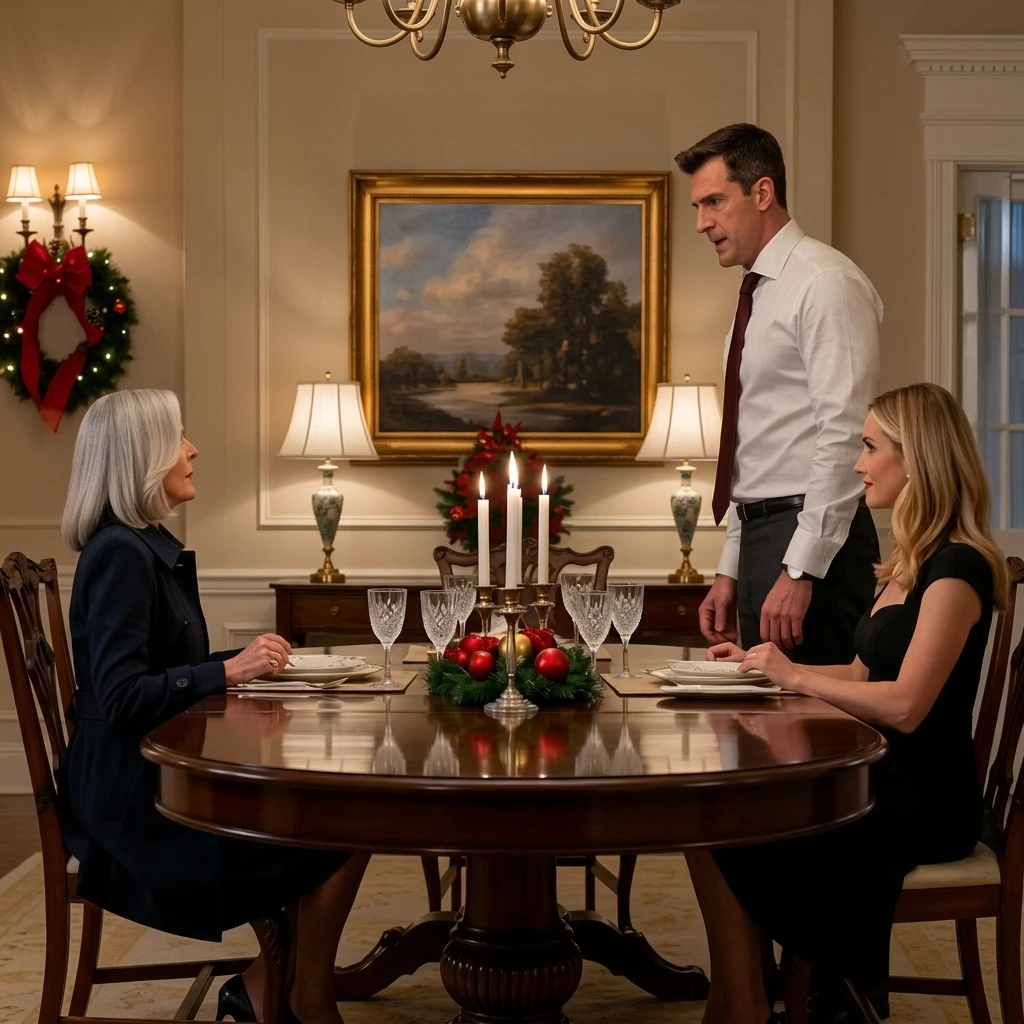
11
The guardianship petition was formally withdrawn on January third.
The court accepted the settlement framework but appointed an independent administrator to oversee the repayment plan.
Harrow received its deposit within thirty days after Larkspur sold the York property.
Ethan’s college fund was restored first.
Melissa moved into her mother’s house and filed for legal separation. She claimed Daniel had controlled the finances and misled her about ownership of my home.
The recordings made that argument difficult.
Prosecutors reviewed the forged deed but considered the settlement, repayment, and lack of completed transfer when deciding how to proceed. Melissa eventually entered a diversion agreement involving restitution, probation, and community service.
Daniel lost his contracting license for a period and took a salaried position with another builder.
For the first time since his twenties, he worked for someone who did not love him enough to excuse lateness, poor decisions, or pride.
Linda returned to Frank’s house once.
He did not let her inside.
Their marriage ended quietly.
She sold her interest in Larkspur and moved to Ohio, where one of our elderly cousins agreed to rent her an apartment.
She wrote me three letters.
I read them.
I answered none.
Not because I hated her.
Hatred is a form of attachment, and I had spent enough of my life tied to Linda’s pain.
The old family house sold in March.
Not to Harrow.
I refused to watch it be demolished.
Instead, I accepted a lower offer from a nonprofit organization that converted large homes into temporary housing for older women facing financial exploitation or displacement by relatives.
The director asked what they should name it.
I considered Robert House.
Then I said no.
The house had carried enough of his name.
They called it The Margaret Project.
I donated the dining table.
For months, I imagined other women sitting around it—women who had been told they were burdens by children living from their labor, women who had signed documents they did not understand, women who had mistaken dependence for affection.
The first resident moved in before Easter.
She was seventy-six and had been evicted by a nephew who persuaded her to transfer her condominium.
When she called to thank me, I cried after hanging up.
Not from sadness.
From the strange realization that something used to humiliate me had become shelter for someone else.
Daniel visited Lancaster twice a month.
At first, our conversations were stiff.
He brought receipts from the repayment administrator as though presenting homework.
I served coffee.
We discussed the boys.
We did not hug.
Trust returned in fractions too small to see.
One afternoon in May, he arrived wearing work boots and asked whether I wanted help repairing the garden fence.
“I can hire someone,” I said.
“I know.”
“Are you offering because you think you owe me?”
“Yes.”
“Then no.”
He looked disappointed.
I continued.
“Offer because you want to spend the afternoon with me.”
He swallowed.
“I want to spend the afternoon with you.”
So we repaired the fence.
He measured twice before cutting each board. Robert had taught him that.
At sunset, we sat on the back steps.
White hydrangeas had begun opening along the path.
“I start therapy next week,” he said.
I looked at him.
“Good.”
“Ethan says I need it.”
“Ethan is often right.”
Daniel smiled faintly.
“Melissa wants to reconcile.”
“What do you want?”
“I don’t know.”
“That is at least an honest answer.”
He picked at a splinter in the step.
“I keep thinking about Christmas.”
“So do I.”
“I wanted everyone to see me as strong.”
“And did you feel strong?”
“No.”
He looked toward the garden.
“I felt like a little boy screaming because no one would admit what I was owed.”
“What do you believe you were owed?”
“The truth.”
“Yes.”
“Not the money.”
“No.”
“I know that now.”
We sat quietly.
Then he said, “I’m sorry, Mom.”
He had apologized before—in Claire’s office, in letters, through repayment.
This time, he said it without asking what the apology would purchase.
I reached for his hand.
“I believe you are sorry.”
He began to cry.
I did not tell him everything was forgiven.
It was not.
But I held his hand until the light faded.
Sometimes reconciliation is not a bridge rebuilt in one heroic act.
Sometimes it is two people sitting on opposite sides of a broken place, choosing not to widen it.
12
On Christmas Eve the following year, snow began falling before noon.
I had invited eight people to Lancaster.
Frank came first, carrying a pecan pie and looking healthier than he had in years.
Claire arrived with wine.
Marcus brought a calculator-shaped ornament that he insisted was tasteful.
Ethan came home from his first semester at college with longer hair and a confidence that made me proud.
Noah carried the blue ceramic bird he had made years before.
“I thought your new tree needed it,” he said.
Daniel arrived last.
He stood on the porch holding a covered dish.
“I made potatoes.”
I raised an eyebrow.
“From a box?”
“Only partially.”
He smiled nervously.
I stepped aside.
“Come in.”
The dining table in my new house was smaller than the old one. There were no crystal glasses. No expensive centerpiece. No twenty-two witnesses waiting to choose sides.
Only people who knew enough truth to be gentle with one another.
Before dinner, Daniel asked if he could say something.
The room became quiet.
He stood beside his chair.
A year earlier, that sight would have tightened my chest.
Now I waited.
“Last Christmas,” he said, “I treated my mother as though her worth depended on what she paid for.”
He looked at Ethan and Noah.
“I lied to my children. I blamed other people for decisions I made. I tried to take a home that wasn’t mine.”
His voice trembled.
“I can’t undo that. But I want both of you to hear me say this in front of the people who know the truth.”
He turned toward me.
“Mom, you never owed me your house. You never owed me your money. And you never had to earn the right to be my mother.”
Noah began crying first.
Then Ethan.
I stood and embraced my son.
The hug did not erase the year.
It did not return the missing money, restore Robert’s innocence, repair Linda’s marriage, or make trust simple.
But it was real.
That was enough.
After dinner, we exchanged gifts.
Daniel handed me a small box.
Inside was the brass key I had held at the previous Christmas dinner.
The key to Lancaster.
He had mounted it in a simple wooden frame.
Beneath it, on a small metal plate, were the words:
THE NIGHT YOU CHOSE YOURSELF.
I ran my thumb across the key.
“Do you like it?” he asked.
“Yes.”
Then Ethan walked toward the tree carrying a final envelope.
“This came for you yesterday,” he said.
There was no return address.
My name was written in unfamiliar handwriting.
Inside was a single photograph.
Linda at sixteen, holding newborn Daniel in a hospital bed.
I had never seen it.
In every version of the story I remembered, Linda had refused to hold him.
Yet there she was.
Her hair damp against her face.
Her eyes swollen from crying.
Daniel asleep against her chest.
On the back, she had written:
I held him for eleven minutes.
You were the one who told me I was allowed to let go.
Beneath that was a recent message.
I spent forty-three years turning those eleven minutes into proof that you stole a lifetime from me.
The truth is that you gave him one.
I am sorry.
No request.
No excuse.
No plea for forgiveness.
Only truth.
I passed the photograph to Daniel.
He stared at it for a long time.
“Are you going to call her?” he asked.
“Not tonight.”
“Someday?”
“Perhaps.”
He nodded.
Outside, snow gathered across the garden.
Inside, Noah placed the ceramic bird near the top of the tree. Frank cut the pecan pie. Marcus argued with Claire about the correct amount of whipped cream. Ethan laughed. Daniel stood beside me, holding the photograph of two mothers who had both loved him imperfectly.
I looked around the room.
For years, I believed family was something preserved by sacrifice.
Then I believed it was something destroyed by betrayal.
I understood now that both ideas were incomplete.
Family was not the house.
It was not the bloodline.
It was not the money transferred each month, the secrets protected, or the apologies demanded.
Family was the truth people were willing to remain present for after the lies were gone.
At midnight, after everyone had gone to bed, I stood alone before the fireplace.
Robert’s photograph was no longer on the mantel.
I kept it in a drawer upstairs.
Not hidden.
Not displayed.
Some memories need neither worship nor destruction.
The framed brass key stood in its place.
I touched it gently.
A year earlier, Daniel had shouted, “Pay the rent or get out!”
He believed he was forcing me into fear.
Instead, he had opened the only door I had been too loyal to open for myself.
I had walked through it carrying two suitcases, a photograph, and a lifetime of misplaced guilt.
On the other side, I found a home.
I found the truth about my husband.
I found the limits of a mother’s responsibility.
I found that love could survive without obedience, forgiveness could exist without forgetting, and generosity meant nothing unless it included oneself.
Most of all, I found the woman I had been before everyone decided they were entitled to pieces of her.
The house settled quietly around me.
Snow brushed the windows.
Somewhere upstairs, my grandsons slept safely.
I turned off the Christmas lights and stood for a moment in the darkness, feeling no fear at all.
Because the greatest surprise was not that my son had tried to take everything.
It was that after cutting off every expense, every favor, and every dollar, I discovered the one thing they had never managed to take from me.
My life still belonged to me.
My Husband Hit Me Because I Refused to Surrender My House to His Mother, Then Ordered Me to Hide the Bruises Before Lunch—But When They Walked In Smiling, the Man Waiting in My Living Room Made Both of Them Realize I Had Been Quiet for a Reason 027

The makeup bag landed beside my hip before the throbbing in my ribs had even faded, and my husband Julian stood at the foot of our bed adjusting his cufflinks while ordering me to hide the bruises before his mother arrived for lunch and pretend the previous night had never happened.
“Use the green concealer because it covers bruises better,” he said with the detached confidence of a man discussing paint samples rather than the purple marks spreading across his wife’s face, then checked his watch and reminded me that Eleanor would arrive at noon to discuss selling my townhouse.
I stared at the makeup kit without touching it because something inside me had finally stopped begging for peace, and for the first time in eleven years of marriage, I understood that Julian did not see my silence as kindness, fear, or exhaustion.
He saw it as permission.
The fight had started the previous evening after Eleanor announced during dinner that we would sell my townhouse and move into her enormous colonial house on the northern edge of Austin, where she claimed we could all “live efficiently as one family” while combining expenses and preparing responsibly for the future.
I knew exactly what “combining expenses” meant because Eleanor had already hinted that my salary should cover groceries, property taxes, utilities, repairs, and household staff while Julian contributed toward his investment ventures, and she had casually suggested I transfer the townhouse deed into a family trust she intended to control.
“No,” I had said.
One word.
That was all it took.
Julian stared across the dining table as if I had humiliated him publicly, even though we were alone, then asked whether I understood how much his mother had sacrificed for us and why I insisted on making every family decision unnecessarily difficult.
I repeated that the townhouse belonged to me because I had purchased it before our marriage using savings accumulated through years of work, and I had no intention of selling the only asset completely protected from Julian’s growing debts, unpredictable investments, and his mother’s constant financial interference.
The first slap came so quickly that my glass of water had not stopped trembling on the table before the second one struck, and when I pushed myself away from him, Julian grabbed my arm, shoved me against the bedroom dresser, and kicked me after I fell.
He stopped only when I curled inward and stopped speaking.
Afterward, he stood over me breathing hard and said I had forced him to lose control because I always knew exactly how to provoke him, a sentence I had heard in different forms throughout our marriage whenever his anger crossed another line.
That morning, however, he behaved as though nothing serious had happened.
He drank coffee.
He answered emails.
He polished his shoes.
Then he tossed me makeup.
“Mom is coming at noon,” Julian repeated, leaning close enough that I could smell coffee on his breath, “and when she gets here, you’ll tell her you slipped in the bathroom, then we’re starting paperwork to sell this place.”
“This house belongs to me,” I whispered.
His smile vanished.
“Not for much longer.”
At exactly 7:42 that morning, the front door slammed behind him, and I remained completely still until the sound of his car disappeared down the street because fear had trained me to wait for certainty before moving.
Then I reached beneath the mattress.
Hidden between the wooden frame and box spring was a second cellphone Julian had never discovered, purchased eighteen months earlier after the first time he shoved me against a wall and afterward insisted I had exaggerated what happened because there had been no witnesses.
My name is Audrey Bennett.
I was forty-one years old that morning, and before fear entered my marriage, I had built a successful career as a senior forensic accountant for a federal contractor specializing in financial irregularities, internal fraud, and complex transactions designed to look innocent until somebody patient enough followed the numbers.
My profession had taught me something Julian underestimated.
People who lie repeatedly eventually create patterns.
People who steal eventually leave trails.
People who believe you are weak eventually become careless.
I photographed every bruise beside that morning’s newspaper, including the swelling around my left cheekbone, the split near my lip, and the darkening marks across my ribs, then uploaded each image to an encrypted cloud folder Julian could not access.
Next, I opened the home-security archive.
Months earlier, Julian believed he had disabled the cloud backup after discovering one interior camera recorded audio, but he never realized I had quietly restored remote storage using a separate administrator account registered under an email address he did not know existed.
The system had captured almost everything.
His threats.
Eleanor’s conversations.
Arguments about money.
The evening he warned that nobody would believe me if I accused him because his mother would tell everyone I had become emotionally unstable.
The night before was there too.
I listened only long enough to verify the recording was intact.
Then I stopped.
I did not need to hear myself screaming again.
Inside my encrypted folder labeled TAX RECEIPTS were screenshots of messages between Julian and Eleanor discussing how to pressure me into selling the townhouse, copies of unauthorized loan applications using my personal information, and banking records showing money disappearing from accounts Julian claimed he had never touched.
There were also forged signatures.
Dozens of them.
For nearly eight months, I had been quietly collecting evidence because I suspected Julian was hiding financial problems, but during those months I discovered something much darker than reckless spending or ordinary marital dishonesty.
He and Eleanor had been planning to take control of my assets.
At first, their messages appeared almost harmless.
Eleanor asked whether Julian had convinced me to refinance.
Julian replied that I remained “stubborn.”
Then they discussed putting pressure on me through debt, family guilt, and eventually questions about my emotional health.
One message still made my stomach twist.
If Audrey becomes difficult, we establish she is unstable before she can establish anything about us.
Julian had written that.
My husband.
The man who had once cried while promising to protect me during our wedding ceremony.
Another message from Eleanor read:
Once the townhouse is sold, she has nowhere separate to run.
That morning, the meaning felt terrifyingly clear.
They were not merely trying to sell property.
They were trying to remove my escape route.
My hands shook when I opened my contacts and scrolled toward a number I had not called in five years, not because the man on the other end had ever hurt me, but because Julian had spent years convincing me that contacting him would destroy our marriage.
The phone rang twice.
“Audrey?”
My throat closed.
“Dad.”
There was a pause.
Then I said the words I had practiced silently countless times.
“I need your help.”
The silence that followed lasted less than two seconds, but something inside me broke open because my father did not ask whether I had caused the argument, misunderstood Julian, or tried harder to keep my marriage together.
He asked only one question.
“Tell me where you are.”
My father, Thomas Bennett, had spent thirty-four years as a federal prosecutor before retiring, and Julian had always hated him because Thomas saw through charm more quickly than most people saw through glass.
Five years earlier, Julian convinced me my father interfered too much and threatened our independence.
I chose my marriage.
My father stopped calling after I asked him to.
He never stopped loving me.
“I’m at home,” I whispered.
“Are you safe right now?”
“Yes.”
“Is Julian there?”
“No.”
“Do not clean anything, delete anything, repair anything, or warn anyone that you called me.”
His voice remained calm.
“I’m coming.”
I ended the call and cried for exactly three minutes.
Then the forensic accountant in me took over.
I opened another secured folder containing financial documents gathered over the previous year, including credit reports showing three accounts I had never opened and two business loans linked indirectly to companies controlled by Julian.
One company immediately caught my attention.
Bennett Residential Holdings LLC.
My maiden name.
My professional credentials.
My mailing address.
But Julian’s phone number.
I searched state registration records and discovered the company had been created seven months earlier with paperwork claiming I was its managing member, despite the fact that I had never heard of it.
Attached to the company were applications for several hundred thousand dollars in financing.
My heart began pounding.
The townhouse was listed as collateral.
I had never approved that.
I called the lender directly.
After verifying my identity, the fraud specialist became cautious and asked whether I had recently signed a limited power of attorney authorizing my husband to negotiate loans on my behalf because their records contained a notarized document saying exactly that.
I told her no.
She immediately froze the file.
Then she asked whether I wanted copies.
“Yes,” I said.
“Everything.”
By 9:15 a.m., I had received fourteen pages electronically.
The signature looked almost perfect.
Almost.
But the notary stamp belonged to a woman named Celeste Warren.
I knew that name.
She was Eleanor’s closest friend.
Suddenly, dozens of strange moments began rearranging themselves in my memory, including Celeste appearing at family dinners with documents, Eleanor asking casual questions about my mother’s maiden name, and Julian once borrowing my passport because he claimed our insurance agent needed identity verification.
I stopped seeing isolated incidents.
I saw infrastructure.
At 9:43 a.m., my father arrived.
When I opened the door, Thomas Bennett seemed older than I remembered, with more silver in his hair and deeper lines around his eyes, but the moment he saw my bruises, something changed behind his expression.
He did not rush forward.
He did not touch me without permission.
He simply said, “May I hug you?”
That nearly destroyed me.
I nodded.
For the first time in years, I felt safe enough to collapse.
My father held me carefully because of my ribs and whispered that I never had to apologize for calling him, no matter how many years had passed or how many times I had pushed him away.
“I should have listened to you,” I cried.
“No,” he said.
“He should never have done this to you.”
That sentence changed something fundamental inside me.
Victims often spend years asking what they should have noticed sooner.
My father redirected the blame toward the person who chose to cause the harm.
After I calmed down, Thomas photographed the injuries independently, reviewed the evidence folder, and made three phone calls.
The first was to a criminal attorney he trusted.
The second was to an investigator who specialized in financial exploitation.
The third was to the police.
I panicked at that one.
“Dad, wait.”
He looked at me gently.
“Do you want me to stop?”
I hesitated.
For years, Julian had warned that involving police would destroy his career, embarrass the family, humiliate Eleanor, and permanently change how everyone saw us.
Then I looked at the bruises reflected in the black television screen.
“No,” I said.
“Don’t stop.”
Two officers arrived before eleven.
I provided photographs, medical documentation from a prior incident, threatening messages, and the security recording from the night before.
One officer listened with headphones while taking notes.
His expression changed slowly.
Julian had always told me nobody would believe recordings without context.
Apparently, context was not his friend.
The officers asked whether I wanted an emergency protective order.
“Yes.”
The word came easier than I expected.
My father then contacted a locksmith.
By 11:20 a.m., Julian’s access code to the front door had been disabled, locks were being changed, and an attorney had begun preparing emergency filings regarding financial fraud and unauthorized use of my identity.
I packed one suitcase anyway.
Not because I planned to leave permanently.
Because I wanted Julian to think I had.
My father understood immediately.
“You want him comfortable enough to talk?”
“Yes.”
He nodded.
“That’s my daughter.”
At 11:54 a.m., the house became perfectly quiet.
The makeup kit remained untouched on the bed upstairs.
My suitcase was gone from the bedroom.
Several drawers stood open.
I placed my wedding ring beside a note reading:
I’m done.
Then I joined my father in the living room.
At exactly 12:06 p.m., I heard Julian’s key scrape uselessly against the new lock.
Three seconds later, he rang the bell.
Eleanor’s laughter sounded behind him.
“Maybe she finally learned to lock the door properly,” Eleanor joked.
My father looked at me.
“You ready?”
For the first time in years, I answered honestly.
“No.”
Then I opened the door anyway.
Julian’s smile disappeared when he saw my father sitting calmly in the living room wearing a dark navy suit, one ankle resting across his knee, with a leather folder positioned neatly on the coffee table.
Eleanor stopped behind him.
Nobody spoke.
Thomas stood.
“Hello, Julian.”
The color drained from my husband’s face.
“What are you doing here?”
My father’s voice remained almost conversational.
“Visiting my daughter.”
Eleanor immediately recovered.
“Well, this is awkward because we’re having a private family discussion.”
Thomas looked toward me.
“Audrey is my family.”
That sentence hit Eleanor harder than shouting would have.
Julian looked past my father toward the staircase, probably noticing the missing suitcase and imagining I had packed to leave exactly as he expected.
His confidence began returning.
“Audrey’s been emotional,” he said.
“She had an accident.”
My father did not react.
“What kind?”
Julian hesitated.
“She slipped.”
“In the bathroom?”
“Yes.”
I watched the lie arrive automatically.
Then Thomas opened the folder.
“That’s interesting.”
He placed a printed transcript from the security recording on the table.
“Because the audio says otherwise.”
Julian froze.
Eleanor turned toward him.
“What audio?”
He stared at me.
“You recorded me?”
“No,” I said.
“The house did.”
His expression changed from fear to fury so quickly that even Eleanor stepped away.
“You manipulative—”
My father stood between us before Julian finished.
“Choose your next word carefully.”
Silence filled the room.
Eleanor suddenly began insisting that marriage arguments happen, everybody says things they regret, and families should resolve private matters without outsiders making situations worse.
Then she looked at my face.
Her eyes narrowed.
“You should have covered that.”
There it was.
Not concern.
Not horror.
Annoyance that evidence remained visible.
My father turned toward her slowly.
“Mrs. Mercer, did you know your son assaulted Audrey last night?”
Eleanor’s answer came instantly.
“I know my son.”
“That wasn’t the question.”
She said nothing.
Thomas opened the folder again.
“Perhaps we discuss the house instead.”
Julian went pale.
I watched Eleanor’s composure falter for the first time.
“What about the house?”
My father placed copies of Bennett Residential Holdings LLC registration records beside the forged power of attorney.
“This company.”
Neither spoke.
Then Thomas added the loan documents.
“And these.”
Eleanor recovered first.
“Those are financial planning matters Audrey doesn’t understand.”
I almost laughed.
I had spent seventeen years tracing financial fraud across corporations worth hundreds of millions of dollars.
Eleanor had just told a forensic accountant she did not understand loan documents forged in her own name.
My father smiled faintly.
“That may be the least intelligent argument available to you.”
Julian stepped forward.
“This is between me and my wife.”
“No,” I said.
He looked at me.
“This became something else when you forged my signature.”
His jaw tightened.
“You signed those documents.”
“I did not.”
“You forget things.”
There it was.
Exactly as the messages predicted.
I looked at Eleanor.
She seemed to realize the mistake before Julian did.
My father quietly asked, “Are you suggesting Audrey has cognitive impairment?”
Julian hesitated.
“She’s been unstable lately.”
Thomas nodded.
“Interesting.”
He removed printed screenshots from the folder.
Including the message where Julian wrote:
If Audrey becomes difficult, we establish she is unstable before she can establish anything about us.
Julian stopped breathing for a moment.
Eleanor sat down.
My father placed another screenshot beside it.
This one came from Eleanor.
Once the townhouse is sold, she has nowhere separate to run.
Nobody needed to explain it.
The room had become a courtroom without a judge.
Then the doorbell rang.
Julian turned toward me.
“Who else did you call?”
I said nothing.
My father opened the door.
Two police officers stood outside.
Julian’s face changed completely.
“No.”
One officer asked him to remain calm.
“This is ridiculous,” Julian said.
“My wife is angry because we argued.”
The officer glanced at my bruises.
“Sir, we need to speak with you.”
Eleanor stepped between them.
“My son is a respected investment consultant.”
The second officer replied, “Ma’am, please step aside.”
For years, Eleanor had commanded waiters, neighbors, relatives, store clerks, contractors, and family members through sheer certainty that everyone would eventually obey her.
The police did not.
Julian looked at me.
For one second, I saw genuine panic.
Then anger returned.
“You’re really doing this?”
I thought about the makeup kit.
The bruises.
The forged signatures.
The plan to eliminate my escape route.
“Yes,” I said.
“I am.”
He was arrested that afternoon based on the assault evidence and initial findings surrounding identity fraud, while Eleanor followed the patrol car in her Mercedes after shouting that I had destroyed my marriage and would regret humiliating their family.
I locked the door behind them.
Then I collapsed.
Freedom did not feel triumphant.
It felt exhausting.
My father sat beside me on the floor.
I cried until my ribs hurt.
Then we ordered soup.
The next morning, the financial investigation became much larger.
The unauthorized loans were not random.
Julian had accumulated nearly eight hundred thousand dollars in investment losses across several failed ventures, many hidden through shell companies and borrowed funds.
He had also borrowed heavily from Eleanor.
She was nearly broke.
That revelation stunned me because Eleanor lived inside an enormous colonial house filled with antiques, imported rugs, marble counters, and luxury furniture while constantly talking about “family wealth.”
Most of it was financed.
Her house carried two mortgages.
Her credit cards were near their limits.
Her retirement accounts had been drained.
She and Julian were not trying to improve their finances.
They were trying to use mine to survive.
The townhouse I owned outright was worth nearly nine hundred thousand dollars after years of rising Austin property values.
My retirement accounts were substantial.
My salary was high.
And Julian knew I had inherited additional investments from my grandmother.
I was not his partner anymore.
I was his exit strategy.
Investigators found emails showing Eleanor had proposed selling my townhouse almost a year before she ever mentioned moving together.
The plan was brutally simple.
Sell my property.
Use part of the proceeds to stabilize Eleanor’s mortgage.
Move the rest into investment accounts Julian controlled.
Convince me the funds remained protected as “family assets.”
Then leave me financially dependent.
My refusal had disrupted everything.
That was why one word triggered violence.
“No.”
For years, I believed Julian’s anger was unpredictable.
It was not.
His anger appeared whenever I interrupted his control.
That realization became one of the most painful truths of my recovery.
The investigation uncovered another secret three weeks later.
Julian had not only forged financial documents.
He had created an email account using my name.
Through that account, he communicated with lenders, insurance agents, and even a therapist.
The therapist had never met me.
Yet emails supposedly written by “Audrey” described memory lapses, paranoia, emotional instability, and difficulty making financial decisions.
Julian was manufacturing a record.
He was preparing evidence that I could not manage my own life.
My father read several messages before quietly setting them down.
“This was not impulsive.”
I knew.
The assault was not the beginning.
It was simply the moment his hidden plan became visible.
Then investigators discovered Celeste Warren’s involvement.
Eleanor’s friend had notarized the forged power of attorney despite never witnessing my signature.
When questioned, Celeste initially insisted I had been present.
Security footage from my workplace proved I was forty miles away during the alleged signing.
She changed her story.
Then she started cooperating.
That was when Eleanor’s role became impossible to deny.
Celeste provided messages showing Eleanor had arranged the documents, supplied copies of my identification, and instructed her to notarize signatures because “Audrey already verbally agreed and paperwork is just paperwork.”
One message from Eleanor read:
Once she lives here, we can manage her properly.
I stared at that sentence for a long time.
Manage her properly.
Not love.
Not help.
Not protect.
Manage.
I finally understood why Eleanor constantly criticized my friendships, career schedule, clothing, spending, holidays, and relationship with my father.
Isolation had always been the goal.
Control worked better when fewer people were nearby to question it.
My father asked whether I blamed myself for distancing from him.
“Yes.”
He shook his head.
“Then blame me too.”
I looked at him.
“I should have fought harder to stay in your life.”
“You respected what I asked.”
“I also let Julian make distance look like peace.”
We both cried.
Healing sometimes requires two people apologizing for things neither caused.
Six weeks after the arrest, Julian was released under strict conditions while the legal cases moved forward, including orders preventing him from contacting me directly or entering the townhouse.
He sent messages through attorneys instead.
At first, they sounded apologetic.
Then desperate.
Then accusatory.
He claimed stress caused everything.
He said he loved me.
He insisted Eleanor manipulated him.
He blamed debt.
He blamed my father.
He blamed fear.
Eventually, he blamed me.
One letter said:
You knew refusing to move would corner me.
I read that sentence three times.
Then I finally understood why I could not save him.
Julian still believed my boundary caused his violence.
I did not answer.
Instead, I filed for divorce.
Eleanor reacted publicly.
She told relatives I had manipulated the police, weaponized my professional knowledge, and exaggerated a private marital disagreement in order to seize money and punish Julian because I had always resented his relationship with his mother.
Some relatives believed her.
Most changed their minds after seeing evidence.
One cousin called me privately.
“She’s been telling everyone you’re mentally unstable for months.”
That hurt.
The narrative had started before the assault.
Eleanor and Julian had been preparing an audience.
They were creating witnesses to a story that had not happened yet.
I stopped defending myself individually.
My attorney advised silence.
The evidence could speak later.
Then Eleanor made a mistake that changed everything.
She filed a civil claim arguing that I had verbally promised proceeds from the townhouse sale toward a shared family residence and that she had relied financially on that promise.
Her lawyer submitted emails as evidence.
One email supposedly came from me.
It said I was “excited to become financially integrated with Eleanor.”
I had never written those words.
Neither had Julian.
Metadata showed the message originated from Eleanor’s home computer.
That discovery opened her devices to deeper examination.
What investigators found destroyed her defense.
There were draft documents.
Edited signatures.
Property valuations.
Lists of my assets.
Notes about my work schedule.
Discussions about my medication history.
Even a document titled TRANSITION PLAN.
My name appeared at the top.
The plan described selling the townhouse, moving me into Eleanor’s home, reducing my independent expenses, consolidating bank access, limiting “outside influence,” and eventually encouraging me to leave my demanding job because stress supposedly worsened my mental health.
Outside influence meant my father.
Reducing independent expenses meant controlling my money.
Leaving work meant losing professional autonomy.
They had planned my disappearance while keeping me physically alive.
I sat in my attorney’s office staring at those pages until the words blurred.
Then I asked the question that had haunted me.
“Did Julian ever love me?”
My attorney did not answer.
My father did.
“Probably.”
I looked at him sharply.
He continued gently.
“Love does not automatically make someone safe.”
That sentence stayed with me.
People often believe cruelty proves there was never love.
Reality can be worse.
Someone can love you and still choose selfishness, control, violence, or greed over your safety.
Love without respect is not enough.
Love without accountability is dangerous.
The divorce became ugly.
Julian demanded spousal support.
He wanted access to marital assets.
He argued that my earnings during marriage contributed to his lifestyle and business opportunities.
Then my forensic team demonstrated that he had secretly diverted marital funds, concealed debts, and used my identity without authorization.
His bargaining position collapsed.
Eleanor sold jewelry to pay legal fees.
Then she refinanced her house again.
Then the bank started foreclosure proceedings.
The enormous colonial home she wanted me to move into was no longer secure.
The woman who wanted my house because she believed mine should rescue hers eventually lost control of her own.
I did not celebrate.
But I noticed the irony.
Then something unexpected happened.
Julian’s younger sister, Camille, contacted me.
We had never been close because Eleanor often portrayed Camille as selfish and disloyal after she moved to Seattle years earlier.
Camille asked to meet somewhere public.
I agreed.
When she arrived, she carried a folder.
“I should have warned you,” she said.
Inside were old messages from Eleanor.
Years earlier, Eleanor had pressured Camille to co-sign debts, surrender part of an inheritance, and move back home to help financially.
When Camille refused, Eleanor told relatives she was mentally unstable.
The pattern had happened before.
Not identically.
But enough.
Camille had escaped because she left the state.
I had married into it.
She began crying.
“She does this when people say no.”
I thought about Julian.
Maybe he had learned control from Eleanor.
Maybe she had learned it from someone before her.
But explanations were not excuses.
Generational damage remains damage.
Someone eventually has to stop passing it forward.
I intended to be that person.
Camille provided testimony and financial records showing Eleanor’s longstanding manipulation around money, strengthening the civil fraud case and revealing additional undisclosed transfers between mother and son.
Then another name appeared repeatedly.
Marcus Hale.
I recognized him immediately.
Marcus had been Julian’s closest business partner for years.
Investigators discovered Julian and Marcus had created multiple ventures using borrowed money, inflated valuations, and questionable collateral.
Marcus quickly began cooperating.
He revealed Julian had expected to receive nearly one million dollars from selling my townhouse.
Most of the money was already allocated on spreadsheets.
Three hundred thousand toward investment debts.
Two hundred thousand toward Eleanor’s mortgage.
One hundred fifty thousand to stabilize another failing venture.
The remainder into a private account.
My name appeared nowhere.
I was supposed to lose my house and still believe the money remained “ours.”
That discovery eliminated the last part of me still wondering whether I had misunderstood anything.
I had not.
The violence was real.
The fraud was real.
The plan was real.
My fear had been accurate.
I began therapy.
At first, I hated it.
I was comfortable analyzing documents, numbers, systems, and patterns.
Feelings felt less orderly.
My therapist asked why I stayed after the first shove.
I became defensive.
Then she clarified.
“I’m not asking why you caused anything.”
“You didn’t.”
“I’m asking what made staying feel safer than leaving.”
That question changed everything.
I stayed because Julian apologized convincingly.
Because the violence escalated gradually.
Because he never hurt me every day.
Because we had good memories.
Because leaving felt like admitting failure.
Because Eleanor always framed conflict as my fault.
Because Julian slowly isolated me.
Because I believed smart women should recognize abuse immediately.
And because shame kept me quiet.
I had investigated fraud professionally while failing to admit what was happening inside my own home.
That contradiction humiliated me.
My therapist disagreed.
“Expertise doesn’t make anyone immune to manipulation.”
She was right.
Knowledge does not eliminate vulnerability.
Sometimes intelligent people remain trapped longer because they become very good at explaining away warning signs.
Months passed.
My bruises faded.
My house changed.
I removed Julian’s office furniture.
Not everything.
Some objects still belonged to good memories.
I kept one photograph from our first anniversary.
I stored it inside a drawer.
Healing did not require pretending my marriage had been entirely miserable.
That would have been another lie.
There were beautiful years.
Then dangerous ones.
Both could be true.
I repainted the bedroom.
I threw away the makeup kit.
That felt important.
I stood beside the trash bin holding it for almost a minute before dropping it inside.
The plastic bag landed softly.
Such a small sound.
Yet it felt louder than the night Julian struck me.
One year after that morning, the criminal case reached resolution.
Julian accepted a plea agreement involving assault-related charges, identity fraud, forgery, and financial misconduct.
He avoided the longest possible sentence by cooperating in broader financial investigations.
He still faced incarceration, probation, restitution, and permanent professional consequences.
Eleanor also accepted responsibility for her role in fraudulent documents.
Celeste lost her notary commission.
Marcus faced separate charges.
The network collapsed because one person finally stopped cooperating with silence.
Me.
At sentencing, I was allowed to speak.
Julian sat across the courtroom wearing a gray suit.
He looked older.
Smaller.
Not physically.
In my memory.
I had spent years experiencing him as enormous because fear magnifies people.
Standing in court, he looked ordinary.
That realization gave me strength.
I read from a prepared statement.
“You did not destroy me the night you hit me.”
“You revealed yourself.”
“You believed fear would keep me quiet, shame would keep me isolated, and marriage would make me protect you from consequences.”
“You were wrong.”
Julian stared downward.
I continued.
“You also tried to convince me that saying no caused your violence.”
“It did not.”
“My refusal did not make you hit me.”
“My independence did not make you forge documents.”
“My house did not make you steal.”
“You chose those things.”
My voice trembled.
But I finished.
“I hope someday you become someone who understands that love cannot exist where another person’s freedom must disappear.”
The courtroom remained silent.
I sat down.
My father squeezed my hand.
That was enough.
The divorce finalized three months later.
I kept the townhouse.
I kept my retirement.
I recovered most unauthorized funds through restitution and insurance claims.
Julian received only what the final settlement legally required after accounting for concealed debts and financial misconduct.
Eleanor lost her colonial house.
The bank sold it.
She moved into a small condominium.
Camille helped her only after establishing strict boundaries.
I respected that choice.
Forgiveness is personal.
Access is optional.
My father began visiting every Sunday.
At first, our conversations felt awkward because five years cannot disappear through one rescue.
We rebuilt slowly.
Coffee.
Walks.
Lunch.
Old stories.
Silences that no longer felt dangerous.
One Sunday, he brought a cardboard box.
Inside were every birthday card he had bought for me during the years we did not speak.
Five cards.
All unopened.
“I never knew whether sending them would make things worse,” he said.
I cried for an hour.
The final card read:
My door never closed.
I framed that one.
Two years after the morning everything changed, I sold the townhouse.
Not because Eleanor wanted me to.
Not because Julian forced me.
Not because debt required it.
Because I chose to.
That difference mattered more than the sale price.
I bought a smaller house twenty minutes away with enormous windows, a quiet garden, and a sunroom that faced east.
No one else selected it.
No one else approved it.
I signed every document myself.
At closing, the title agent asked whether I wanted anyone else listed on ownership.
I smiled.
“No.”
The house is mine.
My life is mine.
My silence is mine too.
But now silence means peace.
Not fear.
I still think about the makeup bag sometimes.
That ordinary green concealer sitting beside me on the bed.
Julian believed covering bruises would erase what happened.
Eleanor believed appearances were stronger than truth.
They were wrong.
Bruises fade.
Records remain.
Evidence survives.
Patterns speak.
And sometimes the quietest person in the house has already been documenting everything.
People occasionally ask what the unexpected guest in my living room did that frightened Julian so badly.
The answer is simple.
My father did not threaten him.
He did not shout.
He did not touch him.
He simply sat there calmly with evidence.
That was enough.
Because controlling people depend on isolation.
The moment another person witnesses the truth, their power changes.
My father helped me leave.
The police protected me.
Attorneys defended me.
Investigators uncovered the fraud.
But none of them made the first decision.
I did.
At 7:43 that morning, one minute after Julian left, I reached beneath the mattress and picked up the hidden phone.
That tiny movement saved my life.
Not because I suddenly stopped being afraid.
I was terrified.
Courage did not replace fear.
It moved beside it.
That is what I understand now.
Sometimes courage is not screaming.
Sometimes courage is photographing a bruise.
Saving a message.
Calling someone you miss.
Opening a door.
Saying no again.
And refusing to cover what someone else should be ashamed of.
On the second anniversary of my divorce, I invited my father, Camille, several friends, and two women from my support group to dinner at my new house.
We ate outside beneath string lights.
Someone asked for a toast.
I stood holding a glass of sparkling water.
For a moment, I did not know what to say.
Then I remembered Julian leaning over me that morning.
Hide the bruises.
Smile.
Pretend nothing happened.
So I raised my glass.
“To everything we no longer pretend didn’t happen.”
Everyone became quiet.
Then Camille lifted her glass.
My father followed.
One by one, everyone joined.
I smiled.
Not because I had hidden anything.
Because I finally did not have to.
For years, Julian believed my greatest weakness was that I loved deeply and endured quietly.
He misunderstood both.
Love made me patient.
Fear made me quiet.
But neither made me powerless.
The day I stopped protecting the people who were hurting me, everything they had built on my silence collapsed.
Their lies.
Their financial plan.
Their reputation.
Their control.
And somehow, from the wreckage, I found something I thought marriage had taken forever.
Myself.
So when people ask whether I regret refusing to move into Eleanor’s house, I sometimes laugh because that single word exposed an entire hidden architecture of manipulation that might otherwise have trapped me permanently.
“No” cost me a marriage.
It saved my home.
My finances.
My relationship with my father.
My career.
My freedom.
Possibly my life.
And if I could return to that dining room the night Julian first struck me, I would kneel beside the terrified woman lying near the dresser and tell her something she could not yet believe.
This is not the end of your story.
Tomorrow morning, he will hand you makeup and order you to hide what he did.
Do not touch it.
Let him leave.
Pick up the hidden phone.
Call your father.
Open the files.
Tell the truth.
And when the door opens at noon and the people who thought they owned your silence walk inside laughing, let them see exactly what happens when the woman they underestimated finally stops pretending.
Because the most dangerous moment for a controlling person is not when their victim becomes fearless.
It is when she becomes done.
And that morning, for the first time in eleven years, I was completely, permanently, and finally done.
Leave a Reply