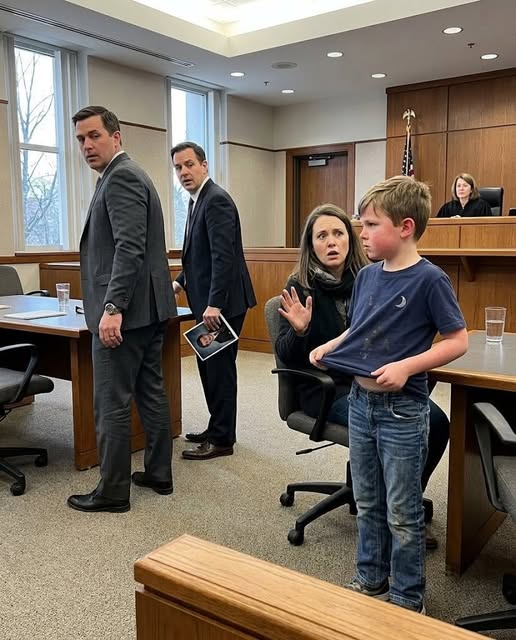
PART 2 — THE MARK UNDER NOLAN’S SHIRT
The judge took the photograph from Carroway and looked at it again.
Then she looked at Nolan.
Then she looked at Grant.
“Nolan,” she said gently, “may I ask what you wanted me to see?”
My son swallowed.
His hands were still gripping the hem of his shirt.
For a second, he looked eight years old again.
Small.
Scared.
But then he lifted it a little higher.
That was when I saw it clearly.
A square of white medical tape was pressed against the skin beneath his ribs.
Under the edge of the tape was a dark purple bruise.
My stomach dropped.
“Nolan?”
He looked at me.
“I’m sorry, Mom.”
I stood so fast my chair scraped across the floor.
“What happened?”
Grant’s attorney immediately stepped forward.
“Your Honor, we have no idea what this is supposed to—”
“Sit down, Mr. Carroway.”
The judge’s voice cut through him.
He stopped.
The courtroom went silent.
The judge looked at Nolan.
“Who put that bandage on you?”
“The school nurse.”
My hands went cold.
“When?”
“Tuesday.”
Tuesday.
The same day the photograph had been taken.
The same photograph Grant’s private investigator had used to make my son look neglected.
I turned toward Grant.
His face had lost every trace of color.
“Nolan,” the judge said, “why did the nurse put it there?”
My son lowered the shirt just enough to cover himself, but he did not sit.
“Because it hurt.”
“What hurt?”
“My side.”
“How did you hurt your side?”
Nolan looked directly at his father.
Grant shook his head almost imperceptibly.
It was tiny.
Most people might not have noticed.
I did.
So did Nolan.
My son’s voice got quieter.
“Dad grabbed me.”
A sharp sound escaped my throat.
Grant immediately stood.
“That is absolutely false.”
The judge turned toward him.
“Sit down.”
“Your Honor, my son is confused.”
“Sit. Down.”
Grant sat.
His jaw was clenched so tightly I could see the muscle moving beneath his cheek.
The judge returned her attention to Nolan.
“Tell me exactly what happened.”
Nolan looked at me.
I wanted to run to him.
I wanted to take him out of that room.
But something in his face told me he had been waiting for this.
Waiting for someone powerful enough to make his father listen.
“It happened at Dad’s house.”
“When?”
“Last weekend.”
My heart pounded.
Grant had taken Nolan for his scheduled overnight visitation.
He had brought him home Sunday evening and told me Nolan had been moody because I was “turning him against his father.”
I remembered Nolan being unusually quiet.
I remembered him refusing dinner.
I remembered him saying his stomach hurt.
I had asked whether he felt sick.
He said no.
I thought he was anxious about school.
Now I felt sick.
“What happened at your father’s house?” the judge asked.
Nolan’s fingers curled around his shirt.
“Dad was mad.”
“About what?”
“Because I wouldn’t say something.”
“What wouldn’t you say?”
Grant’s attorney shifted in his chair.
Nolan looked at him.
Then at his father.
“Dad wanted me to tell the custody lady that Mom leaves me alone at night.”
My breath stopped.
The judge’s face changed.
“What custody lady?”
“The woman who came to Dad’s house.”
Carroway rose.
“Your Honor, I must object to this completely unstructured questioning of a minor—”
The judge stared at him.
“Mr. Carroway, unless you would like me to clear this courtroom and continue this examination in chambers with a child advocate present, you will sit quietly.”
He sat.
The judge spoke more softly.
“Nolan, did your mother leave you alone at night?”
“No.”
“Has she ever?”
“No.”
“Then what did your father want you to say?”
“That she did.”
My eyes filled.
Grant leaned toward Carroway.
The attorney whispered something sharply.
The judge noticed.
“Mr. Cole.”
Grant looked up.
“You are not to communicate with counsel while this child is answering.”
Grant’s face tightened.
“Yes, Your Honor.”
Nolan continued.
“He said if I told the lady Mom left me alone, then I could live at his house.”
The judge asked, “Did you want to live at his house?”
“No.”
Grant flinched.
“Why not?”
Nolan stared at the floor.
“Because he gets scary.”
My hands started shaking.
“Nolan,” I whispered.
The judge looked at me.
“Ms. Cole, please let him answer.”
I nodded.
Barely.
“What does ‘scary’ mean?” she asked.
Nolan took a breath.
“He yells.”
“At you?”
“Sometimes.”
“At anyone else?”
“Mom.”
I stared at him.
Grant hadn’t been around me enough to yell recently.
Then I understood.
Phone calls.
Speakerphone.
The times Nolan had been upstairs while Grant screamed at me about money.
The judge continued.
“Does he ever hurt you?”
Nolan didn’t answer.
Grant leaned forward.
“Nolan.”
The judge snapped her head toward him.
“Mr. Cole.”
Grant stopped.
The judge’s voice became very cold.
“Do not address the child.”
Nolan pulled his shirt up again.
Then he carefully removed the edge of the white tape.
More bruising appeared.
Not one mark.
Several.
Finger-shaped.
My stomach turned.
The room blurred.
“Those are from him.”
I stood.
“Grant.”
The judge immediately said, “Ms. Cole.”
But I couldn’t stop staring at my ex-husband.
“You put your hands on him?”
Grant shook his head.
“No.”
“You bruised him?”
“No.”
Nolan whispered:
“Yes, he did.”
Grant turned toward him.
“I did not hurt you.”
Nolan stepped backward.
That movement destroyed me.
My son was afraid of his own father.
The judge saw it too.
“Bailiff.”
The bailiff stepped forward.
“Please position yourself between Mr. Cole and the child.”
Grant stared in disbelief.
“Your Honor, this is absurd.”
The bailiff moved anyway.
The judge looked at Nolan.
“What happened when your father grabbed you?”
“He squeezed me.”
“Why?”
“Because I said I wouldn’t lie.”
The judge asked:
“What did he say?”
Nolan hesitated.
Then:
“He said Mom needed to lose.”
My eyes closed.
The words were so childish.
So simple.
And that made them worse.
The judge said, “Lose what?”
“Me.”
Grant’s chair creaked.
Nobody else moved.
Nolan continued:
“He said if Mom lost me, she wouldn’t have anything left.”
My knees weakened.
For two years, I had believed Grant wanted custody because he was controlling.
Because he wanted to punish me.
Because he hated paying support.
But hearing those words through Nolan’s mouth stripped away every excuse.
He didn’t want our son.
He wanted me empty.
Carroway stood again.
“Your Honor, these are clearly statements shaped by the mother—”
Nolan spun toward him.
“My mom didn’t know.”
Carroway stopped.
Nolan’s face was red now.
“She didn’t know because I didn’t tell her.”
The judge asked gently:
“Why didn’t you tell your mother?”
Nolan’s eyes filled.
“Because Dad said if I told her, he would make her lose the apartment.”
A cold silence spread through the room.
My stomach twisted.
The apartment.
Our current landlord had suddenly threatened not to renew my lease two weeks earlier.
I had assumed it was because I had fallen behind on rent once.
But Grant knew.
Somehow, he knew.
The judge’s eyes went to him.
Grant said:
“This is ridiculous.”
Nolan reached inside the waistband of his pants.
My heart stopped.
He pulled out something small.
A black plastic rectangle.
At first, I thought it was a toy.
Then I saw the tiny red light.
Carroway went completely still.
Grant whispered:
“No.”
Nolan held it toward the judge.
“Dad told me never to touch this.”
The judge frowned.
“What is it?”
“I don’t know.”
I did.
Or at least, I knew enough.
It looked like a miniature voice recorder.
Grant stood.
“That is my property.”
The bailiff immediately blocked him.
The judge looked at him.
“Sit down.”
“That was taken from my home.”
“Sit down, Mr. Cole.”
He did.
But now he looked afraid.
Real fear.
The judge held out her hand.
“Nolan, may I see it?”
My son walked forward and placed the recorder in her palm.
“How did you get this?”
“It was in Dad’s office.”
Grant muttered something under his breath.
The judge looked up.
“What did you say?”
“Nothing.”
Nolan continued:
“I heard Dad talking to Mr. Carroway.”
Carroway’s face changed.
The judge noticed.
“What did they say?”
“I didn’t understand everything.”
“But?”
“They were talking about Mom’s job.”
My skin went cold.
The job I had lost.
The anonymous complaint that had accused me of stealing medication from the nursing facility where I worked.
The accusation had been false.
I had been cleared.
But not before the facility fired me “to avoid liability.”
I had never discovered who made the complaint.
Nolan said:
“Dad said the first complaint worked.”
The courtroom changed.
I felt it.
Carroway slowly lowered his eyes.
The judge looked at him.
“Mr. Carroway.”
He cleared his throat.
“I have no idea what the child is referring to.”
Nolan looked confused.
“But you were there.”
Carroway stopped breathing.
My heart slammed against my ribs.
“You were in Dad’s office.”
The judge leaned back.
“When?”
“Saturday.”
The same weekend Nolan had been bruised.
Carroway stared at Grant.
Grant stared at the table.
The judge asked:
“What else did you hear?”
Nolan thought.
“Dad said if Mom lost her next job too, she wouldn’t be able to pay rent.”
My hands went numb.
Then:
“Mr. Carroway said the court needed a pattern.”
Carroway rose so quickly his chair almost tipped over.
“Your Honor, I categorically deny—”
“Sit down.”
“But—”
“Sit down or I will have the bailiff assist you.”
He sat.
The judge looked at the recorder.
“Does this contain that conversation?”
Nolan nodded.
“I think so.”
“How do you know?”
“I pressed the button.”
Grant whispered:
“You little—”
The judge slammed her gavel.
“Mr. Cole!”
Grant froze.
The judge’s face had become stone.
“If you direct one threatening word toward this child again, you will be removed from this courtroom immediately.”
Grant lowered his eyes.
The judge turned toward Nolan.
“When did you press the button?”
“After Dad grabbed me.”
“You recorded them after that?”
“Yes.”
“Why?”
My son looked at me.
Then he said something I will remember until the day I die.
“Because nobody believes Mom when Dad lies.”
I covered my mouth.
I couldn’t stop the tears.
Nolan continued:
“So I thought maybe they would believe Dad.”
The judge stared at him for several seconds.
Then she looked toward the court clerk.
“Call child protective services.”
Grant shot up.
“What?”
“Call them now.”
“Your Honor—”
“And contact the district attorney’s office.”
Carroway turned pale.
“On what basis?”
The judge held up the recorder.
“We’re about to find out.”
Carroway said:
“This device may contain illegally obtained communications.”
The judge looked at him.
“If you are correct, the district attorney can sort out admissibility.”
Then she leaned forward.
“But if an eight-year-old child recorded adults discussing retaliation against his mother, fraudulent evidence, or interference with this court, admissibility may not be your most immediate concern.”
Carroway stopped talking.
The judge looked at me.
“Ms. Cole.”
“Yes?”
“Did you know your son had this recorder?”
“No.”
“Did you ask him to record his father?”
“No.”
“Did you know about the bruising?”
My voice broke.
“No.”
“Did you know Mr. Cole had allegedly asked Nolan to give false information regarding your parenting?”
“No.”
She nodded.
Then:
“I believe you.”
Three words.
That was all.
And I nearly collapsed.
For two years, every time something went wrong, Grant had been ready with an explanation that made me sound unstable.
The employer.
The landlord.
The bank.
Friends who suddenly stopped answering my calls.
Even my own lawyer had sometimes told me I was “connecting dots that might not be connected.”
Now one person with authority had finally said it.
I believe you.
The judge ordered a recess.
But nobody was allowed to leave.
CPS arrived first.
Two investigators entered and quietly examined Nolan’s bruises.
A nurse from the courthouse medical office joined them.
Then two men from the district attorney’s office appeared.
Grant looked smaller every minute.
Carroway stopped whispering.
He stopped objecting.
He stopped looking at anyone.
The recorder was taken into evidence.
We waited almost forty minutes.
Nolan sat beside me wrapped in my coat.
“I’m sorry,” he whispered.
I kissed his hair.
“Why are you sorry?”
“I took Dad’s thing.”
“You were scared.”
“I thought you’d be mad.”
“I’m not mad.”
“Even if I stole it?”
I crouched beside him.
“We’ll let the adults figure out the recorder.”
He nodded.
“But you never have to apologize for telling me when someone hurts you.”
His eyes filled.
“Even Dad?”
“Especially Dad.”
He leaned against me.
Then he whispered:
“He said you’d hate me if I told.”
My heart broke.
I held him tighter.
“He lied.”
“I know.”
“How?”
“Because you don’t look like you hate me.”
I laughed through tears.
“No.”
“Not even a little.”
“Okay.”
Across the room, Grant watched us.
For the first time in years, he didn’t look powerful.
He looked furious that something belonged to me which he couldn’t control.
My son’s trust.
Then the courtroom door opened.
The district attorney’s investigator walked directly toward the judge.
He carried headphones.
And a transcript.
The judge returned to the bench.
Everyone stood.
When she sat, she looked first at Grant.
Then Carroway.
Neither looked comfortable.
The judge said:
“I have been informed that investigators conducted a preliminary review of the recording.”
My pulse hammered.
Carroway immediately stood.
“Your Honor, before anything is stated on the record, I request an opportunity to confer with independent counsel.”
The entire courtroom went silent.
Independent counsel.
Not Grant’s counsel.
His own.
The judge understood exactly what that meant.
“So noted.”
Carroway sat.
Grant stared at him.
“What are you doing?”
Carroway didn’t answer.
The judge looked toward the investigator.
“Without disclosing material beyond what is necessary for today’s custody determination, what did you find?”
The investigator stood.
“The device contains approximately seventy-three minutes of recorded conversation.”
My stomach tightened.
“Voices?”
“Three adults are audible for substantial portions.”
The judge asked:
“Have any been preliminarily identified?”
“Yes.”
He looked toward Grant.
“Mr. Grant Cole.”
Grant’s jaw tightened.
Then toward Carroway.
“Mr. Stephen Carroway.”
Carroway closed his eyes.
The judge asked:
“And the third?”
The investigator paused.
“A private investigator named Dennis Pike.”
I knew that name.
The man Grant had hired to photograph Nolan outside school.
The judge asked:
“What topics are discussed?”
The investigator looked at his notes.
“Employment interference.”
My breath caught.
“Housing interference.”
My hands began shaking.
“Asset pressure.”
The bankruptcy.
“Surveillance of Ms. Cole.”
My skin crawled.
“And the planned creation of evidence for use in this custody case.”
The courtroom exploded in whispers.
The judge slammed the gavel.
“Order.”
Grant stood.
“That is not what the recording says.”
The investigator looked at him.
Grant continued:
“They’re taking things out of context.”
The judge’s voice hardened.
“You have not heard the transcript.”
Grant froze.
He had just confirmed he knew what was on the recording.
Carroway turned slowly toward him.
The judge noticed.
So did everyone else.
Grant sat.
The investigator continued:
“There is also discussion of the photograph presented this morning.”
I looked at the glossy picture.
The dirty shirt.
My son’s humiliation.
“What discussion?”
The investigator answered carefully:
“Mr. Pike states that the child’s shirt did not appear sufficiently soiled in earlier photographs.”
My stomach twisted.
The judge’s face hardened.
“And?”
“He asks whether another image should be obtained after the child is given something likely to stain his clothing.”
I stopped breathing.
Nolan looked at me.
“What?”
I turned toward him.
“Nothing, sweetheart.”
But the investigator continued.
“A male voice believed to be Mr. Cole says, ‘Make it look like she sent him that way.’”
Grant went white.
I stared at the shirt.
The sticky stains.
Tuesday.
“Nolan.”
He looked at me.
“What happened before that photo was taken?”
He thought.
“Dad came to school.”
My blood froze.
“What?”
“He brought me a chocolate milk.”
The judge immediately looked toward the investigator.
Nolan continued:
“He said he forgot to put it in my lunch.”
“Did he normally bring you lunch?”
“No.”
“What happened?”
“I spilled it.”
“On your shirt?”
He nodded.
The photograph.
The stain.
Grant had caused it.
Then paid someone to photograph it.
Then carried that photograph into court as proof that I neglected our son.
I turned toward him.
“You did that.”
He said nothing.
“You stained his shirt.”
Nothing.
“You humiliated your own child so you could humiliate me.”
Grant whispered:
“I was trying to prove a point.”
The courtroom froze.
Carroway shut his eyes.
The judge stared at Grant.
“What point?”
Grant realized too late what he had said.
“I mean—”
“What point, Mr. Cole?”
“That she doesn’t take care of him.”
“You created the evidence.”
“No.”
“You just acknowledged involvement.”
“I did not.”
Nolan stood again.
“Dad.”
Grant looked at him.
My son’s eyes were wet.
“Why did you do that?”
Grant opened his mouth.
Nothing came out.
Nolan whispered:
“I liked that shirt.”
My heart shattered.
That was the moment Grant finally looked ashamed.
Not because the judge had caught him.
Not because the recording existed.
Because his eight-year-old son wasn’t asking about custody.
Or money.
Or legal sabotage.
He was asking why his father had ruined his birthday shirt.
Grant looked away.
The judge did not.
She spoke slowly.
“Temporary sole custody is awarded to Ms. Cole effective immediately.”
My breath stopped.
Grant stood.
“Your Honor—”
“All visitation is suspended pending investigation.”
“You cannot do that.”
“I just did.”
“I’m his father.”
“And the evidence before me raises an immediate concern regarding the child’s physical and emotional safety.”
Grant’s face turned red.
“This is insane.”
The bailiff moved closer.
The judge continued:
“A guardian ad litem will be appointed.”
She looked at me.
“Emergency financial relief will be addressed at a hearing within seventy-two hours.”
Grant turned toward Carroway.
“Do something.”
Carroway stared straight ahead.
“I’m no longer in a position to advise you.”
Grant froze.
“What?”
Carroway stood.
“Your Honor, I move to withdraw, subject to whatever further inquiry the court requires.”
Grant looked as though someone had punched him.
“You work for me.”
Carroway didn’t look at him.
Not anymore.
The judge said:
“We will address counsel’s status separately.”
Then she looked at Grant.
“Mr. Cole, you are ordered not to contact Ms. Cole or Nolan directly.”
Grant laughed bitterly.
“You believe her because of a child’s recording?”
The judge’s expression didn’t change.
“No.”
His smile flickered.
“I believe evidence.”
Then she added:
“And today, your son brought me more of it than every adult working for you apparently expected him to.”
Nolan reached for my hand.
I took it.
The hearing ended.
But the nightmare didn’t.
Outside the courtroom, two investigators asked Grant to accompany them for questioning.
He wasn’t arrested.
Not yet.
Still, the sight of him walking away without his attorney at his side felt unreal.
Nolan and I were taken into a private room.
A CPS worker sat with us.
My new emergency legal advocate arrived.
For the first time in two years, people were asking me what happened without looking at me like I was exaggerating.
Then one investigator entered carrying another folder.
“Ms. Cole?”
“Yes.”
“We need to discuss the financial portion of the recording.”
My stomach tightened.
“What about it?”
He sat.
“Your ex-husband appears to discuss several accounts.”
“What accounts?”
“Accounts associated with your name.”
I frowned.
“I don’t have accounts.”
“Not anymore.”
“What does that mean?”
He opened the folder.
“Your bankruptcy may not have happened for the reason you were told.”
My skin went cold.
“I lost everything because debt was taken out in my name.”
“Yes.”
“I reported identity theft.”
“I know.”
“They told me they couldn’t prove Grant did it.”
“I know.”
“So what changed?”
He slid a transcript across the table.
One sentence was highlighted.
Grant’s voice.
Once her credit is destroyed, move the money back through Pike’s company.
I stared at it.
“What money?”
The investigator looked at me.
“The money borrowed under your identity.”
My heart started pounding.
“How much?”
He hesitated.
“Approximately six hundred and forty thousand dollars.”
I almost laughed.
Not because it was funny.
Because the number was so absurd.
“I never saw six hundred thousand dollars.”
“We believe that was the point.”
“Where is it?”
“We’re tracing it.”
I looked at Nolan.
He was drawing quietly at another table with the CPS worker.
I lowered my voice.
“He stole my identity.”
“It appears possible.”
“He got me fired.”
“Potentially.”
“He interfered with my housing.”
“Potentially.”
“All to take my son.”
The investigator shook his head.
“That’s the part we’re not certain about.”
I stared.
“What do you mean?”
He turned another page.
“There’s a section near the end of the recording.”
“What does it say?”
He hesitated.
“Grant talks about getting custody.”
“Yes.”
“But Mr. Pike asks why custody matters if the financial plan is almost finished.”
My stomach tightened.
“What financial plan?”
“That’s what we’re investigating.”
“What did Grant say?”
The investigator looked at me.
Then at Nolan.
Then back at me.
“He said, ‘Because the boy is the only thing she has that can unlock it.’”
I went cold.
“Unlock what?”
“We don’t know.”
“I don’t understand.”
“Neither do we.”
Then Nolan looked up from his drawing.
“I do.”
The investigator turned.
I stared at my son.
“What?”
He slid off his chair.
“Dad asked me about Grandma’s box.”
My heart stopped.
“What box?”
“The wooden one.”
I knew exactly what he meant.
My grandmother’s cedar keepsake box.
The one I had inherited after she died.
The one Grant had always dismissed as “old junk.”
I hadn’t seen it in months.
“Nolan, what did Dad ask?”
“He asked if you still had the key.”
My stomach dropped.
“What key?”
“The one inside your necklace.”
I instinctively reached for my throat.
Empty.
My grandmother’s locket.
The antique locket I had pawned four months earlier to buy Nolan’s birthday shirt.
The same locket I mentioned in court.
The same locket I thought was only sentimental.
I stared at the investigator.
“I pawned it.”
“When?”
“Four months ago.”
“Where?”
I told him.
He immediately pulled out his phone.
“Why would Grant want the key?”
“I don’t know.”
Nolan came closer.
“Dad does.”
I looked at him.
“How?”
“Because he was mad when you sold it.”
I frowned.
“He knew?”
Nolan nodded.
“He said you were too stupid to know what you had.”
My skin prickled.
Grant had never mentioned the locket to me.
Never asked for it.
Never suggested it mattered.
But apparently, he had cared very much.
The investigator asked:
“What’s inside the wooden box?”
“Old family papers.”
“What kind?”
“Photographs.”
“Letters.”
“Maybe my grandmother’s will.”
“Anything valuable?”
“Not that I know.”
“Where is the box now?”
“At my apartment.”
I stopped.
No.
It wasn’t.
I suddenly remembered coming home two weeks earlier and finding my bedroom closet slightly open.
Nothing had seemed missing.
I had blamed Nolan.
But the cedar box had been shoved farther back than usual.
At least I thought it had.
“Call someone.”
The investigator frowned.
“What?”
“Send someone to my apartment.”
“Why?”
“I think Grant has been inside.”
The investigator stood immediately.
He stepped into the hallway.
I pulled Nolan close.
“Did you ever see Dad at our apartment?”
“No.”
“Did he ask you where the box was?”
“Yes.”
“When?”
“Sunday.”
The day he bruised Nolan.
“What did you tell him?”
“That it was in your closet.”
My stomach turned.
“Did that make him angry?”
“He said the box didn’t matter without the key.”
The key.
Inside the locket.
The locket I had pawned.
Maybe that was why Grant had never cared that I was broke.
Maybe he wanted me desperate enough to sell it.
I looked at the stained blue shirt.
My sacrifice.
My grandmother’s locket.
What if selling it had been part of his plan?
The investigator returned.
“Officers are going to the apartment.”
“What about the pawn shop?”
“Another unit is checking.”
I nodded.
Then his phone rang.
He answered.
Listened.
His face changed.
“What?”
I stood.
“What happened?”
He held up one hand.
“Repeat that.”
A pause.
Then:
“Secure it. Don’t touch anything else.”
He hung up.
My heart pounded.
“The apartment?”
“Yes.”
“And?”
“Your front door was unlocked.”
I stopped breathing.
“Was anything taken?”
“They’re checking.”
Then he looked at Nolan.
“The wooden box is gone.”
I grabbed the table.
Grant.
But the investigator wasn’t finished.
“They found something where the box had been.”
“What?”
He showed me a photograph sent from the scene.
An envelope.
Yellowed with age.
My name written across the front.
Not Grant’s handwriting.
My grandmother’s.
I whispered:
“That’s impossible.”
The investigator zoomed in.
Beneath my name were six words:
OPEN ONLY IF GRANT TAKES NOLAN.
The room disappeared.
I stared at the message.
My grandmother had been dead for nine years.
Grant and I had still been married when she died.
She had known something.
Something about him.
Something about Nolan.
Something important enough to hide behind a locked box and a key inside a locket.
I looked at the investigator.
“I need that letter.”
“It’s being secured as potential evidence.”
“It’s addressed to me.”
“I know.”
“Then read it.”
He hesitated.
I stepped closer.
“Please.”
He made a call.
Received authorization for officers at the apartment to photograph the contents before bagging it.
Minutes later, images arrived.
The first page began:
My dearest Claire,
My eyes filled.
I hadn’t seen my grandmother’s handwriting in years.
Then I read:
If you are opening this, then Grant finally did what I feared he would do.
My hands began shaking.
The next line:
He does not want Nolan because he loves him.
I looked toward my son.
Then kept reading.
He wants Nolan because Nolan is named in a trust Grant can never access without legal custody.
My stomach dropped.
“What trust?”
The investigator leaned closer.
I continued.
Your grandfather created it before his death. I was instructed never to tell Grant.
Then:
The trust does not belong to you.
A pause.
It belongs to Nolan.
I stopped breathing.
Nolan was eight.
“What kind of trust?”
The next photograph loaded.
My knees almost gave out.
Current estimated value: $18.4 million.
The investigator whispered:
“Jesus.”
I stared.
My grandmother continued:
Grant discovered its existence shortly before my death.
He does not know where the original documents are stored.
He does know that access passes to Nolan’s legal guardian if you are declared unfit or die before Nolan reaches twenty-one.
My blood went cold.
Every anonymous complaint.
Every stolen dollar.
Every eviction threat.
Every staged photograph.
This had never been about child support.
It had never been about winning.
It was about eighteen million dollars.
Then I reached the final paragraph.
And that was when I nearly stopped breathing.
Claire, if Grant has already begun trying to ruin you, do not confront him alone.
He did the same thing once before.
I frowned.
Once before?
The next line answered.
Ask him what happened to his first wife.
I stared at the page.
Grant had told me I was his first wife.
Always.
There had never been another.
At least that was what I believed.
The investigator looked at me.
“You didn’t know?”
“No.”
The final sentence was underlined twice.
Her name was Rebecca Vale, and she died three weeks before Grant met you.
My entire body turned cold.
The investigator immediately stepped into the hallway.
I could hear him calling someone.
I sat beside Nolan.
He looked up at me.
“Mom?”
“Yes?”
“Are we going home?”
I looked at my son.
My brave eight-year-old boy in the stained shirt his father had weaponized against us.
I kissed his forehead.
“Yes.”
But even as I said it, I knew home was no longer a safe assumption.
Because Grant had just lost temporary custody.
His scheme had been exposed.
His lawyer was distancing himself.
The police were tracing the stolen money.
And now investigators were about to discover that the wealthy man who had spent two years trying to make me look unstable had once had another wife.
A wife who was dead.
Then the investigator came back into the room.
His face had changed completely.
“What?”
I stood.
“We found Rebecca Vale.”
My throat tightened.
“What do you mean?”
“She didn’t die three weeks before you met Grant.”
I stared.
“Then what happened?”
He looked at Nolan.
Then lowered his voice.
“She disappeared.”
My stomach dropped.
“Was her body found?”
“No.”
“Then why did Grant say she died?”
“He didn’t.”
“What?”
The investigator turned his phone toward me.
A newly pulled marriage record filled the screen.
Grant Cole.
Rebecca Vale.
And beneath it:
Marriage dissolved: spouse presumed deceased.
I felt sick.
“Presumed?”
“She vanished seven years into their marriage.”
“When?”
He told me the date.
I nearly dropped the phone.
It was the same week Grant had first contacted me online.
Not three weeks before.
Three days before.
The investigator continued:
“And there’s something else.”
“What?”
“We pulled the original missing-person file.”
My skin crawled.
“And?”
“Rebecca had a child.”
I stopped breathing.
“A son.”
“How old?”
“He would be twenty-two now.”
“What does that have to do with me?”
The investigator’s expression changed.
“Before Rebecca disappeared, she created a trust.”
My heart started pounding.
“No.”
He nodded.
“Same law firm.”
“Same structure.”
“And?”
“The trust was eventually emptied.”
I stared.
“By Grant?”
“We’re investigating.”
The room seemed to close around me.
My grandmother hadn’t been warning me because she was suspicious.
She had recognized a pattern.
Grant had done this before.
A woman.
A child.
A trust.
Then my phone rang.
Unknown number.
The investigator immediately held up his hand.
“Don’t answer yet.”
The phone stopped.
Then a text arrived.
One photograph.
The cedar box.
Open.
Sitting on a table I didn’t recognize.
Beside it was my grandmother’s locket.
The one I had pawned.
Grant had it.
My blood turned cold.
A message appeared beneath the photograph.
You should have taken the custody deal.
The investigator grabbed his radio.
Nolan pressed himself against me.
Another message arrived.
The trust was supposed to make us rich, Claire.
Then:
Now your son gets to decide what happens next.
My heart stopped.
A final photograph loaded.
It showed Grant sitting in a car.
Behind him was a young man I had never seen before.
Hands bound.
Blood on his lip.
And around the young man’s neck hung a silver chain.
Attached to it was a small metal tag engraved with one name:
VALE
The investigator whispered:
“Oh my God.”
I stared at the screen.
Grant’s first wife’s missing son.
Now twenty-two years old.
Alive.
Grant had him.
Then Grant sent one final message:
Bring Nolan and the trust key, or Rebecca’s son disappears the same way she did.
I could barely breathe.
The investigator looked at me.
“Claire, do not respond.”
But Nolan was staring at the picture.
His small face had gone pale.
“Mom.”
“What?”
He pointed at the young man.
“I know him.”
My blood froze.
“How?”
Nolan looked toward the courtroom door.
“He works at my school.”
I stared at him.
“What does he do?”
Nolan swallowed.
“He’s the janitor.”
The investigator and I looked at each other.
Then my son whispered:
“And last week, he told me something weird.”
“What?”
“He said if my dad ever tried to take me away, I should show the judge my shirt.”
I stopped breathing.
The young man in Grant’s car hadn’t been randomly kidnapped.
He had known this was coming.
He had helped Nolan prepare.
Which meant Grant’s missing first wife might have known too.
And suddenly the biggest question was no longer whether Grant had tried to steal eighteen million dollars from our son.
It was whether Rebecca Vale had actually been dead at all.
Leave a Reply