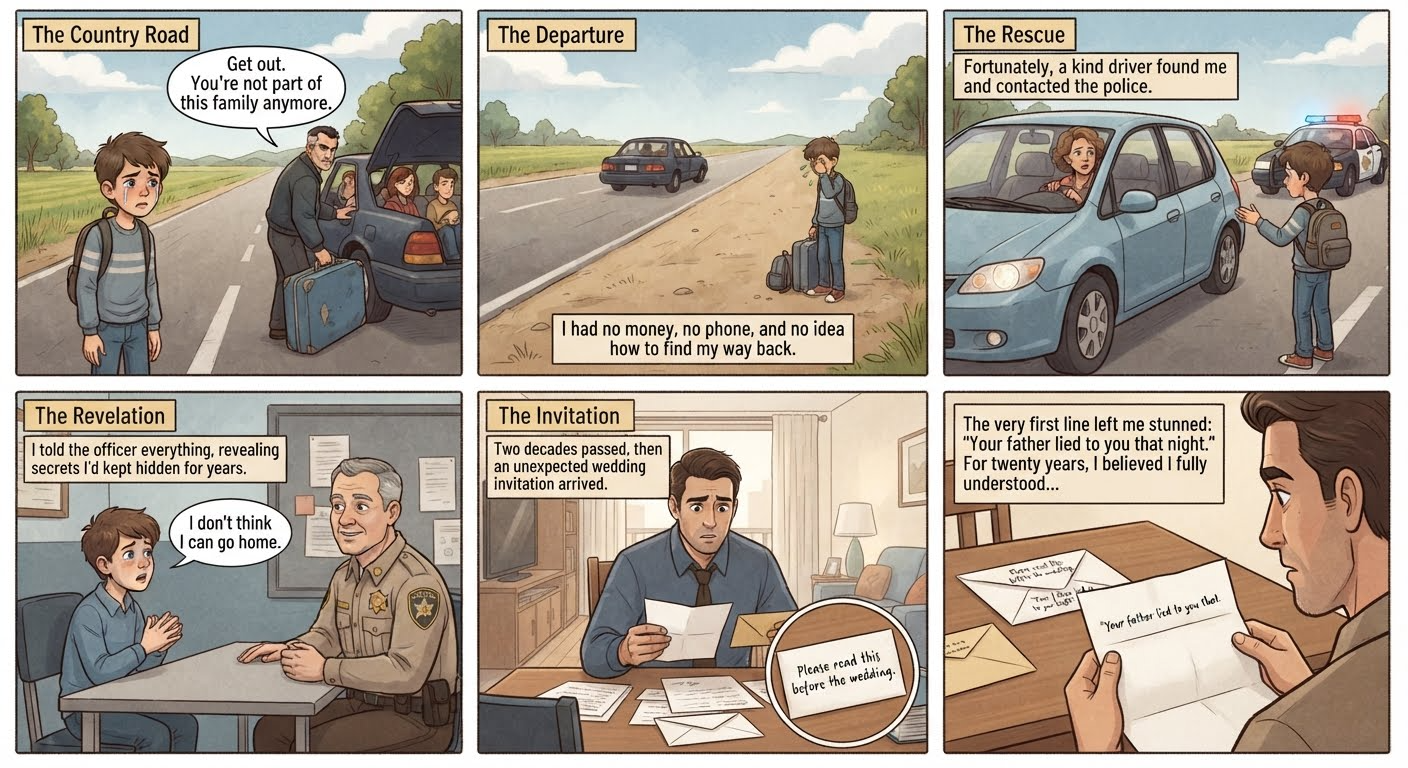
“Get out.”
At first, I thought he was kidding. Then he struck a match.
Within seconds, flames devoured my belongings, sending dark smoke curling into the sky.
“You’re no longer my family,” he declared coldly. “Never come back.”
My mother sat frozen in the front passenger seat, refusing to even look at me. Through the rear window, my younger brother watched in silence as Dad drove off.
I stood there barefoot beside the burning ashes. I had no phone, no money, and no idea where I was. Eventually, a passing motorist spotted me, pulled over, and called the authorities.
When the responding officer asked for my parents’ address, I gave it to him, but then I voiced the reality I had tried so hard to deny:
“I don’t want to go back. Not after what my father just did.”
The officer studied me quietly for a moment. “You’re safe here with us,” he assured me gently.
I stayed with extended family for a short time before entering the foster care system, completely cutting ties with my immediate family. Two decades passed. I built an independent life without them—buying a modest home, building a career, and creating a network of true friends.
Then, last week, an unexpected wedding invitation arrived in my mailbox. My younger brother, Ethan, was getting married.
I almost threw it away, but a second envelope tucked inside caught my eye. Written across the front in my mother’s familiar handwriting were six words:
“Please read this before the wedding.”
I opened it. The very first line left my fingers numb:
“Your father lied to you that night.”
Beneath those words was a date: October 14, 2012—the day I had been abandoned.
Mom confessed she had stayed silent for twenty years out of sheer fear. Dad had lied to our relatives, claiming I had stolen $900 from his wallet and gone completely out of control. But the money had actually come from Mom, given to me in secret so I could buy groceries when Dad stopped providing for us.
More importantly, that wasn’t the real reason he threw me out.
“Your father had been withdrawing money from Grandma’s account,” Mom wrote. “You discovered the statements.”
The memory came flooding back: finding envelopes in Dad’s desk, seeing Grandma’s name, asking why her savings were shrinking. Terrified of being exposed, Dad accused Mom of meddling and decided I had to be erased.
Mom revealed why the invitation had been sent now. Preparing to clear out the family home before his wedding, Ethan had discovered Grandma’s old lockbox containing duplicate bank statements, letters, and an envelope addressed to me. Grandma had uncovered Dad’s theft, but before she could confront him, she suffered a stroke—so she documented everything instead.
Mom’s letter ended with a chilling warning: “Ethan knows Dad has been dishonest. Your father knows Ethan discovered the box.”
Panicked, I tried calling Ethan. He didn’t pick up, but a text immediately arrived:
“Don’t visit the house. Dad knows the letter reached you.”
When Ethan finally answered my second call, his voice was barely a whisper. “Dad discovered Grandma preserved evidence. He’s been demanding its return.”
“Then why did you invite me?” I asked.
“Because I can’t start my marriage knowing our family ruined my sister’s childhood.”
The next morning, I met Ethan near the church. He placed a heavy brown box on the table between us.
“I’m sorry,” he said. “For taking so long.”
Inside were bank statements, photographs, and the sealed envelope bearing my name in Grandma’s handwriting: “If you’re reading this, the truth has finally outlasted his lies.”
Ethan reached across the table, squeezing my hand as tears filled my eyes. Grandma’s note revealed that Dad had transferred her savings into an account under his control and framed me when I stumbled onto the truth. Her final instruction to me was simple: “Never allow him to persuade you that any of this was your fault.”
Before the wedding, Ethan and I brought the records to an attorney. The attorney uncovered a final scheme: Dad had pledged Grandma’s former property as security for a private loan—a property he never legally owned. His plan was to corner Mom during the wedding weekend and force her to sign the transfer papers.
Instead, Ethan revised the guest list and canceled those arrangements.
On the day of the ceremony, I walked up to the church entrance where Dad stood waiting.
He stared directly at me. “You shouldn’t be here.”
“You told me that twenty years ago,” I replied.
“You don’t understand—”
“I understand everything now.”
Ethan stepped beside me. “Dad, this stops today.”
Dad looked stunned. “You’re taking her side?”
“No,” Ethan said quietly. “I’m standing with the truth.”
Our attorney arrived alongside a process server, handing Dad formal legal notices. Dad’s composure shattered instantly—he looked like a man realizing he had lost total control over the narrative.
Mom stepped forward, tears streaming down her face. “I should have protected her,” she confessed.
When Dad snapped at her, she stood her ground: “I was wrong.” Hearing her say those words after two decades was painful, but validating.
The legal proceedings dragged on for months. Dad was forced to return the recoverable funds and relinquish all claims to the property.
Ethan’s wedding was beautiful. Before the reception, he held me tight and whispered, “I’m happy you’re here.”
“So am I,” I smiled.
Over time, Mom and I began rebuilding a relationship—not the one we used to have, but one grounded in honest conversations. I placed Grandma’s final letter safely inside a locked drawer at home.
Twenty years after my father burned my suitcase on the side of that road, I finally understood the truth. He had told a thirteen-year-old girl, “You’re no longer my family.” But he had never destroyed my worth—and that was something he could never take away.
Leave a Reply