
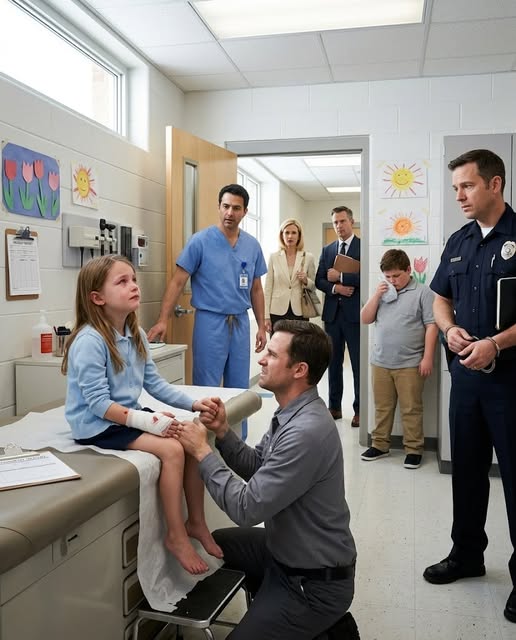
By the time I reached the principal’s office, I had already heard three different versions of what my daughter had done. None of them sounded like Lily, but all of them sounded expensive. The office smelled like floor wax, printer toner, and the coffee the principal had poured but never touched. A blue ice pack crackled in Damian Ashford’s hand every time he pressed it against his jaw. His parents were already there. Mrs. Ashford stood with her arms folded, wearing the kind of cream suit that made every stain look like evidence. Mr. Ashford had a legal folder tucked under one arm. “Your daughter violently assaulted our son,” Mrs. Ashford said before I had even sat down. She said it cleanly, like a prosecutor reading a charge already proven beyond doubt. Mr. Ashford opened the folder and laid several pages on the desk. “We are filing a civil suit. The starting figure is $500,000. And naturally, given the severity of the trauma, we are pressing criminal charges.” Damian was bigger than Lily by a head and a half. Purple bruising had already begun to spread under his jaw, and his mouth sat slightly crooked, as if pain had pulled it out of place. It looked terrible. That was the part that made everyone believe them so quickly. Adults trust visible damage more than quiet terror. A broken face speaks louder than a frightened child.

Lily was seven. She weighed fifty pounds soaking wet. She apologized when she knocked over a chair. She once cried because a cartoon dog had to sleep outside in the rain. That morning, I had signed her school emergency card at 8:05. I had written my phone number, her allergy warning, and the instruction that she should never be released to anyone not listed. By 2:17 p.m., that same trust had become a school incident report, three witness statements, and Officer Caldwell’s county juvenile intake sheet resting on the principal’s desk. People with money learn to make injury sound like a verdict. Parents like me learn to hear numbers as threats. In that office, $500,000 did not sound like a claim. It sounded like a life sentence. Officer Caldwell looked uncomfortable, but discomfort did not stop him from stepping forward. “Sir, based on the witness statements and injuries, I have to take Lily to the station for processing. We need prints.”
Fingerprints. For a child who still slept with a nightlight. Mugshots. For a little girl who kept a smooth stone in her backpack because she said it helped her be brave.
The principal kept glancing at the witness statements as if the papers might rearrange themselves into mercy. The counselor stared at her yellow legal pad. The secretary outside stopped typing completely.
I wanted to grab the file and throw every polished page across the room. Instead, I folded my hands together until my knuckles hurt and asked to see my daughter.
The nurse’s office was two hallways away, past construction-paper tulips and crayon suns. The cheerful walls made the whole walk feel obscene, like the building was pretending childhood had not just cracked open.
Lily sat on the exam table with one hand wrapped in gauze. Her legs dangled over the edge. Dried red specks marked the bandage near her knuckles.
When she looked up, I expected fear. I expected sobbing. I expected the wild panic of a child accused of something too large for her to understand.
Instead, I saw a calm, cold certainty that frightened me more than tears would have. Lily looked small in that room, but not ashamed. She looked like she had chosen something.
The nurse pulled me aside and whispered, “She will not explain. She just keeps asking whether Tommy is okay. I do not know who Tommy is.”
I knew. Tommy was Thomas Reyes, the little boy from Lily’s reading-buddy group. He liked dinosaurs, hated loud bells, and wore a brace under his shirt after spinal surgery.
Lily talked about him every Tuesday. She had told me he was brave because he kept smiling even when kids asked rude questions about the medical strap visible under his sweater.
I had thought it was a classroom friendship. A sweet, small thing. I had not known that friendship would become the line my daughter refused to step back from.
I sat beside her and took her uninjured hand. Her fingers were cold and damp. “Honey,” I said quietly, “the police are here. You have to tell me what happened.”
The Ashfords had followed us. Damian stood behind his mother, still holding the ice pack. Officer Caldwell waited near the door, one hand close to his cuffs, his face tight with duty.
Lily looked from me to the officer. Then she looked straight at Damian. Her little hand tightened around mine, and she said four words.
“He hurt Tommy first.”
The nurse went pale in a way that told me she had remembered something important. She crossed to the medication cabinet and pulled down the clipboard hanging beneath the emergency cards.
There, under the 2:09 p.m. nurse log, was the note: Thomas Reyes sent to St. Mark’s Pediatric Trauma Center for evaluation after hallway incident. Possible brace displacement. Parent notified.
Officer Caldwell read it twice. Mrs. Ashford said, “That proves nothing.” But Damian’s eyes dropped so fast that even his father noticed.
Lily began to speak in pieces. Damian had cornered Tommy near the service hallway after lunch. He had called him fake sick and pulled at the strap under Tommy’s shirt.
Tommy had gasped. Lily said his face changed color. She told Damian to stop. Damian laughed. When he yanked again, Tommy stumbled into the wall and made a sound Lily had never heard from a person before.
Then Damian turned toward Lily. According to Lily, he lifted his metal lunch container and said he would show her what happened to tattletales.
Lily did not punch him like the witness statements claimed. She shoved the lunch container away with both hands. Damian slipped on spilled water near the sink and struck his jaw against the porcelain edge.
Her right hand tore against the metal latch. That was why she bled. That was why she had dried red specks on the gauze. She had not been hiding guilt. She had been hiding pain.
The first witness statements had come from two boys who repeated Damian’s version. The school hallway camera was supposed to confirm it, but the principal admitted it had not been reviewed yet.
Officer Caldwell asked for the footage. Mr. Ashford objected immediately, which did more to expose him than silence ever could. The principal left the room and returned with a district tablet.
The video had no sound, but the picture was enough. Tommy appeared first, small and stiff, one hand pressed to his brace. Damian stepped close and pulled. Tommy folded toward the wall.
Then Lily entered the frame. She pointed toward the nurse’s office. Damian swung the lunch container. Lily raised both hands and shoved it away. Damian stumbled backward, slipped, and hit the sink.
No violent assault. No ambush. No little girl hunting a bigger boy. The camera showed a seven-year-old trying to stop a child from being hurt worse.
The nurse’s desk phone rang before anyone spoke. She answered, listened, and looked at Lily as if the whole story had just grown a second spine.
“Yes, Doctor,” she said. “She’s here. No, sir. They were about to take her.”
A few minutes later, the exterior hallway door buzzed open. A man in blue surgical scrubs walked in with a hospital badge swinging from his chest.
He did not ask where the injured boy was. He did not ask for security. He walked straight toward Lily and lowered himself to her eye level.
“Are you Lily?” he asked.
My daughter nodded, suddenly shy.
He took a folded piece of paper from his pocket. It was a drawing of a dinosaur in a cape, shaky and bright with crayon. At the bottom, in uneven letters, it said: For Lily.
The surgeon swallowed hard. “Tommy is my son,” he said. “His brace shifted when Damian pulled the strap. If Lily had not stopped him, the second hit could have damaged the surgical site.”
The room changed shape around that sentence. Mrs. Ashford’s face went blank. Mr. Ashford stared at the floor. Damian began to cry, but not from his jaw.
The surgeon held out the drawing and a black marker. “Tommy asked whether the brave girl could sign this for him,” he said. “He wants it by his hospital bed.”
That was when everyone understood why he had asked for her autograph. Not because Lily was famous. Because to one frightened boy at St. Mark’s, she was the reason he was still safe.
Officer Caldwell closed his notebook. He told me Lily would not be processed that day. He also told the principal that the original witness statements needed to be supplemented with the video and nurse log.
The Ashfords did not apologize. People like that rarely do in the moment. They collect themselves first. They look for angles, language, technicalities, safer rooms.
But $500,000 disappeared from the conversation. So did criminal charges. Mr. Ashford left with his file pressed tightly under one arm, suddenly much less eager to put evidence in front of a judge.
Damian was still treated for his jaw injury. That mattered. Lily had never wanted him hurt. But the hospital record listed the mechanism as a fall during a hallway altercation, not a targeted assault.
Tommy stayed overnight for observation. His father sent me one update at 11:38 p.m.: stable, scared, asking for Lily. I read it three times before I finally let myself breathe.
The next week, the district reviewed the incident. The two boys who lied admitted Damian told them what to say. The principal apologized to me privately and publicly to Lily.
Lily’s hand healed with a thin scar near one knuckle. For weeks, she asked whether protecting someone was still wrong if somebody else got hurt.
I told her the truth adults hate because it is complicated. Protecting someone can still leave damage. Being brave can still be terrifying. Doing the right thing does not always feel clean afterward.
Tommy mailed her another dinosaur drawing. This one showed two children standing under a huge green T. On the back, his father had written, “Thank you for seeing him when others looked away.”
People with money learn to make injury sound like a verdict. Parents like me learn to hear numbers as threats. But my daughter taught a room full of adults something sharper than either lesson.
The loudest story is not always the true one. Sometimes the truth is a child with a bandaged hand, sitting quietly on an exam table, asking only whether somebody smaller is okay.
Years from now, Lily may not remember every face in that nurse’s office. She may forget the folder, the threats, and the blue ice pack pressed to Damian’s jaw.
I will remember all of it. Especially the moment a surgeon walked past the lawyers, past the police, past the accusation, and asked my seven-year-old daughter for her autograph.
When my stepdaughter called me the help at my own dinner table, I stood there with a dish towel in my hands and corrected her, calm and polite. My husband didn’t defend me. He looked right at me and said,
Promoted Content
“She’s not your daughter. Don’t correct her.”
That was the moment everything changed.
Check This Out
I’m Diane Mercer. I’m fifty-two years old, and I live in Carmel, Indiana. I’ve been married twice. The first one ended when I was forty-three after twenty years of what I thought was a stable life.
It wasn’t dramatic. No yelling, no broken plates, just a quiet unraveling that left me sitting in an empty kitchen one night, realizing I didn’t recognize my own life anymore. I told myself I wouldn’t make the same mistake twice.
Check This Out
et, there I was, standing in my own kitchen, holding a damp towel, being told I had no place at my own table.
That night was a Sunday, a week before Thanksgiving. My sister Patricia had come over early with her usual green bean casserole. She makes it the same way every year, with too many crispy onions on top.
Check This Out
My brother-in-law Ron was in the living room flipping between the Colts game and some hunting show. My son Ethan had driven up from Fishers after work, still in his boots, smelling faintly of motor oil and cold air.
It was a normal family evening, the kind I’d worked hard to build again after my first marriage fell apart. I remember thinking, as I wiped down the counter, that things finally felt settled.
That feeling lasted about twenty minutes.
Ashley came in late like she usually did. The front door opened, heels clicking on the hardwood, her voice carrying before she even stepped fully inside.
“Dad, do we have anything decent to eat, or is it all casseroles again?”
She laughed at her own joke.
No one else did.
Ashley is twenty, a sophomore at Indiana State. Blonde, sharp-featured, always dressed like she’s heading somewhere more important than wherever she actually is.
She’s not stupid. Not lazy either. But she’s used to things being handled for her, especially lately.
She brushed past me in the kitchen, dropped her purse on a chair, and opened the fridge without asking.
“Hi, Diane,” she said, not looking at me.
I smiled anyway.
“Hi, Ashley.”
I had learned over the past year to pick my moments. Not everything needed correcting. Not everything needed to turn into a conversation.
Greg always said she just needed time.
“She’s adjusting,” he’d tell me. “It’s a big change.”
So I adjusted too.
Dinner started out fine. We all sat down, Patricia to my left, Ethan across from me, Greg at the head of the table, Ashley scrolling through her phone between bites.
I remember the sound more than anything. Forks against plates. The TV faint in the other room. Ice shifting in glasses.
Normal sounds.
Until Ashley set her fork down and looked straight at Patricia.
“So,” she said, “how long has Diane been running things like this?”
Patricia frowned slightly.
“What do you mean?”
Ashley shrugged, casual.
“I don’t know. It just feels like she acts like she’s in charge of everything. Like it’s her house or something.”
There was a pause, the kind that stretches just long enough for everyone to realize something’s off.
I felt it in my chest first, that tightening. I kept my voice steady.
“Ashley, this is my house.”
She smiled then, not kindly.
“Yeah,” she said, “but let’s be honest. You’re basically just the help here.”
It landed harder than I expected. Not because of the words. I’ve heard worse in my life.
But because of where we were, who was sitting at that table, the fact that my sister heard it, my son heard it, and no one said anything.
I set my fork down carefully.
“Don’t speak to me like that,” I said, calm, clear, not loud.
She rolled her eyes.
“See? This is what I mean. You’re always correcting me like you’re—”
“Like I’m an adult in this house,” I said, “which I am.”
That was when Greg leaned forward. Not toward me, toward her.
“She’s not your daughter,” he said, his voice flat, like he was stating something obvious. “Don’t correct her.”
The room went completely still.
I remember hearing the hum of the refrigerator, the ticking of the wall clock. Even the TV seemed to go quiet.
I looked at him, really looked.
And in that moment, I saw something I hadn’t wanted to see before. Not confusion. Not conflict.
Certainty.
He meant it.
I didn’t argue. I didn’t raise my voice. I didn’t push my chair back or storm out.
I just nodded once.
“Okay,” I said.
That was it.
Dinner limped along after that. Patricia tried to change the subject. Ron made a comment about the game.
Ethan didn’t say much, just watched, quiet in that way he gets when he’s thinking too hard. Ashley went back to her phone like nothing had happened.
And Greg, he acted like he’d settled something, like he’d kept the peace.
By the time everyone left, the house felt different. Empty in a way that had nothing to do with people being gone.
I cleaned the kitchen slowly, washed the dishes, dried them, put everything back exactly where it belonged. Greg stayed in the living room.
Didn’t come in. Didn’t say anything.
I didn’t ask him to.
Around midnight, I went upstairs and lay down. The ceiling fan spun above me, slow and steady.
I didn’t cry.
That surprised me.
The last time I felt this kind of shift, I cried for hours, sat on a bathroom floor, and wondered how I got there. This time was different.
I stared at the fan and counted the blades as they passed.
One. Two. Three.
Somewhere between the second and third rotation, something settled in my chest. Not anger. Not even hurt.
Clarity.
This wasn’t about Ashley. Not really. This was about a man who had watched me build a home, contribute, support his daughter, and still saw me as optional, replaceable, convenient.
I turned my head and looked at the empty space beside me in the bed, and I thought very clearly, I’m not fixing this.
I’m done paying for it.
I woke up before the sun came up. That’s something that happens more as you get older. Your body doesn’t wait for alarms anymore.
It just decides it’s time.
The house was quiet. Too quiet. No TV, no footsteps, no doors opening and closing.
Just that early-morning stillness that sits heavy for a minute before the day starts.
I went downstairs, made coffee the same way I always do, two scoops, a little too strong, and stood at the kitchen island staring at my phone.
For a second, I almost told myself to let it go. Just smooth things over. Talk to Greg. Give Ashley time. Keep the peace.
I’d done that before. In small ways. In quiet ways.
That’s how I got here.
I took a sip of coffee, set the mug down, and opened my laptop.
If you’ve ever handled the finances in a household, you know what I mean when I say this: everything starts to live in one place. One login leads to another. Bills connect to accounts. Accounts connect to autopay.
It’s like a web. And if you’re the one managing it, you’re the only one who really sees how it’s built.
Greg made more money than I did, on paper anyway. But I was the one who actually paid things on time, every time.
At some point, it had just become easier that way.
I logged into the bank first. Then the credit cards. Then the insurance portal. Then the university payment system.
Each screen loaded one after the other, quiet and indifferent.
Numbers don’t care how you feel.
That was the first thing I noticed. The second thing was how much of this had quietly become my responsibility.
Ashley’s car, a Toyota RAV4, leased at $412 a month. Insurance, $180. Her off-campus apartment shortfall varied, but usually a couple hundred.
Sorority dues and extras, sometimes another $300 depending on the month. Phone plan. Parking permit. Textbooks I’d paid for without thinking twice.
I leaned back slightly in the chair.
At fifty-one, when all this started, I told myself it made sense. It was temporary. It was support. It was family.
I took another sip of coffee, now already cooling.
At fifty-two, sitting in that quiet kitchen, I saw it differently.
I wasn’t just helping.
I had built the structure everything was sitting on.
I clicked into the joint account. That’s where things got interesting.
There were transfers I didn’t recognize. Small ones, easy to miss if you weren’t looking closely.
Four hundred here. Five hundred there. Always labeled something vague.
Emergency. Books. Miscellaneous.
I clicked one open.
Transferred to Ashley.
No conversation. No mention. Just done.
I stared at the screen for a long second.
It wasn’t the amount.
It was the pattern.
Greg hadn’t just leaned on me. He’d gotten comfortable moving things around, assuming I wouldn’t question it, assuming I wouldn’t notice, or maybe assuming I wouldn’t push back if I did.
I closed that tab slowly. Then I opened a fresh notepad file and started listing everything.
Car. Insurance. Tuition payments. Transfers. Subscriptions.
It took about twenty minutes.
When I was done, I just looked at the list.
It didn’t feel dramatic.
It felt clear.
Upstairs, I heard movement. Greg getting up.
I didn’t rush.
I opened the insurance account first. Canceled autopay. Not the policy itself. I’m not reckless.
Just the payment tied to my account.
Then the car lease portal. Removed my payment method.
Phone plan. Same thing.
University account. Switched off scheduled payments.
Each step was simple.
Click.
Confirm.
Done.
No raised voices. No confrontation.
Just removing my hand from things I never should have been carrying alone.
My phone buzzed.
A text.
Ashley: Why was my card declined?
I stared at it for a second. Just a second.
I almost laughed.
Not because it was funny. Because it was predictable.
I set the phone down without answering.
A minute later, another message.
Hello?
I took a breath and stood up, carrying my coffee to the sink. Greg came down the stairs in sweats, still half asleep.
“Morning,” he said, rubbing his eyes.
“Morning.”
He poured himself coffee, glanced at me, then at his phone.
I watched the moment it hit him.
His posture changed slightly, shoulders tightening.
“What did you do?” he asked, not looking up yet.
I didn’t answer right away.
I walked back to the island, picked up the folder I’d printed, just a few pages, nothing dramatic, and set it down in front of him.
“I stopped paying for things that aren’t mine,” I said.
He looked up then.
“What does that mean?”
“It means,” I said, keeping my voice even, “if she’s not my daughter, I’m not responsible for her expenses.”
His jaw tightened.
“Diane, don’t start this again.”
“I’m not starting anything,” I said. “I’m ending something.”
He flipped open the folder, scanning the pages.
“You can’t just cut her off like that,” he said. “She’s in school.”
“I didn’t cut her off,” I said. “I stopped paying. There’s a difference.”
“She relies on that.”
I met his eyes.
“So did you.”
That landed.
He looked back down at the papers.
“You’re overreacting,” he said. “It was one comment.”
“It wasn’t one comment,” I said quietly. “It was the first honest one.”
He let out a breath, frustrated.
“You’re making this into something it’s not.”
“No,” I said. “I’m seeing it for what it is.”
His phone buzzed again, Ashley calling. He declined it.
Then it buzzed again. And again.
He finally picked it up and stepped into the other room. I could hear his voice, low, trying to calm her down.
“It’s fine. I’ll handle it. No, just give me a minute, Ashley.”
I turned back to the sink and rinsed my mug. The water ran steady, warm against my hands.
For the first time in a long while, I didn’t feel like I was holding everything together.
I felt like I’d stepped out of something.
And the world didn’t fall apart.
It just shifted.
A few minutes later, Greg came back in, phone still in his hand.
“She’s freaking out,” he said. “Her insurance, her card, everything.”
“I know,” I said.
“You need to fix this.”
I shook my head.
“No,” I said. “You do.”
He stared at me like he didn’t recognize me.
Maybe he didn’t.
That was fine.
Because for the first time in a long time, I recognized myself.
By noon, I realized something worse than the insult.
My husband hadn’t just let me be disrespected.
He had been rewriting the story behind my back.
Greg spent most of the morning on the phone. I could hear him pacing between the living room and the back patio, his voice going from controlled to irritated to something close to pleading.
I didn’t interrupt. I stayed at the kitchen table with my laptop open, going through things I should have looked at months ago.
You know how sometimes you don’t check something? Not because you can’t, but because you don’t really want to know what you’ll find.
That had been me.
Not anymore.
I pulled up old messages, emails, payment confirmations, anything tied to Ashley’s accounts.
That’s when I found it.
An email thread from about six months earlier. Greg had forwarded something to Ashley, tuition-related, I think, and then replied again a few minutes later.
I almost didn’t open it.
Then I did.
“Don’t worry about Diane,” he’d written. “She likes taking care of this stuff. Makes her feel needed. Just focus on school.”
I sat back slowly.
Read it again.
Then again.
It was so casual, so normal in tone, like he wasn’t lying, like he actually believed what he was saying.
That was the part that got me.
It wasn’t just that he’d let her think I was paying because I wanted to impress them.
It was that he had framed it that way, turned me into something smaller, convenient.
I closed the laptop for a minute and pressed my palms against the table.
That tight feeling came back, but different this time. Sharper. Clearer.
Up until that moment, part of me had still been wondering if I’d gone too far that morning. If cutting everything off all at once had been harsh.
That email answered that.
I hadn’t overreacted.
I had just stopped participating.
My phone buzzed.
Patricia.
I answered on the second ring.
“Hey,” she said. “You okay?”
I looked out the window. The backyard was still, a few leaves moving in the cold wind.
“I’m fine,” I said. “Or I will be.”
She was quiet for a second.
“What happened after we left?”
I told her. Not everything at once, just the important parts. What Greg said. What I did that morning.
There was a pause on the other end. Then she let out a slow breath.
“Well,” she said, “it’s about time.”
I almost smiled.
“I found something,” I added. “An email. He told Ashley I like paying for things. That it makes me feel needed.”
Patricia didn’t hesitate.
“That’s not just disrespect, Diane,” she said. “That’s manipulation.”
“I know.”
“You don’t yell at men like that,” she went on. “You document them.”
I leaned back in the chair.
“I started.”
“Good,” she said. “Because at our age, peace is expensive, but dignity costs more when you lose it.”
That one stuck.
We talked a little longer about practical things, not feelings. That’s how Patricia is. She cares, but she keeps it grounded.
When I hung up, I sat there for a minute.
Then I grabbed my keys.
I needed to get out of the house.
The Kroger on Rangeline Road was busy like it always is late morning. People picking up last-minute groceries, carts clattering, holiday displays already half up.
I walked through it on autopilot.
Milk. Bread. A couple things I didn’t even really need.
At checkout, the cashier made small talk.
“Getting ready for Thanksgiving?”
“Something like that,” I said.
I paid, loaded the bags into the back seat, then got in the car and just sat there, engine off, hands on the steering wheel.
And for the first time since that dinner, I cried.
Not loud. Not dramatic.
Just quiet.
The kind that comes up before you can stop it.
It wasn’t about Greg. Not really.
It was about me.
The version of me who believed this time would be different. Who thought if she showed up enough, gave enough, kept things smooth enough, she’d be treated like she belonged.
I wiped my face with the sleeve of my coat and let out a long breath.
“I should have seen it,” I said out loud.
And maybe I should have.
But seeing it now was enough.
I started the car and drove back home.
When I walked in, Greg was at the kitchen counter with his phone and the stack of papers I’d left. He looked up immediately.
“We need to fix this,” he said.
“We?” I asked.
“Yes, we. Ashley can’t just—she has classes, she has—”
“Greg,” I said, cutting in gently, “you told me she’s not my daughter.”
He exhaled sharply.
“That’s not what I meant.”
“It’s exactly what you meant.”
He ran a hand through his hair.
“You’re blowing this out of proportion.”
I stepped closer, resting my hand lightly on the back of a chair.
“No,” I said. “I’ve been shrinking it for a year. I’m just not doing that anymore.”
His phone rang again.
Ashley.
He picked it up this time.
“Ashley, listen. No, I know. I’m talking to her now.”
I turned away, giving him space.
But I could hear her. Not the words, just the tone. High, panicked, realizing maybe for the first time that things weren’t as stable as she thought.
Greg lowered his voice, pacing again.
“I’ll figure it out,” he said. “Just give me a day.”
A day.
I almost laughed at that.
He’d had a year.
When he hung up, he looked tired.
“Can you just turn it back on for now?” he asked. “We’ll talk this through later.”
I shook my head.
“No,” I said. “We’re not pausing this so it’s easier for you.”
“It’s not about me.”
“It is,” I said. “It always has been.”
That stopped him.
He didn’t argue right away. Just stood there looking at me like he was trying to find the version of me he was used to. The one who would soften, compromise, let things slide.
She wasn’t there anymore.
“I’m not trying to punish anyone,” I said. “I’m just done paying for something I’m not part of.”
He didn’t respond.
Didn’t apologize either.
That told me everything I needed to know.
I picked up my laptop again, opened a new document, and started organizing everything I had. Dates. Amounts. Accounts.
If this was going to continue, and it was, I wanted it clear. Not emotional. Not messy.
Just accurate.
Because I had a feeling this wasn’t going to stay inside the house.
And when it didn’t, I wasn’t going to let anyone rewrite what really happened.
The restaurant was louder than I expected.
Saturday brunch in Carmel always is. Plates clinking. People talking over each other. The low hum of espresso machines behind the counter.
It gave everything a kind of cover, like you could say almost anything and no one outside your table would really hear it.
Greg had picked the place. Of course he did.
Neutral ground. Public. Easier to keep things contained.
Or at least that’s what he thought.
I arrived a few minutes early, sat down at a table near the window, ordered coffee, black.
I wasn’t nervous, but I was aware of the way my hands rested on the table, of the folder in my bag, of the fact that this wasn’t just another conversation.
This was the end of something.
Greg walked in first, Ashley right behind him.
She looked different. Still put together, hair done, makeup perfect, but there was something underneath it now.
Tension.
Her eyes flicked around the room, then landed on me. She didn’t smile.
Greg did.
“Hey,” he said, like we were just meeting for a normal meal. “You got here early.”
“I like to be on time,” I said.
He sat across from me. Ashley slid into the seat beside him.
For a few seconds, no one spoke.
The server came by, cheerful, unaware.
“Can I get you anything to drink?”
Greg ordered coffee. Ashley asked for a latte, extra something I didn’t catch.
Then we were alone again.
Greg leaned forward slightly.
“Diane,” he said, keeping his voice low, “we don’t need to make this a big thing.”
I took a sip of coffee.
“I’m not making anything,” I said. “I’m just explaining.”
Ashley let out a small scoff.
“Explaining what?” she said. “Why you decided to ruin my life overnight?”
I looked at her. Really looked this time.
“You think your life was mine to ruin?” I asked.
She opened her mouth, then closed it.
Greg jumped in.
“Okay, let’s not do this here,” he said. “We can talk at home.”
“No,” I said, calm. “We’re talking here.”
He frowned.
“Why?”
I met his eyes.
“Because this is where you like things to look normal.”
That landed.
He sat back slightly.
Ashley crossed her arms.
Interesting For You
Leave a Reply