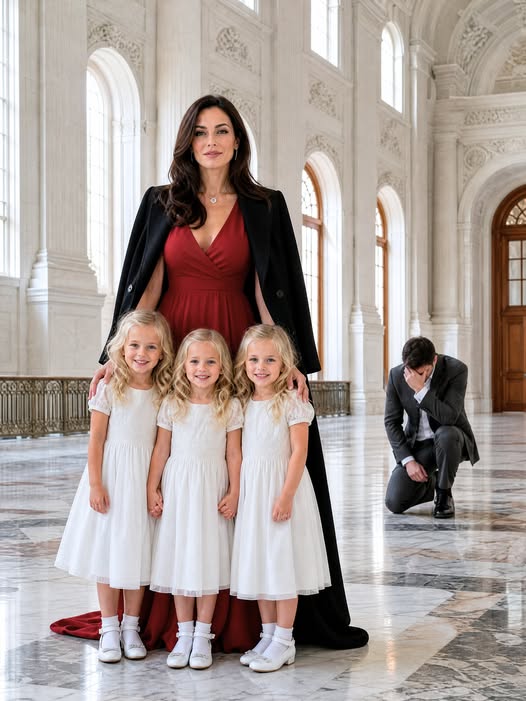

Part 1: The Divorce Papers Signed Outside My ICU Room
The smell of antiseptic filled the hospital corridor while machines inside the ICU fought to keep me alive after an emergency C-section. My body was covered in stitches after delivering premature triplets, and doctors weren’t sure whether I would survive the night. Behind the surgical doors, nurses worked desperately to stabilize me while my newborn babies struggled for breath inside incubators.
Outside the ICU, however, my husband Grant Holloway behaved like he was finalizing a business contract instead of watching his wife fight for her life. Dressed in an expensive Italian suit, he calmly accepted divorce papers from his lawyer and signed them without hesitation. When the lawyer nervously reminded him that I had flatlined only minutes earlier, Grant simply replied that whether I survived or died no longer mattered to him financially.


A doctor soon stepped out of the ICU and begged Grant to authorize additional emergency treatment because I was still in critical condition. Grant interrupted her immediately and coldly explained that he was no longer legally my husband because the divorce paperwork had already been finalized. Then he walked away from the ICU while doctors stood there stunned by what they had just witnessed.
On the drive back through Manhattan, Grant texted his girlfriend Bel Knox a single word: “Yes.” He believed divorcing me during the medical crisis solved all his problems at once. In his mind, I had become a liability capable of damaging the image he needed for an upcoming investor funding round tied to his company.
When I finally woke up later, I barely understood where I was at first. My throat burned from the breathing tube, my abdomen felt like it had been torn apart, and the only thing I could think about was my babies. A nurse quietly explained that the triplets were alive but extremely fragile inside the NICU.
Then a hospital administrator entered my room holding a tablet instead of flowers or sympathy. He corrected himself from calling me “Mrs. Holloway” to “Miss Parker” and calmly informed me that my divorce had been finalized while I was unconscious. At first I thought the medication was making me hallucinate until he showed me Grant’s signature approving everything legally.
The administrator explained that I no longer qualified for Grant’s insurance coverage and that hospital officials were reviewing custody and financial responsibility for the babies. He spoke about my children like accounting problems instead of newborn infants fighting to survive. When I demanded to know where Grant was, the administrator bluntly informed me that my former husband declined further involvement.
Soon afterward, I was transferred from the private recovery suite Grant once insisted on paying for into a smaller room with harsh lighting and almost no privacy. Hospital staff brought me financial forms instead of support while I struggled to sit upright after major surgery. The cruelty wasn’t loud or dramatic. It moved quietly through paperwork, policy changes, and signatures.
Later that day, an orderly wheeled me past the NICU. Through the glass, I saw my three babies surrounded by tubes and machines, their tiny bodies fighting for survival while I remained powerless to hold them. I pressed my hand against the glass and realized the truth all at once: Grant hadn’t simply divorced me. He had erased me as completely as possible the moment I became inconvenient.
Meanwhile, Grant enjoyed his new freedom inside his luxury Manhattan penthouse. He convinced himself he had made a smart and efficient decision by removing emotional complications from his life before major investors evaluated his company. During a boardroom presentation the next morning, he confidently assured investors his business faced “no distractions” moving forward.
But the first crack in his carefully controlled world appeared only hours later.
An assistant interrupted the meeting to inform Grant that one of the investment channels connected to his company had suddenly paused funding because of concerns involving something called the Parker Hale Trust. Grant dismissed it as temporary because he didn’t recognize the name or understand what had just been triggered by divorcing me.
Back at the hospital, my situation continued worsening. Administrators discussed reducing treatment coverage for my babies while pressuring me about discharge plans even though I barely recovered from surgery. Grant blocked every attempt I made to contact him, and for the first time in my life, I fully understood that he wasn’t just abandoning me emotionally. He was actively trying to make sure I couldn’t survive without him.
Part 2: The Trust Grant Never Knew Existed
After the divorce became official, the hospital moved me out of the private recovery wing and into a smaller postpartum room on another floor. The lighting was harsh, the blankets felt paper-thin, and every conversation suddenly revolved around billing instead of recovery. A coordinator eventually arrived carrying forms and quietly explained that extended NICU treatment for my babies now required confirmation of financial responsibility because Grant terminated all insurance authorization tied to me.
Hearing strangers discuss my newborn triplets like expensive liabilities made me physically sick. I begged to stay near the NICU and asked for more time because I could barely walk after surgery, but administrators kept pushing discharge paperwork toward me. The cruelty wasn’t dramatic or emotional. It moved through policy, signatures, reduced medication, and carefully worded hospital language that treated poverty like a personal failure.
Every day I dragged myself back to the NICU to see my babies through the glass. I memorized the rhythm of their breathing machines and whispered promises they couldn’t hear while my stitches burned with every movement. Grant never visited once. Instead, he filed emergency custody paperwork claiming I was financially unstable and incapable of caring for the children properly.
Meanwhile, across Manhattan, Grant convinced himself he still controlled the situation completely. He attended investor meetings, planned public appearances with Bel Knox, and reassured his board that his company faced no personal distractions anymore. But problems connected to the mysterious Parker Hale Trust kept surfacing quietly inside financial channels linked to his business.
Back at the hospital, one person finally refused to ignore what was happening to me.
Dr. Naomi Reed, the physician overseeing the NICU, became increasingly disturbed after administrators suggested reducing interventions for my babies because of insurance complications. She recognized the situation immediately for what it truly was: power being used to pressure a vulnerable mother recovering from catastrophic childbirth.
Naomi secretly contacted an attorney named Ethan Cole after reviewing my file. She explained the suspicious divorce timing, the sudden insurance cancellation, and the pressure surrounding custody and medical decisions. The moment Ethan heard my full name, his reaction changed completely.
That night, Ethan visited my hospital room carrying a sealed envelope. He explained that my mother’s family name, Parker, connected me to an enormous private investment trust created years earlier by my grandmother Eleanor Parker Hale. For more than a decade, the trust remained locked in litigation and inaccessible because of family disputes.
The part that changed everything was hidden inside one specific clause.
According to Ethan, the trust only activated fully after the birth of multiple legitimate heirs. My triplets had unknowingly triggered protections worth far more than Grant ever imagined. Even though the assets themselves remained locked during a mandatory ninety-day review period, I instantly became a legally protected beneficiary under the trust’s structure.
That meant Grant’s actions suddenly looked very different legally.
Cutting my insurance, interfering with medical access, manipulating custody, and pressuring me financially while I recovered from near-fatal surgery could now be interpreted as attempts to coerce or harm a protected beneficiary tied to the trust. Grant thought divorcing me erased his obligations. Instead, he accidentally created a legal disaster connected directly to his company and financial partners.
For the first time since waking up alone in that hospital room, I felt something besides fear.
Validation.
Proof that I hadn’t imagined the cruelty or helplessness surrounding me. Ethan warned me not to confront Grant directly yet because the smartest thing I could do was survive quietly while every decision Grant made continued building evidence against him.
After my discharge, I moved into a small apartment arranged through Ethan’s contacts because I had nowhere else to go. The place smelled like mildew and old cooking oil, but it was safe and close enough for me to visit the hospital every day. A strategist named Julian Cross quietly stepped in as well, helping arrange temporary housing and financial support under consulting agreements designed to avoid attention.
Julian gave me one critical piece of advice.
Do nothing publicly.
Let Grant believe he already won.
So I stayed silent while Grant grew more aggressive. He leaked stories about my supposed emotional instability, pushed harder for custody, and publicly appeared beside Bel Knox at charity events pretending to embody strength and success. He expected me to panic, lash out, or beg him for mercy.
Leave a Reply