Wyatt came downstairs still with that half-smile, disheveled, with the confidence of someone who believes the house still revolves around him.
Her smile vanished when she saw Harrison sitting in my kitchen, with an untouched cup of coffee and an open brown folder on the embroidered tablecloth.
He stood motionless on the last step.
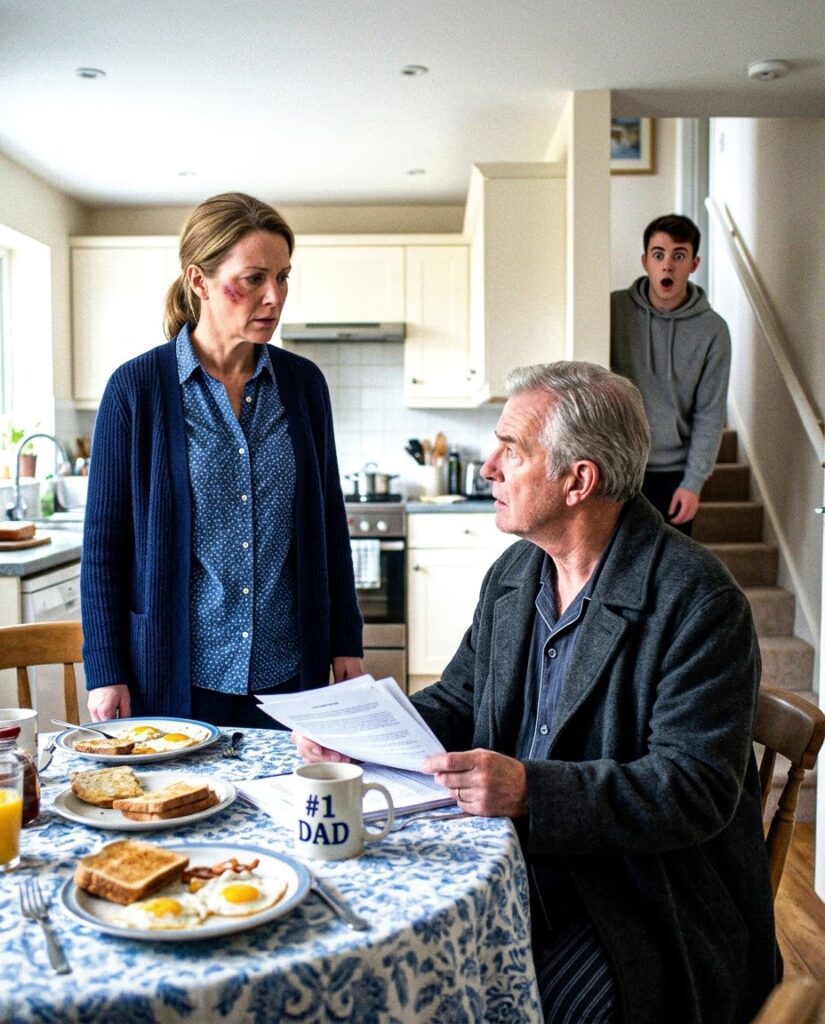
He looked at his father. Then he looked at me. Then he saw the set table, the good dishes, the chilaquiles, the beans, the steaming coffee. All of that gave him confidence for a second.
He thought I had backed down.
He thought the breakfast was an apology.
“What is this?” he asked, with a short laugh. “An intervention?”


Harrison didn’t stand up. He didn’t raise his voice. He just placed a hand on the papers.
“Sit down, Wyatt.”
My son didn’t sit down.
“I asked you what this is.”
I didn’t move either. I remained standing next to the chair, my cheek still tender and my body functioning purely on impulse.
Harrison looked at him in that way that only some parents have when they’re no longer asking for anything. When they’ve already made up their minds.

“This,” he said, touching the folder, “is the day you stop treating your mother like she’s your hostage.”
Wyatt let out an incredulous laugh.
“Don’t mess with me.”
Then Harrison took out the first document and turned it towards him.
It wasn’t an empty threat. It wasn’t theater. It was a formal notice to vacate the house.
The house was solely in my name. Harrison had helped me years ago to legally secure everything after the divorce, though I’d almost forgotten that detail. He hadn’t.
There was another document underneath.
A request already prepared for a temporary protection order if Wyatt refused to leave or raised his hand to me again.
I saw something change in his face. Not regret. Not yet.
More like surprise. The surprise of discovering that the wall he had banged against so many times wasn’t soft. It was firm.
“Did you call a lawyer?” he asked me.
“No,” Harrison answered before I did. “You called me. And this time I did what I should have done a long time ago.”
Wyatt finally stepped down the last step. He approached the table. He didn’t touch the chair.
No photo description available.
“Mom, are you really going to do this to me?”
There was contempt in his voice, but also something else. Fear. Small, dry, newborn.
I knew him too well. I knew when he was about to attack and when he was calculating.
“I’m not doing anything to you,” I told her. “I’m finishing something I should have finished months ago.”
He looked at me as if he wanted to send me back to our usual place. That corner where I hesitated and he was in charge.
“For a slap?”
Harrison placed both hands on the table.
“No. Because of everything that came before and because of what was going to come after.”
The silence fell suddenly.
I could hear the clock ticking. The refrigerator. My own breathing, strange and short.
Wyatt turned towards me, his jaw clenched.
“I asked you for money. You said no. We argued. That’s it. They’re exaggerating to make me look like a monster.”
There it was. The old maneuver. Reduce everything. Shrink the wound until it seemed almost fabricated.
Before, I would have stumbled upon that version. Before, I would have tried to explain, to soften, to protect him from himself.
Not that morning.
“You hit me,” I said. “And then you went upstairs to sleep like nothing happened.”
Không có mô tả ảnh.
He made a gesture with his hand.
“Oh, please. I didn’t even throw you.”
I don’t know if it was the pain in my face or the way he said it, but something inside me finally broke right there.
Not with clamor. With clarity.
Love is not about enduring until you disappear.
Love is putting the door where before there was only permission.
Wyatt heard that phrase and looked at me differently. I think he understood that it didn’t come from an exhausted mother. It came from a woman who had already stopped bargaining with fear.
Harrison pulled out another piece of paper.
“You have two options,” he said. “You can leave today on your own two feet, with a suitcase and whatever else you can reasonably pack this morning, or I’ll call right now to document the assault and activate the next step.”
Wyatt glared at him.
“You don’t live here.”
“No,” Harrison replied. “But she is. And for the first time in years, she’s not alone.”
I saw Wyatt swallow. A small detail. Almost nothing. But I saw it.
I also saw his hand grip the back of a chair. His knuckle turned white.
He had always been big. Tall. Strong. As a child, when he ran toward me, it felt like the whole world was coming to embrace me. As an adult, that same strength began to enter a room like a threat.
And yet, he was still my son. That was the cruelest part.
I wasn’t fighting a stranger. I was throwing out the child I had carried while he was feverish, the teenager I had defended at school meetings, the man I still called “my boy” even when he treated me like garbage.
Perhaps that’s why it hurt so much to see that there was no shame in her face.
Just anger at losing ground.
“And where am I supposed to go?” he asked.
The question would have sounded different coming from someone else. Coming from him, it sounded like an accusation.
Harrison didn’t blink.
“You should have thought about that before hitting your mother.”
Wyatt pointed at me with a trembling finger.
“You do this and don’t ever ask me to talk to you again.”
I nodded.
“If the only way to keep you around was to accept threats, shouting, and beatings, then I had already lost you before today.”
Finally, he looked away.
There, for the first time, I saw the boy beneath the furious man. Not for long. Just a glimpse. Confusion. Humiliation. Something broken that had been rotting for years without anyone wanting to name it.
But a flash doesn’t erase a raised hand.
She doesn’t clean a kitchen where a mother no longer feels safe.
He slumped into the chair as if his legs wouldn’t obey him. The plate in front of him remained untouched. The smell of chorizo and coffee filled the air with an absurd tenderness.
Breakfast felt like a party.
The truth was, it was an eviction.
Harrison slid another sheet of paper toward him.
“There’s a list of resources,” he said. “A paid room for three nights. An assessment center if you agree to go. A contact for temporary work. We’re not letting you die. We’re getting you out of here.”
Wyatt looked up, surprised.
I wasn’t expecting that part.
I hadn’t seen it either until Harrison opened the folder. He hadn’t just brought papers to expel him. He had brought structure. A boundary with an exit. A consequence with a narrow door at the end.
Then I understood something about Harrison that I hadn’t wanted to admit for years. He had left my marriage. Yes. He had failed me in many ways. Yes.
But that morning he hadn’t come to take revenge on our son.
No photo description available.
He had come prepared to contain the disaster without further fueling it.
“I don’t need your charity,” Wyatt said.
“No,” Harrison replied. “What you need is a life where your mother isn’t the price you pay for every one of your failures.”
Wyatt stood up abruptly. The chair scraped against the floor. My body tensed before I could stop it.
Harrison also got up, slowly, placing himself between Wyatt and me without a single dramatic word.
That move almost made me cry. Not out of heroism. For something simpler.
Because someone, at last, was taking seriously the danger that I had been downplaying for far too long.
Wyatt saw his father’s position and let out a bitter laugh.
“Of course. Now he’s the savior. After disappearing for years.”
Harrison accepted the blow without defending himself.
“No,” he said. “I’m a man who arrived late. But I’m here now.”
That phrase left the kitchen feeling empty inside.
Wyatt felt it. So did I.
Because it was true. He arrived late. I arrived late too. We had both let guilt, distance, and excuses fill a void that Wyatt turned into permission.
None of that justified what he did.
But it did explain why the morning had that thick taste, like reheated coffee and old loss.
Wyatt ran a hand through his hair. He looked at the back door. He looked at the stairs. He looked at the papers. He wanted to find a crack.
There wasn’t one.
“How much time do I have?” he finally asked.
Harrison looked at his watch.
“You have until ten to leave with the essentials. If you want us to organize the rest later, we’ll do it another way. But you’re not sleeping here tonight.”
I didn’t say anything. Not because I doubted it.
Because if I spoke, perhaps my voice would break.
Wyatt climbed the stairs again without running. No slamming door this time. Each step sounded different. Less commanding. Heavier.
I waited until I heard her bedroom door close before sitting down.
My legs were trembling.
Harrison pushed my cup towards me.
“Take a sip,” he said.
I did it. The coffee was already lukewarm. Even so, it sustained me.
We remained silent for a moment, listening to the drawers opening upstairs, the nervous footsteps, the dull thud of a suitcase falling onto the bed.
“I don’t know if I’m doing the right thing,” I murmured.
Harrison looked at me with weariness and a strange sweetness.
“It probably hurts because it’s the right thing to do.”
At nine forty-three, Wyatt came down with a black suitcase, a backpack, and a garbage bag full of clothes.
He did not apologize.
He didn’t say he understood.
He stopped at the door, his hand on the handle, and for a second I thought he was going to make one last threat. Something to inflict a fresh wound before he left.
But he just looked at me.
Not like when he was a child. Not like last night. It was a strange, confused, almost empty look. As if he didn’t know who he was without that house swallowing everything he did.
“Are you really not going to stop me?” he asked.
It took me a second to reply.
“No.
Not this time.
He opened the door and went out.
I heard his footsteps on the wooden porch, then the thud of the suitcase going down the steps, then nothing.
Nothing.
And that nothing was so big that it left me breathless.
I didn’t run after him. I didn’t look out the window. I didn’t do what I would have done my whole life.
I sat in my kitchen, facing an untouched plate, with the Christmas tablecloth under my elbows and my face still burning a little.
Harrison gathered the remaining papers and put them back in the folder.
Then he began to lift the plates as if that domestic gesture could restore the room to a normal state.
“Leave them alone,” I told him.
He obeyed.
We looked at each other. Two elderly people in an unusually quiet kitchen, trying to figure out what to do when the crisis finally walks out the door and leaves the void behind.
I cried then. Not before. Not during. There.
I didn’t just cry because of the blow. I cried for all the years it took me to call things by their name. For every time I defended the indefensible. For every night I mistook compassion for surrender.
Harrison didn’t touch me right away. He waited. When he saw me take a step towards him, he hugged me.
It wasn’t a movie hug. It was awkward. Human. Necessary.
Later I changed the tablecloth, put away the good dishes, and opened the kitchen windows to let out the smell of coffee, food, and old fear.
That afternoon I took pictures of my cheek, called a counselor, and changed the locks.
Not because she stopped being his mother.
But because I finally remembered that I was also the owner of my own life.
Three days later, Wyatt sent me a one-line message.
He didn’t say “sorry”.
He said, “I need my social security papers.”
I read it without trembling.
I prepared them in an envelope. That’s all.
There are stories that don’t begin to heal when someone comes back crying.
They begin when a woman stops opening the door to the same harm under another name.
I don’t know what Wyatt is going to do about what he lost that morning.
Leave a Reply