Author: Jonh Philip

  • My parents said I wasn’t invited to my brother’s wedding after I gifted him a house worth $770k. “It’s only for the closest family,” my brother laughed.

    My parents said I wasn’t invited to my brother’s wedding after I gifted him a house worth $770k. “It’s only for the closest family,” my brother laughed.

    I moved with a calmness that surprised even me. Sitting in front of my computer, I began typing, each click of the keyboard making my decision feel more real.

    I was going to sell the house.

    Not someday.

    Not after the wedding.

    Now.

    It was legally mine—the home I had once given Dalton access to out of love, trust, and the belief that family meant something. Instead, it had become the place where I was treated like an outsider, excluded from a celebration happening beneath a roof that belonged to me.

    I refused to accept that humiliation quietly.

    I called Mark, my real estate agent and someone I had trusted for years.

    “I need the house sold,” I told him. “And I need it done quickly.”

    There must have been something in my voice because he didn’t waste time asking questions.

    “Alright,” he said. “I’ll take care of it.”

    From that moment, everything moved rapidly.

    Documents were prepared.

    Signatures were collected.

    Offers were reviewed.

    And while Dalton and Nicole continued planning their wedding as though the house were already theirs, the property was quietly slipping out from beneath them.

    By the time their wedding day arrived, the deal was complete.

    The house no longer belonged to their future.

    It belonged to someone else.

    That morning, the sky hung heavy and gray over the neighborhood. From a distance, I imagined the celebration taking place inside the home I once considered a symbol of family.

    Dalton and Nicole exchanged vows.

    Guests laughed.

    Champagne glasses clinked.

    Music filled the rooms.

    And all the while, neither of them had any idea what was waiting for them once the celebration ended.

    For the first time in weeks, I felt strangely peaceful.

    Later that evening, the newlyweds and several guests returned to the house, expecting to continue celebrating the beginning of their married life.

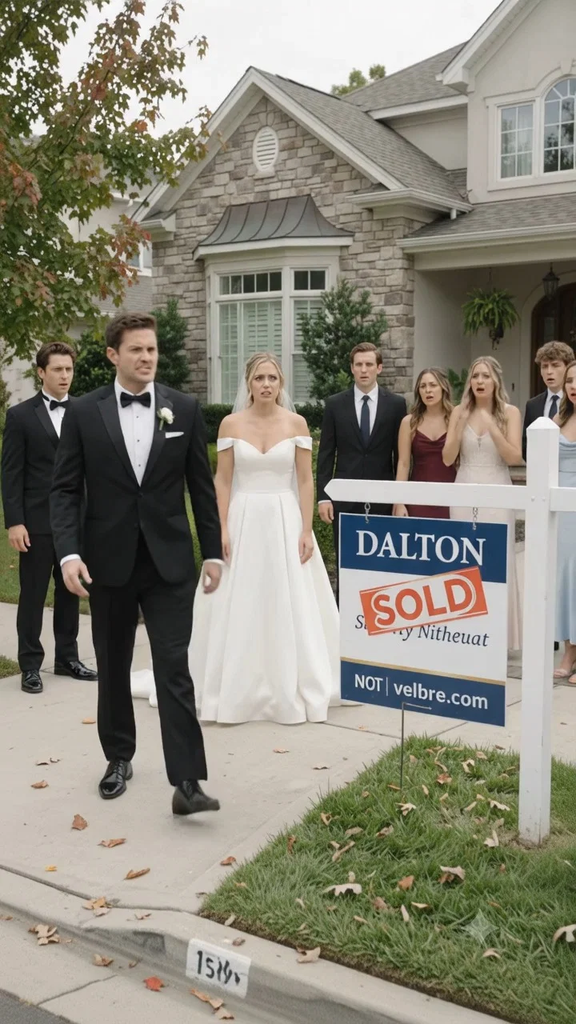
    Instead, they stopped dead in the driveway.

    The house was dark.

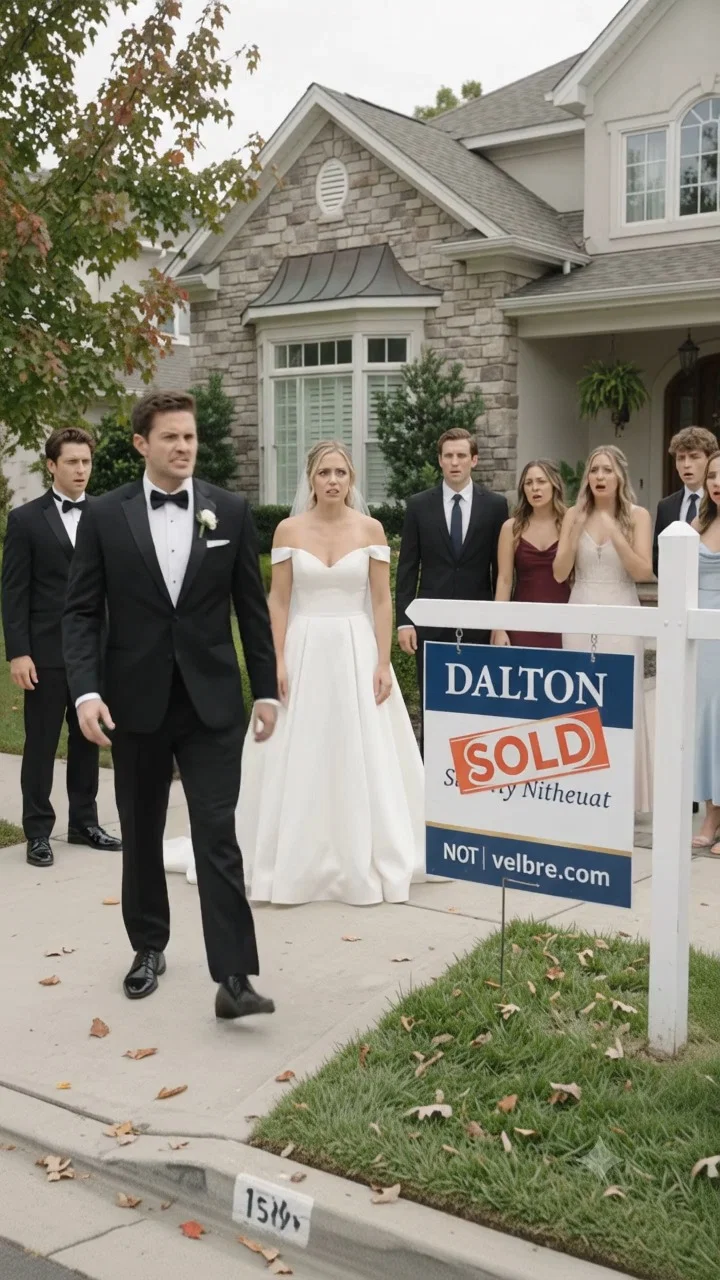
    And standing prominently outside was the sign they had never expected to see.

    SOLD.

    Nicole went completely pale.

    Her carefully perfected makeup couldn’t hide the shock spreading across her face.

    Dalton simply stared at the sign as though his mind refused to understand what his eyes were telling him.

    The guests slowly fell silent.

    Confused whispers spread through the group as everyone stood awkwardly on the damp lawn in expensive dresses and tailored suits, staring at a house that no longer belonged to the newlyweds.

    Then Dalton finally saw me.

    His expression changed instantly.

    “Sierra… what did you do?”

    I looked directly at him.

    For once, I didn’t feel the need to explain myself, defend myself, or soften the truth to protect his feelings.

    “I sold my house.”

    His mouth opened, but no words came out.

    I continued calmly.

    “You made it very clear how little place I had in your life, Dalton. So I decided it was time to make your place in mine equally clear.”

    Nicole stared at me in disbelief.

    Then her voice began trembling as she started talking about her relatives, the wedding, and how humiliating this was going to be for her family.

    I listened without interrupting.

    The embarrassment she felt that evening was nothing compared to the humiliation of being deliberately erased from my own brother’s life while he celebrated inside a home that existed because of me.

    Slowly, the consequences of their choices began to sink in.

    This wasn’t just about a house.

    It was about boundaries.

    It was about respect.

    And it was about finally refusing to let people benefit from my generosity while treating me as though I were invisible.

    I turned away from Dalton, Nicole, and the stunned wedding guests.

    Behind me, I could still hear their hushed conversations and frantic questions.

    But with every step I took, I felt lighter.

    I had spent too much time allowing other people to decide how much I mattered.

    That ended that night.

    Selling the house wasn’t simply revenge.

    It was me reclaiming something far more important than property.

    My dignity.

    My self-respect.

    My voice.

    Maybe I had lost the relationship I once believed I had with my brother.

    But I walked away with something I had nearly forgotten I possessed—the certainty that I deserved better.

    I would never again allow myself to become a background character in someone else’s life while they enjoyed everything I had sacrificed to give them.

    I was finished being invisible.

    And for the first time in a very long time, I finally felt like myself again.

  • I Br0ke My Arm and Asked My Husband to Help with Our 5-Month-Old Twins, but He Said, ‘Moms Don’t Get Sick Days’ – So I Taught Him a Lesson He’d Never Forget

    I Br0ke My Arm and Asked My Husband to Help with Our 5-Month-Old Twins, but He Said, ‘Moms Don’t Get Sick Days’ – So I Taught Him a Lesson He’d Never Forget

    When I broke my arm, I assumed the most difficult part would be figuring out how to care for my five-month-old twin boys while I recovered.

    I was wrong.

    The worst part was discovering just how little my husband understood about everything I did every single day—and realizing how far I would have to go before he finally understood.

    “Hope?”

    I didn’t answer immediately.

    Derek stood in the doorway of my mother’s living room, staring at Luke sleeping in her arms, Miles resting against me, and the diaper bag beside the couch that was clearly packed for more than a short visit.

    His expression changed.

    “Hope? Why are the boys staying here?”

    I looked directly at him.

    “Because my arm is broken, Derek.”

    “Apparently you don’t. Because you still don’t understand that I need help.”

    His eyes fell on the folded piece of paper sitting on the coffee table.

    It was the schedule I had made for us.

    The same schedule he had refused to follow the night before.

    Then he looked back at me.

    “You took my kids and left?”

    “Our kids.”

    “Bring them home.”

    “No.”

    His jaw tightened.

    “Hope.”

    “No.”

    For five months, I had spent every day solving problems before Derek ever had to notice they existed.

    Then I broke my arm.

    And suddenly, I couldn’t keep doing his half of parenting too.

    —

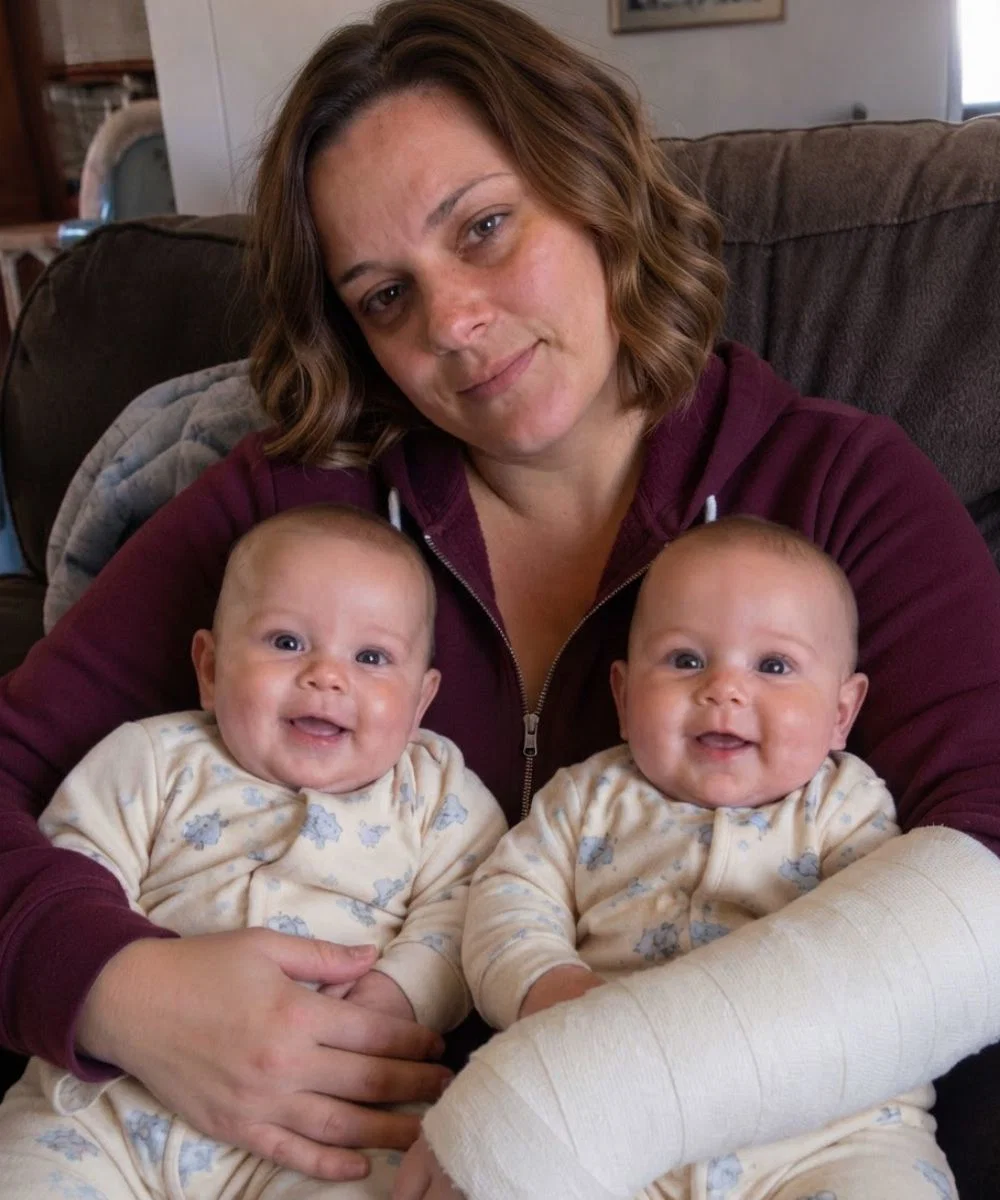
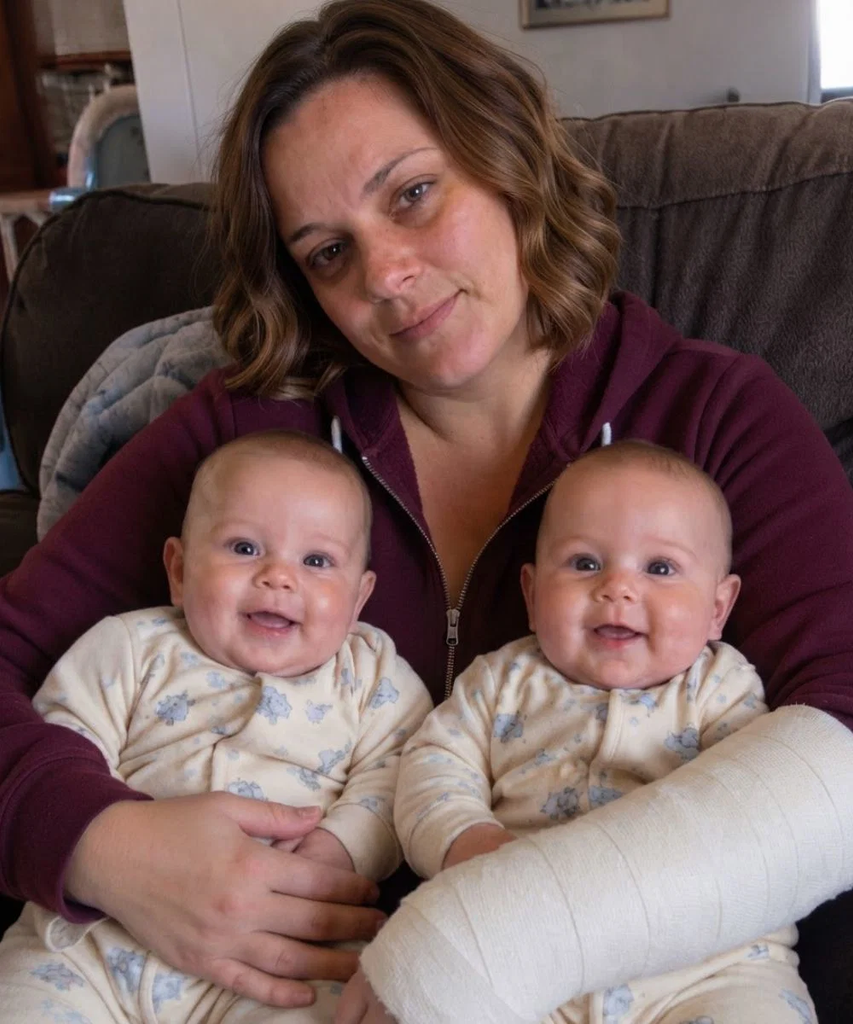
    Two days earlier, I had been sitting on the nursery floor, struggling to fasten Luke’s sleeper using only my left hand.

    My right arm was trapped inside a cast.

    Miles had started fussing behind me, and the cup of tea I had made earlier sat untouched on the changing table.

    Derek walked into the room, stepped over a basket of clean laundry, loosened his tie, and looked at me.

    “What’s for dinner, Hope?”

    I stopped fighting with Luke’s sleeper.

    “My arm is broken.”

    He glanced at the cast.

    “I know.”

    I waited for him to understand.

    He didn’t.

    “So?”

    I stared at him.

    “So what?”

    “I was hoping you might remember what the kitchen is for. Or at least know how to order takeout.”

    He didn’t laugh.

    “I worked ten hours today.”

    “And I fell down the stairs yesterday.”

    The doctor had put my fractured arm in a cast and specifically warned me not to lift Luke or Miles with it until it healed.

    Miles began crying harder.

    “Can you get him?” I asked.

    Derek checked his phone.

    “I haven’t even changed clothes yet.”

    “He doesn’t care what you’re wearing.”

    “Hope.”

    “What?”

    “I just got home.”

    “So did you stop being their father when you pulled into the driveway?”

    His mouth tightened.

    “I pay the bills.”

    “And?”

    “And I’m not coming home from work just to start another shift.”

    Another shift.

    That phrase stayed with me.

    As if being a father was overtime.

    “I need help for a few weeks,” I said carefully. “Come home an hour earlier when you can. Take a day off if you have one. Ask whether you can work from home sometimes.”

    “I have a job.”

    “So did I before maternity leave.”

    “Exactly. You’re home now.”

    “With two babies.”

    “You’re better at this than I am anyway.”

    “I’m better because I do it every day.”

    Miles started crying louder.

    Derek sighed as though the sound irritated him.

    “Can’t you just handle him?”

    “With one arm?”

    “You still have another one.”

    I went completely quiet.

    Then he shrugged.

    “You’re the one who wanted kids.”

    My head snapped up.

    “We wanted them. You were the one sending me nursery ideas before I was even pregnant.”

    “You know what I mean.”

    “No, Derek. I don’t. Right now, I don’t even know who you are.”

    He rubbed his forehead.

    “I’m exhausted, Hope. Moms don’t get sick days.”

    I looked down at my cast.

    “I’m injured.”

    “That’s not my problem.”

    I stared at him.

    “I’m asking you to help me for a few weeks.”

    “You take care of the babies. That’s your job.”

    Then he walked out.

    Miles kept crying.

    Luke reached up and grabbed the edge of my cast with both tiny hands.

    I gently pulled myself free and whispered, “Okay. I’ve got you.”

    I had been saying things like that for too long.

    I’ve got it.

    I’m fine.

    Even when neither was true.

    My mother, Noelle, came over the next afternoon.

    She found me wiping spilled formula from the kitchen counter with my good hand while Luke kicked happily in his seat.

    “Hope.”

    “I’m almost finished.”

    She took the cloth away from me.

    “Sit.”

    “Mom, the counter is sticky.”

    “It’ll still be sticky five minutes from now.”

    So I sat.

    She opened the microwave and found my abandoned cup of tea.

    “You reheated this already?”

    “Twice.”

    Mom knew me well enough to know I cleaned whenever I felt overwhelmed.

    She threw the old tea away and made me a fresh cup.

    “Where’s Derek?”

    “Work.”

    “And when he gets home?”

    I forced a small smile.

    “He’ll be tired, obviously.”

    Mom gave me a look.

    I took a sip.

    “I’m fine.”

    “There’s that voice you use when you’re lying to me.”

    I looked away.

    Mom didn’t lecture me.

    Instead, she helped with the twins, washed bottles, cooked dinner, and stayed until after we ate.

    —

    That night, Miles woke up first.

    Luke followed seconds later.

    I nudged Derek.

    “Can you take Luke?”

    He rolled onto his stomach.

    “I have work tomorrow.”

    “So?”

    “I have to be awake in four hours.”

    Luke’s cries became louder.

    “So do I.”

    “No, you don’t.”

    I froze.

    “What does that mean?”

    “You can sleep when they sleep.”

    I almost laughed.

    Instead, I got out of bed.

    Luke was still screaming while Derek pulled the blanket over his shoulder and went back to sleep.

    Three nights later, Mom called.

    “My car won’t start. I’m sorry, sweetheart. I can’t come over.”

    I looked at the twins.

    Both desperately needed a bath.

    “It’s okay, Mom.”

    “Don’t try bathing them by yourself.”

    “I won’t.”

    “Promise me.”

    “I’ll wait until Derek gets home. Promise.”

    When Derek finally walked through the door, I met him in the kitchen.

    “I need you to bathe the boys tonight.”

    He dropped his keys into the bowl near the door.

    “I literally just got home, Hope. Don’t you think you’re being a little ridiculous?”

    “I know you just got home.”

    “Skip the baths.”

    “They need them.”

    “Use a warm washcloth. That’s what tired mothers do.”

    “Derek.”

    He sighed.

    “I’ve been working all day.”

    “So have I.”

    He looked at me as though I had said something absurd.

    “Why should I have to come home and take care of the kids too?”

    I stopped.

    “Too?”

    “What?”

    “You said ‘too.’”

    “So?”

    “You actually think taking care of them is something I do after my day?”

    “You stay home.”

    “With Luke and Miles.”

    “You stay home and basically do nothing all day.”

    Normally, I would have defended myself.

    I would have listed the feedings, diaper changes, laundry, bottles, appointments, naps, crying, cleaning, and everything else.

    This time, I didn’t.

    I simply said, “Okay.”

    Derek frowned.

    “Okay what?”

    “Nothing.”

    “Don’t do that calm thing.”

    “What calm thing?”

    “That thing where you suddenly stop talking.”

    He knew I hated conflict.

    Usually, I kept explaining myself until everyone felt comfortable again.

    Mostly him.

    But that night, I stopped.

    —

    After the boys were asleep, I sat at the kitchen table with my aching arm resting on a folded towel.

    Earlier, Luke had reached for me, and I had been forced to ask Derek to pick up his own son because I physically couldn’t do it safely.

    I opened a notebook and wrote:

    Baths.

    Evening bottles.

    Carrying the boys upstairs.

    One nighttime waking.

    I stared at the list.

    These were not favors.

    They were things I physically could not safely do until my arm healed.

    The following evening, I slid the paper across the table toward Derek.

    He looked down.

    “What’s this?”

    “What needs to change while my arm heals.”

    He read through the first few lines.

    “You made me a schedule?”

    “I made us a plan.”

    He pushed it away.

    “I’m not doing shifts in my own house.”

    I stared at him.

    “Then tell me what you are willing to do.”

    His expression hardened.

    “Hope, I work all day.”

    “I know. I’m asking what happens after you come home.”

    He had no answer.

    I tapped the paper.

    “I can’t carry both boys. I can’t safely bathe them alone. Last night I tried to settle Luke myself because you wouldn’t get up.”

    That finally got his attention.

    “You shouldn’t have done that.”

    “I shouldn’t have needed to. But you gave me no choice.”

    Derek looked away.

    “Will you take over these things until my doctor clears me?”

    “No.”

    For days, I had convinced myself that Derek simply didn’t understand.

    That we were communicating badly.

    That if I explained myself clearly enough, eventually he would understand.

    But there was nothing confusing about that answer.

    No.

    I nodded.

    “All right.”

    Derek frowned.

    “What does that mean?”

    “It means I heard you.”

    I folded the paper and stood up.

    Inside the nursery, Luke moved slightly when I reached for the diaper bag.

    I froze until he settled.

    Then I called Mom.

    “Can the boys and I stay with you for a few days?”

    She went silent.

    “Did something happen?”

    “Nothing new. That’s the problem.”

    “Hope…”

    “I can’t keep risking my arm because Derek refuses to pick up his own children. I need my arm to heal properly, Mom. My boys need me.”

    Her voice softened immediately.

    “Do you want me to come get you? My car is fixed.”

    “Yes. I’ll pack.”

    “Are you leaving him?”

    I glanced toward the living room, where Derek was watching television.

    “No. I’m trying to heal.”

    It was the first time I said it without apologizing.

    An hour later, Mom handled the twins while I packed our things into the car.

    Derek came outside as I zipped the diaper bag.

    “Where are you going?”

    “Mom’s.”

    “With Luke and Miles?”

    “Yes.”

    His expression changed.

    “For how long?”

    “I don’t know.”

    “Hope, you can’t just walk out.”

    “I asked you to help me stay.”

    He stared at me.

    I didn’t wait for another argument.

    I got into the car.

    At Mom’s house, Luke fell asleep against her chest while Miles kicked his legs beside me on the couch.

    My phone rang.

    It was Derek.

    “Bring them home.”

    “No.”

    “I’m their father.”

    “Then start acting like one.”

    He went silent.

    Then his voice became sharper.

    “Do you realize what this makes me look like?”

    And suddenly, everything became clear.

    He hadn’t asked whether I was okay.

    He hadn’t asked if my arm hurt more.

    He hadn’t asked whether the twins were okay.

    His first concern was how he looked.

    “Tell people the truth,” I said.

    “Are you serious? How dare you make me look like some kind of deadbeat father?”

    “I didn’t make you look like anything.”

    “What am I supposed to tell my mother?”

    “The truth.”

    “And what exactly is that?”

    “Tell her I broke my arm. Tell her I asked you to help me. Tell her you told me mothers don’t get sick days.”

    Silence.

    Then Derek said, “You’re humiliating me.”

    That was when I understood completely.

    “You weren’t embarrassed when you said those things.”

    “What?”

    “You weren’t embarrassed when I was begging you for help.”

    “Hope.”

    “You’re only embarrassed now because someone else might find out.”

    My hand was shaking when I ended the call.

    Mom noticed.

    She didn’t ask what happened.

    She simply reached toward Miles.

    “Give him to me.”

    “I can hold him.”

    “I know.”

    There was something powerful about those two words.

    She wasn’t saying I couldn’t do it.

    She was reminding me that I didn’t have to.

    So I let her help.

    Derek arrived the following evening looking furious.

    “My mother called me,” he said when I opened the door. “She wanted to visit you and the boys. I had to tell her you weren’t home.”

    “And?”

    “She asked why.”

    “What did you tell her?”

    “The truth, apparently.”

    That surprised me.

    Derek glanced toward the living room.

    “She asked whether I had been helping you since you broke your arm.”

    “And?”

    “I told her you stay home with the boys while I work all day.”

    I waited.

    He rubbed the back of his neck.

    “Then she asked why you had to leave your own house just to find someone willing to help you.”

    “What did you say?”

    “Nothing.”

    “Why?”

    His jaw tightened.

    “Because I knew how it sounded.”

    Before I could respond, Miles began crying.

    Derek automatically looked toward me.

    “Hope?”

    I didn’t move.

    “You’ve got him.”

    “I don’t know what he wants.”

    “Neither do I yet.”

    “You usually know.”

    “I usually figure it out.”

    He hesitated before finally lifting Miles.

    The crying became louder.

    “See?” Derek said nervously. “I’m making it worse.”

    “You’ve been holding him for ten seconds.”

    “What do I do?”

    A hundred instructions immediately appeared in my mind.

    Check his diaper.

    Try rocking him.

    Hold him upright.

    Walk slowly.

    But instead of taking control, I said, “Start paying attention.”

    Derek began pacing too quickly.

    Miles cried harder.

    Derek slowed his steps.

    A minute later, the crying softened.

    “He’s stopping,” Derek whispered.

    “Yeah.”

    He looked down at our son.

    “You make this look easy.”

    “You told me I do nothing all day.”

    “I know.”

    “Why?”

    He swallowed.

    “Because every time I came home, you already knew what they needed, and I didn’t.”

    “You could have learned.”

    “I know.”

    “Then why didn’t you?”

    His voice dropped.

    “Because I felt useless. Every time you asked me to do something, it reminded me that I didn’t know how.”

    “So you wanted me to stop asking.”

    He nodded.

    Miles curled his tiny fist into Derek’s shirt.

    “Feeling scared doesn’t excuse what you said to me.”

    “I know.”

    For months, I had wanted to see Derek holding one of our sons like that.

    Now he finally was.

    But I also knew one moment wasn’t enough.

    A few days later, Derek texted me a photograph of our spotless kitchen.

    Cleaned everything. Come home?

    I stared at the message for a moment before replying.

    What time does Miles usually take his last bottle?

    The typing dots appeared.

    Then disappeared.

    Then appeared again.

    He never answered.

    That evening, Derek came over.

    “What do you want me to do, Hope?”

    “I want you to stop waiting for instructions.”

    “I’m trying.”

    “Then try without turning me into your manager.”

    He sat across from me.

    “I cleaned the entire house. I thought you’d be happy.”

    “I’d be happier if you knew why Miles’ cry sounds different from Luke’s.”

    He looked down.

    “Then teach me.”

    For a second, I almost agreed.

    The old version of me would already have been reaching for a notebook.

    Instead, I shook my head.

    “No. Watch them. Learn them. Spend enough time with your sons that you know.”

    His expression tightened.

    “And what if I mess up?”

    “You will.”

    He looked surprised.

    “So will I.”

    That seemed to catch him off guard.

    I glanced at my cast.

    “I’ve spent the last few weeks feeling like I’m failing because I can’t even safely lift my own babies.”

    “Hope…”

    “Let me finish. When this cast comes off, I’ll get another chance to feel like myself again. You can have a second chance too.”

    “At us?”

    “At becoming better than you’ve been.”

    I held his gaze.

    “But I’m not dragging you there.”

    Over the next several weeks, Derek began showing up without waiting to be asked.

    Twice a week, he left work on time.

    He added the twins’ medical appointments to his own calendar.

    He learned that Luke settled faster when pressed against his chest.

    He discovered that Miles usually needed movement before he could fall asleep.

    He still made mistakes.

    But I stopped immediately stepping in to rescue him every time something went wrong.

    He needed to learn.

    And I needed to stop carrying everything simply because I could do it faster.

    Three weeks later, my arm had healed enough that I decided to bring some of our belongings home.

    Not everything.

    Derek noticed immediately.

    “You’re keeping clothes at your mom’s?”

    “Yes.”

    “Because you still don’t trust me?”

    I thought about the question.

    “Because I’m learning to trust myself. If everything falls apart again, I’m not going to wait until I’m physically broken before I do something about it.”

    That night, Miles began crying from the nursery.

    Out of habit, I started to stand.

    But Derek was already on his feet.

    “I’ve got him,” he said. “That’s his tired cry.”

    Then he disappeared down the hallway.

    A minute later, Miles became quiet.

    I picked up the cup of tea beside me.

    It was still warm.

    For months, I had believed being a good mother meant carrying everything.

    Then I broke my arm and learned something much more important.

    A good mother doesn’t have to prove how much she can endure.

    And a father shouldn’t have to be repeatedly asked to act like one.

  • My Grandpa Left Every Grandchild $1—Except the Granddaughter Who Came Every Wednesday

    My Grandpa Left Every Grandchild $1—Except the Granddaughter Who Came Every Wednesday

    PART 3

    I handed it to her. Her eyes moved across the page.

    Then stopped. “That’s not possible.” The balance was $418,760.22.

    P

    June looked at me. “Grandpa didn’t have that kind of money.”

    “No,” I said. “He didn’t.”

    There was another sheet beneath the bank statement.

    I pulled it out.

    This one was a photocopy of a deed.

    The property description took up half the page.

    I recognized the county numbers immediately.

    It was Grandpa’s farm.

    Or at least part of it.

    June stared at the paper.

    “What am I looking at?”

    “Looks like a deed.”

    “To what?”

    I pointed.

    “Your name.”

    Her face went blank.

    For several seconds, neither of us moved.

    Then the sound of an engine came from behind us.

    June folded the papers quickly and shoved them back into the envelope.

    “Don’t tell them.”

    “I wasn’t planning to.”

    “No.”

    She looked toward the road.

    The Silverado had stopped near the gate.

    Mark got out.

    Dale climbed from the Jeep.

    Aunt Carol was right behind them, still wearing the black dress she’d worn to the funeral.

    There was something almost ridiculous about six grown adults standing beside trucks on a dirt road because they couldn’t wait another hour to find out what an old man had left behind.

    June locked the envelope inside the glove compartment.

    Then she got out.

    I followed.

    Mark walked toward us.

    “What did he leave you?”

    June said nothing.

    Dale laughed.

    “Come on, June. We’re family.”

    I almost laughed at that.

    Family.

    That word had been doing a lot of work for people who hadn’t visited Grandpa in months.

    Aunt Carol stepped forward.

    “Your grandfather clearly made some kind of mistake.”

    June looked at her.

    “Mr. Albright read the will.”

    “He read what was written.”

    “Exactly.”

    Carol’s mouth tightened.

    “You know what I mean.”

    June shook her head.

    “No. I don’t.”

    Mark came closer.

    “Just tell us what’s in the envelope.”

    “No.”

    One word.

    Quiet.

    But it landed harder than shouting.

    Mark looked genuinely surprised.

    Maybe because June had spent two years saying yes.

    Yes, I’ll bring groceries.

    Yes, I’ll change the sheets.

    Yes, I’ll drive him to the doctor.

    Yes, I’ll stay another hour.

    Yes, I’ll take care of it.

    Now she was saying no.

    Dale looked at me.

    “You know what’s in it.”

    I didn’t answer.

    “You opened it.”

    I said, “It’s June’s.”

    Aunt Carol stepped between us.

    “Don’t make this ugly.”

    I looked at her.

    “You followed her down a dirt road.”

    Nobody spoke.

    Then something happened that none of us expected.

    The cattle gate behind us swung open.

    Not because anyone touched it.

    The wind had caught it.

    The metal slammed against the post.

    Everyone turned.

    And for some reason, June started crying.

    Not loudly.

    Just two tears.

    She wiped them away immediately.

    “I need to go inside.”

    Grandpa’s house sat another hundred yards down the lane.

    Nobody moved.

    Then June got back into the Tacoma.

    I climbed in beside her.

    She started the engine.

    Mark shouted after us.

    “June!”

    She kept driving.

    The others followed.


    Grandpa’s house looked exactly as it had the day before the funeral.

    The porch light was still on.

    The newspaper he’d never gotten around to reading sat beside the front door.

    His work boots were beneath the chair.

    One boot had a dried line of mud across the toe.

    June stopped the truck.

    She didn’t get out.

    “I can’t.”

    I looked at her.

    “What?”

    “I can’t walk in there.”

    “You don’t have to.”

    She stared through the windshield.

    “I was here every Wednesday.”

    “I know.”

    “And every Wednesday I thought there would be another Wednesday.”

    Her voice broke.

    “I didn’t know the last one was the last one.”

    I didn’t say anything.

    Because there was nothing to say.

    After a minute, she opened the door.

    We walked inside.

    The others stayed outside for a moment.

    Then Mark and Dale came in too.

    Aunt Carol followed.

    Nobody asked permission.

    The living room still smelled like Grandpa.

    Old Spice.

    Menthol.

    Coffee.

    Something faintly medicinal.

    June stood in the middle of the room.

    Then she looked toward his chair.

    His favorite chair.

    The brown recliner.

    She had spent hundreds of hours beside it.

    The blanket she’d washed every week was folded over the arm.

    June walked over and touched it.

    “That’s where he slept after his surgery.”

    Nobody spoke.

    She looked at the kitchen.

    “That’s where I burned the meatloaf.”

    Dale smiled faintly.

    “You burned meatloaf?”

    June laughed through her tears.

    “Once.”

    “You said you couldn’t cook.”

    “I can cook.”

    “You made terrible meatloaf.”

    “It was one time.”

    For a brief second, we were children again.

    Then June’s smile disappeared.

    She looked toward the envelope.

    “I need to know what he was trying to tell me.”

    We went into the kitchen.

    June placed the envelope on the table.

    She opened it again.

    There were more documents beneath the bank statement.

    A letter.

    Two photographs.

    A key.

    And a small handwritten note.

    June picked up the note first.

    It said:

    June—

    If you are reading this, I am gone.

    I know you will be tempted to give everything away because that is what you have always done.

    Don’t.

    June’s hands began shaking.

    She continued.

    This is not payment for taking care of me.

    You never worked for me.

    You loved me.

    She stopped.

    I saw her swallow.

    Then she read the next line.

    There is a difference.

    Nobody spoke.

    Even Carol was silent.

    June continued.

    The money in the Salina account came from the land.

    Not the house.

    Not the farm equipment.

    The land.

    She looked at me.

    “What land?”

    I pointed to the deed.

    “The farm.”

    She kept reading.

    Twenty-seven years ago, I sold mineral rights on part of the property.

    Mark immediately stepped forward.

    “Mineral rights?”

    Grandpa’s voice seemed to echo through the room.

    June kept reading.

    I never told the family because I knew what would happen.

    Dale frowned.

    “What would happen?”

    June looked at him.

    “Apparently exactly this.”

    She returned to the letter.

    The first payments were small. Then the company discovered something deeper.

    She stopped.

    Her eyes widened.

    “What?”

    I took the letter from her.

    The next paragraph was difficult to understand.

    But one phrase was very clear.

    Natural gas reserve.

    Mark swore under his breath.

    Dale grabbed the deed.

    “Let me see that.”

    June pulled it away.

    “No.”

    Dale stared at her.

    “June, this could be worth millions.”

    “I know.”

    “No, you don’t.”

    He laughed nervously.

    “Do you understand what you’re holding?”

    June looked at him.

    “Yes.”

    She folded the letter.

    “Something Grandpa wanted me to have.”

    Mark stepped closer.

    “Why would he leave it to you?”

    June’s eyes hardened.

    “I don’t know.”

    Aunt Carol finally spoke.

    “He was old. He wasn’t thinking clearly.”

    June turned.

    “He wrote this before he went into hospice.”

    Carol didn’t answer.

    June pulled out the bank card Mr. Albright had given her.

    On the back was a handwritten phone number.

    And below it:

    Ask for Helen Ward.

    There was another line.

    She knows everything.

    Nobody slept that night.

    At least not me.

    June called the number at 8:12 the next morning.

    A woman answered.

    “Salina National.”

    June hesitated.

    “My name is June Parker.”

    Silence.

    Then the woman said:

    “Mr. Parker’s granddaughter?”

    June’s eyes met mine.

    “Yes.”

    The woman took a breath.

    “I’ve been expecting your call.”

    June sat straighter.

    “How long?”

    “Since your grandfather died.”

    “Who are you?”

    “My name is Helen Ward. I was his private banking officer.”

    June looked at the papers spread across the table.

    “How much money did he have?”

    Helen paused.

    “Which account?”

    June stared at me.

    “Which account?”

    Helen answered carefully.

    “The one your grandfather left instructions for you to access.”

    June’s voice became quieter.

    “How many accounts are there?”

    Another pause.

    “Three.”

    Mark, who had apparently arrived without anyone inviting him, froze in the doorway.

    June saw him.

    She turned away.

    “How much?”

    Helen said a number.

    June’s face went pale.

    She put the phone on speaker.

    Helen repeated it.

    “$1.8 million.”

    Nobody breathed.

    Dale whispered, “What?”

    June asked, “Is that all?”

    Helen replied:

    “No.”

    June’s hand tightened around the phone.

    “What do you mean, no?”

    “The money in those accounts is separate from the trust.”

    “What trust?”

    Helen was silent.

    Then she said:

    “Mr. Parker established a family trust twenty-one years ago.”

    Mark stepped into the kitchen.

    “For whom?”

    Helen answered.

    “That depends on which document you read.”

    June’s heart was pounding so loudly I could hear it.

    “Who is the beneficiary?”

    Helen said:

    “You.”

    Mark slammed his palm on the counter.

    “That’s impossible!”

    Helen heard him.

    “Mr. Parker specifically instructed us not to discuss the trust with anyone except June Marie Parker.”

    Mark grabbed the phone.

    “Listen—”

    June took it from him.

    “Don’t.”

    Mark stared at her.

    For the first time, he looked afraid.

    Not angry.

    Afraid.

    June said into the phone:

    “Helen, what exactly did my grandfather put into the trust?”

    Helen answered:

    “Land.”

    June closed her eyes.

    “How much?”

    “All of it.”

    The next morning, Mr. Albright came to the house.

    He looked older than he had at the reading.

    He carried a leather briefcase.

    When he saw Mark, Dale, Carol, and the others in the living room, he stopped.

    “I asked June to meet me privately.”

    Carol stood.

    “We’re family.”

    Mr. Albright sighed.

    “Mrs. Wilson, I have explained this already.”

    Carol’s cheeks reddened.

    He turned to June.

    “Your grandfather anticipated this.”

    June almost smiled.

    “He did?”

    “Yes.”

    Mr. Albright opened his briefcase.

    “He knew there would be questions.”

    He pulled out a folder.

    “He also knew some of those questions would not be asked politely.”

    Nobody moved.

    Mr. Albright placed the folder on the table.

    “Your grandfather left very specific instructions.”

    June opened it.

    The first page was a legal document.

    The second was a list.

    Names.

    Amounts.

    Property.

    Dates.

    Then she saw something that made her stop.

    Her own name wasn’t alone.

    Beside it was another name.

    Eleanor Parker.

    June whispered:

    “Who is Eleanor?”

    Mr. Albright looked at her.

    “Your grandmother.”

    June frowned.

    “My grandmother died before I was born.”

    “Yes.”

    He turned another page.

    “This is where your grandfather’s secret becomes complicated.”

    June looked at him.

    “How?”

    Mr. Albright sat down.

    “Your grandmother did not die broke, June.”

    The room became silent.

    “She left your grandfather a substantial inheritance.”

    June stared.

    “Then why did we grow up thinking they had nothing?”

    “Because your grandfather gave almost all of it away.”

    “To charity?”

    Mr. Albright shook his head.

    “To someone.”

    “Who?”

    He looked toward Mark.

    Then Dale.

    Then Carol.

    Finally, June.

    “Your grandfather spent twenty years trying to protect someone.”

    June’s voice was barely audible.

    “Who?”

    Mr. Albright slid a photograph across the table.

    It showed Grandpa thirty years younger.

    Beside him stood a woman.

    June recognized her immediately.

    Her grandmother.

    But there was another person in the photograph.

    A little girl.

    Maybe six years old.

    June picked up the picture.

    “Who is she?”

    Mr. Albright didn’t answer.

    June looked closer.

    The little girl had Grandpa’s eyes.

    And on the back of the photograph, written in her grandfather’s handwriting, were seven words:

    The child your grandmother wanted me to find.

    June looked up.

    “Mr. Albright?”

    He took a slow breath.

    “That girl is alive.”

    June’s fingers went cold.

    “Where?”

    Mr. Albright looked at the others.

    Then back at June.

    “That’s what the rest of your grandfather’s letter is about.”


    Nobody followed us when we left the house.

    Not immediately.

    Mr. Albright drove his sedan.

    June followed.

    I rode beside her.

    We drove north for nearly forty minutes.

    No explanation.

    No conversation.

    Finally, June said:

    “Who do you think she is?”

    “I don’t know.”

    “Maybe a cousin.”

    “Maybe.”

    She shook her head.

    “No.”

    “What?”

    “Grandpa wouldn’t hide a cousin for thirty years.”

    She was right.

    When we arrived at a small cemetery, Mr. Albright parked beside the office.

    June got out.

    There were no cars.

    No family.

    Just wind moving through the grass.

    Mr. Albright waited for us.

    He held another envelope.

    “This was supposed to be given to you only after the bank verified your identity.”

    June took it.

    “Why didn’t you give me this yesterday?”

    “Because yesterday you were grieving.”

    “And today?”

    “Today you’re beginning to understand.”

    June opened the envelope.

    Inside was one handwritten page.

    She read silently.

    Then she handed it to me.

    I read it.

    And my stomach dropped.

    June,

    If you have reached this point, you now know about the money.

    You also know about the girl.

    Her name is Ruth.

    She is your mother’s older sister.

    I looked at June.

    She stared at the cemetery.

    Her mother had always told everyone she was an only child.

    Grandpa had apparently known otherwise.

    The letter continued.

    Your grandmother had a daughter before she married me.

    Her name was Ruth Eleanor Bennett.

    She was six when her father took her away.

    Your grandmother spent the rest of her life trying to find her.

    June whispered:

    “Why didn’t Grandpa tell us?”

    I kept reading.

    Because Ruth did not want to be found.

    And because someone in this family made sure she stayed hidden.

    June looked up.

    “Someone in our family?”

    Mr. Albright nodded.

    “Your grandfather believed so.”

    June’s voice changed.

    “Who?”

    Mr. Albright looked at the paper.

    “I don’t know.”

    “You do.”

    He shook his head.

    “Your grandfather never wrote the name.”

    June folded the letter.

    “Then why bring me here?”

    Mr. Albright pointed toward a grave.

    June followed his finger.

    Her grandmother’s name was carved into the stone.

    Eleanor Marie Bennett Parker.

    June stood there for a long time.

    Then she noticed something.

    The date beneath her grandmother’s name.

    And another date.

    Someone had scratched initials into the stone years ago.

    R.E.B.

    June touched them.

    “Ruth Eleanor Bennett.”

    Mr. Albright nodded.

    June looked at him.

    “She came here.”

    “Yes.”

    “When?”

    “Last year.”

    June’s breath caught.

    “She’s alive?”

    “Yes.”

    “Where is she?”

    Mr. Albright reached into his pocket.

    He pulled out a folded piece of paper.

    “There is one address.”

    June took it.

    She read it.

    Then looked at me.

    The address was in a small town three hours away.

    A nursing home.

    June stared at the paper.

    “Why would she be there?”

    Mr. Albright’s expression changed.

    “Because she is sick.”

    June swallowed.

    “Does she know about Grandpa?”

    “She knew him.”

    “Did she know who I was?”

    Mr. Albright nodded.

    “She asked about you.”

    June’s eyes filled.

    “When?”

    “Two weeks before your grandfather died.”

    “Why?”

    Mr. Albright hesitated.

    Then he said:

    “She wanted to know whether you were still the girl who visited an old man every Wednesday.”

    June wiped her cheek.

    “Why?”

    “Because,” he said, “your grandfather told her that if anything happened to him, you were the only person in the family he trusted.”

    June looked down at the address.

    Then something clicked.

    She remembered something Grandpa had said months earlier.

    A sentence she’d dismissed as another confused story.

    She’d been shaving his face.

    He’d looked at her in the mirror and said:

    “Sometimes the person who loves you most isn’t the person who shares your blood.”

    June had laughed.

    “Grandpa, that’s deep for a Wednesday.”

    He’d smiled.

    “Wednesday is when the truth comes.”

    She had forgotten.

    Until now.

    June looked at the road.

    “We’re going.”

    Mr. Albright nodded.

    “There’s one more thing.”

    She stopped.

    “What?”

    He reached into his briefcase.

    Pulled out a second photograph.

    And handed it to her.

    It showed Ruth as an adult.

    Standing beside a man.

    June stared at the man.

    She knew him.

    We all did.

    He had been at the funeral.

    He had hugged Aunt Carol.

    He had stood behind Mark during the will reading.

    June’s face turned white.

    “That’s impossible.”

    I took the photograph.

    My stomach tightened.

    It was Dale’s father.

    The man who had died eighteen years earlier.

    June looked at Mr. Albright.

    “Why was Ruth standing with him?”

    Mr. Albright’s voice was quiet.

    “Because your grandfather believed Ruth didn’t disappear from the family.”

    He looked at June.

    “She was pushed out.”

    June stared at the photograph.

    “By who?”

    Mr. Albright didn’t answer.

    He didn’t need to.

    Behind us, gravel crunched.

    We turned.

    Aunt Carol’s Buick was coming down the road.

    She had followed us.

    And this time, she wasn’t laughing.

    She got out of the car slowly.

    Her face was pale.

    She looked at the photograph in June’s hand.

    Then she whispered:

    “Your grandfather finally told you.”

    June froze.

    Carol looked at her.

    “I wondered how long he’d keep the secret.”

    June stepped forward.

    “What secret?”

    Carol’s eyes filled with tears.

    And for the first time in my life, I saw fear in my aunt’s face.

    She whispered:

    “Ruth wasn’t the only child.”

    June stopped breathing.

    Carol looked toward the cemetery.

    “There were three of us.”

    Then she looked directly at June.

    “And one of them was your mother.”

    June’s face went completely still.

    Carol continued:

    “Your grandfather didn’t leave you the money because you took care of him.”

    She pointed toward the envelope.

    “He left it to you because you’re the last person in this family who doesn’t know what happened.”

    And then Aunt Carol said the words that changed everything:

    “Your mother wasn’t an only child. She was the reason Ruth disappeared.”

    PART 4

    “Your mother wasn’t an only child. She was the reason Ruth disappeared.”

    For several seconds, nobody moved.

    The wind pushed dry grass against the cemetery fence.

    Somewhere far away, a tractor engine rumbled.

    June stared at Aunt Carol as if she were speaking another language.

    “My mother?” June finally whispered.

    Carol nodded.

    “Your mother.”

    “My mother made Ruth disappear?”

    “I didn’t say that.”

    “You just did.”

    “I said she was the reason.”

    June stepped closer.

    “Then tell me what happened.”

    Carol looked at Mr. Albright.

    He said nothing.

    That seemed to give her permission.

    Carol took a long breath.

    “Your grandmother had three daughters.”

    She pointed toward the cemetery.

    “Ruth was the oldest. Your mother, Linda, was the middle one. I was the youngest.”

    June’s mouth opened slightly.

    “You?”

    “Yes.”

    “My mother never told me.”

    “She couldn’t.”

    “Why?”

    “Because she was ashamed.”

    June laughed once.

    There was no humor in it.

    “My mother lied to me my entire life.”

    Carol looked down.

    “She lied to everybody.”

    Then she told us the story.

    Ruth had been six when Eleanor married June’s grandfather.

    The marriage was complicated.

    Eleanor loved Ruth fiercely, but Ruth’s biological father had custody.

    When Ruth’s father died, Eleanor finally had the chance to bring her home permanently.

    But Ruth came back changed.

    She was angry.

    Frightened.

    Difficult.

    And she wanted the attention she had missed.

    Linda was fourteen at the time.

    Carol was ten.

    According to Carol, Linda hated that.

    “She thought Ruth was stealing Grandma from her,” Carol said.

    June’s eyes narrowed.

    “And what did she do?”

    Carol hesitated.

    “She told a lie.”

    “What lie?”

    “She told Grandpa that Ruth had stolen money from the house.”

    June stared.

    “Did she?”

    “No.”

    Carol shook her head.

    “She didn’t steal anything.”

    “What happened?”

    “Your grandfather believed Linda.”

    “And he sent Ruth away?”

    “No.”

    Carol’s eyes filled with tears.

    “Worse.”

    She looked at the grave.

    “Ruth was sent to live with relatives in Nebraska. She was told she was going there for a few weeks.”

    June whispered:

    “And she never came back.”

    “No.”

    “Why?”

    “Because when she tried, Linda told her she wasn’t wanted.”

    June covered her mouth.

    Carol continued.

    “Ruth wrote letters. Your grandmother answered them. But Linda intercepted some of them.”

    June looked sick.

    “You’re saying my mother kept Ruth away from Grandma?”

    “Yes.”

    “For how long?”

    “Years.”

    “And Grandpa knew?”

    “Eventually.”

    Carol’s voice cracked.

    “He found out after your grandmother died.”

    June looked toward the grave.

    “And that’s when he started looking for her.”

    Mr. Albright finally spoke.

    “Your grandfather spent years trying to locate Ruth.”

    June looked at him.

    “Did he find her?”

    “Yes.”

    “When?”

    “Twenty-seven years ago.”

    June’s eyes widened.

    “The photograph.”

    Mr. Albright nodded.

    “That photograph was taken the day he found her.”

    June looked down at the picture again.

    Ruth was standing beside Dale’s father.

    She had looked young.

    Healthy.

    Almost happy.

    “Why didn’t Grandpa bring her home?”

    Mr. Albright answered.

    “She didn’t want to come.”

    “Because of my mother?”

    “Yes.”

    June closed her eyes.

    “What happened between them?”

    Carol answered.

    “Ruth forgave your grandfather.”

    She swallowed.

    “But she never forgave Linda.”

    June’s face crumpled.

    “My mother is dead.”

    “I know.”

    “And I never knew any of this.”

    “I know.”

    June turned toward Carol.

    “Why didn’t you tell me?”

    Carol looked at the ground.

    “Because I was afraid.”

    “Of what?”

    “Of losing my family.”

    June stared at her.

    “You already lost it.”

    That sentence broke something in Carol.

    She sat down on the cemetery bench and began to cry.

    We drove to the nursing home that afternoon.

    June didn’t speak much.

    Neither did I.

    The three-hour drive felt longer.

    When we finally arrived, the receptionist looked at June’s name and immediately called someone.

    A few minutes later, an elderly woman in a wheelchair appeared at the end of the hallway.

    She was thin.

    Very thin.

    Her white hair was pulled into a braid.

    Her hands trembled.

    But her eyes were sharp.

    She looked at June.

    And smiled.

    “Eleanor’s eyes.”

    June stopped.

    The woman’s voice trembled.

    “You have your grandmother’s eyes.”

    June couldn’t move.

    The woman reached toward her.

    “Come here.”

    June walked forward.

    Ruth touched her cheek.

    “You look just like her.”

    June started crying.

    Ruth pulled her into a hug.

    For almost a minute, neither of them said anything.

    Then Ruth whispered:

    “Your grandfather kept his promise.”

    June pulled away.

    “What promise?”

    “He promised me that one day you’d know.”

    June sat beside her.

    “What happened?”

    Ruth looked at me.

    Then at June.

    “You really want to know?”

    “Yes.”

    “Even if it changes how you remember your mother?”

    June nodded.

    “My memories already changed.”

    Ruth sighed.

    “Your mother was young. That’s not an excuse. But she was afraid.”

    “Of you?”

    “No.”

    Ruth looked toward the window.

    “She was afraid your grandmother would love me more.”

    June’s face softened.

    “She was jealous.”

    “Yes.”

    “And Grandpa?”

    “He tried to fix it.”

    Ruth smiled sadly.

    “He wasn’t very good at fixing people.”

    That sounded exactly like Grandpa.

    June laughed through her tears.

    Ruth reached beneath a blanket.

    She pulled out a small wooden box.

    “I’ve kept this for thirty years.”

    She handed it to June.

    June opened it.

    Inside were letters.

    Dozens of them.

    Some were addressed to her grandmother.

    Some to Grandpa.

    And some to June.

    June picked one up.

    “Why did you write to me?”

    “Because your grandfather told me about you.”

    “When?”

    “Years ago.”

    “What did he say?”

    Ruth smiled.

    “He said you were the only grandchild who visited because you wanted to.”

    June started crying again.

    Ruth squeezed her hand.

    “He told me you brought him meatloaf.”

    June laughed.

    “In a Cool Whip tub.”

    “I remember.”

    “That’s ridiculous.”

    “No.”

    Ruth smiled.

    “It’s love.”

    The wooden box contained one final document.

    A letter from Grandpa.

    June opened it that evening in the motel room.

    I sat beside her.

    She read it aloud.

    “June,

    By now you’ve met Ruth.

    If she has forgiven me, then I have been luckier than I deserve.

    I spent most of my life believing money could repair mistakes.

    It can’t.

    Money can buy land.

    Medicine.

    Security.

    Time.

    But it cannot buy back a childhood.

    It cannot make a daughter trust her mother again.

    It cannot make a woman forget that she was abandoned.

    I made mistakes.

    Your grandmother made mistakes.

    Your mother made mistakes.

    Ruth made mistakes.

    But you are not responsible for any of them.

    That is why I chose you.”

    June stopped reading.

    I waited.

    She continued.

    “The money is yours because I watched what you did when nobody was watching.

    You came every Wednesday.

    Not because I paid you.

    Not because you expected anything.

    You came because you loved me.

    I want you to understand something.

    The others will tell you that I was unfair.

    Maybe I was.

    But they have spent years believing inheritance is something you earn by being born into the right family.

    I believe inheritance should be something you use to build a better life.

    So use it.

    Don’t hide it.

    Don’t let them guilt you out of it.

    And don’t spend your life taking care of everyone else.

    Live.

    Travel.

    Laugh.

    Go somewhere you’ve never been.

    Buy something ridiculous.

    Eat dessert before dinner.

    And if you ever wonder whether you were enough for me, remember this:

    You were the only one who came when there was nothing left to inherit.”

    June couldn’t continue.

    She pressed the letter against her chest.

    I put my arm around her.

    After a long silence, she whispered:

    “He knew.”

    “He knew what?”

    “That I thought I wasn’t important.”

    She looked toward the window.

    “He knew.”

    The next morning, June returned to Salina.

    Mr. Albright was waiting.

    He had one final folder.

    “I want you to understand what you’re inheriting,” he said.

    Inside were the legal documents.

    The trust contained the farm.

    The mineral rights.

    The bank accounts.

    And a significant amount of stock Grandpa had quietly accumulated over the years.

    The total value was far greater than anyone in the family had imagined.

    Nearly $6.4 million.

    June stared at the number.

    “I don’t want all this.”

    Mr. Albright smiled.

    “Your grandfather predicted you’d say that.”

    He handed her another envelope.

    Inside was a handwritten note.

    If June says she doesn’t want the money, tell her she already spent twenty years earning the right to say yes.

    June laughed.

    Then cried.

    Then laughed again.

    The family meeting happened three days later.

    Everyone came.

    Mark.

    Dale.

    Tommy.

    Aunt Carol.

    Even the cousins who had never once visited Grandpa’s house.

    They sat around the same table where the will had been read.

    This time, June sat at the head.

    She placed the original will on the table.

    Then the trust documents.

    Nobody spoke.

    Mark finally said:

    “So it’s true.”

    June nodded.

    “The farm is mine.”

    Dale leaned forward.

    “And the mineral rights?”

    “Mine.”

    “The accounts?”

    “Mine.”

    Carol whispered:

    “And Ruth?”

    June looked at her.

    “She is alive.”

    The room went silent.

    Carol started crying.

    June continued.

    “She forgave Grandpa.”

    Carol looked down.

    “I don’t know if she will forgive us.”

    June shook her head.

    “She didn’t say.”

    Mark rubbed his face.

    “What happens to us?”

    June looked around the table.

    For years, she had imagined this moment.

    She could have humiliated them.

    She could have told them they deserved nothing.

    She could have made them beg.

    Instead, she remembered Grandpa’s letter.

    Don’t spend your life taking care of everyone else.

    June folded her hands.

    “You each got your dollar.”

    Nobody moved.

    Then she smiled faintly.

    “And I’m not changing the will.”

    Dale’s face fell.

    “But—”

    “No.”

    She stood.

    “The farm isn’t being divided.”

    Mark looked angry.

    “You can’t just keep everything.”

    June looked at him.

    “Apparently I can.”

    He opened his mouth.

    Then closed it.

    June continued.

    “But I’m not going to punish you either.”

    She explained what she had decided.

    The house would be preserved.

    The farm would remain in the family trust.

    A portion of the money would establish a small rural caregiver fund in Grandpa’s name.

    It would help families who were caring for elderly relatives and couldn’t afford basic supplies, transportation, or respite care.

    Another portion would be used to restore the old farmhouse.

    And Ruth would receive a share.

    Carol looked at her.

    “You’re giving Ruth money?”

    “No.”

    June paused.

    “I’m giving Ruth back what should have been hers.”

    Six months later, the farm looked different.

    The old porch had been repaired.

    The kitchen had been repainted.

    The fence posts were straight again.

    Grandpa’s recliner remained exactly where he’d left it.

    June refused to sell it.

    On the first Wednesday of every month, June drove out to the farm.

    Sometimes Ruth came.

    Sometimes Carol did.

    Sometimes nobody did.

    June would sit on the porch with coffee.

    She kept the old blue cooler.

    It was dented now.

    The handle was cracked.

    But she refused to throw it away.

    One afternoon, Ruth asked her:

    “Why do you still use that thing?”

    June smiled.

    “Because Grandpa liked it.”

    Ruth shook her head.

    “He would have hated how sentimental you’re becoming.”

    June laughed.

    “He was sentimental.”

    “He pretended not to be.”

    “So do I.”

    They sat together watching the sun fall behind the fields.

    After a while, Ruth said:

    “Your grandfather was proud of you.”

    June looked down.

    “I know.”

    “And your mother?”

    June was quiet.

    “I don’t know what to think about her yet.”

    Ruth nodded.

    “You don’t have to.”

    June looked at her.

    “Did you forgive her?”

    Ruth considered the question.

    “Forgiveness isn’t the same as pretending it didn’t happen.”

    June nodded.

    “I know.”

    “You can love someone and still admit they hurt you.”

    June looked across the field.

    “I think I’m finally learning that.”

    A year after Grandpa’s death, the family returned to his house.

    There was no will reading this time.

    No lawyers.

    No envelopes.

    No arguments.

    They gathered for Thanksgiving.

    June cooked the meatloaf.

    She served it on Grandpa’s old plates.

    Someone laughed when they saw the Cool Whip tub sitting on the counter.

    “Still using that?”

    June smiled.

    “Of course.”

    Mark had changed.

    Dale had changed too.

    Not completely.

    People rarely change completely.

    But they visited.

    They volunteered at the caregiver fund.

    They stopped asking June about money.

    And Aunt Carol?

    She visited Ruth every Sunday.

    At first, Ruth wouldn’t let her stay long.

    Twenty minutes.

    Then thirty.

    Then an hour.

    One Sunday, Carol arrived with a pie.

    Ruth opened the door.

    “You made that?”

    Carol nodded.

    “It’s terrible.”

    Ruth smiled.

    “Come in.”

    It was the first time Carol had been invited inside.

    June watched from the kitchen window.

    She didn’t interfere.

    Some wounds had to heal between the people who created them.

    She couldn’t do that work for them.

    She had spent too much of her life doing things for everyone else.

    Now she was learning to let people carry their own burdens.

    Two years after Grandpa’s death, June sold the mineral rights.

    The offer was enormous.

    Much larger than anyone expected.

    She could have bought a mansion.

    A fleet of cars.

    A dozen houses.

    Instead, she bought one small house near the lake.

    It had a wide porch.

    A vegetable garden.

    And a kitchen big enough to make too much meatloaf.

    She traveled.

    She went to places she’d always said she would visit “someday.”

    Someday finally arrived.

    She went to Montana.

    Arizona.

    Maine.

    She stood beside the ocean for the first time and called me laughing.

    “I finally did it.”

    “Did what?”

    “Nothing.”

    “What?”

    “Exactly.”

    She laughed.

    “I finally did nothing.”

    And she sounded happy.

    Really happy.

    On the third anniversary of Grandpa’s death, June returned to his grave.

    She brought peppermint candies.

    She placed three beside the stone.

    One for Grandpa.

    One for Grandma.

    One for Ruth’s childhood that had been lost.

    Then she sat in the grass.

    “I understand now,” she said.

    There was nobody there to hear her.

    But she said it anyway.

    “You didn’t leave me money because you loved me more.”

    She smiled.

    “You left it because you knew I wouldn’t let it turn me into someone I wasn’t.”

    She touched the gravestone.

    “You were right.”

    Then she pulled the final letter from her purse.

    The one she’d carried for three years.

    There was one sentence she’d never noticed before.

    At the bottom of the page, beneath his signature, Grandpa had written:

    P.S. The meatloaf was never burned. I just told you it was because I wanted you to keep making it.

    June burst out laughing.

    She laughed so hard she cried.

    Then she sat there until sunset.

    That evening, she returned to the farmhouse.

    The porch light came on automatically.

    She opened the front door.

    The house smelled faintly of Old Spice.

    For one second, she could almost hear Grandpa’s voice from the recliner.

    “June?”

    She smiled.

    “Yeah?”

    “Bring me the newspaper.”

    She stood in the doorway.

    Then laughed softly at herself.

    “No, Grandpa.”

    She looked around the empty room.

    “You get it yourself now.”

    And somehow, that was the most peaceful thing she’d ever said.

    Because for two years, she’d been afraid that letting go meant forgetting.

    It didn’t.

    Love wasn’t the Wednesday visits.

    It wasn’t the razors.

    It wasn’t the meatloaf.

    It wasn’t the money.

    Love was remembering someone without needing to save them.

    It was forgiving without pretending the past hadn’t happened.

    It was accepting that some people would never give you the apology you deserved.

    And it was finally understanding that your worth had never depended on what someone left you.

    The others had received one dollar.

    June had received something worth far more.

    The truth.

    And with it, the freedom to stop living for everyone else’s approval.

    Grandpa had spent his final years making sure June knew she mattered.

    In the end, that was his real inheritance.

    Not the farm.

    Not the millions.

    Not the trust.

    Not the mineral rights.

    It was the simple knowledge that someone had seen her when nobody else was looking.

    And sometimes, that is the greatest fortune a person can leave behind.
  • My parents told Grandma they were taking her out to lunch. Three hours later, I got a call from a nursing facility saying her suitcase had been left in the lobby and my parents were gone. I drove 190 miles to pick her up. She buckled her seatbelt, looked straight at me, and said, “Don’t call them. I know exactly where I want you to take me.”

    My parents told Grandma they were taking her out to lunch. Three hours later, I got a call from a nursing facility saying her suitcase had been left in the lobby and my parents were gone. I drove 190 miles to pick her up. She buckled her seatbelt, looked straight at me, and said, “Don’t call them. I know exactly where I want you to take me.”

    Part 1: The Lunch They Never Came Back From

    My parents told my eighty-one-year-old grandmother, Eleanor, that they were taking her out for lunch. Three hours later, I received a call at my Indianapolis apartment from a nursing facility in Ohio.

    “Is this Daniel Mercer? Your grandmother listed you as her emergency contact. Her suitcase is in our lobby, but the relatives who brought her here left before admission was completed.”

    I stopped with my coffee halfway to my mouth.

    “What do you mean, they left?”

    The administrator explained that my parents had gone outside claiming they needed paperwork from their car. They never returned.

    I called Dad, then Mom. Both calls went directly to voicemail.

    I drove the entire 190 miles with my hands locked around the steering wheel.

    When I arrived, Grandma was sitting beside one brown suitcase and a grocery bag containing her medications. She still wore her church coat despite the warm lobby, her gray hair neatly pinned in place.

    “Grandma.”

    She looked at me for several seconds, stood, and walked toward my car without crying or asking a single question. Once inside, she fastened her seatbelt.

    “Don’t call them.”

    “Where are we going?”

    “First, the county courthouse.”

    On the highway, she handed me a folded bank statement. Three withdrawals had been circled in red: twelve thousand, eighteen thousand, and twenty-five thousand dollars, all removed within six weeks.

    “Your father has power of attorney. Temporary. I signed it after my surgery because I trusted him.”

    Dad had convinced her she needed help managing bills while recovering. Then she discovered the withdrawals and confronted him.

    “He said the money was being used for my care.”

    I glanced at the single suitcase behind us.

    Grandma gave a humorless laugh. She explained that Mom had promised lunch and a visit somewhere with a garden. Instead, my parents walked her into a nursing facility and disappeared.

    My phone rang again. Dad. Grandma turned it face down.

    “Courthouse first. Then the bank. Then my house.”

    “Why the house?”

    She removed an envelope from her coat. Across the front, in my late grandfather’s handwriting, were the words HOUSE DEED.

    “They wanted me out of the way.”

    We reached the courthouse minutes before closing. Grandma requested every document recorded against her property during the previous ninety days.

    The clerk searched the address and suddenly became quiet.

    “There’s a quitclaim deed recorded twelve days ago.”

    “To whom?”

    The screen showed my father’s name.

    Richard Mercer.

    Grandma requested a certified copy. Outside, she examined the document and found what appeared to be her signature.

    “That isn’t mine.”

    It was convincing at first glance, but the final letters were too smooth.

    At the bank, things became worse.

    A manager helped Grandma revoke Dad’s access, change her passwords, and obtain complete transaction records. The fifty-five thousand dollars she had discovered was only part of what had disappeared.

    The actual amount was eighty-three thousand.

    Most had gone to Mercer Renovations LLC, Dad’s struggling contracting company. Another twenty thousand had been transferred to a title company connected to the house.

    I finally called him.

    “Daniel, where is she?”

    “You abandoned her at a nursing facility.”

    Dad insisted Grandma needed supervision and claimed they had been trying to keep her safe. Then I mentioned the missing eighty-three thousand dollars.

    His silence lasted just long enough.

    “Daniel, do not bring her back to that house.”

    “Why?”

    His answer turned my stomach cold.

    “Because it doesn’t belong to her anymore.”

    Grandma took the phone from me.

    “Richard, you signed my name without permission.”

    After several minutes of excuses, Mom joined the conversation and said something neither Grandma nor I would ever forget.

    “You’re eighty-one years old. What exactly are you keeping that house for?”

    Grandma ended the call. We drove straight to Maple Ridge Road.

    Two pickup trucks were parked outside her home. The front door stood open, and a stranger was carrying Grandma’s dining chairs onto the porch.

    Then I saw the red-and-white sign planted in her yard.

    ESTATE LIQUIDATION, SATURDAY.

    The sale was tomorrow.

    My parents hadn’t merely abandoned Grandma at a nursing facility. They had already started selling her life.

    Part 2: They Had Already Priced Her Life

    I parked behind the two pickup trucks so neither could leave easily. Before I could tell Grandma to wait, she opened the passenger door and walked directly toward the man carrying her dining chairs.

    He carefully set them down.

    “Mrs. Mercer?”

    “Yes.”

    “I was told you had relocated permanently.”

    “Who told you that?”

    “Your son.”

    Grandma walked past him and entered her house. I followed, but the home I remembered barely existed anymore. Blue price stickers covered furniture, lamps, photographs, and even the oak clock Grandpa had built by hand. Cabinets had been emptied, while decades of Grandma’s possessions had been divided among plastic bins and cardboard boxes.

    On the dining table sat a clipboard labeled MERCER ESTATE SALE.

    The contract bore Dad’s signature.

    The estate-sale operator introduced himself as Kevin Doyle. As Grandma questioned him, his confidence quickly disappeared. Dad had told him Grandma had permanently entered long-term care and that ownership of the house had transferred to him.

    “He showed us a deed and power of attorney,” Kevin explained.

    Grandma looked at me.

    “Photograph everything.”

    I documented every room, sticker, box, and piece of paperwork. Realizing he might have been pulled into something far beyond an ordinary estate sale, Kevin emailed me copies of the documents Dad had provided and immediately agreed to cancel the sale.

    The second truck belonged to someone hired to remove items considered unsuitable for sale. He returned the boxes he had already loaded and left.

    Dad called eleven times. Mom called six. Grandma answered neither.

    I expected her to collapse after everyone left. Instead, she made tea and began deciding what needed to happen next.

    That evening, she called the county sheriff’s non-emergency line and reported the missing money, disputed signatures, and suspected misuse of the temporary power of attorney. A deputy came to the house, photographed everything, copied the banking records, and listened carefully as Grandma described being left at the nursing facility.

    After he left, I finally asked about Grandpa’s envelope.

    Inside was the original deed from twenty-three years earlier and a handwritten note Grandpa had left before he passed away.

    Keep the originals somewhere Richard cannot access if he ever begins asking about the house.

    I read it twice.

    “Grandpa thought Dad might do this?”

    “No. But he worried he might.”

    At 8:15 that evening, headlights swept across the windows.

    My parents had arrived.

    We met them on the porch. Dad looked exhausted, while Mom was visibly furious.

    “What have you done?” she demanded.

    “I came home,” Grandma replied.

    Dad accused her of jeopardizing his business by involving the police. He finally admitted taking the money, but called it a temporary loan intended to rescue three failing projects.

    Then Grandma asked about the deed.

    Mom answered first.

    “The house was only being used as collateral.”

    Grandma became completely still.

    “Collateral for what?”

    After a long silence, Dad admitted he had used the property to secure a $160,000 bridge loan for his company.

    “And when does that loan get repaid?”

    He said nothing. Mom finally answered.

    “The client declared bankruptcy.”

    That was when I understood the nursing home, the forged deed, and the estate sale were all connected. My parents weren’t simply trying to gain control over Grandma’s assets.

    They were racing against a financial deadline.

    Grandma looked directly at Dad.

    “How much debt exists that I haven’t been told about?”

    He refused to answer. She went inside and shut the door. Dad tried to follow, but I stepped between him and the entrance.

    “This is my mother’s house,” he snapped.

    “No,” I said. “That seems to be the entire problem.”

    The next morning, Grandma called an attorney. And by lunchtime, we discovered that Dad hadn’t acted alone.

    Part 3: The Signature That Couldn’t Be Hers

    The following morning, Grandma and I met Rebecca Sloan, a sixty-two-year-old attorney who specialized in elder law and property disputes. Grandma had previously hired her for estate planning, so Rebecca already knew enough about the family to understand how unusual the situation was.

    She moved quickly.

    By noon, Rebecca had filed an emergency petition asking the court to invalidate the quitclaim deed, revoke Dad’s power of attorney, and temporarily prevent any sale, transfer, or foreclosure involving Grandma’s house until ownership could be resolved.

    Then she contacted the lender behind the $160,000 bridge loan.

    That was when another name entered the story.

    The lender’s attorney provided the notarized deed used to secure the transaction. According to the document, Grandma had personally signed it in front of a notary named Scott Vance.

    “I’ve never met this man,” Grandma said.

    Rebecca investigated Scott’s commission and discovered his office was only two blocks from Mercer Renovations.

    Then Kevin Doyle, the estate-sale operator, forwarded an email Dad had sent three days earlier.

    Need house emptied immediately. Owner has entered memory care and will not be coming back.

    Grandma read the message without speaking.

    Rebecca explained that Dad had now represented to several different people that Grandma was mentally incapable or permanently living in long-term care. If those claims had been used to transfer or dispose of her property, the situation could become a much broader financial exploitation case.

    “Can I keep my home?” Grandma asked.

    Rebecca didn’t make promises.

    “The evidence is strong, but this could still take months.”

    Grandma nodded.

    “Then we begin.”

    Over the following week, investigators interviewed bank employees, nursing-facility staff, Kevin, my parents, and eventually Scott Vance.

    Security footage from the nursing facility showed Dad and Mom walking Grandma into the lobby at 12:41 p.m. Dad carried her suitcase while Mom spoke with the receptionist.

    Seventeen minutes later, both of them left through a side entrance.

    Neither returned.

    Even more damaging was a note written by the admissions coordinator. Mom had claimed Grandma suffered from “progressive confusion” and could no longer manage everyday life independently.

    There was one problem.

    Grandma had passed a cognitive evaluation only two months earlier.

    Scott Vance became the next critical piece. At first, he insisted Grandma had personally appeared before him when the deed was notarized.

    Investigators then showed him evidence that Grandma had been attending physical therapy across town at that exact time.

    His story changed.

    Scott admitted Dad had arrived with the document already signed, claiming his mother was recovering from surgery and unable to travel. Scott had notarized it as a personal favor without ever seeing Grandma.

    Two weeks later, he surrendered his journal and emails.

    One message from Dad stood out.

    “She won’t understand the paperwork anyway. Just need this completed by Friday.”

    I had spent days wondering whether Dad had simply panicked because his company was collapsing. Maybe desperation had pushed him into one terrible decision after another.

    That email destroyed the possibility. He knew exactly what he was doing.

    Then Rebecca obtained the financial records from Mercer Renovations, and the eighty-three thousand dollars Dad had taken from Grandma suddenly looked even worse.

    It hadn’t all gone toward saving his employees or paying desperate suppliers.

    Almost twenty-seven thousand dollars had paid personal credit-card balances. Nine thousand had gone toward Mom’s SUV, while another six thousand covered a vacation deposit my parents later canceled.

    Only part of Grandma’s money had actually gone toward business expenses.

    Rebecca placed the breakdown in front of her.

    Grandma stared at it for nearly a minute before asking one question.

    “Did Daniel know?”

    “No,” Rebecca said.

    Grandma nodded quietly. That question hurt more than the numbers.

    She could accept that money had been taken from her. What she could no longer bear was wondering how many people she loved had known about it.

    And the investigation still wasn’t finished.

    Part 4: The House Was Finally Hers Again

    I moved into Grandma’s guest room for the next month. She didn’t need anyone supervising her, despite what my parents had claimed, but unfamiliar cars occasionally slowed outside the house and Dad kept looking for opportunities to speak with her alone.

    He came by twice.

    Both times, Grandma refused to let him inside.

    Mom took a different approach. She sent me long messages accusing me of poisoning Grandma against them and destroying our family over a financial misunderstanding.

    I saved every message.

    Six weeks after the day my parents abandoned Grandma at the nursing facility, Rebecca called us into her office with news we had barely allowed ourselves to hope for.

    The lender was releasing its claim against the house.

    Its attorneys had reviewed the questionable deed, the false statements about Grandma’s mental condition, the notary’s admission, and the evidence showing she had never authorized the transaction. Rather than continue defending the mortgage, the lender decided to reverse the deal and pursue Dad and Mercer Renovations directly.

    Grandma’s title was restored.

    When Rebecca handed her the paperwork, Grandma read every page before looking up.

    “So the house is mine?”

    “It’s yours.”

    Grandma closed her eyes.

    For the first time since I had found her sitting beside that brown suitcase, I saw tears roll down her face.

    But getting the house back didn’t end the investigation.

    Dad faced multiple charges related to unauthorized documents, financial misuse, and the alleged exploitation of an elderly person. Scott Vance faced separate legal proceedings and professional disciplinary action for notarizing a document without Grandma being present.

    Mom’s situation was more complicated. Investigators didn’t accuse her of forging Grandma’s signature, but they believed she had participated in placing Grandma in long-term care using inaccurate claims about her mental condition. Her attorney entered negotiations while prosecutors evaluated the evidence.

    Then the family began choosing sides.

    One aunt called Grandma and reminded her that Richard was still her son.

    A cousin argued that putting Dad through criminal proceedings wouldn’t magically return the missing money. Another relative suggested family counseling, as though eighty-three thousand dollars, a disputed deed, and an abandoned suitcase could be resolved by everyone sitting in a circle and discussing their feelings.

    Grandma listened patiently.

    Then she asked every person the same question.

    “If someone outside this family had done this to me, would you still tell me to protect them?”

    Nobody gave her a convincing answer.

    Dad eventually accepted responsibility for reduced charges rather than taking the case to trial. The outcome included time in custody, supervised release, restitution, and restrictions preventing him from managing Grandma’s finances or contacting her without approval.

    Mercer Renovations eventually closed.

    The restitution order looked reassuring on paper, but reality was messier. Some of Grandma’s money had already disappeared permanently, and legal expenses consumed more. Insurance and civil settlements helped her recover part of what she had lost, but she never got everything back.

    That was when I learned that winning a legal fight didn’t reset life to the day before the betrayal.

    There were accounts to secure, passwords to replace, credit reports to monitor, legal bills to pay, and relatives who suddenly needed boundaries.

    There were also quiet mornings when Grandma remembered exactly who had carried her suitcase into that nursing facility and walked away.

    Eight months later, she called me into the kitchen.

    “I’ve decided what I’m doing with the house.”

    For one terrible second, I thought another problem had appeared.

    Instead, Grandma slid a real-estate brochure across the table.

    She had decided to sell.

    Not because Dad wanted the property. Not because a lender was forcing her. Not because anyone thought eighty-one was too old to keep it.

    This time, the decision belonged entirely to her.

    Part 5: Not Yours to Sell

    Eight months after everything began, Grandma sold the house on Maple Ridge Road.

    This time there was no forged signature, no secret loan, and no relative making decisions on her behalf. Rebecca reviewed every document, Grandma chose the buyer herself, and when she finally signed the papers, the signature at the bottom belonged unmistakably to Eleanor Mercer.

    She bought a smaller single-story home about thirty minutes from me. It had two bedrooms, a wide front porch, and enough garden space for the tomatoes she had been talking about growing for years.

    On moving day, I was clearing the garage when I discovered something folded behind an old shelf.

    It was the red-and-white estate-sale sign.

    I carried it outside.

    “Do you want me to throw this away?”

    Grandma studied it for several seconds.

    “No.”

    I assumed she wanted to keep it because it had been part of the evidence. Instead, she took a black marker and wrote three words across the front in large letters.

    NOT YOURS TO SELL.

    Then she carried the sign into the garage of her new home and hung it on the wall.

    It became the one object from the entire ordeal that she deliberately chose to display.

    Life gradually became quieter, although it never returned to what it had been before. Dad’s contracting business was gone, the court restrictions remained in place, and some relatives continued insisting that the family had been permanently damaged because Grandma refused to keep the matter private.

    Grandma never argued with them anymore.

    She had spent enough time explaining why what happened to her mattered.

    The missing money was never fully recovered. Between what had already been spent, legal expenses, and the complicated process of recovering funds through insurance and civil settlements, there was no magical restoration of everything Dad had taken.

    But Grandma had regained something more important than a bank balance.

    Control.

    She decided where she lived, who had access to her accounts, which relatives could visit, and what happened to her property. Nobody could hide behind a power of attorney and pretend that age had erased her right to make those choices.

    Exactly one year after the nursing facility called me, Grandma and I were driving to lunch when we passed Maple Ridge Road.

    Her old house belonged to someone else now. A young couple had painted the shutters dark green, and two bicycles rested against the porch.

    Grandma watched quietly until the house disappeared behind us.

    “Do you miss it?”

    “Sometimes.”

    She adjusted her seatbelt.

    “But a home only has value when you’re free to live your own life inside it.”

    We stopped at a diner outside Columbus. Grandma ordered chicken soup and half a turkey sandwich, which struck me as almost absurdly ordinary after everything that had happened.

    When the waitress walked away, Grandma looked across the table.

    “You know what your parents misunderstood?”

    “What?”

    “They believed getting older made it easier to overlook.”

    She opened a packet of crackers.

    “It only made me less willing to stay quiet.”

    I started laughing, and within seconds, Grandma was laughing too.

    A year earlier, my parents had invited her to lunch and secretly delivered her to a nursing facility. They believed that once she was out of her house, they could control the money, the property, and eventually the story itself.

    Instead, Grandma had made one phone call turn into a trail of bank statements, deeds, emails, surveillance footage, and legal consequences.

    She lost money. She lost trust in people she had once believed would protect her. She even chose to leave the house where she had spent decades building a life with Grandpa.

    But she left on her own terms.

    When lunch was finished, Grandma stood beside me and walked toward the parking lot.

    Nobody carried her suitcase away. Nobody decided where she was going next. Nobody disappeared. We simply walked back to the car together.

    And this time, Grandma chose the destination.

  • Shock in D.C.: President Donald Trump Shot AGAIN…

    Shock rippled across social media today after alarming claims began circulating that former U.S. President Donald Trump had been “shot again” in Washington, D.C. The dramatic wording spread rapidly across platforms, sparking panic, speculation, and a flood of reactions from supporters and critics alike. Within hours, however, the truth behind the viral claim became clearer — and far less sensational than the rumors suggested.

    Despite the intensity of the online posts, no credible news organization, law-enforcement

    agency, Secret Service statement, or hospital report has confirmed any new attack on Donald Trump in Washington or anywhere else. Major U.S. and international media outlets, which routinely break and verify incidents of this scale within minutes, have reported nothing supporting the claim. Federal authorities also remain silent on any such emergency — a strong indication that the story is not based on real events.

    Much of the confusion appears to stem from recycled footage, misleading captions, and click-driven posts designed to generate fear and engagement rather than provide verified information. Several of the viral posts traced back to unverified social accounts and private groups, where dramatic language is often used without evidence. In the current digital environment, where misinformation can spread faster than official updates, such false alarms are becoming increasingly common.

    It is important to distinguish this rumor from the very real and widely documented assassination attempt that occurred in 2024 at a rally in Butler, Pennsylvania, where Trump was wounded but survived. That incident led to sweeping security changes, federal investigations, and a criminal case that remains part of the public record. Since then, there have been heightened security protocols around the former president, with multiple foiled threats reported — but no confirmed new shooting incident as described in today’s viral claims.

    Security experts warn that false reports like these can have serious consequences.

    They can cause unnecessary panic, overwhelm emergency services with inquiries, mislead the public, and erode trust in real news reporting. They also place added strain on public safety agencies that must repeatedly respond to rumors instead of real emergencies.

    Political analysts note that high-profile figures like Trump remain constant targets for misinformation, especially during election seasons and periods of national tension. Sensational headlines are often crafted to trigger emotional reactions, encouraging users to share before verifying. In many cases, the goal is not to inform, but to generate clicks, outrage, or division.

    For now, all available verified information confirms that Donald Trump has not been shot again, in Washington or elsewhere. Officials urge the public to rely only on trusted news outlets and confirmed government statements for developments involving national security or public safety.

    As this incident shows, not everything labeled “breaking news” online is real. In an age where a single unverified post can reach millions in minutes, caution, verification, and patience remain the most reliable defenses against panic and deception.

  • BREAKING: Thirteen Nations Form Military Coalition Amid Escalating Global Tensionss

    BREAKING: 13 countries join forces to attack…

    Coalition Details and Strategic Implications

    According to early reports, the newly formed alliance is described as a “defensive coordination effort,” According to early reports, the newly formed alliance is described as a “defensive coordination effort,” aimed at countering what member states view as increasing strategic threats and military posturing. While officials have stopped short of confirming imminent military action, the scale of cooperation suggests a significant shift in global power dynamics. Military experts note that the presence of long-range missile platforms in the imagery sends a powerful message-one of deterrence, readiness, and technological capability.

    Expert Analysis and Global Response

    “This is not just about weapons,” one security analyst said. “It’s about signaling influence, unity, and resolve.” World leaders have urged calm, emphasizing the importance of diplomacy over confrontation World leaders have urged calm, emphasizing the importance of diplomacy over confrontation. Emergency sessions have reportedly been convened at international institutions to prevent further escalation and to open communication channels between opposing blocs. Citizens around the world are watching closely as events unfold, with many fearing the consequences of miscalculation in an already fragile global environment. Whether this coalition marks the beginning of a new balance of power-or a dangerous step toward wider conflict-remains to be seen.

  • Trump FALLS AGAIN! — White House Doctor Breaks Silence

    Recent online reports have circulated claims that Donald Trump stumbled while boarding Air Force One en route to Florida.

    These accounts suggested the former president was preparing for critical discussions regarding the Ukraine war, including a speculated meeting with President Volodymyr Zelensky. The rumors quickly gained momentum on social media, driven by sensationalist narratives questioning Trump’s physical health and overall stamina during a period of significant international focus. The narrative was intensified by unverified allegations involving a White House physician, who supposedly risked their career to reveal a hidden medical diagnosis after a reported fall.

    However, journalists and fact-checkers note there is no official video footage, medical documentation, or confirmed statements to validate these claims. Representatives for Donald Trump have dismissed the viral stories as exaggerations, asserting that minor missteps on aircraft stairs are frequently mischaracterized by the media for political or sensationalist purposes.

    Expert Analysis and Verification

    Independent medical experts have also intervened, cautioning the public against making diagnostic conclusions without verified data. They emphasize that occasional stumbles are not definitive indicators of serious underlying health issues. This wave of speculation occurred against a backdrop of intense geopolitical tension, as Russia launched large-scale strikes across Ukraine.

    The convergence of potential diplomatic maneuvers and unsubstantiated health rumors illustrates how domestic political narratives can become entangled with global events, highlighting the critical need for credible sourcing and official confirmation in the modern information ecosystem

    Interesting For You

  • Judge Dismisses Michael Wolff Lawsuit Against Melania Trump, Sending Dispute Back to State Court

    NEW YORK — A federal judge has dismissed journalist and author Michael Wolff’s lawsuit against First Lady Melania Trump, ruling that the dispute should be handled in state court rather than through the federal judiciary.

    U.S. District Judge Mary Kay Vyskocil described Wolff’s attempt to litigate the matter in federal court as “contorted” and criticized what she characterized as an inappropriate level of tactical maneuvering. Although the judge acknowledged that the parties have a genuine legal dispute, she said the federal court should not be used to manage what she viewed as an improperly presented conflict.

    “It’s an inappropriate level of tactical gamesmanship,” Vyskocil said during the proceedings, according to reports.

    The judge also said she would not be “drafted to oversee an abusively presented spat,” while emphasizing that her decision did not necessarily resolve the underlying disagreement between Wolff and the first lady.

    The dispute began after an attorney for Melania Trump sent Wolff a legal demand last year calling on him to remove statements he had made concerning the first lady. The letter reportedly warned that Melania Trump would have “no alternative” but to pursue legal action if the statements were not withdrawn.

    Wolff subsequently filed a lawsuit in state court in October. Melania Trump’s attorney, Alejandro Brito, later moved the case to federal court. Vyskocil ruled that federal jurisdiction existed but declined to exercise it, effectively sending the matter back to be litigated through the state judicial system.

    A spokesperson for Melania Trump defended the first lady’s position, saying she remains prepared to challenge what her legal team considers malicious and defamatory statements.

    The dispute centers in part on comments Wolff has made about Melania Trump and her relationship with President Donald Trump. Wolff’s lawsuit argues that some of his statements were protected opinion or had been taken out of context.

    Among the statements cited in the litigation was Wolff’s characterization of the Trump marriage as a “sham marriage, trophy marriage.” His legal filings reportedly argued that the statement constituted an opinion rather than a factual allegation.

    Wolff also maintained that he had never accused Melania Trump of participating in criminal activity connected to convicted sex offender Jeffrey Epstein. The first lady has repeatedly denied any association with Epstein and has publicly objected to what she described as false claims linking her to him.

    “The lies linking me with the disgraceful Jeffrey Epstein need to end today,” Melania Trump said during an April press conference.

    She accused those making the allegations of attempting to damage her reputation and rejected what she described as efforts to defame her.

    The controversy also drew attention after The Daily Beast retracted an article published last summer that had suggested Melania Trump was “very involved” in the Epstein scandal. The article was based on an interview with Wolff and was withdrawn after the publication received a letter from Brito.

    Wolff later clarified that his comments referred to Melania Trump being involved “behind the scenes” in dealing with matters at the White House, while he said he was not alleging criminal involvement.

    The broader Epstein controversy has also generated political responses. Republican Rep. Nancy Mace praised Melania Trump for speaking publicly about Epstein victims and pointed to her support for legislation addressing the distribution of fabricated intimate images.

    Democratic lawmakers have likewise called for greater congressional scrutiny. Rep. Robert Garcia said lawmakers supported Melania Trump’s call for a public hearing and urged congressional leaders to schedule one.

    In her remarks, Melania Trump called on Congress to take action and urged lawmakers to give victims an opportunity to testify under oath.

    For now, however, the legal dispute with Wolff remains unresolved on its underlying merits. Judge Vyskocil’s ruling determines where the case should be litigated, not whether either side ultimately prevails.

    The dismissal represents a procedural setback for Wolff in federal court, while leaving the broader dispute—and the competing claims over speech, reputation and defamation—to be addressed through the appropriate state-court proceedings.

  • At 2 a.m., my son texted me: “Mom, I know you paid $10 million for this house… but my mother-in-law says you’re not welcome at your own grandson’s birthday.”

    I simply replied, “I understand.” But I wasn’t going to accept the humiliation quietly. If they wanted to treat me like I didn’t belong in my own family, I thought,

    then they were about to learn just how badly they had underestimated me. That night, I made one final move. By morning, my son, his wife, and her entire family were stunned by what I had set in motion.

    PART 1

    At two in the morning, listening to the freezing rain outside, I stared at the text message from my son. “Mom, please don’t come to your grandson’s birthday tomorrow. My mother-in-law says your presence makes people uncomfortable.”

    He was banning me from a ten-million-dollar estate—the exact same house I had secretly bought to save him from bankruptcy and ruin six years ago.

    My grief evaporated, replaced by a chilling, crystalline clarity. I walked across the plush carpet of my office and spun the dial on the heavy steel wall safe. The mechanism clicked. I reached inside and pulled out a thick blue folder. It contained the ironclad property deeds under my name, bank transfers, and a tear-stained letter Steven had once written: “I owe you my life, Mom.” Yet here he was, trading his mother for the approval of a shallow, socialite mother-in-law.

    I picked up my phone and dialed my corporate attorney.

    “Betty?” Eric’s groggy voice came through the speaker. “It’s two in the morning. Is everything alright?”

    “I am perfectly fine, Eric, but I need you awake,” I said, my voice as sharp as broken glass. “It is time. I want full control of the Westside property restored. Activate the eviction clause and terminate their residential agreement, effective immediately.”

    A dead silence hung on the line. I heard the rustle of sheets as Eric sat bolt upright in bed.

    “Betty… we structured that contract with a nuclear option for a reason. But if you pull this trigger, Steven’s marriage and carefully curated life will be reduced to rubble. There will be no coming back from this. You will lose your son.”

    I looked out at the dark, empty street below, letting the weight of six years of silent humiliation slide off my shoulders. A mother’s boundless patience had finally run dry.

    “That is exactly what I want,” I replied without a sliver of hesitation. “Have the paperwork ready by eight o’clock. And Eric?”

    “Yes, Betty?”

    “Bring the court officers. And a notary. This morning, we are going to a birthday party…”

    PART 2

    Eric parked the SUV right in front of the massive wrought-iron gates. “Showtime,” he said softly.

    I stepped out of the car, adjusted my coat, and tucked the heavy blue folder tightly under my arm. Flanked by Eric, a notary, and two court officers in tactical uniforms, I began the long walk up the cobblestone driveway.

    The cheerful music and loud, forced laughter echoing from the garden seemed to die as we approached. Women in designer dresses and men holding champagne flutes froze in their tracks, heads turning toward us.

    Stephanie saw me first. Her painted smile vanished, replaced by pure, vicious panic. She marched over, physically blocking the grand entrance.

    “Betty,” Stephanie hissed, her tone razor-sharp. “What on earth are you doing here? Steven made it explicitly clear you were not invited. You are trespassing.”

    I didn’t stop until I was mere inches from her. “Yes, he made it clear. And I have come to make my position just as clear.”

    Right behind her stood a massive, elegantly printed sign: Welcome to the Callahan-Vance Estate. She had put her own family name first on a ten-million-dollar house I paid for out of my own pocket!

    “Leave now,” Stephanie demanded. “Or I will have security throw you out into the street.”

    “You don’t have security, Stephanie,” I whispered calmly. “You have a catering staff. And you don’t have a house. You have a delusion.”

    Steven sprinted across the lawn, draining of all color when he saw the uniformed officers. “Mom! Please, do not do this today. I’ll come to your house tonight, I swear!”

    “We had time to talk at two in the morning. But you chose to text me to keep the peace for her?” I stared at the coward my son had become.

    Eric smoothly bypassed him. Addressing the dead-silent, affluent crowd, his deep voice sliced through the tension:

    “Ladies and gentlemen, excuse the interruption. I am the legal representative for Sterling Holdings—and my client here is the sole legal owner of this entire estate.”

    A collective gasp rippled through the socialites. Stephanie’s face turned a sickening shade of pale…

    PART 3

    Stephanie’s jaw dropped, but her shock quickly twisted back into frantic anger. “That’s a lie! This is my daughter and son-in-law’s home! Their names are on the deed!”

    Eric opened the heavy blue folder and pulled out a stack of certified legal documents, turning toward the crowd.

    “Steven and his wife were granted a conditional tenancy agreement under Sterling Holdings,” Eric explained loudly enough for every guest to hear. “Under Section 12 of that agreement, full residential rights were contingent on maintaining zero undisclosed corporate liabilities and keeping the underlying mortgage free of secondary liens. Six months ago, Stephanie Vance secretly leveraged a two-million-dollar unauthorized secondary mortgage against this property to fund her failing luxury boutique chain—using a forged proxy signature from my client.”

    The crowd erupted into hushed, horrified whispers. Several guests stepped back from Stephanie as if she were toxic.

    Stephanie’s face lost every drop of color. “That… that was an internal family arrangement!”

    “No, Stephanie. It was bank fraud,” Eric corrected flatly.

    Steven grabbed my arm, his voice trembling hysterically. “Mom, please! Stephanie said she would pay it back! If you enforce this now, the bank will freeze my accounts! My reputation will be ruined!”

    I looked down at his hand on my sleeve, then looked him dead in the eye until he slowly let go.

    “Your reputation?” I asked, my voice chillingly quiet. “You let this woman treat me like an unwanted servant for six years. You let her erase my name from your life. You took my ten million dollars to save yourself from bankruptcy, and then you sent me a text message at two in the morning banning me from my grandson’s birthday because I made her friends ‘uncomfortable.’”

    “Mom…” Steven choked out, tears welling in his eyes.

    “You traded your mother for a fake pedigree, Steven,” I said. “Now you get to see what that pedigree is actually worth.”

    The senior court officer stepped forward, pulling a bright orange legal notice from his clip-board and slapping it directly onto the heavy oak front doors of the estate.

    “By court order under Case 409, this property is under immediate corporate seizure,” the officer announced firmly to the entire gathering. “All non-resident guests have fifteen minutes to vacate the premises. The primary occupants have until five o’clock today to surrender the keys.”

    Pandemonium broke out. Guests began abandoning their champagne glasses, hurrying toward their cars to avoid being caught in the middle of a public scandal. Stephanie’s high-society friends practically tripped over their designer heels trying to exit the driveway.

    Stephanie sank onto the stone steps, burying her face in her hands, realizing her boutique, her social standing, and her stolen luxury lifestyle were completely over.

    Steven fell to his knees in front of me on the cobblestone floor. “Mom… please. Where are we supposed to go?”

    I took a slow, deep breath, pulling my coat tight against the cold morning wind. I looked at my son—not with hatred, but with the quiet, absolute finality of a mother who had finally learned her lesson.

    “You have a mother-in-law, Steven,” I said smoothly. “Ask her if she has room for you.”

    EPILOGUE

    By six o’clock that evening, the eviction process was complete.

    The lock mechanisms on the wrought-iron gates and every outer door of the ten-million-dollar estate were replaced by private security contractors hired by Sterling Holdings. Stephanie Vance’s secondary mortgage was formally turned over to federal financial fraud investigators, leading to an immediate seizure of her boutique chain assets.

    Faced with public humiliation, immense debt, and imminent criminal charges for signature forgery, Stephanie retreated to a small rented apartment out of state, completely abandoned by the high-society circle she had sacrificed everything to impress.

    Steven’s marriage collapsed under the weight of the disaster within three months. Without my financial backing or the estate to cushion their lifestyle, his wife filed for divorce, bitter over the loss of their wealth and social status. Steven was forced to take a modest desk job in the city, living in a small two-bedroom apartment while navigating court-ordered financial restructuring.

    Six months later, the spring sun shone brightly over a quiet, sunlit park on the outskirts of the city.

    I sat on a park bench, holding a warm cup of coffee, watching my seven-year-old grandson run across the green grass, laughing as Eric tossed a football back and forth with him. Under the terms of the custody agreement, I had secured generous, protected visitation rights to ensure my grandson grew up knowing stability, love, and genuine values.

    Steven stood a few feet away near the park pavilion, looking gaunt and humbled. He walked over slowly, keeping his hands in his pockets, stopping a respectful distance from my bench.

    “He’s really happy when he’s with you, Mom,” Steven said softly, his voice devoid of the old arrogance.

    “He’s a good boy,” I replied, keeping my eyes on my grandson. “He deserves an honest life.”

    Steven swallowed hard. “I… I think about that text message every day. I can’t believe I sent that to you.”

    I turned my head and looked at him. The anger had long since faded, leaving behind only the calm, unshakeable boundary of a woman who would never allow herself to be disrespectfully discarded again.

    “Some lessons are expensive, Steven,” I said gently. “You spent six years thinking that love meant allowing people to walk all over the person who built your foundation. I hope you teach your son a better lesson than the one you learned.”

    Steven nodded silently, a tear slipping down his cheek. He didn’t ask for money. He didn’t ask to move back into the house. He simply stood there, finally understanding the cost of his choices.

    I took a sip of my coffee and looked back out at the park.

    My estate was secure, my grandson was safe, and for the first time in six years, I was living in absolute, unburdened peace—knowing that a mother’s love is endless, but her self-respect is non-negotiable.

  • I abandoned my newborn son at the ……

    I abandoned my newborn son at the hospital because he was born different, walking toward the exit acting as if my soul wasn’t shattering inside of me.

    Three days later, a nurse called me and delivered a single sentence that completely tore me in half.

    “Before I touch him?” I asked, feeling the hot blood rush to my cheeks. “He’s my son.”

    The social worker didn’t break eye contact. She looked to be in her late forties, her hair pulled back in a tight bun, wearing a face exhausted from watching mothers shatter every single day in a million different ways. “You signed a temporary voluntary surrender, Ms. Ramirez. From that exact moment, the hospital was legally obligated to report the situation to Child Protective Services. I’m not saying you can’t get him back. I’m just saying it’s no longer as simple as showing up to pick him up.”

    I felt like my chest was being violently ripped open. Julian wiggled his tiny hand again, as if he were blindly searching for my finger in the open air. I stood frozen there, less than three feet from his bassinet, gripping the second blue blanket tightly against my torso, my prosthetic chafing my thigh because I had practically run down the hall.

    “I honestly didn’t know what I was doing,” I whispered. “I was terrified.” “We know.” “No, you absolutely don’t,” I shot back, my voice cracking. “Nobody knows. Nobody knows what it’s actually like to look at your newborn child and hear every single voice in your head telling you that you won’t be able to handle it. Nobody knows what it feels like to believe your own body is already ‘incomplete’ and that now the universe is demanding you to be twice as strong.”

    The woman hugged the thick red folder closer to her chest. “That is exactly why we need to have a conversation.”

    Nurse Brenda walked over from the back of the room. Her eyes were glassy, but her tone remained perfectly steady. “Elena, come on. Let’s just sit down for five minutes.” “I don’t want to sit down. I just want to hold him.” “And you absolutely will,” she said softly, “but first you need to make a decision without running away.”

    That specific word punched me in the gut. Running. Because that’s exactly what I had done. It wasn’t a calculated, mature choice. It wasn’t some twisted act of love. I ran away.

    They escorted me into a cramped little office with a cold metal table, two plastic chairs, and a crooked crucifix hanging on the drywall. I took a seat across from the social worker, but I refused to let go of the blanket. I clung to the knitted fabric as if it were a literal lifeline stretching all the way from Julian’s crib directly to my heart.

    The woman finally opened the red folder. “My name is Susan Vance. Your specific case was formally reported to the Department of Children and Family Services. There isn’t an official final resolution yet simply because it’s only been three days, but a report does exist. It explicitly states that you left the infant voluntarily, named absolutely no responsible relatives, and departed the premises without requesting any medical follow-up.”

    I hung my head in shame. Every single word was a fact. And every single word filled me with unbearable disgust. “It also states,” she gently continued, “that you came back for him today.”

    I quickly looked up. “Does that actually count for anything?”

    Susan sighed heavily. “It counts for quite a bit. But it doesn’t just magically erase the past three days. We need to establish if you actually have a solid support system, if you fully comprehend his medical diagnosis, if you are genuinely willing to commit to endless doctor checkups, physical therapies, and highly specialized care. We need to know if you are ready to be his mother on the bright, beautiful days and the impossibly dark ones.”

    My bottom lip trembled. “I am already his mother.” “Biologically speaking, yes.” “Please don’t say that as if it means nothing.” “It certainly isn’t nothing,” she replied calmly. “But a fragile baby doesn’t survive on biology alone. He survives on physical presence.”

    I felt a sudden, hot surge of anger. I desperately wanted to defend myself. To scream at her that she knew absolutely nothing about my life. That I had spent months buying newborn diapers, knitting soft blankets, assembling a wooden crib—that I had sung sweet lullabies while rubbing my swollen belly. But then my mind flashed back to the empty nursery room. And I just couldn’t.

    “I am so afraid,” I finally admitted.

    Susan slowly closed the file folder. “That honestly doesn’t disqualify you.” I stared at her, totally confused. “It doesn’t?” “No. The mothers who proudly claim they aren’t afraid are almost always the ones who listen the least. The real problem isn’t that you are afraid, Elena. The real problem is exactly what you choose to do when you feel that fear.”

    I buried my face in my trembling hands. I openly wept right there, sitting in front of two strangers who didn’t immediately try to hug me, purely because they understood that sometimes, a person just has to hit the rock bottom of their own brutal truth.

    “I honestly thought I wouldn’t be able to physically carry him,” I sobbed out loud. “I thought when he grew into a toddler and started running around, I wouldn’t be fast enough to catch him. I thought when cruel kids eventually made fun of him, I wouldn’t even possess the emotional strength to fiercely defend him. I thought he would just look up at me one day and ask God why he got stuck with a mom like this.”

    Nurse Brenda leaned forward in her chair. “A mom like what?” I swallowed a hard lump in my throat. “Broken.”

    She crouched down until we were exactly at eye level. “Elena, you are definitely not broken. You just have scars. And sometimes, those scars are there specifically to teach a child that intense pain doesn’t have to be the end of anyone’s story.”

    That single sentence broke me wide open. Not like the initial phone call had—much deeper. Because it wasn’t an accusation. It actively lifted me up off the floor.

    Susan pulled out another crisp sheet of paper. “There is something else you urgently need to know.” The entire atmosphere in the room shifted. “What is it?” “Julian was born with a heart murmur. Cardiology is still running several tests. In infants with his specific condition, there can often be cardiac complications. It might not be life-threatening. It might just require some routine treatment. But we desperately need your legal authorization to run more specific diagnostics.”

    I felt the plastic chair practically disappear beneath me. “Is my baby sick?” “He is currently being closely evaluated.” “Why didn’t a single person tell me this?”

    Susan looked at me with a heavy gravity that left me totally defenseless. “Because you left.”

    The brutal phrase shattered between us like a dropped glass. I buried my face back into the knitted blanket. It smelled exactly like my house. Like baby soap. Like everything I had painstakingly prepared for him and completely lacked the courage to actually live. “I want to sign the papers,” I stated. “Absolutely anything. The diagnostic tests, the legal revocation, whatever it takes. I just want to be with him.” “We need to do everything strictly by the book.” “Then do it by the book, but please do not take him away from me.”

    Susan went completely silent for a few agonizing seconds. “Nobody in this building wants to rip a child away from a mother who actively decides to stay. But I need you to deeply understand something: just coming back today is not enough. You have to willingly come back tomorrow. And the day after that. When he’s screaming crying, when he gets a high fever, when you haven’t slept in three days, when some ignorant stranger says something incredibly cruel to you on the sidewalk. Are you actually staying?”

    The honest answer came from a hidden place deep inside me I didn’t even know existed. “Yes.” “Even if you honestly have no idea how?” “I will learn.” “Even if you desperately need to ask for help?” “I will ask for it.” “Even if you feel deeply ashamed?”

    I pulled in a long, deep breath. I thought about my metal prosthetic. The lingering stares. The muttered “poor thing” whispers. The long years of aggressively pretending I didn’t need a single person just to stubbornly prove I was worthy. “Even if I feel deeply ashamed,” I swore. “But I am absolutely never leaving him again.”

    Susan held my intense gaze. Then she firmly pushed the legal paper across the table toward me. “Then let’s get started.”

    I signed my name with a violently shaking hand, but this time around, it genuinely felt like my own hand. When we finally walked back over to the neonatal nursery, my legs didn’t feel nearly as weak. Julian was miraculously still awake. Nurse Brenda pushed the heavy door open and pointed to the sink for me to scrub my hands. I washed them with an absurd level of intense concentration, exactly as if every single drop of soap and water was slowly handing me back a stolen piece of my own motherhood.

    Then I slowly walked right over to his bassinet. “Go ahead,” Brenda murmured.

    I reached down into the crib and scooped him up with extreme care. He was physically lighter than I remembered, but resting in my arms, he weighed as much as a lifelong promise. Julian scrunched up his little face, opened his tiny mouth, and blindly searched the air for my chest, my familiar scent, my shaky voice. I pulled him tight against my heart.

    “Please forgive me,” I whispered softly against his warm forehead. “Forgive me, my sweet, sweet boy. Your mommy just got really scared. Your mommy acted like a total coward. But I am right here now. I came back for you.”

    Julian let out a tiny, soft sigh. And then he just went completely quiet. It wasn’t a fairy-tale magic trick. No grand bells rang out. No cinematic light beamed through the hospital window. It was simply a fragile baby resting safely on his mother’s chest. But to me, it was the single greatest miracle in the entire world.

    I stayed glued to his side until nightfall. The doctors ran more tests. They hooked him up to sticky monitors. He wailed when the nurses prodded him, and I openly cried right along with him, but this time I definitely didn’t walk away. I asked a million questions. I jotted down specialists’ names. I memorized his feeding schedules. I forced them to clearly explain exactly what a heart condition entailed, what physical therapies he would eventually need, and what specific checkups were coming down the pipeline.

    Right at eight o’clock, my mom rushed in. She came practically sprinting through the doors, her hair a total mess, her eyes bloodshot red. My older sister was right on her heels, lugging a massive tote bag stuffed with clean clothes and bakery pastries, as if a box of carbs could somehow sustain us through a tragedy. My mom spotted me tightly holding Julian and froze in her tracks. She didn’t scream, “I told you so.” She didn’t snap, “How could you do this?” She just walked over incredibly slowly and placed a gentle hand softly on the baby’s fuzzy head. “Oh, my sweet, perfect boy,” she whispered tearfully. “Please forgive us for being so late.”

    I instantly burst into fresh tears. “Mom, I actually left him here.” She wrapped her arms around me very carefully so as not to squish Julian. “But you came back.” “That absolutely doesn’t erase what I did to him.” “No,” she agreed softly. “But it officially starts everything you are going to do for him.”

    My sister pulled up a chair next to me and grabbed my free hand. “You aren’t going to have to do this alone.” I glared at her with a sad, heavy anger. “You guys were terrified, too. You all kept telling me it was going to be way too much for me to handle.”

    My mom squeezed her eyes shut in deep shame. “Yes. And I was completely wrong. I looked at you struggling with your leg, dealing with your physical pain, carrying all the heavy burdens you’ve always carried, and I stupidly thought I was actively protecting you by constantly feeding your worst fears. But a mother absolutely doesn’t protect her daughter by teaching her to abandon her own heart.”

    Nobody spoke for a long time. Julian smacked his little lips in his sleep. My mom smiled softly through her tears. “He honestly looks exactly like you did when you were born.” I let out a wet laugh. “Mom, he literally only has my nose.” “Well, that is more than enough for him to be incredibly stubborn.”

    I didn’t go home that night. I stayed parked in a rigid, uncomfortable hospital chair right next to the open incubator where Julian was sleeping. My prosthetic leg throbbed. My lower back burned. My arms ached terribly from constantly holding him. And yet, I had never, ever felt so completely whole.

    The very next day, Susan returned with a thick stack of new paperwork. She thoroughly explained that there would be mandatory home visits, psychological evaluations, and strict home inspections. She definitely didn’t frame it as a threat, but rather as a necessary path forward. I eagerly accepted every single condition.

    One week later, the pediatric cardiologist confirmed that Julian’s heart issue was relatively mild and could be easily managed with routine checkups. I sobbed with pure relief out in the hallway, practically crushing Nurse Brenda in a hug. She rubbed my back exactly as if I were a brand-new baby, too. “Do you want to know what the absolute worst part was?” I asked her. “What?” “Genuinely thinking he was born ‘different’.”

    Brenda looked at me with deep, profound tenderness. “He absolutely was born different.” I dropped my gaze to the linoleum floor. “I know, but I stupidly thought that was a massive tragedy.” She glanced through the glass into the nursery. “Different definitely doesn’t mean less. Sometimes it just simply means life is going to force you to learn an entirely new language for love.”

    The day Julian was officially discharged, I proudly walked out of the Medical Center through the exact same sliding doors I had used to abandon him. But this time around, I wasn’t alone. My mom was happily pushing a borrowed baby stroller. My sister was lugging the heavy diaper bag. I was carrying Julian strapped tightly against my chest in a soft wrap that a physical therapist had patiently taught me how to use so I could walk much more steadily with my prosthetic limb.

    The bright Seattle sun hit my face. The city was exactly the same: incredibly noisy, totally indifferent, and constantly rushed. But I was fundamentally not the same woman anymore.

    Once we were in the car, Julian slowly blinked his eyes open. They were dark, deep, and incredibly peaceful. He stared up at me exactly as if he knew absolutely nothing about my massive failures. As if he only knew about my return.

    We finally got back to my house, and I paused right at the nursery door. The wooden crib was still perfectly made. The star mobile was slowly spinning. The fuzzy brown teddy bear was still sitting on the wall shelf. The bear-shaped cereal box obviously wasn’t in the kitchen pantry because I had thrown it in the trash. My sister, without uttering a single word, pulled a brand-new box out of her tote bag and placed it gently on the table. “For when he finally gets some teeth,” she smiled. I laughed. I cried. Both at the exact same time.

    The first few grueling months definitely weren’t easy. Julian had endless doctor’s appointments, early intervention therapies, long nights of screaming, and days of bone-crushing exhaustion. Sometimes I still broke down and cried in the bathroom, sitting on the closed toilet lid with my prosthetic resting to one side, while the intense guilt still haunted me like a dark ghost. But every single morning, I actively came back. I came back to hold him tight. To sing goofy songs to him. To proactively choose him.

    One random afternoon, while I was changing his messy diaper, Julian reached up and grabbed my index finger exactly like he did that very first time in the hospital. But this time around, he actually smiled. A tiny, crooked, absolutely luminous smile. I physically felt the entire planet stop spinning. “Mommy’s right here,” I promised him. “Even when she shakes. Even when she’s exhausted. Even when she honestly has no clue what she’s doing. Mommy is right here.”

    Several months later, Susan conducted her final, mandatory CPS visit. She walked through my house, carefully inspecting the wooden ramps my dad had installed, the cozy crib pushed right next to my bed, the massive medical files perfectly organized in color-coded folders, the bright developmental toys, and the soft blue blankets neatly folded in the dresser drawer. Julian was happily sitting in my arms, loudly babbling as if he actively wanted to defend my honor. Susan offered a genuine smile for the very first time since the day I met her. “He looks incredibly well cared for.” “He is incredibly loved,” I shot back. She snapped her red folder shut. “Then my official report ends right here.”

    After she walked out, I stood in the doorway tightly holding Julian. I stared down at his sweet face, his wide curious eyes, his constantly restless little hands. I thought back to the broken woman who, just a few months ago, had walked out of the hospital with her soul actively dying and her hands completely empty. I honestly wanted to give her a hug. I wanted to reassure her that she wasn’t an evil person, she was just incredibly lost. But I also wanted to tell her something much harder to swallow: that intense fear is totally understandable, but it absolutely cannot be the thing that raises a child.

    Later that night, right before bedtime, I securely wrapped Julian in the exact same blue blanket that had miraculously calmed his crying when I wasn’t there to do it. I pulled the knitted fabric close to my nose, and it honestly still smelled a tiny bit like the hospital, like baby soap, and like extremely old tears. Then I gently laid him down in his crib. He fluttered his eyes open. He looked up at me. And I finally understood that Nurse Brenda hadn’t called me that day just to guilt-trip me. She had called me to offer me one final, desperate chance to hear what my newborn son couldn’t possibly say with actual words: “Mommy, I’m still here waiting for you.”

    I leaned over the railing and planted a kiss on his forehead. “Thank you so much for waiting for me, my sweet love,” I whispered into the dark room. “I am never, ever leaving you again.”