PART 2: THE CABIN WAS MINE, BUT THE BETRAYAL WAS BIGGER THAN I IMAGINED
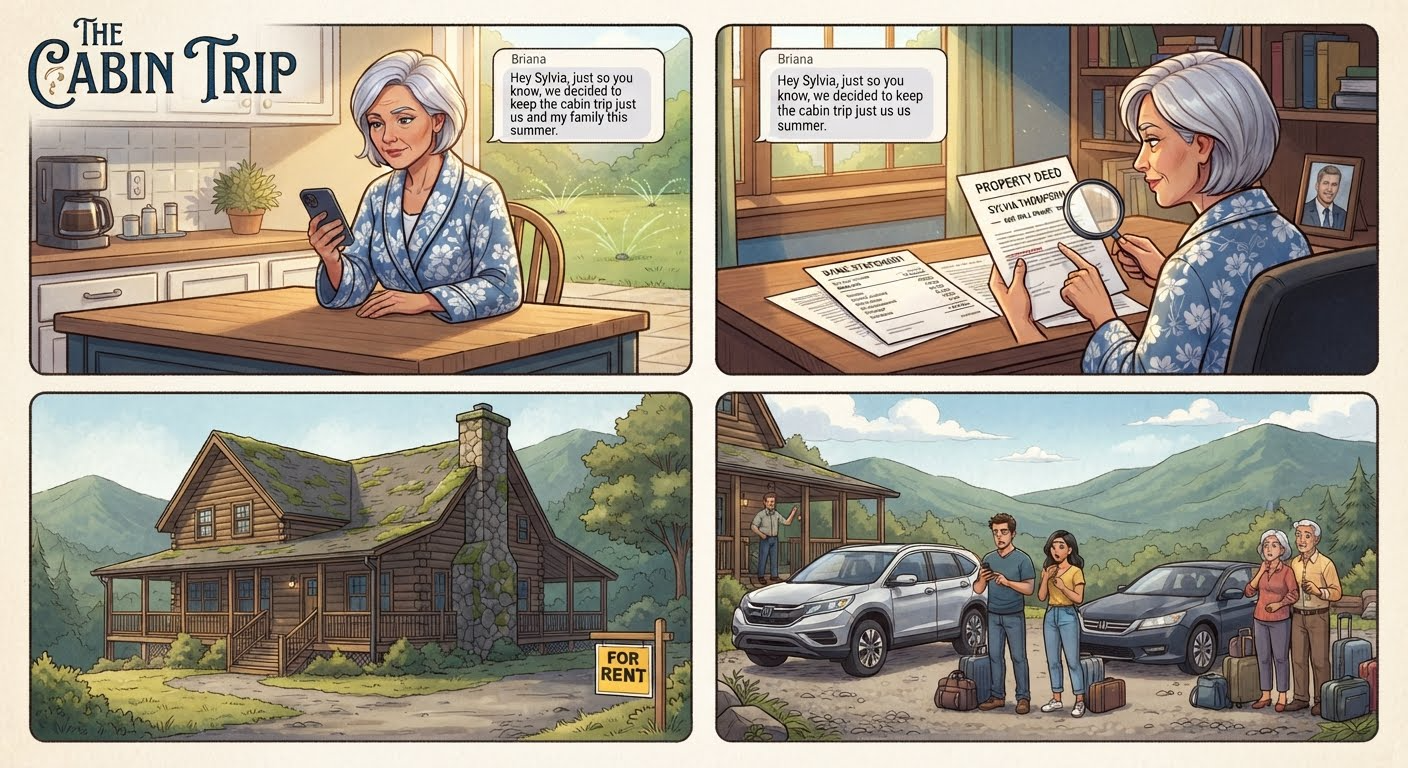
The third time James called, I finally answered.
“Mom, what is going on?”
There was something unfamiliar in my son’s voice. It wasn’t anger. Not yet. It was the sound of a grown man discovering that something he had always taken for granted was no longer available.
“Hello, James,” I said calmly. “Did you have a nice drive?”
“Mom, please. There’s a man standing on the porch telling us we can’t go inside.”
I took a slow sip of iced tea.
“That would be Walter. He’s been looking after the property for almost twelve years.”
“I know who Walter is, Mom! He’s saying our reservation was canceled.”
“That’s correct.”
“Canceled? Mom, we drove three hours to get here! Briana’s parents are standing in the driveway with their luggage. The kids are exhausted. What are we supposed to do?”
I closed my eyes briefly.
The mention of my grandchildren hurt. They were innocent in all this, and I had no intention of punishing them for decisions their parents had made.
“Your children are welcome at my house anytime, James. You know that.”
“Then why aren’t we allowed inside the cabin?”
“Because I changed my mind about who gets to use it.”
Silence.
Then I heard Briana shouting in the background.
“Give me the phone!”
A rustling sound followed.
And suddenly, my daughter-in-law’s voice filled my ear.
“Sylvia, are you seriously doing this right now?”
“Good afternoon, Briana.”
“Don’t ‘good afternoon’ me! We have been planning this vacation for months!”
“I understand.”
“No, I don’t think you do! My parents rearranged their entire schedule for this trip. My father took a week off work. We bought groceries. We ordered things for the porch. You can’t just cancel everything two days before we arrive!”
I glanced toward the kitchen window.
Robert’s old desk was visible through the doorway.
The property folder was still lying on top.
“Actually, Briana, I can.”
She made a sharp sound of disbelief.
“Excuse me?”
“The cabin belongs to me. I am the only person listed on the deed. And since you made it clear that this summer was supposed to be for your family only, I decided to respect your wishes.”
“What is that supposed to mean?”
“It means you should probably find a cabin that belongs to your family.”
For several seconds, nobody spoke.
Then Briana laughed.
It was a short, humorless laugh.
“Oh, I see. This is because of my text message.”
“Your message helped me understand a few things.”
“Oh, come on, Sylvia! You’re being dramatic. I wasn’t excluding you. I just thought it would be better if we had some private family time.”
“And that’s perfectly reasonable.”
“Then what’s the problem?”
“The problem is that you decided I wasn’t family while expecting me to provide the place where your family would spend its vacation.”
Her voice rose.
“You’re twisting my words!”
“I’m repeating them.”
I could hear James trying to take back the phone.
Then another voice appeared.
A man’s voice.
Briana’s father, Richard.
“What kind of nonsense is this? We were told the property was available!”
Briana apparently turned the speakerphone on.
“Richard,” I said, “I think there has been a misunderstanding.”
“You’re absolutely right there has! My daughter told us this cabin was going to be our family’s summer retreat!”
I sat upright.
“Your family’s summer retreat?”
“Yes! She said James had arranged everything!”
My fingers tightened around the glass.
James had asked to borrow the cabin for one week.
Nothing more.
“Did Briana happen to mention who owns the property?”
A pause.
“Well, James does, doesn’t he?”
I looked toward the maple tree in my yard.
Robert had planted it the spring before he became ill.
“No, Richard. James does not.”
Another silence.
Then Briana interrupted.
“Oh, for heaven’s sake! Why are we arguing about paperwork? It’s a family cabin!”
“A family cabin,” I repeated softly.
“Exactly!”
“Then perhaps you can explain why I wasn’t considered family when you sent your message.”
Briana’s breathing became louder.
“You know what? This is unbelievably petty.”
I waited.
She continued.
“After everything James has done for you, you embarrass us in front of my parents?”
That sentence landed harder than she probably intended.
Everything James had done for me.
I thought about the years after Robert died.
The months when I paid James’s mortgage because his commissions were low.
The time I covered their youngest child’s medical bills without asking for reimbursement.
The countless weekends I babysat while Briana attended conferences, parties, and weekend getaways.
I never counted those things as debts.
I had done them because I loved my family.
But hearing Briana speak as though I were the one living off their generosity made something inside me grow very still.
“Briana,” I said, “please give the phone back to my son.”
“No. You need to understand—”
“Now, please.”
There was a pause.
Then James came back.
“Mom?”
“Are the children listening to this conversation?”
“No. They’re in the car watching something on the tablet.”
“Good.”
“Mom, can’t we just talk about this when we get home? Walter is standing right here. Briana’s parents are upset. Everyone’s looking at us.”
“I imagine they are.”
“Please. Just tell Walter to open the door.”
I stared at the condensation sliding down my glass.
For one painful moment, I almost agreed.
It would have been so easy.
One phone call.
One sentence.
Everything back to normal.
James would get his vacation.
Briana would get her way.
And I would spend another few months pretending not to notice how little my feelings mattered.
Then I remembered the bank statement.
“James, before I answer, I need to ask you something.”
“What?”
“Do you remember the emergency savings account we opened three years ago?”
His breathing changed.
It was subtle.
But a mother learns the sounds her child makes when he is frightened.
“What about it?”
“How much money do you believe is in that account?”
“Mom, why are we talking about this now?”
“Because I checked it.”
Silence.
“James?”
“I can explain.”
Four words.
Four words I had heard from him many times growing up.
When he was eleven and broke the living room window.
When he was sixteen and dented Robert’s truck.
When he was twenty-two and missed a college tuition payment.
But this time he was forty-one years old.
And more than twenty-eight thousand dollars was missing from an account I had created to protect his family during an emergency.
“Then explain.”
Briana was saying something in the background.
I couldn’t make out the words.
James lowered his voice.
“Mom, please. Not right now.”
“Did you use that money to purchase outdoor furniture?”
He didn’t answer.
“Did you use it to pay a contractor?”
“It’s complicated.”
“Did you spend that money preparing my cabin for Briana’s family?”
A long, terrible silence followed.
Then James said something I will never forget.
“We thought you wouldn’t mind.”
I looked down at my hands.
They were the same hands that had buttoned his childhood coats, packed his school lunches, and held his father’s fingers in a hospital room during the last hours of his life.
“We?” I whispered.
“Mom—”
“Who is we, James?”
“Briana and I.”
“And did either of you think to ask me?”
His voice became defensive.
“You always said the money was for us!”
“For emergencies, James. Losing a job. A broken furnace. A sick child. Not furnishing a vacation property you don’t own.”
“It wasn’t like that.”
“Then tell me what it was like.”
He sighed.
“Briana wanted to make the cabin more comfortable. We thought maybe we could use it more often. Her parents were talking about coming up every summer, and we figured—”
“You figured what?”
He stopped.
I waited.
Finally, he answered.
“We figured the place would eventually be mine anyway.”
I felt a cold heaviness spread through my chest.
There it was.
Not an accident.
Not a misunderstanding.
An assumption.
They had already begun treating my property as an inheritance.
And I was still alive.
“James,” I said quietly, “your father built that cabin.”
“I know.”
“He spent two summers working on it after his regular job. He used to come home with splinters in his fingers and sawdust in his hair. He wanted a place where our family could gather.”
“Mom, I know all this.”
“Then you should understand why I won’t allow people to decide what happens to it without asking me.”
James exhaled sharply.
“So what now? You’re going to punish us over some furniture?”
“I’m not punishing anyone.”
“You locked us out!”
“I withdrew permission to use my home.”
“Because Briana sent one badly worded text?”
“No, James. Because that text made me look at something I had been refusing to see.”
“What are you talking about?”
“That your wife sees my property as hers, and you have been helping her act as though that is true.”
He went quiet.
For a moment, I heard nothing except wind brushing against my porch screens.
Then another voice came through the phone.
A woman’s voice.
Briana’s mother, Diane.
“Sylvia? This is Diane. May I speak with you?”
I hesitated.
Diane had always been pleasant enough at birthday dinners and Christmas gatherings, though we had never been particularly close.
“Of course.”
Her voice sounded embarrassed.
“I think there’s been a misunderstanding about the arrangements.”
“Yes, I believe there has.”
“Briana told us you had given James the cabin.”
I stopped breathing for a moment.
“Given him the cabin?”
“Yes. She said you transferred it to him earlier this year.”
My eyes moved slowly toward Robert’s office.
I could almost feel the property folder waiting on the desk.
“No, Diane. I have never transferred the cabin to James.”
“Oh.”
That single syllable contained more surprise than anything else I had heard that afternoon.
Then Diane spoke again.
“But Briana told us the paperwork was already handled.”
My pulse quickened.
“What paperwork?”
There was a muffled conversation on the other end.
Then Diane returned.
“The ownership paperwork. She said James was already listed on the property.”
I stood up.
Very slowly.
“Diane, would you mind telling me exactly what Briana said?”
Another silence.
Then she answered.
“She told us you signed everything after Robert passed away, and the cabin was essentially theirs. She said you preferred to stay out of the mountains because the memories were too painful.”
I stared at the wall.
I had never said any such thing.
Yes, the cabin reminded me of Robert.
Yes, there were mornings when I could barely enter the bedroom where he used to sleep.
But the mountains were also where I felt closest to him.
I had no intention of giving that away.
“Thank you for telling me, Diane.”
Her voice softened.
“Sylvia, I didn’t know.”
“I believe you.”
I heard a car door close.
Then James came back onto the phone.
“Mom, can we please stop talking to everybody about our private business?”
I answered with a question.
“James, did you tell Briana’s parents that I gave you the cabin?”
He hesitated.
“Not exactly.”
“What does that mean?”
“I told them it would be ours someday.”
“Someday?”
“Mom, you’re making it sound terrible.”
I closed my eyes.
“James, do you understand how terrible it feels to hear your living child making plans for what he expects to receive after you’re gone?”
“That’s not fair.”
“No. It isn’t.”
His voice broke slightly.
“Mom, please. I don’t want to fight.”
“Neither do I.”
“Then just let us inside.”
I looked at the clock.
It was almost five.
The mountain evening would arrive quickly.
“I’ll pay for two hotel rooms tonight so the children have somewhere comfortable to sleep,” I said. “But the cabin will remain closed to your group.”
Briana shouted loudly enough for me to hear every word.
“We don’t need her charity!”
I almost laughed.
Not because it was funny.
Because of the irony.
For years, she had been perfectly willing to accept my money, my time, my house, and my silence.
But the moment I offered help without surrendering control, it became charity.
“James,” I said, “I’ll send you the hotel information. The children shouldn’t be caught in the middle of this.”
He didn’t thank me.
Instead, he whispered, “I can’t believe you’re doing this.”
And then he hung up.
I stood on the porch for several minutes.
My iced tea had gone warm.
I expected to feel victorious.
Instead, I felt tired.
Deeply tired.
Setting a boundary was easy to describe.
Living with the disappointment of someone you loved was something else entirely.
That night, I made myself a small dinner.
I wasn’t hungry, but Robert had always insisted that difficult days were no excuse for skipping a meal.
I had just finished washing the dishes when Walter called.
“Mrs. Bennett?”
“Hello, Walter. Is everything all right?”
There was an unusual hesitation in his voice.
“I think there’s something you need to know.”
My stomach tightened.
“What happened?”
“After they left, I checked the side entrance, just like you asked.”
“And?”
“Somebody had a contractor put a new keypad lock on the mudroom door.”
I stared at the kitchen counter.
“What?”
“I didn’t authorize it. And neither did you, as far as I know.”
“No.”
“There’s more.”
I gripped the phone.
“Go on.”
Walter took a breath.
“I found a delivery notice tucked under the porch bench. It was addressed to Mrs. Briana Bennett.”
“That doesn’t surprise me.”
“Mrs. Bennett, it wasn’t a furniture delivery.”
I frowned.
“Then what was it?”
He paused.
“It was for a custom brass plaque.”
“A plaque?”
“Yes, ma’am.”
“What did it say?”
His next words made the room feel suddenly colder.
“THE BENNETT FAMILY MOUNTAIN RETREAT — ESTABLISHED 2026.”
I sat down.
For a moment, all I could hear was the quiet hum of the refrigerator.
They had not just bought furniture.
They had ordered a sign.
A permanent sign for my husband’s cabin.
A place they had never paid to purchase.
A place they had never asked to own.
And then Walter said something even more unsettling.
“There’s one more thing, Mrs. Bennett.”
I swallowed.
“What is it?”
“When I was checking the paperwork for that lock installation, I found a copy of a document left in the maintenance folder.”
“What kind of document?”
“An authorization form.”
“Signed by whom?”
He hesitated.
“That’s the problem.”
My fingers tightened around the phone.
“Walter.”
“The signature looks like yours.”
I couldn’t move.
For several seconds, the room seemed to fall silent around me.
Then I asked the only question that mattered.
“Walter, are you telling me someone signed my name?”
“I’m telling you there’s a document here authorizing changes to the property, and it has your name on it.”
I stood so quickly the chair scraped across the tile.
“Send me a picture. Right now.”
A minute later, my phone buzzed.
I opened the photograph.
There was my full name.
Sylvia Margaret Bennett.
Written in dark ink beneath a paragraph granting permission for property improvements and access modifications.
At first glance, the signature looked convincing.
But I knew immediately it wasn’t mine.
Because I had stopped signing my middle name after Robert died.
And whoever had copied my old signature apparently didn’t know that.
I enlarged the photograph.
Read the form again.
Then noticed the date.
April 17.
Three days after James first asked to borrow the cabin.
My hands began to shake.
Not from fear.
From the realization that this had been planned much earlier than Briana’s insulting text.
I called Carol, my attorney, even though it was nearly eight in the evening.
She answered on the fourth ring.
“Sylvia? Is everything all right?”
“No,” I said. “I think somebody has been signing documents in my name.”
Her tone changed immediately.
“What documents?”
“An authorization form for my cabin.”
“Who signed it?”
“I don’t know yet.”
“Do you have a copy?”
“Yes.”
“Send it to me. Don’t confront anyone about the signature until we’ve reviewed it.”
I forwarded the photograph.
Carol called back less than ten minutes later.
“Sylvia, I need you to listen carefully.”
Something in her voice made me sit down.
“This form references a contractor. Did you authorize major renovations?”
“No.”
“Did you approve any new electronic locks?”
“No.”
“Did you discuss placing the property into a family trust?”
My heart seemed to stop.
“A family trust?”
There was a long pause.
Then Carol said, “That’s what I was afraid of.”
I felt my mouth go dry.
“Carol, what are you talking about?”
“The authorization form refers to a second document. I want to verify what it is before drawing conclusions. I’m going to check the county records first thing in the morning.”
I looked toward the framed photograph of Robert hanging near the dining room.
He was smiling beside James on the cabin porch.
James couldn’t have been more than ten years old.
“Carol,” I whispered, “could someone have tried to transfer my property without telling me?”
“It’s possible someone attempted to. I can’t tell you whether anything was actually filed until I check.”
After we hung up, I sat alone in the kitchen.
And then my phone lit up.
A message from Briana.
I expected another insult.
Another accusation.
Another demand.
Instead, it was one sentence.
“You should have just let us have the week, Sylvia. Now James is going to have to tell you what we already started.”
I read it twice.
My heart began pounding.
Before I could reply, another message appeared.
This one from James.
“Mom, please don’t sign anything Carol sends you until we talk.”
I stared at the screen.
How did James know I had called Carol?
I hadn’t told him.
I hadn’t told Briana.
And then, at 9:17 p.m., a third message arrived.
An email from an unfamiliar address.
The subject line read:
“RE: BENNETT CABIN — OWNERSHIP CHANGE REQUEST.”
I opened it.
There were two attachments.
One was a preliminary property transfer form.
The other was a letter bearing my name.
And halfway down the letter was a sentence that made my blood run cold.
“I, Sylvia Margaret Bennett, voluntarily relinquish my ownership interest in the property to my son, James Robert Bennett.”
I had never written those words.
I had never agreed to them.
And beneath that sentence was a signature that someone clearly hoped would pass for mine.
Then I saw who had been copied on the email.
James.
Briana.
And a third person whose name I recognized immediately.
Someone who had sat at my dinner table just six weeks earlier and looked me in the eyes while assuring me that my family’s affairs were in safe hands.
I pressed one trembling hand against my mouth.
Because in that moment, I understood something worse than having a daughter-in-law who wanted my cabin.
Someone I trusted had been helping them try to take it.
And the next morning, when Carol called with what she had uncovered in the county records, I realized the missing money and the suspicious signature might be only the beginning.
PART 3: THE SIGNATURE THAT EXPOSED MY SON’S BETRAYAL
At 7:12 the next morning, my phone rang.
I was already awake.
In fact, I hadn’t slept more than two hours.
Every time I closed my eyes, I saw that document.
My name.
My husband’s cabin.
And a signature that looked almost identical to mine.
But it wasn’t mine.
“Good morning, Sylvia,” Carol said.
There was no warmth in her voice.
No usual small talk about the weather or her grandchildren.
Just a seriousness that made my stomach tighten.
“Carol, what did you find?”
“I need you to sit down.”
“I am sitting.”
“Good. Because this is worse than I expected.”
I pressed the phone against my ear.
Carol took a breath.
“Someone submitted paperwork requesting a transfer of your cabin into a family trust.”
I closed my eyes.
“Was it approved?”
“No. The county records still show you as the owner. But the documents were prepared, and an inquiry was made about filing them.”
My fingers tightened around my coffee mug.
“Who made the inquiry?”
“An attorney named Martin Caldwell.”
The name struck me like a slap.
Martin Caldwell.
I knew him.
He had been James’s friend since college.
He had attended my husband’s funeral.
He had sat in my living room six weeks earlier, drinking coffee and asking how I was managing Robert’s estate.
I remembered his smile.
His polished shoes.
The reassuring way he said, “Sylvia, you have nothing to worry about. Everything looks very straightforward.”
And now his name was attached to paperwork that could have taken my property away.
“Carol,” I whispered, “Martin was in my house.”
“I know.”
“He looked through Robert’s old property records.”
“Did you give him permission?”
I thought carefully.
“He asked whether he could review some estate documents because James was worried about future inheritance taxes.”
Carol went silent.
“Did you sign anything?”
“No.”
“Did you give him copies?”
“I let him photograph the deed and an old insurance document.”
Another silence.
Then Carol asked a question that made my entire body go cold.
“Sylvia, did that insurance document contain your signature?”
I stared at the kitchen wall.
“Yes.”
Carol exhaled.
“That may explain where the signature came from.”
For a moment, I couldn’t speak.
I had invited Martin into my home.
I had offered him coffee.
I had trusted him because my son trusted him.
And he may have used that trust to help someone imitate my signature.
“Is James involved?” I asked.
Carol didn’t answer immediately.
“The correspondence I reviewed suggests he knew about the proposed trust. That doesn’t prove he knew the signature was unauthorized.”
“Tell me what you have.”
“I spoke to Martin’s office. They confirmed he had been discussing estate planning with James and Briana. They wouldn’t release his complete file without authorization.”
I swallowed.
“And the email?”
“The email you received appears to be part of a draft document exchange. The transfer hadn’t been finalized.”
I felt a small wave of relief.
Then Carol continued.
“But there’s something else.”
My stomach dropped.
“What?”
“Have you recently agreed to rent your cabin to anyone?”
“No.”
“Have you authorized James or Briana to collect payments from guests?”
I sat completely still.
“Payments?”
Carol’s voice became very careful.
“Sylvia, I found an online vacation rental listing using photographs of your property.”
I stared at the table.
“What listing?”
“It’s advertised as a luxury mountain retreat outside Asheville.”
I couldn’t seem to make my mouth work.
“And who is renting it?”
“The listing identifies Briana as the host.”
I slowly placed my coffee mug down.
The sound of porcelain touching wood seemed unusually loud.
“How long has it been listed?”
“At least several months, judging by the reviews.”
Reviews.
That word made something inside me twist.
People had been staying at my cabin.
Sleeping in the beds Robert and I had chosen.
Sitting beside the fireplace we had built together.
Walking across the porch where he used to drink his morning coffee.
And I hadn’t known.
“Carol,” I said quietly, “send me the link.”
A moment later, my phone buzzed.
I opened the listing.
And there it was.
My cabin.
My beautiful three-bedroom cabin surrounded by pine trees.
Except the photographs were different.
There were new throw pillows on the couches.
A new dining room table.
A large decorative mirror hanging where Robert’s fishing photograph used to be.
And beneath the photographs was the title:
“THE BENNETT FAMILY MOUNTAIN RETREAT — PRIVATE LUXURY ESCAPE.”
I felt sick.
I scrolled.
Five-star reviews.
Dozens of them.
“Wonderful family-owned property!”
“Host Briana was extremely responsive!”
“Beautiful cabin! We stayed for our anniversary and would definitely return.”
Then I saw something that made me stop.
One guest had written:
“Briana mentioned that her husband inherited the cabin from his late father. Such a beautiful way to honor his memory.”
I read the sentence three times.
Inherited.
From his late father.
Robert had been gone for four years.
But I was very much alive.
And the cabin had never belonged to James.
I called Walter.
He answered immediately.
“Mrs. Bennett?”
“Walter, I need you to tell me something, and I need the truth.”
“Of course.”
“Have strangers been staying at my cabin?”
There was a long pause.
A terrible pause.
Then he said, “I was hoping to speak with you about that.”
My throat tightened.
“You knew?”
“Not exactly. James told me you had approved occasional rentals to help cover maintenance expenses. He said Briana would handle the bookings.”
I closed my eyes.
“How long?”
“Since late January.”
January.
It was now July.
Six months.
Six months of strangers entering my property while I believed James was simply visiting occasionally with his family.
“Walter, why didn’t you tell me?”
His voice cracked.
“Mrs. Bennett, I believed your son. He told me you didn’t want to be bothered with the details. I should have called you directly.”
I pressed my fingers against my forehead.
Walter had worked for us for twelve years.
He was a good man.
But even good people could make terrible mistakes when they trusted the wrong person.
“Did you receive any of the rental money?”
“No, ma’am. James told me Briana was handling everything.”
“Did they ask you to make changes to the property?”
“Yes.”
My heart sank.
“What kind of changes?”
“New locks. Furniture deliveries. Some landscaping. They talked about replacing the kitchen cabinets in the fall.”
I stared through the window toward the garden.
Robert had installed those cabinets himself.
He used to joke that the doors weren’t perfectly straight because he cared more about fishing than carpentry.
And I loved those crooked cabinets.
Every single one.
“Walter,” I whispered, “I need you to secure the property. No one enters without my direct permission.”
“Yes, ma’am.”
“And please photograph anything that looks different from the last time I was there.”
“I’ll take care of it.”
After we hung up, I called Carol back.
“There have been rentals,” I said.
“I suspected as much.”
“Since January.”
Carol was silent for a moment.
“Then we need to preserve everything. The listing, communications, financial records, and whatever booking information we can lawfully obtain.”
I looked at the bank statement beside me.
“The emergency account,” I whispered.
“What about it?”
“I think some of the money they withdrew might have gone into renovating the cabin for rentals.”
“That would explain the contractor payments.”
I swallowed hard.
“But where did the rental income go?”
Carol didn’t answer.
And somehow, that silence frightened me more than any explanation would have.
At 10:26 a.m., James called.
I looked at the screen for several seconds before answering.
“Hello, James.”
“Mom, we need to talk.”
His voice sounded exhausted.
“I’m listening.”
“Briana’s parents went home this morning.”
“I see.”
“They’re furious.”
“About what?”
“About everything. The cabin. The ownership situation. The whole mess.”
“The ownership situation?” I repeated.
He sighed.
“Mom, please don’t start.”
I felt a strange calm settle over me.
“James, I discovered the rental listing.”
Silence.
Complete silence.
“James?”
“Mom, I can explain.”
“There are more than thirty reviews.”
He said nothing.
“You’ve been renting my cabin to strangers.”
“We were going to tell you.”
“When?”
Another pause.
“Eventually.”
I stared at the photograph of Robert on the mantel.
“Eventually isn’t an answer.”
James’s voice became defensive.
“Mom, we were trying to make something productive out of the property. It just sits empty most of the year.”
“That property belongs to me.”
“I know that!”
“Then why did you allow your wife to advertise it as though she owned it?”
He exhaled sharply.
“Because we thought it would be a good way to generate income.”
“For whom?”
He hesitated.
“For the family.”
“Which family, James?”
He didn’t respond.
“Because according to Briana, I wasn’t part of the family that deserved to spend a week there.”
“Mom, stop bringing up that text!”
“I’ll stop bringing it up when you stop pretending it was the only problem.”
He went quiet.
I opened the rental listing again.
“James, how much money have you made?”
“That’s not really—”
“How much?”
“Mom, it’s not as much as you think.”
“Then tell me.”
I heard him breathing.
Finally, he said, “Maybe eighteen thousand.”
I stared at the wall.
“Eighteen thousand dollars?”
“Before expenses.”
“And where is that money?”
“Briana handles the account.”
“Which account?”
“Our business account.”
I felt the air leave my lungs.
Business.
They had turned my husband’s cabin into a business.
Without telling me.
Without asking permission.
Without sharing a single dollar.
“James,” I said slowly, “what is the name of this business?”
“Mom—”
“What is it called?”
He sighed.
“Bennett Mountain Properties.”
I closed my eyes.
“And who owns Bennett Mountain Properties?”
Another silence.
Then he answered.
“Briana and me.”
I took a breath.
“And what does your company own?”
“Nothing yet. It just manages the bookings.”
“Yet?”
He stopped breathing for a moment.
I heard it.
That tiny pause when someone realizes he has said too much.
“James,” I whispered, “what do you mean by yet?”
“Nothing.”
“Were you planning to move my cabin into that company?”
“No, Mom. Not exactly.”
“Then what exactly were you planning?”
He became irritated.
“Martin said there were ways to structure things so the property could stay in the family without creating tax problems later.”
“Did Martin tell you I needed to agree to that?”
“Yes.”
“Then why is there a document with a signature I never wrote?”
His voice disappeared.
For nearly ten seconds, neither of us spoke.
Then James whispered, “What document?”
“The transfer authorization.”
“Mom, I don’t know what you’re talking about.”
“James, don’t lie to me.”
“I’m not!”
I heard something crash in the background.
Then Briana’s voice.
“What did she say?”
James muttered something.
Briana shouted.
“James, give me the phone!”
But this time he didn’t.
“Mom,” he said quickly, “I need to call you back.”
“James—”
The call ended.
I stared at my phone.
And then something strange happened.
I began to cry.
Not loudly.
Not dramatically.
Just tears sliding down my face while I sat alone at the kitchen table.
Because when a stranger steals from you, you can call the police.
When a business cheats you, you can hire an attorney.
But when your own son looks at everything you’ve built and sees only what he might inherit, the pain settles somewhere much deeper.
I thought about the little boy who used to run through the cabin with muddy shoes.
The teenager who helped Robert stack firewood.
The young man who cried against my shoulder at his father’s funeral.
Where had that boy gone?
And how had I missed the moment he began seeing me as an obstacle instead of his mother?
Around noon, Carol arrived at my house.
She had a leather briefcase and a look on her face that told me she hadn’t come merely to comfort me.
“Sylvia, there’s something I need to show you.”
She sat across from me and opened her laptop.
“After you sent me the rental listing, I reviewed the public business registration information.”
“And?”
“Bennett Mountain Properties was formed last December.”
I frowned.
“December?”
“Yes. Before the rentals began.”
She turned the screen toward me.
There were the names.
James Robert Bennett.
Briana Elise Bennett.
Both listed as members of the company.
Then Carol pointed to another document.
“This is an advertisement they used to seek financing.”
I leaned closer.
It showed a photograph of the cabin.
Underneath it were the words:
“ESTABLISHED VACATION RENTAL BUSINESS WITH PLANNED PROPERTY ACQUISITION.”
I felt my stomach twist.
“Property acquisition?”
Carol nodded.
“They appear to have been looking for financing to expand the rental operation.”
“Using my cabin?”
“That’s what the materials suggest. But we need to determine exactly what representations were made.”
She opened another page.
A financial projection.
Rental income.
Expected occupancy.
Renovation budgets.
And a line marked:
“OWNER TRANSFER — Q3 2026.”
I stared.
Quarter three.
July through September.
Now.
They hadn’t just imagined owning the cabin someday.
They had put it into a business plan.
“Carol,” I whispered, “they planned to take it this summer.”
“That’s one possible interpretation. I want the underlying documents before we conclude how far the plan went.”
I looked at her.
“What do we do?”
“First, we protect your property and preserve evidence. Then we determine whether anyone has submitted false documents, misrepresented ownership, or improperly used your funds.”
“Can we stop them?”
“The deed is still in your name. That gives us a solid starting point.”
She leaned forward.
“But there’s something you need to understand.”
“What?”
“James may not be the person making the decisions.”
I frowned.
“What do you mean?”
Carol hesitated.
“Martin’s office called me back while I was driving here.”
My heart began pounding again.
“And?”
“They said Briana was the primary contact for the proposed transfer.”
I stared at her.
“Briana?”
“Yes.”
“But James is my son. Wouldn’t he need to be involved?”
“He was involved in the discussions. But according to the office, Briana was the one pushing for the documents to be prepared quickly.”
I sat back.
Then Carol added something that made my entire body go rigid.
“And Martin claims he believed you had already agreed.”
I stared at her.
“How could he believe that?”
“He says Briana showed him a letter.”
“What letter?”
“A handwritten letter, supposedly from you, explaining why you wanted James to have the property.”
I shook my head.
“I never wrote anything like that.”
“That’s what I told him.”
Carol opened her briefcase and removed a printed copy.
“I asked him to send it.”
She placed the paper in front of me.
I looked down.
The handwriting resembled mine.
Not perfectly.
But enough to fool someone who didn’t know me well.
The letter began:
“Dear James, after losing your father, I’ve come to understand that the mountain cabin should belong to the next generation.”
My vision blurred.
I kept reading.
It talked about Robert.
About family.
About wanting my grandchildren to enjoy the mountains.
Every sentence sounded like something a loving mother might write.
Until I reached the final paragraph.
“I have decided to transfer the cabin to James and Briana so they may manage it responsibly and build a future for their children.”
I pushed the paper away.
“No.”
Carol watched me.
“No, Carol. I never wrote that.”
“I believe you.”
Then I noticed something.
A detail so small that anyone else might have overlooked it.
The letter mentioned Robert’s final Christmas at the cabin.
It described him sitting beside the fireplace, holding our youngest granddaughter.
But Robert had never met our youngest granddaughter.
She was born eight months after he died.
I pointed at the sentence.
“Carol.”
She leaned closer.
“What is it?”
“This is impossible.”
I explained.
Her expression changed.
Then she carefully circled the sentence.
“That may be important evidence that the letter was fabricated.”
I stared at the page.
Whoever had written it knew enough about my family to make it emotional.
But not enough to make it true.
And suddenly, I knew exactly how I was going to handle this.
I wasn’t going to scream.
I wasn’t going to threaten Briana.
I wasn’t going to beg James to tell me the truth.
I was going to find out how far they had gone.
Every document.
Every withdrawal.
Every rental payment.
Every lie.
“Carol,” I said, “I want a complete accounting.”
She nodded.
“And I want the rental listing removed.”
“We can pursue that.”
“And I want to make sure no one can sign anything in my name again.”
“We’ll discuss appropriate protective steps today.”
I paused.
Then said something I hadn’t expected to say.
“I also want to review my will.”
Carol looked at me for a long moment.
“Are you sure?”
I swallowed.
“No. But I’m sure I can’t leave everything exactly as it is.”
She nodded slowly.
“We don’t have to make every decision today.”
I looked down at Robert’s photograph.
For years, I’d believed the cabin would naturally pass to James.
It had seemed obvious.
He was our only son.
He had grown up there.
Robert had dreamed of seeing his grandchildren playing beneath those pine trees.
But Robert had also taught me something important.
A gift given without respect eventually becomes something the recipient believes he’s entitled to.
And I was no longer willing to be treated like a person who mattered only because of what I owned.
That afternoon, I asked Carol to help me prepare a written notice for James and Briana.
It requested documentation of the rental income, expenses, bank withdrawals, and any paperwork concerning the cabin.
It also made clear that they had no further permission to advertise, rent, renovate, or enter the property without my express consent.
Carol reviewed every word before it was sent.
At 4:38 p.m., James received it.
At 4:41, he called me.
I didn’t answer.
At 4:47, Briana called.
I didn’t answer her either.
Then, at 5:03, a text arrived.
This time it wasn’t from either of them.
It was from Diane.
Briana’s mother.
“Sylvia, I’m sorry to bother you, but I need to tell you something. I think Briana has been hiding information from all of us.”
I stared at the message.
Then another appeared.
“When we left the cabin yesterday, Richard confronted her about the ownership. She became furious. But later that night, I overheard her talking to someone on the phone.”
My pulse quickened.
I typed back.
“Talking to whom?”
Three dots appeared.
Disappeared.
Appeared again.
Then Diane replied.
“I don’t know who it was. But she said, ‘The old woman found the listing. If she finds the loan documents, we’re finished.’”
I froze.
Loan documents.
Not transfer documents.
Not rental paperwork.
Loan documents.
My hands began trembling.
I immediately called Carol.
“There’s something else,” I said when she answered.
“What happened?”
“I think they may have tried to borrow money using my cabin.”
Carol went silent.
Then she said, “Forward me everything Diane sent you. We need to verify whether any loan was applied for, approved, or secured against the property.”
Before I could answer, my phone buzzed again.
Another message from Diane.
This one contained a photograph.
It showed a page from a folder Briana had apparently left in her parents’ car.
Across the top were the words:
“BENNETT MOUNTAIN PROPERTIES — FINANCING SUMMARY.”
Below that was an amount.
$285,000.
I stared at the number.
Then my eyes moved to the next line.
“Proposed collateral: Mountain property, Buncombe County, North Carolina.”
My heart hammered against my ribs.
That was my cabin.
My Robert’s cabin.
And the final sentence on the page frightened me most of all.
“Pending verification of property owner authorization.”
I could barely breathe.
They hadn’t merely spent my money.
They hadn’t merely rented my property.
Someone appeared to be trying to use the cabin to obtain nearly three hundred thousand dollars.
But the worst discovery came twenty minutes later.
Carol called back after speaking to a contact at the lending company.
“Sylvia,” she said, her voice trembling with anger, “there’s another name on the paperwork.”
I gripped the edge of the counter.
“Whose name?”
“The person who supposedly verified your identity.”
I swallowed.
“Who?”
Carol hesitated.
Then spoke a name I hadn’t heard in almost four years.
A name connected to the final weeks of Robert’s life.
A name that should never have appeared in any document involving our cabin.
And in that instant, I realized my son and daughter-in-law might not have been acting alone.
Someone had been planning this long before Briana sent that text message.
And what I discovered next would force James to choose between the woman he married and the mother who had trusted him with everything.
PART 4: THE WOMAN WHO KNEW MY HUSBAND’S SECRET
For a moment, I couldn’t hear anything except the pounding of my own heart.
“Carol,” I whispered, “say that name again.”
My attorney hesitated.
“Elaine Mercer.”
The kitchen seemed to tilt beneath my feet.
Elaine Mercer.
Four years had passed since I last saw that woman.
Four years since she stood beside Robert’s hospital bed, holding a clipboard and promising me that every important document would be handled with care.
Elaine had worked as an administrative coordinator at the private medical facility where Robert spent his final weeks.
She had helped organize his insurance paperwork, medical authorizations, and several documents related to our estate planning.
She had also attended his funeral.
I remembered her standing near the back of the church, wearing a dark blue dress and crying quietly.
Afterward, she had hugged me.
“If you ever need anything, Sylvia,” she whispered, “please don’t hesitate to call.”
I had believed her.
Now her name was appearing on paperwork connected to an attempted loan against my cabin.
“Carol, that can’t be right.”
“I wish I could tell you otherwise.”
“Elaine hasn’t been involved with my family since Robert died.”
“According to the preliminary financing documents, she was listed as an identity verification contact.”
I gripped the countertop.
“What does that mean?”
“It means someone represented that Elaine could confirm your identity and your apparent authorization. We don’t yet know whether she actually did so.”
My stomach turned.
“Did the lender speak with her?”
“That’s one of the things we’re trying to establish.”
I looked toward Robert’s photograph.
He was smiling in that picture.
He had no idea how many people would eventually use his memory as an excuse to reach for what he left behind.
“Carol, could Elaine have given them copies of my signature?”
“Possibly. But let’s not assume it until we have evidence.”
I nodded, though she couldn’t see me.
“And James?”
“We need to determine what your son knew.”
I felt tears sting my eyes.
Because that was the question I feared most.
Not whether Briana had lied.
Not whether Elaine had helped.
But whether the little boy Robert and I had raised had knowingly participated in taking away the one place where I still felt close to his father.
That evening, I didn’t eat dinner.
I sat at Robert’s desk, surrounded by papers.
The deed.
The bank statements.
The suspicious authorization.
The false letter.
The rental listing.
And now the financing summary.
Every page revealed another layer of something I couldn’t understand.
Why?
Why would my son do this?
I had never denied him help.
I had never demanded repayment when he borrowed money.
I had never refused to watch his children.
I had never reminded him how many sacrifices Robert and I had made.
Perhaps that had been my mistake.
Maybe when you give without limits, some people stop seeing the gift.
They see only the next thing they expect to receive.
At 8:16 p.m., someone knocked on my front door.
I wasn’t expecting visitors.
When I looked through the window, my breath caught.
James.
He was standing on the porch alone.
His shoulders sagged.
His shirt was wrinkled.
And for the first time in years, he looked less like the confident businessman Briana had married and more like the frightened boy who used to come home when something had gone terribly wrong.
I opened the door but didn’t step aside.
“James.”
“Mom.”
His eyes were red.
“Can we talk?”
I studied him.
“Where’s Briana?”
“At home.”
“And the children?”
“With her parents.”
I nodded.
“Come in.”
He followed me into the living room.
For a moment, neither of us spoke.
His gaze settled on the photograph of Robert above the fireplace.
Then he sat on the couch.
The same couch where Robert once taught him how to tie a fishing knot.
“Mom,” he began, “I need you to understand something.”
I sat across from him.
“Then tell me the truth.”
He rubbed both hands over his face.
“I didn’t know about the loan.”
I watched him carefully.
“Which loan?”
His head lifted.
“The one Briana tried to arrange.”
My chest tightened.
“So there was a loan application.”
He closed his eyes.
“Yes.”
“For two hundred and eighty-five thousand dollars?”
His expression changed.
“How do you know the amount?”
“That isn’t important right now.”
“Mom—”
“Did you sign anything?”
He stared down at his hands.
“Yes.”
The room went still.
“What did you sign?”
“Business documents. A personal guarantee. Some preliminary financing paperwork.”
I swallowed.
“Did you tell the lender you owned my cabin?”
“No.”
“Did Briana?”
“I think she may have.”
I leaned forward.
“James, please don’t give me guesses. Tell me what you actually know.”
He breathed out shakily.
“Briana said the company could expand if we acquired the cabin. Martin was supposed to help us discuss a family trust with you.”
“Discuss it with me?”
“Yes.”
“Then why did Martin receive paperwork bearing a signature I never wrote?”
James looked away.
“That’s what I came to talk about.”
I felt my fingers turn cold.
He reached into his jacket and pulled out a folded envelope.
“Briana gave me these yesterday. She said they were copies of papers you’d signed.”
I didn’t move.
“What papers?”
He opened the envelope.
Inside were three pages.
A purported authorization letter.
A draft trust agreement.
And a photocopy of an old document bearing my signature.
My stomach dropped.
“Where did she get that?”
James looked miserable.
“She said Elaine helped her locate your old estate records.”
I stared at him.
“Elaine Mercer?”
He nodded.
For several seconds, I couldn’t speak.
Then I asked quietly, “How long have you known Elaine was involved?”
“Since March.”
March.
Four months.
Four months of meetings.
Four months of plans.
Four months of family dinners where James smiled at me across the table while discussing paperwork that could strip me of my property.
“You brought Elaine into this?”
“No. Briana did.”
“Why?”
He hesitated.
“Because Elaine said she knew how Dad had wanted things handled.”
I felt something sharp twist beneath my ribs.
“What did she say?”
James swallowed.
“She said Dad had once discussed putting the cabin into a trust for me.”
I stood.
“That is not the same as giving you the cabin while I’m alive.”
“I know.”
“Do you?”
My voice cracked.
“Because your wife rented it to strangers, spent money from our emergency account, ordered a sign with her family’s name on it, and helped prepare documents claiming I agreed to transfer ownership.”
James lowered his head.
“I know.”
“No, James. You knew parts of it. And you let those parts happen.”
He covered his face.
“I thought if the rentals worked, we could pay the emergency money back before you noticed.”
The words struck me harder than I expected.
“Before I noticed?”
He started crying.
Not loudly.
Just quiet, exhausted tears.
“We got behind on bills, Mom.”
I stared at him.
“What bills?”
“The business wasn’t doing well. My commissions dropped last year. Briana’s online boutique lost money. We had credit card payments, private school tuition, and the mortgage.”
I sat back down.
“Why didn’t you tell me?”
“Because I was ashamed.”
“And you weren’t ashamed to use my cabin without permission?”
He didn’t answer.
I waited.
Finally, he whispered, “At first, it was just supposed to be temporary.”
I felt a tear slide down my cheek.
“James, your father and I spent thirty years building what we have. You could have asked me for help. I might not have given you everything you wanted, but I would have listened.”
“I know.”
“Instead, you treated me like someone whose signature you needed rather than someone whose permission mattered.”
He broke down.
“I’m sorry, Mom.”
I looked at him.
I wanted to believe those words.
But apologies are easy when the consequences finally arrive.
“Are you sorry because you hurt me,” I asked, “or because I found out?”
He looked up.
For the first time that evening, he didn’t have an answer.
And somehow, that told me more than another apology would have.
After a long silence, I asked, “Where is Elaine now?”
James wiped his eyes.
“She lives outside Hendersonville.”
“When did you last see her?”
“Three weeks ago.”
“Was Briana with you?”
“Yes.”
“What happened at that meeting?”
He hesitated.
“Elaine had some old documents from Dad’s estate. She showed Briana a copy of an unsigned trust proposal.”
My chest tightened.
“Unsigned?”
James nodded.
“She said Dad had asked about protecting the cabin for future generations.”
I remembered that conversation.
Robert and I had discussed estate planning many times.
We wanted James and our grandchildren to be secure.
But we never agreed to surrender control of our property while we were alive.
“And then?”
“Briana said if Dad had wanted the cabin protected for me, we should finish what he started.”
I stared at my son.
“And you agreed.”
He lowered his eyes.
“Yes.”
I shook my head.
“James, your father also wanted you to be honest.”
He flinched.
“He wanted you to work hard, keep your promises, and treat people fairly. Why did you remember only the part that might give you property?”
Tears ran down his cheeks again.
“I don’t know, Mom.”
I believed him.
Perhaps that was the saddest part.
He really didn’t seem to understand how far he had wandered from the man Robert had hoped he would become.
Then James said something that changed everything.
“Mom, there’s another reason I came here.”
I waited.
“Briana told me not to.”
“Not to do what?”
“Tell you about the bank.”
My stomach tightened.
“What bank?”
He swallowed.
“The lender sent us a notice yesterday. They’ve suspended the application.”
I frowned.
“Suspended?”
“Yes. They want additional proof that you authorized the property to be used.”
I exhaled.
At least someone had stopped the process.
Then he continued.
“But Briana says she can still fix it.”
I stared at him.
“How?”
“She says Elaine has something from Dad that proves he wanted the cabin transferred.”
My blood ran cold.
“What something?”
James looked toward Robert’s photograph.
“A recording.”
For several seconds, I couldn’t speak.
“A recording of what?”
“Dad discussing the cabin.”
I stared at him.
“Robert died four years ago.”
“I know.”
“When was this recording made?”
“During his final hospital stay.”
My hands began to tremble.
Robert had been heavily medicated during parts of those final weeks.
Some days he was lucid.
Other days he struggled to remember what month it was.
And Elaine had been there.
Helping with paperwork.
Recording medical notes.
Handling administrative arrangements.
“James,” I whispered, “have you heard the recording?”
He shook his head.
“Briana says Elaine has it.”
“And what exactly is it supposed to prove?”
“That Dad wanted me to have the cabin.”
I closed my eyes.
I remembered Robert’s last clear conversation with me.
He had held my hand and whispered, “Don’t let anyone rush you, Sylvie. Take your time. Enjoy what we built.”
Not once had he told me to give everything to James.
Not once had he suggested that my son should control the cabin while I was alive.
I looked at James.
“Your father loved you more than you will ever understand.”
James started crying again.
“But loving you did not mean he wanted you to take things from me.”
He covered his face.
“I know.”
I rose.
“Go home, James.”
He looked startled.
“Mom?”
“I need time to think.”
“Please don’t shut me out.”
I stood beside the front door.
“I’m not shutting you out. I’m asking you to stop hiding things from me.”
He followed me slowly.
At the doorway, he turned.
“Do you still love me?”
The question broke something inside me.
I stepped forward and placed my hand against his cheek.
“James, I will love you until the day I die.”
He began to cry harder.
“But love doesn’t erase consequences.”
He nodded.
And then he left.
I watched his car disappear down the street.
For a moment, I wanted to run after him.
To hug him.
To tell him we would find a way to make everything all right.
But Robert’s voice seemed to echo in my memory.
Don’t let anyone rush you.
Take your time.
Enjoy what we built.
I closed the door.
And for the first time in my life, I chose not to rescue my son from the consequences of his own decisions.
The next morning, Carol and I drove to Hendersonville.
We had arranged a meeting with Elaine Mercer at her office.
Carol had insisted on being present.
I was grateful.
Because when Elaine opened the door, she smiled at me as though nothing had happened.
“Sylvia! It’s been ages!”
She stepped forward to hug me.
I didn’t move.
Her smile faltered.
“Is something wrong?”
Carol spoke before I could.
“Ms. Mercer, we need to discuss certain documents connected to the Bennett cabin.”
Elaine’s expression changed.
Only for a second.
But I saw it.
Fear.
Then she recovered.
“I’m not sure what you mean.”
Carol placed a copy of the suspicious authorization on the desk.
“Your name appears in the financing materials as an identity verification contact.”
Elaine looked down.
Then up.
“That’s a misunderstanding.”
“Then we’d appreciate your explanation.”
She folded her arms.
“I helped Briana with some old family paperwork. That’s all.”
I stared at her.
“You helped her find my signature.”
Elaine’s face tightened.
“Sylvia, that’s a serious accusation.”
“Then tell me why you gave her copies of documents I never authorized her to use.”
She looked toward Carol.
“I don’t have to answer that.”
Carol nodded.
“You don’t have to answer us today. But these questions may be raised through formal legal channels.”
Elaine went pale.
Then I asked the question that had been haunting me.
“Where is the recording of Robert?”
Her head lifted sharply.
“What recording?”
“The one you told Briana about.”
Elaine stared at me.
For a moment, she seemed to be deciding whether lying was still possible.
Then she opened a drawer.
Removed a small envelope.
And placed it on the desk.
Inside was a USB drive.
“I never intended any of this,” she whispered.
Carol didn’t touch it.
“Before anyone accesses that drive, we need to establish what it contains and preserve it properly.”
Elaine nodded, trembling.
Then she said something I never expected.
“Robert asked me to keep a copy because he was afraid someone would pressure you after he died.”
My breath caught.
“What?”
Elaine’s eyes filled with tears.
“He knew James was having financial problems even back then.”
I shook my head.
“James was doing fine four years ago.”
Elaine looked at me sadly.
“That’s what he wanted you to believe.”
The room went silent.
Then she continued.
“Robert helped James with debts you never knew about. More than once.”
My knees felt weak.
“How much?”
Elaine lowered her eyes.
“I don’t know the full amount. But I saw correspondence concerning a large payment during his last year.”
I turned toward Carol.
She looked just as surprised as I felt.
Elaine whispered, “Robert was worried.”
“About James?”
“About what would happen to you if James became desperate.”
A tear slid down my face.
And then Elaine spoke the words that changed how I saw the past four years.
“He said the cabin should remain yours for as long as you wanted it. He asked that any future transfer be your decision alone.”
I stared at her.
“Then why did you help Briana?”
Elaine began to cry.
“Because she told me you had changed your mind.”
“That doesn’t explain the signature.”
Elaine covered her mouth.
“No,” she whispered. “It doesn’t.”
Carol leaned forward.
“Did you sign Sylvia’s name?”
Elaine shook her head quickly.
“No.”
“Did you provide an old signature sample?”
She didn’t answer.
“Elaine,” I whispered, “please.”
Finally, she nodded.
“Yes.”
I felt as though the floor had disappeared beneath me.
“Why?”
Her voice broke.
“Briana said it was needed to reconstruct some missing paperwork. She told me you had agreed and couldn’t locate the original.”
Carol’s expression hardened.
“And you didn’t call Sylvia to confirm?”
Elaine shook her head.
“No.”
I stared at the woman who had held my hand at Robert’s funeral.
“How could you?”
She began sobbing.
“I was wrong.”
I stood.
I couldn’t stay in that room another moment.
Carol gathered the papers.
“We’ll need to arrange for any relevant evidence to be preserved,” she told Elaine. “And I strongly recommend you obtain independent legal advice.”
We left without another word.
Outside, the mountain air was cool.
I stood beside Carol’s car, breathing deeply.
And then my phone rang.
Briana.
I almost ignored it.
But something told me to answer.
“Hello?”
Her voice was sharp.
“You went to see Elaine.”
I froze.
“How do you know that?”
“Because she called me.”
I looked toward Carol.
Briana continued.
“You have no idea what you’re doing, Sylvia.”
I felt a sudden calm.
“Actually, Briana, I’m beginning to understand exactly what you’ve been doing.”
She laughed bitterly.
“You think James is innocent? You think I forced him into everything?”
I said nothing.
“He knew about the rentals. He knew about the business. He signed the loan application. Stop pretending your precious son is some helpless little boy.”
I closed my eyes.
“I’m not pretending anything.”
“Then why are you coming after me?”
“Because someone has been using my property and my identity without my permission.”
Her voice turned icy.
“You should have given us the cabin when we asked.”
I stared out at the mountains.
“There it is,” I whispered.
“What?”
“The truth.”
She went silent.
I continued.
“You never wanted to borrow the cabin. You wanted to own it.”
“James deserves that property.”
“James deserves to be treated fairly. So do I.”
“You’re an old woman living alone in a house that’s too big for you! What do you need a mountain cabin for?”
I felt something inside me harden.
Not into hatred.
Into certainty.
“Briana, I don’t have to justify owning something simply because you want it.”
She made an angry sound.
“You’ll regret this.”
I didn’t raise my voice.
“Perhaps. But I will never regret protecting what Robert and I built.”
I ended the call.
Carol looked at me.
“Are you all right?”
I stared at my phone.
“No.”
Then I took a breath.
“But I will be.”
We drove home in silence.
I thought about James.
About Robert.
About all those years when I mistook keeping the peace for keeping my family together.
And when we reached my driveway, Carol’s phone rang.
She answered.
Listened.
Then slowly turned toward me.
“Sylvia, there’s been another development.”
My stomach tightened.
“What now?”
“The lender has provided additional information.”
“About the loan?”
“Yes.”
Carol’s expression was grave.
“The application wasn’t only for renovations or business expansion.”
I stared at her.
“What else?”
“They submitted documents claiming the cabin would be transferred as part of a larger property transaction.”
I frowned.
“What property transaction?”
Carol took a breath.
“An agreement involving a prospective buyer.”
I felt my heart stop.
“A buyer?”
“Yes.”
My voice came out barely above a whisper.
“Carol, are you telling me they were planning to sell my cabin?”
She looked at me for a long moment.
“I’m telling you there’s evidence they were exploring a sale.”
I gripped the car door.
“Who would buy it?”
Carol looked down at her phone.
Then back at me.
“The paperwork names Richard and Diane.”
Briana’s parents.
The people who had stood in my driveway pretending they believed James already owned the property.
The people who had acted shocked when I told them otherwise.
The people who had spent the previous evening telling me they didn’t know anything.
I stared straight ahead.
“Diane told me Briana had been hiding things from her.”
Carol nodded.
“That may still be true. We need to verify who knew what, and when.”
But my mind was already racing.
Because Richard hadn’t simply been invited to spend a week at my cabin.
Someone had discussed selling it to him.
And if he knew about the transaction, his outrage in the driveway had meant something very different.
I looked at Carol.
“Call Diane.”
“Why?”
“Because if her name is on those documents, I want to hear what she says when I ask whether she knew someone was trying to sell her a house that belonged to me.”
Carol studied me.
Then nodded.
I reached for my phone.
But before I could dial, a message arrived.
From Diane.
It contained only two sentences.
“Sylvia, Richard just told me something terrible. Please don’t call James yet. I need to come see you alone.”
I stared at the screen.
Then another message appeared.
“Briana wasn’t the first person who wanted your cabin. Richard has been talking about buying it since before Robert died.”
My blood turned cold.
Because suddenly, the story wasn’t just about an entitled daughter-in-law or a son desperate for money.
It was about something that might have begun while my husband was still alive.
And when Diane arrived that evening carrying an old envelope with Robert’s handwriting across the front, I was about to discover why my husband had never trusted Richard in the first place.
PART 5: THE LETTER MY HUSBAND LEFT BEHIND
Diane arrived at my front door at 6:37 that evening.
She wasn’t wearing the expensive jewelry or carefully coordinated clothes I usually saw at family gatherings.
Her hair was pulled into a loose ponytail. Her eyes were swollen, and she was holding a yellowed envelope against her chest as though someone might try to take it from her.
When I opened the door, she didn’t smile.
“Sylvia,” she whispered, “before you decide how much you hate my family, please let me explain.”
I stepped aside.
“Come in, Diane.”
She entered slowly, glancing around the living room.
Her eyes stopped on Robert’s photograph above the fireplace.
For a moment, she said nothing.
Then she began to cry.
“I wish I had listened to him.”
My heart tightened.
“Listened to whom?”
“Robert.”
The name hung between us.
I closed the door.
“Diane, what are you talking about?”
She turned toward me.
“Your husband knew Richard was interested in the cabin. He knew long before any of this happened.”
I stared at her.
“Interested in buying it?”
She shook her head.
“Interested in controlling it.”
I felt a cold sensation move through my stomach.
“Sit down.”
We sat across from each other at the kitchen table.
The same table where James had once promised me he would never touch the emergency savings unless his family truly needed it.
Diane placed the envelope between us.
Across the front, written in Robert’s unmistakable handwriting, were four words.
FOR SYLVIA — IF NECESSARY.
My breath caught.
I reached toward it.
Then stopped.
“Where did you get this?”
Diane folded her hands.
“Richard kept it in a locked drawer in his study.”
I stared at her.
“Why would Richard have a letter addressed to me?”
“That’s what I asked him.”
“And?”
“He told me it was none of my business.”
I looked down at the envelope.
Robert’s handwriting was slightly uneven.
I recognized that particular shakiness.
It had appeared during the last months of his illness, when his hands sometimes trembled from medication and exhaustion.
“Diane, how long has he had this?”
She swallowed.
“Almost four years.”
The words hit me like a physical blow.
Four years.
My husband had been dead for four years.
And another man had kept a letter addressed to me hidden in his desk.
I looked at Diane.
“Why are you giving it to me now?”
Her lips trembled.
“Because I found something else in that drawer. Something that made me realize Richard hasn’t been telling me the truth.”
“What did you find?”
“A draft agreement. It involved your cabin, an investment company, and a payment to Richard.”
I leaned forward.
“What investment company?”
She hesitated.
“Blue Ridge Development Holdings.”
The name meant nothing to me.
But the fear in Diane’s eyes told me it meant something to her.
“What does that company do?”
“It purchases mountain properties and develops luxury vacation homes.”
I stared at her.
“Are you saying Richard wanted to develop our land?”
Diane nodded slowly.
“He told me he was trying to purchase a small piece of property near Asheville. But the agreement I found described your cabin and several adjoining parcels.”
My mouth went dry.
Robert and I had purchased nearly eight acres around the cabin.
Most of it remained wooded.
We had never wanted to build more houses there.
Robert loved the quiet.
He used to say the birds were better neighbors than most people.
“Diane, Richard couldn’t sell land he doesn’t own.”
“I know.”
“Then what was his plan?”
She lowered her eyes.
“I think he believed James would eventually convince you to transfer the property.”
I looked at the envelope.
Then back at her.
“And Briana?”
Diane’s face crumpled.
“My daughter knew more than she told me.”
I waited.
Finally, Diane whispered, “She thought your cabin was her family’s opportunity to become wealthy.”
I felt an unexpected sadness.
Not surprise.
Not even anger.
Just sadness.
Because while I had been remembering summers with Robert, other people had been calculating how much our memories might be worth.
“Open the letter, Sylvia,” Diane whispered.
I picked up the envelope.
The paper was fragile.
The seal had already been broken.
I unfolded the single sheet inside.
And there was Robert’s handwriting.
My beautiful Robert.
For a moment, I could barely see through my tears.
Then I began to read.
“My dearest Sylvie,
If this letter reaches you, it means something happened that I hoped we could avoid.
I know how much you love James. I love him too. More than anything except you.
But there’s something you need to understand about Richard.
He approached me about the cabin shortly after James married Briana. He said the land had development potential and suggested that our families could make a great deal of money together.
I told him no.
He didn’t accept that answer.
Later, he offered to purchase the cabin privately, without involving real estate agents or anyone else. He said I should consider our son’s future instead of holding on to old sentimental attachments.
Sylvie, I want you to remember something.
That cabin is not a business opportunity.
It is our home in the mountains.
We built it together, and when I am gone, it must remain your choice what happens to it.
James may eventually inherit it. Or he may not. That decision belongs to you.
Do not allow anyone to convince you that love requires surrendering what is yours.
You have spent your entire life putting others first.
Promise me that when I am no longer beside you, you will remember you have the right to say no.
All my love,
Robert.”
I couldn’t finish reading the signature aloud.
My hands were shaking too badly.
Diane sat silently as I pressed the letter against my chest.
Four years.
Four years since Robert had kissed my forehead for the last time.
Four years since I held his hand and told him he didn’t need to fight anymore.
And somehow, through a letter he had written while dying, he was still trying to protect me.
I began to sob.
Not the quiet tears I had shed after James left.
These were deep, painful sobs that seemed to come from a place I had kept locked away since the funeral.
Diane came around the table.
She put a hand on my shoulder.
“I’m sorry, Sylvia.”
I shook my head.
“Why did Richard have this?”
She wiped her eyes.
“I think Robert gave it to him during an argument.”
I looked up.
“What?”
“There was a meeting at our house, a few months before Robert passed. I remember them arguing in Richard’s study. Robert left angry. Afterward, Richard said your husband had become unreasonable.”
I stared at the letter.
“Robert would never deliberately give Richard a private letter addressed to me.”
“I know. I think he may have left it behind with other papers, or Richard took it. I don’t know which.”
That uncertainty hurt.
There were things I might never know.
Conversations my husband had without me.
Warnings he tried to give.
Promises others had broken.
But one thing was clear.
Richard had possessed this letter for years.
And he had never given it to me.
“Does Richard know you took it?” I asked.
Diane nodded.
“He knows I found his folder. We argued before I came here.”
“What did he say?”
Her face hardened.
“He told me I was choosing you over our daughter.”
I looked at her.
“And what did you say?”
Diane lifted her chin.
“I told him I was choosing the truth.”
For the first time that evening, I reached across the table and took her hand.
We were two mothers sitting in a kitchen, both realizing how much our children had hidden from us.
But Diane had made a choice.
She had come to tell me what she knew.
And I wasn’t going to ignore that courage.
We called Carol together.
She arrived forty minutes later.
After reading Robert’s letter, she placed it carefully inside a protective sleeve.
“This may help establish Robert’s wishes,” she said, “although it doesn’t replace the deed or determine ownership by itself.”
I nodded.
“The deed is in my name.”
“Exactly. And that remains the most important thing.”
Then Carol turned to Diane.
“I need you to tell me everything you know about Blue Ridge Development Holdings.”
Diane swallowed.
“Richard met with them several times this spring.”
“Did you attend those meetings?”
“No. He told me they were about investments.”
“Did he ever mention the Bennett property?”
“Not directly. But I heard him discussing acreage, road access, and rental revenue.”
Carol wrote everything down.
“Do you have copies of the agreement you found?”
Diane opened her handbag.
“Yes.”
She removed several folded pages.
“I photographed the originals, too. These copies came from the folder in our study.”
Carol studied the first page.
Her expression grew serious.
“What is it?” I asked.
She pointed to a paragraph.
“The agreement describes Richard as a prospective intermediary for acquiring the property.”
“What does that mean?”
“It suggests he expected to receive compensation if he helped arrange a purchase.”
I felt my stomach tighten.
“How much compensation?”
Carol turned the page.
Then stopped.
Her eyes narrowed.
“Fifty-eight thousand dollars.”
I stared at her.
“Fifty-eight thousand?”
Diane covered her mouth.
Carol nodded.
“That’s the amount listed as a proposed acquisition fee.”
For several seconds, I couldn’t speak.
Richard had been planning to collect fifty-eight thousand dollars for helping someone acquire land he didn’t own.
Land my husband had built a home upon.
Land that held forty years of memories.
I looked at Diane.
“Did Briana know about that?”
She began crying again.
“I think so.”
“Why?”
“Because I heard her and Richard arguing about how much she would receive.”
I felt my blood turn cold.
“How much?”
Diane shook her head.
“I don’t know. But Richard told her that without him, the deal would never happen.”
Carol leaned forward.
“Did James participate in those discussions?”
Diane hesitated.
“I don’t know whether he understood the whole arrangement. But I know he attended at least one meeting.”
I closed my eyes.
James.
Again.
Every new discovery brought me back to the same painful place.
My own son.
My own flesh and blood.
How much had he known?
And how much had he chosen not to know?
Carol collected the copies.
“I want both of you to avoid confronting Richard or Briana about these documents until we can assess them.”
Diane nodded.
“And Sylvia,” Carol continued, “we should arrange a formal review of the property’s title and any recorded claims against it.”
“Do whatever is necessary.”
She looked at me.
“I also recommend that you preserve the original letter and document how Diane obtained it.”
I nodded.
But my mind was already moving somewhere else.
Back to the cabin.
Back to Robert’s fireplace.
Back to the place where James had learned to ride a bicycle on the gravel driveway.
I needed to go there.
Not because I was trying to escape.
Because I needed to stand inside the home we had built and remind myself that it was still mine.
The following morning, Walter met me at the cabin just after ten.
The mountain air smelled of pine needles and damp earth.
For a moment, the sight of the porch made my chest ache.
Robert had built those steps.
I still remembered the afternoon he dropped a box of nails and spent twenty minutes laughing while our dog tried to carry them away.
But when I reached the front door, I stopped.
There was a new electronic keypad beside the handle.
Matte black.
Modern.
Completely wrong against the old wood.
Walter noticed my expression.
“I can have that removed, Mrs. Bennett.”
I touched the edge of the keypad.
“Not until Carol finishes documenting everything.”
He nodded.
Inside, the cabin looked familiar and unfamiliar at the same time.
The furniture had been rearranged.
Several of Robert’s framed photographs were missing.
The old braided rug beneath the dining table had disappeared.
And in the living room, a large decorative sign hung above the fireplace.
“BENNETT FAMILY MOUNTAIN RETREAT.”
I stared at it.
My throat tightened.
Walter stood quietly behind me.
“Would you like me to take it down?”
“Not yet.”
I walked toward the fireplace.
There was a faint mark on the wall where Robert’s photograph had hung for nearly twenty years.
I reached up and touched it.
He had always loved that picture.
It showed James at eight years old, standing beside his father with a fishing rod nearly twice his height.
I remembered the day it was taken.
James hadn’t caught a single fish.
But Robert had told him that the best part of fishing was getting to spend the day together.
I turned to Walter.
“Where are the photographs?”
He looked uncomfortable.
“I found several boxes in the storage room.”
My heart sank.
We walked down the hall.
In the storage room, behind cleaning supplies and spare blankets, were three cardboard boxes.
I knelt beside the first.
Inside were family photographs.
Old books.
A handmade wooden clock.
And the blue ceramic bowl Robert had bought me on our twentieth anniversary.
I lifted it carefully.
A chip had appeared along the rim.
I pressed my lips together.
The bowl had survived decades of holidays and grandchildren.
Now it was packed into a cardboard box as though it were something nobody wanted.
Then Walter said quietly, “Mrs. Bennett, I think you should see the third box.”
I opened it.
Inside were more photographs.
Several framed certificates.
And a small wooden plaque.
I recognized it immediately.
Robert had carved it himself.
The words were simple.
“THE BENNETT CABIN — BUILT WITH LOVE, 1998.”
I picked it up.
My hands trembled.
Then I noticed something underneath.
A manila folder.
My name was written across the front.
I opened it.
Inside were photocopies of property records.
Old insurance policies.
And a handwritten list of what appeared to be renovation expenses.
At first, I thought it was simply another set of documents Briana had been using.
Then I noticed a page titled:
“PROPOSED SALE DISTRIBUTION.”
My stomach tightened.
There were several names.
Richard.
Briana.
James.
And Blue Ridge Development Holdings.
Beside each name was an amount.
Richard: $58,000.
Briana: $72,000.
James: $45,000.
Development and transaction expenses: $35,000.
I stared at the page.
The figures were labeled as proposed allocations, not completed payments.
Still, someone had sat down and decided how the proceeds of a deal involving my cabin might be divided.
Without me.
I turned the page.
And that’s when I saw the estimated acquisition price.
$640,000.
I felt my knees weaken.
Robert and I had built that cabin with our savings, our weekends, our hands, and our hearts.
And someone had apparently assigned it a price, calculated their shares, and planned to move on.
Walter crouched beside me.
“Are you all right?”
I shook my head.
“No.”
Then I looked at the little wooden plaque in my lap.
“But I’m going to be.”
I photographed the documents exactly as I found them and called Carol.
She asked me not to disturb the originals further until they could be documented.
Walter and I spent the next hour walking through the cabin.
He recorded every change.
Every replacement.
Every missing photograph.
Every new fixture.
Then, in the upstairs bedroom, I noticed something strange.
The door to Robert’s old writing desk was open.
It had always been kept locked.
Inside, one of the drawers was empty.
I turned to Walter.
“Did you move anything from this desk?”
“No, ma’am.”
I stared at the empty drawer.
Robert had kept his private papers there.
Letters.
Old receipts.
His handwritten fishing notes.
And a small black notebook where he recorded family expenses.
I remembered that notebook clearly.
Robert used to joke that he trusted pencil more than computers.
I hadn’t seen it since he died.
“Walter, did anyone remove documents from here?”
He shook his head.
“I don’t know.”
I felt a strange chill.
Because suddenly, Elaine’s words came back to me.
Robert helped James with debts you never knew about.
More than once.
And I realized there might be something in that notebook that explained why Richard had been so interested in our cabin long before Robert died.
I called James.
He answered after two rings.
“Mom?”
“Where is your father’s black notebook?”
Silence.
“What notebook?”
“The one he kept in his writing desk at the cabin.”
“I don’t know.”
“James.”
“I haven’t seen it.”
I closed my eyes.
“Please don’t lie to me again.”
He exhaled.
“Mom, I’m not lying.”
Then I heard Briana in the background.
“What does she want now?”
James didn’t answer her.
Instead, he whispered, “Mom, why are you at the cabin?”
I frowned.
“How do you know I’m here?”
He hesitated.
“Walter told me.”
I looked at Walter.
He was standing several feet away, examining the window latch.
He shook his head.
I felt my stomach tighten.
“Walter hasn’t spoken to you.”
Another silence.
Then James said something that made the hairs on my arms rise.
“Mom, you need to leave the cabin.”
I stood very still.
“Why?”
“Please. Just get in your car and go home.”
“James, what are you talking about?”
His voice became urgent.
“There’s something you don’t understand about the deal.”
I gripped the phone.
“What deal?”
“The one Richard arranged.”
I felt my heart pounding.
“What about it?”
James took a shaky breath.
“Richard told Briana the buyers were coming to inspect the property today.”
I stared at the wall.
“Today?”
“Yes.”
I looked at my watch.
It was 11:48 a.m.
“James, no one is inspecting my property without permission.”
“I know, Mom. But Richard already told them everything was arranged.”
“Then he can tell them he was mistaken.”
“Mom, please listen. He’s bringing people who think there’s a signed agreement.”
I felt a cold wave move through my chest.
“What agreement?”
“The one with your signature.”
My mouth went dry.
I looked down at the papers in my hand.
“James, are you telling me there is another document with my name on it?”
He began breathing quickly.
“Yes.”
“What kind of document?”
For several seconds, he said nothing.
Then he whispered, “A purchase agreement.”
I closed my eyes.
My husband had warned me about Richard.
My daughter-in-law had excluded me from my own cabin.
My son had admitted using my money.
And now there might be another document claiming I had agreed to sell the land Robert and I built our dreams upon.
“James,” I said quietly, “did you sign that agreement?”
“No.”
“Did Briana?”
“I don’t know. But I saw it.”
“Did you know my signature was on it?”
He began crying.
“Yes.”
I felt a pain so deep it almost took my breath away.
“And you didn’t tell me?”
“Mom, I was scared.”
I stared toward the pine trees outside the window.
“Of what?”
His answer came in a whisper.
“Of losing everything.”
I closed my eyes.
Then I said the words I had been avoiding since this nightmare began.
“James, you were willing to let me lose my home because you were afraid of losing yours.”
He didn’t answer.
He didn’t have to.
I ended the call.
Then I turned to Walter.
“Please lock the doors.”
He looked surprised.
“Mrs. Bennett?”
“Carol is on her way. Until she gets here, nobody enters.”
Walter nodded.
I stood in the living room beneath the enormous decorative sign Briana had installed.
For the first time since Robert’s death, I wasn’t crying.
I wasn’t shaking.
I wasn’t wondering whether I had been too harsh.
I was angry.
Not the kind of anger that makes people scream.
The kind that finally gives them the strength to stop surrendering.
At 12:26 p.m., three vehicles turned into the driveway.
A black SUV.
A silver sedan.
And Richard’s dark blue Mercedes.
I watched through the front window.
Richard stepped out wearing a pressed shirt and carrying a leather portfolio.
Two men in business suits followed him toward the porch.
Then Briana climbed out of the silver sedan.
She looked directly at the cabin.
And smiled.
As though she had already won.
Walter stepped onto the porch.
“Good afternoon. I’m afraid the property isn’t available for inspection.”
Richard stopped.
“What nonsense is this?”
“The owner hasn’t authorized any visitors.”
Richard laughed.
“I’m here on behalf of the ownership group.”
My hands went cold.
Ownership group.
He actually said it.
I walked to the front door.
Opened it.
And stepped onto the porch.
“Richard,” I said, “the only owner standing on this property is me.”
His smile disappeared.
For a moment, nobody spoke.
Then Briana stepped forward.
“Oh, wonderful,” she said bitterly. “The queen of the mountain has arrived.”
I looked at her.
“Hello, Briana.”
Richard raised his portfolio.
“Sylvia, we’re not here to argue. We’re here to conduct a scheduled business inspection.”
“An inspection I never approved.”
One of the men in suits frowned.
“Excuse me, ma’am. Are you Sylvia Bennett?”
“Yes.”
He turned toward Richard.
“I was under the impression Mrs. Bennett had already consented to the transaction.”
Richard’s expression tightened.
“She has. There’s documentation.”
I folded my arms.
“Then show it to me.”
Richard hesitated.
Briana looked suddenly nervous.
The man opened his briefcase.
Removed several papers.
And handed me a copy of the agreement.
I read the first page.
Then the second.
And there, at the bottom of the third page, was my name.
My signature.
My supposed consent.
I stared at it.
The handwriting was almost perfect.
Almost.
I looked at Richard.
“Who signed this?”
He smiled tightly.
“You did.”
“No.”
His expression hardened.
“Sylvia, perhaps you don’t remember—”
I raised my hand.
“Don’t finish that sentence.”
The porch went silent.
I stepped forward.
“I remember every document I have signed concerning this cabin. I never signed this one.”
One of the men frowned.
“Richard, you told us the seller had executed the agreement.”
Richard opened his mouth.
But I spoke first.
“Gentlemen, I am the owner. I have not agreed to sell this property, and my attorney is reviewing suspected unauthorized documents.”
The taller man slowly closed his folder.
“I believe we need to suspend this meeting.”
Richard turned red.
“This is a family misunderstanding!”
“No,” I said. “This is a property ownership matter.”
Then a car came up the driveway.
Carol.
She stepped out carrying her briefcase.
And for the first time since all of this began, I saw real fear appear on Richard’s face.
Carol approached the porch.
“Good afternoon. I’m Carol Whitman, counsel for Sylvia Bennett.”
The two men exchanged a look.
Carol continued.
“My client has not authorized any sale. We request that all parties preserve documents and communications relating to this proposed transaction.”
Richard’s jaw tightened.
“You’re making a very serious mistake.”
Carol looked at him.
“Then I’m sure you’ll welcome a thorough review.”
The taller man handed her his business card.
“We were relying on the representations made by Mr. Porter,” he said, indicating Richard. “We had no idea ownership was disputed.”
Carol nodded.
“Thank you. We’ll be in contact.”
The men returned to their vehicle.
Within minutes, their SUV disappeared down the driveway.
Richard stood motionless.
Briana looked furious.
“You’ve ruined everything!” she shouted at me.
I stared at her.
“No, Briana. I discovered what you were doing.”
She pointed toward the cabin.
“That house was supposed to secure our future!”
I felt the words land.
Our future.
Not my memories.
Not Robert’s legacy.
Not even a home for the grandchildren.
An asset.
A transaction.
A means of paying their debts.
I looked at her.
“You were willing to take away my security to build your own.”
She opened her mouth.
But Richard interrupted.
“Enough. We’re leaving.”
He reached for Briana’s arm.
She pulled away.
“No! I’m tired of this! James promised me that cabin!”
The words rang across the porch.
James promised me.
I stood very still.
“Did he?”
Briana froze.
I stepped closer.
“Did my son promise you something he didn’t own?”
She looked away.
And that was answer enough.
Richard started toward his car.
But before he reached it, Carol spoke.
“Mr. Porter, one question.”
He turned.
“What?”
“Did you know that Robert Bennett had expressly rejected your earlier proposal to acquire this property?”
Richard stopped.
The color drained from his face.
“How do you know about that?”
Carol didn’t answer.
She didn’t need to.
I held up Robert’s letter.
Richard stared at it.
And for the first time, he looked genuinely frightened.
“Where did you get that?”
I took a breath.
“From the person who finally decided I deserved the truth.”
He looked toward Briana.
Then back at me.
“That letter proves nothing.”
“Perhaps not by itself,” Carol replied. “But it may help establish the history of these dealings.”
Richard said nothing.
Then he turned and walked away.
Briana followed, but not before looking back at me.
Her eyes were filled with hatred.
“You think you’ve won?”
I met her gaze.
“No.”
She frowned.
“I think I’ve finally stopped losing.”
She slammed the car door.
A moment later, they were gone.
I stood on the porch long after the dust settled.
Walter remained beside me.
Carol quietly gathered the documents.
Then my phone rang.
James.
I answered.
“Mom?”
His voice sounded broken.
“Did they come?”
“Yes.”
“Did Richard show you the agreement?”
“Yes.”
He began crying.
“I’m sorry.”
I looked out across the mountains.
“James, I’m going to ask you something, and I need an honest answer.”
“Anything.”
“Did you know Richard planned to sell the cabin before I died?”
He was silent.
So silent that I thought the call had disconnected.
Then he whispered, “Yes.”
The word pierced straight through me.
I closed my eyes.
“How long?”
“Since February.”
I gripped the porch railing.
“And did you ever intend to tell me?”
His voice broke.
“After the debts were paid.”
I felt tears filling my eyes again.
“James, did you ever consider that I might want to keep living my own life?”
He sobbed.
“Mom, please.”
I looked toward Robert’s old wooden sign, still lying inside the cabin.
“Your father spent his life teaching you what kind of man to be.”
“I know.”
“Then it’s time you decided whether you’re going to be that man.”
He cried harder.
“Briana says she’ll leave me if I don’t fix this.”
I felt my heart twist.
There it was.
The threat behind so many of his decisions.
The fear of losing his marriage.
The fear of losing his children.
The fear of failing.
But fear did not excuse what he had done.
“James,” I said gently, “I cannot make that choice for you.”
He sniffed.
“What am I supposed to do?”
“Tell the truth. All of it. To Carol. To the lender. To anyone you’ve misled.”
“What if I lose everything?”
I closed my eyes.
“Then you will still have the chance to rebuild honestly.”
He didn’t answer.
I continued.
“But if you keep lying, James, you may lose the one thing money cannot replace.”
“What?”
“The trust of the people who love you.”
He began crying again.
Then the call ended.
I stood alone on the porch.
For the first time in weeks, the mountains looked peaceful.
I thought perhaps the worst was over.
I was wrong.
Because that evening, Carol called with information from the lender’s document review.
“Sylvia, we have a serious problem.”
My stomach tightened.
“What happened?”
“The company Richard was dealing with has produced additional correspondence.”
“And?”
Carol hesitated.
“The correspondence suggests there may have been a separate payment made before the proposed sale.”
I frowned.
“A payment to whom?”
She took a breath.
“Bennett Mountain Properties.”
My heart began pounding.
“How much?”
“Seventy-five thousand dollars.”
I stared at the wall.
Seventy-five thousand.
Money that may have been paid in anticipation of a sale I never authorized.
I whispered, “Where is it?”
Carol’s voice grew quieter.
“That’s what we need to find out.”
Then she added something that made my entire body go cold.
“Sylvia, there’s a copy of a payment instruction in the file. It lists a bank account that may be connected to the transaction.”
I closed my eyes.
“Whose account?”
Carol hesitated.
“We don’t know who controls it yet.”
“Then why are you calling me?”
“Because part of the account information matches the emergency savings account you opened with James.”
I stopped breathing.
The account.
My forty-five thousand dollars.
The money I believed had simply been drained by careless spending.
Could it be connected to something much larger?
I looked down at the statement I had printed days earlier.
The withdrawals.
The contractor deposits.
The furniture payments.
The unfamiliar vendor.
Suddenly, nothing looked accidental.
“Carol,” I whispered, “are you saying the missing money may have been tied to the attempted sale?”
“I’m saying we need to trace the funds before we know.”
I stared at Robert’s photograph.
Then my phone buzzed.
A message from James.
It contained only five words.
“Mom, Briana knows you found out.”
Before I could respond, another message appeared.
“She’s taking the kids somewhere.”
My chest tightened.
I called him immediately.
“James, where are my grandchildren?”
His voice was frantic.
“I don’t know! She packed their bags and left!”
“Have you called her?”
“She won’t answer!”
I stood.
“James, listen to me. Stay calm. Call Diane. Call Richard. Find out where they’re going.”
“I already did!”
“And?”
He began sobbing.
“Mom, Richard says he doesn’t know. Diane says Briana hasn’t contacted her.”
I gripped the phone.
Then James whispered something that made my heart stop.
“Mom, she took Dad’s black notebook.”
I froze.
“What?”
“She had it hidden in our bedroom. I found the empty box.”
My hands began to shake.
“James, how long has she had that notebook?”
“I don’t know.”
“Did you read it?”
He was silent.
“James!”
“Yes,” he whispered.
My heart hammered against my ribs.
“What was in it?”
His answer came in a broken voice.
“Mom, Dad wrote down every dollar Richard ever owed him.”
I pressed a hand against my mouth.
“And?”
James started crying harder.
“And there’s something else. Something Dad wrote about Briana before he died.”
I could barely breathe.
“What did he write?”
James hesitated.
Then whispered, “He said if you ever discovered what happened to the money, you should look inside the cabin’s old fireplace.”
I stared at the wall.
The fireplace.
The one Robert and I built stone by stone.
“Why?”
James’s next words were barely audible.
“Because Dad hid something there that he never trusted me to keep.”
And at that moment, I realized my husband had left behind more than a letter.
He had left behind evidence that could expose a betrayal that began years before his death.