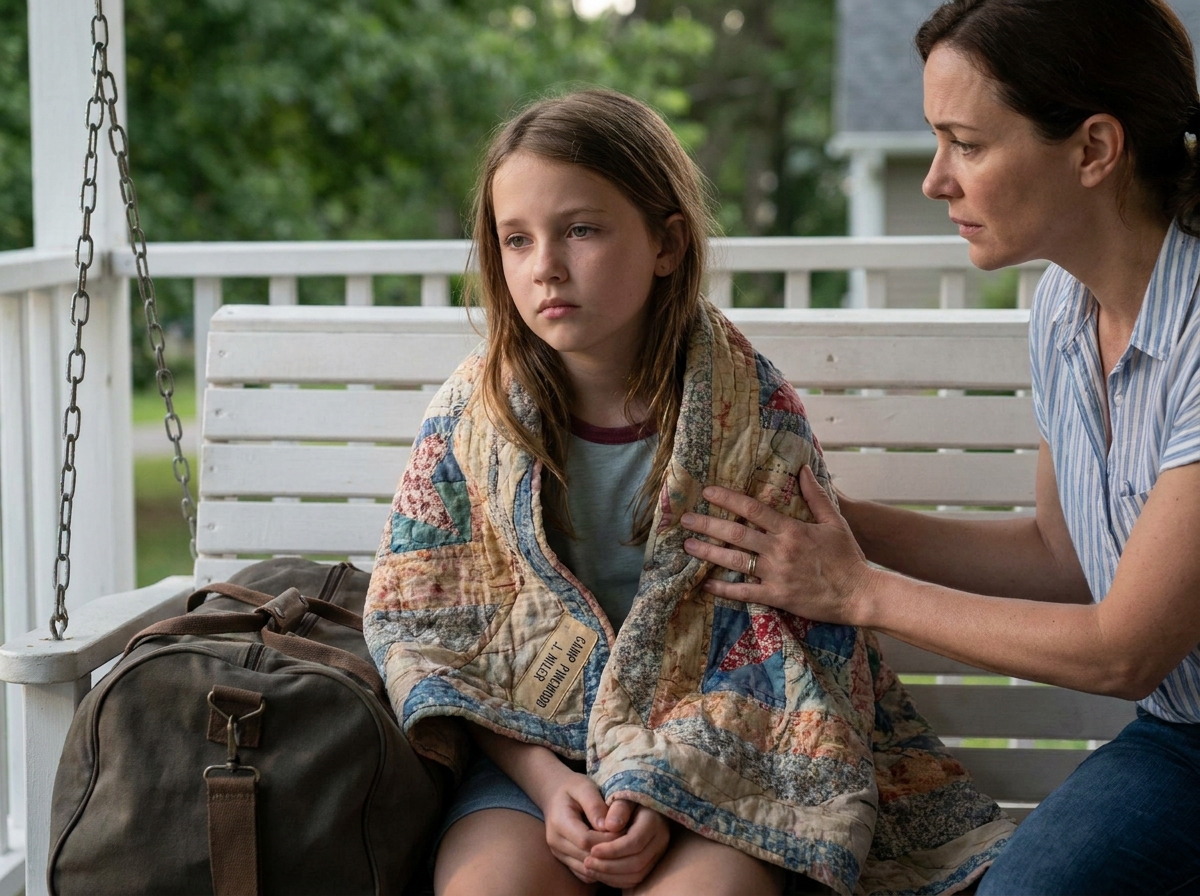
PART 2
“In the room without windows.”
For one second, nobody moved.
The hospital hallway became so silent that I could hear the tiny electronic beep of a monitor behind the closed door, the squeak of a nurse’s shoes far down the corridor, and Renata’s breath breaking against my shirt.
The officer nearest Beatrice lowered his hand slowly to the radio clipped to his shoulder.
“Repeat that,” he said.
Renata’s fingers dug into my sleeve.
I bent so my face was close to hers. “Baby, only if you can. Only what you remember.”
She looked at the floor.
“The room is downstairs,” she whispered. “Past the kitchen. Past the laundry. There’s a blue door, but it doesn’t look like a door because they put shelves in front of it.”
Beatrice made a sound like she had been slapped.
“That is ridiculous,” she snapped. “There is no such room.”
The coordinator, still sitting in the chair, pressed both hands over her mouth.
The officer’s eyes moved to her.
“You know the room,” he said.
She shook her head too fast.
“I don’t know anything.”
But she was crying now.
Not loudly.
Not honestly.
Just leaking fear.
Renata’s voice got smaller. “Daniela said she was scared of dark places. She cried when they took her. Miss Paula said if she stopped crying, they would let her come back to the cabin.”
“Miss Paula?” the officer asked.
“The night teacher.”
Beatrice stepped forward. “That child is confused. She has been through a stressful accident, and this mother is feeding her ideas.”
The doctor, who had been silent until then, turned on her with a face so cold it made Beatrice step back.
“This child said that before her mother asked a single leading question.”
Beatrice’s mouth opened.
No sound came out.
Then my phone rang.
The caller ID said Saint Emily’s Academy.
The officer looked at me. “Put it on speaker. Do not answer as if anything is wrong. Keep her talking.”
My hand shook as I accepted the call.
“Gabriela?” a woman said.
Not Beatrice. Older. Softer. The kind of voice people use at church bake sales and parent orientation nights.
“Yes?”
“This is Sister Agnes from Saint Emily’s. I understand there has been a misunderstanding tonight.”
A misunderstanding.
My daughter was shaking in a hospital gown.
A girl was missing.
Evidence had already been cleaned.
And this woman called it a misunderstanding.
I looked at the officer.
He nodded.
“What kind of misunderstanding?” I asked.
Sister Agnes sighed gently. “Children get frightened. They exaggerate. Especially after peer conflict.”
“Peer conflict?”
“Renata and Daniela had a difficult week together. We don’t want this to become something damaging to the school, to the girls, or to your family.”
My stomach turned.
“Where is Daniela?”
There was half a second of silence.
Not long.
But long enough.
“Daniela was picked up earlier by her family.”
The officer wrote something down fast.
“What family?” I asked.
“Her father.”
“Daniela told Renata her father died.”
This time, the silence lasted longer.
Then Sister Agnes said, “Gabriela, I think it would be best if you brought Renata back to us in the morning so we can help her process the story correctly.”
The story.
Not the incident.
Not the truth.
The story.
Beatrice stared at the phone as if she wanted to climb through it and strangle the voice on the other end.
The officer leaned close and whispered, “Ask if they found the backpack.”
I swallowed. “Did you find Renata’s backpack?”
A rustle came through the speaker.
Then Sister Agnes’s voice changed. The softness cracked.
“Why would you ask that?”
“You said her things were mixed with luggage.”
“Yes. Yes, of course. We are still sorting them.”
“What about the red backpack?”
A sound came through the speaker.
Someone on her end dropped something.
Then a man’s voice, muffled but clear enough, said, “End the call.”
Sister Agnes came back sharp and low.
“You need to be very careful, Mrs. Vargas. Accusations have consequences.”
The officer reached over and ended the call.
The moment the screen went dark, he spoke into his radio.
“We need units to Saint Emily’s retreat property now. Possible missing minor on site. Possible concealed room, basement level, blue door behind shelving, past kitchen and laundry. Secure all exits. Detain adult staff present. Preserve digital evidence.”
Beatrice lunged.
Not toward me.
Toward the coordinator.
“Do not say a word,” she hissed.
The officer stepped between them. “Ma’am, you are done giving instructions.”
Beatrice’s face changed then.
It was the first time I saw the real woman under the beige coat.
Not the elegant director.
Not the polished educator.
Not the woman who smiled at fundraisers and called children “my girls.”
This woman was afraid.
But not for Renata.
Not for Daniela.
For herself.
Another officer appeared at the end of the hallway with two hospital security guards.
“Director Beatrice Hale,” he said, “you’re going to come with us.”
“I have rights.”
“Yes, ma’am. You do. And so does every child in your care.”
As they led her away, her head turned toward me.
Her voice dropped so low I almost didn’t hear it.
“You have no idea what you just opened.”
Renata heard it.
She pressed herself tighter against me.
I wanted to tell my daughter that Beatrice was powerless now.
I wanted to tell her the police would handle everything.
I wanted to tell her monsters stopped being monsters once adults saw them clearly.
But motherhood teaches you the difference between comfort and lies.
So I held her and said the only thing I knew was true.
“I opened the door, baby.”
She looked up at me with wet eyes.
“And we’re not closing it again.”
The hospital moved us into a private family room after that. A social worker named Mara sat with Renata, gentle and patient, and explained that she didn’t have to tell the story all at once. She could draw. She could point. She could write. She could stop whenever she wanted.
Renata asked for paper.
Not crayons.
A pencil.
Her hands trembled as she drew the retreat house.
First the bus loop.
Then the front steps.
The chapel.
The dining hall.
The cabins.
The pool.
She paused when she reached the back corner of the page.
Mara did not push.
Renata bit her lip until I wanted to beg her to stop.
Then she drew stairs.
Down.
A hallway.
A rectangle.
A blue door.
And inside it, a small circle.
Daniela.
I covered my mouth.
Renata kept drawing.
Next to the blue door, she made three marks.
“What are those?” Mara asked gently.
“Locks.”
“Were they on the outside or the inside?”
Renata looked confused by the question, as if no one could possibly think they were on the inside.
“Outside.”
Mara nodded once. “You’re doing very well.”
Renata’s pencil moved again.
She drew shelves in front of the door.
Boxes.
Towels.
Cans.
Then, slowly, she drew another shape on the wall across from the door.
A camera.
The officer standing nearby leaned in.
“I thought they cleared the cameras,” he said.
Renata shook her head.
“Not that one.”
Everyone looked at her.
“It’s not a camp camera,” she whispered. “It belongs to the old man.”
“What old man?” I asked.
Renata’s pencil froze.
Her whole body went still.
Mara raised a hand slightly, telling me not to ask again.
Renata erased the camera so hard the paper tore.
Then she whispered, “He wears gloves.”
My legs nearly gave out.
Mara immediately shifted, placing her body between Renata and the adults in the room like a shield.
“That’s enough for tonight,” she said calmly. “She needs rest.”
But the officer had already taken a photo of the drawing.
Within minutes, more people arrived.
A detective named Lawson.
A child advocate.
A woman from the district attorney’s office.
They spoke in low voices near the door, using words that sounded official and sterile because the real words were too ugly to say in front of a ten-year-old.
Possible confinement.
Tampering.
Failure to report.
Obstruction.
Missing child.
Organized cover-up.
I sat beside Renata’s bed while she slept, one hand wrapped around mine even in dreams.
Her hair was still damp.
That detail would not leave me.
Someone had washed my daughter.
Someone had tried to rinse away what happened before she could reach me.
But they had forgotten she was my child.
They had forgotten I knew the difference between tired and terrified.
At 11:36 p.m., Detective Lawson came back into the room.
His expression told me something had happened.
I stood so fast the chair scraped the floor.
“Daniela?”
He looked toward Renata, then back at me. “Can we step outside?”
“No,” Renata whispered from the bed.
Her eyes were open.
She had not been sleeping.
She had been pretending.
Detective Lawson softened. “Renata, we have officers at the camp now.”
Her grip on my hand tightened.
“Did they find her?”
He hesitated.
That hesitation nearly killed me.
“They found the room.”
Renata’s lips parted.
“It was empty.”
The sound that came out of her was not a cry.
It was worse.
It was the sound of a child realizing that telling the truth had not been fast enough.
“No,” she whispered. “No, she was there.”
“I believe you,” Detective Lawson said quickly. “We found signs someone had been there recently. Very recently. Food wrappers. A blanket. A hair ribbon.”
“What color?” Renata asked.
“Yellow.”
Renata began to cry. “That’s Daniela’s.”
I sank back into the chair.
Detective Lawson continued, his voice low.
“There were fresh scrape marks near the back service exit. Tire tracks behind the laundry building. We think someone moved her after Sister Agnes made that phone call.”
The room tilted.
I remembered the muffled man’s voice.
End the call.
“What about Sister Agnes?” I asked.
“Gone.”
“Gone?”
“The retreat house staff says she left before officers arrived. Her office was cleared out. Computer missing. Filing cabinet empty. Phone turned off.”
“And Beatrice?”
“In custody. Not talking.”
“What about the coordinator?”
“She’s talking.”
The detective looked toward the hallway.
“She says Daniela was never supposed to be on the official roster.”
I stared at him. “What does that mean?”
“It means the camp has two lists.”
Renata wiped her face with the sheet.
Detective Lawson looked like he wished he could leave her out of it, but there was no leaving her out of something she had survived.
“One list for parents, insurance, the state.”
“And the other?” I asked.
His jaw tightened.
“Children sponsored privately. No public paperwork. No clear guardian signatures. No medical forms. No emergency contacts.”
My blood went cold.
“How many?”
“We don’t know yet.”
Renata spoke so quietly we almost missed it.
“Daniela said she wasn’t the first.”
The detective turned to her carefully. “Did Daniela say who else?”
Renata stared at the ceiling.
“A girl named Lucia.”
Detective Lawson wrote it down.
“And Nelly.”
He wrote again.
“And the twins with no shoes.”
No one spoke.
The room seemed to shrink around us.
The twins with no shoes.
I had heard terrifying things in my life. I had worked jobs where mothers screamed in emergency rooms and fathers punched walls after bad news. But nothing had ever hollowed me out like those five words spoken by my little girl in a hospital bed.
The twins with no shoes.
Detective Lawson left to make another call.
Mara stayed.
She told Renata none of this was her fault.
Renata nodded the way children nod when they want adults to stop saying things they cannot yet believe.
At 12:14 a.m., my phone buzzed again.
Unknown number.
I showed Mara.
She called Detective Lawson back in.
“Answer,” he said. “Speaker.”
I accepted.
For a moment, there was only breathing.
Then a girl’s voice whispered, “Renata?”
Renata sat upright so fast the blanket fell from her lap.
“Daniela?”
I forgot how to breathe.
The detective moved closer, already signaling for someone to trace the call.
“Daniela, this is Renata’s mom,” I said gently. “Where are you?”
The girl began crying.
Not loudly.
Like she was trying not to be heard.
“I don’t know.”
Renata’s face crumpled. “Are you still in the room?”
“No. They put me in a car.”
“Who?” Detective Lawson asked.
Daniela went silent.
Then she whispered, “The nun.”
Sister Agnes.
My skin turned to ice.
Daniela continued, every word shaking.
“She said Renata ruined everything.”
Renata made a small wounded sound.
I squeezed her hand hard. “No, sweetheart. No.”
Detective Lawson spoke with incredible calm.
“Daniela, my name is Detective Lawson. Are you in the car now?”
“No.”
“Inside a building?”
“Yes.”
“Can you see anything?”
“It smells like flowers.”
The detective’s eyes sharpened.
“Flowers?”
“And old candles.”
A church.
My mind went there before anyone said it.
“Can you see windows?”
“One. It’s high. Red and blue glass.”
Stained glass.
Detective Lawson wrote something down.
“Can you hear traffic? Trains? Water?”
Daniela was quiet.
Then: “Bells.”
“What kind of bells?”
“Church bells.”
“How many times did they ring?”
“I don’t know.”
“Did they ring recently?”
“Yes.”
“What number?”
Daniela sniffled. “Twelve.”
Midnight bells.
Detective Lawson looked at the officer by the door.
“Search every affiliated church property within thirty miles. Start with chapels that ring midnight bells and have stained glass.”
Daniela suddenly gasped.
A sound came through the phone.
A door.
Footsteps.
A woman’s voice in the distance.
“Daniela?”
The girl whispered, “She’s coming.”
“Hide the phone,” Renata said desperately.
“I can’t. She gave it to me.”
Detective Lawson froze.
“She gave you the phone?”
Daniela sobbed. “She told me to call Renata and say I was okay.”
A chill passed through everyone in the room.
This was not a rescue call.
It was a trap.
Before Detective Lawson could speak, another voice came on the line.
Sister Agnes.
“Mrs. Vargas,” she said softly. “You should have accepted the misunderstanding.”
I stood so suddenly the chair hit the wall.
“Where is she?”
“Safe.”
“Where is Daniela?”
“With people who know how to protect institutions from hysterical mothers.”
Detective Lawson motioned for me to keep her talking.
I forced my voice not to break.
“She’s a child.”
“So is your daughter. And your daughter can still have a future if you stop.”
Renata stared at the phone with terror and fury battling in her eyes.
Sister Agnes continued. “Children recover from confusion. Schools do not recover from scandal. Families do not recover from being named in court documents.”
“What families?”
A soft laugh.
“Oh, Gabriela. You really think Beatrice made these decisions alone?”
Detective Lawson’s face hardened.
Sister Agnes lowered her voice.
“There are donors. Trustees. Doctors. Judges. Men and women whose names open doors you don’t even know exist. Your daughter came home. Be grateful.”
My hand tightened around the phone until my knuckles hurt.
“My daughter came home because someone made a mistake.”
“No,” Sister Agnes said. “Your daughter came home because Daniela stayed quiet long enough.”
Renata flinched.
I looked at my child, and something inside me became calm in the most dangerous way.
“Listen to me,” I said. “I don’t care how many doors those names open. I’m going to burn every building behind them.”
For the first time, Sister Agnes’s voice lost its sweetness.
“You are a receptionist with a mortgage.”
“I am a mother.”
The line went dead.
Detective Lawson turned to the officer.
“Trace?”
The officer shook his head. “Too short. Burner. But we got a tower ping.”
“Where?”
“North side. Near Saint Bartholomew’s Parish.”
Mara whispered, “That church closed last year.”
Detective Lawson was already moving.
“Not closed enough.”
He looked at me.
“You and Renata stay here. No visitors except hospital staff cleared through police. No calls answered unless we’re present.”
“I’m coming.”
“No.”
“That’s another child.”
“And yours is here.”
That stopped me.
Because Renata was staring at me with a face that looked five years younger.
Afraid I would leave her too.
I sat back down slowly.
Detective Lawson’s voice softened. “We’ll go get Daniela.”
He left with three officers.
And I stayed.
Because motherhood sometimes means running toward danger.
And sometimes it means sitting beside the child who thinks danger is what happens when you close the bathroom door.
For almost an hour, we heard nothing.
The clock moved from 12:20 to 12:41 to 1:03.
Renata refused to sleep.
She kept asking if Daniela was cold.
If Daniela still had the yellow ribbon.
If Daniela thought she had abandoned her.
At 1:18, Mara stepped out to answer a call.
When she returned, her eyes were wet.
“They found Saint Bartholomew’s empty.”
Renata’s face collapsed.
“But,” Mara said quickly, “they found something else.”
“What?” I asked.
“A phone.”
Daniela’s burner phone.
Left on the altar.
Beside one yellow hair ribbon.
Renata turned her face into my side and screamed.
I had heard my daughter cry before.
Over scraped knees.
Over spelling tests.
Over the death of our old Labrador, Milo, who had once slept beside her crib.
But this scream came from somewhere deeper than pain.
It came from guilt.
“She called me,” Renata sobbed. “She called me and I couldn’t save her.”
I held her as tightly as the nurses allowed.
“No, baby. She called you because you already did.”
Renata shook her head.
“They took her again.”
“And now we know they’re running.”
Mara looked at me.
There was something in her eyes.
Something she hadn’t said yet.
“What else?” I asked.
She hesitated. “Gabriela…”
“What else?”
She closed the door behind her.
“The officers found old records in the church basement. Not complete files. More like fragments. Boxes of donation forms, camp newsletters, handwritten notes. The names Renata mentioned were there.”
Lucia.
Nelly.
The twins with no shoes.
I felt the room spin.
“How old?”
“Some of them go back twelve years.”
Twelve years.
Saint Emily’s had been operating for decades. They had glossy brochures, scholarship dinners, chapel retreats, smiling board members, polished social media posts, parent testimonials, and a waiting list so long mothers bragged when their daughters got accepted.
All that time, children had been disappearing inside the seams.
Not always physically.
Sometimes on paper.
Sometimes into silence.
Sometimes into rooms no one wanted to admit existed.
At 1:32 a.m., another officer arrived with a plastic evidence bag.
Inside was a small red backpack.
Renata saw it and stopped crying instantly.
Her whole body went rigid.
“That’s mine.”
The officer looked at Detective Lawson, who had returned with a face carved from stone.
“We found it in a dumpster behind Saint Bartholomew’s,” he said.
I stood. “Why would they throw it away?”
He did not answer.
He opened the evidence photo on his tablet instead.
The backpack had been cut open.
The lining removed.
The pockets turned inside out.
“They were looking for something,” he said.
Renata slowly touched her own throat.
“My necklace.”
I blinked.
“What necklace?”
“The little heart camera Uncle Tomas gave me.”
My brother.
Tomas had given it to her two weeks earlier as a joke and a safety gift because Renata wanted to make “camp documentaries.” It was a tiny heart-shaped pendant that looked like cheap pink plastic but recorded short videos when pressed twice.
I had forgotten about it.
Renata had not.
Detective Lawson leaned forward.
“Renata, did you record something?”
She swallowed.
“I didn’t mean to.”
“What did you record?”
“I pressed it when we were making friendship bracelets. Then I forgot it was on.” Her eyes filled again. “Daniela said if anything happened, grown-ups always believe video more than kids.”
My entire body went cold.
“Where is the necklace now?” Detective Lawson asked.
Renata looked down.
“I put it in Daniela’s shoe.”
The detective stared at her.
Everyone did.
“Why?”
“Because Miss Paula took my backpack. She took Daniela’s too. But Daniela had old sneakers with the soles coming loose. We hid it under the inside part. She said if she got out first, she would bring it to my mom.”
Her voice broke.
“But she didn’t get out.”
Detective Lawson stood.
“If Daniela still has those shoes—”
“She doesn’t,” Renata whispered.
He stopped.
“She lost one when they pulled her into the laundry hallway.”
The officer with the evidence bag went pale.
“What?”
Renata wiped her nose with the sheet.
“It came off near the big dryer. Miss Paula kicked it under the cart.”
Detective Lawson grabbed his radio.
“Search the laundry room again. Under every cart, appliance, vent, and drain. Look for a child’s sneaker. Possible recording device inside.”
The next twenty minutes were the longest of my life.
At 1:57 a.m., the call came in.
They found the shoe.
At 2:09, they found the necklace.
At 2:25, the technician recovered video.
Detective Lawson did not show it to us.
Thank God.
He only came back into the room with his face changed forever.
Some people believe justice begins in courtrooms.
They are wrong.
Sometimes justice begins with one adult watching something so terrible that he can no longer pretend the world is complicated.
He stood at the foot of Renata’s bed and said, “Your daughter saved lives tonight.”
Renata stared at him.
“Did it show Daniela?”
“Yes.”
“Was she alive?”
“Yes.”
Renata squeezed her eyes shut.
“Did it show where they took her?”
Detective Lawson’s face shifted.
“Not exactly. But it showed something else.”
He turned the tablet toward me, not playing the video, just showing a still frame.
A man’s hand.
A black glove.
A silver ring.
And behind him, reflected in a metal laundry machine, a partial sign on the wall.
MERCY HALL – EAST WING
Mara sucked in a breath.
“What is Mercy Hall?” I asked.
She looked sick.
“It’s not a camp building.”
Detective Lawson answered.
“It’s part of Saint Emily’s old boarding facility. Officially demolished in 2016.”
“Officially?” I repeated.
He nodded.
“The state file says it was torn down after a fire.”
“And unofficially?”
His radio crackled before he could answer.
A voice came through, urgent.
“Detective, we have a live witness at the retreat property.”
Lawson lifted the radio. “Who?”
“A maintenance worker. Says Mercy Hall wasn’t demolished. It was sealed off.”
My knees weakened.
The radio continued.
“He says there’s an underground service tunnel from the old laundry to the east wing.”
Renata sat up.
“Daniela said there was a tunnel.”
Detective Lawson moved toward the door.
Then the radio crackled again.
This time the voice was different.
Breathless.
Terrified.
“We found the entrance.”
A pause.
Then:
“There are children inside.”
Mara covered her mouth.
Renata stopped breathing.
The officer at the door whispered a curse.
Detective Lawson froze with the radio in his hand.
“How many?”
Static.
Then the answer came.
“Four visible. Maybe more. We need medical now. Repeat, we need medical now.”
I reached for the bed rail because the room seemed to drop beneath me.
Four.
Not one.
Four visible.
Maybe more.
Renata whispered, “Daniela?”
Static burst again.
Then the officer’s voice returned.
“We have a girl matching Daniela’s description.”
Renata made a sound like her soul had come back into her body.
“She’s alive,” the officer said. “Scared. Weak. But alive.”
I fell to my knees beside the bed.
Renata sobbed into my shoulder.
For the first time since the bus, her tears sounded like tears instead of trapped air.
“She’s alive,” she kept saying. “Mom, she’s alive.”
I pressed my face into her hair.
“Yes, baby.”
But Detective Lawson was not smiling.
Not fully.
Because the radio was still talking.
Because the story was not over.
Because Daniela had been found alive, but the people who moved her were still running.
And children had been hidden in a building the state believed no longer existed.
At 3:11 a.m., the hospital went into restricted access.
At 3:24, the news vans arrived.
By 3:40, every parent whose daughter had attended Saint Emily’s that summer was calling the police, the hospital, or each other.
By 4:05, Saint Emily’s Academy deleted its social media pages.
By 4:12, someone tried to access Renata’s medical records without authorization.
The hospital locked everything down.
At 4:30, my ex-husband, Carlos, arrived.
He had been out of state for work. He came through the family room door still wearing his airport clothes, face ashen, eyes wild.
“Where is she?”
Renata was asleep.
Finally.
He saw her in the bed and nearly collapsed.
I stepped in front of him before he could rush to her.
“Slowly,” I whispered. “Don’t wake her scared.”
Carlos covered his mouth with both hands.
My marriage to him had ended three years earlier because we were better at hurting each other quietly than loving each other well. But in that moment, he was not my ex-husband.
He was Renata’s father.
And he looked destroyed.
“What happened?” he whispered.
I shook my head.
“Not here.”
He looked through the glass at our daughter.
Then his expression changed.
“What is that blanket?”
“It was on her when she came home.”
His eyes hardened.
“Who put it on her?”
“We don’t know yet.”
He turned toward the hallway.
I grabbed his arm.
“Carlos. No.”
He looked back at me, shaking.
“I sent her there.”
“We both did.”
“No,” he said. “You were unsure. I said she needed independence. I said it was the best girls’ academy in the state.”
His voice broke.
“I put our baby on that bus.”
I wanted to hate him for saying it.
I wanted to throw my guilt into his hands and let him carry all of it.
But Renata had already been carrying too much that did not belong to her.
So I said, “The people who hurt children count on parents blaming themselves. Don’t help them.”
Carlos closed his eyes.
Then he nodded once.
At 5:02 a.m., Detective Lawson returned with Daniela’s mother.
Her name was Marisol.
She was small, with dark circles under her eyes and a hospital visitor sticker pressed crookedly to her sweater.
She looked like someone who had been screaming for hours and had run out of voice.
I stood.
She stared at me.
Then she crossed the room and grabbed my hands.
“Your daughter,” she whispered. “Your daughter remembered.”
I could not speak.
Marisol looked toward Renata sleeping behind the glass.
“I called the camp when Daniela didn’t get off the bus. They told me I was mistaken. They said my daughter had left early with her father.”
Her face twisted.
“Her father has been dead for two years.”
Carlos looked away, jaw clenched.
Marisol continued. “When I called police, Saint Emily’s sent them paperwork. A release form. A signature. A copy of an ID.”
“Forged?” I asked.
She laughed once. Not because anything was funny.
“Not forged. My old ID. From before I moved. They had it from Daniela’s scholarship application.”
Detective Lawson added quietly, “The officer who took the initial report classified it as a custody misunderstanding.”
Marisol’s eyes turned to him.
“Because Saint Emily’s called first.”
There it was.
The machine.
Not one monster in a hallway.
A machine.
A school that called first.
A director who smiled first.
A nun who threatened first.
Paperwork that arrived before mothers could be believed.
By sunrise, the first arrests were public.
Beatrice Hale.
Paula Greene.
Two night staff members.
A driver.
A retired board treasurer found trying to leave through a private airport.
Sister Agnes was still missing.
So was the man with the black gloves.
But Mercy Hall was no longer hidden.
Police found five children inside.
Daniela.
A twelve-year-old girl named Lucia, missing from a “voluntary transfer” three months earlier.
Nelly, who had been listed as withdrawn by a guardian nobody could locate.
And twins named Ava and Elise.
They had shoes.
But not their own.
The news called it a “shocking institutional failure.”
Detective Lawson called it what it was.
A system.
At 8:17 a.m., Renata woke up and asked for pancakes.
I cried so suddenly that Carlos had to turn away.
Renata frowned at us.
“What?”
“Nothing,” I said quickly. “Pancakes are good.”
She looked toward the door.
“Can Daniela have some?”
I sat beside her bed.
“She’s being treated by doctors right now.”
“Can I see her?”
“Not yet.”
“Will she think I left her?”
“No.”
“How do you know?”
The door opened before I could answer.
Marisol stood there, holding a folded piece of paper.
“She asked me to give this to Renata.”
Mara checked with the nurse and Detective Lawson first. Everything was careful now. Everything documented.
Then Marisol handed the note to me.
It was written in shaky pencil.
Only four words.
You told. I lived.
Renata stared at the note.
Her chin trembled.
Then she pressed it to her chest and cried quietly.
Not like before.
This was different.
This was grief leaving through a small open window.
At 9:30 a.m., the district attorney came.
Her name was Elaine Porter. She wore a navy suit, no jewelry except a wedding band, and carried a file thick enough to make my stomach twist.
She asked to speak with me and Carlos outside Renata’s room.
“We are going to need your daughter’s cooperation eventually,” she said. “But not today. Not this week if we can avoid it. The recording gives us probable cause and leverage. The recovered children give us testimony. The staff member is cooperating. The coordinator is requesting protection.”
“Protection from who?” Carlos asked.
Elaine looked down the hallway, then back at us.
“From the people whose names are in Beatrice Hale’s private donor ledger.”
I remembered Sister Agnes’s words.
Donors.
Trustees.
Doctors.
Judges.
“What ledger?” I asked.
Elaine opened the file and slid out a photograph.
It showed a book.
Brown leather.
Gold corners.
No title.
Just initials stamped on the cover.
S.E.
Saint Emily’s.
Elaine tapped the photograph.
“We found this in a safe behind the director’s office wall.”
Carlos stared at it. “What’s inside?”
“Names. Dates. Payments. Transfer notes. Some are coded. Some are not.”
“And my daughter?”
Elaine’s mouth tightened.
“Renata’s name was added two days ago.”
The hallway seemed to fall silent.
Carlos gripped the wall.
I could not move.
“What does that mean?” he asked.
Elaine did not soften the truth.
“It means whatever happened this week was not random.”
I thought of the coordinator’s too-fast smile.
The missing backpack.
The washed hair.
The blanket.
The director arriving at the hospital with her perfect beige coat.
“Why Renata?” I whispered.
Elaine looked at me with something like pity.
“We don’t know yet.”
But I did.
Not fully.
Not legally.
Not with evidence.
But somewhere deep in my bones, I knew there had been a reason Renata came home and Daniela did not.
Someone had chosen.
Someone had planned.
Someone had put my daughter’s name in a ledger.
And the scariest part was that they had expected her to stay silent.
At 10:06 a.m., Beatrice Hale requested her attorney.
At 10:22, her attorney arrived.
At 10:40, three board members resigned.
At 11:15, Saint Emily’s Academy released a public statement saying they were “heartbroken by allegations” and “cooperating fully.”
At 11:17, Detective Lawson showed me a copy of an email Beatrice had sent at 8:52 the previous night.
Twelve minutes after my daughter’s bus arrived.
The subject line read:
Problem parent. Contain immediately.
The message was sent to five people.
Sister Agnes.
The board treasurer.
A lawyer.
A doctor.
And one email address with no name.
Just initials.
M.H.
Below the subject line, Beatrice had written:
Renata Vargas’s mother called emergency services. The girl may have retained something. Daniela remains unresolved. Activate Mercy protocol.
Mercy protocol.
I read those two words over and over until they stopped looking like words.
“What is Mercy protocol?” I asked.
Detective Lawson’s face darkened.
“We’re trying to determine that.”
But his phone buzzed before he could say anything else.
He read the message.
Then he looked at me.
“What?” I asked.
“The anonymous email address just sent a message.”
“To who?”
“To you.”
My phone was in an evidence sleeve, held by the officer nearby.
He took it out carefully, opened the new email, and placed the screen where I could see it.
No subject.
No greeting.
Just one sentence.
You saved Daniela, but you should have checked Renata’s blanket sooner.
My blood turned to ice.
The officer unfolded the evidence log.
“The blanket is sealed downstairs.”
Detective Lawson was already running.
I stayed frozen in the hallway.
Carlos said my name, but I barely heard him.
Because suddenly I remembered something.
When Renata came off the bus, she had gripped that gray blanket like it was the only thing holding her together.
At the hospital, they sealed it.
Dated.
Timed.
Stored.
Everyone thought it was evidence of what they had done.
But what if it was more than that?
What if they had sent something home with her?
At 11:29 a.m., the evidence technician opened the blanket under controlled conditions.
At 11:31, Detective Lawson came back upstairs.
He held a clear plastic bag.
Inside was a tiny silver key.
And a strip of paper with three words written in a child’s handwriting.
Not Renata’s.
Not Daniela’s.
A third child.
Find Room Seven.
Renata was awake when I walked back in.
She looked at my face and knew.
Children always know more than adults think they do.
“What happened?” she asked.
I sat beside her.
I tried to smile.
Failed.
“Baby,” I said softly, “do you remember a Room Seven?”
She stared at me.
Then every drop of color left her face.
She did not answer.
She did not cry.
She only reached for the note Daniela had given her and held it like a shield.
Mara stepped closer.
“Renata?”
My daughter’s lips barely moved.
“Room Seven isn’t at camp.”
Detective Lawson stood in the doorway.
“Where is it?”
Renata looked at him.
Then at me.
Then at the sealed evidence bag in his hand.
“It’s where they take the girls who don’t have anyone coming for them.”
The room went silent.
Renata swallowed.
“And Mom…”
Her voice cracked.
“I saw the list.”
“What list?”
“The list for next week.”
I could barely speak.
“What was on it?”
Renata’s eyes filled with horror.
“My name.”
PART 3
“My name.”
For a moment, the words did not enter my mind.
They hit the air.
They hung there.
They turned the room colder.
But I could not understand them.
Because mothers are not built to hear their children say that strangers wrote their names on a list.
My daughter sat in a hospital bed, small under a white blanket, with tape still on the back of her hand from the IV and bruised shadows under her eyes from a night no child should ever have to survive.
And she was looking at me as if I could stop the entire world from reaching her.
“My name was on it,” she whispered again.
Carlos moved first.
He stepped toward the bed, but Mara lifted one hand.
Not harshly.
Just enough.
“Slowly,” she said.
He stopped like a man who had walked to the edge of a cliff.
Detective Lawson came into the room with the evidence bag still in his hand. The tiny silver key inside caught the fluorescent light.
“Renata,” he said gently, “I need to understand. What list did you see?”
Renata swallowed.
“The paper on Miss Paula’s desk.”
“Where was the desk?”
“In the nurse room.”
My head snapped up. “There was a nurse room?”
Renata nodded. “But there wasn’t a nurse.”
Mara sat beside her, close but not touching. “Can you tell us what you remember about the paper?”
Renata closed her eyes.
I could see her trying to go back there.
Trying to stand again inside whatever hallway, whatever smell, whatever fear had swallowed her at Saint Emily’s.
Her lips trembled.
“It was a clipboard. Miss Paula put it down when the man came in.”
“The man with gloves?” Detective Lawson asked.
Renata nodded.
“What did the list say?”
She looked at me.
Not the detective.
Me.
Because she was about to say something terrible, and children always look for their mother before terrible things become real.
“There were names,” she whispered. “And numbers.”
“What numbers?”
“I don’t know. Some were dates. Some were money.”
Money.
The word entered the room like poison.
Carlos turned away and pressed both hands against the wall.
Detective Lawson kept his voice calm. “Do you remember any names?”
Renata hugged her knees.
“Daniela. Lucia. Nelly. Ava. Elise.”
The recovered children.
“And yours?”
She nodded.
“Were there any others?”
Her eyes drifted to the window.
“Two boys.”
Everyone froze.
Detective Lawson’s pen stopped moving.
“Boys?”
Renata nodded slowly. “They weren’t at our camp. Miss Paula said they were from the winter program.”
A silence followed.
A heavy silence.
The kind that makes adults realize the hole is deeper than the first body of water they found.
Detective Lawson exchanged a look with the district attorney.
Elaine Porter had returned quietly and was now standing near the door, arms folded across her navy suit, her face still but her eyes burning.
“Do you remember their names?” she asked.
Renata shook her head. “One started with M. Maybe Mateo. Or Mason.”
“And the other?”
Renata’s voice nearly disappeared.
“He had no name.”
My heart stopped.
Carlos turned around. “What does that mean?”
She looked frightened, as if she had said something wrong.
“On the list, it just said Blue Jacket.”
Mara inhaled sharply.
Elaine’s jaw tightened.
Detective Lawson wrote it down.
Blue Jacket.
Not a name.
A description.
A child reduced to clothing.
A child nobody bothered to identify.
That was the moment I understood something that would haunt me long after the hospital, long after the cameras, long after the trials and headlines and angry school board meetings.
The world does not become evil all at once.
It becomes evil when one person writes “Blue Jacket” instead of searching for a name.
Detective Lawson crouched slightly so he was not towering over Renata.
“Do you remember anything else on the clipboard?”
Renata nodded once.
“The top had a title.”
“What title?”
She looked at the evidence bag.
Then at the little silver key.
Then back at me.
“Mercy placements.”
Nobody spoke.
Mercy.
Again.
Mercy Hall.
Mercy protocol.
Mercy placements.
They had taken one of the most beautiful words in the world and turned it into a lock.
Elaine Porter stepped into the hallway and made a call. Her voice was low, fast, controlled.
“Expand the warrant scope. Yes, now. Include all historical programs, scholarship funds, winter retreats, affiliate parishes, medical partners, and donor placement ledgers. I want every sealed record challenged by noon.”
Carlos stared through the glass at Renata.
“Medical partners?” he said quietly.
I looked at him.
He was pale.
“Carlos?”
He did not answer at first.
“Carlos, what?”
His eyes shifted toward me with something like dread.
“When we applied for Saint Emily’s,” he said slowly, “they required a physical exam.”
“Yes. Every camp does.”
“No.” He shook his head. “Not like that.”
My stomach tightened.
“What are you talking about?”
“I filled out the first packet. I remember thinking it was too much. Family medical history. Insurance details. Behavioral questions. Sleep habits. Allergies. Medication records. Whether she had extended family nearby. Whether we were married. Whether either parent traveled for work.”
His voice broke at the last sentence.
I remembered.
I remembered being annoyed at the paperwork, but not alarmed.
Because Saint Emily’s had been prestigious. Organized. Strict. Expensive enough that everything felt official instead of invasive.
Carlos continued, “They asked who could pick her up in an emergency.”
I nodded. “Us. My brother Tomas. Your mother.”
His face changed.
“My mother’s name wasn’t on the final copy.”
“What?”
“I added her,” he said. “I know I did. But the confirmation packet only listed you and Tomas.”
I stared at him.
“What are you saying?”
“I’m saying the camp knew my mother was out of the country this summer. They knew Tomas works nights. They knew I was traveling this week.”
My mouth went dry.
“And they knew I’d be alone.”
Neither of us said the rest.
They had not chosen Renata only because she was there.
They had studied her.
They had studied us.
They knew which children had parents who would notice quickly, and which children had parents whose calls could be delayed, confused, redirected, buried in paperwork.
But they had made one mistake with my daughter.
They underestimated the kind of mother who smells the wrong soap in her child’s hair and calls 911 before asking permission.
Elaine came back inside.
Her expression was colder now.
“Gabriela,” she said. “Did anyone from Saint Emily’s contact you before camp started asking about your home situation?”
I laughed once because the memory arrived at the exact moment she asked.
Not a funny laugh.
A sick one.
“Yes.”
Carlos looked at me.
“Who?”
“Sister Agnes.”
Elaine stepped closer. “What did she ask?”
I pressed my fingers to my temples.
“She called to welcome Renata. She said Saint Emily’s liked to understand every child’s emotional background.”
“What did you tell her?”
“That Renata was shy at first but warmed up quickly. That she liked drawing. That she had nightmares after our divorce.”
Carlos closed his eyes.
“What else?”
I tried to remember her voice. That soft church-bake-sale voice. That gentle, patient tone that had made me feel safe enough to answer.
“She asked if Renata was close to both parents. I said yes, but Carlos traveled a lot. She asked if there were any custody tensions. I said no, not serious ones. She asked if Renata had separation anxiety.”
Elaine’s face hardened.
“And did she?”
“A little,” I said. “When she was younger.”
“Did Sister Agnes ask about bathrooms?”
The room went still.
My eyes lifted.
“Yes.”
Carlos whispered, “What?”
I looked at Renata.
She was watching me.
“She said the cabins had shared bathrooms, and some younger girls got nervous. She asked if Renata had privacy fears.”
Elaine did not look surprised.
Detective Lawson wrote something down.
Carlos put both hands on top of his head and turned in a circle like he could not stay still without breaking something.
“They made us hand them the map,” he said.
I looked at him.
“What?”
“They didn’t break into our lives. We gave them the map.”
The words destroyed him.
Mara spoke softly. “No. They disguised a trap as care. That is not your fault.”
Carlos nodded, but I knew he didn’t believe her.
Because I didn’t believe her either.
Not yet.
At 12:30 p.m., the hospital became a fortress.
Uniformed officers stood near the elevators.
Every visitor was checked.
Every staff badge scanned twice.
No one entered Renata’s room without Mara or the nurse present.
Outside, the world was waking up to the story.
Parents were screaming outside Saint Emily’s gates.
News helicopters circled over the Catskills retreat property.
Reporters said things like “exclusive academy scandal” and “missing children recovered” as if this were a storm, an accident, a tragedy that had fallen from the sky.
But inside the hospital, I saw the truth walking by on small legs.
Daniela, being moved from one treatment room to another, wrapped in a clean blanket, holding her mother’s hand.
Lucia, refusing to let anyone close the curtain.
Nelly, asking every doctor if they were “with the school.”
The twins, Ava and Elise, who only responded when spoken to together.
They were alive.
Alive was a miracle.
But alive was not the same as safe.
At 1:14 p.m., Renata asked again to see Daniela.
This time, Mara spoke to Marisol.
The doctors agreed to two minutes.
No touching unless both girls wanted it.
No questions about what happened.
No adults crying in front of them if they could help it.
Marisol brought Daniela in a wheelchair.
She looked smaller than I expected.
Her hair had been brushed, but unevenly, as if someone had cut out tangles. She had a hospital bracelet around her wrist and a yellow ribbon tied loosely around two fingers.
Renata sat up.
Daniela saw her and began to cry.
Renata’s face crumpled.
“I’m sorry,” Renata said immediately.
Daniela shook her head hard.
“No.”
“I told too late.”
“No.”
“I didn’t know where they took you.”
“You remembered the shoe.”
Renata covered her mouth.
Daniela lifted the yellow ribbon.
“You remembered me.”
That was all they said.
Then Daniela reached out.
Renata reached back.
Their fingers touched.
Not a hug.
Not a dramatic reunion like in movies.
Just two children holding on to proof that both of them had made it through the night.
Marisol and I stood beside each other, trying not to fall apart.
Daniela looked at me.
Her voice was hoarse.
“Are you Renata’s mom?”
“Yes, sweetheart.”
She swallowed. “She said you would come.”
I looked at my daughter.
Renata stared at her lap.
“She said even if the teachers told her not to talk, you would hear her face.”
Hear her face.
I covered my mouth.
Because that was exactly what had happened.
My daughter had come off a bus without words.
And I had heard everything.
Daniela was wheeled back out after two minutes.
But before she left, she turned around.
“Renata?”
Renata looked up.
Daniela’s voice dropped.
“Room Seven has a red floor.”
Mara stiffened.
Detective Lawson, who had been standing outside the doorway, stepped in.
But Daniela was already trembling.
Marisol knelt beside her wheelchair. “No more, mija. No more right now.”
Daniela grabbed her mother’s sleeve.
“No, I have to say it before I forget.”
Detective Lawson crouched nearby. “Only one thing, Daniela. Then you rest.”
She nodded.
“Room Seven has a red floor and a picture of a white horse. The lady with silver hair said if we were good, we would get new names.”
New names.
The words made my skin crawl.
Mara took a slow breath.
Elaine Porter appeared at the doorway as if the sentence had pulled her from the hallway.
“A white horse?” Elaine asked.
Daniela nodded.
“Was it painted on the wall?”
“No. A picture. Big frame. The horse was standing in snow.”
Elaine went pale.
For the first time since I met her, the district attorney looked afraid.
“What is it?” I asked.
She did not answer.
“What is it?” Carlos demanded.
Elaine looked at Detective Lawson.
“Meredith Holloway.”
M.H.
The initials from the email.
The initials from the anonymous account.
The person who had written to me.
You saved Daniela, but you should have checked Renata’s blanket sooner.
Detective Lawson’s face hardened.
“Are you sure?”
Elaine’s voice was low.
“Her family estate has a famous painting in the entry hall. A white horse in snow.”
Carlos stepped forward. “Who is Meredith Holloway?”
No one answered quickly enough.
So I asked again, louder.
“Who is she?”
Elaine looked at me.
“Chairwoman of Saint Emily’s Board of Trustees.”
My body went cold.
Of course.
Not Beatrice.
Not Sister Agnes.
Not the coordinator.
Someone above them.
Someone whose name did not appear in smiling camp brochures because power does not always stand in front of cameras.
Sometimes power signs checks.
Sometimes power hosts charity dinners.
Sometimes power owns the room everyone else is afraid to name.
Detective Lawson spoke into his phone. “We need a warrant for the Holloway estate.”
Elaine was already shaking her head. “A judge will want more than a child’s description of a painting.”
“You’re the DA.”
“And Meredith Holloway has lunch with half the bench.”
“Then find the other half.”
Elaine’s eyes flashed. “That is exactly what I’m doing.”
She stepped into the hall again, phone to her ear.
Carlos looked at me.
“Did you know her?”
“No.”
But as soon as I said it, something moved in my memory.
A photograph.
A newsletter.
Saint Emily’s welcome packet.
A woman with silver hair standing beside scholarship girls in white dresses.
The caption under her face:
Meredith Holloway, Founder of the Mercy Initiative.
I grabbed my phone from the officer’s evidence pouch with permission and searched my email under supervision.
Saint Emily’s.
Welcome.
Scholarship.
Mercy Initiative.
There it was.
The message had come six months earlier.
A glossy PDF brochure.
I opened it.
Children smiling in gardens.
Girls reading beneath trees.
A chapel flooded with sunlight.
And at the bottom:
The Mercy Initiative provides transformative retreat opportunities for promising children in vulnerable family circumstances.
Vulnerable family circumstances.
I almost dropped the phone.
Carlos read over my shoulder.
“They called us vulnerable.”
I opened the next page.
There were testimonials.
Parents praising the program.
Children thanking Saint Emily’s.
Donors listed in elegant gold type.
And then I saw it.
A photograph from the annual gala.
Meredith Holloway in a silver gown.
Beatrice beside her.
Sister Agnes behind them.
And standing at the edge of the frame, half turned away from the camera—
a man in black gloves.
My hand froze.
“Detective.”
Lawson came in.
I showed him the screen.
He enlarged the image.
The man’s face was mostly turned, but the ring on his hand was visible.
Silver.
Same shape as the still from the laundry room.
Lawson stared at it.
“Do you know him?” I asked.
“No.”
But his tone said he recognized something.
He sent the image to his team.
Within minutes, the answer came back.
The man was Dr. Malcolm Hensley.
Pediatric behavioral specialist.
Saint Emily’s consultant.
Court-approved child welfare evaluator.
M.H.
Not Meredith Holloway.
Another M.H.
Carlos cursed under his breath.
I stared at the photo.
The black gloves.
The ring.
The polished posture.
The way he stood just outside the center, not hidden, but not exposed.
A man comfortable being near power.
“What does a court-approved child welfare evaluator do?” I asked.
Elaine had returned just in time to hear.
She looked at me with the kind of expression people wear before telling you the floor is gone.
“He evaluates children and families in custody disputes, foster placements, institutional care, trauma claims, school incidents.”
The words stacked on top of each other.
Custody.
Foster.
Institutional.
Trauma.
School.
Children who could be disbelieved with one signature.
Carlos understood at the same moment I did.
“If a child accused Saint Emily’s…”
Elaine nodded slowly.
“Someone like Hensley could write a report saying the child was confused, coached, unstable, attention-seeking, unreliable.”
“And courts believed him?”
“He was respected.”
“Was?”
Her mouth tightened.
“By tonight, he will not be.”
But tonight was too far away.
Because at 2:06 p.m., Detective Lawson’s phone rang.
He listened.
His face changed.
“What?” I asked.
He raised a finger.
Listened again.
Then ended the call.
“Hensley’s office is empty.”
Carlos swore.
“Home?”
“Empty.”
“Car?”
“Gone.”
My stomach dropped.
“And Meredith Holloway?”
Lawson looked at Elaine.
“Her attorney says she’s at a private medical retreat and unavailable.”
Elaine’s face went deadly calm.
“Where?”
“He refused to say.”
I laughed.
I actually laughed.
Everyone looked at me.
Not because anything was funny.
Because something inside me had finally snapped into clarity.
“They’re still doing it.”
Mara frowned. “Doing what?”
“Using polite words for locked doors.”
Private medical retreat.
Unavailable.
Misunderstanding.
Mercy.
Accident.
Every evil thing they did came wrapped in a softer word.
I walked to Renata’s bedside.
She had gone quiet again.
Too quiet.
“Baby,” I said. “Did Dr. Hensley talk to you?”
Her eyes moved to mine.
Then away.
Carlos’s fists clenched.
Mara leaned closer. “Renata, you don’t have to answer now.”
But Renata whispered, “He asked me if my mom gets angry.”
The room stilled.
“What did you say?” I asked.
“I said sometimes. Like when people are late or when the dog eats socks.”
Despite everything, Carlos made a broken sound that was almost a laugh.
Renata did not smile.
“He asked if you ever grabbed me.”
My throat closed.
“I told him no. He asked if I was sure. He said sometimes children forget scary things.”
Mara’s expression hardened.
Renata continued, “Then he asked if Dad made you cry.”
Carlos looked like he had been stabbed.
“And what did you say?”
“I said yes.”
Carlos closed his eyes.
“But only before the divorce,” Renata added quickly. “Not like that. Not bad. Just loud.”
He turned away.
I wanted to comfort him, but I couldn’t move.
Because now I understood.
“They were building a report,” I whispered.
Elaine nodded grimly.
“If Renata came forward, they were ready to claim family instability. Coaching. Parental conflict. Emotional confusion.”
Carlos’s voice was hollow.
“They were going to use our divorce to erase her.”
“No,” I said.
Everyone looked at me.
I turned toward the hallway, toward the officers, toward the hospital full of recovered children and locked records and soft-spoken predators running in expensive cars.
“No,” I repeated. “They were going to try.”
At 3:00 p.m., the first emergency court order came through.
Saint Emily’s Academy was temporarily shut down.
Its retreat property seized.
All student files preserved.
All staff passports flagged.
All current and former board communications subpoenaed.
By 3:45, the Mercy Initiative’s bank accounts were frozen.
By 4:10, the state opened an investigation into every placement connected to Dr. Malcolm Hensley in the last fifteen years.
By 4:22, the story hit national news.
That was when the attacks changed.
Before, they had tried to silence us.
Now they tried to bury us.
My phone filled with messages from unknown numbers.
Liar.
Attention-seeker.
You ruined a school.
Your daughter is disturbed.
How much are you being paid?
Then came the messages from people I knew.
A mother from Renata’s class:
Are you sure she didn’t misunderstand? My daughter loved Saint Emily’s.
A former teacher:
These accusations can destroy innocent adults. Please think carefully.
A neighbor:
There are reporters outside your building. Did you really need to make this so public?
Make this public.
As if I had invited cameras.
As if I had dragged Mercy Hall into daylight for attention.
As if children hidden behind a sealed wall were a matter of reputation management.
Carlos took the phone from my hand before I could throw it.
“Don’t read them.”
“I need to know what they’re saying.”
“No,” he said, voice breaking. “You need to stay standing.”
Before I could answer, another message arrived.
This one was not from an unknown number.
It was from my mother.
I saw the news. Tell me this isn’t about Renata.
I had not called her yet.
I had not called anyone except Carlos.
Because once you say a thing out loud to family, it becomes real in a different way.
I stepped into the hallway and called her.
She answered on the first ring.
“Gabriela?”
One word.
My name.
And I broke.
For the first time since the bus, I cried like someone who had not been allowed to be human yet.
My mother did not interrupt.
She did not ask for details.
She did not panic.
She just said, “I’m coming.”
“I don’t know if they’ll let you in.”
“I don’t care if I have to sit outside the hospital on the sidewalk. I’m coming.”
She arrived an hour later with my brother Tomas.
Tomas was a former state trooper, broad-shouldered, quiet, and so furious he looked calm.
He hugged me once.
Hard.
Then he looked through the glass at Renata.
“The necklace worked,” I whispered.
His jaw trembled.
“I bought it because she wanted to make silly camp videos.”
“She saved Daniela with it.”
“No,” he said. “She saved Daniela because she was brave. The necklace just told adults what they should have believed anyway.”
Then he turned to Detective Lawson.
“Tell me where to stand.”
Lawson eyed him. “Are you law enforcement?”
“Former.”
“Then you know you’re not part of the security team.”
Tomas nodded.
“I know. Tell me where family is allowed to stand.”
Lawson pointed to a chair outside Renata’s room.
Tomas sat down.
He did not move for the next six hours.
At 6:03 p.m., Elaine Porter returned with news.
“We got the Holloway warrant.”
I stood.
“How?”
She looked toward Renata’s room.
“Daniela remembered the painting. Renata remembered Mercy placements. The video gave us Hensley. The ledger gave us initials. And Dr. Hensley’s assistant just turned over his appointment calendar.”
“Meredith Holloway?”
Elaine nodded.
“Her estate is listed as a private consultation location.”
Carlos stepped closer. “Room Seven?”
“We don’t know yet.”
“When are they going?”
“Now.”
I wanted to go.
Every part of me wanted to go.
But Renata was awake, watching cartoons with the sound low, pretending not to listen to every adult word.
So I stayed.
Again.
Because by then I understood the shape of my role.
The police chased the monsters.
The prosecutors opened the records.
The doctors treated the wounds.
But I was the proof Renata had come home to the right place.
So I sat beside her and held the cup while she drank apple juice through a straw.
At 7:20 p.m., the Holloway estate was searched.
We learned pieces as they came in.
A locked gate.
Private security refusing entry.
A judge on the phone yelling that the warrant was valid.
Dogs removed from the grounds.
A staff member crying in the pantry.
A basement wine cellar with fresh plaster on one wall.
No Room Seven.
Not at first.
At 8:05, they found the painting.
White horse.
Snow.
Huge gold frame.
It hung in the entry hall just as Daniela described.
Renata saw the photograph and turned away.
“That’s it,” she whispered.
At 8:18, they found Meredith Holloway’s office.
At 8:26, they found a safe.
At 8:41, they opened it.
Inside were passports.
Not hers.
Children’s.
Some expired.
Some current.
Some with names that matched children recovered from Mercy Hall.
Some with names nobody recognized.
At 8:52, Elaine came into the family room with a face like stone.
“There are adoption documents.”
Marisol, who had been sitting two chairs away, stood so fast her purse fell.
“For who?”
Elaine did not answer immediately.
That was answer enough.
Marisol started shaking.
“No.”
Elaine’s voice softened. “Daniela’s name appears in a draft file. It was not completed.”
Marisol backed into the wall.
“No. No. She has a mother. She has me.”
“I know.”
“They can’t give away a child who has a mother.”
Elaine looked at her with tears in her eyes.
“No, they can’t.”
But they had tried.
The machine had not only hidden children.
It had renamed them.
Moved them.
Reassigned them.
Turned fear into paperwork and paperwork into disappearance.
Renata heard Marisol crying and began crying too.
Daniela was not in the room, but somehow the girls were still connected by an invisible thread of terror.
At 9:10, my mother arrived at the hospital floor after arguing with security for twenty minutes and proving her identity three different ways.
She entered the room slowly.
Renata saw her and whispered, “Abuela.”
My mother climbed onto the hospital bed as carefully as her knees allowed and gathered my daughter into her arms.
She did not ask what happened.
She did not say be strong.
She did not say everything happens for a reason.
She rocked Renata like she was a baby again and whispered in Spanish, “You came back. You came back. You came back.”
Renata finally slept.
At 10:33 p.m., the search at the Holloway estate changed.
One of the dogs reacted to the floor beneath the main staircase.
The boards were new.
Too new.
Private contractors had replaced them three months earlier after “water damage.”
There was no water damage.
There was a hatch.
Under the hatch was a narrow staircase.
At the bottom of the staircase was a hallway.
At the end of the hallway was a door painted white.
Not blue.
White.
On the door was a brass number.
7
Room Seven.
When Lawson called Elaine, she put him on speaker in the conference room away from the children.
I stood beside Carlos.
Marisol stood beside me.
Tomas stood by the door like a guard dog.
Elaine said, “What’s inside?”
Lawson’s voice came through tight with controlled anger.
“Beds. Three of them. Clean. Recently used.”
“Children?”
“No children.”
My knees weakened.
“But there are files.”
“What kind?”
“Behavioral profiles. Medical summaries. Family vulnerability assessments.”
Carlos gripped the edge of the table.
Lawson continued.
“There’s a wall board. Photos. Names. Arrows. Transfer dates.”
Elaine closed her eyes briefly.
“Renata?”
There was static.
Then Lawson answered.
“Yes.”
My body went numb.
Carlos made a sound like he had been hit.
“Her photo is here,” Lawson said. “Along with Daniela’s. Lucia’s. The twins. Nelly. Others.”
“How many others?” Elaine asked.
A pause.
“Too many.”
I leaned over the table, trying to breathe.
Elaine’s voice lowered.
“What does it say beside Renata’s photo?”
Papers shuffled.
Lawson exhaled.
“Subject resistant but emotionally bonded to peer D.M. Maternal attachment strong. Risk of disclosure high. Recommended revised handling.”
My hands went cold.
Revised handling.
A phrase created by people who did not want to write what they meant.
Carlos looked like he might be sick.
Elaine asked, “Is there a date?”
“Yes.”
“When?”
“Tomorrow.”
No one moved.
Tomorrow.
If I had bathed her—
If I had changed her clothes—
If I had called the director instead of 911—
If I had believed the coordinator’s smile—
If I had waited until morning—
Tomorrow would have come.
The room tilted hard enough that Tomas caught my elbow.
Carlos whispered, “They were going to take her back.”
Elaine said nothing.
Because there was nothing to say.
At 11:02 p.m., they found Meredith Holloway.
Not at a medical retreat.
Not sick.
Not unavailable.
She was in a guesthouse on her own property, dressed in travel clothes, sitting beside a packed suitcase and a lawyer who kept saying she had a heart condition.
She was arrested before midnight.
She did not cry.
She did not ask about the children.
She only asked if the press had been notified.
At 12:15 a.m., Dr. Malcolm Hensley was still missing.
So was Sister Agnes.
At 12:40, an Amber Alert went out for a boy known only as Blue Jacket.
At 1:05, Renata woke from a nightmare screaming, “Don’t give me a new name.”
It took twenty minutes to bring her back to the hospital room.
Not physically.
She was in the bed the whole time.
But her mind had gone somewhere else.
A blue door.
A red floor.
A white horse in snow.
When she finally recognized me, she grabbed my face with both hands and said, “Mom, what’s my name?”
I broke.
“Renata Vargas.”
“Again.”
“Renata Vargas.”
“Again.”
I said it until my voice cracked.
“Renata Vargas. Renata Vargas. Renata Vargas.”
Carlos sat on her other side and repeated it with me.
Her father’s voice and mine, together for the first time in years without anger between them.
“Renata Vargas.”
By morning, the story had changed again.
No longer a camp accident.
No longer a missing child case.
No longer one corrupt academy.
The headlines now said:
CHILD PLACEMENT NETWORK INVESTIGATED ACROSS THREE STATES
Three states.
Saint Emily’s was only one door.
Holloway only one house.
Hensley only one doctor.
Sister Agnes only one keeper of keys.
At 9:00 a.m., Elaine Porter came with two federal agents.
That was when I knew it had become bigger than any of us.
The first agent was named Brooks. The second was Agent Rivera.
Rivera did most of the talking.
She had kind eyes that had seen too much and no patience for polite evil.
“We believe Saint Emily’s was part of a larger trafficking and illegal placement network operating under charitable, educational, and medical fronts,” she said.
The word hit the room like a dropped blade.
Trafficking.
Carlos flinched.
Marisol crossed herself.
I looked toward Renata’s room.
“She cannot hear this,” I said.
“She won’t,” Agent Rivera promised. “We have child advocates coordinating every step.”
“What do you need from us?”
“Permission to include Renata’s recovered video as evidence in the federal case. It will be sealed. Restricted. Not public.”
Carlos and I looked at each other.
Neither of us wanted any part of our daughter’s fear placed into another system.
But that video had opened Mercy Hall.
That video had found Daniela’s shoe.
That video had shown the ring.
And if sealed evidence could lock the right doors forever, then we had to consider it.
“Will Renata have to watch it?” I asked.
“No.”
“Will we?”
“No.”
“Will the defense?”
Rivera’s expression changed.
“Eventually, under controlled legal conditions, yes. But we can fight for strict limitations.”
Carlos’s jaw tightened. “So the people who did this get to see what they did to her?”
“No,” Agent Rivera said. “They get to see what proves they cannot lie anymore.”
I closed my eyes.
Renata had already told me she thought grown-ups believed video more than children.
I hated that she was right.
But I hated even more that the video existed because children had learned to document danger before adults believed them.
“We agree,” I said.
Carlos nodded.
“We agree.”
At 10:30, they asked us to identify anything we recognized from Room Seven.
Not inside the room.
Not in person.
Photographs only.
On a tablet.
One image at a time.
A bed.
A shelf.
A row of folded clothes with tags still attached.
A locked cabinet.
A red floor.
A framed painting removed from the wall.
A corkboard.
Children’s names blurred except Renata’s.
I saw her school photo pinned with a metal tack.
A photo I had uploaded to the Saint Emily’s parent portal.
I had chosen that picture because she looked happy.
She was missing one front baby tooth, holding Milo’s old tennis ball, laughing at something outside the frame.
I had given that photo to a school.
They had pinned it to a wall in Room Seven.
I turned away and vomited into a trash can.
Carlos took the tablet from me.
Then he froze.
“What is that?”
I wiped my mouth and looked back.
In one corner of the corkboard was a printed email.
The sender line was blurred except for the domain.
Carlos pointed. “That’s my company domain.”
Elaine took the tablet.
“What?”
“That email address,” Carlos said. “It’s from my employer.”
My skin prickled.
“What does that mean?”
He shook his head. “I don’t know.”
Agent Rivera enlarged the image, then stepped aside to make a call.
Carlos stared at nothing.
“Who at your company knew you’d be away this week?” I asked.
His face drained.
“My assistant. My department. Travel coordinator. The conference team.”
“Who booked the conference?”
He blinked.
Then slowly turned toward me.
“What?”
“Who booked it?”
“It was an invitation. Last minute. Investment panel in Denver.”
“When did you get it?”
“Three weeks ago.”
“After Renata was accepted to camp?”
He did not answer.
Because we both knew.
Agent Rivera returned.
“Mr. Vargas, we need the full details of your Denver trip.”
Carlos sat down hard.
“You think they arranged it?”
“We think someone wanted you out of state.”
He covered his mouth.
“And me alone,” I whispered.
Elaine’s voice was grim. “Possibly.”
I thought of Sister Agnes asking about home life.
Beatrice knowing I was a “problem parent.”
Hensley asking Renata if I got angry.
Holloway’s board.
The ledger.
Carlos’s work trip.
The net had been wider than we knew.
And it had tightened quietly around us for months.
At noon, Carlos called his company’s legal department with Agent Rivera listening.
By 1:00, they had identified the email.
It had come from the office of a senior consultant.
A man named Everett Miles.
I had never heard the name.
Carlos had.
He went still when Agent Rivera said it.
“What?” I asked.
Carlos looked at me with horror.
“Everett sits on a nonprofit board.”
Elaine’s eyes narrowed.
“Which nonprofit?”
Carlos swallowed.
“The Holloway Family Foundation.”
That was when the walls closed in again.
Because it was not just Saint Emily’s.
It was not just one school hidden in the Catskills.
It was board seats.
Foundations.
Companies.
Doctors.
Courts.
Churches.
People who made phone calls before mothers could scream.
At 2:15 p.m., Everett Miles was detained for questioning.
At 3:20, federal agents searched his office.
At 3:44, they found a folder labeled Retreat Logistics.
Inside were travel schedules.
Parent availability charts.
Staff assignments.
And a printed note beside Carlos’s name:
Father unavailable. Mother reactive. Child bond target: Daniela. Proceed with caution.
Child bond target.
Daniela had not just been Renata’s friend.
She had been used as leverage.
My daughter had been emotionally mapped.
They had known she would try to protect Daniela.
They had counted on it.
But children are not predictable in the way monsters think.
Renata did not stay silent to protect Daniela.
She told the truth to save her.
At 4:00 p.m., Renata asked why adults kept whispering.
I sat beside her.
Carlos stood behind me.
Mara watched carefully.
I had promised myself I would not lie to my child again through softness.
So I told her the truth in words she could carry.
“The police found out that the people at Saint Emily’s hurt more children than we knew. They are finding the adults who helped them.”
Renata looked down at her hands.
“Because of me?”
I touched the bed near her fingers, waiting for permission.
She gave it by sliding her hand into mine.
“Because of what they did,” I said. “And because you were brave enough to let us help.”
She thought about that.
Then asked, “Am I in trouble?”
Carlos made a broken sound.
“No,” he said, coming around the bed. “Never. Never, never, never.”
Her lips trembled. “Miss Paula said if I told, Daniela would disappear and it would be my fault.”
I kept my voice steady by force.
“Miss Paula lied.”
“But Daniela did disappear.”
“And then you helped bring her back.”
She stared at me for a long time.
Then she whispered, “What about Blue Jacket?”
I did not know how to answer.
Thankfully, Mara did.
“The police are looking for him too.”
“Do they know his real name?”
“Not yet.”
Renata looked toward the window.
“Then he’s still Blue Jacket.”
No child should understand that as a tragedy.
Mine did.
At 5:35 p.m., the Amber Alert brought the first lead.
A gas station clerk ninety miles north remembered a boy in a blue jacket with a woman dressed like a nun.
The woman had bought bottled water, crackers, and a prepaid phone.
The boy had not spoken.
Security footage confirmed it.
Sister Agnes was alive.
Blue Jacket was with her.
At 6:10, the footage was enhanced.
Sister Agnes was not alone.
A second person stood near the car, partly hidden by the gas pump.
A man.
Black gloves.
Dr. Malcolm Hensley.
Agent Rivera showed us the still image.
I felt Renata’s hand go cold in mine.
She recognized him.
No one asked her to say it.
No one needed to.
At 7:00, law enforcement tracked the prepaid phone.
At 7:18, the signal moved toward the state line.
At 7:40, a toll camera captured the vehicle.
At 8:05, police found the car abandoned near a bus terminal.
Inside were gloves.
A torn piece of blue fabric.
And a child’s hospital-style ID bracelet with no name printed on it.
Renata looked at the photo and whispered, “They’re going to give him a new name.”
Agent Rivera immediately covered the image.
“I’m sorry,” she said. “You shouldn’t have seen that.”
But Renata had already seen too much.
That night, she refused to close her eyes.
Not because she wasn’t tired.
Because she believed sleep was how children disappeared.
So I climbed carefully into the hospital bed beside her.
Carlos slept in the chair.
My mother prayed under her breath.
Tomas stood outside the door.
And sometime after midnight, Renata whispered, “Mom?”
“I’m here.”
“If I forget something important, will they lose him?”
I turned toward her in the dark.
“No.”
“But Daniela remembered the painting. I remembered the shoe. What if I’m supposed to remember something else?”
I brushed hair from her forehead.
“You are not responsible for saving everyone.”
She stared at the ceiling.
“But if I don’t remember, who will?”
I had no answer.
Because that was the cruelty of what they had done.
They had placed adult burdens inside children and called their silence obedience.
“I will remember for you,” I said.
“How?”
“Every word you tell me, I will hold. Every drawing. Every fear. Every name. But you don’t have to search your head like a dark room.”
She turned toward me.
“Promise?”
“I promise.”
Her eyes grew heavy.
But just before she drifted off, she whispered, “The bell.”
I froze.
“What bell?”
Her eyes stayed closed.
“Blue Jacket had a bell.”
I did not move.
“What kind of bell, baby?”
“A little one. On his backpack. Not a jingle bell. A silver bell. It had a bird on it.”
Her breathing slowed.
“Miss Paula said it was stupid. He cried when she took it.”
Then she slept.
I carefully slid out of the bed and went into the hallway.
Agent Rivera was still there, speaking quietly with Elaine.
“A silver bell with a bird on it,” I said.
Rivera turned.
“What?”
“Renata remembered something. Blue Jacket had a silver bell on his backpack. With a bird.”
Agent Rivera’s expression shifted.
She pulled out her phone and searched through missing child reports.
Elaine watched over her shoulder.
Minutes passed.
Then Rivera stopped scrolling.
Her face changed.
“What?” I asked.
She turned the screen toward us.
A missing child flyer.
A boy around eight years old.
Dark hair.
Brown eyes.
Shy smile.
Wearing a blue jacket.
His name was not Mateo.
Not Mason.
His name was Gabriel Knox.
Missing for six months from a supervised group home outing.
Last seen carrying a backpack with a small silver bell charm shaped like a bird.
My knees nearly gave out.
“He has a name,” I whispered.
Agent Rivera nodded.
“Yes,” she said. “Now he does.”
At 1:45 a.m., Gabriel Knox’s case was reopened as connected.
At 2:20, his former group home director was awakened by federal agents.
At 3:05, records showed Dr. Malcolm Hensley had evaluated Gabriel two weeks before his disappearance.
At 4:12, a sealed court memo was uncovered.
Hensley had written that Gabriel was “prone to fantasy,” “attention-seeking,” and “unlikely to accurately report events.”
The same method.
Over and over.
Break the child’s credibility first.
Then disappear the child.
At 5:30 a.m., Agent Rivera entered our room.
I was sitting beside Renata, still awake, watching the sunrise turn the hospital windows gray.
“We found where Sister Agnes is going,” she said.
Carlos sat up instantly.
“Where?”
Rivera looked at Renata, who was asleep.
Then she lowered her voice.
“There’s an old property near the Canadian border. Former convent. It was sold ten years ago to a shell company tied to the Holloway Foundation.”
My heart began pounding.
“Room Seven?”
“No. We think Room Seven was a sorting location.”
I hated the word sorting.
Rivera continued, “This property may be where they move children before transferring them across state lines or out of the country.”
I gripped the chair.
“Gabriel is there?”
“We don’t know. But the abandoned car route points that way.”
“When are you going?”
“Already moving.”
She hesitated.
That hesitation made me stand.
“What?”
Rivera looked me straight in the eye.
“We found a document in Hensley’s files. It mentions Renata.”
Carlos rose behind me.
“What document?”
“A contingency note.”
“Meaning?”
“If Renata disclosed, they had a backup narrative.”
I felt sick.
“What narrative?”
Rivera’s voice softened, but the words still cut.
“That you fabricated the entire thing during a custody dispute.”
Carlos went still.
I laughed once. Hollow. Empty.
“We don’t have a custody dispute.”
“They were preparing to create one.”
Carlos stepped forward. “How?”
Rivera looked at him.
“By contacting you privately and suggesting Gabriela was unstable. By contacting Gabriela and suggesting you had concealed information. By separating you before court.”
My eyes moved to Carlos.
He looked as horrified as I felt.
“They were going to turn us against each other.”
Rivera nodded.
“It’s easier to discredit a child when the parents are fighting over her.”
I sat down slowly.
That was the part that almost broke me.
Not because they had tried to scare me.
Not because they had threatened me.
But because they had studied the old fracture in our family and prepared to break it open again.
Carlos came around the bed and stood beside me.
“We don’t fight,” he said.
I looked up at him.
His voice was shaking, but firm.
“Not about this. Not ever.”
I nodded.
“Not ever.”
At 8:00 a.m., we gave a statement through the district attorney’s office.
Not on camera.
Not outside.
Not with Renata’s face.
Elaine read it aloud.
Our daughter is safe because emergency responders, medical staff, and investigators acted quickly after she came home in distress. We ask the public to protect the privacy of every child involved. We also ask every parent to listen when a child is afraid, even when powerful adults offer comfortable explanations.
Comfortable explanations.
That phrase became the headline.
By noon, thousands of parents were sharing it.
By afternoon, former Saint Emily’s students began calling tip lines.
Some were grown women now.
Some had been silent for years.
Some did not remember enough to make legal claims, only enough to say they had always known something was wrong.
A locked hallway.
A missing friend.
A teacher who left overnight.
A scholarship girl who was “transferred.”
A winter retreat no one could find photos of.
A room with a red floor.
A white horse in snow.
A woman with silver hair.
A doctor with gloves.
The machine was coughing up ghosts.
At 3:30 p.m., Detective Lawson came with a box.
Inside were Renata’s belongings recovered from Saint Emily’s.
Her sneakers.
Her hairbrush.
Her camp notebook.
Her friendship bracelet kit.
Her water bottle.
And her uniform.
The uniform had been sealed separately.
I did not touch it.
But Renata wanted the notebook.
Mara checked it first.
Then handed it to her.
Renata flipped through the pages slowly.
Drawings of cabins.
A crooked sun.
Daniela’s name written in bubble letters.
A list of snacks.
Then Renata stopped.
Her fingers pressed against one page.
“What is it?” I asked.
She turned the notebook around.
It was a drawing of five girls standing under a tree.
Renata.
Daniela.
Lucia.
Nelly.
Ava and Elise drawn as one shape with two faces because Renata said they were always together.
At the bottom, in Daniela’s handwriting, someone had written:
If one goes home, tell all moms.
Tell all moms.
Renata stared at it.
Then she looked at me.
“Can we?”
My throat closed.
“What, baby?”
“Tell all moms.”
I looked at Elaine.
Then at Agent Rivera.
Mara’s eyes filled.
I turned back to my daughter.
“Yes,” I said. “We can.”
That evening, with the help of the DA’s office, a hotline was established for families connected to Saint Emily’s, the Mercy Initiative, Holloway Foundation programs, and Dr. Malcolm Hensley’s evaluations.
They did not use Renata’s name.
They did not use Daniela’s.
But at the bottom of the announcement were five words:
If one came home, tell.
The calls overwhelmed the system in forty minutes.
At 9:12 p.m., the first call came from a mother in Vermont.
Her son had vanished from a winter program eight months earlier.
He had a blue jacket.
Not Gabriel.
Another boy.
At 9:40, a grandmother from Pennsylvania reported that her granddaughter had been placed through a Mercy Initiative “educational guardianship” she never understood.
At 10:15, a former staff member called from Arizona and said she knew where old files were buried.
At 11:00, a woman called crying so hard the operator could barely understand her.
She said her sister had disappeared from Saint Emily’s fifteen years ago.
The school told the family she had run away.
The sister’s name was Lucia.
But not the Lucia found in Mercy Hall.
Another Lucia.
The machine had used names more than once.
As if children were categories.
As if identity could be recycled.
By midnight, the investigation was no longer widening.
It was exploding.
And then, at 12:26 a.m., my phone rang.
Unknown number.
Every adult in the room froze.
The officer reached for it.
But Renata woke instantly.
“Don’t answer,” she whispered.
The phone kept vibrating.
Unknown number.
Unknown number.
Unknown number.
Detective Lawson arrived within seconds.
“Speaker,” he said.
He started recording.
I answered.
No one spoke at first.
Then came the sound of breathing.
Small.
Fast.
A child.
“Hello?” I said carefully.
A whisper came through.
“Is this the mom who hears faces?”
Renata sat up.
My heart stopped.
“Yes,” I said, voice shaking. “This is Renata’s mom.”
The child breathed harder.
“I have the bell.”
Agent Rivera’s eyes widened.
“Gabriel?” I whispered.
A pause.
Then, so quietly I almost missed it:
“That used to be my name.”
Renata covered her mouth.
I gripped the phone with both hands.
“It still is,” I said.
The child began to cry.
Behind his crying, I heard something else.
A low engine.
Wind.
Then a woman’s voice, far away but approaching.
“Who are you talking to?”
Gabriel gasped.
The phone rustled.
Agent Rivera signaled urgently, tracing, recording, mouthing instructions.
“Gabriel,” I whispered. “Listen to me. Hide the phone if you can. Leave it on.”
But the woman’s voice came closer.
“Give that to me.”
Then another voice.
Male.
Calm.
Polished.
Dr. Hensley.
“That’s enough, Gabriel.”
The boy whimpered.
A struggle.
A sharp breath.
Then Hensley’s voice came directly onto the line.
“Mrs. Vargas,” he said.
Carlos stepped forward, face white with rage.
I did not speak.
Hensley sighed, almost disappointed.
“You have caused an extraordinary amount of damage.”
Agent Rivera motioned for me to keep him talking.
I forced air into my lungs.
“Where is Gabriel?”
“Children like Gabriel need structure.”
“He needs safety.”
“He had safety before people like you taught him to fear systems built to help him.”
I looked at Renata.
Her eyes were huge.
Too much.
Too soon.
I stepped toward the hallway, but she grabbed my sleeve.
Do not leave.
So I stayed.
“Let him go,” I said.
“You still think this is about one child at a time.” Hensley sounded amused. “That is why mothers are so inefficient. All emotion. No vision.”
“You mean no profit.”
His silence told me I had struck something.
Then he said, “Meredith underestimated you.”
“And you?”
“I never underestimate unstable mothers.”
Carlos took one step toward the phone, but Tomas stopped him.
Hensley continued, “By tomorrow morning, documents will surface. Reports. Custody concerns. Notes about your temper. Your ex-husband’s absence. Your daughter’s suggestibility.”
Elaine whispered, “He doesn’t know we have his files.”
I stared at the phone.
“You’re too late,” I said.
A pause.
“What did you say?”
“You’re too late. We found Room Seven.”
For the first time, his voice changed.
Only slightly.
But enough.
“You found a room.”
“We found the wall board.”
Silence.
“The files.”
More silence.
“The passports.”
His breathing shifted.
Agent Rivera’s eyes locked onto mine.
Keep going.
“And the picture of you beside Meredith Holloway.”
Hensley’s voice lost its polish.
“You stupid woman.”
There he was.
Not the doctor.
Not the evaluator.
Not the expert witness.
The man underneath.
“You built your whole life making children sound unreliable,” I said. “But you forgot one thing.”
“What?”
“My daughter records everything.”
A sound came through the phone.
Movement.
A door opening.
Wind louder now.
Then Gabriel screamed.
Not words.
Just fear.
The line went dead.
Agent Rivera shouted into her radio.
“Trace status!”
The technician answered from the hall.
“Signal locked. Moving north on Route 11. Three miles from the border road.”
Rivera turned and ran.
Lawson followed.
Elaine stayed behind, already on another phone with federal command.
Carlos stood frozen.
Renata began shaking.
“Mom,” she whispered. “He’s going to take Gabriel.”
I climbed onto the bed and pulled her against me.
“No.”
“But the phone stopped.”
“No.”
“But—”
I held her face.
“No, Renata Vargas. Listen to me. You gave him his name back. The police have the road. They have the call. They have the signal. He is not Blue Jacket anymore.”
She cried into my chest.
But I was not sure whether I was comforting her or begging the universe to make me honest.
At 1:08 a.m., federal units intercepted a black SUV near an old service road less than two miles from the border.
At 1:10, the driver refused to stop.
At 1:12, spike strips took out the front tires.
At 1:14, Sister Agnes was pulled from the passenger seat.
At 1:15, Gabriel Knox was found in the back seat, alive, clutching a silver bell charm in one fist.
At 1:17, Dr. Malcolm Hensley ran into the woods.
At 1:22, a helicopter picked up heat movement near the tree line.
At 1:31, he was found hiding behind a collapsed shed, still wearing one black glove.
The other glove was missing.
When Agent Rivera called, she did not dramatize it.
She simply said, “We have Gabriel.”
Renata closed her eyes.
“His name is Gabriel,” she whispered.
“Yes,” I said. “His name is Gabriel.”
Then she slept.
Really slept.
The kind of sleep that looks almost like trust.
But peace did not last.
Because at 6:00 a.m., Meredith Holloway’s lawyers filed an emergency motion claiming she was the victim of a conspiracy.
At 7:30, Dr. Hensley refused to answer questions and requested protective custody.
At 8:15, Sister Agnes asked for a priest.
At 8:40, Beatrice Hale started talking.
Not out of remorse.
Out of fear that Meredith would blame everything on her.
And what she said changed the entire case.
Elaine came to us with the update just before noon.
“Beatrice claims Renata was not originally selected for transfer.”
Carlos frowned. “What does that mean?”
“She says Renata was marked for observation only.”
“Observation for what?” I asked.
Elaine hesitated.
“She had something they wanted.”
I looked through the glass at my daughter, asleep with Daniela’s note beside her pillow.
“What could they possibly want from a ten-year-old?”
Elaine opened a folder.
Inside was a copy of Renata’s Saint Emily’s application.
A page had been circled.
Emergency contacts.
My name.
Carlos’s name.
Tomas.
And under family physician:
Dr. Isabel Moreno.
I stared at it.
“That’s Renata’s pediatrician.”
Elaine nodded.
“Dr. Moreno testified five years ago against Dr. Hensley in a sealed medical board complaint.”
My pulse quickened.
“What complaint?”
“She accused him of falsifying child evaluations.”
Carlos leaned forward.
“And nothing happened?”
“The case disappeared.”
Of course it did.
Elaine tapped the page.
“Beatrice says Hensley recognized Dr. Moreno’s name in Renata’s file. He panicked. Thought Renata’s medical records might be harder to manipulate if anything went wrong.”
“So why take her?” Carlos demanded.
Elaine’s face darkened.
“Because Meredith decided that made Renata useful.”
“Useful how?”
Elaine did not answer fast enough.
I stood.
“Useful how?”
She looked at me.
“As leverage.”
The room blurred at the edges.
“Against Dr. Moreno?”
“Yes.”
I thought of Dr. Moreno, who had held Renata as a newborn, who had given her stickers after shots, who had once noticed a tiny heart murmur no urgent care doctor had caught.
A woman who had tried to tell the truth about Hensley five years earlier.
And now my daughter’s name had appeared on a list because of it.
“Does Dr. Moreno know?” I asked.
“Federal agents are with her now.”
At that exact moment, my phone rang again.
This time, it was not unknown.
It was Dr. Moreno.
Elaine nodded for me to answer.
“Isabel?”
For a moment, there was only crying.
Then Dr. Moreno said, “Gabriela, I’m so sorry.”
“You didn’t do this.”
“I tried to stop him years ago.”
“You didn’t do this.”
“I had files,” she whispered. “Records. Children whose stories didn’t match his reports. I gave them to the board. Then my office was audited, my reputation attacked, parents withdrew, and the complaint vanished.”
Her voice broke.
“I thought if I stayed quiet after that, I could still protect my patients one by one.”
I looked at Renata.
“You did protect one.”
Dr. Moreno sobbed.
“I have copies.”
Elaine’s head lifted.
“What?”
Dr. Moreno’s voice steadied slightly.
“I kept copies. Not in my office. Somewhere safe.”
Elaine stepped closer.
“Dr. Moreno, this is District Attorney Porter. Where are they?”
Dr. Moreno inhaled shakily.
“In a storage unit under my sister’s name.”
Elaine closed her eyes, relief and fury crossing her face together.
“How many files?”
“Thirty-seven.”
The room went silent.
Thirty-seven children.
Thirty-seven reports.
Thirty-seven chances to stop him.
Thirty-seven doors that had been closed by people who preferred comfortable explanations.
At 3:00 p.m., federal agents recovered Dr. Moreno’s files.
At 5:00, Hensley’s protective wall began to crack.
At 6:30, three judges recused themselves from related proceedings.
At 7:00, the governor announced an independent review.
At 8:15, the first parent arrived at the hospital carrying a photograph of a child who had not come home ten years earlier.
And by midnight, Saint Emily’s was no longer the center of the story.
The children were.
Their names.
Their faces.
Their mothers.
Their fathers.
Their grandparents.
Their foster siblings.
Their teachers who had wondered.
Their nurses who had doubted the official notes.
Their friends who remembered empty beds.
The machine had survived on silence.
But now every silence had a phone number.
Every missing child had a file.
Every file had a chance to become a name again.
Three days later, Renata was discharged.
She did not want to go home at first.
Not because she loved the hospital.
Because the hospital had guards.
I promised we would have guards too.
Carlos moved into the guest room without either of us discussing it.
My mother filled the freezer with food.
Tomas installed cameras, locks, lights, and one ridiculous doorbell system that announced every passing squirrel like an invasion.
Renata smiled for the first time when the dog barked at the new alarm and ran into a laundry basket.
It was small.
But small joys become holy after terror.
That night, as I tucked her into bed, she asked me to leave the bathroom light on.
Then the hallway light.
Then the bedroom lamp.
Then she apologized.
“I’m being babyish.”
“No,” I said. “You’re being honest.”
She looked at the ceiling.
“Will I ever not be scared?”
“Yes.”
“When?”
“I don’t know.”
She considered this.
Then nodded, accepting the first answer I had given her that did not pretend.
I kissed her forehead.
At the door, she whispered, “Mom?”
“Yes?”
“Can we still tell all moms?”
“We already started.”
“No,” she said. “I mean all.”
I looked back.
Her eyes were wide open.
“What do you mean, baby?”
Renata reached under her pillow and pulled out Daniela’s note.
You told. I lived.
She held it carefully.
“Daniela said there were girls who didn’t know they were missing.”
A chill moved through me.
“What does that mean?”
Renata swallowed.
“They got new names.”
I stepped back into the room slowly.
“Did Daniela tell you where?”
Renata shook her head.
“No. But Lucia did.”
I sat on the edge of the bed.
“When?”
“At the hospital. When you were talking to the lawyer lady.”
My heart began to pound.
“What did Lucia say?”
Renata’s small fingers tightened around the note.
“She said if anyone found the passports, we had to look for the birthday room.”
“The birthday room?”
Renata nodded.
“She said that’s where they kept the cakes.”
I tried to understand.
“Cakes?”
“For the new names,” Renata whispered. “When girls got new families, they gave them new birthdays.”
The room seemed to tilt around me.
New names.
New birthdays.
New families.
A life stolen so completely even the date of birth was replaced.
I stood and called Detective Lawson.
He answered on the second ring.
“Gabriela?”
“Lucia told Renata about a birthday room.”
Silence.
Then: “Say that again.”
I repeated it.
He covered the phone and shouted something to someone nearby.
Then he came back.
“Did she say where?”
“No.”
“Anything else?”
“Cakes. New birthdays. New families.”
Lawson swore under his breath.
“What is it?”
“We found references in Holloway’s files to birthday packages. We thought it meant gifts.”
“It doesn’t.”
“No,” he said grimly. “It doesn’t.”
After I hung up, I turned back to Renata.
She looked terrified.
“I forgot to tell,” she whispered.
“No.” I sat beside her and took both her hands. “You remembered when you were ready.”
“But what if they already moved them?”
“Then we keep looking.”
She searched my face.
“All moms?”
“All moms,” I promised.
The next morning, the hotline announcement changed.
A new line was added:
If a child in your life was given a new name, a new birthday, or a private educational placement through any Mercy-affiliated program, contact investigators immediately.
Within two hours, the first call came.
A woman in Ohio.
Her adopted daughter had nightmares about a red floor.
A man in Maine.
His niece had a silver bell hidden in a drawer and no memory of where it came from.
A teacher in New Jersey.
A student named Emma once drew a white horse in snow and screamed when the classroom lights went out.
At 4:17 p.m., a call came from a bakery.
A bakery.
The owner said she had made custom birthday cakes for the Holloway Foundation for years.
Always vanilla.
Always white frosting.
Always first names only.
Always delivered to different private homes.
She thought they were charity events.
Then she saw the news.
She still had the delivery records.
Twenty-six addresses.
Twenty-six birthday cakes.
Twenty-six children who might have been renamed behind closed doors while adults clapped and called it rescue.
At 6:00 p.m., Elaine Porter stood in my kitchen with Agent Rivera, Detective Lawson, Carlos, Tomas, and my mother.
Renata was upstairs with my mother’s sister, safe, drawing with the bedroom door open.
Elaine spread the bakery records across the table.
Addresses in five states.
Some wealthy homes.
Some private clinics.
Some retreat centers.
Some empty lots.
And one address circled in red.
Carlos leaned over it.
“Why that one?”
Agent Rivera’s face was grim.
“Because it appears on the bakery list, the passport records, and Dr. Moreno’s files.”
I read the address.
It meant nothing to me.
A farmhouse in northern Pennsylvania.
No foundation name.
No school.
No church.
Just a road.
A number.
A place.
Lawson placed a photograph beside it.
A child’s birthday cake.
White frosting.
Pink flowers.
One name written across the top.
Sophie
I stared at the photo.
“Who is Sophie?”
Elaine looked at me.
“That’s what we’re trying to find out.”
Then Renata’s voice came from the doorway.
“She was Ava.”
Everyone turned.
My daughter stood there in pajamas, holding her sketchbook to her chest.
My mother was behind her, stricken.
“Renata,” I said softly, “you were supposed to be upstairs.”
“I know.”
Her eyes were fixed on the cake photo.
“That’s Ava’s new name.”
Agent Rivera stepped forward carefully.
“How do you know that?”
Renata opened her sketchbook.
Inside was the drawing of the five girls under the tree.
Ava and Elise drawn together.
Two faces.
One shape.
Renata pointed to Ava.
“She told me she had to remember Elise because after her birthday, they said twins were too hard.”
My breath left me.
Carlos gripped the back of a chair.
Renata’s voice shook.
“They were going to make Ava be Sophie.”
Mara had told us trauma memories came in pieces.
A word.
A smell.
A drawing.
A cake.
A name.
Now another piece had fallen into place.
Agent Rivera turned to Lawson.
“We need units at that farmhouse now.”
Elaine was already calling the judge.
Renata looked at me with tears in her eyes.
“Mom…”
I went to her.
She held up the sketchbook.
On the back of the drawing, in tiny handwriting I had not noticed before, were two words written by one of the twins.
Keep together.
I pulled Renata into my arms.
Downstairs, the adults moved quickly around us.
Warrants.
Phones.
Radios.
Addresses.
Names.
But all I could see were two little girls holding hands so tightly that Renata had drawn them as one person.
Ava and Elise.
Keep together.
At 9:48 p.m., law enforcement reached the farmhouse.
At 9:51, a woman answered the door holding adoption paperwork.
At 9:53, officers heard crying from upstairs.
At 9:55, they found a bedroom decorated for a birthday party.
White balloons.
Pink flowers.
A cake on the dresser.
A dress laid neatly on the bed.
A new birth certificate on the nightstand.
Name:
Sophie Grace Whitcomb.
But inside the closet, sitting behind a laundry basket with both hands clamped over her mouth, was Ava.
Alive.
Alone.
Elise was not there.
When Agent Rivera called us, Renata was sitting between me and Carlos on the couch.
The phone was on speaker.
Rivera’s voice was careful.
“We found Ava.”
Renata’s eyes filled. “And Elise?”
A pause.
Too long.
“Not yet.”
Ava had been separated from her twin six hours before the raid.
Six hours.
The couple at the farmhouse claimed they believed everything was legal. Claimed they had paid a “private international facilitation fee.” Claimed they were told Sophie was an orphan. Claimed they had no idea why the child screamed another girl’s name all afternoon.
Elise.
Elise.
Elise.
Renata ran to the bathroom and threw up.
I held her hair back while she sobbed.
“I told too late again.”
“No.”
“Yes.”
“No, Renata.”
“They split them.”
“They did that. Not you.”
But this time, she did not believe me at all.
At 11:30 p.m., Ava was taken to a hospital under federal protection.
At midnight, she told investigators one thing before falling asleep.
“Elise went with the lady who smells like roses.”
Sister Agnes smelled like lavender soap.
Meredith Holloway smelled like expensive perfume.
Miss Paula smelled like cigarettes and mint gum.
The lady who smelled like roses was someone new.
At 12:20 a.m., Elaine checked Holloway’s donor ledger for any woman connected to roses.
There were too many.
Rose Hill Foundation.
Rosemere Clinic.
Rosalind Price.
Rosewood Estate.
Rose.
Rose.
Rose.
At 1:10 a.m., Renata came downstairs.
She looked pale but determined.
“I know the rose lady.”
I turned from the kitchen table.
“You do?”
She nodded.
“She came on the second day. She didn’t talk to us. She talked to Dr. Hensley. Daniela called her the birthday woman.”
Agent Rivera’s voice sharpened over the phone.
“What did she look like?”
Renata hugged herself.
“Pretty. Like a grandma in a magazine. White hair, but not like Meredith. Softer. She wore pink.”
“What else?”
Renata closed her eyes.
“She had a pin.”
“What kind of pin?”
“A gold flower.”
Elaine began searching the ledger.
Renata added, “And everyone called her Mrs. Rose.”
The kitchen went silent.
Elaine looked up slowly.
“There’s no Mrs. Rose in the ledger.”
Agent Rivera spoke from the phone.
“Check aliases.”
Elaine typed.
Seconds passed.
Then her face changed.
“What?” I asked.
She turned the laptop around.
A photograph appeared.
An older woman in a pale pink suit.
White hair.
Soft smile.
Gold flower pin.
The caption read:
Rosalind Holloway Price, Founder of Rosemere Children’s Wellness Trust.
Holloway.
Meredith’s sister.
The machine had another head.
Elaine whispered, “She runs post-placement wellness programs.”
I gripped the table.
“Post-placement?”
Agent Rivera’s voice came through cold.
“After children are renamed.”
Carlos stood so abruptly his chair hit the floor.
“Where is she?”
Elaine scrolled.
Her face drained.
“What?”
“Rosemere has a facility two hours from the farmhouse.”
Lawson’s voice came from Rivera’s side of the call.
“Send the address.”
Elaine did.
Then she went still.
“What is it?” I asked.
She looked at me.
“The facility has a ceremonial room listed for family integration events.”
My body turned cold.
“A birthday room?”
Elaine nodded once.
At 2:05 a.m., units moved toward Rosemere.
At 2:20, the building went dark.
At 2:33, thermal imaging showed movement inside.
At 2:41, officers breached the side entrance.
At 2:43, they found the birthday room.
White balloons.
Fresh cake.
New clothes.
A camera on a tripod.
And three chairs.
One for Rosalind Price.
One for a wealthy couple waiting to receive their “daughter.”
And one small empty chair with a pink dress folded across it.
Elise was gone.
On the cake, written in white frosting, was a new name.
Lily.
Renata saw the photograph hours later by accident when Elaine’s folder slipped open.
She stared at the cake.
Then whispered, “That’s not her name.”
No one answered.
Because everyone already knew.
Her name was Elise.
And somewhere in the dark, another door had closed.
At 3:00 a.m., Rosalind Price was arrested.
She asked if she could change clothes before being photographed.
At 3:15, her assistant confessed that Elise had been moved ten minutes before the raid.
Ten minutes.
A black sedan.
No plate.
Female driver.
Destination unknown.
At 3:40, officers found the sedan abandoned.
At 4:05, they found the pink dress in a roadside ditch.
At 4:22, they found a note pinned to it with a gold flower pin.
Not written to police.
Not to Elaine.
Not to Agent Rivera.
To me.
You wanted all moms. Now choose one child and stop.
Under the sentence were two photographs.
Elise.
And Renata.
My daughter’s school photo.
The one from the corkboard.
The one I had uploaded.
The one they had stolen.
On the back of Renata’s photo was written:
Room Eight is for mothers.
PART 4
Room Eight is for mothers.
The words looked small on the back of Renata’s photo.
Too small.
Too neat.
Too calm.
A child’s school picture lay on my kitchen table, and behind that innocent smile, someone had written a sentence meant to split my heart open.
Room Eight is for mothers.
For a few seconds, no one in the kitchen moved.
Carlos stood with one hand on the back of a chair, his knuckles white.
My brother Tomas was by the window, one hand near the curtain, scanning the dark street like he expected the darkness itself to knock.
My mother stood beside the sink, whispering a prayer so softly I could barely hear the words.
Detective Lawson held the photograph in gloved hands.
Agent Rivera looked at it once, then again, her face tightening in a way I had learned to fear.
Because by then, I understood something.
Investigators did not go quiet when something was harmless.
They went quiet when a new door opened.
And every door in this case had children behind it.
Or mothers.
Or both.
“What is Room Eight?” Carlos asked.
No one answered.
He turned to Agent Rivera. “You know something.”
Rivera didn’t deny it. “We’ve seen a reference to it once.”
“Where?” I asked.
“In one of Hensley’s archived notes. We didn’t understand it at the time.”
Detective Lawson set the photo inside a clear evidence sleeve.
“What did it say?”
Rivera looked at me before answering.
“It said, ‘Mother escalation requires Room Eight preparation.’”
My stomach dropped.
Mother escalation.
That was what they called it.
Not grief.
Not panic.
Not love.
Not a woman screaming because her child had vanished.
Escalation.
I gripped the edge of the table. “Preparation for what?”
Rivera’s expression said she wished she had a better answer.
“We think Room Eight was part of the discrediting system.”
Carlos shook his head. “English.”
Elaine Porter, the district attorney, had been standing near the hallway, silent until now. Her voice came low.
“They didn’t only hide children. They prepared explanations for mothers who wouldn’t stop looking.”
My mother made a wounded sound.
Elaine continued, “Custody concerns. Mental health concerns. Fabricated recordings. Edited statements. Social service reports. Anything that could make a desperate mother look unstable.”
I looked down at the photo.
Renata’s smile.
Renata’s missing baby tooth.
Renata before the bus.
Before the blanket.
Before she learned adults could call a locked room mercy.
“So Room Eight is where they erase mothers,” I whispered.
Rivera’s jaw tightened. “That is what we need to prove.”
From upstairs, a floorboard creaked.
Everyone froze.
Then Renata’s small voice came from the stairway.
“Room Eight has water.”
I turned so fast the chair scraped the floor.
Renata stood halfway down the stairs in her pajamas, bare feet on the wood, hair messy from sleep, one hand gripping the railing.
She looked pale.
Too pale.
“Baby,” I said, moving toward her. “You should be in bed.”
She shook her head.
“I remembered.”
Mara, the child advocate, stepped carefully into the hallway. She had been upstairs with Renata, but my daughter had slipped past her like a ghost.
“Renata,” Mara said gently, “you don’t have to tell anything right now.”
“Yes, I do.”
Her voice was trembling, but her eyes were fixed on Agent Rivera.
“Room Eight has water. Daniela said if her mom kept calling, they would send her there. She said her mom would sound crazy after.”
Marisol.
Daniela’s mother.
I felt sick.
Agent Rivera crouched at the bottom of the stairs so she would not tower over her.
“Renata, do you remember where Daniela heard that?”
Renata nodded slowly.
“Miss Paula said it when Daniela cried too loud. She said, ‘If Marisol doesn’t learn, she’ll be sitting in Eight before Sunday.’”
Marisol’s name landed like a dropped glass.
Carlos turned away, breathing hard.
I went up two steps and opened my arms. Renata hesitated, then came down into them. She was cold.
So cold.
I wrapped my arms around her and looked over her head at Rivera.
“She said water,” I repeated.
Rivera was already typing into her phone.
“Harbor Grace,” Elaine said suddenly.
Everyone turned.
Elaine’s face had changed.
“What?” Lawson asked.
Elaine looked at Rivera. “The Holloway Foundation owns an old women’s recovery center on Lake Ontario. Harbor Grace Retreat. It was listed as inactive.”
Rivera’s eyes sharpened. “Women’s recovery center?”
Elaine nodded. “Private. Donor-funded. No active public license.”
“Water,” Renata whispered into my shirt.
I held her tighter.
Elaine looked at Lawson. “It has a lighthouse on the brochure.”
Renata lifted her head.
“A little white one?”
Elaine’s face went pale.
“Yes.”
Renata’s lip trembled. “That’s where Room Eight is.”
The kitchen changed.
Not loudly.
No one shouted.
No one slammed anything.
But the air shifted into motion.
Phones came out.
Radios crackled.
Rivera stepped into the living room and began issuing orders.
“Emergency warrant request for Harbor Grace Retreat. Cross-reference Holloway Foundation, Rosemere, Mercy Initiative, Hensley files. I want aerial confirmation and local units staged without lights until the warrant clears.”
Carlos sat down hard.
My mother came to Renata and put a shaking hand on her hair.
“Mi niña,” she whispered. “Enough now. Please.”
Renata looked at me.
“Is Elise there?”
The question cracked the room open.
Elise.
The twin separated from Ava.
The child taken ten minutes before police reached Rosemere.
The girl whose new name was supposed to be Lily.
The girl whose pink dress had been found in a roadside ditch with a note for me.
You wanted all moms. Now choose one child and stop.
I had not told Renata about the note.
Not all of it.
But children hear silence.
They read faces.
They understand what adults try to hide by whispering.
“We don’t know,” I said.
Renata nodded like she had expected that answer.
Then she whispered, “Then I’m not sleeping.”
Mara came down the stairs and knelt beside her.
“You don’t have to sleep. But you do have to rest your body.”
“I can rest here.”
She meant the kitchen.
Where the adults were.
Where the phones were.
Where Elise might come back through the sound of a ringing device.
I wanted to carry her upstairs.
I wanted to close every door, turn on every light, and build a wall around her bed with my own body.
Instead, I pulled out a chair.
“Then sit beside me.”
Renata climbed into the chair and tucked her feet under herself.
Carlos immediately took the seat on her other side.
Tomas moved to the front door.
My mother put a blanket over Renata’s shoulders.
No one said it, but we all knew.
The house had become a waiting room.
Again.
At 2:13 a.m., law enforcement confirmed vehicles at Harbor Grace.
At 2:27, thermal imaging showed movement inside the main building.
At 2:40, the emergency warrant was signed.
At 2:51, private security at the gate refused entry.
At 2:52, the gate came down.
Renata’s hand found mine under the table.
I held it.
Agent Rivera stayed on speaker with the tactical team while standing in my living room. She did not let Renata hear the worst of it. Whenever the radio grew too loud, she lowered the volume or stepped away.
But we heard enough.
“Main entrance clear.”
“Two adult females detained.”
“Documents burning in rear office. Fire suppressed.”
“Basement access located.”
“Multiple numbered rooms.”
Renata stopped breathing.
Carlos leaned closer. “Breathe, mija.”
She inhaled shakily.
Then the radio crackled again.
“Room Five clear.”
“Room Six clear.”
“Room Seven appears to be storage.”
A pause.
Then:
“Room Eight located.”
My body went numb.
Rivera lifted the radio. “Status?”
Static.
Footsteps.
A door opening.
Someone swore.
Then Detective Lawson’s voice came through, rough and controlled.
“It’s not a holding room.”
Rivera’s eyes narrowed. “What is it?”
“A recording room.”
No one in the kitchen moved.
Lawson continued.
“One chair. Camera lights. Soundproofing. Medical restraint straps on the arms of the chair. Filing cabinets. Audio equipment. Scripts.”
Scripts.
The word turned my stomach.
“What scripts?” Rivera asked.
Papers rustled over the line.
Lawson read, disgust sharpening every word.
“‘I understand my child is confused.’ ‘I accept the placement recommendation.’ ‘I have struggled with emotional instability.’ ‘I withdraw my complaint.’”
My mother covered her mouth.
Marisol’s name had been mentioned.
Mine had been in files.
How many mothers had sat in that chair and been coached, threatened, drugged, edited, broken?
How many had walked out of Room Eight sounding “crazy” because someone had filmed their terror and cut it into a weapon?
Rivera’s voice hardened. “Children?”
“Not in this room.”
“Files?”
“Dozens.”
“Names?”
Another pause.
Then Lawson said, “Gabriela Vargas.”
Carlos stood so fast his chair hit the floor.
Renata looked at me.
I could feel her panic rising.
“Why is Mom there?” she whispered.
I pulled her into my arms. “Because they were afraid of me.”
It was the only answer I could give that did not make her feel guilty.
Lawson continued over the radio.
“Marisol Delgado. Carmen Reyes. Elena Marquez. Dr. Isabel Moreno. Multiple mothers listed by initials only.”
Elaine whispered, “Elena Marquez?”
Rivera looked at her. “You know the name?”
Elaine’s face drained. “Old case. Very old. I thought…”
She stopped.
There was no time to finish the thought.
The radio exploded with noise.
“Hidden door behind acoustic panel.”
“Repeat?”
“Hidden door behind Room Eight. Narrow stairwell going down.”
Renata stood.
“Elise.”
I held her shoulders. “Wait.”
But she was shaking now.
“Elise is there. I know she is.”
Rivera raised the radio. “Lawson, proceed with caution. Possible child below Room Eight.”
Static.
Footsteps.
A low metallic groan.
Then a sound came through that I will never forget.
A child crying.
Not screaming.
Not calling out.
Just crying in the exhausted way of a child who thinks no one is coming.
Renata covered her mouth.
The radio crackled.
“We have a child.”
Rivera’s voice cut through the room.
“Identify.”
No answer.
“Lawson, identify the child.”
Static.
Then Lawson’s voice returned.
“Female. Approximately ten. Brown hair. Pink sweater. Conscious.”
Renata’s whole body shook.
Lawson said something to someone in the background.
Then his voice came back softer.
“She says her name is Elise Martin.”
The kitchen broke.
My mother sobbed out loud.
Carlos sank into the chair, both hands over his face.
Tomas turned toward the door and bowed his head.
Renata collapsed against me so suddenly I had to catch her.
“She’s alive,” she sobbed. “Mom, Elise is alive.”
“Yes,” I whispered into her hair. “She’s alive.”
For a moment, relief was so strong it felt like pain.
Ava had not lost her twin.
Elise had not been renamed into Lily.
The pink dress had not become a funeral object.
The empty chair at Rosemere had not been the end.
But the radio was still alive.
And the investigation had taught me that every rescue opened into another room.
Lawson’s voice came through again.
“We have more below.”
Rivera straightened. “More children?”
“No. Files. A wall.”
“What kind of wall?”
He exhaled sharply.
“Photographs. Mothers. Children. Arrows connecting them. Transfer routes. Court orders. Medical reports.”
Elaine stepped closer to the speaker.
Lawson continued.
“There’s a label over the board.”
“What does it say?” Rivera asked.
A pause.
Then Lawson read:
“Maternal Disruption Map.”
The words entered my bones.
Maternal disruption.
Not kidnapping.
Not theft.
Not erasure.
Disruption.
As if mothers were technical problems.
As if love were a system error.
As if the fastest way to move a child was to break the woman who would search the hardest.
Rivera’s face had gone cold.
“Photograph everything. Nobody touches that wall until forensic finishes.”
“Copy.”
“Any sign of Rosalind Price?”
“Not here.”
“Meredith?”
“No.”
“Hensley?”
“No.”
“Sister Agnes?”
Lawson paused.
Then: “Maybe.”
Rivera’s eyes sharpened.
“What do you mean maybe?”
“We found a room with religious garments, travel bags, passports, and medication. Looks like someone left in a hurry.”
“Children’s passports?”
“No. Adult aliases.”
Adult aliases.
Sister Agnes had more than one name.
Of course she did.
People who stole identities rarely lived under only one.
At 4:16 a.m., Elise was transported under federal protection.
At 4:50, Ava was brought to the same hospital.
At 5:08, the twins were reunited.
Agent Rivera showed us only one photo with permission from their advocate.
Two small hands clasped together on a hospital blanket.
No faces.
No wounds.
Just hands.
Renata stared at the photo for a long time.
Then whispered, “Keep together.”
Carlos wiped his eyes.
I didn’t even try to hide my tears.
At 6:00 a.m., Harbor Grace was fully secured.
At 7:15, the first Room Eight files were catalogued.
At 8:00, Elaine confirmed what none of us wanted to say out loud.
Room Eight had been used for years to destroy the credibility of mothers, guardians, whistleblowers, doctors, former staff, and older children who tried to speak.
Some had been recorded under pressure.
Some had been medicated.
Some had been edited.
Some had been threatened with losing other children.
Some had been told their missing children would suffer if they did not cooperate.
Some had refused.
Those women had been marked as dangerous.
Unstable.
Unfit.
Delusional.
Then courts, schools, clinics, and agencies accepted the paper trail.
Because paper does not cry.
Paper does not shake.
Paper does not sound hysterical.
Paper looks professional.
And the network had hidden behind professionalism for years.
At 9:30 a.m., Marisol arrived at our house with Daniela.
Daniela looked smaller in daylight.
Her eyes went straight to Renata.
“Elise?”
Renata nodded. “Alive.”
Daniela closed her eyes and began to cry.
Renata ran to her.
The two girls stood in my living room holding each other, not saying anything.
There are friendships that take years to form.
And there are friendships made in locked rooms, in whispers, in promises children should never have to make.
Daniela pulled something from her pocket.
A yellow ribbon.
She tore it carefully in half.
One half she kept.
The other she gave to Renata.
“For remembering,” Daniela whispered.
Renata tied it around her wrist.
My daughter had worn bracelets before.
Friendship bracelets.
Plastic beads.
Little charms.
But this one looked different.
Not decoration.
A vow.
At 10:45, Dr. Moreno called.
Her voice shook.
“They found my name in Room Eight.”
I closed my eyes.
“I know.”
“They had a script for me.”
“What did it say?”
She was silent for a long moment.
Then she read, voice breaking.
“‘I acknowledge that my past complaint against Dr. Malcolm Hensley was influenced by personal bias, incomplete records, and emotional over-identification with unstable parents.’”
I gripped the counter so hard my fingers hurt.
“They were going to make you erase yourself.”
“Yes.”
“And Renata was leverage.”
Dr. Moreno sobbed once.
“I am so sorry.”
“No,” I said. “You tried to stop him. That’s why they were afraid of you.”
“But your daughter—”
“My daughter is alive. And so are Daniela, Ava, Elise, Gabriel. Because people like you kept copies.”
Dr. Moreno cried quietly.
Then she said, “There are more.”
“More copies?”
“Yes.”
“How many?”
“Enough to hurt them.”
That afternoon, Dr. Moreno delivered three sealed boxes to the federal building.
Inside were medical reports, complaint drafts, letters from mothers, photographs of unexplained injuries, and handwritten notes from children whose official evaluations claimed they were “fantasy-prone.”
One of the notes was only six words:
I told him. He changed it.
The signature was a child’s first name.
Camila.
Elaine saw it and had to leave the room.
When she came back, her eyes were red.
“I handled Camila’s juvenile petition,” she told me later. “Years ago. I was young. I was busy. I trusted the expert report.”
“Hensley?”
She nodded.
“He said Camila was manipulative. Delusional. Attached to false memories. He said her claims about stolen children were attention-seeking.”
Her voice cracked.
“And I believed the paper instead of the girl.”
I didn’t know what to say.
Because the easy thing would have been to comfort her.
The honest thing was harder.
“You cannot undo that,” I said.
Elaine looked at me.
“I know.”
“But you can open every door now.”
She nodded slowly.
Then she stood straighter.
“I will.”
By evening, seven old cases were reopened.
By midnight, three judges had recused themselves.
By morning, the attorney general announced an independent review of every child placement touched by Hensley, Holloway, Rosemere, Harbor Grace, the Mercy Initiative, or Saint Emily’s Academy.
The network was no longer a scandal.
It was a map.
And maps can be followed.
But maps also reveal how far the road goes.
For the next week, our house became a place where hope and fear took turns knocking.
Agents came with updates.
Advocates called with questions.
Parents sent letters.
Some thanked Renata.
Some begged us to ask her if she remembered their child.
Some included photographs.
A girl in a blue dress.
A boy holding a turtle.
Twins on a porch.
A baby wrapped in a yellow blanket.
I did not show them to Renata.
Not all of them.
I couldn’t.
She was ten years old.
A child, not an archive.
But sometimes she would walk past the kitchen and stop when she saw a photo turned face down.
“Another one?” she would ask.
And I would say, “Maybe.”
Then she would go upstairs and draw.
The survival wall in her room kept growing.
Daniela’s note: You told. I lived.
Ava and Elise’s drawing: two girls holding hands.
Gabriel’s silver bell.
The yellow ribbon taped in a clear sleeve after she decided it was too important to wear every day.
A new drawing of Room Eight with a big red X through it.
And beside it, words Renata wrote herself:
Moms are not crazy for looking.
That sentence spread farther than any of us expected.
Mara showed it to Elaine.
Elaine quoted it in a sealed hearing.
Someone in the courtroom wrote it down.
By the next day, mothers outside the courthouse held signs:
MOMS ARE NOT CRAZY FOR LOOKING.
Some came with photos.
Some came with old case numbers.
Some came with nothing but names.
Every sign felt like a hand reaching through a wall.
But the people behind the network did not disappear quietly.
They fought back with polished statements.
Lawyers claimed investigators were overreaching.
Former donors claimed they had only given money to help disadvantaged children.
Board members said they had never seen operational files.
Medical consultants said Hensley acted alone.
Politicians who had posed at Holloway fundraisers deleted photos and issued carefully worded denials.
Everyone suddenly knew nothing.
Everyone was shocked.
Everyone was heartbroken.
Everyone wanted privacy.
But privacy had been the network’s favorite hiding place.
And this time, the doors were open.
Three weeks after Harbor Grace, Meredith Holloway appeared in court.
It was the first time I saw her in person since the arrests.
She wore gray.
Simple.
Elegant.
Her silver hair was pinned low.
She did not look like a monster.
That was the worst part.
People expect evil to announce itself.
A crooked smile.
A harsh voice.
Something ugly.
Meredith Holloway looked like someone’s generous aunt. The woman who funded libraries. The woman who shook hands with governors. The woman who smiled beside children in white dresses.
She looked across the courtroom and found me immediately.
Her eyes did not plead.
They did not rage.
They studied.
As if I were an error in a system she had designed.
Carlos sat beside me.
Tomas sat behind me.
Marisol sat on my other side.
Dr. Moreno sat two rows back with a folder on her lap.
Carmen Reyes, one of the mothers from the old Room Eight files, sat near the front holding a photograph of her missing son.
When Meredith’s attorney stood, he spoke for twenty minutes about charity.
About complex child welfare cases.
About misunderstood interventions.
About fragile children with unreliable memories.
About emotional mothers.
At the phrase emotional mothers, half the courtroom shifted.
Carmen Reyes stood up.
Her lawyer tried to stop her, but she was already on her feet.
“My son was not an emotion,” she said.
The courtroom went silent.
The judge warned her to sit.
She did.
But her sentence remained standing.
My son was not an emotion.
By evening, it was on every sign outside the courthouse.
By morning, it was on national news.
The machine had used language to bury people.
Now people were taking language back.
The prosecutor presented evidence from Room Eight.
Not the videos themselves.
Not publicly.
But screenshots of file names.
Mother escalation.
Unfit narrative.
Complaint withdrawal.
Guardian instability.
Maternal disruption map.
Each phrase landed like a brick.
Then Elaine presented the photograph of my daughter with the note on the back.
Room Eight is for mothers.
The judge looked at it for a long time.
Then he said quietly, “No. Room Eight was against mothers.”
Renata was not in court.
But when I told her later, she nodded.
“I know.”
I smiled sadly. “You said it first.”
She looked down at her sketchbook.
“Did the judge believe it?”
“Yes.”
She thought about that.
“Good.”
For a while, good was enough.
Then the letter came.
Not from Meredith.
Not from Hensley.
Not from Rosalind.
Not from anyone in custody.
It arrived in a plain envelope with no return address.
Inside was a photograph.
Old.
Bent at the corners.
It showed a group of girls standing in front of a stone chapel built into a hill.
No bell tower.
No cross on top.
No windows except one narrow slit above the door.
At the bottom of the photograph, written in faded ink, were the words:
Quiet Chapel, 2009.
On the back, someone had written:
The first names are still there.
Agent Rivera came within twenty minutes.
Elaine followed.
Dr. Moreno arrived with her old files.
No one touched the photo without gloves.
Renata saw the adults gathered in the kitchen and came down the stairs silently.
She looked at the photograph from the doorway.
Then her face changed.
I knew that look now.
Memory arriving.
Not all at once.
In pieces sharp enough to cut.
“Baby?” I said.
She stepped closer.
“That’s the quiet church.”
Agent Rivera looked at her.
“From your drawing?”
Renata nodded.
“Daniela said we weren’t supposed to go there.”
“Where was it?”
“At camp. But not where parents saw. Past the old tennis courts. There was a hill. The older girls said the chapel was empty.”
“Did you go inside?”
Renata shook her head quickly.
“No. Daniela said girls who went inside came back with new names.”
The room went cold.
Elaine turned to Rivera. “Saint Emily’s property map didn’t show a chapel under a hill.”
Tomas said, “Then the map was wrong.”
Rivera took out her phone. “Or incomplete.”
By noon, ground scans were ordered for the undeveloped section of Saint Emily’s retreat property.
By 2:00, old architectural plans were pulled from county archives.
By 3:30, investigators discovered a sealed structure listed as “storm storage” beneath the eastern hill.
By 4:15, cadaver dogs and search teams arrived.
At 5:05, they found the door.
A stone door.
Half-covered by ivy.
No handle on the outside.
At the center of it was a circular metal plate.
A lock.
Agent Rivera called us from the scene.
“We found it.”
I gripped the phone. “The chapel?”
“We think so.”
“Can you open it?”
“Working on it.”
Renata stood beside me, listening.
Then she whispered, “The silver key.”
Every adult in the room turned toward her.
“What key?” Carlos asked.
Renata looked at me.
“The one from the blanket.”
My blood went cold.
The tiny silver key found inside the gray blanket.
The one hidden with the note:
Find Room Seven.
The one we thought belonged to the Holloway estate.
Agent Rivera heard her through the phone.
“The key is in evidence.”
“Try it,” Renata said.
Rivera was silent for half a second.
Then: “I’ll call the evidence unit.”
Two hours later, under full documentation, the silver key was brought to Saint Emily’s property.
It was inserted into the circular lock on the stone chapel door.
It turned.
No one in my kitchen breathed.
Over the phone, I heard the old mechanism groan.
Stone shifted.
Metal scraped.
Then Detective Lawson’s voice came through.
“We’re inside.”
Renata took my hand.
“What do you see?” Rivera asked from the scene.
Lawson did not answer immediately.
His breathing changed.
Then he said, “Names.”
Elaine closed her eyes.
“How many?”
“Walls are covered.”
My knees weakened.
Lawson continued, voice rough.
“First names. Dates. Some carved. Some written. Some on tags. Bracelets. Baby blankets. Birth records.”
The first names are still there.
Renata whispered, “They kept them.”
But I heard the horror under the hope.
They kept them.
Not out of mercy.
Out of ownership.
Like trophies.
Like inventory.
Like proof that every stolen identity had begun with something real.
Lawson’s voice broke through again.
“There’s a central ledger.”
Agent Rivera asked, “Condition?”
“Old. Handwritten. Locked case.”
“Do not open until forensic arrives.”
“Copy.”
Static.
Then Lawson said, “Wait.”
I gripped the counter.
“What?”
“There’s a recent page loose on the altar.”
Rivera’s voice sharpened. “Read it.”
Paper rustled.
Lawson’s voice came back slower.
“It’s a list.”
My heart started pounding.
“What kind of list?” Elaine asked.
Lawson swallowed audibly.
“Children pending correction.”
Renata’s fingers tightened around mine.
“Names?” Rivera asked.
Lawson read the first few.
“Elise Martin. Gabriel Knox. Nelly Carter.”
Recovered children.
My stomach twisted.
Then Lawson stopped.
“Keep reading,” Rivera said.
He didn’t.
“Lawson.”
His voice changed.
“Renata Vargas.”
The kitchen disappeared beneath me.
Carlos caught my arm.
Renata stared at the phone.
“Pending correction,” she whispered.
Not transfer.
Not placement.
Correction.
As if surviving had made her an error that needed to be fixed.
Lawson continued, his voice grim.
“There’s a note beside her name.”
Rivera said, “Read it.”
Another pause.
Then:
“Mother opened sequence. Child retains memory. If unrecoverable, discredit through maternal instability. If mother persists, activate final mercy.”
Final mercy.
My mother began to cry.
Carlos took the phone from the counter.
“What does final mercy mean?”
No one answered.
Because no one knew.
Or because everyone feared they did.
That night, federal agents placed us under full protective watch.
Not routine.
Full.
Two vehicles outside the house.
One unmarked car down the block.
Panic buttons.
Temporary relocation offered.
Carlos wanted to leave immediately.
My mother wanted us in a hotel with no windows.
Tomas wanted us somewhere with one entrance and a roof he could see.
Renata said no.
“I want my room.”
I understood.
The world had already taken too many rooms from her.
I would not let fear take the first one that belonged to her.
So we stayed under protection.
Every window locked.
Every blind lowered.
Every light on.
At 2:00 a.m., Renata woke screaming.
Not from a nightmare.
From memory.
“She said final mercy,” Renata sobbed into my arms. “Sister Agnes said it.”
Mara, who had stayed overnight, turned on the lamp.
“When, sweetheart?”
“At camp. When Daniela wouldn’t stop asking about her mom.”
“What did she say exactly?”
Renata shook so hard I wrapped a blanket around her.
“She said, ‘Some mothers only stop after final mercy.’”
Carlos stood in the doorway, face gray.
Mara’s voice was very soft. “Did Daniela know what that meant?”
Renata nodded.
“She said her mom’s car had bad brakes once, but her mom didn’t get in.”
Every adult froze.
Marisol.
They had tried before.
They had tried to make Daniela’s mother stop looking before Daniela even disappeared.
My stomach turned.
At 2:20 a.m., Agent Rivera was informed.
At 2:45, Marisol and Daniela were moved to a secure location.
At 3:10, Dr. Moreno was moved.
At 3:30, Carmen Reyes was moved.
By sunrise, every known mother connected to Room Eight had protective monitoring.
Final mercy was not a phrase.
It was a threat protocol.
Accidents.
Overdoses.
Psychiatric holds.
Custody removals.
Deportations.
Disappearing the mother when discrediting her failed.
At 8:00 a.m., Elaine stood in my living room and said, “We are charging this as organized attempted murder where evidence supports it.”
Carlos closed his eyes.
Tomas muttered, “Finally.”
But I could only think of the mothers who had not been protected in time.
The mothers whose names were initials.
The mothers who were recorded crying under lights.
The mothers who had been called unstable because the truth made powerful people uncomfortable.
At noon, the central ledger from the Quiet Chapel was opened.
It was older than Saint Emily’s.
Older than Harbor Grace.
Older than the Mercy Initiative.
The earliest entries went back thirty-two years.
Thirty-two.
The network had changed names, buildings, directors, doctors, foundations, and legal language.
But the ledger remained.
First name.
Original date of birth.
Mother’s name.
Vulnerability category.
Placement route.
Correction status.
Final disposition.
Final disposition.
I hated that phrase more than almost any other.
Because it sounded like a file closing.
Not a life ending.
Or changing.
Or being stolen.
At 1:30, Agent Rivera called.
“We found Camila Reyes in the ledger.”
Elaine sat beside me at the table.
Her face went pale.
“What does it say?” I asked.
Rivera’s voice softened.
“Original name: Camila Marquez.”
“Elena’s daughter,” Elaine whispered.
“Mother: Elena Marquez. Category: undocumented, isolated, high maternal attachment. Placement route: Harbor Grace. Correction status: unstable memory recovery at nineteen.”
I closed my eyes.
“And final disposition?”
Rivera was quiet.
I opened my eyes.
“Tell me.”
“Final disposition: self-harm narrative accepted.”
Elaine covered her mouth.
Self-harm narrative.
Not death.
Not murder.
Narrative accepted.
The machine did not only take Camila.
It wrote the story of her death and got the world to accept it.
Elaine stood abruptly and walked outside.
Through the window, I saw her bend forward with both hands on her knees, trying not to fall.
A few minutes later, she came back in.
Her face was wet.
But her voice was steel.
“I want every death in that ledger reopened.”
Rivera said through the phone, “Already in motion.”
Elaine looked at me.
“And I want Meredith Holloway charged for Camila.”
By evening, the news broke that the Quiet Chapel had been found.
Reporters tried to get close, but the road was sealed.
Helicopters captured images of investigators moving in and out of the hillside structure under floodlights.
The public saw only a stone door and yellow tape.
They did not see the names.
Thank God.
Some things should not become content.
Some walls should be read only by those sworn to bring children home.
Renata asked if her name was in the chapel.
I had prepared for the question.
I still wasn’t ready.
“Yes,” I said.
She sat very still.
“Was Daniela’s?”
“Yes.”
“Ava and Elise?”
“Yes.”
“Gabriel?”
“Yes.”
She looked down at her hands.
“Did they write our real names?”
“Yes.”
Her lips trembled.
“Then they knew we had real names.”
I could not speak.
Because that was the wound inside the wound.
They had known.
They had always known.
They had written the real names down before stealing them.
Renata looked at me with tears in her eyes.
“Why keep them?”
Mara, sitting beside us, answered gently.
“Sometimes people who do wrong keep records because they think they own the story.”
Renata frowned.
“But they don’t.”
“No,” I said. “They don’t.”
That night, Renata took a blank sheet of paper and wrote her name twenty times.
Renata Vargas.
Renata Vargas.
Renata Vargas.
Then she wrote Daniela’s.
Daniela Moreno Delgado.
Then Ava Martin.
Elise Martin.
Gabriel Knox.
Lucia Alvarez.
Nelly Carter.
Camila Marquez.
She taped the paper beside the survival wall.
At the top, she wrote:
REAL NAMES.
The next day, parents began gathering outside the courthouse with their children’s real names written on white cards.
Not case numbers.
Not initials.
Names.
The movement changed again.
It was no longer only about telling mothers.
It became about restoring names.
Say the real names.
By the end of the week, hundreds of names had been submitted to investigators.
Some connected to the ledger.
Some did not.
Some were mistaken.
Some were heartbreakingly real.
Every name had to be handled carefully.
Because hope can injure people when it is rushed.
But still, the names came.
From mothers.
Fathers.
Grandparents.
Former foster siblings.
Teachers.
Nurses.
Neighbors.
Children who had grown up and felt a missing place inside themselves.
One message arrived from a seventeen-year-old girl in Ohio.
My name is Sophie on paper, but I hate birthdays and dream about a woman singing in Spanish. Could I be someone else?
Another from a boy in Maine:
I have a bell charm and my parents say it was from a church sale, but I remember a red floor.
Another from a woman in Florida:
I was told my daughter died in care in 2011. I was never allowed to see her body. Her first name was Elise, but not the twin. Please help me.
Not every message led somewhere.
But every message mattered.
Because the machine had survived by making people feel alone.
Now they could see each other.
Two months after the Quiet Chapel opened, the first full indictment was announced.
Meredith Holloway.
Rosalind Price.
Dr. Malcolm Hensley.
Sister Agnes, whose legal name turned out to be Margaret Vale.
Beatrice Hale.
Everett Miles.
Three judges.
Two doctors.
Four agency directors.
Seven foundation officers.
A list of charges so long the news anchors could not read them without stopping.
Kidnapping.
Conspiracy.
Fraud.
Obstruction.
Witness tampering.
Child endangerment.
Illegal adoption.
Document falsification.
Medical misconduct.
Attempted murder.
And, in connection with Camila Marquez and two others:
Murder.
Elaine stood at the press conference in a navy suit, no jewelry except her wedding band, and spoke with a voice that did not shake.
“For years, this network used the language of charity to commit acts of cruelty. It used medical authority to silence children. It used court systems to discredit mothers. It used paperwork to rename the stolen and erase the searching. That ends now.”
Behind her stood mothers holding names.
Not signs.
Names.
Carmen Reyes.
Marisol Delgado.
Elena Marquez on a video screen from Guatemala.
Dr. Isabel Moreno.
And me.
I did not plan to stand there.
But Renata had asked me to.
“Not for cameras,” she said. “For the moms.”
So I stood.
No statement.
No interview.
Just stood.
Sometimes presence is testimony.
That evening, when I came home, Renata was waiting by the door.
She looked at my face and asked, “Were you scared?”
“Yes.”
“But you went.”
“Yes.”
“Why?”
I knelt in front of her.
“Because this time, you were safe and I was not alone.”
She considered that.
Then she nodded.
“Good.”
Good.
Again, that small miracle word.
For several weeks, life almost resembled life.
Not normal.
Normal was gone.
But something livable.
Renata went to school three days a week.
Then four.
She still left bathroom doors open.
She still hated gray blankets.
She still cried when she smelled heavy soap in public places.
But she also laughed sometimes.
She baked awful cookies with Carlos.
She taught Daniela how to draw dogs.
She sent Ava and Elise a package of matching pencils.
She wrote Gabriel a note that said:
Your bell is loud now.
He wrote back:
I know my name.
I kept that one in my own drawer.
On the seventh month after the bus, Renata asked to visit the ocean.
Not Lake Ontario.
Not any lake.
The ocean.
“Big water,” she said. “Not bad water.”
So Carlos and I took her to the coast for one weekend, with security discreetly nearby and Tomas pretending he was not also watching everyone from behind sunglasses.
Renata stood at the edge of the waves with her shoes in her hand.
The wind blew her hair across her face.
For the first time in months, she looked like a child in summer.
Not recovered.
Not healed.
Not fixed.
But present.
She looked at me and said, “This water has windows.”
I smiled through tears.
“Yes, baby.”
She ran from a wave then, laughing.
Actually laughing.
Carlos stood beside me.
“She’s still in there,” he whispered.
I nodded.
“She always was.”
The trial preparation continued.
Meredith’s lawyers fought every document.
Hensley’s lawyers attacked every witness.
Sister Agnes claimed religious persecution.
Rosalind claimed diminished capacity.
Everett Miles claimed he only coordinated schedules.
Everyone had an explanation.
None had remorse.
Then, one month before Meredith’s trial, Agent Rivera came to our house with a different kind of folder.
Thin.
Personal.
She looked tired.
Not case-tired.
Heart-tired.
“I need to show you something,” she said.
Renata was at school.
Carlos was home.
Tomas was in the backyard.
My mother sat at the kitchen table, rosary in hand.
Rivera opened the folder.
Inside was a copy of the first page of the Quiet Chapel ledger.
The very first entry.
Thirty-two years old.
Name: Isabel.
Mother: Rosa Moreno.
Category: migrant, no legal support, high attachment.
Placement route: medical foster transition.
Correction status: successful.
Final disposition: identity stabilized.
I stared at it.
“Isabel?” I whispered.
Rivera looked at me.
“Dr. Isabel Moreno.”
The room went silent.
My mother crossed herself.
Carlos leaned forward slowly.
“What are you saying?”
Rivera’s voice was gentle.
“We believe Dr. Moreno herself may have been one of the first stolen children.”
I could not breathe.
Dr. Moreno.
Renata’s pediatrician.
The doctor who tried to expose Hensley.
The woman whose name in Renata’s file made them panic.
The woman who kept copies.
The woman who had spent her career protecting children because some part of her knew.
“Does she know?” I asked.
Rivera shook her head.
“Not yet.”
My eyes filled.
“Who is her mother?”
“Rosa Moreno. We’re trying to locate her. The ledger suggests she was deported within months of Isabel’s placement.”
“And Isabel’s current family?”
“Adoptive. Legal on paper. Possibly arranged through an early version of the network.”
The kitchen blurred.
The machine had not only silenced Dr. Moreno.
It had made her.
And then she had grown into the kind of woman who tried to stop it.
That kind of justice was almost too painful to hold.
Rivera closed the folder.
“We wanted you to know before we speak to her. She asked us to keep you informed if her name appeared in the ledger.”
I nodded slowly.
When Dr. Moreno arrived that evening, she already knew something was wrong.
Doctors recognize rooms where bad news waits.
She sat at my kitchen table.
Agent Rivera told her.
No dramatic music.
No sudden storm.
Just facts, dates, copies, signatures, one stolen first name.
Isabel listened without interrupting.
At the end, she touched the paper with two fingers.
“My mother’s name was Rosa?”
Rivera nodded.
Dr. Moreno’s face crumpled.
Not loudly.
Not theatrically.
She simply folded inward, like a building whose center had been removed.
I went to her.
For a moment, I did not know if I had the right to touch her.
Then she reached for me first.
“I thought I was helping other people’s children,” she whispered.
I held her.
“You were.”
“All this time…”
“You were.”
She pulled back, tears running down her face.
“I kept copies because something felt wrong.”