Author: Jonh Philip

  • My Sister Called My Husband The Waiter Until The Ballroom Learned Who He Really Was

    My sister laughed in front of the whole ballroom and called my husband the waiter like she had finally found the perfect way to humiliate me.

    My mother smiled faintly, my ex-fiance leaned back in his chair, and everyone waited for me to shrink the way I always had.

    Then I noticed the Sterling name engraved on the service folder near Benjamin’s hand, the Ferrari keys in Ethan’s fist, and the hotel security chief standing just a little too close to the doors.

    Ezoic

    That was when I realized Madison had not stolen a better life from me.

    She had walked straight into a room where the truth already had a reservation.

    My name is Emma Caldwell. I am thirty-four years old, and for most of my life, my family treated me like the sister who was easier to correct than protect.

    Ezoic

    Madison was the pretty one. The polished one. The daughter who knew which dress to wear, which fork to lift, which man would photograph well beside her at a holiday party. I was the practical one. The one who remembered birthdays, fixed Mom’s phone settings, picked up pharmacy refills, and sat at the kitchen table with unpaid bills while everyone else acted like responsibility was a personality flaw.

    Madison corrected me the way some people adjust crooked picture frames. My hair. My shoes. My job. My relationships. And my mother let her do it because in our family, cruelty sounded more acceptable when it came wrapped in concern.

    “Emma, honey, Madison is only trying to help.” That was my mother’s favorite sentence. If Madison told me my dress made me look tired, she was helping. If she laughed because I bought store-brand coffee, she was teasing. But if I answered back, I was bitter. If I cried, I was sensitive. That is how a family trains one daughter to speak and the other to absorb.

    Ezoic

    We grew up in Oak Brook, Illinois, in a house with a circular driveway and a kitchen my mother remodeled twice before I turned twenty-five. My father, Martin Caldwell, owned a regional insurance brokerage. My mother, Elaine, managed image the way other women managed budgets. Everything had a place. The silver candlesticks. The family reputation. Madison had a place too, front and center. I had a place beside the sink, helping clear plates.

    It was not that my parents hated me. That would have been easier to understand. They simply liked me best when I was useful and quiet. Madison gave them shine. I gave them reliability. Shine got photographed. Reliability got called when something broke.

    By thirty, I had built a decent life in Chicago, working as operations manager for a nonprofit that helped community health clinics secure grants and manage outreach events. My mother called it sweet little event work. Madison called it not exactly a career, but good for Emma. I stopped correcting them because correction requires the listener to believe you are worth updating.

    Ezoic

    Then Ethan Whitmore entered my life. Smooth voice, good suit, old private-school confidence, a last name people in certain rooms recognized before they recognized him. He worked in commercial real estate finance. He met me at a donor luncheon where I was fixing a seating mistake and calming a board member who had discovered too late that vegetarian meals do not appear by wishing. Afterward he said, “You’re very real.” At the time I thought he meant grounded. Now I know people who say they love how real you are sometimes mean they enjoy visiting your life before returning to theirs.

    We dated for a year. He proposed in the conservatory at Garfield Park with a ring that made my mother cry harder than she cried at my college graduation. For six months I thought I had chosen something no one could take from me. That shows you how young a woman can still be at thirty-one.

    Madison met Ethan properly at my parents’ anniversary dinner. She came late, in a red dress, carrying a bottle of wine she had not chosen herself. Ethan stood when she arrived. Madison noticed that. Madison noticed everything that could become hers. At dinner she laughed too long at his jokes, touched his sleeve when she passed the bread, asked about his work with that careful interest she usually reserved for men who had valet parking.

    Ezoic

    I saw it. I told myself not to be insecure. That is another thing women are trained to do. We see danger and then shame ourselves for having eyes.

    Three months later, Ethan was confused. Four months later, he needed space. Five months later, Madison and Ethan were seen together at a charity auction in Lake Forest. By Christmas my mother was asking me to be mature about it because love can be complicated. No one called it betrayal. They called it unfortunate timing.

    Madison cried once at my parents’ kitchen island and said, “I never meant for this to happen.”

    Ezoic

    I asked, “Then why did you answer every call?”

    She looked wounded, as if my question had been the knife.

    After that, my family expected me to remain available for occasions. Birthdays. Holidays. Engagement brunches. My mother said, “You don’t want people to think you’re bitter.” People always worry about bitterness after handing you something bitter to swallow.

    For a while I stayed away. I worked. I cried in my car. Then I met Benjamin.

    Ezoic

    It happened at the Grand Alcott Hotel downtown, during a fundraising dinner for a free clinic network. I was running check-in because our volunteer coordinator had the flu. A donor’s wife lost her coat ticket, a sponsor’s logo was printed wrong, the AV technician was late. In the middle of that, a server carrying champagne glasses stopped beside me and said, “Table twelve has two extra chairs and table six is missing one. Want me to fix it before anyone turns this into a moral failure?”

    I looked at him. White shirt, black vest, calm hands, dark eyes that seemed to see the room without judging it.

    “Yes,” I said. “Please.”

    Within five minutes the chairs were fixed, the table signs replaced, the coat ticket sorted because Benjamin had asked the right person instead of making a spectacle. At the end of the night he brought me a cup of coffee in a paper cup.

    Ezoic

    “You’ve been standing for six hours,” he said.

    “So have you.”

    “Yes, but I’m wearing better shoes.”

    I laughed, a real laugh, the kind that surprised me.

    His name tag said Benjamin Ross. I assumed he worked banquet service at the Grand Alcott. He did, technically. That was the part everyone later thought was the whole truth.

    Benjamin had started in hospitality at sixteen, washing dishes in a family restaurant on the South Side. He worked banquet shifts through college, became a floor captain, then an operations manager, then built a consulting company that helped independent hotels stop bleeding money through bad systems and worse leadership. Years later, his company, Sterling International Hospitality, acquired a small portfolio of historic hotels, including the Grand Alcott.

    Ezoic

    Benjamin did not tell people that first. He never led with ownership. He said, “Hospitality should make the guest feel seen without making the staff feel invisible.” Once a quarter he worked a service shift in one of his properties. No cameras, no announcement. He said he could not own hotels if he forgot the weight of a tray.

    When he told me that, months into dating, I believed him because I had already seen him treat a busboy, a valet, and an elderly guest with the same attention. He never tried to impress me. That was what impressed me. He listened when I spoke. He remembered how I took coffee. He noticed when Madison’s compliments cut too deep and never once told me I was overreacting.

    When I finally told him the whole Ethan story, he said, “Your sister did not steal love from you. She revealed what that love was made of.” That was the first time the wound felt less like humiliation and more like information.

    Ezoic

    Benjamin and I married quietly fourteen months later at the Cook County courthouse on a rainy Friday morning. My best friend Nora came. So did Benjamin’s aunt Lillian. My family was not invited. Not because I wanted revenge. Because I wanted one major life event where no one measured my worth against Madison’s reflection.

    My mother found out two weeks later and called, crying, not because she missed the ceremony but because people will ask why we weren’t there. That told me everything. Benjamin heard the call from the kitchen and said nothing until I hung up. Then he put a plate of toast beside me and said, “You don’t owe people an invitation to the parts of your life they only want to audit.”

    When Madison and Ethan announced their engagement, my mother called with her careful voice. “Emma, I know this may feel difficult.”

    Ezoic

    “Then don’t ask me to come.”

    “It’s family.”

    “No. It’s Madison.”

    “She wants to extend peace.”

    “She wants an audience.”

    The engagement gala was at the Grand Alcott. Of course it was. Madison loved old hotels, or maybe she loved being photographed in them. The ballroom had high ceilings, gold trim, carved plasterwork, the kind of room people call timeless when they mean expensive enough to pretend the past had better manners.

    Benjamin heard the venue name and simply said, “Interesting.”

    “Is that bad?”

    “No. It means if we go, I’ll know where the exits are.”

    “You know the exits everywhere.”

    “That’s why I’m alive in hospitality.”

    I asked him if he wanted to skip it. He said, “Do you?” I thought about the years I had hidden from events because I did not want to be called bitter. “I want to go,” I said. “Then we go.”

    Ezoic

    He wore a charcoal suit, perfectly tailored, though only someone who understood tailoring would know. I wore a deep blue dress, simple gold earrings, the small diamond band Benjamin gave me at the courthouse. When we arrived, my mother looked at my ring before she looked at my face. “Emma,” she said. “Benjamin.” Not son-in-law. Not welcome. Just his name, held at arm’s length.

    Madison stood in the center of the room in silver silk, the smile of a woman who thought she had won twice. First my fiance. Now my dignity. Ethan stood beside her, Ferrari keys looped around his finger, looking richer and more polished than when we were together. He kissed Madison’s temple when he saw me. Too deliberately.

    Benjamin’s hand touched the small of my back. Not to guide me. To steady me. “Breathe,” he said quietly.

    Ezoic

    “I am.”

    “No. You’re surviving. Different skill.”

    My place card was at table nineteen, near the service doors. Naturally. Benjamin saw it and raised one eyebrow. “Subtle.”

    “She thinks so.”

    “Do you want to move?”

    “No.”

    He nodded. That was something I loved about him. He offered exits. He did not force them.

    Dinner was elegant. Madison floated from table to table accepting compliments. Ethan shook hands, let people admire the Ferrari key ring, and said things like closing next quarter loud enough to be overheard. Benjamin watched more than he spoke. People like Ethan talk because silence makes them feel unaccompanied. Benjamin could sit inside silence like it had offered him a chair.

    Ezoic

    During the main course, one of Madison’s bridesmaids asked Benjamin what he did.

    “Hospitality,” he said.

    “Oh, like restaurants?”

    “Sometimes.”

    “Hotels?”

    “Yes.”

    She blinked, bored by the absence of a brag, and turned to ask someone else about vacation homes. I felt anger move through me, not because Benjamin needed defending, but because I knew this room, knew how quickly people measured a man by whether his job could be used in conversation.

    Benjamin only squeezed my hand under the table. “Let them show themselves,” he said.

    Ezoic

    Madison waited until dessert. Of course she did. Women like Madison understand timing better than kindness. The waiters had just placed small chocolate cakes with gold leaf at each setting. The string quartet paused. People leaned back, softened by sugar and alcohol.

    Madison stood, lifted her glass, and thanked everyone for celebrating a love story that proved everything happens for a reason. Her eyes found mine.

    “And I want to thank my sister Emma for coming tonight. That must have taken courage.” The room made a soft sound, anticipation rather than sympathy. “Emma has always been practical. Grounded. Simple in the best way.” A few people chuckled. “After everything, I’m just so glad she found someone who fits her world.” Then she looked at Benjamin. “Oh please, go ahead, Emma. Tell us your big secret. That your waiter husband is secretly what? A restaurant manager?”

    Ezoic

    The laughter came fast. Too fast. Like people had been waiting for permission.

    “Let her talk,” Ethan said. “This should be fun.”

    I looked at my mother. She did not stop them. She smiled. Small. Tired. Almost pleased. That smile did more damage than Madison’s words, because it told me she had never wanted me defended. Only managed.

    Benjamin stood behind me, quiet as ever. Not embarrassed, not angry, just watching the room with that steady patience I had once mistaken for shyness.

    Ezoic

    Then I saw it. The black service folder near his hand, Sterling International Hospitality stamped in silver across the front. A hotel security chief at the east doors looking directly at Benjamin, not at the guests. And Ethan’s face changing when Benjamin finally stood. Not fear exactly. Recognition. The kind that arrives too late.

    “You’ve spent your whole life correcting me,” I said quietly to Madison. “But tonight, you and Ethan made the same mistake.”

    Her smile thinned. “What are you talking about?”

    Benjamin did not raise his voice. He did not need to.

    Ezoic

    “Madison, if I were a waiter, that would not be an insult.” The room quieted quickly. That sentence traveled farther than any title could have. “The problem is not that you mistook my role. The problem is that you believe service work makes a person safe to humiliate.”

    “Don’t be dramatic. It was a joke.”

    “No. It was a test of the room.”

    Ethan stood. “Look, man, this is a private event.”

    Benjamin looked at him. For the first time all night, his expression changed. Not anger. Authority. “It is.”

    A man near the east doors stepped forward. Marcus Reed, former Chicago police, now head of security for Sterling International Hospitality. I knew him because Benjamin had introduced us after a staff holiday dinner.

    Ezoic

    “Mr. Sterling?” Marcus said.

    That was when the room truly shifted. My mother’s smile disappeared. Madison frowned. Ethan’s hand tightened around the keys.

    Benjamin lifted the folder. “Thank you, Marcus.” The Sterling logo caught the chandelier light. Silver letters. Unmistakable.

    “Mr. Sterling?” Madison repeated.

    “My full name is Benjamin Sterling Ross. I am the majority owner and managing director of Sterling International Hospitality. The Grand Alcott is one of our properties.”

    Ezoic

    The silence that followed had weight. Someone whispered, “Oh my God.” Madison’s face went blank in a way I had never seen.

    Ethan tried to recover first. He laughed once, too loudly. “Well, that’s quite a reveal. You might have mentioned that before letting people assume”

    “I didn’t let them assume anything,” Benjamin said. “You did.”

    Ezoic

    He opened the service folder. “I came tonight as Emma’s husband. I intended to remain here only as her guest. But since this room has chosen to mock the people who serve it, and since you specifically chose to use my staff’s work as an insult, I’ll speak as the owner.”

    “No one mocked your staff,” Madison said.

    Benjamin looked toward the west wall, where three servers stood near the service station, faces carefully professional. “You mocked what you thought I was. They heard you.”

    That landed harder than the money. Harder than the title. Because for one brief second, Madison had to face not just being wrong, but being ugly in front of the people she had treated as scenery.

    Ezoic

    My mother stood. “Benjamin, surely this can be handled privately.”

    Privately. That old family word. It meant let us hide what we did in public.

    Benjamin looked at me first. “Emma?”

    I stood. My knees felt unsteady, but my voice did not. “No. This started publicly.”

    Ezoic

    Madison whispered, “Emma.”

    “No. You do not get to use my name softly now.”

    Benjamin nodded once to Marcus. “Please have the event manager bring the final account summary.”

    Ethan straightened. “What account summary?”

    “The one you have ignored for three days.”

    A woman in a black suit entered carrying another folder. Camila Ortiz, the Grand Alcott’s senior event director for almost a decade. She handed it to Benjamin.

    Ezoic

    “Madison, Ethan, the engagement gala was contracted under Ethan Whitmore Events LLC. The initial deposit cleared. The second installment was reversed. The final balance remains unpaid. The upgraded champagne service, valet extension, and luxury vehicle display were added through Mr. Whitmore’s concierge request.”

    “That’s a billing issue,” Ethan said.

    “The billing issue,” Camila said, “is that your card declined twice and the wire confirmation you sent us cannot be verified.”

    Madison turned fully toward him. “Wire confirmation?”

    Ethan’s smile had vanished. “It’s a timing issue.”

    Benjamin looked at the keys in his hand. “The Ferrari is not yours, Mr. Whitmore. It is part of a promotional vehicle arrangement through our luxury concierge vendor. You signed a use agreement for entrance display and photography only. You do not have authorization to remove the vehicle from the property, especially with the hold unresolved.”

    Ezoic

    “You’re making this sound criminal.”

    “I’m making it sound contractual. That’s often worse for men who prefer performance.”

    Madison whispered, “Ethan, tell me this is not true.”

    “Madison, not here.”

    There it was. The same line every coward finds eventually. Not here. Not now. Not where people can hear the truth.

    Madison’s face crumpled, then hardened. “You knew,” she said to me.

    Ezoic

    “No. But I recognized the pattern.”

    “What pattern?”

    “Choosing a man because he photographs well beside you.”

    My mother said sharply, “Emma.”

    For the first time in my life, I did not feel twelve when she used my name that way. “No, Mom. You smiled. When Madison called my husband the waiter, you smiled.”

    “I was uncomfortable.”

    “You were pleased.” The words left me before I could soften them. “You have spent my whole life letting Madison correct me because it was easier than protecting me. Tonight was not new. It was just louder.”

    My father stood slowly. “Emma”

    “And you stayed quiet.”

    His mouth closed.

    Benjamin placed the event summary on the table. “Mr. Whitmore, the Grand Alcott will end service for the evening. Your guests may finish what has been served. No further alcohol will be poured. The unpaid balance will be handled through counsel. The vehicle keys will be returned to Marcus now.”

    Ezoic

    “You can’t just shut down my engagement party.”

    Benjamin looked at the servers along the wall. “I can end service in a room where my staff has been insulted and my property misrepresented. You can continue your celebration without Sterling labor.”

    The word labor landed exactly where it needed to. Ethan held the keys for one beat too long. Marcus stepped forward. “Mr. Whitmore.” Ethan placed them on the table. The sound was tiny, metal on linen, but it ended the performance.

    Madison sat down slowly, her silver dress pooling around her like spilled light. Phones lowered around the room, and some guests stood, unsure whether leaving made them rude or staying made them complicit. Camila signaled staff quietly, and the servers moved with dignity. That almost broke me. Not Madison’s humiliation. The dignity of people continuing to work in a room that had just been forced to admit it depended on them.

    Ezoic

    Benjamin touched my hand. “Are you ready?”

    I looked around. At Madison. At Ethan. At my mother. At the place card that put me near the service doors. “Yes.”

    I turned to Madison one last time. “You didn’t steal a better life from me. You just took the man who thought better meant shinier.”

    Her eyes filled. I did not wait for a reply. Benjamin and I walked out through the main doors, not the service doors. Marcus opened them for us.

    Ezoic

    Outside the ballroom, a young server stood near the corridor holding a tray. As we passed she said softly, “Thank you, Mrs. Ross.”

    “You never have to thank me for someone else being corrected,” I said.

    She smiled a little. “Still.”

    When we reached the elevator, I started shaking. Benjamin pressed the button. “Delayed response,” he said gently.

    Ezoic

    “I’m okay.”

    “I know. You’re shaking and okay.”

    When the doors closed, I finally cried. Not because Madison had been exposed. Not because Benjamin owned the hotel. Because I had walked into that ballroom expecting to be humiliated and had discovered, with a strange aching relief, that I no longer had to stay seated for it.

    Benjamin pulled me close. “I’m sorry,” he said.

    “For what?”

    “That they made you hear it before they learned.”

    That was the difference between Benjamin and my family. He did not apologize for my reaction. He apologized for what I had been made to endure.

    By morning, my phone was full. My mother called eleven times. My father called twice. Madison sent one text at 2:13 a.m.: I didn’t know about the hotel balance. Nothing about what she said. Nothing about Benjamin. Nothing about me. Only the part that affected her.

    Ezoic

    Ethan sent nothing. Good.

    Benjamin’s legal department handled the account. Ethan’s false wire confirmation became a serious matter, though Benjamin chose not to make it a public spectacle. The concierge vendor retrieved the Ferrari from the garage. Ethan left the property in a rideshare. The engagement did not survive the week.

    Three days later, my father came to see me. At my condo in River North, not at my parents’ house. He arrived with flowers. I opened the door and did not step aside right away.

    “I wanted to apologize,” he said. “I should have stopped Madison.”

    Ezoic

    “Yes.”

    “Your mother and I thought keeping peace meant not embarrassing anyone.”

    “No. You thought keeping peace meant not embarrassing Madison.”

    He flinched, then nodded. “Benjamin handled that room with more grace than any of us deserved.”

    “He did.”

    “I misjudged him.”

    “You misjudged me first.”

    His eyes filled. “I know.”

    I let him in. We sat at the kitchen table. He apologized specifically, for the engagement, for Ethan, for Madison’s comments over the years, for smiling when he should have spoken. Specific apologies are rare. I listened.

    Ezoic

    “I am not ready for family dinners,” I said.

    “I understand.”

    “I am not ready to see Mom.”

    “I understand that too.”

    “And Madison?”

    “She is a mess.”

    “That is not my assignment.”

    “No,” he said. “It isn’t.”

    My mother’s apology came differently, which means it did not come at all. She sent a handwritten note. The gala was painful for everyone. I hope we can all move forward with grace. Madison is devastated. I read it once and handed it to Benjamin.

    “Do you want my honest opinion?”

    “Yes.”

    “This is a napkin over a grease fire.”

    I laughed so hard I had to sit down.

    Madison came last, two months after the gala, asking to meet at a coffee shop in Oak Park. Benjamin said, “You don’t owe her. But if you want to hear what she says, I’ll be nearby.” He sat at a table across the room with a book.

    Madison arrived in jeans and a sweater. No silver silk. She looked tired in a way makeup could not organize.

    Ezoic

    “I owe you an apology,” she said.

    “You do.”

    “I’m sorry for Ethan.”

    “That’s broad.”

    She closed her eyes. “I’m sorry I let him come between us. I’m sorry I liked that he chose me after choosing you. I’m sorry I called Benjamin a waiter like that was something shameful. I’m sorry I made the room laugh.”

    “Why did you do it?”

    She laughed once, small and ugly. “At first? Because I could.” No perfume on the truth. “Then because I was scared. That you were happy. Really happy. With someone I thought was beneath the room. And I hated that because if you could be happy without proving anything, then maybe I had spent my whole life proving the wrong things.”

    I did not comfort her.

    “Ethan was all shine,” she said. “I wanted shine. I thought that meant I won.”

    Ezoic

    “What do you think now?”

    “I think I stood in a ballroom beside a man who rented keys and lied about a bill while mocking the only decent man in the room.”

    I glanced across the cafe. Benjamin turned a page in his book, no idea he had just been called decent, which was exactly why it was true.

    “I know you probably won’t forgive me,” Madison said.

    “Not today.”

    “I know.”

    “And maybe not for a long time.”

    “I know.”

    “But I hear you.”

    She cried then, quietly, for the first time without asking the room to rearrange itself around her.

    Ezoic

    We did not become sisters again over coffee. People love stories where one apology repairs thirty years, but those stories are usually written by people who have not spent thirty years being cut. Something shifted, though. A little. A door cracked. Not open. Cracked.

    The Grand Alcott changed too. Benjamin started a new training series, not for staff but for event clients. Respectful event conduct. Vendor treatment. Contract language around staff harassment. I helped write the materials. We named it The Table Standard. The first rule: No person working an event is to be treated as an object, prop, punchline, or substitute for someone’s insecurity.

    Six months later, Sterling International Hospitality created a scholarship fund for hospitality workers moving into management. Benjamin asked if I wanted my name on it. I thought of the young server in the hallway. Thank you, Mrs. Ross. “Use the Sterling name,” I said. “But make the first dinner at the Grand Alcott.”

    Ezoic

    No gala nonsense. Just a dinner for staff, families, scholarship recipients, mentors. Round tables, good food, name cards that did not rank anyone by social value. I gave a short toast.

    “My husband taught me that hospitality is not about teaching guests they are above service. It is about reminding everyone in the room that dignity is not assigned by job title.”

    My mother did not attend. My father did. Afterward he hugged Benjamin and said, “I have a lot to learn.”

    Ezoic

    “We all do,” Benjamin said.

    Years have passed since that night, and Chicago has continued doing what Chicago does, indifferent to any single family’s reckoning. Madison and I speak occasionally now, carefully. She never married Ethan. He moved to Dallas, then Miami, depending on which version of his life is being filtered through LinkedIn. The Ferrari story follows him in certain Chicago circles, though nobody says it directly. They say things like questionable liquidity and showroom confidence. Rich people have such elegant ways of saying broke and dishonest.

    Madison works in interior styling now. She is good at it. Annoyingly good, the kind of good that makes you wonder what she might have built years earlier if shine had not always come easier than substance. She sent us a housewarming gift when we moved into our current home, a handmade ceramic serving bowl, with a note: No correction. Just love. I kept the bowl. I kept the note too. Not because everything is healed. Because evidence of change matters.

    My mother is still my mother. That sentence contains both love and exhaustion. She has never said she smiled when Madison hurt me because she was used to me absorbing it. She probably never will. But she no longer corrects me to make Madison comfortable. Once, at Thanksgiving, when a cousin made a small joke about my nonprofit salary, my mother said, “Emma works hard. Let’s not do that.” It was not enough for thirty years. But it was a start I had stopped expecting.

    Ezoic

    Benjamin and I have been married four years now. He still works a service shift once a quarter, still comes home with stories about guests who think the pastry chef controls the weather, bridesmaids who lose their shoes, CEOs who cannot read banquet invoices, and once, a grandfather who tipped every dishwasher in the building because, he said, he knew who actually saved a party. I still work in nonprofit operations. My family still does not fully understand what I do. That matters less than it used to.

    Every now and then, we attend events at the Grand Alcott. I notice everything now. The way a server’s face changes when a guest says thank you and means it. The way wealthy people reveal themselves by how they speak to someone carrying a tray.

    I think back to Madison laughing in silver silk, Ethan spinning rented keys, my mother’s faint smile, the Sterling name in silver. But that was not the true victory. If Benjamin had simply been a waiter, Madison still would have been wrong. That is the part I hold onto. The reveal did not make Benjamin worthy. It made the room aware. He had already been worthy when he carried chairs without complaint, when he brought me coffee, when he respected me in rooms where no one was watching.

    Ezoic

    Madison thought she had stolen a better life from me because she stole Ethan. She did not. She removed the man who needed applause and left space for the man who knew how to stand quietly beside me until I remembered I did not have to shrink.

    That night, truth had a reservation. Not because my husband owned the hotel. Because dignity finally had a seat at the table.

    And this time, when the room waited to see if I would shrink, I did something my family had not prepared for.

  • My Son Chose Europe Over His Mother’s Funeral Until His Wife Found What Diane Left Behind

    The phone rang four times before my son answered.

    His voice came through flat and annoyed, as if I had interrupted something important. In the background I could hear music, laughter, the bright careless sound of a good time being had far away from the kitchen where I stood with one hand on the counter and the other still remembering the weight of Diane’s hand.

    She had been gone only a few hours. I could still feel the exact moment her fingers loosened in mine. I could still hear the quiet shift in the room after her last breath, that strange and merciless silence that arrives when a person you have loved for most of your life is no longer fighting to stay.

    I told my son his mother was gone.

    And he told me I was being dramatic.

    That was three weeks ago. At the time, I thought that phone call was the lowest place a father could reach with his only child. I did not yet know what Diane had been quietly building in the dark for fifteen years. I did not yet know that my wife, who had folded laundry beside me, paid bills at our kitchen table, and kissed me goodnight under the same cracked bedroom ceiling, had left behind a fortress I had been living inside without ever seeing the walls.

    Ezoic

    My name is Raymond Cole. I am sixty-four years old, and I am only just beginning to understand how much my wife loved me.

    Diane passed on a Tuesday at 6:14 in the morning. The hospice nurse, a young woman named Carla who had been with us for three weeks by then, squeezed my shoulder and said, “She went peacefully.”

    I nodded like I understood what that meant. I did not. There is nothing peaceful about the moment a room becomes a different room. Diane’s oxygen machine went quiet. The house settled around us. Somewhere outside, a car rolled slowly down Fielding Street, tires hissing against the damp pavement, just another November morning in Northwest Detroit.

    Ezoic

    I sat beside her for a long time. Carla gave me privacy without making a show of it.

    Afterward, I did what people do when grief has not yet taken a shape. I made calls.

    Our son, Darnell, was thirty-one. He and his wife, Veronica, had been in Barcelona for two weeks as part of what Veronica called her creative sabbatical. Darnell worked as a marketing consultant. Veronica was, depending on the week, a lifestyle influencer, an art consultant, or a brand strategist. She was also the most calculating person I had ever met, though it took me years to fully understand that.

    Ezoic

    I waited until two in the afternoon before I called him. I wanted to give him the news the way a father should: calmly, with love, leaving space for his grief.

    He answered on the fourth ring. “Dad?” he said, already impatient. I could hear voices behind him, glasses clinking, someone laughing too loudly.

    “Darnell,” I said, and my throat closed around his name. “Your mother passed away this morning.”

    Ezoic

    There was a pause. I held my breath through it.

    Then I heard Veronica’s voice in the background, crisp and sharp. “Who is it? We need to leave.”

    Darnell lowered his voice, but not enough. “Dad, stop. Mom has episodes. You’re catastrophizing.”

    Ezoic

    I closed my eyes. The kitchen smelled faintly of coffee I had made and never touched.

    “Darnell, your mother died this morning. She is gone.”

    Another pause. Then he said, “Look, Dad. Veronica and I have reservations. We’ve been planning this leg of the trip for months. Mom would want us to enjoy this.”

    The line went dead.

    I sat at the kitchen table in the house Diane and I had lived in for twenty-nine years. It was the same table where she had made breakfast every morning before work, where she had helped Darnell with spelling words and algebra. The vinyl placemats were still laid out. Her mug was still beside the sink, the one with the faded little cardinal on it because she said red birds looked like hope refusing to freeze.

    Ezoic

    I sat there and felt something leave me. Not anger. Not yet. It was more like someone had removed something structural from inside my chest and the rest of me had not caught up to the collapse.

    I called back. Voicemail. I called again the next morning. Nothing.

    Mrs. Pette from next door came by that afternoon with a foil-covered dish warm enough to fog the plastic wrap. She hugged me in the front hall without saying a word. That hug held more love than anything my son offered that week.

    Ezoic

    The funeral was on Thursday. I wore the charcoal suit Diane had picked out for me two Christmases ago. I remembered her standing in the men’s department, running her hand along the lapel and saying, “Raymond, you look like someone worth knowing.”

    I had stopped trying to reach Darnell by then. His voicemail was full. I had received one text the night before: Dad, you know I’d be there if I could. You understand?

    I did not understand.

    The chapel held twelve rows of chairs. Eight of them were empty. Mrs. Pette came with her husband, Gerald. Diane’s old friend from the department store, Bev, came wearing the same soft floral perfume Diane used to love. The letter carrier, a man named Deshawn, came in his work uniform. He told me Diane used to leave coffee for him on cold mornings, tucked inside the storm door so it would stay warm until he reached our porch.

    Ezoic

    Five people came to say goodbye to the woman who had stayed up all night when Darnell had a fever of 103. Five people for the woman who had worked extra shifts for four years to help with his tuition.

    I stood at the podium and talked about Diane’s apple cake, baked in a Bundt pan she insisted was older than our marriage. I talked about the way she laughed, surprised every time, as if laughter had sneaked up behind her and tapped her on the shoulder. My voice broke once. I pulled it back. I did not mention that our son was not there. Everyone could see the empty rows. No one said a word about them. That silence was its own kind of mercy.

    They lowered Diane into the ground under a November sky that could not decide between gray and white. Deshawn took off his postal cap and held it to his chest. That image has stayed with me: a man in a blue uniform standing at my wife’s grave with his hat over his heart.

    Ezoic

    Sometimes love shows up in people you never expected to be carrying it. Sometimes it is completely absent in the people you built your whole life around.

    The week after the funeral moved like cold syrup. Every morning I woke up and, for exactly three seconds, did not remember. Then memory returned whole and merciless. I started making one cup of coffee instead of two, and that small adjustment felt impossible. Diane’s reading glasses were still on the nightstand. Her crossword puzzle was still on the kitchen table, half finished in green ink. She had always used green ink because she said black was too final and blue was too common.

    Ten days after the funeral, I began going through her dresser. I started with the top drawer because I thought scarves and folded nightgowns would be easier than bank folders or medical papers. I was wrong.

    Ezoic

    Under her jewelry box, I found a photo album I had never seen before, the leather cover worn at the edges from being handled often. It was full of photographs of Darnell. Not formal pictures. The ones Diane had taken when no one was paying attention. Darnell at five, covered in backyard mud, grinning with two missing teeth. Darnell at nine, asleep on the couch with our old dog, Murphy, pressed against his leg. Darnell at twelve, helping Diane plant tomatoes, his face serious with the importance of the task. Darnell at sixteen, pretending not to smile while Diane pinned a boutonniere crookedly on his prom jacket.

    I sat on the edge of the bed and turned every page. I asked myself when he had become someone else. I knew the answer. I just had not wanted to say it out loud.

    He had begun becoming someone else when he met Veronica. Darnell was twenty-seven when he brought her to Detroit. She was polished in a way that made you feel underdressed in your own house. Her hair was cut in a sleek line just under her chin. Her coat looked expensive enough to make our front hallway seem smaller. She called us Mr. and Mrs. Cole even after Diane told her to use our first names.

    Ezoic

    I noticed the first night how her eyes moved around our living room. Not with curiosity, but with appraisal. The mantel. The framed family pictures. The old hardwood floors. The china cabinet.

    Diane noticed too. Later, while we washed dishes, she said quietly, “I hope she makes him happy.”

    Not I like her. Not She seems wonderful. Just that. The distinction told me everything, but fathers are skilled at ignoring warnings when those warnings concern their children. Hope can make a coward out of common sense.

    Ezoic

    The changes in Darnell came slowly enough that each one felt minor. He visited less. When he came, Veronica spent most of her time on her phone or making polite conversation about things with no weight. Not once in four years did she ask Diane how she was doing and wait for the answer.

    During one visit, Veronica ran one finger along the kitchen counter and said, “You really should update this, Raymond. These cabinets are so dated.” Diane had worked overtime for eight months to afford those cabinets. She smiled and said nothing. I saw her jaw tighten, just barely.

    Back then, I told myself Veronica had no manners. That was easier than admitting she had intentions.

    Ezoic

    In the bottom dresser drawer, pushed to the very back under two folded winter sweaters, I found a small cedar box. Inside were letters. Dozens of them. All in Diane’s handwriting. All addressed to me. None of them had ever been sent.

    I carried the box to the kitchen table and began reading, and once I started I could not stop.

    The first letter was dated three years earlier.

    Raymond, I need to write this down because I cannot say it out loud yet.

    Ezoic

    Darnell called today asking for money again. Four thousand dollars for something Veronica found. When I told him we did not have it, he said something I am writing exactly so I do not later convince myself I misheard him.

    He said, “Mom, when you and Dad can’t take care of yourselves anymore, Veronica and I will have to make those decisions for you anyway.”

    Raymond, our son is already planning to manage us like a problem to be solved.

    Ezoic

    I put the letter down. Then I picked it up again.

    There were more. Letter after letter documented years of small cruelties I had noticed and dismissed because noticing fully would have required me to act. Darnell correcting the way Diane set the table. Darnell making jokes about her cooking. Darnell forgetting birthdays, then holidays, then ordinary Sunday dinners. Darnell asking for money with affection at the beginning of the call and irritation by the end of it.

    Near the bottom of the stack, I found the last letter. Dated two months before she died.

    Ezoic

    My darling Raymond,

    If you are reading this, I am gone. And Harold has told you about the money.

    I stared at that line. Harold. The money. I had never heard either word in that context.

    The following week, I received a call from a man named Harold Whitfield, an estate attorney. His voice was formal but kind. He asked me to come to his office downtown.

    Ezoic

    I told him there must be some mistake. Diane and I had a paid-off house on Fielding Street, a savings account with enough for emergencies, and two old cars that made sounds no mechanic could fully identify.

    He listened without interrupting. Then he said, gently but firmly, “Mr. Cole, you should come in.”

    His office was on Woodward Avenue. Harold Whitfield was in his late sixties, with silver hair and square glasses. He explained that Diane had owned three rental properties in Macomb County through a small LLC I had never heard of. Investment accounts at two separate firms. A life insurance policy. A trust arranged with more precision than I knew my wife possessed, though saying that now feels foolish. Diane had possessed precision all her life. I had mistaken quiet for simple.

    Ezoic

    Then Harold told me that the total accumulated assets, including our home, came to approximately nine million dollars.

    I sat in that chair and could not speak. I thought about the times I had worried over grocery prices. The overtime I had worked at the plant. The nights Diane had come home tired from the department store, and how I had never asked why she always seemed to be there more than part-time.

    “She was not part-time,” Harold said when I managed to ask. “She was assistant manager for twelve years. She also handled bookkeeping for four small businesses in your neighborhood. She was exceptionally good with numbers.”

    Ezoic

    He told me Diane had taken an inheritance from her aunt fifteen years earlier, a single house that needed work, and instead of selling it, she had fixed it up, rented it, and used that income as a foundation. She had kept a post office box for business mail. She had reinvested patiently. She had turned one neglected property into three, and then into a portfolio. Strategic, disciplined, almost entirely silent.

    “Why?” I asked.

    “Her notes say she wanted to surprise you on your sixty-seventh birthday. She wanted you to retire knowing you never had to ask anyone for anything.” He paused. “She also wrote that she did not want Darnell to know about the assets until he had demonstrated that he could value them correctly. Her words.”

    Then my phone rang. Darnell’s name appeared on the screen. I had not heard his voice in nineteen days.

    Ezoic

    When I answered, he sounded warm. Warmer than he had sounded in years. “Dad. Hey. How are you holding up?”

    “I’m managing.”

    “Veronica and I feel terrible about missing the funeral. We’ve been talking, and we realize we should have been there.” He kept going. “We’re worried about you, Dad. Living alone in that big house. We were thinking we should come visit. Help you sort out whatever Mom left behind.”

    The phrase landed like a stone.

    “How did you hear there was anything to sort out?” I asked.

    Ezoic

    Half a beat of silence. Too long.

    “I just assumed,” he said. “Dad, there’s always paperwork.”

    He was lying. He already knew something. Maybe not everything, but enough.

    “I have to go,” I said.

    Harold reached back into his folder and pulled out another document. “Your wife left very specific instructions for exactly this scenario.” He explained the will. The trust. What would happen if anyone attempted to have me declared incompetent, manipulated me into signing over power of attorney, or contested the estate for purely financial reasons. Every path Veronica would logically take had already been narrowed, blocked, or turned back on itself by Diane in advance.

    Then Harold handed me a sealed envelope with my name on it in Diane’s handwriting.

    Ezoic

    Raymond,

    If you are reading this, I am gone, and you know about the money.

    I know you are hurt that I kept it from you. I kept this secret to protect you, not from poverty, but from the people who would come running the moment they smelled security.

    I have been watching Darnell change for years, and it has broken my heart in ways I did not know how to say. I kept hoping he would find his way back to himself. I still hope that, even now.

    Ezoic

    If Darnell comes to you with love, real love, the kind that asks nothing first, then share whatever you choose. But if he comes because he has heard about the money, you will know what to do.

    And Raymond, I hired someone. His name is Marcus Webb. He is a private investigator Harold recommended. What Marcus found about Veronica, you need to know.

    She has done this before.

    Please read the full report. It is in our safe deposit box. Harold has the key.

    Ezoic

    She has done this before.

    Those words followed me home. For the first time in our marriage, I understood how little I had known about my own life. Not because Diane had hidden it to deceive me, but because she had been working quietly and relentlessly to make sure I would be safe when she was gone. She had been building a fortress around me, and I had been living inside it without knowing the walls were there.

    Darnell and Veronica arrived on a Saturday morning. I watched them from the living room window. They sat in a rented sedan for nearly ten minutes before getting out, having what looked, even from inside, like a strategy session.

    When they finally walked up the porch steps, there was something in the way they moved that I could not name then. Purposeful in a way that felt wrong.

    Ezoic

    Veronica hugged me. She had never hugged me before. “Raymond, we are so sorry for your loss.”

    They came inside, and I watched both of their eyes move around the room. The antique clock that had belonged to my father. Diane’s small collection of paintings. The china cabinet. The silver-framed wedding photograph on the mantel.

    They were not looking at memories. They were taking inventory.

    Ezoic

    Veronica’s voice was calibrated to sound gentle and concerned. We’re just worried. It’s a lot for one person. There’s no shame in getting support. Darnell talked about the spare room in their Chicago condo. He mentioned stairs, winter ice, loneliness, paperwork, medical decisions, all in a tone that tried to sound practical instead of hungry. Twice, he asked what kind of financial situation I was dealing with. Whether there was a lot of paperwork. Whether I understood the legal complexities of estate management.

    Every question was a probe. Every expression of concern was a perimeter check.

    Then Veronica produced a business card. A geriatric psychiatrist. “We’ve made you an appointment,” she said. “Just to make sure you’re doing okay. Grief affects judgment, Raymond. People in your situation sometimes make impulsive decisions they later regret.”

    Ezoic

    I looked at my son. “People in my situation. You mean old men who might not be competent to manage their own money.”

    Darnell looked at his shoes. He could not hold my eyes.

    I was not afraid in that moment. What I felt was colder than fear and quieter than anger. Grief for the boy in Diane’s photographs, the child with mud on his knees and tomatoes in his hands. The man sitting in my living room was a version of Darnell that Veronica had been shaping for years, piece by piece.

    Ezoic

    I stood. “I need to make a phone call.”

    “There’s no need to involve lawyers, Raymond,” Veronica said, her voice still soft. “We’re all family here.”

    That sentence told me more than anything else she had said.

    I walked into the kitchen and dialed Harold. When he answered, I said three words. “They’re here.”

    Ezoic

    “Ready?” he asked.

    “Yes.”

    Three days later, they came back. This time they brought a team. An attorney in a suit that cost more than my monthly mortgage. A woman with a clipboard, Dr. Reeves, a geriatric evaluation specialist. A social worker. And Darnell, standing slightly apart from them on my front porch.

    The attorney produced a court order for a mental competency evaluation. I let them in.

    I sat through two hours of questions designed to catch me in confusion. The date. The president. The names of my medications. What I would do if I smelled smoke in the kitchen. They asked about Diane’s passing, then watched my face as if grief itself were evidence.

    Ezoic

    I answered carefully. Diane had taught me in her letters that documentation mattered.

    Veronica drifted through my house while they questioned me. A fingertip along the piano bench. A hand resting on the back of the chair where Diane sat to read the Sunday paper. A glance toward the hallway closet.

    When Dr. Reeves finished her assessment and the attorney began asking about my understanding of estate management, I folded my hands on my knees.

    Ezoic

    “I think it’s time to make that phone call,” I said.

    “Raymond, there really is no need to” Veronica started.

    The doorbell rang.

    Harold came in first. Behind him was Marcus Webb, the investigator Diane had hired. A broad-shouldered man in a dark overcoat, with a face that gave away nothing. Behind Marcus came Detective Sandra Okafor from the financial crimes unit.

    Veronica’s face changed. Specific and unmistakable, the way a face changes when a plan encounters reality.

    Ezoic

    “There must be some misunderstanding,” her attorney said. His voice had already lost some of its weight.

    Harold smiled pleasantly. “No misunderstanding at all.”

    Marcus Webb laid photographs and documents on my coffee table. Images of Veronica with men I had never seen. Marriage records. Probate documents. Guardianship petitions. Death certificates. Property transfers. Legal filings from California, Arizona, and Georgia.

    Three prior marriages. Three older widowers with substantial assets. Three estates that had passed cleanly and almost entirely to Veronica. Three families left with nothing, their legal challenges dismissed after courts found the men had willingly signed documents establishing her authority over their affairs.

    Ezoic

    The pattern was identical. Meticulous. Practiced.

    Darnell stared at the documents for a long time without speaking. Shame arrived first, but disbelief fought it. Then fear. Then the beginning of understanding, which looked almost like physical pain.

    “Those can’t be right,” he said. His voice was not the voice of a man defending his wife. It was the voice of a man watching the floor give way beneath him.

    Harold reached into his briefcase and set a small recorder on the table. “This was provided by Diane Cole. Recorded during a conversation in which she was present.” He pressed play.

    Ezoic

    Diane’s voice filled the room. Clear. Steady. Unhurried. “Veronica, I know what you’re planning. I know about the other families.”

    Then Veronica’s voice, unmistakable, stripped of all sweetness. “You can’t prove anything, Diane. And when you’re gone, Raymond is going to need someone to handle things for him.”

    Diane’s voice again. “Someone who will handle him into a facility while she liquidates his home.”

    Ezoic

    Veronica laughed once. A small sound, cold enough to change the air in the room. “Someone who understands that sentiment doesn’t manage assets.”

    No one moved. Darnell sat with his hands on his knees, staring at the recorder as if it were alive. I watched my son’s face. I watched the exact moment five years of illusion broke open.

    It did not look like relief. It looked like falling.

    Ezoic

    Detective Okafor stepped forward and informed Veronica that she was being taken in for questioning regarding multiple allegations of elder financial exploitation and fraud.

    Veronica turned to Darnell one final time. Every layer of warmth had vanished from her voice. “Don’t let them do this to us,” she said.

    Darnell looked at her. Really looked at her. Maybe for the first time. And he said nothing.

    Ezoic

    That silence was its own kind of answer.

    After they left, Darnell and I sat alone in the living room. He leaned forward with his elbows on his knees and his face in his hands. He stayed that way for a long time. I did not rush him.

    There had been a time when I would have crossed the room and put my hand on his back. But grief changes the route between love and action. I still loved him. I just no longer trusted that love to know what was wise.

    When he finally looked up, his eyes were red. “Dad, I don’t know where to start.”

    “You don’t have to start anywhere tonight.”

    “I missed her funeral.”

    Three words. Plain and unbearable.

    “I know,” I said.

    “She must have hated me.”

    “No. She knew you would miss it. She forgave you before it happened. That was who she was.”

    He covered his mouth with one hand and turned his head toward the window. Mrs. Pette’s porch lamp came on next door. “I don’t deserve that,” he said.

    “No,” I said quietly. “You don’t.”

    He looked at me then, startled. Maybe he expected comfort. I had been that father for too long.

    “But she gave it anyway,” I said. “That doesn’t erase what you did. It gives you something to spend the rest of your life trying to become worthy of.”

    For the first time in years, Darnell did not argue.

    In the months that followed, the truth unfolded through attorneys, interviews, hearings, and paperwork thick enough to make a life feel like a case file. Veronica’s history was worse than Marcus’s report had first suggested. There were families in other states who had spent years trying to explain what had happened to their fathers and uncles, only to be dismissed as bitter relatives angry over inheritance. Diane’s documentation gave them something they had never had before: a pattern that could be seen from outside the grief.

    Ezoic

    Eight months later, Veronica accepted a plea deal that included a twelve-year sentence. Civil proceedings helped the families of her previous victims recover partial restitution. Not enough. It is never enough. Money can be returned in portions. Time cannot. Trust cannot.

    Darnell moved back to Detroit. Not into my house. I made that clear. He rented a small apartment near Corktown and took a job at a credit union. He wore pressed shirts and came by on Sundays when invited. Sometimes we talked. Sometimes we just ate. Sometimes I looked across the table and caught a glimpse of the boy from Diane’s album, and sometimes I saw only the man who had let his mother be buried without him.

    Both things were true. That is the hardest part of family. The truth rarely arrives clean.

    Ezoic

    Last Sunday, Darnell came to dinner and brought a plant for the kitchen windowsill, a small basil plant from Eastern Market wrapped in brown paper. “I thought this spot should have something green in it,” he said. It was the same spot where Diane always kept her herbs.

    It took me a moment before I could answer. “Your mother would have liked that,” I said.

    His eyes filled, but he did not make a scene. He set the basil in the window, turned the pot until the leaves faced the light, and washed his hands before helping me set the table.

    Ezoic

    I still live on Fielding Street. Diane’s crossword puzzle is still on the kitchen table. Her glasses are still on the nightstand. I am not ready to move those things yet. Maybe I never will be. People like to talk about moving on as if grief were a room you eventually leave. I do not think it works that way. I think grief becomes part of the house. You learn which floorboards creak. You learn where the light falls.

    What I know is this. I wake every morning in a house a woman loved me enough to make safe. She did it without applause. Diane spent fifteen years building something for me in the quietest places: in ledgers, in rental agreements, in letters, in careful notes, in conversations she must have been terrified to have and brave enough to record.

    She protected me from poverty, yes. But more than that, she protected me from being handled.

    Ezoic

    Veronica had looked at me and seen an old man who could be moved like furniture, softened by grief, cornered by paperwork, and guided away from his own life in the name of care. Darnell had looked at me, for a while, through her eyes. Diane looked at me and saw her husband. Still whole. Still capable. Still worth defending even after she was gone.

    The mistake people make is assuming the loudest love is the truest love. Diane never raised her voice. She just never stopped.

    There are mornings when I sit at the kitchen table with one cup of coffee and imagine telling her everything. That the basil is still alive. That Darnell is trying, though trying is not the same as repaired. That Harold still calls once a month to check on me even though he pretends it is about paperwork. That Mrs. Pette keeps bringing casseroles no single man could ever finish.

    Ezoic

    I imagine telling Diane that I finally understand. Not all at once. Not enough. But more than I did.

    I understand that love is not always the hand you see reaching for yours. Sometimes love is the signature on a document you never knew existed. Sometimes it is a note hidden in a cedar box. Sometimes it is a woman working late under fluorescent lights, carrying a secret not because she lacks trust, but because she understands danger before anyone else is ready to name it.

    I have forgiven Darnell in the only way I can right now: slowly, with boundaries. Forgiveness, I am learning, is not the same as handing someone the keys again. It is deciding that bitterness will not be the only thing left sitting at the table.

    He has a long road ahead of him. So do I.

    At night, when the house settles and the old clock in the living room ticks louder than it should, I sometimes take Diane’s last letter from the drawer and read the final lines.

    Live, Raymond. Not just safely. Fully. Take your time. Let people earn their way close. And when you miss me, look at what I built and know that every brick of it was love.

    Ezoic

    I fold the letter carefully afterward. I place it back in its envelope. Then I turn off the kitchen light, walk through the house she saved for me, and climb the stairs slowly, one hand on the rail, carrying my grief differently than I did before.

    It is still heavy.

    But now I know what is underneath it.

    Love, quiet and unglamorous.

    Love, patient enough to plan.

    Love, strong enough to remain after the voice that made it has gone silent.

  • A widowed father was turned away at his own hotel with his sleeping daughter in his arms… but by the time the staff realized who he truly was, it was already too late.

    A widowed father was turned away at his own hotel with his sleeping daughter in his arms… but by the time the staff realized who he truly was, it was already too late.

    Part 1 of 3

    PART 1

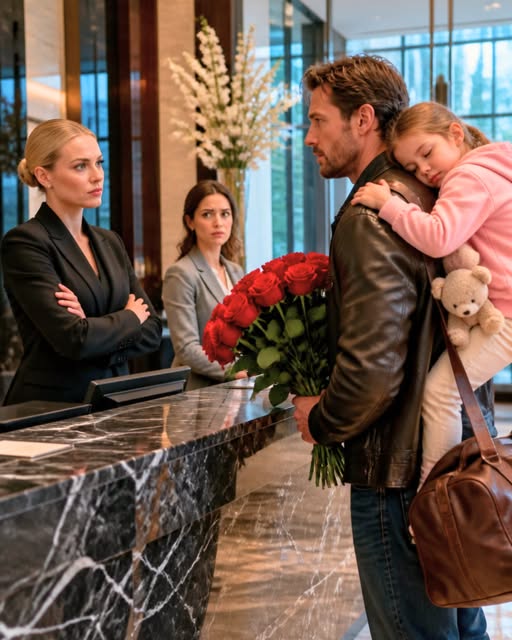
    “Sir, with that sleeping child and those bruised flowers, you might want to look for a cheaper motel down the road.”

    Ethan Vance froze in front of the marble reception desk of the Grand Regent Hotel, right in the heart of downtown Chicago. His six-year-old daughter was fast asleep against his shoulder, and a bouquet of red roses was tightly gripped in his left hand.

    He didn’t reply immediately. Not because he hadn’t felt the sting of the humiliation, but because Lily was breathing softly against his neck, completely exhausted after a three-hour flight delay from Denver. Ethan had learned long ago that when a child finally falls asleep after crying quietly from sheer fatigue, a parent will swallow every drop of their own pride just to keep from waking them.

    He wore a brown leather jacket, heavily faded at the elbows, a three-day stubble, and a scuffed backpack stuffed with snacks, a dead tablet, a change of clothes, and the stuffed rabbit Lily hadn’t let go of since her mother died.

    He had bought the roses at the airport.

    Tomorrow marked exactly three years since Sarah, his wife, had passed away. Every anniversary, Ethan would place fresh flowers in the living room, and Lily would choose the vase. It was a small, stubborn tradition—one of those routines that survive because grief needs something simple and tangible to rest upon.

    “I have a reservation,” Ethan said, keeping his voice strictly at a whisper. “Under Ethan Vance.”

    The receptionist—a blonde woman with flawlessly styled hair and a gold nametag that read Patricia—scanned him from head to toe before reluctantly tapping on her computer. Beside her, Karla, another front-desk agent wearing a crisp beige blazer, crossed her arms with a cold smile.

    Patricia typed for a few seconds. “Nothing is coming up.”

    “It should have been booked directly through the corporate office,” Ethan explained calmly. “Could you check the executive block?”

    Patricia let out a heavy sigh. “Sir, we are completely booked tonight. There is a massive corporate gala in the grand ballroom, and we have zero vacancies.”

    Ethan carefully adjusted Lily’s weight on his shoulder. The little girl murmured something in her sleep, burying her face deeper into his neck.

    “I understand you’re busy,” Ethan said. “But we’ve had a very long travel day. My daughter needs a bed. If you could look a little closer, I’d deeply appreciate it.”

    Karla let out a sharp, barely audible laugh. “People always show up thinking that if they push hard enough, a luxury suite will just magically open up for them.”

    Patricia didn’t correct her colleague. “You can try one of the budget inns closer to the highway,” she added dismissively. “You might have better luck there.”

    Ethan looked at her with a calm that shouldn’t have been mistaken for weakness. It was total restraint. What neither woman knew was that he wasn’t just any guest.

    The Grand Regent Hotel belonged to him.

    It was one of seven flagship properties owned by the hospitality group Ethan had built from the ground up over eleven years—before Sarah got sick, before Lily learned to ask why Mommy couldn’t come back down from heaven.

    Ethan never announced his visits to his hotels. He dressed plainly, arrived alone, and simply observed. He always said that corporate reports showed you numbers, but the way staff treated a total stranger showed you their true character.

    “Can I speak with the general manager?” he asked.

    Patricia’s face hardened. “The general manager is occupied. I am not going to disturb him just because you can’t find your booking.”

    Right then, a woman in her mid-50s stepped out from a side service door, carrying a stack of fresh white towels. Her dark hair was streaked with gray and pulled back into a simple braid, and she wore the maroon vest of the housekeeping staff. Her nametag read: Lupita.

    Lupita took one look at the sleeping child, the bent stems of the roses, the exhaustion weighing down Ethan’s shoulders, and the expressions on the receptionists’ faces. She set the towels down on a nearby luggage cart.

    “Excuse me, sir,” Lupita said softly, stepping closer. “Is everything alright?”

    “It seems my reservation isn’t showing up in their main system.”

    Lupita looked over at Patricia. “Did you check the corporate holding block?”

    Patricia clenched her jaw. “I already checked.”

    “The secondary corporate tab,” Lupita insisted gently. “Executive bookings sometimes don’t propagate to the main front-desk screen on the first search.”

    Karla rolled her eyes. “Lupita, go back to your floor. This isn’t your department.”

    Lupita didn’t raise her voice. “No, it isn’t. But a tired father with a sleeping little girl is my business if he’s being left to stand out here in the lobby.”

    Annoyed, Patricia aggressively hit a few more keys. Four seconds passed. Then, the color drained from her face.

    “Here it is,” she murmured, her voice suddenly hollow. “Suite 904. Corporate reservation. Confirmed two weeks ago.”

    A heavy, suffocating silence fell over the front desk. Ethan didn’t smile.

    Lupita stepped forward, looking warmly at the bouquet. “Those are beautiful flowers, sir, even if the stems got a little bent in transit. Are they for someone special?”

    Ethan lowered his eyes. “For my wife. Tomorrow is the anniversary of her passing.”

    Lupita caught her breath, her eyes softening completely. “Oh, sir… I am so deeply sorry for your loss.” She looked at Lily with a genuine tenderness that no customer-service manual could ever teach. “Let me find you a proper crystal vase before you head upstairs. Those flowers shouldn’t be left to wither in a dark room.”

    Patricia opened her mouth to say something, but Lupita was already walking toward the auxiliary supply room.

    And Ethan, holding his sleeping daughter tightly, realized that in his own luxury hotel, a housekeeping employee had shown more basic humanity than the staff explicitly hired to welcome the world.

    But the worst was yet to come.

    As Lupita walked back with the vase, Karla leaned over to Patricia, whispering in a tone she thought was completely private: “This is exactly why you don’t give the cleaning staff too much leeway… they start thinking they own the place.”

    Ethan snapped his eyes up to meet hers. And in that moment, nobody in the lobby could have guessed who the man in the faded jacket truly was.

    PART 2

    Lupita froze, holding the crystal vase tightly in her hands. She didn’t look offended for her own sake, but rather carrying the weight of a deeper, older hurt—the kind born from hearing similar remarks muttered in corridors, elevators, and supply closets, spoken by people who believed dignity belonged only to those with corporate titles.

    Ethan adjusted Lily with absolute precision, making sure she was completely secure.

    “Repeat what you just said,” Ethan commanded, his voice dropping to a low, icy register.

    Karla’s smile instantly evaporated, her skin turning pale, though she tried to brush it off. “I didn’t say anything, sir.”

    “Yes, you did,” Lupita said firmly, not shouting, but refusing to back down. “And it’s not the first time.”

    Patricia nervously tapped her fingers on the counter. “Lupita, that’s enough. Don’t make a scene in the lobby.”

    The word scene caused a sharp, cold anger to flare in Ethan’s chest. He had come here simply looking for a bed for his daughter. He had come with a heavy heart on the eve of his wife’s passing, carrying the exhaustion of a long flight, wanting nothing more than to put some roses in water before dawn.

    Instead, he was witnessing a toxic reality that perfectly explained the numerous anonymous complaints that had been reaching his corporate headquarters over the last few months: guests being quietly profiled by their appearance, staff being degraded, and blatant elitism disguised as “luxury standards.”

    “Get the general manager down here right now,” Ethan said.

    Patricia fired back defensively, “I already told you, he is in an important meeting.”

    “Then tell him that Ethan Vance is waiting for him at the front desk.”

    The two receptionists stared at him. That last name was carved into the gold-leaf signage in the corporate boardroom upstairs.

    Karla completely lost her breath. Patricia looked down at her screen, as if the confirmed corporate reservation was suddenly screaming an impossible, terrifying truth back at her.

  • I froze when I saw them—dozens of tiny red bumps dotting my husband’s back, clustered like something had been laid there. “It’s probably a rash,” he muttered, trying to laugh it off.

    I froze when I saw them—dozens of tiny red bumps dotting my husband’s back, clustered like something had been laid there. “It’s probably a rash,” he muttered, trying to laugh it off.

    Part 1 of 2

    PART 1

    But my stomach turned. At the clinic, the doctor leaned in, then went strangely still. His lips parted, eyes draining of color. He whispered, “Don’t go home. Call the police. Now.”

    The bumps were too neat to be a rash. They formed three crimson rings across Ethan Mercer’s back, each circle made of tiny punctures, as if something had been pressed against his skin and allowed to feed.

    “It’s nothing,” my husband said, pulling his shirt down. His laugh cracked in the middle. “Probably that cheap detergent you bought.”

    He always did that—turned fear into my fault.

    For twelve years, Ethan had treated me like furniture: useful, quiet, replaceable. He controlled our accounts, mocked my bookkeeping job, and reminded me that the house belonged to his mother’s family trust. Lately, his sister Monica Mercer had joined in, sweeping through our kitchen in designer heels and calling me “the little wife with the calculator.”

    I had stopped correcting them.

    What Ethan never understood was that before I married him, I had worked seven years in forensic accounting for the state attorney general. I left after my father died, but I never lost the habit of noticing patterns.

    I had also quietly reopened my old encrypted case archive, storing bank statements, photographs, and voice notes beyond Ethan’s reach. He believed my silence meant surrender. In truth, silence had become the cleanest room in which I could think and prepare.

    And Ethan had become a pattern.

    Late-night drives. Cash withdrawals under reporting limits. Calls from Monica that ended when I entered the room. A locked basement storage room he claimed held moldy furniture. Then, two weeks earlier, I found a veterinary invoice in his coat for imported tropical insects.

    So when the clinic doctor stared at Ethan’s back and went pale, I did not scream.

    Dr. Patel shut the exam-room door. “Mrs. Mercer, take your purse. Do not return home.”

    Ethan sat up sharply. “What are you talking about?”

    The doctor ignored him. His voice dropped. “Those are feeding marks from triatomine insects. Kissing bugs. But the arrangement is artificial. Someone confined them against his skin.”

    Dr. Patel continued, “One specimen was trapped beneath his waistband. It had been altered. Its abdomen contains a colored veterinary marker used in controlled colonies.”

    I looked at my husband. “Controlled by whom?”

    He lunged for his phone.

    I grabbed it first.

    The lock screen flashed with a message from Monica: DID SHE TOUCH THE SAFE YET? WE NEED HER PRINTS BEFORE TONIGHT.

    Ethan’s eyes met mine, and the fear in them answered everything.

    Dr. Patel whispered, “Call the police. Now.”

    I did—but not before forwarding the message, photographing the screen, and emailing both to an evidence vault Ethan did not know existed.

    For the first time in our marriage, he looked at me without contempt.

    He looked at me like prey that had suddenly turned around.

    Part 2

    Police separated us before Ethan could invent a story. Detective Maya Ortiz listened while Dr. Patel documented every mark, bagged the insect, and called the county health department. Ethan claimed Monica had bought the bugs for a university project and that he had accidentally opened their container.

    Ortiz raised an eyebrow. “Against your bare back? In three strapped circles?”

    He stopped talking.

    I told her about the basement, the invoice, and the message. I also told her something Ethan did not know: for six months, I had been copying our financial records. The withdrawals he called business expenses led to a shell company owned by Monica. That company had purchased laboratory cages, sedatives, disposable restraints, and a life insurance policy on me worth four million dollars.

    The beneficiary was Ethan.

    His lawyer arrived within an hour and began calling me unstable. Ethan recovered his smirk.

    “You’ve always been dramatic, Elena,” he said as officers escorted him for questioning. “Go home, calm down, and stop embarrassing us.”

    I smiled. “I’m not going home.”

    Monica texted me ten minutes later from Ethan’s phone, unaware police had returned it under supervision.

    COME TO THE HOUSE. WE SHOULD TALK BEFORE THIS GETS UGLY.

    Ortiz wanted to arrest her immediately. I asked for twenty minutes.

    “Why?” she said.

    “Because she thinks I’m stupid.”

    We arranged a recorded call. I told Monica I was frightened and willing to cooperate. She softened instantly.

    “That’s better,” she purred. “Open the basement safe, touch the silver case inside, and bring it to me. Ethan says the combination is your birthday.”

    My birthday. The little insult almost made me laugh.

    “What’s in it?” I asked.

    “Proof that Ethan is sick because of you.”

    There it was.

    Monica believed the plan still worked. They had intended to drug me, strap infected insects against my skin, then frame me as the careless keeper of an illegal colony. If I died slowly from complications, Ethan collected the policy. If I survived, the planted fingerprints and purchase records made me criminally responsible.

  • He rushed into the emergency room carrying his injured daughter, never imagining that the doctor in front of him was the pregnant woman he had abandoned months ago; but when the little girl whispered, “Grandma said that baby shouldn’t be born,” he felt his entire past explode right in his face.

    He rushed into the emergency room carrying his injured daughter, never imagining that the doctor in front of him was the pregnant woman he had abandoned months ago; but when the little girl whispered, “Grandma said that baby shouldn’t be born,” he felt his entire past explode right in his face.

    Part 1 of 3

    Part 1

    “I don’t care who the doctor is… just save my daughter!” Eli shouted the moment he burst through the emergency room doors, never imagining that the doctor on duty was me.

    I watched him cross the threshold of San Gabriel Hospital, holding Sophie tightly in his arms. The little girl was sobbing, clutching her arm against her chest, while Eli stood there pale, disheveled, his expensive suit wrinkled, and his tie completely askew. I had never seen him look like this. Eli Vance, the man who always spoke as if the world owed him absolute obedience, was visibly shaking.

    And there I was.

    Wearing my white lab coat, a stethoscope draped around my neck, my hair hastily pinned back, and one hand—almost by pure instinct—resting protectively over my seven-month-pregnant belly.

    For a split second, the frantic noise of the emergency room completely vanished. The stretchers, the monitors, the nurses rushing past—everything blurred into the background. The only things left in existence were his eyes locked onto mine.

    First, recognition hit him. Then, his gaze dropped to my stomach. And the air left him completely.

    “Valerie…” he breathed.

    He didn’t say “doctor.” He didn’t say “I’m sorry.” He simply whispered my name the exact way he used to back when we still slept wrapped in each other’s arms in his penthouse, back when I foolishly thought that one day he would find the courage to love me in front of the world.

    I took a deep, grounding breath.

    “I am Dr. Valerie Torres,” I said calmly, shifting my focus entirely to the little girl. “What’s your name, sweetheart?”

    “Sophie,” she whimpered through her tears. “I fell off the playground equipment at school.”

    “From the monkey bars?”

    She gave a small nod. “My daddy got really scared.”

    The sheer irony of his terror tightened around my throat. Eli, the man who hadn’t flinched when he watched me walk out into the pouring rain six months ago, was completely falling apart because his daughter was in pain.

    I stepped closer to the exam table. “I’m going to check your arm very gently, Sophie. If it hurts too much, you tell me, okay?”

    “Okay, Dr. Valerie.”

    Then, I looked up at Eli, my voice professional and detached. “Sir, I need you to take a step back.”

    Sir. The formal word visibly stung him. I saw it register in his face, but he obeyed without a word.

    As I examined Sophie, I could feel his eyes tracking my every movement. I knew exactly what he was calculating. Seven months pregnant. Six months since he last saw me. Six months since that devastating afternoon in his kitchen, when I finally asked him if he actually loved me, or if he just used me whenever he felt lonely.

    He hadn’t answered back then. He just muttered that he didn’t know how to build a family.

    So, I left.

    Three weeks later, sitting alone in my bathroom with a positive test in my hand, I realized I hadn’t walked away empty-handed.

    The X-rays confirmed that Sophie had a hairline fracture in her wrist. It wasn’t severe, but we needed to keep her overnight for observation. When she was finally moved up to a pediatric room, Eli followed me out into the quiet hallway.

    “Is the baby mine?” he asked, his voice raw and broken.

    My hand automatically moved to protect my stomach. “Your daughter needs you right now,” I replied flatly. “Focus on her.”

    “Valerie, please…”

    “No, Eli. You don’t get to reappear after one hundred and eighty days of absolute silence and suddenly demand answers.”

    “I thought you wanted space.”

    “I wanted you to choose us.”

    His eyes filled with something that looked a lot like deep regret. “I was a coward.”

    “Yes,” I said, swallowing the lump in my throat. “You were.”

    I turned and walked away before I could break down in front of him.

    Hours later, while I was charting medical files at the desk, my phone buzzed with a text from his number:

    Sophie can’t sleep. She keeps asking for the pretty baby doctor. Could you please come see her?

    Every professional boundary told me to stay away, but I went back for the sake of the little girl.

    Sophie was wide awake, tightly hugging her hospital blanket. Her face lit up with a small smile the moment she saw me.

    “Dr. Valerie, is your baby a girl?”

    “I don’t know for sure yet,” I lied softly. I did know. It was a girl.

    Sophie glanced toward the doorway, where Eli stood completely motionless, watching us.

    “My grandma said that women like you just want to take everything away from my daddy,” Sophie murmured innocently.

    I felt the blood freeze in my veins. Eli turned completely white.

    And then, the little girl added with heartbreaking innocence: “She also told Uncle Ryan that baby should never be born into this family.”

    Part 2

    The silence that collapsed onto Sophie’s hospital room was so suffocating that even the rhythmic beep of the heart monitor felt deafening.

    “Who told you that, sweetheart?” Eli asked, forcing a strained, unnatural calm into his voice.

    Sophie shrank back slightly into her pillows. “Grandma Teresa. When she was on the phone with Uncle Ryan. She said that if you found out about the baby, it would ruin the Vance name.”

    I felt the floor slide out from under my feet.

    Teresa Vance, Eli’s mother, had always smiled at me with that icy, high-society elegance—the kind of woman who embraces you while mentally calculating the exact net worth of your shoes. To her, I was never going to be enough. It didn’t matter that I was a licensed physician, that I had worked since I was seventeen, or that I had earned every single residency shift through grueling, sleepless nights. To her, I was just “that middle-class girl” who had managed to worm her way into her wealthy, divorced son’s life.

    Eli took a desperate step toward me. “Valerie, I swear I had no idea.”

    “Of course you didn’t,” I whispered, my voice trembling. “You never seem to know anything when it’s convenient for you.”

    Sophie began to cry, frightened by the sudden tension written across our faces. I immediately swallowed my own pain and shifted back into being her doctor.

    “It’s okay, sweetheart. You didn’t do anything wrong, I promise.”

  • Sometimes one call can fix what years of silence couldn’t.

    “…Where are you?”

    Promoted Content

    I froze, my breath fogging up the windshield. His voice hadn’t changed—steady, calm, like the years between us were nothing more than a bad dream.

    “Outside your building,” I said quietly.

    Promoted Content

    There was a pause. Not awkward—just heavy, like something unspoken was finally finding its way to the surface.

    “Stay there,” he replied. “I’m coming down.”

    I almost hung up. My fingers hovered over the screen, heart pounding harder than it should. Three years of silence… and now this? It felt too easy. Too sudden.

    But I stayed.

    A few minutes later, I saw him. Same walk. Same jacket style. Just… older. Tired, maybe. Or maybe that was just me seeing what I felt.

    He knocked on the window.

    Promoted Content

    For a second, I couldn’t move. Then I unlocked the door.

    “Hey,” he said.

    “Hey.”

    That was it. No dramatic apology. No shouting. Just one small word carrying years of regret.

    He popped the hood, like nothing had ever changed. Like we were kids again, messing around with Dad’s old car. I stepped out, the cold biting through my coat, but I barely noticed.

    “You still ignore warning lights?” he asked, a faint smirk forming.

    Promoted Content

    I let out a small laugh. “Some things don’t change.”

    He glanced at me then—really looked. “Yeah… some things don’t.”

    Silence again. But this time, it wasn’t empty.

    “I missed you,” I blurted.

    He didn’t hesitate. “Me too.”

    That was all it took.

    Promoted Content

    No big speeches. No perfect timing. Just two people, standing in the cold, finally choosing each other again.

    The car started a few minutes later.

    But something else started too.

  • Thrown out without pay—until the truth under the bed changed everything

    For ten years, I had cleaned that room, changed his sheets, checked his medicines—every corner was familiar to me. That box hadn’t been there. Or if it had… he had made sure I never noticed.

    “Open it,” his son said, his voice shaking in a way I hadn’t expected from someone so arrogant just days ago.

    “I don’t have the key,” I replied, keeping my distance.

    Promoted Content

    “He told me… before he died,” the son stammered, “he said you would know how.”

    I felt a chill crawl up my spine.

    Slowly, I knelt beside the bed. My fingers brushed against the underside of the wooden frame—and there it was. A tiny piece of tape. Beneath it, a small brass key.

    My heart started pounding.

    I unlocked the box.

    Inside were bundles of cash… more money than I had seen in my entire life. Beneath the money was a stack of envelopes, each carefully labeled in the old man’s shaky handwriting.

    The top one had my name.

    I hesitated, then opened it.

    “If you are reading this, it means I am gone. And if my children are standing near you, I suspect they have already shown you their true nature.”

    My throat tightened.

    Promoted Content

    “You stayed when no one else would. You cared for me when I was at my worst. This money is yours—your unpaid salary, and more. Do not let them take it from you.”

    My hands trembled as I lowered the letter.

    The son stepped forward. “What does it say?”

    I looked at him—the same man who had thrown me out like I was nothing.

    Then I reached into the box, pulled out another envelope, and handed it to him. His name was written across it.

    He opened it quickly, scanning the contents. His face drained of color.

    “What… what is this?” he whispered.

    Promoted Content

    I already knew.

    “To my children: Everything you did not earn in kindness, you will not receive in wealth.”

    The rest of the envelopes were addressed to charities.

    The son sank onto the bed, stunned. For the first time, he looked small.

    Promoted Content

    I stood up, clutching my letter.

    For ten years, I had taken care of a grumpy old man.

    In the end, he had taken care of me.

  • My daughter-in-law claimed my Malibu home as her own. One item in my purse changed everything.

    My daughter-in-law claimed my Malibu home as her own. One item in my purse changed everything.

    Part 1:

    The message arrived while I was smiling at a tired family from St. Louis.

    That is the part I remember most clearly. Not the chill that ran through my fingers, not the pressure tightening in my chest, but the smile. In hospitality, you learn to become whatever the moment demands: calm, friendly, patient, dependable. Whatever storm is happening inside you does not matter to the person standing at the desk.

    I was working the front desk at the Ashford Grand in downtown Charlotte when my phone buzzed beside the computer.


    My fiancée usually texted during check-in hours for small things—last-minute plans, errands, or money for something she had already decided on. I expected something annoying but ordinary.

    Instead, I read:

    Hey, we talked and gave Ethan and Ava’s spots to my sister’s crew. They’re just more fun for this kind of trip lol.

    I stared at the screen.

    Ethan was my eleven-year-old son. For two weeks, he had been practicing Spanish for our Punta Cana vacation. Ava, my seven-year-old daughter, had made a glitter-covered packing list. At the bottom, she had written in careful letters: ASK DAD IF FLAMINGOS BITE.

    And Vanessa had reduced them to “spots.”

    I finished helping the guests. I smiled, handed over the room keys, explained breakfast hours, and waited until the elevator doors closed.

    Then I looked at the message again.

    Vanessa had not made a mistake. She had decided my children were optional, my money was available, and I would probably stay quiet to avoid conflict.

    So I replied with two words.

    Understood.

    Then I finished my shift.

    Later that evening, I sat in my office and opened the Punta Cana folder on my laptop. I had planned everything: flights, transfers, suites, dinner reservations, activities for the kids.

    Total cost: $9,400.

    Part 2:

    I checked the shared itinerary and saw Vanessa had added her sister Mariah days earlier. Then I saw a message from my brother Caleb, who had been living in my house for free for four months.

    About time the boring half got trimmed.

    So Caleb knew too.

    That was enough.

    One by one, I canceled the flights, the resort, the airport transfer, and the dinner reservation. By the time the final confirmation arrived, the trip no longer existed.

    Then I called the property manager. The lease was in my name. The house was paid for by me. Vanessa, Caleb, and Mariah had treated it like theirs because they never had to carry the cost.

    By that night, the locks were reset, Caleb’s parking access was canceled, Vanessa’s authorized-user card was removed, and the rent renewal was declined.

    The next morning, Ethan and Ava sat at the kitchen table eating pancakes in their pajamas. Ava’s flamingo list was beside her plate.

    I told them the trip had changed because some adults had made selfish choices. I made sure they knew it was not their fault.

    Ethan looked at me and asked, “Is she mad because of us?”

    I put down the syrup and looked both of my children in the eyes.

    “No,” I said. “She’s mad because she forgot you matter.”

    Ava quietly crossed flamingos off her list.

    That nearly broke me.

    When Vanessa called from the airport, her voice was sharp and panicked.

    “Alan, what did you do?”

    “The tickets were canceled,” I said. “So were the rooms.”

    “You’re punishing everyone because two kids aren’t going?”

    Two kids.

    Not Ethan. Not Ava. Just two inconvenient names removed from a vacation.

    “You’re at the airport with your sister, her husband, my brother, and your parents,” I said. “You’re all adults. Buy your own tickets. Book your own resort. Enjoy the fun people.”

    “You know we can’t afford that.”

    “I know.”

    Then she realized her card did not work.

    I told her I had removed her access.

    She said they would come home and talk.

    I told her they would not.

    “The locks have been changed,” I said. “Your belongings and Caleb’s will be packed and delivered to Mariah’s address.”

    Caleb grabbed the phone and accused me of throwing him out over a vacation.

    “No,” I said. “I’m throwing you out because you lived off me for months and laughed while my kids were pushed aside.”

    Then I hung up.

    By noon, I booked a cabin in Asheville for me and the kids. Fireplace, board games, mountain air, and a hot tub Ava called “fancy soup.”

    For three days, Vanessa sent messages. First anger. Then excuses. Then apologies. She said Mariah pressured her. Caleb made it sound harmless. She loved me. She loved the kids.

    But I understood the pattern.

    Part 3:

    She loved us most when her cards stopped working.

    When we came home, the house felt different. Correctly sized. Vanessa’s boxes were gone. Caleb’s things were gone. Mariah’s clutter was gone.

    That evening, the doorbell rang.

    Vanessa stood outside crying.

    “Please,” she said. “Let me talk to them.”

    “No.”

    “I was going to be their stepmother.”

    “You were showing me who you are,” I said. “I was paying attention.”

    She said it was one mistake.

    “No,” I answered. “It was one revealing mistake.”

    Two months later, she mailed the engagement ring back. I sold it and put the money into Ethan and Ava’s college accounts.

    A year later, the three of us finally took the trip that felt right. Not Punta Cana. Puerto Rico. Ethan wanted to use his Spanish, and Ava had researched iguanas with serious dedication.

    On the last night, we sat near the ocean eating fried plantains from paper plates. Ava ran from the waves, laughing. Ethan leaned against my shoulder.

    “Dad?”

    “Yeah?”

    “I’m glad we didn’t go on the birthday trip.”

    “Why?”

    He watched the water for a moment.

    “Because this one feels like ours.”

    And he was right.

    Their places in my life were never “spots.” They were the reason for everything I was building. Everyone else was only a guest—and guests were welcome only as long as they remembered whose home it was.

    You may like

  • My sister thought she’d won my dream home in court. Then the judge uncovered one hidden truth.

    My sister thought she’d won my dream home in court. Then the judge uncovered one hidden truth.

    My younger sister walked into the county courthouse in Bellingham, Washington, wearing a cream designer suit and the same confident smile she had used on our parents for most of her life.

    Her name was Brielle Ashton.

    Mine was Laurel Whitaker.

    For thirty-four years, Brielle had been the golden child in our family. She was the one my parents praised at dinner, protected during arguments, and excused whenever she hurt someone. I was the quiet one. The practical one. The daughter who worked late, paid her own bills, and learned early that asking for help usually led to disappointment.

    That morning, Brielle did not come alone.

    Her husband, Everett Ashton, sat beside her at the plaintiff’s table with a leather folder in front of him and a smug expression on his face. He was the kind of man who spoke softly only because he believed everyone should lean in to listen.

    Across the aisle, our parents sat behind them.

    My mother, Marlene, kept her purse pressed against her lap. My father, Ronald, stared at the floor like he was already tired of pretending this was fair.

    At the center of the case was a cedar-and-glass home overlooking Lake Whatcom.

    I had bought that house eight years earlier.

    I had worked double shifts, skipped vacations, sold my first small rental at the right time, and poured every spare dollar into making that property mine. It was not just a beautiful mountain home. It was proof that I had built something with my own hands after years of being treated like I was less important than everyone else.

    But Brielle wanted it.

    And when Brielle wanted something, my parents usually found a way to call it “family.”

    The Paper She Thought Would End Me

    Everett’s attorney stood first.

    He was a polished man named Dalton Pierce, with silver hair, sharp glasses, and a voice that made every sentence sound rehearsed.

    “Your Honor,” he said, holding up a folder, “this case is simple. My clients are here to enforce a signed agreement transferring ownership of the Lake Whatcom property from Ms. Whitaker to her sister, Mrs. Ashton.”

    I sat still.

    Beside me, my attorney, Miriam Vale, did not react.

    Brielle turned slightly in her chair just enough for me to see her smile.

    It was small.

    Careful.

    Cruel.

    The judge, Honorable Judith Ramsey, looked down at the document placed before her.

    “Ms. Whitaker,” the judge asked, “are you familiar with this agreement?”

    I looked at the paper.

    There it was.

    My printed name.

    My supposed signature.

    A clean sentence claiming I had voluntarily given my mountain home to Brielle as a family settlement.

    I could feel my mother watching me from behind.

    I could feel Brielle waiting for me to break.

    I did not break.

    “No, Your Honor,” I said. “I did not sign that document.”

    Everett leaned back in his chair, almost amused.

    Dalton Pierce sighed as if I were wasting the court’s time.

    “Your Honor, regret after signing a legal document does not make the document false.”

    Brielle lowered her voice, but not enough.

    “Your little real-estate dream ends today.”

    I heard every word.

    So did Miriam.

    The judge’s eyes lifted slowly.

    “Mrs. Ashton,” she said, “you will not make comments from counsel table again.”

    Brielle’s smile disappeared for half a second.

    Then Everett whispered something to her, and she relaxed.

    They thought the hard part was over.

    They thought one forged signature could erase eight years of sacrifice.

    They had no idea what was coming next.

    The Question That Changed The Room

    Judge Ramsey studied the paperwork for a long moment.

    Then her eyes stopped on the property description.

    Her brow tightened.

    “Ms. Whitaker,” she said, “this address is listed as part of a real-estate portfolio. How many properties do you currently own?”

    The room went still.

    Brielle blinked.

    Everett turned his head.

    My mother’s hand flew to her chest.

    I answered calmly.

    “Twelve, Your Honor.”

    For the first time that morning, Brielle looked confused.

    Not angry.

    Not proud.

    Confused.

    Because in her mind, I was still the struggling older sister who worked too much, dressed too simply, and never had enough time to show off.

    She did not know about the duplex in Spokane.

    She did not know about the three townhomes near Tacoma.

    She did not know about the small commercial building in Olympia or the lake cabins I had renovated one by one.

    She only knew the version of me she needed to believe in.

    The version that made her feel superior.

    Judge Ramsey adjusted her glasses.

    “Twelve properties?”

    “Yes, Your Honor.”

    Everett’s attorney stood quickly.

    “Your Honor, Ms. Whitaker’s financial status is not relevant to whether she signed this agreement.”

    Miriam finally rose.

    She was calm, but there was steel in her voice.

    “Actually, Your Honor, it is relevant. The opposing party has repeatedly argued that my client is emotionally attached to one home because it is her only meaningful asset. That is not true.”

    She opened her briefcase.

    Brielle’s face tightened.

    Everett’s fingers curled around the edge of the table.

    Miriam placed a folder before the judge.

    “My client’s property portfolio shows a clear pattern of ownership, investment, and independent management. The Lake Whatcom house was never a family asset. It was never jointly owned. And it was never offered to Mrs. Ashton.”

    Judge Ramsey read silently.

    Then she looked at Brielle.

    “Mrs. Ashton, did you know your sister owned twelve properties?”

    Brielle did not answer.

    Everett answered for her.

    “That has nothing to do with this case.”

    The judge’s expression cooled.

    “Mr. Ashton, I did not ask you.”

    The Forged Signature

    Miriam opened a second folder.

    This one was thinner.

    More dangerous.

    “Your Honor,” she said, “we also have the report of a certified handwriting analyst.”

    Dalton Pierce immediately objected.

    “We were not given proper notice of expert testimony.”

    Miriam looked at him.

    “Your client submitted the document this morning, counselor.”

    The judge looked over the report.

    The courtroom went silent except for the soft sound of paper turning.

    Brielle’s confident posture began to collapse.

    Everett whispered something to Dalton, but Dalton did not respond.

    Judge Ramsey read one line aloud.

    “Forty-seven points of comparison indicate the signature was not written by Laurel Whitaker.”

    My mother made a small sound behind me.

    My father finally looked up.

    Brielle’s lips parted.

    “That’s not true,” she whispered.

    Miriam continued.

    “The report concludes the signature was copied from an older closing document and reproduced onto the transfer agreement.”

    Everett stood too fast.

    His chair scraped against the floor.

    “This is ridiculous.”

    Judge Ramsey’s voice sharpened.

    “Sit down, Mr. Ashton.”

    He sat.

    But his face had changed.

    The confidence was gone.

    Now there was fear.

    The Video From My Office

    Miriam took out a small flash drive.

    “Your Honor, there is one more piece of evidence.”

    Dalton Pierce looked as if he already knew he had lost control of the room.

    “What evidence?”

    Miriam turned toward the court monitor.

    “Security footage from Ms. Whitaker’s office, recorded three months ago.”

    Brielle looked at Everett.

    Everett did not look back.

    The screen came on.

    There he was.

    Everett Ashton.

    Wearing a baseball cap and a dark jacket, walking into my private office after hours.

    The footage showed him opening drawers, photographing paperwork, and removing a file from my desk before leaving through the back hallway.

    The courtroom did not need dramatic music.

    The silence was worse.

    Brielle stared at the screen as if she were watching a stranger.

    Then she turned slowly toward her husband.

    “Everett,” she whispered, “what did you do?”

    He did not answer.

    Judge Ramsey leaned forward.

    “Mr. Ashton, did you enter Ms. Whitaker’s office without permission?”

    Everett swallowed.

    “I was trying to help my wife.”

    Miriam’s voice cut through the room.

    “By taking private documents and using them to support a false transfer claim?”

    Brielle shook her head.

    “No. No, he told me Laurel had agreed. He told me she just changed her mind.”

    I looked at my sister.

    For once, she did not look powerful.

    She looked young.

    Spoiled.

    Frightened.

    But not innocent.

    Because she had wanted to believe the lie.

    She had wanted my house badly enough to ignore every warning sign.

    The Family Myth Finally Broke

    Judge Ramsey recessed the court for fifteen minutes.

    No one moved at first.

    Then my mother stood.

    She walked toward me with a trembling mouth.

    “Laurel,” she said softly, “we didn’t know.”

    I looked at her.

    For years, those words would have made me cry.

    That morning, they only made me tired.

    “You never asked,” I said.

    My father stepped beside her.

    He looked older than he had when the hearing began.

    “We thought you were being difficult,” he said.

    I almost laughed.

    Not because it was funny.

    Because it was the same sentence in a new outfit.

    Difficult.

    That was what they called me when I set boundaries.

    Difficult when I refused to pay for Brielle’s mistakes.

    Difficult when I skipped family dinners because I had inspections, repairs, tenants, contracts, and bills.

    Difficult when I stopped explaining why I was exhausted.

    Brielle stood a few feet away, tears on her face.

    “You had twelve properties,” she said. “Why did you care so much about one house?”

    I turned to her.

    “Because it was mine.”

    She flinched.

    I kept my voice steady.

    “You didn’t want that house because you needed it. You wanted it because I had something you couldn’t take by smiling.”

    Her tears fell harder.

    But I had learned something about tears.

    Some tears are regret.

    Some are embarrassment.

    And some are only disappointment that the plan failed.

    The Judge’s Decision

    When court resumed, Judge Ramsey’s voice was calm but firm.

    “Based on the evidence presented, this court will not enforce the alleged transfer agreement.”

    Brielle lowered her head.

    Everett stared straight ahead.

    The judge continued.

    “This matter raises serious concerns regarding document falsification, unauthorized access to private records, and an attempt to obtain property through improper means.”

    Dalton Pierce stood slowly.

    “Your Honor, my clients request time to—”

    “No,” Judge Ramsey said. “The request is denied.”

    The word landed like a door closing.

    Then she looked toward Everett.

    “The court will refer this matter for further review. Mr. Ashton, I strongly advise you to cooperate with any investigation that follows.”

    Everett’s face went pale.

    Brielle began crying quietly.

    My parents sat frozen behind her.

    For the first time in my life, no one knew how to rescue the golden child.

    No one knew how to explain away what everyone had seen.

    No one knew how to make me the problem.

    I gathered my folder.

    Miriam touched my arm gently.

    “You did well,” she said.

    I nodded, but I did not feel victorious.

    I felt free.

    There is a difference.

    Victory is loud.

    Freedom is quiet.

    The Sister Who Finally Saw Me

    Outside the courthouse, the air smelled like rain and cedar trees.

    I walked down the steps with my file tucked under my arm.

    Behind me, I heard Brielle call my name.

    “Laurel, wait.”

    I stopped but did not turn around right away.

    When I finally faced her, she looked smaller than she ever had.

    Her makeup was streaked. Her perfect suit was wrinkled. Her confidence had disappeared somewhere between the video footage and the judge’s final words.

    “I didn’t know he went into your office,” she said.

    “But you knew I didn’t want to give you my house.”

    She looked down.

    That answer was enough.

    “I thought Mom and Dad would make you see reason,” she admitted.

    I nodded slowly.

    “That was always the problem, Brielle. You thought my life was something the family could vote on.”

    She covered her mouth.

    “I’m sorry.”

    The words were small.

    Late.

    Maybe sincere.

    But apology does not erase years of being measured, compared, dismissed, and used.

    “I hope one day you understand what you tried to do,” I told her. “Not because of the house. Because of what it says about how you saw me.”

    She cried harder.

    I walked away.

    Not because I hated her.

    Because I finally loved myself enough not to stand there and comfort the person who had tried to take my peace.

    The House I Chose To Keep

    Six months later, Everett faced charges connected to the forged documents and the office footage.

    Brielle moved out of their house and into a rented apartment near the waterfront.

    My parents called often at first.

    I answered sometimes.

    Not always.

    Boundaries are not cruelty.

    They are doors with locks.

    And after years of letting people walk in and rearrange my life, I had finally learned to keep the key.

    One year later, I stood on the deck of the Lake Whatcom house as morning light spilled over the water.

    The cedar boards were warm beneath my feet.

    The mountains stood quietly in the distance.

    For a long time, I had thought that home was my reward for surviving my family.

    But I understood now it was more than that.

    It was proof.

    Proof that I could be overlooked and still rise.

    Proof that I could be underestimated and still build.

    Proof that the daughter they called difficult had only been strong enough to stop disappearing.

    I kept the house.

    Not because I had no other place to live.

    Not because it was the most valuable property I owned.

    I kept it because peace is not something you hand over to people who never respected the cost of building it.

    And when I looked across the lake that morning, I did not think about Brielle, Everett, or the courtroom.

    I thought about the woman I had been eight years earlier, tired and uncertain, signing the first real deed of her life with shaking hands.

    I wished I could tell her one thing.

    “You are not behind. You are becoming.”

    Sometimes the people who call you selfish are only angry because you finally stopped giving them access to everything you built.

    A family that only loves you when you are useful is not asking for loyalty; it is asking for control wrapped in familiar words.

    You do not have to surrender your peace just because someone else believes your success should belong to them.

    Being quiet for years does not mean you are weak; sometimes it means you were gathering the strength to speak only when it truly mattered.

    The person who works in silence may look ordinary to those who never paid attention, but quiet discipline can build a life no one saw coming.

    Not every apology deserves immediate closeness, because forgiveness and access are two very different things.

    When people underestimate you, let them, because their low opinion of you does not reduce the value of what you are building.

    Boundaries may disappoint those who benefited from your silence, but they will protect the version of you that fought so hard to survive.

    The greatest victory is not proving everyone wrong; it is reaching a place where their approval no longer decides your worth.

    Never be ashamed of protecting what you earned, because the life you built with sacrifice deserves the same loyalty you once gave to people who did not protect you.

    You may like

  • Right after my husband’s funeral, my in-laws locked my children and me out. They never knew what he’d left behind

    Right after my husband’s funeral, my in-laws locked my children and me out. They never knew what he’d left behind

    The morning we buried my husband, David Hayes, the sky was a bruised, unyielding gray. A fine mist hung in the air, clinging to the wool of my dark coat like liquid ash. I stood in the foyer of the sprawling Oakridge Funeral Home, my fingers intertwined with those of my sixteen-year-old son, Ethan, and my nine-year-old daughter, Maya. My heart felt as if a fault line had cracked open right through the center of my chest, leaving nothing but a hollow, echoing void.

    David had fought the leukemia for three agonizing years. I had watched the man who used to carry Maya on his shoulders across the beach slowly fade into the sterile white sheets of a hospice bed. But even in his final days, his eyes had held a fierce, protective fire.

    I thought the worst pain of my life was saying goodbye to him. I was wrong. The true nightmare began an hour before the service, right there in the hushed, velvet-lined hallway of the funeral home.

    The funeral director, a soft-spoken man named Mr. Abernathy, approached me with an apologetic wince. “Mrs. Hayes, I am so deeply sorry to disturb you at this moment. However, the final payment for the transport and the plot… your primary bank card was declined. I tried the secondary one as well. The accounts appear to be frozen.”

    A cold dread coiled in my gut. “Frozen? That’s impossible. David and I made sure everything was funded last week.”

    “I assure you, ma’am, the bank cited a freeze placed by the primary corporate account holder.”

    My blood ran like ice water. The corporate account. David’s family owned Hayes Manufacturing, a regional empire his father, Arthur Hayes, ruled with an iron fist. David had been a junior partner, but our personal finances were supposed to be completely separate.

    Before I could speak, a shadow fell over us. It was my mother-in-law, Beatrice, dressed in impeccable, expensive black silk, smelling of heavy gardenia perfume. Arthur stood half a step behind her, his face a mask of sculpted stone.

    “Is there a problem, Mr. Abernathy?” Arthur asked, his voice booming slightly too loud for a house of mourning.

    “Just a minor billing issue, Mr. Hayes. Mrs. Hayes’s cards seem to be… unavailable.”

    Beatrice smiled. It was a terrifying, razor-thin expression. “Of course they are. Arthur had the bank lock down all family assets this morning. We cannot have company funds bleeding out into the ether, especially now that David is no longer here to oversee his charities.”

    Charities. She meant me. She meant my children.

    “Beatrice,” I whispered, acutely aware of the gathering crowd of mourners—distant cousins, business associates, neighbors—who were beginning to stare. “This is David’s funeral. Please. Let me handle this later.”

    “Handle what?” Beatrice’s voice rose, designed to carry. She stepped into my personal space, her eyes dropping to my left hand. “Handle the money you were siphoning off while my son was dying? Did you think we were blind, Claire? We know about the missing funds.”

    “There are no missing funds!” Ethan stepped forward, his voice cracking with adolescent outrage. “Leave my mom alone!”

    Arthur placed a heavy, manicured hand on my son’s chest, shoving him back just hard enough to send him stumbling into a floral arrangement. “Learn your place, boy.”

    I gasped, pulling Ethan behind me. “Don’t you ever touch him.”

    Beatrice lunged forward. Her manicured fingers clamped down on my left hand with the strength of a vice. Before I could pull away, she violently twisted and yanked my wedding ring off my finger. The platinum band, set with a stunning vintage diamond, scraped painfully over my knuckle.

    “This is a Hayes family heirloom,” she hissed loudly, ensuring the silent, watching crowd caught every word. “It belongs to this family. Not to a woman who was planning to pawn it and run off with her little friends the moment the monitor flatlined. You disgust me.”

    The whisper network in the room ignited instantly. The humiliation was a physical weight, pressing down on my lungs. I was a grieving widow, standing beside my husband’s casket, being painted as a gold-digging traitor in front of everyone I knew. I had no money to pay the undertaker. I had no ring. I had nothing but the terrified grip of my children’s hands.

    Somehow, I survived the service. I sat numbly, staring at the polished mahogany box, ignoring the judgmental glares burning into the back of my neck.

    By four o’clock that afternoon, the rain had turned into a steady downpour. I drove us back to our suburban home—the house David and I had bought ten years ago, the house where Maya took her first steps. I just wanted to lock the doors, collapse onto David’s side of the bed, and weep until I vanished.

    But as I pulled into the driveway, I slammed on the brakes.

    Arthur’s black SUV was parked on the lawn. Arthur and Beatrice stood on our front porch. The front door was wide open, and two burly men in matching uniforms were changing the deadbolt.

    I threw the car into park and leaped out into the rain, Ethan and Maya scrambling after me. “What are you doing? Get out of my house!”

    Arthur descended the steps, holding a shiny new brass key up to the gray light. “Your house? Check the original deed, Claire. David bought this property before you were married. It’s titled under the Hayes Corporate Trust. And as the head of the trust, I am reclaiming company property.”

    “He was your son!” I screamed over the rain, the sheer injustice tearing at my throat. “These are his children!”

    “And you,” Beatrice spat from the porch, “are a liability. You can take your brats to your sister’s cramped little apartment. You will not get a single dime of Hayes money. The locks are changed. The alarm is set to a code you don’t know.”

    I stepped forward, my fists clenched, but Arthur stepped into my path, pulling a cell phone from his tailored coat.

    “Take another step, Claire, and I make a phone call,” Arthur said, his voice terrifyingly calm. “You have no money. You have no home. You look unstable, hysterical, and frankly, unfit to care for minors. One call to Child Protective Services, with my lawyers backing it up, and Ethan and Maya will be in foster care by dinnertime. Is that what you want?”

    My breath hitched. The rain soaked through my thin dress, chilling me to the bone. They had taken my husband, my dignity, my ring, my home, and now, they were threatening to take my children. I was entirely backed into a corner, staring into the eyes of a monster who held all the cards.

    Or so he thought.


    Arthur’s threat hung in the damp air, paralyzing me. Maya was sobbing quietly against my hip, hiding her face in my wet coat. Ethan was vibrating with rage, his fists balled so tightly his knuckles were white, but he stayed rooted, terrified by the mention of foster care.

    “Get back in your rusted car, Claire,” Arthur sneered, pocketing the new key. “And don’t ever think about challenging us. You are outmatched.”

    I took a trembling breath, forcing myself to look away from the house I loved. I guided my children back into our aging sedan. The doors slammed shut, sealing us in the cold, damp interior.

    “Mom?” Ethan’s voice trembled. “What do we do? We can’t let them take everything.”

    “I know, baby. I know.” My mind was racing, scrambling for a lifeline. I rested my forehead against the cold steering wheel, closing my eyes.

    Think, Claire. Think.

    My thoughts drifted back to a Tuesday afternoon, two months ago. The hospice room had smelled of antiseptic and fading hope. David had been unusually lucid that day. He had pulled my ear down to his dry lips, his breath rattling in his chest.

    “Claire,” he had whispered, his grip on my hand surprisingly strong. “My father is a shark. He only knows how to smell blood. When I’m gone, he will try to erase you. He will try to take it all back.”

    “Don’t talk like that, David,” I had cried.

    “Listen to me,” he had commanded gently. “Do not fight him. Let him think he’s won. But when he makes his move, look beneath the passenger side. Exactly where you dropped your cherry lipstick on our very first date. You’ll find what you need. And Claire? When you find it… give the signal.”

    I snapped my eyes open.

    “Ethan,” I whispered, my voice suddenly steady. “Get out of the front seat. Move to the back with Maya.”

    Ethan frowned but climbed over the center console without a word.

    I scrambled over into the passenger seat. My hands shook as I reached down, blindly feeling the dirty floorboard. Our first date had been at a drive-in movie. I had been so nervous I dropped my lipstick, and it had rolled… where? Under the seat track? No, further up. Under the dashboard casing.

    I jammed my fingers under the plastic molding of the glovebox, feeling along the dusty, unseeable crevices. Arthur was still standing on the porch, watching my car with a smug, victorious smile, likely waiting for me to drive away in defeat.

    My fingernail caught on a piece of heavy-duty tape.

    I pulled. A small, flat, waterproof pouch dropped into my hand.

    My heart hammered a frantic rhythm against my ribs as I ripped the pouch open. Inside was a single, sealed brown envelope. I tore it open, pulling out a thick stack of folded documents and a small handwritten note on top. The handwriting was David’s—shaky, written during his final weeks, but unmistakable.

    My brave Claire,

    If you are reading this, it means my father has shown his true colors. I am so sorry I cannot be there to stand in front of you. But I promised to protect you for the rest of your life, and I meant it. Everything in this envelope is yours. The house. The trust. The leverage. I planned this for months. Do not let them see you cry. Do exactly as I say.

    Turn the car key to accessories. Flash the high beams three times. Then, wait.

    I stared at the note, my breath catching in my throat. I looked up. Through the rain-streaked windshield, I saw Arthur pulling his phone back out, a frown forming on his face as he realized I wasn’t leaving. He began dialing. He was going to call CPS. He was going to take my kids.

    I scrambled back into the driver’s seat. I shoved the key into the ignition, turning it just enough to power the battery.

    I gripped the indicator stalk.

    Click. Click. (One).

    Click. Click. (Two).

    Click. Click. (Three).

    The bright beams cut through the fading evening gloom, illuminating Arthur and Beatrice on the porch like actors caught on a stage. Arthur shielded his eyes, shouting something I couldn’t hear over the rain.

    I sat back, my hands gripping the steering wheel, my heart pounding so hard I felt dizzy. Ten seconds passed. Then twenty. The rain drummed relentlessly on the metal roof. Arthur was aggressively marching down the porch steps, phone pressed to his ear, his face twisted in fury. He was coming to drag us out of the car.

    “Mom, he’s coming!” Maya shrieked.

    Suddenly, the roar of a high-performance engine drowned out the rain.

    Headlights flared in my rearview mirror. A sleek, black luxury sedan swerved into our driveway, its tires violently kicking up gravel as it blocked Arthur’s SUV perfectly, trapping it.

    The driver’s side door swung open, and a pair of stiletto heels stepped into the puddles. A woman emerged. She wore a tailored crimson trench coat that stood out vividly against the drab gray world. She held a large black umbrella and carried a thick leather briefcase.

    Arthur stopped in his tracks, his phone dropping slowly from his ear. The color drained entirely from his face.

    The woman didn’t even look at him. She walked directly to my window and tapped twice on the glass. I rolled it down, shivering as the cold air rushed in.

    She looked at me, her eyes sweeping over my tear-stained face, then to the terrified children in the back. A dangerous, brilliant smile touched her lips.

    “Hello, Claire. I’m Eleanor Vance,” she said, her voice smooth and sharp as obsidian. “David hired me six months ago. I hear you have a pest problem on your property.”


    Before I could even process her words, the wail of sirens pierced the suburban quiet. Two police cruisers turned onto our street, their red and blue lights painting the wet pavement in frantic bursts of color. They parked directly behind Eleanor’s car, boxing everyone in.

    Arthur’s arrogant posture crumpled. Beatrice rushed down the stairs to stand beside him, clutching her silk coat around her neck.

    Eleanor Vance turned slowly, resting both hands on her briefcase. She looked like a predator assessing a very slow, very stupid meal. “Stay in the car, Claire,” she instructed softly. “Let me do my job.”

    I watched in stunned silence as Eleanor walked toward my in-laws, flanked by three uniformed police officers who had just stepped out of their cruisers.

    “Arthur Hayes,” Eleanor called out, her voice cutting through the rain with practiced authority. “You and your wife are currently trespassing on private property.”

    Arthur let out a booming, forced laugh, though his eyes darted nervously to the police. “Trespassing? This is Hayes property. I hold the original deed, and you, whoever you are, are interfering with family business.”

    Eleanor didn’t flinch. She popped open the golden clasps of her briefcase, extracting a thick, blue-backed legal document wrapped in a plastic sleeve to protect it from the rain.

    “You hold a voided deed, Arthur,” Eleanor corrected, holding the document up. “Five months ago, recognizing his declining health and your… predictable nature, David Hayes legally transferred this property, the lake house in Michigan, and his entire thirty percent voting share of Hayes Manufacturing into an Irrevocable Marital Trust.”

    Beatrice gasped, taking a step back. “That’s a lie! David would never—”

    “I have the notarized documents right here,” Eleanor interrupted, handing a copy to the lead police officer. “Claire Hayes is the sole trustee and primary beneficiary. You two have absolutely no legal standing here. In fact, you just unlawfully changed the locks on a home you do not own, which is a criminal offense.”

    The lead officer, a stern-looking woman with a tight bun, reviewed the document. She looked up at Arthur. “Sir, this documentation is ironclad. You have no rights to this property.”

    “He was sick!” Arthur roared, a vein throbbing in his forehead. “He was on heavy medication! He didn’t know what he was signing! I will have this thrown out in court by Monday morning!”

    “You can certainly try,” Eleanor said, her smile widening. “But right now, it is Friday evening. And right now, you are trespassing.” She turned to the officer. “Officer, my client wishes to press charges for trespassing, harassment, and the theft of a high-value piece of personal jewelry.”

    Beatrice’s hand instinctively flew to her coat pocket.

    “The ring,” I whispered to myself inside the car.

    Eleanor’s eyes zeroed in on Beatrice’s movement. “According to the trust addendum, all of David’s personal gifts to his wife, specifically including the vintage diamond engagement ring originally belonging to his grandmother, were legally gifted to Claire six years ago. It is her exclusive, legal property.” Eleanor stepped closer to Beatrice, her voice dropping to a terrifying whisper. “Hand it over, Beatrice. Or the officer will search you, arrest you for grand larceny, and you will spend the night of your son’s funeral in a holding cell wearing that expensive silk.”

    Beatrice looked at Arthur for help, but Arthur was staring at the legal documents in the officer’s hand, utterly defeated by the sudden, brutal ambush.

    Trembling, her face twisted in a mixture of hatred and humiliation, Beatrice reached into her pocket. She pulled out my ring. The officer took it from her and walked over to my car, handing it through the window.

    I took the cold metal in my palm. It didn’t feel like a victory. It felt like a message from David, reaching across the veil, telling me I was safe.

    “Now,” Eleanor commanded, her voice ringing out. “You will surrender the new keys to the house. You will get in your vehicle. And you will leave this property. If you ever come within five hundred feet of Claire or these children again, I will personally see to it that the restraining order is the least of your worries.”

    Arthur threw the new keys into the wet grass. He grabbed Beatrice by the arm, and together they marched to their SUV. The police made them wait until they verified I had access to the house, forcing Arthur to endure the indignity of sitting in his car while the neighbors peeked through their blinds, watching the great Arthur Hayes be treated like a common criminal.

    Eleanor walked back to my car, her umbrella sheltering us. “Let’s get you and the kids inside, Claire. The locksmith is already on his way to change them back.”

    That night, after the kids were finally asleep in their own beds, I sat at the kitchen island with Eleanor. She explained everything. David had known about his parents’ plans to bleed me dry. He had spent his last ounces of energy working with Eleanor in secret, securing our future, tying up his company shares in a way that would force Arthur to pay me dividends for the rest of my life.

    “He loved you fiercely, Claire,” Eleanor said, sipping a cup of tea. “He wanted to leave you freedom.”

    For the first time since the hospital monitors had gone flat, I broke down. I cried until my vision blurred and my chest ached, mourning the brilliant, loving man who had fought for me even as he was dying.

    But the war wasn’t over.

    Three weeks later, the doorbell rang. It was a process server. Arthur had made good on his threat. He was suing to invalidate the trust, claiming David was mentally incapacitated.

    I called Eleanor in a panic. She arrived an hour later, reading over the summons. Her face was unusually grave.

    “They have a sworn affidavit from Dr. Aris, one of David’s attending physicians,” Eleanor said, tracing the signature with her perfectly manicured nail. “He claims David was suffering from severe delirium the week the trust was signed. They are presenting an alternate will, allegedly signed by David two days before he died, leaving everything to Arthur.”

    “That’s a forgery!” I yelled. “David was barely conscious those last two days!”

    “I know,” Eleanor said quietly. She looked up at me, her eyes filled with a strange, somber intensity. “I can win this, Claire. But to do it, I have to play a card I was hoping to never show you. It’s going to break your heart all over again.”


    The weeks leading up to the trial were a suffocating purgatory. Grief is never a straight line; it is a labyrinth with invisible walls. Maya wore David’s old oversized flannel shirt everywhere, drowning in the scent of his faded cologne. Ethan withdrew into a silent, simmering anger, spending hours punching a heavy bag in the garage until his knuckles bled. I spent my nights staring at the ceiling, haunted by Eleanor’s warning.

    What card? What could possibly break my heart more than it already was?

    Arthur Hayes didn’t just wait for the court date; he waged a psychological shadow war. My tires were mysteriously slashed in the grocery store parking lot. Strange, silent phone calls came at 3:00 AM. Former friends from our country club circle suddenly stopped returning my calls, infected by the poisonous rumors Beatrice was spreading about my supposed “infidelities.”

    They were trying to break my spirit. They wanted me to settle, to take a meager payout and walk away, surrendering the house and the company shares.

    But every time I felt like collapsing, I twisted the diamond ring on my left hand. David had believed in my strength. I would not let him down.

    The morning of the hearing, the courthouse smelled of lemon polish, old paper, and palpable anxiety. The courtroom was vast, lined with dark oak paneling that seemed to press inward. I sat at the plaintiff’s table beside Eleanor, wearing the same dark suit I wore to the funeral.

    Arthur and Beatrice sat across the aisle. Arthur looked incredibly smug, wearing a tailored navy suit, chatting amiably with his high-priced corporate defense team. Beatrice refused to look at me, her chin tilted upward in arrogant defiance.

    Judge Robert Vance—no relation to Eleanor, but a man known for his strict, no-nonsense demeanor—banged his gavel.

    “Alright,” Judge Vance rumbled. “Let’s get to it. Mr. Hayes’s counsel asserts that the Irrevocable Trust created five months ago is invalid due to mental incapacitation, and presents a superseding Last Will and Testament dated October 12th. Counsel, proceed.”

    Arthur’s lawyer, a slick man named Mr. Sterling, stood up. He painted a tragic picture of a dying son, heavily medicated, manipulated by a scheming wife (me) and a rogue lawyer (Eleanor). Then, he called their star witness: Dr. Aris.

    Dr. Aris took the stand. He avoided my gaze. Under oath, he testified that the pain medication David was on five months ago caused severe hallucinations and cognitive decline. He then testified that on October 12th, David had a “moment of profound clarity” where he supposedly realized his mistake and signed the new will, handing everything back to his father.

    My blood boiled. It was a complete, fabricated lie. I had been by David’s side on October 12th. He hadn’t been able to lift a pen, let alone read a complex legal document.

    “Your Honor,” Mr. Sterling concluded, “the timeline is clear. The deceased corrected a grave error in his final moments of lucidity. We ask that the new will be validated, and the trust dissolved.”

    Arthur smirked at me across the room. It was the look of a man who believed money could buy any truth.

    Judge Vance turned to our table. “Ms. Vance. Cross-examination?”

    Eleanor stood up slowly. She didn’t carry a notepad. She didn’t look flustered. She walked to the center of the room, the click of her heels echoing like gunshots in the silent courtroom.

    “Dr. Aris,” Eleanor began, her tone conversational. “You stated David Hayes had a moment of profound clarity on October 12th. Is that correct?”

    “Yes,” Dr. Aris replied, shifting uncomfortably.

    “Fascinating,” Eleanor said. “Because my client, Mrs. Hayes, was with her husband for twenty-two hours that day. The only two hours she left were to go home and shower. Between 2:00 PM and 4:00 PM.”

    “That is when the… the new will was signed,” Dr. Aris stammered.

    “I see.” Eleanor turned to the judge. “Your Honor, I have no further questions for this perjuring witness. Instead, I would like to introduce Defense Exhibit A. A video recording.”

    Mr. Sterling jumped up. “Objection! We were not provided any video in discovery!”

    “Because it wasn’t discovered until yesterday, Your Honor,” Eleanor countered smoothly. “My client found a hidden flash drive inside a locked safe behind a wall in her home. It is direct, time-stamped evidence of the events of October 12th.”

    Judge Vance narrowed his eyes. “I’ll allow it. But this better be good, Counselor.”

    A bailiff rolled a large television monitor into the center of the courtroom. Eleanor plugged in a small USB drive.

    My heart hammered against my ribs. I looked at Eleanor, terrified. Is this the card?

    The screen flickered to life.

    It was silent, grainy, black-and-white security footage. But the angle was unmistakable. It was David’s hospice room. The camera had been hidden high up, likely disguised in the smoke detector.

    On the screen, David lay in the bed, motionless, hooked up to dozens of wires. The time stamp read October 12th, 2:15 PM.

    The door opened. Arthur and Beatrice Hayes walked in. They didn’t look sad. They looked hurried.

    A collective gasp echoed through the courtroom as the silent horror unfolded on the screen.


    The courtroom was so quiet you could hear the hum of the air conditioning vents. Every eye was glued to the monitor.

    On the screen, Arthur pulled a sheaf of papers from his briefcase—the fabricated will. He approached the bed. Beatrice stood by the door, acting as a lookout.

    David didn’t move. He was completely unresponsive, trapped in the deep, medically induced coma of his final days.

    We watched in horrifying high-definition as Arthur Hayes, the patriarch of the family, grabbed his dying son’s limp, fragile hand. Arthur aggressively pressed David’s thumb onto a black ink pad he had brought with him.

    David’s body jerked slightly from the rough handling, his head lolling to the side.

    I clamped a hand over my mouth, a sob tearing from my throat. It was a brutal, physical violation of my husband’s dying body. This was the secret Eleanor warned me about. David hadn’t just suspected they would forge a document; he had installed a hidden nanny-cam in his own room weeks prior to catch them in the act if they tried. He had endured this violation, knowing it would be the ultimate weapon to protect me.

    On the screen, Arthur slammed David’s inked thumb down onto the signature line of the forged will. He wiped his son’s hand with a tissue, tossed the tissue in the trash, and quickly left the room with Beatrice.

    The video ended, freezing on the image of David, alone and violated in his bed.

    The silence in the courtroom shattered.

    Pandemonium erupted. Mr. Sterling, Arthur’s lawyer, physically backed away from his own client, his face pale with shock and sudden professional terror. Dr. Aris buried his face in his hands, realizing he was going to lose his medical license and likely face prison time.

    Arthur sat frozen, his jaw slack, staring at the black screen as if it were a ghost. Beatrice was hyperventilating, clutching her chest.

    Bang! Bang! Bang! Judge Vance struck his gavel with such force I thought the wood might splinter. His face was purple with absolute fury.

    “Order! Order in this court!” The judge pointed a trembling finger at Arthur Hayes. “Mr. Hayes, in my thirty years on the bench, I have never witnessed an act of such depraved, ghoulish fraud. Not only is this fabricated document dismissed entirely, but I am ordering the bailiff to take Arthur and Beatrice Hayes into custody immediately pending charges of elder abuse, forgery, perjury, and conspiracy to commit fraud.”

    “No!” Beatrice screamed as two armed bailiffs advanced on their table. “We are the Hayes family! You can’t do this!”

    Arthur tried to stand, his arrogance finally fracturing into pure panic. “Sterling, do something!”

    “I no longer represent you, Mr. Hayes,” Mr. Sterling said coldly, snapping his briefcase shut and walking rapidly away from the table.

    I stood up, my legs shaking, as the bailiffs forced Arthur’s hands behind his back, securing them in steel handcuffs. The satisfying click echoed loudly. Beatrice was weeping hysterically as cuffs were slapped onto her wrists as well.

    As they were marched down the center aisle, Arthur caught my eye. There was no power left in him. Only the terrified realization that the woman he thought was a helpless pawn had just utterly destroyed him.

    I didn’t smile. I didn’t gloat. I simply looked at him, touched the vintage diamond on my left hand, and turned my back.

    The aftermath was a swift, brutal dismantling of the Hayes empire. Dr. Aris confessed to accepting a massive bribe to lie under oath. With Arthur and Beatrice facing years in federal prison, the board of Hayes Manufacturing panicked. As the trustee of David’s 30% voting bloc, I suddenly held the swing vote. Under Eleanor’s ruthless guidance, we forced a restructuring. I didn’t want to run a company; I just wanted peace. We negotiated a massive, eight-figure buyout of our shares.

    Noah’s bruised knuckles finally healed. Maya stopped wearing the flannel shirt every single day, slowly learning to sleep through the night again.

    I learned that grief never truly leaves you. It doesn’t disappear; it just changes shape. Some mornings, it looks like a quiet cup of coffee while staring at an empty chair. Some nights, it is a sudden, sharp intake of breath when a song plays on the radio.

    But we survived. We were safe.

    That spring, exactly one year after the funeral, I drove Ethan and Maya up to the lake cabin in Michigan—the one David had secured for us. The air was crisp, smelling of pine needles and fresh water.

    We opened every window, letting the breeze chase away the stagnant air. Maya ran down to the dock, laughing as Ethan chased her with a bucket of freezing lake water.

    I stood on the porch, holding a mug of tea, watching them. I looked down at my left hand. The vintage diamond caught the afternoon sunlight, scattering tiny rainbows across the wooden railing.

    I didn’t wear the ring because it proved I belonged to the Hayes family. I wore it because David had chosen me. When everyone else expected me to break, fold, and disappear, he had reached out from the dark, handed me the sword, and trusted me to fight.

    And I never lost.