Author: Jonh Philip

  • “My MIL Invited 20 Extra People to My Thanksgiving Table the Night Before. She Had No Idea What I’d Quietly Changed.”

    My Mother-in-Law Added 20 Guests to Thanksgiving at the Last Minute, Then She Discovered My Quiet Little Change
    One Small Detail
    A Story About Hospitality, Boundaries, and the Particular Power of a Woman Who Has Decided to Stop Being Gracious About Everything
    There is a kind of woman who knows exactly what she is doing when she says I didn’t think you’d mind.
    She is not confused. She is not forgetful. She is not operating under a genuinely mistaken belief that her actions fall within acceptable limits. She knows precisely where the limits are — she has tested them carefully over years — and she has decided that the limits do not apply to her, and she says I didn’t think you’d mind as a closing argument rather than an explanation, because by the time she says it, the thing is already done and the only question is whether you are going to make a scene about it.
    She is counting on the fact that you won’t.
    She has been right about that for a long time.
    My name is Rachel, and my mother-in-law’s name is Helen, and for six years I let her be right about it because I had convinced myself that keeping the peace was the same as keeping the family together, and it took twenty uninvited guests and one small change to a dining room to understand the difference.
    This is that story.
    I need to tell you about the house first.
    We bought it four years ago, Daniel and I, after three years in the apartment that was right for two people and wrong for a family, which we had decided we were going to become. The house is a Victorian on Elm Street — old, a little particular in its eccentricities, large enough that when we first walked through it we both stood in the front hall and looked at each other with the look that said this is too much house and this is exactly right simultaneously.

    It has a dining room that can seat fourteen comfortably, with the right table and the right extension.

    This detail matters.

    The house also has a back entrance through the kitchen, a front parlor that still has its original plaster medallions, a porch that needs repainting every other year, a second staircase from the kitchen that the previous owners used for back-stairs purposes and that my children have used entirely for ambush purposes, and seven bedrooms that have become, over four years, slowly and specifically ours.

    When Helen first saw the house, she said: This is much too big for just the four of you.

    This is how Helen talks about things. In terms of whether they are appropriate for your circumstances, by her measurement.

    She had not been invited to see the house before we bought it. We had mentioned we were looking, and she had shown up at the showing, which Daniel had somehow not anticipated when he mentioned the address to her. She had walked through every room with the assessing gaze of a woman deciding whether the space would serve her purposes, and she had delivered her verdict — much too big for just the four of you — and I had smiled and said we like the space and she had said well, it’s very useful for entertaining.

    This, I now understand, was the moment she began planning.

    Helen is seventy-one years old and she is, in many ways, a woman worth knowing.

    She raised Daniel alone after her husband left when Daniel was nine, and she did it with the specific fierceness of a woman who decided that her son would not be defined by his father’s absence. She worked two jobs for three years. She was at every school event, every game, every graduation, every important moment, and she was there not as a performance but as the genuine constant presence of a woman who had decided her son was the central project of her life and she was going to see it through.

    Daniel loves her.

    He loves her the way you love someone who has given you everything and with whom the accounting is therefore very complicated, because how do you weigh the debt of being present for every important moment of your childhood against the very specific ways that presence has calcified into control?

    He has been managing this calcification his whole adult life.

    I have been managing it for six years of marriage.

    The first Thanksgiving in our house, Helen arrived at nine in the morning for a meal scheduled at two. I had thought I was prepared. I had the turkey in the oven, the sides planned, a timeline that I had actually written on a notecard and taped to the inside of a cabinet door.

    Helen arrived at nine with her own turkey.

    A whole turkey, in a roasting pan, pre-brined, ready to cook.

    I didn’t know if you’d have time, she said, setting it on my counter.

    I have a turkey in the oven, I said.

    She looked at the oven.

    Well, she said. Now you’ll have two.

    She cooked her turkey in my oven, using the rack I had reserved for the sides, and we ate both turkeys because to have done otherwise would have been to make an issue of it, and Daniel’s eyes had the look they get when he is trying to communicate please just let this one go without saying anything.

    We ate two turkeys.

    The second year, she rearranged my dining table.

    I had set it carefully the evening before — the good tablecloth, the centerpiece I had spent two evenings assembling, the place cards, the specific arrangement of seating that put people who enjoyed each other’s company next to each other. Helen arrived, looked at the table, and began moving things.

    The centerpiece blocks the sightlines, she said. You want people to be able to see each other.

    The centerpiece was six inches tall. No sightlines were blocked.

    I watched her move it to the kitchen counter.

    It’s a bit much for the space, she said.

    The third year was the house tour.

    I came downstairs to discover that Helen was escorting a group of relatives through the second floor. My bedroom. My bathroom. The room I use as a home office, with the desk that still had my laptop open and my notebooks spread across it.

    Helen, I said. Can I talk to you?

    She turned at the top of the stairs.

    Oh, I’m just showing them the house. It’s such a lovely house.

    I’d appreciate it if you asked first, I said. This is my home.

    She smiled the smile.

    You’re acting like a guest in your own home, she said, and turned back to the relatives, and I stood at the bottom of the stairs with the sentence settling into me in the way of something that has been perfectly aimed.

    My son would never celebrate like this if I didn’t help, she said to anyone who would listen, every year.

    My son would never celebrate like this.

    As if the house were his and I were the guest in it.

    As if twenty-three years of his life before me had produced the man and six years of marriage to me were simply the current administrative arrangement.

    As if I didn’t exist except as the person who bought the centerpiece she moved to the counter.

    I let her have it.

    Every year, Daniel would catch my eye over the table and the look would say: I know. I’m sorry. Just this one day. And I would let her have it because I loved Daniel and I knew what his mother had given him and I knew what it cost him to be caught between us and I told myself that the cost of peace was manageable.

    The extra relatives had been building for three years.

    One the first year — a cousin passing through who needed somewhere to be. Two the second year — an aunt and her new boyfriend, added to the count forty-eight hours before. Three the third year, with a they were going to be alone and you know how big your house is.

    I had absorbed them.

    I had added chairs. I had stretched the food. I had smiled at strangers who walked into my house without having been invited by the people who lived in it, and I had said welcome, I’m so glad you could come because the alternative was to say what I actually thought, which was that this was my house and my Thanksgiving and if someone was going to invite people to it, that someone should be me.

    But I didn’t say that.

    I smiled.

    Until the year of the twenty.

    The conversation with Daniel’s cousin happened on a Tuesday.

    His name is Michael, and he is one of the uninvited additions from three years ago who has since become someone I actually like, which is a complication I hadn’t anticipated. He was helping us carry boxes from the basement and he said, with the casual air of a man asking about logistics he assumed had been sorted: So where are all the extra people supposed to sit?

    I put down the box I was carrying.

    What extra people, I said.

    He looked at me.

    He had the specific expression of a man who has just understood that he has said something he should not have said, who is now calculating whether there is a version of the next thirty seconds that goes well for him.

    There was not.

    Your mother-in-law, he said carefully, mentioned that she’d invited some people. I think she said almost twenty.

    I looked at him for a long moment.

    Almost twenty, I said.

    More or less.

    How many exactly.

    He ran a quick mental calculation.

    Around twenty, he said. Maybe a few more.

    I picked up the box.

    I carried it to where it was going.

    I did not say anything else to Michael, who stood in my basement looking relieved that I had not done whatever he had been afraid I might do.

    I asked Daniel about it that evening.

    I use the word asked in the technical sense. I sat across from him at the kitchen table after the children were in bed and I said: Daniel, did you know your mother invited twenty additional people to our Thanksgiving.

    He rubbed the back of his neck.

    He did the specific thing he does when he is about to say something that requires courage he is not fully sure he has.

    She mentioned it, he said. But I figured she’d already talked to you.

    I let the silence sit for a moment.

    She hadn’t, I said.

    I know that now.

    Did you know it then.

    He did not answer immediately, which was its own answer.

    I should have checked, he said.

    Yes, I said.

    I’m sorry.


    I know.

    Rachel—

    Daniel, I said, I’m not angry at you right now. I’m going to deal with this. But I need you to hear me when I say that this has to stop. Not after this Thanksgiving. Now. It stops now.

    He looked at me.

    What are you going to do?

    I thought about this.

    What I was not going to do was call Helen and have the conversation that she would not hear, the one where I explained that inviting twenty people to my home without telling me was not acceptable, and she would agree with the surface of what I said while continuing to believe, underneath it, that she had done nothing wrong because she never does anything wrong, and the next year would be worse because now she would also have the grievance of having been confronted.

    I had tried that conversation. Different versions of it, smaller versions, after the house tour and after the extra relatives and after the centerpiece. Each time she had received it with the gracious tolerance of a woman doing me the favor of listening, and nothing had changed.

    What I was going to do was something different.

    I have a plan, I said.

    What plan?

    One small change, I said.

    He looked at me with the expression he has when he is trying to decide whether to ask more questions.

    Do you want to know about it? I said.

    He thought about it.

    No, he said finally. I think I probably trust you.

    You should, I said.

    Rachel.

    Daniel.

    Whatever you do — don’t make it worse than it needs to be.

    I am going to make it exactly as bad as it needs to be, I said. Not more.

    He was quiet for a moment.

    Okay, he said. That’s fair.

    Here is the one small detail I changed.

    I removed the extension from the dining room table.

    That’s it.

    The table seats fourteen with the extension. Without it, it seats eight.

    I had called a friend with a truck on Wednesday morning and together we had carried the extension to her garage, where it would stay for the next forty-eight hours, and I had rearranged the dining room around the smaller table and I had set it for eight people and it looked beautiful.

    Exactly eight place settings.

    The good china. The real silverware. The linens I had bought the year we moved in and had been waiting for a reason to use. The centerpiece — the same style as the one Helen had moved to the kitchen counter the year before, six inches tall, perfectly proportioned — in the center of the table.

    Eight chairs.

    Eight plates.

    Eight of everything.

    I had made food for eight.

    Not the Thanksgiving-for-thirty production of previous years. A perfect, complete, utterly gracious Thanksgiving for eight. The turkey was exactly the right size. The sides were scaled correctly. There was dessert — three kinds, because dessert should always have options — in quantities appropriate for eight people who were going to eat well.

    I had written eight place cards.

    Me, Daniel, our two children, Michael, Daniel’s sister Pam and her husband, and Pam’s daughter who was twelve and had a sophistication about food that I respected and wanted at the table.

    Eight people who had been invited.

    Eight people who were expected.

    Eight people who would have exactly the Thanksgiving I had planned.

    I made no other preparations.

    I did not call rental companies for tables or chairs. I did not make additional food. I did not, in any way, prepare for the guests that Helen had invited in my name to my house without my knowledge.

    The house was clean and warm and smelled like turkey and butter and the particular combination of things that makes November smell right.

    I put on the dress I had bought for this specific occasion.

    I waited.

    The cars began arriving at noon.

    One after another, which is the specific quality of how twenty uninvited guests arrive — not all at once, which would be its own kind of statement, but in the drawn-out way of people who have been told to show up and are showing up at various times around the hour, carrying things, bringing the assumption that they have somewhere to be and something to contribute and a seat waiting.

    They carried pies.

    They carried casseroles that were not going to fit in my oven because my oven was committed to the turkey.

    They carried desserts for thirty people and bottles of wine and the specific energy of people arriving at a holiday gathering, festive and expectant.

    I opened the door for each of them.

    I said: Hello, I’m Rachel. I’m glad you’re here. Which was true in the sense that I was glad they were here because their being here was necessary for what was about to happen.

    They came in.

    They looked at the dining room.

    They looked at the table set for eight.

    They looked at each other.

    They put their contributions in the kitchen, which was the only available surface, and they stood in my front parlor with their coats on, talking in the low voices of people who are unsure of the situation.

    Helen arrived last.


    This was not an accident. Helen always arrived last, even to things she was allegedly helping with, because arriving last gave her the full effect of what had been assembled — the crowd already gathered, the house already full, the scene already set for her entrance.

    She came through the front door at twelve-forty-five.

    She looked around at the people in the parlor.

    She looked at the coats, the wine bottles on the kitchen counter, the casserole dishes stacked on every available surface.

    She smiled the smile of a woman who has pulled off something satisfying.

    Then she took off her coat, and she turned toward the dining room, and she stopped.

    She blinked.

    She looked at the table.

    Eight settings.

    Eight chairs.

    The centerpiece exactly in the center.

    She turned slowly.

    She looked at me.

    Her voice, when it came, had a quality I had never heard from her before — not the smooth certainty of the woman who moves centerpieces and gives house tours without asking. Something more like the voice of a person who has walked into a room expecting one thing and found something else entirely and cannot immediately find her footing.

    Oh my God, she said. What did you do?

    The room was very quiet.

    Twenty-odd people in my front parlor with their wine and their casseroles, twenty people who had driven here in good faith on the basis of an invitation they had received in good faith, all of them now watching the exchange between me and the woman who had issued that invitation.

    I said: I set the table for the people I invited.

    Helen looked at the table again.

    She looked at the eight place cards.

    There are people outside, she said.

    Yes, I said.

    You knew people were coming.

    I found out on Tuesday, I said. From Michael. Two days before Thanksgiving. That you had invited nearly twenty people to my home without telling me.

    The room was very still.

    Rachel, she said, and her voice had shifted to the careful register of a woman who is preparing to manage a situation. This is family. Family doesn’t need—

    Helen, I said. I want to be very clear about something. This is my house. I decide who is invited to my house. Those are not abstract principles or technicalities — they are the actual facts of this situation. You invited twenty people to my home without asking me, without telling me, and without giving me any opportunity to prepare.

    I thought you wouldn’t mind, she said.

    There it was.

    The sentence she always had ready.

    I know you thought that, I said. I know you’ve thought that for a very long time. Because I have let you think it. Every time you arrived with an extra turkey, and I cooked both turkeys. Every time you moved my centerpiece, and I left it where you put it. Every time you brought extra relatives, and I added chairs and smiled and said welcome. Every time you gave tours of my home without asking, and I let it go because it wasn’t worth the argument.

    She opened her mouth.

    I continued.

    What I want you to understand is that I let you think it. Not because it was true. Because I was choosing to keep the peace. But keeping the peace has a cost, Helen, and I’ve been paying it for six years, and this year you invited twenty people without telling me and you didn’t ask because you were certain I’d manage it, and I am telling you now that I’m not going to manage it.

    She looked at the table again.

    The eight place settings.

    The eight chairs.

    What are they supposed to do? she said. She meant the twenty people in the parlor with their wine and their casseroles.

    I don’t know, I said. You invited them. That’s your question to answer.

    Helen stood in my dining room for a long moment.

    I want to be honest about what that moment was like. It was not triumphant in the simple way. It was complicated in the way that most real moments are complicated, which is to say it contained several things at once.

    Helen’s face was doing something I had not seen it do before, which was process the specific experience of being fully, undeniably accountable for a choice she had made. There was no tour to be given, no centerpiece to move, no second turkey to cook. There was just the table for eight and the twenty people she had invited and the gap between those two facts, which was entirely, unambiguously her creation.

    Daniel was somewhere behind me.

    He had come into the room at some point — I had not registered when — and I could feel him there without looking. I did not look because I needed to finish what I was doing and looking at Daniel would have required me to read his face and his face would have told me something I needed to be able to act on, and I was not ready to act on it yet.

    The twenty people in the parlor were very quiet.

    Some of them, I realized, were people I might genuinely like under different circumstances. Distant relatives of Daniel’s I’d never had the chance to know because I’d always been too busy managing the chaos of their arrival to actually meet them. An older woman near the door who had a quality of stillness that told me she was taking the whole situation in without needing to comment on it, which I respected.

    They had come in good faith.

    They had driven here with their pies and their casseroles and their good faith, and whatever they had done, they had not done it to me.

    Helen had done it to me.

    And to them, actually — by putting them in this position without their knowledge.

    This was the thing I had understood on Wednesday when I was making the plan.

    The plan was not punishment.


    The plan was clarity.

    I said: Helen, there are a few things I can do.

    She looked at me.

    I can order enough food for everyone who is here. It will take an hour or two and people will have to wait, and I’d ask you to explain to them why they’re waiting. I paused. Or the two of us can do some creative rearranging — there are folding tables in the basement and I can add my friend’s card table, and if people are willing to eat in the living room and the den it’s not the holiday anyone expected but it’s workable. Another pause. Or the people you invited can go home, and we can have Thanksgiving for the people who were invited.

    Helen stared at me.

    You would really send them home.

    I would really let them choose, I said. They’re adults. They didn’t know about the situation when they came. They deserve to make an informed choice.

    Rachel—

    Helen, I said. I’m not doing this to humiliate you. I’m doing this because you need to understand that I mean what I say when I say this is my home and I decide who comes into it. I have been very patient and very flexible and very quiet about all the ways this has come up over the years. And I am telling you clearly, right now, that it ends here.

    She was looking at me in a way she had never looked at me before.

    Not the tolerant assessment of a woman managing a situation. Not the smooth authority of the woman who knows how to take up space in other people’s homes. Something different. Something I could only describe as actually seeing me, possibly for the first time.

    You planned this, she said.

    Yes, I said.

    You knew what I’d done and you planned this.

    Yes.

    She looked at the table again.

    The extension is gone, she said.

    Yes.

    You had it taken somewhere.

    Yes.

    She was quiet.

    Then, from the parlor, the older woman’s voice — the one with the stillness.

    Helen, she said. I think we owe this young woman an apology.

    Helen turned.

    The older woman was standing at the parlor doorway and she had the calm authority of someone who has been in the world for a long time and has decided that clarity is more valuable than comfort.

    We came without an invitation, she said. That’s not her fault. That’s yours.

    Helen opened her mouth.

    I know you didn’t think of it that way, the older woman continued. You never do. But the woman whose house this is has been very clear about what happened and what she needs. I think the least we can do is listen to her.

    She looked at me.

    I’m Evelyn, she said. I’m Daniel’s father’s aunt. I haven’t met you before because you’ve never been given a chance to invite me.

    Rachel, I said.

    Rachel, she said. What do you need us to do?

    What happened next was not what I had expected.

    I had expected, in my planning, one of three outcomes. The confrontation and departure. The confrontation and accommodation with folding tables. Or the confrontation and a Helen who dug in and made it a war.

    What happened was Evelyn.

    Evelyn, who had come to Thanksgiving without being invited and who responded to that fact with the quiet accountability of someone who knows how to be honest about a thing. Evelyn, who turned to the twenty people in the parlor and said: We’re going to figure this out, and the first thing we’re going to do is apologize to the woman whose home this is.

    The apologies came.

    Not all of them and not all elaborately — some people just said I’m sorry, I didn’t know and that was exactly right, exactly the right amount. Some people quietly gathered their casseroles and their pies and said they understood and left without drama, which I respected profoundly. Some people stayed and helped carry the folding tables from the basement and rearrange the living room and the den into something that could hold people, and they did it without being asked and without making me feel that I had to thank them excessively for cleaning up a mess they had contributed to creating.

    Helen stood in the dining room for a while.

    Then she picked up her coat from the chair she’d left it on.

    She found me in the kitchen.

    I need to think, she said. I’m going to go home.

    I looked at her.

    Helen, I said. I don’t want you to go home.

    She looked surprised.

    I want you here for Thanksgiving, I said. I want you at the table for eight. Your place card is there. I paused. But I need you to understand that we are changing something today. Not me being cold to you or Daniel being caught in the middle. We’re changing the actual thing — the part where you make decisions about my home as if it’s your home, and I absorb it, and we all pretend it didn’t happen.

    She was very still.

    Can you be here for that Thanksgiving? I said. Not the one you planned. The one I planned.

    She looked at me for a long time.

    She was not an unintelligent woman.

    She was a woman who had operated for a long time without anyone being willing to name the thing clearly, and naming things clearly has a particular power that vague discomfort and swallowed grievance do not have. She could not unknow what had just been said in her hearing. She could not unfeel what she had felt, standing in front of a table for eight in a house she had been treating as her stage.

    I didn’t know you felt this way, she said.

    I’ve been telling you for six years, I said. In every way except directly. I should have been direct.


    Yes, she said.

    You should have asked, I said.

    She was quiet.

    Then: Yes. A different kind of yes. Not defensive, not managed.

    Will you stay? I said.

    She looked at the kitchen, at the pies lined up on the counter that had arrived with her guests, at the casseroles that various people had quietly tucked into any available corner.

    Where does all this food go? she said.

    I’ll figure that out, I said. People took some home. Evelyn has the trunk of her car.

    Something passed across Helen’s face.

    Evelyn always knows what to do, she said.

    She’s good, I said.

    She’s Daniel’s father’s family, Helen said. I don’t see her often enough.

    You could invite her, I said. Properly. When she’s wanted.

    Helen looked at me.

    Would that be all right? she said.

    Yes, I said. That would be all right.

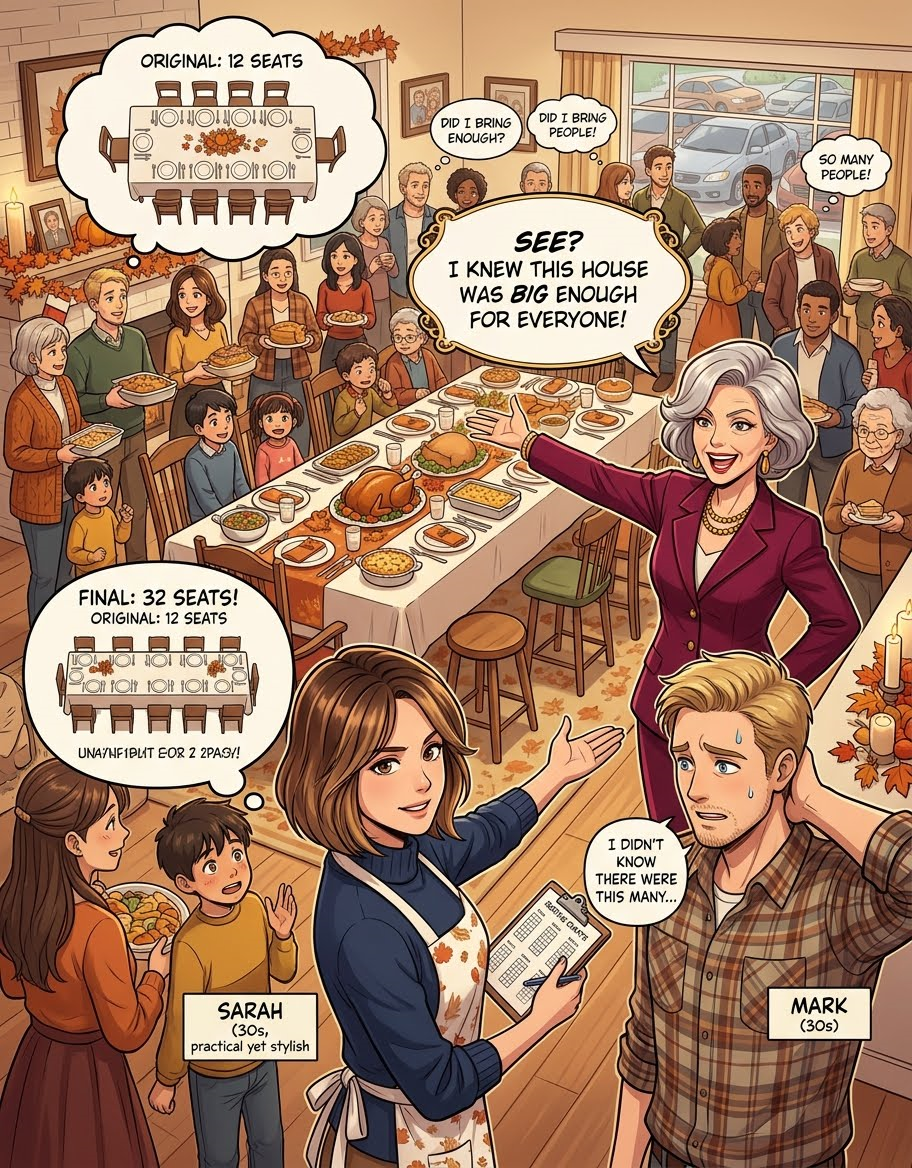
    We had Thanksgiving for eight.

    Or more accurately, for ten — Daniel’s sister Pam had said that Evelyn couldn’t drive home alone and invited her to stay, and Evelyn had said she wouldn’t impose, and Pam had said she absolutely would and wouldn’t hear otherwise, and so Evelyn stayed, and I added two place settings with the everyday china, and it was fine.

    The turkey was exactly right.

    The sides were exactly right.

    The table held everyone at a comfortable distance that allowed actual conversation rather than the managed chaos of previous years, and I watched conversations happen across the table that had never happened at my Thanksgivings before because when thirty people are at a table, no one can hear anything and everything becomes performance rather than connection.

    Helen sat next to Evelyn.

    I watched them talk.

    Helen, for the first time at my table, was not performing. She was not narrating her contribution to the evening or pointing out things she had helped with or managing the room. She was talking to her former sister-in-law — the aunt of her ex-husband, a woman she had lost connection with when the marriage ended — and she was, I thought, simply present.

    It looked good on her.

    Daniel, across the table, caught my eye.

    He had a look I had not seen before, or had not seen in a long time. The look of a man who is at his own table in his own home at his own holiday and is not managing a situation, not mediating, not absorbing and smoothing and keeping the peace at his own expense.

    He just looked like himself.

    He mouthed something.

    I read it: Thank you.

    I shook my head.

    He mouthed it again.

    I let it land this time.

    After dinner, when the children were doing whatever children do after Thanksgiving dinner and Daniel had corralled the men into some form of after-dinner activity involving football, Helen found me in the kitchen where I was wrapping the leftover turkey.

    She said: Can I help?

    I said: Yes.

    We wrapped things together in the specific companionable silence of women doing kitchen work after a meal, and after a while Helen said:

    I want to say something and I want you to let me finish before you respond.

    I stopped wrapping.

    All right, I said.

    I know that I have treated your home as though it were partly mine, she said. I know that I have told myself this was because I love my son and I love your children and I wanted to be present, and all of those things are true. But I also know that I have used those true things to excuse something that isn’t true, which is that I have the right to make decisions about your house. She paused. I don’t. I know that. I knew it every time I did it and I did it anyway.

    I did not speak.

    I’m sixty-seven years old, she said. Not seventy-one — perhaps she had been sixty-seven for a while before I began this story and the years had passed the way years do. And I have spent a significant portion of those years making sure things happened the way I thought they should happen. Because when Daniel’s father left, nothing happened the way I thought it should, and I think I spent a very long time afterwards making sure I had control over everything I could. She looked at the turkey in her hands. I don’t think I had noticed how far that had spread.

    Did tonight help you notice? I said.

    She almost smiled.

    That table for eight was very clear, she said.

    I meant it to be, I said.

    Yes, she said. I know.

    She finished wrapping the turkey.

    She put it in the refrigerator.

    She turned to face me with the expression of a woman who has arrived somewhere difficult and is not going to leave before it’s done.

    I would like, she said carefully, to try to do this differently. If you’ll give me the opportunity.

    Helen, I said. You have been in my family for six years. I have wanted a real relationship with you for six years. That is not available when one of us is managing the other. I paused. If you want to come to Christmas, you are welcome to come to Christmas. If you want to bring Evelyn, I would genuinely like to know Evelyn. If you want to help with something — with a dish, with the children, with anything — I will ask you. And I need you to let me ask.

    She was quiet.

    That sounds like me having less, she said.

    It sounds like you having something real, I said. Instead of something you had to take.

    She looked at me for a long time.


    Then she said: You’re a good woman, Rachel.

    I know, I said.

    She looked startled.

    Then she laughed.

    It was the first time I had heard Helen Calloway laugh without performing it.

    The extension came back on Friday.

    My friend brought it in her truck and Daniel and Michael reinstalled it, and the dining room was back to normal, the normal of a room that can hold fourteen when it needs to and eight when eight is exactly right.

    Evelyn came back on Friday too, actually — she had stayed at a hotel because she lived far enough away that driving the night before felt unwise — and she appeared at the door on Friday morning with pastries and the natural ease of a woman who had been coming to houses all her life and knew how to enter one without taking it over.

    I hope I’m not intruding, she said.

    You’re invited, I said.

    She came in.

    We sat in the kitchen and had coffee and pastries and talked for two hours about things that had nothing to do with the previous night’s drama, and I found that I genuinely liked her, which is the thing about Evelyn — she is the kind of person you like without needing a reason.

    You handled yourself well last night, she said.

    I’d been planning it for two days, I said.

    Still, she said. It’s hard to say what needs saying. Most people don’t.

    I almost didn’t, I said.

    But you did.

    I had a table to say it for me, I said.

    She smiled.

    That was well done, she said. Eight place settings. You made it very easy to understand.

    That was the idea, I said.

    Helen is not a bad woman, Evelyn said.

    I know, I said. She’s a woman who got used to making things happen her way and no one stopped her.

    Including me, Evelyn said. I’ve known her for thirty years and I never said what I said last night.

    What made you say it?

    She considered this.

    You were very calm, she said. You weren’t screaming or crying or making it about your feelings. You were just stating facts. That’s a hard thing to argue with. She paused. And I thought — she’s right. We’re in her home. We were invited by someone who doesn’t live here. That’s not her problem to solve.

    It wasn’t, I said.

    No, she said. It was ours.

    Christmas came six weeks later.

    Helen came.

    She called first.

    She called on the first of December and asked if she could come to Christmas, and she asked in the voice of a woman who had understood something new and was not entirely comfortable with the discomfort of asking, and I said yes, of course, we would love to have you.

    She asked if she could bring anything.

    I said: What would you like to bring?

    She said she made a good cranberry sauce.

    I said that sounded perfect.

    She came on Christmas Day at the time we had agreed on, not two hours early. She brought the cranberry sauce and a small gift for each of the children and a bottle of wine for Daniel and me. She walked in and she looked at the dining room — the table with the extension, the sixteen chairs, because we were more people this year and had planned accordingly — and she sat down where I pointed and she stayed in her seat.

    She ate the food I had made.

    At one point she offered to help in the kitchen and I said yes, and she came in and I handed her a task and she did the task and she did not rearrange anything or comment on the centerpiece or suggest that something should be different.

    After dinner, in the kitchen, she said: The turkey was very good.


    Thank you, I said.

    Better than mine, she said.

    I looked at her.

    You don’t have to say that.

    I know, she said. It’s true anyway.

    I will not tell you that everything changed on Thanksgiving.

    People do not change completely and permanently in a single evening, and anyone who tells you they do is selling something. Helen has not become a different woman. She is still the woman who arrived with an extra turkey on the first Thanksgiving, who moved my centerpiece, who gave the house tour. That history exists and it shapes things.

    But something shifted.

    Something that had been invisible because it had never been named was named, clearly, in front of twenty people in my front parlor, and you cannot unname a thing once it is named.

    Helen knows that I know what she was doing.

    She knows that I will not absorb it indefinitely.

    She knows that the table in my dining room seats eight or fourteen depending on how many people I have invited, and that the question of how many people I have invited is my question to answer.

    That knowledge changes things.

    Not everything. Not permanently and not without work.

    But enough.

    The extension is back in the table.

    The centerpiece is on the table where I put it.

    The place cards, when there are place cards, are where I put them.

    My house is my house.

    It took a table for eight and one small detail to say so.

    Sometimes that is all it takes — not the years of swallowing, not the confrontations that produced nothing, not the patient management of someone else’s certainty.

    Just a table, set with eight plates, in exactly the center of a room that belongs to you.

    Clear. Undeniable. Honest.

    A thing that cannot be argued with.

    I set the table for the people I invited.

    Six words.

    Everything I had been not saying for six years.

    Helen came to Easter.

    She brought the cranberry sauce again, which is not a traditional Easter dish.

    I did not point this out.

    Evelyn came too.

    She is, apparently, becoming a regular.

    I have asked Helen to come early for Christmas this year.

    I need someone to watch the children while I do the prep.

    She said yes immediately.

    We are figuring it out.

    The extension stays in the table.

    But I decide who sits at it.

    That part doesn’t change.

    PART 3 — THE CHRISTMAS SHE WAS FINALLY INVITED TO
    The first time Helen asked permission to enter my kitchen, I nearly cried.
    Not because the question was remarkable.
    Because of how many years I had waited to hear it.
    She stood in the doorway on a cold December morning, holding the handles of a canvas shopping bag against her coat.
    Outside, snow had begun collecting along the porch rail.
    Inside, my daughter was looking for a missing mitten, my son was accusing the dog of stealing it, and the oven had started making the clicking noise that meant it was either about to heat properly or ruin my entire morning.
    Helen looked at the flour on my sleeves.
    Then at the children.
    Then back at me.
    “Where would you like me?”
    Six years earlier, she would have already been opening cabinets.
    A year earlier, she would have arrived carrying an entire second meal and a reason why mine might not be sufficient.
    That morning, she waited.
    I put down the measuring cup.
    “With the children, if that’s still all right.”
    “Of course.”
    She hung her coat on the hook by the back door.
    She did not move my coat to make room.
    She did not comment on the untidy boots beneath it.
    She crouched beside my daughter and asked which mitten was missing.
    “The purple one,” my daughter said.
    Helen nodded seriously.
    “That narrows the investigation.”
    I turned back toward the counter before either of them could see my face.
    For a moment, I let myself believe we had reached the easy part.
    We had survived the Thanksgiving with the missing table extension.
    We had survived the Christmas afterward.
    We had made it through Easter with cranberry sauce beside the ham and no unexpected guests standing in the hallway.
    Helen had asked.
    I had answered.
    We were learning.
    Then her phone rang.
    She looked at the screen.
    And the expression on her face changed so quickly that I felt it before I understood it.
    She silenced the call.

    A moment later, it rang again.
    “Do you need to take that?” I asked.
    “No.”
    The word came too fast.
    My daughter held up a purple mitten she had discovered inside a boot.
    Helen smiled at her, but the smile was unfinished.
    The phone rang a third time.
    This time, I saw the name.
    Arthur.
    Daniel’s father.
    The man who had left when Daniel was nine.
    The man whose absence had become the unspoken explanation beneath almost everything Helen did.
    She turned the phone facedown.
    But by then, something old had entered the room.
    Something that had nothing to do with a table.
    CHAPTER 1 — A NAME WE DIDN’T USE
    There were things Daniel told me easily.
    He could tell me about the apartment where he grew up.
    About the broken radiator that made his bedroom sound like someone was throwing pebbles against the wall.
    About Helen ironing his school shirt at midnight after finishing a shift.
    About how she once drove through freezing rain to see a school play in which he had exactly one line.
    But when I asked about his father, the stories shortened.
    “He wasn’t around much.”
    “He sent a card sometimes.”
    “We don’t really talk.”
    I had learned to hear the locked door inside those sentences.
    I did not push at it.
    Once, shortly before our wedding, I asked whether Arthur should receive an invitation.
    Daniel had been sorting silverware into a drawer in our apartment.
    He kept sorting.
    “No.”
    “Okay.”
    He looked at me then.
    “You don’t need an explanation?”
    “Not to respect your answer.”
    For a few seconds, he stood with a fork in his hand.
    Then he put it down and hugged me so tightly I could feel his heartbeat through his shirt.
    Arthur did not come to our wedding.
    He did not come when our first child was born.
    He did not send anything when our second arrived.
    As far as I knew, he had not been inside Helen’s home in more than twenty years.
    Now he was calling her three times before ten in the morning.
    Helen tucked the phone into her bag.
    “Would you like me to take them upstairs to find their Christmas sweaters?”
    “That would help.”
    She gathered the children with unusual efficiency.
    By the time they reached the kitchen stairs, my son was explaining that he no longer liked the sweater with the reindeer because the reindeer looked judgmental.
    Usually, Helen would have laughed.
    That morning, she barely seemed to hear him.
    I waited until their footsteps faded.
    Then I walked into Daniel’s office.
    He was answering a work message, his reading glasses low on his nose.
    “Your father called your mother.”
    His hands stopped over the keyboard.
    “When?”
    “Just now.”
    “What did she say?”
    “She didn’t answer.”
    He leaned back.
    I watched him turn the news over without touching it.
    “Maybe it’s nothing.”
    “Maybe.”
    He took off his glasses.
    “Did she say why he was calling?”
    “No.”
    “Then let’s leave it.”
    I stood beside the doorway.
    “Daniel.”
    His eyes lifted.
    “I’m not asking you to call him.”
    “I know.”
    “I’m asking whether there’s something you need from me.”
    His face changed a little.
    That was another thing we were learning.
    How to ask the actual question instead of the one we had learned to survive.
    “Just don’t let today become about him,” he said.
    “I won’t.”
    Neither of us knew how difficult that promise would become.
    CHAPTER 2 — THE MESSAGE SHE COULD NOT DELETE
    At eleven, Helen came downstairs alone.
    The children were building a fort in the upstairs sitting room.
    She said this as if delivering a report.
    Then she asked whether I had five minutes.
    I turned off the mixer.
    She remained standing.
    “Please sit,” I said.
    “I don’t think I want to.”
    “All right.”
    For a while, she looked at the recipe card beside my bowl.
    It was one of my mother’s.
    There was a grease stain across the corner and a note in blue ink reminding me not to overwork the dough.
    Helen touched the edge of the counter.
    “Arthur is in town.”
    I said nothing.
    “He called last week.”
    The kitchen seemed to become quieter around us.
    “Does Daniel know?”
    “No.”
    “Why not?”
    She closed her eyes briefly.
    “Because I didn’t know what to do with it.”
    That answer sounded honest.
    It was also incomplete.
    “What does he want?”
    “To see him.”
    “Has Daniel agreed?”
    “No.”
    She swallowed.
    “He doesn’t know.”
    I looked toward the office hallway.
    Then back at her.
    “Helen.”
    “I haven’t invited him here.”
    The speed of that sentence made my stomach tighten.
    “Did he ask to come here?”
    “Yes.”
    “When?”
    “Today.”
    I set the towel in my hands on the counter.

    For a moment, neither of us moved.
    She watched me with the expression she had worn in front of the table for eight.
    Not indignation.
    Fear.
    “He said Christmas might be a good time,” she continued.
    “He said there would be people around, that it wouldn’t have to be a formal conversation.”
    “A surprise reunion.”
    “He didn’t call it that.”
    “What did he call it?”
    She looked down.
    “An opportunity.”
    I took a breath.
    “Whose opportunity?”
    Helen’s fingers tightened on the edge of the counter.
    “I know.”
    “Do you?”
    “Yes.”
    She finally sat.
    For the first time that morning, she looked her age.
    Not diminished.
    Just tired in a way that had nothing to do with the children or the stairs.
    “He told me Daniel wouldn’t answer if he called directly.”
    “Daniel might not want to answer.”
    “He told me he was getting older.”
    “We all are.”
    “He said he doesn’t know how many Christmases he has left.”
    I pulled out the chair opposite her.
    “That may be true.”
    She looked up.
    “But it doesn’t give him the right to choose how Daniel spends this one.”
    Helen’s mouth trembled.
    “I nearly told him to come.”
    There it was.
    Not a guest already driving toward my house.
    Not another completed decision I was expected to absorb.
    A temptation confessed before it became an action.
    I sat down.
    “Nearly?”
    She nodded.
    “I thought if he arrived, Daniel would have to see him.”
    I let the words remain between us.
    She heard them too.
    I could tell by the way her shoulders lowered.
    “Listen to what I just said.”
    “I am.”
    She looked toward the staircase.
    “For years, I’ve told myself I was making things easier for my son.”
    Her voice cracked.
    “And there I was, thinking I could make him do something he hadn’t chosen.”
    I did not reach for reassurance.
    She did not need me to make the admission less uncomfortable.
    She needed to finish it.
    “I told Arthur I would speak to Daniel.”
    “Then that’s what needs to happen.”
    “What if he says no?”
    “Then the answer is no.”
    “What if he regrets it?”
    “That would still be his regret to work through.”
    Helen looked at me for a long moment.
    Then she gave a small, exhausted laugh.
    “You make it sound simple.”
    “It isn’t simple.”
    “But you know what to do.”
    “I know whose decision it is.”
    She sat very still.
    Then she took her phone out.
    There was a message waiting.
    She turned the screen toward me.
    I have the address.
    I’ll come by around two.
    A little surprise might do everyone good.
    I looked at the message.
    Then at the clock.
    Eleven-seventeen.
    Our guests were expected at one.
    Dinner was at three.
    Somewhere in town, a man who had been absent for decades had decided that he could arrive in the middle of it all and be received.
    Helen whispered, “I haven’t replied.”
    I stood.
    “Then we need to tell Daniel now.”
    CHAPTER 3 — WHAT MY HUSBAND REMEMBERED
    Daniel read the message twice.
    The first time, his face emptied.
    The second time, his jaw tightened.
    Helen sat across from him in the office.
    I remained near the door.
    Nobody touched the tea I had brought.
    “You gave him our address?”
    “He found it.”
    “How?”
    “I don’t know.”
    “Did you tell him he could come?”
    “No.”
    “Did you tell him he couldn’t?”
    Helen looked at her hands.
    “Not clearly enough.”
    Daniel put the phone on the desk.
    “I don’t want him here.”
    “All right,” Helen said.
    The answer was so immediate that he looked up.
    She held his gaze.
    “I will tell him.”
    He watched her carefully.
    “You’re not going to ask me to reconsider?”
    “No.”
    “You’re not going to tell me he’s my father?”
    “No.”
    “Because I know who he is.”
    Helen’s face folded.
    “I know you do.”
    Daniel stood and walked to the window.
    Snow had thickened against the glass.
    For several seconds, the only sound was the low hum of his computer.
    “He said he was coming one Christmas.”
    Helen closed her eyes.
    I had never heard this story.
    Daniel kept looking outside.
    “I was eleven.”
    His voice was flat.

    “He called on the twenty-third and said he had something for me.”
    Helen’s hand moved toward her mouth.
    “I remember.”
    “I know you remember.”
    He turned.
    “I kept looking out the window.”
    The sentence was quiet.
    It hurt more because it was quiet.
    “I thought every set of headlights was his.”
    Helen began to speak.
    Daniel lifted a hand.
    “Please let me finish.”
    She nodded.
    “You told me the roads were bad.”
    “They were.”
    “But that wasn’t why he didn’t come.”
    “No.”
    “You knew?”
    “Not at first.”
    “Later?”
    “Yes.”
    Daniel laughed once, without amusement.
    “I wore that sweater until bedtime because I wanted him to see it.”
    Helen’s eyes filled.
    “It was the green one.”
    “With the stupid skier.”
    “You loved that sweater.”
    “I loved the idea that he might remember buying it.”
    Nobody spoke.
    I could see Daniel as a boy with painful clarity.
    Standing near a window.
    Trying not to seem eager.
    Trying to prepare himself to be noticed.
    “I’m not doing that to my children,” he said.
    Helen nodded.
    “And I’m not doing it to myself.”
    “I understand.”
    He studied her.
    “Do you?”
    She took a breath.
    “I understand that I should have told you when he first called.”
    “Yes.”
    “And that I wanted a happy ending badly enough to consider making you responsible for producing it.”
    Daniel sat down slowly.
    Helen continued.
    “I think part of me still wants proof that all of it can be repaired.”
    “All of what?”
    “The years.”
    “The years happened, Mom.”
    “I know.”
    “You can’t get them back by seating him beside the mashed potatoes.”
    She gave a broken little smile.
    “No.”
    Daniel rubbed his eyes.
    He looked suddenly exhausted.
    “You don’t have to fix my childhood.”
    Her tears spilled then.
    “I should have protected you better.”
    “You protected me from a lot.”
    “Not from this.”
    “You couldn’t make him come.”
    “I could have stopped making excuses.”
    Daniel looked at her.
    For a while, neither spoke.
    Then he said, “Yes.”
    It was not cruel.
    It was the truth she had finally left room for.
    Helen nodded.
    “I’m sorry.”
    He breathed out.
    “I believe you.”
    I saw something loosen in her face.
    Not because the past had been forgiven.
    Because it had been spoken without anyone trying to change its shape.
    She picked up her phone.
    “What would you like me to tell him?”
    Daniel looked at me.
    I did not answer for him.
    He turned back to his mother.
    “Tell him he is not invited.”
    Helen typed.
    Then she read the message aloud.
    “Arthur, Daniel does not want a visit today.”
    “Do not come to Rachel and Daniel’s house.”
    “If he decides he wants contact, he will make that decision himself.”
    She looked up.
    “Is that right?”
    “Yes.”
    She pressed send.
    Then she set the phone down and waited.
    CHAPTER 4 — THE WOMAN IN THE RED COAT
    Arthur replied within two minutes.
    So this is Rachel’s decision.
    Daniel picked up the phone before Helen could.
    “No.”
    He typed one word first.
    Then more.
    This is Daniel.
    I am making this decision.
    Do not come to my home.
    He sent it.
    The response took longer.
    You always did let your mother speak for you.
    Daniel stared at the screen.
    I watched anger move through him, followed by something older and less visible.
    He set the phone down.
    “Turn it off.”
    Helen did.
    At twelve-forty, Evelyn arrived in a red wool coat with snow caught along the shoulders.
    She held a covered dish in one hand and a bakery box in the other.
    “I brought the rolls you asked for,” she said.
    “And something unnecessary.”
    “What’s unnecessary?”
    “Small cakes.”
    “How many?”
    “An unreasonable number.”
    I laughed and took the box.
    She looked at me.
    Then at Helen, standing behind me in the hall.
    Her expression changed.
    “What happened?”
    Helen answered before I could.
    “Arthur contacted me.”
    Evelyn’s hand went still on her scarf.
    “When?”

    “Last week.”
    “I see.”
    “He wanted to come today.”
    Evelyn looked toward Daniel’s office.
    “Does Daniel want that?”
    “No.”
    “Then he should not come.”
    Helen exhaled.
    “I told him.”
    “Good.”
    The word was calm.
    It carried no triumph.
    Evelyn handed me her coat.
    Then she asked where she could put the dish.
    The ordinariness of the question steadied me.
    We walked into the kitchen together.
    For a few minutes, we spoke about the roads and the rolls and whether the children were likely to eat Brussels sprouts this year.
    Then, while Helen went upstairs to check the fort, Evelyn touched my arm.
    “Has he accepted the answer?”
    “Not gracefully.”
    “That sounds familiar.”
    I looked at her.
    She opened the bakery box.
    “You’re his aunt.”
    “Yes.”
    “Was he always like this?”
    She arranged the small cakes on a plate before answering.
    “Arthur was charming when he wanted something.”
    “And when he didn’t get it?”
    “He found someone else to blame.”
    I leaned against the counter.
    “Did you know what happened?”
    “Some of it.”
    “Why didn’t you stay in touch with Helen?”
    Evelyn’s hands stopped.
    For the first time since I had met her, she looked uncertain.
    “Because I believed a convenient version.”
    “His version?”
    “Yes.”
    “What did he tell you?”
    “That Helen made seeing Daniel impossible.”
    I felt a small chill.
    Evelyn closed the bakery box.
    “He said she changed arrangements.”
    “He said she was angry.”
    “He said every attempt turned into a fight.”
    “Did you ask her?”
    “No.”
    She looked at me directly.
    “I should have.”
    I thought about the boy at the window.
    “Daniel waited for him.”
    “I know that now.”
    Her voice thickened.
    “Pam told me things after last Thanksgiving.”
    “I started understanding how much I had accepted without checking.”
    She drew a breath.
    “I can’t pretend I was kept completely outside.”
    “There were doors I didn’t knock on.”
    I looked toward the stairs.
    “Have you told Helen that?”
    “Not properly.”
    “Maybe you should.”
    Evelyn nodded.
    “Yes.”
    Outside, a car slowed along the street.
    Both of us looked toward the window.
    It continued past.
    I noticed that I was holding my breath.
    Evelyn noticed too.
    “If he arrives,” she said, “you do not have to open the door.”
    “I know.”
    She put a hand over mine.
    “And knowing that does not always stop your body from preparing for a fight.”
    CHAPTER 5 — THE DOORBELL
    Pam and her family arrived just after one.
    Michael came ten minutes later with cider and a bag of oranges because he had somehow decided that every Christmas gathering needed a large quantity of citrus.
    The children emerged from the fort.
    Coats filled the hallway.
    The house acquired the familiar noise of people settling into a holiday.
    I checked the potatoes.
    Daniel poured drinks.
    Helen asked Pam whether she wanted help carrying gifts upstairs.
    Nobody mentioned Arthur.
    For forty minutes, I almost believed the message had been enough.
    Then the doorbell rang.
    I knew before I reached the hallway.
    There are sounds that become different because of what you are afraid they mean.
    The bell was the same one it had always been.
    My body heard it as a warning.
    Through the glass beside the front door, I saw a man in a dark overcoat.
    He held a paper gift bag.
    Snow lay across his hair.
    Arthur.
    I had seen him in photographs.
    The resemblance to Daniel was unmistakable and unsettling.
    The same shape around the eyes.
    The same mouth.
    A familiar face occupied by a stranger.
    Daniel came out of the kitchen.
    He stopped beside me.
    “Is it him?”
    “Yes.”
    The bell rang again.
    Behind us, the conversation in the living room faded.
    Helen appeared at the foot of the stairs.
    Her face went white.
    “I told him.”
    “I know,” Daniel said.
    Arthur lifted his hand toward the glass.
    Then his voice came through the door.
    “Daniel.”
    My husband did not move.
    “It’s cold out here.”
    Daniel reached for the lock.
    I touched his wrist.
    “You don’t have to.”
    He looked at me.
    “I know.”
    Then he opened the door far enough to stand in the frame.

    He kept the storm door closed.
    Arthur smiled.
    It was a practiced smile.
    The kind meant to skip whatever conversation should have happened first.
    “There he is.”
    Daniel said nothing.
    Arthur lifted the bag.
    “Brought a few things for the kids.”
    “They’re not meeting you today.”
    The smile faltered.
    “Come on.”
    “Dad.”
    The word startled both of them.
    I could see it.
    For Arthur, it sounded like an opening.
    For Daniel, it seemed to cost something.
    “I told you not to come.”
    Arthur looked past him.
    His eyes found me.
    “Rachel, right?”
    I stayed where I was.
    “Hello, Arthur.”
    “Maybe you can help me out here.”
    “No.”
    He gave a small laugh.
    “I just mean this is a family matter.”
    “It is,” I said.
    “And Daniel has answered you.”
    Arthur looked back at his son.
    “You’re really going to leave me standing outside on Christmas?”
    “You chose to come after I told you not to.”
    “I drove a long way.”
    “You should have called before you drove.”
    “I called your mother.”
    “You should have called me.”
    Arthur’s face tightened.
    “I didn’t know you’d become this unforgiving.”
    Daniel’s hand closed around the edge of the door.
    For a second, I thought he might shut it.
    Instead, he asked, “What did you expect?”
    “A chance.”
    “To do what?”
    “To see my family.”
    “Do you know my daughter’s name?”
    Arthur blinked.
    He looked down at the bag.
    “I brought—”
    “Do you know her name?”
    The hallway was silent.
    Arthur’s mouth opened.
    Nothing came.
    Daniel nodded once.
    “What about my son?”
    “I know you have two children.”
    “That wasn’t the question.”
    Arthur looked toward Helen.
    She had moved closer, but she did not step beside Daniel.
    “Help me here,” Arthur said.
    Helen’s voice was steady.
    “You need to leave.”
    His eyes widened.
    “After all this time, you still—”
    “No.”
    She stopped him so firmly that I felt it in my chest.
    “You are not going to make this about me.”
    He stared at her.
    “Daniel told you not to come.”
    “I repeated it.”
    “You came anyway.”
    Arthur’s face reddened.
    “I thought once we were all together—”
    “You thought he would be less able to refuse you with an audience,” Helen said.
    The sentence hung between them.
    I knew what it had cost her to recognize that.
    I knew because a year earlier she had relied on the same thing.
    Daniel looked back at his mother.
    Then he faced Arthur again.
    “I’m not having this conversation with my children listening upstairs.”
    Arthur’s eyes flicked toward the staircase.
    For the first time, he seemed to understand that children were not an abstract reason to gain entry.
    They were people inside a home.
    People who could hear him.
    “I can come back later.”
    “No.”
    “Tomorrow.”
    “No.”
    “Then when?”
    Daniel took a breath.
    “I don’t know.”
    Arthur seemed more offended by uncertainty than by rejection.
    “You can’t leave things like that.”
    “I can.”
    Daniel’s voice did not rise.
    “If I want contact, I’ll decide when.”
    Arthur stood very still.
    Then he lowered the bag.
    “Fine.”
    He set it on the porch.
    “Keep those, at least.”
    “We’ll decide what to do with them.”
    Arthur shook his head.
    He looked as though he wanted one final sentence that would put the discomfort back where he thought it belonged.
    But Evelyn had come into the hallway.
    He saw her over Daniel’s shoulder.
    “Aunt Evelyn.”
    “Arthur.”
    “You too?”
    She held his gaze.
    “Yes.”
    Whatever he had prepared disappeared.
    He stepped backward.
    Then he turned and walked down the porch steps.
    Daniel remained in the doorway until the car pulled away.
    Only then did he close the door.
    CHAPTER 6 — THE CHILD AT THE TOP OF THE STAIRS
    Our daughter was sitting halfway down the staircase.
    Her Christmas sweater had slipped off one shoulder.
    She held a stuffed rabbit by one ear.
    I had not seen her there.

    Daniel had.
    His face changed immediately.
    He walked to the bottom step and crouched.
    “Hey.”
    She looked at him.
    “Was that your daddy?”
    “Yes.”
    “Why didn’t he come in?”
    Daniel looked back at me.
    Not for an answer.
    For company.
    I sat on the step beside her.
    He rested one hand on the banister.
    “Because I told him today wasn’t a good day for a visit.”
    “Was he bad?”
    Daniel thought before speaking.
    “He made choices that hurt me a long time ago.”
    “Like when somebody says they’ll play and then they don’t?”
    “A little like that.”
    Her eyebrows pulled together.
    “But grown-up.”
    “Yes.”
    She looked toward the door.
    “He looked sad.”
    “I think he probably was.”
    “Are you sad?”
    Daniel swallowed.
    “Yes.”
    She slid off the step and put her arms around his neck.
    He held her.
    For a moment, all the noise in the house seemed very far away.
    Then she leaned back.
    “Are you going away?”
    The question went through him.
    I saw it.
    “No.”
    “You promise?”
    “I promise I’m coming to dinner.”
    She waited.
    “And tomorrow?”
    “Tomorrow too.”
    “What about when I’m eleven?”
    A tear escaped before he could stop it.
    He wiped it away.
    “Yes.”
    “When you’re eleven.”
    She considered this.
    Then she touched his cheek with the kind of tenderness children give without knowing what they are repairing.
    “You can sit by me.”
    He nodded.
    “I’d like that.”
    When she ran back upstairs to retrieve her brother, Daniel remained crouched by the staircase.
    I put my hand on his shoulder.
    He leaned into it.
    “I didn’t know she heard.”
    “She heard us say no.”
    He looked at me.
    “She also heard that being sad doesn’t mean you have to let someone in.”
    He nodded slowly.
    Then he stood and pulled me against him.
    “I’m sorry.”
    “For what?”
    “For the doorbell.”
    “You didn’t ring it.”
    He laughed through the tears.
    It was a small laugh.
    But it belonged to him.
    CHAPTER 7 — WHAT HELEN SAID WITHOUT AN AUDIENCE
    Helen was in the kitchen when I returned.
    She stood over the sink without running the water.
    On the counter, the potatoes waited beneath a clean towel.
    She turned when she heard me.
    “I’m sorry.”
    “I know.”
    “I should have told him no the first time.”
    “Yes.”
    “I should have told Daniel immediately.”
    “Yes.”
    Her eyes filled again.
    I did not soften the facts.
    I also did not leave her alone inside them.
    “He knows you told him not to come.”
    “That doesn’t undo the delay.”
    “No.”
    She nodded.
    Then she wiped her face with the heel of her hand.
    For a while, we listened to the oven.
    “I hated him for doing that,” she said.
    “For standing on your porch and acting as though being there should make the answer different.”
    I waited.
    She looked at the dining room doorway.
    “Then I remembered all the people I brought here.”
    I turned toward her fully.
    “Helen.”
    “I know it isn’t the same history.”
    Her voice shook.
    “But I recognized the expectation.”
    She pressed her hands flat against the counter.
    “That if I made the situation happen, everyone else would have to adjust.”
    The admission hurt her.
    It also seemed to steady her.
    “I used to think asking gave other people a chance to reject me.”
    “What do you think now?”
    “That refusing to ask gave them a reason to.”
    I picked up the spoon beside the potatoes.
    “Would you mash these?”
    She looked surprised.
    “Now?”
    “Yes.”
    “Are you sure?”
    “I’m asking.”
    She took the spoon.
    Her hand brushed mine.
    “Thank you.”
    We worked for a few minutes.
    Then she said, “When Arthur left, I thought if I made our home good enough, he might come back.”
    I kept cutting carrots.
    “I cooked too much.”
    “I cleaned things that were already clean.”
    “I bought curtains we couldn’t afford.”
    “He had complained about the curtains before he left.”
    She gave a small, incredulous laugh.

    “As though curtains had anything to do with it.”
    I looked at her.
    She was staring into the bowl.
    “Then I thought if I made holidays perfect, Daniel wouldn’t notice who was missing.”
    “Did he?”
    “Of course.”
    Her voice fell.
    “He noticed every time.”
    I laid down the knife.
    “Did anyone tell you that you didn’t have to make up for him?”
    “No.”
    She looked at me.
    “And after a while, I stopped wanting anyone to.”
    “Why?”
    “Because if I wasn’t the woman who could do everything, I didn’t know who I was.”
    There it was.
    Not an excuse.
    A room beneath the room we had been arguing in for years.
    I could understand it without giving her my house.
    I could feel compassion without moving my centerpiece.
    “I think you’re someone my children love,” I said.
    Her eyes went toward the stairs.
    “Even when I don’t bring anything?”
    “Especially when you listen to their ridiculous mitten investigations.”
    She smiled through her tears.
    “That was a serious investigation.”
    “The dog was innocent.”
    “Of that particular offense.”
    We laughed.
    Then she lowered her gaze.
    “Will you believe me if I say I want to keep learning?”
    “Yes.”
    “Even after today?”
    “Because of what you did today.”
    She looked up.
    “You told us before inviting him.”
    “You sent the message Daniel asked you to send.”
    “You didn’t open the door for him.”
    “That matters.”
    She swallowed.
    “I nearly did the wrong thing.”
    “You chose what to do next.”
    For a long time, she said nothing.
    Then she began mashing the potatoes.
    CHAPTER 8 — DINNER WITH THE PEOPLE WHO WERE THERE
    We ate at three-twenty.
    The delay was twenty minutes.
    Nobody announced it as a failure.
    Nobody suggested I should have planned better.
    Michael put the cider on the table.
    Pam carried in the rolls.
    Her daughter found the missing serving spoon in the drawer where it belonged, a small miracle that deserved more recognition than it received.
    Helen carried the potatoes.
    She stopped at the dining room doorway.
    “Where would you like these?”
    “Beside the carrots.”
    She set them there.
    The centerpiece stayed in the middle.
    The extension was in the table.
    Every chair had someone who knew they were welcome.
    Before we began, Daniel looked around.
    “I want to say something.”
    My stomach tightened.
    He reached for my hand beneath the table.
    “Thank you for being here.”
    His voice was quiet.
    “I mean that.”
    He looked at his mother.
    Then at Evelyn.
    Then at the children, who were already studying the rolls.
    “I’m glad we’re together.”
    That was all.
    No speech about Arthur.
    No explanation of the porch.
    No effort to turn an unwanted visit into the central event of the day.
    We passed the food.
    My son dropped butter on the tablecloth.
    Pam’s daughter told a long story about a school concert in which the wrong backing track had played.
    Michael laughed so hard he had to put down his glass.
    Evelyn asked my daughter about the fort.
    Helen listened.
    At one point, I looked across the table and found Daniel watching his mother.
    She was helping our son cut a potato that did not require cutting.
    He had asked her anyway.
    She was doing it with complete seriousness.
    Daniel’s expression held grief and gratitude at once.
    I was beginning to understand that growing older did not mean choosing one feeling and discarding the others.
    Sometimes it meant making room for several without letting the most painful one make every decision.
    After dinner, the children opened the gifts we had planned.
    Arthur’s bag stayed on the porch until Daniel brought it into his office.
    He did not open it that day.
    Nobody told him he should.
    CHAPTER 9 — THE APOLOGY EVELYN HAD WAITED TOO LONG TO GIVE
    I found Evelyn and Helen in the front parlor after dessert.
    The lamps were on.
    Outside, snow softened the street.
    I had gone in to collect cups.
    Then I heard Evelyn say, “I owe you something.”
    I stopped in the doorway.
    Helen sat beside the fireplace.
    “For what?”
    “For believing him.”
    Her voice was low.
    Helen stared at her.
    “You knew?”
    “I knew what he told me.”
    “What did he tell you?”
    Evelyn answered without dressing it up.
    “That you kept Daniel from him.”
    “That you changed plans.”
    “That every visit became a punishment.”
    Helen’s face went still.
    “He said that?”
    “Yes.”
    “And you believed him.”
    “Yes.”
    The fire shifted.
    I could hear a log settle.
    Helen looked down at the cup in her hands.
    “I used to save the messages.”
    Evelyn did not speak.
    “When he said he was coming.”
    “When he canceled.”
    “When he didn’t call.”
    “I saved them because I thought one day someone might ask.”
    Her voice broke.
    “Nobody asked.”
    Evelyn’s eyes filled.
    “I should have.”

    “Yes.”
    “I’m sorry.”
    Helen shook her head slowly.
    “For years, I wondered why nobody came.”
    “I thought perhaps I had been unpleasant.”
    “I was tired all the time.”
    “I probably was unpleasant.”
    “That wasn’t a reason to leave you alone.”
    Helen looked at her then.
    There was anger in her face.
    Real anger.
    I was glad Evelyn did not ask her to make it smaller.
    “I don’t know what to do with this,” Helen said.
    “You don’t have to do anything with it tonight.”
    “Were there other people?”
    “Who believed him?”
    “Yes.”
    “I think so.”
    Helen closed her eyes.
    Evelyn continued.
    “I can tell them what I know now.”
    “I can stop repeating the story by staying silent when it comes up.”
    “I can do that whether you forgive me or not.”
    Helen was quiet for a long time.
    Then she said, “I don’t want an argument going around the family.”
    “I understand.”
    “But I don’t want that lie left there either.”
    Evelyn nodded.
    “Then I’ll be clear.”
    Helen rubbed her thumb along the cup handle.
    “I was difficult sometimes.”
    “I’m sure you were.”
    Helen gave a startled laugh.
    Evelyn smiled sadly.
    “So was I.”
    “It still doesn’t explain what he did.”
    I stepped into the room then.
    “Would either of you like more tea?”
    Both looked up.
    Helen wiped her face.
    “Yes, please.”
    I collected the cups.
    Evelyn touched Helen’s wrist.
    Helen did not pull away.
    It was not reconciliation all at once.
    It was two women agreeing, after too many years, to stop speaking around the truth.
    CHAPTER 10 — THE LETTER IN THE GIFT BAG
    Three days after Christmas, Daniel opened the bag.
    I was folding laundry on our bed when he came upstairs carrying an envelope.
    “There were toys.”
    “For the children?”
    “Yes.”
    “What do you want to do with them?”
    “I don’t know yet.”
    He sat beside the laundry.
    “And this.”
    The envelope had his name on it.
    He held it between two fingers.
    “Do you want me to leave?”
    “No.”
    “Do you want me to read it?”
    “Not yet.”
    He opened it.
    I watched his eyes move down the page.
    Once.
    Then again.
    He handed it to me.
    The letter was shorter than I expected.
    Arthur wrote that he had made mistakes.
    He wrote that time had passed faster than he understood.
    He wrote that he wanted a chance to explain.
    Then came the sentence that made Daniel stand and walk away from the bed.
    I hope you can put aside what your mother has told you and remember that there are two sides to every story.
    I put the page down.
    Daniel stood near the dresser.
    “He’s still doing it.”
    “Yes.”
    “He thinks I don’t remember.”
    I waited.
    “He thinks my entire childhood is something Mom described to me.”
    His voice rose, then fell.
    “I was there.”
    “I know.”
    “I was the one waiting.”
    “I know.”
    He turned toward me.
    “I wanted the letter to be different.”
    That was the part he had not wanted to admit.
    The small hope that survived beneath every sensible decision.
    I stood and went to him.
    “You can want that.”
    “I feel stupid.”
    “You’re not.”
    “He didn’t even say which mistakes.”
    “No.”
    “He could have written one sentence.”
    “Which one?”
    Daniel looked at the letter.
    “I told you I would come.”
    “I didn’t.”
    “I knew you were waiting.”
    His eyes filled.
    “That would have been something.”
    I held him.
    We stood there until the anger had somewhere to go besides his throat.
    That night, he did not reply.
    The next morning, he put the letter in a drawer.
    A week later, he called a counselor.
    He made the appointment himself.
    When he told me, he sounded embarrassed.
    “I don’t want to spend another twenty years having the same conversation in my head.”
    I put my hand over his.
    “That sounds like a good reason.”
    CHAPTER 11 — THE PART OF OUR MARRIAGE THAT WAS ALSO IN THE ROOM
    The changes with Helen did not erase the changes Daniel and I still needed to make.
    That became clear on an ordinary Tuesday in February.
    I was taking a casserole out of the refrigerator when he said, “Mom might come Sunday.”
    I stopped.
    “Might?”
    “She mentioned it.”
    “Did you invite her?”
    “Sort of.”
    I closed the refrigerator.

    He saw my face.
    Then he closed his eyes.
    “I did it again.”
    “Yes.”
    He rubbed his forehead.
    “I was thinking it would be nice.”
    “It might be.”
    “But I didn’t check.”
    “No.”
    For a moment, the old pattern stood between us.
    Not Helen at the center.
    Daniel.
    His habit of letting a conversation become an arrangement before anyone had named it as one.
    He leaned against the counter.
    “What do you need?”
    “I need you to stop saying ‘sort of’ about plans that create work for both of us.”
    He nodded.
    “Fair.”
    “I don’t need you to ask permission for every person you speak to.”
    “I know.”
    “But if we’re hosting, we decide together.”
    “Yes.”
    He took out his phone.
    “What are you doing?”
    “Calling Mom.”
    “You don’t need to tell her I objected.”
    “I’m not going to.”
    He made the call.
    I kept preparing dinner.
    “Mom, I realized I made Sunday sound more settled than it is.”
    He listened.
    “No, Rachel and I haven’t talked about our weekend yet.”
    He listened again.
    “I’ll call you tomorrow after we have.”
    A pause.
    “Thanks.”
    He put the phone down.
    “What did she say?”
    “She said she understood.”
    I smiled a little.
    “Look at that.”
    He returned the smile.
    Then it faded.
    “I used to think if I didn’t make a firm decision, nobody could be angry at me.”
    I turned toward him.
    “But you still made one.”
    “Yes.”
    “You just left me to discover it.”
    He nodded.
    For a long time, I had thought the problem in my marriage was that Daniel would not stand up to his mother.
    That was part of it.
    But the deeper problem was his belief that avoiding discomfort was an act of kindness.
    He had avoided an uncomfortable conversation with Helen.
    I had carried the inconvenience.
    He had avoided saying no.
    I had done the extra shopping.
    He had avoided admitting he knew about the twenty guests.
    I had found out in the basement from Michael.
    “I thought I was keeping things small,” he said.
    “You were moving them.”
    He looked at me.
    “Yes.”
    “Onto you.”
    I heard the shame in his voice.
    I did not want him to drown in it.
    “I need it to change,” I said.
    “It is changing.”
    “I know.”
    “But I need you to keep choosing it when it’s awkward.”
    He reached for my hand.
    “I will.”
    We did invite Helen that Sunday.
    Daniel cooked.
    I sat in the parlor with a book for twenty minutes while the kitchen made noises that suggested several utensils were being used incorrectly.
    Dinner was excellent.
    The sink was terrible.
    Both were his responsibility.
    CHAPTER 12 — THE KEY
    Helen had a key to our house.
    She had received it when our daughter was a baby, during a week when I had a fever and Daniel was away for work.
    At the time, it had been useful.
    Afterward, usefulness became assumption.
    She had let herself in to drop off groceries.
    Then to leave a coat she thought my son needed.
    Then once to collect a casserole dish while I was upstairs on a work call.
    None of those things had become a major argument.
    They had joined the pile of smaller things I told myself were too small to name.
    By spring, I knew I needed to ask for it back.
    Not secretly change the locks.
    Not wait until the next intrusion gave me enough anger to speak.
    Just ask.
    I did it after Sunday lunch.
    Helen was gathering her scarf.

    “There’s one more thing.”
    She looked up.
    “All right.”
    “We’re changing how we use the spare keys.”
    She waited.
    “I’d like you to give yours back.”
    For a moment, her face closed.
    There it was.
    The hurt I had expected.
    The interpretation that a practical boundary meant she had become less loved.
    “Of course.”
    Her voice was stiff.
    She opened her handbag.
    I let her look.
    Then I said, “We can still arrange for you to have one when you’re staying here or helping with the children.”
    “You don’t trust me.”
    The sentence was quiet.
    I could have argued with it.
    I could have produced a list.
    Instead, I answered the part that mattered.
    “I don’t want anyone letting themselves into our home unless we have arranged it.”
    She looked at me.
    “Even family.”
    “Yes.”
    She found the key.
    It hung beside a small silver charm shaped like a bird.
    She took it off the ring.
    For a second, she held it in her palm.
    Then she handed it to me.
    “I liked knowing I could help.”
    “I know.”
    “It made me feel useful.”
    “You are useful.”
    “But you want to choose when.”
    “Yes.”
    She breathed in.
    Then out.
    “I don’t like how that feels.”
    “Thank you for telling me.”
    She gave a little, unwilling smile.
    “You’re not going to make it feel better by giving it back.”
    “No.”
    “All right.”
    She picked up her bag.
    At the door, she paused.
    “Would you call if you needed me?”
    “Yes.”
    “Really?”
    “Really.”
    Two weeks later, my son developed a fever while I was due at an appointment I could not easily move.
    I called Helen.
    She came.
    I left a key for that day.
    When I returned, she handed it back before putting on her coat.
    There was no speech.
    No comment about being temporary.
    Just the key in my hand.
    I understood then that trust was not only something you gave people before they behaved differently.
    Sometimes it was something you built while watching them practice.
    CHAPTER 13 — THE DINNER AT HELEN’S
    In June, Helen invited us to her house.
    She called Daniel and me together.
    Not separately.
    Together.
    “I’d like to have everyone over on the second Sunday.”
    “What time?” Daniel asked.
    “One.”
    “What can we bring?” I asked.
    “Nothing.”
    Then she stopped herself.
    “Actually, Rachel, would you bring the lemon cake?”
    “The one from Easter?”
    “Yes.”
    “I’ve been thinking about it.”
    “I’d love to.”
    She hesitated.
    “And I’d like to invite Evelyn.”
    “Of course,” Daniel said.
    Helen laughed softly.
    “I don’t need your permission to invite someone to my own house.”
    “No,” I said.
    “You don’t.”
    “I’m still getting used to that part.”
    When we arrived, her table was set for the number of people she had invited.
    The meal was simple.
    Chicken.
    Potatoes.
    Salad.
    Bread.
    No second main dish waiting as insurance against criticism.
    No enormous production that left her too tired to enjoy it.
    On the table stood a low glass bowl filled with garden flowers.
    I looked at it.
    Helen noticed.
    “Can everyone see?”
    My first instinct was to reassure her extravagantly.
    To tell her it was perfect.
    To repair the memory beneath the question.
    Instead, I answered plainly.
    “Yes.”
    She smiled.
    “Good.”
    Halfway through lunch, my daughter asked why Grandma’s house was smaller than ours.
    Daniel almost choked on his water.
    Helen answered without discomfort.
    “Because this is the amount of house I need.”
    “Do you wish you had seven bedrooms?”
    “Only if someone else cleaned them.”
    My daughter looked at me.
    “That’s Mommy.”
    There was a small silence.
    Then Daniel put down his fork.
    “Mommy does a lot.”
    “Yes,” I said.
    “She does.”
    My daughter tilted her head.


    “Do you help?”
    “I do.”
    “Are you going to help more?”
    Michael laughed into his napkin.
    Daniel looked at me.
    “Yes,” he said.
    “I am.”
    Helen smiled.
    Not at my expense.
    Not as though she were being generous by acknowledging the woman who managed her son’s house.
    She looked proud of him for answering.
    After lunch, I helped carry plates into the kitchen.
    On the refrigerator was a photograph from our last Christmas.
    It showed Helen sitting on the floor beside the children while they opened gifts.
    Her hair was untidy.
    She was laughing.
    She had not known the photograph was being taken.
    “That’s a good one,” I said.
    “I like it.”
    “You look happy.”
    “I was.”
    She leaned against the counter.
    “For a long time, I thought I had to be standing in the middle of everything to be part of it.”
    I looked at the picture again.
    She was at the edge of the frame.
    My daughter was leaning against her shoulder.
    My son had one hand on her knee.
    “You’re very much part of that,” I said.
    Helen nodded.
    “I’m beginning to see it.”
    CHAPTER 14 — THE RESPONSE DANIEL CHOSE
    Arthur contacted Daniel again in August.
    This time, he sent an email.
    No holiday.
    No surprise arrival.
    No gift bag.
    Daniel read it at the kitchen table while I watered the plants by the window.
    “He wants to meet.”
    I turned off the tap.
    “What do you want?”
    “I don’t know.”
    “Okay.”
    “He says he’s willing to listen.”
    Daniel gave a small shrug.
    “He also says he knows he handled Christmas badly.”
    “That’s more specific.”
    “Yes.”
    He leaned back.
    “I hate that part of me is relieved.”
    “Why?”
    “Because I don’t want one decent sentence to wipe out everything else.”
    “It doesn’t have to.”
    He looked at the screen.
    “I don’t want to do this at home.”
    “Then don’t.”
    “I don’t want the children there.”
    “Then they won’t be.”
    “I might leave.”
    “Then you can leave.”
    He laughed a little.

    “You keep saying these things as though I’m allowed.”
    “You are.”
    He went quiet.
    Then he nodded.
    He arranged a meeting at a café on a Saturday morning.
    One hour.
    He drove himself.
    He did not ask Helen to attend.
    He did not ask me to attend.
    But he asked whether I could be home when he returned.
    “I’ll be here.”
    The morning of the meeting, he stood in our bedroom changing his shirt twice.
    Finally, he laughed at himself.
    “I’m forty years old.”
    I sat on the bed.
    “And?”
    “And I’m choosing a shirt for a man who once forgot to show up.”
    “You can wear whichever one makes you comfortable.”
    He looked at the blue shirt in his hand.
    Then he put it on.
    When he came home, it was raining.
    He stepped into the kitchen and stood beside the back door.
    I waited.
    “Well?”
    He took off his jacket.
    “He apologized.”
    I set down my mug.
    “For what?”
    “For leaving.”
    “For not coming when he said he would.”
    “For blaming Mom.”
    I breathed out.
    “That’s something.”
    “Yes.”
    He sat.
    “Then he asked whether we could start over.”
    “What did you say?”
    “That I wasn’t nine anymore.”
    His eyes filled.
    “And I wasn’t looking for a replacement childhood.”
    I sat beside him.
    “What did he say?”
    “That he understood.”
    “Did he?”
    “I don’t know.”
    Daniel rubbed his hands together.
    “I told him we could exchange occasional emails.”
    “I told him he wouldn’t meet the children yet.”
    “I told him he couldn’t come to the house.”
    “How did that feel?”
    “Awful.”
    He laughed softly.
    “Then better.”
    He looked at me.
    “I spent years thinking my choices were letting him back into everything or never speaking to him again.”
    “What did today feel like?”
    “Like there might be other choices.”
    I took his hand.
    He was quiet for a while.
    Then he said, “I’m not sure I’ll want another meeting.”
    “You don’t have to decide today.”
    He leaned his head back.
    For the first time, uncertainty did not seem to frighten him.
    It seemed to give him room.
    CHAPTER 15 — TWENTY PEOPLE, ONE YEAR LATER
    In October, Helen called about Thanksgiving.
    I was sorting winter coats when her name appeared.
    “Have you made plans?” she asked.
    “Yes.”
    “All right.”
    She paused.
    “I’d love to come if you have room.”
    I sat on the edge of the bench in the hall.
    “We have room.”
    “What would you like me to bring?”
    “Your cranberry sauce.”
    She laughed.
    “You know I do make other things.”
    “I know.”
    “Perhaps someday you’ll trust me with a potato.”
    “I’m considering it.”
    We both laughed.
    Then she became quiet.

    “There’s something else.”
    I waited.
    “Last year, I invited a number of people who ended up in a very uncomfortable situation.”
    “Yes.”
    “I’ve apologized to most of them.”
    “Most?”
    “There are a few I haven’t spoken to yet.”
    She took a breath.
    “I was thinking of hosting a lunch at my house the weekend before Thanksgiving.”
    “That sounds nice.”
    “It would be crowded.”
    “Do you want to borrow folding chairs?”
    “Would that be all right?”
    “Yes.”
    “I’ll arrange the food.”
    “I’ll manage the invitations.”
    “I won’t tell anyone it’s at your house.”
    The last sentence made us both quiet.
    Then Helen said, “I know I don’t need to explain that.”
    “You can explain if you want.”
    “I think I do.”
    I heard movement on her end of the phone.
    Perhaps she had sat down too.
    “I told myself I was gathering people.”
    “What I actually did was leave you with the work and take the pleasure of being the one who gathered them.”
    I pressed my hand against the coat beside me.
    “That’s how it felt.”
    “I know.”
    She swallowed audibly.
    “I’m sorry, Rachel.”
    “I’m not saying it because we’re discussing this year.”
    “I’m saying it because I don’t think I ever named that part properly.”
    I looked down the hall toward the dining room.
    The table was visible through the open doorway.
    The extension was in.
    A vase of branches stood in the center.
    “Thank you,” I said.
    She exhaled.
    “Would you and Daniel like to come to the lunch?”
    “Yes.”
  • Captain Evans’s voice drifted over the cabin intercom, tight and strained. “Folks, this is a minor technical issue. Please remain seated.”

    Chapter 1: The Descent

    Every passenger focused on the word minor.

    Pauline Sanders focused on the pitch. The port turbine was shuddering, sending an irregular vibration through the cabin floor that signaled a failing compressor. As an ordinary elderly woman in a bright red jacket, she should have stayed in her seat. As the legendary test pilot known decades ago as Widow Six, she knew the aircraft was drifting dangerously off course.

    Up front, First Officer Mark Jensen emerged from the flight deck, sweating and desperate. The captain was incapacitated, the left engine was dying, and Mark was struggling to keep the heavy jet level.

    When Pauline stood in the aisle and calmly offered help, Mark scoffed. “What do you know about flying? Is that pin from a cereal box?”

    Pauline touched the tarnished silver dart on her lapel—a badge from a secretive era of aviation history. “You can arrest me on the ground. But right now, you need me to get you there.”

    Yielding to desperation, Mark let her into the cockpit. Pauline immediately took the left seat, her hands finding familiar rhythms on the yokes. She stabilized the descent, coordinated an emergency vector, and directed Mark to declare an emergency with Nellis Air Force Base. Moments later, two gray shadows materialized outside the windows: a pair of F-35 fighters sliding smoothly into wingtip formation.

    “Havoc 1 to lead aircraft,” a crisp voice crackled over the radio. “State your qualifications.”

    Pauline keyed her mic. “I have a few thousand hours in everything from a T-38 to a YF-23. My old call sign was Widow 6.”

    The radio fell dead silent before the fighter pilot replied, voice trembling: “Widow 6… ma’am, holy cow.”

    Chapter 2: The Approach

    Inside Nellis command, an officer stared at a digital file older than most people in the room. At the top was a yellowed photograph of a young Pauline Sanders posing beside an experimental delta-wing jet.

    Back in the cockpit, a Nellis escort officer stepped inside, regarding Pauline with profound reverence. “Ma’am, you’re being cleared straight in,” he said, before turning a stern eye to Mark. “And you’d better listen to every word she says.”

    The aircraft dropped abruptly into an air pocket, alarms screaming. Mark instinctively lunged for the yoke, but Pauline intercepted his hand. “Don’t fight it. Let her settle.” Seconds later, the jet smoothed out. Mark stared at her steady hands in awe. “How did you know?”

    “Because I’ve watched prototypes do that exact thing when they were trying to kill me,” Pauline replied quietly.

    Outside, Havoc 1 transmitted a final escort heading: “Widow 6, Nellis has cleared the tarmac. Bring her home.” Pauline looked through the rain-streaked windshield toward the glowing ribbon of runway lights. “That’s exactly what I intend to do.”

    Chapter 3: Arrival at Nellis

    As the wheels slammed hard onto the concrete, tire smoke plumed into the desert air and applause erupted through the passenger cabin. When the main exit stairs rolled into place, Brigadier General Thomas Vance waited at the bottom, offering a sharp, formal salute.

    Mark stumbled down the stairs behind Pauline, his uniform soaked in sweat. General Vance turned to the young first officer with icy disappointment. “Young man, you are standing behind a founding member of the United States Air Force Aerospace Research Pilot School.”

    Color drained completely from Mark’s face. The mocking words he had spoken about her lapel pin felt like lead in his throat.

    “Come inside, Pauline,” General Vance said gently, gesturing toward an idling armored sedan. “You have people waiting who spent thirty-five years praying you were still breathing.”

    Chloe, the flight attendant who had kept the passengers calm, rushed down the stairs to hand Pauline her forgotten handbag. Pauline smiled warmly. “Thank you, my dear. You kept three hundred people calm while we wrestled a dying compressor.”

    General Vance invited Pauline, Chloe, and the humbled Mark into the back seat, noting as they pulled away: “You can tell your passengers they were brought down by the very first woman to exceed Mach 4.”

    Chapter 4: Underground Hangar Eighteen

    The motorcade descended a concrete ramp into a subterranean bunker complex, halting inside subterranean Hangar Eighteen. Standing at attention along the pristine white perimeter were veteran test pilots in faded blue jackets.

    Near the center of the room sat an electric wheelchair holding an elderly man with thick glasses and a patched flight jacket. As Pauline approached, Arthur Pendelton’s lined face broke into a tearful smile.

    “You’re late for our debriefing, Sanders,” Artie rasped, raising a trembling hand.

    Pauline knelt, throwing her arms around his frail shoulders as hot tears spilled down her weathered cheeks. “You stubborn old mule,” she whispered. “You were supposed to wait for my eject command before pulling that capsule release.”

    “I knew if I waited, you’d try to glide that burning brick back to Groom Lake by yourself,” Artie laughed softly through his tears.

    General Vance stepped forward, pulling a heavy green parachute silk off a sleek, matte-black aircraft resting in the center of the hangar. It was the Nightshade X-11, the experimental high-altitude interceptor Pauline had flown decades ago before the government buried its existence. Beneath the canopy rail, fresh lettering read: COL. PAULINE ‘WIDOW 6’ SANDERS.

    Chapter 5: Restoring the Record

    “The Pentagon officially declassified Project Nightshade at noon today,” General Vance announced, handing her a leather presentation case containing the Distinguished Flying Cross, the National Medal of Science, and Command Pilot astronaut wings. “Your flight records have been fully restored, and your rank is permanently adjusted to Brigadier General.”

    Mark approached hesitantly, bowing his head. “Sir, I made terrible assumptions today. I disrespected Colonel Sanders when she tried to save our passengers. I am deeply sorry.”

    Arthur studied him for a long moment. “Son, the sky doesn’t care about your ego or your polished buttons. It only respects competence.”

    “She saved every life on board that aircraft, sir,” Mark replied, his voice breaking.

    Outside, the distant murmur of international news crews echoed through the ventilation shafts. Chloe stepped forward with a compact mirror and a silver comb. “If you’ll allow me, General, I would be honored to help you prepare before you face those cameras.”

    Pauline chuckled, sitting down as Chloe smoothed her silver hair. “It seems you’re determined to take care of me whether we’re airborne or on the ground.”

    Chapter 6: Facing the World

    The massive blast doors of Hangar Eighteen opened, flooding the press room with brilliant desert sunlight. When General Vance introduced Brigadier General Pauline ‘Widow Six’ Sanders, the auditorium erupted in a standing ovation and a flurry of camera flashes.

    “When I stepped onto flight 448 this morning, I was simply an old woman traveling to see my great-granddaughter’s birthday party,” Pauline told the silent, captivated crowd. “Turbulence is a normal part of life, whether you encounter it at seventy thousand feet in a prototype or inside a commercial cabin. What defines an aviator, and a human being, is not how smooth the journey is, but how you handle the sudden storm.”

    She pulled Arthur toward the podium, resting a hand on his shoulder. “This medal belongs equally to Major Arthur Pendelton, who risked everything to ensure our sacrifices were not buried forever.”

    Chapter 7: Welcome Home

    Later that evening, as twilight painted the Sierra Nevada mountains purple, Pauline stood near the flight line. Two F-35 pilots, including Captain Sarah ‘Havoc’ Miller—granddaughter of Pauline’s old wingman, Jimmy Miller—waited by their jets to offer a final salute.

    Mark walked up cautiously, holding his airline logbook out. “General Sanders, would you do me the absolute honor of signing my flight log?”

    Pauline took her silver pen and wrote in the blank space beneath the emergency entry:

    Hand-flown with courage when the computers died. Keep flying, Mark.

    She closed the book and pressed it gently against his chest. “You are an aviator now, Mark. Never forget to listen to the vibrations beneath your feet.”

    General Vance offered a government transport jet to San Diego, but Pauline shook her head with a faint smile. “After sixty years of high-altitude flight, I think I’d prefer to take the scenic route by train.”

    As the runway lights flickered on across the darkening Nevada desert, Pauline rested one hand over the silver dart on her red jacket. She had protected her passengers, brought her crew safely home, and reclaimed a lost chapter of her life.

    Widow Six was finally home, her wings forever unclipped and her legacy restored to the boundless American sky.

  • PART 2 – My sister asked me to disappear before her wedding. I sold her condo instead, quietly.

    PART 2 — THE GIFT SHE NEVER EXPECTED

    The woman held the envelope so tightly the paper bent between her fingers.
    “Gavin.”
    His smile disappeared.
    Not slowly.
    Instantly.
    Evelyn turned toward him. “Do you know her?”

    Gavin reached for his water glass, but his hand stopped halfway.
    The woman stepped into the aisle.
    “My name is Rachel Mercer,” she said.
    A murmur moved through the room.
    I didn’t move.
    Ethan remained near the back wall, watching quietly.

    Rachel lifted the paper from the envelope.
    “This says Gavin Mercer transferred seventy-eight thousand dollars from a joint investment account three years ago.”
    Evelyn looked at Gavin.
    “What joint account?”
    Gavin pushed his chair back.
    “This is ridiculous. Whoever gave you that—”

    “I did,” I said.
    Every head turned toward me.
    For the first time all weekend, Evelyn really looked at me.
    Not through me.
    At me.
    “What did you do?” she whispered.
    I stood.
    “I gave everyone the truth.”

    Gavin’s face hardened.
    “You have no idea what you’re talking about.”
    Rachel laughed once, but there was no humor in it.
    “Oh, she knows exactly what she’s talking about.”
    She turned toward Evelyn.
    “I was married to him.”
    The room went silent.
    Evelyn blinked.
    “What?”
    Gavin stood so fast his chair nearly tipped.
    “Rachel, don’t.”
    She stared at him.
    “You told her I was your cousin, didn’t you?”
    Several guests exchanged looks.
    Evelyn’s mouth opened, but nothing came out.
    Rachel continued.
    “Gavin and I were married for six years. We built a business together. We bought property together. And when things started falling apart, he moved money out of our accounts before filing for divorce.”
    “That is not what happened,” Gavin snapped.
    Rachel raised the document.
    “Bank records usually don’t care which version sounds nicer.”
    Someone at the nearest table opened another page from their envelope.
    Then another guest did the same.
    Suddenly the room filled with rustling paper.
    Every envelope contained copies of publicly available records, property filings, court documents, and financial information Ethan had helped organize after I hired him months earlier.
    Because this hadn’t started yesterday.
    Yesterday was only when I finally stopped making excuses for what I already knew.
    Gavin had been asking questions about the condo for months.
    Was the mortgage paid?
    Whose name was on the insurance?
    Had I considered transferring ownership before the wedding?
    At first, I thought he was protecting Evelyn.
    Then I discovered he had contacted a lender using the condo’s address while discussing financing for a business project.
    A property he didn’t own.
    A property Evelyn didn’t own.
    A property they had apparently already started treating like collateral.
    Evelyn looked down at the papers in front of her.
    Her hands trembled.
    “This says you tried to borrow against my condo.”
    Gavin leaned closer.
    “Our condo.”
    “No,” I said.
    He looked at me.
    I kept my voice calm.
    “It was never yours.”
    Evelyn’s head snapped toward me.
    “What are you talking about?”
    “The condo.”
    She stared.
    “You gave it to me.”
    “I gave you the keys.”
    Her face drained of color.
    “You said it was mine.”
    “I said you could live there. I said I wanted you to have somewhere safe while you started your marriage.”
    “That means it was mine!”
    “No, Evelyn. Ownership requires a deed. Your name was never on it.”
    The room had become so quiet I could hear someone setting down a spoon three tables away.
    Gavin stepped forward.
    “You can’t just take it back.”
    “I didn’t.”
    Something flickered across his face.
    Confusion.
    Then fear.
    “I sold it.”
    Evelyn froze.
    Gavin stared at me.
    “You what?”
    “The sale closed this morning.”
    Evelyn stumbled back against her chair.
    “You sold my home the morning of my wedding?”
    “No.”
    I looked directly at her.
    “I sold my property.”
    Her eyes filled with tears.
    “You did this because I asked you for space?”
    “No.”
    My voice stayed softer than hers.
    “I did this because asking me for space finally made me realize how much space I had already surrendered.”
    She stared at me.
    I continued.
    “For years, I fixed everything before you had to feel uncomfortable. Bills. Deposits. Emergencies. Rent. Cars. Vacations you couldn’t afford. Wedding expenses you promised you’d repay.”
    Her face tightened.
    “Don’t do this here.”
    “You chose here.”
    “I asked you to leave me alone!”
    “And I did.”
    I gestured gently toward the papers.
    “This is what leaving you alone looks like.”
    Gavin slammed his palm on the table.
    “This is insane. Evelyn, we’re leaving.”
    But Evelyn didn’t move.
    She was reading another page.
    Then another.
    Her expression changed.
    Not anger this time.
    Something worse.
    Recognition.
    She looked at him.
    “What is North Lake Ventures?”
    Gavin said nothing.
    “Gavin.”
    “It’s a business entity.”
    “I can read that. Why is my name listed as a guarantor?”
    My stomach tightened.
    That was the page Ethan had warned me would hurt the most.
    Gavin had drafted financing documents listing Evelyn as a future guarantor for a private loan.
    The documents hadn’t been finalized.
    But they made one thing painfully obvious.
    He hadn’t been marrying into a family.
    He had been building access to assets.
    Evelyn looked at him like she was seeing a stranger.
    “You told me those forms were for our honeymoon credit card.”
    Gavin lowered his voice.
    “We can talk about this privately.”
    Rachel spoke from across the room.
    “That’s what he always says when other people can hear the truth.”
    “Stay out of this!” Gavin shouted.
    And that was when something inside Evelyn finally cracked.
    “No.”
    One word.
    Quiet.
    But every person in the room heard it.
    Gavin turned toward her.
    “What?”
    “I said no.”
    She removed her wedding ring.
    His face changed.
    “Evelyn, don’t be stupid.”
    I saw her flinch.
    I had seen that flinch before.
    Not from him.
    From our father.
    Years ago.
    The same tiny movement people make when they have spent too long learning that love can turn into humiliation without warning.
    Evelyn placed the ring on the table.
    “You’ve been lying to me.”
    Gavin looked around at the guests.
    “This is exactly what your sister wanted. Can’t you see that? She’s jealous. She couldn’t stand watching you have your own life.”
    For years, that sentence would have destroyed me.
    Because some part of me always feared Evelyn believed it.
    But that evening, she looked at me.
    Really looked.
    Then she looked back at him.
    “My sister paid the deposit on our apartment when I lost my job.”
    Gavin scoffed.
    “She paid my hospital bill.”
    “Evelyn—”

  • Dad uninvited me from the family Christmas celebration with the exact same flat, surgical tone he used when firing an underperforming regional manager.

    Part 1

    “Don’t come home, Leah,” he said. “Your Army career could take attention away from Bryce’s promotion.”

    For three full seconds, I sat frozen on the edge of my narrow barracks bed.

    My pressed dress uniform hung crisply right beside me. My flight confirmation glowed on my phone screen. And some small, foolish part of me still expected Dad to laugh and tell me he was kidding.

    He didn’t.

    Behind him, I could hear my stepmother, Celeste, moving heavy glass ornaments around the tree branches.

    “Tell her not to take it personally,” she called out.

    Then Bryce laughed.

    My stepbrother had always laughed like a man checking the balance of an account that belonged to someone else.

    “It’s Christmas,” I said softly.

    “It’s also Bryce’s evening,” Dad replied, his voice firm. “Regional Vice President at thirty-one. That’s important. Your medals, your uniform, everything you’ve done… people tend to make a big deal out of it.”

    “Everything I’ve done,” I repeated.

    Dad sighed heavily.

    “Don’t make this dramatic. You know how people look at you now. Like you’re the one who really made something of yourself. Bryce worked hard for this promotion.”

    I almost laughed out loud.

    Bryce’s version of “working hard” had included losing two major contracts, blaming one of his assistants for his own failure, and using high-resolution photographs from my combat deployments in Mercer Logistics newsletters beneath the sickening slogan: Serving Those Who Serve.

    I almost reminded Dad that I had stopped asking him for financial support the day I turned eighteen. Bryce, meanwhile, was still cashing corporate checks from an office partly funded through my late mother’s ironclad trust.

    Instead, I looked down at the silver captain’s bars pinned to my uniform.

    “Understood.”

    Dad went quiet on the line.

    He had always hated that word when I used it. It sounded too disciplined. Too final.

    “Leah—”

    “Merry Christmas, Dad.”

    I ended the call before my voice had a chance to betray me.

    Then I canceled my flight to Virginia, messaged my commander, and volunteered for overnight duty at Fort Mason’s emergency operations center.

    A major winter storm was moving in fast. Half the staff had families waiting for them at home.

    I didn’t.

    At 1900 hours, I entered the operations center carrying a cup of coffee, my hair pulled into a tight bun, my expression calm in the way the Army had trained me to be.

    My phone kept vibrating against the desk.

    Celeste: This is for the best. Don’t make your father feel guilty.

    Bryce: Try not to invade the North Pole, Captain Spotlight.

    I turned the phone face down.

    What none of them knew was that two weeks earlier, a civilian attorney had contacted me regarding my late mother’s trust. What none of them knew was that Mercer Logistics did not belong entirely to my father.

    And what Bryce definitely did not know was that the promotion he was celebrating had put him directly in the path of a federal audit from which I had already formally removed myself.

    Part 2

    By eight-thirty that evening, my father’s house was packed with people who spoke constantly about charity while thinking almost exclusively about investments.

    I knew because Celeste posted a photo in the family group chat: a crystal-covered Christmas tree, a hired pianist, and a glittering champagne tower. Bryce stood proudly in a navy suit, holding a glass like royalty receiving applause.

    Her caption read: Our rising star.

    Then came a video. Dad stood in the great room beside Bryce with one hand resting proudly on his shoulder.

    “My son earned this,” he announced to the room.

    People applauded.

    “Bryce understands loyalty. He understands family. Some people chase uniforms and headlines. Bryce built something real.”

    A few guests laughed politely.

    I watched the clip once. Then I deleted it.

    Across the operations center, Sergeant Kim looked up sharply from a weather monitor.

    “Captain Mercer, state police are requesting military support. Multi-car pileup on Route 17. Fuel tanker jackknifed. Civilian bus trapped right behind it.”

    I stood up immediately.

    “How many on the bus?”

    “Twenty-six children. A church choir returning from a holiday pageant. Local county units are completely blocked by the same wreck.”

    Everything around me suddenly sharpened into absolute focus.

    “Put aviation on standby,” I ordered. “Call the gate. I want two Humvees, medics, thermal blankets, and emergency kits. Notify command that we’re supporting civil authorities under emergency protocol.”

    For the next hour, Christmas stopped existing. There was only the wind hammering the building, radios firing off coordinates, and my own voice staying steady while the storm tried to turn a highway into a catastrophe.

    At 2140, I rode out with the convoy. Snow slammed against the windshield like handfuls of salt, and red emergency lights blurred through the darkness.

    When we reached the crash site, the bus leaned dangerously toward the icy shoulder. Its windows were heavily fogged, and children inside were pressing their hands against the glass. Thirty yards away, the damaged tanker hissed ominously.

    A state trooper grabbed my sleeve.

    “Captain, if that fuel line ruptures—”

    “I know.”

    I pulled on my thermal gloves. “We move them now.”

    We forced open the rear emergency door. The first child who came out had no shoes. Another little girl was crying because she couldn’t find her inhaler. A boy with blood running from a small cut on his forehead looked up at me and asked whether Santa knew where he was.

    “He knows,” I told him, wrapping him securely in my heavy coat. “But tonight, he sent us.”

    A local news van had become trapped right behind the accident. The crew started filming because that was their job. I barely noticed. I was too busy carrying a little girl named Maddie through snow that reached almost to my knees.

    She clutched my dog tags in one tiny hand.

    “Are you a real soldier?” she whispered.

    “Real enough,” I said.

    Back at Dad’s house, Bryce was apparently preparing his toast. Celeste sent another message: Everyone understands why you stayed away. Please don’t make tomorrow uncomfortable.

    Then Dad texted: Proud of Bryce tonight. You could learn something about grace.

    I stood beside an ambulance with my face numb from the cold and my uniform soaked through, watching the final child being loaded safely inside.

    I replied with one sentence: I already did.

    Part 3

    At 10:07 p.m., every television inside my father’s great room showed my face.

    I learned that from Aunt Marjorie. She called me crying before the ambulances had even left the scene.

    “Leah,” she whispered. “The news… sweetheart, they’re all watching.”

    The national broadcast showed a highway buried beneath snow, soldiers carrying children, emergency lights flashing through the storm, and me kneeling beside a stretcher with ice frozen into my hair.

    The anchor’s voice came through my aunt’s trembling phone:

    “Army Captain Leah Mercer, the officer coordinating the rescue, helped evacuate all twenty-six children and four other civilians before the damaged fuel tanker caught fire. Officials say the unit’s rapid response prevented what could have become a mass-casualty incident on Christmas Eve.”

    Behind Aunt Marjorie, I heard silence. Not ordinary silence—the kind that follows when an entire room realizes a narrative has suddenly collapsed.

    Then Bryce’s voice cut through: “Turn it off.”

    Aunt Marjorie spoke up, clear and unyielding: “Richard, didn’t you tell everyone Leah chose not to come?”

    My father answered sharply: “This is not the time.”

    But it was exactly the time.

    The following morning, I woke up to forty-seven missed calls. At noon, Dad texted: We need to get ahead of this before people misunderstand what happened.

    I called him from my office on speaker. My attorney, Ms. Alvarez, sat across from me with documents from my mother’s trust spread across the desk.

    “Misunderstand what?” I asked.

    “That you were excluded,” Dad said quickly. “That Bryce’s speech was somehow—”

    “Cruel?” I suggested.

    Bryce interrupted from the background. “Don’t pretend you’re innocent. You knew those cameras were there.”

    “I knew those children were there.”

    “You always do this,” he snapped. “You make everyone else look small.”

    Ms. Alvarez slid a document toward me. I signed it.

    “No,” I said calmly. “You managed that yourselves.”

    Dad exhaled hard. “Leah, stop this. Family forgives.”

    “Family doesn’t use my deployment photos to win veteran-related contracts.”

    Silence hummed over the line.

    “Family doesn’t exaggerate hiring numbers.”

    Bryce stopped breathing loudly into the phone.

    “Family doesn’t promote an unqualified executive three days before an audit and assume my last name will make investigators hesitate.”

    Bryce said nothing. Dad did.

    “You have absolutely no idea what you’re talking about.”

    “I do.” I looked down at my mother’s signature on the trust paperwork. “That’s why I formally recused myself and reported the conflict.”

    Another heavy silence.

    “Independent auditors already have the files,” I added. “So does the board.”

    Dad’s voice changed entirely. “Leah…”

    “And as of this morning, I control Mom’s voting shares.”

    For the first time, neither of them had an answer.

    Part 4

    By New Year’s, Bryce’s promotion had been formally withdrawn.

    By February, Mercer Logistics had lost its pending federal contracts and entered supervised corporate restructuring. Bryce resigned before the board could formally dismiss him. Dad stepped down as CEO after auditors referred several financial irregularities for further federal investigation. Celeste eventually sold the lake house she had loved showing off online.

    Three months later, one of the rescued children mailed me a drawing made with crayons. It showed a soldier standing in falling snow. Underneath, in uneven handwriting, she had written: Thank you for coming.

    I framed that picture. Not the newspaper coverage. Not the military commendations. Not even the formal apology my father eventually sent.

    The following Christmas Eve, I sat alone in my small apartment with takeout noodles, a simple tree glowing quietly in the corner, and my phone switched to silent.

    No speeches. No competition. No one measuring one person’s success against another’s.

    Just peace.

    And for the first time in years, home felt less like a place I had been denied—and more like a place I had finally chosen for myself.

  • His second will gave everything to his secret lover—but when the lawyer revealed the “third document,” the entire room realized my husband had planned one final truth.

    My husband of 31 years had a heart attack and died.

    I was holding his hand.

    One moment, he was squeezing my fingers.

    The next, his hand went still.

    For thirty-one years, I had called him my husband.

    For thirty-one years, I had believed I knew the man lying in that hospital bed.

    I was wrong.

    At the will reading, a woman showed up with a lawyer.

    I had never seen her before.

    She walked into the room wearing a black dress and carrying a leather folder.

    She didn’t look sad.

    She looked confident.

    Then the lawyer placed a document on the table.

    “A second will,” he said.

    Dated three weeks before my husband died.

    Everything went to her.

    The house.

    The cars.

    The investments.

    And the $1.2 million life insurance policy.

    I couldn’t speak.

    Then the woman looked at me.

    “He loved me more,” she said.

    “He just felt sorry for you.”

    I felt something inside me break.

    I turned toward my children.

    My daughter stared at the floor.

    My son wouldn’t look at me.

    “Did you know?”

    Neither answered.

    The woman smiled.

    “They’ve known about me for five years.”

    Five years.

    My children had known.

    My husband had another woman.

    And everyone had decided I was the only person who didn’t deserve the truth.

    The lawyer began reading the second will.

    My hands were trembling.

    “Everything I own shall pass to—”

    He suddenly stopped.

    His eyes moved from the document to the woman.

    Then to me.

    “There’s a third document.”

    The woman’s smile disappeared.

    “What third document?”

    The lawyer reached into his briefcase.

    “This was delivered to my office yesterday morning.”

    He placed a sealed envelope on the table.

    My husband’s handwriting was across the front.

    TO BE OPENED ONLY AFTER MY DEATH.

    The woman stood.

    “You can’t read that.”

    The lawyer looked at her.

    “Actually, I can.”

    He opened the envelope.

    Inside was a letter.

    And a USB drive.

    The lawyer read the first line aloud.

    “If you’re reading this, then my plan worked.”

    Everyone froze.

    The lawyer continued.

    “I know about the affair.

    I know my wife will eventually discover the truth.

    And I know my children have been told to keep silent.

    But they don’t know the whole truth either.”

    My daughter finally looked up.

    “What does that mean?”

    The lawyer turned the page.

    “Five years ago, I was diagnosed with a heart condition.

    I was told I could die suddenly.

    I panicked.

    I started thinking about everything I had done and everything I had failed to do.

    I had an affair.

    I hurt the woman who loved me more than anyone.

    I hurt my children by asking them to keep my secret.

    And then I made a terrible decision.”

    The other woman stood up.

    “This is ridiculous.”

    The lawyer continued anyway.

    “I created a second will.

    I made it look like I was leaving everything to her.

    I wanted her to believe she had won.

    I wanted my family to believe I had chosen her.

    But that document was never meant to be my final will.”

    The room went silent.

    The woman looked at the lawyer.

    “You told me it was valid.”

    “I believed it was,” he said.

    She started shaking.

    The lawyer picked up another page.

    “The third document is my actual estate plan.

    Everything goes to my wife.”

    My breath caught.

    The lawyer continued.

    “The house. The investment accounts. The retirement funds. The life insurance proceeds.”

    The other woman screamed.

    “No!”

    The lawyer raised his voice.

    “Please.”

    But she wasn’t listening.

    “You can’t do this!”

    He looked at her.

    “I didn’t do anything. Your relationship with the deceased did not make you an heir.”

    Then he handed me another page.

    It was a handwritten note.

    Only three sentences.

    “I don’t expect forgiveness.

    I don’t deserve it.

    But I want you protected from the consequences of my cowardice.”

    I couldn’t stop crying.

    Not because I’d inherited everything.

    Because even in death, my husband had finally told me the truth.

    Then came the part that hurt the most.

    The lawyer plugged the USB drive into his laptop.

    A video appeared.

    My husband’s face filled the screen.

    He looked thinner than I remembered.

    Tired.

    But completely sober.

    He looked directly into the camera.

    “If you’re watching this, I’m gone.”

    He paused.

    “I wish I could say I spent the last five years being a good man.”

    He shook his head.

    “I didn’t.”

    “I betrayed my wife.”

    “I lied to my children.”

    “And I convinced myself that because I was afraid of dying, I was entitled to make everyone else carry my secrets.”

    My daughter began crying.

    My son covered his face.

    My husband continued.

    “But there is something you all need to understand.”

    He looked directly at the camera.

    “Your mother never failed this family.”

    “I did.”

    “She never deserved to be humiliated.”

    “She never deserved to spend five years wondering why I was distant.”

    “And she never deserved to sit beside me in a hospital room believing she was holding the hand of the man she knew.”

    He took a breath.

    “I’ve left everything to her because she built it with me.”

    “Not just financially.”

    “She gave me thirty-one years of her life.”

    “She stood beside me when I had nothing.”

    “She raised our children.”

    “She cared for my parents.”

    “She supported every stupid dream I ever had.”

    “And when I was dying, she was the one holding my hand.”

    His voice broke.

    “I don’t know if she will ever forgive me.”

    “But I hope she understands one thing.”

    “I was never sorry that I married her.”

    “I was sorry that I became someone she couldn’t trust.”

    The video ended.

    Nobody spoke.

    Then my daughter came toward me.

    “Mom.”

    I stepped back.

    She started crying.

    “We were scared.”

    “You knew for five years.”

    “I know.”

    “You watched me cook dinner for him.”

    “I know.”

    “You watched me kiss him goodbye.”

    “I know.”

    “You let me believe I was imagining things.”

    She couldn’t answer.

    My son finally stood.

    “I wanted to tell you.”

    “Then why didn’t you?”

    “Dad made us promise.”

    I shook my head.

    “Your father made a lot of promises.”

    The other woman had gone completely silent.

    She picked up her purse and walked toward the door.

    Before leaving, she stopped.

    She looked at me.

    “He really loved you.”

    I didn’t respond.

    She swallowed.

    “I thought I was the one he chose.”

    Then she walked out.

    I never saw her again.

    The months afterward were complicated.

    I sold the cars.

    Not because I needed the money.

    Because I couldn’t stand seeing them in the driveway.

    I kept the house.

    Not because it represented my marriage.

    Because after thirty-one years, it was mine too.

    I changed the locks.

    Painted the bedroom.

    Removed every photograph of him from the walls.

    But I kept one picture.

    Our wedding photograph.

    Not because I wanted him back.

    Because that young woman in the picture deserved to remember that she had once loved someone completely.

    My children slowly came back into my life.

    Forgiveness took time.

    A lot of time.

    I eventually forgave them.

    But I never forgot.

    As for my husband, I learned something strange about grief.

    You can mourn someone and be angry with them at the same time.

    You can miss someone and know you were better off without the person they became.

    You can love the memories while refusing to excuse the betrayal.

    One year after his death, I found his final handwritten note in the back of the safe.

    It said:

    “I spent my whole life thinking leaving money behind was how I could make things right.

    I was wrong.

    If I could leave you anything, it would be thirty-one more years.

    But I can’t.

    So take the life insurance.

    Take the house.

    Take the freedom.

    And please, for once, choose yourself.”

    I sat there for a long time.

    Then I folded the note.

    I put it back in the safe.

    And I went outside.

    For the first time in thirty-one years, there was no one waiting for me to come home.

    No husband.

    No secrets.

    No pretending.

    Just me.

    And somehow, that didn’t feel like the ending.

    It felt like the beginning.

    Because my husband had spent his final years trying to control what would happen after he died.

    He thought money could repair betrayal.

    He thought documents could explain five years of lies.

    He thought he could decide what I deserved.

    He was wrong.

    The greatest thing he left me wasn’t the house.

    It wasn’t the $1.2 million.

    It wasn’t the cars.

    It was the truth.

    And once I had the truth, I was finally free to build a life that belonged entirely to me.

  • My stepmother told me to change my brother’s baby’s diaper while everyone else remained……….

    PART 2 — THE PHONE CALL CYNTHIA NEVER EXPECTED

    Cynthia pointed toward the front door as though she were dismissing an employee.
    “Then leave.”
    “I am.”
    I had barely finished speaking when the phone on the kitchen counter began to ring.
    Cynthia’s hand stopped in midair.
    Brandon looked toward it.
    So did I.
    The name glowing across the screen was enough to wipe the smile from Cynthia’s face.
    DAD.
    For several seconds, nobody moved.
    Cynthia looked at me slowly.
    “What did you do?”
    I adjusted the duffel bag on my shoulder.
    “I told him the truth.”
    Her expression changed immediately.
    Not fear.
    Not yet.
    First came calculation.
    I had seen that expression countless times before.
    It was the look Cynthia wore whenever something unexpected happened and she needed three seconds to decide what version of reality would benefit her most.
    The phone kept ringing.
    Brandon stood up.
    “Maya, what did you send Dad?”
    “Everything I should’ve sent years ago.”
    Cynthia grabbed her phone.
    Before answering, she pointed a finger at me.
    “If you exaggerated anything—”
    “I didn’t.”
    “You better hope not.”
    She accepted the call and instantly changed her voice.
    “Hi, honey.”
    I almost laughed.
    That soft voice.
    That concerned voice.
    The voice my father had heard for eight years.
    Dad didn’t answer loudly enough for me to hear what he said, but Cynthia’s shoulders stiffened.
    “Oh.”
    A pause.
    “No, that’s not exactly what happened.”
    Another pause.
    Cynthia glanced at me.

    Her eyes hardened.
    “She’s upset.”
    Dad said something else.
    “No, I did not throw her computer.”
    I looked at the laptop lying crooked beside the cabinet.
    The corner of its case was cracked.
    Brandon looked at it too.
    Cynthia saw us looking.
    Her face flushed.
    “It slipped.”
    I finally spoke.
    “It’s on video.”
    Silence.
    Cynthia slowly lowered the phone from her ear.
    “What?”
    “I said it’s on video.”
    Brandon stared at me.
    “You recorded that?”
    “I didn’t.”
    I nodded toward the small security camera mounted above the hallway entrance.
    Brandon’s face changed.
    Months earlier, Dad had installed two inexpensive indoor cameras after packages began disappearing from our porch.
    Cynthia had complained about them constantly.
    Eventually she seemed to forget the kitchen camera existed.
    I hadn’t.
    Ten minutes before Cynthia knocked my laptop off the table, I had opened the camera application because I could already feel the evening heading toward another argument.
    When Cynthia told me to leave, I downloaded the clip.
    Then I sent it to Dad.
    Along with several other things.
    Cynthia raised the phone back to her ear.
    “Honey, Maya is trying to make this look worse than it was.”
    Dad’s voice became loud enough that I finally heard part of his response.
    “Put Maya on.”
    Cynthia didn’t move.
    “Cynthia.”
    Her jaw tightened.
    “Put her on.”
    She handed me the phone.
    I took it.
    “Hi, Dad.”
    For a moment, he said nothing.
    Behind the silence I could hear the low rumble of his truck.
    He was probably parked somewhere at a rest stop hundreds of miles away.
    Then he asked one question.
    “Are you leaving the house?”
    “Yes.”
    “Tonight?”
    “Yes.”
    “Where are you going?”
    “I have somewhere safe.”
    Dad exhaled slowly.
    “Maya, I need you to tell me exactly what happened.”
    My throat tightened.
    Eight years earlier, sitting in his truck at seventeen years old, I had tried to do exactly that.
    He had told me Cynthia was trying.
    He had told me not to make things difficult.
    Now suddenly he wanted details.
    I looked at Cynthia.
    She was watching me carefully.
    So was Brandon.
    “I already sent you the video.”
    “I watched it.”
    “Then you know what happened tonight.”
    “I want to know about the other things you sent.”
    Cynthia’s eyes widened slightly.
    She hadn’t known there were other things.
    I turned away from her.
    “There’s a folder in the email.”
    “I saw it.”
    “Read it.”
    “Maya—”
    “Read all of it before you call me again.”
    My father went quiet.
    I swallowed.
    “I spent years trying to tell you things were wrong here. You didn’t want to hear it then. I’m not standing in this kitchen explaining eight years of my life while Cynthia waits beside me so she can interrupt every sentence.”
    Cynthia scoffed.
    “I would never—”
    I raised my hand.
    For once, she stopped.
    Dad spoke again.
    “Where are you going?”
    “To Beth’s apartment tonight.”
    Beth had already offered me her spare bedroom.
    “And after your exam?”
    I looked at the folder inside my duffel bag.
    Inside it was my acceptance letter.
    Something else Cynthia still didn’t know.
    “I’ll figure it out.”
    “Maya—”
    “I have to go.”
    I handed the phone back to Cynthia.
    She didn’t take it immediately.
    Then she snatched it from my hand.
    I walked toward the door.
    “Maya.”
    It was Brandon.
    I stopped.
    He stood behind the couch looking uncomfortable.
    For most of my childhood, Brandon had been the person I defended.
    When Cynthia blamed him for something, I stepped in.
    When he needed money in college, I lent it.
    When Mason was born and Brandon was overwhelmed, I covered shifts at home I never agreed to take.
    But when Cynthia threw my laptop onto the floor, he had stared at his phone.
    “What?” I asked.
    His voice lowered.
    “Are you seriously leaving?”
    The question almost hurt more than Cynthia’s behavior.
    “You heard her tell me to.”
    “She didn’t mean forever.”
    I looked at him.
    “That’s the problem, Brandon.”
    He frowned.
    “What?”
    “You all think I’ll always come back.”
    He opened his mouth.
    I continued.
    “You think you can hand me the baby whenever you’re tired. Cynthia thinks she can scream at me, break my things, and threaten to throw me out. Dad thinks he can ignore everything because dealing with it is uncomfortable.”
    I tightened my grip on the bag.
    “And everybody assumes Maya will still be here tomorrow morning.”
    Brandon glanced toward Mason.
    The baby had begun crying harder.
    Then he looked at me.
    “Well… what am I supposed to do tonight?”
    I stared at him.
    “With your son?”
    He looked embarrassed.
    “I’ve got work early.”
    “So do I.”
    “My shift starts at seven.”
    “My anatomy final starts at eight.”
    He rubbed the back of his neck.
    “But you usually handle mornings.”
    There it was.
    Not an apology.
    Not concern.
    Logistics.
    I suddenly understood something that had taken me years to recognize.
    People rarely complain when the person carrying everyone’s weight is exhausted.
    They complain when that person finally puts the weight down.
    “I don’t handle mornings anymore,” I said.
    Then I opened the door.
    Cold air rushed into the hallway.
    Behind me, Cynthia was still talking to Dad.
    Her voice had lost its sweetness.
    “You don’t understand what she’s been like lately.”
    I stepped onto the porch.
    Then Dad said something that stopped Cynthia mid-sentence.
    I couldn’t hear the words.
    But I saw the reaction.
    Her face went pale.
    “What do you mean you’re coming home?”
    Brandon looked at her.
    I turned around.
    Cynthia pressed the phone tighter against her ear.
    “You’re in Missouri.”
    Dad replied.
    She looked toward me.
    “When?”
    Another pause.
    Her eyes widened.
    “Tomorrow?”
    I felt something strange in my chest.
    For years my father’s long-haul schedule had protected Cynthia.
    He was always somewhere else.
    Texas.
    Ohio.
    Missouri.
    Pennsylvania.
    Another highway.
    Another motel.
    Another excuse not to see what was happening inside his own house.
    Apparently that was changing.
    Cynthia lowered her voice.
    “You don’t need to come all the way back because Maya’s having some emotional episode.”
    That sentence made me stop.
    I turned around completely.
    “Maya.”
    Beth was standing beside her car at the curb.
    I hadn’t even noticed her arrive.
    She wore sweatpants beneath her winter coat, and her gray hair was pulled into a loose bun.
    When I texted her earlier saying I might need somewhere to stay, she had replied with four words.
    I’ll come get you.
    Now she looked from me to Cynthia.
    “Everything okay?”
    Cynthia stared at her.
    “Who are you?”
    “Beth.”
    “The nurse?”
    “Yes.”
    Something about the way Cynthia said it told me she had heard my name mentioned before.
    Maybe during one of Dad’s calls.
    Maybe from Brandon.
    Beth walked toward the porch.
    Her eyes landed on the broken laptop visible through the doorway.
    Then on my duffel bag.
    Then back on me.
    “You ready?”
    “Yes.”
    Cynthia stepped toward us.
    “Maya is not leaving with some coworker in the middle of the night.”
    Beth looked genuinely confused.
    “How old is Maya?”
    “Twenty-three.”
    “Then I believe she can decide where she sleeps.”
    Cynthia’s face hardened.
    “This is a family matter.”
    Beth nodded.
    “Then maybe the family should’ve treated her like family.”
    Nobody said anything.
    Beth didn’t wait for a response.
    She took my duffel bag from my shoulder.
    “Come on.”
    We reached her car before Brandon called after me.
    “Maya!”
    I turned.
    He had stepped onto the porch with Mason in his arms.
    “Your laptop!”
    I looked past him.
    It was still lying beside the kitchen cabinet.
    For half a second, instinct told me to run back for it.
    Then I remembered the flash drive in my bag.
    The cloud backups.
    The exam notes I had emailed to myself.
    The documentation Beth had taught me to protect.
    “Keep it,” I said.
    Brandon blinked.
    “What?”
    “I don’t need it tonight.”
    The truth was, I did.
    But I needed something else more.
    Distance.
    Beth opened the passenger door.
    I got inside.
    As we drove away, I looked through the side mirror.
    Cynthia stood in the doorway.
    Brandon stood beside her holding Mason.
    For the first time, neither of them looked angry.
    They looked uncertain.
    Because the person they depended on had actually left.
    Beth waited until we turned onto the main road before speaking.
    “You hungry?”
    I shook my head.
    “You sure?”
    “Yes.”
    “When did you last eat?”
    I thought about it.
    “Lunch.”
    She sighed.
    “That means you’re hungry.”
    Ten minutes later she pulled into a twenty-four-hour diner.
    I tried protesting.
    “My exam—”
    “Your brain needs glucose.”
    Inside, she ordered me eggs, toast, fruit, and coffee.
    Then she pulled a notebook from her purse.
    “Study.”
    So I did.
    For the next two hours, between bites of toast and refilled coffee, Beth asked me questions about muscles, nerves, circulation, and skeletal structures.
    She didn’t ask about Cynthia.
    She didn’t ask why my hands occasionally shook.
    She just kept turning pages.
    At nearly one in the morning, my phone began vibrating.
    Dad.
    Brandon.
    Dad again.
    Then an unknown number.
    Then Cynthia.
    I turned the phone facedown.
    Beth looked at it.
    “You don’t have to answer tonight.”
    “I know.”
    Those four words nearly made me cry.
    You don’t have to.
    Nobody had said anything like that to me in years.
    At Beth’s apartment, she gave me clean sheets and showed me the spare bedroom.
    Before closing the door, she paused.
    “Maya?”
    “Yeah?”
    “Whatever happens tomorrow, take the exam.”
    I smiled weakly.
    “I will.”
    “No. Listen to me.”
    Her voice became firm.
    “Family emergencies have a strange way of becoming permanent whenever the responsible person keeps sacrificing their future to solve them.”
    I stared at her.
    She pointed toward my backpack.
    “Take the exam.”
    Then she closed the door.
    I slept three hours.
    At six-thirty, I woke to twenty-seven missed calls and thirty-four messages.
    Most were from Dad.
    Several were from Brandon.
    Two were from Cynthia.
    One message from Cynthia read:
    You’ve made your point. Come home and we’ll discuss this like adults.
    I almost laughed.
    Another arrived thirty seconds later.
    Your father is threatening to turn his truck around because of you.
    I deleted neither message.
    I took screenshots.
    Then added them to the folder.
    At 7:41, I walked into the college building.
    At 7:52, I sat at my assigned desk.
    At 8:00, the anatomy final began.
    For the first ten minutes, my thoughts kept returning to the house.
    Was Dad actually coming home?
    Was Cynthia packing?
    Was Brandon angry?
    Had Mason slept?
    Then Beth’s words returned.
    Take the exam.
    So I did.
    Two hours and twelve minutes later, I clicked SUBMIT.
    The screen loaded.
    My preliminary score appeared.
    94%.
    I stared at it.
    Then I covered my mouth.
    Months of exhaustion.
    Years of planning.
    Three hours of sleep.
    Ninety-four percent.
    For the first time since leaving the house, I cried.
    Not because I was sad.
    Because despite everything they had demanded from me, I had not allowed them to take this.
    My phone vibrated.
    A message from Dad.
    Please call me when you’re finished.
    I walked outside before calling.
    He answered immediately.
    “Maya.”
    “I finished the exam.”
    “How did it go?”
    “Ninety-four.”
    There was a pause.
    Then Dad said quietly, “I’m proud of you.”
    I closed my eyes.
    Those words should have felt good.
    Instead, they hurt.
    “Dad, why are you calling?”
    Another pause.
    “I read the folder.”
    All of it?”
    “Yes.”
    My stomach tightened.
    “I listened to the recordings too.”
    I said nothing.
    There were eleven.
    Cynthia calling me ungrateful.
    Cynthia telling Brandon not to worry about childcare because “Maya doesn’t have a real job yet.”
    Cynthia demanding money for household expenses after discovering I had worked overtime.
    Cynthia telling me that nursing school was unrealistic because I wasn’t disciplined enough.
    And one recording I had almost deleted.
    My father asking Cynthia during a phone call whether I was doing okay.
    Cynthia answering:
    “She’s wonderful. We barely ask anything from her.”
    Dad’s voice broke slightly.
    “I didn’t know.”
    I looked across the campus parking lot.
    “You didn’t ask.”
    “That’s not fair.”
    I laughed once.
    “Neither was the last eight years.”
    He went silent.
    Then he surprised me.
    “You’re right.”
    I stopped walking.
    My father rarely admitted being wrong.
    “I should’ve listened when you were seventeen.”
    My eyes burned.
    “I should’ve noticed more.”
    “Yes.”
    “I kept telling myself you and Cynthia just had personality differences.”
    “It was easier to believe that.”
    “Yes.”
    Another long silence.
    Then Dad said, “I’m coming home.”
    “When?”
    “Tonight.”
    “You don’t need to do that for me.”
    “I’m not.”
    His voice changed.
    “I’m doing it because there are things in that folder that require me to come home.”
    Something about the way he said it made me uneasy.
    “What things?”
    “The bank statements.”
    I stopped.
    “What bank statements?”
    Now Dad was silent.
    “Maya… you don’t know?”
    “Know what?”
    I heard him exhale.
    “One of the screenshots you sent showed a checking account notification behind one of Cynthia’s messages.”
    I searched my memory.
    “I didn’t notice it.”
    “I did.”
    My father’s voice became colder than I had ever heard it.
    “That account was supposed to have been closed five years ago.”
    A chill moved across my arms.
    “What account?”
    “The account your mother left for you.”
    Everything around me seemed to become quiet.
    Students were walking past.
    Cars were pulling from parking spaces.
    Somewhere nearby, someone laughed.
    But all I heard was my father’s breathing.
    “My mother left me an account?”
    “Yes.”
    I could barely get the word out.
    “How much?”
    Dad hesitated.
    “Originally?”
    “Yes.”
    “About seventy-eight thousand dollars.”
    I sat down on a concrete bench.
    My legs suddenly felt weak.
    “Seventy-eight thousand?”
    “It came from her life insurance and savings. Your mother wanted it used for your education.”
    I stared straight ahead.
    “I never knew.”
    “I was trustee until you turned eighteen.”
    My heart began pounding.
    “Then where is it?”
    “That’s what I’m trying to find out.”
    I stood again.
    “Dad.”
    “Maya.”
    “Where is my money?”
    “I don’t know yet.”
    I remembered all the years I had worked.
    The overtime.
    The skipped meals.
    The five-dollar deposits.
    The twenty-dollar deposits.
    The secret bank account.
    The nights I believed nursing school might be impossible because tuition was too expensive.
    All while there had apparently been money specifically intended for my education.
    “Did Cynthia know about it?”
    Another pause.
    “Yes.”
    My stomach dropped.
    “How?”
    “We were married by then. She helped me organize the household finances.”
    I closed my eyes.
    Dad continued.
    “I thought the education account had been transferred into a protected account when you turned eighteen.”
    “Thought?”
    “The paperwork was handled while I was on the road.”
    “By who?”
    Dad didn’t answer immediately.
    He didn’t need to.
    I already knew.
    “Cynthia.”
    “Yes.”
    I felt sick.
    “And you never checked?”
    “I trusted her.”
    I almost shouted.
    “You trusted her with my mother’s money?”
    “Maya—”
    “My mother died and left something for me, and you let Cynthia handle it?”
    “I didn’t know anything was wrong.”
    “That sentence is becoming a problem, Dad.”
    He went silent.
    I pressed my fingers against my forehead.
    “What did you find?”
    “There are withdrawals.”
    “How many?”
    “I only have access to partial records.”
    “How many?”
    “Several.”
    “For what?”
    “I don’t know.”
    My phone beeped.
    Another call was coming through.
    Brandon.
    I ignored it.
    Then another message appeared from him.
    MAYA CALL ME NOW.
    Immediately another arrived.
    Something is happening here.
    Then a third.
    Dad called the bank.
    Cynthia is freaking out.
    I looked at the screen.
    “Dad.”
    “Yes?”
    “Did you tell Cynthia about the account?”
    “No.”
    “Then she knows you’re checking it.”
    Dad went quiet.
    At that exact moment Brandon called again.
    I answered.
    “What?”
    He was whispering.
    “Maya, where are you?”
    “At school.”
    “Don’t come home.”
    My pulse jumped.
    “Why?”
    “I don’t know what’s going on, but Cynthia is tearing through the office.”
    “What do you mean?”
    “She’s pulling folders out of Dad’s filing cabinet.”
    I stood completely still.
    “Brandon, listen carefully.”
    “What?”
    “Don’t confront her.”
    “Why?”
    “Just don’t.”
    I heard movement through his phone.
    Then Cynthia’s voice somewhere in the background.
    “Brandon?”
    He stopped breathing.
    “Brandon, what are you doing?”
    The call disconnected.
    I immediately called him back.
    No answer.
    Again.
    No answer.
    Then Dad spoke through the other line I still had connected.
    “Maya?”
    I switched back.
    “Dad, Cynthia is going through your office.”
    Silence.
    Then my father said something I had never heard him say before.
    “Call the police.”
    My stomach dropped.
    “What?”
    “Call the police and have Brandon leave the house.”
    “Dad, what exactly did you find?”
    There was a long silence.
    When he finally answered, his voice was almost unrecognizable.
    “The withdrawals from your education account didn’t go toward household expenses.”
    My fingers tightened around the phone.
    “Where did they go?”
    “To another account.”
    “Whose?”
    “I’m still verifying it.”
    “Dad.”
    He exhaled.
    “The account has Cynthia’s name on it.”
    For several seconds I couldn’t speak.
    Then another message arrived.
    This one was from Brandon.
    It contained only six words.
    She knows you have the records.
    A second message appeared.
    Then a photograph.
    Cynthia’s bedroom.
    An open suitcase on the bed.
    Clothes thrown inside.
    Documents beside it.
    And resting on top of those documents was a blue folder.
    Even through the blurry photograph, I recognized the handwriting across the front.
    MAYA — EDUCATION TRUST.
    My entire body went cold.
    I zoomed in.
    Under the folder was something else.
    A bank statement.
    And at the bottom of the page, partially visible beneath Cynthia’s hand, was a number.
    $31,842.17.
    Dad was still speaking.
    “Maya?”
    I stared at the photograph.
    “I think Brandon just found the missing records.”
    “What?”
    “Dad…”
    I swallowed.
    “Cynthia isn’t just cleaning out the office.”
    I looked again at the open suitcase.
    “She’s leaving.”
    And before my father could answer, my phone lit up with one final incoming call.
    CYNTHIA.
    This time, I answered.
    Neither of us spoke at first.
    Then Cynthia said quietly,
    “You should have left this alone.”

    PART 3 — THE ACCOUNT CYNTHIA THOUGHT WAS BURIED

    “You should have left this alone.”
    Cynthia’s voice was calm.
    Too calm.
    I stood outside the college building with students moving around me, but suddenly it felt like I was the only person there.
    “What exactly should I have left alone?” I asked.
    She gave a quiet laugh.
    “You know exactly what I’m talking about.”
    “The education trust?”
    Silence.
    That silence told me everything.
    I tightened my grip on the phone.
    “My mother left that money for me.”
    Cynthia’s voice hardened.
    “Your mother left behind a mess your father had to clean up.”
    My stomach twisted.
    “Don’t talk about my mother.”
    “I’m telling you the truth.”
    “No. You’re telling me whatever you think will scare me into backing down.”
    Another pause.
    Then she said something I wasn’t expecting.
    “You think your father is innocent?”
    I stopped breathing for half a second.
    “What?”
    Cynthia lowered her voice.
    “You really believe he knew nothing?”
    I glanced toward the parking lot.
    “Dad says you handled the transfer.”
    “He says a lot of things when he’s trying to make himself look clean.”
    My heart began pounding faster.
    “Then explain it.”
    “You don’t deserve an explanation after what you did.”
    “What I did?”
    “You collected recordings in my house.”
    “You mean Dad’s house.”
    “You sent private conversations.”
    “Conversations where you lied about me.”
    “You turned Brandon against me.”
    “I haven’t even spoken to Brandon about you.”
    Cynthia laughed bitterly.
    “You don’t have to. You’re good at making yourself the victim.”
    There it was again.
    Her favorite trick.
    Turn the accusation around.
    Make me defend myself.
    Make me forget the original question.
    But this time, I didn’t.
    “Where is the money?”
    Silence.
    “Cynthia.”
    “You’re not getting seventy-eight thousand dollars.”
    “I didn’t ask whether I was getting it.”
    I swallowed.
    “I asked where it went.”
    Her breathing changed.
    Just slightly.
    Then she said, “Ask your father.”
    The call ended.
    I stared at the screen.
    For several seconds I didn’t move.
    Then Brandon called again.
    I answered immediately.
    “Are you okay?”
    “Yeah.”
    “Where’s Cynthia?”
    “Bedroom.”
    “Still packing?”
    “I think so.”
    “Did you leave?”
    “No.”
    I closed my eyes.
    “Brandon, Dad told you to leave.”
    “I’m not leaving Mason here.”
    “Then take Mason.”
    “I’m trying.”
    He sounded shaken now.
    “What happened?”
    “I confronted her.”
    “What?”
    My voice came out sharper than I intended.
    “I told you not to.”
    “I know.”
    “Brandon.”
    “I know, Maya.”
    I heard him breathing.
    Then he said, “She slapped me.”
    Everything inside me went still.
    “What?”
    “She slapped me.”
    “Are you hurt?”
    “No.”
    “Where’s Mason?”
    “With me.”
    “Get out of the house.”
    “I’m packing his diaper bag.”
    “Forget clothes.”
    “He needs formula.”
    “Take what you can reach and leave.”
    Brandon didn’t answer.
    “Brandon.”
    “I’m leaving.”
    “Go to your mother-in-law’s.”
    “She’s out of town.”
    “Then go to a hotel.”
    “I don’t have money for a hotel.”
    That sentence hit me strangely.
    For years, Brandon had always acted as if money simply appeared.
    Food.
    Diapers.
    Utility bills.
    Rent.
    Whenever something needed paying, somebody else handled it.
    Usually Dad.
    Sometimes me.
    Now for the first time, I heard fear in his voice.
    “I’ll pay for one night,” I said.
    “Maya—”
    “One night.”
    He went quiet.
    Then, softly, “Thank you.”
    “Send me the address when you’re there.”
    I hung up and called Dad.
    He answered on the first ring.
    “What did she say?”
    “She told me to ask you where the money went.”
    There was silence.
    “Dad?”
    “I heard you.”
    “She says you knew.”
    “I didn’t.”
    “You’re sure?”
    “Yes.”
    “Then why would she say that?”
    “To confuse you.”
    “Maybe.”
    Dad didn’t respond.
    That bothered me.
    “Dad.”
    “What?”
    “You hesitated.”
    “I’m driving.”
    “That wasn’t why.”
    Another silence.
    I stopped walking.
    “What are you not telling me?”
    “Maya.”
    “Tell me now.”
    “I knew some money had been used.”
    My chest tightened.
    “How much?”
    “I don’t know.”
    “That doesn’t make sense.”
    “It does.”
    “No, it doesn’t.”
    I could feel anger rising into my throat.
    “You told me you thought the whole account had been transferred.”
    “I did.”
    “Then how did you know some had been used?”
    Dad exhaled.
    “When you were nineteen, we had a problem with the mortgage.”
    I closed my eyes.
    “No.”
    “It was temporary.”
    “No.”
    “Listen to me.”
    “Did you take money from my trust?”
    “I authorized a withdrawal.”
    “How much?”
    “Eight thousand.”
    The world seemed to tilt.
    My voice came out almost as a whisper.
    “You took eight thousand dollars from the money Mom left for my education?”
    “I intended to put it back.”
    “Did you?”
    Silence.
    “Dad.”
    “No.”
    I laughed once.
    There was no humor in it.
    “Unbelievable.”
    “I was trying to keep the house.”
    “The house Cynthia just told me to leave?”
    “Maya.”
    “The house where I worked for years because I thought I had no money for school?”
    “I didn’t know the account had been drained.”
    “But you opened the door.”
    Dad went quiet.
    “You showed Cynthia that money could be touched.”
    “That is not what happened.”
    “How do you know?”
    “I signed one withdrawal.”
    “And after that?”
    “I don’t know.”
    “That’s the problem.”
    I began pacing.
    “Nobody knows anything until suddenly I have screenshots.”
    “I understand you’re angry.”
    “No, you don’t.”
    My voice cracked.
    “I worked nights at the clinic.”
    “I know.”
    “I skipped buying textbooks and borrowed old editions.”
    “I know.”
    “I ate vending machine crackers for dinner because I was trying to save tuition.”
    “Maya—”
    “All while there was money Mom specifically left so I wouldn’t have to live like that.”
    Dad said nothing.
    I wiped my eyes angrily.
    Then I heard him say, “You’re right.”
    I stopped.
    “I failed you.”
    The words didn’t fix anything.
    But they stopped me from hanging up.
    “I should have protected that account.”
    “Yes.”
    “I should have protected you.”
    “Yes.”
    “I can’t change that.”
    “No.”
    “But I can find out what happened.”
    I looked down at the pavement.
    “How?”
    “I already called the bank’s fraud department.”
    My head lifted.
    “What did they say?”
    “They froze one linked account.”
    “Cynthia’s?”
    “Yes.”
    “And?”
    “They’re reviewing the transfers.”
    “How long?”
    “They wouldn’t say.”
    I thought about the suitcase.
    “She might be trying to leave.”
    “I know.”
    “What if she takes the records?”
    “I’ve already downloaded what the bank sent me.”
    A car horn sounded through Dad’s phone.
    Then he said, “Maya, I need you to promise me something.”
    “What?”
    “Do not go back to the house.”
    “I wasn’t planning to.”
    “Even if Cynthia calls.”
    “She already did.”
    “What did she say?”
    I hesitated.
    “That you’re not innocent.”
    Dad went silent again.
    I hated that silence now.
    Before I could question him, my phone buzzed.
    A picture from Brandon.
    He had sent a photo from inside his car.
    Mason was strapped into the back seat.
    Under it, Brandon wrote:
    We’re out.
    I exhaled.
    “Brandon left.”
    “With Mason?”
    “Yes.”
    “Good.”
    Another message arrived.
    This one was from an unknown number.
    I opened it.
    A photograph filled the screen.
    It showed a bank deposit slip.
    Old.
    Creased.
    The amount made my stomach drop.
    $18,500.
    The account holder name was partially covered by a thumb.
    But the date was visible.
    Five years earlier.
    Two weeks after my eighteenth birthday.
    Below the photo was a message.
    ASK YOUR FATHER WHAT THIS WAS FOR.
    I stared at the screen.
    “Dad.”
    “What?”
    “I just got a message.”
    “From who?”
    “I don’t know.”
    “What does it say?”
    I zoomed in on the deposit slip.
    “Eighteen thousand five hundred dollars.”
    Dad stopped speaking.
    “Dad?”
    Nothing.
    “The date is two weeks after I turned eighteen.”
    His breathing changed.
    That was enough.
    “You know what it is.”
    “Maya.”
    “What is it?”
    “I need to see the picture.”
    I forwarded it.
    For almost a minute, there was only road noise.
    Then Dad cursed under his breath.
    “What?”
    “That isn’t supposed to exist.”
    My stomach turned.
    “What does that mean?”
    “I thought that transfer had been reversed.”
    “Transfer to where?”
    He hesitated.
    I shouted, “Dad!”
    “To Cynthia’s business.”
    I stopped walking.
    “What business?”
    “She had a catering company back then.”
    I remembered it vaguely.
    Cynthia had sold baked goods and small event packages for maybe a year.
    Then one day she stopped mentioning it.
    “You transferred my education money into her business?”
    “No.”
    “Then why is there a deposit slip?”
    “She asked me to approve a temporary loan.”
    I felt sick.
    “You said you only authorized eight thousand.”
    “That was from the trust directly.”
    “And this?”
    “I thought it came from our joint savings.”
    “You thought?”
    “I signed paperwork she gave me.”
    I laughed again.
    Every answer somehow made it worse.
    “So you didn’t read it.”
    “Maya.”
    “You just signed.”
    “Yes.”
    “And she had access to everything.”
    Dad didn’t answer.
    A terrible thought came to me.
    “How many times did you sign things without reading them?”
    Silence.
    “Dad.”
    “I don’t know.”
    That answer frightened me more than anything Cynthia had said.
    Because suddenly this wasn’t one missing withdrawal.
    It could have been years of documents.
    Years of signatures.
    Years of money moving while Dad drove across the country and Cynthia controlled the paperwork.
    “Dad.”
    “Yes?”
    “You need a lawyer.”
    “I know.”
    “You need one before you talk to Cynthia again.”
    “I already called someone.”
    That surprised me.
    “Who?”
    “An attorney your mother used.”
    I blinked.
    “My mother had an attorney?”
    “For the estate.”
    “Does he know about the trust?”
    “Yes.”
    My heartbeat accelerated.
    “What did he say?”
    “He wants to see the original trust documents.”
    “Where are they?”
    “That blue folder Brandon photographed.”
    I looked back at the picture.
    The folder was sitting right on top of Cynthia’s suitcase.
    “Oh God.”
    “What?”
    “Cynthia has it.”
    Dad swore.
    “Can Brandon go back?”
    “No.”
    “Maya—”
    “No.”
    I spoke firmly.
    “She already hit him. He has Mason with him. I’m not sending him back into that house for paperwork.”
    “You’re right.”
    I thought for a moment.
    “What about copies?”
    “There should be copies with the attorney.”
    “Then use those.”
    Dad went quiet.
    Then another call came through.
    Brandon.
    I answered.
    “Are you at the hotel?”
    “No.”
    “Why?”
    “Maya… the police are at the house.”
    My stomach tightened.
    “Why?”
    “I called them after I left.”
    “Okay.”
    “But Cynthia is telling them you stole money.”
    I froze.
    “What?”
    “She says you stole from her.”
    “How?”
    “I don’t know.”
    I heard Mason crying in the background.
    Then Brandon said, “She told them you accessed her private bank information and transferred money.”
    I nearly laughed from disbelief.
    “I didn’t transfer anything.”
    “I know.”
    “She’s trying to turn this around.”
    “I know.”
    Brandon’s voice became quieter.
    “And there’s something else.”
    “What?”
    “I found another folder before I left.”
    I stopped.
    “What folder?”
    “It had your name on it.”
    My skin prickled.
    “What was inside?”
    “I only looked at the first page.”
    “Brandon.”
    “What?”
    “Tell me.”
    “It was a withdrawal request.”
    “How much?”
    “Twenty-five thousand.”
    I felt my knees weaken.
    “From when?”
    “Three years ago.”
    I sat down on the bench again.
    Three years ago.
    I had been twenty.
    Working two jobs that summer.
    Taking chemistry at night.
    Trying to save three thousand dollars for tuition.
    “Who signed it?”
    There was silence.
    “Brandon.”
    “The signature looked like yours.”
    My entire body went cold.
    “That’s impossible.”
    “I know.”
    “I never signed anything.”
    “I know.”
    “Take a picture.”
    “I already did.”
    My phone buzzed.
    The image arrived.
    I opened it.
    There it was.
    My full legal name.
    Maya Elizabeth Carter.
    Signed in handwriting that looked almost like mine.
    Almost.
    But whoever had copied it made one mistake.
    A tiny mistake.
    Something most people would never notice.
    I never looped the Y in Maya.
    My mother taught me cursive when I was little.
    She always said my Y looked like a lightning bolt.
    The signature on the paper had a perfect loop.
    I stared at it.
    “That isn’t my signature.”
    “I figured.”
    My pulse hammered.
    “Send this to Dad.”
    “Okay.”
    “And keep the original safe.”
    “I don’t have the original.”
    “What?”
    “I photographed it in the office.”
    “Before Cynthia started packing?”
    “Yes.”
    “Where is it now?”
    “I don’t know.”
    I already knew.
    If Cynthia realized Brandon had seen it, that page would disappear.
    Maybe all of them would.
    I called Dad back.
    He had already received the photo.
    His voice was different now.
    Cold.
    Focused.
    “Maya.”
    “That signature is fake.”
    “I know.”
    “How do you know?”
    “Because I have something else here.”
    “What?”
    “The bank sent me a scanned ID used with that withdrawal request.”
    My breath caught.
    “Whose ID?”
    “It was supposed to be yours.”
    “Supposed to be?”
    “The name is yours.”
    “And the photo?”
    Dad went silent for two seconds.
    Then he said, “It’s Cynthia.”
    I stood up so fast the world blurred.
    “What?”
    “She used an old copy of your information with her photograph attached.”
    I couldn’t process it.
    “That’s identity theft.”
    “Yes.”
    “She pretended to be me?”
    “It appears that way.”
    My hands began shaking.
    This was no longer family drama.
    No longer screaming.
    No longer a broken laptop.
    No longer years of manipulation that everyone could minimize as personality differences.
    This was documented.
    Numbers.
    Forms.
    Signatures.
    Bank records.
    And apparently, my face had been replaced with hers.
    “Dad.”
    “Yes?”
    “Call the police.”
    “I already did.”
    Another message appeared on my phone.
    Unknown number.
    Again.
    This time there was no photograph.
    Only one sentence.
    YOU HAVE NO IDEA WHAT YOUR MOTHER REALLY LEFT YOU.
    I stared at the words.
    Then another message appeared.
    THE MONEY WASN’T THE MOST VALUABLE THING IN THAT TRUST.
    I stopped breathing.
    A third message came.
    ASK YOUR FATHER ABOUT THE PROPERTY.
    I slowly raised the phone.
    “Dad.”
    He didn’t answer immediately.
    “Dad.”
    “Yes?”
    “What property?”
    Silence.
    Longer this time.
    Too long.
    And suddenly I knew Cynthia wasn’t the only person who had been keeping secrets from me.

  • PART 2 – My daughter-in-law pocket-dialed me. For nineteen minutes, I heard their Christmas plan—and everything changed forever.

    PART 2 — THE FOLDER THEY DIDN’T EXPECT

    And I let in my guest, and watched every drop of color leave Alicia’s face, because walking into my kitchen, holding his own folder, saying, “Morning, folks,” was Arthur Bennett.
    Arthur had been Raymond’s attorney for thirty-seven years.
    He had handled our wills.
    Our mortgage.
    Raymond’s estate.
    And, more importantly, every piece of paper connected to the house Alicia was apparently planning to sell before Christmas.
    Mark stood so quickly his chair scraped across the floor.
    “Mr. Bennett?”
    Arthur smiled politely.
    “Mark. Been a while.”
    Alicia recovered faster.
    She always did.
    Her smile snapped back into place like a curtain being pulled over a broken window.
    “Oh! Dorothy didn’t tell us she had company.”

    “I didn’t know I had company either,” I said cheerfully. “You two were just in the neighborhood, remember?”
    Mark finally looked at me.
    Only for a second.
    But I saw it.
    He knew.
    Not everything.
    Not yet.
    But somewhere deep inside him, my son realized the morning had stopped going according to plan.
    Arthur placed his leather folder on the table.
    Right beside Alicia’s.
    Two folders.
    Two plans.
    Only one of them had been prepared by someone who actually owned the house.
    “Coffee?” I asked.
    Nobody answered.

    I poured Arthur a cup anyway.
    He took the chair beside me and added one spoonful of sugar, exactly the way he had every Sunday afternoon when Raymond was alive.
    Alicia cleared her throat.
    “Well, since we’re all here, maybe this is actually helpful. We’ve been concerned about Dorothy living alone.”
    “Have you?” Arthur asked.
    “Oh, absolutely.”
    She leaned toward him, lowering her voice as though I had suddenly become deaf.
    “This house is too much for her. The stairs. The yard. Maintenance. We found a wonderful senior community.”
    “Silver Meadows,” I said.
    Alicia froze.
    Mark’s eyes dropped to the table.
    I took a small bite of banana bread.
    “Isn’t that the name?”
    “Yes,” Alicia said slowly. “How did you—”
    “You mentioned it.”
    “I don’t think I did.”

    “Oh.”
    I smiled.
    “Must be my old-lady intuition.”
    Arthur looked down so they wouldn’t see him almost smile.
    Alicia opened her folder.
    “Anyway, these are simply preliminary documents. Nothing major. Just authorization so Mark can help manage certain things if Dorothy needs assistance.”
    Arthur extended one hand.
    “May I?”
    For the first time that morning, Alicia hesitated.
    “It’s really very basic.”
    “I enjoy basic paperwork.”
    She looked at Mark.
    Mark said nothing.
    So she slid the papers across.
    Arthur put on his reading glasses.


    One page.
    Then another.
    Then another.
    The kitchen grew so quiet I could hear my wall clock clicking.
    Finally Arthur looked up.
    “These aren’t admission forms.”
    Alicia’s fingers tightened around her coffee cup.
    “They’re part of the process.”
    “No.”
    Arthur tapped the first page.
    “This is a durable financial power of attorney.”
    He tapped the second.
    “This authorizes Mark to access and manage Dorothy’s bank accounts.”
    Another page.
    “And this permits him to execute certain real-estate transactions on her behalf.”
    I watched my son’s face.
    His mouth opened.
    Then closed.
    Alicia spoke first.
    “Obviously that’s only in case of emergency.”
    Arthur looked directly at her.
    “Then why does the effective date begin immediately?”
    Silence.
    Mark whispered, “Alicia.”
    She turned on him.
    “What?”
    “You said these were just backup forms.”
    “They are.”
    Arthur continued.
    “This section gives the designated agent broad authority to sell property.”
    Alicia’s voice sharpened.
    “She needs someone to handle things.”
    “I handle my things,” I said.
    She turned to me with that patient smile people use on toddlers and dogs.
    “Mother D, nobody is saying you can’t. We just want protection.”
    “Protection from what?”
    “From something happening.”
    “Something like what?”
    She glanced at Mark.
    He looked sick.
    Then Alicia reached for my hand.
    I moved mine before she could touch it.
    That seemed to bother her more than anything Arthur had said.
    She sat back.
    “Dorothy, you’re seventy-three.”
    “Yes.”
    “People your age need to think realistically.”
    I nodded.
    “That is exactly what Raymond used to say.”
    Mark looked up when I said his father’s name.
    I continued.
    “He also used to say never sign anything without reading it.”
    Alicia went still.
    “And,” I added, “when something matters, write it down.”
    Now Mark’s eyes moved toward the yellow grocery notepad beside my plate.
    7:19.
    7:21.
    7:24.
    7:26.
    Every time.
    Every sentence.
    Every word.
    He stared at it.
    Then at me.
    “Mom…”
    Alicia followed his eyes.
    I watched realization arrive.
    It came slowly at first.
    Then all at once.
    “What is that?” she asked.
    “My grocery list.”
    “Dorothy.”
    “Bananas. Milk. Bread. Silver Meadows. Steal my glasses.”
    Mark’s face turned gray.
    Alicia stopped breathing.
    I leaned back in my chair.
    “You pocket-dialed me at 7:15 this morning.”
    Nobody moved.
    “You were still connected when you asked Mark if he brought the folder.”
    Mark covered his mouth.
    I continued.
    “I heard about the brochure.”
    Alicia’s lips parted.
    “The family discount.”
    Her face changed.
    “I heard you say I sign whatever you put in front of me.”
    “Dorothy, listen—”
    “I heard you suggest taking my glasses so I couldn’t read.”
    “That was a joke.”
    “And I heard what you planned to do after Silver Meadows.”
    Now Mark stood.
    “Mom, please.”
    I looked at him.
    Not Alicia.
    Him.
    Because her betrayal was ugly.
    His was heartbreaking.
    “You were going to sell my house.”
    Mark shook his head.
    “It wasn’t like that.”
    “You said ‘yeah’ when she told you to practice looking sad.”
    “Mom—”
    “You sat beside her while she planned to put me somewhere I never asked to go, then sell the home your father and I worked thirty-one years to pay for.”
    His eyes filled.
    And for one dangerous second, I nearly became his mother instead of Raymond’s widow.
    I nearly comforted him.
    Nearly.
    Then Alicia slammed her palm on the table.
    “This is ridiculous.”
    Arthur calmly removed his glasses.
    “No, Mrs. Ellis. Attempting to obtain a vulnerable adult’s signature through deception is significantly more serious than ridiculous.”
    “I didn’t deceive anyone.”
    “You just told Dorothy these were admission-related documents.”
    “They are connected.”
    “You deliberately misrepresented their purpose.”
    Alicia stood.
    “You’re twisting this because she called you here before we could explain.”
    Arthur folded his hands.
    “She called me because she heard you planning to manipulate her signature.”
    Alicia grabbed her folder.
    Arthur placed two fingers on it before she could lift it.
    “I’d leave that.”
    Her eyes narrowed.
    “Excuse me?”
    “Dorothy may want a copy.”
    “It belongs to me.”
    “It contains proposed legal documents naming Dorothy and her property. I recommend you leave copies.”
    “Recommend?”
    Arthur’s voice remained mild.
    “Strongly.”
    That was when Eleanor appeared outside my kitchen window holding her phone upright.
    Alicia saw her.
    “What is she doing?”
    I looked over.
    “Oh, Eleanor?”
    My neighbor waved.
    “She’s seventy-five. According to you, women our age need help with technology, but somehow she figured out video.”
    Mark sank back into his chair.
    Alicia’s face turned crimson.
    “You’re recording us?”
    “The front walk,” I said. “And the driveway.”
    “You had no right.”
    “It’s my property.”
    That sentence landed exactly where I wanted it to.
    My property.
    My kitchen.
    My house.
    My life.
    Alicia grabbed her purse.
    “Come on, Mark.”
    He didn’t move.
    “Mark.”
    Still nothing.
    She stared at him.
    “You’re seriously going to sit there?”
    My son looked at me.
    “Mom, I didn’t know everything that was in those papers.”
    I wanted to believe him.
    God, I wanted to.
    So I asked the question I had been saving.
    “Did you know she planned to list my house?”
    He looked down.
    That was my answer.
    Alicia yanked her coat off the chair.
    “She offered us forty thousand dollars years ago. She’s always used money to control you.”
    I almost laughed.
    “Giving you forty thousand dollars when the twins were born was controlling you?”
    “You remind us constantly.”
    “I have mentioned it twice in eleven years.”
    “You expect gratitude forever.”
    “No,” I said. “But I didn’t expect theft.”
    “It isn’t theft if Mark inherits the house eventually!”
    There it was.
    Even Arthur looked surprised.
    Mark stared at his wife.
    “Alicia.”
    “What?”
    “My mother is alive.”
    “I know that.”
    “Do you?”
    The room changed.
    For the first time, Mark wasn’t speaking to me.
    He was looking at his wife as though he had suddenly realized he didn’t know who she was.
    Alicia laughed nervously.
    “Don’t be dramatic.”
    “You said we were helping her.”
    “We are.”
    “You said those documents were for emergencies.”
    “They are.”
    “You told me Bruce could get one-eighty for the house.”
    “Because you asked what it was worth!”
    “I never asked that.”
    She stopped.
    Arthur looked from one to the other.
    I stayed quiet.
    Sometimes silence opens doors people spend years keeping shut.
    Mark’s voice dropped.
    “When did I ask you what Mom’s house was worth?”
    Alicia stared at him.
    “I don’t remember.”
    “You told me Bruce brought it up.”
    “Well, maybe he did.”
    “You just said I asked.”
    “Mark, this isn’t the time.”
    “It’s exactly the time.”
    He reached across the table and pulled Alicia’s folder back toward himself.
    She grabbed for it.
    “Give me that.”
    He held it away.
    Then something slipped from the back pocket.
    A single white sheet floated to the floor.
    Alicia moved faster than anyone.
    But Arthur was closer.
    He bent down and picked it up.
    I watched his expression change as he read it.
    Not shock.
    Something colder.
    Professional alarm.
    “What?” Mark asked.
    Arthur didn’t answer immediately.
    Alicia reached for the paper.
    “That has nothing to do with Dorothy.”
    Arthur moved it out of her reach.
    “I believe it does.”
    My stomach tightened.
    “What is it?”
    Arthur handed the page to me.
    At the top was the logo of Bruce Talbot Realty.
    Below it was my address.
    My home.
    Photographs of my house.
    Exterior.
    Kitchen.
    Back patio.
    Upstairs bedroom.
    Photos I had never authorized anyone to take.
    Then I saw the words beneath them.
    PRE-MARKET PROPERTY ESTIMATE.
    And under that:
    PREPARED FOR: ALICIA ELLIS.
    DATED:
    Three months earlier.
    I looked at Mark.
    He looked genuinely stunned.
    “Alicia?”
    She said nothing.
    “You told me Bruce was just admiring the molding,” I said quietly.
    Her jaw tightened.
    Arthur took the paper back.
    “There’s more.”
    He pointed to a handwritten note at the bottom.
    Vacant possession preferred before holiday market.
    I read it twice.
    Then I understood.
    This had not begun this morning.
    It had not begun with Silver Meadows.
    For at least three months, my daughter-in-law had been preparing to sell a house she did not own.
    Mark whispered, “You met with Bruce about my mother’s house?”
    Alicia’s eyes flashed.
    “I was planning ahead.”
    “For what?”
    “For reality!”
    She finally exploded.
    “Your mother is seventy-three! What did everyone think was going to happen? That she would live here forever?”
    I had never heard her speak that loudly.
    Mark stood.
    “Get out.”
    She stared at him.
    “What?”
    “Get out.”
    “Mark.”
    “My mother’s house. You photographed it. You contacted Bruce. You brought paperwork for her to sign.”
    “You were part of this!”
    “Not that part.”
    “Oh, please.”
    She pointed at him.
    “You wanted the boat too.”
    Mark flinched.
    “And the lake trip. And you told me you were tired of waiting for your inheritance.”
    His head snapped toward her.
    I felt something inside me break very quietly.
    He looked at me.
    “Mom, I said that once. I was angry. I didn’t mean—”
    I raised my hand.
    “I can only absorb one betrayal at a time.”
    He stopped talking.
    Alicia smiled.
    Not kindly.
    “You see? She’ll never forgive you anyway.”
    Then she looked at me.
    “And while we’re all pretending you’re helpless and innocent, maybe you should tell Mark what Raymond really left behind.”
    The room went completely still.
    Arthur’s face changed.
    Only slightly.
    But I saw it.
    Mark saw it too.
    “What does she mean?” he asked.
    I looked at Arthur.
    He looked at me.
    Alicia gave a small victorious laugh.
    “Oh.”
    She crossed her arms.
    “So he doesn’t know.”
    “Know what?” Mark demanded.
    I felt my pulse in my throat.
    Because Alicia had just stepped into a room she did not understand.
    She thought she had discovered my secret.
    What she didn’t know was that Raymond’s secret was the exact reason I had called Arthur that morning.
    Arthur slowly opened his own folder.
    Mark stared at it.
    Alicia’s smile disappeared.
    I reached across the table and placed my hand on the first document inside.
    “Your father left instructions,” I told my son.
    “Instructions for what?”
    I looked at Alicia.
    Then back at Mark.
    “For what happens if anyone ever tries to take this house from me.”
    And when Arthur turned the first page around, Mark read the heading…
    then whispered two words that made Alicia stumble backward.
    “What trust?”…………..

  • After my divorce, I bought a house and told only a few people. Eleven days later, while……….

    PART 2 — THE PERSON WHO GAVE HIM THE CODE

    The police officer who answered my call told me to stay where I was. “Do not approach the property yourself,” he said. “You’re four hours away, correct?” “Yes.” “Then stay with your sister. We’ll send officers to the address.” I swallowed. “Thank you.” “Do you have proof of ownership?” “I have the closing documents.” “Keep them available. And don’t contact your ex-husband right now.” That last sentence almost made me laugh. As if I wanted to. For twenty-seven years, Mark had been the person I called whenever something went wrong. A broken water heater. A strange noise outside. A flat tire. A tax problem. A family argument. Even after the divorce, part of me still had the old reflex. Call Mark. Let Mark explain. Let Mark tell me I was overreacting. Let Mark make me feel guilty for questioning him. But something inside me had changed.
    I kept the security camera open on my phone.
    Mark and Vanessa had no idea I was watching.
    For the next six minutes, they carried boxes through the side door like they owned the place.
    Vanessa even stopped on my front porch, put both hands on her hips, and looked across the yard.
    Then she smiled.
    Not a nervous smile.
    Not the smile of someone who thought she had permission to be there.
    It was the satisfied smile of someone inspecting her new home.
    Rachel leaned closer to my screen.
    “She really thinks she’s moving into your house.”
    “I know.”
    “But why?”
    “I don’t know.”
    Then Mark walked back toward the truck.
    He pulled out his phone.
    A second later, my camera microphone picked up his voice.
    “Yeah, we’re inside.”
    He paused.
    “No problem at all.”
    Another pause.
    Then he laughed.
    “She still doesn’t know.”
    My stomach tightened.
    Rachel and I looked at each other.
    He wasn’t talking to Vanessa.
    Someone else was on that phone.
    Someone who knew what Mark was doing.
    Mark lowered his voice, but the camera still caught part of the conversation.
    “You were right about the code.”
    My hand went cold around the phone.
    Rachel whispered, “Did he just say what I think he said?”
    I nodded.
    Then Mark said something worse.
    “She won’t be back until tomorrow night.”
    I stopped breathing.
    I had told almost nobody that I was staying at Rachel’s until Sunday.
    My real estate agent knew I was traveling.
    Rachel obviously knew.
    My daughter, Emma, knew.
    And one other person knew.
    My older brother, Daniel.
    That was it.
    Four people.

    Four people who knew where I had bought the house or where I was spending the weekend.
    And now somebody had apparently told Mark both.
    Before I could process it, flashing red and blue lights appeared at the edge of the camera.
    Two police cruisers pulled into my driveway.
    Vanessa froze halfway down the ramp of the moving truck.
    Mark immediately ended his call.
    An officer stepped out.
    Then another.
    Even through the tiny phone speaker, I heard the first officer say, “Sir, I need you to step away from the residence.”
    Mark raised both hands.
    “There’s been a misunderstanding.”
    Of course.
    A misunderstanding.
    That was Mark’s favorite word whenever he got caught doing something he couldn’t explain.
    The officer asked, “Do you live here?”
    “We’re moving in today.”
    “That wasn’t my question. Do you currently live at this address?”
    Mark hesitated.
    Vanessa answered instead.
    “My husband has permission.”
    The officer looked at Mark.
    “Permission from whom?”
    Mark said my name.
    My full name.
    “She told me I could use the house temporarily.”
    Rachel actually laughed beside me.
    “Unbelievable.”
    The officer called me.
    “Ma’am, I’m standing with your former husband. He says you gave him permission to enter the property and move belongings inside.”
    “I absolutely did not.”
    “Did you give him the entry code?”
    “No.”
    “Did you give anyone permission to give him the entry code?”
    “No.”
    There was silence for a moment.
    Then the officer said, “Understood.”
    On the camera, I watched him turn back toward Mark.
    “The homeowner denies giving you permission.”
    Mark’s posture changed immediately.
    His shoulders stiffened.
    “She’s upset because of the divorce.”
    The officer didn’t react.
    “She has provided documentation showing she is the sole owner.”
    “She’s being emotional.”
    That sentence hit me harder than I expected.
    For twenty-seven years, those words had worked.
    She’s emotional.
    She misunderstood.
    She’s overreacting.
    She remembers things differently.
    But the police officer didn’t know our marriage.
    He didn’t care about Mark’s explanations.
    He cared about ownership and permission.
    “Sir,” he said, “you need to remove yourself and your belongings from the property while we determine what happened.”
    Vanessa stepped forward.
    “You can’t be serious.”
    “Ma’am, step away from the house.”
    “This is supposed to be our home!”
    The words came out so loudly that even Rachel heard them clearly through my phone.
    Our home.
    Not a temporary place.
    Not somewhere they were visiting.
    Their home.
    Mark turned sharply toward Vanessa.
    “Stop talking.”
    But it was too late.
    The officer heard it too.
    He asked, “Why would you believe this was going to be your home?”
    Vanessa looked at Mark.
    Mark stared at the ground.
    Then she said, “Because Mark said everything had been arranged.”
    My heart began pounding.
    The officer asked, “Arranged with whom?”
    Vanessa opened her mouth.
    Mark snapped, “Vanessa.”
    She stopped.
    The officer noticed.
    So did I.
    Rachel whispered, “He’s hiding something.”
    “I know.”
    The officers made them remove every box they had carried inside.
    Then one officer walked through the house while I stayed on the phone, describing what belonged to me and what didn’t.
    That was when he found something strange.
    “Ma’am, there’s a folder sitting on your kitchen counter.”
    “A folder?”
    “Yes. Blue. It has your address written on the front.”
    I frowned.
    “That isn’t mine.”
    The officer opened it.
    There was a pause.
    Then he asked, “Did you recently purchase this property through a company called Hamilton Realty?”
    “Yes.”
    “And did you have a home inspection performed by a company called North Valley Property Services?”
    “Yes.”
    Rachel looked at me.
    Why would Mark have that information?
    The officer continued.
    “There are copies of several documents in this folder. Your property listing. The closing date. A floor plan. And what appears to be a printed screenshot showing instructions for your keypad.”
    I stood so quickly my chair scraped across Rachel’s kitchen floor.
    “What?”
    “It includes the temporary contractor access code.”
    The exact code Mark had used.
    Suddenly I remembered something.
    Three days before closing, I had emailed that temporary code to one person so he could meet the flooring contractor while I was at work.
    My brother Daniel.
    I had trusted him because he lived only twenty minutes from the new house.
    Daniel had even joked that he was my unpaid project manager.
    Rachel saw my face change.
    “What?”
    I could barely speak.
    “Daniel had the code.”
    Her expression fell.
    “Your brother?”
    “He also had the address before almost anyone else.”
    Rachel shook her head immediately.
    “No. Daniel wouldn’t help Mark.”
    “I don’t know anymore.”
    The officer photographed the folder and told me it would be documented with the incident.
    Mark and Vanessa were eventually ordered off the property.
    The moving truck left at 11:36.
    But before Mark climbed into the passenger seat, he looked directly at my security camera.
    For several seconds, he simply stared into the lens.
    Then he smiled.
    That frightened me more than if he had shouted.
    Because Mark didn’t look defeated.
    He looked like someone who believed this was only the beginning.
    I changed every access code remotely.
    Then I called Daniel.
    He answered on the fourth ring.
    “Hey, sis.”
    “Did you give Mark my address?”
    Silence.
    Just two seconds.
    Maybe three.
    But Daniel had always answered quickly when he had nothing to hide.
    “What are you talking about?”
    “Mark and Vanessa tried to move into my house this morning.”
    Another silence.
    Then Daniel said, “What?”
    “He knew the address.”
    “I don’t know how.”
    “He knew my keypad code.”
    Daniel stopped talking.
    I closed my eyes.
    “Daniel.”
    “I never gave him your code.”
    “Then how did he get it?”
    “I don’t know.”
    “The police found a folder inside the house containing the property listing, closing information, floor plan, and keypad instructions.”
    “I swear I didn’t make any folder.”
    I wanted to believe him.
    He was my brother.
    The person who had helped carry my dining table into storage when I left Mark.
    The person who told me I deserved a peaceful life after the divorce.
    But then I remembered something else.
    A week earlier, Daniel had asked a strange question.
    “Are you sure you can afford that house alone?”
    At the time, I thought he was worried about me.
    Now I wasn’t so sure.
    “Daniel, when was the last time you spoke to Mark?”
    He exhaled slowly.
    “Why does that matter?”
    My chest tightened.
    “Answer me.”
    “A couple weeks ago.”
    I gripped the edge of Rachel’s counter.
    “You told me you hadn’t spoken to him since the divorce.”
    “I forgot.”
    “You forgot speaking to the man I was married to for twenty-seven years?”
    “It wasn’t important.”
    “What did he want?”
    Daniel went quiet again.
    Then he said, “He had questions about the house.”
    Rachel’s eyes widened.
    “What questions?”
    “Just whether you bought something. Where you were living. Things like that.”
    “And you told him?”
    “No.”
    His answer came too fast.
    “Daniel.”
    “I didn’t give him the code.”
    “That wasn’t my question.”
    Silence.
    Then my brother said something that changed everything.
    “Look, Mark told me you already knew.”
    My knees weakened.
    “Knew what?”
    Daniel didn’t answer.
    “Knew what, Daniel?”
    He sighed.
    “About the agreement.”
    Every sound in Rachel’s kitchen seemed to disappear.
    “What agreement?”
    Another long silence.
    Then Daniel muttered, “You need to ask Mark.”
    “No. I’m asking you.”
    “Please don’t drag me into this.”
    “You are already in this.”
    Daniel lowered his voice.
    “Mark said the house was partly purchased with money that belonged to both of you.”
    “That’s false.”
    “He said there was still an unresolved marital asset.”
    “Our divorce settlement was finalized.”
    “I know.”
    “Then why would you help him?”
    “I didn’t help him move in.”
    “But you gave him information.”
    Silence.
    That was my answer.
    My own brother had told Mark where I lived.
    I felt something break inside me.
    Not loudly.
    Not dramatically.
    Just a quiet realization that someone I trusted had crossed a line I would never forget.
    “Did you give him the keypad code?”
    “No.”
    “Then who did?”
    “I honestly don’t know.”
    For some reason, that answer sounded truthful.
    Which meant Daniel had betrayed me.
    But he might not have been the person who gave Mark the code.
    There was someone else.
    I ended the call and sat there staring at my security footage.
    Then Rachel said, “Go back.”
    “To what?”
    “Mark’s phone call.”
    We replayed the recording.
    Yeah, we’re inside.
    No problem at all.
    She still doesn’t know.
    You were right about the code.
    Rachel froze the video.
    “Listen to his wording.”
    I stared at her.
    “He didn’t say, ‘Thanks for the code.’”
    My stomach dropped.
    “He said, ‘You were right about the code.’”
    Exactly.
    Whoever Mark had spoken to might not have directly given him those four numbers.
    They had told him where to find them.
    I suddenly remembered the smart-lock installation.
    The contractor had created the temporary code.
    The instructions had been emailed to me.
    And copied to the real estate office because they were coordinating access during final repairs.
    I opened my email.
    There it was.
    An old message from Hamilton Realty.
    ACCESS DETAILS — 418 WILLOW CREEK LANE.
    Recipients:
    Me.
    My agent, Claire Bennett.
    And Claire’s assistant.
    Samantha Reed.
    I didn’t recognize Samantha’s name beyond seeing it occasionally on paperwork.
    Rachel asked, “Do you know her?”
    “Barely.”
    I searched my email for Samantha.
    Five messages appeared.
    Scheduling inspection.
    Final walk-through confirmation.
    Closing packet.
    Contractor access.
    Then one email stopped me cold.
    It had been sent nine days before closing.
    Subject:
    REQUESTED PROPERTY INFORMATION.
    The sender wasn’t Samantha.
    It was Mark.
    Somehow, the email had been forwarded into my closing folder.
    I opened it.
    Mark had written:
    Hi Samantha, Claire said you could help me with information regarding the Willow Creek property my wife is purchasing. I’m coordinating some post-closing work for her. Please send any access details and timing information when available.
    My wife.
    We had already been divorced for months.
    And beneath his message was Samantha’s reply.
    Of course. I’ll send you the updated access instructions once the contractor code is activated.
    I stared at those words until they blurred.
    Rachel whispered, “There it is.”
    Mark hadn’t hacked anything.
    He hadn’t guessed my code.
    He had simply lied.
    And someone at the real estate office had believed him.
    But that still didn’t explain why he thought he could move into my house.
    Then my phone buzzed.
    An incoming text from Mark.
    I almost ignored it.
    Then I saw the first line.
    YOU NEED TO STOP BEFORE YOU MAKE THIS WORSE.
    I opened the message.
    There was a photograph attached.
    A document.
    At the top were the words:
    PROPERTY REIMBURSEMENT AGREEMENT.
    Underneath was my name.
    Mark’s name.
    And a signature that looked almost exactly like mine.
    Rachel leaned over my shoulder.
    “Did you sign that?”
    “No.”
    The document claimed I had agreed that Mark retained a financial interest in any property purchased using funds transferred from our former joint investment account.
    But I had never seen it before.
    I had never signed it.
    And then I noticed the date.
    December 18.
    Three weeks before our divorce became final.
    On December 18, I hadn’t been in Ohio.
    I had been in Nashville visiting our daughter Emma.
    I had airline receipts.
    Hotel records.
    Photographs.
    I knew exactly where I had been.
    My phone rang.
    Mark.
    This time, I answered.
    Neither of us spoke for several seconds.
    Then he said calmly, “You shouldn’t have called the police.”
    “You tried to move into my house.”
    “It’s not only your house.”
    “Yes, it is.”
    “You saw the agreement.”
    “I never signed that.”
    Mark sighed.
    That familiar exhausted sigh he used whenever he wanted me to feel unreasonable.
    “You signed a lot of documents during the separation.”
    “Not that one.”
    “You don’t remember everything.”
    There it was again.
    The old trick.
    Make me doubt myself.
    Except I wasn’t the same woman anymore.
    “I remember where I was on December eighteenth.”
    Mark went silent.
    I continued.
    “I was in Nashville.”
    Nothing.
    “I have proof.”
    Still nothing.
    Then his voice changed.
    The patient husband disappeared.
    Something colder replaced him.
    “You have no idea what you’re getting into.”
    My heart began hammering.
    “Is that a threat?”
    “It’s advice.”
    “Who forged my signature?”
    He hung up.
    Rachel and I stared at each other.
    Then, thirty seconds later, another message appeared.
    This one wasn’t from Mark.
    It was from my daughter Emma.
    Mom, why is Dad saying you stole money from him?
    I felt sick.
    Before I could answer, another message arrived.
    Mom, please call me. Uncle Daniel says there are documents you never told us about.
    Daniel.
    My brother.
    Mark.
    The fake agreement.
    The real estate office.
    Suddenly this wasn’t about an ex-husband trying to bully his way into my new house.
    Something larger had been happening behind my back.
    I called Emma immediately.
    But before she answered, Rachel pointed toward my laptop.
    “Look.”
    A new email had arrived from an address I didn’t recognize.
    No subject.
    No message.
    Just one attachment.
    I opened it.
    It was a scanned bank statement.
    My name appeared at the top.
    So did Mark’s.
    The statement showed a transfer made six months earlier.
    $184,000.
    Transferred out of an investment account I thought had been closed during our divorce.
    The destination account was listed only by its final four digits.
    7714.
    Then I saw something handwritten at the bottom of the page.
    Three words.
    ASK DANIEL WHY.
    I looked at Rachel.
    She looked at me.
    And for the first time since that moving truck appeared in my driveway, I understood that my brother’s betrayal might be far worse than giving Mark my address.
    Because Daniel hadn’t just known about the house.
    He knew about the money.
    And whoever had sent me that bank statement wanted me to discover exactly what he had done.
    But the most terrifying part was the date of the $184,000 transfer.
    It had happened two days before Daniel suddenly offered to help me with my divorce paperwork.
    And when I finally found out whose account ended in 7714, I realized my new house had never been Mark’s real target.
    He wanted something hidden inside my divorce settlement.
    And my brother had known about it from the beginning.

    PART 3 — THE ACCOUNT ENDING IN 7714

    Emma answered on the second ring.
    “Mom?”
    Her voice was tense.
    I looked at Rachel, then at the bank statement glowing on my laptop.
    “Emma, where are you?”
    “At home.”
    “Is your father there?”
    “No.”
    “Good. I need you to listen carefully. Do not call him. Do not call Uncle Daniel. And do not forward anything they send you.”
    There was a pause.
    “Mom, you’re scaring me.”
    “I know. I’m sorry. But I need to understand what they told you.”
    Emma took a breath.
    “Dad called about twenty minutes ago. He said you bought the house with money that belonged to both of you.”
    “That is not true.”
    “He said there was some agreement.”
    “The agreement he sent me has a forged signature.”
    Emma went completely silent.
    Then she whispered, “Forged?”
    “Yes.”
    “But Uncle Daniel said—”
    “What did Daniel say?”
    “He said Dad might have paperwork you forgot about.”
    I closed my eyes.
    There it was again.
    Forget.
    Misremember.
    Confuse.
    For years Mark had used those words whenever reality became inconvenient for him.
    Now my own brother was helping him build the same story around me.
    “Emma, I need you to tell me exactly what Daniel said.”
    “He said the divorce was complicated. He said there were investment accounts that didn’t get divided properly. Then he told me not to choose sides.”
    “Did he mention $184,000?”
    Silence.
    Then Emma said, “How do you know about that?”
    My blood turned cold.
    Rachel saw my expression.
    “What?” she whispered.
    I raised one finger, telling her to wait.
    “Emma, answer me.”
    “Dad mentioned a transfer.”
    “When?”
    “Last month.”
    I gripped the phone tighter.
    “Last month?”
    “Yes.”
    “Why didn’t you tell me?”
    “Because he said it was being handled by the lawyers.”
    I stood up.
    Mark had been talking about the money before I even closed on the house.
    This had not started eleven days ago.
    It had not started when the moving truck arrived.
    It had been building for weeks.
    Maybe months.
    “What exactly did he say?”
    Emma hesitated.
    “He said there was money missing from one of your old investment accounts. He said you had moved it before the divorce.”
    “I did not.”
    “I believe you.”
    “Did he tell you where the money went?”
    “No. But…”
    “But what?”
    “He asked me something strange.”
    Rachel leaned closer.
    “What?”
    Emma continued.
    “He asked whether Uncle Daniel had ever talked to me about starting a business.”
    I stared at the statement.
    Account ending 7714.
    “Did Daniel start a business?”
    “I don’t know. I thought he was still doing consulting.”
    So did I.
    My brother Daniel had spent fifteen years working as a regional sales manager for a medical equipment company.
    Two years earlier, he left and started doing independent consulting.
    At least that was what he told everyone.
    He always seemed to have money.
    New truck.
    Weekend trips.
    Expensive watches.
    But Daniel had always been generous, so I never questioned it.
    Until now.
    “Emma, I’m going to send you a photograph.”
    “Of what?”
    “A bank statement.”
    “Mom—”
    “Just look at it.”
    I texted her the image.
    A minute later, she said, “Okay.”
    “See the transfer?”
    “Yes.”
    “Look at the date.”
    “March fourth.”
    “Two days before Daniel offered to help me organize the financial documents for the divorce.”
    Emma went quiet.
    Then she said, “Mom, I need to tell you something.”
    My stomach tightened.
    “What?”
    “When Dad called last month, he asked me whether you still kept paper copies of your financial records.”
    I stopped breathing.
    “Why would he ask that?”
    “He said his lawyer needed something.”
    “Did you answer him?”
    “I told him you probably did.”
    I didn’t blame her.
    Why would she have suspected anything?
    Mark was her father.
    Daniel was her uncle.
    For most of her life, those two men had been part of the same family.
    She had no reason to think they were searching for something.
    Until now.
    “Emma, listen to me. If either of them asks you anything else about my finances, my house, my documents, or where I am, tell them you don’t know.”
    “Okay.”
    “And send me screenshots of every message.”
    “I will.”
    After we hung up, Rachel crossed her arms.
    “This is getting ugly.”
    “No.”
    I looked at the bank statement again.
    “It was already ugly. I just didn’t know.”
    I enlarged the document.
    $184,000.
    Transfer destination:
    ACCOUNT 7714.
    But the bank name was partially visible near the transaction details.
    First Midwestern Commercial Bank.
    Rachel pulled out her phone.
    “Do you recognize that bank?”
    “No.”
    Then I remembered something.
    Daniel had once complained about a local bank freezing one of his business payments.
    I couldn’t remember the name.
    But I remembered when.
    The previous spring.
    I opened my old text messages and searched Daniel’s name with the word bank.
    Seven results appeared.
    One immediately caught my attention.
    Daniel had written:
    This stupid First Midwestern system locked my business account again. Never open an account there.
    I stared at the message.
    Rachel read it over my shoulder.
    “There you go.”
    “It doesn’t prove account 7714 belongs to him.”
    “No. But it gives you somewhere to start.”
    I called my divorce attorney, Laura Stein.
    She didn’t answer.
    I left a message saying it was urgent.
    Then I called the bank that had held Mark’s and my investment account.
    After forty minutes of transfers and security questions, I reached someone in the fraud department.
    I explained that I had discovered a transfer from an account that should have been frozen during divorce proceedings.
    The representative asked for the date and amount.
    “March fourth. One hundred eighty-four thousand dollars.”
    There was a long pause.
    Then she said, “I can confirm a transfer matching that amount occurred.”
    “Who authorized it?”
    “I cannot provide that information until we complete identity verification and review the account permissions from that period.”
    “Was I the person who authorized it?”
    Another pause.
    “I’m not able to answer that yet.”
    That answer scared me.
    “Can you tell me whether the destination account belonged to Mark?”
    “No.”
    “Can you tell me whether it belonged to me?”
    “No.”
    “Can you freeze anything?”
    “The originating investment account is already closed.”
    Of course it was.
    Everything important seemed to have happened just before something disappeared.
    Accounts closed.
    Documents finalized.
    Passwords changed.
    I asked, “Can you send me the transaction authorization records?”
    “You’ll need to submit a written request.”
    “How long does that take?”
    “I’ll mark this as suspected fraud and escalate it.”
    Before hanging up, she gave me a case number.
    I wrote it down.
    Rachel said, “Good.”
    “It doesn’t feel good.”
    “It’s proof you’re creating a record.”
    She was right.
    Mark loved conversations.
    Conversations could be twisted.
    Records could not.
    At 1:42 p.m., my attorney called back.
    I told Laura everything.
    The moving truck.
    The forged agreement.
    Daniel.
    The $184,000 transfer.
    She interrupted only once.
    “Do you still have the document Mark sent?”
    “Yes.”
    “Do not edit it, rename it, or forward it from the original message. Preserve everything.”
    “I will.”
    “And send me screenshots showing when it arrived.”
    I did.
    Then Laura asked, “During your divorce, did Mark ever claim there was a missing marital asset?”
    “No.”
    “Any dispute over the investment account?”
    “No. We submitted statements.”
    “Was your brother involved in gathering documents?”
    “Yes.”
    “How involved?”
    I thought about it.
    More involved than I had realized.
    Daniel had spent hours helping me sort through boxes.
    He scanned statements.
    He made spreadsheets.
    He offered to deliver financial documents to Laura’s office when I was overwhelmed.
    At the time, I thought he was saving me.
    Now I wondered what he had been looking for.
    “Very involved.”
    Laura became quiet.
    Then she asked, “Did he ever have access to your email?”
    My pulse jumped.
    “For a short time.”
    Rachel looked at me sharply.
    “When?”
    “During the separation. My laptop crashed. Daniel helped recover some files and set up my new computer.”
    Laura asked, “Did you change your email password afterward?”
    “I don’t remember.”
    There it was.
    The first time those words came from me instead of Mark.
    And I hated how vulnerable they made me feel.
    Laura’s voice remained calm.
    “Change it now. Change your banking passwords too. Enable two-factor authentication on everything.”
    I started doing it while she spoke.
    Then she asked one final question.
    “Do you remember giving Daniel permission to access your investment account?”
    “No.”
    “Could he have known enough personal information to impersonate you?”
    I looked at Rachel.
    My brother knew my birthday.
    My Social Security number had been on divorce paperwork.
    He knew my old address.
    He knew my mother’s maiden name.
    He knew the names of my first pets.
    He knew nearly everything a bank might ask.
    “Yes.”
    Laura exhaled.
    “Then you need to treat this as possible financial fraud until we know otherwise.”
    The words made it real.
    Possible financial fraud.
    Not family drama.
    Not divorce bitterness.
    Fraud.
    After we hung up, I changed every password I could think of.
    Email.
    Banking.
    Retirement.
    Credit cards.
    Cloud storage.
    My phone carrier.
    Even my pharmacy account.
    Then I checked recent login activity on my email.
    Most locations were mine.
    Ohio.
    Kentucky.
    My phone.
    My laptop.
    But one login stopped me.
    Three weeks earlier.
    Cincinnati.
    Windows desktop.
    I hadn’t been in Cincinnati.
    Rachel leaned closer.
    “Daniel lives outside Cincinnati.”
    “I know.”
    The login had occurred at 2:17 a.m.
    Someone had accessed my email for eleven minutes.
    During those eleven minutes, three messages had been opened.
    One from Hamilton Realty.
    One from my mortgage lender.
    One from Laura’s law office.
    I clicked the law office email.
    Subject:
    FINAL ASSET DISTRIBUTION SUMMARY.
    My hands began shaking.
    That message contained the complete breakdown of my divorce settlement.
    Property.
    Retirement accounts.
    Insurance.
    Investment accounts.
    Everything.
    Someone had opened it three weeks ago.
    The same week Mark first contacted Emma about missing money.
    I called Daniel again.
    He answered immediately this time.
    “What?”
    Not hello.
    Not hey, sis.
    Just:
    “What?”
    “Were you in my email three weeks ago?”
    Silence.
    “Daniel.”
    “No.”
    “I can see a login from Cincinnati.”
    “That could be anything.”
    “It opened emails about my mortgage and divorce settlement.”
    “I told you, it wasn’t me.”
    “Then tell me who owns account 7714.”
    His breathing changed.
    That was all I needed.
    “You know.”
    “I don’t.”
    “You do.”
    “Stop this.”
    “Who owns it?”
    “You’re making accusations you don’t understand.”
    I felt something inside me turn completely calm.
    For the first time all day, I wasn’t afraid.
    “Then help me understand.”
    Daniel didn’t answer.
    I continued.
    “Did you receive $184,000 from my investment account?”
    “No.”
    “Did Mark?”
    “No.”
    “Then who?”
    Another silence.
    Finally Daniel whispered, “That money wasn’t supposed to be discovered.”
    Rachel’s mouth fell open.
    My heart pounded once.
    Hard.
    “What did you just say?”
    Daniel seemed to realize his mistake.
    “I didn’t mean—”
    “Yes, you did.”
    “It’s complicated.”
    “No. It’s very simple. You knew about the money.”
    “I knew there was a transfer.”
    “Before today?”
    “Yes.”
    “How long?”
    Silence.
    “Daniel.”
    “Since March.”
    I almost laughed.
    Not because anything was funny.
    Because the truth was suddenly so much worse than I had imagined.
    “Seven months.”
    “Please.”
    “You have known for seven months.”
    “You don’t understand why it happened.”
    “Then explain.”
    “I can’t over the phone.”
    “Why?”
    “Because Mark is involved.”
    Rachel and I exchanged a look.
    “Of course Mark is involved.”
    “No,” Daniel said quickly. “You don’t understand. Mark doesn’t know everything.”
    That sentence changed the room.
    I sat down slowly.
    “What doesn’t Mark know?”
    Daniel went quiet.
    Then I heard a noise behind him.
    A door closing.
    His voice dropped almost to a whisper.
    “The $184,000 wasn’t transferred to me.”
    “Then who received it?”
    “I can’t tell you.”
    “You will tell me.”
    “You need to stop digging.”
    I gripped the phone.
    “Mark told me the same thing.”
    “I’m serious.”
    “So am I.”
    Daniel exhaled shakily.
    Then he said, “If Mark finds out what that account really was, this gets worse.”
    “What account?”
    “7714.”
    “Whose account is it?”
    Another pause.
    Then Daniel whispered one sentence I never expected.
    “It belonged to Dad.”
    I froze.
    Our father had been dead for six years.
    Rachel stared at me.
    “What did he say?”
    I could barely answer.
    “Our father.”
    Daniel continued rapidly.
    “It wasn’t supposed to still exist.”
    “What do you mean?”
    “Dad created the account before he died.”
    “For what?”
    “I can’t do this right now.”
    “Daniel!”
    But he hung up.
    For almost a minute, neither Rachel nor I spoke.
    Our father, Thomas Bennett, had died from a heart attack six years earlier.
    His estate had been straightforward.
    A modest house.
    Savings.
    Life insurance.
    A small investment portfolio.
    Everything had been divided between Daniel and me according to his will.
    There had never been any secret commercial account.
    At least none I knew about.
    I searched the internet for First Midwestern Commercial Bank and our father’s name.
    Nothing.
    Then I searched my old files.
    Dad.
    Estate.
    Bank.
    Business.
    Finally I found a scanned document buried inside a folder labeled TAXES 2020.
    It was a letter from an accountant I barely remembered.
    Dear Mr. Bennett,
    This confirms receipt of instructions regarding the temporary holding account established for the benefit of your children.
    My heartbeat became louder.
    Temporary holding account.
    For the benefit of your children.
    I kept reading.
    The letter referenced an account number.
    Only the final four digits were visible.
    7714.
    Rachel covered her mouth.
    “Oh my God.”
    The account ending 7714 had belonged to my father.
    But that made the transfer even more impossible.
    Why would $184,000 from my marital investment account be transferred into an account belonging to a dead man?
    Then I noticed the date of the accountant’s letter.
    Two weeks before Dad died.
    Attached behind it was another page.
    Handwritten.
    In my father’s handwriting.
    Daniel —
    If anything happens to me before this is resolved, do not let Mark know about the account.
    I stared at the sentence.
    My father had written Mark’s name.
    My ex-husband.
    Six years before our divorce.
    Below that were four more words:
    He already asked once.
    Rachel whispered, “Your father knew something.”
    I felt sick.
    Then my phone buzzed again.
    A text from an unknown number.
    You found your father’s letter.
    I dropped the phone onto the table.
    Rachel jumped.
    “What?”
    I showed her.
    Another message appeared.
    Do not tell Daniel you found it.
    Then another.
    And definitely do not tell Mark.
    My hands were shaking so badly I could barely type.
    WHO IS THIS?
    The reply came immediately.
    Someone who should have told you the truth six years ago.
    Then an image arrived.
    An old photograph.
    My father was standing outside a bank.
    Daniel was beside him.
    And standing several feet behind them was Mark.
    The photograph had been taken six years earlier.
    Three days before my father died.
    On the back, someone had written a date and one sentence.
    Thomas finally discovered who was taking the money.
    I stared at Mark’s face in the photograph.
    Then I noticed something I hadn’t seen at first.
    He wasn’t alone.
    There was another person standing partly behind him.
    A woman.
    Only half of her face was visible.
    But I recognized her.
    I had seen that face earlier that morning.
    Standing in my driveway.
    Carrying a brass lamp into my house.
    Vanessa.
    Mark’s new wife.
    Except six years ago, Vanessa wasn’t supposed to know Mark.
    According to both of them, they had met after our separation.
    But the photograph proved they had known each other while my father was still alive.
    And suddenly the affair I thought had destroyed my marriage looked like the smallest secret Mark had ever kept from me.

  • PART 3: THE HEARING AND THE EVIDENCE

    The following morning, we entered the Franklin County courthouse through completely separate security doors.

    Rachel looked pale, hollow-eyed, and thoroughly exhausted. Melissa sat rigidly beside her, radiating raw, unbridled fury. Lily was intentionally left out of the building; Daniel had successfully petitioned the court to keep her out of the initial proceedings unless the judge explicitly required a private chambers interview.

    When the bailiff announced the judge and everyone stood, the tension in the courtroom was thick enough to cut with a knife.

    The emergency hearing lasted only thirty-seven minutes.

    Yet, within those thirty-seven minutes, Melissa’s defensive facade began to visibly and rapidly crack.

    Because Daniel hadn’t walked into that courtroom armed with emotional outbursts, speculation, or petty grievances.

    He had come prepared with irrefutable records.

    Daniel started with the most objective evidence possible: Lily’s pediatric growth chart.

    Over the previous eighteen months, Lily had plummeted significantly out of the steady weight percentile range where she had historically remained stable. Dr. Patel’s sworn written statement emphasized that while natural weight fluctuations could occur, this sharp downward trajectory demanded urgent investigation—especially when paired with Lily’s detailed descriptions of severe, restrictive eating protocols at home.

    Next came the official incident report from the school nurse.

    During morning physical education, Lily had experienced sudden dizziness and mild fainting symptoms. When the nurse offered her juice and saltines, Lily had broken down in terror, asking frantically if she was “allowed” to consume them.

    The judge read that specific sentence twice, her eyes scanning the text carefully.

    Rachel’s defense attorney, Thomas Greene, shifted uncomfortably in his chair. Melissa remained carved of stone beside him.

    The judge looked up, fixing her gaze directly on Rachel.

    “Mrs. Coleman, were you aware that your daughter was terrified that eating crackers at school would result in disciplinary consequences?”

    Rachel swallowed hard, her voice trembling.

    “No, Your Honor.”

    “Were you aware that food intake was being strictly limited in your household?”

    Rachel hesitated, glancing sideways.

    “We were only trying to encourage healthier habits.”

    Daniel maintained a completely neutral expression. He had drilled into me before the hearing: no smirking, no visible anger, no satisfaction.

    The judge turned her gaze slightly.

    “Who is ‘we’?”

    Rachel’s eyes flicked instinctively toward Melissa.

    That single, panicked glance communicated more to the court than Rachel could have ever articulated with words.

    “Melissa has much more knowledge about nutrition and health than I do,” Rachel whispered.

    Daniel stepped forward, smoothing his suit jacket.

    “Your Honor, may we clarify the exact nature of that knowledge?”

    The judge nodded. “Proceed.”

    Daniel turned his attention toward Melissa.

    “Mrs. Coleman, are you a registered dietitian?”

    “No.”

    “A licensed medical physician?”

    “No.”

    “A registered nurse?”

    “No.”

    “Do you hold any professional certification in pediatric nutrition or child development?”

    Melissa’s jaw tightened into a hard line.

    “No, but I’ve spent years independently studying fitness and wellness.”

    Daniel paused, letting the silence settle over the room.

    “What does that study involve?”

    “I train regularly at the gym. I understand caloric deficits, portion control, and macros.”

    “For adults?”

    “For anyone.”

    Daniel allowed a beat of dead silence to linger before picking up a new folder.

    “Did you create and maintain a weight-tracking chart for a nine-year-old child?”

    Melissa’s attorney bolted up, objecting that Daniel was treating a temporary emergency hearing like a full-scale trial.

    The judge overruled him instantly.

    Melissa answered through clenched teeth.

    “Yes.”

    “Where was this chart kept?”

    “In the upstairs hallway bathroom.”

    “What specific information was logged on it?”

    “Her body weight.”

    “How frequently?”

    “Twice a week.”

    Rachel suddenly turned her head sharply toward Melissa, her eyes wide with shock. That sudden physical movement caught my attention instantly.

    Daniel caught it, too.

    “Did Mrs. Coleman participate in these mandatory weigh-ins?”

    Melissa’s eyes flashed.

    “Sometimes.”

    Rachel whispered something frantic and panicked to her attorney.

    Daniel pressed forward.

    “What happened whenever Lily’s recorded weight increased?”

    “Nothing happened,” Melissa snapped.

    Daniel reached down and picked up a printed, color-highlighted screenshot.

    This was the exact moment the entire case shifted on its axis.

    The digital evidence had come straight from Lily’s tablet. On Sunday afternoon, while my sister Megan was helping Lily organize her school bag, Lily had quietly asked if she needed to delete “the food pictures.”

    Megan had instantly told her to leave everything untouched. Instead, she gently knelt down and asked what she meant.

    Lily unlocked her photo gallery, revealing an album she had secretly compiled over several months. Photographs of meager meals. Photographs of the bathroom whiteboard tracking metrics. Photographs of harsh, handwritten sticky notes Melissa had plastered across the refrigerator door.

    Megan had immediately called me into the room, and Daniel had instructed us to preserve the tablet without altering a single file. We photographed the screens, logged the digital metadata, and delivered certified copies directly to the court and child protective services.

    Daniel projected one of the images onto the courtroom’s digital display screen.

    It showed the bathroom whiteboard.

    At the top, written in thick, aggressive black dry-erase marker, were the words:

    LILY — WEEKLY GOAL

    Underneath were columns of dates and corresponding numbers. Beside one upward tick in weight was a glaring red circle.

    And next to it, written in capital letters:

    NO DESSERT. NO SNACKS. MORE DISCIPLINE.

    Rachel stared up at the giant screen, every ounce of color draining entirely from her face.

    It was transparently obvious in that instant: she had never actually seen the whiteboard.

    Daniel clicked to the next piece of evidence.

    A sticky note plastered to the family refrigerator:

    ASK BEFORE EATING ANYTHING BETWEEN MEALS.

    Another:

    DRINK WATER FIRST. HUNGER WILL PASS.

    Then came the final photograph. This one had been captured inside the dark confines of Lily’s bedroom closet.

    A small, hidden plastic storage box.

    Inside were stashed saltine crackers, half-eaten granola bars, and two wrapped dinner rolls saved from a previous restaurant outing.

    Lily’s secret emergency rations.

    Rachel slowly raised a trembling hand, covering her mouth as quiet tears spilled over her cheeks.

    Melissa leaned aggressively toward her lawyer, whispering fiercely.

    The judge noticed the movement.

    “Mrs. Coleman, is there something you wish to place on the record?”

    Melissa straightened in her chair, showing no remorse whatsoever.

    “She was stealing food behind our backs. That was the core issue.”

    The courtroom fell into an eerie, absolute stillness. Even defense attorney Thomas Greene looked like he had stopped breathing.

    Melissa continued, her voice sharp and defensive.

    “She would try to graze whenever she was bored. Children require strict boundaries. If you allow a child to eat whenever they claim they want to, they develop undisciplined, unhealthy habits for life.”

    The judge’s expression remained an unreadable mask.

    “Was the child medically overweight according to any pediatric growth standard?”

    “No, but she was trending toward—”

    “Was she clinically overweight?” the judge pressed, her voice cutting like glass.

    Melissa hesitated, her jaw working.

    “No.”

    “Had a licensed pediatrician ever advised you to place her on a calorie-restricted diet?”

    “No.”

    “Had any medical professional recommended twice-weekly weigh-ins and punitive food denial for a nine-year-old?”

    “No.”

    Daniel calmly gathered his papers and sat down at the table. He didn’t need to ask another question.

    Thomas Greene attempted a desperate salvage operation during his closing arguments. He argued that while Melissa’s methods might have been unconventional or overly rigorous, they were well-intentioned efforts to promote healthy lifestyle habits. He stressed that there was no physical violence, no hospitalization, and no legal proof that Rachel had intentionally set out to harm her daughter.

    The judge listened intently, taking meticulous notes.

    Then, she turned her eyes back toward Rachel.

    “Mrs. Coleman, did you truly not understand the extent of these rules in your home?”

    Rachel broke down completely, weeping softly into her hands.

    “No… I didn’t.”

    Melissa snapped her head around, glaring at her wife. “Rachel—”

    Rachel shook her head violently, pulling away. “You told me you were only cutting back on refined sugar!”

    “Because you never had the backbone to enforce boundaries!” Melissa fired back.

    The judge banged her gavel once—a sharp, authoritative crack.

    “Do not argue across my courtroom. Silence, both of you.”

    Melissa fell silent, her chest heaving with indignation. Rachel wiped her face with a damp tissue, staring miserably at the wooden table.

    The judge looked out over the room, her expression resolute.

    “The court is issuing an immediate temporary emergency order,” she announced clearly.

    “Effective immediately, physical custody of the minor child, Lily Coleman, is granted solely to the petitioner, Mark Coleman, for the next fourteen days. “Respondent Rachel Coleman shall be granted supervised visitation through the county family services center twice weekly. “Respondent Melissa Coleman is strictly enjoined from any contact, direct or indirect, with the minor child while this matter remains under active court review. “A Guardian ad Litem will be appointed immediately to independently represent the best interests of the child. Both households are ordered to cooperate fully with child protective services.”

    The judge signed the documents without another word.

    Just like that, the entire landscape of our lives shifted.

    As we walked out into the hallway, Melissa’s footsteps clicked rapidly behind us.

    “You think you’ve won something here?” she hissed, stepping into my path.

    I stopped in my tracks, though I didn’t immediately turn around to face her.

    Daniel placed a firm hand on my elbow. “Keep walking, Mark.”

    Melissa raised her voice, echoing off the marble walls. “You manipulated that child! You coached her!”

    I finally turned slowly to look at her.

    Thomas Greene was already hurrying over, grabbing Melissa by the arm to pull her back. Rachel stood much farther down the hall near the elevators, weeping quietly into her hands.

    I looked dead into Melissa’s furious eyes and said only one sentence:

    “She took those pictures because she knew deep down that nobody in your house was listening to her.”

    Melissa’s face drained of color, her mouth opening and closing. For the first time since I had known her, she had absolutely nothing left to say.

    Daniel guided me smoothly toward the elevators, leaving the wreckage behind us.

  • I was forced to sign away all my father had left behind when my mother locked me in a room with five influential attorneys.

    The doorbell rang again, and this time it was accompanied by three sharp knocks that echoed through the marble foyer like a judge’s gavel.
    My mother stood frozen, her perfectly manicured hand hovering over the table. Christopher had stopped mid-stride, his face cycling through confusion, anger, and something that looked remarkably like fear.
    “Sit down,” I said quietly. “All of you.”
    The lead attorney—a silver-haired man named Whitmore who had introduced himself with practiced authority—was already on his feet. “Colonel Prescott, perhaps we should discuss—”
    “That wasn’t a suggestion.”
    I walked to the front door. Behind me, I heard Lucas whisper to our mother, “What’s happening? Who did she call?”
    My mother’s response was barely audible. “I don’t know.”
    I opened the door.
    Three people stood on the porch. Two of them wore FBI jackets over tactical vests. The third was a woman in a charcoal suit with a leather portfolio tucked under her arm. She was in her early fifties, with sharp gray eyes and the kind of posture that suggested she had spent decades in rooms where people underestimated her at their own peril.
    “Colonel Prescott,” she said, extending her hand. “I’m Margaret Chen, Assistant U.S. Attorney for the District of Rhode Island. Your father’s attorney, Mr. Delgado, contacted our office six months ago regarding certain irregularities in the Prescott family finances.”
    My mother appeared behind me, her voice shrill. “What is this? What are you doing in my house?”
    Margaret Chen stepped inside without waiting for an invitation. “Mrs. Prescott, we have a warrant to search these premises and to seize any and all financial records, electronic devices, and documentation related to Prescott Regional Builders and the Gregory Prescott estate.”
    “You can’t do that!”
    “We can, and we are.” Chen gestured to the two agents, who moved past us toward the dining room. “Additionally, I’d like to speak with everyone present regarding an ongoing investigation into fraud, embezzlement, and possibly worse.”
    The color drained from Christopher’s face. “Fraud? What are you talking about?”
    I closed the front door and leaned against it, watching the scene unfold with the calm detachment of someone who had spent years observing people in their most vulnerable moments. The attorneys around the table had gone very still. Whitmore was sweating. Two of his colleagues were already reaching for their phones, only to discover that the agents were collecting them.
    My mother turned to me, her eyes wild. “You did this. You called the government on your own family!”


    “No,” I said. “Dad did.”

    I pulled the brass key from my pocket and held it up. “Six months ago, when Dad knew his health was declining, he gave me a letter and this key. He told me that if anyone ever pressured me to surrender my inheritance, I should ask about the blue ledger. And if they didn’t have a satisfactory answer, I should call Margaret Chen.”

    Lucas stepped forward, his face pale. “What’s in the ledger?”

    Margaret Chen answered instead. “Evidence, Mr. Prescott. Evidence that your stepfather and mother have been systematically diverting funds from Prescott Regional Builders for the past four years. Evidence of falsified tax returns, shell companies in the Cayman Islands, and at least two instances of insurance fraud.”

    “That’s ridiculous,” Christopher sputtered. “Gregory was the one who ran the company. If there were irregularities—”

    “Your father,” Chen interrupted, “spent the last three years of his life documenting everything. Every transfer. Every forged signature. Every conversation he overheard when you thought he wasn’t paying attention.”

    One of the FBI agents emerged from the study carrying a laptop and a stack of files. “We found the ledger, ma’am. It was in the wall safe behind the painting.”

    My mother’s knees buckled. She grabbed the edge of the dining table to steady herself.

    “Florence Prescott,” Chen said, her voice formal now, “you are under arrest for conspiracy to commit fraud, embezzlement, and obstruction of justice. Christopher Hayes, you are under arrest for the same charges, plus additional counts of money laundering and tax evasion.”

    “You can’t prove any of this,” Christopher said, but his voice cracked on the last word.

    Chen smiled thinly. “We’ve been building this case for six months. The ledger is just the final piece. We have bank records, testimony from former employees, and—” she paused, glancing at me, “—a very thorough intelligence report compiled by someone with access to resources you clearly never anticipated.”

    My mother’s eyes found mine. For the first time that evening, I saw something other than contempt or calculation in her gaze. I saw understanding. The horrible, dawning realization that she had fundamentally misjudged the daughter she thought she could bully.

    “Who are you?” she whispered.

    I met her eyes without flinching. “Someone who learned from Dad that the most important battles are won before anyone knows they’ve started.”

    The agents began reading rights and guiding my mother and Christopher toward the door. Lucas stood in the corner, his phone confiscated, his face a mask of confusion and fear.

    “I didn’t know,” he said suddenly. “I swear I didn’t know about any of this.”

    Chen paused. “We’ll determine that, Mr. Prescott. For now, I’d suggest you cooperate fully.”

    As they were led out, my mother looked back over her shoulder one last time. “You planned this. All of it.”

    “No,” I said. “Dad planned it. I just executed the mission.”

    The door closed behind them, and the house fell silent.

    I found Lucas sitting on the front steps twenty minutes later, his head in his hands. The FBI vehicles had pulled away, their red taillights disappearing down the long driveway. The night air was cool, carrying the salt smell of the Atlantic from the nearby coast.

    “I really didn’t know,” he said without looking up. “I mean, I knew Mom wanted me to have the company. She always said Dad was too controlling, that he didn’t understand my vision. But I didn’t know about the fraud.”

    I sat down beside him. “I believe you.”

    He looked at me then, his eyes red-rimmed. “How can you? I was in that room trying to take everything from you.”

    “You were following orders. You always have.” I shrugged. “That’s not a crime. It’s just… sad.”

    “I don’t understand. How did you know about the ledger? How did Dad know to plan for this?”

    I pulled out the letter again, unfolding it carefully. The paper was worn from being read and reread over six months.

    “He knew, Lucas. He knew what they were doing to the company, and he knew he didn’t have much time left. But he also knew that if he confronted them directly, they would destroy the evidence and paint him as paranoid. So he documented everything, hid it in the safe, and waited.”

    “For what?”

    “For me.” I folded the letter and put it away. “He knew I would know what to do with it.”

    Lucas was quiet for a long moment. “Why didn’t he tell me?”

    “Because you would have told Mom. Not maliciously, but because you don’t know how to keep secrets from her. That’s not your fault—it’s how she raised you. But Dad knew he couldn’t trust you with this, and he loved you too much to put you in that position.”

    “He loved me?”

    I turned to look at him directly. “He left you something, Lucas. It’s not in the will—it’s separate. A trust fund that Mom and Christopher can’t touch, designated specifically for your restaurant. He set it up three years ago, before he found out about the fraud. Because he believed in you, even if he didn’t believe in your business partner.”

    Lucas’s face crumpled. He buried his head in his hands and wept.

    I sat with him in the darkness, saying nothing. Sometimes the most important thing intelligence work teaches you is when to be silent.

    The next morning, I was standing in the Providence house—my grandmother’s historic home, the one my mother had tried to make me surrender. The morning light filtered through the tall windows, illuminating dust motes in the air and the faded beauty of nineteenth-century craftsmanship.

    Margaret Chen stood beside me, examining the brass key I had used to open the front door.

    “So this was your father’s plan all along,” she said. “Get you the key, get the letter, wait for them to make their move.”

    “It wasn’t just about the inheritance.” I walked to the fireplace, where a portrait of my grandmother hung above the mantle. “He knew that once they were arrested, the company would be vulnerable. Hostile takeover attempts, board interference, creditors circling. He wanted me positioned to protect it.”

    Chen nodded slowly. “And you are? Positioned, I mean?”

    I turned to face her. “Dad’s will left me controlling interest in Prescott Regional Builders, the two commercial properties, and this house. But what he didn’t put in the will—what he told me in person—was that he wanted me to restructure the company. Turn it into something legitimate. Something that could support the community instead of draining it.”

    “That’s a significant responsibility for someone with a military career.”

    “It is.” I smiled slightly. “But I’ve been planning for this. My commission ends in three months. I’ve been considering a transition to the private sector for a while now. This just… accelerated the timeline.”

    Chen studied me for a moment. “You know, I’ve worked with a lot of families in situations like this. Usually, when there’s a collapse like the one your mother engineered, everyone walks away. They sell the assets, split the money, and try to forget the whole thing. But you’re not going to do that, are you?”

    “No.”

    “Why?”

    I looked at the portrait of my grandmother, then at the room around me—the library where my father had taught me to play chess, the kitchen where we had made pancakes on Sunday mornings, the garden where I had hidden as a child to escape my mother’s sharp tongue and sharper expectations.

    “Because my father spent his entire life building something he believed in. And I’ll be damned if I let them destroy it.”

    Three weeks later, I was in my office at the Pentagon, packing the last of my personal effects, when my secretary called through the intercom.

    “Colonel Prescott? There’s someone here to see you. He says he’s your brother.”

    I paused, a framed photograph of my father in my hands. “Send him in.”

    Lucas entered looking better than I had seen him in years. The sullen, perpetually defensive expression was gone, replaced by something that looked almost like resolve.

    “I wanted to thank you,” he said. “For what you did at the hearing. You didn’t have to vouch for me.”

    “You didn’t know what they were doing. You don’t deserve to go down for their crimes.”

    “That’s not what Mom thinks.”

    “Mom is facing thirty years in federal prison. Her opinion on justice is somewhat compromised.”

    Lucas almost smiled. “I’m going to testify. Against them. Against Mom and Christopher. I want to tell the court everything I know.”

    I set down the photograph and looked at him carefully. “That’s a significant decision. You understand what it means?”

    “It means I lose whatever relationship I had with her. It means the family—what’s left of it—will never forgive me.” He shrugged. “But I’ve been thinking about what you said. About how Dad believed in me. And I think… I think I want to be someone worth believing in.”

    I crossed the room and put my hand on his shoulder. “That’s the most intelligent thing you’ve said in ten years.”

    “Don’t get sentimental. I’m still mad at you for the FBI thing.”

    “I’d be worried if you weren’t.”

    He laughed then—a real laugh, the first one I’d heard from him since we were children. “So what happens now? With the company, I mean?”

    “I’m taking over as CEO next month. I’ve already started assembling a new board. People with actual integrity.” I paused. “I want you to stay on as head of operations. Oversee the restaurant expansion, but under the new structure. Legitimate, transparent, accountable.”

    Lucas blinked. “You’re offering me a job?”

    “I’m offering you a chance to prove yourself. The salary is competitive, the hours are terrible, and the scrutiny will be intense. But if you’re serious about changing—really changing—this is where you start.”

    He was quiet for a long moment. Then he extended his hand. “I’ll take it.”

    We shook on it.

    Six months later, I stood on the balcony of the Providence house, watching the sunset paint the sky in shades of orange and pink. The company was stable. The legal proceedings against my mother and Christopher were moving forward. Lucas had enrolled in an ethics course at the local university and was, against all odds, thriving in his new role.

    My phone buzzed with a text from Margaret Chen: “Got a minute? Need to discuss something sensitive.”

    I typed back: “Call anytime.”

    The phone rang thirty seconds later.

    “Colonel Prescott,” Chen said, her voice careful. “I’ve been going through the evidence in your father’s case, and something doesn’t add up.”

    “What do you mean?”

    “Your father’s death. The heart attack. The coroner’s report says it was natural causes, but there are inconsistencies. Some things that don’t make sense given his medical history.”

    I gripped the balcony railing. “Like what?”

    “Like the fact that he had been taking a new medication for six months before he died. One that isn’t in his medical records. One that has been linked to cardiac complications in certain dosages.”

    “Where did he get it?”

    “That’s what I’m trying to figure out.” Chen paused. “But there’s something else. Something more disturbing. The medication was prescribed by a doctor who has since disappeared. And the pharmacy records were deliberately deleted.”

    The sunset suddenly seemed less beautiful. The shadows on the lawn lengthened, and I felt a chill that had nothing to do with the cooling evening air.

    “You’re saying my father might have been murdered.”

    “I’m saying there are questions that need answers. And I think someone—someone who wasn’t in that room with us six months ago—doesn’t want those questions asked.”

    I stared out at the ocean, my mind racing through possibilities, connections, threats.

    “Do you have a name?”

    “Not yet. But I have a lead. A financial transaction that traces back to a shell company we haven’t seen before. One that wasn’t in the blue ledger.”

    “And?”

    “And it was paid out three days before your father’s funeral. To someone who was supposed to be dead.”

    The line went quiet.

    “Colonel Prescott? Are you still there?”

    I was still there. But my entire understanding of what had happened—of what my father had been trying to protect me from—was crumbling and reforming into something far more dangerous.

    Because if someone had killed my father, and if that someone was still out there, then everything I had done to expose my mother’s crimes was just the beginning.

    “Send me everything you have,” I said. “I’ll be at the office in an hour.”

    The sun dipped below the horizon, and darkness claimed the Newport coast.

    Somewhere out there, a killer was watching. And I intended to find them.

    But what I didn’t know—what I couldn’t possibly have anticipated—was that the truth would be far more devastating than I could imagine.

    Because my father’s death wasn’t the end of the story.

    It was just the first layer of a conspiracy that went deeper than anyone suspected.

    And the person responsible wasn’t who I thought it was.

    Not even close.

    Part 3: The Name Beneath the Payment
    I did not drive to the office.
    Halfway down the stairs, I stopped and called Margaret Chen back.
    “You said the payment went to someone who was supposed to be dead.”
    “Yes.”
    “Are you certain the person received it?”
    “We know the account was opened using that person’s identity.”
    “That isn’t the same thing.”
    “No,” Margaret said.
    “I was about to tell you that.”
    I sat on the bottom step.
    The house was quiet.
    Lucas had gone home an hour earlier, and the only light came from the lamp in the front hall.
    “Tell me exactly what you found.”
    “A payment from an account held by a company called Harbor Meridian Holdings.”
    “Where does that company fit?”
    “We haven’t established that.”
    “The receiving account is in the name of Daniel Vale.”
    I searched my memory.
    “Should I know him?”
    “He was your father’s accountant.”
    “Dad told me Daniel died.”
    “He did.”
    “Four years ago.”
    “According to the death certificate, yes.”
    I looked toward my father’s study.
    “Someone used his name.”
    “That is one possibility.”
    “What are the others?”
    “The records could be wrong.”
    “The account could belong to someone with the same name.”
    “Or the person behind it could have had access to Daniel’s identity.”
    I heard papers move on Margaret’s end of the call.
    “There’s something else, Alyssa.”
    “What?”
    “The payment came from funds linked to one of the commercial properties you inherited.”
    I stood.
    “Which property?”
    “The waterfront warehouse.”
    I knew the building.
    My father had bought it when I was in college and had spent years trying to turn it into a space for small businesses.
    Christopher had called it a waste of money.
    My father had never agreed.
    “Dad’s company paid the account?”
    “Not directly.”
    “That’s why I want the records in front of you before we draw conclusions.”
    “Then I’m coming in.”
    “Bring your attorney,” Margaret said.
    I stopped beside the front door.
    “This concerns the company now.”
    “It does.”
    “Do you think my father was murdered?”


    Margaret’s answer came after a pause.
    “I think we owe him a careful examination of what happened.”
    That was not the answer I wanted.
    It was the one I trusted.
    The Photograph in the Ledger
    My attorney, Isabel Delgado, arrived at my office shortly before midnight.
    She had taken over my father’s estate matters from her uncle, the attorney who had helped him prepare for the confrontation with Florence and Christopher.
    She walked in carrying a raincoat over one arm and a notebook in the other.
    “You sounded alarmed,” she said.
    “Margaret found a payment linked to the warehouse.”
    “To whom?”
    “An account in Daniel Vale’s name.”
    Isabel stopped.
    “He died years ago.”
    “That’s what we’re trying to understand.”
    She set her notebook on the table.
    “Your father trusted Daniel.”
    “He talked about him often.”
    “When Daniel died, Gregory said he’d lost the only person who knew the company’s books as well as he did.”
    I opened the blue ledger on the desk.
    It had been returned after investigators made copies.
    My father’s neat handwriting filled page after page.
    Amounts.
    Dates.
    Initials.
    Questions he had circled but not answered.
    Near the middle, a small photograph was tucked between two pages.
    I had seen it before without giving it much thought.
    My father stood outside the waterfront warehouse with three people.
    Christopher was one.
    Daniel Vale was another.
    The third was a woman in a yellow coat.
    She faced the camera, but someone had folded the photograph through the middle of her face.
    “Do you know who she is?” I asked Isabel.
    She leaned closer.
    “No.”
    I turned the picture over.
    On the back, my father had written a date from seven years earlier.
    Beneath it were three words.
    Ask Daniel first.
    Isabel read them aloud.
    “Why would he keep that here?”
    “I don’t know.”
    My phone rang.
    Margaret was downstairs.
    I took the photograph with us to the conference room.
    Margaret arrived carrying a thin file.
    Beside her was an investigator I had met during the case against Florence and Christopher.
    Neither looked as though they had come to announce an arrest.
    They looked tired.
    Margaret placed the file on the table.
    “Before you look at this, I want to correct something from our call,” she said.
    “I spoke too dramatically.”
    “The doctor who wrote the prescription has not disappeared.”
    I stared at her.
    “Where is he?”
    “He moved overseas two years ago.”
    “We’ve confirmed where he is.”
    “The pharmacy records weren’t all deleted either.”
    “Some were archived under a different system.”
    I let out a breath I had not realized I was holding.
    “So the medication may have been properly prescribed.”
    “It may have been.”
    “We still have questions about who requested refills and whether your father took it as directed.”
    Margaret turned the file toward me.
    “I wanted you to hear the correction before you saw the payment.”
    I appreciated that.
    It did not make the payment easier to understand.
    Harbor Meridian Holdings had received rent from the waterfront warehouse through an arrangement approved years earlier.
    A portion had been transferred through two accounts before reaching the account labeled Daniel Vale.
    The transaction had occurred three days before my father’s funeral.
    “What was the payment for?” Isabel asked.
    “That isn’t recorded.”


    “Who controls Harbor Meridian?” I asked.
    “We’re tracing that.”
    Margaret saw the photograph beside my hand.
    “Where did you find that?”
    “In the ledger.”
    I slid it across the table.
    Her investigator studied it.
    “Do you know the woman?” Margaret asked.
    “No.”
    “My father wrote ‘Ask Daniel first’ on the back.”
    Margaret looked at the fold across the woman’s face.
    “May we make a copy?”
    “Yes.”
    I looked from the photograph to the payment record.
    For a moment, I thought the woman in the yellow coat was looking directly at me.
    I had inherited my father’s company.
    I had read his ledger.
    Yet someone in one photograph remained a stranger, and an account in a dead man’s name had received money after his funeral.
    The Woman Who Opened the Door
    The next afternoon, Lucas came to the Providence house.
    He found me in my father’s study with boxes of old warehouse files spread across the floor.
    “You should have called me,” he said.
    “I knew where these were stored.”
    “I wasn’t sure I wanted to tell you yet.”
    “That sounds promising.”
    I showed him the photograph.
    He recognized Daniel immediately.
    Then he pointed to the woman in the yellow coat.
    “That’s Evelyn.”
    “Evelyn who?”
    “Evelyn Vale.”
    “Daniel’s wife?”
    “His sister.”
    I looked at the photograph again.
    “Dad never mentioned her.”
    “She worked at the warehouse for a while.”
    “When?”
    “Before the renovation plans fell apart.”
    Lucas sat on the arm of a chair.
    “She managed tenants.”
    “She knew every person in that building.”
    “Do you know where she is now?”
    “No.”
    “After Daniel died, I heard she moved away.”
    “Who told you that?”
    “Mom.”
    We looked at each other.
    Florence’s account of almost anything connected to the company now required checking.
    Lucas took out his phone.
    “I might have her old number.”
    “If you find it, give it to Margaret.”
    “Why Margaret?”
    I told him about the payment.
    His expression hardened.
    “Are they saying something happened to Dad?”
    “They’re asking questions.”
    “Are they asking Mom?”
    “I assume they will.”
    Lucas looked down at the photograph.
    “I visited Dad two days before he died.”
    I put the file aside.
    “You never told me that.”
    “I didn’t think it mattered.”
    “What happened?”
    “We argued.”
    “About the restaurant?”
    “About the company.”
    Lucas rubbed his hands together.
    “He said I needed to look more closely at one of my investors.”
    “He wouldn’t tell me which one.”
    “I thought he was doing what he always did when he disapproved.”
    “Did you ask?”
    “I walked out.”
    He looked toward the window.
    “I didn’t call him again before he died.”
    “I’m sorry.”
    “What if he was trying to warn me?”
    “We can look at your investors.”
    “I already started.”
    Lucas raised his phone.
    “That’s why I came.”
    He showed me a message from an unfamiliar number.
    It had arrived that morning.
    Leave the warehouse alone.
    Your father understood what it costs to ask questions.


    For a moment, neither of us spoke.
    “Did you answer?” I asked.
    “No.”
    “Did you tell Margaret?”
    “I called you first.”
    “Call her now.”
    Lucas stared at the screen.
    “I thought the fraud case was nearly over.”
    “So did I.”
    The Porch Light
    Margaret arranged for someone to take Lucas’s statement.
    She also asked us to preserve the message and let her office handle contact with Evelyn Vale.
    I agreed.
    That evening, I drove back to Newport.
    The estate still felt like my mother’s house, though her furniture was being inventoried and her photographs had been taken down.
    I had gone there to check an old storage cabinet where my father kept documents before moving them to Providence.
    At the front door, I found the porch light burning.
    I had turned it off when I left the week before.
    Inside, nothing looked disturbed.
    I called the caretaker.
    He said he had not been there since Monday.
    I left the cabinet untouched and called Margaret.
    An investigator came to inspect the house.
    The changed light could have been a simple electrical setting.
    A neighbor might have visited.
    Someone might have entered with an old key.
    Until we knew, it was another question.
    I hated how quickly I had begun counting questions.
    While we waited, I stood in the dining room.
    The table where my mother had placed the waiver was gone.
    An empty rectangle showed on the floor where it had stood.
    I remembered the five lawyers and the way their faces had changed when the blue ledger was mentioned.
    Back then, I had thought uncovering Florence and Christopher’s fraud would bring the whole story into view.
    Now I wondered what my father had known before he began the ledger.
    The investigator returned from the study.
    “There’s no sign of forced entry,” she said.
    “That doesn’t mean no one came in.”
    “No.”
    “We’ll check who has keys.”
    I looked once more at the dark window.
    “Could I have the cabinet examined before I open it?”
    “Yes.”
    I stayed while she photographed it.
    Inside were old tax folders, building permits, and an envelope addressed to Daniel Vale.
    My father had never mailed it.
    The envelope was sealed.
    Margaret asked me to leave it with the investigator.
    I did.
    It was the first time I had held a letter from my father and chosen not to open it.
    The Conversation Lucas Avoided
    Lucas called late that night.
    He had met with an investigator and turned over the threatening message.
    “I keep thinking about the last time I saw Dad,” he said.
    “You told them about it?”
    “Yes.”
    “I told them everything I remembered.”
    We were quiet.
    Then he said, “I didn’t tell you the worst part.”
    I sat on the edge of my bed.
    “What was it?”
    “I said he cared more about proving people wrong than about helping me.”
    “He asked me who had told me that.”
    “What did you say?”
    “I said Mom.”
    Lucas’s voice broke.


    “He looked so tired.”
    “He told me to be careful whose version of a story I repeated.”
    “What happened next?”
    “I left.”
    “You didn’t know it was your last conversation.”
    “I know.”
    “That doesn’t stop me hearing it.”
    I understood.
    I had my own last conversation with Dad.
    I had called from Washington while rushing between meetings.
    He had asked whether I had eaten dinner.
    I had told him I would.
    Then I had said I had to go.
    There was nothing cruel in it.
    There was nothing memorable either.
    I would have given a great deal for ten more minutes.
    “Dad knew you loved him,” I said.
    Lucas took a long breath.
    “I hope so.”
    “He left you a trust because he believed you could build something.”
    “That doesn’t sound like a man who thought one argument told him everything about you.”
    Lucas did not answer for a moment.
    Then he said, “I found Evelyn’s old number.”
    “Give it to Margaret.”
    “I already did.”
    “Good.”
    “It’s disconnected.”
    “That doesn’t mean they can’t find her.”
    “What if she sent the message?”
    “Then they’ll investigate that.”
    “What if it came from someone we work with?”
    “Then we’ll deal with what we learn.”
    I heard him exhale.
    “You sound like Dad.”
    “He would have asked us to check the records.”
    “He would have asked whether I’d eaten.”
    “That too.”
    Lucas laughed weakly.
    After we hung up, I went downstairs and made tea.
    I did not drink it.
    I sat at the kitchen table remembering how my father would set an extra cup beside mine whenever he expected a difficult conversation.
    The Sealed Envelope
    Margaret called the following morning.
    The envelope from the cabinet had been opened and documented.
    My father had written to Daniel Vale months before Daniel’s death.
    Margaret read me one passage.
    Daniel,
    I found the discrepancy you described.
    The warehouse invoices do not match the work performed.
    I need to know whether Evelyn signed the approval or whether someone used her name.
    Please call me before you speak to Christopher.
    “Dad suspected forged invoices that far back?” I asked.
    “It appears so.”
    “Did Daniel receive another letter?”
    “We haven’t found one.”
    “What happened to Evelyn?”
    “We’re locating her.”
    Margaret paused.
    “There’s a detail you should know.”
    “What?”
    “The company receiving the warehouse payments was formed before Daniel died.”
    “The account in his name was opened later.”
    “So whoever set it up may have wanted his name on it after he could no longer object.”
    “That’s one possibility.”
    I had started to recognize Margaret’s careful language.
    She would not give me a conclusion simply because I was frightened enough to want one.
    “Do you think Christopher set it up?” I asked.
    “We’re examining his access.”
    “Can you ask him?”
    “We can.”
    “Will he answer?”
    “We’ll see.”
    After the call, I stood in my father’s study and looked at the photograph again.
    The fold ran across Evelyn’s face.
    I turned it over.
    Ask Daniel first.
    My father had tried.
    The unopened letter showed that.
    I wondered how many times he had waited for an answer that never came.
    Evelyn Vale
    They found Evelyn four days later.
    She lived in a small town in Vermont.
    She had not used her brother’s name to open the account.
    She agreed to speak with investigators.
    Margaret would not tell me what she said during the interview.
    She did tell me Evelyn was willing to meet me after they finished asking their questions.
    I drove to Vermont with Isabel.
    We met her in a quiet café near the town square.
    Evelyn had silver hair cut close to her face.
    She recognized me at once.
    “You have Gregory’s eyes,” she said.
    I had expected many things.
    That was not one of them.
    “You knew my father well?”
    “He was my friend.”
    She looked at Isabel.
    “You must be the attorney.”
    “Isabel Delgado.”
    “My uncle represented Gregory.”
    Evelyn nodded.
    “Daniel liked him.”
    We ordered coffee.
    Evelyn kept her hands around the cup without drinking.
    “Margaret says you found a photograph,” she said.
    I took out a copy.
    She looked at it for a long time.
    “That was taken the day Gregory showed us the plans for the warehouse.”
    “Why is it folded?”
    “I don’t know.”
    “Did you sign off on invoices for work that wasn’t done?”
    “No.”
    Her answer was immediate.
    “Someone signed my name after I left.”
    “Why did you leave?”
    “Because Daniel told me to.”
    I leaned forward.
    “He knew something?”
    “He knew money was moving through the warehouse.”
    “He thought Christopher had found a way to hide losses elsewhere in the company.”
    “Why didn’t he tell Dad?”
    “He tried.”
    Evelyn looked down.
    “Then Daniel became ill.”
    “Was his death suspicious?”


    “No.”
    “He had been sick for a long time.”
    “He wanted to keep working because he thought he could put the accounts right.”
    “What did he tell my father before he died?”
    “I don’t know everything.”
    “Gregory came to see me afterward.”
    “He said Daniel had left notes.”
    “He asked whether I would help him understand the invoices.”
    “Did you?”
    “Yes.”
    Evelyn met my eyes.
    “That’s why Christopher wanted me gone.”
    I looked at the woman in the photograph.
    “Did my father know you left because you were afraid?”
    “He knew.”
    “He helped me find work here.”
    “He told me to stay away from Newport until he had enough evidence.”
    “And you did?”
    “For a long time.”
    “Did you send money to Daniel’s account?”
    “No.”
    “Did you send Lucas a message?”
    “No.”
    “I’ve never met Lucas.”
    Isabel took notes while I tried to decide which question mattered most.
    “My father was taking medication before he died,” I said.
    “Did he mention it?”
    Evelyn nodded.
    “He said his doctor had changed a prescription.”
    “He complained that it made him tired.”
    “Did he say who suggested the doctor?”
    “No.”
    “Do you think someone hurt him?”
    Her face softened.
    “I know you want an answer.”
    “I do.”
    “Your father was frightened of losing the company.”
    “He was tired.”
    “He was angry with people he loved.”
    “He was also trying to work out what was happening.”
    She pushed the photograph back toward me.
    “I won’t pretend to know why his heart stopped.”
    “I can tell you he knew you would keep asking questions after he was gone.”
    I folded the photograph carefully and put it away.
    “Did he tell you that?”
    “He talked about you whenever I saw him.”
    “He didn’t tell me what you did in the military.”
    “He said you knew how to hear what someone was leaving out.”
    For a moment, I could not speak.
    Evelyn reached into her bag and placed a small notebook on the table.
    “This belonged to Daniel.”
    “I gave investigators copies of the relevant pages.”
    “I wanted you to see the rest.”
    I opened it.
    Most pages held figures and short notes.
    Near the back, Daniel had written a list of names.
    Christopher.
    Florence.
    An executive at the construction company I barely knew.
    And beneath them, one more name.
    Martin Keene.
    I looked up.
    “Who is Martin Keene?”
    Evelyn’s expression changed.
    “He was Lucas’s first business partner.”
    The Partner at the End of the Table
    I remembered Martin.
    At family dinners, he had always sat near Lucas and spoken warmly about his restaurant plans.
    He had praised my mother’s instincts.
    He had called my father too cautious.
    Lucas had said Martin left the business the year before my father died.
    “What did Martin have to do with the warehouse?” I asked.
    “He arranged contractors for Christopher.”
    “Real contractors?”
    “Some of them.”
    Evelyn touched the notebook.
    “Daniel thought Martin’s company billed for work it never did.”
    I looked at Isabel.
    Lucas had been searching his investor records.
    Martin might still have a stake in his business.
    I stepped outside and called my brother.
    He answered at once.
    “I’m with Evelyn,” I said.
    “Is Martin Keene still involved in your restaurant?”
    “No.”
    “Are you sure?”
    “I bought out his share.”
    “When?”
    “Six months ago.”
    “Where did the money come from?”
    A silence opened on the line.
    “Lucas.”
    “Dad’s trust,” he said.
    “How much?”
    He told me.
    It was a large amount.
    “Did Martin contact you recently?”


    “No.”
    “Did he know you used Dad’s trust to buy him out?”
    “Yes.”
    Lucas’s voice sharpened.
    “Why are you asking?”
    “Daniel Vale listed him in his notes about the warehouse.”
    “That doesn’t make sense.”
    “I need you to bring the buyout records to Isabel.”
    “Tonight?”
    “As soon as you can.”
    Lucas lowered his voice.
    “Alyssa, the message said to leave the warehouse alone.”
    “I remember.”
    “You think Martin sent it.”
    “I don’t know.”
    “I want the records.”
    When I went back inside, Evelyn was watching the door.
    “Lucas knew Martin?” she asked.
    “They were partners.”
    She looked troubled.
    “Daniel worried Martin was using him.”
    “Using Lucas?”
    “Lucas wanted his father’s approval.”
    “Martin knew that.”
    I thought of my brother on the front steps after Florence’s arrest, asking whether Dad had loved him.
    I felt a sudden, fierce need to get home.
    The Signature
    Lucas arrived at Isabel’s office the next morning carrying three binders.
    He had barely slept.
    “Martin said the buyout was good for both of us,” he told us.
    “He wanted to focus on construction.”
    “I wanted the restaurants.”
    Isabel reviewed the agreement while I checked the payment records.
    The buyout had been handled by a lawyer.
    The amount matched what Lucas remembered.
    Then Isabel turned to an attachment near the back.
    “What is this?”
    Lucas leaned over her shoulder.
    “An old debt from one of the restaurant locations.”
    “It was included in the settlement.”
    “Who was the lender?”
    “Harbor Meridian Holdings,” Isabel read.
    Lucas stared.
    “That’s the name Margaret gave us.”
    The room went still.
    Martin had sold his stake to Lucas.
    The agreement required Lucas to settle a debt to Harbor Meridian at the same time.
    Money from the trust my father had created for Lucas had reached the company linked to the warehouse.
    “Did Dad know about this debt?” I asked.
    “I don’t think so.”
    Lucas looked sick.
    “He warned me about an investor.”
    “I thought he meant Martin wanted too much of the restaurant.”
    “Maybe that’s what he was trying to tell you.”
    “Or maybe he knew the loan wasn’t real.”
    Isabel closed the binder.
    “We need to give Margaret these documents.”
    Lucas nodded.
    “I’ll go with you.”
    I put a hand on the table.
    “Lucas, whatever Martin told you, we need every message and agreement you have.”
    “I’ll give her all of it.”
    He looked at the binder.
    “Dad set up that trust to help me.”
    “I used it to pay someone he was trying to stop.”


    “You didn’t know what Harbor Meridian was.”
    “I could have asked more questions.”
    “Yes,” I said.
    “We both could have.”
    I had taken control of my father’s company without recognizing a name connected to one of its properties.
    I had trusted the ledger to show me every hidden path.
    It had shown me where Dad’s questions began.
    He had left the answers for us to find.
    The Doctor’s Record
    Three days later, Margaret called with another correction.
    She had obtained the prescribing doctor’s records.
    My father had met the doctor himself.
    He had been told about the medication’s known risks.
    His regular physician had received a copy of the prescription.
    There was still a question about the dosage he had taken near the end of his life, but the records no longer supported the idea of a vanished doctor secretly supplying him.
    I sat at my desk and listened.
    “I thought you should know immediately,” Margaret said.
    “Thank you.”
    “We’re checking the remaining records.”
    “I understand.”
    I looked at my father’s photograph on the shelf.
    For several days, I had imagined someone placing a bottle beside him with the intention of causing his death.
    I had let that fear fill every gap in what I knew.
    Now one of those gaps had closed.
    His death might have been what the coroner had first determined.
    That would not make the fraud against him less real.
    It would not make his last months easier to bear.
    “Margaret,” I said, “the message to Lucas still matters.”
    “Yes.”
    “The warehouse payments still matter.”
    “Yes.”
    “We’re continuing that investigation.”
    When the call ended, I went outside.
    The Providence garden needed work.
    My grandmother had planted roses along the back wall.
    Some were overgrown.
    I found the pruning shears in the shed and started with the dead branches.
    After a while, Lucas came through the gate.
    Isabel had told him where I was.
    “Margaret told me about the doctor,” he said.
    I nodded.
    “Does that make you feel better?”
    “I don’t know yet.”
    He picked up a fallen branch.
    “I thought if someone killed Dad, there would be a person to blame for losing him.”
    “We already have people to hold responsible for the money.”
    “That isn’t the same.”
    “No.”
    Lucas put the branch in a pile.
    “I’m angry at him too.”
    I turned toward him.
    “For dying?”
    “For working on the ledger while he was sick.”
    “For trying to solve everything alone.”
    “He could have asked us for help.”
    “He did ask me.”
    “He gave me the key.”
    “Six months before he died,” Lucas said.
    “He could have told you more.”
    “Yes.”
    I cut away another dead stem.
    “He was afraid the evidence would disappear.”
    “He was also our father.”
    “We were his children.”
    Lucas moved closer.
    “Can both things be true?”
    I looked at the photograph of Dad in my mind.
    He had trusted me with the letter.
    He had kept me outside the investigation while he was alive.
    Both choices had shaped what happened after his death.
    “Yes,” I said.
    “I think they can.”
    We worked in the garden until the light began to fade.
    The Door Left Unlocked
    That evening, someone called Lucas from an unknown number.
    He put the phone on speaker.
    “Alyssa Prescott,” a man said.
    His voice was low and familiar.
    I recognized him before Lucas spoke.
    “Martin?”
    “You finally looked at the paperwork,” Martin Keene said.
    Lucas gripped the edge of the table.
    “Where are you?”
    “That isn’t why I called.”
    “Did you send me the message?”
    “I’m calling because there are things your father never told either of you.”
    “Then tell us now,” I said.
    Martin was quiet for a moment.
    “He came to the warehouse the week before he died.”
    “He brought the ledger.”
    My pulse quickened.
    “What happened?”
    “He asked me about Daniel’s account.”
    “What did you tell him?”
    “I told him the truth.”
    “Which was?”
    “That Daniel didn’t open it.”
    “We know that much.”
    “Then you don’t know enough.”
    A car passed outside the open window.
    Martin’s voice dropped.
    “Your father learned who controlled Harbor Meridian.”
    I looked at Lucas.
    “Who?”
    Martin did not answer immediately.
    When he spoke, the confidence was gone from his voice.
    “I can’t say this over the phone.”
    “Margaret can arrange somewhere for you to speak,” I said.
    “Margaret Chen?”
    “Yes.”
    “No.”
    “Martin, Lucas received a threatening message.”
    “I didn’t send it.”
    “Then help us find who did.”
    He breathed into the phone.
    “I’ll call again tomorrow.”
    The line went dead.
    Lucas stared at the screen.
    “Do you believe him?”
    “I believe he wants us to think he has something we need.”
    “That isn’t an answer.”
    “It’s the only one I have.”


    We called Margaret and gave her the details.
    She told us not to meet Martin privately if he contacted us again.
    I agreed.
    Later, when Lucas had gone home, I checked the locks on the Providence house.
    The front door was secure.
    The back door was secure.
    In my father’s study, the blue ledger lay on a table beneath the lamp.
    I opened it to the page beside the photograph.
    There, tucked close to the binding, was a line I had overlooked.
    The ink was faint.
    The words were brief.
    Martin says he can explain the account.
    Ask who benefits if he does not.
    I read the sentence twice.
    Dad had known Martin might talk.
    He had also known someone might want him silent.
    I closed the ledger and left it on the desk.
    Martin had promised to call the next day.
    For the first time since the conversation began, I hoped he would keep his word………….