The U.S. Navy has suspended its active search for a sailor who went missing after an MH-60S Sea Hawk helicopter made an emergency landing in the Arabian Sea, ending an extensive multinational military search that lasted more than four days.
The Navy said the search concluded July 5 after more than 102 hours of continuous search-and-rescue operations covering more than 14,000 square miles of ocean. Navy and Air Force aircraft, ships and specialized search units participated in the effort across the U.S. Central Command area of responsibility. The helicopter was assigned to Helicopter Sea Combat Squadron 5 (HSC-5) aboard the aircraft carrier USS George H.W. Bush.
It made an emergency water landing at approximately 3:30 a.m. Eastern time on July 1, according to the Navy. Three of the four crew members aboard the helicopter were rescued and brought back to the carrier. The remaining sailor could not be located despite the large-scale search involving multiple naval formations and U.S. Air Force aircraft.
Search Details and Missing Commander
The Navy initially withheld the missing sailor’s identity while officials completed notification of the sailor’s family. On July 7, the service identified the missing crew member as Cmdr. Gabriel Edwards, the commanding officer of HSC-5. Edwards had served in the Navy for about two decades and had accumulated more than 2,000 flight hours across several helicopter platforms, including the MH-60S.
He had assumed command of HSC-5 in July 2025 and was deployed in the Middle East aboard the USS George H.W. Bush. The search operation brought together personnel and equipment from two carrier strike groups, multiple helicopter squadrons, P-8A Poseidon maritime patrol aircraft, guided-missile destroyers and additional Air Force assets. The scale of the response reflected the difficulty of locating a person in a vast area of open ocean.
Navy officials said there was no indication that hostile action caused the helicopter’s emergency landing. The circumstances surrounding the incident remain under investigation, and officials have not publicly identified a definitive cause.
Investigation and Support Efforts
The suspension of the active search does not end the Navy’s investigation. Investigators are expected to examine available evidence and operational information to determine what led to the emergency landing and whether additional safety measures may be warranted. The Navy has also emphasized support for Edwards’ family, his squadron and fellow sailors following the conclusion of the search.
Mental-health professionals, chaplains and other support personnel have been made available to members of the ship and squadron. The incident highlights the inherent challenges of military search-and-rescue operations at sea, where vast distances, changing conditions and limited visibility can complicate efforts to locate missing personnel. For Edwards’ family, shipmates and fellow service members, the conclusion of the search marks a painful chapter in an incident that began with an emergency at sea and ended despite an extensive effort to bring their missing colleague home.
“Is she…?”
The girl didn’t finish her sentence, but she didn’t need to.
My mother kept weeping silently, doing that thing she always did where she made a scene without making a sound. My father, however, stood rigid with his hands clasped behind his back. He looked like he was greeting the congregation on the church steps, not facing the teenage daughter he had thrown out into the street.
I turned my attention back to the girl.
She looked way too much like me for it to be a coincidence. It wasn’t just her facial features. It was the defensive way she kept her sneaker wedged against the door, ready to slam it shut if things went south. It was the subtle tilt of her chin when she felt scrutinized.
It was like looking at my teenage self, just… better fed. Calmer. More loved, I realized with a sudden pang of shame.
“What’s your name?” I asked.
My mother immediately stepped in front of her. “You do not have to speak to her, Maya.” Maya. Hearing that name fall from my mother’s lips sent a bizarre chill through me. Not just because it was a beautiful name, but because I had picked it out myself, decades ago, for the little girl I thought I was going to have.
The girl narrowed her eyes at me. “Do I know you?” she asked.
“No,” I answered softly. “But it looks like we should have met a very long time ago.”
My father finally stepped off the porch. “You’ve said your piece. Now get off my property.”
I took a slow, deliberate look at him. He had aged much worse than I’d pictured. He was smaller. Hollowed out. The terrifying authority he used to project now just looked like poorly managed exhaustion.
“Twenty years without seeing me,” I shot back, “and you still think you can boss me around.” “And you still come around here just to cause a scene.” “I didn’t come to cause a scene. I came to look you dead in the eye when you finally heard me say out loud what you did to me.”
Maya glanced back and forth between us. “What the hell is going on?”
My mother dabbed at her eyes with the corner of her cardigan. “It’s nothing that concerns you, sweetheart. Just go back inside.”
But the girl planted her feet.
Her defiance sparked a sudden, unexpected surge of strength in my chest. Maybe because I wasn’t just standing there fighting for myself anymore. The way they were trying to hush her up felt sickeningly familiar to how they used to silence me.
“They threw me out of this house when I was sixteen because I got pregnant,” I said, keeping my eyes locked on Maya. “They kicked me out into a rainstorm. No money. No high school diploma. Nobody to call. And apparently, after they scrubbed me from their lives, they decided to just start over.”
Maya’s brow furrowed deep. “Grandma…?”
My mother stared at the concrete. “Don’t listen to her crazy talk.” “Is it a lie?”
Nobody answered her. The silence was so suffocating that even the cicadas in the oak trees seemed to mute themselves.
I took a deep breath. I had replayed this exact confrontation in my head a thousand times. In my wildest fantasies, I showed up looking flawless, delivered a few devastating one-liners, and left them completely broken. In other versions, they dropped to their knees sobbing for forgiveness, and I magnanimously decided whether or not to grant it.
Real life didn’t match the movie script. Real life smelled like damp mildew, stale coffee, and old dust. Real life featured a teenager standing in a doorway, staring at us like we had just cracked the earth wide open under her feet.
“Who is she?” Maya demanded, looking past me to them.
My father set his jaw. “She’s nobody.”
That word hit my chest like a blunt object. It was so familiar, so deeply ingrained, that for a split second, I was a terrified sixteen-year-old with a soaked backpack all over again.
But before I could even defend myself, Maya spoke up, her voice eerily calm. “If she was nobody, you two wouldn’t be shaking like this.”
My mother actually started to tremble. My father grabbed her by the elbow—not to comfort her, but with that controlling grip of his, trying to micromanage the way his wife was falling apart.
That was when I really saw my mother. Not the ruthless enforcer who locked me out that night. Not the pious martyr of the church potlucks. Just a fragile, pride-sick old woman who had been carrying the weight of a massive lie for far too long.
Even seeing her like that, I felt zero pity. I only felt a starving hunger for the truth. “Who is her mother?” I asked Maya directly.
My mother’s head snapped up. “No.”
My heart started hammering against my ribs. Maya blinked, totally lost. “What do you mean, who’s my mom?”
My father barked over her, “That is enough! Get the hell out of here before I throw you out myself.”
I offered him a humorless, icy smile. “I’d love to see you try.”
Maybe it was my tone, or maybe it was the realization that I wasn’t the malnourished kid he had bullied decades ago, but he stayed put. And in that tiny hesitation, I saw something in my father’s eyes I had never witnessed before: genuine fear.
Maya let go of the screen door and stepped out onto the porch, standing directly across from me. “I want somebody to explain what’s going on,” she demanded. “Right now.”
She had fire. My fire. And for a fleeting second, even before I knew the exact bloodline connecting us, I felt an intense, painful surge of maternal pride.
My mother practically collapsed into a rusty patio chair, her knees giving out completely. My father stood his ground. “Your mom was a woman who ran out on us a long, long time ago,” he said, glaring at me with raw venom. “And she only came back today to destroy the little bit of peace we have left in this house.”
His words gutted me, but it wasn’t the insult itself. It was the specific phrasing. Your mom.
Not “her.” Not “this crazy woman.” Not even “my daughter.” Your mom.
Maya’s eyes went wide. The oxygen left the atmosphere.
“What did you just say?” I whispered.
My father clamped his mouth shut. He had slipped up. He realized it the second the words left his tongue.
My mother started shaking her head frantically. “No, no, please, no…”
Maya whipped her head toward him. “What did you mean by that?” He went totally mute.
I pressed my palm against my sternum because I actually thought I might pass out. The porch, the peeling siding, the overgrown weeds—everything started spinning in slow motion around this grotesque, impossible reality that my body was digesting before my brain could.
“No,” I choked out, mostly to myself. “That’s impossible.”
Maya was studying my face like she was trying to read a map. “Are you…?” she started.
My voice cracked down the middle. “I had a little girl.”
Nobody moved a muscle. “Or, at least, that’s what they told me I had.”
My mother let out a pathetic, wheezing sob. My legs turned to lead. I slumped back against the porch railing to stay upright.
Twenty years.
Twenty years of believing that, after I delivered in a crowded county hospital in Memphis, my baby girl had passed away just hours later. Twenty years of carrying that grief like a burning coal in my stomach. Twenty years of hating myself for being too broke, too young, and too alone to ask the doctors more questions while I lay there bleeding, doped up on painkillers, listening to an exhausted nurse say that “sometimes God just needs another angel.”
I never got to see a body. I never got to hold her. They didn’t show me a single thing.
I just blindly signed a stack of clinical paperwork and cried myself to sleep. When I woke up, there was no baby. Just an endless void.
“No,” I repeated, locking eyes with my mother. “Do not tell me you did that. Tell me you weren’t actually capable of doing that.”
My father finally closed the distance between us. “Drop the theatrics.”
And in that exact moment, the last remaining thread of my sanity snapped. I slapped him across the face.
I didn’t plan it. I didn’t think about the consequences. It was pure, unfiltered reflex.
The crack of my palm against his cheek echoed across the yard like a gunshot. Maya jumped backward. My mother leaped out of her chair. My father grabbed his face, utterly stunned—not by the physical pain, but by the sheer humiliation of someone finally striking back.
“Twenty years,” I hissed at him, my entire body vibrating. “Twenty years letting me believe my daughter was dead in the ground.” “She wasn’t dead!” my mother shrieked.
All three of us whipped our heads toward her.
The horrific truth of her confession hung in the humid air. There was no walking it back now. My mother clamped her hands over her mouth, her eyes frantic with panic. Maya took a stumbling step backward.
“What are you talking about?!” I could barely keep myself on my feet. “Tell her,” I growled at my mother. “Look that girl dead in the eyes and tell her exactly what you did.”
She looked at me with this sickening blend of deep shame and desperate self-justification. As if, after everything, she still expected me to sympathize with her twisted logic.
“You were totally alone,” she stammered, her voice cracking. “You had zero money. There was no way a kid like you was going to survive out there with a newborn.” “And so you decided to steal my baby?!” “I didn’t steal her!” “Then what the hell do you call it?!”
Maya was sobbing silently now, the tears cascading down her cheeks without her even trying to wipe them away. My father raised a hand. “Alright, that is enou—”
“Shut up!” Maya screamed at him.
The absolute venom and authority in her teenage voice gave me goosebumps. My mother sank back down into the rusty chair.
“Your father made an arrangement with a social worker at the clinic,” she confessed, staring at the dirt. “We told them the baby was born with complications. We said that if they handed her over to you, you’d just drag her down and ruin both your lives. We told them it was better to keep it off the books. That we could take her back here, give her a stable home, and a real name. We even drove back to Memphis a few days later to find you, but they said you’d already checked out.”
I let out a harsh, agonizing, suffocating laugh.
“You drove back to look for me? After you locked me out? After you threw a pregnant teenager onto the street? And you want me to buy that this was some act of parental mercy?”
My mother looked up, her eyes totally shattered.
“It was about the shame at first. Yes. I’m not going to lie about that. But then… then we went and looked at her in the nursery…” Her voice fractured into a sob. “And she looked exactly like you did the day you were born.”
That sentence gutted me in the most manipulative, filthy way possible. Not because it was a sweet sentiment, but because it’s exactly the kind of poetic garbage abusers use to dress up an unforgivable sin and call it fate.
Maya was ghostly pale. “So…?” she breathed out. “Are you… my mom?”
Neither of my parents had the guts to answer her. So I did. “Yes.”
My own voice sounded totally foreign to me. It sounded like it was coming from a woman standing five feet away, not from my own vocal cords.
Maya froze. She stared at me with an intensity that physically hurt. I watched a dozen emotions sprint across her face: complete shock, pure terror, a tiny spark of impossible hope, and finally, a bright, fiery, absolute rage.
“Then what have I been my whole life?” she yelled, turning on my parents. “Your granddaughter? Your secret do-over? Your cover-up?”
My father tilted his chin up, desperately clinging to his pathetic delusion of righteousness. “You were whatever you needed to be in order to have a decent life.”
She let out a wet, hysterical laugh. “Decent? You’ve been lying to my face since I took my first breath!” “We gave you everything!” he barked. “No! You gave me a hostage situation!”
I couldn’t tear my eyes away from her. Every time her lip quivered, every time she shifted her weight, I was struck by the suffocating weight of twenty stolen years. At the same time, I was terrified. Terrified of reaching out. Terrified of trying to claim a connection I wasn’t sure I had earned the right to touch.
“What’s your full legal name?” I asked her, my voice gentle.
She took a long second to answer, her eyes still locked in a glare on my parents. “Maya Rose Gallagher.”
Gallagher. My father’s surname. I didn’t know a last name could physically stab you in the chest until that exact second.
“I picked the name Maya,” I told her quietly. Her expression shifted.
It was a microscopic change, but I caught it: a puzzle piece snapping into place in her mind where there used to just be empty paranoia.
My mother started bawling again. “I overheard it,” she wept. “I heard you whispering it to your stomach when you were pregnant. That’s why…”
Maya turned to look at the old woman with bone-chilling slowness. “You couldn’t even let me have my own name?”
Nobody said a word. A pickup truck rumbled down the county road. A dog barked a few blocks over. A neighbor’s lawnmower buzzed in the distance. The rest of the world was just spinning on, totally indifferent, while our entire universe was burning to the ground on this overgrown patio.
Maya looked back at me. “Did you know about me? All this time?”
That question shattered my heart. “No,” I promised her, my voice shaking. “I swear to God, I had no idea. They told me you didn’t make it.”
She squeezed her eyes shut, seemingly weighing whether or not to trust me. When she opened them, the dam broke, and she really started crying.
“My entire life, I felt this weird… ache right here,” she said, pressing a hand to her breastbone. “Like everyone in this house loved me, but nobody could ever look me in the eye for too long. It always felt like I was trying to remember a memory that never actually happened.”
I took a hesitant step closer. “Me too.”
We just stood there, staring at each other, separated by three feet of concrete and two decades of kidnapping. I wanted to grab her and hug her. I was too terrified to try.
Maybe she felt the same paralyzing fear, because she didn’t step forward either. She just sniffled and asked in a tiny, fragile voice that wrecked me completely: “Do I… did you have… I mean, do I have any brothers or sisters?”
I swallowed a hard lump in my throat.
I thought of the dusty memory box sitting in my closet back in Seattle. The faded ultrasound strips. The plastic hospital bracelet. The incredible life I had built out West. And the other life—the boy who actually got to grow up with me.
“Yeah,” I told her, managing a watery smile. “You have a little brother.” Maya’s jaw dropped.
“Seriously?” I nodded. “His name is Miles. He’s seventeen.”
A weird, complex emotion flickered across her face. It was almost a smile, blooming right in the middle of a warzone. Almost. My father slammed his fist down on the rusty patio table.
“Alright, enough of this absolute garbage! Nobody is taking anyone anywhere.”
Maya slowly turned to face him. And for the very first time in her life, she wasn’t looking at him like a grandfather, or a guardian, or even an elder. She was looking at him like an irrelevant old man who had just run out of ammunition.
“I’m leaving,” she stated. My mother jumped up so fast she tipped the patio chair backward into the grass.
“No, sweetie, please don’t do this to me!” Maya yanked her arm out of reach when my mother tried to grab her.
“Do not call me that. Not today.”
The absolute rejection in her tone left my mother gasping for air.
I didn’t know what to say, either. Because while every cell in my body wanted to throw her in my SUV and speed off, the logical part of me knew you couldn’t fix twenty years of trauma with a packed duffel bag and a road trip. This girl was woven out of years of lies. She had deep attachments, hometown guilt, ingrained habits. And then there was me: a total stranger wearing her face, showing up on a Friday afternoon to announce that her entire existence was a staged theatrical production.
Maya furiously wiped her eyes. “I want to check something,” she announced.
She marched through the front door without waiting for permission. The three of us trailed behind her on pure instinct. She stomped down the hallway into the living room, yanked open the bottom drawer of an old oak cabinet, and pulled out a battered, faded yellow envelope. She tossed it onto the coffee table.
“I found this hidden in the back three years ago,” she said, her voice trembling. “They never gave me a straight answer about it.”
I picked it up with numb fingers and peeled it open. Inside was a tiny plastic hospital wristband.
It was minuscule. Transparent. The printed text was severely faded by time. I read my own name. My maiden name.
And printed right beneath it, in smudged black ink: Baby Girl.
My knees gave out. I collapsed onto the edge of the sofa.
“I always knew something was screwed up,” Maya sobbed, burying her face in her hands. “When I found that, they lied and said it belonged to a sick cousin who passed away. But then I’d find hidden toddler photos of me stuffed in shoeboxes, but zero baby pictures in the family albums. Nothing on the walls. It was like I just magically spawned as a two-year-old.”
I looked up at my parents standing in the doorway.
They didn’t look terrifying anymore. They didn’t look intimidating, or righteous, or invincible. They were just two pathetic, shrinking people who had blown up multiple lives just because they thought they could play God.
Maya took a deep, shuddering breath and looked at me. “I don’t know what happens next.”
“I have absolutely no idea, either,” I admitted. It was the first completely honest sentence spoken in that house all day.
She gave me a slow nod, almost like she appreciated that I wasn’t trying to sell her a fairytale ending. “But I’m not sleeping in this house tonight,” she declared.
My heart did a backflip. “Okay.”
My mother let out a wretched wail. “Maya, please…”
The girl turned to her. Her voice was shaking, but her spine was steel.
“I lived here my entire life. And yet, the very first person to ever tell me the truth was a random stranger knocking on the front door.”
I desperately wanted to interrupt her. I wanted to scream that I wasn’t a stranger, that I was her mother, and that I had spent the last two decades searching for her without even knowing she was missing. But I bit my tongue. Not yet.
I didn’t have the right to overwhelm her with declarations of love she wasn’t ready to process.
Maya stormed upstairs to grab a duffel bag. I stood frozen in the living room, clutching the plastic hospital bracelet, listening to my pulse hammer in my eardrums. My father never said another word. My mother just sat heavily at the dining table, crying into her hands, staring at the linoleum like she might find forgiveness down there.
When Maya came back down the stairs, she was carrying bare essentials: a few changes of clothes, a phone charger, a manila folder, and one framed photo she kept turned away from me. She walked right past her grandparents without saying goodbye.
When she reached the screen door, she stopped and looked back at me.
“Did you seriously drive all the way out here just to look them in the eyes?”
I thought about the massive emotional baggage I had hauled down here: my decades of anger, my morbid curiosity, my unhealed trauma, and that desperate, childish need to look my abusers in the face and prove I had survived them. I took one final look at the suffocating house that broke me.
“Yes,” I answered honestly. “But it looks like the universe had other plans.”
Maya held my gaze. I could see the terror swirling in her eyes, sure. But there was something else in there, too. Something fragile and brave, like a tightrope stretched across a massive canyon.
“Then drive safe,” she told me, pushing the screen door open. “Because I think we’re both going to have to figure out who we actually are today.”
White House Press Secretary Karoline Leavitt presented a compelling statistic about how accessible President Donald Trump has been just a year into taking office and how little the public ever saw former President Joe Biden during his term.
While speaking at a media event hosted by Axios co-founder Mike Allen, Leavitt highlighted the contrast between President Donald Trump’s accessibility and that of Biden. She also pointed out that many in the media overlooked Biden’s avoidance of the media and his largely “hiding” behavior during his four years in office.
“You have tailed access to the ‘Associated Press,’ which reaches half the world’s population every day. The most definitive photo of President Trump, the fight, fight, fight photo after the assassination attempt in Butler, Pennsylvania, was made by Evan Vucci, who’s the chief photographer in Washington for the ‘Associated Press.’ Do you worry about history being lost with these new restrictions?” Allen asked Leavitt.
“I don’t view them as restrictions. We view them as opening access to more outlets, more voices, more news, journalists and outlets. We shouldn’t have a few outlets who have a monopoly over the briefing room or over that 13 person press pool that covers the president. And so we’ve actually ensured that more print outlets like Axios have a greater chance of being part of that 13 person press pool,” Leavitt began.
“There are thousands of outlets who have White House press credentials. There are hundreds that actually show up every day and cover the beat. Why should a single outlet have the privilege of being in that 13 person press pool every single day. And so the changes we’ve made have actually created more transparency, more accessibility, and greater access for a broad variety of outlets and a diversity of journalists, which I think is a good thing. And we’ve seen that play out,” Leavitt added.
“I mean, we started this. I think you’re all still getting your news, right? You’re still hearing about what the administration is doing every single day, because we have good journalists who are in that room covering the president every single time,” Leavitt said.
Allen jumped in and asked: “The counter to that is in a White House Correspondents Association’s statement about the White House changes to the position of wire services in the pool. And the statement says the government should not be able to control the independent media that covers it. Do you agree with that statement?”
“Well, I think that a small group of journalists who comprise the board of the White House Correspondents Association should not dictate who gets to go into the Oval Office and who gets to ride on Air Force One. There should be equal access for all outlets,” Leavitt responded.
“And that’s exactly what we’re doing. And if we were trying, by the way, to create positive press for the president, if we were trying to make it easier on him or on the administration, we wouldn’t allow some of these fake news leftist outlets in. But we continue to do that. No one has been restricted. We’ve just given more spots to more outlets and more voices,” she said.
Leavitt concluded, “It’s not about ideology. It’s just about increasing the wide variety of outlets that have access. And we live in a digital age, and we’re recognizing that at the White House. The president ran a nontraditional media campaign, which propelled him back to the highest office in the land. And we felt it was our responsibility to continue that in our coverage at the White House.”
In July, Axios published a story titled “Biden’s media evasion,” revealing that the Democrat held fewer press conferences and media interviews than any of the last seven presidents at the same point in their term. At that time, Biden had conducted only 164, compared to Trump’s 468.
The next lowest were George W. Bush with 248 and Ronald Reagan with 262.
Kerry Sheron, the Southern California Army veteran known for owning the iconic “Trump House,” is fighting for his life after a brutal assault outside his home, with his wife saying the odds of his survival are virtually nonexistent. Escondido police responded around 2:15 p.m. Wednesday to reports of an assault in progress near the intersection of East Mission Avenue and Buchanan Street, directly adjacent to Sheron’s heavily decorated home. When officers arrived, they found the 69-year-old suffering from catastrophic injuries. Authorities said a utility worker who witnessed the attack stepped in and helped restrain the suspect until police arrived. Sheron was rushed to a trauma center, where he remained in critical condition in the ICU.
His wife, Maria Garcia, gave a devastating update as the family waits for what appears to be the worst. She told reporters she does not expect her husband to survive. Garcia also believes the attack may have been politically motivated, given the history surrounding the home. “He tried to kill my husband, you know,” Garcia told CBS 8. “It’s terrible. I don’t know what kind of hate… what heart, the black heart.”
The home, known throughout the San Diego area as the “Trump House,” has long been covered in American flags, patriotic decorations and pro-Trump displays. For years, the property has attracted both supporters and critics. Garcia suggested the visible patriotic displays may have fueled hostility. “They don’t like the flags. I don’t know why. I support America. My husband is [a] veteran,” she said.
Suspect Arrested and Charged
Police arrested 32-year-old Thomas Caleb Butler, who has now been charged with attempted murder. He is being held without bail at the Vista Detention Facility in San Diego County. Authorities say Butler fled the scene after the attack but was quickly tracked down and arrested. Police also said a bystander who intervened during the violence suffered injuries.
A friend of Butler told the California Post that the suspect is a Navy veteran with serious mental health struggles. “This is the guy that plays with Legos and Star Wars stuff,” the friend reportedly said. According to the friend, Butler had been taking medication for mental illness, but his condition had worsened significantly. The friend described Butler as increasingly paranoid and unstable. “He sits in his room and thinks everyone is coming to get him,” the friend reportedly said. The same source said Butler had been unemployed after his time in the Navy.
While police have not publicly declared a motive, Sheron’s home has previously been the target of vandalism and complaints. Its highly visible political messaging made it one of the most recognizable private homes in the area. That history has fueled immediate speculation that politics may have played a role.
Political Response and Investigation
California Republican Rep. Darrell Issa called for swift action. “Full and immediate investigation,” Issa wrote on X. He also claimed Trump supporters are increasingly being targeted. President Trump’s supporters are “routinely the victims of leftist violence all across the country,” Issa said.
At this stage, investigators have not publicly confirmed whether politics played any role in the alleged attempted killing. Mental illness may also be a major factor, based on accounts from those who knew the suspect. Still, for Sheron’s family, those questions are secondary to the immediate tragedy unfolding.
Sheron’s patriotic home became a symbol for supporters in the area who saw it as an unapologetic display of American pride. Now it has become the backdrop for a horrifying act of violence. The utility worker who intervened may have prevented an even worse outcome, though Sheron’s condition remains dire, Fox News reported. As of the latest reports, Butler remains behind bars awaiting further court proceedings. Police have not released additional details about the circumstances leading up to the confrontation. For now, a veteran known for proudly displaying his support for America and President Trump is fighting for his life, while his family braces for what may come next.
The laundry-room handle shifted under Julian’s grip, once, then again, while I held Chloe against me and listened to the dispatcher tell me not to unlock the door.
Julian knocked hard enough to rattle the frame.
“Mom, open this door.”
Chloe buried her face against my shoulder.
I could feel heat coming through the black wool shawl wrapped around her, and every few seconds a small tremor ran through her body as if she were trying to make herself smaller.
“Emergency services are coming,” I said.
The hallway went quiet.
Only for a second.
“You called them?”
It was the first thing Julian asked.
Not whether his daughter could breathe.
Not whether her fever was worse.
Not whether the child he had allowed an entire family to believe was dead was somehow alive in my arms.
He wanted to know who I had called.
Chloe’s fingers tightened around my sleeve.
“Grandma,” she whispered, “Daddy gave me the sleepy medicine again.”
I looked down at her.
Her eyelids were heavy, but she was awake enough to see the fear on my face.
“Again?”
She nodded against my chest.
Then she gave me the detail she had been trying to tell me before Julian reached the door.
“Mommy said I was still awake,” Chloe whispered. “Daddy said to give me more because everybody was coming tomorrow.”
My stomach turned cold.
For months, Julian and Victoria had explained away Chloe’s constant sleeping, missed visits, and strange absences as anxiety, illness, or a difficult bedtime schedule.
I had accepted every explanation because each one sounded almost reasonable by itself.
Together, they sounded different now.
Julian struck the door with his palm.
“She has a fever. She doesn’t know what she’s saying.”
The dispatcher heard him.
She told me to keep talking to Chloe, keep the door locked, and tell her immediately if Julian got inside.
“Julian,” I said through the door, “why was she restrained inside that casket?”
Nothing.
I waited.
“Why was there a key hidden under the lining?”
His next answer came too quickly.
“I don’t know what you’re talking about.”
That frightened me more than shouting would have.
Because I still had the key.
It was clenched inside my fist so tightly that its little metal teeth had pressed red lines into my palm.
Julian could deny my words, but he could not make that key disappear.
Upstairs, another door opened.
Victoria called his name.
Her footsteps came down more slowly than his had, and when she reached the hallway, I heard her ask what was happening.
“Your mother called an ambulance,” Julian said.
He made it sound like an accusation.
Victoria did not ask why.
She said, “Oh, God.”
That was all.
Chloe heard her mother’s voice and began shaking harder.
“Don’t give me back,” she whispered.
“I won’t.”
It was the only promise I made that night before I knew whether I had the power to keep it.
Julian tried a softer voice next.
“Mom, you’re upsetting her. Open the door and let Victoria take Chloe. We can explain everything.”
Chloe made a tiny sound against my shoulder.
“No.”
One word.
Barely audible.
But I heard it.
So did the dispatcher through the telephone.
“Chloe stays with me,” I said.
Julian’s tone changed again.
“You’re not her parent.”
He was right about one thing.
I wasn’t.
I was his mother.
For most of his life, that had meant believing there was a decent explanation when he made a mistake, giving him time to speak when he was angry, and remembering the boy he had once been instead of judging every bad moment as the whole of him.
But there are moments when love stops meaning protection from consequences.
This was one of them.
“No,” I said. “I’m the person standing between her and that door.”
A siren became audible somewhere beyond the house.
Julian stopped talking.
Victoria did not.
“We need to clean this up before they come inside,” she hissed.
She must have thought I couldn’t hear her through the door.
I could.
So could the dispatcher.
Julian muttered something I couldn’t make out, and their footsteps moved away from the laundry room.
That scared me almost as much as having him outside it.
I pictured the casket in the living room.
The padded lining.
The restraint.
The flowers.
Anything that could be moved, hidden, thrown away, or explained differently before another person saw it.
“They left the door,” I told the dispatcher.
She told me not to follow them.
So I stayed on the floor beside the washing machine with Chloe in my lap and my back pressed against the locked door.
Her breathing was shallow but regular.
I kept one hand against the side of her face and asked simple questions to keep her awake.
Her name.
Her age.
Her favorite cereal.
The name of the stuffed rabbit she slept with.
“Bunny,” she murmured.
I almost laughed from relief because it was such a six-year-old answer.
Then someone pounded on the front door.
Voices filled the house.
Julian started speaking immediately, loud and controlled, telling the responders there had been a misunderstanding and his mother was confused from grief.
I heard another voice ask where Chloe was.
Julian talked around the question.
Again.
Again.
Again.
Finally, the responder said, “Sir, move away from the hallway.”
Heavy footsteps approached the laundry room.
I gave my name through the door.
A calm voice answered and told me who was outside with him.
Only then did I unlock it.
The door opened inward.
Two responders saw Chloe in my arms.
Everything changed at once.
One dropped to his knees beside us while the other called for equipment and asked me what medication Chloe might have been given.
“I don’t know,” I said. “She says her parents gave her something to make her sleep.”
Julian appeared at the far end of the hallway.
“She had cold medicine,” he said.
The responder looking at Chloe did not turn around.
“How much?”
Julian hesitated.
Victoria answered from behind him.
“The normal amount.”
“What medication?”
Neither of them answered.
The responder checked Chloe’s breathing, pulse, temperature, and responsiveness while his partner wrapped her in a clean blanket over my shawl.
When he asked Chloe whether she knew where she was, she looked toward the laundry-room doorway and whispered, “Grandma found me in the box.”
Julian stepped forward.
“She’s confused.”
This time the second responder faced him.
“Stay back.”
Julian stopped.
I reached into my palm and opened my fingers.
The little metal key sat there beneath the fluorescent laundry-room light.
“This opened what was holding her inside the casket,” I said.
I did not give a speech.
I did not accuse anybody of anything I could not prove.
I handed over the key.
The responder placed it carefully into a small bag and asked where I had found it.
I told him.
Then Chloe was lifted onto a stretcher.
As they rolled her toward the living room, she saw the casket again.
Her entire body stiffened.
“No box,” she cried.
It was the loudest thing she had said all night.
One responder immediately changed direction so the stretcher would pass behind the furniture instead of beside the casket.
Julian watched them do it.
His face did something I will never forget.
Not grief.
Calculation.
He looked from Chloe to the casket, then toward the front door where more people were entering the house.
Victoria stood beside the staircase with both hands pressed together at her waist.
“She woke up earlier than we expected,” she said.
The room froze around that sentence.
Julian turned toward her.
“Victoria.”
She looked at him.
For the first time that night, they seemed afraid of each other.
“What did you mean by that?” I asked.
Victoria shook her head.
“Nothing. I’m exhausted. I meant the fever medication.”
But the sentence had already been heard.
And Chloe had already been found.
They could not put either fact back where it came from.
I climbed into the ambulance beside my granddaughter because when a responder asked Chloe who she wanted with her, she pointed at me.
That choice mattered more to me than anything Julian said afterward.
At the hospital, the night became a series of ordinary objects that suddenly carried enormous weight: a plastic wristband, a thermometer, a paper cup of water, a folded blanket, a small light clipped to a monitor.
Nothing looked dramatic.
Everything mattered.
The medical team treated Chloe’s fever, dehydration, and extreme drowsiness while tests were ordered to understand what might have been in her system.
I stayed near the bed.
Whenever someone needed to examine her, they explained what they were doing before touching her.
The first time a nurse asked, “Is it okay if I move your blanket?” Chloe stared at her as if the question itself were unfamiliar.
Then she nodded.
That broke something in me.
Not because it was dramatic.
Because permission should have been ordinary.
Near dawn, a doctor told me they had found evidence consistent with a sedating medication in Chloe’s system and that the amount, her condition, and her parents’ explanation did not fit neatly together.
He did not pretend to know exactly how it had happened.
He did say Chloe needed observation and that the circumstances of her arrival had to be documented carefully.
I thought about every time Julian had told me not to visit.
“She just fell asleep.”
“She had a rough night.”
“She doesn’t want company.”
Three ordinary sentences.
Three doors I had allowed to close.
I kept wondering what I should have noticed sooner.
The answer was uncomfortable because there wasn’t one magical clue.
There had been a pattern.
Chloe stopped answering video calls.
Her drawings disappeared from the refrigerator when I visited.
Victoria began meeting me on the porch instead of inviting me inside.
Julian started saying I was undermining them whenever I asked why Chloe seemed tired.
Once, about six weeks earlier, Chloe had hugged me at the front door and whispered, “Can I sleep at your house?”
Before I could answer, Julian had laughed and said she was going through a clingy phase.
I had let him pull the moment into something harmless.
Now I sat beside a hospital bed and understood why she had asked.
A little after sunrise, Chloe woke more fully.
She asked for apple juice.
Then she asked where her parents were.
I told her they were not in the room.
“Are they mad?”
“You don’t have to worry about that right now.”
She studied my face.
“Daddy said people would be mad if I ruined it.”
“Ruined what?”
She picked at the blanket with two fingers.
“Being dead.”
I had to look away for a moment.
Chloe continued in fragments, the way children do when they are describing something they do not have adult words for.
She said Victoria had given her medicine on other nights when she “wouldn’t stay sleepy.”
She said the night everyone was told she had died, she remembered waking on the couch while her parents were arguing.
Victoria had said they needed help.
Julian had said getting help would bring questions.
Chloe remembered him carrying her somewhere afterward.
She remembered the soft lining beneath her.
She remembered waking again and being told to stay quiet.
She did not understand why.
The adults listening did.
By late morning, the story Julian had given everyone was no longer the only story in the room.
There was Chloe’s condition.
There was what the responders had personally seen.
There was the key from the casket.
There was the restraint inside it.
And there were Chloe’s own simple statements, recorded in the careful way such statements are supposed to be handled instead of being turned into a family argument.
No one needed me to make the case dramatic.
The facts were enough.
Julian tried calling me repeatedly.
I did not answer while Chloe was awake.
When she finally slept, I listened to one voicemail.
He sounded exhausted.
He said Victoria had caused everything.
He said she had been giving Chloe medication without telling him how often.
He said when he realized how sick Chloe was, he panicked.
Then he said the sentence that ended whatever part of me was still searching for an explanation that would let him remain the son I thought I knew.
“I thought if we could just get through the funeral, nobody would ever know how it started.”
He did not say he believed Chloe was dead.
He said he wanted to get through the funeral.
I saved the message and handed the phone to the people handling the investigation.
I did not call him back.
Later, I learned Victoria had given a different account.
She admitted she had used medication to make Chloe sleep on multiple occasions because she said the child had become difficult at night.
But she insisted Julian made the decision not to seek emergency help when Chloe became dangerously unresponsive.
Julian blamed Victoria for the medication.
Victoria blamed Julian for what happened afterward.
Each tried to move the line separating guilt from innocence so it would fall just beyond their own feet.
Neither explanation changed the most important fact.
Chloe had needed help.
They had chosen concealment.
She had awakened inside that casket because two adults were more afraid of consequences than they were afraid for their child.
The case did not resolve overnight, and I will not pretend recovery did either.
Chloe stayed in the hospital until the medical team was satisfied she was stable.
People responsible for her safety determined that she would not return to Julian and Victoria’s house while everything was being investigated.
When she was finally discharged, she came with me.
The first night at my house, I expected her to be frightened of sleeping.
Instead, she stood in the doorway of the little guest room and asked me a question.
“Can the door stay open?”
“Yes.”
“All night?”
“All night.”
She climbed into bed.
Ten minutes later she called me back.
“Grandma?”
“I’m here.”
“Can I close it a little?”
So I let her move the door herself.
An inch.
Then another.
Then another.
She stopped when the opening was about as wide as her hand.
That became our routine for a while.
She decided how far the door opened.
She decided when the hallway light stayed on.
She decided whether she wanted a hug before bed.
Small choices.
Ordinary choices.
Choices that should never have felt revolutionary to a six-year-old.
Weeks later, I found the black wool shawl I had wrapped around her that night folded over the back of a chair.
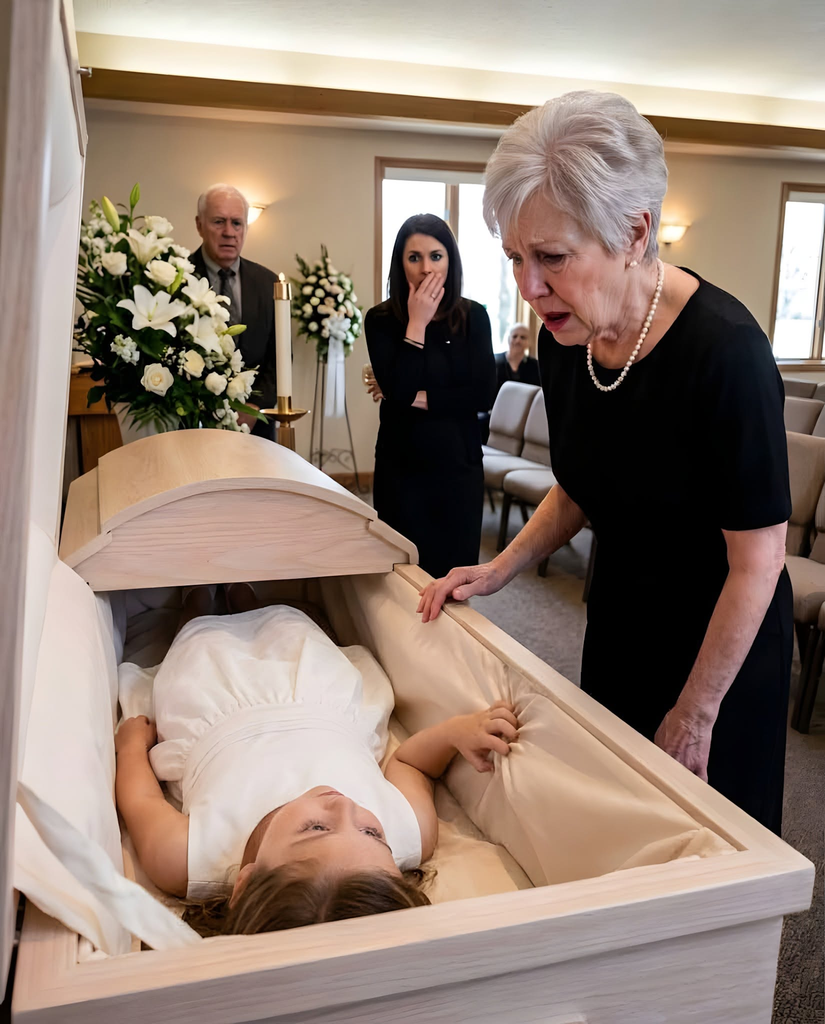
For a long time, I could not touch it without seeing the living room again—the white lilies, the casket, my hand against Chloe’s cheek, and the impossible movement of her eyelids.
Chloe saw me staring at it one afternoon.
She dragged the shawl down, wrapped it around her shoulders, and marched into the kitchen pretending it was a queen’s cape.
I almost told her to be careful with it.
Instead, I let her play.
That shawl no longer belonged to the worst night of her life.
Neither did the word “quiet.”
Neither did sleep.
Neither did a closed door.
Months passed before Chloe began sleeping through the night consistently.
The first morning she did, I woke before her and stood outside her room listening to nothing but the soft hum of the house.
Once, that kind of silence had terrified me.
Now I waited until I heard her roll over beneath the blankets.
Then the door moved.
Chloe opened it herself.
Her hair was tangled, one sock was missing, and she was holding Bunny by one ear.
“Pancakes?” she asked.
“Absolutely.”
She walked past me toward the kitchen without looking back.
I followed a few steps behind.
Not because she needed me to carry her anymore.
Because she finally knew she could walk through an open doorway and nobody would stop her.
She refused to answer. So I checked the security camera footage—and what I saw made my phone slip from my hands.
“Who is the man, Mom? Just tell me once and for all! Did you come to my house to help raise my daughter, or to hide a pregnancy?”
It still sickens me to remember those exact words coming out of my mouth.
My mother, Rosa, was fifty-three years old. She had been a widow for nearly a decade and, until six months prior, lived quietly in a small town in New Mexico. She moved to Phoenix because I practically begged her on my knees to help with Maya, my newborn daughter.
My husband, David, and I were drowning.
I was working as a senior project coordinator for a tech firm in Scottsdale. My maternity leave ended right as the most critical product launch of my career was kicking off. David was working long shifts at a logistics firm, and neither of us felt comfortable leaving a three-month-old infant with a complete stranger.
Mom didn’t hesitate for a second.
“Focus on your career, Laura,” she told me, cupping my cheek. “I’ll take care of my granddaughter.”
And she took care of far more than that.
When I came home late from the office, Maya was bathed and fed, the laundry was folded, a warm meal sat on the stove, and the house was spotless. I tried to compensate her by buying her designer clothes, expensive vitamins, luxury creams, and transferring money directly into her account.
She almost always protested. “Save it for the baby.”
I mistook her selflessness for simple maternal gratitude. I understand now that showering her with material things was much easier for me than actually sitting down and asking her how she felt.
By her fifth month living with us, I began noticing subtle changes.
Mom was eating less and less, yet her abdomen was visibly expanding. One afternoon, I even made a lighthearted joke about it. “At this rate, Mom, you’re going to go back home looking like a pampered, well-fed lady.”
She offered a weak, strained smile. “It’s just severe bloating, sweetie. And my lower back has been aching.”
I bought her heat patches, patted her on the shoulder, and went straight back to my laptop.
A few weeks later, her face looked dangerously thin, her arms appeared frail and hollow, but her stomach was noticeably round, firm, and protruding.
She looked pregnant.
I had given birth just months earlier. I recognized that distinct silhouette.
At first, the thought seemed absurd. Then, it began to curdle into suspicion. I offered to take her to a clinic, but she firmly declined. “Don’t waste money. It’ll pass.”
David suggested she was simply exhausted from keeping up with an infant, and I eagerly accepted that excuse—because it was comfortable. It allowed me to keep focusing on my career.
Until that Tuesday evening.
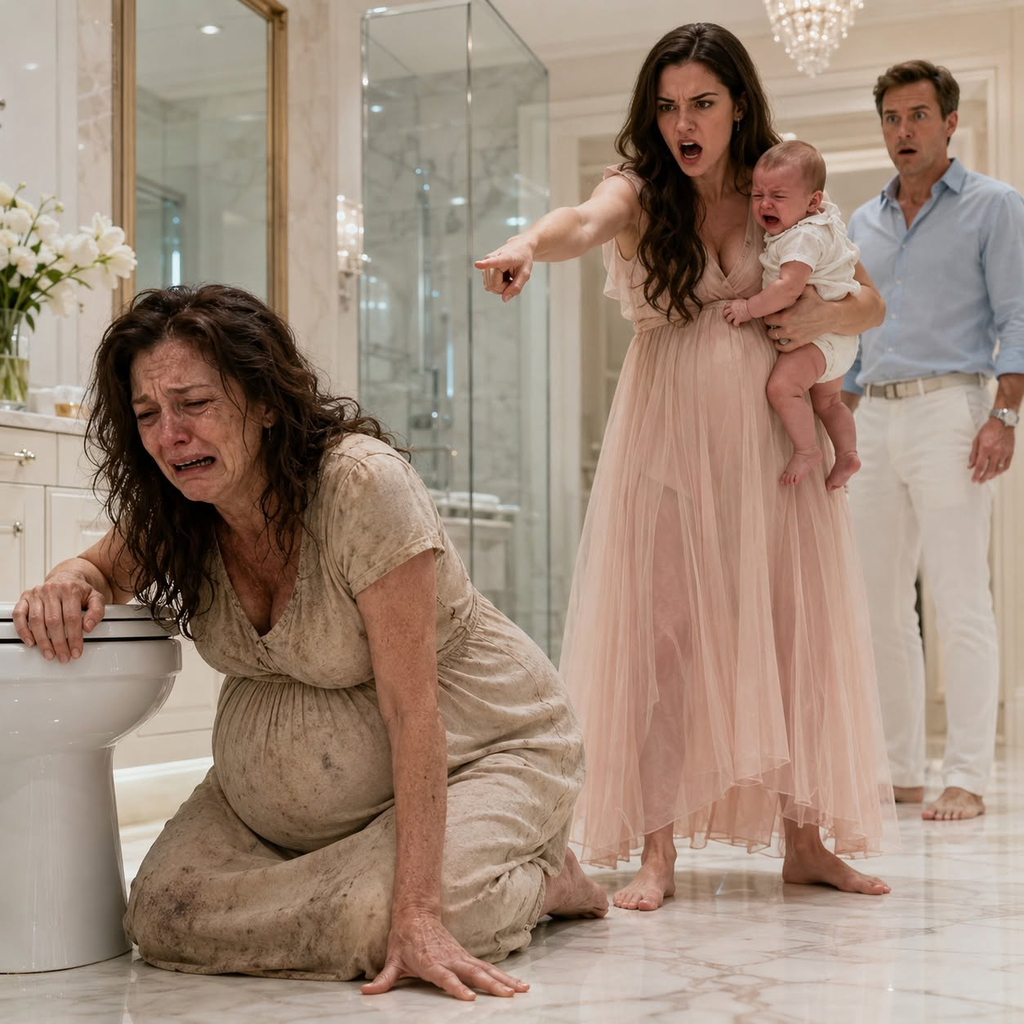
I came home early from work and found my mother bent double over the toilet, dry-heaving so violently her frame was shaking. David stood in the hallway, looking frantic.
“Laura, we need to take her to the emergency room right now,” David urged.
But when I looked at her, seeing her loose blouse stretched tight over her rounded belly, all the anxiety and suspicion I had buried over the past few weeks erupted into pure, ugly cruelty.
“Mom, what are you hiding from us?!” I demanded, my voice echoing off the bathroom tiles.
She lifted her pale, damp face. “What are you talking about, Laura?”
“That!” I pointed directly at her abdomen. “Who is the father?!”
David grabbed my arm, shocked. “Laura, stop it!”
I yanked my arm free. “She’s fifty-three years old, David! She’s been keeping secrets under our roof for months! Mom, if you’re pregnant, just say it! But don’t come into my house making us think you’re sick while you’re hiding an affair!”
Her face completely changed. She didn’t scream. She didn’t defend herself.
That was so much worse.
She looked at me as if the girl standing in front of her were a total stranger. Then, without a word, she wiped her mouth, leaned heavily against the wall for support, and walked slowly into her bedroom.
She didn’t eat dinner. She didn’t say another word to either of us.
Late that night, still convinced I was going to uncover proof of a secret relationship, I logged into the home security app on my laptop to review the living room and kitchen feeds.
I rewound through the past few days.
I watched my mother preparing baby bottles at four in the morning, her face contorted in silent agony. I saw her holding Maya with one arm while her other hand gripped her abdomen tight. I saw her dry-heave quietly into the kitchen sink when she thought the house was empty. I saw her lower herself to sit flat on the floor, catching her breath when the pain became unbearable.
Then, I opened the recording from earlier that afternoon.
Maya had choked slightly on a piece of soft fruit. Mom sprinted across the room, lifted the baby, and performed gentle back blows until Maya coughed, took a deep breath, and cried normally.
The moment the baby was safe, Mom collapsed backward against the kitchen wall. Her loose blouse hitched up above her waist.
And there, taped securely against her right flank, was a medical colostomy bag. Beneath it, a massive, jagged surgical scar spanned across her abdomen.
There was no pregnancy.
I turned the audio volume up to maximum.
My mother was sitting alone on the kitchen floor, breathing in short, ragged gasps. She pressed her hand over her abdomen and whispered to herself in the empty room:
“Just hold on a little longer, Rosa. Just until Laura finishes her big launch. You can’t cause problems for her right now.”
My knees gave out. I slid off the couch onto the floor, choking on my own breath.
I had accused my mother of hiding a secret lover—the very woman who was quietly dying inside my house just so she wouldn’t inconvenience my schedule.
And I had no idea that the darkest part of her secret was still waiting for me.
PART 2
I scrambled to my feet and ran to my mother’s bedroom door, pounding frantically against the wood.
“Mom! Please open the door!”
No answer.
“Mom, please!” I sobbed.
I turned around to see David standing at the end of the hallway, holding a sleeping Maya in his arms. There was an intense, guilty sadness in his eyes.
I stared at him, a sudden wave of realization hitting me. “You knew.”
David lowered his eyes, unable to meet my gaze. “Not everything, Laura.”
I felt a sickening wave of betrayal. “What did you know, David?!”
“A few weeks ago, I found blood-stained towels in the laundry bin,” David admitted softly. “Your mom caught me holding them. She begged me on her knees not to tell you.”
“And you listened to her?!”
“She told me she was already seeing an oncologist,” David stammered. “She said your major product launch was happening, that if you found out, you’d drop everything, ruin your career, and blame yourself. She swore she had it under control.”
Tears burned my eyes. “Did you see her in pain before tonight?”
David went silent.
“How many times, David?!”
“Several times,” he whispered.
I wanted to scream at him. I wanted to blame him entirely.
But then I remembered every single time over the past six months I had seen my mother wince while reaching for a dish. Every time she claimed she had already eaten dinner before we got home. Every single evening I walked through the front door and asked her:
“Did Maya take her full bottle?”
“Did you wash the crib sheets?”
“Can you stay up an hour later tomorrow so I can finish a presentation?”
Never once had I looked her in the eyes and asked: “Mom, are you okay?”
I turned the door handle. It wasn’t locked.
My mother was sitting on the edge of the bed, her small frame looking impossibly fragile in the dim light. I dropped to my knees in front of her, taking her cold hands in mine.
“I saw the security footage, Mom,” I wept.
She turned her head away.
“Mom… please look at me. What is happening to you?”
“It’s nothing I can’t manage, Laura,” she whispered softly.
“Don’t you dare say that to me again!” I sobbed, resting my forehead against her knees. “Please. Tell me.”
She let out a long, shuddering breath.
“Cancer,” she said softly.
A single word that instantly rendered my job, my promotion, my career, and my hideous accusations completely meaningless.
“Where?” I choked out.
“Stage IV colon cancer.”
“Since when?!”
She hesitated, staring down at her lap. “It was diagnosed almost a year ago.”
I went dead cold. A year ago.
“But… you moved in with us six months ago.”
Mom offered a small, heartbreakingly tender smile. “That’s why I came, Laura.”
“What do you mean?”
She looked over at the portable crib set up in the corner of her room. “When you called me crying six months ago, saying you couldn’t find child care and that your career was falling apart… I had already finished my first round of surgery. I had the colostomy fitted. The doctors in New Mexico told me I needed to start aggressive chemotherapy in the city.”
My breath hitched. “You left your treatment to raise my baby?”
“No, sweetie,” she said gently. “I realized I could get my treatment at the medical center in Phoenix while staying with you. But then I saw how stressed you were… how hard David was working… how tiny Maya was…”
“Mom!”
“I just wanted to watch her grow up a little bit, Laura,” she whispered, her own tears finally spilling over her lashes. “I wanted to be here for you.”
That was the moment I understood something far more terrifying than any medical diagnosis. My mother knew her time was short. And she had chosen to spend her remaining energy shielding me from the world.
“We’re going to the hospital right now,” I said, scrambling to my feet.
“Tomorrow, Laura. It’s late—”
“Now, Mom!”
“I don’t want to be a burden—”
I dropped back to my knees and grabbed her face with both hands, looking straight into her eyes. “Listen to me very carefully, Rosa Martinez. You are not a burden. You have never been a burden!”
A tear tracked through the lines around her eyes. “I just didn’t want to become a chore for you to manage.”
A fierce, protective rage surged through me—not toward her, but toward myself, toward my ambition, toward the culture that taught women that requiring care makes them a nuisance.
We called an ambulance.
In the emergency room, the triage nurses fired questions at me that I couldn’t answer.
When was her last blood panel?
What chemotherapy regimen was she currently on?
Who was her primary oncologist?
What was the date of her bowel resection?
To almost every question, I had to choke out: “I don’t know.”
Every “I don’t know” felt like a physical blow to my chest.
At three in the morning, the attending physician stepped out into the waiting room.
“Your mother has a severe partial bowel obstruction, a localized infection around her stoma site, and a massive accumulation of fluid in her abdominal cavity,” he explained quietly.
“Is that… is that why her stomach was swelling?” I asked, my voice barely audible.
The doctor nodded sympathetically. “It’s called ascites. It’s a common complication when GI cancers advance. We need to run full scans to see how far the disease has progressed.”
The word pregnancy flashed across my mind again, making me feel physically sick. It was never new life growing inside her. It was fluid caused by an aggressive disease I had actively chosen not to see.
At dawn, while Mom was being prepped for a procedure, I drove back to the house to gather her personal documents. She had told me her medical file was stored in a false bottom of her travel trunk.
I pulled out the folder. Inside were official pathology reports, surgical discharge papers, oncology referrals, and prescriptions.
Tucked beneath the medical files was a thick white envelope containing every single dollar I had transferred into her bank account over the past six months. She hadn’t spent a single penny.
Written on the front of the envelope in her neat cursive was:
“For Maya’s college fund.”
And beneath the envelope rested a folded sheet of notebook paper.
I recognized her handwriting immediately:
“If Laura ever finds these papers, please make sure she doesn’t blame herself. Coming to Phoenix was my choice. I wanted to see my daughter become a mother. I wanted to hold my granddaughter. Caring for Maya was never a chore; it was the greatest gift of my life.”
I collapsed onto the bedroom rug, clutching the paper against my chest, crying until I couldn’t breathe. My mother had hidden her terminal illness, saved my money for my daughter, and prepared my forgiveness in advance—all while I was accusing her of having an affair.
I turned the page over. Written on the back was a specific medical instruction that made my blood run cold.
A request that forced me to face a reality I wasn’t ready for.
PART 3
When I returned to the hospital room, the senior oncologist was standing by Mom’s bedside, holding her chart.
He turned to me with a grave expression. “Mrs. Sterling, we need to discuss your mother’s current status and our realistic treatment options.”
I pulled a chair right up to her bed and held her frail hand in both of mine.
“The scans show the cancer has metastasized extensively throughout her peritoneal lining,” the oncologist explained gently. “The bowel obstructions will continue to recur. We can attempt to stabilize the current infection and administer a mild palliative chemotherapy regimen, but we need to be very clear about our goals.”
I hated that word the moment it left his mouth.
Palliative. To me, it sounded like giving up.
“So you’re saying you won’t even try to cure her?!” I demanded, my voice rising.
The oncologist looked at me calmly. “At Stage IV, our goal must shift from curative to quality of life—managing her pain, preventing suffering, and giving her meaningful time with her family.”
“How much time?” I choked out.
Mom squeezed my hand softly. “Laura, don’t.”
“I need to know, Mom!”
“No doctor can give you an exact date, Mrs. Sterling,” the physician answered honestly. “It could be a matter of months.”
My mother took a slow, labored breath. “Then we do what is reasonable, Doctor.”
“No!” I interrupted, looking at her. “We do everything. We get second opinions. We look into clinical trials. We do everything possible!”
My mother turned her pale face toward me. “No, Laura.”
I blinked, stunned. “What do you mean, no?!”
“I am not going to let you force me through aggressive, painful experimental treatments just because you feel guilty,” she said, her voice quiet but firm.
The blunt truth of her words hit me like a physical slap.
“It’s not guilt, Mom!” I sobbed. “I want to save you!”
“I know you love me, Laura. But saving me doesn’t mean forcing me to spend my final months hooked up to machines in an ICU just so you can feel like you paid off a debt.”
I stood up, shaking my head violently. “Don’t talk about ‘final months’!”
“Someone in this room has to be realistic,” she replied softly.
The oncologist quietly excused himself, closing the door to give us privacy.
I wanted to cover my ears like a child. I wanted to shut out the reality. But my mother wouldn’t let me hide.
“Look at me, Laura,” she insisted, tugging gently on my hand until I met her eyes. “If the doctors say a mild treatment will give me a few good months without severe pain, I’ll take it. I want to see Maya take her first steps. I want to tease David about his terrible cooking. I want to sit on the porch with you. But if the day comes where treatment only prolongs my agony, I need you to promise me that you will let me go peacefully.”
Tears streamed uncontrollably down my face. “I can’t promise you that, Mom.”
“Yes, you can,” she said firmly.
“I don’t want to lose you!”
“I don’t want to leave you either, sweetie.”
It was the very first time I had ever heard my mother admit she was afraid.
My entire life, Rosa Martinez had been an immovable pillar of strength. When my father died a decade ago, she held our family together. When money was tight, she took on extra seamstress work late into the night. When I applied to college, she sold her mother’s heirloom gold earrings to cover my application and deposit fees.
She had never once said, “I can’t.”
And that had been our fatal mistake: we had all grown up believing she was invincible.
I sat on the edge of her mattress, burying my face in her shoulder. “Why didn’t you tell me from the very beginning, Mom? Why keep it all to yourself?”
Mom looked out the hospital window at the rising sun. “Because my whole life, I was the one who fixed things for everyone else. I was ashamed to let you see me weak… hooked up to a colostomy bag, vomiting, needing help just to bathe.”
“You’re my mother!” I cried.
“Exactly,” she whispered. “Mothers do foolish things to protect their children from seeing them break.”
“Well, your secret almost killed you!”
“No, Laura,” she corrected me softly. “The cancer is killing me. My silence just made it harder for you to walk beside me.”
She didn’t offer excuses. She didn’t let me wallow in self-pity, nor did she let me shoulder all the blame alone. That was who she was: even while facing death, she was still trying to guide me.
I called my VP at the tech firm that same morning.
My boss immediately started pressing me over the phone: “Laura, the product launch is entering its final sprint. Your presence is non-negotiable right now.”
For the first time in my life, I felt zero fear about disappointing my employer.
“My mother has Stage IV cancer,” I said, my voice deadpan and steady. “I’m not asking for your permission to take family medical leave. I’m informing you that I won’t be in the office.”
I hung up before he could respond.
For years, I had believed that being indispensable at work was the ultimate proof of success. That morning, I realized how tragic it was to be indispensable everywhere except in my own mother’s life.
Mom spent eleven days in the hospital while the medical team managed the infection and cleared the obstruction. When she was finally discharged, everything about our household routine changed.
We didn’t allow her to carry the burden alone anymore.
We hired a private home-health nurse for the daytime hours. We enrolled Maya in a local morning daycare program three days a week to give Mom quiet time to rest. David arranged to work remotely three days a week to help with meals and transportation.
And I restructured my life around a simple, non-negotiable truth: my mother needed to be cared for.
At first, she protested constantly.
“You’re spending too much money on nurses!”
“We can afford it, Mom.”
“Maya is too young for daycare!”
“She loves playing with the other toddlers, Mom.”
“Your job—”
“I have a mother,” I interrupted firmly.
The first time I said those four words, she stopped arguing entirely.
Caring for her didn’t erase the memory of what I had said in the bathroom, though. Guilt would wash over me at unexpected moments—whenever I found a fresh medical dressing in the bathroom trash, whenever I saw her fall asleep sitting upright from sheer exhaustion, or whenever I had to gently take a dish rag out of her hands when she tried to force herself to wipe down the counter.
The toxic words I had yelled at her constantly echoed in my mind:
“Who is he?!”
“How could you come into my house like this?!”
One sunny afternoon, Mom was sitting on our back patio, watching ten-month-old Maya crawl across a blanket on the grass.
I sat down beside her, setting a cup of warm tea in her lap. “Mom… we need to talk about that night.”
“We’ve already talked about it, Laura.”
“Not enough,” I insisted. “I need you to tell me the truth. When I accused you… how badly did it hurt you?”
Mom went quiet, staring out at the yard. This time, I didn’t let her protect me with a gentle lie.
“Yes,” she admitted softly. “It hurt.”
A heavy knot tightened in my throat. “A lot?”
“For a few seconds… it felt as if all the years I spent raising you vanished,” she whispered.
I bowed my head, tears dripping onto my knees. “I am so, so sorry, Mom. I was a monster.”
“You were scared, Laura,” she corrected me gently.
“That doesn’t justify how I treated you!”
“No,” she agreed softly. “It doesn’t.”
Her honesty hurt, but I needed to hear it. I didn’t want a fake, convenient absolution just to make myself feel better.
“Can you ever forgive me?” I asked.
Mom looked over at Maya, who was happily stacking soft foam blocks on the lawn.
“Forgiving doesn’t mean pretending it never happened, Laura,” Mom said. “But I refuse to spend whatever time I have left punishing you for a terrible moment.”
Whatever time I have left. I had finally learned not to ask her to stop using those words.
“Then let me care for you, Mom,” I whispered.
“You already are, sweetie.”
“Not to pay off a debt,” I added, looking her in the eyes. “Just as your daughter.”
A genuine smile illuminated her face. “That’s all I ever wanted.”
The next four months were painful, challenging, and difficult—but they were also the most profoundly meaningful months of my life.
There were endless doctor consultations, heavy medications, and harrowing nights where the pain flared. There were days Mom couldn’t swallow a single bite of solid food. But there were also glorious days where she asked for homemade chicken soup, cherry popsicles, or fresh peaches, eating with genuine enjoyment.
There were mornings where Maya would waddle into her bedroom, babbling loudly, and Mom would open her frail arms with a radiant smile: “Come here, my sweet girl!”
And there were deep, honest conversations we had never had in thirty years.
I discovered that before she met my father, my mother had dreamed of becoming an elementary school teacher. I learned that as a young woman in New Mexico, she used to sing in a local community choir. And I discovered that after my father passed away, a kind man named Thomas who ran a local fruit stand back home used to set aside the sweetest peaches for her every single week.
“Did you like him?” I teased one afternoon.
Mom let out a bright, embarrassed laugh. “Oh, mind your own business, Laura!”
“That means you did!” I grinned.
She looked out the window, her eyes softening. “He was a very good man.”
“Why didn’t anything ever happen between you two?”
“I was too busy surviving,” she answered quietly. “And then I just got used to being alone.”
Her words cut deep into my heart. For thirty years, I had thought of her exclusively as Mom—never as Rosa, a woman who had dreams, who enjoyed music, who experienced deep loneliness, and who deserved to be asked what she wanted out of life.
I began using my phone to record her telling stories for Maya to watch when she grew up—recipes, family memories, lullabies, and advice for future milestones.
In one video, Mom looked directly into the camera lens and smiled:
“Maya, my sweet girl, when you grow up, remember that your mother works very hard and sometimes thinks she has to be strong for the whole world. If you ever see her looking too stressed, make her sit down, hold her hand, and remind her to breathe.”
I sobbed quietly behind the camera. Mom cranked an eyebrow at me. “Don’t ruin my video with your sniffling, woman!”
We both ended up laughing through our tears.
By late autumn, her health began to deteriorate rapidly.
One evening, she called me into her room. Her voice was faint, barely above a whisper.
“Laura… I want to go back to New Mexico.”
“For a visit?” I asked, my heart sinking.
She shook her head slowly. I understood immediately.
“Mom…”
“I want to be in my own home, sweetie.”
My initial instinct was to refuse. The top specialists were here in Phoenix. The major hospitals were minutes away. I was terrified of what would happen if an emergency occurred on a quiet rural road in New Mexico.
But then I remembered the instruction she had written on the back of that medical document months ago:
“If the day comes where medicine can do no more, I want to go home. I don’t want Laura to confuse keeping me alive with saving me.”
My mother knew me better than I knew myself. She knew I would try to turn my guilt into a desperate, agonizing war against the inevitable.
I looked down at her frail, peaceful face and took a breath. “I’ll arrange everything, Mom.”
We traveled four days later with the full support of her hospice care team. David drove us in our SUV while Mom, Maya, and I sat together in the back.
When we pulled up to her small, adobe-style home in New Mexico, the local neighbors were already waiting on the porch with warm meals, fresh flowers, and home-baked bread. The house smelled exactly as I remembered from my childhood—pinon wood, lavender soap, and fresh coffee.
The following afternoon, a soft knock sounded at the front door.
An elderly man wearing a silver bolo tie and a wide-brimmed hat stood on the porch, holding a brown paper bag.
“Rosa?” he called out gently.
Mom lifted her head from her pillows, a brilliant smile breaking across her face—a smile I hadn’t seen in months. “Thomas.”
He set the bag on her nightstand. “Brought you some fresh peaches. Had to drive two towns over to find them this late in the season.”
Mom chuckled softly. “You always were a terrible businessman, Thomas.”
Thomas sat quietly beside her bed for nearly an hour. They didn’t speak much; they just held hands and enjoyed the quiet afternoon breeze coming through the window.
When he stepped out onto the porch later, I followed him. “Did you know she was sick before she moved to Phoenix?”
He nodded slowly. “She told me last year before she left.”
A sudden sting of jealousy hit me—another stranger knew what I had been blind to. But I kept my temper in check.
“Why didn’t you reach out to me?” I asked softly.
“Because Rosa made me promise not to,” Thomas replied gently. He looked out over the desert landscape. “Your mother talked about you constantly, Laura.”
“What did she say?”
Thomas smiled. “She talked about you as if you had invented the stars.”
I had to turn away to hide my tears.
Mom passed away nine days later, just as the sun was rising over the red rocks.
It was peaceful. Maya was sleeping in the adjacent room, David was quietly making coffee in the kitchen, and I was sitting right beside her bed, holding her hand.
Mom opened her eyes one last time, locking her gaze onto mine. “Laura.”
“I’m right here, Mom.”
“Promise me… don’t carry too much weight on your shoulders.”
“I promise, Mom,” I wept.
“And when Maya tells you she’s hurting… listen to her before you try to fix everything.”
“I will.”
A faint, beautiful smile touched her lips. “You were a wonderful daughter, Laura.”
“Not always,” I sobbed, shaking my head.
Her frail hand squeezed mine with surprising strength. “Daughters don’t have to be perfect, sweetie. They just have to know how to come home.”
Those were her final clear words. Minutes later, her breathing slowed, then stopped entirely.
I didn’t scream. I didn’t break down in panic. I simply leaned forward, pressed my forehead against her warm hand, and whispered: “Thank you for waiting for me, Mom.”
EPILOGUE
After the funeral service, I found a small wooden box tucked beneath her bed back in New Mexico. Inside were sealed letters—one for David, one for Maya to open on her eighteenth birthday, and one for me.
I opened mine sitting on the front porch where Mom used to read.
“Dearest Laura,
If you are reading this, I have finally moved on to join your father. You are allowed to cry, my sweet girl, but promise me you will remember to eat a good meal today.
I need you to promise me that you will never let that terrible afternoon in the bathroom define our entire story. Yes, it hurt me in the moment. But our story is so much bigger than a few harsh words spoken in fear.
Our story is you coming home from elementary school with scraped knees, demanding a hug.
Our story is you studying late into the night at the kitchen table until you fell asleep on your textbooks.
Our story is watching you walk down the aisle in your wedding dress.
Our story is watching you hold Maya for the very first time and asking me if you were going to be a good mother.
I don’t want you to spend the rest of your life punishing yourself. I want you to learn.
The people you love need you to really look at them—not just when they are useful, not just when they are cooking meals, taking care of children, or appearing strong. Look at them when they go quiet. Ask them questions when they change. Listen to them when they tell you they are tired.
And please, never teach Maya that love means enduring pain until you break. Teach her that it is okay to say: ‘I’m hurting,’ ‘I’m afraid,’ or ‘I need help.’
And make sure that whenever she says those words, you stop everything and reply: ‘I’m right here.’
Not when your work project is finished.
Not when it’s convenient.
Right now.
All my love,
Mom.”
I wept for a long time on that porch, feeling a profound, transformative peace wash over my soul.
When we returned to Phoenix, I officially declined the corporate executive promotion I had spent two years chasing.
My VP called me into his office, utterly bewildered. “Laura, opportunities like this don’t come around twice in a career.”
I thought of my mother whispering to herself on a security camera that she had to hold out until my project launch was over.
“My life doesn’t come around twice either,” I told him, and handed in my three weeks’ notice.
I transitioned into a remote consulting role that allowed me to work flexible hours, giving me the time and space to actually be present for my family. David and I entered marriage counseling to heal the communication barriers that had allowed secrets to fester in our home.
And together, we established a non-negotiable rule in our house: No one ever has to pretend they are fine just to make things easier for everyone else.
A year after Mom’s passing, we drove back to New Mexico to visit her grave.
Thomas was still working at his fruit stand near the town plaza. When he saw three-year-old Maya running toward him, he reached into his wooden crate and handed her a large, ripe peach.
Maya took it with both hands and offered a big, bright smile. “Thank you, Grandpa Thomas!”
Thomas froze for a second, his eyes brimming with tears. He tipped his silver hat down to hide his face, clearing his throat quietly. I didn’t correct Maya.
We walked up the hill to the cemetery. Maya set a colorful drawing she had made on her grandmother’s headstone—a picture of four people holding hands beneath a bright yellow sun.
“This is Grandma Rosa,” Maya said proudly, pointing to the largest figure.
I sat down on the grass beside the headstone, feeling the warm desert breeze brush against my face.
“I’m still learning, Mom,” I whispered to the quiet wind.
For months, I had hated that home security recording. I had viewed it as the ultimate evidence of my self-absorbed cruelty. But over time, I realized it had been my mother’s final, miraculous gift to me.
That camera had forced me to open my eyes. It had forced me to stop running, stop prioritizing status, and start seeing the human beings right in front of me.
I picked up Maya, holding her tight against my chest, and took David’s hand in mine.
I knew I wouldn’t magically become a perfect mother. I still get tired. I still get overwhelmed. There are still busy days, endless chores, and moments where life feels chaotic.
But now, whenever my daughter calls my name while I’m staring at a screen, I shut the laptop lid immediately. I look up. And I really see her.
Because I finally understand that a family doesn’t fall apart all at once. First, we stop asking how people are. Then, we stop listening. And eventually, we start treating the people we love like background scenery in our own busy lives—the mother who cooks, the husband who fixes things, the grandmother who babysits, the daughter who never causes trouble.
Strong people. Useful people. People who can supposedly “handle everything.”
Until the day you wake up and realize they were never handling everything at all. They were just suffering in silence, waiting for someone to finally notice.
My mother came to my house to help me raise my baby. Six months later, I saw her abdomen swelling and assumed the worst of her. I thought she was hiding a shameful secret. In reality, she was hiding immense pain.
And the most devastating part of all was that even while facing death, her greatest fear wasn’t dying—it was inconveniencing me.
That is why there is one phrase I have erased from my family’s vocabulary forever:
“I can handle it on my own.”
No.
The people who love you are allowed to be tired. They are allowed to be sick. They are allowed to ask for help. And they deserve to be cared for with the exact same devotion they give to the world.
Sometimes a mother won’t ask for help twice. Sometimes she won’t even ask once. Sometimes she will simply lean against a wall, clench her teeth, and wait in silence for one of her children to stop looking at everything else—and finally look at her.
My father stood in my kitchen asking to borrow $1,000, his hands trembling with shame. Before he could explain why, my wife looked at him and said,
“Tell him to get a job. We aren’t a bank.” I gave him the money anyway. Three days later, a hospital called to say he was in emergency surgery—and that before going under, he had left me a sealed envelope with one warning: “Do not let your wife see this.”
Maya Sharma was waiting outside the surgical ward. She introduced herself as the attorney overseeing the estate of Eleanor Vance, a wealthy Oregon property owner who had passed away eight months earlier.
“What does her estate have to do with my father?” I asked.
“Your father believed it had something to do with you.”
She handed me a thick envelope. Inside was an old photograph. Arthur looked barely twenty-five. He was wearing a construction jacket and kneeling near a hospital service entrance with a baby wrapped in a faded blue blanket pressed against his chest.
On the back, he had written: The morning I found my son.
My hands began to shake. Under the photograph was a letter.
Son,
I should have told you this years ago. I am not the man who gave you his blood.
Thirty-two years ago, I finished an overnight repair job near Oakridge Women’s Clinic. As I passed the service entrance, I heard a baby crying. You were inside a canvas laundry bag beside a dumpster.
I carried you to the emergency department across the street and called the police. I gave statements, cooperated with Child Services, and followed every rule they gave me. No one claimed you. I visited you while you were in temporary care. After months of home inspections, background checks, hearings, and paperwork, I was allowed to adopt you.
I did not steal you. I found you after someone else left you behind.
I planned to tell you when you turned eighteen, but I lost my nerve. Every year I waited made the truth harder to speak.
Two years ago, I finally decided to tell you. Before I could, Jessica came to my apartment. She said she knew you had been adopted. She threatened to tell you I had hidden you from your biological family and to make sure her lawyers told the story first. I had proof that I adopted you legally. I was not afraid of prison. I was afraid you would hear the ugliest version of the truth before you heard mine.
Last month, Ms. Sharma contacted me. She said Eleanor Vance had spent years searching for a son who disappeared after birth. The thousand dollars paid for certified adoption records, a legal consultation, and a DNA test proving that I am not biologically related to you.
That test cannot prove Eleanor was your mother. Only you can choose to take the official test. Whatever you decide, I am sorry I waited. You have always been my son.
Dad
I read the letter twice. Then I looked at Maya. “Who was Eleanor Vance?”
“She may have been your biological mother.”
“May have been?”
“Your father’s certified adoption records establish that you were the infant found outside Oakridge Clinic on the same morning Eleanor’s baby disappeared. The birth date, time, blood type, blanket description, and location all match.”
“Why was her baby missing?”
“Eleanor was nineteen and unmarried when she gave birth. She was heavily sedated after a difficult delivery. Her father told her the child had not survived.”
“And she believed him?”
“For years. Then a former clinic employee anonymously contacted her and claimed several babies had disappeared through irregular private transfers.”
“Several?”
“Eleanor’s investigator found eleven suspicious files, but most of the records were incomplete. Your case was the only one connected to an infant found alive near the clinic.”
“Is Eleanor alive?”
Maya lowered her eyes. “No. She passed away before she could confirm your identity.”
The grief that struck me made no sense, yet it was real. I had never heard Eleanor’s voice. I did not know her face. But learning that she had spent years searching for me felt like losing a mother I had never been allowed to meet.
“She left a trust for her missing son,” Maya continued. “It controls several commercial buildings and investments worth millions. Her half-brother, Richard Vance, has managed those assets for years and collected substantial management fees. If Eleanor’s son is found, Richard loses control of the trust.”
“Does he know about me?”
“We believe he suspected before we did.”
Maya showed me copies of letters sent to my house during the previous two years. Jessica had signed for each one.
“I never saw these.”
“The delivery records prove she received them,” Maya said. “Since you say they were never given to you, we have reason to believe she intercepted them.”
The Discovery
That was all Maya would tell me until my identity was confirmed. The first revelation was already enough. Arthur was not my biological father. Eleanor Vance might have been my mother. And Jessica had known someone was searching for me.
I agreed to take a supervised DNA test. A laboratory technician collected the sample at the hospital under a documented chain of custody.
Less than an hour later, the surgeon emerged. Arthur had survived.
That was when I finally cried. Not for the inheritance or the secrets. I cried because I still had my father.
When I was allowed into his room, he looked pale and fragile beneath the blankets. His eyes opened when I took his hand.
“Ethan.” “I read your letter.”
He closed his eyes. “I’m sorry.” “You should have told me.” “I know.” “But you saved me. You adopted me legally. You did not keep me from Eleanor because you didn’t know who she was.” “What if the test proves she was your mother?” “Then I’ll know where I began.”
His fingers loosened around mine. “And me?” “You’re the man who stayed.”
Tears filled his eyes.
“The test might say you didn’t make me,” I said. “It cannot say you didn’t raise me.”
He squeezed my hand weakly. Then his expression changed. “Jessica’s mother worked at the clinic.”
“Brenda?”
Arthur nodded. “She knew my name because the police questioned clinic employees after I found you. The official records were later sealed, but she had already seen the internal report.”
“How does Jessica fit into this?”
“Brenda tracked you years later. She arranged for Jessica to meet you.”
I thought about the charity fundraiser where Jessica and I had first spoken. She had claimed she attended by chance after seeing an advertisement.
Arthur closed his eyes. “I’m sorry, son.”
This time, he was not apologizing for the adoption.
Five days later, the DNA results confirmed that Eleanor Vance was my biological mother. Only then did Maya reveal the rest.
Richard Vance’s attorney, Marcus Thorne, had obtained an old copy of the police inquiry through a former clinic administrator. It contained Arthur’s name. Brenda confirmed that I was the abandoned infant and gave them enough information to locate me.
Years earlier, Brenda had encouraged Jessica to volunteer for the same charity where I worked. She had shown her my photograph and told her I might one day inherit Eleanor’s fortune. Jessica’s approach had not been accidental.
After Eleanor’s estate began sending letters, Marcus paid Jessica $75,000 through a consulting account. In return, she signed a document in my name renouncing any future claim to the Vance trust.
My signature had been forged.
I felt physically ill. Jessica arrived at the hospital that afternoon with Brenda beside her. Neither asked how Arthur was doing. Jessica went straight to me.
“We need to talk privately.” “No. We’ll talk here.”
Her gaze moved to Maya.
“You intercepted letters about Eleanor Vance,” I said. “Did you sign my name to a waiver?”
Jessica went pale. “I was protecting our life.” “From what?” “From people who abandoned you and suddenly wanted to control you.” “My mother searched for me for years.” “That’s what their attorney says.” “The DNA confirmed she was my mother.”
Jessica’s face collapsed. Brenda gripped the cross around her neck. I looked at my wife.
“Did your mother arrange for us to meet?” “It wasn’t that simple.” “Yes or no?”
Her silence answered me.
“At first, I only agreed to meet you,” she said. “I didn’t know whether any of it was true.” “But you learned the truth.” “Years later.” “And you still took Richard’s money.”
Tears filled her eyes. “I did love you.” “Maybe you eventually did. But every time you had the chance to choose me over the lie, you chose the lie.”
Brenda stepped forward. “You already had a good life. Eleanor’s family would have torn everything apart.” “You helped tear me away from her.” “I processed paperwork. I did not abandon you.”
Brenda’s confidence disappeared. “That was decades ago.” “You also contacted Richard’s attorney recently, destroyed correspondence, and instructed Jessica to erase files. Those actions are not decades old.”
Brenda stopped speaking.
I told Jessica to stay with her mother while my attorney sought a temporary order granting me exclusive use of the house. Her lawyer later arranged supervised access so she could collect clothing and personal belongings. I did not search her things myself.
Maya gave the forged waiver, payment records, and delivery receipts to investigators. Detectives subpoenaed Jessica’s bank records and obtained confirmation of the payment from Marcus Thorne’s office.
Only after establishing that evidence related to the fraud was probably inside my house did they obtain a search warrant. They found copies of Eleanor’s letters, messages between Jessica and Brenda, and a forged power of attorney that would have given Jessica control over my finances if I became incapacitated.
They also found a deed adding her name to my house and a loan application using the property as security. Both contained forged signatures and false notary information. The loan had been rejected during verification.
While Jessica called my father a burden, she had tried to borrow against the home he helped me buy.
Investigators questioned Brenda separately. At first, she claimed she had merely followed instructions from the clinic administrator. She said Eleanor’s father had arranged a private adoption to avoid scandal and that a driver was supposed to collect the baby outside.
The driver never arrived. Rather than return me to the clinic and expose the plan, someone left me beside the dumpster.
Brenda denied being the person who abandoned me, but admitted carrying me through the service entrance. She also admitted recognizing Arthur’s name when police questioned clinic staff. Years later, when Eleanor renewed her search, Richard used Brenda to locate me. Brenda then sent Jessica into my life.
The older crimes were difficult to prosecute because witnesses had passed away and records had been destroyed. But Brenda’s recent lies, destruction of correspondence, attempts to erase electronic evidence, and role in the estate fraud were easier to prove.
The clinic ledger also confirmed Eleanor’s suspicions. My case was not the only irregular one. Eleven infant files contained altered discharge papers, missing parental signatures, or unexplained transfers. The investigation expanded, but my story remained painfully simple.
Eleanor had been told I was gone. Arthur had found me alive. Richard had profited from my absence. Brenda had helped preserve the secret. And Jessica had married me because she believed I might someday become valuable.
Jessica later insisted that her feelings had become genuine. Perhaps they had. But love did not erase the fact that she had forged my signature, sold my silence, and humiliated the man who raised me.
Richard and Marcus faced charges connected to fraud, conspiracy, and obstruction. Jessica pleaded guilty to forgery and financial fraud after the bank records and electronic messages made denial impossible.
Our divorce was finalized within a year. She demanded part of the house, claiming she had furnished it and contributed to our marriage. My attorney presented the deed, our separate-property agreement, my mortgage records, Arthur’s contribution to the down payment, and Jessica’s forged ownership documents.
She left without the house.
During one hearing, an attorney questioned Arthur about his relationship to me. He arrived in a wheelchair, still recovering from surgery, wearing his best brown jacket.
“You are not Ethan’s biological father, correct?” the attorney asked.
Arthur did not hesitate. “The test says I didn’t make him,” he replied. “It doesn’t say I didn’t raise him.”
No one challenged him again.
Eleanor’s sister later invited me to the Vance estate. She gave me boxes filled with Eleanor’s letters, photographs, and investigation files. In one letter addressed to the son she could not find, Eleanor had written:
I don’t know whether you are alive or whether you would forgive me. I only hope someone held you when I could not.
Someone had. A tired construction worker had heard me crying after an overnight shift and refused to walk away.
I accepted Eleanor’s inheritance, but I sold most of the commercial properties. Part of the money funded an organization that helped families investigate suspicious adoption records and reopen sealed archives. I named it The Eleanor and Arthur Project.
My father objected. “Use your mother’s name,” he said. “She searched for you.” “And you found me.” “I only did what anyone would have done.” “But no one else did.”
I bought him a small house near mine and created a fund for his medical care. He complained until I called it thirty-two years of unpaid parental leave.
Months after the divorce, Jessica sent me a message from an unknown number.
All of this over a thousand dollars.
I forwarded it to my attorney, then replied:
No. All of this happened because you humiliated the only man who never abandoned me.
I blocked the number.
On the anniversary of the day Arthur found me, I took him to dinner. He complained about the prices, the tiny portions, and the unnecessary number of forks. Afterward, I handed him a wooden box containing his letter, the receipt for the records he had purchased, and the photograph of the blue blanket.
He stared at it for a long time.
“That thousand dollars caused a lot of trouble,” he said. “No. It uncovered trouble that was already there.”
He looked down at the photograph. “You have two families now.” “I have two histories.”
He nodded slowly.
“Eleanor gave me my beginning,” I said. “You gave me everything that came after.”
His eyes filled with tears.
My biological mother had spent her life searching for me. My father had spent his life staying. One gave me my beginning. The other gave me everything that came after.
“Don’t think being my wife gives you the right to speak! You should go back and apologize to her.” I once believed I still had a family worth protecting. That night, I realized I was simply the only person expected to stay silent. At 3 a.m., I left the hospital, returned to our apartment, and packed exactly one suitcase. On the dining table, I placed the spare key and a thick envelope. No explanation. No tears. Just three words across the front: “YOU CHOSE WRONG.”
PART 1
The first time my mother-in-law laid hands on me, she smiled before the physical pain even landed. By the time she drove me to the hospital, acting like she was doing me a grand favor, I could barely stand.
Her name was Wendy Sterling, and for three years, she had treated my marriage like a hostile corporate takeover. That night, she showed up at our apartment without warning, furious that I had changed the password to our joint savings account.
“It’s family money!” she snapped, her eyes narrowing in the hallway.
“It’s my hard-earned salary,” I replied calmly, standing my ground.
Her face twisted in sudden, ugly rage. What followed was a ruthless altercation that backed me against the marble kitchen counter, leaving me battered, bruised, and breathless. Finally, she tossed my car keys onto the island. “Look what you made me do.”
At the hospital’s intake desk, she hovered menacingly over my shoulder, coldly hijacking the conversation when the triage nurse asked what happened.
“She’s quite clumsy,” Wendy said, glancing at me with a sickeningly sweet expression. “She fell down the stairs. Bruises easily, too.”
I looked straight into the nurse’s eyes, balling my hands into fists to hide the trembling, and asked clearly, “Can I speak to you alone?”
Wendy’s smug smile vanished instantly.
Later that night, while I sat in a private room with an ER social worker having my injuries photographed for evidence, my husband, Luca—who was away on a weekend fishing trip with his friends—finally texted.
“Mom said you two had a fight. Don’t make this a big deal. Go back and apologize.”
I stared at the phone screen, reading his heartless words twice. Another message popped up.
“She only gets like that when people disrespect her.”
I typed a single sentence back: “Fine. I’ll handle it my way.”
He casually replied with a thumbs-up emoji. That was the exact moment I stopped being his wife.
What Luca and his mother never understood was that before marrying him, I spent nine years working as a senior corporate forensic accountant. I knew every tax filing, vendor ledger, and hidden cash flow of their family business. Six months ago, I had uncovered a massive secret: Wendy had been systematically siphoning company money through fake vendor invoices. The worst part? Luca was covering it up.
At 3:00 a.m., I quietly left the hospital, returned to our apartment, and packed exactly one suitcase, my laptop, and all my classified audit documents. Nothing sentimental.
By sunrise, I was a ghost. On the empty dining table, I left the spare key and a thick envelope. Across the front, I wrote three words: “YOU CHOSE WRONG.”
When Luca returns home and opens that envelope, what’s waiting inside isn’t just standard divorce papers…
PART 2
Luca called twenty-three times before noon.
I didn’t answer a single call.
I was already checked into a downtown hotel suite under my maiden name, pressing an ice pack against my cracked ribs, my laptop open on the desk as I transmitted encrypted PDF files to three people: my senior divorce attorney, the detective assigned to my domestic assault report, and the regional bank’s corporate fraud unit.
Inside the thick envelope resting on our empty dining table, Luca had found high-resolution copies of Wendy’s fraudulent invoices, wire transfers totaling $186,400, text thread screenshots showing him approving the unauthorized payments, and one highlighted page from the family company’s operating agreement.
He called again. This time, I hit the green button.
“What the hell did you do, Jessi?!” he shouted into the receiver, his voice tight with panic.
“Nothing yet,” I replied, my voice completely flat.
“My mom made a mistake!”
“She committed felony assault, Luca.”
“You’re trying to destroy my family!”
“No, Luca. I’m simply documenting what your family did to itself.”
His tone shifted instantly, dropping into a desperate, pleading whisper. “Please… come home. We’ll sit down and talk. We can fix this.”
I almost let out a laugh.
“I was home, Luca,” I said softly into the microphone. “When your mother beat me.”
PART 3
Silence fell over the line. I didn’t wait for his excuses; I hung up and muted my phone.
By 2:00 p.m., the legal dominoes began to fall.
My attorney filed an emergency petition for a temporary restraining order alongside a high-conflict divorce petition citing physical cruelty, financial coercion, and breach of fiduciary duty. Because the apartment was held in my name prior to our marriage, the judge granted an emergency motion for exclusive possession of the residence.
Meanwhile, Detective Miller took my formal statement at the precinct. When he reviewed the ER intake records, the social worker’s photographs of my injuries, and the audio recording I had secretly captured on my phone while Wendy was hovering over me in the kitchen, his jaw set tight.
“This is an airtight felony domestic assault case, Mrs. Sterling,” Detective Miller stated. “We’re serving the warrant today.”
At 5:30 p.m., two uniformed officers executed the arrest warrant at the Sterling family estate. Wendy was taken into custody right in front of her country club friends, led away in handcuffs while yelling about her social standing.
Simultaneously, the bank’s fraud division froze the company’s operating accounts, flagging the $186,400 in diverted funds.
Luca drove to my hotel that evening, frantic and disheveled, but he couldn’t get past the building’s private security detail. When he attempted to enter the apartment to retrieve his belongings, he was met by sheriff’s deputies enforcing the emergency protective order.
Over the next four months, the legal and financial fallout wiped out everything Luca and Wendy had spent years trying to maintain.
Facing indisputable forensic ledgers, digital wire transfers, and text threads detailing his cover-up, Luca agreed to a corporate settlement. He surrendered his entire share in our joint liquid assets, agreed to pay full financial restitution for the diverted funds, and signed off on a clean, uncontested divorce.
Wendy’s legal team attempted to argue that the physical altercation was a “mutual domestic dispute.” But when Detective Miller presented the ER photographs, my forensic medical reports, and the kitchen audio recording where Wendy explicitly sneered, “Look what you made me do,” her defense completely collapsed.
Facing a jury trial and potential state prison time, Wendy accepted a plea deal. She received two years of supervised probation, two hundred hours of mandatory community service, a permanent criminal record for assault, and was ordered to pay all of my medical expenses.
The family business, stripped of its reputation and burdened by bank audits, was forced to liquidate its primary assets to cover restitution and legal fees.
EPILOGUE
Two years after the midnight rain washed over the quiet parking lot of the hospital, the autumn sun streamed brightly through the floor-to-ceiling windows of my firm’s new high-rise office in downtown Chicago. The brass plaque beside the double glass doors bore a single, proud title: Sterling Forensic Auditing & Financial Investigation.
I sat behind a wide walnut desk, a steaming cup of dark roast coffee resting beside a stack of quarterly reports. The room smelled of fresh paper, roasted coffee beans, and a quiet, unshakeable peace.
After leaving the hospital at 3:00 a.m. with one suitcase and a bruised ribcage, I hadn’t just walked away from a toxic marriage; I had reclaimed the professional identity I had quietly suppressed for three years. In the months following the divorce and the corporate scandal that dismantled the Sterling family business, I threw myself entirely into building my own independent practice. I specialized in high-stakes corporate fraud, forensic asset tracing, and high-conflict matrimonial financial audits—helping women who, like me, had been lied to, financially exploited, or kept in the dark by powerful men who believed they were untouchable.
A soft chime sounded on my desk console. My executive assistant, Maya, stepped into the office holding a leather-bound courier envelope.
“The final administrative closing documents just arrived from Detective Miller’s office and your attorney,” Maya said, offering a warm, supportive smile. “The court-ordered restitution checks have cleared, and the Sterling estate liquidation is officially closed.”
“Thank you, Maya,” I said, taking the envelope. “Take the rest of the afternoon off. You’ve worked incredibly hard this week.”
Once she closed the door behind her, I untied the string on the envelope and pulled out the legal summary.
The fall of Luca and Wendy Sterling had not been sudden or cinematic; it had been a slow, systematic dismantling carried out by the precise machinery of the justice system and federal banking regulators.
Wendy’s conviction for felony assault had effectively destroyed her high-society status. The country club revoked her membership within forty-eight hours of her mugshot appearing in the local paper. The charity boards she had dominated for a decade scrubbed her name from their websites. Facing two years of supervised probation, two hundred hours of court-ordered community service at a local food bank, and a permanent criminal record, she was forced to move out of the grand family estate. Unable to afford the property taxes or the massive legal bills accumulated during her defense, she now lived in a small, single-story rental home on the outskirts of the county, isolated from the social circle that had once been her entire world.
Luca’s downfall had been equally absolute. His attempt to cover up his mother’s embezzlement meant that the regional bank revoked his corporate line of credit and demanded immediate repayment of the $186,400 in diverted funds. To satisfy the bank’s fraud judgments and my court-ordered divorce settlement, Luca was forced to liquidate the family business at a steep discount. Without my forensic management, the company’s remaining client portfolio dissolved within months.
Today, Luca worked as a low-level data clerk for a mid-tier logistics firm in Indiana. He lived in a modest one-bedroom apartment, stripped of the luxury vehicles, private golf club passes, and unearned arrogance that had defined his thirties.
I looked at a brief administrative note attached to the back of the file from my divorce attorney:
“Note: Mr. Sterling’s attorney reached out yesterday asking if you would be open to a brief coffee meeting for ‘closure.’ I informed him that all communication remains strictly barred under the permanent protective order.”
I let out a soft, slow breath, setting the paper down.
Closure. Luca still didn’t understand. He thought closure was a conversation, an explanation, or an apology offered over coffee. He didn’t realize that closure had occurred at 3:00 a.m. in an empty hospital hallway when I packed my laptop, left the spare key on the dining table, and walked out into the night. Closure wasn’t something he gave me; it was something I had claimed for myself the moment I stopped allowing him to define my worth.
I closed the file, slid it into the metal filing cabinet behind my desk, and turned the key in the lock.
Standing up, I walked over to the floor-to-ceiling window, looking out over the Chicago skyline. The city stretched out below, bathed in the rich, golden light of the late afternoon sun.
My physical recovery had taken months. The cracked ribs healed slowly, and for a long time, a sudden loud sound or an unexpected knock at a door would send a phantom spike of anxiety through my chest. But with time, therapy, and the steady support of real friends, those physical and emotional scars lost their sharp edges. They were no longer open wounds; they were simple proof of survival.
My phone chimed on the desk. A text message popped up from Sarah, a former client whose ex-husband had tried to hide millions in offshore accounts during their divorce—a case my firm had successfully solved three months prior.
“Jessi! Just wanted to send a quick note. The girls and I just moved into our new house. Thank you for giving us our life back. We’re finally safe.”
A genuine, radiant smile spread across my face as I typed a reply: “You gave yourself your life back, Sarah. I just did the math. Enjoy your new home.”
I picked up my coat, switched off the office lights, and stepped out into the hallway.
When Luca and Wendy had backed me against that marble kitchen counter, they truly believed that physical intimidation and emotional coldness would force me into silence. They had assumed that being a wife meant enduring cruelty quietly, keeping up appearances, and accepting secondary status in my own home.
They had forgotten the most important rule of my profession: an auditor never ignores a discrepancy. She documents it, traces the truth behind it, and presents the final balance sheet for the world to see.
I stepped out of the high-rise lobby into the crisp evening air. The wind was cool, blowing fresh from the lake, carrying the vibrant energy of the city. I buttoned my coat, took a deep, clear breath of the autumn air, and walked down the sidewalk toward my car—completely free, entirely whole, and unconditionally the sole author of my own life.
I hadn’t contacted my old team in 19 years. Until that night, when a voice answered: “Commander… are we coming back?”
PART 1
The emergency room lights buzzed harshly overhead. The doctor placed the X-ray on the monitor and slowly pointed to each fracture with his pen. “Commander Sterling, this wasn’t done to scare her. Whoever did this wanted to DESTROY her.”
I stared at the image on the screen. My daughter’s face looked like a map of broken lines. Chloe was lying behind the curtain. Her jaw had been wired shut. Bruises surrounded both of her eyes, and dried blood was still tangled in her hair.
I reached for her hand. “Daddy’s here.”
Her fingers tightened around mine. Weakly. But enough for me to feel it. That nearly broke me.
To everyone else, I was Alexander Sterling. A widower. A security consultant. A father who carried scars but never explained where they came from. Chloe knew I had served in the military, but she never knew what I had actually been.
I was Commander Alexander Vance, leader of Task Force Vanguard. The PHANTOM COMMANDER. No photographs. No medals. No official records anyone could verify. When Chloe was born, I buried that identity. I became nothing more than a father. For nineteen years, that had been enough.
Then the hospital called at 11:47 p.m.
Campus security claimed the cameras had malfunctioned. The emergency phones were down. Nobody had witnessed what happened. Every detail was far too convenient. Someone had already begun wiping away evidence before my daughter had even been admitted.
They gave me her torn sweatshirt, sealed inside an evidence bag. Something small and rigid had been caught beneath the fabric. A bloodstained piece of paper. Three names were written across it:
Chad Kensington.
Brantley Sterling.
Wyatt Holbrook.
Kensington controlled half the city’s construction industry. Sterling’s mother served on the Armed Services Committee. Holbrook’s father ran a defense company worth billions. They hadn’t attacked Chloe by chance. They had picked her because their family names made them feel INVISIBLE.
When the detective arrived, he barely looked toward Chloe. “These cases are complicated, Commander. No witnesses, no footage. There may not be much we can do.”
His hands trembled when he mentioned Holbrook. Someone had already reached him.
“Then I suppose your investigation is over,” I said.
Relief immediately crossed his face. He believed I was surrendering. It was the same mistake men had made in places this country insists never existed.
I stepped into the empty hallway. From my wallet, I pulled out a black challenge coin. A silver eagle sat above the words: VANGUARD NEVER DIES. On the opposite side was a phone number I hadn’t called in nineteen years.
I dialed. One ring. A man answered.
Neither of us spoke at first. Then he whispered, “Commander?”
I looked through the glass toward my daughter. Swollen. Bruised. Silent.
“Major Vance,” I said.
Julian Vance slowly exhaled across the line. “I never thought this number would ring again.”
“Neither did I.”
“What happened?”
“My daughter was attacked.”
The silence on the other end instantly turned cold.
“Everything. Their money. Their contracts. Their political connections. The university. The police. The judges. The deleted footage. Every person connected to those three names.”
Julian went quiet for a moment. Then his voice changed. “Should I activate the team?”
I thought about the faces I hadn’t seen in years. Marcus. Leo. Hayes. Men who had promised they would come if I ever called.
“The Phantom Commander is back?” he asked.
I looked at Chloe again.
“No,” I said. “A father is.”
I heard him stand. Then came words I hadn’t heard in two decades:
“Task Force Vanguard awaits your orders, sir.”
The Phantom had awakened. But I didn’t want to become him again. I wanted to be the father who could keep his daughter safe. And that father was ready to tear through every name written on that paper.
PART 2
The three operatives fixated on the surveillance printouts. From a distance, they had silently guarded Chloe’s every milestone, dispatching birthday tokens through untraceable intelligence conduits. She represented the sole piece of humanity these dangerous men possessed.
I witnessed Leo’s jaw clench with such force I feared his teeth would fracture. Hayes’s eyes narrowed into twin slits of pure, murderous intent. Marcus deliberately removed his spectacles, his fingers quivering with an explosive, suppressed rage.
“I retrieved the wiped campus feed, Commander,” Marcus reported, his tone a lethal gravel rasp as his hands blitzed across three encrypted keyboards at once.
“The university’s main mainframe underwent a professional wipe and magnetic purge,” Marcus elaborated, cascading raw terminal code across secondary displays. “Yet they contracted rookies. I breached their primary firewalls, rerouted through an overseas proxy, and infiltrated the local provider nodes that mirrored the cloud before the wipe occurred.”
Marcus slammed the execution key. A grainy, monochromatic security stream flickered onto the main display.
A suffocating silence fell over the war room.
The camera captured a pitch-black, secluded alley behind an exclusive off-campus fraternity mansion.
Three affluent youths—Chad Kensington, Brantley Sterling, and Wyatt Holbrook—appeared in tailored designer coats. However, they were not alone. They were forcibly restraining and hauling a heavily incapacitated, semi-conscious, terrified female freshman toward the rear entrance.
“These rich kids didn’t just target Chloe by accident,” Marcus stated, his voice trembling with visceral revulsion as the footage rolled.
“This was a calculated abduction… and what’s about to play next on this screen will unleash three ruthless monsters who will stop at nothing to tear those boys apart.”
PART 3
The video continued to play.
Chloe had stumbled onto the scene coming out of the library, hearing the young woman’s muffled cries. In the footage, Chloe didn’t hesitate. She ran straight toward them, yelling, pulling at Chad Kensington’s shoulder, using her body as a shield to buy the incapacitated freshman enough time to slip away into the dark.
And that was when the three of them turned on Chloe.
Wyatt Holbrook delivered the first blow. Brantley Sterling held her arms behind her back. Chad Kensington laughed, taking his time, pulling brass knuckles from his designer coat before striking her repeatedly in the face while she lay helpless on the cobblestones.
When the video cut to static, no one in the tactical room breathed for ten full seconds.
Leo stood up slowly, reaching into his duffel bag and pulling out a matte-black tactical sidearm. “Give me three hours, Commander. I’ll make sure their bodies are never found.”
“No,” I said, my voice dangerously low, resonating like a hammer against anvil. “Death is too clean. Death lets their families mourn them as tragic victims. They think their money and their names make them gods? We are going to dismantle every single thing that protects them first.”
Julian Vance stepped forward, pulling up financial networks on the central projector. “Where do we strike, Alexander?”
“Everything simultaneously,” I commanded. “Hayes, take out the Kensington Construction Group. Marcus, breach the defense contract databases for Holbrook’s father. Julian, compile every illegal transaction, bribery record, and off-the-books campaign fund linked to Congresswoman Sterling.”
My team moved with terrifying, practiced efficiency.
By 3:00 a.m., Hayes had initiated an automated short-sell algorithm against Holbrook Defense Industries, while leaking top-secret blueprint specifications to international trade regulators. By 4:15 a.m., Marcus had transmitted unredacted internal emails proving Kensington Construction had bribed city inspectors for cheap steel in high-rise buildings, triggering an immediate federal freeze on all active sites.
By 5:30 a.m., Congresswoman Sterling’s private offshore accounts were completely emptied, their contents redirected to an anonymous victim-support fund, accompanied by a leak of her private correspondence to every major news outlet in the country.
Their empires were crumbling before the sun even rose.
At 7:00 a.m., I stepped into the precinct where Detective Miller was sitting comfortably with a mug of coffee. He looked up, annoyed. “Commander Sterling, I told you we’re working on the case, but these things take time—”
Julian Vance walked in behind me, wearing a crisp federal prosecutor’s suit, throwing a two-hundred-page warrant dossier onto the detective’s desk.
“Detective Miller,” Julian said, his voice dropping like an anvil. “You have thirty seconds to issue arrest warrants for Chad Kensington, Brantley Sterling, and Wyatt Holbrook for felony kidnapping, aggravated assault, and obstruction of justice. If you refuse, Federal Marshals standing outside will arrest you as a co-conspirator in a federal cover-up.”
The detective went pale, his coffee cup trembling as he stared at the federal seals stamping every page.
An hour later, police cruisers—escorted by blacked-out tactical SUVs—surrounded the off-campus fraternity house.
Chad, Brantley, and Wyatt were dragged out onto the lawn in their silk pajamas, forced onto their knees in front of news cameras that had magically arrived on scene. Their phones were buzzing frantically with calls from their parents—parents who were currently watching their businesses collapse, their assets freeze, and their political careers end in real-time.
Chad Kensington looked up, his face twisted in desperate rage as he saw me standing beside a black SUV. “Do you know who my father is?!” he shrieked. “We’re gonna make your life a living hell!”
I walked up to him, stopping inches away, looking down into his terrified eyes with the cold, unyielding gaze of the Phantom Commander.
“Your father lost his company twenty minutes ago,” I said softly, my voice carrying an authority that made the surrounding police officers step back in awe. “Your mother’s accounts are frozen. And the three of you are going to spend the rest of your lives in a federal penitentiary where your names mean absolutely nothing.”
Chad’s eyes widened with pure, unadulterated terror as he finally realized who he was dealing with.
The three boys were shoved into the back of police vans, crying and screaming for attorneys who could no longer save them.
EPILOGUE
Six months later.
The morning sun washed over the quiet back patio of our suburban home. The air smelled of fresh coffee and blooming honeysuckle.
The legal proceedings had been absolute and swift. Deprived of their family fortunes, corrupt political protection, and high-priced defense lawyers, Chad Kensington, Brantley Sterling, and Wyatt Holbrook pled guilty to multiple felony charges. Each received twenty-five years in a federal maximum-security facility without the possibility of early parole.
Their families’ financial empires were completely dismantled, their stolen wealth liquidated to pay court-ordered restitution to Chloe and the other young women they had targeted over the years.
Chloe sat at the wooden patio table, holding a mug of warm tea. Her jaw had healed completely under the care of the country’s top reconstructive surgeons—surgeons Julian Vance had personally flown in. Her smile had returned, bright, fierce, and unburdened.
I stepped onto the patio carrying a plate of fresh pastries and sat down across from her.
“Dad?” she asked, looking up at me with a soft, thoughtful expression.
“Yeah, sweetie?”
“The news called those men who helped us ‘ghosts.’ They said someone erased an entire network of corrupt people in one night.” She looked straight into my eyes. “Who were they really, Dad?”
I reached across the table and squeezed her hand—the same hand I had held in the emergency room when her world had been broken into pieces.
“Just old friends, Chloe,” I smiled gently. “Men who remember that the most important duty in this world is protecting the people you love.”
My phone chimed quietly on the table. A simple text message from Julian:
“The horizon is clear, Commander. Task Force Vanguard is standing down.”
I locked the screen and set the phone face down.
The Phantom Commander was gone forever, buried deep beneath the quiet, peaceful life I had chosen. But as I sat there watching my daughter laugh in the morning sun, completely safe and whole, I knew that if the darkness ever dared to reach for her again, the ghosts would always answer the call.
I still remember exactly what Noah wore to my father’s seventy-first birthday picnic. He had chosen his favorite navy-blue dinosaur shirt, the one with a Triceratops printed across the chest.
Noah believed clothes mattered for important occasions.
He was eight years old and approached family gatherings with the seriousness of someone preparing for an exam.
On the drive there, he reminded me three times to park in the driveway instead of along the street because one neighbor’s dog occasionally escaped through a loose section of fence.
“I’m not scared of dogs,” he explained. “I just like knowing where they are before they come near me.”
Predictability.
Knowing what might happen before it happened.
His therapist, Dr. Anita Ramos, called it strong situational awareness combined with a need for predictable environments.
At family gatherings, however, that meant Noah was always working harder than everyone realized.
When we arrived, he carefully chose a wooden bench because he had noticed ants in the grass.
From the moment he got there, he seemed determined to do everything correctly.
Then came the lemonade accident.
My brother David’s golden retriever, Murphy, raced around the corner and bumped Noah from behind.
Noah’s cup flew from his hand.
Lemonade splashed across the table and onto my aunt Carol’s sleeve.
Noah immediately apologized.
First to Aunt Carol.
Then, somehow, to Murphy.
After that, he found paper towels and cleaned the table himself.
Everyone laughed.
“It was just the dog.”
“Noah, relax.”
“You didn’t do anything.”
But Noah kept wiping until the table was completely dry.
Nobody had asked him to clean it.
The mess wasn’t even his fault.
But Noah wanted everyone to see that he could handle himself.
That he could be helpful.
That he wasn’t a problem.
Watching him try so hard to earn acceptance from people who should have given it freely broke something inside me.
My family wasn’t openly cruel.
That would almost have been easier.
What they had—especially my mother—was a habit of deciding which people were easy to love and which people required too much adjustment.
Children who behaved the way she expected received warmth.
Children who needed accommodations received management.
And anyone who made a family gathering less convenient was quietly treated like a complication.
My mother had lived that way for so long that the rest of us had learned not to challenge her.
Then she said it.
She was sitting directly across from Noah at the picnic table.
Her plate held half a hamburger and her famous potato salad.
She watched him for several minutes.
Then, without lowering her voice, she said:
“Next time, don’t bring the kid.”
Noah had his plastic fork halfway to his mouth.
Slowly, he lowered it.
Then he stared at the Triceratops printed on his shirt.
I felt my entire body go cold.
“What did you just say?”
Mom wiped her mouth with a napkin.
“I said what everyone else is thinking. He ruins the mood.”
Nobody moved.
My brother suddenly became fascinated with the grill.
My sister looked at her phone.
My father cleared his throat.
Noah’s cousins stared at their plates.
Not one person defended him.
I opened my mouth.
Before I could speak, a chair scraped sharply against the patio.
My seventeen-year-old daughter, Lily, stood up.
Lily was normally quiet.
She was thoughtful and observant, someone who preferred listening before speaking.
She rarely created conflict.
But she had spent eight years watching her little brother work twice as hard as everyone else just to feel included.
She placed both hands on the table.
Then she looked directly at her grandmother.
“Say that again.”
Mom blinked.
“Excuse me?”
Lily didn’t move.
“Say it again. Look at Noah and tell him he doesn’t belong at family gatherings because he makes you uncomfortable.”
Aunt Carol whispered, “Lily…”
“No.”
Lily’s voice trembled, but she never looked away.
“Everyone keeps pretending Grandma doesn’t mean these things. Noah knows she means them. He always knows.”
Under the table, I reached for Noah’s hand.
His fingers closed tightly around mine.
Mom leaned back.
“You’re seventeen. Stay out of adult conversations.”
Lily answered immediately.
“This stopped being an adult conversation when you humiliated an eight-year-old in front of everyone.”
The entire yard went quiet.
Then Lily reached into her backpack.
She took out her phone.
She unlocked it and placed it in the middle of the table.
On the screen was an audio recording.
Four minutes and twenty-three seconds.
Recorded three nights earlier.
Mom stared at it.
Lily rested her finger beside the play button.
“You told me I was old enough to understand why Noah shouldn’t come to family events anymore.”
Mom’s napkin slipped from her hand.
I already knew what was on that recording.
Lily had called me the night after the conversation.
“Mom,” she whispered. “Grandma called me. She said things about Noah. I recorded it.”
Then she played it for me.
I had sat at my kitchen table listening to my mother explain why my son was inconvenient.
She told Lily that Noah’s presence disrupted gatherings.
That he was too sensitive.
That he required too much attention.
That perhaps it would be easier if I simply found somewhere else for him to stay during family events.
“You love your brother,” Mom had told Lily. “But you know he’s different.”
Lily had calmly asked:
“What do you mean by different?”
“You know what I mean.”
“No. I want you to say it.”
Mom said Noah made gatherings harder.
“He has to be managed.”
Lily reminded her that when Murphy knocked over his lemonade, Noah was the one who cleaned everything.
Mom dismissed that.
“Your mother spends the whole gathering trying to prevent him from having one of his episodes.”
“A meltdown?”
“Whatever they call it now.”
Then Lily asked one question.
“Grandma, do you love Noah?”
There was a pause.
“Of course I do. I love all my grandchildren.”
“But you don’t want him at family events?”
“I think it would be easier for everyone.”
“Including Noah?”
“Children know when they don’t fit somewhere.”
Lily’s final response was quiet.
“Yes. They do.”
Then the recording ended.
Now her phone sat in the middle of the picnic table.
Mom stared at it.
“Where did you get that?”
“From our phone call three nights ago.”
My father finally spoke.
“Margaret.”
Mom remained silent.
Dad pointed toward the phone.
“What’s on that recording?”
Lily answered.
“A conversation where Grandma explains why Noah shouldn’t come to family events because he makes them difficult.”
Dad turned toward his wife.
“Is that true?”
“I was speaking privately to my granddaughter.”
“That didn’t answer me.”
“Robert—”
“Margaret. Did you say those things?”
Nobody moved.
Finally, Mom lifted her chin.
“Yes. I said what I believe. Noah is difficult. These gatherings are stressful when he’s here. Lily is old enough to understand that.”
Dad stared at her.
“He’s eight.”
“I know how old he is.”
“He is eight years old, Margaret, and he is sitting right there.”
“Children need to understand the world isn’t always going to—”
“Stop.”
Dad didn’t shout.
He didn’t need to.
In forty-seven years of marriage, I had never heard him speak to her in that tone.
Mom stopped immediately.
Dad turned toward Noah.
“Noah.”
My son looked up.
“You belong here. Do you understand me?”
Noah’s voice was barely audible.
“Yes, sir.”
“I’m sorry you had to hear that.”
“It’s okay.”
“No.”
Dad shook his head.
“It isn’t okay. I need you to understand that.”
Noah nodded slowly.
“Okay. Thank you, Grandpa.”
Then Dad stood and walked inside.
The picnic never really recovered.
People started gathering plates.
My brother removed food from the grill.
Aunt Carol refilled the lemonade pitcher.
Noah leaned toward me.
“Mom?”
“Yes, sweetheart?”
“Can I go sit somewhere else?”
“Of course.”
He walked carefully across the yard and sat beneath a large oak tree.
When Noah needed to process something difficult, he liked to focus on something visual.
That day, he studied the twisted roots emerging from the ground.
Lily stayed at the table a moment longer.
Then she picked up her phone.
“I’m not going to play the recording.”
Mom looked at her.
“I thought about it. But Noah is twenty feet away, and he doesn’t need to hear everything you said about him.”
She slipped the phone back into her backpack.
“But I needed you to know I had it. And I needed everyone here to know that these conversations have been happening.”
Then she picked up her plate.
“I’m going to sit with Noah.”
She walked to the oak tree and lowered herself beside her brother.
Neither spoke.
They simply sat together.
I looked at my mother.
“I need you to understand something.”
She looked at me.
“For three years, I’ve been managing your feelings about Noah.”
“Marissa—”
“No.”
I continued.
“Before every gathering, I prepare him for you. I tell him Grandma can be difficult. I tell him to be patient. I apologize for things he does differently as though his differences are something he has done to you.”
I took a breath.
“I’m done.”
Mom’s expression shifted.
“He tries harder at these gatherings than any child I’ve ever known. He comes home exhausted because he spends hours monitoring everything around him so he can fit into this family.”
“I know he tries.”
“Then behave like you know.”
She looked down.
“We aren’t attending another family event until I know he will be treated like someone you actually want there.”
“Of course I want him there.”
“Then show him.”
I picked up my plate and Noah’s.
Then I joined my children beneath the oak tree.
After a few minutes, Noah spoke.
“Mom?”
“Yes?”
“Is Grandma right?”
My stomach tightened.
“About what?”
“Do I ruin the mood?”
I looked at my son.
At the dinosaur shirt he had chosen because he wanted to look nice.
At the boy who had cleaned lemonade he hadn’t spilled.
At the child who worked so hard to make other people comfortable.
“No.”
He studied the roots.
“Then why did she say it?”
“Because Grandma is wrong about some things.”
“Specifically about me?”
“Yes.”
“Does she know she’s wrong?”
“Not yet.”
“Will she?”
“I don’t know. I hope so.”
He was silent for a moment.
Then he touched the Triceratops on his shirt.
“Triceratops were misunderstood too.”
“I know.”
“People thought their horns were just weapons. But they probably used the horns and frill to communicate.”
He glanced toward Lily.
“They were communicating the whole time. People just didn’t know how to read it.”
I swallowed.
“Yes.”
“It’s hard when you’re communicating and nobody notices.”
“It is.”
He looked at his sister.
“But some people notice.”
Without looking at him, Lily gently bumped her shoulder against his.
Noah bumped her back.
Three days later, Dad called me.
“I need to tell you something.”
I waited.
“I’ve known for a while that your mother says things about Noah.”
“Yes.”
“I kept telling myself it wasn’t serious enough to confront.”
“Yes.”
“I was wrong.”
I stayed quiet.
“I want to fix this.”
Dad explained that he and Mom had argued for days after the picnic.
Eventually, she agreed to see a family counselor.
“That’s more than I expected,” I admitted.
“She listened to Lily’s recording.”
I stiffened.
“All of it?”
“Yes.”
“What did she say?”
Dad paused.
“She said, ‘I sound mean.’”
“She was mean.”
“I told her that.”
Then he added:
“I’m not asking you to forgive her. I’m asking you to give me time to work on this.”
“The question isn’t whether I forgive her.”
“What is it?”
“Whether Noah feels safe and wanted at family gatherings.”
Dad understood.
We agreed that for the next two months, Noah wouldn’t attend.
Mom and Dad would continue counseling.
After that, we would reassess.
That evening, I explained everything to Noah.
He was building a model of the solar system at the kitchen table.
“Grandpa and Grandma are talking to someone who helps families understand each other.”
He carefully positioned Neptune.
“Is Grandma learning how to understand me?”
“That’s the goal.”
He thought for a moment.
“Maybe she needs to learn about the Triceratops.”
“What do you mean?”
“That communicating differently doesn’t mean you’re not communicating. If someone doesn’t know how to read the frill, they miss everything.”
“You could tell her yourself someday.”
He looked up.
“Would she listen?”
“I hope so.”
Then he smiled faintly.
“Lily was brave.”
“She was.”
“She planned everything.”
“Yes.”
“She was scared but did it anyway.”
“Yes.”
“That’s the best kind of brave.”
I smiled.
“I think so too.”
Over the next eight weeks, Mom attended counseling with Dad.
At the two-month mark, he called again.
“She said something during the last session.”
“What?”
“She admitted she was afraid of Noah.”
I frowned.
“Afraid?”
“Not of him personally. Of what she didn’t understand.”
Dad explained.
For years, Mom hadn’t understood why Noah reacted differently to certain noises, crowds, changes in routine, or overwhelming environments.
Instead of trying to learn, she became uncomfortable.
The discomfort became fear.
And eventually, fear came out as criticism.
“That doesn’t excuse what she did.”
“She knows.”
Dad paused.
“The counselor helped her understand the difference between an explanation and an excuse.”
Then he told me the counselor had given Mom material about autism and sensory processing.
After watching it, Mom had called Dad into the room.
“She said, ‘I’ve been reading the frill wrong.’”
I stopped breathing for a second.
“She said that?”
“Exactly.”
Dad had told her Noah’s Triceratops explanation.
Mom wanted to see him.
Not at a large gathering.
Just Noah, with Dad there.
She wanted another chance.
I asked Noah.
He thought carefully.
“Can the visit be short?”
“Yes.”
“I need somewhere quiet if I get overwhelmed.”
“We’ll arrange that.”
“And I want Lily there.”
“Okay.”
He looked down at his hands.
“I want to tell Grandma about the Triceratops myself.”
“That sounds perfect.”
We went to my parents’ house one Saturday afternoon in October.
Mom had made lemonade.
Beforehand, she had actually called to ask exactly how Noah liked it.
Slightly tart.
Less sugar.
When we entered the kitchen, Noah noticed the pitcher immediately.
“You made lemonade.”
“I did.”
He tasted it.
“It’s exactly right.”
Relief crossed Mom’s face.
Then she sat across from him.
“Noah, I need to tell you something.”
He waited.
“What I said at Grandpa’s birthday was wrong.”
She looked directly at him.
“It was unkind. You were trying very hard that day, and instead of making things easier for you, I made them harder. That was the opposite of what a grandmother should do.”
Noah held his glass.
“Grandpa told me about counseling.”
“Yes.”
“The counselor helped you understand something?”
“She helped me understand that I was afraid of things I didn’t understand.”
Noah nodded.
“That makes sense.”
Mom looked surprised.
“It does?”
“Yes. Fear causes avoidance. And when you can’t avoid something, sometimes you become defensive.”
Mom blinked.
“That’s almost exactly what the counselor said.”
Noah leaned forward.
“I want to explain Triceratops.”
Mom smiled carefully.
“Your grandfather told me you might.”
So Noah explained.
He told her about the horns.
The frill.
How scientists once focused on the obvious purpose of those features and overlooked the possibility that they were also part of communication.
Then he connected it to himself.
“I communicate all the time, Grandma.”
She listened.
“At Grandpa’s picnic, I was communicating that I was trying hard. I was trying to belong. I was handling a lot of noise and people and information.”
He touched his shirt.
“But because I don’t always communicate the way other people do, sometimes people don’t notice.”
Mom’s eyes filled.
“If you don’t understand the frill,” Noah continued, “you miss the whole conversation.”
She nodded.
“I understand that now.”
He studied her.
“Do you?”
Mom didn’t lie.
“I’m learning.”
Noah considered that answer.
“That’s honest.”
“Yes.”
“I can work with honest.”
Mom smiled.
Then she asked him something.
“If I could go back to the picnic, what should I have done differently?”
Noah thought carefully.
“When Murphy hit me and I spilled the lemonade, you could have said, ‘Nice save.’”
“Why?”
“Because I fixed it quickly.”
Mom nodded.
“You did.”
“You could have noticed what I did right instead of still thinking about me as the problem.”
Her eyes lowered.
“Yes.”
“And if you thought the gathering was getting too much for me, you could have asked me.”
“I should have.”
“I know my own limits better than people think.”
Mom nodded again.
“So what should I do?”
“Ask.”
“All right.”
Noah took another drink of lemonade.
Then he said:
“I want to come for Thanksgiving.”
Mom’s eyes widened slightly.
“You’re welcome.”
“I’ll need a quiet room.”
“The reading room.”
“Is it quiet?”
“Very.”
“And if Murphy is there, could he stay outside while we eat?”
“I’ll talk to David.”
“That’s all.”
Mom looked at him for a long moment.
Then she smiled.
“You’re quite something, Noah.”
He shrugged.
“Triceratops were quite something too. People just took a while to figure it out.”
Mom laughed.
A real laugh.
Noah looked confused.
“What?”
“That was funny.”
“I wasn’t trying to be funny.”
“I know. That’s why it was funny.”
He thought for a second.
“Is that the frill?”
Mom laughed again.
“I think maybe it is.”
Noah smiled.
“So you can read it a little.”
“I’m trying.”
“That’s enough to start.”
We stayed for two hours.
While Noah showed Grandpa his solar-system project, Mom spoke privately with Lily.
“You planned the recording.”
“Yes.”
“You were scared.”
“Very.”
“But you still did it.”
“Yes.”
Mom took a breath.
“At first, I was furious that you recorded me.”
Lily waited.
“Then I listened to myself.”
Mom’s eyes watered.
“And I became more angry at myself than at you.”
Lily said nothing.
“I spent years telling myself I was being practical about Noah.”
Mom looked toward the other room.
“But I was treating a child like he was the source of every difficulty instead of understanding that the environment itself was difficult for him.”
Lily nodded.
“That’s the difference.”
Mom looked at her granddaughter.
“You understood that at seventeen.”
“I understood because I watched Noah handle things that would overwhelm a lot of adults.”
Lily swallowed.
“I got tired of everyone acting like they couldn’t see how hard he was trying.”
Mom lowered her head.
“I didn’t see it.”
“You’re seeing it now.”
Mom nodded.
“Yes.”
Then she said:
“Thank you for making it impossible for me to look away.”
Lily’s expression softened.
“You’re welcome, Grandma.”
We drove home in the golden October light.
Noah watched the trees through the window.
“Mom?”
“Yes?”
“I think that went well.”
“So do I.”
“The lemonade was exactly right.”
“She worked hard on it.”
“I know.”
He paused.
“I could taste that she worked on it.”
Then he looked outside again.
“She’s learning the frill.”
“She is.”
“That’s enough to start.”
In the rearview mirror, I could see Lily smiling quietly.
She had stood up at that picnic when every adult stayed silent.
She had looked directly at her grandmother.
She had placed the phone on the table.
And she had said:
“Say that again.”
But she hadn’t played the recording.
She had protected Noah even while defending him.
Then she had gone to sit beside him beneath the oak tree.
Noah had once told me that being afraid and doing the right thing anyway was the best kind of bravery.
I think he was right.
And I think sometimes families don’t change because everyone suddenly becomes wiser.
Sometimes they change because one person finally becomes brave enough to make silence impossible.