Stockton, CA — What began as a sunny Saturday afternoon filled with laughter, balloons, cake, and celebration has become one of the most tragic events in this city’s recent history. According to law enforcement and firsthand accounts, at least four people have died and at least ten others are injured after gunfire erupted during a birthday party for a young child. The gathering — meant to be joyful and carefree — turned into an unfolding nightmare that has left families, neighbors, and the wider community reeling.
Details remain preliminary, and this is a fluid, developing situation. But as more information has emerged, authorities, witnesses, medical responders, and community leaders are beginning to paint a fuller picture of what happened, why it has struck such a deep chord locally, and how Stockton is moving forward in the aftermath.
How the Celebration Turned Into Tragedy
According to early reports from law enforcement and multiple eyewitnesses, the incident took place in a residential neighborhood where several families had gathered to celebrate a child’s birthday. The home was decorated for the occasion with balloons, streamers, a birthday cake, and music in the background. Children were playing games in the yard while adults chatted on the porch.
Just before the shooting began, neighbors reported hearing music and laughter — sounds typical of weekend family celebrations. But within seconds, that turned to something no one expected.
Some residents initially thought the loud popping noises were fireworks. Many in the neighborhood were celebrating or simply enjoying time outdoors. But when the volume and rapid succession of the sounds didn’t match fireworks, people quickly realized something was terribly wrong.
Parents scrambled to shield their children. Some grabbed blankets, some covered kids with their own bodies, and others dove for shelter inside the house or behind cars on the street. The joyful scene, once full of innocent celebration, became chaotic.
Accounts from Witnesses
Several people who were at or near the event shared their impressions with reporters and police.
One neighbor, who asked not to be named, said she was just stepping outside when she first heard the gunfire.
“It sounded like it was coming from everywhere at once — like someone set off a machine,” she told reporters. “For a moment we thought it was fireworks… then we saw adults dropping to the ground, kids screaming, and parents trying to shield them. It was terrifying.”
Another witness recounted the chaos from inside the home:
“We had just arrived, and I was holding my niece when the shots started. At first nobody knew what it was. We thought maybe someone was celebrating too hard. But then the looks on people’s faces… we realized this was something very wrong. Everybody just dropped where they were and tried to get to safety.”
There are also reports that some guests and neighbors assisted the injured before medical responders arrived — applying pressure to wounds, using towels as makeshift bandages, and comforting children.
Emergency Response: What Happened Next
First responders — police, firefighters, and paramedics — were dispatched within minutes of the first calls to emergency services. Area hospitals put emergency staff on high alert as victims were transported from the scene.
Paramedics arrived to a scene of disorder: terrified children, distraught family members, broken decorations, and multiple victims requiring immediate medical attention.
Local medical staff described the influx of patients as intense and urgent.
An emergency room nurse, speaking on condition of anonymity, said:
“We received multiple patients in a very short period of time — some with life‑threatening injuries. Our teams went into active triage mode. We worked to stabilize as many as possible, and every staff member from physicians to technicians was assisting.”
Law enforcement has not yet confirmed the identity of the suspect(s) or motive. Detectives are conducting interviews with witnesses, reviewing available surveillance footage from the neighborhood and surrounding homes, and gathering physical evidence from the scene. Press conferences are expected as early as tomorrow with updates from Stockton Police Department leadership.
Confirmed Casualties and Hospitalizations
As of the latest official reports:
At least four people are confirmed dead.
At least ten others are injured and hospitalized.
Several of those injured are children.
Victims range in age, including both adults and minors.
Local hospitals have not yet released the names or conditions of those injured due to ongoing family notifications and privacy protocols. Law enforcement has stated they will release further details when appropriate and with family consent.
The identities of the deceased have also not been disclosed publicly at this time.
Law Enforcement Investigation Underway
The Stockton Police Department has confirmed that the investigation is active and ongoing. Officials are asking anyone who may have video footage — whether from doorbell cameras, phones, or security systems — to share it with investigators.
In an official statement, police emphasized that the public should not speculate about motive or suspect identity until facts have been confirmed.
“At this time, we have no verified information regarding the shooter’s identity, motive, or connection to any of the victims. We are pursuing all leads, reviewing evidence, and speaking with witnesses. Our priority is public safety, transparency, and thorough investigation.”
Special Units within the police department — including homicide, forensics, and crisis negotiation teams — are involved. Assistance has also been requested from regional law enforcement partners.
Questions About Motive Remain Unanswered
As of now, law enforcement has not confirmed:
Whether the shooter knew any of the victims personally.
Whether this was a targeted attack.
Whether multiple shooters were involved.
If the weapon or weapons used have been recovered.
Neighbors reported seeing a vehicle flee the area immediately after the gunfire, but police have not confirmed whether a suspect has been identified or apprehended.
Authorities have cautioned the public against spreading unverified information, emphasizing that rumors can impede the investigation.
Impact on Children and Families Present
One of the most heartbreaking aspects of this incident is that it occurred at an event meant for children — and that many of those injured are minors.
Parents and caregivers described scenes of terror as they tried to shield children from harm. One mother, who was at the party along with her young daughter, tearfully shared:
“I don’t even remember the sounds clearly anymore… I just remember scooping her up and running. Nothing else mattered except getting her safe.”
Psychologists and child development experts describe events like this as potentially traumatic, not just physically but emotionally.
Dr. Marissa Grady, a licensed child psychologist, explained:
“When a child experiences or witnesses violence — especially in what should be a safe environment like a party — it can fundamentally affect their sense of security. No one expects a celebration to become a life‑threatening event.”
Experts note that trauma after events like this can manifest in a variety of ways, including:
Sudden fear or avoidance of loud noises
Sleep disturbances
Increased anxiety or mood changes
Regression in behavior for younger children
Parents and caregivers are being encouraged to monitor their children’s mental health in the days and weeks ahead.
Community Response and Grief
In the hours after the tragedy, members of the Stockton community have been gathering — not in fear, but in solidarity.
At a nearby community center, dozens of residents came together to offer support, share prayers, and provide comfort to one another.
Volunteers brought water, snacks, and blankets. Others offered rides for family members trying to reach local hospitals. Local clergy and community leaders arrived to provide emotional and spiritual support.
One neighbor, holding a bouquet of flowers near the scene, said:
“It doesn’t matter if you knew the families personally. When something like this happens, it touches all of us. We are a community, and we will stand together.”
City officials have also announced that counseling services will be made available for those affected — including families of the victims, witnesses, emergency responders, and students in local schools.
Schools and Youth Services Respond
Because children were present — and in some cases injured — several local schools have released statements addressing the incident.
School districts in the area are working with mental health professionals to offer counseling and support services to students and staff affected by the violence.
Parents are being encouraged to talk with their children openly — to answer questions honestly, acknowledge their emotions, and offer reassurance that efforts are being made to ensure safety.
Some schools have also postponed events this week out of respect for affected families and to give students and staff space to process the news.
Mayor and Law Enforcement Leadership Speak Out
In an official press briefing, the mayor of Stockton addressed the community:
“Our hearts are broken today. What was meant to be a joyful celebration ended in unspeakable loss. Our thoughts and prayers are with the families of the victims, those injured, and everyone affected by this tragedy.”
The mayor also emphasized public safety, urging residents to remain calm and supportive of law enforcement efforts as the investigation continues.
Police leadership echoed these sentiments, promising transparency and ongoing updates as new information becomes available.
Gun Violence in America: A Larger Context
While details of this specific case continue to unfold, this event again raises broader questions about gun violence in the United States — particularly when it occurs in community and family settings.
According to national data gathered by research organizations, incidents of mass shootings — especially those involving public or private gatherings — have risen in frequency over the past decade.
Topics often discussed as part of this broader context include:
Public safety measures
Community support systems
The role of mental health resources
Gun ownership laws and regulations
School and neighborhood safety planning
Experts emphasize that understanding and addressing the root causes of violence requires a multifaceted approach — one that includes education, enforcement, community outreach, and support for families affected by trauma.
What’s Next: Investigation, Accountability, and Healing
At this stage, law enforcement continues to investigate key questions:
Who was responsible for the shooting?
What was the motive?
Were there warning signs or preventable factors?
How can similar incidents be avoided in the future?
As forensic teams analyze evidence and detectives interview witnesses, the broader community remains focused on healing.
Local organizations have already begun organizing vigils, fundraisers for victims’ families, and support groups to help those affected navigate the emotional aftermath.
City officials have pledged to provide resources and updates to ensure that families do not have to face this process alone.
Final Reflection: A Community in Recovery
On what should have been a day of laughter, celebration, and family memories, tragedy instead unfolded — leaving deep wounds and unanswered questions.
Yet even in the midst of pain, the response from neighbors, first responders, volunteers, and community leaders reflects a resilient spirit.
This event is more than a headline — it’s a human story of loss, shock, confusion, and the difficult road toward healing.
Stockton — like communities everywhere — now must navigate the complex path from grief to recovery, working to understand, support, and protect its residents in the days, weeks, and months ahead.
As Details Emerge, Stay Informed
Because this is a developing story:
Official updates from law enforcement and public safety agencies will be shared as soon as they are available.
Families and victims’ identities will be released when appropriate and with next‑of‑kin notification completed.
Community resources and support contact information will be provided by local authorities.
For now, the focus remains on supporting survivors, assisting families, and comprehensively investigating what happened and why.
BEIT SHEMESH, Israel — A deadly missile strike in the Israeli city of Beit Shemesh has intensified concerns over a rapidly escalating confrontation between Israel and Iran, after authorities reported multiple incoming attacks and a significant number of casualties.
Israeli officials said the latest wave of Iranian strikes triggered warning sirens across several areas, sending residents toward bomb shelters as air-defense systems moved to intercept incoming missiles. The attacks came amid heightened regional tensions and growing expectations that Israel, potentially with U.S. support, could respond with additional military action.
The most serious incident occurred in Beit Shemesh, west of Jerusalem, where a ballistic missile caused extensive destruction after striking a residential area. Medical officials reported that nine people were killed and 28 others were injured.
Among the injured, two people were reported to be in serious condition, two were in moderate condition and 24 suffered relatively minor injuries. Emergency personnel rushed to the scene as rescue teams searched through collapsed structures for survivors.
Missile Strikes Shelter, Causing Deadly Collapse
The circumstances of the Beit Shemesh attack made the incident particularly devastating. Officials said many of those affected had sought protection inside a public shelter when the missile struck.
Jerusalem District Police Chief Avshalom Peled said the missile directly hit a synagogue, causing the structure to collapse onto the shelter below. The impact reportedly trapped people beneath heavy debris and created extremely difficult conditions for rescue crews.
Peled described the strike as a direct hit and said the majority, if not all, of the casualties were believed to have been inside the protected area when the missile struck.
Firefighters, police officers, medical teams and search-and-rescue personnel worked through the damaged site to locate victims and provide emergency treatment. Heavy structural damage complicated the operation, while authorities continued assessing the full extent of the destruction.
The incident has highlighted the dangers faced by civilians even when they follow emergency instructions and seek refuge in designated protected spaces.
Regional Tensions Continue to Rise
The attack occurred as Israel and Iran remain locked in an increasingly dangerous confrontation involving missile strikes, air-defense operations and threats of further retaliation.
Israeli authorities have placed emergency services and security forces on heightened alert as officials assess whether additional attacks could follow. Residents in affected areas have been urged to remain close to protected spaces and comply with instructions issued by local authorities.
The latest casualties are expected to intensify political pressure on Israel’s leadership as it considers its next steps. Any Israeli military response could further widen the conflict and increase the risk of attacks involving Iranian-backed groups elsewhere in the region.
The United States is also closely involved in the broader crisis, adding another layer of uncertainty to an already volatile situation. Officials have repeatedly emphasized the importance of protecting American personnel and allied forces while monitoring developments across the Middle East.
A Crisis With Wider Consequences
The Beit Shemesh strike underscores the growing human cost of the conflict. Beyond military targets and strategic calculations, missile exchanges are increasingly affecting ordinary families, homes and civilian infrastructure.
For residents in affected communities, the sound of warning sirens has become a reminder that even fortified shelters cannot eliminate every danger.
Authorities said the security situation remains fluid, and casualty figures could change as emergency crews complete their work and investigators assess the damage.
For now, Israeli forces remain on alert, emergency teams continue responding to the aftermath, and residents across vulnerable areas are being urged to remain vigilant.
The deadly strike in Beit Shemesh has become another stark indication of how quickly the Israel-Iran confrontation can escalate—and how profoundly its consequences can be felt far from the battlefield.
My name is Rachel, and until that week, I thought the worst phone call a mother could receive would come from the police or an emergency room. Instead, mine came from Sophie’s pediatrician after I brought my ten-year-old daughter in because weeks of headaches, nausea, exhaustion, dizziness, and morning vomiting had become impossible to dismiss.
At first, I assumed Sophie had picked up a stubborn virus or was simply overwhelmed by school. The doctor ordered routine blood and urine tests, and I expected to leave with instructions about rest and hydration, but instead she returned looking unusually serious.
“Rachel, I need to discuss one of Sophie’s test results with you privately.”
I followed her into the hallway and immediately asked whether they’d discovered an infection. She hesitated before explaining that Sophie’s blood contained an elevated level of hCG, which had caused her pregnancy test to return positive.
“She’s ten years old.”
“I understand, but we need to determine why the test is positive.”
The doctor emphasized that the result alone didn’t prove what had happened and that Sophie needed further evaluation immediately. But I was already terrified, desperately searching for some explanation that would make what I’d just heard impossible.
My husband, Daniel, had been Sophie’s stepfather for almost five years. He helped her with homework, drove her to soccer practice, made pancakes every Saturday, and had never once given me a reason to believe my daughter wasn’t safe with him.
Then I called Sophie’s biological father, Eric.
“Rachel, you need to get Sophie away from him until you know what happened.”
Hearing him immediately suspect Daniel made me feel physically sick. I wanted to defend my husband, but Sophie had to come first, so I decided she would remain with me until the doctors and appropriate professionals understood exactly what the positive test meant.
Daniel looked devastated when I told him.
“You think I could do something to Sophie?”
“I don’t know what this test means yet, Daniel. I’m not accusing you, but until we understand what’s happening, I have to put her first.”
He stared at me as though I’d struck him, yet he didn’t argue.
“You should put her first. I just wish you knew me well enough to know I would never hurt her.”
Eric arrived at the hospital before the additional testing was finished, and his suspicion toward Daniel was obvious. He insisted that a positive pregnancy test in a ten-year-old could only point toward something terrible, but I refused to let either man turn Sophie’s hospital room into a confrontation built entirely on assumptions.
Doctors ordered more bloodwork and an ultrasound while a specialist spoke privately with Sophie. She denied that anyone had behaved inappropriately toward her and seemed genuinely confused by the questions, although Eric interpreted that confusion as fear.
Hours later, the doctor called Eric, Daniel, and me into a consultation room.
“The ultrasound shows no pregnancy.”
Eric immediately leaned forward.
“Then why was the test positive?”
“That is what we need to investigate.”
The doctor explained that Sophie’s hCG was genuinely elevated, so the original laboratory result wasn’t simply an error. If she wasn’t pregnant, something else inside her body had to be producing the hormone.
For the first time all day, I looked at Daniel and wondered whether fear had sent us in completely the wrong direction. Eric still questioned whether the ultrasound could somehow be mistaken, but the medical team had already begun examining Sophie’s other symptoms more closely.
During another examination, the pediatric specialist discovered something Sophie had never mentioned to me. Her vision had changed, particularly when looking upward, and after more questions, Sophie admitted that she sometimes saw double and had recently struggled to see the board at school.
Suddenly, the headaches, vomiting, morning nausea, exhaustion, and vision problems seemed connected. A neurologist was called, and after examining Sophie, he recommended an urgent MRI of her brain.
“Why would she need a brain scan if the problem is hCG?”
“Because pregnancy is not the only possible reason the body can produce that hormone.”
Daniel reached for my hand, but guilt was already creeping through me. Only hours earlier, we’d allowed one terrifying laboratory result to turn suspicion toward him while Sophie’s body might have been warning us about something entirely different.
Eric finally stopped talking about Daniel.
“What exactly are you looking for?”
The neurologist explained that several rare medical conditions could produce hCG, and Sophie’s neurological symptoms made imaging necessary. He refused to speculate until they had something concrete, which somehow frightened me even more.
When the nurse came to prepare Sophie for the MRI, she squeezed my hand tightly.
“Am I in trouble?”
The question nearly broke me.
“No, sweetheart. None of this is your fault.”
Daniel waited at the opposite end of the waiting room while Sophie underwent the scan, respecting the distance we’d asked him to keep even though the suspicion had clearly wounded him. By then, however, I wasn’t watching my husband anymore; I couldn’t take my eyes off the closed doors of the imaging department.
About forty minutes later, the neurologist returned with a radiologist and asked us to follow them into a private room. Sophie’s MRI appeared on a large screen, and the neurologist pointed toward an abnormal area deep inside her brain.
He explained that they’d found something requiring immediate attention.
The positive pregnancy test hadn’t uncovered the nightmare we’d spent the entire day fearing.
It had led the doctors to something none of us had ever thought to look for.
The neurologist pointed toward the abnormal area on Sophie’s MRI and explained that they had discovered a mass deep inside her brain. He was careful not to reach a final diagnosis before completing more tests, but its location could explain the headaches, morning vomiting, exhaustion, vision problems, and even the elevated hCG that had triggered the positive pregnancy test.
I struggled to understand how something inside my daughter’s brain could produce a hormone normally associated with pregnancy. The neurologist explained that certain rare germ cell tumors could release hCG, meaning the original test had detected something real, but every adult in the room had initially interpreted that signal in the wrong way.
“So she was never pregnant?”
“No. The ultrasound showed no pregnancy, and the imaging gives us a medical explanation that fits what we’re seeing.”
I immediately looked at Daniel, and shame washed over me. Only hours earlier, I had asked the man who had helped raise Sophie for five years to keep his distance because one terrifying test result had made me question everything I believed about him.
Eric was equally stunned, but his suspicion quickly transformed into fear. He began asking whether the mass was cancerous, whether doctors could remove it, and whether Sophie’s worsening symptoms meant we’d discovered it too late, but the medical team said they needed additional testing before discussing treatment or prognosis.
Daniel barely spoke until we stepped into the hallway.
“Is Sophie going to be okay?”
“I don’t know.”
“Then we deal with that first.”
His response made my guilt even heavier. Daniel had spent hours being treated as though he might have harmed the little girl he loved, yet once the evidence pointed elsewhere, his first concern wasn’t clearing his own name; it was Sophie.
Doctors ordered additional imaging and bloodwork while bringing pediatric oncology and neurosurgery into the case. Sophie’s hCG remained abnormally elevated, and the characteristics of the mass increasingly suggested an intracranial germ cell tumor capable of producing the hormone.
When I returned to Sophie’s room, she immediately wanted to know what doctors had discovered. I sat beside her and explained as simply as possible that they’d found something inside her head that shouldn’t be there, but at least they were finally beginning to understand why she’d been feeling sick.
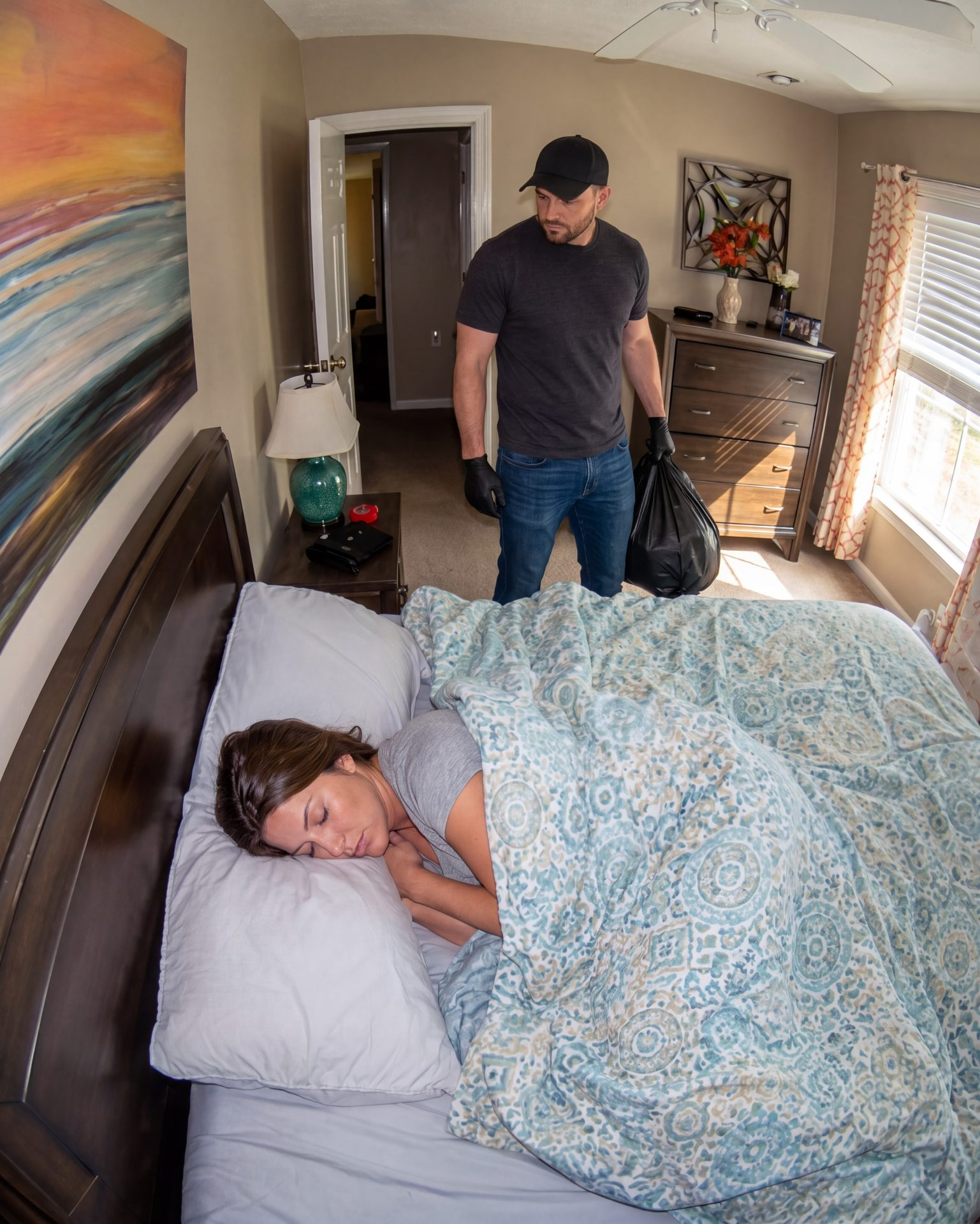
At 2:17 a.m., I lay perfectly still beside my husband, Dererick, forcing myself to breathe slowly while watching him through barely opened eyes. He moved through our dark
bedroom wearing latex gloves and carrying a small black bag I had never seen before, completely convinced that I was unconscious.
Three hours earlier, Dererick had handed me my usual cup of chamomile tea. He had prepared the same drink for me every night for the past month, but this time, after he went to brush his teeth, I poured it down the bathroom sink, rinsed the cup, climbed into bed, and pretended to fall asleep.
Watching him now confirmed the suspicion I had been terrified to believe. Whatever Dererick had been putting in that tea was supposed to keep me unconscious, and the confidence with which he moved suggested this wasn’t the first time he had done something while I slept.
The strange pattern had started about three weeks earlier. Every morning after Dererick spent the night at home, I woke feeling unusually groggy and confused, sometimes with my pajamas twisted or my body in a position I couldn’t remember falling asleep in.
At first, I blamed stress. Dererick had been traveling frequently for his medical-equipment sales job, while I was spending long hours finishing an important project for my graphic design business.
Then my sister Clare called one Tuesday morning.
“Anna, are you okay? You sounded really weird last night when we talked. Like you were drunk or something, but you said you hadn’t been drinking.”
I had no memory of speaking with her. The last thing I remembered from the previous evening was drinking the tea Dererick made for me and going to bed.
After that, I started watching for patterns. The heavy, unnatural sleep happened only when Dererick was home; whenever he traveled, I slept normally and woke feeling refreshed.
Then I noticed small unexplained marks on my arms and legs. When I mentioned them, Dererick acted concerned and suggested that I might be sleepwalking, even offering to take me to a doctor.
For a while, his concern made me feel guilty for suspecting him. But I couldn’t ignore what my own body was telling me, so I began quietly testing my theory.
On evenings when I told him I was too full for tea, I slept normally. Whenever I drank it, I woke disoriented and exhausted, and one night when I pretended to have a headache and went to bed early without drinking anything, Dererick spent more than an hour downstairs before finally coming to bed looking strangely agitated.
That was when I became certain my husband was secretly sedating me. What I still didn’t understand was why, and that unanswered question frightened me enough that I knew I had to catch him.
So that night, I pretended to drink the tea and waited.
Dererick approached the bed and looked down at me while I fought every instinct telling me to move. He reached into the black bag, removed a small camera, and positioned it on the dresser facing the bed.
A tiny red light appeared. He was recording me.
Then he opened a notebook and studied several pages as though following instructions. When he reached into the bag again, he pulled out a pair of scissors and carefully cut a small piece from the hem of my pajama top before sealing the fabric inside a plastic bag.
I wanted to scream, but I stayed completely limp.
Dererick began photographing me from different angles, repositioning my arm, adjusting my head, and moving my clothing before taking more pictures. Everything about his movements was disturbingly methodical, as though he had practiced exactly how to manipulate someone without waking them.
Then his phone buzzed. Dererick read the message and smiled.
A second message arrived, followed by another. He took several new photographs of me and immediately sent them to whoever was communicating with him.
That was when the truth became even more terrifying.
My husband wasn’t doing this alone.
PART 2: I Wasn’t His Only Victim
Dererick continued working as though I were nothing more than an unconscious object. He opened his laptop beside the bed, transferred the photographs he had taken, and appeared to upload them somewhere while repeatedly checking the notebook in his hands.
His phone buzzed several more times, and each new message seemed to contain instructions. At one point, he took additional photographs and immediately sent them, confirming my worst suspicion that someone else was watching and directing at least part of what he was doing.
Then Dererick removed a small swab from his black bag and collected samples from several places on my skin. He carefully sealed each one inside a plastic bag with the same clinical precision he used for everything else.
Finally, he packed away the camera, notebook, and laptop. Before leaving, he leaned over and kissed my forehead with the same tenderness he normally showed me.
“Sweet dreams, Anna.”
Hearing that gentle voice after what I had witnessed was almost unbearable. A few minutes later, the front door quietly closed, and I heard Dererick’s car leave the driveway shortly before three in the morning.
Only then did I allow myself to shake.
My husband hadn’t merely been secretly sedating me. He had photographed me, repositioned me, collected samples, documented everything, and communicated with other people while doing it.
Dererick had told me he was leaving for a three-day business trip to Chicago, so I knew I had a limited opportunity to discover what was happening. I waited another ten minutes before getting out of bed and searching for the personal laptop he kept separate from the computer he used for work.
I eventually found a locked briefcase beneath our bed. The combination was our anniversary, and when the lock clicked open, I felt a sickening mixture of relief and dread.
The laptop contained hundreds of photographs arranged in folders by date. Some went back eight months, long before I had noticed anything unusual, but what terrified me most was discovering folders labeled with other women’s names.
Jennifer. Patricia. Michelle.
There were at least six women.
I opened Jennifer’s folder and found photographs resembling the ones Dererick had taken of me. Later images, however, showed her looking increasingly weak and unwell, and Patricia’s and Michelle’s folders revealed the same disturbing progression.
Then I discovered a document labeled “Client Communications.”
It revealed that Dererick had been running a criminal operation in which paying customers requested photographs and specific staged scenarios involving women whose conditions gradually deteriorated. Different services had different prices, and messages showed customers giving instructions about what they wanted Dererick to document.
I kept searching until I found an email from only two days earlier that mentioned me by name. A customer had asked about something called “Graduation Services,” and Dererick’s response made my hands begin trembling.
He had written that I was “almost ready” and that he would “begin the final phase soon.”
I didn’t know exactly what those words meant, but after seeing the later photographs of the other women, I knew I couldn’t afford to wait and discover the answer. I copied everything I could onto a flash drive, then searched the bedroom until I found Dererick’s notebook hidden inside his sock drawer.
The entries documented substances, amounts, my reactions, and customer requests. More recent notes mentioned people asking about “permanent access,” while Dererick had written that I was becoming suspicious and he might need to “accelerate the timeline.”
That was enough.
Whatever Dererick had planned for his “final phase,” I believed my safety was in immediate danger. I photographed every page, returned everything exactly where I had found it, and tried to think clearly.
Dererick couldn’t know that I had discovered his secret.
Not yet.
But he would eventually come home.
And I had three days to make sure I wasn’t there waiting helplessly when he did.
PART 3: My Neighbor Knew Something Was Wrong
Once I had copied the files and photographed Dererick’s notebook, I returned everything exactly where I had found it. I couldn’t risk letting him know I had discovered what he was doing, but I also knew I couldn’t handle the situation alone.
My first call was to my sister, Clare. She was working a night shift at the hospital, so the call went directly to voicemail.
“It’s an emergency. Call me as soon as you can.”
While waiting, I thought about our elderly neighbor, Mr. Peterson. He spent a lot of time on his front porch, and if Dererick had really been leaving the house in the middle of the night for months, there was a chance Mr. Peterson had noticed something.
It was almost five in the morning, but I saw a light glowing in his kitchen. I crossed the street and knocked, and when he opened the door in his bathrobe, his expression changed the moment he saw me.
“Anna, dear, what’s wrong? You look like you’ve seen a ghost.”
We sat at his kitchen table while I tried to control my shaking hands. I didn’t tell him everything immediately because I needed to know whether his observations matched what I had discovered.
“Mr. Peterson, I need to ask you something. Have you noticed anything strange at our house at night? Anything unusual with Dererick?”
His face became serious.
“Anna, I’ve been wondering when you were going to ask me that.”
My stomach tightened.
“What do you mean?”
Mr. Peterson explained that for months he had seen Dererick leaving at two or three in the morning. Even more disturbing, unfamiliar visitors sometimes parked farther down the street and approached our house on foot after dark.
“Why didn’t you say anything?”
He told me Dererick had already prepared an explanation. According to my husband, I suffered from severe sleep problems and was taking powerful medication, so he occasionally needed to check on me or take me to emergency medical appointments.
“He asked me not to mention it to you. He said you were embarrassed.”
I felt sick hearing how carefully Dererick had protected himself. He hadn’t simply hidden his behavior from me; he had created a believable story for anyone who might notice something unusual.
Fortunately, Mr. Peterson had never completely believed him. He said I had always appeared healthy, and the people visiting our house at strange hours certainly hadn’t looked like medical professionals.
I showed him the photographs I had taken of Dererick’s notebook. As he read the entries, the color disappeared from his face.
“Dear God, Anna, we need to call the police right now.”
We contacted 911, but the dispatcher initially treated my report cautiously, apparently hearing it as a complicated domestic situation. They promised to send an officer when one became available, but Mr. Peterson immediately said waiting wasn’t good enough.
“Dererick could come back at any time.”
Then my phone rang.
It was Clare.
“Anna, I got your message. What’s going on?”
I told her everything, from the tea to the camera, the photographs, the other women, and the disturbing records on Dererick’s laptop. Clare remained silent until I finished.
“I’m coming over right now. And I’m bringing someone with me.”
About an hour later, Clare arrived with Detective Martinez, someone she knew through the hospital who specialized in complex investigations. I handed over the flash drive, and after reviewing the evidence, Martinez’s entire demeanor changed.
“This is much bigger than just what he was doing to you. Based on what you’ve found, he’s been running a criminal enterprise for years.”
She immediately called for additional officers. Investigators began tracing information from Dererick’s records, and within hours, they had identified several men in different states who appeared connected to his network.
But there was one problem.
Dererick was still free.
And instead of remaining in Chicago for three days as he had told me, police learned that he was expected home that evening.
Detective Martinez decided they wouldn’t wait for him to disappear.
They were going to let my husband walk back into our house.
And I was going to be waiting for him.
PART 4: The Trap Waiting for My Husband
Detective Martinez moved quickly once she understood what was on the flash drive. Officers began monitoring our house while investigators traced phone numbers and other information from Dererick’s records, and within hours they identified several men in different states who appeared to be connected to his operation.
Some of those men were already being located by law enforcement, but Dererick remained the immediate problem. He was supposed to be away on business, yet investigators learned that he was returning home that evening, which meant there was no time for me to disappear quietly and hope he wouldn’t realize I had uncovered everything.
Detective Martinez proposed a plan that terrified me. Instead of warning Dererick or arresting him somewhere else, they wanted to let him return home normally while officers surrounded the property and waited for evidence of what he intended to do.
I would have to act as though nothing had changed.
Every instinct told me to get as far away from that house as possible, but I also understood why catching Dererick with his equipment could strengthen the case. After everything I had found about the other women, I wanted investigators to have enough evidence to expose the entire network rather than only what he had done to me.
That evening, I sat in our living room with a concealed wire under my shirt. Police officers were positioned around the house, but knowing they were nearby did little to stop the fear tightening in my chest.
At exactly seven o’clock, I heard Dererick arrive.
He walked through the front door carrying flowers and chocolates, looking exactly like the affectionate husband I had once believed him to be. Nothing in his expression suggested that he knew his private files had been copied or that police officers were waiting only a short distance away.
“I missed you.”
He kissed me hello, and I forced myself to respond normally. Sitting beside him while remembering the photographs, notebooks, and names on his laptop felt surreal, but I couldn’t allow him to suspect anything.
Eventually, bedtime arrived.
Dererick went into the kitchen and returned carrying the familiar cup of tea. The sight of it made my stomach tighten because I finally understood what those quiet nightly rituals had really meant.
“Sweet dreams, honey.”
He kissed my forehead with the same gentle expression he had used countless times before. I pretended to drink the tea and later lay motionless in bed, waiting for him to believe the substance had taken effect.
About twenty minutes passed before I heard him moving.
Dererick retrieved the black bag.
He entered the bedroom with the same confidence I had witnessed before, apparently convinced that I was completely unconscious. He positioned his camera, opened the notebook, and began preparing for another session.
This time, however, he wasn’t alone with me.
The bedroom door suddenly opened, and Detective Martinez entered with three other officers. Dererick froze as they surrounded him, his face draining of color while the black bag and notebook remained within reach.
For several seconds, he seemed unable to understand what was happening. Then his eyes moved from the officers to me lying on the bed.
I opened my eyes.
That was when everything changed.
Dererick stared at me as realization slowly replaced confusion. The wife he believed he had secretly controlled for months had been awake, watching him walk directly into the trap.
“You knew.”
For the first time since I had known him, Dererick looked genuinely afraid.
I sat up and looked directly at him.
“I knew. I knew everything.”
The officers took control of the room and led him away. Dererick kept looking back at me, as if he still couldn’t understand how the life he had so carefully hidden had collapsed in a single evening.
But arresting my husband was only the beginning.
The evidence on his laptop was about to reveal just how many lives his secret operation had already touched.
PART 5: The Life He Couldn’t Take From Me
As the officers escorted Dererick out of our house, he kept turning his head to look at me. I couldn’t tell whether his expression came from anger, disbelief, or the realization that the secret world he had spent years constructing had finally collapsed.
His arrest turned out to be only one piece of a much larger investigation. The evidence from his laptop, notebook, messages, and financial records led investigators to a network operating across multiple states, and seventeen women eventually came forward as victims.
For months, I had believed something was wrong with me. I had blamed stress for my exhaustion, questioned my own memory, and even felt guilty when Dererick suggested that I might be sleepwalking.
Now I understood how deliberately he had created that confusion. He hadn’t only hidden what he was doing; he had built explanations around my symptoms so that I would question myself before I ever questioned him.
The investigation also revealed how carefully the operation had been organized. The folders, customer communications, staged photographs, and detailed records provided investigators with evidence that Dererick’s behavior had extended far beyond our marriage.
Eventually, the case reached its conclusion. Dererick was sentenced to life in prison without the possibility of parole.
Knowing he couldn’t return didn’t immediately make me feel safe again. After the investigation, I moved in with Clare because I couldn’t bear the thought of sleeping alone in the house where I had spent so many nights unknowingly vulnerable.
Recovery was much slower than the arrest. I spent months in therapy trying to rebuild my sense of safety, and one of the hardest things to recover was my ability to trust another person without wondering what might be hidden beneath their kindness.
Clare stayed beside me throughout that process. I also connected with other survivors, and hearing their experiences helped me understand that surviving what happened wasn’t the end of my story.
A year later, I decided to use the skills I already had as a graphic designer to help other women facing similar situations. I started a nonprofit organization focused on connecting survivors with information, support, and resources they might otherwise struggle to find.
Creating websites and educational materials gave my work a purpose I had never expected. Every resource we published felt like a small reversal of what Dererick had tried to accomplish by isolating women, controlling information, and making them doubt their own instincts.
The nightmares didn’t disappear completely. Sometimes I still woke in the middle of the night remembering the red light on that camera or the sound of Dererick whispering goodnight while believing I was unconscious.
But those nights became less frequent.
Whenever fear returned, I reminded myself of what had actually happened. I had noticed the pattern, trusted my instincts when the explanations stopped making sense, gathered evidence, reached out to people I trusted, and helped investigators expose something far larger than I initially understood.
Dererick had expected me to remain confused and dependent on him. Instead, the moment I stopped drinking that tea and pretended to sleep became the beginning of the end of everything he had built.
For a long time, I thought survival meant returning to the woman I had been before discovering the truth. Eventually, I realized there was no reason to go backward.
I could build something new.
Dererick had tried to reduce me to a victim inside his secret operation, but that wasn’t the identity I carried forward. I became a survivor, and then I used what I had survived to help other women find their own strength and voices.
Sometimes I still remembered lying motionless in that bedroom at 2:17 in the morning, terrified that opening my eyes would reveal I was awake.
Now I understood that keeping them open was exactly what saved me. I had trusted myself. I had asked for help. And I had survived.
That was the one thing Dererick could never take away from me.
He said nothing—until he saw the little girl’s eyes. What he discovered revealed that the poverty he once knew was hiding a devastating betrayal by his own family.
PART 1
“Are you seriously planning to walk another two miles carrying that mattress with a little girl under this heat?”
Mabel Sterling didn’t hear the question because no one had spoken it aloud yet. She simply kept moving down the unpaved dirt road under the oppressive July heat of the Texas countryside, a worn, secondhand mattress folding her spine, while her three-year-old daughter, Lily, walked beside her clutching two plastic grocery bags.
The little girl was exhausted, her small shoes coated in dust.
“Almost there, my love,” Mabel whispered, though they both knew it wasn’t true.
That was when a sleek black SUV slowed to a crawl several yards behind them. At the wheel sat Damian Vance, a forty-four-year-old self-made billionaire who had left Houston that morning to close a land acquisition deal for a sprawling ranch estate. He was a man accustomed to reviewing multi-million-dollar portfolios without losing his composure.
But when he caught sight of the woman’s face through the dust, his heart slammed against his ribs.
It was Mabel.
His first love.
The brilliant, proud girl he had promised to return for when he left their small town at eighteen with a duffel bag, a hundred dollars, and reckless ambition.
Twenty-six years had passed.
Damian pulled over onto the shoulder, his hands trembling on the leather steering wheel. From a distance, he watched as Mabel adjusted the heavy mattress over her narrow shoulders and trudged up to a dilapidated cottage hidden behind dry brush.
The tin roof was patched with rusted metal. A cracked side wall was covered with blue tarp. The wooden door looked barely attached to its hinges.
Damian sat in his running vehicle for twenty minutes, completely paralyzed.
He couldn’t reconcile this sight with his memories. The Mabel he knew was fiercely independent, brilliant with numbers, and possessed a razor-sharp intellect. She had dreamed of earning an accounting degree and running her own firm.
What on earth had happened to her?
The following morning, Damian began making discreet inquiries in town. At the local general store, the woman behind the counter, Mrs. Gable, recognized the name immediately.
“Mabel Sterling?” Mrs. Gable sighed, shaking her head. “Terrible shame. That poor woman was completely ruined by the Vance family.”
The Vance family—led by their ruthless patriarch, Arthur Vance—owned the largest logistics and cattle operations in the county. Mabel had worked as their head accountant until four years ago, when nearly two hundred thousand dollars mysteriously vanished from their corporate accounts.
Arthur Vance had publicly accused her of grand larceny.
They never found a single dollar in Mabel’s possession. They never produced digital proof that she had authorized the wire transfers.
It didn’t matter.
The Vances had legal teams, political connections, and deep pockets. Mabel had a newborn child and nothing else.
She lost her career overnight. Neighbors began treating her like a thief, and no business in three counties would hire her to handle money. She ended up scrubbing floors, sewing school uniforms, and taking any grueling odd job that would allow her to feed Lily.
A dark, overwhelming rage flared inside Damian’s chest.
Two days later, he drove straight to the cottage.
Mabel opened the door, wiping her hands on a damp rag. It took her several seconds to recognize the man standing on her porch in a tailored suit.
The rag slipped from her fingers, hitting the floorboards.
“…Damian?”
“It’s me, Mabel.”
Her initial shock hardened into instant, cold resentment. “Did you come all this way to see how the girl you promised to come back for turned out?”
Damian took a step forward, desperate to explain. “Mabel, please—”
Before he could finish, little Lily peeked out from behind her mother’s skirt, wrapping her small arms tightly around Mabel’s leg.
Damian looked down at the little girl.
Something about the child’s striking, clear green eyes made the breath catch in his throat. He had seen that distinct shade of green in only one other person in his entire life: his late mother.
“Mabel…” he whispered, his voice cracking. “How old is Lily?”
Mabel’s face drained of every drop of color. “Get off my porch.”
“I need to know, Mabel.”
Mabel pulled the little girl tightly against her hip, staring at him with unyielding eyes.
“My daughter and I learned to survive without you,” she said, her voice deadpan and icy. “Your promises stopped meaning anything to me twenty-six years ago.”
She slammed the heavy wooden door shut.
Damian walked back to his vehicle as a specific timeline began replaying relentlessly in his mind.
Four years ago.
The only time in twenty-six years he had ever returned to this town—for his uncle’s funeral. He had stayed for three days. One rain-soaked night, he had run into Mabel at a quiet roadhouse tavern outside town. They had talked for hours, drinking too much, unearthing memories they thought were dead.
They had spent that night together.
The next morning, confused by feelings he thought he had buried decades ago, Damian had fled back to Houston without leaving a note. He had never reached out again.
Now, Lily was three years old.
Damian stared at the closed door of the cottage, realizing that the child inside changed every single thing in his world.
PART 2
Damian spent the night running calculations he didn’t want to finish.
The timeline was undeniable. Lily was his daughter.
The following Sunday afternoon, he found Mabel sitting on a wooden bench near the town square park while Lily chased pigeons across the grass.
He walked over slowly. “May I sit down for five minutes?”
Mabel didn’t look at him, but she didn’t walk away either. “Say what you came to say.”
Damian didn’t beat around the bush. “Lily is my daughter, isn’t she?”
Mabel set her sewing kit down on her lap. “Yes.”
The answer was so immediate, so unadorned, that it cut deeper than any outburst could have.
“Why didn’t you tell me, Mabel?” Damian asked, his voice raw. “Why didn’t you find me?”
Mabel offered a dry, hollow laugh. “Find you where, Damian? You changed your private cell number, moved your corporate offices, and built a wall of receptionists around yourself. Years before that, when I was struggling, I tried reaching out through your old contacts and you never replied. When I discovered I was pregnant four years ago, I had just been publicly branded a thief. I had no job, no savings, and no reputation. I wasn’t going to crawl across Texas begging a man who always found a convenient reason to leave.”
Damian lowered his head. He had no defense.
“I want to be in her life,” he said softly.
“You don’t get to show up with your billions and decide you’re a father overnight.”
“I’m not trying to buy her, Mabel.”
“Then prove you know how to stay.”
That single sentence became his non-negotiable directive.
Damian immediately finalized the land deal in the county, establishing a permanent local residence, and restructured his corporate schedule so he could spend the majority of his time in town. He visited Lily in public parks, brought children’s literature instead of extravagant gifts, spent hours playing on the grass, and scrupulously respected every boundary Mabel set.
In secret, however, he activated his private legal team and senior forensic accountants to conduct an independent investigation into the four-year-old embezzlement case at the Vance family enterprise.
When the forensic team delivered their preliminary findings three weeks later, Damian drove straight to Mabel.
He laid a stack of financial ledgers flat on her small kitchen table. “The two hundred thousand dollars that disappeared never entered any account linked to you, Mabel. It was systematically siphoned out through minor wire transfers over an eight-month period.”
Mabel stared at the forensic spreadsheets. “Then who took it?”
Damian slid a secondary dossier forward. “The ultimate beneficiary was a shell company registered to Flynn Vance—Arthur Vance’s son.”
Mabel went completely still.
Flynn Vance had been the very person who had loudly “defended” her integrity when the initial audit began, playing the sympathetic employer while the evidence was presented to his father.
“That bastard told me to my face that he believed in me…” she whispered, her voice shaking.
“Because he needed everyone looking at you while he covered his own tracks,” Damian said coldly.
Flynn had accumulated massive, hidden gambling debts in Dallas. When his father noticed the corporate accounting discrepancies, Flynn had framed Mabel—the sole accountant with daily administrative credentials.
Damian expected Mabel to react with relief. Instead, tears spilled over her eyelashes.
It wasn’t relief. It was pure, unadulterated rage.
“Four years,” she whispered, her chest heaving. “My daughter slept in a room where rain poured through the ceiling. There were weeks I ate one meal a day so Lily would have milk. And that coward lived in a mansion, driving luxury cars, acting like a pillar of the community!”
The forensic evidence was submitted directly to federal and state financial prosecutors.
The news hit the county like a bomb. For the first time, the untouchable Vance family was facing public scrutiny.
Flynn Vance arrived at Damian’s newly acquired ranch house two days later, sweating profusely through his designer shirt.
“We can handle this quietly, Vance,” Flynn pleaded, looking around frantically. “Tell Mabel I’ll pay her out! A new house, cash settlement, whatever she wants. Just pull the forensic filings!”
Damian looked at him with icy contempt. “You didn’t destroy a wall that can be patched with cash, Flynn. You stole a mother’s reputation and left a toddler to starve.”
When Damian presented Flynn’s settlement offer to Mabel later that evening, she immediately shook her head.
“I don’t want his hush money,” Mabel said firmly. “I want my daughter to grow up knowing that her mother’s name was cleared by the truth, not bought off with a check.”
It seemed the legal prosecution was unstoppable.
Then, on a rainy Thursday afternoon, an unexpected visitor arrived at Damian’s estate.
It was Phoebe Vance—Flynn’s younger sister.
She was pale, clutching a thick leather accordion folder against her chest.
“I know what my brother did,” Phoebe said, her voice trembling.
Damian stood in the doorway. “How long have you known?”
Phoebe broke down in tears. “Since before Mabel was ever accused.”
She set the folder on his desk. “But that isn’t the worst of it. My father found out the truth back then, too… and I have the proof right here.”
PART 3
Damian stared at the leather folder on his desk without touching it. “Explain that to me.”
Phoebe took a deep, shuddering breath. “Flynn had been siphoning money from our father’s operations for nearly a year. I stumbled across the wire transfers while organizing tax filings for my dad. I brought the statements straight to Arthur.”
“To your father?”
“Yes.”
Damian felt his jaw tighten. Until that moment, everyone had assumed Flynn had deceived his father, taking advantage of the old man’s fiery temper to make Mabel the scapegoat.
Phoebe’s revelation shattered that assumption.
“What did your father do?” Damian asked, his voice dangerously low.
“He confronted Flynn. They had a furious argument behind closed doors. Flynn admitted he owed money to dangerous people and promised to pay it back. But my father said a public scandal involving his son would ruin the Vance family name and torpedo our bank credit lines.”
Phoebe unbuckled the folder. Inside were printed email chains, internal bank audits, and a handwritten note on Arthur Vance’s personal stationery.
“Two days later,” Phoebe whispered, “my father and Flynn decided to blame Mabel.”
Damian felt a surge of nausea. “Arthur Vance knowingly allowed an innocent woman—a single mother—to be framed and destroyed to protect his deadbeat son?”
Phoebe lowered her eyes. “He didn’t just allow it. He orchestrated the narrative.”
That evening, Mabel sat in Damian’s study, reading through every single document in silence.
One sheet contained explicit instructions sent from Arthur Vance to his chief corporate counsel: Direct all internal audit focus toward Mabel Sterling. She holds primary administrative access.
Another page was a internal memo where Flynn acknowledged unauthorized withdrawals to his father.
The most damning piece of evidence was a handwritten note by Arthur Vance himself:
Flynn will reimburse the corporate accounts over time. The discrepancy must remain attributed to the accounting clerk.
Mabel read that line three times. She slowly set the paper down on the mahogany desk.
“So they knew,” she said softly.
No one answered.
“While I walked through town and people pulled their children away from my daughter… they knew.” Her voice began to crack with raw, painful emotion. “While I applied for basic jobs and was told that no one would ever trust a thief near a cash register… they knew.”
Damian moved to step beside her, but Mabel raised a hand, stopping him. She needed to say it all.
“When Lily was sick and I couldn’t afford a private clinic visit… they knew. When rain soaked through our roof and ruined our clothes… they knew. When I dragged that secondhand mattress two miles down a dirt road because I didn’t have twenty dollars for a truck… they knew!”
She turned her eyes to Phoebe Vance. “And you knew, too?”
Phoebe wept openly. “Yes.”
“Why didn’t you speak up?”
“Because I was a coward,” Phoebe confessed, offering no excuses. “My father controlled my trust, my house, my employment. I knew if I blew the whistle, I’d be cast out on the street. Every year I told myself it was too late to fix it.”
Mabel looked at her with cold clarity. “For you, it was four years of quiet comfort. For my daughter and me, it was four years of hell.”
Phoebe nodded miserably. “I know. That’s why I’m here now. I will testify under oath to everything.”
The new evidence transformed the legal case entirely.
It was no longer just a corporate embezzlement investigation against Flynn; federal prosecutors launched a formal inquiry into obstruction of justice, evidence tampering, and conspiracy against Arthur Vance and Flynn Vance.
The Vance family reacted with furious panic. Arthur Vance attempted to order Phoebe to recuse her statements, but she refused to meet with him. Flynn offered massive financial settlements through intermediaries, but Mabel rejected every offer.
When money failed, rumors began circulating. Desperate chatter spread through town claiming Mabel had seduced a visiting billionaire to attack the Vance family out of spite.
Except this time, Mabel wasn’t standing alone in the dark.
Townspeople who had stayed silent for years began coming forward. A former junior accountant testified that Flynn had ordered him to alter digital entry memos. A former executive assistant recalled Arthur Vance meeting with criminal defense attorneys days before Mabel was ever publicly named.
The truth that had seemed impossible to prove four years ago broke open like a dam.
Meanwhile, Damian focused on a far more delicate task: learning how to be a father.
He didn’t force Lily to call him “Dad.” He didn’t demand instant affection. To the three-year-old girl, he was simply Damian—the tall man who built elaborate fortresses out of cardboard boxes, did hilarious voices while reading bedtime stories, and never grew tired of listening to her explain her drawings.
One afternoon, while they were sitting on the porch, Lily looked up from her coloring book. “Why do you stay here so much?”
Damian froze, looking over at Mabel, who was watching from the doorway.
“Because I love being with you, Lily,” Damian said gently.
“And with my mommy?” Lily asked innocently.
Mabel almost dropped the tea glass she was holding.
Damian smiled warmly. “Especially with your mommy.”
Lily considered this for a moment, nodded sagely, and went right back to coloring her dinosaur.
It was the quiet, unscripted moments that struck Damian the hardest. He had spent half his life believing that success meant corporate acquisitions, wealth accumulation, and needing no one. Now, sitting on a wooden porch watching a three-year-old draw, he realized that true purpose was far simpler.
However, one immediate crisis could no longer be ignored: Mabel’s cottage.
A severe summer thunderstorm revealed the full extent of the structural damage. Water poured through three rooms, forcing Mabel and Damian to set out buckets while moving furniture in the middle of the night. A section of soaked drywall collapsed near the hallway.
Lily woke up crying from the noise.
Damian couldn’t stand it another second. “This house is unsafe, Mabel.”
“I know,” Mabel said, wringing out a towel.
“Let me rebuild it. Or let me buy a proper home for you two.”
Mabel immediately bristled. “I will not live in a mansion bought out of guilt, Damian.”
“I’m not talking about guilt, and I’m not talking about you!” Damian said, pointing toward the bedroom where Lily slept. “I am her father. For three years, I didn’t contribute a single dollar because I didn’t know she existed. Now I know. I cannot watch a ceiling collapse near my daughter’s bed and pretend I’m ‘respecting your independence.’”
Mabel went quiet.
For the first time, she realized that accepting support for her child didn’t mean surrendering her own dignity.
“Under one condition,” Mabel said finally. “Everything is documented legally as your parental financial obligation to Lily. No grand luxury estates. Just a safe, sturdy house.”
Damian smiled gently. “A blow to my billionaire ego, but I’ll survive.”
It was the first time Mabel had genuinely laughed with him since his return.
They brought in contractors to completely overhaul the cottage—installing a reinforced roof, fixing the foundation, updating the plumbing, and securing the structure. Damian respected every boundary Mabel set. No extravagant displays—just safety, warmth, and stability.
When the work was completed, Lily ran through the bright, sunlit rooms as if she had been handed a castle.
Mabel stood on the porch, watching Damian sit on the floor helping Lily assemble a wooden puzzle. A new, unfamiliar fear crept into her heart.
She was no longer afraid of him invading her life. She was terrified of him leaving again.
“You can’t stay in this town forever, Damian,” she said softly one evening after Lily was asleep.
“Why not?”
“You have global corporate headquarters in Houston, international offices, board meetings, people who depend on your daily presence. Eventually, you’ll grow tired of small-town life, of playing the domestic father.”
“I’m not playing, Mabel.”
“You know what I mean, Damian. Your real life is elsewhere.”
Damian walked over, stopping a respectful distance from her.
“That’s why I restructured my corporate holdings last month,” he revealed quietly. “I appointed a COO to handle daily operations in Houston, opened a regional executive branch thirty minutes from here, and transitioned to remote oversight. I will only travel when absolutely necessary.”
Mabel stared at him, stunned. “You restructured your entire business empire without telling me?”
“I didn’t want to use it as a bargaining chip to persuade you.”
“Then why tell me now?”
“Because you just admitted you’re afraid I’ll walk away,” Damian said, taking a deep breath. “And I want you to know that this time, I made structural choices before I made promises.”
Mabel didn’t answer right away, but the shift inside her was profound. Months ago, she would have viewed his actions as a high-handed corporate maneuver to win her over. Now, she recognized what it truly was: consistency.
The federal legal proceedings concluded months later.
Phoebe Vance fulfilled her promise, delivering clear, devastating testimony under oath. Facing an overwhelming mountain of forensic paper trails and internal communications, Flynn Vance pled guilty to corporate fraud and embezzlement, receiving a six-year sentence in a federal facility.
Arthur Vance was convicted of felony obstruction of justice and civil conspiracy, forced to pay massive financial restitution to Mabel for the destruction of her professional livelihood.
An official judicial decree was issued, fully exonerating Mabel Sterling of all past allegations and striking the incident entirely from public record.
The most meaningful moment for Mabel, however, didn’t occur inside a courtroom.
It happened weeks later at Mrs. Gable’s general store. Mabel was buying groceries when a woman who had pulled her child away from Lily at a park three years prior walked up to her down the aisle.
The woman stopped, her face flushed with shame. “Mabel… I judged you without knowing the truth. I am so deeply sorry.”
Mabel looked at her quietly. She didn’t offer a dramatic speech, nor did she pretend the past four years hadn’t hurt.
“Thank you,” Mabel said simply, and walked on.
She realized she was under no obligation to hand out cheap forgiveness to everyone who had failed her. Justice wasn’t about pretending the damage hadn’t occurred; it was about reclaiming the right to decide how to live her life moving forward.
With her court-awarded restitution funds, Mabel permanently retired from odd jobs. She enrolled in an executive business management program to finish the degree she had put on hold years ago, placing the remainder of the funds into a secure educational trust for Lily.
One golden autumn afternoon, a year after Damian had first spotted her on that dirt road, he prepared a simple dinner on the renovated porch.
After Lily fell fast asleep in her room, Mabel walked out to find a small vase of wild prairie flowers resting on the wooden table.
They both laughed softly. Damian reached across the small table, gently taking her hand.
“When I was eighteen, I thought leaving this town made me brave,” Damian said, his voice dropping into quiet reflection. “For twenty-six years, I convinced myself that never looking back was the price of success. Then I saw you walking down that road, and I realized I had built an empire around a hollow space.”
Mabel listened, her hand resting quietly in his.
“I can’t rewrite twenty-six lost years, Mabel,” he continued, his green eyes fixed on hers. “That’s impossible. But I want to earn whatever comes next.”
Mabel squeezed his hand softly. “You’ve already started.”
There was no immediate wedding. There was no overnight fairytale transformation.
There was simply time, trust, and presence.
Damian formally established legal paternity. Over time, without anyone coaxing her, Lily began calling him “Daddy.” The first time it happened, Damian was kneeling on the rug fixing the wheel of her small bicycle.
“Daddy, is it fixed yet?” Lily asked casually.
Damian set his tools down on the floor, swallowing back tears before looking up. “Almost ready, sweetie.”
A year later, Mabel and Damian were married in a quiet, intimate ceremony in the garden behind their home. Mrs. Gable attended, crying tears of joy from the front row. Phoebe Vance attended as well; though her relationship with her father was permanently severed, her choice to tell the truth had allowed her to build a life free of her family’s toxic secrets.
Mabel eventually completed her degree and took over the regional management of Damian’s agricultural land holdings—not as “the founder’s wife,” but as an independent, salaried executive with full operational authority.
The narrative surrounding Mabel in the county shifted permanently. For four years, she had been “the woman who stole.” Then she became “the woman who was framed.” But eventually, those titles faded away entirely.
She was simply Mabel. A brilliant executive. A devoted mother. A woman who had survived the dark and built a life on her own terms.
Years later, an older Lily was sifting through a photo album and found a faded photograph of her parents as teenagers, standing near a fence line.
“You two knew each other way back then?” Lily asked, looking up.
Mabel looked over at Damian, who was leaning against the kitchen counter with a cup of coffee.
“A very long time ago,” Mabel smiled.
“Then why did it take you guys so long to be together?”
Damian walked over, resting a loving hand on his wife’s shoulder. “Because some people have to get completely lost before they realize what was worth finding all along.”
Lily didn’t look entirely convinced. “Well, you guys took way too long.”
All three of them burst into warm, unburdened laughter.
Damian had learned that wealth could buy influence, land, and power, but it could never buy back a single lost second. Real strength wasn’t about rescuing someone; it was about standing beside them, believing them, and when the moment came where it would be easy to walk away… knowing how to stay.
The Funeral That Wasn’t: A Grandmother’s Shocking Discovery
The chapel was almost silent when I approached my granddaughter’s casket, except for the soft sobbing behind me and the distant hum
It could be a picture of children.
of the heating system that seemed strangely loud. Emma had been six years old. Six. Old enough to read short stories, lose baby teeth, argue about bedtime, and insist that
every pancake needed extra strawberries. She was supposed to have decades ahead. Instead, her parents had told us she had died suddenly from a contagious illness. The diagnosis had been
frightening, the doctors had supposedly been unable to save her, and the family had been warned to avoid touching her body. I had accepted the story because grief makes even
unbelievable things sound possible. My son Daniel was devastated, his wife Claire looked shattered, and everyone around them seemed convinced that the tragedy had arrived without warning. But as I
leaned over Emma to say goodbye, something changed. At first, I thought I had imagined it. There was a faint sound beneath the lid, so soft that I almost dismissed
it as wood shifting inside the old chapel. Then came another scrape. I froze. My hand remained on the edge of the casket as I listened. The room seemed to
disappear. I could hear nothing except my own heartbeat and that tiny, desperate movement beneath me. Then a whisper came through the narrow space. “Grandma?” I nearly collapsed. I stared
at Emma’s face. Her lips were pale, her eyelashes still, but her chest appeared to move almost imperceptibly beneath the white fabric covering her. “Emma?” I whispered. Her fingers twitched.
Then her voice came again, weaker than before. “Daddy said if I woke up, I would ruin everything.” For several seconds, I could not understand the sentence. My mind rejected
it because accepting it meant accepting something far worse than death. I screamed for help. The funeral director rushed forward, but I pushed past him and grabbed the lid. Someone
shouted that we were not supposed to open it because of the supposed contagion. “I don’t care,” I said. With trembling hands, I forced the lid upward. Emma was breathing.
Barely, but she was breathing. The next few minutes became a blur of shouting, frantic calls, and medical instructions. Someone ran for an emergency kit. Another person called an ambulance.
I held Emma’s tiny hand and kept repeating her name. Then heavy footsteps thundered from the staircase behind us. Daniel appeared at the bottom of the stairs. He stopped when
he saw the open casket. His face changed instantly. Not into relief. Not into joy. Into terror. That was the moment I knew my granddaughter’s near-death was not an accident.
For the previous three days, I had believed I was preparing to bury the little girl who had once spent an entire Christmas morning wearing a red superhero cape over
her pajamas. Now I was standing beside her, watching her father stare at her as though he had seen a ghost. “What did you do?” Daniel asked. I could barely
recognize my own son. “What did I do?” I replied. “I saved your daughter.” Claire came rushing behind him. When she saw Emma alive, she covered her mouth with both
hands. For one brief moment, I thought she might run to the child. Instead, she whispered, “This wasn’t supposed to happen.” Those five words destroyed whatever doubt remained in my
mind. The ambulance arrived minutes later. Paramedics immediately began working on Emma. They checked her pulse, oxygen level, pupils, and breathing, then placed an oxygen mask over her face. One
of them looked at me. “She’s alive,” he said. “Weak, but alive. We need to move now.” I rode behind the ambulance to the hospital, while police officers stayed behind
to question Daniel and Claire. During the drive, I kept replaying Emma’s words. Daddy said if I woke up, I would ruin everything. What could waking up possibly ruin? A
funeral? A diagnosis? An inheritance? A secret? By the time I reached the emergency department, my fear had turned into something harder. Anger. Doctors worked on Emma for hours. They
discovered that she had been heavily sedated and dangerously dehydrated. Her body temperature was unusually low, and her breathing was suppressed. But she was alive. The attending physician told me
that if she had remained in the casket much longer, she might not have survived. I sat in the waiting room and cried until my chest hurt. Then a detective
approached me. “Mrs. Harris, we need to ask you something.” I looked up. “Your son told us Emma suffered from a sudden contagious disease. The hospital records don’t support that.”
“What do they say?” The detective opened a folder. “There was no confirmed infectious illness.” My stomach tightened. “So why did they say there was?” “We don’t know yet.” Then
he showed me another document. It was a medical report from a private clinic. Emma had apparently been treated there several times during the previous month. The visits had been
paid for in cash. The diagnosis listed on the report was not an infection. It was medication-induced respiratory suppression. I stared at the page. Someone had been giving my granddaughter
medication that could slow her breathing. “Who prescribed it?” I asked. The detective paused. “We’re still tracing that.” The investigation quickly became larger than any of us expected. Police searched
Daniel and Claire’s house. They found prescription bottles hidden inside a locked cabinet in their bedroom. Some were prescribed to Claire. Others had labels removed. They also found a notebook.
Inside were dates, times, medication amounts, and notes about Emma’s condition. One line was circled several times. “Keep her asleep until the transfer is complete.” The detective would not tell
me what transfer meant. But I soon learned. Daniel had been facing enormous financial problems. His construction company had failed. He owed creditors hundreds of thousands of dollars. His home
was close to foreclosure, and several business partners were threatening lawsuits. Then police discovered an insurance policy. Emma had been listed as the beneficiary of a substantial life insurance policy
purchased months earlier. Daniel and Claire were the policy owners. The investigators believed they had found a possible motive. But there was another problem. Emma’s policy had recently been changed.
The beneficiary designation had been altered two weeks before her supposed death. Daniel and Claire would receive the money if she died. I felt sick. My son had not simply
lied about his daughter’s condition. He may have planned for her death to become a financial solution. But the case was still incomplete. Police found evidence that someone had contacted
a funeral home before Emma was officially pronounced dead. That detail became crucial. The funeral director admitted that Daniel had called him almost immediately after bringing Emma home from the
clinic. He had asked about an expedited funeral. He had also insisted that the casket remain closed. When detectives asked why, Daniel repeated the same explanation about contagion. But the
clinic records contradicted him. There had been no infectious disease. There had been sedation. And now there was a living child who could potentially tell investigators what happened. When Emma
finally woke fully, she was frightened. I sat beside her hospital bed. “Grandma?” “I’m here.” “Am I going to the funeral?” I swallowed hard. “No, sweetheart. There won’t be a
funeral.” She looked confused. “But Daddy said I had to stay asleep.” I gently asked what she remembered. Emma told me she had become dizzy after taking medicine at home.
Her mother had said she was sick and needed to rest. She remembered Daniel carrying her to a bedroom. Then she remembered being placed somewhere cold. She said she could
hear voices. She remembered her father saying, “Don’t let her wake up.” After that, everything became darkness. Until she heard me crying beside her casket. That testimony changed the investigation.
Police arrested Daniel and Claire after obtaining additional evidence from their phones and financial records. Messages revealed discussions about debts, the insurance policy, and a planned transfer of money. One
message from Daniel to Claire read, “Once this is finished, we can start over.” Another message from Claire asked, “What if she wakes?” Daniel replied, “She won’t.” But Emma did
wake. And because she did, the entire plan began to collapse. The case eventually went to court. Daniel’s attorney argued that the parents had been desperate and overwhelmed, claiming the
medication had been intended to calm Emma during an undiagnosed medical crisis. Prosecutors presented evidence showing repeated administration, hidden medications, falsified medical explanations, and financial preparations made before Emma’s supposed
death. The jury heard the emergency physician explain that Emma’s condition was inconsistent with the contagious disease her parents had described. They heard the funeral director testify that Daniel had
arranged the funeral before the medical circumstances were properly established. They heard about the insurance policy. And finally, they heard Emma’s recorded statement. She was too young to understand every
detail, but she remembered enough. When the prosecutor asked what she wanted people to know, Emma answered simply. “I wanted my grandma to find me.” The courtroom became silent. I
looked at my granddaughter and realized that, in the most terrifying moment of her life, she had trusted the sound of my voice. Daniel was convicted on multiple charges related
to the attempt on Emma’s life and the financial scheme surrounding it. Claire was also convicted for her role. The court ordered that Emma’s insurance policy be voided and that
her parents have no financial claim connected to her. But the legal victory did not erase what happened. Emma spent months recovering. She had nightmares about dark rooms and closed
doors. She became afraid of medicine. She refused to sleep unless a light remained on. We found a therapist who specialized in helping children recover from trauma. Slowly, she began
to heal. She returned to school. She started drawing again. She planted strawberries in my backyard because she remembered that strawberries belonged on every pancake. One afternoon, months after the
funeral that never happened, she asked me a question. “Grandma, why did Daddy want me gone?” I did not know how to answer a child honestly without giving her more
pain. So I told her the truth she needed most. “Sometimes adults make terrible choices because they are afraid, selfish, or desperate. But none of that was your fault.” She
nodded. Then she hugged me. “I knew you would come,” she said. Those words stayed with me. The story spread through our community, and many people asked how I had
known to open the casket. The truth is, I didn’t know. I simply heard something. A tiny scrape. A whisper. A final attempt to be heard. And sometimes, that is
all it takes to change the ending of a story. Emma was supposed to be remembered as a little girl who died suddenly. Instead, she became a little girl who
survived. Her parents had tried to close the final chapter before she could speak. But they forgot one thing. A child who is still breathing can still tell the truth.
And a grandmother who listens can sometimes hear what everyone else has missed. The experience changed how I understood grief. I had believed grief meant accepting what others said and
learning to live with a chair. Instead, I learned that grief can make people overlook questions they would ask. I now tell every family facing sudden tragedy to slow down,
ask questions, examine records, and trust instincts. None of they dishonors the dead. Sometimes they protect the living. Emma’s story is not a lesson about suspicion alone. It is about
paying attention when something feels wrong, especially when a vulnerable child cannot speak for themselves. Her voice was hard to hear, but it was enough. Today, Emma keeps the red
superhero cape from Christmas morning in her room. She says it reminds her that heroes do not always wear costumes. Sometimes, she says, heroes listen when someone whispers their name.
At 2:17 a.m., I lay perfectly still beside my husband, Dererick, forcing myself to breathe slowly while watching him through barely opened eyes. He moved through our dark bedroom wearing latex gloves and carrying a small black bag I had never seen before, completely convinced that I was unconscious.
Three hours earlier, Dererick had handed me my usual cup of chamomile tea. He had prepared the same drink for me every night for the past month, but this time, after he went to brush his teeth, I poured it down the bathroom sink, rinsed the cup, climbed into bed, and pretended to fall asleep.
Watching him now confirmed the suspicion I had been terrified to believe. Whatever Dererick had been putting in that tea was supposed to keep me unconscious, and the confidence with which he moved suggested this wasn’t the first time he had done something while I slept.
The strange pattern had started about three weeks earlier. Every morning after Dererick spent the night at home, I woke feeling unusually groggy and confused, sometimes with my pajamas twisted or my body in a position I couldn’t remember falling asleep in.
At first, I blamed stress. Dererick had been traveling frequently for his medical-equipment sales job, while I was spending long hours finishing an important project for my graphic design business.
Then my sister Clare called one Tuesday morning.
“Anna, are you okay? You sounded really weird last night when we talked. Like you were drunk or something, but you said you hadn’t been drinking.”
I had no memory of speaking with her. The last thing I remembered from the previous evening was drinking the tea Dererick made for me and going to bed.
After that, I started watching for patterns. The heavy, unnatural sleep happened only when Dererick was home; whenever he traveled, I slept normally and woke feeling refreshed.
Then I noticed small unexplained marks on my arms and legs. When I mentioned them, Dererick acted concerned and suggested that I might be sleepwalking, even offering to take me to a doctor.
For a while, his concern made me feel guilty for suspecting him. But I couldn’t ignore what my own body was telling me, so I began quietly testing my theory.
On evenings when I told him I was too full for tea, I slept normally. Whenever I drank it, I woke disoriented and exhausted, and one night when I pretended to have a headache and went to bed early without drinking anything, Dererick spent more than an hour downstairs before finally coming to bed looking strangely agitated.
That was when I became certain my husband was secretly sedating me. What I still didn’t understand was why, and that unanswered question frightened me enough that I knew I had to catch him.
So that night, I pretended to drink the tea and waited.
Dererick approached the bed and looked down at me while I fought every instinct telling me to move. He reached into the black bag, removed a small camera, and positioned it on the dresser facing the bed.
A tiny red light appeared. He was recording me.
Then he opened a notebook and studied several pages as though following instructions. When he reached into the bag again, he pulled out a pair of scissors and carefully cut a small piece from the hem of my pajama top before sealing the fabric inside a plastic bag.
I wanted to scream, but I stayed completely limp.
Dererick began photographing me from different angles, repositioning my arm, adjusting my head, and moving my clothing before taking more pictures. Everything about his movements was disturbingly methodical, as though he had practiced exactly how to manipulate someone without waking them.
Then his phone buzzed. Dererick read the message and smiled.
A second message arrived, followed by another. He took several new photographs of me and immediately sent them to whoever was communicating with him.
That was when the truth became even more terrifying.
My husband wasn’t doing this alone.
PART 2: I Wasn’t His Only Victim
Dererick continued working as though I were nothing more than an unconscious object. He opened his laptop beside the bed, transferred the photographs he had taken, and appeared to upload them somewhere while repeatedly checking the notebook in his hands.
His phone buzzed several more times, and each new message seemed to contain instructions. At one point, he took additional photographs and immediately sent them, confirming my worst suspicion that someone else was watching and directing at least part of what he was doing.
Then Dererick removed a small swab from his black bag and collected samples from several places on my skin. He carefully sealed each one inside a plastic bag with the same clinical precision he used for everything else.
Finally, he packed away the camera, notebook, and laptop. Before leaving, he leaned over and kissed my forehead with the same tenderness he normally showed me.
“Sweet dreams, Anna.”
Hearing that gentle voice after what I had witnessed was almost unbearable. A few minutes later, the front door quietly closed, and I heard Dererick’s car leave the driveway shortly before three in the morning.
Only then did I allow myself to shake.
My husband hadn’t merely been secretly sedating me. He had photographed me, repositioned me, collected samples, documented everything, and communicated with other people while doing it.
Dererick had told me he was leaving for a three-day business trip to Chicago, so I knew I had a limited opportunity to discover what was happening. I waited another ten minutes before getting out of bed and searching for the personal laptop he kept separate from the computer he used for work.
I eventually found a locked briefcase beneath our bed. The combination was our anniversary, and when the lock clicked open, I felt a sickening mixture of relief and dread.
The laptop contained hundreds of photographs arranged in folders by date. Some went back eight months, long before I had noticed anything unusual, but what terrified me most was discovering folders labeled with other women’s names.
Jennifer. Patricia. Michelle.
There were at least six women.
I opened Jennifer’s folder and found photographs resembling the ones Dererick had taken of me. Later images, however, showed her looking increasingly weak and unwell, and Patricia’s and Michelle’s folders revealed the same disturbing progression.
Then I discovered a document labeled “Client Communications.”
It revealed that Dererick had been running a criminal operation in which paying customers requested photographs and specific staged scenarios involving women whose conditions gradually deteriorated. Different services had different prices, and messages showed customers giving instructions about what they wanted Dererick to document.
I kept searching until I found an email from only two days earlier that mentioned me by name. A customer had asked about something called “Graduation Services,” and Dererick’s response made my hands begin trembling.
He had written that I was “almost ready” and that he would “begin the final phase soon.”
I didn’t know exactly what those words meant, but after seeing the later photographs of the other women, I knew I couldn’t afford to wait and discover the answer. I copied everything I could onto a flash drive, then searched the bedroom until I found Dererick’s notebook hidden inside his sock drawer.
The entries documented substances, amounts, my reactions, and customer requests. More recent notes mentioned people asking about “permanent access,” while Dererick had written that I was becoming suspicious and he might need to “accelerate the timeline.”
That was enough.
Whatever Dererick had planned for his “final phase,” I believed my safety was in immediate danger. I photographed every page, returned everything exactly where I had found it, and tried to think clearly.
Dererick couldn’t know that I had discovered his secret.
Not yet.
But he would eventually come home.
And I had three days to make sure I wasn’t there waiting helplessly when he did.
PART 3: My Neighbor Knew Something Was Wrong
Once I had copied the files and photographed Dererick’s notebook, I returned everything exactly where I had found it. I couldn’t risk letting him know I had discovered what he was doing, but I also knew I couldn’t handle the situation alone.
My first call was to my sister, Clare. She was working a night shift at the hospital, so the call went directly to voicemail.
“It’s an emergency. Call me as soon as you can.”
While waiting, I thought about our elderly neighbor, Mr. Peterson. He spent a lot of time on his front porch, and if Dererick had really been leaving the house in the middle of the night for months, there was a chance Mr. Peterson had noticed something.
It was almost five in the morning, but I saw a light glowing in his kitchen. I crossed the street and knocked, and when he opened the door in his bathrobe, his expression changed the moment he saw me.
“Anna, dear, what’s wrong? You look like you’ve seen a ghost.”
We sat at his kitchen table while I tried to control my shaking hands. I didn’t tell him everything immediately because I needed to know whether his observations matched what I had discovered.
“Mr. Peterson, I need to ask you something. Have you noticed anything strange at our house at night? Anything unusual with Dererick?”
His face became serious.
“Anna, I’ve been wondering when you were going to ask me that.”
My stomach tightened.
“What do you mean?”
Mr. Peterson explained that for months he had seen Dererick leaving at two or three in the morning. Even more disturbing, unfamiliar visitors sometimes parked farther down the street and approached our house on foot after dark.
“Why didn’t you say anything?”
He told me Dererick had already prepared an explanation. According to my husband, I suffered from severe sleep problems and was taking powerful medication, so he occasionally needed to check on me or take me to emergency medical appointments.
“He asked me not to mention it to you. He said you were embarrassed.”
I felt sick hearing how carefully Dererick had protected himself. He hadn’t simply hidden his behavior from me; he had created a believable story for anyone who might notice something unusual.
Fortunately, Mr. Peterson had never completely believed him. He said I had always appeared healthy, and the people visiting our house at strange hours certainly hadn’t looked like medical professionals.
I showed him the photographs I had taken of Dererick’s notebook. As he read the entries, the color disappeared from his face.
“Dear God, Anna, we need to call the police right now.”
We contacted 911, but the dispatcher initially treated my report cautiously, apparently hearing it as a complicated domestic situation. They promised to send an officer when one became available, but Mr. Peterson immediately said waiting wasn’t good enough.
“Dererick could come back at any time.”
Then my phone rang.
It was Clare.
“Anna, I got your message. What’s going on?”
I told her everything, from the tea to the camera, the photographs, the other women, and the disturbing records on Dererick’s laptop. Clare remained silent until I finished.
“I’m coming over right now. And I’m bringing someone with me.”
About an hour later, Clare arrived with Detective Martinez, someone she knew through the hospital who specialized in complex investigations. I handed over the flash drive, and after reviewing the evidence, Martinez’s entire demeanor changed.
“This is much bigger than just what he was doing to you. Based on what you’ve found, he’s been running a criminal enterprise for years.”
She immediately called for additional officers. Investigators began tracing information from Dererick’s records, and within hours, they had identified several men in different states who appeared connected to his network.
But there was one problem.
Dererick was still free.
And instead of remaining in Chicago for three days as he had told me, police learned that he was expected home that evening.
Detective Martinez decided they wouldn’t wait for him to disappear.
They were going to let my husband walk back into our house.
And I was going to be waiting for him.
PART 4: The Trap Waiting for My Husband
Detective Martinez moved quickly once she understood what was on the flash drive. Officers began monitoring our house while investigators traced phone numbers and other information from Dererick’s records, and within hours they identified several men in different states who appeared to be connected to his operation.
Some of those men were already being located by law enforcement, but Dererick remained the immediate problem. He was supposed to be away on business, yet investigators learned that he was returning home that evening, which meant there was no time for me to disappear quietly and hope he wouldn’t realize I had uncovered everything.
Detective Martinez proposed a plan that terrified me. Instead of warning Dererick or arresting him somewhere else, they wanted to let him return home normally while officers surrounded the property and waited for evidence of what he intended to do.
I would have to act as though nothing had changed.
Every instinct told me to get as far away from that house as possible, but I also understood why catching Dererick with his equipment could strengthen the case. After everything I had found about the other women, I wanted investigators to have enough evidence to expose the entire network rather than only what he had done to me.
That evening, I sat in our living room with a concealed wire under my shirt. Police officers were positioned around the house, but knowing they were nearby did little to stop the fear tightening in my chest.
At exactly seven o’clock, I heard Dererick arrive.
He walked through the front door carrying flowers and chocolates, looking exactly like the affectionate husband I had once believed him to be. Nothing in his expression suggested that he knew his private files had been copied or that police officers were waiting only a short distance away.
“I missed you.”
He kissed me hello, and I forced myself to respond normally. Sitting beside him while remembering the photographs, notebooks, and names on his laptop felt surreal, but I couldn’t allow him to suspect anything.
Eventually, bedtime arrived.
Dererick went into the kitchen and returned carrying the familiar cup of tea. The sight of it made my stomach tighten because I finally understood what those quiet nightly rituals had really meant.
“Sweet dreams, honey.”
He kissed my forehead with the same gentle expression he had used countless times before. I pretended to drink the tea and later lay motionless in bed, waiting for him to believe the substance had taken effect.
About twenty minutes passed before I heard him moving.
Dererick retrieved the black bag.
He entered the bedroom with the same confidence I had witnessed before, apparently convinced that I was completely unconscious. He positioned his camera, opened the notebook, and began preparing for another session.
This time, however, he wasn’t alone with me.
The bedroom door suddenly opened, and Detective Martinez entered with three other officers. Dererick froze as they surrounded him, his face draining of color while the black bag and notebook remained within reach.
For several seconds, he seemed unable to understand what was happening. Then his eyes moved from the officers to me lying on the bed.
I opened my eyes.
That was when everything changed.
Dererick stared at me as realization slowly replaced confusion. The wife he believed he had secretly controlled for months had been awake, watching him walk directly into the trap.
“You knew.”
For the first time since I had known him, Dererick looked genuinely afraid.
I sat up and looked directly at him.
“I knew. I knew everything.”
The officers took control of the room and led him away. Dererick kept looking back at me, as if he still couldn’t understand how the life he had so carefully hidden had collapsed in a single evening.
But arresting my husband was only the beginning.
The evidence on his laptop was about to reveal just how many lives his secret operation had already touched.
PART 5: The Life He Couldn’t Take From Me
As the officers escorted Dererick out of our house, he kept turning his head to look at me. I couldn’t tell whether his expression came from anger, disbelief, or the realization that the secret world he had spent years constructing had finally collapsed.
His arrest turned out to be only one piece of a much larger investigation. The evidence from his laptop, notebook, messages, and financial records led investigators to a network operating across multiple states, and seventeen women eventually came forward as victims.
For months, I had believed something was wrong with me. I had blamed stress for my exhaustion, questioned my own memory, and even felt guilty when Dererick suggested that I might be sleepwalking.
Now I understood how deliberately he had created that confusion. He hadn’t only hidden what he was doing; he had built explanations around my symptoms so that I would question myself before I ever questioned him.
The investigation also revealed how carefully the operation had been organized. The folders, customer communications, staged photographs, and detailed records provided investigators with evidence that Dererick’s behavior had extended far beyond our marriage.
Eventually, the case reached its conclusion. Dererick was sentenced to life in prison without the possibility of parole.
Knowing he couldn’t return didn’t immediately make me feel safe again. After the investigation, I moved in with Clare because I couldn’t bear the thought of sleeping alone in the house where I had spent so many nights unknowingly vulnerable.
Recovery was much slower than the arrest. I spent months in therapy trying to rebuild my sense of safety, and one of the hardest things to recover was my ability to trust another person without wondering what might be hidden beneath their kindness.
Clare stayed beside me throughout that process. I also connected with other survivors, and hearing their experiences helped me understand that surviving what happened wasn’t the end of my story.
A year later, I decided to use the skills I already had as a graphic designer to help other women facing similar situations. I started a nonprofit organization focused on connecting survivors with information, support, and resources they might otherwise struggle to find.
Creating websites and educational materials gave my work a purpose I had never expected. Every resource we published felt like a small reversal of what Dererick had tried to accomplish by isolating women, controlling information, and making them doubt their own instincts.
The nightmares didn’t disappear completely. Sometimes I still woke in the middle of the night remembering the red light on that camera or the sound of Dererick whispering goodnight while believing I was unconscious.
But those nights became less frequent.
Whenever fear returned, I reminded myself of what had actually happened. I had noticed the pattern, trusted my instincts when the explanations stopped making sense, gathered evidence, reached out to people I trusted, and helped investigators expose something far larger than I initially understood.
Dererick had expected me to remain confused and dependent on him. Instead, the moment I stopped drinking that tea and pretended to sleep became the beginning of the end of everything he had built.
For a long time, I thought survival meant returning to the woman I had been before discovering the truth. Eventually, I realized there was no reason to go backward.
I could build something new.
Dererick had tried to reduce me to a victim inside his secret operation, but that wasn’t the identity I carried forward. I became a survivor, and then I used what I had survived to help other women find their own strength and voices.
Sometimes I still remembered lying motionless in that bedroom at 2:17 in the morning, terrified that opening my eyes would reveal I was awake.
Now I understood that keeping them open was exactly what saved me. I had trusted myself. I had asked for help. And I had survived.
That was the one thing Dererick could never take away from me.
My family laughed when I arrived alone at my sister’s wedding, and my father made sure everyone heard him say, “She couldn’t even find a date.” A few minutes later, after he shoved me into the fountain and the applause finally faded, I looked him straight in the eye. “Remember this moment.” Because the secret I had protected for three years was already walking toward the ballroom doors.
PART 1: The Fountain
My father made four hundred wedding guests laugh at me, then pushed me into a fountain and expected me to disappear quietly.
For thirty-two years, my family treated me like the difficult, lonely older daughter whose main purpose was making my younger sister, Sophie, look brighter. Her lavish wedding was supposed to be one more night of me smiling through it.
Then my father, Graham Hart, took the microphone.
“Look, there’s Clara,” he announced, his voice carrying across the ballroom. “All by herself. Couldn’t even find a date for her sister’s big day.”
The room erupted in laughter.
I retreated to the terrace fountain, trying to breathe, but Graham followed me. He placed both hands on my shoulders and sneered, “Stop sulking. You’re ruining the aesthetic.”
Then he shoved me.
Not hard enough to look violent.
Just careless enough to humiliate me.
My heel caught the slick stone edge, and I fell backward into freezing water. My pale green dress clung to me, ruined and heavy.
The worst part was not the cold.
It was the applause.
No one gasped. No one rushed forward. They clapped while my father stood above me, still holding the microphone, smiling like he had delivered the perfect joke.
Something inside me went completely still.
Thirty-two years of being the family punchline ended in that fountain.
I wiped water from my lashes and looked straight at him.
“Remember this moment,” I said quietly. “Remember exactly what you just did to me. Because I will.”
His smile faltered.
I climbed out, walked to the lobby restroom, peeled off the soaked dress, and changed into the black cocktail dress I had packed as a backup. Then I painted my lips red and looked at the woman in the mirror.
She was not disappearing anymore.
I pulled out my damaged phone and sent two words to the hidden contact I had protected for three years.
Come now.
My family loved calling me lonely.
Tonight, they were about to meet my husband.
PART 2: The Secret I Kept
A soft knock came at the restroom door.
“Clara?”
It was my mother, Elaine.
She entered carefully, holding a cream shawl. Her silver dress was perfect, but her face had lost its practiced calm.
“Oh, sweetheart.”
The word sounded strange coming from her.
“What happened out there wasn’t meant to—”
“Mom,” I cut in. “Don’t explain what Dad meant.”
She looked down.
That hurt more than any defense.
Because she knew.
“I should have stopped him,” she said.
“Yes.”
For years, Elaine had called silence “keeping peace.” But in our family, silence had always meant permission.
My phone buzzed.
Ten minutes. Side entrance.
My heartbeat steadied.
Elaine noticed. “Is someone meeting you?”
“Yes.”
“Who?”
I hesitated. For three years, I had kept one part of my life away from the Hart family, away from Graham’s jokes, away from Sophie’s comparisons, away from every dinner that turned my choices into an evaluation.
But hiding had stopped feeling like protection.
“My husband,” I said.
Elaine blinked.
“Your what?”
“My husband.”
“You’re married?”
“Yes.”
“How long?”
“Three years.”
Her mouth opened, then closed.
“To whom?”
“Adrian Reyes.”
The name landed slowly.
Adrian was not famous in the way my family measured fame, but most people in that ballroom knew him. He was a respected corporate attorney with a quiet, powerful reputation.
Elaine sat down.
“Why didn’t you tell us?”
“I wanted one part of my life that wasn’t measured against Sophie.”
Her face fell.
“I didn’t want Dad asking how much he earned, whether his family mattered, or whether he had settled for me.”
Elaine whispered, “I wish I had known.”
“I wish I had felt safe telling you.”
PART 3: Sophie Learns the Truth
Another knock came.
This time, Sophie stepped in wearing ivory silk and anxiety.
“Oh, thank goodness,” she said. “Are you okay?”
“I’ll survive.”
“Dad is impossible,” she muttered.
That surprised me.
She said she had told him he went too far. I wanted to believe her, but I had spent years resenting how easily she benefited from being his favorite.
Then she said something I did not expect.
“I asked you to be my maid of honor.”
I stared at her.
“You didn’t. Tessa is your maid of honor.”
“I asked you first. You never answered my email.”
“I never got an email.”
Sophie frowned. “I sent it in January.”
“To what address?”
“Your old Hart Foundation account.”
“That account was deactivated last year.”
Silence passed between us.
Not reconciliation.
Not yet.
But possibility.
Then my phone buzzed again.
I’m here.
Sophie noticed. “Who’s here?”
I pulled the thin silver chain from beneath my dress. A simple platinum ring hung from it.
Sophie stared.
“What is that?”
“My wedding ring.”
The room went silent.
“You’re married?”
“Yes.”
“How long?”
“Three years.”
“To who?”
“Adrian Reyes.”
Sophie sat down abruptly.
“The Adrian Reyes?”
“He would hate being called that.”
She covered her mouth.
“I sat through three Christmas dinners where Dad made jokes about your dating life. You could have stopped him anytime.”
I looked at her.
“I shouldn’t have needed a husband to make those jokes unacceptable.”
Her amusement vanished.
“No,” she said softly. “You shouldn’t have.”
PART 4: The Husband at the Door
Aunt June entered without knocking, wearing midnight-blue velvet and carrying champagne.
“I assume we’re finally telling everyone.”
Sophie turned. “You knew?”
“I signed the certificate.”
“Aunt June!”
“I keep confidences.”
She told us Adrian was in the lobby, already being greeted by attorneys and one retired judge.
Sophie looked at me. “What are you going to do?”
For years, I had imagined a grand reveal: taking Adrian’s hand, walking straight to my father, watching the room go silent.
But standing there, I realized that fantasy felt empty.
Adrian was not ammunition.
My marriage was not evidence.
“I’m leaving with my husband,” I said.
“That’s it?”
“That’s it.”
“What about Dad?”
“He’ll learn eventually that not everything is about him.”
We walked into the lobby together: me in black, Sophie in ivory, my mother in silver, and Aunt June trailing behind like a satisfied conspirator.
Adrian stood beneath the chandelier in a charcoal suit, speaking with Judge Weston.
Then he saw me.
Everything else disappeared from his face.
He crossed the lobby directly.
“You’re okay?”
“Yes.”
“You said come now.”
“I know.”
“Something happened.”
“Yes.”
His gaze dropped to my hand, to the wedding band I was wearing openly for the first time at a family event.
“So,” he said.
“So.”
His thumb brushed my knuckles.
“That’s new.”
“It shouldn’t be.”
“No,” he said. “It shouldn’t.”
PART 5: My Father Finds Out
Sophie stepped forward awkwardly.
“Hi.”
I took a breath.
“Adrian, this is my sister, Sophie.”
“The bride,” he said warmly.
“And apparently your sister-in-law,” she replied.
Adrian smiled. “Apparently.”
A few guests drifted into the lobby and recognized him immediately. Within seconds, people were greeting him.
Then my father’s voice cut through the room.
“Well, well.”
Graham stood in the ballroom doorway, smiling again.
This smile was calculated.
“Adrian Reyes,” he said. “What brings you here?”
Adrian looked at me, letting me decide.
“He’s here for me,” I said.
Graham laughed lightly. “Clara, don’t tell me you called counsel because you fell into a fountain.”
Several guests suddenly became fascinated by their drinks.
I shook my head.
“No.”
I took Adrian’s hand.
“I called my husband.”
The lobby became astonishingly quiet.
Graham looked at our joined hands, then at my ring.
“Your what?”
“My husband.”
He laughed once.
No one joined him.
“This is some kind of joke.”
“No.”
“How long?”
“Three years.”
His face changed.
Not anger.
Hurt.
“You married without telling us?”
The old reflex rose in me.
Apologize.
Explain.
Make him comfortable.
I did none of it.
“Yes.”
PART 6: The Conversation I Finally Had
Graham looked around and straightened, ready to perform for the room.
I spoke before he could.
“Dad, I’m leaving.”
“We’re talking about this.”
“Not tonight.”
“This affects the family.”
I looked at Adrian, then back at him.
“My marriage isn’t a family asset.”
His jaw tightened.
“Why didn’t you tell me?”
Not us.
Me.
I thought of the fountain, the laughter, thirty-two years of jokes. But I also remembered pancakes shaped like animals, bicycle lessons, and the time he drove through snow to bring me home from college when I was sick.
Families are tragic that way.
Love does not erase harm.
Harm does not erase every memory of love.
“Because I didn’t know how to let you into my life without letting you define it,” I said.
He stared at me.
“I didn’t trust you to meet Adrian without evaluating him. And I didn’t trust you to see me happy without making it a joke.”
His certainty faded.
“You think that little of me?”
“I think you taught me to expect it.”
He flinched.
For once, I did not take the words back.
Sophie hugged me before I left.
“I want to talk,” she whispered.
“So do I.”
“When?”
“Tomorrow.”
“Promise?”
“Yes.”
Adrian opened the car door outside.
“You don’t have to be fine,” he said.
“I know.”
“And you don’t owe me an apology for calling.”
I almost laughed.
“I was going to apologize.”
“I know.”
PART 7: The Email Sophie Never Sent
That night, Adrian and I went home, ordered soup from the deli, and sat in bed eating bread from paper bags.
At two in the morning, I finally said, “I’m sorry.”
“For what?”
“For making our marriage smaller so my family couldn’t touch it.”
“It wasn’t small,” he said.
“You know what I mean.”
He took my hand.
“I don’t want you to tell people because you’re ashamed of secrecy. I want you to tell people because you’re proud of your life.”
I looked around our apartment.
The chipped bowl from Adrian’s failed pottery class.
The photo from Peru.
The blanket he stole every night.
It was not glamorous.
It was ours.
And I was proud.
Then my phone buzzed.
A message from Sophie.
I found something you need to see.
Another followed.
It’s about the email I sent in January.
Then a third.
It wasn’t sent to your old account by mistake. Dad forwarded it there after I gave it to him with the wedding documents.
I sat upright.
Adrian looked at me.
“What?”
I handed him the phone.
Sophie’s fourth message appeared.
Clara, I think Dad made sure you never saw it.
Suddenly, the unanswered invitation was no longer a misunderstanding.
It was a choice someone had made for us.
PART 8: The Pattern
The next morning, Sophie came over with pastries.
She showed me the email.
Subject: Please stand with me.
Her message was simple.
She knew we had not been close. She knew some of it was her fault. But I was her sister, and she did not want to get married without me beside her.
She had asked me to be her maid of honor.
Below it was the forwarded chain.
Sophie had sent the email to Graham with wedding documents because he was coordinating family logistics. He forwarded everything to my old foundation account, then added a note to his assistant:
Use the old Clara address. She doesn’t need another reason to make Sophie’s wedding about herself.
There was no dramatic scheme.
Just one casual sentence.
That was what made it hurt.
Then Sophie found more.
An invitation to a charity event I never received.
A Christmas plan Graham told her I had declined.
An engagement-party toast he quietly prevented me from giving because I could be “sharp when uncomfortable.”
Sophie and I stared at the evidence.
For years, she thought I did not want her.
For years, I thought she did not want me.
We had both been wrong.
Not entirely.
But enough to matter.
“I want to fix this,” she said at the door.
“We can’t fix thirty years in one weekend.”
“I know.”
“But we can stop adding to it.”
She nodded.
That was new.
No guilt.
No pressure.
Just permission.
PART 9: My Marriage in the Open
That afternoon, Adrian and I walked through the botanical gardens because some conversations were too large for the apartment.
“I owe you an apology,” I said.
“We’ve covered that.”
“Not fully.”
I admitted that when we married, I told myself secrecy meant privacy.
“At first it did,” Adrian said.
“Yes. Then I got comfortable having separate worlds.”
He nodded.
“I could be myself with you,” I said. “Then go home and become whatever version of me they expected.”
“That sounds exhausting.”
“It was.”
Then he told me something he had been holding back too.
He had been offered a position in Seattle.
Partnership track.
More resources.
A pro bono program he had wanted for years.
“Do you want it?” I asked.
“Maybe.”
That word scared me more than yes.
“Were you going to accept?”
“No.”
“Decline?”
“No.”
“Then what?”
“I was waiting to see if there was still room for us to make decisions together.”
The sentence hurt because it was fair.
“I never hid you because I was ashamed of you,” I said. “I was ashamed of myself.”
Adrian took my hand.
“Let’s stop making decisions based on people who aren’t in our marriage.”
We agreed not to decide immediately.
That itself felt like progress.
PART 10: Brunch and the Letters
The next morning, I went to brunch because I chose to.
Not because Sophie asked.
I entered the hotel dining room with Adrian beside me. Conversation softened, but no one laughed.
Graham stood.
For one second, I expected another performance.
Instead, he said, “Morning.”
Breakfast began painfully normally.
Coffee.
Eggs.
Wedding stories.
Then Graham tapped his glass.
I stiffened.
Sophie looked at him sharply.
He set the spoon down.
“No speech.”
A few people smiled.
Then he looked at me.
“I owe my daughter an apology.”
The room went quiet.
“What happened last night was not funny,” he said. “I embarrassed Clara because I thought making people laugh mattered more than considering why they were laughing.”
No excuses.
No “if anyone was offended.”
“I’ve apparently done versions of that for years,” he continued. “I also interfered in communication between my daughters. That was wrong.”
I wanted to believe him.
That frightened me.
Hope makes people vulnerable.
“I don’t expect you to forgive me today,” he said.
“Okay.”
“I would like the chance to understand what I’ve done.”
“That will take time.”
“I know.”
There was no hug.
No instant repair.
That made it feel more real.
Later, Elaine pulled me aside.
“I found something at home.”
“What?”
“Your grandmother’s letters.”
My fingers went cold.
“I never received letters.”
“I know.”
She handed me a thin bundle tied with faded blue ribbon.
The top envelope was addressed in my grandmother’s handwriting.
For Clara. Personal.
The postmark was twelve years old.
The first envelope had already been opened.
Not by me.
Inside was a letter from a woman I had loved deeply.
And the first sentence changed everything I thought I knew about why my father had spent so many years controlling the story of his oldest daughter.
PART 1
“If she passed out, she can learn not to defy me again.”
Those were the very first words my ex-husband said to me when I found our fifteen-year-old daughter lying motionless on the pavement outside his front door, soaked in the cold rain.
It was 7:10 PM. I had just driven back from an out-of-town work training and wanted nothing more than to pick up Maya, take her home, and make us some dinner. I had texted Richard earlier that afternoon: “I’ll be there to pick her up between 7:00 and 7:15.” He had simply replied: “K.”
Ever since our divorce four years ago, I did everything in my power to avoid conflict. My single priority was ensuring Maya felt she still had two supportive parents.
When I pulled up to Richard’s house, the driveway was dark, the porch light was on, and then I saw my daughter.
She was curled on her side on the wet concrete. Her backpack lay a few feet away, and she was missing one of her sneakers.
I sprinted out of the car. “Maya! Maya, baby!”
No response.
Richard stepped onto the porch. Behind him stood his wife, Patricia, her arms crossed over her chest.
“What happened?!” I cried out, kneeling beside my daughter.
Richard didn’t even step down off the porch. “She’s grounded.”
“She’s unconscious, Richard!”
“Don’t be dramatic, Sarah,” he scoffed. “She threw a tantrum because we confiscated her phone.”
My hands shook as I dialed 911.
“Don’t make a scene,” Richard warned. “She’s just throwing a fit. She’ll snap out of it.”
“How long has she been lying out here in the rain?!”
He didn’t answer.
The paramedics arrived within minutes. As they checked Maya’s vitals, one of them—a paramedic named Mark—ganced up at Richard with a sharp, discerning look. “Sir, did you place a call to emergency services earlier tonight?”
“No,” Richard said flatly.
Mark stared at him for a long beat before turning his attention back to Maya. As they loaded her onto the stretcher, Mark stepped over to me. “Ma’am, is he your husband?”
“My ex-husband.”
“I’ve been called out to this address before,” Mark said quietly.
A cold weight dropped into my stomach. “For Maya?”
Before Mark could answer, his partner called him over to step into the ambulance.
Richard caught up to me as I hurried toward my car. “Don’t you dare try to use this to mess with my custody arrangement, Sarah.”
“I’m not trying to start anything, Richard,” I said, my voice trembling with rage. “I am trying to figure out what you two did to my daughter.”
In the ER, Maya finally woke up, pale and disoriented. She looked around frantically. “Is… is Dad here?”
“No, sweetie. It’s just me.”
She let out a long breath and closed her eyes, visibly relieved.
“Maya, what happened?” I asked gently, stroking her hair.
“Patricia said I was being disrespectful because I rolled my eyes,” Maya whispered, her voice raspy. “They took my phone and told me I couldn’t come back inside until I learned some respect.”
“How long were you out there?”
“I don’t know. It started raining, and then… they left.”
“They left?!”
She nodded weakly. “Mom… please don’t make me go back there. Please.”
Later that night, after Maya finally drifted off to sleep, a nurse handed me her damp backpack. Tucked into the small back pocket, I found a piece of notebook paper folded into a tight square.
Written in Maya’s neat handwriting were dates and short notes:
Tuesday: Wouldn’t let me inside after school.Friday: Sent to room without dinner.Sunday: Confiscated phone so I couldn’t call Mom.Wednesday: Patricia told me Mom wouldn’t believe me anyway.
At the bottom of the page, one final line was written:
If they do it again, I just have to wait outside until someone sees me.
I stood frozen in the quiet hospital room.
This night hadn’t been an isolated incident. It was a pattern.
And I had no idea that Richard had left behind evidence of something far worse.
I remembered every single time Maya had gone quiet whenever her father’s name came up over the past year. I had brushed off her silence as typical teenage moody behavior, or the stress of adjusting to two households with different rules. Suddenly, every comfortable excuse I had made for Richard felt like a warning sign I had willfully ignored.
PART 2
At seven the next morning, I called Silvia Vance, the family law attorney who had handled my divorce. I walked her through everything.
“Do not go over to Richard’s house,” Silvia instructed firmly. “Do not threaten him, do not blast this on social media, and do not send him twenty angry text messages. If this ends up in front of a family court judge, we need documented facts, not a shouting match.”
Her advice was hard to hear, but I knew she was right.
Two hours later, while Maya was resting, Silvia called me back. “Sarah, something else came up. The paramedic from last night—Mark—contacted Child Protective Services. He remembered a prior service call to that house.”
“For Maya?”
“Yes. About three months ago.”
I felt the air leave my lungs.
Richard had told me three months ago that Maya had “felt dizzy from skipping breakfast” and that it was nothing to worry about. I had believed him.
Silvia managed to obtain a copy of the official responder report. It didn’t indicate physical abuse, but the notes were deeply troubling: Minor appeared fearful, non-communicative. Father’s explanation of events inconsistent with responder observations.
Then came a note from Maya’s high school counselor. Three months ago, Maya had asked the counselor if a parent was legally allowed to lock a child out of the house “as a disciplinary measure” and confiscate all communication devices.
I buried my face in my hands.
For months, I had been telling Maya: “Give your father a chance.” “Don’t turn every house rule into a battle.” “Patricia has a right to set boundaries in her home, too.”
I had been so desperate to be the reasonable ex-wife that I had completely ignored the cry for help my daughter had been trying to give me.
Over the next week, I compiled every text message, custody schedule, school attendance report, and medical record into a yellow legal pad, building a meticulous timeline.
Then Richard called me. “What are you playing at, Sarah?”
“I am protecting our daughter.”
“You are turning her against me!”
“She was found unconscious on your doorstep in the pouring rain, Richard!”
“She was completely fine!”
“Then explain to me why you didn’t call an ambulance when she collapsed.”
Silence on the line. For the first time, I heard a flicker of panic in his voice.
That evening, I received an automated email notification from a joint grocery rewards account Richard and I had shared when we were married. I almost deleted it, until I noticed the timestamp on the receipt: 7:02 PM.
The purchase: two ribeye steaks, a bottle of red wine, artisan cheese, and snacks.
The grocery store branch was a twenty-minute drive from his house.
That digital receipt proved that while Maya was lying outside in the cold rain, Richard wasn’t inside “monitoring her punishment” as he had claimed to CPS. He had driven out to pick up a luxury dinner.
It got worse.
Through the formal CPS disclosure process, Silvia obtained a copy of a written “behavioral log” that Patricia had been keeping on Maya. There were pages detailing Maya as “manipulative, aggressive, emotionally unstable, and defiant.”
One entry stated: Maya refused to come inside and chose to stay outdoors.
Yet, in a text message Richard had sent to Maya’s school counselor on that exact same afternoon, he had written: We barred her from entering the residence until she understands that actions have consequences.
Two completely contradictory stories written on the same day.
Another entry from Patricia claimed Maya had “screamed and smashed household items.”
On that exact date, Maya’s school attendance records showed she had arrived at school unusually quiet, exhibiting high anxiety, and had spent her lunch period sitting in the guidance counselor’s office.
They weren’t just punishing my daughter. They were manufacturing a paper trail. They were systematically painting Maya as a troubled, deceitful teenager so that if she ever spoke up about what was happening, no one would believe her.
The emergency custody hearing was set for the following Thursday.
The night before court, Maya walked into my bedroom, her eyes red and swollen. “Mom… there’s something else I haven’t told you.”
I sat up immediately. “What is it, sweetie?”
She glanced nervously toward the hallway, as if terrified someone might be listening. “The first time the ambulance came… Dad made me promise not to tell you why I passed out.”
“Why did you pass out, Maya?”
Maya took a deep, shaky breath. “Because Patricia recorded the whole thing on her security camera.”
And when she told me where that camera feed was stored, I realized the entire case was about to change.
PART 3
Maya explained that Patricia had installed a smart security camera in the living room to keep an eye on their dog while they were out. It wasn’t hidden; I had seen it sitting on a bookshelf during drop-offs.
What I hadn’t realized was that it recorded continuous audio and video of their arguments with Maya.
“After the ambulance left the first time,” Maya whispered, “I heard Patricia tell Dad she was going to delete the clip because ‘it made them look terrible.’”
“Did you see the footage?” I asked.
“A little bit. Dad played part of it on the TV to prove to me that I was ‘being dramatic.’”
“What did it show?”
Maya squeezed her hands together tightly. “I was sitting on the floor, telling them I couldn’t breathe properly and felt dizzy. Patricia was standing over me saying I was faking it for attention. Dad told me that if I kept putting on an act, he was taking my phone for a month.”
I didn’t press her any further. I texted Silvia immediately.
Silvia’s instruction was instant: Do not attempt to access their cloud account or retrieve anything yourselves. We disclose the existence of the camera system to the judge tomorrow and let the court issue a formal preservation order.
The next morning, the family court building was buzzing with attorneys, clerks, and anxious families. I wore a dark navy blazer I hadn’t used since my divorce proceedings. Richard arrived in a sharp gray suit, flanked by his attorney. Patricia sat beside him, completely avoiding eye contact with me.
Maya remained in a private waiting room accompanied by a court-appointed child advocate.
Richard’s attorney opened with the narrative I had expected: an overprotective mother, a “rebellious, difficult” teenager, and a father simply trying to enforce household discipline. According to them, I was using a routine disciplinary incident to strip a loving father of his parental rights.
I stayed silent.
Silvia presented the ER intake records, the paramedic’s official statement, the guidance counselor’s notes, and the yellow pad timeline.
Then, Silvia called the paramedic, Mark, to the stand.
“Mr. Davis, had you been dispatched to Mr. Salgado’s address prior to the night in question?” Silvia asked.
“Yes. Approximately three months ago.”
“Was that call also regarding a medical emergency involving the minor, Maya?”
“Yes, it was.”
Richard’s attorney jumped up to cross-examine. “Are you asserting that my client physically assaulted his daughter?”
“No,” Mark replied calmly. “I am stating that I documented what I observed.”
“So your concerns were merely subjective impressions?”
Mark shook his head. “The story the parents provided did not match the physical symptoms we observed in the minor. Furthermore, the minor appeared visibly fearful and avoided answering direct questions in her parents’ presence.”
Richard began nervously tapping his foot against the floor.
Silvia then presented Patricia’s written “behavioral log.”
“Mrs. Salgado, in this entry, you write that Maya ‘voluntarily chose to remain outdoors.’ Did you write this?”
Patricia cleared her throat. “Yes.”
Silvia then held up the text message Richard had sent to the school counselor on the exact same afternoon: We barred her from entering the residence until she understands consequences.
“Mrs. Salgado, which of these statements is the truth?” Silvia asked.
Patricia looked frantically at Richard. “I… I don’t recall the exact wording from that day.”
“Did you write this log entry?”
“Yes.”
“And did your husband send this text?”
“Yes.”
For the first time, the court saw clearly that words like discipline and boundaries were being used to mask psychological cruelty and neglect.
Silvia then formally requested a court subpoena for the cloud storage records associated with the home security camera system.
Richard leaned over and whispered something sharply to Patricia.
Patricia, caught off guard, spoke loud enough for the entire courtroom to hear: “You told me you deleted those files!”
The courtroom fell dead silent.
Richard whipped around, his face dark with rage. “Shut up!”
The judge slammed her gavel down instantly, reprimanding Richard for his outburst. Silvia glanced at me and gave my arm a soft squeeze. No argument was necessary; they had just exposed themselves.
Then came the grocery receipt.
The timestamp proved the purchase had been made at 7:02 PM at a store twenty minutes away. It directly exploded Richard’s claim to CPS that he had been inside his home, actively monitoring Maya while she was sitting outside.
Piece by piece, their carefully constructed story disintegrated.
My daughter had been systematically isolated. Her phone was routinely taken so she couldn’t call me. She was locked out of the house in bad weather as punishment. When she exhibited severe anxiety, she was labeled manipulative. And whenever an outsider noticed something wrong, Richard and Patricia manufactured a cover story.
The judge issued an immediate temporary order granting me sole physical and legal custody, suspending all unsupervised visitation for Richard pending a full psychological evaluation and CPS investigation.
I didn’t feel a surge of triumph. I felt an overwhelming wave of relief.
As we walked out into the corridor, Richard caught up to me. “Are you happy now, Sarah?”
I stopped and looked at him. “No, Richard. I’m not.”
“Then what do you want?!”
“I want our daughter to be able to walk into a house without wondering what punishment is waiting for her behind the door.”
“You’re turning her against me!”
“No,” I said softly. “I’m finally listening to her.”
Richard let out a harsh, bitter scoff. “She always knew how to manipulate you.”
For a second, I wanted to scream at him. Then I remembered the note Maya had written: Mom won’t believe me anyway.
I didn’t need to argue with him anymore. “We have nothing left to say to each other, Richard.” I turned and walked away.
Three days later, Silvia called me with an update.
The security camera cloud provider had complied with the court subpoena. Although Patricia had deleted the local clips from her smartphone app, the automated cloud server had retained the raw backup files.
The video footage didn’t show physical violence. It showed something equally heart-wrenching.
In one clip, Maya was sitting on the living room floor against the wall, hyperventilating. “I feel sick… I can’t breathe properly.”
Patricia’s voice echoed off the camera speaker: “Stop the theatrics, Maya.”
Richard walked past her, not even looking down. “If you keep acting up, you’re losing your phone for the rest of the semester.”
In another clip, Maya stood by the front door in a light hoodie. “It’s freezing outside.”
“Then learn to fix your attitude,” Patricia responded coldly.
Richard opened the front door. “Out. When you’re ready to apologize, we’ll see about letting you back in.”
I couldn’t watch any more. Tears streamed down my face. “I kept telling her to be patient with him,” I sobbed to Silvia. “I kept telling her to give him a chance.”
“You couldn’t have known what was happening behind closed doors, Sarah,” Silvia said gently.
That was the hardest part to swallow. For months, I had reinforced his authority, telling Maya that her father had a right to set rules, that not everything was an injustice, that maybe she was overreacting. I couldn’t undo those words. All I could do was promise never to doubt her again.
Over the next few months, Maya began seeing a wonderful adolescent trauma therapist recommended by her school. Slowly, she began opening up about the quiet cruelty she had endured.
She confessed that she kept non-perishable snacks hidden in her school backpack because some nights her punishment was going to bed without dinner. She explained how Patricia documented every sign of teenage frustration as “aggressive behavior.” She revealed how Richard constantly warned her that if she complained to me, I would eventually get sick of the drama and abandon her to him permanently.
“He told me you were already working so hard,” Maya admitted one evening, staring at her hands. “He said if I made your life complicated, you’d prefer it if I just lived with him full-time.”
I pulled her into a tight hug, holding her close. “Maya, look at me. You will never, ever be a burden to me. Do you hear me?”
“Even when I’m moody?” she whispered.
“Even when you’re moody. You’re a teenager—that comes with the territory.”
A tiny smile played at the corner of her lips. “Even when I make mistakes?”
“Especially when you make mistakes. You don’t have to be perfect for me to love you and believe you.”
That night, she ate two full helpings of dinner and asked for a third.
As I washed the dishes later, tears fell into the sink—not out of sorrow, but out of immense gratitude. I was getting my daughter back. Her appetite was returning, her sense of humor was coming back, her habit of leaving water glasses all over the house was back, and she was singing along to music in her room again.
Two months later, the final custody hearing concluded.
CPS issued a formal finding of emotional abuse and educational neglect against Richard and Patricia. The judge permanently awarded me sole legal and physical custody. Richard was granted limited, professionally supervised visitation contingent on completing court-mandated parenting and anger management classes. Patricia was issued a civil restraining order barring her from unmonitored contact with Maya.
There was no dramatic scene in the courtroom. Just clear, firm, legally enforced boundaries.
Richard looked at me as if I had ruined his life. But I hadn’t forged a single document. I hadn’t written contradictory text messages. I hadn’t left Maya out in the rain. I hadn’t bought steak and wine while my daughter lay unconscious on a doorstep.
They had built the evidence themselves. I had simply stopped making excuses for them.
A few weeks later, Patricia filed for divorce from Richard. He called my phone one afternoon, his voice raspy and broken. “Are you happy now, Sarah? Patricia left me. My own daughter refuses to speak to me. Everyone thinks I’m a monster.”
I stood in my kitchen, watching Maya do her homework at the dining table. “I’m not happy about any of this, Richard.”
“You ruined my reputation!”
“Your actions ruined your reputation.”
“You always wanted to get back at me for the divorce!”
I looked at my daughter. “No, Richard. For four years, I tried to keep the peace between us at all costs. That was my mistake.”
“Your mistake?!”
“I confused keeping the peace with staying silent,” I said firmly. “And while I was busy trying not to cause trouble with you, Maya was learning that asking for help would only get her punished.”
His voice hardened. “She lied about everything.”
Those four words closed whatever remaining door existed in my heart. “Then we have nothing left to talk about.” I hung up and blocked his number.
Healing wasn’t a straight line.
Some days Maya felt immense guilt. Other days she missed the good memories of her father and felt conflicted for missing him. Her therapist helped her understand that you can love someone and still recognize that they are unsafe to be around.
On weekends, Maya and I started a new routine—going to the local farmers market, arguing playfully over which cereal to buy, and bringing home fresh pastries.
One Saturday, Maya found her old backpack in the back of her closet—the one that had been soaked in the rain that night. One of the shoulder straps was still torn.
“Should I throw it out?” I asked gently.
“No,” she said, running her fingers over the worn fabric.
“Why do you want to keep it?”
“Because that’s where I kept the note.”
“Does looking at it bring back bad memories?”
“It used to,” Maya said, looking up at me with clear, confident eyes. “Now it just reminds me that I wasn’t crazy.”
A lump formed in my throat. “You were never crazy, sweetie.”
She looked at me thoughtfully. “But you used to think I was overreacting sometimes.”
I didn’t try to defend myself. “I did. And I am so, so sorry.”
“It hurt when you didn’t believe me.”
“I know,” I said, taking her hand. “I was so focused on trying to be a ‘fair’ ex-wife that I failed to be a careful mother. I will never make that mistake again.”
Maya squeezed my hand softly. “Thanks, Mom.”
She didn’t offer a dramatic speech of forgiveness, but trust returned in small, quiet ways—in the way she shared her thoughts without fear, in the way she laughed freely, and in the unshakeable knowledge that I would always stand between her and anyone who tried to harm her.
One Sunday morning, we made pancakes together. Maya accidentally burned one side of hers and slid it onto my plate with a grin. “Here you go, Mom. Your favorite.”
“Why do I get the burnt one?” I laughed.
“Because you’re the mom. Self-sacrifice is in the job description.”
“I don’t think that’s in the handbook.”
“Page one,” she teased.
We both laughed out loud.
That simple, joyful moment meant more to me than any court ruling ever could. My kitchen was a safe home again.
I finally realized that my purpose was never to destroy Richard or expose Patricia. It was simply to ensure that no one could ever rewrite my daughter’s story again.
For months, they had tried to turn Maya into the “troubled kid”—dramatic, manipulative, disrespectful, deserving of every punishment. But the facts proved otherwise. A brave young girl had asked for help in every way she knew how. She kept notes. She asked questions at school. She documented dates.
And when she finally found the courage to say, “I can’t go back there,” she needed someone to believe her.
I wasn’t that person at first. But I promised myself I would be that person for the rest of her life.
I still remember the cold rain that night, the wet backpack, and the single sneaker left on the pavement. I also remember the phrase I used to treat like a virtue: “I don’t want any trouble.”
Now I know better. There are times when avoiding trouble simply means leaving the person you love to face the storm alone.
Peace isn’t found in silence. Peace begins the moment you have the courage to say, “This is wrong,” and the person you love replies, “I believe you.”
My Daughter-in-Law Locked Me Out of My Own Florida Beach House By Lunch, the Sheriff Was on My Porch
The beach house was supposed to be my peaceful place.
Not grand. Not the sort of house people in glossy magazines point to and say, “Now that is wealth.” It was a simple Florida beach house with white siding, blue shutters, a narrow screened porch, and sand that found its way inside no matter how many times I swept it out the door.
My late husband Harold used to say the place smelled like salt, sunscreen, and second chances. He was right. Every time I opened the front door, even after he was gone, I could still feel him there.
I could see him rinsing fishing rods by the outdoor shower. I could hear him humming in the kitchen while he burned toast he swore was “perfectly golden.” I could picture him sitting on the porch in that old faded ball cap, holding his coffee in both hands while the sun climbed over the dunes.
That house was not just property to me. It was years.
It was packed lunches instead of restaurant dinners. It was used cars with stubborn air-conditioning. It was Harold taking overtime at the marine supply warehouse and me working double shifts at the school office during registration week.
It was every vacation we didn’t take, every couch we didn’t replace, every Christmas when we told each other, “Next year, maybe.” We didn’t inherit it. We didn’t win it. We bought it one month at a time until the bank finally stopped owning more of it than we did.
My name is Patricia Wells. I’m sixty-nine years old, widowed, and for a long time I believed that if you gave your family enough love, they would at least know where the line was.
That was my mistake.
The trouble didn’t begin with shouting. Trouble in families rarely does. It begins with small things people pretend aren’t worth mentioning. A mug moved from one cabinet to another. A drawer cleaned out without asking. A guest acting a little too comfortable in a house that isn’t theirs.
After Harold passed, I kept the beach house mostly as he’d left it. Some people told me that was unhealthy. My sister Diane said, “Patty, you can’t live in a museum.” But it wasn’t a museum. It was a place where grief had softened around the edges.
Harold’s fishing hat still hung by the back door. His old paperback westerns leaned on the shelf by the porch. A glass bowl full of shells sat on the coffee table, each one collected on a different morning walk back when our knees worked better and we still thought we had endless time.
Then my son Marcus called.
“Mom,” he said, sounding tired in that careful way adult children sound when they want something but don’t want it to feel like asking. “Lauren and I are in a bind.”
Marcus was my only child. Forty-two years old, good-looking the way his father had been, with the same dark hair and the same habit of rubbing the back of his neck when he was uncomfortable. He worked in sales for a regional medical equipment company and had always been able to talk his way through a closed door.
His wife, Lauren, was harder to read. She was polished. That was the word people used for her. Blonde hair always done. Nails always pale pink. Linen pants in colors I was too practical to ever buy. She spoke in a smooth, friendly voice that somehow made every sentence feel like a decision had already been made for you, without you.
Their condo in Destin had water damage, Marcus said. A pipe had burst in the unit upstairs, and the repair company was dragging its feet.
“Could we stay at the beach house for a few weeks?” he asked. “Just until things get fixed.”
A few weeks. That’s what he said.
I was making chicken salad at my kitchen counter in Tallahassee, using Harold’s old mixing bowl, when he asked me. I remember looking out the window at my crepe myrtle tree and feeling a little relieved, honestly. The house had been quiet. Maybe too quiet. Maybe having family there would make it feel alive again.
“Of course,” I said.
“Really?”
“Marcus, it’s family. You don’t have to sound like you’re calling a bank.”
He laughed. “Thanks, Mom. We’ll take good care of it.”
I believed him, because mothers are good at believing the version of their children they raised, even when life has already shown them a different one.
The first few weeks were fine. Lauren sent me pictures of sunsets from the porch. Marcus fixed the loose latch on the outdoor shower. I drove down twice with groceries and fresh towels, and Lauren hugged me at the door like I was a blessing. “You saved us,” she said. I smiled and told her it was no trouble.
Then little things changed.
I noticed the shell bowl had been moved from the coffee table to the bottom shelf of the bookcase. Harold’s paperbacks disappeared into a storage bin. The framed photo of him holding a redfish, the one I’d kept on the side table near the front window, was moved to the guest room.
“It just looked less cluttered this way,” Lauren said when I asked.
I told myself not to be sensitive. People rearrange things when they stay somewhere. That didn’t mean anything.
Then she started calling it “our beach house.”
Not once. Not by accident. All summer, whenever she spoke to friends on the phone, posted a photo, or chatted with neighbors walking by, I heard it. “Our porch gets the prettiest light in the morning.” “We’re still settling into our beach house.” “Come down sometime, we love hosting.”
The first time, I corrected her gently. “My beach house,” I said with a smile.
Lauren laughed as if I’d told a sweet little joke.
Marcus heard me. He was standing near the kitchen island opening a bag of chips. “Mom,” he said, “don’t make it weird. Lauren just loves the place.”
That should have bothered me more than it did. But when you’re a widow and your only son is standing in front of you, looking tired and asking you not to start trouble, you swallow things. You tell yourself peace is worth more than pride.
You tell yourself young couples are different now, that maybe ownership means less to them, that maybe words are just words.
Words were not just words.
By September, Lauren had changed the curtains in the front bedroom without asking. The old ones were soft blue cotton, faded by sun, chosen by Harold because he said they looked “beachy but not fussy.” Lauren replaced them with stiff white panels that reminded me of a hotel lobby.
“They were dated,” she said.
I stood there holding the folded blue curtains in my arms, smelling the faint traces of laundry soap and salt air still in them.
“They were mine,” I said.
She blinked. “Of course. I saved them for you.”
For me. As if I were a visiting aunt collecting odds and ends from a house she’d outgrown.
Marcus was no help. He’d developed a new way of looking at me during those months, a look that said, Please don’t force me to choose. It would have broken my heart less if he had simply chosen. Instead, he hid behind discomfort.
In October, my neighbor Ruth called me. Ruth lived three houses down and had known Harold and me for nearly twenty years. She was a retired nurse with sharp eyes, a soft voice, and a talent for knowing everyone’s business without ever seeming nosy.
“Patty,” she said, “I’m only calling because I’d want someone to tell me.”
My stomach tightened. “Tell me what?”
“There was a party last night.”
“A party?”
“At your house. Not wild, exactly. But big enough. Cars up and down the road. People on the porch. Music until after midnight.”
I sat down at my kitchen table. “Marcus didn’t mention anything.”
“I didn’t think he would.” There was a quiet pause. Then Ruth added, “Lauren told someone they were thinking of doing ‘small luxury rentals’ next spring. I don’t know what that means, but I didn’t like the sound of it.”
I thanked her and hung up, but I didn’t call Marcus right away. I sat there with my hand on the phone, remembering the first time Harold and I had walked through that house with a realtor. Back then the porch screen had a tear in it.
The kitchen linoleum was curling near the refrigerator. The air conditioner groaned like a tired dog. But Harold had stepped into the back room, looked out at the dunes, and said, “Patty, this is where we’re going to learn how to be old.”
We never got to be old there together. He died at sixty-eight from a heart attack in the driveway of our Tallahassee home, one hand still holding the garden hose, the other pressed to his chest. One minute he was fussing over brown spots in the grass.
The next he was gone, before the ambulance could do what ambulances are supposed to do.
For months after that, I couldn’t enter the beach house without crying. Then one morning I drove there alone. I made coffee. I sat on the porch. I listened to the waves. And something inside me settled just enough to keep going.
That was what Lauren was treating like a backdrop for photographs.
I called Marcus that evening. He answered on speakerphone. I could hear Lauren in the background moving dishes around.
“Ruth said there was a party,” I said.
Marcus sighed. “Mom, it wasn’t a party. A few people came over.”
“Were they your people or Lauren’s?”
“Does it matter?”
“It matters because I wasn’t told.”
Lauren’s voice came through, bright and cool. “Patricia, we didn’t think we needed to report every dinner guest.”
Every dinner guest. I looked at the wall where Harold’s photo hung in my kitchen, his smile crooked and kind. “You are staying there because I allowed it,” I said. “That house is not a rental venue.”
“No one said it was,” Marcus replied, too quickly.
“Good,” I said. “Then we understand each other.”
We did not.
By Thanksgiving, I could feel the shift. Marcus and Lauren still hadn’t moved back to their condo, though I later learned the repairs had been finished weeks earlier. When I asked about it, Marcus said the insurance claim was complicated.
Lauren said mold testing took time. Then she said the furniture delivery had been delayed. There was always another reason.
I should have driven down and ended it then. But Thanksgiving came, and I wanted peace. Families can make cowards of us when we confuse silence with love.
On Thanksgiving Day, Lauren hosted dinner at my beach house. Hosted. That was the word she used in the group text. Patricia, we’d love to host Thanksgiving at the beach house this year. Less stress for you.
Less stress for me.
I brought sweet potato casserole, two pies, and Harold’s carving knife because Marcus liked using it. Lauren had set the table with beige cloth napkins I’d never seen before. Her parents were there, along with her sister and brother-in-law. Everyone acted as if the house belonged to Lauren and Marcus.
Her mother, Celeste, walked through the living room holding a glass of chardonnay and said, “This place is charming. Lauren has done wonders with it.”
I was standing beside the coffee table. Harold’s shell bowl was gone. In its place sat a glossy white ceramic tray with fake lemons.
I heard myself say, “Where are the shells?”
Lauren didn’t even turn around. “Packed away. They didn’t match.”
They didn’t match.
That night, after everyone left, I found the glass bowl in the laundry room, wrapped in an old beach towel. Two shells were cracked. I picked them up one by one and sat on the edge of the washer, crying so quietly that nobody heard me. Or maybe Marcus heard and pretended he didn’t.
After Thanksgiving, I asked them for a firm move-out date. Marcus said, “After New Year’s.” Lauren said, “We’ll revisit it.” Revisit it. As though my home were a committee topic.
That was when I called my attorney, Rebecca Marsh.
Rebecca had handled Harold’s estate. She was in her early fifties, tidy, direct, and not easily impressed by family drama. Her office smelled like paper, coffee, and lemon cleaner. She had known Harold well enough to respect him and me well enough not to baby me.
I brought her the old leather folder Harold had kept in the top drawer of his desk. Inside were the deed, insurance records, tax bills, estate documents, and a separate agreement Harold had insisted on years earlier, after watching a cousin nearly lose access to a family cabin because of a handshake arrangement gone sour.
At the time, I’d thought Harold was being dramatic. “Patty,” he’d said, tapping the paper with his finger, “family is family until property is involved. Then everyone suddenly remembers things differently.”
The paper was simple but strong. Any family member permitted to use the beach house was a temporary guest unless Patricia Wells gave written approval otherwise.
No guest, relative, invitee, or spouse of any relative could claim ownership, residency, tenancy, or control over the property through use, storage of belongings, payment of utilities, decorating, entertaining, or verbal statements. Permission could be ended at Patricia’s sole discretion.
Harold had made Marcus sign a copy years earlier, when Marcus used the house for a month after college. At the time, Marcus had laughed and said, “Dad, seriously?”
Harold had said, “Seriously.”
I’d forgotten about that signed page until Rebecca pulled it from the folder and laid it on her desk.
“Your husband was a careful man,” she said.
“He was a stubborn man.”
“Sometimes that’s the same thing.”
Rebecca reviewed everything, then looked at me over her reading glasses. “Do Marcus and Lauren have another legal residence?”
“Yes. Their condo.”
“Do they pay you rent?”
“No.”
“Do they have a lease?”
“No.”
“Have you ever given them written permission to live there permanently?”
“No.”
“Have they changed locks or alarm access?”
“Not that I know of.”
Rebecca’s expression sharpened. “If they do, call me immediately.”
I almost laughed. “They wouldn’t go that far.”
Rebecca didn’t smile. “Patricia, people go as far as they are allowed to go.”
Those words stayed with me.
By December, I had started to dread phone calls from my own son. Lauren had stopped asking before making changes.
She’d had a landscaper trim the sea oats near the dune line, which could have caused trouble with the county if Ruth’s husband hadn’t stopped them. She ordered new porch chairs and put Harold’s old wooden rockers in the garage.
She asked Marcus whether they should “open up the kitchen wall eventually,” as if eventually belonged to her.
When I told Marcus this had gone too far, he said, “Mom, I know you’re emotional about the house.”
Emotional. That’s the word people use when they want to make your boundaries sound like symptoms.
“I’m not emotional,” I said. “I’m clear.”
He went quiet. Then he said, “Lauren feels like you don’t respect our space.”
I gripped the phone so hard my knuckles hurt. “Your space is your condo. My house is my house.”
“See?” he said, his voice tightening. “That’s what I mean. You make it sound like we’re strangers.”
“No, Marcus. I make it sound like I still exist.”
He had no answer for that.
Three days later, Lauren posted a photo online. I didn’t use social media much, but Diane sent me a screenshot with the message: Please tell me you approved this.
The photo showed my screened porch at sunset, glowing gold and soft. On the table sat wine glasses, a cheese board, and those stiff white napkins Lauren liked. The caption read: First Christmas in our beach home. New traditions begin where old energy ends.
Old energy.
I stared at those words until they blurred. I could forgive young people for being careless. I could forgive taste I didn’t share.
I could even forgive Marcus for being weak, though it cut deep. But I could not forgive my husband being erased. Not by a woman wearing my kindness like a key.
That Thursday, I packed a small overnight bag, stopped at Publix for groceries, and drove down Highway 98 toward the coast.
The drive was familiar enough that my body knew the curves before my mind did. Gas stations with faded signs. Seafood shacks with hand-painted specials.
Snowbirds in rental cars driving too slowly. The flash of water between buildings. Palm trees bending in the wind like they had gossip to share.
I bought the things I always bought for a family weekend. Coffee creamer Marcus liked. The cinnamon rolls Lauren pretended not to eat but always did.
Fresh shrimp. A bag of oranges. A pecan pie from the bakery, because Harold had loved pecan pie, and I still bought it sometimes as if he might walk in late and ask for a small piece.
The house came into view just after four. White siding. Blue shutters. Porch facing the dunes.
For one moment, I felt the old relief. Then I saw the new wreath on the front door. Huge, expensive, covered in gold ribbon. Pretty, yes. But too much. Like Lauren.
I carried two grocery bags to the front door and typed in the alarm code.
Red light.
I paused. Maybe I’d hit the wrong number. I typed it again. Red light.
A strange coldness moved through me. Not fear. Not yet. Something cleaner and sharper. I tried the old backup code Harold and I had used for years. Red light.
Then the door opened.
Lauren stood there wearing sunglasses on top of her head and my white linen shirt over her swimsuit. My shirt. From my closet. Not borrowed. Not asked for. Taken.
“Oh,” she said. “We changed the code.”
Behind her, I saw my living room and felt my stomach twist. The couch had new pillows, pale beige with blue piping. Her candles sat on my side table.
A large framed photo of Lauren and Marcus on the beach now occupied the place where Harold’s picture had been. The fake lemons were still there. My shell bowl was not.
I stood in my own doorway holding grocery bags like a delivery woman.
“Why would you change the code to my house?” I asked.
Lauren smiled. It wasn’t a big smile. That was the ugly part. It was small and calm and practiced, the kind of smile a person gives when she believes the hard part is already over.
“Patricia, we just need boundaries,” she said. “You can visit after we approve it.”
For a second, the world narrowed. The waves were behind the house, but I couldn’t hear them. A gull cried somewhere over the dunes, but it sounded far away. I could smell sunscreen, candle wax, and the shrimp thawing in one of the grocery bags.
You can visit after we approve it.
That sentence did something inside me. It didn’t break me. It finished something.
Then Marcus appeared behind her in the hallway. He saw me. He saw the groceries. He saw his wife wearing my shirt. He saw the red light still glowing on the alarm panel.
And he looked away. Not shocked. Not confused. Ashamed, maybe. But not surprised.
That hurt more than anything Lauren had said. Because he knew. He knew whose house it was. He knew who had paid the mortgage, whose name was on the tax bill, whose signature was on the insurance policy, whose husband’s ashes had been scattered from the dune walkover one windy morning while he held my elbow and cried.
He knew. And he still stood behind her.
I could have yelled. A younger version of me might have. But grief had taught me the value of silence. So had Harold. Harold, who once told me, “Never argue with a person who thinks volume is ownership. Let the paper talk when the room gets stupid.”
I looked at Marcus. His face was pale, but he said nothing.
I set the grocery bags gently on the porch. “Alright,” I said. “Enjoy the evening.”
Lauren looked pleased. Marcus looked relieved. That told me everything.
I turned around, walked back to my car, and drove away without looking in the rearview mirror.
I did not go home. I drove ten minutes down Highway 98 to a motel with blue doors, thin towels, and an air conditioner loud enough to rattle the window. The sign outside flickered between VACANCY and VACANC, which felt about right.
The young man at the desk called me ma’am three times and gave me a room near the ice machine. Inside, the bedspread had a tropical pattern so faded it looked tired of pretending. The lamp leaned slightly. The bathroom smelled like bleach. Somewhere next door, a television laugh track played through the wall.
I sat on the edge of the bed with my purse in my lap and finally let my hands shake. Not because I was helpless. Because I had almost allowed them to make me believe I was. There is a difference.
I opened my tote bag and took out the leather folder. Harold’s folder. Brown, scratched, soft at the corners from years of being pulled from drawers and put back. He’d labeled it in black marker: BEACH HOUSE — DO NOT LOSE.
I used to tease him about that. “Harold, if the house is on the beach, I doubt I’ll forget where we put it.”
He always said, “Laugh all you want. One day this folder will save somebody a headache.”
I laid the papers across the motel bedspread. The deed. The tax records. The insurance policy. The estate documents. The letter from Rebecca. And the signed agreement.
Marcus’s signature looked young. Looser than it was now. Careless in the way twenty-two-year-olds write their names when they think paperwork is something only older people worry about.
I read the key line three times. Permission to use the property is temporary, personal, revocable, and creates no ownership, tenancy, or control.
There it was. Plain as sunrise.
I thought of Lauren saying, You can visit after we approve it. Then I thought of Harold. Not as a ghost. I never liked when people said that. He wasn’t haunting me; he had loved me too well for that. But I could feel the old steadiness he’d left behind.
I took out my phone and called Rebecca. She answered on the third ring.
“Patricia?”
“They changed the alarm code,” I said. My voice sounded calmer than I felt. “Lauren told me I can visit after they approve it.”
Rebecca was quiet for one second. Then she said, “Are you safe?”
“Yes.”
“Where are you?”
“At a motel off Highway 98.”
“Good. Don’t go back there alone tonight. Do you have the folder?”
“Yes.”
“Tell me exactly what happened.”
So I did. I told her about the code. The shirt. The photo moved from the table. The sentence. Marcus looking away. Rebecca listened without interrupting. When I finished, she said, “I’m going to prepare a notice tonight.
In the morning, you’ll call the alarm company, the insurance agent, and the county sheriff’s non-emergency line. Not 911. You’ll request a civil standby. I’ll be available by phone.”
“Can they really be removed by lunch?” I asked.
“They are not tenants if the facts are what you’ve told me and what the documents show. They have a separate residence, no lease, no rent, and signed temporary permission. Lauren has no signed permission at all.
The deputy will not be your moving crew, but he can keep the peace while you regain access and end their permission to remain.”
“What if Marcus refuses?”
“Then he can explain to a judge why he changed access to property he does not own, after signing an agreement saying he never had control.”
I looked at the signed page on the bed. For the first time all day, I took a full breath.
Rebecca’s voice softened. “Patricia, I know this is your son. I’m sorry.”
That nearly undid me. Not the legal part. Not the house. That one sentence.
“I don’t want to hurt him,” I whispered.
“I know,” she said. “But he has helped hurt you.”
Outside, a truck rolled past the motel, headlights flashing through the curtain.
“I keep thinking Harold would be ashamed,” I said.
“Of you?”
“Of all this.”
“No,” Rebecca said firmly. “A man who put that agreement in writing was trying to protect you from exactly this. Let him.”
After we hung up, I sat in the motel room until the air conditioner clicked off and the silence pressed in. Then my phone buzzed. Marcus. I let it ring. He called again. Then a text appeared. Mom, Lauren feels like you left angry. Can we talk tomorrow when everyone is calm?
Everyone. As if I had been the storm.
A minute later, another text. Please don’t make this bigger than it needs to be.
I almost answered. I almost typed, You let your wife lock me out of my own house. But I had spent sixty-nine years explaining myself to people who benefited from misunderstanding me. I did not owe him one more paragraph.
I turned off the lamp and lay awake in the dark, listening to the ice machine clatter outside my door. I slept maybe four hours.
At six-thirty in the morning, I washed my face with motel soap that smelled like paper and stood in front of the mirror. I looked older than I had the day before. But not smaller.
At seven exactly, I called the alarm company. The representative asked for my security phrase, my billing address, and the last four digits of the account holder’s Social Security number. Mine. Not Marcus’s. Not Lauren’s. Mine.
“Yes, Mrs. Wells,” the woman said after verifying everything. “I see the code was changed two weeks ago through a keypad entry. We do not have a written authorization request on file from you.”
“Can you reset it?”
“Absolutely. Would you like to remove any temporary codes?”
“All of them.”
There was a pause. “All temporary user codes have been removed. I can create a new master code for you now.”
I wrote it down on motel stationery.
Then I called my insurance agent, a man named Paul who had sent me Christmas cards for twelve years and always wrote little notes about his grandkids. When I explained what had happened, his friendly voice turned businesslike.
“Patricia, are they operating any business out of the home? Rental? Events?”
“I heard the word rental from a neighbor, but nothing approved.”
“Good that you called. Do not allow any short-term rental activity without a policy review. And if someone changed access without your authorization, document it.”
“I am.”
“Want me to email a copy of the current policy showing you as named insured?”
“Yes, please.”
Then I called the sheriff’s non-emergency line. The dispatcher was polite, patient, and very used to people sounding shaky while trying to sound calm.
By eight-fifteen, Rebecca had emailed me the notice terminating permission to occupy, use, access, host guests, alter security systems, or represent control of the property.
By nine, I had printed it at the motel office while the same young man from the front desk pretended not to read the top line. By ten-thirty, I pulled into my own driveway behind a marked sheriff’s vehicle.
The deputy who stepped out was a broad-shouldered man in his fifties named Deputy Calhoun. He had a calm face, a sun-reddened neck, and the kind of steady manner that made the air around him less chaotic.
“Mrs. Wells?” he asked.
“Yes.”
He looked at the folder in my hands. “Your attorney briefed our office. I’ll review what you have, then we’ll keep things peaceful while you serve notice and regain access. I’m not here to settle a family argument.”
“I understand.”
He nodded. “Good. Family arguments are above my pay grade.”
Under different circumstances, I might have laughed.
Rebecca was already on speakerphone when we walked to the front door. My new code worked on the first try. Green light. Such a small thing. Such a powerful thing.
The front door opened before I touched the handle. Lauren stood there barefoot, wearing a white sundress and an expression of offended disbelief. Behind her, I saw three open suitcases in the living room. Not because she was leaving.
Because she had been unpacking more. A framed photo leaned against the wall. A new mirror sat in cardboard near the hallway. Two large shopping bags from an expensive home store rested on my couch.
She looked from me to the deputy. Then she smiled. Not as confident this time.
“Patricia,” she said, voice sweetening. “What is this?”
“This is Deputy Calhoun,” I said. “He’s here while I end your permission to stay in my house.”
Lauren blinked once. Then her face hardened. “You can’t be serious.”
“I am.”
Marcus came from the kitchen holding a coffee mug. Harold’s mug. The blue one with the chipped handle. His eyes went straight to the deputy, then to me.
“Mom,” he said quietly, “what are you doing?”
I looked at the mug in his hand and felt a grief so old it had become part of my bones. “I’m taking back my home.”
Lauren laughed, sharp and disbelieving. “Your home? We live here.”
Deputy Calhoun unfolded the notice Rebecca had prepared. “Ma’am, my understanding is you were allowed to stay here temporarily.”
Lauren turned to him. “We’ve been here for months.”
“Yes, ma’am,” he said. “That doesn’t necessarily make it yours.”
Marcus set the mug down too hard on the counter. Coffee jumped over the rim. “Mom, this is insane. We could have talked.”
I looked at him. “You had all night to call and apologize.”
His mouth opened, then closed.
Lauren stepped forward. “We changed the alarm code because Patricia kept coming in without warning.”
“That’s not true,” I said.
“She made us uncomfortable,” Lauren said to the deputy, her voice rising. “We deserve privacy.”
Deputy Calhoun remained calm. “Do you own the property, ma’am?”
Lauren hesitated.
Marcus said, “No, but—”
“Do you have a lease?”
“No, but she said we could stay.”
Deputy Calhoun looked at the paper again. “Permission can be ended.”
Lauren’s face flushed. “This is a family matter.”
“Yes, ma’am,” he said. “And right now the owner of the property has asked you to gather your necessary belongings and leave peacefully.”
That word, owner, moved through the room like a door opening. Lauren heard it. Marcus heard it. I heard it too, though I had always known.
Lauren crossed her arms. “I’m not leaving because of some emotional overreaction.”
Rebecca’s voice came from my phone, crisp and clear. “Mrs. Wells has terminated your permission in writing. Continued refusal will create additional legal problems. I would strongly suggest you cooperate.”
Lauren stared at the phone as though it had insulted her personally. “Who is that?”
“My attorney,” I said.
For the first time, Lauren looked uncertain. Marcus looked worse. He rubbed the back of his neck the way he had as a boy when Harold caught him lying about a broken window.
“Mom,” he said softly, “you brought a lawyer into this?”
“No, Marcus. You brought a lock into it.”
That silenced him.
Lauren turned on him. “You signed something?” she demanded.
Marcus’s face drained.
I opened the folder. It felt strange how peaceful my hands were. The night before, they had trembled on a motel bed. Now they were steady. I pulled out the agreement and handed it to Deputy Calhoun, who glanced at it, then passed it to Marcus.
Marcus didn’t need to read far. He knew. He had probably forgotten, or convinced himself it didn’t matter, but his signature sat there at the bottom like a witness that had waited patiently for years.
Lauren grabbed the paper from him. “Let me see.” She scanned it quickly, her eyes moving faster and faster until they landed on the line Harold had insisted on adding.
No guest, relative, invitee, or spouse of any relative shall acquire ownership, residency, tenancy, or control through occupancy, use, storage of personal property, decoration, maintenance, hosting, verbal representation, or family relationship.
Her face changed. Not dramatically. Not like in movies. No gasp. No hand to the chest. The color simply left her cheeks.
That was when I knew she had planned on more than comfort. Lauren had not merely been careless. She had been building a story. A slow one. A public one. Our beach house. Our porch. Our first Christmas. Our renovations. Old energy ends. She had been trying to turn repetition into reality.
Marcus sank into one of the dining chairs. “Lauren,” he whispered, “you told me that didn’t matter.”
The room went still. There it was. Not the whole truth, maybe. But enough.
Lauren whipped around. “Don’t.”
I looked at my son. “What did she tell you didn’t matter?”
Marcus pressed both hands to his face. “Mom, I didn’t think it would go this far.”
“What did she tell you?”
Lauren’s voice sharpened. “Marcus.”
He lowered his hands. He looked awful. Not like a villain. Worse, in some ways. Like a man who had allowed himself to be led into doing something ugly and now wanted credit for feeling bad about it.
“She said if we stayed long enough,” he said, barely above a whisper, “if we made improvements and used it as our main home, it would be harder for you to force us out.”
The room seemed to tilt. I heard Rebecca inhale softly through the phone. Deputy Calhoun’s jaw tightened, but he said nothing.
Lauren’s eyes flashed. “That is not what I said.”
Marcus laughed once, without humor. “Yes, it is.”
She looked at me, then at the deputy, then back at Marcus. “You’re really going to do this now? In front of them?”
He stared down at the floor.
I thought I would feel satisfaction. I did not. I felt tired. Deeply, bitterly tired. Because there is a special grief in discovering that someone did not misunderstand your kindness. They understood it perfectly and counted on it.
“How much of this was your idea?” I asked Marcus.
He swallowed. “I should have stopped it.”
“That is not what I asked.”
His eyes filled, but I did not soften. Not yet.
“I liked being here,” he said. “I liked feeling like we had something beautiful. Lauren kept saying Dad would want me to have it someday.”
I closed my eyes for one second. Harold had loved Marcus. Loved him fiercely. Coached his Little League team even though he hated baseball. Built him a desk when he went to college. Drove six hours once because Marcus’s car died in a gas station parking lot. But Harold would never have wanted our son to steal peace from his mother.
When I opened my eyes, Marcus looked like a boy again.
“Your father wanted you to be a good man,” I said. “That would have been enough.”
Lauren made a frustrated sound. “Oh, please. This is ridiculous. It’s a house. She barely uses it.”
That did it. Not because it was cruel; Lauren had been cruel plenty. Because it was honest.
I looked at her, really looked. The polished hair. The expensive watch. The bare feet on my hardwood floor. My white linen shirt draped over a chair behind her, because apparently even that had become hers the moment she touched it.
“You’re right,” I said.
Lauren blinked, thrown off.
“I don’t use it every day. I don’t fill every room with noise. I don’t host parties or post sunsets or move furniture just to prove I can. Sometimes I come here and sit on the porch with coffee. Sometimes I cry. Sometimes I talk to my husband, because this is the last place where I can still hear him clearly.”
Marcus looked down. I kept my eyes on Lauren.
“You saw an empty house. I saw thirty-six years of marriage. That is the difference between us.”
For once, she had no smooth answer.
Deputy Calhoun cleared his throat gently. “Mrs. Wells, how would you like to proceed?”
The practical question steadied me. “They can take clothing, personal documents, medication, work equipment, and anything that clearly belongs to them today.
Larger items can be scheduled through my attorney. They are not to remove furniture, fixtures, housewares, family items, photographs, tools, or anything that was here before they arrived.”
Lauren snapped, “You can’t keep our things.”
“I don’t want your things,” I said. “I want mine left alone.”
For the next two hours, the house became a strange, quiet operation. Lauren moved fast and angrily, dragging clothes from the front bedroom closet, slamming drawers, muttering under her breath. Deputy Calhoun stood near the porch, close enough to hear but not hovering.
Rebecca stayed on the phone for the first forty minutes, then told me to call back if anything escalated.
Marcus packed slower. He took his laptop. His clothes. A toiletry bag. A stack of mail. At one point he paused beside the back door and touched Harold’s fishing hat.
“Leave it,” I said.
He pulled his hand back as if burned. “I wasn’t going to take it.”
“I know. I just wanted to hear myself say it.”
He nodded.
Lauren came out of the hallway carrying my shell bowl. I saw it immediately. “Put that down.”
She froze. “It was in the laundry room,” she said.
“I know where it was.”
“I thought it was decorative.”
“It is not yours.”
Her lips pressed together. For a second I thought she might throw it. Deputy Calhoun shifted his weight, just slightly. Lauren set the bowl on the dining table. A few shells clicked against the glass. The sound went through me.
When she turned away, I picked up the bowl and held it against my chest. There were new cracks in two shells, but most were whole. Like me, I thought. Not untouched. Whole enough.
By noon, Lauren’s designer suitcases were lined along the porch. Three of them. Beige, hard-sided, expensive little things with gold zippers. Marcus carried out two duffel bags and a cardboard box. Lauren stood in the driveway with her phone in her hand, furious and embarrassed.
“This is humiliating,” she said.
I looked at the house behind her. “Yes,” I said. “It is.”
She glared. “You’re enjoying this.”
“No. That’s another difference between us.”
Marcus flinched. A neighbor’s curtain moved across the street. Ruth, probably. Maybe half the block knew by now. In a beach community, privacy is mostly an idea people pretend to respect while watching through blinds. Lauren hated that part most. Not losing the house. Being seen losing it.
She turned to Deputy Calhoun. “Can she just put us out like this with nowhere to go?”
He said, “Mrs. Wells provided documentation showing you have another residence and temporary permission only. This is a civil matter, and you’re being allowed to gather belongings peacefully. I’d suggest you contact your own attorney if you disagree.”
Lauren looked at Marcus. “Say something.”
He looked at her, then at me. For a moment, I saw the fight inside him. Wife against mother. Pride against truth. Comfort against character. Then he said, “We should go.”
Lauren stared at him as though he had betrayed her. Maybe he had. But not before betraying me first.
They loaded the suitcases into Marcus’s SUV. Lauren refused to look at me. Marcus came back once, alone, and stood at the edge of the porch.
“Mom,” he said.
I held the shell bowl in both hands. He glanced at Deputy Calhoun, then lowered his voice. “I’m sorry.”
Two words. Small words. Too small for what had happened, but not meaningless.
I studied his face. He looked tired. Ashamed. Older than he had yesterday.
“I believe you’re sorry this ended badly,” I said.
Pain crossed his face. “That’s not fair.”
“No,” I said. “It is accurate. Fair would have been you opening the door yesterday and telling your wife she had lost her mind. Fair would have been you handing me the new code before I had to ask. Fair would have been remembering I am your mother before remembering you are her husband.”
His eyes reddened. “I don’t know how to fix this.”
“Start by not asking me to make it easy for you.”
He nodded slowly. “I love you,” he whispered.
That was the hardest part. Because I loved him too. Even then. Even standing in the driveway after he had helped turn my own home against me.
“I love you,” I said. “But love is not a deed. It does not give you the right to take what grief left me.”
He covered his mouth with one hand, nodded again, and walked to the SUV. Lauren slammed her door. Marcus did not. That was the last small mercy of that morning.
When they drove away, the house seemed to exhale.
Deputy Calhoun waited until the SUV turned onto the main road. “You okay, Mrs. Wells?” People ask that when they know the answer is no.
“I will be,” I said.
He looked toward the porch. “Need anything else from us today?”
“No. Thank you.”
He handed me his card. “If they come back and refuse to leave, call. If they threaten you, call. If they try to enter without permission, call. Don’t handle it alone.”
“I won’t.”
After he left, I stood in the driveway for a long time. The sun was high. The air smelled of salt and hot pavement. Somewhere down the street, someone was mowing. Ordinary life had the nerve to continue.
Inside, the house looked both familiar and wounded. Lauren’s candles were still on the table. Her pillows sat on my couch. The fake lemons gleamed stupidly in their white tray. Harold’s photograph was in the guest room, leaning against a lamp, dusty along the top edge.
I picked it up. In the picture, Harold stood on the beach holding that redfish, grinning like a man who had just outsmarted the ocean.
“Well,” I said to him, my voice breaking, “you were right about the folder.”
I carried his picture back to the front window. Then I spent the afternoon undoing Lauren. Not angrily. Carefully. I took her pillows off the couch and stacked them by the door for Marcus to collect later. I threw away the fake lemons.
I removed the stiff white curtains and washed Harold’s blue ones before hanging them back up. I opened windows. I cleaned the kitchen. I changed the bed linens. I found my white linen shirt in the laundry basket, washed it twice, then folded it and put it in my suitcase. I wasn’t sure I would ever wear it again.
In the garage, I found Harold’s wooden porch rockers behind two boxes of Lauren’s home décor. One rocker had a scratch down the arm, but it wasn’t broken. I dragged both back to the screened porch, sweating and muttering at my knees.
By sunset, the porch looked almost like itself. Almost.
I made coffee even though it was too late in the day for coffee. Harold had never cared about that rule, and neither did I anymore. I sat in his rocker, held the warm mug in both hands, and watched the sky turn pink over the dunes. For the first time in months, the house was quiet in the right way. Not empty. Peaceful.
My phone buzzed around seven. A message from Lauren. You have no idea what you’ve done to this family.
I looked at it for a long moment. Then I blocked her number.
A minute later, Marcus called. I let it go to voicemail. Then, after a while, I listened. His voice sounded rough. “Mom. I’m at the condo. Lauren’s furious. I know you probably don’t want to talk. I just… I found Dad’s mug in my bag by accident. I didn’t mean to pack it. I’ll bring it back whenever you say. I’m sorry.” There was a pause. Then he added, quieter, “I don’t know when I became this person.”
I saved the voicemail. Not because it fixed anything. Because one day he might need to hear the moment he told the truth.
The next week was not easy. Family never lets a boundary stand without sending inspectors. My sister Diane called first, already fully informed because Ruth had apparently called her “out of concern,” which is Southern for “with details.”
“Patty,” Diane said, “I am proud of you.”
I cried then, because I had expected caution or questions. Instead, my sister gave me exactly what I needed.
Then Marcus called again. I answered on the third day.
“Hi, Mom,” he said.
“Hello, Marcus.”
That little formality hurt us both.
He came by the beach house alone that Saturday to return Harold’s mug. He looked thinner. Tired. He wore jeans and an old Florida State sweatshirt, not the crisp shirts Lauren liked him in. He handed me the mug at the door like it was a peace offering from a defeated country.
“I washed it,” he said.
“Thank you.”
I let him in, but I didn’t make coffee. Not yet. He noticed. His eyes moved around the living room, taking in the restored curtains, the shell bowl, Harold’s photo.
“It looks like it used to,” he said.
“No,” I said. “It looks like mine again.”
He nodded.
We sat at the dining table. The same table where Lauren had set beige napkins and accepted compliments for a life she had not earned.
Marcus stared at his hands. “Lauren and I are staying at the condo,” he said.
“That sounds appropriate.”
“She’s angry.”
“I assumed.”
“She says you ruined her reputation.”
I almost laughed. “Reputation is what people think you are. Character is what you do when someone trusts you with a key.”
He looked up. “That sounds like Dad.”
“It is.”
Marcus swallowed. “I let her convince me you were holding on too tightly.”
“I was holding on to my own home.”
“I know that now.”
“No,” I said gently, “you knew it then. That is why this hurts.”
He closed his eyes. For a while, neither of us spoke. Outside, wind moved against the porch screen.
Finally, he said, “She wanted us to talk to an attorney after New Year’s.”
My hand tightened around the edge of the table. “For what?”
He looked ashamed. “She said there might be options. Since we’d been living here. Since we made improvements. Since I was your only child.”
My stomach turned, but my face stayed calm. “What improvements?”
“The curtains. Some furniture. The alarm system. She kept receipts.”
Of course she did. Receipts. Photos. Captions. Parties. New traditions begin where old energy ends. It had been a campaign, not a misunderstanding.
I thought of Harold’s warning. Family is family until property is involved.
“Did you know that was wrong?” I asked.
“Yes.”
“Then why did you go along with it?”
His answer came slowly. “Because it felt good to imagine having something I didn’t earn.”
That was the first honest thing he’d said in months.
I leaned back in my chair. “And?”
He looked confused.
“And because Lauren made it sound like you owed me,” he said. “Like you and Dad had everything, and I was struggling, and it wasn’t fair for you to sit on a house we could use.”
I nodded. “That kind of thinking is easy when you leave out the years it took to get the thing you want.”
His eyes filled again. “I’m ashamed.”
“Good,” I said.
He looked startled. “Good?”
“Shame can be useful if it teaches you not to do the thing again. It becomes useless only when you ask other people to carry it for you.”
He let out a breath that almost sounded like a laugh. “Dad really did teach you how to end a sentence.”
“No. Your father taught me how to survive one.”
That broke something open between us. Not forgiveness. Not yet. But truth had finally entered the room, and truth changes the air.
Before he left, Marcus asked if he could walk out to the dunes.
I hesitated. Then I said, “Ten minutes.”
He nodded, accepting the limit. That mattered.
I watched from the porch as he walked toward the dune path. For a moment, I saw him at twelve years old, running barefoot with a bucket, Harold calling after him not to step on the sea oats. Then I saw him as he was. A grown man who had hurt me.
Both were true. That is the hard part about children. They carry every age they ever were, and mothers are cursed with seeing all of them at once.
Lauren did not come back. She sent one letter through an attorney two weeks later, full of phrases like emotional distress, family understanding, contribution to property value, and unlawful exclusion. Rebecca answered it with six pages of documents and one sentence I read three times because it
sounded exactly like something Harold would have framed: Your client’s disappointment is not a property interest.
We never heard from Lauren’s attorney again.
In January, Marcus told me he and Lauren were separating. I did not cheer. I did not say I told you so. Older women are often accused of waiting for moments like that, but the truth is uglier. There is no joy in watching your child climb out of a hole he helped dig.
He moved into a small apartment near his office and started counseling. He came by my Tallahassee house every other Sunday at first, always asking before bringing anything, always leaving when I said I was tired. He learned to knock again. That sounds small, but it was not. Boundaries are built from small things.
One afternoon in March, he asked if he could help me at the beach house.
“What kind of help?” I asked.
“Repairs. Cleaning. Whatever you want. Not moving in. Not staying over. Just helping.”
I looked at him for a long moment. “You can come Saturday. Nine to noon.”
He smiled a little. “That specific?”
“Yes.”
“I’ll be there at nine.”
He was there at eight-fifty-five with work gloves, a toolbox, and two coffees from the gas station Harold used to like. He fixed the porch screen. Repaired the loose cabinet hinge. Hauled Lauren’s last boxes from the garage after Rebecca arranged a pickup through her attorney. He did not complain. He did not reminisce too much. He did not touch Harold’s things unless I told him to.
At noon, he packed up. “Thank you,” I said.
He looked surprised. “You’re welcome.” Then he glanced at the porch. “Can I sit for a minute?”
I considered it. “One minute,” I said.
He smiled sadly. “I’ll take it.”
We sat side by side facing the dunes, not speaking. After a while, he said, “Dad loved this place.”
“Yes.”
“He loved you more.”
My throat tightened. “Yes,” I said. “He did.”
Marcus wiped his eyes quickly, like a man embarrassed by his own heart. “I’m sorry I forgot that.”
I looked at him then. “You didn’t forget,” I said. “You looked away. There’s a difference.”
He nodded. “I’m trying not to anymore.”
That was the closest thing to a beginning I could accept.
Spring came slowly, with warmer mornings and tourists returning to the beach. Ruth brought over lemon bars and pretended she just happened to bake too many. Diane visited for a weekend and declared the house “rescued from beige prison.” I laughed harder than I had in months.
In April, I did something that surprised everyone, including myself. I hosted Easter lunch. Not a large thing. Just Diane, Ruth and her husband, Marcus, and two widowed friends from church who understood quiet houses too well. We ate ham, deviled eggs, green beans, and a coconut cake from Publix because I had finally accepted that not every cake needed to be made from scratch to be loved.
Marcus arrived with flowers. He stood at the door and said, “May I come in?”
I stepped aside. “Yes.”
He did not bring Lauren. He did not bring excuses. He brought flowers, helped set the table, and washed dishes after lunch without being asked.
After everyone left, he lingered by the back door. “Mom?”
“Yes?”
“I know I may never get to use this place the way I did before.”
“No,” I said. “You won’t.”
He took that in. “But maybe someday,” he said, “I could bring kids here. If I have them. With you here. With your permission.”
There was no demand in his voice. No entitlement. Just hope, carefully held.
I looked around the kitchen. At Harold’s mug drying in the rack. At the shell bowl back on the coffee table. At the sunlight lying across the floor.
“Maybe someday,” I said.
His face softened with gratitude, and for once, he did not try to turn maybe into yes. That was how I knew he had learned something.
By summer, I had changed the house in ways I chose. Not to erase Harold. To make room for the woman who had survived losing him. I bought a new blue rug for the living room. Replaced the old porch fan. Planted rosemary in a pot by the steps because Harold hated rosemary and I loved it, and marriage, even a good one, is still full of tiny compromises you can reclaim later.
I kept the shell bowl. I kept his fishing hat. I kept the photo by the window. But I also put a picture of myself on the mantel, taken by Diane on Easter. In it, I’m standing on the porch, hair blown sideways, laughing at something Ruth said. For a long time after Harold died, I had not liked photos of myself alone. I thought they made the loneliness too visible. Now I saw something else. A woman still standing in her own life.
One evening in late June, Marcus came by with takeout from a seafood place on the highway. He brought fried shrimp, hush puppies, coleslaw, and two slices of key lime pie. He asked first. I said yes. We ate on the porch while the sky darkened and the air smelled like rain.
“I signed the divorce papers today,” he said.
I set down my fork. “I’m sorry.”
“I am too,” he said. “And I’m not.” That was honest enough. He looked out toward the dunes. “Lauren said I chose you over my marriage.”
I said nothing.
He turned the plastic fork between his fingers. “I told her I should have chosen right over wrong before it got that far.”
I looked at him then. There are moments when a mother sees the man inside her son step forward. Not perfect. Not healed. But present.
“Your father would have been proud of that sentence,” I said.
Marcus’s mouth trembled. “Do you think he’d forgive me?”
I watched a line of pelicans move low over the water. “Your father was softer than people knew,” I said. “He would forgive you. But he would also make you fix what you broke.”
Marcus nodded. “I’m trying.”
“I know.”
We finished eating as rain began ticking against the porch screen. Not hard. Just enough to cool the air. After dinner, Marcus washed the plastic containers even though I told him they could be thrown away. That made me smile, because Harold used to do the same thing.
When he left, he hugged me at the door. It was careful at first. Then real.
“I love you, Mom,” he said.
“I love you too.”
This time, the words did not feel like a bandage over a wound. They felt like two people standing on opposite sides of damage, deciding to build a bridge slowly and properly.
After he drove away, I reset the alarm. My code. My house. My choice. Then I walked to the porch and sat in Harold’s rocker.
The beach was dark except for moonlight on the water. Somewhere down the road, a family laughed on a deck. A dog barked once. The porch fan hummed overhead.
For months, I had thought that taking back the house would be the victory. It was not. The victory was quieter. It was opening my own front door without asking permission. It was seeing Harold’s photo where it belonged. It was hearing my son say please and mean it. It was learning that a peaceful woman does not have to be a permissive one.
People like Lauren count on older women being too polite to defend what is theirs. They mistake grief for weakness, generosity for surrender, and family love for a blank check they can cash forever.
But they forget something. Women my age have buried husbands, raised children, balanced checkbooks during lean years, sat in hospital rooms, signed legal papers with shaking hands, and kept going when the world expected us to fold.
We may speak softly. We may smile at the door. We may even sleep one night in a cheap motel with thin towels and a flickering sign.
But that does not mean we have surrendered.
Sometimes it only means we are done arguing. And by morning, the paperwork is ready.