“There’s an appointment scheduled for tomorrow at ten. It says ‘signature verification.’ And there’s an address in Rome, Georgia.”
I stood by the bed, staring at the new door the locksmith had just installed. The shiny lock seemed to mock me. I had locked the house, but Emmett had been opening drawers in my life for months.
“Valeria, there are police outside. Emmett is screaming that I robbed him.”
“Don’t touch anything,” I repeated. “Tell them that folder is mine. Tell them I’m on my way.”
I put on jeans, a sweatshirt, and sneakers without socks. I grabbed my purse, my ID, the keys, and the pepper spray I’d bought once out of fear of public transit and never used. Before leaving, I looked at my living room.
For the first time, I saw it as a crime scene.
The gap in the bookshelf where my grandmother’s box used to be. The desk drawer left slightly ajar. The envelope where I kept my pay stubs, now empty.
Because of all the times I left his hands near my things, believing that love was trust, while he was learning my routines the way one studies a lock.
I drove back to my house in Coyoacán.
The early morning was cold. I passed by a nearly empty Central Avenue, by shuttered market stalls, by a popcorn vendor pushing his cart like a ghost with a whistle. Chicago at that hour seemed enormous and lonely, as if every window hid a tragedy that no one could quite tell.
When I reached Lara’s street, there was a squad car, an ambulance, and three neighbors in bathrobes pretending to water their plants.
Emmett was sitting on the curb.
Not sprawled out.
Not passed out.
Sitting.
Wrapped in a thermal blanket, wearing the victim face he always pulled out when someone confronted him. When he saw me, he tried to stand up.
“Val, finally. Tell them it’s a misunderstanding.”
A police officer stopped him with a hand.
“Stay seated.”
Emmett looked at me as if I were the one to blame for his public shame.
“Are you seriously going to do this?”
I walked past him.
I didn’t answer.
Lara opened the door before I could knock. Her hair was half-pulled back, her face scrubbed of makeup, her eyes red. She didn’t look like the femme fatale I had imagined so many nights while Emmett smiled at his phone.
She looked like another fool waking up with a jolt.
“He’s in the living room,” she said.
I went in.
The boxes I had left were open. Emmett’s clothes were scattered on the floor—sneakers, cables, colognes, papers. On a low table lay the gray folder.
My name written in black marker:
VALERIA MONTES RIVERA.
I felt nauseous.
Lara handed me some plastic kitchen gloves.
“I didn’t know what to do. I didn’t want to get anything dirty.”
I looked at her for the first time without hatred.
“Thank you.”
I opened the folder.
There were copies of my ID, front and back. My Social Security number. Utility bills. Bank statements. Pay stubs. Photos of my signature taken from old documents.
And the application.
$48,000.
Personal loan.
A finance company I didn’t recognize.
My supposed signature on every page.
My hands shook, but I kept checking. Behind it was a promissory note. Then an authorization form for a credit bureau inquiry. Then a beneficiary sheet where Emmett appeared as my “trusted contact.”
I let out a dry laugh.
“How thoughtful.”
Lara brought her hand to her throat.
“There’s more.”
She took out the blue velvet box.
I recognized it before I touched it.
It was my grandmother’s. An old, soft box with a loose golden clasp. She kept it in her closet with mothballs and holy cards. When she died, my mom told me, “It isn’t worth much in money, but it’s worth a lot in history.”
There it was.
Open in the house of a stranger.
The garnet earrings were missing.
The wedding ring was missing.
The gold medal of the Virgin was missing.
Only two thin bracelets and a flower-shaped brooch remained.
Underneath were pawn receipts.
Three of them.
One from downtown. One near the university. Another from the suburbs.
The dates cut through me.
The first pawn was two weeks after Emmett took me to dinner in Lincoln Park and told me he wanted to “build a serious future with me.”
My grandmother paid for that future.
I sat down on Lara’s sofa.
The fury came late, but it came in full.
“That wretch sold my dead grandmother’s jewelry.”
Lara started to cry.
“He told me he was separating from you. He said you owed him money. He said he was helping you because you were impulsive with shopping.”
I looked at her.
“And you believed him?”
She lowered her head.
“I wanted to believe him. That’s different.”
I didn’t have the strength to hate her.
Outside, Emmett screamed my name.
“Valeria! Don’t sign anything! Don’t talk to her!”
A police officer told him to calm down.
“That’s not civil status, nor is it permission,” the officer said.
That sentence held me up better than a chair.
We went to the District Attorney’s office that same night.
Lara went with me.
Not as a friend.
As a witness.
I rode in my SUV with the documents in a sealed bag. The police cruiser followed us through sleeping streets, past blinking traffic lights and trees dripping with drizzle. Passing a bakery firing up its ovens, the smell of fresh bread drifted through the window, filling me with an absurd sadness.
Life was still making mornings.
Mine was just coming out of the fire.
At the police station, the coffee tasted like metal. There were plastic chairs, an old fan, and a poster about economic violence that, in the past, I would have read as if it were about other women.
Now, it was about me.
I testified to everything.
The text.
The boxes.
The folder.
The jewelry.
The loans.
The pawn receipts.
The agent took my phone and saved screenshots. Lara handed over her conversations with Emmett. In one of them, he had written:
“If Valeria gets difficult, I have a way to prove she’s losing her mind.”
I read that line and felt the love I once had for him die without a funeral.
Nothing was left.
Not affection.
Not nostalgia.
Not the stupid hope that there was a human explanation.
At six in the morning, my mom answered the phone.
“Honey?”
I couldn’t speak.
I just cried.
She arrived at seven, her hair messy, a coat over her pajamas, and a bag of sweet bread because Mexican mothers can reach the end of the world, but they never arrive empty-handed.
She hugged me in the middle of the hallway.
“Did he hit you?”
“No.”
“Did he threaten you?”
“I don’t know yet.”
“Then let’s find out.”
My mom had never liked Emmett.
She used to say he was “too polished for someone who never looks you in the eye.” I used to get angry when she said it. Now, I remembered every warning like little candles I had blown out myself.
At nine, while the agent was still filing papers, another call came into Lara’s phone.
She showed me the screen.
Emmett.
The agent raised an eyebrow.
“Put it on speaker.”
Lara obeyed.
“Where are you?” he asked.
His voice didn’t sound drunk anymore.
It sounded clean.
Dangerous.
“At the DA’s office,” Lara said.
Silence.
Then Emmett let out a low laugh.
“With Valeria?”
I didn’t say anything.
“Listen to me, Val,” he continued. “That folder doesn’t prove anything. You signed. You gave me your papers. And you gave me the jewelry.”
My mom squeezed my hand.
The agent started recording.
“Give back what is mine,” I said.
“Yours? Everything you had with me belonged to both of us.”
“My grandmother wasn’t ‘both of us’.”
There was a pause.
When he spoke again, his voice cracked just a little.
“You don’t know what you’re getting into. That money is already tied up.”
The agent leaned toward the phone.
“With whom?”
Emmett hung up.
That click was worse than a confession.
Because it confirmed he wasn’t alone.
The investigation uncovered the rest within two days.
Not by magic.
By receipts.
By cameras.
By Emmett’s arrogance, because he kept everything, believing that one day he could twist it to his advantage.
He had online gambling debts. He had taken out small loans using my information to test if they’d get approved. He had tried to open a digital account with my address and a fake email, but using my name. The $48,000 loan was the big hit.
The Rome appointment wasn’t to verify anything.
It was to see me trapped.
According to the finance company, I was supposed to show up with ID, and a “friend” of his would validate my signature. If I didn’t go, Emmett would bring a forged power of attorney saying I was ill.
Lara had been holding the suitcase because he planned to leave that very afternoon for another state.
With my money.
With my jewelry.
With my name turned into debt.
At 11:00 AM, we went to the apartment with the police.
My apartment.
The new lock was still intact, but the doorbell camera showed Emmett trying to get in at 5:00 AM, after leaving the precinct with the help of a lawyer. He was holding an old key and wearing a tired smile.
He couldn’t get in.
For the first time, a door of mine did its job.
Inside, the agent and I checked every drawer. We found more gaps: a tax folder, my passport, a notebook where I used to write down old passwords. Everything had been moved.
In the kitchen, the vegetables from the night before were still in the pan.
Black.
Bitter.
As if dinner had also understood that someone needed to burn so I could wake up.
My mom turned off the stove, even though it was already off. Then she threw everything into the trash.
“You don’t eat leftovers from that man anymore,” she said.
I wanted to laugh.
A sob came out instead.
That afternoon, we went to the bank, the credit bureau, and everywhere they sent us. I made disclaimers, freezes, reports, applications. I signed so many papers my hand hurt. Each transaction was slow, cold, desperate.
But every stamp was one more stone on Emmett’s grave.
The trial wasn’t quick.
Nothing important ever is.
Emmett changed his story three times. First, he said I gave him permission. Then, that Lara had orchestrated everything. Then, that he was desperate and “didn’t realize the gravity.” The judge wasn’t moved by that elegant word used to name trash.
Realize the gravity.
As if forging signatures, stealing documents, and pawning memories were a calculation error.
At the hearing, he watched me from the other table.
He had grown a beard, wore a white shirt, and had that look of a man who still believes a woman should break when she sees him.
I didn’t break.
“Valeria,” he said when we walked into the hallway. “We could have worked this out.”
I stopped.
The hallway smelled of sweat, paper, and coffee. Outside, the city kept roaring.
“That’s what you tried to do,” I replied. “Work it out between you and my name.”
He clenched his jaw.
“You never really loved me.”
Before, that phrase would have destroyed me.
Now, it seemed pathetic.
“I did love you,” I said. “That was the problem. You confused love with access.”
I walked away without looking back.
Months later, Lara reached out.
I didn’t answer the first time.
Or the second.
On the third, she sent a message:
“I found something else. I don’t know if you want to see it.”
I went to see her at a cafe near the city center, where the street musicians played under the trees and tourists bought churros as if the world were innocent. She arrived with an envelope.
Inside was a photo.
Emmett and me in Lake Tahoe.
The same one I had put in the box.
But on the back, in my handwriting, was a phrase I wrote when I still believed:
“May this be our first life.”
I didn’t remember writing it.
Lara looked down.
“I found it among my books. I didn’t want to keep it.”
I looked at the photo for a long time.
Then I tore it into four pieces.
Lara didn’t say anything.
“Thanks for calling that night,” I said.
She started to cry.
“Sorry for opening the door to him.”
I put the photo pieces into a napkin.
“I opened it to him, too.”
We didn’t become friends.
Life doesn’t need to dress every wound in reconciliation.
But we said goodbye without poison.
That was enough.
I drove back to Lincoln Park, driving slowly. On the avenue, there was a line at the taco stand, hungry office workers, students laughing, couples holding hands without yet knowing what they could do to each other if they don’t learn to respect what isn’t theirs.
I went up to my apartment.
The new lock shone under the hallway light.
Inside, it smelled of coffee and lavender soap. I had rearranged the furniture. I threw away the chair where he used to leave his jacket. I bought yellow curtains. I put a plant in the corner where his console used to be.
My house no longer felt empty.
It felt returned.
That night, I opened my grandmother’s blue box.
There was little left.
Two bracelets.
A brooch.
The recovered medal.
And a space where the ring should have been.
I put a copy of the police report inside—not out of sadness, but out of memory. So I would never forget how expensive it is to ignore the first sign of disrespect.
Then I put the box in a locked drawer.
My phone rang at three in the morning again.
Unknown number.
For one second, my body remembered the fear.
Then I breathed.
I didn’t answer.
I watched the screen fade to black on its own.
Outside, a truck passed by on the wet street. In some apartment, someone was laughing. In another, a dog barked twice. The city was alive, brutal, beautiful, indifferent.
So was I.
Emmett wrote to me that he would be sleeping with another woman to humiliate me.
He ended up sleeping in a holding cell, while two women compared his lies under a dawn light.
He thought I had left his life on Lara’s doorstep.
Lauren had not planned to make Christmas about money.
That was the first thing she would tell herself later, when everyone tried to rewrite the evening into a story about her temper. She had planned to deliver pies, roasted vegetables, and one sealed envelope. She had planned to sit down for one meal without checking invoices, oven timers, or bank balances. She had planned, foolishly, to be a daughter for a few hours instead of the quiet financial emergency contact everyone used and no one thanked.
By late afternoon, suburban Ohio had gone hard and silver with December cold. The roads were dry, but snow crusted along the gutters, and every house on Diane’s street glowed with wreath lights and kitchen warmth. Lauren drove with the heat blasting against her ankles and the smell of apple pie filling the passenger seat. Her hands were raw from washing bakery pans. There was flour in the seam of her coat cuff that she’d given up trying to brush out.
Her bakery had opened at five that morning, because Christmas customers did not care whether the owner had a family dinner to attend. They wanted pumpkin pies, cinnamon rolls, sugar cookies shaped like mittens, and the two dozen dinner rolls Mrs. Alvarez had ordered three weeks in advance. Lauren had made every order herself. By eleven, her shoulders ached. By noon, her hair smelled like butter and yeast. By one-thirty, she was boxing the last paid order and doing math in her head about whether she could close early without losing someone’s repeat business.
Then Diane called.
“Don’t forget the envelope,” her mother said.
Not Merry Christmas. Not drive safe. The envelope.
Lauren looked toward the office drawer where the December mortgage payment sat folded behind a bakery supply receipt.
“I have it,” she said.
Diane exhaled like the world had just corrected itself. “Good. And bring those pies you mentioned. Melissa said Tyler likes cherry.”
Lauren had almost laughed then. Almost.
After her father died, Diane’s house had become the thing everyone talked around. It was the house with the maple tree Dad had planted too close to the driveway, the one whose roots were slowly buckling the concrete and nobody had the heart to cut down. It was the house where Lauren and Melissa had learned to ride bikes, wobbling down the same cracked sidewalk one summer apart. It was the house where Diane still kept Dad’s old coat in the hall closet, because she said moving it felt cruel.
It was also the house with a mortgage Diane could no longer manage alone.
At first, Lauren helped because grief makes promises before wisdom can stop them. Standing in a funeral home parking lot, watching her mother fold in on herself, Lauren had said the words every responsible child says. Don’t worry about the house, Mom. We’ll figure it out. We turned out to be Lauren.
She paid one month. Then another. Then the electric bill, because winter was coming. Then groceries, because Diane’s card declined at the store and she’d called Lauren crying in the parking lot. Then the car repair Melissa swore she would pay back after tax season, a season that apparently never arrived. Then Tyler’s summer camp, because Diane said the boy had been through enough since his grandfather died, and how do you argue with that.
Lauren did not have children. She did not take vacations. She owned a small bakery that smelled like sugar and survival, and she kept telling herself that family was allowed to need you.
The trouble came when need turned into habit. Habit turned into expectation. Expectation dressed itself up as love and started giving orders.
That was the part nobody wanted named.
When Lauren reached Diane’s house, the windows were glowing gold. The smell of turkey, cinnamon, and buttered rolls drifted into the freezing air before she even made it up the walkway. For half a second, standing there with the pies balanced against her hip, she let herself remember being twelve years old and running through that same front door in snow boots. Dad would have been in the kitchen, carving the turkey badly and pretending he wasn’t. Diane would have been swatting at him with a dish towel, pretending to be annoyed while smiling anyway. Melissa would have been stealing olives off the relish tray, one at a time, like nobody could see her.
Memory is dangerous that way. It keeps handing you older versions of people and asking you to forgive the ones standing in front of you.
Lauren shifted the tray of roasted vegetables against her arm and rang the bell.
Diane opened the door in pearls and a bright red sweater. “Finally,” she said, and then corrected her face into a smile, the seam barely visible. She kissed Lauren’s cheek quickly. Her perfume was floral and sharp. “Come in, come in. Put those in the kitchen.”
Lauren stepped inside. The house was loud with silverware, football commentary from the living room, and Melissa’s laugh floating above all of it. Melissa had always laughed like she owned the room. Even when they were children, she knew how to make adults look at her first. Lauren had been the useful one. Melissa had been the bright one. No one ever said it that plainly, but families don’t need to print labels when they practice the roles every single day.
Brad sat at the dining table with his sleeves rolled up, looking comfortable in a house he had never paid a single bill for. Tyler, ten years old, leaned over his plate, pushing cranberry sauce around with his fork. Cousin Rachel sat near the candles, quiet as always, watching everyone without committing to anyone.
There was one empty chair left. It was at the far end of the table, near the hallway, the seat you give someone you expect to keep getting up.
Lauren carried the food to the kitchen island. Diane’s eyes flicked to her purse. Lauren noticed. Of course she noticed. The envelope was inside. The December mortgage statement had arrived the week before, and Diane had called three times in one day to make sure Lauren knew the exact amount, down to the cents.
What Diane didn’t know was that Lauren kept records now. The payment confirmations printed from the bank portal. The utility emails. The car repair invoice. The summer camp receipt, paid from the bakery account on June 3. All of it lived in a folder under her register, labeled taxes, because shame often needs a boring disguise.
“Lauren,” Diane said, already turning back toward the stove, “can you help serve? You’re so good at that.”
The sentence was small. That was why it worked. Small sentences carry years inside them when the right person says them. You’re so good at that. Not sit down, you must be exhausted. Not we saved you a seat. You’re so good at serving.
Lauren slipped one arm out of her coat. “Sure,” she said. “After I sit down for a minute.”
Melissa looked up then. Her eyes moved over Lauren’s coat, her tired face, the purse on her shoulder, and something passed across her expression that was not quite a smile and not quite irritation.
It was ownership.
Lauren recognized it because she’d seen it every time Melissa asked for help without calling it help. A loan. A favor. A quick transfer, just until things got better. Things always got better for Melissa right after Lauren paid.
Lauren reached for the empty chair.
That was when Tyler dragged his plate across the table.
The ceramic scrape cut through the room. It wasn’t loud, exactly. It was worse than loud, because it was deliberate. The plate slid over the tablecloth toward Lauren, stopping near the edge, turkey and potatoes and cranberry sauce arranged like an insult.
Tyler’s face was smug in a way children rarely invent by themselves. He looked at his mother first. Then he looked at Lauren.
“Mom says you should serve, not eat.”
The room froze.
Brad’s fork stopped halfway to his mouth. Rachel stared down at her napkin. Diane’s serving spoon hovered over the gravy bowl while a single ribbon of gravy slipped back into the dish. The chandelier hummed faintly overhead. The cranberry sauce glistened, untouched.
For one breath, everyone in that room understood exactly what had just happened. Nobody moved.
Then Melissa laughed.
Brad laughed with her, too loud and too fast, like a man making sure he was on the winning side. Diane covered her mouth, but Lauren saw the way her shoulders shook. Rachel pressed her lips together and looked away.
That was the part Lauren would remember most clearly, later. Not the child’s line. Not Melissa’s laugh. Rachel looking away. Because there are betrayals that shout, and there are betrayals that lower their eyes and let the shouting happen.
Lauren looked at Tyler. He was ten. He still had a child’s roundness in his cheeks and cranberry sauce on the side of one finger. The sentence had not come from him. It had been rehearsed somewhere. In the car, maybe. In the kitchen. Over the kind of adult conversation people think children don’t understand, right up until the child repeats it perfectly, with the timing intact.
“Who told you to say that?” Lauren asked.
Her voice came out quiet. That frightened her more than shouting would have.
Tyler’s eyes flicked to Melissa.
Melissa lifted her wineglass. “Oh, relax. It’s Christmas. Don’t be dramatic.”
Brad snorted.
Diane lowered the serving spoon. “Lauren,” she warned.
Not Melissa. Not Tyler. Lauren.
The room got warm and close. Lauren could feel the heat rolling out of the kitchen, the scratch of her coat lining against her wrist, the purse strap biting into her shoulder. Her fingers tightened around the strap until her knuckles went pale.
For one ugly second, she imagined picking up Tyler’s plate and throwing it against the wall. She imagined cranberry sauce sliding down Diane’s perfect cream paint. She imagined everyone finally going silent for the right reason.
She did not do it. That restraint cost her something. It always had.
People love the word family when they mean access. They love the word sacrifice when they are not the ones bleeding.
Lauren looked at her mother. “Do you think that’s funny?”
Diane’s smile vanished. “Don’t start a scene.”
The words landed with more force than Tyler’s line had. Because Tyler was a child repeating poison. Diane was an adult protecting the person who had handed it to him.
Lauren thought of her father then. Not as a saint, because he hadn’t been one. He’d been stubborn, late with apologies, terrible at remembering birthdays. But he would never, not once, have let a child humiliate someone at his table and then called the humiliated person dramatic. He would have said Tyler’s name one time, in that low voice, and that would have been the end of it.
Lauren’s eyes moved around the table. Melissa with her wine. Brad with his grin. Rachel with her napkin. Diane in her pearls beside the stove. All of them sitting warm and fed in the house Lauren had been keeping warm for three years.
The envelope pressed against the inside of her purse like a pulse.
Lauren reached in and took it out.
Diane’s eyes followed the movement immediately, and for the first time that evening, her performance cracked.
The envelope was plain white. No bow. No card. Just the December mortgage payment Diane had asked about three times, folded with the kind of care Lauren usually reserved for wedding cake invoices and vendor contracts.
Lauren placed it on the table beside the cranberry dish. It made almost no sound.
Diane heard it anyway.
“You’re right,” Lauren said. “I won’t.”
She turned for her coat.
Diane’s voice sharpened. “Lauren, sit down.”
Lauren slipped her other arm into the coat.
Melissa muttered, “There she goes again.” It was meant for the table, not for Lauren. Somehow that made it worse.
Lauren turned once at the door, her hand closing around the cold brass knob.
“Enjoy dinner,” she said.
Then she left.
The cold outside hit her face like water. Behind her, the house stayed bright and golden. Someone laughed again before the door swung fully shut, and that small sound followed her all the way down the walkway, past the maple tree, to her car.
She sat with both hands on the steering wheel and did not start the engine. Her breath fogged the windshield. The pies were gone. The vegetables were gone. The envelope was no longer in her purse, and for one weak moment, she thought about going back inside. Not to apologize.
To take it back.
Then her phone buzzed. Diane. Lauren didn’t answer. It buzzed again before she reached the end of the street. Then Melissa. Then Diane again.
She drove to the bakery instead of her apartment, because the apartment would be too quiet and the bakery, at least, was a place where effort became something honest. The ovens were off when she arrived, but the air still held the ghost of cinnamon and yeast. She turned on the fluorescent lights, locked the front door behind her, and stood in her own kitchen with her coat still on, listening to nothing.
At 9:17 p.m., Diane texted.
Stay away.
Two words. After three years of mortgage payments, after the groceries and the electric bills and the summer camp. After raising a daughter and then renting her out as the family’s safety net. Stay away.
Lauren stared at the message. The ovens clicked softly as they cooled. A tray rack gleamed under the lights. Her hands smelled like butter, cold metal, and winter.
She could have replied a dozen ways. She could have explained that Tyler was a child and Melissa was the one responsible. She could have said Diane had hurt her tonight, badly. She could have asked whether anyone at that table understood what she’d been carrying alone.
Instead, Lauren typed the truth stripped down to the bone.
Sure. The payments stay away too.
She pressed send.
Three dots appeared almost immediately. Then disappeared. Then appeared again.
No message came.
Lauren walked into the office behind the bakery and opened the bottom drawer. The folder labeled taxes sat beneath a stack of supplier catalogs. She pulled it out and laid it on the desk, opening it under the lamp.
Inside were all the things love was never supposed to need. Mortgage confirmation pages, dated and stamped. Utility receipts. Melissa’s car repair invoice. The summer camp receipt, paid June 3 from the bakery account. Screenshots of Diane’s texts asking for help in careful, pleading fragments, always sent when no one else would see them.
The December statement wasn’t in the folder. It was sitting unopened on Diane’s dining table, next to the cranberry sauce.
Lauren looked at the folder for a long time. She did not feel proud. She did not feel cruel. She felt awake, the way you feel when a noise you’ve lived with for years suddenly stops and you realize how loud it had been.
By 10:04, Melissa called. Lauren let it ring. By 10:19, Brad called from Melissa’s phone. By 10:36, Diane again. By midnight, the calls had become a storm, names flashing across the screen in rotation. Diane. Melissa. Diane. Melissa. Brad. Diane.
The same people who had laughed when a ten-year-old called her the help now needed her to answer like family.
When Melissa’s name appeared for the sixth time, Lauren finally picked up. She put the phone on speaker and set it on the stainless-steel prep table, in the middle of her own kingdom.
“What?” she said.
Diane’s voice came through first, tight and breathless. “Lauren, you need to fix this before the bank calls me.”
The bakery went silent around that sentence.
Lauren looked at the phone. Not before you forgive your sister. Not before Tyler cries himself to sleep thinking you hate him. Not before Christmas is ruined.
Before the bank calls me.
Even now, even after everything, the first concern was the money.
Melissa’s voice came next. “You’re seriously going to punish Mom because Tyler made a joke?”
“It wasn’t a joke,” Lauren said.
“Oh my God, you’re impossible.”
Then Brad’s voice entered, and it sounded different from the others. Uncertain. “Wait. What payments?”
That was when the real fracture opened.
Lauren could almost see it through the phone. Melissa turning toward her husband, wineglass still in hand, her face changing as the part of the story she had carefully edited out came alive in the room.
“Brad, stay out of it,” Diane said.
But Brad did not stay out of it. “What payments?” he repeated.
Lauren picked up the folder and spread the documents across the prep table under the bright bakery lights. Each page looked so plain. That was exactly what made them powerful. A mortgage confirmation. An electric bill. A car repair invoice. A summer camp receipt. Proof does not need to be loud. It only needs to be kept.
“For three years,” Lauren said, slowly and clearly, “I have paid Mom’s mortgage and utilities. I paid for Melissa’s car repair last spring. I paid for Tyler’s summer camp in June. I brought the December mortgage payment to dinner tonight because Mom asked me to. Three times.”
The phone went very quiet.
Then Brad said one word. “Melissa?”
Melissa did not answer. Diane did. “Lauren, this is not the time.”
Lauren almost laughed out loud. For three years, there had never been a time. There had only been emergencies, whispered requests, calls made when no one else was in the room. The help had been real, but it had also been a secret, because a secret can’t be thanked, and what can’t be thanked doesn’t have to be respected.
“You let him say it,” Lauren said.
Diane’s voice hardened. “He is a child.”
“He looked at Melissa before he said it.”
Another silence, and this one had shape. On the other end, something clinked against a plate. Maybe Melissa’s glass. Maybe Diane’s spoon. Maybe just the sound of a family realizing the person they had been treating like a servant was the person keeping the roof over their heads.
Brad spoke again, quietly. “You told me your mom was managing fine.”
“Not now,” Melissa snapped.
“When?” Brad asked.
The question hung in the air, and Lauren did not rescue Melissa from it. She had rescued enough.
Diane tried again, softer this time. “Lauren, honey, you know I didn’t mean for anyone to hurt you.”
The word honey came too late. It sounded borrowed, like something taken down off a high shelf and dusted for the occasion.
Lauren looked at the documents spread in front of her and thought of the little girl she had been in that house, helping set the table because Dad said every guest deserved to sit down warm. She thought of the woman she had become, standing in a bakery after midnight, finally understanding something she wished she didn’t.
Tyler hadn’t invented that line. He had been taught it. And not only by Melissa in the car. He’d been taught it by an entire table, over years, every time the adults laughed at the wrong moment, every time Lauren was handed the serving dish and the empty chair by the hallway. A child learns where to aim by watching who the adults refuse to defend.
And they had expected her to keep paying for the room where it happened.
“I’m not sending the payment,” Lauren said.
Diane inhaled sharply. “Lauren.”
“I’m also not paying the utilities next month.”
Melissa exploded. “You selfish—”
“Stop talking,” Brad said.
The command surprised everyone, including, Lauren suspected, Brad himself. She heard it in the silence that followed.
Diane began to cry then. But Lauren had heard her mother cry many times over the years, and she had learned the difference between grief and strategy. This was the second kind. It had an audience and an objective.
“Your father would be ashamed,” Diane whispered.
For one second, the sentence found its mark, the way only a mother’s aim can. Lauren closed her eyes. She saw Dad at the old dining table, sleeves rolled up, carving the turkey badly. She saw him looking down the table at Tyler, at Melissa, at Diane laughing behind her hand.
No, she thought. No, he would not be ashamed of me.
He would be ashamed of the table.
Lauren opened her eyes. “My father taught me not to humiliate people in my house,” she said.
Diane stopped crying.
“And if you want to keep that house,” Lauren continued before anyone could speak, “you need to figure out how to do it without making me pay for the privilege of being insulted inside it.”
Brad said Melissa’s name again, and this time it sounded different. Not angry yet. Worse than angry. Awake.
Somewhere in the background, Lauren heard Tyler’s small voice. “Mom? What’s happening?”
Nobody answered him. That hurt too, in its own way, because Tyler was still a child. He had been handed an adult’s cruelty, told it was funny, and praised for the delivery. Someday, if someone loved him enough to tell him the truth, maybe he’d understand what had really happened at that table. But that wasn’t Lauren’s work anymore.
“So that’s it?” Diane said. “You’re abandoning your family on Christmas?”
Lauren looked around her bakery. The stainless-steel counters she had saved two years to buy. The cooling ovens. The flour bin. The quiet, solid proof that her life existed outside of their need.
“No,” she said. “I’m leaving the table where I was never allowed to sit.”
No one spoke.
Lauren picked up the phone. Her hand was perfectly steady.
“Do not call me tonight,” she said, and ended the call.
The silence afterward was enormous. It did not feel peaceful at first. It felt like standing in a house after the power goes out, waiting for your eyes to adjust. She gathered the documents back into the folder, locked the office, went home at 12:41 a.m., and slept badly.
But she slept.
The next morning brought messages. Diane sent seven. Melissa sent five, then deleted two before Lauren could open them, which told its own story. Brad sent one.
I didn’t know.
Lauren believed him about halfway. Not knowing is much easier when knowing would cost you comfort. Still, it was the first message from that side of the family in three years that didn’t ask her for something. She didn’t reply yet. She brewed coffee, showered, and went to the bakery, because there were day-after-Christmas orders to fill. People still wanted bread. People still wanted coffee cake. Life, rude and ordinary, kept requiring her hands, and for once she was grateful for it.
By noon, Diane called the bakery landline. Lauren let it go to voicemail.
By three, Rachel appeared at the front door.
She looked smaller in daylight, her hair pulled back, her gloves held in both hands like a hat at a funeral.
“I’m sorry,” Rachel said, before Lauren could even speak.
Lauren wiped her hands on her apron. “For what?”
Rachel’s eyes filled. “For looking down.”
That apology mattered more than Lauren expected it to. It didn’t fix the dinner. It didn’t erase the laughter. But it named the exact thing everyone else was still pretending was invisible, and naming it was more than anyone else had managed.
Rachel told her what had happened after the call ended. Brad had asked Melissa how much Lauren had paid over the years. Melissa said she didn’t know. Diane said it was private. Tyler had started crying because he thought he’d made everyone angry, and Melissa had blamed Lauren for that, too. Of course she had. Blame travels downhill in families unless somebody finally stands on the stairs and blocks it.
Lauren listened without interrupting. Then she boxed up two rolls and pushed them across the counter.
“I don’t deserve these,” Rachel said.
Lauren gave her a tired smile. “They’re day-old.”
It was the closest either of them came to laughing.
In the weeks that followed, Diane learned what unpaid bills sounded like when Lauren’s phone stayed silent. They sounded like hold music. They sounded like late notices in the mailbox. They sounded like conversations with lenders who did not care about Christmas, embarrassment, or daughters who had finally reached their limit.
Lauren did not gloat. She did not post anything. She did not mail Melissa copies of the receipts, though she drafted that envelope in her head more than once. She simply stopped paying, and let reality introduce itself to the people who had been living behind her like a windbreak.
The bakery became quieter without the constant emergency texts. Her apartment did too. At first the quiet felt like punishment, like being sent to her room. Then, slowly, it began to feel like oxygen.
In February, Diane asked to meet. Not at the house. Lauren suggested a diner halfway between the bakery and Diane’s neighborhood. Neutral ground. Bright lights. Separate checks.
Diane arrived wearing no pearls. That was the first thing Lauren noticed. She looked older, and more tired, though maybe she had always looked that tired and Lauren had simply been too busy rescuing her to see her clearly.
Diane apologized. Not perfectly, and not all at once. She started with excuses, detoured through tears, and finally, somewhere near the bottom of her second cup of coffee, arrived at the sentence Lauren had actually needed to hear.
“I should have stopped him.”
Lauren stirred her coffee. “Yes.”
Diane nodded slowly. “I should have stopped Melissa before he ever said it.”
That was better. That was the real shape of it.
Lauren did not forgive her right there in the diner booth. Forgiveness, she had learned, was not a curtain you dropped over the stage so everyone could file out comfortable. It was a door. Sometimes it opened slowly. Sometimes it stayed locked until people stopped rattling the handle and started knocking properly.
Melissa took longer. Melissa always took longer when the truth did not flatter her. Her first apology arrived secondhand through Brad and did not count. Her second came by text and contained the words if you felt hurt, which is not an apology but an accusation in a costume, and Lauren ignored it.
The third came in person, outside the bakery after closing, on a gray evening in March. Melissa stood on the sidewalk looking miserable, and beside her stood Tyler in a puffy coat, staring at his shoes.
“Tyler,” Melissa said, her voice trembling. “Tell Aunt Lauren what you told me.”
Tyler swallowed hard. “I’m sorry I said you should serve and not eat.”
Lauren waited. She could see there was more.
His eyes filled with tears. “Mom said it in the car. I thought it would be funny.”
Melissa flinched like the words had hit her, which, finally, they had.
Lauren looked at her sister for a long moment. There it was, out loud, on a public sidewalk. Not a misunderstanding. Not a child’s joke. A line, written by an adult, taught in the car, delivered at a table full of people who laughed.
She felt the old anger rise, and she let it pass through her without picking it up. Then she crouched slightly, so Tyler wouldn’t have to look up at her.
“Thank you for telling me the truth,” she said.
He nodded miserably.
“I don’t hate you,” Lauren added.
His head came up. “You don’t?”
“No. But grown-ups should not teach kids to be cruel.”
Melissa started crying then, right there on the sidewalk. For once in her life, Lauren did not move to comfort her. That was Melissa’s own work now, and it was overdue.
Months later, Diane sold the house.
Not because Lauren forced her to. Because the house had become too expensive and too heavy, and because keeping it had required too many lies from too many people for too long. The maple tree, the buckled driveway, Dad’s coat in the hall closet, all of it traded for a smaller place near the library, with a manageable payment and a radiator that clanked.
Diane hated it for three weeks. Then she started walking to book club. Then she admitted, grudgingly, that the heating bill was lower. Then, one Sunday in the fall, she invited Lauren over for coffee and did not ask her to bring anything.
Lauren went. She sat at Diane’s small kitchen table with both hands wrapped around a mug. There was no empty chair shoved off by the hallway. There was no envelope in her purse. There was only coffee, a plate of store-bought cookies that Diane apologized for twice, and a mother trying, carefully and clumsily, to learn the difference between needing her daughter and using her.
Melissa and Lauren did not become close again overnight, and maybe they never would be, not the way the word usually means. Some relationships don’t heal back into what they were. They heal into something smaller, more honest, and far less convenient, and that is its own kind of progress. Brad eventually learned the full amount Lauren had paid over the years, every line of it, and he was quiet for a long time afterward. Whatever conversations happened in that house after Christmas, they were no longer Lauren’s to manage, and that, too, felt like recovery.
And Tyler, to his credit, never made another joke like that one.
At the next family meal Lauren attended, almost a full year later, at Diane’s small new place with its clanking radiator, Tyler carried his own plate to the sink without being asked. Then he came back to the table and stood beside Lauren’s chair, fidgeting.
“Can I take that?” he asked.
Lauren studied him for a second. He looked nervous. Not smug. Nervous, and hopeful, the way kids look when they’re trying to fix something they only half understand.
She handed him the plate.
“Thank you,” she said.
His shoulders loosened, and he carried it to the sink like it mattered.
It was not a grand ending. Real endings rarely are. No one clapped. No one delivered a perfect speech. No court declared Lauren right and awarded her three years of payments and one ruined Christmas in damages.
But a child learned a different line to say at the table. A mother learned that help is not ownership, and that the person who keeps the lights on gets to sit in the light. A sister learned that jokes can carry invoices, and that some of them come due all at once.
And Lauren learned the thing she would carry for the rest of her life, the thing she would think about every December when the bakery filled with the smell of cinnamon and the orders stacked up by the register.
Leaving a table is not always abandonment.
Sometimes it is the first honest meal you give yourself.
My parents called at one in the morning screaming that my brother was in the emergency room and needed twenty thousand dollars immediately.
I asked one question.
What hospital?
Instead of answering, they panicked louder. My father told me to stop asking questions and wire the money. My mother cried harder, which was her contribution to every conversation that was not going the way she needed it to go. I waited for an answer that did not come.
Then I said, “Call your favorite daughter,” and hung up.
That sentence had been living in my throat for years.
I lay in the dark with my phone on the nightstand and my husband Matt stirring beside me, and I felt the specific physical sensation of having said something true that could not be unsaid. Not relief. Something more complicated, more hollow. Like stepping out of a costume I had been wearing for so long I had forgotten what my actual body felt like underneath it.
Matt asked if everything was okay.
I told him no, but that I thought I had finally stopped pretending it was. Then I put my phone face down and went back to sleep.
When you grow up in a family like mine, you learn that emergencies are rarely just emergencies. They are tests. They are tools. They are measurements of loyalty calibrated to favor whoever moves fastest and asks the fewest questions. Speed is called love. Questions are called coldness. The person who hesitates is accused of caring too little. The person who wires money at one in the morning without knowing where it is going is praised for being good in a crisis.
I had been the wrong kind of good my entire life.
My brother Mark was forty-two years old and had been treated since childhood as a promising young man suffering an unusually long streak of bad luck. The reality was less romantic and considerably less sympathetic. Mark quit jobs dramatically, usually in ways that ensured maximum disruption and minimum personal accountability. He borrowed money casually, from parents, from acquaintances, from anyone whose goodwill he had not yet exhausted, and he lied the way some people breathe, without apparent effort or awareness that he was doing it. He always had a reason why nothing that happened to him was actually his fault, and my parents had always had the specific flexibility required to believe him, because believing him was easier than the alternative.
The alternative was admitting that they had raised someone who would not stop taking until something outside the family finally made him.
They did not simply forgive Mark. They edited him. They revised his choices into weather events, his consequences into things that had happened to him rather than because of him, his debts into temporary inconveniences that the rest of us should feel grateful to help resolve. Every time Mark failed, there was a brief period of disappointment and then a quiet family consensus that the real problem had been circumstances, or bad luck, or someone else’s failure to support him adequately. I had watched this consensus form and re-form my entire life and I had long since stopped believing it reflected anything except my parents’ need to protect their own narrative.
Then there was Emily, my younger sister by ten years. Emily was the soft one, the sweet one, the one every adult in the room moved instinctively to protect. She received patience. She received the kind version of every difficult story. She received reassurance that things would work out, that people meant well, that the family was difficult but loving underneath. Emily existed, in our family’s emotional economy, as the person who could still be shaped into needing them. That function kept her close. It also kept her dependent, though neither she nor my parents would have used that word.
I got competence assigned to me like a chore.
I was the one who could handle it. The one who would understand. The one who could be counted on to show up, to problem-solve, to convert whatever the latest crisis was into a manageable situation and then step back and ask for nothing. When my responses diverged from what was needed, when I pushed back or asked inconvenient questions or expressed frustration at being called in as emergency infrastructure, it was framed as a character issue. I was too cold. Too rigid. Too unwilling to recognize that family required sacrifice. I had been useful for so long that the distinction between me as a person and me as a resource had stopped mattering to anyone in my family except me.
So when my mother cried into the phone that night asking me to just wire the money, please honey, just this once, just wire it, something old and tired in me finally refused to stand up on command.
At seven in the morning the pounding on my front door pulled me out of sleep so violently it felt like being dragged up through dark water. It was not a neighborly knock. It was hard and official in the specific way that official knocking is different from all other kinds.
I opened the door in old sweatpants and the shirt I had slept in, hair loose, and found two police officers on my porch. One introduced himself, confirmed my name, and asked whether I had received a call around one in the morning demanding that I wire twenty thousand dollars.
Demanding.
That was the word he used.
The second he said it, I understood that I had not imagined the sour note in my father’s voice when he told me to stop asking questions. I had not overreacted to the pause after I asked for the hospital’s name. Whatever had happened in that phone call was not what they had told me.
The officers came inside. We sat at my kitchen table while my coffee maker clicked on the counter because I had turned it on and forgotten to put a mug under it. The taller officer opened his notebook.
My brother, he told me, had never been in any emergency room.
I let out one short sound. Not laughter exactly. The kind of exhalation that comes when you hear a thing confirmed that part of you already knew.
He went on. Around one-forty in the morning, officers had responded to a disturbance at my parents’ address. A neighbor had reported screaming, glass breaking, and what sounded like furniture being thrown. When police arrived, Mark was there. So were my parents. So was Emily.
Emily, the officer told me, had already wired money before she drove over.
That detail hit me hard enough to shift the room.
I could picture it with painful accuracy: Emily waking up frightened, moving money from her savings because she still believed that emergencies in our family were real, probably crying, probably praised for acting fast, probably driving over expecting to find blood and chaos. Walking into a kitchen and finding Mark in jeans and a stained sweatshirt, drinking whiskey, a split knuckle where he had put his fist through a cabinet door.
No hospital bracelet. No discharge paperwork. No ambulance. Just my parents, my brother, and documents spread across the kitchen table.
The officer slid a manila folder toward me.
Inside were a photocopy of my driver’s license, the first page of last year’s tax return, and an old voided check from an account Matt and I had closed two years earlier. Sitting on top of all of it was a yellow sticky note in my mother’s handwriting.
Cry first. Don’t let Olivia talk too much. If she asks the hospital, say County General.
I stared at it until the words stopped looking like language.
My mother had written instructions for how to manipulate me. She had recorded the technique, with specific tactical notes, on a physical document that was then left on a table where police could photograph it. I do not know whether that was carelessness or whether she had simply never considered that things could go wrong enough for anyone else to see it. Both possibilities say something equally devastating.
Under the note was a loan application in my name for twenty thousand dollars. The signature was a rough imitation of mine. The co-applicant line had been signed by Emily.
I remember saying no even though the officer had not asked me a question.
At the station, Emily was sitting in a plastic chair gripping a paper cup with both hands. Her mascara had dried in gray streaks under her eyes. She stood when she saw me and then froze, as if she genuinely could not determine whether I would embrace her or say something she could not recover from.
She told me, before I could speak, that she had thought it was hospital paperwork. That my father said Mark didn’t have time to deal with the forms himself. That my mother was crying. That she had wired eight thousand from her savings when they called and then when she arrived they told her the emergency room needed a family co-signer because Mark had no insurance, and they put the papers in front of her, and they kept saying there was no time, no time, no time.
I did not immediately let her off the hook. I was too angry and too aware that my name was on those pages because she had signed without reading. But I also saw something I had almost never seen in Emily before: not fear, exactly, but recognition. The particular expression of a person watching the story they were raised on tear open.
She told me what happened after she arrived. Mark’s hand was not injured except for the knuckle he had split punching the cabinet after I hung up on him. My mother was pacing and performing distress at intervals. My father kept folding and refolding the loan documents and repeating that there was no time. Mark said that if I refused to send the money willingly, he would find another way to get what he was owed. That was the word he used: owed.
Emily said she eventually looked past all of them and noticed there was no hospital bag, no discharge papers, nothing that belonged to a person who had just come from an emergency room. Just whiskey, broken ceramic from a lamp that had been knocked off a shelf, and a gathering ugliness in the room.
When she tried to pull the paperwork back to read it, my father reached for it. Mark moved toward her across the table. My mother told Emily not to make this harder than it already was.
A neighbor had heard the shouting. Police arrived minutes later.
Then Emily told me the part that made my skin go cold in a different way than everything else.
Under the loan application, there had been another form: a change-of-address request for my bank statements, rerouting them to my parents’ house. It was dated three days earlier.
Three days before the phone call.
The crying at one in the morning, the hospital lie, the demand for speed, the specific instructions to keep me from asking questions: those were the performance. The planning had already happened, three days before my mother dialed my number in the dark.
Matt met me at the station with my purse and phone charger and the expression he gets when he is working hard to stay calm for my sake while being furious on my behalf. We spent the next two hours on the phone with every bank we used, freezing accounts, changing passwords and security questions, flagging my Social Security number, and placing fraud alerts with all three credit bureaus.
A fraud specialist at our bank confirmed there had been two recent attempts to access an old profile tied to my maiden name. A second lender confirmed that an online prequalification had been started forty-eight hours earlier using my information and my parents’ home address. The representative lowered her voice and told me that whoever had initiated it knew enough personal history to answer the security questions correctly.
Family history. Mother’s maiden name. First school attended. Childhood street. The biographical facts that belong to a life rather than to a credit file. The things that are only accessible to people who knew you before you were anyone other than a child in a house you did not choose.
Late that afternoon, a detective explained why the amount was exactly twenty thousand dollars. Mark had been skimming deposits at the construction company where he handled payroll. An internal review had been scheduled for that morning. He had known for days that he was about to be caught. He had told my parents he only needed to replace it temporarily, that he could fix everything if the money moved fast enough. He had told them that if his employer discovered the shortfall, his life would be over.
Maybe he believed that. Maybe they believed him. I do not know whether that makes it better or worse, and I have stopped trying to decide.
Somewhere between loving him and protecting him, they had crossed into using me. They had taken the information that belonged to my life and placed it on a kitchen table as raw material.
Against Matt’s advice, I went to my parents’ house that evening. Emily came with me. I think she needed to stand in that kitchen with daylight on their faces, without the panic and the performance, and see what remained.
My father opened the door as if we were an interruption in his evening. My mother looked tired but not guilty enough. No one asked whether either of us was okay.
My mother started with the pressure Mark had been under. I held up the photocopy of my driver’s license and told her they had my documents on their table. She put a hand to her chest and said they were trying to solve a family crisis. I told her they were trying to open debt in my name. My father cut in and said they were going to pay it back. He said it as if this were a reasonable point. As if borrowed identity were a category of loan rather than a crime. As if the relevant question were the repayment schedule rather than the forged signature. He said it with the calm delivery of a man who had spent decades deciding which facts required his attention and which could be safely reclassified.
I asked what they planned to pay it back from. Mark’s next recovery. Their retirement. The eight thousand Emily had already sent because they had lied to her too.
My mother flinched at the word lied, briefly, the way she always flinched at words that declined the softer version of events. Then she said I always made everything sound ugly.
I looked around the kitchen where I had done homework as a girl and where my parents had recently spread my financial documents across the table like material to be processed.
“I don’t make it ugly,” I said. “I stopped translating it for you.”
Mark came out of the hallway then. Eyes bloodshot, jaw tight, carrying himself with the wounded arrogance that gets mistaken for confidence until it is pointed at you personally. He said this was my fault. He said if I had wired the money, none of this would have happened.
I looked at him and felt something I had not expected to feel: no fear at all. For most of my life Mark had occupied the specific threatening space that people who learn early that tantrums produce results tend to occupy. They become large in a room in a particular way, the way weather is large, and you adjust yourself around them without quite noticing you are doing it. Standing in that kitchen I felt only clear and very tired.
“If you hadn’t stolen from your employer and tried to use my name to cover it,” I said, “none of this would be happening.”
He took one step toward me before my father grabbed his arm.
I saw the whole structure of it in one frame: my brother furious, my mother shifting into appeal, my father managing appearances in real time, Emily standing pale beside me, and myself in the doorway of a house I had spent years leaving only to be pulled back by manufactured urgency. I understood in that moment how much of my life I had spent mistaking endurance for peace. They were not the same. Endurance meant surviving something ongoing. Peace meant the thing had stopped.
I left before anyone started crying again.
The district attorney filed charges. Mark was charged with embezzlement from his employer, attempted identity theft, and fraud relating to the loan application. My parents were charged with conspiracy connected to the loan documents and the attempted redirection of my bank statements. The evidence against all of them included the documents themselves, the forensic confirmation that the signatures on the loan application were not mine, the advance date on the change-of-address form, my mother’s handwritten note, and Emily’s statement given after she chose to cooperate.
Emily was not charged. Her cooperation, and the police record showing she had alerted officers to the documents once she understood what she had signed, kept her outside the prosecution. Her lawyer negotiated the arrangement. She made it through because she had finally looked up from the script she had been handed.
My parents blamed me for the charges. That part was almost clarifying in its absurdity. The state brought the charges. The evidence was theirs. The handwriting on the coaching note was my mother’s. But in the family’s version of events, consequences had always belonged to whoever stopped participating in the rescue, never to the person who started the fire.
Mark left me a voicemail from county jail before his attorney instructed him to stop making calls. He said I had destroyed the family over paperwork. I saved the message for the detective and never listened to it again.
Emily and I started talking. Not the brief, guarded calls we used to have, where she softened everything and I pretended not to notice because it was less exhausting than the alternative, where we circled around the real things and discussed the weather of our lives instead of the climate. Real conversations, the kind where both people are actually present and no one is performing a version of themselves designed to keep someone else comfortable.
She told me she had always thought I was cold. Difficult. Someone who made reasonable things harder than they needed to be, who could never simply accept that family was family and love was supposed to smooth the hard edges of everything else. I told her that distance had not been a personality trait. It had been scar tissue built over years of being expected to give without complaint and then accused of being deficient when I arrived at limits any reasonable person would have reached.
She was quiet for a long time after I said that.
She told me she thought she had been the favorite.
I told her what I had come to understand about how our family actually operated: there was no favorite, not in the warm sense she meant. There was the one they leaned on, who was expected to convert reliability into infinite resources without complaint, and there was the one they kept soft enough to lean on later, who was managed carefully so that her eventual usefulness would be preserved. Two different functions. Neither of us had been loved for who we were outside of what we could provide.
She cried when I said that. Not dramatically. The quiet kind, sitting at my kitchen table with her hands around a mug, the way people cry when something they have been protecting themselves from believing finally becomes unavoidable.
I did not pretend it was not true to make the moment easier. I sat with her until the crying finished. That was the most honest thing I had done for Emily in years.
Months passed with the procedural slowness of legal systems. Mark eventually took a plea when the embezzlement records, the bank data, the loan documents, and Emily’s statement combined into something his attorney told him he could not contest. He received prison time, mandatory restitution, and the kind of accountability he had spent most of his adult life engineering around.
My parents pleaded to lesser charges. They received probation, financial penalties, and mandatory counseling. They avoided prison, which they treated as evidence that what they had done was not genuinely wrong, only misunderstood.
The last time I saw my mother before sentencing, she asked me to write a letter for the judge about what good parents they had been. She said the court needed context. She said it with the same composed appeal she used for everything, the expression that had always suggested that the problem with any difficult situation was simply insufficient sympathy for her position.
I told her no.
I stood in the hallway outside the courtroom and I told her no, and I watched her face move through several versions of a response before settling on disappointment, which was the emotion she had always deployed most effectively against me because it implied that my refusal was a failure of character rather than a reasonable response to documented fraud.
For the first time, the disappointment did not reach me.
Matt and I changed our locks, moved our accounts, shredded files, and built the kind of practical security that seems excessive until you have seen your own voided check photographed as collateral for a loan you never applied for. Emily began therapy. She and I started having dinner once a month, then more often, and the first time she came over and stayed long enough to laugh at something small and ordinary, I realized how much of our relationship had been crowded out by the years we spent servicing a machine that called itself a family.
I wish I could say everything became simple after that. It did not. There are still nights when a late phone call makes my body respond before my mind does. There are still moments when guilt arrives wearing my mother’s voice and tells me I should have been more patient, more generous, more willing to absorb the cost of other people’s choices. There are still holidays that feel like rooms with load-bearing walls removed.
But peace and comfort are different things. I know that now in a way I did not before.
Sometimes I go back to the moment on the phone when I asked what hospital my brother was in and no one answered. That pause held everything. It was the whole truth compressed into three seconds of silence, and I almost missed it because I had been trained my entire life to interpret absence of information as a reason to give more, not as a reason to stop.
The amount they asked for was not the red flag. The hour was not the red flag. Even the pressure was not the red flag. The red flag was the dodge. The red flag was the fact that people demanding trust could not survive one honest question.
Emily asked me once whether I would ever forgive them.
I told her I genuinely did not know. Forgiveness might arrive someday. It might not. I have stopped treating its absence as evidence of a deficiency in me. What I know is that forgiveness cannot precede accountability, because in my family forgiveness without accountability had always functioned as another form of credit extended on demand, another loan against a balance they had never intended to repay.
Every time I wonder whether I was too harsh, I remember the sticky note on that kitchen table. The handwriting I knew. The instructions written by a woman who knew exactly which emotional levers I had and exactly how long she had been pulling them. The calculation that was not rage or desperation but deliberate engineering.
The real grief is not that they tried to steal from me. People who have been desperate enough, and cornered enough, and self-deceived enough, do terrible things. The real grief is that they knew precisely how to reach me. They knew which version of love I was still susceptible to. They knew how many years I had been answering the phone, how many times I had shown up, how many times I had chosen them over my own exhaustion.
They knew all of that, and they used it.
That is the knowledge that changed me.
Not the fraud, not the charges, not the legal aftermath. The understanding that people who claim to love you can study the shape of your love and use it as a blueprint for taking from you. And that the most effective thing I ever did for myself was ask one simple question and wait for an answer that never came.
I stood in the rain, watching them take pictures. But they didn’t know I wasn’t just graduating—I was the keynote speaker and the recipient of the university’s highest research grant. When the Dean took the microphone to introduce the guest of honor, my family’s smiles instantly froze…
Returning home after a brutal 22-hour shift, my stepmother’s sharp voice immediately greeted me: “Clara, clean up those greasy plates. Haley has a photoshoot tomorrow; don’t ruin the aesthetic.”
My father, Thomas, waved me away dismissively without looking up from his tablet. Swallowing my exhaustion, I pulled a single, gold-embossed envelope from my bag.
“Dad,” I whispered, my voice raw. “My graduation is this Friday. I only got one VIP ticket, and I was really hoping you would come…”
Before I could finish, he snatched the ticket from my trembling fingers and handed it straight to my stepsister.
“Don’t be selfish, Clara,” Thomas sneered, looking down his nose at me. “You’re just a low-level nurse’s assistant; you’ll be in the back row anyway. Haley needs this VIP access to network with wealthy doctors for her lifestyle brand. Let your sister have her moment.”
I froze. For four grueling years, I kept the truth locked away.
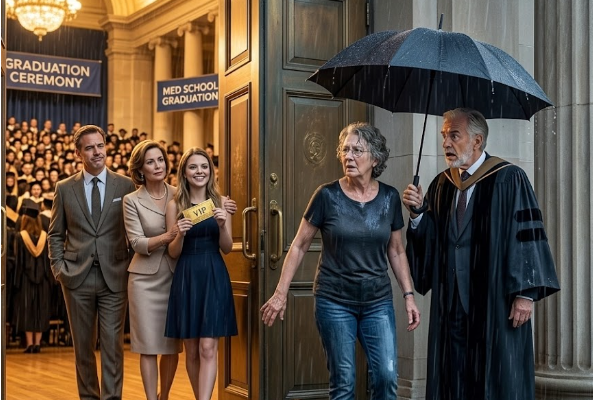
The sky on graduation day was a churning gray, attacking the campus with freezing rain. I stood shivering near the grand hall, my wet hair plastered to my face. Suddenly, a black taxi pulled up to the VIP curb. Out stepped my family.
My stepsister, Haley, twirled in a designer coat, excitedly waving the gold-embossed VIP ticket my father had stolen from me the night before.
“This VIP access is going to make my photos go viral!” she squealed.
I took a deep breath, stepping toward the security doors to explain I didn’t need a ticket because I was part of the graduating class. But before I could speak, my father’s hand shot out. His fingers dug painfully into my arm, physically dragging me backward into the freezing downpour.
“What the hell are you doing?” Thomas hissed, sneering at my soaked appearance. “You’re going to ruin Haley’s photos! You’re just a low-level assistant! Do not embarrass us in front of these wealthy doctors. Go wait in the car!”
My stepmother walked past, her face twisted in pure disgust. “Listen to your father, Clara. Let your sister have her moment. Go hide somewhere out of sight.”
With a final shove, he pushed me toward the wet steps. They walked through the magnificent bronze doors, leaving me completely alone in the storm. For four grueling years, they assumed I was just a lowly assistant, exploiting and crushing me.
Wiping hot tears from my face, I was about to walk away. But suddenly, the relentless rain stopped hitting me. A massive black umbrella shadowed my head.
I looked up, startled, to find Dean Jonathan Bradley, the head of the university’s medical board, wearing his flawless academic regalia. He stared at me in absolute, bewildered shock.
“Dr. Hensley?!” The Dean’s resonant voice cut through the storm. “Why on earth are you standing out here in the freezing rain? The entire Board of Trustees has been frantically looking for you backstage for thirty minutes to prepare for the Valedictorian speech!”…
The heavy, crimson velvet curtains parted with a mechanical hum, and a blinding, pure white spotlight illuminated the massive wooden stage. The auditorium, packed with over three thousand people, fell into a breathless, reverent hush.
Dean Bradley stepped to the gold-embossed podium. He adjusted his microphone, the sound echoing crisply through the state-of-the-art acoustic system.
“Ladies and gentlemen, esteemed colleagues, board of trustees, and honored guests,” his voice rolled over the crowd like thunder. “Today, we gather to graduate a class of extraordinary, brilliant minds. We send a new generation of healers into the world.”
He paused, resting his hands on the edges of the podium, letting the silence stretch until it was almost agonizing.
“But one among them,” he continued, his tone shifting into one of profound awe, “stands entirely apart. She stands as a titan. This individual is not only graduating at the absolute, undisputed top of her class with a dual MD/PhD in pediatric oncology—an incredibly rare feat—but she is also the sole, historic recipient of our university’s highest national honor: the two-million-dollar National Health Research Grant.”
A collective, audible gasp rippled through the massive audience. The sheer magnitude of the achievement sent a shockwave of whispers through the velvet seats.
In the fourth row, Thomas crossed his legs, a smug, envious smirk playing on his lips. He leaned over and muttered into Victoria’s ear. “Imagine having a daughter like that. Two million dollars in federal funding before she’s even out of school. Instead, we have Clara scrubbing bedpans.”
Victoria snorted quietly, rolling her eyes.
“Please join me,” Dean Bradley’s voice boomed, reaching a triumphant crescendo, “in welcoming to the stage our Valedictorian, our keynote speaker, and the undeniable future of oncology research… Dr. Clara Hensley.”
For a fraction of a second, the universe seemed to hold its breath.
Then, the spotlight swung sharply away from the podium, slicing through the darkness to illuminate the wings. I stepped out from the shadows. My posture was regal, my chin held high. The heavy velvet academic robes flowed behind me with every measured, confident step I took toward the center of the stage.
The entire auditorium erupted. Three thousand people rose to their feet in unison, delivering a thunderous, deafening standing ovation that physically shook the wooden floorboards beneath my feet…
My hands were perpetually stripped raw. Even now, standing on the uneven concrete of the driveway, I could smell the caustic, medical-grade chlorhexidine sanitizer clinging to my skin—a scent that had become my permanent perfume over the last four years. My spine felt like a stack of brittle porcelain saucers, grinding together and threatening to shatter with one wrong step after another brutal twelve-hour shift at the university hospital.
I slipped my key into the lock of the back door of my late mother’s house. It used to smell of cinnamon and old books here. Now, the air that rushed out to greet me was cloying, choked with the artificial lavender diffusers Victoria Hensley, my stepmother, bought by the dozen. My father, Thomas Hensley, had spent the last five years systematically erasing my mother’s existence, replacing her solid oak antiques with Victoria’s expensive, tacky mirrored furniture and acrylic chairs.
A burst of shrill, performative laughter erupted from the formal dining room as I stepped into the hallway.
“Oh my god, you guys, this sheer detailing is literally everything.”
It was my stepsister, Haley Hensley. She was standing in the center of the room, illuminated by the harsh, blinding halo of a professional ring light, live-streaming to her followers. She twirled in a designer trench coat that probably cost more than two months of my nursing assistant salary.
I kept my head down, my heavy canvas tote bag bumping against my hip. All I wanted was the dark sanctuary of my cramped basement bedroom. I had been awake for twenty-two hours. Between rotating patient beds in the pediatric oncology ward and secretly agonizing over the final statistical models for my doctoral thesis in the bio-lab, my mind was fraying at the edges.
As I tried to quietly skirt past the dining room archway, Victoria’s sharp voice snapped like a wet towel.
“Clara. Stop creeping around.”
She sat at the head of the dining table, meticulously painting her nails a blood-red crimson. She didn’t bother to look up. With a pointed, manicured finger, she shoved a towering stack of grease-stained porcelain plates toward the edge of the table.
“Clean those up before you go to sleep. Haley has a very important brand partnership shoot tomorrow morning, and we cannot have the kitchen looking like a slum. You know how sensitive she is to visual clutter.”
In the corner, sitting in a leather wingback chair, Thomas finally looked up from his glowing tablet. He was a man who measured worth entirely in profit margins and networking opportunities. His logistics company was currently bleeding money, a fact he tried to hide behind tailored suits and country club memberships.
“Just do it, Clara,” Thomas muttered, waving his hand dismissively. “And try not to make so much noise. I’m waiting for an email from a pharmaceutical rep.”
I stood frozen, the exhaustion heavy in my marrow. My throat tightened. I dug my raw fingers into the strap of my bag, feeling the stiff edge of the envelope I had carried with me all day. I took a deep, shaky breath and pulled it out. It was a single, gold-embossed envelope containing a VIP guest pass.
“Dad,” I started, my voice barely above a rasp. “My graduation ceremony is this Friday. Because of the security protocols this year, I only get one guest ticket. I was really hoping you would come—”
Before the sentence could fully leave my mouth, Thomas was out of his chair. He crossed the room in three long strides, his face twisted in a mask of aggressive irritation. He snatched the thick envelope right out of my trembling fingers.
He didn’t open it. He didn’t look at the university seal. He just turned and held it out to Haley, who had paused her live stream to watch the exchange with a smug, knowing little smile.
“Don’t be entirely selfish, Clara,” Thomas sneered, looking down his nose at me. “Haley’s lifestyle brand desperately needs high-society networking content. The medical school graduation brings in the wealthiest families in the state. You’re just a nurse’s assistant anyway. You’ll be sitting in the back row of some general assembly hall with the rest of the support staff. Let your sister have her moment in a real venue.”
Haley snatched the ticket with a squeal, waving it in front of her ring light. “VIP access! Thanks, Dad. I’m going to get so much amazing footage.”
I stared at the man who shared my DNA. A cold, suffocating knot tightened in my chest. Let your sister have her moment.
It was a truth I had kept fiercely guarded, locked away in the darkest, safest vault of my mind for four grueling years. I hadn’t corrected them when they assumed my grueling clinical hours were just low-level assistant work. I hadn’t told them because I knew Thomas would instantly try to exploit my connections, or worse, Victoria would find a way to sabotage my funding out of pure, venomous jealousy.
They didn’t know I wasn’t graduating from a community college certificate program. They had no idea I was graduating from the university’s elite, top-tier medical school.
I didn’t say a word. I turned on my heel, the plates left untouched, and descended the creaking stairs to my windowless basement room.
As I reached the bottom step, the floorboards above my head creaked. The house was old, and the air vents carried every whisper like a megaphone. I stood dead still in the dark as Victoria’s hushed, conspiratorial voice drifted down through the aluminum grating.
“Are the papers drafted?” she asked.
“Yes,” Thomas replied, his tone devoid of any paternal warmth. “Once this ridiculous graduation is over on Friday, we’ll present her with the eviction notice. She’s officially eighteen now; she has no legal claim to her mother’s estate anymore. Haley needs that basement cleared out. It’s going to be her new personal content studio.”…
The morning of the ceremony, the sky over University Hall was a bruised, violently churning gray. The rain didn’t just fall; it attacked in heavy, freezing sheets, turning the grand limestone pillars of the campus into slick, imposing monoliths.
I stood near the edge of the sprawling stone courtyard, the hem of my black graduation gown plastered wetly to my ankles. The cold seeped through the thin soles of my sensible shoes, chilling me all the way to my teeth. I had arrived early, needing a moment to breathe before the chaos swallowed me, only to watch a sleek black taxi pull up to the VIP curb.
Out stepped my family.
Haley emerged first, completely shielded by a massive golf umbrella held by the taxi driver. She wore a pristine, cream-colored designer trench coat, completely inappropriate for the weather but perfect for a photograph. In her manicured hand, she clutched my stolen gold-embossed VIP ticket, waving it around as if she had won a lottery. Victoria stepped out behind her, complaining loudly about the humidity ruining her blowout, while Thomas adjusted his silk tie, his eyes already darting around, scanning the crowd of arriving families for anyone wealthy enough to pitch his failing logistics company to.
They looked like a parody of a loving family.
I took a breath, stepping out from the meager shelter of a stone archway. I needed to get inside. As I approached the main security checkpoint, Thomas spotted me. His face instantly contorted with profound embarrassment.
I stepped toward the velvet rope to explain to the security guard that I didn’t require a guest ticket because I was part of the graduating doctoral class. Before I could even open my mouth, Thomas’s hand shot out. His fingers dug painfully into the meat of my upper arm, his grip like a vice. With a violent jerk, he pulled me backward, physically tearing me out of the queue and dragging me toward the unsheltered, rain-slicked steps.
“What the hell do you think you’re doing?” Thomas hissed, his voice a furious, dripping sneer. He looked at my soaked hair and the simple black gown I wore over my dress. “You’re going to ruin Haley’s photos looking like a drowned rat. I told you yesterday, you’re just an assistant. You don’t belong in the VIP entrance. Go wait in the car. Do not embarrass us in front of these wealthy doctors!”
Victoria walked past, flanked by Haley. She paused just long enough to look me up and down with an expression of sheer, unadulterated disgust. She gave a cold, dismissive little laugh as she adjusted a stray lock of Haley’s perfectly styled hair.
“Listen to your father, Clara. Let your sister have her moment. Go dry off somewhere out of sight.”
Thomas released my arm with a final, forceful shove toward the bottom of the exterior stairs. My heel slipped on the wet stone, and I stumbled, barely catching my balance on the freezing bronze railing.
I stood completely alone in the freezing downpour. I watched the heavy, magnificent bronze doors of the grand hall swing shut behind them, cutting off the warm golden light from inside. The absolute, staggering betrayal fractured something deep within my chest. They weren’t just oblivious; they were actively, joyfully cruel. The rain mixed with the hot tears spilling over my eyelashes, blurring the world into a gray smear.
Wiping the cold rain from my face with a trembling hand, I turned away from the doors. My spirit felt scraped hollow. Maybe I couldn’t do this. Maybe I should just walk away.
But before I could take a single step down into the flooded street, the relentless pelting of rain on my head suddenly stopped.
A shadow fell over me. I looked up, startled, to find a massive, black umbrella held firmly over my head. Standing beside me was the imposing, aristocratic figure of Dean Jonathan Bradley, the head of the university’s medical board. He was impeccably dressed in his full academic regalia, the purple velvet of his station rich and dry.
He stared down at me, his silver eyebrows drawn together in an expression of absolute, bewildered shock.
“Dr. Hensley?” Dean Bradley’s deep, resonant voice cut through the noise of the storm. “Why on earth are you standing out here in the freezing rain? The board of trustees has been frantically looking for you backstage for thirty minutes!”
The air backstage was entirely different from the rest of the world. It was thick with the scent of polished leather, ancient paper, and the expensive, hothouse floral arrangements that lined the corridors. It was the scent of untouchable, institutional power.
The moment Dean Bradley ushered me through the private faculty entrance, the atmosphere shifted from panic to synchronized, hyper-focused action. Two administrative assistants practically materialized out of thin air, rushing toward me with thick, heated cotton towels. They gently draped them over my shivering shoulders, dabbing the rainwater from my face with careful reverence.
“We have her! Dr. Hensley is here!” one of the assistants called out down the hall.
From an adjacent dressing room emerged Dr. Charles Fletcher, the internationally renowned head of the pediatric oncology department and my personal thesis advisor. His usually stern face broke into a massive, deeply affectionate smile. He carried something draped carefully over his arm.
“My god, Clara, we thought we’d lost our star,” Dr. Fletcher chuckled warmly. He stepped forward as I shrugged off the wet towels. With practiced, deliberate care, he lifted the heavy, magnificent velvet doctoral hood.
The fabric felt incredibly weighty as he draped it over my shoulders, smoothing the brilliant green and gold satin lining that designated my dual MD/PhD status. It wasn’t just clothing; it was a coronation.
“You look magnificent, Clara,” Dr. Fletcher said softly, his eyes shining with unshed tears. He placed a warm, fatherly hand on my shoulder. “Your research on cellular apoptosis in pediatric leukemia… it’s going to change the world. Your late mother would have been so incredibly proud of the history you are making today.”
I looked at my reflection in the massive gilded mirror leaning against the brick wall. I blinked, barely recognizing the woman staring back. The exhausted, invisible nurse’s assistant in stained scrubs was gone. In her place stood a sovereign force, draped in the armor of unparalleled academic achievement.
I earned this, I thought, the realization finally anchoring in my bones. Every sleepless night. Every tear. It was all real.
Meanwhile, just on the other side of the heavy velvet curtain, a vastly different reality was playing out.
In the fourth row of the auditorium’s velvet-lined VIP section, Thomas and Victoria were holding court. They had commandeered the seats I had bled for, practically shouting to be heard over the low murmur of the sophisticated crowd.
“Oh, absolutely,” Victoria lied smoothly, adjusting her heavy pearl necklace and flashing a brilliant, fake smile to the wealthy neurosurgeon’s family sitting next to them. “Our Haley is practically the guest of honor today. She’s a major lifestyle influencer, you see. We had to leave our other daughter at home, unfortunately. She’s just a low-level assistant, very sweet, but she doesn’t really belong in a high-caliber room like this. She gets so intimidated.”
Thomas nodded proudly, puffing out his chest. He reached into his tailored breast pocket, his fingers tapping affectionately against a folded legal folder. It was the eviction notice. He planned to slap it onto my mattress the second they returned to the house.
“It’s all about surrounding yourself with excellence,” Thomas boasted to the surgeon, his eyes darting around the room hungrily. “Actually, I own a logistics firm that specializes in—”
Backstage, the warning chimes echoed through the PA system, signaling the five-minute mark. The lights in the grand hall began to slowly dim, bathing the audience in a hushed, expectant twilight.
Dean Bradley walked up beside me, holding a heavy, leather-bound binder containing the run-of-show and my keynote address. He leaned in, his expression turning intensely serious.
“Clara, I must warn you before you step out there,” he murmured, his voice low enough that only I could hear. “We have some incredibly powerful global investors sitting in the front rows today. Word of your grant has leaked. Specifically, Marcus Sterling, the CEO of the Sterling Pharmaceutical Conglomerate, is in the audience. I believe your father’s logistics company has been desperately begging his office for a distribution contract for the last two years.”
My heart skipped a beat, a sudden, sharp thrill of pure adrenaline flooding my veins.
Dean Bradley handed me the leather binder, his eyes glinting with a fierce, knowing pride. “They are all waiting for you. Are you ready to change your life?”
The heavy, crimson velvet curtains parted with a mechanical hum, and a blinding, pure white spotlight illuminated the massive wooden stage. The auditorium, packed with over three thousand people, fell into a breathless, reverent hush.
Dean Bradley stepped to the gold-embossed podium. He adjusted his microphone, the sound echoing crisply through the state-of-the-art acoustic system.
“Ladies and gentlemen, esteemed colleagues, board of trustees, and honored guests,” his voice rolled over the crowd like thunder. “Today, we gather to graduate a class of extraordinary, brilliant minds. We send a new generation of healers into the world.”
He paused, resting his hands on the edges of the podium, letting the silence stretch until it was almost agonizing.
“But one among them,” he continued, his tone shifting into one of profound awe, “stands entirely apart. She stands as a titan. This individual is not only graduating at the absolute, undisputed top of her class with a dual MD/PhD in pediatric oncology—an incredibly rare feat—but she is also the sole, historic recipient of our university’s highest national honor: the two-million-dollar National Health Research Grant.”
A collective, audible gasp rippled through the massive audience. The sheer magnitude of the achievement sent a shockwave of whispers through the velvet seats.
In the fourth row, Thomas crossed his legs, a smug, envious smirk playing on his lips. He leaned over and muttered into Victoria’s ear. “Imagine having a daughter like that. Two million dollars in federal funding before she’s even out of school. Instead, we have Clara scrubbing bedpans.”
Victoria snorted quietly, rolling her eyes.
“Please join me,” Dean Bradley’s voice boomed, reaching a triumphant crescendo, “in welcoming to the stage our Valedictorian, our keynote speaker, and the undeniable future of oncology research… Dr. Clara Hensley.”
For a fraction of a second, the universe seemed to hold its breath.
Then, the spotlight swung sharply away from the podium, slicing through the darkness to illuminate the wings. I stepped out from the shadows. My posture was regal, my chin held high. The heavy velvet academic robes flowed behind me with every measured, confident step I took toward the center of the stage.
The entire auditorium erupted. Three thousand people rose to their feet in unison, delivering a thunderous, deafening standing ovation that physically shook the wooden floorboards beneath my feet.
But I didn’t look at the crowd. I looked exactly at the fourth row, center aisle.
I watched the smug smile on Thomas’s face evaporate so violently that I could almost hear his jaw physically click out of place. His eyes bulged, wide and unblinking, staring up at me as if I were a ghost that had just crawled out of a grave.
Beside him, Victoria’s artificially tanned face drained of all blood, turning an ashen, sickly, ghostly white. Her perfectly manicured hand went limp, and her thousand-dollar designer purse slipped from her lap, hitting the concrete floor with a heavy, unnoticed thud.
Haley, who had been holding her phone up to record the mysterious genius, froze. Her mouth fell open in a silent scream. The phone slipped through her trembling, sweat-slicked fingers, clattering loudly against the legs of the chairs.
They were paralyzed. Stripped of their delusions in front of the most powerful people in the state, they stared up at the stage, drowning in absolute, suffocating terror.
I reached the podium. I let the applause wash over me for a long, luxurious moment before I gently raised a hand. The room quieted immediately, eager for every word.
I adjusted the microphone. I leaned in, my eyes locking onto my trembling, hyperventilating father.
“To those who explicitly told me to step aside so that others could have their moment,” I said. My voice was crystal clear, completely devoid of fear, dripping with a quiet, lethal authority. The microphone picked up the icy edge of my tone, projecting it into the very marrow of the audience. “Thank you. Your cruelty forced me to build a stage where I no longer need your permission to stand.”
The silence in the room was absolute, pregnant with the brutal, unspoken context of my words.
Before the applause could resume, the pressure inside Thomas’s fragile, narcissistic ego violently ruptured. He couldn’t process the reality. He couldn’t accept that the servant he planned to evict was the queen of the room.
He stood up, kicking his chair back so hard it slammed into the knees of the neurosurgeon behind him. He was trapped in a blind, desperate, foaming panic.
“This is a mistake!” Thomas screamed, his voice cracking, pointing a shaking finger up at the stage. “She’s a liar! She’s not a doctor! She’s just a nurse’s assistant! She stole someone’s identity! Security! Arrest her immediately!”
The reaction was instantaneous and violently decisive. The elite medical community did not tolerate disruptions, let alone unhinged attacks on their crown jewel.
Within seconds of Thomas’s screaming outburst, three burly, heavily armed campus security guards materialized from the aisles. They didn’t ask questions. Two of them flanked Thomas, grabbing his flailing arms and pinning them forcefully behind his back, twisting just enough to make him gasp in pain.
“Sir, you are disrupting a federally funded academic ceremony. You are trespassing. Move your feet now, or you will be carried out in zip-ties,” the lead guard growled, his voice brooking no argument.
They dragged him, still shouting semi-coherent, red-faced demands, backward up the aisle. Every head in the auditorium turned to watch the spectacle. The wealthy doctors, the investors, the pharmaceutical CEOs—they all glared at him with an undisguised, aristocratic disgust.
Victoria and Haley were practically vibrating with deep, burning humiliation. Surrounded by the sneers of the high society they so desperately wanted to belong to, they had no choice. They grabbed their coats and scurried up the aisle behind the guards, heads ducked down, fleeing the auditorium like frightened, pathetic rodents fleeing a sinking ship.
I watched them go, feeling nothing but a cool, refreshing breeze where my anxiety used to live. I turned my attention back to the audience.
Unfazed by the interruption, I delivered my keynote. I spoke passionately, weaving the raw emotional reality of pediatric suffering with the brilliant, cutting-edge molecular pathways my research had uncovered. I didn’t just give a speech; I painted a vision of a future without fear. By the time I delivered my final, resonant sentence, there wasn’t a dry eye in the house. Even the stoic board of trustees were openly weeping. The room erupted onto its feet once again, the applause this time deafening, a physical validation of my existence.
Two hours later, the contrast between our lives became a permanent chasm.
I was sitting in Dean Bradley’s private, wood-paneled office. The air smelled of expensive espresso and success. I held a Montblanc pen, signing my name across the bottom line of my official two-million-dollar federal research contract. Dr. Fletcher stood behind me, beaming like a proud father.
Meanwhile, three blocks away, Thomas and Victoria were huddled in the corner booth of a cheap, fluorescent-lit coffee shop, seeking shelter from the lingering rain. Their phones were buzzing relentlessly on the sticky laminate table. Haley had forgotten to end her live stream when she dropped her phone. The entire internet had witnessed Thomas’s screaming, humiliating meltdown. Haley’s inbox was flooded with notifications—not from fans, but from her major sponsors, dropping her lifestyle brand by the minute due to the viral embarrassment.
Before Thomas could even begin to process the catastrophic loss of his daughter’s income, a tall, imposing man in a bespoke gray suit walked up to their table. He didn’t introduce himself warmly. He simply laid a thick, legally binding document directly over Thomas’s cooling coffee cup.
“Mr. Hensley?” the man asked, his tone clipped and professional. “I am Arthur Vance. I represent Dr. Clara Hensley. This document serves as an immediate injunction freeze on all of your personal and business bank accounts.”
Thomas stared at the paper, his mouth opening and closing like a suffocating fish. “What? On what grounds?!”
“On the grounds of a civil lawsuit contesting your documented, illegal attempt to fraudulently transfer and liquidate her late mother’s estate,” Mr. Vance replied smoothly, buttoning his jacket. “My client has also filed a restraining order. If you step foot near her property or her laboratory, you will be jailed. We will see you in federal court.”
Back in the Dean’s office, I capped the pen, a profound sigh of relief leaving my lungs. It was done. The house was safe. I was safe.
As I stood up to leave, the heavy oak door opened. Dr. Fletcher walked in, accompanied by a stern, incredibly wealthy-looking older man wearing a tailored Italian suit that radiated quiet, old money.
“Clara,” Dr. Fletcher said, his eyes dancing with excitement. “I’d like you to meet someone. This is Elias Thorne. He is the head of the Global Pharmaceutical Alliance, and coincidentally, Marcus Sterling’s chief corporate competitor.”
Mr. Thorne stepped forward, extending a calloused hand. “Dr. Hensley. I just watched your speech. It was the most brilliant defense of targeted molecular therapy I have heard in a decade.” He paused, his gaze turning intensely sharp. “I want to personally fund the construction of your private research laboratory. Unlimited capital. But I will only do it on one very specific condition.”
One year later.
The air in the Hensley Oncology Lab was perfectly climate-controlled, carrying the faint, clean scent of ozone and sterilized glass. Located in the newly constructed, sunlit wing of the university’s research center, it was widely considered the crown jewel of the institution.
I stood in the center of my pristine, state-of-the-art private laboratory. The walls were lined with millions of dollars of sequencing equipment, humming with quiet, obedient power. I wore a crisp, immaculate white lab coat, my name—Dr. Clara Hensley, MD/PhD, Director—embroidered in navy blue thread above my heart.
I leaned against my glass desk, looking down at a beautiful, silver-framed photograph of my mother. She was smiling, her eyes bright and full of life. I kept the house, Mom, I thought. I kept the promise.
I was no longer a frightened girl hiding in a basement. I was a globally recognized authority in my field, fiercely financially independent, and surrounded every day by a team of brilliant researchers who respected my intellect, not my subservience.
A soft, hesitant knock on my heavy glass office door pulled me from my thoughts. My lead assistant, a bright-eyed grad student named Sarah, walked in. She looked deeply uncomfortable, clutching an iPad to her chest.
“Dr. Hensley? I’m so sorry to interrupt your data review,” Sarah stammered. “There’s a man out in the main lobby. He claims to be your father. He… well, he doesn’t have an appointment, and security tried to turn him away, but he’s practically begging to see you for just two minutes.”
I felt a faint, distant prickle at the back of my neck, but the panic that used to accompany his name was completely gone. In its place was a vast, arctic calm.
“It’s fine, Sarah. I’ll handle it.”
I stepped out of my office, the automatic glass doors parting with a soft hiss, and walked into the expansive, marble-floored lobby.
Thomas stood near the security desk. The last twelve months had not been kind to him. The arrogant, tailored businessman was gone. He looked aged by a decade, his posture slumped, his suit slightly wrinkled and out of style. The lawsuit I had filed exposed years of his financial mismanagement. His logistics company had gone bankrupt mere months after the public scandal of my graduation. Victoria, true to her nature, had filed for divorce the moment the bank accounts were frozen, taking what little liquid cash he had left and moving to Florida with Haley.
He was completely, utterly broken.
When he saw me walking toward him, flanked by security, his bloodshot eyes watered. He looked at my pristine white coat, at the massive steel letters spelling my name on the wall behind me.
“Clara… please,” Thomas whispered, his voice trembling with a pathetic, raw desperation. He took a hesitant step forward, but the security guard put a hand on his chest, stopping him. “Clara, I’m your father. I… I made a terrible mistake. I was blind. But I’m destitute. The bank is taking my apartment tomorrow. Just… just sign a single recommendation letter for me. Introduce me to Elias Thorne. You have so much power now, so much influence. Please, save my life.”
I stopped a few feet away from him. I looked at the man who had pushed me into the freezing rain, who had tried to steal my mother’s legacy to build a TikTok studio. I searched my heart for a flicker of anger, or perhaps a lingering drop of hatred.
I found absolutely nothing. Only a cold, clinical, profound indifference. He wasn’t a monster anymore. He was just a sad, irrelevant man.
“I’m sorry, Thomas,” I said softly. My voice was calm, steady, and utterly devoid of empathy. I purposefully used his first name, drawing an immediate, unbreakable boundary between us.
His face crumbled at the sound of his name on my lips.
“But as you once told me,” I continued, tilting my head slightly, “when you’re in the presence of greatness, you have to get out of the way. You have to let the real achievers have their moment.”
I didn’t wait for a response. I didn’t need to see his tears. I simply turned my back on him. I walked away, my white coat billowing slightly, passing through the secure glass doors of my laboratory, leaving him standing completely alone in the cold, unforgiving lobby of the empire I had built without him.
As I sat back down at my desk, exhaling a breath I felt like I had been holding for twenty years, the silence of the lab was broken.
My secure personal phone chimed with an incoming, encrypted international call. The caller ID flashed briefly: Stockholm, Sweden.
I picked up the receiver, my heart suddenly hammering against my ribs. I pressed the phone to my ear, listening to the heavy, prestigious, accented voice of the chairman of the Nobel Committee’s selection board.
As the man spoke the words that would immortalize my name in the annals of medical history forever, I closed my eyes. A beautiful, victorious, tearful smile spread slowly across my face. I looked at the framed picture on my desk.
“We did it, Mom,” I whispered to the empty, perfect room. “We finally did it.”
My name is Laura Mitchell, and until last spring, I still believed blood meant something. I believed family could disappoint you, hurt you, even embarrass you, but I never believed family could look you in the eye while quietly planning to destroy you. My older brother Ethan had always been the wild one — bad jobs, bad friends, bad timing. But when he called me crying after losing his apartment, I opened my door.
Advertisement
I let him sleep in the guest room. I let his girlfriend Maya come and go. I even added him as a temporary authorized user on my accounts so he could help pay shared bills while he stayed with us. I told myself it was temporary. I told myself he was my brother. That was the stupidest thing I ever believed.
On a Monday morning, I opened my banking app while packing Emily’s lunch. At first I thought the app had glitched. My checking account was almost empty. Then I checked savings — the emergency fund I had built one painful paycheck at a time over ten years. Gone. Every cent. My hands shook so badly I could barely call the bank. The woman on the phone sounded sorry, but her words cut straight through: “Ma’am, the transfers were completed by an authorized user.” Authorized by Ethan. I called him once. Voicemail. Twice. Voicemail. Then I texted him, begged him, threatened him. Nothing.
By noon I walked into the guest room and found it stripped bare. His clothes were gone. Maya’s makeup bag was gone. Even the cheap spare phone he kept in the nightstand. That was when I understood. He had not panicked. He had not made one bad decision. He had planned all of it. He had folded clothes while I made dinner. He had carried bags out while Emily slept. He had left no note, no apology, no hesitation. Just the faint smell of cologne. I sank onto the kitchen floor and sobbed until my throat hurt. Rent was due. Groceries were low. Emily had school fees coming. I felt the walls closing in while my own brother disappeared with everything I had worked for.
Advertisement
Emily had never liked Maya. She never said it dramatically — Emily was a careful child, observant in the quiet corners, noticing when people smiled with their mouths but not their eyes. One night while I was washing dishes she came beside me and whispered: “Does Uncle Ethan have to stay forever?” I laughed, thinking she was just a child who wanted her space back. “No, honey. He’s just getting back on his feet.” Emily looked toward the hallway where Ethan and Maya were whispering behind the guest room door. “He doesn’t sound like he’s getting better,” she said. “He sounds like he’s planning.” I should have listened. Instead I kissed the top of her head and told her not to worry.
The worst part is how normal the betrayal looked while it was happening. Ethan bought groceries one afternoon and made a big show of leaving the receipt on the counter. He fixed the loose handle on my pantry door. He drove Emily to soccer practice twice when I had late meetings. He asked about my mortgage, my utilities, my savings, my emergency fund — making it all sound like concern. “You’ve always been good with money,” he said one evening, leaning against the fridge. “I don’t know how you do it.” I remember feeling proud in the smallest, saddest way. As a single mother, I had built my stability dollar by dollar. Every overtime shift, every packed lunch, every vacation I skipped had gone into those accounts. That money was not luxury. It was safety — rent if I got sick, groceries if my hours got cut, braces for Emily one day, a car repair without choosing between heat and food. Ethan knew that. And he took it anyway.
Advertisement
That night, Emily sat beside me at the kitchen table surrounded by bank papers, police report notes, and a list of bills I no longer knew how to pay. She watched me with eyes too serious for ten, swinging her legs slowly. Then she said it: “Mom, don’t worry. I handled it.” I looked up, exhausted. “Honey, this is adult stuff.” She nodded. “I know. That’s why I did what I did.” I was too tired to ask. I thought she meant she had prayed, or hidden her allowance, or made some small childlike plan. I did not ask because I could not bear to hear something sweet and helpless when I needed a miracle.
Two days of bank calls and police forms passed in a blur. The bank officer took my report carefully but warned me that voluntary account access complicated everything. The police officer was sympathetic but kept asking: “Was there anything in writing about what he could or couldn’t do?” There was not. Because I had trusted him. Because I had been foolish in the exact way loving people are when someone they grew up with asks for help.
Then Wednesday morning, Ethan’s name lit up my phone. For two days I had called him until my fingers hurt. He had ignored every one. Now he was calling me. And he was screaming. “What did you do, Laura? What did you do?” His voice cracked through the speaker — high, furious, terrified all at once. Emily was at the table, her cereal untouched. She went completely still. I could see her face change in that quiet way children have when they know adults are about to discover something they were not supposed to know. “Where is my money, Ethan?” I said. There was a sound like a slammed door, then Maya’s voice hissing: “Hang up. Hang up now.” But Ethan did not hang up. “You think you’re so smart? Sending that stuff is going to scare me? Maya’s bank account is frozen. Frozen. They called her mother.” I gripped the counter. I had not sent anyone anything. I had not frozen anything.
Advertisement
Across the kitchen, Emily slowly lowered her spoon. “Mom,” she said softly. Ethan heard her voice. He went silent. Then he whispered, “Emily?” Something in his tone made my skin crawl. My daughter looked at the phone as if it were a snake on the table. Then she lifted her chin. “You shouldn’t have taken Mom’s money,” she said. I put the call on speaker. Emily’s lower lip trembled once, then pressed flat. “He borrowed my tablet Saturday night,” she whispered. “I was supposed to be asleep. But I came downstairs for water and heard them talking. Maya said, ‘Once the transfer clears, we leave before Laura wakes up.’”
Emily reached into her backpack and pulled out her small blue tablet — cracked corner, stickers on the case. She opened a folder I had never seen before and turned the screen toward me. The first file was a video, recorded from a low angle in the guest room, partly blocked by a pile of clothes but with clear audio. Maya’s voice came first: “How much can you move before they flag it?” Then Ethan: “Enough. She never checks at night. She trusts me.” I put one hand over my mouth. The recording continued. Maya: “And your sister won’t call the cops?” Ethan laughed. That laugh was worse than any confession. “Laura? No. She’ll cry first. Then she’ll try to fix it quietly because she doesn’t want Emily scared. By the time she grows a spine, we’ll be gone.” My eyes burned but I did not cry. Not then. Something colder was building in me.
Advertisement
Emily tapped another file. Ethan had borrowed her tablet one evening because his phone was dead. He had forgotten it was still logged into his ride-share account. Emily had found the trip history. Every location. Hotels. A storage unit forty minutes away. An address in another state. She had screenshotted everything before logging him out. A third file showed Maya’s payment account — Ethan had used the tablet to transfer one chunk of my money there. Emily had found the routing number and sent everything, the screenshots, the recording, and Maya’s account details, to the fraud tip line of the state attorney general’s office, a number she had found by googling “what to do when someone steals your family’s money.” On the phone, Ethan stopped breathing loudly. Maya whispered something sharp in the background. Then the line went dead.
I sat in the kitchen staring at my ten-year-old daughter. She had not cried. She had not panicked. She had gathered evidence, identified where the money went, and reported it to the right authority, all while I was too broken to think straight. “Emily,” I finally said, “how did you know to do that?” She shrugged in the careful way she shrugged when she did not want credit. “I asked my teacher once what someone should do if they think someone might steal from their family. She said document everything and report it to the right people. So I did.” I pulled her into a hug so hard she made a small sound of surprise. Then she hugged me back and did not let go for a long time.
Advertisement
The state attorney general’s fraud office called me three days later. They had received Emily’s report and flagged it because the documentation was detailed enough to be taken seriously. Within a week, the transfers were traced. Maya’s account, which held a portion of my money, was frozen pending investigation. The storage unit Emily had found turned out to hold property that had been moved from my house — items I hadn’t even noticed were missing. A negotiated settlement returned most of my money within two months. Not every cent. But enough to breathe again.
Ethan and Maya were eventually charged with fraud and theft. He called once more, from a number I didn’t recognize. His voice was smaller that time. He said he had been desperate. He said Maya had pressured him. He said he had always planned to pay me back. I listened to all of it. Then I said: “You told her I would cry first and try to fix it quietly. You were right about the crying. But you forgot about Emily.” And I hung up. My daughter had seen what I had missed. She had moved quietly through that crisis the same way she moved through everything — carefully, seriously, without drama or hesitation. While I was on the kitchen floor falling apart, she was at her desk taking notes.
Advertisement
It took me months to fully understand what that meant. Not just what she had done, but what it said about who she already was at ten. She had watched someone take advantage of her mother, felt the shift in the house that adults try to hide from children, and decided she was not going to wait for someone else to fix it. She did not have account access or legal authority. She had a tablet, a cracked screen, a question she had once asked her teacher, and the quiet stubbornness of a child who refused to let injustice win simply because she was small. That stubbornness had saved us. I thought I was raising her to feel safe. She was raising herself to be capable. The difference between those two things, I think, is where strength actually comes from.
Part 2 — The Bride Won’t Stand “Nick…”
Renee’s smile vanished.
The ballroom was filled with applause as guests raised their glasses for the first family toast.
Everyone stood.
Except the bride.
Nicholas leaned closer.
“What?”
“I can’t get up.”
At first, he laughed.
“Stop messing around.”
“I’m serious.”
Renee gripped the edge of the table and pushed.
Nothing.
The chair refused to move.
A tiny crack appeared in her perfect smile.
Around them, guests were beginning to notice.
“Is she okay?”
“What’s happening?”
“Why isn’t the bride standing?”
The toastmaster awkwardly lowered his microphone.
Nicholas bent down beside her.
“Come on.”
He grabbed her arm and pulled.
The chair lifted with her.
Gasps rippled through the ballroom.
Renee immediately dropped back down.
The chair slammed against the floor.
A nervous laugh escaped from somewhere in the crowd.
Then another.
Then silence.
Her mother rushed forward.
“Renee?”
“I don’t know what’s wrong!”
She tried standing again.
The chair came with her.
This time everyone saw it.
The elegant white chair was attached to the back of her wedding dress.
A wave of whispers swept through the room.
Nicholas’s face turned pale.
I watched from my seat beside Rosario.
My wife looked confused.
“Poor girl,” Rosario whispered. “Maybe her dress got caught.”
I swallowed hard.
Even now, Rosario’s first instinct was kindness.
Toward the woman who had wanted to destroy her.
Across the room, Renee was breathing faster.
“Get it off!”
Hotel staff hurried over.
One of them crouched beside the chair.
The man’s expression changed immediately.
He touched the edge of the seat.
His fingers stuck.
He frowned.
Then he smelled the substance.
As soon as he recognized it, his eyes widened.
“Sir,” he said quietly to Nicholas.
“What?”
The employee looked uncomfortable.
“There’s glue on this chair.”
The ballroom fell silent.
Complete silence.
Nicholas froze.
Renee froze.
And for the first time that day, fear appeared in both of their eyes.
“Glue?” someone repeated.
“Why would there be glue on a wedding chair?”
“Was this some kind of prank?”
Questions exploded across the room.
The employee stood up.
“There is a large amount of industrial adhesive on this seat.”
Industrial adhesive.
Not spilled wine.
Not a torn dress.
Not an accident.
Someone had put it there on purpose.
I saw Nicholas glance toward the head table.
Toward the seating cards.
Toward the chair.
Then toward me.
Our eyes met.
My son suddenly looked like a man staring over the edge of a cliff.
“Dad…” he whispered.
I said nothing.
I simply lifted my glass and took a slow sip of water.
Rosario looked between us.
“Bill?”
“Hmm?”
“Why does Nicholas look so frightened?”
I kept my eyes on my son.
Because I knew something he didn’t.
The glue wasn’t the real problem.
The real problem was sitting inside my tuxedo pocket.
A phone.
A phone containing every word Nicholas and Renee had spoken behind that curtain.
And before this night was over, the entire ballroom was going to hear it.
Part 3 — The Questions Begin
The silence didn’t last long.
It never does when two hundred wealthy guests smell scandal.
“Glue?”
“Did he say glue?”
“On a wedding chair?”
The whispers spread across the ballroom like wildfire.
The hotel employee looked uncomfortable.
“Sir, this appears to be industrial adhesive.”
Industrial adhesive.
The exact words hit Nicholas like a hammer.
His face lost all color.
Renee immediately pointed at the staff.
“This is your fault!”
The employee blinked.
“Ma’am?”
“You people set up the room. Someone obviously made a mistake.”
Several guests nodded uncertainly.
For a moment, it looked like the lie might work.
Then another employee walked over.
An older man.
The banquet manager.
He examined the chair carefully.
Then he shook his head.
“No, ma’am.”
Renee froze.
The manager continued.
“This adhesive wasn’t accidentally spilled.”
The room became quiet again.
“It was deliberately applied around the entire seat.”
A murmur swept through the crowd.
Deliberately.
That single word changed everything.
Because accidents happen.
Plans don’t.
Across the table, Nicholas couldn’t stop staring at me.
He knew.
He knew exactly who that chair had originally been assigned to.
And he knew I knew.
Rosario leaned closer.
“Bill, what’s going on?”
I forced a smile.
“I think someone made a very bad decision.”
Little did she know how true that was.
Part 4 — A Mother’s Kindness
While the guests whispered, Rosario did something that nearly broke my heart.
She stood.
Slowly.
Carefully.
Using her cane.
Then she walked toward Renee.
Toward the woman who had wanted to humiliate her.
“Rosario, sit down,” I said quietly.
But she was already moving.
When she reached the head table, she placed a gentle hand on Renee’s shoulder.
“Oh, sweetheart,” Rosario said.
“You must be so embarrassed.”
Renee couldn’t even look at her.
Rosario continued.
“Don’t worry. These things happen.”
I watched several guests lower their eyes.
Because they were witnessing something extraordinary.
Kindness.
Pure kindness.
Given to someone who didn’t deserve it.
Rosario smiled warmly.
“The important thing is that nobody got hurt.”
Nobody got hurt.
The words struck Nicholas like a bullet.
Because someone had almost gotten hurt.
His mother.
His own mother.
For the first time all evening, guilt appeared in his eyes.
Real guilt.
Not fear.
Not panic.
Guilt.
Rosario returned to our table.
She never noticed the tears forming in the eyes of Nicholas’s aunt.
Or the expressions on the faces of several family members.
Because in that moment, everyone saw exactly who Rosario was.
And exactly who Nicholas and Renee were not.
Part 5 — The Missing Phone
The banquet manager finally announced a short break.
Guests scattered into small groups.
The gossip became impossible to contain.
At the head table, Nicholas pulled Renee aside.
“What did you do with your phone?”
Renee frowned.
“My phone?”
“The one you used earlier.”
Her eyes widened.
The color drained from her face.
“Oh my God.”
“What?”
“I left it on the table.”
Nicholas looked around frantically.
The phone wasn’t there.
Neither was the small tripod she’d used.
For several terrifying seconds, neither of them spoke.
Then Renee whispered:
“Do you think someone found it?”
Nicholas already knew the answer.
His eyes slowly moved across the ballroom.
Until they landed on me.
I was sitting beside Rosario.
Calm.
Silent.
Holding a glass of wine.
Watching.
Nothing more.
Nothing less.
But Nicholas suddenly remembered something.
When he and Renee had finished setting their trap, they had walked away.
And someone had been nearby.
Someone who had every reason to check that chair afterward.
Someone who knew exactly what industrial glue looked like.
His father.
“He’s got it,” Nicholas whispered.
Renee’s breathing became shallow.
“What?”
“He’s got the phone.”
For the first time all day, true fear entered Renee’s eyes.
Because if William Aranda had that phone…
Then he had everything.
And from across the ballroom, I watched them panic.
The same way they had hoped Rosario would panic.
The difference was simple.
Their suffering was only beginning.
Part 6 — Father and Son
Nicholas found me near the ballroom windows.
The city lights glittered beyond the glass.
For a moment, neither of us spoke.
I remembered teaching him how to ride a bicycle.
He looked like he remembered it too.
Then reality returned.
“Give me the phone.”
No greeting.
No apology.
No shame.
Just a demand.
I took a sip of water.
“What phone?”
His jaw tightened.
“Dad, stop playing games.”
“Games?”
I looked at him carefully.
“Isn’t that an interesting choice of words?”
His eyes darted around to make sure nobody was listening.
“If you have Renee’s phone, give it back.”
I set my glass down.
“Why?”
Nicholas froze.
“Because it’s hers.”
“That’s not a reason.”
His face darkened.
“Dad.”
“No, Nicholas.”
For the first time all night, my voice hardened.
“If there’s nothing on that phone to worry about, why are you so desperate to get it back?”
He opened his mouth.
Then closed it.
Because there was no answer.
Only guilt.
Part 7 — Cracks in the Foundation
Word was spreading.
I could see it happening table by table.
Guests whispered.
Relatives exchanged looks.
Business partners watched quietly.
The wedding no longer felt like a wedding.
It felt like an investigation.
At one table, I spotted Nicholas’s aunt Elena speaking with Rosario.
“What happened with Renee’s chair?” Elena asked.
Rosario smiled sadly.
“I don’t know.”
Then she added:
“I just hope nobody was trying to be cruel.”
The sentence hit harder than she realized.
Because several nearby guests suddenly became very uncomfortable.
Meanwhile, Renee was losing control.
Her makeup artist was trying to clean glue from her dress.
The more they worked, the worse it looked.
The beautiful gown now carried visible damage.
And with every torn thread, Renee became more agitated.
“This is a disaster.”
Her mother tried comforting her.
“It’s only a dress.”
“It’s not only a dress!”
The sharpness in Renee’s voice shocked everyone nearby.
Including her own mother.
For the first time, her mother looked at her with suspicion.
Not concern.
Suspicion.
A tiny crack had appeared.
And I knew from experience that cracks rarely stay small.
Part 8 — The Wrong Question
An hour later, the banquet manager approached our table.
“Mr. Aranda.”
“Yes?”
“We’ve reviewed security footage from before the reception.”
Nicholas appeared out of nowhere.
Too quickly.
Far too quickly.
“What footage?”
The manager glanced at him.
“Standard ballroom surveillance.”
Nicholas looked terrified.
The manager continued.
“We haven’t completed our review yet, but we should know who approached the chair.”
Silence.
Heavy silence.
I watched sweat form along my son’s forehead.
Then he asked the question that doomed him.
Not:
“Was anyone hurt?”
Not:
“Did you find out what happened?”
Not even:
“Can I help?”
Instead, he asked:
“Does the footage have audio?”
The manager frowned.
“No.”
Relief flooded Nicholas’s face.
Instant relief.
And everyone saw it.
His aunt saw it.
His cousin saw it.
Even Renee’s mother saw it.
The reaction lasted only a second.
But it was enough.
A guilty man worries about evidence.
An innocent man worries about answers.
The manager walked away.
Nicholas turned and found me watching him.
Our eyes met.
And for the first time, I saw fear.
Real fear.
Not fear of embarrassment.
Not fear of gossip.
Fear of exposure.
Because deep down, he was beginning to realize something.
The security cameras weren’t the danger.
I was.
Part 9 — Rosario Remembers
The music started again.
The orchestra was doing its best to save the evening.
But the celebration felt hollow now.
Like a beautiful building with a cracked foundation.
Rosario sat quietly beside me.
For several minutes, she said nothing.
Then she surprised me.
“Bill?”
“Yes?”
“Do you remember Nicholas’s eighth birthday?”
I smiled despite everything.
“The bicycle.”
She nodded.
“He wanted that red bicycle so badly.”
I remembered.
The overtime shifts.
The extra weekends.
The nights Rosario stayed awake balancing bills at the kitchen table.
We had barely been making ends meet.
But somehow, that bicycle appeared under the birthday banner.
Rosario laughed softly.
“He cried when he saw it.”
Then her smile faded.
“He had such a good heart.”
The words cut deeper than she knew.
Across the ballroom, Nicholas was arguing with Renee.
Neither of them noticed his mother watching.
“He had such a good heart.”
Rosario repeated the sentence quietly.
As if she were trying to convince herself.
Part 10 — The Search
Renee finally cornered me near the bar.
Her damaged wedding dress rustled as she approached.
For the first time since I’d met her, there was no sweetness in her voice.
No fake charm.
No carefully rehearsed smile.
Only anger.
“Where is it?”
I raised an eyebrow.
“Where is what?”
“My phone.”
I almost laughed.
“You’re asking the wrong person.”
Her eyes narrowed.
“Don’t play innocent.”
“Innocent?”
The word hung between us.
A dangerous word.
Renee stepped closer.
“I know you took it.”
“And if I did?”
She froze.
For a brief second, she realized she had pushed too far.
I leaned toward her.
“Tell me something, Renee.”
“What?”
“If that phone is so important…”
I paused.
“What’s on it?”
Her face went white.
Not pale.
White.
The kind of expression people get when they accidentally reveal too much.
Then she turned and walked away without another word.
That told me everything I needed to know.
Part 11 — The First Witness
Just before dessert, an unexpected voice spoke up.
“Actually…”
The entire table turned.
It was Melissa.
One of Renee’s bridesmaids.
A young woman in a silver dress.
Quiet.
Forgettable.
The kind of person nobody notices until they start talking.
“What do you mean?” someone asked.
Melissa swallowed.
“I saw something earlier.”
The room became still.
At the head table, Nicholas stopped moving.
Renee nearly dropped her glass.
Melissa looked nervous.
Very nervous.
“I didn’t think anything of it at the time.”
“What did you see?” asked Renee’s mother.
Melissa hesitated.
Then said:
“I saw Renee and Nicholas near the head table before the ceremony.”
Neither bride nor groom moved.
Neither breathed.
“They were doing something to one of the chairs.”
A collective gasp swept through the nearby guests.
Melissa immediately looked down.
“I didn’t know what they were doing.”
Her voice trembled.
“I just thought maybe they were adjusting decorations.”
The silence that followed was devastating.
Because for the first time all evening…
The suspicion had names.
Nicholas.
And Renee.
Across the room, I watched my son realize something terrifying.
The truth no longer lived only inside a phone.
Now it lived inside witnesses.
And witnesses were much harder to erase.
Part 12 — Damage Control
Nicholas moved fast.
Too fast.
The moment Melissa finished speaking, he crossed the ballroom and pulled her aside.
Unfortunately for him, half the guests noticed.
Including me.
“Melissa,” he said quietly, “you must be mistaken.”
The bridesmaid looked uncomfortable.
“No, Nicholas. I saw you.”
“You saw us near the table.”
“Yes.”
“That doesn’t mean anything.”
Melissa swallowed.
“I know what I saw.”
Nicholas lowered his voice.
“Please.”
That single word caught her attention.
Please.
Not because it sounded sincere.
Because it sounded desperate.
For the first time all evening, Melissa realized something.
An innocent man wouldn’t be begging.
An innocent man would be explaining.
She stepped away.
Nicholas stood there alone.
And the whispers grew louder.
END PART 12
Part 13 — The Mother of the Bride
Renee’s mother finally cornered her daughter.
The older woman looked exhausted.
“Tell me the truth.”
Renee stared at her.
“What truth?”
“The chair.”
“There is no truth.”
“Renee.”
The sharpness in her mother’s voice was enough to stop her.
“I raised you better than this.”
For a moment, neither woman spoke.
Then her mother asked the question Renee feared most.
“Were you involved?”
Renee immediately looked away.
Just for a second.
But a second was enough.
Her mother’s face changed.
A mother’s instinct is a dangerous thing.
She didn’t need a confession.
She already knew.
“Oh my God.”
Renee felt her stomach drop.
Her mother stepped backward.
Actually stepped backward.
As if she no longer recognized the woman standing in front of her.
END PART 13
Part 14 — The Builder
An hour later, Nicholas approached me again.
This time there was no anger.
Only fear.
“Dad.”
I looked up from my table.
“Yes?”
“We need to talk.”
“We’re talking.”
“No. Privately.”
I studied him for a moment.
Then stood.
Together we walked onto a quiet balcony overlooking Manhattan.
The city lights stretched endlessly below us.
For several seconds, my son said nothing.
Finally:
“What do you want?”
I almost laughed.
“What do I want?”
“You know what I mean.”
I turned toward him.
“No, Nicholas. I don’t think I do.”
His hands were shaking.
“How do we fix this?”
There it was.
Not:
How do I apologize?
Not:
How do I make this right?
Not:
How is Mom?
No.
His first concern was fixing the situation.
Not fixing the damage.
The difference mattered.
A lot.
I stepped closer.
“You know what I’ve done my entire life?”
He looked confused.
“Construction.”
I nodded.
“When a building has a small crack, you repair it.”
The city lights reflected in his eyes.
“But when the damage reaches the foundation…”
I paused.
“…you stop pretending the structure is safe.”
Nicholas stared at me.
Slowly realizing that I wasn’t talking about buildings anymore.
I was talking about him.
And for the first time in his life…
His father wasn’t coming to save him.
Part 15 — Rosario Notices
When Nicholas returned from the balcony, Rosario was waiting.
Not standing.
Not angry.
Just waiting.
That frightened him more than anything else.
“Mom.”
She smiled gently.
“Sit with me for a minute.”
Nicholas obeyed.
For a few moments, neither spoke.
Then Rosario took his hand.
The same way she had done when he was a little boy.
“Nicholas.”
“Yes?”
“Did something happen tonight?”
His heart nearly stopped.
“What do you mean?”
She looked around the ballroom.
The whispers.
The stares.
The tension.
The damaged wedding dress.
The frightened faces.
All of it.
Then she looked back at him.
“People keep looking at you.”
Nicholas couldn’t answer.
Rosario squeezed his hand.
“If you’re in trouble, tell me.”
That almost broke him.
Because even now…
Even now…
She was trying to protect him.
Part 16 — Another Witness
The second witness appeared by accident.
An elderly waiter.
Gray hair.
Forty years in hospitality.
The kind of man nobody notices.
Until he speaks.
The banquet manager was reviewing details when the waiter quietly interrupted.
“I remember them.”
The manager looked up.
“Who?”
“The bride and groom.”
Within minutes, several family members were listening.
The waiter pointed toward the head table.
“I saw them before the ceremony.”
Nicholas froze.
Renee closed her eyes.
The waiter continued.
“The young lady was kneeling beside a chair.”
A gasp escaped from someone nearby.
“I thought she had dropped an earring.”
The manager frowned.
“And the groom?”
“He was standing watch near the entrance.”
Silence.
Heavy silence.
Nobody needed more details.
The picture was becoming clearer.
A bridesmaid.
Now a waiter.
Two unrelated witnesses.
Both telling the same story.
The walls were closing in.
Part 17 — The Envelope
As dessert arrived, Rosario reached into her purse.
I was halfway through buttoning my favorite navy-blue cardigan when my phone buzzed.
At seventy-seven years old, I didn’t receive many messages that surprised me anymore.
This one did.
It was from my son, Wesley.
At first, I assumed he was checking whether I needed a ride to dinner. After all, his family had invited me earlier that week. I had even baked Lily’s favorite apple pie.
Instead, I read a message that made my hands go cold.
The invitation had been canceled.
Wesley explained that Serena, his wife, thought it would be better if I didn’t attend.
No explanation.
No apology.
No attempt to soften the blow.
Just a polite rejection disguised as a practical decision.
For several minutes, I sat alone in my kitchen staring at the screen.
The pie cooled on the counter.
The table remained empty.
And a painful realization slowly settled over me.
This wasn’t really about dinner.
It never was.
This was simply the latest chapter in a story that had been unfolding for years.
I had spent most of my adult life helping Wesley.
When he struggled in college, I paid tuition.
When he couldn’t afford rent, I covered it.
When unexpected medical bills appeared, I wrote checks.
When he married Serena, I contributed to the wedding.
When they bought their first home, I helped with the down payment.
When financial emergencies arose, somehow I always became the solution.
I never complained.
I never kept score.
At least, that’s what I told myself.
But sitting alone that evening, I opened an old filing cabinet and discovered the truth.
Part of me had been keeping score all along.
Inside were decades of records.
Canceled checks.
Mortgage payments.
Insurance contributions.
Emergency transfers.
College tuition statements.
Hundreds of thousands of dollars spread across years of quiet sacrifice.
The deeper I dug, the more shocked I became.
Not because of the amount.
Because of what it represented.
Every document was evidence of my presence in Wesley’s life.
And yet somehow, despite all of it, I had become optional.
Discover more
Financial planning tools
History of colors
I looked around the silent house and thought about my late husband, Arthur.
He used to tell me something I never fully understood.
“Love should be given freely,” he would say. “But never at the expense of your own dignity.”
That night, his words finally made sense.
The next morning, I made an appointment with my banker.
Lydia Chen had worked with me for years.
She greeted me warmly and assumed we were reviewing retirement accounts.
Instead, I handed her a folder.
“I need to stop every recurring payment connected to my son’s household.”
She looked surprised.
Then concerned.
Then understanding.
Together, we reviewed everything.
Mortgage assistance.
Insurance premiums.
Utility contributions.
Educational funds.
Automatic transfers.
The list seemed endless.
Some of the payments had been active so long that I barely noticed them anymore.
They had become part of my routine.
Part of my identity.
Part of how I remained relevant.
One by one, I canceled them.
When the final signature was complete, I expected guilt.
Instead, I felt relief.
Not because I wanted Wesley to struggle.
Because for the first time in years, I felt honest.
A week later, my front door flew open.
Wesley and Serena stormed into my living room.
They looked panicked.
Confused.
Angry.
“What happened to the mortgage payment?” Wesley demanded.
“And the insurance?” Serena added.
“Why are accounts suddenly missing money?”
Lydia happened to be present that day finalizing paperwork.
She quietly remained in the room while I answered.
For the first time in years, I didn’t apologize.
I didn’t explain.
I didn’t soften my words.
I simply told the truth.
I explained how much support I had provided.
How often I had rearranged my life to solve their problems.
How painful it felt to be useful when money was needed but unwelcome when family gathered.
The room grew silent.
Wesley’s expression slowly changed.
The anger disappeared first.
Then the defensiveness.
Then something else took its place.
Recognition.
For perhaps the first time, he saw the full picture.
Not isolated favors.
Not occasional assistance.
An entire system holding parts of his life together.
A system he had started taking for granted.
“I’m not doing this to punish you,” I told him quietly.
“I’m doing this because you don’t need me to pay your bills anymore.”
Neither Wesley nor Serena responded immediately.
Because there wasn’t much to say.
The truth had finally been spoken aloud.
The weeks afterward were difficult.
There were no phone calls.
No visits.
No messages.
The silence hurt.
More than I expected.
For years, helping them had given me purpose.
Without that role, I felt strangely lost.
Then something unexpected happened.
I started living again.
I joined a bridge club at the local library.
I attended community events.
I met people who knew nothing about my financial history.
People who liked me simply because they enjoyed my company.
I started gardening again.
Started reading more.
Started laughing more.
Little by little, I stopped waiting for someone else to need me.
And started asking what I needed.
Then one afternoon, a letter arrived.
Handwritten.
From Wesley.
I recognized his handwriting immediately.
My hands trembled while opening it.
Inside were several pages.
No excuses.
No blame.
No requests.
Just honesty.
He admitted he had become dependent.
He admitted he had taken my support for granted.
He admitted he had failed to recognize how much of his life rested on sacrifices I never discussed.
Most importantly, he apologized.
Not because the money stopped.
Because he finally understood the loneliness behind it.
Months later, Wesley visited alone.
No Serena.
No agenda.
No financial emergency.
Just my son.
We sat at the kitchen table for hours.
Talking.
Really talking.
About mistakes.
About responsibility.
About family.
About the kind of man he wanted to become.
The conversation wasn’t perfect.
Healing rarely is.
But it was real.
And that mattered more.
A year later, Wesley and my granddaughter Lily came for dinner.
Nothing extravagant.
Just family.
Laughter filled the house again.
At one point during the evening, Lily reached into her pocket and handed me a cookie she had been saving all afternoon.
It wasn’t expensive.
It wasn’t dramatic.
It wasn’t life-changing.
Yet somehow it meant more than every check I had written over the previous twenty years.
Because it wasn’t given out of obligation.
It was given out of love.
As I watched my son helping clear the dishes, I realized something important.
For years, I believed supporting my family meant solving every problem.
Paying every bill.
Removing every obstacle.
But real love isn’t measured by how much you give.
It’s measured by what remains when the giving stops.
The boundaries I established didn’t destroy my family.
They revealed it.
And once the transactions disappeared, something far more valuable finally had room to grow.
Respect.
Honesty.
Responsibility.
Connection.
For the first time in a very long time, I wasn’t sitting at the table because of what I provided.
I continued driving with both hands glued to the steering wheel, looking at the avenue as if every traffic light were an enemy. Chloe walked in the back in silence, too quiet to be her. Mia was cowering by the door, hugging her wet towel with painful force, as if she believed that at any moment someone was going to rip it from her arms.
Not “what happened?”
Not “Okay?”
Don’t “let me know if you need anything.”
Don’t wear it.
That was worse than the cut. Worse than the tape. Worse than Mia’s whisper saying it wasn’t an accident.
I looked in the rear-view mirror. Mia had her eyes fixed on her knees. Chloe watched me with those huge eyes that children look at their parents with when they sense that the world has just become dangerous.
“Mom?” Chloe whispered.
“It’s all right,” I lied.
It wasn’t right. Nothing was right. But my voice came out firm, and at that age sometimes that’s enough for a girl to last five more minutes without breaking.
The children’s hospital appeared at the end of the avenue as a cold, white promise. I parked in the emergency area, got out first, opened the back door and helped the two girls out. Chloe grabbed my left hand. Mia, without me asking her, took my right.
That broke me in two.
Because a six-year-old girl shouldn’t seek refuge like that. Not with that silent desperation. Not with that custom.
In admission I said the first thing I could say:
“I need my niece to be checked. He has a recent surgical wound and I have no medical explanation for this.
The receptionist changed her face immediately. He made us pass without endless forms or smiles of procedure. Five minutes later we were in a small examination room, with green walls, crooked drawings of animals and the clean smell of everything that still doesn’t hurt.
A young pediatrician, Dr. Elena Solís, entered, accompanied by a nurse with hair tied back and attentive eyes.
“I’m going to check on Mia, okay?” He said in a calm voice, addressing her, not me.
I liked that.
Mia didn’t answer. He just looked at the door.
The doctor noticed.
“No one is going to enter here without my permission.
Then Mia finally raised her face.
“Not even my mother?”
The question left the room breathless.
The doctor and I exchanged a quick glance. The nurse took a step toward the door and closed it gently.
“Not even your mother if you don’t want to,” said the doctor.
Mia swallowed hard and nodded.
The review was slow. Respectful. Painful to watch. When the doctor carefully removed the tape, a small but clean incision appeared, with fresh stitches and slight swelling around it. It was not a homemade wound. It was not something solved with improvised bandages.
“This was done by medical personnel,” Elena said, very serious. Do you know if the girl had any surgery?
“No,” I answered. My sister said absolutely nothing to me.
The doctor turned to Mia.
“Honey, do you remember why they did this to you?”
Mia looked at her bathing suit on the floor.
“They said it was so that Mom would stop crying.
I felt like I was going to pass out.
The doctor did not show surprise, but she did show instant tension in her shoulders.
“Who said that?”
Mia played with the edge of the sheet.
“The man in the dressing gown. And Mom said if I was good, everything would be easier for everyone. That I shouldn’t tell my aunt because she wouldn’t understand.
The nurse was already writing something. The doctor kept her voice exactly as soft.
“Did it hurt?”
Mia nodded.
“Did someone explain to you what they were going to do to you?”
He strongly denied.
“Is it your sleeper?”
“Yes… They put a mask on me that smelled bad.
I had to hold on to the edge of the stretcher to keep from collapsing.
The doctor then looked at me as if she were already knowing that she was about to open a door that was impossible to close.
“I need to talk to you outside for a moment.”
I followed her into the hallway. Chloe stayed inside with the nurse and a tablet that appeared as if by magic to distract her with cartoons. When the door closed, the doctor lowered her voice.
—This seems to be a recent minor intervention, probably outpatient. But a girl of that age cannot be subjected to a procedure without informed legal consent and, above all, without a clear clinical justification. I have already asked the regional system for any registration in Mia’s name.
“What kind of procedure?” I asked, though part of me didn’t want to know.
“I can’t say it yet, but because of the location…” It could be the placement or removal of a device, a biopsy, or even the surgical taking of tissue. I need a history. And I need to activate child protection protocol.
I nodded without hesitation.
My phone vibrated again.
Lauren:
If you talk to doctors, you ruin my life.
I no longer felt afraid.
I felt fury.
I showed the message to the doctor.
“Thank you,” she said. That helps.
It wasn’t long before a social worker showed up, then a paediatric supervisor and finally a woman in thin glasses who came forward as a child protection liaison. Everything moved quickly, but without chaos. It was the kind of quickness that only exists when adults finally understand that someone small might be in danger.
Twenty minutes later, the system returned a match.
The doctor returned with a face that was no longer just serious. She was tough.
“We found the register,” he said. Four days ago, in a private outpatient surgery clinic. The procedure was authorized by the mother. It is listed as “compatible sample extraction for advanced genetic panel”.
I looked at her without understanding.
—What does that mean in normal Spanish?
The doctor took a deep breath.
—That your sister had tissue removed from the girl for genetic compatibility tests. Possibly related to transplantation, donation, or medical parenthood. And it does not seem that it was done following adequate pediatric protocols of explanatory consent.
The wall of the corridor seemed to fall on top of it.
“Transplant?” I whispered.
“I’m not saying that they removed an organ. But they did perform an invasive procedure to obtain a larger sample than a simple blood draw. And a six-year-old girl shouldn’t get out of it without someone explaining what happened.
I thought about Lauren’s message.
Turn around. Now.
I thought about the way Mia had said, “I’m not supposed to say it.”
I thought about all the times my sister had spoken, with that tense smile of an exhausted mother, about how sick Owen, her new husband, was. How delicate her kidneys were. The sadness of not finding a donor. How unfair life was.
And suddenly everything fell into place in such a monstrous way that it made me nauseous.
“No,” I murmured. “Don’t tell me that—”
The doctor held my gaze.
“We don’t know yet if this was connected to him. But someone used that girl in a medical evaluation that he doesn’t understand. And that’s already very serious.
At that moment I saw Lauren appear at the end of the hallway.
She came disheveled, without a bag, with her face washed in a hurry and that way of walking when she is scared but wants to feign control. When she saw me next to the doctor, she stayed still.
Then he ran to me.
“What did you do?” He said, in a low, angry voice. “I told you to turn around!”
I had never wanted to hit my sister.
Until that second.
“What did you do to your daughter?” I asked.
His expression changed. Not to guilt. To defense.
“You don’t understand anything.
The social worker stood discreetly next to us. Lauren looked at her and turned pale.
“Ma’am,” the woman said, “before I go any further, I need to inform you that we have activated a safety assessment for the child.
Lauren immediately started crying.
Of course.
My sister always cried well. She cried convincingly. She cried with her shoulders just right, her voice broken at the right point, her eyes shining like an actress who knows her best angle.
“I’m his mother,” she sobbed. “I did all this for my husband. He’s dying. No one helped us! No one understands what it’s like to see the person you love go out every day.
I heard her speak, but I no longer heard her as a sister.
I listened to her like a stranger.
“Did you take Mia out for surgery without telling me anything and explaining it to her?” I asked.
“It was just a test,” he said quickly. “A match. We needed to know if he could be a partial donor later. The doctors said it was a minor intervention.
Dr. Elena took a step forward.
“Not “later.” This is the result of a deep sample extraction with sedation. And the minor does not seem to have received psychological support or adequate explanation.
Lauren turned to me in desperate rage.
“Don’t look at me like that! She’s my daughter! I decide!”
The sentence was suspended for a second.
Then Mia appeared at the door of the office.
Small. Pale. With Chloe behind her, clinging to the edge of her shirt.
“Mommy,” Mia said, looking at Lauren. “You said it wouldn’t hurt.”
We all stood still.
Lauren broke down for the first time for real. Not because of guilt, yet, but because the scene was no longer under her control.
Mia went one step further.
“And you said if I did, Owen was going to love me more.”
I closed my eyes for a moment because I felt something inside me tear irreversibly.
My sister started crying harder.
“I just wanted to save him,” she whispered.
But it was too late for the story of the noble sacrifice.
Because in the middle of the corridor there was a six-year-old girl who had just revealed, in a single sentence, that the adults around her had turned their love into a bargaining chip.
The social worker spoke then, with that calm voice used by those who are used to entering the worst moments of other people’s lives.
“Mia is staying here tonight. And she won’t go out with you until this is cleared up.”
Lauren opened her eyes wide.
“They can’t do that.
“Yes, we can,” the woman replied.
And for the first time since I arrived at the hospital, I felt something like relief.
Not because the horror was less.
But because, at last, someone had stopped looking at my sister as a mother rather than as a risk.
Lauren tried to get closer to Mia. The girl backed away and hid behind me.
That gesture decided the rest.
I squeezed my niece’s hand.
“That’s it,” I whispered. You are no longer alone.
And as my sister began to scream that I was stealing her daughter, that she didn’t understand what it was like to love someone who was sick, that she had only tried to save her husband, I understood something that will haunt me all my life:
Sometimes the real danger doesn’t come through the door with a monster face.
Sometimes she asks you to babysit her daughter on the weekend… hoping that no one lifts the strap of the bathing suit.
They returned three days early. They didn’t walk in like a family ashamed or like tired travelers. They walked in the way they always had: making noise, dragging expensive suitcases, complaining about the world as if the world owed them something. Patricia was the first to cross the threshold, wrapped in a cream-colored coat, her lips pursed and her chin held high. Behind her came Jamie, wearing dark sunglasses even though it was already getting dark, and Mauro brought up the rear, dragging two suitcases and talking on the phone to someone at the bank, demanding explanations in a tone that mixed fury and arrogance. I was sitting in the living room with a cup of tea in my hands, and Veronica was to my right, elegant and calm, with a black portfolio on her lap. Across from us, a notary was waiting. And by the window, looking solemn, stood my company’s forensic accountant. The scene threw them off for only a second. Then Patricia reacted.
“What is the meaning of this?” she snapped, dropping her bag onto an armchair as if she still had the right to own the air in the room. “What are these people doing in my house?” I smiled. “That’s exactly what I’d like to clarify, Patricia. Because this is not your house.” Mauro hung up the phone and looked at me with bloodshot eyes. “What the hell is wrong with you? You put us through a horrifying humiliation. They detained us, froze our hotel, made us pay out of pocket for emergencies, my dad almost passed out from the rage, and you’re just sitting here drinking tea as if you hadn’t done anything.” “I did exactly what I had to do when someone steals my card and spends hundreds of thousands of dollars without authorization.” Jamie let out a venomous laugh. “Oh, please. You’re his wife. It wasn’t theft. It was family support.” Veronica finally opened her portfolio and set a folder on the table. “Legally, it was theft,” she said with such impeccable serenity that Jamie lost her smile. “It was also breach of trust, misuse of financial instruments, and, regarding subsequent transactions, potential corporate fraud.”
“Watch your words, Rebecca. Nobody has stolen anything from you. My son has given you a last name, stability, and social standing.”
I let out a laugh so clear and sharp that it made everyone uncomfortable.
“A last name? Mine opened more doors than his did from day one. Stability? Your son can’t keep a checking account stable. Social standing? Patricia, please. The only thing your family has managed to maintain with discipline is a lie.”
“No,” I said, and that word sounded like a deadbolt sliding into place. “No more private conversations where you twist the facts to suit yourself.”
I saw him tense up. Mauro had always hated losing control of the narrative. His favorite trick was to make me doubt my own memory, my own boundaries, my own anger. But that night, he had nowhere to put his hands.
Veronica slid several documents toward him.
“Here are the divorce papers, the request for a financial restraining order, and notice of an internal investigation into the misappropriation of funds from Miller Biotech.”
The color drained from his face.
“What?”
“For eleven months,” Veronica continued, “periodic amounts were transferred from a corporate account to three shell vendors. This morning, we finished linking those payments to a shell company managed by a straw man connected to you.”
Jamie’s eyes went wide. Patricia whipped around to face her son.
“Mauro… what is she talking about?”
He held up both hands, sweat already beading on his forehead.
“That’s absurd. It must be an administrative error. I never…”
The accountant spoke for the first time.
“We have digital signatures, remote authorizations, and correspondence forwarded from your personal email. It is not an error.”
The word correspondence hit exactly where it hurt. I saw the exact moment on his face when he realized he could no longer improvise. This wasn’t a marital spat. It was a documented downfall.
Patricia, however, still didn’t grasp the scale of the fire. She took a step toward me with that old superiority she’d used to crush me for years.
“You are not going to destroy my son over a temper tantrum. You’re a woman. Marriages go through tests. They get fixed. And if you think you own anything, let me remind you that this house is upheld by our family name.”
The notary cleared his throat.
“Forgive me for correcting you, ma’am. The property belongs to the Herrera-Miller Trust. The only living beneficiary is Mrs. Rebecca Miller. Your husband has no ownership stake. Neither do you, nor your children.”
Patricia stared at him as if he were speaking a foreign language.
“That can’t be.”
“It is,” the notary said, dryly. “And there’s more. By virtue of the proceedings initiated, any non-owner resident must vacate the premises by a deadline that expires today, unless expressly authorized by the titleholder.”
Jamie took off her sunglasses.
“Are you kicking us out?”
I looked at her.
“No, Jamie. I am reclaiming my house.”
Patricia let out a strangled gasp and turned toward Mauro.
“Do something.”
But Mauro was no longer the man screaming from the airport. There was something childish and pathetic in the way his gaze darted between the documents, my lawyer, and the door, searching for an exit that didn’t exist.
“Rebecca,” he said, changing his tone with a disgusting speed, “honey, this got out of hand. The trip was a silly thing, yes, but you can’t destroy us over that. We can fix it. I’ll pay you back. I’ll sign whatever you want. Let’s talk calmly.”
“You don’t just owe me for the trip, Mauro.”
I took a sip of tea and set the cup down on the table with total care.
“You owe me three years of tolerated humiliations, of money used behind my back, of meetings where you took credit for contracts I closed, of employees pressured to cover your mistakes, of favors demanded in my name, of bank accounts tampered with, and of letting me live with your mother turned into an executioner inside my own home.”
Patricia exploded.
“I did you the favor of accepting you! You never fit into our family.”
I looked at her with all the calm I had left.
“And I made the mistake of believing I had to be grateful for tolerance where I deserved respect.”
There was a heavy silence. Then Veronica arranged the last folder.
“Furthermore,” she said, “we have filed a preemptive complaint for economic and domestic violence. The private bank, the insurance carrier, and two strategic partners have already been notified that Mr. Mauro Miller has no authority to represent or operate on behalf of Rebecca Miller’s company.”
That was what really triggered him.
“No!” he roared. “You can’t do that. I have a meeting with the Japanese investors tomorrow.”
“Not anymore,” I replied. “I canceled it this morning. And I’ve also canceled your access to the corporate office, the country club, the company car, and the credit line you were using as if it were your inheritance.”
Jamie started to cry. Not out of sadness. Out of rage. Patricia brought a hand to her chest like a soap opera actress offended by life. Mauro, meanwhile, looked at me with naked hatred.
“Did you plan all of this?”
“No. You planned it the day you decided to believe that I would never defend myself.”
Then the doorbell rang.
Nobody was expecting anyone else. Veronica looked at me briefly, and I nodded.
The bailiff walked in, accompanied by two private security guards. He held an additional notice in his hand.
“Mr. Mauro Miller, Mrs. Patricia Salas, and Miss Jamie Miller,” he read in a formal tone, “by instruction of the property owner and based on the granted protective measures, you must vacate the premises immediately, taking only your essential personal belongings. The rest will be subject to inventory.”
“This is an outrage!” Patricia shouted.
“No,” I said, standing up for the first time all night. “An outrage was what you did to me, believing my patience was submission.”
I walked slowly toward Mauro.
I saw him up close, without the social charm, without his rehearsed smiles, without the comfort of believing himself untouchable. Just a man in debt, a coward, held up for years by the talent of a woman he never respected.
“You said if I didn’t reactivate the card, you’d divorce me,” I whispered. “Thank you for giving me the idea.”
He tried to touch my arm. I took a step back.
“Don’t touch me.”
“I’m just talking to you.”
“No. You’re holding me.”
He must have seen something in my face, because he let go immediately.
Good.
Because if he hadn’t, that story would have taken a different path, not the one I wanted to tell.
I walked out with the suitcase to the living room. Adriana made an indignant noise. Ernest shook his head as if I were an investment that turned out defective.
“Do as you please,” he said. “But don’t think about coming back later.”
I left the suitcase by the door. I walked over to the table where the remains of the disaster still lay. Glass, the smell of alcohol, the TV black as a dead eye. I picked up the hammer from the floor.
The three of them recoiled.
I didn’t raise my arm.
I just walked to the kitchen, opened the bag drawer, and tucked it inside a grocery bag. Then I pulled out another folder. The green one. The one I had put together myself when we married with guarantees, manuals, tickets, and invoices for the valuable items that were actually mine or came from my parents.
I went back to the living room and placed it on the bar.
“Everything in here is backed up by invoices or transfers. Everything in here is mine or my parents’. Everything goes with me tomorrow.”
Adriana was on the verge of a heart attack from pure spite.
“You gold digger!”
The phrase made me laugh this time. Truly.
“No, ma’am. A gold digger is Kevin selling other people’s cherries. I would be a gold digger if I stayed here supplying appliances while you call me crazy.”
David ran a hand over his face.
“Are you seriously going to do this over a fight?”
I tucked the folder into my tote bag and grabbed the suitcase.
“No. I’m doing this for my dignity.”
I opened the front door.
Then the doorbell rang.
One long ring.
Persistent.
The four of us stood still.
We all turned toward the door as if the world could still take one more twist and get even worse.
Andrew was the only one to react first.
“I’ll get it.”
He walked toward the entrance with a firm step. We followed him with our eyes. We heard the latch. The door.
And then a woman’s voice.
Old.
Broken.
Familiar.
“I apologize for arriving unannounced… but I was told Rebecca Miller lives here.”
My entire body went cold.
I didn’t recognize the face. I didn’t know her.
The voice.
It was the exact same voice from the old audio clip that had been in my mother’s paperwork. The one that, years ago, on a poorly recorded cassette, said to someone: “Don’t ask any more about the girl, Rose, they’ve already made their life.”
Andrew took a step back.
Standing in the doorway was a very elderly woman, frail, leaning heavily on a cane, her hair dyed an impossible shade of jet black, and a brown manila folder clutched tightly against her chest.
Rebecca saw her.
And the little bit of air she had left vanished.
“No…” she whispered.
The woman locked her eyes onto her.
“Yes, honey. It’s time.”
I felt my heart crawl up into my throat.
“Who is she?” I asked.
The old woman looked at me.
And with a calm that scared me more than any crying ever could, she replied:
“The only person alive who saw your mother hand Charlotte over… and the same person who signed the forged paperwork so the child would end up where she never should have grown up.”
Family Story—Yes —the woman said—. And the worst part is, she didn’t go to work today.
Mark’s voice fell silent. I felt the dust under the bed clog my throat. I couldn’t cough. I couldn’t move a finger. My eyes were glued to the black shoes of that woman standing half a meter from my face. —What do you mean she didn’t go? —Mark asked. It was his voice. The same voice that told me “go to sleep, my love” when I cried after the funeral. The same voice I heard in the last voicemail message before the accident. The same voice that had been repeating in my head like a prison sentence for two years. —I saw her leave —she said—. But her car isn’t at the office. I checked. She didn’t clock in. And her neighbor is being nosy again. —Then check the house. My heart stopped. The woman walked toward the closet. She opened the doors. She moved my coats. She checked the bathroom. Then she came back to the bedroom. —She’s not here. Her heels pivoted toward the bed. I closed my eyes. I had never prayed so hard in silence. The woman crouched slightly. I saw her hand press onto the mattress. Her perfume drifted under the bed: expensive flowers and hidden cigarettes. I gripped my phone against my chest, ready to call 911 even if she discovered me. Then, a knock sounded on the gate. —Laura! —Mrs. Cecilia shouted from outside—. You left the patio gate open! The woman stood up abruptly. —Damn old hag —she whispered. Mark spoke from the speaker: —Get out. Now. Don’t risk anything. —And the audio? —Leave it programmed. It needs to sound louder today. The woman left the bedroom. I heard quick footsteps. A drawer in the living room opened. An electronic beep. Then the front door closing. I didn’t move until I heard the main gate of the gated community close. Then I crawled out from under the bed with my legs numb and my body soaked in cold sweat. I ran to the living room. On the bookshelf, behind a photo of Mark and me in Central Park, was a small black speaker. It wasn’t mine. I had never seen it before. It had a memory card plugged in and a blue light blinking. I ripped it off with trembling hands. A woman’s voice came out. A scream. Then another. Then my own voice. —Leave me alone! Please!
I dropped the device. It was my voice. But I had never recorded that. I doubled over, unable to breathe. These weren’t real screams. They were a trap. Someone was playing audio in my house while I was at work, so the neighbors would think I was losing my mind. So Mrs. Cecilia would hear. So the world would prepare the stage before Mark returned to bury me alive. Mrs. Cecilia kept knocking. I opened the door. She saw my face, and her annoyance vanished. —Child, what happened? I hugged her. I couldn’t help it. —My husband is alive.
Mrs. Cecilia didn’t laugh. That was my first salvation. She brought me into her house, sat me on a plastic chair in her kitchen, and gave me linden tea, even though it was noon. Her house smelled of vegetable soup, laundry soap, and basil. Outside, a gas truck went by, shouting into a megaphone on the street, as if the suburbs of Connecticut hadn’t just turned into a horror movie.
I told her everything. The call. The woman. The speaker. The blue mug. Mark’s voice. Mrs. Cecilia made the sign of the cross. —I knew something was wrong. Yesterday I heard screaming and then laughing. But it wasn’t your laughter.
I took out my phone. I had a recording. Without knowing it, when I gripped the phone under the bed, I had started recording. You could hear footsteps, the woman’s voice, and Mark’s voice saying: “It needs to sound louder today.”
Mrs. Cecilia turned pale. —This isn’t something to stay here and wait for. —I don’t know where to go. She stood up with determination. —To the police station. —They’ll think I’m crazy. —Then we’ll go as two crazy women.
She took me in her old car, a white sedan that rattled over every speed bump. We drove through streets where the cherry blossoms left purple flowers crushed on the sidewalk. We passed near the town center, with its old mansions, street vendors, and the smell of bread coming from a bakery. Everything seemed too normal.
I looked out the window and thought about Mark’s coffin. About how they didn’t let me see him completely. About how his mother told me: “It’s better not to keep that image, honey.” About how the car was charred on the highway near the pass, where everyone said accidents were common due to the curves, the fog, and the heavy trucks coming down fast. About how I signed papers with swollen eyes, sedated, guided by someone else’s hands.
Mark didn’t die. They made me believe it.
At the police station, they looked at us with fatigue at first. Then they heard the recording. Then they saw the speaker, the memory card, and the messages from my job confirming I wasn’t home when the screaming occurred. The officer changed her posture. —Ms. Miller, I need you not to go back to your house alone. —Why would they do this? —I asked. She took a deep breath. —To discredit you. To simulate crises. To prepare a report. To gain entry to your property. There are many reasons.
I thought about the house. Mark and I bought it together, but after the “accident,” the insurance paid out a portion. The deed was in my name. He always said it was a romantic gesture, that if anything happened to him, I would be protected. How generous. How calculated.
The officer requested forensics, a patrol unit, and a review of the gated community’s cameras. Mrs. Cecilia testified that she had heard screaming for days. She also said she had seen a woman enter twice before, with a key, wearing a headscarf and sunglasses. —Do you recognize her? —the officer asked. No. But I did. When they showed me a screenshot from the security camera, I felt my face go cold. It was Julia. Mark’s younger sister. The one who cried at the funeral hugging me. The one who called me every month to ask if I was “better” yet. The one who insisted I sell the house because, according to her, living alone was damaging me.
Julia was the woman in the heels. Julia spoke with her dead brother. Julia entered my house like she owned it.
That night, I didn’t sleep in my house. Mrs. Cecilia took me to her daughter’s place, where the air smelled of damp earth and spring water. From the window, you could hear frogs and distant cars, a strange mix of forest and city. I sat on a borrowed bed, with the speaker inside an evidence bag and my soul outside my body.
At two in the morning, a message arrived from Julia. “Laura, my mom is worried. They say you’re making things up. Please don’t have another episode.”
Another episode. The phrase wasn’t accidental. I sent the message to the officer. I didn’t reply.
The next day, the police organized something that still feels impossible to remember without trembling. They wanted to catch Julia inside the house. I had to pretend everything was normal. I left with a patrol car trailing behind, guards alerted, and a small camera hidden in my blouse. I felt ridiculous. I felt terrified. I felt alive out of pure spite.
At eleven in the morning, I walked out the front door as if I were going to work. I waved to Mrs. Cecilia. I started the car. I drove two blocks. This time, I didn’t walk back. The agents were already inside, hidden in the laundry room and the patio storage. I stayed at Mrs. Cecilia’s house, watching a live feed on the officer’s phone.
At twelve-eleven, Julia entered. Just like the day before. Key. Red bag. Heels. —I’m inside —she said on the phone. Mark’s voice replied: —Set up the audio and check if she left any documents. We need to find the original policy today.
Julia walked toward my bedroom. —I don’t understand why we didn’t just have her committed. —Because we need the psychiatrist’s signature.
My stomach knotted. —My mom says Laura is getting difficult —Julia continued—. If the neighbor talks, everything gets complicated. Mark let out a sigh. —Then we’ll do the Cuernavaca thing.
The officer beside me looked up. I stopped breathing. Julia went quiet. —Are you insane? —she whispered. —It worked once already.
The dead man had just confessed. Not everything, but enough.
The agents moved in. Julia screamed. The cell phone hit the floor. Mark’s voice kept coming through, small, distorted: —Julia? What’s happening? Julia, answer me.
They arrested her in my living room, in front of the photo of her dead brother.
When they allowed me to enter, Julia looked at me with a mix of hatred and fear. —You don’t know anything —she spat. —Then talk.
She didn’t talk there. She talked hours later, when she understood Mark wasn’t going to save her.
The story was worse than I imagined. Mark owed millions. Not just to banks. To dangerous people. He had used his job in insurance to move fake claims, collect illegal commissions, and manufacture accidents. When the walls started closing in, he decided to disappear.
The crash in Cuernavaca was staged. The body wasn’t his. It was a man without immediate family, a driver who had died hours earlier in another minor accident and whose file was altered with the help of a corrupt coroner and a funeral home agent. I didn’t see the face because I was never meant to see it. I cried over a closed box while Mark crossed the border with fake documents.
—Why come back now? —I asked. Julia looked at the table. —Because he ran out of money.
The house. The insurance. My accounts. My signature. All of that was the new plan. They wanted to make me appear unstable. Record “episodes.” Put screaming in my house, move mugs, leave traces of Mark to break me. Then Julia and her mother would ask for a psychiatric evaluation, arguing that I saw dead people, that I heard voices, that I was a danger to myself. Then they would sell the house “for my own good.” And Mark, from somewhere else, would collect his share under another identity.
—And if it didn’t work? —I asked. Julia didn’t look at me. She didn’t need to.
That’s when I finally cried. Not at the station. Not in front of the officers. I cried when I returned home and saw the blue mug on the table. The mug Mark had used to make me doubt my own memory. I grabbed it and smashed it against the floor. It broke into three pieces. Like my mourning. Like my marriage. Like the woman I was, believing that to love was to trust even a closed coffin.
The search for Mark took weeks. They tracked calls, accounts, contacts. The police found he was living under another name in Merida, in a rented apartment near the city center, where he had started working as an advisor to small businesses. On his computer, they found files with my routine, photos of me entering the office, copies of my signature, and audio generated from fragments of my voice. They also found a ticket purchased to return to Mexico City. Date: two days after Julia was arrested. He wasn’t coming to apologize. He was coming to finish what he started.
They arrested him at the airport. When they told me, I was at the Tlalpan market buying yellow flowers. I don’t know why. Maybe because for two years I only bought white flowers for the dead, and that day I wanted something alive.
The officer told me: —We’ve got him.
I sat on a bench. Amidst the stalls of barbecue, quesadillas, cut fruit, and ladies haggling over cilantro, I felt the world finally let out its breath. There was no joy. Only an enormous exhaustion.
I saw Mark only once after that. It was in a cold room, during a hearing. He entered in handcuffs, but still with that face of a man who believes he can explain the inexplicable if he finds the right tone. —Laura —he said—. I was going to come back for you.
I almost laughed. —From the grave? He lowered his gaze. —You don’t understand. They threatened me. I had to disappear. —And you decided to kill me without touching me. —I never wanted to hurt you.
I looked at him. At that man who had been living while I buried his clothes. Who ate while I couldn’t swallow. Who breathed while I talked to his photo at night. —Mark, you made me the widow of a living man. That’s murder, too.
He didn’t answer. Because there are truths that have no defense.
His mother tried to visit me. I didn’t receive her. Julia asked for a plea deal. I didn’t accept it.
The legal process was long, dirty, full of papers and words that made me nauseous: fraud, conspiracy, perjury, psychological violence, attempted murder. But this time, I wasn’t alone. Mrs. Cecilia went to the hearings with me when she could, with her bag of sweet bread and her stone-cold personality. —I told you there was screaming coming from your house —she would remind me. —Yes, Mrs. Ceci. —And you didn’t believe me. —No. —Next time, you listen to the old lady.
The first time I laughed after everything was because of that. I laughed on a sidewalk in front of the prosecutor’s office, with swollen eyes and a bad coffee in my hand. I laughed because I was still alive. Because my nosy neighbor had saved me. Because the dead don’t always stay dead, but lies don’t live forever either.
Months passed before I could sleep in my house again. I changed the locks. I removed hidden cameras that the forensics team found in two outlets and a smoke detector. I painted the bedroom light blue. I threw away Mark’s nightstand. I sold his armchair. I took his suits out in black trash bags and didn’t cry when I gave them away.
What I did keep was the folded photo I found under the bed that day. I opened it much later. It was an old image of me and Mark at a local park, years before the accident. I was laughing by the small lake, with a cup of hot chocolate in my hand. He was hugging me from behind. In the photo, it looked like love. I kept it in a box, not because I wanted to remember him, but because I wanted to remember that I wasn’t a fool for loving. I was deceived. And that wasn’t the same thing.
One afternoon, Mrs. Cecilia knocked on my door with a pot. —I brought you mole. The good stuff, not the store-bought kind.
I let her in. We sat in my kitchen, the same one where I found the blue mug. Outside, it was raining over the suburbs, and the trees in the gated community smelled of wet earth. There were no programmed screams anymore. No secret footsteps. No dead men calling on the phone. Only a gossipy neighbor, a survivor, and a pot of mole warming up. —And what are you going to do now? —she asked.
I looked at my house. For the first time in two years, it didn’t feel like a mausoleum. It felt like mine. —Live here —I said—. But awake.
We ate in silence. That night, I slept with the lights off. I woke up at three in the morning, just like so many times since the accident call. I waited for the fear. I waited for the creaking. I waited for the voice. Nothing came. Only the hum of the refrigerator, a distant dog, and the rain gently hitting the windows.
Then I understood something. Mark had faked his death to escape his debts. Then he tried to use my love to steal my sanity. But he failed for a simple, almost ridiculous reason: a neighbor heard screaming that wasn’t mine and decided not to stay quiet.
Sometimes salvation doesn’t arrive with sirens. It arrives with a woman in a bathrobe, clinging to a gate, saying: “Child, something is happening in your house.”
And from that night on, every time I close the door, I no longer look at the photo of a dead man. I look at the key in my hand. I look at the clean walls. I look at my own reflection in the window. And I tell myself, so the house can hear me: —Laura lives here. No one else.
The officer didn’t let me go home after that. Not even to get clothes. By sunset, the rain had turned the streets silver, and the town looked blurred through the patrol car windows, like the whole world had been smeared by wet fingers. Mrs. Cecilia sat beside me in silence, clutching her purse against her chest like she expected someone to snatch it through the glass. The younger officer driving kept checking the rearview mirror. At first, I thought he was nervous. Then I realized he was checking if we were being followed. The realization settled coldly into my stomach. At the station, they placed me in a small interview room with pale green walls and a buzzing fluorescent light that made everyone look sick. Someone brought coffee that tasted burnt enough to strip paint. I wrapped both hands around the cup anyway. Across from me, Detective Alvarez opened a folder slowly. —Ms. Miller, I need you to answer something honestly. I nodded. —Before today… did your husband ever hurt you?
The question hit harder than I expected. My first instinct was immediate. —No. But the word stayed hanging in the air longer than it should have. The detective noticed. So did I. Because suddenly my mind was replaying things I had buried under the word love. Mark controlling the bank passwords. Mark insisting on tracking my location “for safety.” Mark convincing me to stop seeing certain friends because they were “negative influences.” Mark always knowing where I was. What time I left work. What I bought. Who I spoke to. Tiny things. Tiny enough not to look like cages until years later. —I don’t know anymore —I admitted quietly. Detective Alvarez leaned back. Outside the interview room window, officers moved quickly through the hallway carrying folders and evidence bags.
Everything suddenly felt bigger than fraud. Much bigger. The detective opened another file. —There’s something else. My pulse quickened. She slid a printed photograph across the table. A traffic camera image. A man entering a pharmacy three months earlier. Hat. Beard. Sunglasses. But I knew that posture. Even blurred, I knew it instantly.
Mark.
Alive.
Breathing.
Existing in the same world where I had mourned him.
My stomach twisted so violently I nearly dropped the coffee.
—That was taken in New Mexico —the detective said softly. —Three months ago.
Three months.
While I stood in cemeteries talking to stone.
While I slept hugging one of his sweaters because I missed his smell.
While I cried in grocery store parking lots because I saw men built like him from behind.
Three months ago, my dead husband had been buying cough medicine.
I suddenly couldn’t breathe.
Mrs. Cecilia grabbed my hand immediately.
—Breathe, child.
I hadn’t even noticed she entered the room.
The detective hesitated.
Then she lowered her voice.
—There’s something we haven’t told you yet.
The room went still.
—Julia wasn’t working alone.
A pulse started beating hard in my throat.
—Who else?
The detective exchanged a glance with another officer standing near the doorway.
And for the first time since this nightmare began…
I saw fear in a police officer’s face.
Not concern.
Fear.
The detective slowly closed the folder.
—We think someone inside the department has been helping your husband.
The fluorescent light buzzed overhead.
My coffee suddenly tasted like metal.
—What?
—Certain evidence disappeared after the original crash. Reports were modified. Camera files erased. And yesterday… someone accessed your case file at three in the morning using an internal terminal.
Mrs. Cecilia whispered a prayer under her breath.
I stared at the detective.
—So what are you saying?
She held my gaze carefully.
—We don’t know who we can trust yet.
A cold silence filled the room.
Then my phone vibrated.
Every person froze.
Unknown number.
The detective immediately said:
—Don’t answer it.
But the screen lit again.
And again.
And again.
Six calls in less than ten seconds.
My hands shook as I stared at the phone.
Finally, a voicemail notification appeared.
No one moved.
Detective Alvarez slowly nodded.
—Put it on speaker.
I pressed play.
At first there was only static.
Then traffic noise.
A car horn somewhere far away.
And finally…
Mark’s voice.
Calm.
Almost amused.
—Laura… if the police are with you right now, tell them to stop looking in New Mexico.
The detective went pale.
Mark continued:
—Because I’m already back in Connecticut.
The voicemail ended.
For one horrible second, nobody in the room breathed.
Then every officer moved at once.
Orders exploded through the hallway.
Radios crackled.
Chairs scraped across the floor.
Mrs. Cecilia squeezed my hand so tightly it hurt.
And deep inside my chest…
Something old and animal finally understood the truth.
This wasn’t over.
Not even close.
The station erupted into movement.
Officers rushed through the hallway carrying files, radios, jackets. Someone shouted for traffic cameras. Another officer cursed because half the surveillance system was suddenly offline.
Detective Alvarez grabbed the phone from the table.
—Trace the voicemail now.
A technician shook his head almost immediately.
—Spoofed number.
Of course it was.
Mark never entered a room without planning the exit first.
Mrs. Cecilia leaned toward me.
—Child… your face is white.
I hadn’t realized how cold I was until then.
My hands were trembling violently in my lap.
Not from fear alone anymore.
From anger.
Pure, poisonous anger.
Because Mark wasn’t hiding anymore.
He wanted me to know he was close.
The detective turned back toward me.
—Ms. Miller, I need you to think carefully. Is there anywhere he would go first? Anyone he trusts? Any property we don’t know about?
I opened my mouth.
Closed it again.
Then something surfaced from memory.
A cabin.
Fog.
Pine trees.
Mark once rented a small hunting cabin near the state border during our second year of marriage. He used to go there “to disconnect.”
At the time, I thought he meant stress.
Now I wondered if he meant evidence.
—I know a place.
━━━━━━━━━━
Two hours later, we were driving through heavy rain toward the mountains.
Three police vehicles.
One unmarked SUV.
Me in the backseat beside Detective Alvarez.
Mrs. Cecilia refused to stay behind.
Absolutely refused.
—If that dead idiot comes back to life again, I’m seeing it with my own eyes.
Nobody argued with her.
Outside, Connecticut disappeared into forests and winding roads slick with rainwater. Fog rolled between the trees in pale waves.
The farther we drove, the tighter my chest became.
I remembered this road.
Mark once kissed me beside a gas station near here.
We once drank hot chocolate in a diner twenty miles away.
We once laughed here.
That was the part poisoning me most.
Not that Mark lied.
That some part of him had once been real enough for me to love.
The detective’s radio crackled.
—Unit three approaching property line.
My stomach dropped.
Through the rain-covered window, I finally saw it.
The cabin.
Small.
Dark.
Hidden among trees.
One upstairs light glowing faintly yellow.
Detective Alvarez raised a hand immediately.
All vehicles stopped.
The officers exited quietly, weapons drawn.
Rain hammered against the roofs.
My heartbeat became unbearable.
The detective turned toward me sharply.
—You stay inside the car.
I nodded.
Then immediately ignored her.
The second she stepped away, I opened the door and slipped out into the rain.
Cold water soaked my clothes instantly.
I crouched behind the SUV, staring toward the cabin through the storm.
Flashlights moved carefully between trees.
An officer approached the front door.
Another circled toward the back.
Everything felt silent except for rain.
Then—
A gunshot exploded inside the cabin.
Everybody froze.
Another shot.
Someone screamed.
The officers surged forward instantly.
—MOVE MOVE MOVE!
The front door burst open.
Chaos swallowed the night.
I saw flashlight beams shaking violently through windows.
Someone crashed into furniture inside.
A man shouted.
Then another voice yelled:
—HE’S RUNNING OUT BACK!
My blood turned to ice.
A figure burst from the rear of the cabin into the storm.
Tall.
Dark jacket.
Running hard through the trees.
Mark.
Even at a distance, I knew the way he moved.
The officers took off after him.
Branches snapped violently in the darkness.
Flashlights bounced through rain and fog.
Then suddenly—
Another figure emerged from the cabin doorway.
An officer.
Bleeding from the shoulder.
Detective Alvarez grabbed him immediately.
—Where’s Daniel?!
The injured officer looked confused.
—Who the hell is Daniel?
The detective’s expression changed instantly.
My stomach dropped.
Daniel Reyes.
The man supposedly used in the fake death.
The man from the records.
The dead man who wasn’t dead.
I stepped closer before anyone could stop me.
—What do you mean?
The officer winced in pain.
—There was another person in there.
Rain streamed down his face.
His voice shook.
—Someone locked in the basement.
Everything inside me stopped.
Detective Alvarez stared at him.
—Alive?
The officer looked back toward the cabin.
His face had gone completely pale.
—Barely.
The rain somehow grew louder after that.
As if the storm itself had heard Mark’s name and decided to come closer.
Inside the cabin basement, paramedics rushed around Daniel Reyes while officers shouted into radios that crackled with static and overlapping voices. Flashlights bounced wildly against damp concrete walls. Someone wrapped a thermal blanket around Daniel’s shoulders, but he kept gripping Detective Alvarez’s sleeve with desperate strength.
—Listen to me —he rasped—. He always goes back there.
The detective crouched beside him.
—Back where?
Daniel looked directly at me.
Not at the officers.
Not at the paramedics.
Me.
—Home.
A cold wave rolled through my body.
Outside, thunder shook the cabin windows hard enough to rattle the glass.
Detective Alvarez immediately grabbed her radio.
—All units move now. Dispatch, send patrols to Miller residence immediately.
Static answered first.
Then a voice:
—Road blockage near Route Seven. Trees down from the storm.
The detective cursed under her breath.
Daniel’s breathing became shallow.
—You don’t understand him —he whispered weakly. —He doesn’t run when he’s angry. He comes back.
━━━━━━━━━━
The drive felt endless.
Rain hammered against the SUV so violently that the windshield wipers barely mattered. The roads twisted through darkness and forest while emergency lights painted the wet pavement blue and red.
Mrs. Cecilia sat beside me clutching her purse like a weapon.
Neither of us spoke.
We didn’t need to.
The fear inside the vehicle felt alive already.
Detective Alvarez kept trying to contact the patrol units near my neighborhood.
Nothing.
Only static.
Finally, one voice broke through:
—Power outage across the gated community… backup units delayed…
Then silence again.
My stomach tightened harder.
No power.
Dark house.
Mark inside.
The detective looked at the driver.
—Faster.
━━━━━━━━━━
By the time we reached the neighborhood gates, half the streetlights were dead.
The entire community looked wrong.
Houses sat in darkness beneath swaying trees while rainwater rushed along the sidewalks like black rivers. Wind bent the branches overhead until they scraped across roofs with long screeching sounds.
My house stood at the end of the street.
Completely dark.
But something immediately felt wrong.
The front door was open.
Only slightly.
Just enough for darkness to breathe through the gap.
Every muscle in my body locked.
Detective Alvarez raised her hand instantly.
—Nobody moves.
Officers stepped carefully from the vehicles with weapons drawn.
Flashlights cut through rain and darkness.
Mrs. Cecilia whispered beside me:
—That son of a bitch…
The detective turned sharply toward me.
—You stay in the car this time. That’s not a request.
I nodded automatically.
Then stared at the house.
At my house.
The same kitchen where I drank coffee every morning.
The same hallway where I cried after the funeral.
The same bedroom where I once slept beside a man I thought I knew.
Now it looked like a mouth waiting to swallow people whole.
━━━━━━━━━━
The officers approached slowly.
One reached the front door carefully and pushed it wider.
The hinges creaked softly.
The flashlight beam disappeared into darkness.
Nothing moved inside.
No sound.
No voice.
Only the storm.
Another officer entered first.
Then another.
Detective Alvarez followed.
I watched from the SUV, barely breathing.
Seconds passed.
Then a minute.
The radio on the dashboard crackled suddenly.
—Ground floor clear.
Another voice:
—Kitchen clear.
Then:
—Moving upstairs.
Mrs. Cecilia crossed herself again.
Lightning flashed overhead.
For one second, the entire house lit up white through the rain-covered windows.
And in that single flash…
I saw someone standing upstairs.
Motionless.
Watching the officers below.
My blood turned to ice.
—THERE! —I screamed.
At the exact same moment, every light inside the house exploded on.
Not normal lights.
Red lights.
Dark red.
Every room glowing like open wounds.
The officers shouted instantly.
Then speakers hidden somewhere inside the walls crackled alive.
And Mark’s voice filled the entire house.
Calm.
Warm.
Almost loving.
—Welcome home, Laura.
PART 18 — THE GAME Every officer inside the house froze. Mark’s voice echoed through the walls with horrifying clarity, soft and intimate, as if he were standing directly behind us instead of hidden somewhere in the dark. —Welcome home, Laura. The red lights pulsed faintly across the windows. Not bright enough to fully illuminate the rooms. Just enough to make the house look alive. Detective Alvarez shouted immediately: —Kill the power source! FIND THOSE SPEAKERS! Officers spread through the first floor while radios crackled violently with overlapping commands. I stepped out of the SUV before anyone could stop me. Rain soaked me instantly. Mrs. Cecilia grabbed my arm. —Child, don’t. But I couldn’t stay outside anymore. Because the voice coming through those walls no longer sounded like Mark pretending to be calm. It sounded excited.
Inside the house, everything felt wrong. The red light distorted familiar spaces into something unrecognizable. The family photos on the hallway walls looked dipped in blood. Shadows stretched too long across the floorboards. And underneath it all… Music played softly. An old jazz record. My stomach twisted immediately. Mark used to play that record while cooking on Sundays. Detective Alvarez swept her flashlight across the living room. —Clear! An officer near the kitchen shouted: —Speaker found! Static burst loudly overhead. Then Mark laughed softly through the system. —Wrong one. The kitchen speaker suddenly emitted a deafening scream. Laura’s scream. My scream. The same fake recording from before. Mrs. Cecilia jumped violently beside me. The detective ripped the speaker from the wall. Instantly another one activated upstairs. Then another. The house itself had become his voice. —Basement clear! —Garage clear! —Backyard clear!
But every room they searched only seemed to make Mark calmer. —You always hated storms, Laura —his voice murmured overhead. —Remember that night the power went out during our first winter here? My throat tightened. I remembered. Candles. Blankets. Mark reading beside the fireplace while snow hit the windows. For one dangerous second, grief hit harder than fear. And Mark knew it. —You said this house felt safe with me in it.
Detective Alvarez looked at me sharply.
—Don’t answer him.
But my pulse was already spiraling.
Because that was exactly how Mark worked.
Not violence first.
Memory first.
Love first.
Then control.
━━━━━━━━━━
An officer suddenly called from upstairs:
—Detective! You need to see this!
We rushed toward the staircase.
The red emergency lights flickered harder overhead now, bathing the hallway in uneven pulses.
Upstairs, the officer stood frozen outside my bedroom.
The door was open.
My stomach dropped immediately.
The room had changed.
Every photograph of Mark I thought I had thrown away…
Was back.
On the nightstand.
The dresser.
The walls.
Even the folded photo from under the bed now sat neatly centered on my pillow.
Like someone had rebuilt the ghost of our marriage while we were gone.
Mrs. Cecilia whispered:
—Holy Mother of God…
Then Detective Alvarez’s flashlight landed on the wall above the bed.
And everyone stopped breathing.
Written across the paint in black marker were the words:
“YOU WERE HAPPIER WHEN YOU BELIEVED ME.”
Thunder exploded outside.
At the same instant—
The bedroom door slammed shut behind us.
Hard.
The lights went out completely.
Total darkness swallowed the room.
Mrs. Cecilia screamed.
Officers shouted instantly.
Then came the sound.
Breathing.
Very close.
Inside the room with us.
And somewhere in the darkness…
Mark whispered:
—Laura?
PART 19 — THE TRUTH IN THE DARK
Nobody moved.
Nobody breathed.
The darkness inside the bedroom felt thick enough to touch.
My pulse slammed violently against my ribs while officers shouted over each other somewhere near the doorway.
—Flashlights! —Turn the lights back on! —WATCH YOUR LEFT!
But before any beam appeared…
I heard it again.
Breathing.
Close.
Slow.
Right beside me.
My entire body locked.
Then something brushed softly against my wrist.
I almost screamed.
A flashlight suddenly snapped on.
The beam shook wildly across the room.
Empty.
No one beside me.
No one near the walls.
No one near the bed.
Detective Alvarez immediately turned toward the officers.
—CHECK THE WINDOWS!
One officer rushed forward.
Locked.
Another checked the closet.
Empty.
The bathroom.
Nothing.
But the room still felt occupied.
Like Mark had just stepped backward into the shadows and was still watching us.
Mrs. Cecilia clutched my arm so tightly her nails hurt.
—Child… I swear I heard him breathing.
—I did too.
Detective Alvarez slowly swept her flashlight across the room again.
Then froze.
The beam landed on the bed.
The pillow had changed.
Written across the white fabric in fresh black ink were three words:
“TURN AROUND, LAURA.”
Every instinct inside me screamed not to move.
Slowly…
Terribly slowly…
I turned anyway.
The bedroom door behind us stood open now.
None of us had touched it.
And at the far end of the upstairs hallway…
A figure stood motionless in the red emergency glow.
Tall.
Broad shoulders.
Dark clothes soaked from rain.
Mark.
For one impossible second, nobody reacted.
Because seeing him alive with my own eyes felt wrong in a way my brain could barely process.
The dead are not supposed to stand in hallways.
Mrs. Cecilia whispered:
—Jesus Christ…
Mark smiled faintly.
Not warmly.
Sadly.
Like a man disappointed by how everything turned out.
Then he looked directly at me.
—not the officers—
Me.
—Laura.
My throat tightened instantly.
The sound of my name in his voice nearly shattered something inside me.
Detective Alvarez raised her weapon immediately.
—DON’T MOVE!
Mark didn’t even look at her.
His eyes stayed on mine.
—You brought strangers into our house.
The words landed softly.
Almost hurt.
That was what made them terrifying.
Because he still spoke like a husband.
Not a fugitive.
Not a criminal.
A husband.
One officer stepped forward carefully.
—Hands where I can see them!
Mark finally glanced toward him.
And smiled.
Then all the lights in the hallway exploded at once.
Glass shattered.
The house plunged back into darkness.
Gunshots erupted instantly.
Mrs. Cecilia screamed.
I dropped to the floor as officers shouted over one another.
Flashlights bounced wildly through blackness and flying dust.
Then came running footsteps.
Fast.
Very fast.
Somewhere downstairs.
—HE’S MOVING!
Detective Alvarez grabbed my arm.
—MOVE NOW!
We rushed into the hallway while officers chased the sound below.
The jazz music downstairs had become louder now.
Distorted.
Warped.
Like an old record melting.
We reached the staircase just in time to hear the front door slam violently downstairs.
One officer shouted from the living room:
—HE’S GONE!
Detective Alvarez cursed hard enough to echo through the house.
Rain blasted through the still-open front door.
Wind scattered papers across the floor.
Mark had escaped again.
But then…
An officer near the kitchen suddenly yelled:
—Detective!
We rushed toward him.
He stood frozen beside the dining table.
On the wood surface sat a small black tape recorder.
Still playing softly.
Mark’s voice crackled through the speaker:
“If you’re hearing this, Laura… then you still don’t understand what this house really is.”
The tape hissed softly.
Then Mark continued:
“You think I came back for the money.”
A pause.
Thunder rolled outside.
Then came the sentence that made the entire room go silent.
“I came back because there’s something buried underneath your home.”
PART 20 — WHAT’S UNDER THE HOUSE
Nobody spoke for several seconds.
Rain hammered against the windows.
The tape recorder hissed softly on the dining table while every officer stared at it like it might explode.
Then Mark’s voice returned.
Calm.
Controlled.
Almost intimate.
“You always thought this house was a gift, Laura.”
Detective Alvarez motioned for nobody to touch the recorder.
“You cried when I handed you the keys.”
My stomach tightened painfully.
I remembered that day perfectly.
The sunlight.
The white roses.
Mark smiling beside the front porch while telling me: “This is where we’ll grow old.”
The tape crackled again.
“But houses remember things.”
Thunder rolled outside hard enough to shake the windows.
Then silence.
The recording ended.
━━━━━━━━━━
Mrs. Cecilia was the first person to speak.
—That man belongs in hell.
Nobody disagreed.
Detective Alvarez immediately turned toward the officers.
But my eyes remained fixed on the floor beneath my feet.
Something buried underneath your home.
A terrible feeling had already begun growing inside me.
Because Mark never said things randomly.
Every sentence was calculated.
Every word placed carefully like bait.
━━━━━━━━━━
Hours passed.
The storm slowly weakened outside, but the tension inside the house only worsened.
An officer emerged from the basement stairs wiping sweat from his forehead.
—Nothing.
Another officer stepped out from the garage.
—No hidden access points.
Detective Alvarez looked frustrated for the first time.
Then Daniel Reyes arrived.
Wrapped in a hospital blanket and limping slightly beside a paramedic.
The second he entered the house, his face changed.
All the color drained from it instantly.
He stared toward the kitchen floor.
Then whispered:
—Oh God.
Detective Alvarez turned sharply.
—What?
Daniel swallowed hard.
—This house…
His eyes moved slowly upward toward me.
Fear filled them completely.
—I’ve been here before.
The room went silent.
My pulse stopped.
—What?
Daniel’s breathing became uneven.
—Not upstairs. Underground.
A freezing sensation crawled across my skin.
Detective Alvarez stepped closer.
—Explain.
Daniel rubbed trembling hands over his face.
—Mark brought me here once after the fake crash. I was drugged most of the time, but I remember pieces. Concrete walls. Pipes. Water dripping. I remember hearing your voice upstairs one night.
My knees nearly gave out.
—That’s impossible.
Daniel looked sick.
—I thought it was a dream.
Mrs. Cecilia crossed herself again.
—Sweet Virgin…
Detective Alvarez immediately barked orders:
—Rip this basement apart.
━━━━━━━━━━
The search became violent after that.
Shelves dragged aside.
Concrete tapped for hollow spaces.
Floor panels removed.
Dust filled the air.
At nearly four in the morning, one officer suddenly shouted:
—Detective!
Everyone rushed toward the far basement wall behind an old storage shelf.
The officer pointed downward.
A thin gap had appeared beneath the concrete floor.
Not natural.
A seam.
Like something hidden underneath.
Detective Alvarez crouched immediately.
—Get me tools. Now.
Minutes later, officers hammered into the concrete.
The sound echoed horribly through the basement.
Piece by piece, the floor cracked apart.
Dust exploded upward.
And underneath…
A metal door appeared.
Old.
Rust-covered.
With a thick lock bolted across it.
Nobody moved for one terrible second.
Then Daniel whispered:
—That’s where he kept them.
Every hair on my body rose.
Detective Alvarez slowly looked toward him.
—Kept who?
Daniel’s eyes filled with horror.
When he answered, his voice barely existed.
—The people who didn’t survive the accidents.
PART 21 — THE ROOM BELOW Nobody in the basement moved. The broken concrete surrounded the metal door like a wound ripped open beneath the house. Dust floated through flashlight beams. Rainwater dripped softly through old pipes somewhere inside the walls. And Daniel Reyes stood frozen beside the staircase, staring at the hatch like a man looking into hell. Detective Alvarez slowly stepped toward him. —What do you mean “the people”? Daniel’s face looked gray beneath the flashlight glow. —Mark never planned accidents for money alone. A horrible silence settled through the basement. One officer tightened his grip on his flashlight. Daniel swallowed hard. —Sometimes the crashes were real. Sometimes people survived longer than they were supposed to. My stomach twisted violently. —No… Daniel closed his eyes briefly. —I heard them down there. Mrs. Cecilia whispered a trembling prayer behind me. Detective Alvarez motioned two officers forward. —Open it.
The bolt cutters snapped against the thick lock once. Twice. Then the rusted metal finally broke apart with a loud crack that echoed through the basement. Nobody breathed. One officer slowly pulled the hatch upward. The hinges screamed. Cold air rushed out immediately. Not fresh air. Buried air. Wet.
Rotten.
Forgotten.
The smell hit us so hard that one officer turned away coughing.
Flashlights pointed downward together.
Concrete stairs disappeared into darkness below.
A second underground level.
Much older than the basement itself.
My chest tightened painfully.
Because suddenly I understood why the house had always felt wrong.
It wasn’t haunted.
It was hiding something.
━━━━━━━━━━
The officers descended first.
Weapons drawn.
Flashlights trembling slightly now despite their training.
Detective Alvarez followed.
Then me.
I don’t know why.
Maybe because by then the horror already belonged to me.
The stairs groaned beneath our weight.
The underground room below was enormous.
Larger than the basement upstairs.
Concrete walls.
Rust-covered pipes.
A drain in the center of the floor.
Old chains bolted into one wall.
And shelves.
Dozens of shelves.
Covered in boxes.
Files.
Photographs.
Tape recordings.
The entire room looked like a graveyard of secrets.
Mrs. Cecilia stopped halfway down the stairs.
—I knew that man was trash —she whispered shakily. —But this…
She couldn’t finish.
An officer opened one of the boxes carefully.
Inside were driver licenses.
Wallets.
Watches.
Wedding rings.
Personal belongings.
My blood turned cold.
Not evidence.
Trophies.
━━━━━━━━━━
Daniel stood near the bottom stair trembling violently.
His eyes moved across the room with terrified recognition.
—He brought people here after the crashes.
Detective Alvarez turned sharply.
—Alive?
Daniel nodded slowly.
—Some of them.
Silence crushed the room.
Rain thundered faintly overhead through layers of earth and concrete.
I stared at the chains on the wall.
At the drain in the floor.
At the tiny mattress shoved into one corner.
Then I saw it.
A camera.
Mounted near the ceiling.
Still blinking red.
Active.
Every officer noticed it at the same moment.
Detective Alvarez shouted immediately:
—KILL THAT CAMERA!
An officer smashed it down with the butt of his weapon.
But too late.
Because suddenly…
A speaker somewhere inside the underground room crackled alive.
And Mark’s voice filled the darkness once more.
Soft.
Almost emotional.
—I hoped you’d never see this part of me, Laura.
My entire body went numb.
The speaker hissed gently.
Then Mark continued:
—I really did love you.
Mrs. Cecilia shouted upward at the ceiling:
—You sick bastard!
But Mark ignored her.
His voice remained fixed only on me.
—That’s the problem with love, Laura. Eventually, it becomes the only weakness people can use against you.
Detective Alvarez searched wildly for the speaker source.
—Trace it NOW!
But Mark kept talking calmly.
—The men I owed money to wanted payment. Insurance companies wanted results. Corrupt officers wanted their cut. Everybody wanted something.
A pause.
Then:
—And people are easier to erase than debt.
Daniel suddenly collapsed against the wall.
His breathing turned ragged.
Because he remembered.
Not rumors.
Not theories.
Memories.
Real memories.
Mark’s voice softened almost sadly.
—I tried to protect you from this version of me.
Tears burned behind my eyes instantly.
Because even now…
Even after all this…
Part of me still recognized the man I once loved hidden somewhere inside that monster’s voice.
And I hated myself for it.
Then came the final sentence.
The sentence that turned the entire room to ice.
—But now that you’ve found the room below…
You finally understand why I can never let you leave alive.
PART 22 — THE FIRE UNDER THE HOUSE
The underground room exploded into chaos.
Detective Alvarez shouted for every officer to spread out while flashlights swung violently across the concrete walls searching for another hidden speaker.
But Mark’s voice kept moving around us.
Not from one direction.
From everywhere.
Like the house itself had learned how to speak.
—I warned you not to dig too deep, Laura.
One officer ripped open another storage box.
Inside were photographs.
Crash scenes.
Bodies.
Insurance forms stained with old water damage.
Another officer suddenly cursed loudly.
—Detective… you need to see this.
He held up a photograph carefully.
Even from across the room, I recognized the image instantly.
My house.
Years earlier.
Before Mark and I bought it.
The front porch looked unfinished.
The trees smaller.
And standing beside the real estate sign…
Was Mark.
Beside another man.
A police officer.
Detective Alvarez went pale the second she saw the face.
—No…
My stomach dropped.
—You know him?
The detective stared at the photograph like it might burn her hand.
—That’s Captain Holloway.
The room fell silent.
Captain Holloway.
The head of the local department.
The same man who signed off on the original accident report after Mark’s “death.”
The same man who attended the funeral.
The same man who shook my hand and told me: “Your husband was a good man.”
Cold horror spread through me.
Daniel looked sick.
—He was part of it from the beginning.
━━━━━━━━━━
Suddenly the lights overhead flickered once.
Twice.
Then every bulb in the underground room snapped dark at the exact same time.
Total blackness swallowed us.
Mrs. Cecilia screamed upstairs.
Officers shouted immediately.
—FLASHLIGHTS! —MOVE! —WATCH THE STAIRS!
Then came the sound.
A metallic click.
Detective Alvarez froze instantly.
—Gas.
My blood turned cold.
A faint chemical smell spread through the underground room.
Mark’s voice returned softly through the darkness.
—I built this place carefully.
The detective grabbed my arm hard.
—GET EVERYBODY OUT NOW!
Panic exploded.
Flashlights bounced wildly as officers shoved people toward the stairs.
Daniel nearly collapsed trying to run.
I grabbed one of his arms while another officer grabbed the other.
The chemical smell grew stronger.
Then came another click.
And somewhere below us…
Something ignited.
━━━━━━━━━━
Fire erupted beneath the underground room with a deafening roar.
Heat exploded upward instantly.
The concrete floor shook violently.
Someone screamed behind me.
Smoke swallowed the staircase almost immediately.
The hidden chamber had become a furnace.
Mark was trying to erase everything.
The evidence.
The bodies.
Us.
Detective Alvarez shoved Mrs. Cecilia upward toward the basement.
—MOVE MOVE MOVE!
I could barely breathe.
Smoke clawed into my lungs while heat blasted against my skin.
Daniel stumbled hard beside me.
Halfway up the stairs, another explosion thundered below us.
The entire underground room shook violently.
Concrete cracked.
Dust rained from the ceiling.
Then the lights upstairs suddenly came back on.
Bright.
Blinding.
Red emergency lights flashing through smoke.
Officers dragged Daniel into the basement while alarms screamed throughout the house.
And then—
The front door upstairs slammed shut.
Hard.
Every officer froze.
A slow creaking sound echoed above us.
Footsteps.
Heavy.
Calm.
Walking across the first floor.
Not running.
Walking.
Mark.
Detective Alvarez raised her weapon toward the basement stairs.
Smoke curled upward around us.
The entire house groaned from heat below.
Then Mark spoke.
Not through speakers this time.
His real voice.
Somewhere upstairs.
Very close.
—Laura?
My blood turned to ice.
The footsteps stopped directly above us.
And then came the sound none of us were prepared for.
The front door lock clicking shut from the inside.
He wasn’t escaping anymore.
He was trapping us in the burning house with him.
PART 23 — THE BURNING HOUSE
Nobody moved.
Smoke crawled upward from the underground chamber in thick black waves while alarms screamed throughout the house like dying animals.
And somewhere above us…
Mark waited.
Detective Alvarez kept her weapon aimed toward the basement stairs.
—Get Laura out first.
But before anyone could move—
Mark laughed softly upstairs.
Not loud.
Not insane.
Worse.
Calm.
Like a man hosting guests in his own home.
—I knew you’d eventually find the room.
The floorboards creaked slowly overhead.
One step.
Then another.
Smoke thickened around us.
Daniel coughed violently beside the wall.
Mrs. Cecilia grabbed my wrist.
—Child, we need to go NOW.
But my legs wouldn’t move.
Because after everything…
After the fake death.
The lies.
The manipulation.
The bodies.
I suddenly understood something horrifying.
Mark never planned to run tonight.
He planned to end the story here.
With all of us inside the house.
━━━━━━━━━━
Another explosion thundered below us.
The basement lights flickered violently.
Concrete cracked somewhere underground.
Detective Alvarez shouted into her radio:
—FIRE UNITS NOW! OFFICERS TRAPPED INSIDE!
Only static answered.
Then another voice cut through the radio instead.
Mark’s voice.
—The radios won’t help anymore.
Every officer froze.
The detective’s jaw tightened.
—How are you doing this?
Mark ignored her completely.
His footsteps moved slowly across the first floor overhead.
Unhurried.
Patient.
—Do you remember what you told me when we bought this house, Laura?
My chest tightened painfully.
Because I remembered.
Of course I remembered.
We stood in the empty living room while sunlight poured through the windows.
And I told him: “It finally feels like we belong somewhere.”
Tears burned my eyes instantly.
Mark’s voice softened.
—I believed you.
Mrs. Cecilia whispered angrily:
—Don’t listen to him.
But the danger of Mark was never just violence.
It was memory.
The way he could still sound like love while standing inside horror.
━━━━━━━━━━
Detective Alvarez motioned two officers toward the back basement stairs leading into the kitchen.
—Move carefully.
The officers advanced slowly through smoke.
Weapons raised.
One reached the top step first.
Then suddenly stopped.
His flashlight trembled.
—Detective…
Something in his voice made my stomach drop.
Detective Alvarez climbed upward carefully.
The second her flashlight reached the kitchen…
She froze too.
I moved before she could stop me.
And saw it.
The kitchen table had been set for dinner.
Perfectly.
Candles lit softly.
Two plates.
Two wine glasses.
Steam still rising from fresh food.
Like a husband waiting for his wife to come home.
My entire body went cold.
And sitting in the center of the table…
Was the blue mug.
Mark’s favorite mug.
The cracked one I shattered months earlier.
Impossible.
Absolutely impossible.
Mrs. Cecilia crossed herself again.
—No no no…
Then we heard movement behind us.
Everyone turned instantly.
Mark stood at the far end of the hallway.
Alive.
Real.
Closer than ever before.
Dark clothes soaked from rain.
Blood running from a cut near his temple.
But his eyes…
His eyes looked heartbreakingly normal.
That was the worst part.
He didn’t look like a monster.
He looked like my husband.
The man who used to kiss my forehead before work.
The man who held my hand at my mother’s funeral.
The man I buried.
Mark looked directly at me.
Not at the officers.
Only me.
Then he smiled sadly.
—You broke my mug.
Nobody breathed.
Detective Alvarez raised her weapon immediately.
—DON’T MOVE!
Mark slowly lifted his empty hands.
Still calm.
Still gentle.
Smoke curled through the hallway between us.
The house groaned from fire below.
And Mark whispered the words that finally shattered whatever remained inside me.
—I came home for you, Laura.
PART 24 — THE THINGS WE BURY The house groaned around us. Smoke rolled across the ceiling while orange firelight pulsed beneath the basement door like the heartbeat of something dying underneath the floorboards. And Mark stood in the hallway looking at me like none of this was strange. Like we were simply having another argument after dinner. Detective Alvarez’s weapon never lowered. —Get on the ground. NOW. Mark barely acknowledged her. His eyes remained fixed on mine. —I came home for you, Laura. Something inside me finally snapped. Not loudly. Not dramatically. Quietly. Like a rope pulled too tight for too long. I stepped forward before anyone could stop me. —No —I whispered. Mark’s expression shifted slightly. Confusion. Pain. Real pain. For the first time all night, he looked uncertain. I felt tears burning my eyes. —You didn’t come home for me.
Smoke curled between us. The fire below cracked violently beneath the floorboards. And suddenly every memory I still carried of him—the good ones, the dangerous ones—rose together inside my chest like broken glass. The camping trips. The Sunday music. The way he held me after nightmares. The lies. The manipulation. The dead people hidden underground. The screaming in my house. The years he stole from my life. My voice shook harder now. —You came home because you couldn’t let go of owning me. Silence.
Even the officers seemed frozen. Because this was no longer a negotiation. It was a marriage finally dying. Mark stared at me through drifting smoke. Then slowly… He smiled. Not cruelly. Almost sadly. —That’s the same thing. Mrs. Cecilia whispered: —That man is sick.
Another explosion erupted below us.
The kitchen lights flickered violently.
Part of the ceiling cracked above the hallway.
Detective Alvarez stepped forward sharply.
—This house is collapsing. Last warning, Mark.
Mark finally looked toward her.
And for the first time since I saw him alive again…
The softness disappeared completely.
His face became cold.
Empty.
The real Mark.
—You should’ve stopped digging.
Then everything happened at once.
Mark moved suddenly toward the kitchen.
An officer shouted.
Gunfire exploded through the hallway.
Glass shattered.
Mrs. Cecilia screamed.
I dropped instinctively as bullets tore through the wall behind us.
Mark overturned the dining table hard enough to send plates crashing across the floor.
The candles rolled into the curtains.
Fire spread instantly upward.
The kitchen erupted orange.
Smoke exploded toward the ceiling.
Detective Alvarez shouted:
—MOVE MOVE MOVE!
Officers rushed forward through chaos while Mark disappeared deeper into the burning first floor.
I heard footsteps upstairs.
Fast.
Running.
Detective Alvarez grabbed my arm violently.
—He’s heading for the attic!
━━━━━━━━━━
The staircase shook beneath us as we climbed.
Smoke thickened higher inside the house.
Heat pressed against my skin harder with every step.
Halfway up, Daniel collapsed coughing behind us while paramedics struggled to keep him moving.
Mrs. Cecilia refused to leave him.
—I’m not abandoning anybody tonight!
The second floor looked like hell.
Red emergency lights flashed through black smoke while flames climbed the walls downstairs.
And somewhere above us…
We heard Mark dragging something heavy.
The attic.
Detective Alvarez kicked open the attic ladder hatch.
The wooden stairs unfolded downward violently.
Hot air poured out immediately.
Then silence.
No movement.
No voice.
Only fire below.
The detective motioned two officers upward carefully.
Flashlights cut through darkness above.
One officer froze instantly.
—Oh my God…
My stomach dropped.
I climbed high enough to see.
The attic was covered in photographs.
Thousands of them.
Pinned across every wall.
Me sleeping.
Me working.
Me crying at the cemetery.
Me grocery shopping.
Me inside my own bedroom.
Years of my life.
Watched.
Collected.
Owned.
The air left my lungs.
And standing at the far end of the attic…
Beside a small attic window glowing with storm light…
Was Mark.
Holding a gasoline can in one hand.
Rain hammered against the roof overhead.
Fire climbed closer beneath us.
Mark looked around the attic slowly.
At the photographs.
At the walls.
At me.
Then he whispered:
—I built this place out of love.
My chest shattered completely then.
Because only truly dangerous people confuse love with possession.
Tears blurred my vision.
—No, Mark.
Smoke curled between us.
The flames below roared louder.
And I looked at the man I once would have died for.
Then finally said the truth out loud.
—You built it out of fear.
PART 25 — THE ATTIC
For one terrible moment, nobody moved.
The attic glowed with flickering orange firelight rising from below while rain hammered violently against the roof overhead. Smoke drifted through the beams in slow black ribbons.
And Mark stood among the photographs like a man inside his own cathedral.
My photographs.
My life.
Pinned across every wall.
Years of watching me.
Years of control disguised as devotion.
Detective Alvarez raised her weapon carefully.
—Drop the gasoline can.
Mark didn’t even look at her.
His eyes stayed on mine.
Always mine.
That was the horror of him.
Even now, with the house burning around us, he still acted like this was about love instead of destruction.
He lifted one photograph from the wall slowly.
It was me sitting on the porch months after his “death,” wrapped in a blanket with swollen eyes after crying.
I remembered that night.
I had talked to his photograph for almost an hour because I missed him so badly it physically hurt.
Mark stared at the picture quietly.
—You still loved me then.
My throat tightened painfully.
—The man I loved never existed.
That finally hit him.
I saw it happen.
A tiny crack beneath the calm expression.
Not rage.
Worse.
Wounded pride.
Because men like Mark could survive prison, lies, violence, even death itself…
But not rejection.
━━━━━━━━━━
The fire downstairs exploded louder.
Part of the attic floor trembled violently beneath our feet.
An officer shouted from below:
—The second floor’s collapsing!
Smoke thickened instantly around us.
Mrs. Cecilia coughed hard somewhere behind the attic ladder.
Mark looked around slowly at the walls covered in photographs.
Then back at me.
His voice became softer.
Almost exhausted.
—Do you know what terrified me most after the crash?
I said nothing.
Rain pounded above us.
The attic windows rattled in the storm.
Mark swallowed hard.
—That you’d forget me.
My chest twisted painfully despite everything.
Because somewhere beneath the monster…
There really had once been a man terrified of disappearing.
And that was what made all of this tragic instead of simple.
Mark gave a weak laugh.
—I thought if I watched you long enough… maybe I could still belong somewhere.
Tears blurred my vision instantly.
Not because I forgave him.
Never that.
Because love had rotted into obsession so completely that even he no longer understood the difference.
━━━━━━━━━━
Detective Alvarez stepped forward carefully.
—It’s over, Mark.
For the first time all night…
Mark finally looked tired.
Not dangerous.
Not manipulative.
Just tired.
The fire reflected in his eyes while smoke swallowed the attic slowly around him.
Then his gaze moved toward the small attic window behind him.
Open slightly.
Wind and rain screaming through the gap.
Detective Alvarez noticed immediately.
—Don’t do it.
Mark smiled faintly.
—I already died once, Detective.
Every officer tensed instantly.
I stepped forward without thinking.
—Mark.
He looked at me one last time.
And suddenly I saw it clearly.
Not my husband.
Not the ghost I mourned.
Not the monster under the house.
Just a broken man who destroyed everyone around him because he could not bear losing control.
The flames below roared upward violently.
The attic floor cracked.
And Mark whispered softly:
—I really did love you, Laura.
I wiped tears from my face slowly.
Then answered with the hardest truth of my life.
—Love that destroys people isn’t love.
Silence filled the attic.
Only rain.
Only fire.
Only smoke.
Then Mark closed his eyes briefly.
And stepped backward through the attic window.
Gone.
━━━━━━━━━━
Everybody rushed forward instantly.
Detective Alvarez reached the window first.
Flashlights searched wildly through the storm outside.
Nothing.
No body.
No movement.
No scream.
Only darkness and rain crashing against the trees below.
Mark had vanished into the storm.
Again.
Behind us, the attic floor suddenly gave way with a deafening crack.
Flames erupted upward through the boards.
Detective Alvarez grabbed my arm violently.
—EVERYBODY OUT NOW!
The house finally began collapsing around us.
PART 26 — THE COLLAPSE
The staircase nearly collapsed beneath us as we ran.
Smoke swallowed the hallway in thick black waves while flames climbed the walls behind us with terrifying speed. The heat felt alive now, breathing against my skin, crawling into my lungs.
Detective Alvarez practically dragged me down the second-floor hallway.
Behind us, officers shouted for everyone to move faster.
Mrs. Cecilia coughed violently somewhere below.
Daniel Reyes leaned heavily against a paramedic, barely conscious.
And above all of it—
The house screamed.
Wood splitting.
Glass exploding.
Pipes bursting somewhere inside the walls.
The home Mark built from secrets and obsession was finally tearing itself apart.
━━━━━━━━━━
We reached the first floor just as another section of ceiling crashed behind us.
Burning debris exploded across the hallway.
An officer barely shoved Mrs. Cecilia aside in time.
The old woman slapped his shoulder immediately afterward.
—Don’t you die before me, idiot!
Even then.
Even inside a burning nightmare.
She was still Mrs. Cecilia.
━━━━━━━━━━
The front door stood open ahead of us.
Rain blasted inward through the entrance while emergency lights flashed across the neighborhood outside. Fire trucks had finally arrived, painting the storm red and blue.
We were almost out.
Almost.
Then I stopped moving.
Because something caught my eye inside the living room.
A photograph.
Lying on the floor beside the fireplace.
One of the attic photographs must have fallen downstairs during the collapse.
Detective Alvarez shouted immediately:
—Laura, MOVE!
But my body ignored her.
I stepped toward the picture slowly.
Rainwater dripped from my hair onto the hardwood floor while smoke rolled across the ceiling above me.
And then I picked it up.
It wasn’t one of the surveillance photos.
It was older.
Much older.
A photograph I had never seen before.
Mark stood beside the house during construction years ago.
Beside him stood Captain Holloway.
And beside them…
Was another man.
Tall.
Gray suit.
Silver watch.
I didn’t recognize him.
But written across the back of the photograph in Mark’s handwriting were four words:
“The one who started it.”
Cold spread through my chest.
This wasn’t over.
Not really.
Someone bigger existed above Mark.
Above the fraud.
Above the accidents.
━━━━━━━━━━
Another explosion shook the house violently.
The floor cracked beneath my feet.
Detective Alvarez grabbed me hard enough to nearly pull my shoulder.
—NOW!
We ran through the front door seconds before the living room windows exploded outward behind us.
Heat blasted into the storm.
The officers dragged everyone away from the porch as flames swallowed the first floor completely.
And then—
The roof collapsed.
The sound shook the entire street.
Neighbors screamed outside.
Rain hissed violently against the fire while sparks spiraled upward into the dark sky.
I stood frozen in the middle of the street staring at the burning remains of my house.
My home.
My marriage.
My grief.
My fear.
Everything burned together.
Mrs. Cecilia wrapped a blanket around my shoulders silently.
For a long time, nobody spoke.
Then Detective Alvarez approached me slowly.
Her face looked exhausted beneath the emergency lights.
—We searched the ground behind the attic window.
My stomach tightened immediately.
—And?
She hesitated.
That alone terrified me.
—No body.
Rain rolled down my face like tears.
Somewhere behind us, firefighters shouted over collapsing beams.
The detective lowered her voice.
—Either he survived the jump…
A terrible silence followed.
Then:
—Or someone was waiting to help him disappear again.
The storm swallowed the rest of her words.
And standing there watching my house burn to the ground…
I realized something horrifying.
Mark might still be alive.
And if he was…
Then somewhere out there, in the darkness beyond the flames…
He was watching me leave again…
g harder to handle,” Julia muttered, turning over the papers on my desk. “She’s actually questioning things now.”
“She won’t question anything when the police report matches the psychiatric evaluation,” Mark’s voice came chillingly clear through her speakerphone. “Once she’s institutionalized as a danger to herself, the court automatically transfers executorship of the estate and the insurance trust to my mother. Just find the policy.”
On the phone screen in Mrs. Cecilia’s kitchen, I watched Julia rifle through my nightstand. My hands were shaking so violently I nearly dropped the officer’s phone. Beside me, the detective, a sharp woman named Miller, tapped her radio. “Units move in. Subject is looking through private documents. Confirmation of fraud and conspiracy obtained.”
Through the live feed, I saw my bedroom door burst open.
“Federal agents! Don’t move!”
Julia let out a sharp shriek, dropping my folders to the floor. The phone in her hand clattered against the hardwood, and I could hear Mark’s muffled voice shouting through the speaker, frantic and confused: “Julia? Julia, what’s happening?!”
Officer Miller stepped over the dropped phone, looking down at it, then straight into the hidden camera feed. “Mark Miller? This is Detective Miller with the Connecticut Financial Crimes Task Force. We know you’re alive. And your perimeter is completely sealed.”
The line went dead.
Julia was handcuffed right there in my bedroom, her expensive leather heels slipping on the papers she had tried to steal. They led her out of the house in tears, her face pale, her headscarf falling around her neck. She looked completely different without her mask of family sympathy.
But the real shock came three hours later at the station.
The police had traced the burner phone Julia was using straight to a motel room just forty miles away in New Jersey. They didn’t just find Mark; they found his mother, Evelyn, sitting on the bed with a mountain of forged financial records, bank statements, and a fake passport bearing Mark’s photo under a new name.
They had staged the accident two years ago using a stolen vehicle and a bribed corrupt medical examiner to collect a four-million-dollar life insurance policy. But because the payout was tied up in a strict probate trust that required my signature or legal incapacitation to release, they couldn’t touch the bulk of the money. Mark had been living in hiding, funded by his mother, while they systematically tried to drive me insane to trigger the court-ordered conservatorship.
When they brought me in to verify Mark’s identity through the double-sided glass of the interrogation room, my chest felt hollow.
He sat at the metal table, his hair longer, wearing a faded jacket. He didn’t look like the man I had grieved for two years. He looked like a stranger. He looked like a ghost that had finally lost its power to haunt me.
“Are you alright, Laura?” Mrs. Cecilia asked gently, leaning her hand against my shoulder.
“I am,” I whispered, watching the detective read Mark his rights.
The nightmare that had occupied my house, my neighborhood, and my mind for two years was finally over. The screams coming from my walls weren’t a sign of my madness; they were the dying echoes of a family’s greed.
I walked out of the police station into the bright afternoon sun, the Connecticut air crisp and smelling of fresh rain. For two years, I had been trapped in a prison of grief they built for me. But as I got into Mrs. Cecilia’s rattling white sedan, I knew I was finally going home—and this time, the silence would belong entirely to me.