My Mother-in-Law Added 20 Guests to Thanksgiving at the Last Minute, Then She Discovered My Quiet Little Change
One Small Detail
A Story About Hospitality, Boundaries, and the Particular Power of a Woman Who Has Decided to Stop Being Gracious About Everything
There is a kind of woman who knows exactly what she is doing when she says I didn’t think you’d mind.
She is not confused. She is not forgetful. She is not operating under a genuinely mistaken belief that her actions fall within acceptable limits. She knows precisely where the limits are — she has tested them carefully over years — and she has decided that the limits do not apply to her, and she says I didn’t think you’d mind as a closing argument rather than an explanation, because by the time she says it, the thing is already done and the only question is whether you are going to make a scene about it.
She is counting on the fact that you won’t.
She has been right about that for a long time.
My name is Rachel, and my mother-in-law’s name is Helen, and for six years I let her be right about it because I had convinced myself that keeping the peace was the same as keeping the family together, and it took twenty uninvited guests and one small change to a dining room to understand the difference.
This is that story.
I need to tell you about the house first.
We bought it four years ago, Daniel and I, after three years in the apartment that was right for two people and wrong for a family, which we had decided we were going to become. The house is a Victorian on Elm Street — old, a little particular in its eccentricities, large enough that when we first walked through it we both stood in the front hall and looked at each other with the look that said this is too much house and this is exactly right simultaneously.
It has a dining room that can seat fourteen comfortably, with the right table and the right extension.
This detail matters.
The house also has a back entrance through the kitchen, a front parlor that still has its original plaster medallions, a porch that needs repainting every other year, a second staircase from the kitchen that the previous owners used for back-stairs purposes and that my children have used entirely for ambush purposes, and seven bedrooms that have become, over four years, slowly and specifically ours.
When Helen first saw the house, she said: This is much too big for just the four of you.
This is how Helen talks about things. In terms of whether they are appropriate for your circumstances, by her measurement.
She had not been invited to see the house before we bought it. We had mentioned we were looking, and she had shown up at the showing, which Daniel had somehow not anticipated when he mentioned the address to her. She had walked through every room with the assessing gaze of a woman deciding whether the space would serve her purposes, and she had delivered her verdict — much too big for just the four of you — and I had smiled and said we like the space and she had said well, it’s very useful for entertaining.
This, I now understand, was the moment she began planning.
Helen is seventy-one years old and she is, in many ways, a woman worth knowing.
She raised Daniel alone after her husband left when Daniel was nine, and she did it with the specific fierceness of a woman who decided that her son would not be defined by his father’s absence. She worked two jobs for three years. She was at every school event, every game, every graduation, every important moment, and she was there not as a performance but as the genuine constant presence of a woman who had decided her son was the central project of her life and she was going to see it through.
Daniel loves her.
He loves her the way you love someone who has given you everything and with whom the accounting is therefore very complicated, because how do you weigh the debt of being present for every important moment of your childhood against the very specific ways that presence has calcified into control?
He has been managing this calcification his whole adult life.
I have been managing it for six years of marriage.
The first Thanksgiving in our house, Helen arrived at nine in the morning for a meal scheduled at two. I had thought I was prepared. I had the turkey in the oven, the sides planned, a timeline that I had actually written on a notecard and taped to the inside of a cabinet door.
Helen arrived at nine with her own turkey.
A whole turkey, in a roasting pan, pre-brined, ready to cook.
I didn’t know if you’d have time, she said, setting it on my counter.
I have a turkey in the oven, I said.
She looked at the oven.
Well, she said. Now you’ll have two.
She cooked her turkey in my oven, using the rack I had reserved for the sides, and we ate both turkeys because to have done otherwise would have been to make an issue of it, and Daniel’s eyes had the look they get when he is trying to communicate please just let this one go without saying anything.
We ate two turkeys.
The second year, she rearranged my dining table.
I had set it carefully the evening before — the good tablecloth, the centerpiece I had spent two evenings assembling, the place cards, the specific arrangement of seating that put people who enjoyed each other’s company next to each other. Helen arrived, looked at the table, and began moving things.
The centerpiece blocks the sightlines, she said. You want people to be able to see each other.
The centerpiece was six inches tall. No sightlines were blocked.
I watched her move it to the kitchen counter.
It’s a bit much for the space, she said.
The third year was the house tour.
I came downstairs to discover that Helen was escorting a group of relatives through the second floor. My bedroom. My bathroom. The room I use as a home office, with the desk that still had my laptop open and my notebooks spread across it.
Helen, I said. Can I talk to you?
She turned at the top of the stairs.
Oh, I’m just showing them the house. It’s such a lovely house.
I’d appreciate it if you asked first, I said. This is my home.
She smiled the smile.
You’re acting like a guest in your own home, she said, and turned back to the relatives, and I stood at the bottom of the stairs with the sentence settling into me in the way of something that has been perfectly aimed.
My son would never celebrate like this if I didn’t help, she said to anyone who would listen, every year.
My son would never celebrate like this.
As if the house were his and I were the guest in it.
As if twenty-three years of his life before me had produced the man and six years of marriage to me were simply the current administrative arrangement.
As if I didn’t exist except as the person who bought the centerpiece she moved to the counter.
I let her have it.
Every year, Daniel would catch my eye over the table and the look would say: I know. I’m sorry. Just this one day. And I would let her have it because I loved Daniel and I knew what his mother had given him and I knew what it cost him to be caught between us and I told myself that the cost of peace was manageable.
The extra relatives had been building for three years.
One the first year — a cousin passing through who needed somewhere to be. Two the second year — an aunt and her new boyfriend, added to the count forty-eight hours before. Three the third year, with a they were going to be alone and you know how big your house is.
I had absorbed them.
I had added chairs. I had stretched the food. I had smiled at strangers who walked into my house without having been invited by the people who lived in it, and I had said welcome, I’m so glad you could come because the alternative was to say what I actually thought, which was that this was my house and my Thanksgiving and if someone was going to invite people to it, that someone should be me.
But I didn’t say that.
I smiled.
Until the year of the twenty.
The conversation with Daniel’s cousin happened on a Tuesday.
His name is Michael, and he is one of the uninvited additions from three years ago who has since become someone I actually like, which is a complication I hadn’t anticipated. He was helping us carry boxes from the basement and he said, with the casual air of a man asking about logistics he assumed had been sorted: So where are all the extra people supposed to sit?
I put down the box I was carrying.
What extra people, I said.
He looked at me.
He had the specific expression of a man who has just understood that he has said something he should not have said, who is now calculating whether there is a version of the next thirty seconds that goes well for him.
There was not.
Your mother-in-law, he said carefully, mentioned that she’d invited some people. I think she said almost twenty.
I looked at him for a long moment.
Almost twenty, I said.
More or less.
How many exactly.
He ran a quick mental calculation.
Around twenty, he said. Maybe a few more.
I picked up the box.
I carried it to where it was going.
I did not say anything else to Michael, who stood in my basement looking relieved that I had not done whatever he had been afraid I might do.
I asked Daniel about it that evening.
I use the word asked in the technical sense. I sat across from him at the kitchen table after the children were in bed and I said: Daniel, did you know your mother invited twenty additional people to our Thanksgiving.
He rubbed the back of his neck.
He did the specific thing he does when he is about to say something that requires courage he is not fully sure he has.
She mentioned it, he said. But I figured she’d already talked to you.
I let the silence sit for a moment.
She hadn’t, I said.
I know that now.
Did you know it then.
He did not answer immediately, which was its own answer.
I should have checked, he said.
Yes, I said.
I’m sorry.
I know.
Rachel—
Daniel, I said, I’m not angry at you right now. I’m going to deal with this. But I need you to hear me when I say that this has to stop. Not after this Thanksgiving. Now. It stops now.
He looked at me.
What are you going to do?
I thought about this.
What I was not going to do was call Helen and have the conversation that she would not hear, the one where I explained that inviting twenty people to my home without telling me was not acceptable, and she would agree with the surface of what I said while continuing to believe, underneath it, that she had done nothing wrong because she never does anything wrong, and the next year would be worse because now she would also have the grievance of having been confronted.
I had tried that conversation. Different versions of it, smaller versions, after the house tour and after the extra relatives and after the centerpiece. Each time she had received it with the gracious tolerance of a woman doing me the favor of listening, and nothing had changed.
What I was going to do was something different.
I have a plan, I said.
What plan?
One small change, I said.
He looked at me with the expression he has when he is trying to decide whether to ask more questions.
Do you want to know about it? I said.
He thought about it.
No, he said finally. I think I probably trust you.
You should, I said.
Rachel.
Daniel.
Whatever you do — don’t make it worse than it needs to be.
I am going to make it exactly as bad as it needs to be, I said. Not more.
He was quiet for a moment.
Okay, he said. That’s fair.
Here is the one small detail I changed.
I removed the extension from the dining room table.
That’s it.
The table seats fourteen with the extension. Without it, it seats eight.
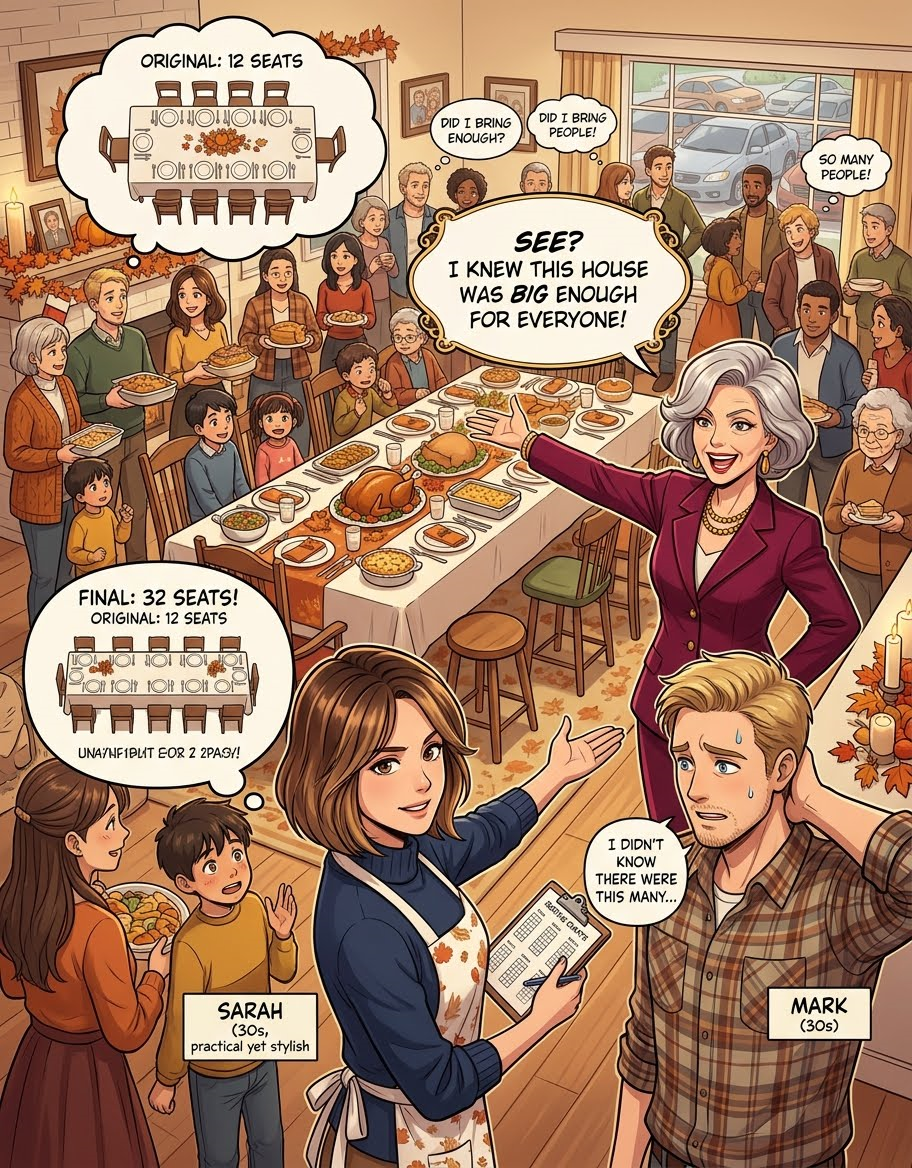
I had called a friend with a truck on Wednesday morning and together we had carried the extension to her garage, where it would stay for the next forty-eight hours, and I had rearranged the dining room around the smaller table and I had set it for eight people and it looked beautiful.
Exactly eight place settings.
The good china. The real silverware. The linens I had bought the year we moved in and had been waiting for a reason to use. The centerpiece — the same style as the one Helen had moved to the kitchen counter the year before, six inches tall, perfectly proportioned — in the center of the table.
Eight chairs.
Eight plates.
Eight of everything.
I had made food for eight.
Not the Thanksgiving-for-thirty production of previous years. A perfect, complete, utterly gracious Thanksgiving for eight. The turkey was exactly the right size. The sides were scaled correctly. There was dessert — three kinds, because dessert should always have options — in quantities appropriate for eight people who were going to eat well.
I had written eight place cards.
Me, Daniel, our two children, Michael, Daniel’s sister Pam and her husband, and Pam’s daughter who was twelve and had a sophistication about food that I respected and wanted at the table.
Eight people who had been invited.
Eight people who were expected.
Eight people who would have exactly the Thanksgiving I had planned.
I made no other preparations.
I did not call rental companies for tables or chairs. I did not make additional food. I did not, in any way, prepare for the guests that Helen had invited in my name to my house without my knowledge.
The house was clean and warm and smelled like turkey and butter and the particular combination of things that makes November smell right.
I put on the dress I had bought for this specific occasion.
I waited.
The cars began arriving at noon.
One after another, which is the specific quality of how twenty uninvited guests arrive — not all at once, which would be its own kind of statement, but in the drawn-out way of people who have been told to show up and are showing up at various times around the hour, carrying things, bringing the assumption that they have somewhere to be and something to contribute and a seat waiting.
They carried pies.
They carried casseroles that were not going to fit in my oven because my oven was committed to the turkey.
They carried desserts for thirty people and bottles of wine and the specific energy of people arriving at a holiday gathering, festive and expectant.
I opened the door for each of them.
I said: Hello, I’m Rachel. I’m glad you’re here. Which was true in the sense that I was glad they were here because their being here was necessary for what was about to happen.
They came in.
They looked at the dining room.
They looked at the table set for eight.
They looked at each other.
They put their contributions in the kitchen, which was the only available surface, and they stood in my front parlor with their coats on, talking in the low voices of people who are unsure of the situation.
Helen arrived last.
This was not an accident. Helen always arrived last, even to things she was allegedly helping with, because arriving last gave her the full effect of what had been assembled — the crowd already gathered, the house already full, the scene already set for her entrance.
She came through the front door at twelve-forty-five.
She looked around at the people in the parlor.
She looked at the coats, the wine bottles on the kitchen counter, the casserole dishes stacked on every available surface.
She smiled the smile of a woman who has pulled off something satisfying.
Then she took off her coat, and she turned toward the dining room, and she stopped.
She blinked.
She looked at the table.
Eight settings.
Eight chairs.
The centerpiece exactly in the center.
She turned slowly.
She looked at me.
Her voice, when it came, had a quality I had never heard from her before — not the smooth certainty of the woman who moves centerpieces and gives house tours without asking. Something more like the voice of a person who has walked into a room expecting one thing and found something else entirely and cannot immediately find her footing.
Oh my God, she said. What did you do?
The room was very quiet.
Twenty-odd people in my front parlor with their wine and their casseroles, twenty people who had driven here in good faith on the basis of an invitation they had received in good faith, all of them now watching the exchange between me and the woman who had issued that invitation.
I said: I set the table for the people I invited.
Helen looked at the table again.
She looked at the eight place cards.
There are people outside, she said.
Yes, I said.
You knew people were coming.
I found out on Tuesday, I said. From Michael. Two days before Thanksgiving. That you had invited nearly twenty people to my home without telling me.
The room was very still.
Rachel, she said, and her voice had shifted to the careful register of a woman who is preparing to manage a situation. This is family. Family doesn’t need—
Helen, I said. I want to be very clear about something. This is my house. I decide who is invited to my house. Those are not abstract principles or technicalities — they are the actual facts of this situation. You invited twenty people to my home without asking me, without telling me, and without giving me any opportunity to prepare.
I thought you wouldn’t mind, she said.
There it was.
The sentence she always had ready.
I know you thought that, I said. I know you’ve thought that for a very long time. Because I have let you think it. Every time you arrived with an extra turkey, and I cooked both turkeys. Every time you moved my centerpiece, and I left it where you put it. Every time you brought extra relatives, and I added chairs and smiled and said welcome. Every time you gave tours of my home without asking, and I let it go because it wasn’t worth the argument.
She opened her mouth.
I continued.
What I want you to understand is that I let you think it. Not because it was true. Because I was choosing to keep the peace. But keeping the peace has a cost, Helen, and I’ve been paying it for six years, and this year you invited twenty people without telling me and you didn’t ask because you were certain I’d manage it, and I am telling you now that I’m not going to manage it.
She looked at the table again.
The eight place settings.
The eight chairs.
What are they supposed to do? she said. She meant the twenty people in the parlor with their wine and their casseroles.
I don’t know, I said. You invited them. That’s your question to answer.
Helen stood in my dining room for a long moment.
I want to be honest about what that moment was like. It was not triumphant in the simple way. It was complicated in the way that most real moments are complicated, which is to say it contained several things at once.
Helen’s face was doing something I had not seen it do before, which was process the specific experience of being fully, undeniably accountable for a choice she had made. There was no tour to be given, no centerpiece to move, no second turkey to cook. There was just the table for eight and the twenty people she had invited and the gap between those two facts, which was entirely, unambiguously her creation.
Daniel was somewhere behind me.
He had come into the room at some point — I had not registered when — and I could feel him there without looking. I did not look because I needed to finish what I was doing and looking at Daniel would have required me to read his face and his face would have told me something I needed to be able to act on, and I was not ready to act on it yet.
The twenty people in the parlor were very quiet.
Some of them, I realized, were people I might genuinely like under different circumstances. Distant relatives of Daniel’s I’d never had the chance to know because I’d always been too busy managing the chaos of their arrival to actually meet them. An older woman near the door who had a quality of stillness that told me she was taking the whole situation in without needing to comment on it, which I respected.
They had come in good faith.
They had driven here with their pies and their casseroles and their good faith, and whatever they had done, they had not done it to me.
Helen had done it to me.
And to them, actually — by putting them in this position without their knowledge.
This was the thing I had understood on Wednesday when I was making the plan.
The plan was not punishment.
The plan was clarity.
I said: Helen, there are a few things I can do.
She looked at me.
I can order enough food for everyone who is here. It will take an hour or two and people will have to wait, and I’d ask you to explain to them why they’re waiting. I paused. Or the two of us can do some creative rearranging — there are folding tables in the basement and I can add my friend’s card table, and if people are willing to eat in the living room and the den it’s not the holiday anyone expected but it’s workable. Another pause. Or the people you invited can go home, and we can have Thanksgiving for the people who were invited.
Helen stared at me.
You would really send them home.
I would really let them choose, I said. They’re adults. They didn’t know about the situation when they came. They deserve to make an informed choice.
Rachel—
Helen, I said. I’m not doing this to humiliate you. I’m doing this because you need to understand that I mean what I say when I say this is my home and I decide who comes into it. I have been very patient and very flexible and very quiet about all the ways this has come up over the years. And I am telling you clearly, right now, that it ends here.
She was looking at me in a way she had never looked at me before.
Not the tolerant assessment of a woman managing a situation. Not the smooth authority of the woman who knows how to take up space in other people’s homes. Something different. Something I could only describe as actually seeing me, possibly for the first time.
You planned this, she said.
Yes, I said.
You knew what I’d done and you planned this.
Yes.
She looked at the table again.
The extension is gone, she said.
Yes.
You had it taken somewhere.
Yes.
She was quiet.
Then, from the parlor, the older woman’s voice — the one with the stillness.
Helen, she said. I think we owe this young woman an apology.
Helen turned.
The older woman was standing at the parlor doorway and she had the calm authority of someone who has been in the world for a long time and has decided that clarity is more valuable than comfort.
We came without an invitation, she said. That’s not her fault. That’s yours.
Helen opened her mouth.
I know you didn’t think of it that way, the older woman continued. You never do. But the woman whose house this is has been very clear about what happened and what she needs. I think the least we can do is listen to her.
She looked at me.
I’m Evelyn, she said. I’m Daniel’s father’s aunt. I haven’t met you before because you’ve never been given a chance to invite me.
Rachel, I said.
Rachel, she said. What do you need us to do?
What happened next was not what I had expected.
I had expected, in my planning, one of three outcomes. The confrontation and departure. The confrontation and accommodation with folding tables. Or the confrontation and a Helen who dug in and made it a war.
What happened was Evelyn.
Evelyn, who had come to Thanksgiving without being invited and who responded to that fact with the quiet accountability of someone who knows how to be honest about a thing. Evelyn, who turned to the twenty people in the parlor and said: We’re going to figure this out, and the first thing we’re going to do is apologize to the woman whose home this is.
The apologies came.
Not all of them and not all elaborately — some people just said I’m sorry, I didn’t know and that was exactly right, exactly the right amount. Some people quietly gathered their casseroles and their pies and said they understood and left without drama, which I respected profoundly. Some people stayed and helped carry the folding tables from the basement and rearrange the living room and the den into something that could hold people, and they did it without being asked and without making me feel that I had to thank them excessively for cleaning up a mess they had contributed to creating.
Helen stood in the dining room for a while.
Then she picked up her coat from the chair she’d left it on.
She found me in the kitchen.
I need to think, she said. I’m going to go home.
I looked at her.
Helen, I said. I don’t want you to go home.
She looked surprised.
I want you here for Thanksgiving, I said. I want you at the table for eight. Your place card is there. I paused. But I need you to understand that we are changing something today. Not me being cold to you or Daniel being caught in the middle. We’re changing the actual thing — the part where you make decisions about my home as if it’s your home, and I absorb it, and we all pretend it didn’t happen.
She was very still.
Can you be here for that Thanksgiving? I said. Not the one you planned. The one I planned.
She looked at me for a long time.
She was not an unintelligent woman.
She was a woman who had operated for a long time without anyone being willing to name the thing clearly, and naming things clearly has a particular power that vague discomfort and swallowed grievance do not have. She could not unknow what had just been said in her hearing. She could not unfeel what she had felt, standing in front of a table for eight in a house she had been treating as her stage.
I didn’t know you felt this way, she said.
I’ve been telling you for six years, I said. In every way except directly. I should have been direct.
Yes, she said.
You should have asked, I said.
She was quiet.
Then: Yes. A different kind of yes. Not defensive, not managed.
Will you stay? I said.
She looked at the kitchen, at the pies lined up on the counter that had arrived with her guests, at the casseroles that various people had quietly tucked into any available corner.
Where does all this food go? she said.
I’ll figure that out, I said. People took some home. Evelyn has the trunk of her car.
Something passed across Helen’s face.
Evelyn always knows what to do, she said.
She’s good, I said.
She’s Daniel’s father’s family, Helen said. I don’t see her often enough.
You could invite her, I said. Properly. When she’s wanted.
Helen looked at me.
Would that be all right? she said.
Yes, I said. That would be all right.
We had Thanksgiving for eight.
Or more accurately, for ten — Daniel’s sister Pam had said that Evelyn couldn’t drive home alone and invited her to stay, and Evelyn had said she wouldn’t impose, and Pam had said she absolutely would and wouldn’t hear otherwise, and so Evelyn stayed, and I added two place settings with the everyday china, and it was fine.
The turkey was exactly right.
The sides were exactly right.
The table held everyone at a comfortable distance that allowed actual conversation rather than the managed chaos of previous years, and I watched conversations happen across the table that had never happened at my Thanksgivings before because when thirty people are at a table, no one can hear anything and everything becomes performance rather than connection.
Helen sat next to Evelyn.
I watched them talk.
Helen, for the first time at my table, was not performing. She was not narrating her contribution to the evening or pointing out things she had helped with or managing the room. She was talking to her former sister-in-law — the aunt of her ex-husband, a woman she had lost connection with when the marriage ended — and she was, I thought, simply present.
It looked good on her.
Daniel, across the table, caught my eye.
He had a look I had not seen before, or had not seen in a long time. The look of a man who is at his own table in his own home at his own holiday and is not managing a situation, not mediating, not absorbing and smoothing and keeping the peace at his own expense.
He just looked like himself.
He mouthed something.
I read it: Thank you.
I shook my head.
He mouthed it again.
I let it land this time.
After dinner, when the children were doing whatever children do after Thanksgiving dinner and Daniel had corralled the men into some form of after-dinner activity involving football, Helen found me in the kitchen where I was wrapping the leftover turkey.
She said: Can I help?
I said: Yes.
We wrapped things together in the specific companionable silence of women doing kitchen work after a meal, and after a while Helen said:
I want to say something and I want you to let me finish before you respond.
I stopped wrapping.
All right, I said.
I know that I have treated your home as though it were partly mine, she said. I know that I have told myself this was because I love my son and I love your children and I wanted to be present, and all of those things are true. But I also know that I have used those true things to excuse something that isn’t true, which is that I have the right to make decisions about your house. She paused. I don’t. I know that. I knew it every time I did it and I did it anyway.
I did not speak.
I’m sixty-seven years old, she said. Not seventy-one — perhaps she had been sixty-seven for a while before I began this story and the years had passed the way years do. And I have spent a significant portion of those years making sure things happened the way I thought they should happen. Because when Daniel’s father left, nothing happened the way I thought it should, and I think I spent a very long time afterwards making sure I had control over everything I could. She looked at the turkey in her hands. I don’t think I had noticed how far that had spread.
Did tonight help you notice? I said.
She almost smiled.
That table for eight was very clear, she said.
I meant it to be, I said.
Yes, she said. I know.
She finished wrapping the turkey.
She put it in the refrigerator.
She turned to face me with the expression of a woman who has arrived somewhere difficult and is not going to leave before it’s done.
I would like, she said carefully, to try to do this differently. If you’ll give me the opportunity.
Helen, I said. You have been in my family for six years. I have wanted a real relationship with you for six years. That is not available when one of us is managing the other. I paused. If you want to come to Christmas, you are welcome to come to Christmas. If you want to bring Evelyn, I would genuinely like to know Evelyn. If you want to help with something — with a dish, with the children, with anything — I will ask you. And I need you to let me ask.
She was quiet.
That sounds like me having less, she said.
It sounds like you having something real, I said. Instead of something you had to take.
She looked at me for a long time.
Then she said: You’re a good woman, Rachel.
I know, I said.
She looked startled.
Then she laughed.
It was the first time I had heard Helen Calloway laugh without performing it.
The extension came back on Friday.
My friend brought it in her truck and Daniel and Michael reinstalled it, and the dining room was back to normal, the normal of a room that can hold fourteen when it needs to and eight when eight is exactly right.
Evelyn came back on Friday too, actually — she had stayed at a hotel because she lived far enough away that driving the night before felt unwise — and she appeared at the door on Friday morning with pastries and the natural ease of a woman who had been coming to houses all her life and knew how to enter one without taking it over.
I hope I’m not intruding, she said.
You’re invited, I said.
She came in.
We sat in the kitchen and had coffee and pastries and talked for two hours about things that had nothing to do with the previous night’s drama, and I found that I genuinely liked her, which is the thing about Evelyn — she is the kind of person you like without needing a reason.
You handled yourself well last night, she said.
I’d been planning it for two days, I said.
Still, she said. It’s hard to say what needs saying. Most people don’t.
I almost didn’t, I said.
But you did.
I had a table to say it for me, I said.
She smiled.
That was well done, she said. Eight place settings. You made it very easy to understand.
That was the idea, I said.
Helen is not a bad woman, Evelyn said.
I know, I said. She’s a woman who got used to making things happen her way and no one stopped her.
Including me, Evelyn said. I’ve known her for thirty years and I never said what I said last night.
What made you say it?
She considered this.
You were very calm, she said. You weren’t screaming or crying or making it about your feelings. You were just stating facts. That’s a hard thing to argue with. She paused. And I thought — she’s right. We’re in her home. We were invited by someone who doesn’t live here. That’s not her problem to solve.
It wasn’t, I said.
No, she said. It was ours.
Christmas came six weeks later.
Helen came.
She called first.
She called on the first of December and asked if she could come to Christmas, and she asked in the voice of a woman who had understood something new and was not entirely comfortable with the discomfort of asking, and I said yes, of course, we would love to have you.
She asked if she could bring anything.
I said: What would you like to bring?
She said she made a good cranberry sauce.
I said that sounded perfect.
She came on Christmas Day at the time we had agreed on, not two hours early. She brought the cranberry sauce and a small gift for each of the children and a bottle of wine for Daniel and me. She walked in and she looked at the dining room — the table with the extension, the sixteen chairs, because we were more people this year and had planned accordingly — and she sat down where I pointed and she stayed in her seat.
She ate the food I had made.
At one point she offered to help in the kitchen and I said yes, and she came in and I handed her a task and she did the task and she did not rearrange anything or comment on the centerpiece or suggest that something should be different.
After dinner, in the kitchen, she said: The turkey was very good.
Thank you, I said.
Better than mine, she said.
I looked at her.
You don’t have to say that.
I know, she said. It’s true anyway.
I will not tell you that everything changed on Thanksgiving.
People do not change completely and permanently in a single evening, and anyone who tells you they do is selling something. Helen has not become a different woman. She is still the woman who arrived with an extra turkey on the first Thanksgiving, who moved my centerpiece, who gave the house tour. That history exists and it shapes things.
But something shifted.
Something that had been invisible because it had never been named was named, clearly, in front of twenty people in my front parlor, and you cannot unname a thing once it is named.
Helen knows that I know what she was doing.
She knows that I will not absorb it indefinitely.
She knows that the table in my dining room seats eight or fourteen depending on how many people I have invited, and that the question of how many people I have invited is my question to answer.
That knowledge changes things.
Not everything. Not permanently and not without work.
But enough.
The extension is back in the table.
The centerpiece is on the table where I put it.
The place cards, when there are place cards, are where I put them.
My house is my house.
It took a table for eight and one small detail to say so.
Sometimes that is all it takes — not the years of swallowing, not the confrontations that produced nothing, not the patient management of someone else’s certainty.
Just a table, set with eight plates, in exactly the center of a room that belongs to you.
Clear. Undeniable. Honest.
A thing that cannot be argued with.
I set the table for the people I invited.
Six words.
Everything I had been not saying for six years.
Helen came to Easter.
She brought the cranberry sauce again, which is not a traditional Easter dish.
I did not point this out.
Evelyn came too.
She is, apparently, becoming a regular.
I have asked Helen to come early for Christmas this year.
I need someone to watch the children while I do the prep.
She said yes immediately.
We are figuring it out.
The extension stays in the table.
But I decide who sits at it.
That part doesn’t change.
PART 3 — THE CHRISTMAS SHE WAS FINALLY INVITED TO
The first time Helen asked permission to enter my kitchen, I nearly cried.
Not because the question was remarkable.
Because of how many years I had waited to hear it.
She stood in the doorway on a cold December morning, holding the handles of a canvas shopping bag against her coat.
Outside, snow had begun collecting along the porch rail.
Inside, my daughter was looking for a missing mitten, my son was accusing the dog of stealing it, and the oven had started making the clicking noise that meant it was either about to heat properly or ruin my entire morning.
Helen looked at the flour on my sleeves.
Then at the children.
Then back at me.
“Where would you like me?”
Six years earlier, she would have already been opening cabinets.
A year earlier, she would have arrived carrying an entire second meal and a reason why mine might not be sufficient.
That morning, she waited.
I put down the measuring cup.
“With the children, if that’s still all right.”
“Of course.”
She hung her coat on the hook by the back door.
She did not move my coat to make room.
She did not comment on the untidy boots beneath it.
She crouched beside my daughter and asked which mitten was missing.
“The purple one,” my daughter said.
Helen nodded seriously.
“That narrows the investigation.”
I turned back toward the counter before either of them could see my face.
For a moment, I let myself believe we had reached the easy part.
We had survived the Thanksgiving with the missing table extension.
We had survived the Christmas afterward.
We had made it through Easter with cranberry sauce beside the ham and no unexpected guests standing in the hallway.
Helen had asked.
I had answered.
We were learning.
Then her phone rang.
She looked at the screen.
And the expression on her face changed so quickly that I felt it before I understood it.
She silenced the call.
A moment later, it rang again.
“Do you need to take that?” I asked.
“No.”
The word came too fast.
My daughter held up a purple mitten she had discovered inside a boot.
Helen smiled at her, but the smile was unfinished.
The phone rang a third time.
This time, I saw the name.
Arthur.
Daniel’s father.
The man who had left when Daniel was nine.
The man whose absence had become the unspoken explanation beneath almost everything Helen did.
She turned the phone facedown.
But by then, something old had entered the room.
Something that had nothing to do with a table.
CHAPTER 1 — A NAME WE DIDN’T USE
There were things Daniel told me easily.
He could tell me about the apartment where he grew up.
About the broken radiator that made his bedroom sound like someone was throwing pebbles against the wall.
About Helen ironing his school shirt at midnight after finishing a shift.
About how she once drove through freezing rain to see a school play in which he had exactly one line.
But when I asked about his father, the stories shortened.
“He wasn’t around much.”
“He sent a card sometimes.”
“We don’t really talk.”
I had learned to hear the locked door inside those sentences.
I did not push at it.
Once, shortly before our wedding, I asked whether Arthur should receive an invitation.
Daniel had been sorting silverware into a drawer in our apartment.
He kept sorting.
“No.”
“Okay.”
He looked at me then.
“You don’t need an explanation?”
“Not to respect your answer.”
For a few seconds, he stood with a fork in his hand.
Then he put it down and hugged me so tightly I could feel his heartbeat through his shirt.
Arthur did not come to our wedding.
He did not come when our first child was born.
He did not send anything when our second arrived.
As far as I knew, he had not been inside Helen’s home in more than twenty years.
Now he was calling her three times before ten in the morning.
Helen tucked the phone into her bag.
“Would you like me to take them upstairs to find their Christmas sweaters?”
“That would help.”
She gathered the children with unusual efficiency.
By the time they reached the kitchen stairs, my son was explaining that he no longer liked the sweater with the reindeer because the reindeer looked judgmental.
Usually, Helen would have laughed.
That morning, she barely seemed to hear him.
I waited until their footsteps faded.
Then I walked into Daniel’s office.
He was answering a work message, his reading glasses low on his nose.
“Your father called your mother.”
His hands stopped over the keyboard.
“When?”
“Just now.”
“What did she say?”
“She didn’t answer.”
He leaned back.
I watched him turn the news over without touching it.
“Maybe it’s nothing.”
“Maybe.”
He took off his glasses.
“Did she say why he was calling?”
“No.”
“Then let’s leave it.”
I stood beside the doorway.
“Daniel.”
His eyes lifted.
“I’m not asking you to call him.”
“I know.”
“I’m asking whether there’s something you need from me.”
His face changed a little.
That was another thing we were learning.
How to ask the actual question instead of the one we had learned to survive.
“Just don’t let today become about him,” he said.
“I won’t.”
Neither of us knew how difficult that promise would become.
CHAPTER 2 — THE MESSAGE SHE COULD NOT DELETE
At eleven, Helen came downstairs alone.
The children were building a fort in the upstairs sitting room.
She said this as if delivering a report.
Then she asked whether I had five minutes.
I turned off the mixer.
She remained standing.
“Please sit,” I said.
“I don’t think I want to.”
“All right.”
For a while, she looked at the recipe card beside my bowl.
It was one of my mother’s.
There was a grease stain across the corner and a note in blue ink reminding me not to overwork the dough.
Helen touched the edge of the counter.
“Arthur is in town.”
I said nothing.
“He called last week.”
The kitchen seemed to become quieter around us.
“Does Daniel know?”
“No.”
“Why not?”
She closed her eyes briefly.
“Because I didn’t know what to do with it.”
That answer sounded honest.
It was also incomplete.
“What does he want?”
“To see him.”
“Has Daniel agreed?”
“No.”
She swallowed.
“He doesn’t know.”
I looked toward the office hallway.
Then back at her.
“Helen.”
“I haven’t invited him here.”
The speed of that sentence made my stomach tighten.
“Did he ask to come here?”
“Yes.”
“When?”
“Today.”
I set the towel in my hands on the counter.
For a moment, neither of us moved.
She watched me with the expression she had worn in front of the table for eight.
Not indignation.
Fear.
“He said Christmas might be a good time,” she continued.
“He said there would be people around, that it wouldn’t have to be a formal conversation.”
“A surprise reunion.”
“He didn’t call it that.”
“What did he call it?”
She looked down.
“An opportunity.”
I took a breath.
“Whose opportunity?”
Helen’s fingers tightened on the edge of the counter.
“I know.”
“Do you?”
“Yes.”
She finally sat.
For the first time that morning, she looked her age.
Not diminished.
Just tired in a way that had nothing to do with the children or the stairs.
“He told me Daniel wouldn’t answer if he called directly.”
“Daniel might not want to answer.”
“He told me he was getting older.”
“We all are.”
“He said he doesn’t know how many Christmases he has left.”
I pulled out the chair opposite her.
“That may be true.”
She looked up.
“But it doesn’t give him the right to choose how Daniel spends this one.”
Helen’s mouth trembled.
“I nearly told him to come.”
There it was.
Not a guest already driving toward my house.
Not another completed decision I was expected to absorb.
A temptation confessed before it became an action.
I sat down.
“Nearly?”
She nodded.
“I thought if he arrived, Daniel would have to see him.”
I let the words remain between us.
She heard them too.
I could tell by the way her shoulders lowered.
“Listen to what I just said.”
“I am.”
She looked toward the staircase.
“For years, I’ve told myself I was making things easier for my son.”
Her voice cracked.
“And there I was, thinking I could make him do something he hadn’t chosen.”
I did not reach for reassurance.
She did not need me to make the admission less uncomfortable.
She needed to finish it.
“I told Arthur I would speak to Daniel.”
“Then that’s what needs to happen.”
“What if he says no?”
“Then the answer is no.”
“What if he regrets it?”
“That would still be his regret to work through.”
Helen looked at me for a long moment.
Then she gave a small, exhausted laugh.
“You make it sound simple.”
“It isn’t simple.”
“But you know what to do.”
“I know whose decision it is.”
She sat very still.
Then she took her phone out.
There was a message waiting.
She turned the screen toward me.
I have the address.
I’ll come by around two.
A little surprise might do everyone good.
I looked at the message.
Then at the clock.
Eleven-seventeen.
Our guests were expected at one.
Dinner was at three.
Somewhere in town, a man who had been absent for decades had decided that he could arrive in the middle of it all and be received.
Helen whispered, “I haven’t replied.”
I stood.
“Then we need to tell Daniel now.”
CHAPTER 3 — WHAT MY HUSBAND REMEMBERED
Daniel read the message twice.
The first time, his face emptied.
The second time, his jaw tightened.
Helen sat across from him in the office.
I remained near the door.
Nobody touched the tea I had brought.
“You gave him our address?”
“He found it.”
“How?”
“I don’t know.”
“Did you tell him he could come?”
“No.”
“Did you tell him he couldn’t?”
Helen looked at her hands.
“Not clearly enough.”
Daniel put the phone on the desk.
“I don’t want him here.”
“All right,” Helen said.
The answer was so immediate that he looked up.
She held his gaze.
“I will tell him.”
He watched her carefully.
“You’re not going to ask me to reconsider?”
“No.”
“You’re not going to tell me he’s my father?”
“No.”
“Because I know who he is.”
Helen’s face folded.
“I know you do.”
Daniel stood and walked to the window.
Snow had thickened against the glass.
For several seconds, the only sound was the low hum of his computer.
“He said he was coming one Christmas.”
Helen closed her eyes.
I had never heard this story.
Daniel kept looking outside.
“I was eleven.”
His voice was flat.
“He called on the twenty-third and said he had something for me.”
Helen’s hand moved toward her mouth.
“I remember.”
“I know you remember.”
He turned.
“I kept looking out the window.”
The sentence was quiet.
It hurt more because it was quiet.
“I thought every set of headlights was his.”
Helen began to speak.
Daniel lifted a hand.
“Please let me finish.”
She nodded.
“You told me the roads were bad.”
“They were.”
“But that wasn’t why he didn’t come.”
“No.”
“You knew?”
“Not at first.”
“Later?”
“Yes.”
Daniel laughed once, without amusement.
“I wore that sweater until bedtime because I wanted him to see it.”
Helen’s eyes filled.
“It was the green one.”
“With the stupid skier.”
“You loved that sweater.”
“I loved the idea that he might remember buying it.”
Nobody spoke.
I could see Daniel as a boy with painful clarity.
Standing near a window.
Trying not to seem eager.
Trying to prepare himself to be noticed.
“I’m not doing that to my children,” he said.
Helen nodded.
“And I’m not doing it to myself.”
“I understand.”
He studied her.
“Do you?”
She took a breath.
“I understand that I should have told you when he first called.”
“Yes.”
“And that I wanted a happy ending badly enough to consider making you responsible for producing it.”
Daniel sat down slowly.
Helen continued.
“I think part of me still wants proof that all of it can be repaired.”
“All of what?”
“The years.”
“The years happened, Mom.”
“I know.”
“You can’t get them back by seating him beside the mashed potatoes.”
She gave a broken little smile.
“No.”
Daniel rubbed his eyes.
He looked suddenly exhausted.
“You don’t have to fix my childhood.”
Her tears spilled then.
“I should have protected you better.”
“You protected me from a lot.”
“Not from this.”
“You couldn’t make him come.”
“I could have stopped making excuses.”
Daniel looked at her.
For a while, neither spoke.
Then he said, “Yes.”
It was not cruel.
It was the truth she had finally left room for.
Helen nodded.
“I’m sorry.”
He breathed out.
“I believe you.”
I saw something loosen in her face.
Not because the past had been forgiven.
Because it had been spoken without anyone trying to change its shape.
She picked up her phone.
“What would you like me to tell him?”
Daniel looked at me.
I did not answer for him.
He turned back to his mother.
“Tell him he is not invited.”
Helen typed.
Then she read the message aloud.
“Arthur, Daniel does not want a visit today.”
“Do not come to Rachel and Daniel’s house.”
“If he decides he wants contact, he will make that decision himself.”
She looked up.
“Is that right?”
“Yes.”
She pressed send.
Then she set the phone down and waited.
CHAPTER 4 — THE WOMAN IN THE RED COAT
Arthur replied within two minutes.
So this is Rachel’s decision.
Daniel picked up the phone before Helen could.
“No.”
He typed one word first.
Then more.
This is Daniel.
I am making this decision.
Do not come to my home.
He sent it.
The response took longer.
You always did let your mother speak for you.
Daniel stared at the screen.
I watched anger move through him, followed by something older and less visible.
He set the phone down.
“Turn it off.”
Helen did.
At twelve-forty, Evelyn arrived in a red wool coat with snow caught along the shoulders.
She held a covered dish in one hand and a bakery box in the other.
“I brought the rolls you asked for,” she said.
“And something unnecessary.”
“What’s unnecessary?”
“Small cakes.”
“How many?”
“An unreasonable number.”
I laughed and took the box.
She looked at me.
Then at Helen, standing behind me in the hall.
Her expression changed.
“What happened?”
Helen answered before I could.
“Arthur contacted me.”
Evelyn’s hand went still on her scarf.
“When?”
“Last week.”
“I see.”
“He wanted to come today.”
Evelyn looked toward Daniel’s office.
“Does Daniel want that?”
“No.”
“Then he should not come.”
Helen exhaled.
“I told him.”
“Good.”
The word was calm.
It carried no triumph.
Evelyn handed me her coat.
Then she asked where she could put the dish.
The ordinariness of the question steadied me.
We walked into the kitchen together.
For a few minutes, we spoke about the roads and the rolls and whether the children were likely to eat Brussels sprouts this year.
Then, while Helen went upstairs to check the fort, Evelyn touched my arm.
“Has he accepted the answer?”
“Not gracefully.”
“That sounds familiar.”
I looked at her.
She opened the bakery box.
“You’re his aunt.”
“Yes.”
“Was he always like this?”
She arranged the small cakes on a plate before answering.
“Arthur was charming when he wanted something.”
“And when he didn’t get it?”
“He found someone else to blame.”
I leaned against the counter.
“Did you know what happened?”
“Some of it.”
“Why didn’t you stay in touch with Helen?”
Evelyn’s hands stopped.
For the first time since I had met her, she looked uncertain.
“Because I believed a convenient version.”
“His version?”
“Yes.”
“What did he tell you?”
“That Helen made seeing Daniel impossible.”
I felt a small chill.
Evelyn closed the bakery box.
“He said she changed arrangements.”
“He said she was angry.”
“He said every attempt turned into a fight.”
“Did you ask her?”
“No.”
She looked at me directly.
“I should have.”
I thought about the boy at the window.
“Daniel waited for him.”
“I know that now.”
Her voice thickened.
“Pam told me things after last Thanksgiving.”
“I started understanding how much I had accepted without checking.”
She drew a breath.
“I can’t pretend I was kept completely outside.”
“There were doors I didn’t knock on.”
I looked toward the stairs.
“Have you told Helen that?”
“Not properly.”
“Maybe you should.”
Evelyn nodded.
“Yes.”
Outside, a car slowed along the street.
Both of us looked toward the window.
It continued past.
I noticed that I was holding my breath.
Evelyn noticed too.
“If he arrives,” she said, “you do not have to open the door.”
“I know.”
She put a hand over mine.
“And knowing that does not always stop your body from preparing for a fight.”
CHAPTER 5 — THE DOORBELL
Pam and her family arrived just after one.
Michael came ten minutes later with cider and a bag of oranges because he had somehow decided that every Christmas gathering needed a large quantity of citrus.
The children emerged from the fort.
Coats filled the hallway.
The house acquired the familiar noise of people settling into a holiday.
I checked the potatoes.
Daniel poured drinks.
Helen asked Pam whether she wanted help carrying gifts upstairs.
Nobody mentioned Arthur.
For forty minutes, I almost believed the message had been enough.
Then the doorbell rang.
I knew before I reached the hallway.
There are sounds that become different because of what you are afraid they mean.
The bell was the same one it had always been.
My body heard it as a warning.
Through the glass beside the front door, I saw a man in a dark overcoat.
He held a paper gift bag.
Snow lay across his hair.
Arthur.
I had seen him in photographs.
The resemblance to Daniel was unmistakable and unsettling.
The same shape around the eyes.
The same mouth.
A familiar face occupied by a stranger.
Daniel came out of the kitchen.
He stopped beside me.
“Is it him?”
“Yes.”
The bell rang again.
Behind us, the conversation in the living room faded.
Helen appeared at the foot of the stairs.
Her face went white.
“I told him.”
“I know,” Daniel said.
Arthur lifted his hand toward the glass.
Then his voice came through the door.
“Daniel.”
My husband did not move.
“It’s cold out here.”
Daniel reached for the lock.
I touched his wrist.
“You don’t have to.”
He looked at me.
“I know.”
Then he opened the door far enough to stand in the frame.
He kept the storm door closed.
Arthur smiled.
It was a practiced smile.
The kind meant to skip whatever conversation should have happened first.
“There he is.”
Daniel said nothing.
Arthur lifted the bag.
“Brought a few things for the kids.”
“They’re not meeting you today.”
The smile faltered.
“Come on.”
“Dad.”
The word startled both of them.
I could see it.
For Arthur, it sounded like an opening.
For Daniel, it seemed to cost something.
“I told you not to come.”
Arthur looked past him.
His eyes found me.
“Rachel, right?”
I stayed where I was.
“Hello, Arthur.”
“Maybe you can help me out here.”
“No.”
He gave a small laugh.
“I just mean this is a family matter.”
“It is,” I said.
“And Daniel has answered you.”
Arthur looked back at his son.
“You’re really going to leave me standing outside on Christmas?”
“You chose to come after I told you not to.”
“I drove a long way.”
“You should have called before you drove.”
“I called your mother.”
“You should have called me.”
Arthur’s face tightened.
“I didn’t know you’d become this unforgiving.”
Daniel’s hand closed around the edge of the door.
For a second, I thought he might shut it.
Instead, he asked, “What did you expect?”
“A chance.”
“To do what?”
“To see my family.”
“Do you know my daughter’s name?”
Arthur blinked.
He looked down at the bag.
“I brought—”
“Do you know her name?”
The hallway was silent.
Arthur’s mouth opened.
Nothing came.
Daniel nodded once.
“What about my son?”
“I know you have two children.”
“That wasn’t the question.”
Arthur looked toward Helen.
She had moved closer, but she did not step beside Daniel.
“Help me here,” Arthur said.
Helen’s voice was steady.
“You need to leave.”
His eyes widened.
“After all this time, you still—”
“No.”
She stopped him so firmly that I felt it in my chest.
“You are not going to make this about me.”
He stared at her.
“Daniel told you not to come.”
“I repeated it.”
“You came anyway.”
Arthur’s face reddened.
“I thought once we were all together—”
“You thought he would be less able to refuse you with an audience,” Helen said.
The sentence hung between them.
I knew what it had cost her to recognize that.
I knew because a year earlier she had relied on the same thing.
Daniel looked back at his mother.
Then he faced Arthur again.
“I’m not having this conversation with my children listening upstairs.”
Arthur’s eyes flicked toward the staircase.
For the first time, he seemed to understand that children were not an abstract reason to gain entry.
They were people inside a home.
People who could hear him.
“I can come back later.”
“No.”
“Tomorrow.”
“No.”
“Then when?”
Daniel took a breath.
“I don’t know.”
Arthur seemed more offended by uncertainty than by rejection.
“You can’t leave things like that.”
“I can.”
Daniel’s voice did not rise.
“If I want contact, I’ll decide when.”
Arthur stood very still.
Then he lowered the bag.
“Fine.”
He set it on the porch.
“Keep those, at least.”
“We’ll decide what to do with them.”
Arthur shook his head.
He looked as though he wanted one final sentence that would put the discomfort back where he thought it belonged.
But Evelyn had come into the hallway.
He saw her over Daniel’s shoulder.
“Aunt Evelyn.”
“Arthur.”
“You too?”
She held his gaze.
“Yes.”
Whatever he had prepared disappeared.
He stepped backward.
Then he turned and walked down the porch steps.
Daniel remained in the doorway until the car pulled away.
Only then did he close the door.
CHAPTER 6 — THE CHILD AT THE TOP OF THE STAIRS
Our daughter was sitting halfway down the staircase.
Her Christmas sweater had slipped off one shoulder.
She held a stuffed rabbit by one ear.
I had not seen her there.
Daniel had.
His face changed immediately.
He walked to the bottom step and crouched.
“Hey.”
She looked at him.
“Was that your daddy?”
“Yes.”
“Why didn’t he come in?”
Daniel looked back at me.
Not for an answer.
For company.
I sat on the step beside her.
He rested one hand on the banister.
“Because I told him today wasn’t a good day for a visit.”
“Was he bad?”
Daniel thought before speaking.
“He made choices that hurt me a long time ago.”
“Like when somebody says they’ll play and then they don’t?”
“A little like that.”
Her eyebrows pulled together.
“But grown-up.”
“Yes.”
She looked toward the door.
“He looked sad.”
“I think he probably was.”
“Are you sad?”
Daniel swallowed.
“Yes.”
She slid off the step and put her arms around his neck.
He held her.
For a moment, all the noise in the house seemed very far away.
Then she leaned back.
“Are you going away?”
The question went through him.
I saw it.
“No.”
“You promise?”
“I promise I’m coming to dinner.”
She waited.
“And tomorrow?”
“Tomorrow too.”
“What about when I’m eleven?”
A tear escaped before he could stop it.
He wiped it away.
“Yes.”
“When you’re eleven.”
She considered this.
Then she touched his cheek with the kind of tenderness children give without knowing what they are repairing.
“You can sit by me.”
He nodded.
“I’d like that.”
When she ran back upstairs to retrieve her brother, Daniel remained crouched by the staircase.
I put my hand on his shoulder.
He leaned into it.
“I didn’t know she heard.”
“She heard us say no.”
He looked at me.
“She also heard that being sad doesn’t mean you have to let someone in.”
He nodded slowly.
Then he stood and pulled me against him.
“I’m sorry.”
“For what?”
“For the doorbell.”
“You didn’t ring it.”
He laughed through the tears.
It was a small laugh.
But it belonged to him.
CHAPTER 7 — WHAT HELEN SAID WITHOUT AN AUDIENCE
Helen was in the kitchen when I returned.
She stood over the sink without running the water.
On the counter, the potatoes waited beneath a clean towel.
She turned when she heard me.
“I’m sorry.”
“I know.”
“I should have told him no the first time.”
“Yes.”
“I should have told Daniel immediately.”
“Yes.”
Her eyes filled again.
I did not soften the facts.
I also did not leave her alone inside them.
“He knows you told him not to come.”
“That doesn’t undo the delay.”
“No.”
She nodded.
Then she wiped her face with the heel of her hand.
For a while, we listened to the oven.
“I hated him for doing that,” she said.
“For standing on your porch and acting as though being there should make the answer different.”
I waited.
She looked at the dining room doorway.
“Then I remembered all the people I brought here.”
I turned toward her fully.
“Helen.”
“I know it isn’t the same history.”
Her voice shook.
“But I recognized the expectation.”
She pressed her hands flat against the counter.
“That if I made the situation happen, everyone else would have to adjust.”
The admission hurt her.
It also seemed to steady her.
“I used to think asking gave other people a chance to reject me.”
“What do you think now?”
“That refusing to ask gave them a reason to.”
I picked up the spoon beside the potatoes.
“Would you mash these?”
She looked surprised.
“Now?”
“Yes.”
“Are you sure?”
“I’m asking.”
She took the spoon.
Her hand brushed mine.
“Thank you.”
We worked for a few minutes.
Then she said, “When Arthur left, I thought if I made our home good enough, he might come back.”
I kept cutting carrots.
“I cooked too much.”
“I cleaned things that were already clean.”
“I bought curtains we couldn’t afford.”
“He had complained about the curtains before he left.”
She gave a small, incredulous laugh.
“As though curtains had anything to do with it.”
I looked at her.
She was staring into the bowl.
“Then I thought if I made holidays perfect, Daniel wouldn’t notice who was missing.”
“Did he?”
“Of course.”
Her voice fell.
“He noticed every time.”
I laid down the knife.
“Did anyone tell you that you didn’t have to make up for him?”
“No.”
She looked at me.
“And after a while, I stopped wanting anyone to.”
“Why?”
“Because if I wasn’t the woman who could do everything, I didn’t know who I was.”
There it was.
Not an excuse.
A room beneath the room we had been arguing in for years.
I could understand it without giving her my house.
I could feel compassion without moving my centerpiece.
“I think you’re someone my children love,” I said.
Her eyes went toward the stairs.
“Even when I don’t bring anything?”
“Especially when you listen to their ridiculous mitten investigations.”
She smiled through her tears.
“That was a serious investigation.”
“The dog was innocent.”
“Of that particular offense.”
We laughed.
Then she lowered her gaze.
“Will you believe me if I say I want to keep learning?”
“Yes.”
“Even after today?”
“Because of what you did today.”
She looked up.
“You told us before inviting him.”
“You sent the message Daniel asked you to send.”
“You didn’t open the door for him.”
“That matters.”
She swallowed.
“I nearly did the wrong thing.”
“You chose what to do next.”
For a long time, she said nothing.
Then she began mashing the potatoes.
CHAPTER 8 — DINNER WITH THE PEOPLE WHO WERE THERE
We ate at three-twenty.
The delay was twenty minutes.
Nobody announced it as a failure.
Nobody suggested I should have planned better.
Michael put the cider on the table.
Pam carried in the rolls.
Her daughter found the missing serving spoon in the drawer where it belonged, a small miracle that deserved more recognition than it received.
Helen carried the potatoes.
She stopped at the dining room doorway.
“Where would you like these?”
“Beside the carrots.”
She set them there.
The centerpiece stayed in the middle.
The extension was in the table.
Every chair had someone who knew they were welcome.
Before we began, Daniel looked around.
“I want to say something.”
My stomach tightened.
He reached for my hand beneath the table.
“Thank you for being here.”
His voice was quiet.
“I mean that.”
He looked at his mother.
Then at Evelyn.
Then at the children, who were already studying the rolls.
“I’m glad we’re together.”
That was all.
No speech about Arthur.
No explanation of the porch.
No effort to turn an unwanted visit into the central event of the day.
We passed the food.
My son dropped butter on the tablecloth.
Pam’s daughter told a long story about a school concert in which the wrong backing track had played.
Michael laughed so hard he had to put down his glass.
Evelyn asked my daughter about the fort.
Helen listened.
At one point, I looked across the table and found Daniel watching his mother.
She was helping our son cut a potato that did not require cutting.
He had asked her anyway.
She was doing it with complete seriousness.
Daniel’s expression held grief and gratitude at once.
I was beginning to understand that growing older did not mean choosing one feeling and discarding the others.
Sometimes it meant making room for several without letting the most painful one make every decision.
After dinner, the children opened the gifts we had planned.
Arthur’s bag stayed on the porch until Daniel brought it into his office.
He did not open it that day.
Nobody told him he should.
CHAPTER 9 — THE APOLOGY EVELYN HAD WAITED TOO LONG TO GIVE
I found Evelyn and Helen in the front parlor after dessert.
The lamps were on.
Outside, snow softened the street.
I had gone in to collect cups.
Then I heard Evelyn say, “I owe you something.”
I stopped in the doorway.
Helen sat beside the fireplace.
“For what?”
“For believing him.”
Her voice was low.
Helen stared at her.
“You knew?”
“I knew what he told me.”
“What did he tell you?”
Evelyn answered without dressing it up.
“That you kept Daniel from him.”
“That you changed plans.”
“That every visit became a punishment.”
Helen’s face went still.
“He said that?”
“Yes.”
“And you believed him.”
“Yes.”
The fire shifted.
I could hear a log settle.
Helen looked down at the cup in her hands.
“I used to save the messages.”
Evelyn did not speak.
“When he said he was coming.”
“When he canceled.”
“When he didn’t call.”
“I saved them because I thought one day someone might ask.”
Her voice broke.
“Nobody asked.”
Evelyn’s eyes filled.
“I should have.”
“Yes.”
“I’m sorry.”
Helen shook her head slowly.
“For years, I wondered why nobody came.”
“I thought perhaps I had been unpleasant.”
“I was tired all the time.”
“I probably was unpleasant.”
“That wasn’t a reason to leave you alone.”
Helen looked at her then.
There was anger in her face.
Real anger.
I was glad Evelyn did not ask her to make it smaller.
“I don’t know what to do with this,” Helen said.
“You don’t have to do anything with it tonight.”
“Were there other people?”
“Who believed him?”
“Yes.”
“I think so.”
Helen closed her eyes.
Evelyn continued.
“I can tell them what I know now.”
“I can stop repeating the story by staying silent when it comes up.”
“I can do that whether you forgive me or not.”
Helen was quiet for a long time.
Then she said, “I don’t want an argument going around the family.”
“I understand.”
“But I don’t want that lie left there either.”
Evelyn nodded.
“Then I’ll be clear.”
Helen rubbed her thumb along the cup handle.
“I was difficult sometimes.”
“I’m sure you were.”
Helen gave a startled laugh.
Evelyn smiled sadly.
“So was I.”
“It still doesn’t explain what he did.”
I stepped into the room then.
“Would either of you like more tea?”
Both looked up.
Helen wiped her face.
“Yes, please.”
I collected the cups.
Evelyn touched Helen’s wrist.
Helen did not pull away.
It was not reconciliation all at once.
It was two women agreeing, after too many years, to stop speaking around the truth.
CHAPTER 10 — THE LETTER IN THE GIFT BAG
Three days after Christmas, Daniel opened the bag.
I was folding laundry on our bed when he came upstairs carrying an envelope.
“There were toys.”
“For the children?”
“Yes.”
“What do you want to do with them?”
“I don’t know yet.”
He sat beside the laundry.
“And this.”
The envelope had his name on it.
He held it between two fingers.
“Do you want me to leave?”
“No.”
“Do you want me to read it?”
“Not yet.”
He opened it.
I watched his eyes move down the page.
Once.
Then again.
He handed it to me.
The letter was shorter than I expected.
Arthur wrote that he had made mistakes.
He wrote that time had passed faster than he understood.
He wrote that he wanted a chance to explain.
Then came the sentence that made Daniel stand and walk away from the bed.
I hope you can put aside what your mother has told you and remember that there are two sides to every story.
I put the page down.
Daniel stood near the dresser.
“He’s still doing it.”
“Yes.”
“He thinks I don’t remember.”
I waited.
“He thinks my entire childhood is something Mom described to me.”
His voice rose, then fell.
“I was there.”
“I know.”
“I was the one waiting.”
“I know.”
He turned toward me.
“I wanted the letter to be different.”
That was the part he had not wanted to admit.
The small hope that survived beneath every sensible decision.
I stood and went to him.
“You can want that.”
“I feel stupid.”
“You’re not.”
“He didn’t even say which mistakes.”
“No.”
“He could have written one sentence.”
“Which one?”
Daniel looked at the letter.
“I told you I would come.”
“I didn’t.”
“I knew you were waiting.”
His eyes filled.
“That would have been something.”
I held him.
We stood there until the anger had somewhere to go besides his throat.
That night, he did not reply.
The next morning, he put the letter in a drawer.
A week later, he called a counselor.
He made the appointment himself.
When he told me, he sounded embarrassed.
“I don’t want to spend another twenty years having the same conversation in my head.”
I put my hand over his.
“That sounds like a good reason.”
CHAPTER 11 — THE PART OF OUR MARRIAGE THAT WAS ALSO IN THE ROOM
The changes with Helen did not erase the changes Daniel and I still needed to make.
That became clear on an ordinary Tuesday in February.
I was taking a casserole out of the refrigerator when he said, “Mom might come Sunday.”
I stopped.
“Might?”
“She mentioned it.”
“Did you invite her?”
“Sort of.”
I closed the refrigerator.
He saw my face.
Then he closed his eyes.
“I did it again.”
“Yes.”
He rubbed his forehead.
“I was thinking it would be nice.”
“It might be.”
“But I didn’t check.”
“No.”
For a moment, the old pattern stood between us.
Not Helen at the center.
Daniel.
His habit of letting a conversation become an arrangement before anyone had named it as one.
He leaned against the counter.
“What do you need?”
“I need you to stop saying ‘sort of’ about plans that create work for both of us.”
He nodded.
“Fair.”
“I don’t need you to ask permission for every person you speak to.”
“I know.”
“But if we’re hosting, we decide together.”
“Yes.”
He took out his phone.
“What are you doing?”
“Calling Mom.”
“You don’t need to tell her I objected.”
“I’m not going to.”
He made the call.
I kept preparing dinner.
“Mom, I realized I made Sunday sound more settled than it is.”
He listened.
“No, Rachel and I haven’t talked about our weekend yet.”
He listened again.
“I’ll call you tomorrow after we have.”
A pause.
“Thanks.”
He put the phone down.
“What did she say?”
“She said she understood.”
I smiled a little.
“Look at that.”
He returned the smile.
Then it faded.
“I used to think if I didn’t make a firm decision, nobody could be angry at me.”
I turned toward him.
“But you still made one.”
“Yes.”
“You just left me to discover it.”
He nodded.
For a long time, I had thought the problem in my marriage was that Daniel would not stand up to his mother.
That was part of it.
But the deeper problem was his belief that avoiding discomfort was an act of kindness.
He had avoided an uncomfortable conversation with Helen.
I had carried the inconvenience.
He had avoided saying no.
I had done the extra shopping.
He had avoided admitting he knew about the twenty guests.
I had found out in the basement from Michael.
“I thought I was keeping things small,” he said.
“You were moving them.”
He looked at me.
“Yes.”
“Onto you.”
I heard the shame in his voice.
I did not want him to drown in it.
“I need it to change,” I said.
“It is changing.”
“I know.”
“But I need you to keep choosing it when it’s awkward.”
He reached for my hand.
“I will.”
We did invite Helen that Sunday.
Daniel cooked.
I sat in the parlor with a book for twenty minutes while the kitchen made noises that suggested several utensils were being used incorrectly.
Dinner was excellent.
The sink was terrible.
Both were his responsibility.
CHAPTER 12 — THE KEY
Helen had a key to our house.
She had received it when our daughter was a baby, during a week when I had a fever and Daniel was away for work.
At the time, it had been useful.
Afterward, usefulness became assumption.
She had let herself in to drop off groceries.
Then to leave a coat she thought my son needed.
Then once to collect a casserole dish while I was upstairs on a work call.
None of those things had become a major argument.
They had joined the pile of smaller things I told myself were too small to name.
By spring, I knew I needed to ask for it back.
Not secretly change the locks.
Not wait until the next intrusion gave me enough anger to speak.
Just ask.
I did it after Sunday lunch.
Helen was gathering her scarf.
“There’s one more thing.”
She looked up.
“All right.”
“We’re changing how we use the spare keys.”
She waited.
“I’d like you to give yours back.”
For a moment, her face closed.
There it was.
The hurt I had expected.
The interpretation that a practical boundary meant she had become less loved.
“Of course.”
Her voice was stiff.
She opened her handbag.
I let her look.
Then I said, “We can still arrange for you to have one when you’re staying here or helping with the children.”
“You don’t trust me.”
The sentence was quiet.
I could have argued with it.
I could have produced a list.
Instead, I answered the part that mattered.
“I don’t want anyone letting themselves into our home unless we have arranged it.”
She looked at me.
“Even family.”
“Yes.”
She found the key.
It hung beside a small silver charm shaped like a bird.
She took it off the ring.
For a second, she held it in her palm.
Then she handed it to me.
“I liked knowing I could help.”
“I know.”
“It made me feel useful.”
“You are useful.”
“But you want to choose when.”
“Yes.”
She breathed in.
Then out.
“I don’t like how that feels.”
“Thank you for telling me.”
She gave a little, unwilling smile.
“You’re not going to make it feel better by giving it back.”
“No.”
“All right.”
She picked up her bag.
At the door, she paused.
“Would you call if you needed me?”
“Yes.”
“Really?”
“Really.”
Two weeks later, my son developed a fever while I was due at an appointment I could not easily move.
I called Helen.
She came.
I left a key for that day.
When I returned, she handed it back before putting on her coat.
There was no speech.
No comment about being temporary.
Just the key in my hand.
I understood then that trust was not only something you gave people before they behaved differently.
Sometimes it was something you built while watching them practice.
CHAPTER 13 — THE DINNER AT HELEN’S
In June, Helen invited us to her house.
She called Daniel and me together.
Not separately.
Together.
“I’d like to have everyone over on the second Sunday.”
“What time?” Daniel asked.
“One.”
“What can we bring?” I asked.
“Nothing.”
Then she stopped herself.
“Actually, Rachel, would you bring the lemon cake?”
“The one from Easter?”
“Yes.”
“I’ve been thinking about it.”
“I’d love to.”
She hesitated.
“And I’d like to invite Evelyn.”
“Of course,” Daniel said.
Helen laughed softly.
“I don’t need your permission to invite someone to my own house.”
“No,” I said.
“You don’t.”
“I’m still getting used to that part.”
When we arrived, her table was set for the number of people she had invited.
The meal was simple.
Chicken.
Potatoes.
Salad.
Bread.
No second main dish waiting as insurance against criticism.
No enormous production that left her too tired to enjoy it.
On the table stood a low glass bowl filled with garden flowers.
I looked at it.
Helen noticed.
“Can everyone see?”
My first instinct was to reassure her extravagantly.
To tell her it was perfect.
To repair the memory beneath the question.
Instead, I answered plainly.
“Yes.”
She smiled.
“Good.”
Halfway through lunch, my daughter asked why Grandma’s house was smaller than ours.
Daniel almost choked on his water.
Helen answered without discomfort.
“Because this is the amount of house I need.”
“Do you wish you had seven bedrooms?”
“Only if someone else cleaned them.”
My daughter looked at me.
“That’s Mommy.”
There was a small silence.
Then Daniel put down his fork.
“Mommy does a lot.”
“Yes,” I said.
“She does.”
My daughter tilted her head.
“Do you help?”
“I do.”
“Are you going to help more?”
Michael laughed into his napkin.
Daniel looked at me.
“Yes,” he said.
“I am.”
Helen smiled.
Not at my expense.
Not as though she were being generous by acknowledging the woman who managed her son’s house.
She looked proud of him for answering.
After lunch, I helped carry plates into the kitchen.
On the refrigerator was a photograph from our last Christmas.
It showed Helen sitting on the floor beside the children while they opened gifts.
Her hair was untidy.
She was laughing.
She had not known the photograph was being taken.
“That’s a good one,” I said.
“I like it.”
“You look happy.”
“I was.”
She leaned against the counter.
“For a long time, I thought I had to be standing in the middle of everything to be part of it.”
I looked at the picture again.
She was at the edge of the frame.
My daughter was leaning against her shoulder.
My son had one hand on her knee.
“You’re very much part of that,” I said.
Helen nodded.
“I’m beginning to see it.”
CHAPTER 14 — THE RESPONSE DANIEL CHOSE
Arthur contacted Daniel again in August.
This time, he sent an email.
No holiday.
No surprise arrival.
No gift bag.
Daniel read it at the kitchen table while I watered the plants by the window.
“He wants to meet.”
I turned off the tap.
“What do you want?”
“I don’t know.”
“Okay.”
“He says he’s willing to listen.”
Daniel gave a small shrug.
“He also says he knows he handled Christmas badly.”
“That’s more specific.”
“Yes.”
He leaned back.
“I hate that part of me is relieved.”
“Why?”
“Because I don’t want one decent sentence to wipe out everything else.”
“It doesn’t have to.”
He looked at the screen.
“I don’t want to do this at home.”
“Then don’t.”
“I don’t want the children there.”
“Then they won’t be.”
“I might leave.”
“Then you can leave.”
He laughed a little.
“You keep saying these things as though I’m allowed.”
“You are.”
He went quiet.
Then he nodded.
He arranged a meeting at a café on a Saturday morning.
One hour.
He drove himself.
He did not ask Helen to attend.
He did not ask me to attend.
But he asked whether I could be home when he returned.
“I’ll be here.”
The morning of the meeting, he stood in our bedroom changing his shirt twice.
Finally, he laughed at himself.
“I’m forty years old.”
I sat on the bed.
“And?”
“And I’m choosing a shirt for a man who once forgot to show up.”
“You can wear whichever one makes you comfortable.”
He looked at the blue shirt in his hand.
Then he put it on.
When he came home, it was raining.
He stepped into the kitchen and stood beside the back door.
I waited.
“Well?”
He took off his jacket.
“He apologized.”
I set down my mug.
“For what?”
“For leaving.”
“For not coming when he said he would.”
“For blaming Mom.”
I breathed out.
“That’s something.”
“Yes.”
He sat.
“Then he asked whether we could start over.”
“What did you say?”
“That I wasn’t nine anymore.”
His eyes filled.
“And I wasn’t looking for a replacement childhood.”
I sat beside him.
“What did he say?”
“That he understood.”
“Did he?”
“I don’t know.”
Daniel rubbed his hands together.
“I told him we could exchange occasional emails.”
“I told him he wouldn’t meet the children yet.”
“I told him he couldn’t come to the house.”
“How did that feel?”
“Awful.”
He laughed softly.
“Then better.”
He looked at me.
“I spent years thinking my choices were letting him back into everything or never speaking to him again.”
“What did today feel like?”
“Like there might be other choices.”
I took his hand.
He was quiet for a while.
Then he said, “I’m not sure I’ll want another meeting.”
“You don’t have to decide today.”
He leaned his head back.
For the first time, uncertainty did not seem to frighten him.
It seemed to give him room.
CHAPTER 15 — TWENTY PEOPLE, ONE YEAR LATER
In October, Helen called about Thanksgiving.
I was sorting winter coats when her name appeared.
“Have you made plans?” she asked.
“Yes.”
“All right.”
She paused.
“I’d love to come if you have room.”
I sat on the edge of the bench in the hall.
“We have room.”
“What would you like me to bring?”
“Your cranberry sauce.”
She laughed.
“You know I do make other things.”
“I know.”
“Perhaps someday you’ll trust me with a potato.”
“I’m considering it.”
We both laughed.
Then she became quiet.
“There’s something else.”
I waited.
“Last year, I invited a number of people who ended up in a very uncomfortable situation.”
“Yes.”
“I’ve apologized to most of them.”
“Most?”
“There are a few I haven’t spoken to yet.”
She took a breath.
“I was thinking of hosting a lunch at my house the weekend before Thanksgiving.”
“That sounds nice.”
“It would be crowded.”
“Do you want to borrow folding chairs?”
“Would that be all right?”
“Yes.”
“I’ll arrange the food.”
“I’ll manage the invitations.”
“I won’t tell anyone it’s at your house.”
The last sentence made us both quiet.
Then Helen said, “I know I don’t need to explain that.”
“You can explain if you want.”
“I think I do.”
I heard movement on her end of the phone.
Perhaps she had sat down too.
“I told myself I was gathering people.”
“What I actually did was leave you with the work and take the pleasure of being the one who gathered them.”
I pressed my hand against the coat beside me.
“That’s how it felt.”
“I know.”
She swallowed audibly.
“I’m sorry, Rachel.”
“I’m not saying it because we’re discussing this year.”
“I’m saying it because I don’t think I ever named that part properly.”
I looked down the hall toward the dining room.
The table was visible through the open doorway.
The extension was in.
A vase of branches stood in the center.
“Thank you,” I said.
She exhaled.
“Would you and Daniel like to come to the lunch?”
“Yes.”