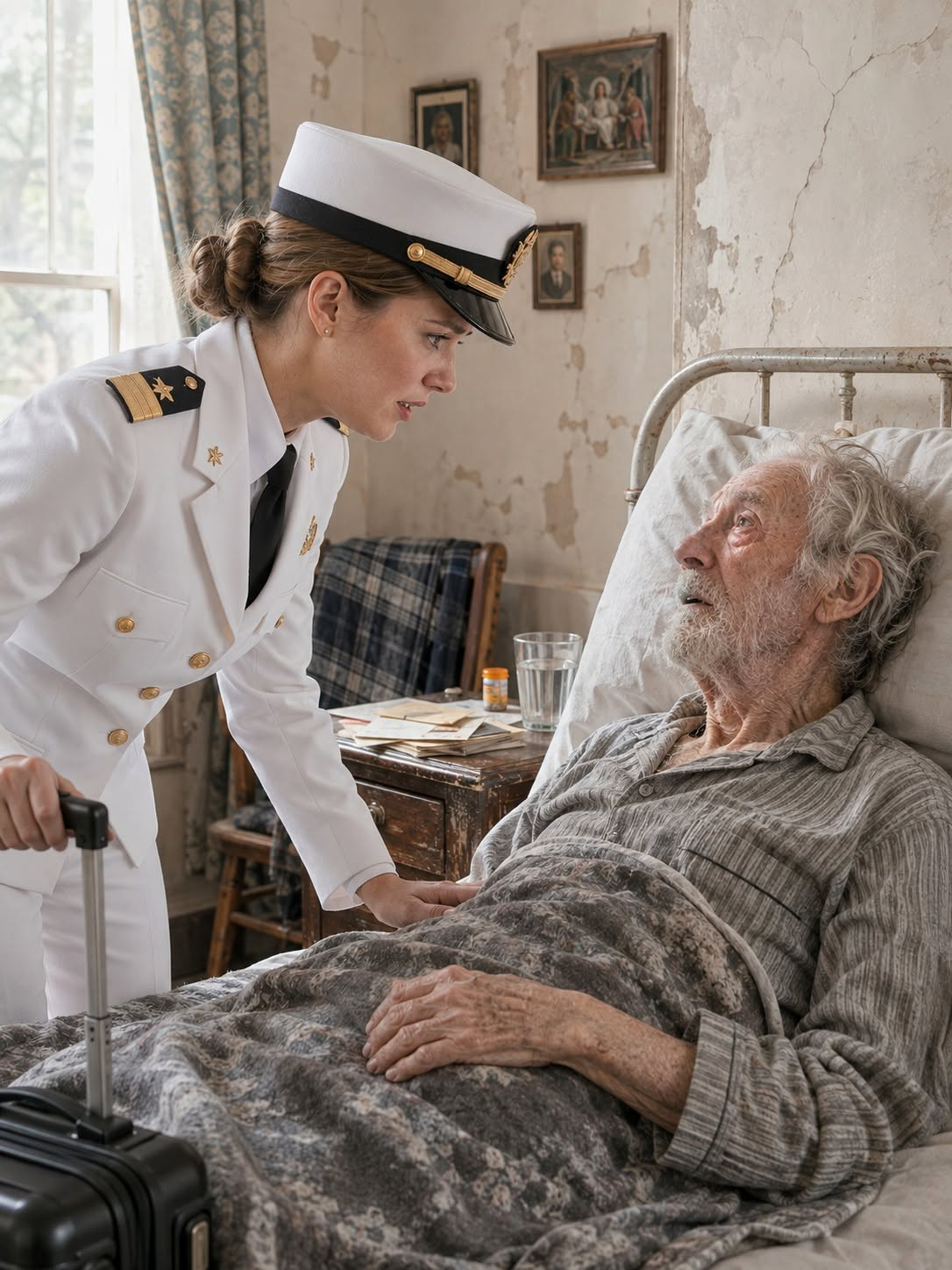
• I found my sick stepfather shivering under a blanket, and on the table my mother had written, “It sucks, fix it before we get back.” I checked the family account and discovered expenses for cruises, casinos, and shopping while he barely had enough medicine.

    I found my sick stepfather shivering under a blanket, and on the table my mother had written, “It sucks, fix it before we get back.” I checked the family account and discovered expenses for cruises, casinos, and shopping while he barely had enough medicine.

    I didn’t confront anyone; I laid everything on the table. Then he gave me his ring and mentioned a secret trust.

    Part 1

    “We took the treatment money for the cruise. You can handle Victor when you get back. We’re sick of taking care of him.”

    That was the note my mother had left on the kitchen counter.

    I had just arrived home in Norfolk after nine months away. As a Navy flight surgeon, I’d spent almost that entire stretch rotating between intense shifts, emergency transfers, and a long medical support mission at sea. For months, I had dreamed of returning home, embracing my family, and above all, seeing Victor—my stepfather, the man who had raised me as his own daughter since I was eight years old.

    Instead, I unlocked the door to a freezing, silent house.

    “Victor?”

    No answer.

    I dropped my duffel bag and ran down the hallway to his bedroom.

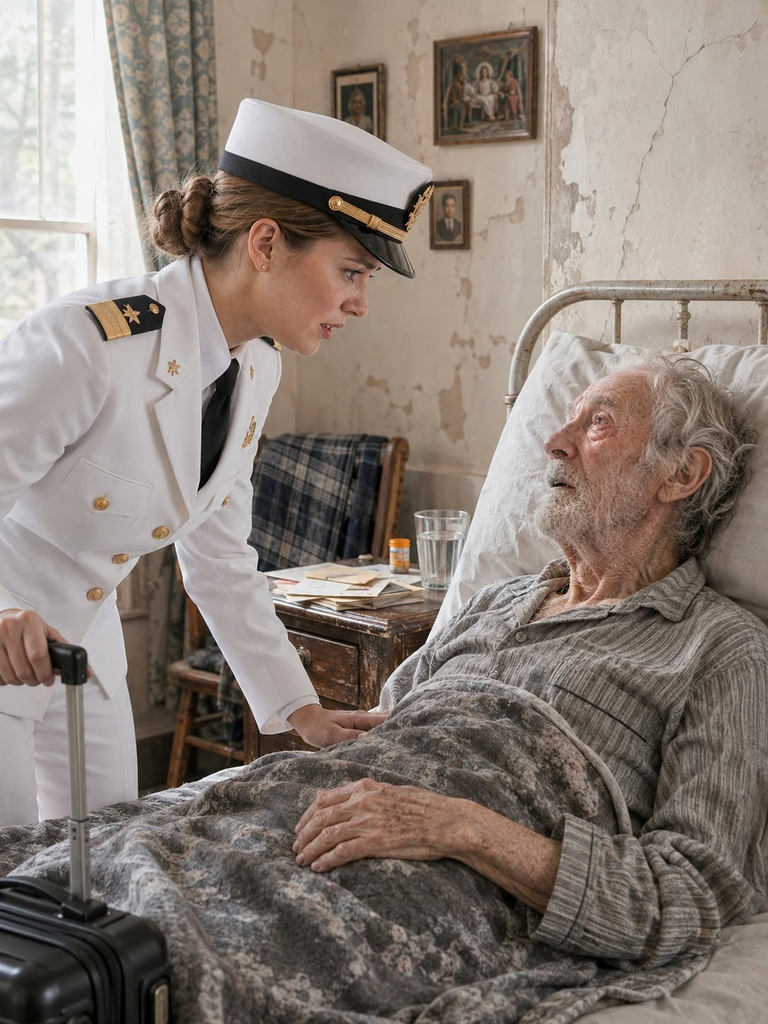
    I found him lying on his side, shivering violently under a threadbare blanket. He was severely dehydrated, his clothes were soiled, and he could barely whisper. Victor had late-stage pancreatic cancer; he needed help just to sit up.

    “Maya… you’re home,” he rasped.

    Something inside me fractured.

    I kicked the heat on, gave him small sips of water, cleaned him up, changed his sheets, and called his home-hospice care team for immediate guidance. While waiting for their callback, I heated a cup of broth.

    “Where is Mom?” I asked softly.

    Victor closed his eyes. “A trip.”

    That’s when I noticed the note on the counter. My mother, Evelyn, my brother, Mason, and my sister, Chloe, had taken the family emergency fund to pay for a luxury Caribbean cruise.

    The very same account into which I deposited a significant portion of my Navy paycheck every single month.

    I picked up the tablet sitting on the coffee table. A notification from Instagram popped up on the screen. Mason was grinning on the top deck of a cruise ship, wearing expensive new sunglasses and wrapping his arm around his girlfriend.

    The caption read: “Working hard to play harder. Living the life we deserve.”

    My stomach turned.

    I logged into the joint banking app on my phone.

    Available balance: $14.12.

    I stared at it, convinced it was a glitch. I pulled up the transaction ledger:

    • Cruise line tickets.
    • High-end designer boutiques.
    • Premium drink packages.
    • Onboard spa services.
    • ATM cash withdrawals.
    • Shipboard casino chips.

    In less than six days, they had blown through nearly $10,000. Money I had transferred specifically for Victor’s specialized prescriptions, home visits, groceries, and utility bills.

    I walked back into his bedroom, my hands trembling.

    That was when I noticed something else. The display cabinet where Victor kept his prized mementos from his twenty-two years of active service in the U.S. Marine Corps was completely bare.

    “Where are your military decorations, Victor?”

    He let out a hollow, bitter chuckle. “Your mother listed them online. Sold the whole shadow box.”

    “What?”

    “Said they were just old pieces of metal, and she needed extra spending money for port excursions.”

    I couldn’t even find words. But the nightmare wasn’t over.

    Victor suddenly doubled over, groaning in agony. I rushed to the nightstand for the bottle of liquid morphine his doctor had prescribed for breakthrough pain.

    Victor reached out, his weak hand gripping my wrist with surprising force. “Don’t give me that.”

    “Victor, you’re in severe pain. You need this.”

    Tears welled in his sunken eyes. “It’s not medicine anymore, Maya.”

    I looked down at the bottle. “What do you mean?”

    He took a ragged breath. “Evelyn poured out what was left three days ago. She filled it back up with tap water.”

    The floor felt like it was caving in beneath me. “Why… why would she do that?!”

    It took him several seconds to answer. “She said the real refills were too expensive for someone who was going to die anyway.”

    I carefully set the bottle down, handling it like a piece of crime scene evidence.

    In that single moment, I realized I wasn’t just dealing with family neglect or greed. I was looking at something far more sinister.

    And I had no idea that this diluted bottle of pain medication was about to blow open a secret that would dismantle my entire family.

    Part 2

    By the next morning, I used my medical and operational training to turn the house into what I never imagined my childhood home would become: a documented crime scene.

    I took high-resolution photos of the condition in which I’d found Victor, the unpaid utility notices, the shut-off thermostat, the empty refrigerator, and every single line item in the bank statements.

    Then I called his lead oncologist, Dr. Vance. When I laid out what had happened, there was a long, heavy silence on the line.

    “Maya, keep that bottle untouched,” Dr. Vance instructed firmly. “Do not throw it away. If he has another severe crisis, bring him directly to the hospital transport unit. We will document everything officially on our end.”

    Next, I spoke with Mrs. Gable, our longtime neighbor. She had seen my mother, brother, and sister leave three days prior.

    “They were all smiles,” Mrs. Gable told me, shaking her head. “Mason was bragging that they were finally traveling ‘like rich people.’ I asked Evelyn about Victor, and she just shrugged and said, ‘He’s sleeping. He doesn’t need anyone bothering him.’”

    As the afternoon wore on, Victor’s strength continued to wane. He called me into the room and asked me to lock the door.

    “There’s something your mother never knew, Maya.”

    I assumed he was going to confess to some hidden debt or unpaid medical bill. Instead, he pointed toward the closet and asked me to pull down a leather briefcase hidden behind a row of old winter coats.

    Inside were legal contracts, private investment portfolios, and certified bank trust documents.

    “Evelyn always assumed I lost everything when I retired from my private wealth management firm,” Victor said softly. “I let her believe it.”

    I stared at the figures on the top page. “Victor… how much is here?”

    “A little over three million dollars.”

    I swallowed hard. “Three million?”

    He nodded slowly.

    The wealth had been tied up in diversified index funds, commercial real estate holdings, and an irrevocable trust established years before he ever met my mother. Furthermore, Victor and Evelyn had signed a premarital agreement keeping their pre-existing assets completely separate.

    “Why didn’t you ever tell her?” I asked.

    “Because right after we married, I started noticing a pattern,” Victor said quietly. “When they thought I had money, everyone was attentive. When I pretended the funds were gone, they slowly drifted away.”

    He looked toward the window. “I wanted to see who would stick around when I was no longer useful to them.”

    He looked back at me, his eyes filled with a heartbreaking mixture of grief and clarity. “Now I have my answer.”

    My mother had abandoned a man she believed was broke, entirely unaware that he held a fortune. But Victor took no satisfaction in the irony. He looked utterly broken.

    “The money wasn’t the test, Maya. The test was seeing if anyone would offer me a glass of water when they thought I couldn’t pay them for it.” He squeezed my fingers. “And you were the only one who came back.”

    Later that afternoon, his estate attorney, Sarah Jenkins, arrived at the house accompanied by a notary and Dr. Vance, who formally certified that Victor was fully lucid and competent to execute legal instruments.

    For two hours, they reviewed and revised his estate plan.

    Victor completely restructured his will and trust. The bulk of the three-million-dollar estate was assigned to an endowment supporting homeless and terminally ill veterans. A significant portion was placed under my direct administration, along with a personal bequest.

    Evelyn, Mason, and Chloe were explicitly written out of any voluntary benefits.

    Not out of spite, but as Victor plainly stated to the attorney: “I have no intention of rewarding the people who waited for me to die so they could divide up a fortune they didn’t even know existed.”

    That evening, I opened our family group chat and sent a message:

    “Victor’s condition has deteriorated sharply. The doctor says he may not make it through the night. Please come back. This is your last chance to say goodbye.”

    Mason read it immediately. Chloe read it two minutes later.

    My mother took five minutes to reply:

    “Stop being dramatic, Maya. The cruise doesn’t dock until Tuesday.”

    Mason added:

    “You’re a doctor, Maya. Deal with it. That’s what you’re there for.”

    Victor watched the screen from his bed as I read the responses aloud. I watched the last flicker of hope extinguish from his eyes.

    I tapped the video-call button. My mother answered from a sunlit deck party on the ship. Upbeat music pounded in the background; people were drinking and dancing behind her.

    “What do you want now, Maya?” she shouted over the noise.

    “I want you to come home,” I said evenly. “Victor is dying.”

    Her expression barely shifted. “Maya, we paid thousands of dollars for this vacation! We are not cutting it short because he decided to take a turn for the worse right now.”

    From behind her, Mason popped into the frame, holding a margarita and laughing. “Tell him to hold on until Tuesday!”

    Victor heard every single word.

    As I reached to end the call, my mother added one final remark:

    “And if he passes before we get back, just call the funeral home and handle it. You’re the responsible one, aren’t you?”

    The line went dead.

    The room fell into an absolute, heavy silence.

    Victor took a slow breath and looked up at me. “Save that video recording, Maya.”

    He pointed toward the briefcase containing his trust documents. “Because when they walk through that front door, they’re going to find out that the most expensive cruise of their lives didn’t cost ten thousand dollars.”

    He locked eyes with me. “It cost them three million.”

    Part 3

    I spent that night sitting in an armchair beside Victor’s bed. Every so often, he’d open his eyes just to make sure I was still sitting there.

    Around three in the morning, he looked over at me with a faint spark in his eyes. “Maya… do you know how to make cinnamon apples?”

    I let out a soft tearful laugh. “Roughly. Why?”

    “My mother used to make them for me when I was a boy in Ohio.”

    I went into the kitchen. I found a can of sliced apples in the back of the pantry, some brown sugar, butter, and a dash of cinnamon. It wasn’t culinary art, but I warm-simmered it on the stove and brought a small bowl back to his room.

    Victor took two small bites, chewed slowly, and smiled. It was the first genuine smile I had seen on his face since returning home.

    “This is terrible,” he whispered.

    I giggled softly.

    “But it tastes like home,” he added, his voice thick with emotion.

    He reached up with a trembling hand and slipped off an old sterling silver Marine Corps signet ring he had worn on his left hand for forty years. He pressed it into my palm and closed my fingers over it.

    “They share your blood, Maya,” he whispered, “but you are my real daughter.”

    I couldn’t hold it back anymore. I buried my face against his arm and wept.

    Victor had never tried to replace my biological father, who had passed away when I was little. He had never forced me to call him Dad. He had simply been there. He taught me how to drive, sat in the bleachers at every one of my track meets, and waited outside for four hours in the cold the day I took my Navy commission exam.

    When my mother used to tell me that joining the military was “unbecoming for a young woman,” Victor would cut in: “Leave her be, Evelyn. If she wants to fly high, let her fly.”

    I squeezed his hand. “I love you, Dad.”

    It was the very first time I had ever called him that.

    And it was the last.

    He passed away quietly just before dawn. Peacefully. His hand resting in mine.

    I sat motionless beside him for a long time. Then I smoothed his blanket, gently closed his eyes, and called Dr. Vance. There were no hysterical screams inside me—just a vast, quiet sorrow. The man my family had treated as an inconvenient financial burden had held on just long enough for me to get home so he wouldn’t have to die alone.

    Sarah, his attorney, took care of the legal notifications while I arranged a dignified cremation and a small military memorial service.

    It was attended by six fellow Marine veterans, two neighbors, Dr. Vance, Sarah, and me.

    My mother wasn’t there. Neither was Mason, nor Chloe. They were still posting photos to social media—one of them showing my mother holding a glass of champagne against the sunset with the caption: “Last night in paradise!”

    I didn’t comment.

    On Tuesday afternoon, I heard a car pull into the driveway.

    I had placed Victor’s brass urn on the mantelpiece in the living room alongside his Marine Corps ring, a framed photograph of him in uniform, a copy of his updated will, and the official police evidence receipt for the diluted morphine bottle.

    Sarah and the estate notary sat quietly on the sofa beside me.

    The front door unlocked, and my mother strolled in, sporting a fresh tan and carrying a new designer shoulder bag. Mason and Chloe followed right behind her, dragging rolling suitcases and laughing loudly.

    “Maya!” my mother called out from the foyer. “I hope you aired this place out. It smelled like a nursing home when we left!”

    She stepped into the living room and froze. Her eyes landed on the brass urn on the mantel.

    Her smile evaporated. “What is that?”

    I didn’t answer right away.

    Mason set his bag down. “Where’s Victor?”

    I pointed directly at the mantel. “Right there.”

    My mother went pale. “No…”

    Chloe covered her mouth. “He passed away?”

    “Sunday morning,” I said evenly.

    “And you had him cremated without us?!” my mother shrieked.

    That was her very first question. Not how he died. Not if he suffered. Not what his final words were. Only why she hadn’t been granted her theatrical moment at a funeral.

    I pulled out my phone and tapped the screen. The video recording from Saturday night played through the Bluetooth speaker on the counter.

    My mother’s loud, dismissive voice filled the living room:

    “We paid thousands of dollars for this vacation! We are not cutting it short because he decided to take a turn for the worse right now.”

    Then Mason’s voice followed:

    “Tell him to hold on until Tuesday!”

    Mason swallowed hard, glancing nervously at Chloe. “We… we were drinking. It was a joke.”

    “A joke about a dying man?” I asked.

    My mother tried to reclaim her dominant posture. “Look, Maya, we used the family account for the trip. So what? I was his wife. I’m entitled to manage our household funds.”

    I set a stack of printed bank ledgers on the coffee table. “You spent nearly ten thousand dollars of my personal military pay transfers while Victor was left without basic care or food.”

    Mason threw his hands up. “We’ll pay you back once the estate settles!”

    “Pay me back with what?” I asked coldly.

    My mother scoffed, stepping closer. “With Victor’s life insurance and his pension payout, of course! As his widow, I’m the sole beneficiary of his estate. So stop acting so holier-than-thou!”

    Sarah Jenkins stood up from the sofa, holding a leather legal portfolio.

    “Mrs. Vance, I am Victor’s estate attorney,” Sarah said with absolute professional calm. “And I suggest you take a seat.”

    My mother frowned. “What is this?”

    “We are here to formally execute your late husband’s final estate instructions,” Sarah explained, opening the file. “Prior to his passing, Mr. Vance executed a comprehensive revision of his last will and testament, as well as his master trust agreement.”

    My mother laughed, a sharp, nervous sound. “He didn’t have a master trust! Victor was living on a modest veteran’s disability stipend!”

    Sarah slid a certified asset summary across the table.

    My mother picked it up. Her eyes scanned the first page. Then the second. The tan on her face seemed to fade in real time.

    “Three million…” she whispered, her voice cracking.

    Mason snatched the document from her hand. “Three million dollars?! Where the hell did he get three million dollars?!”

    “Mr. Vance maintained an independent investment portfolio established prior to your marriage,” Sarah stated crisply. “Under the premarital agreement signed by Mrs. Vance, these assets remained entirely separate. Furthermore, under the terms of the revised trust, one hundred percent of the portfolio has been irrevocably assigned to the Marine Corps Scholarship Foundation and a private trust administered exclusively by Maya.”

    The silence in the room was absolute.

    Chloe sank onto an entryway stool. Mason stared at the paper as if it were written in a foreign language.

    “What about me?” my mother gasped, her hands shaking. “I was his wife! I am legally entitled to a spousal share!”

    “You signed a complete waiver of spousal elective share when you executed your premarital agreement twenty years ago,” Sarah noted smoothly. “And given the ongoing criminal inquiry, any attempt to contest the instrument would be legally frivolous.”

    My mother’s head snapped toward me. “Criminal inquiry? What are you talking about?!”

    I picked up the police evidence receipt from the mantel.

    “The toxicology report on Victor’s pain medication came back yesterday,” I said, looking her straight in the eye. “The liquid in his prescription bottle was ninety-eight percent tap water. The police have opened a formal investigation into elder abuse, medical neglect, and the illegal tampering of a controlled substance.”

    My mother’s mouth opened, but no sound came out.

    Mason stepped back toward the front door. “I didn’t touch his medicine! Mom was the one who handled his prescriptions!”

    “Mason!” my mother shrieked, turning on him. “You told me to save money on the refills!”

    “Because you said we needed cash for the cruise!” Mason yelled back.

    I watched them turn on each other like starved animals over the scraps of a fortune they had never earned.

    “You have until six o’clock tomorrow evening to remove your personal clothing from this property,” I told them, my voice completely devoid of emotion. “The house is held under the trust. The locks will be changed at six-0-one.”

    Over the next six months, the legal and criminal fallout unfolded with cold precision.

    State prosecutors filed formal charges against my mother for felony elder neglect and reckless endangerment. To avoid a lengthy trial, she accepted a plea agreement that included probation, mandatory community service, and full restitution to Victor’s estate for the funds stolen from the joint account. To satisfy her restitution debts, she was forced to liquidate her vehicle and sell her jewelry.

    Mason’s financial standing completely collapsed. Without my monthly financial support or the illusion of an inheritance, his girlfriend left him. He moved into a small, rented one-bedroom apartment on the edge of town, working two retail jobs to cover his debts.

    Chloe, humbled by the scandal, chose to cooperate fully with the authorities, admitting that she had known about the neglect but had been too cowardly to stand up to our mother. I didn’t cut her off entirely, but I kept a strict, unbreakable boundary between us.

    Using the funds Victor left under my administration, I established the Victor Salgado Veteran Care Initiative—a non-profit organization dedicated to providing emergency home-care support, meal deliveries, and legal advocacy for low-income and terminally ill military veterans.

    I placed a simple, framed photograph of Victor on the wall of our new regional office. It wasn’t a formal military portrait, nor was it a corporate headshot. It was a photo I had taken of him years ago in our backyard—sitting in a lawn chair in a faded t-shirt, laughing with a plate of homemade cinnamon apples in his lap.

    Beneath the photo, I had a small plaque engraved:

    “Family isn’t defined by blood. It is proven by who stands beside you when you have nothing left to offer.”

    Every now and then, I look down at the silver Marine Corps signet ring on my chain and remember that last quiet night in his room.

    My mother and brother thought they had pulled off a clever scheme. They spent ten thousand dollars of stolen money, drank champagne on a luxury ship, and posted sunny photos to prove to the world how successful they were.

    In their arrogance, they traded away a three-million-dollar legacy, their dignity, and the devotion of a man who would have cared for them until the very end.

    Blood may link us to the people who bring us into this world, but it is loyalty, integrity, and quiet love that truly make a family.
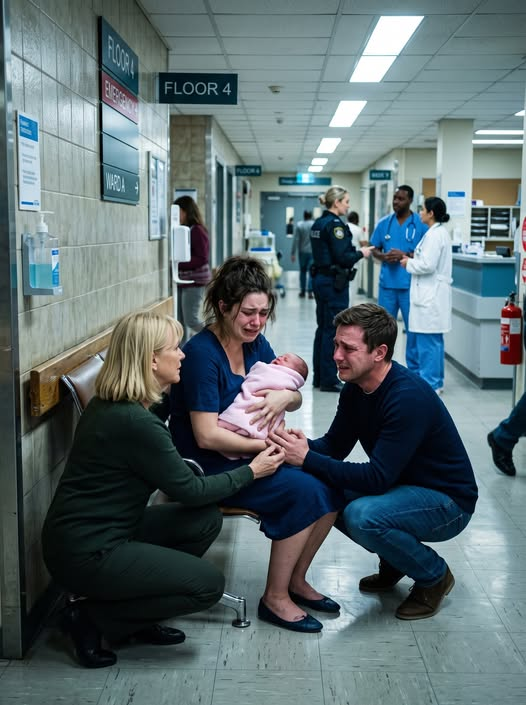
  • My Mother-in-Law Slapped Me in Front of Everyone—Then My Newborn …

    My Mother-in-Law Slapped Me in Front of Everyone—Then My Newborn Suddenly Stopped Crying, and What Happened Next Exposed a Family Secret That Left Us All Frozen.

    The slap came so fast I never saw Patricia Miller raise her hand.

    One second, I was standing in the dim hallway of our house in Columbus, Ohio, rocking my three-week-old daughter, Lily, against my shoulder.

    The next, Patricia’s palm cracked across my face hard enough to make my ears ring.

    It was midnight, and Lily had been crying for what felt like hours.

    Not the soft, fussy whimper people imagine when they think about newborns.

    She was crying with her whole tiny body, red-faced and exhausted, while I moved through the same checklist I had already gone through twice.

    Diaper.

    Bottle.

    Temperature.

    Burping.

    Breathing.

    I checked the blanket around her legs, then loosened it because I worried she might be too warm.

    I held her against my chest and walked slowly up and down the hallway because sometimes the movement helped.

    That night, it didn’t.

    I was wearing pajama pants and a formula-stained shirt.

    My hair had been twisted into the same loose knot since sometime that afternoon, and every muscle in my shoulders hurt from carrying Lily and trying to sleep in twenty-minute pieces.

    Still, I kept walking.

    She was my daughter.

    She was three weeks old.

    If she needed me awake, I was going to stay awake.

    Patricia did not see it that way.

    She had already complained twice about the noise.

    The first time, she had opened her bedroom door and told me to take Lily farther down the hall.

    The second time, she had walked into the kitchen while I was warming a bottle and asked how a baby that small could possibly be that loud.

    I had been too tired to argue.

    I told her I was doing everything I could.

    By midnight, apparently that was not enough for her.

    I heard her bedroom door open behind me.

    I turned slightly, still bouncing Lily against my shoulder.

    Patricia walked toward me with her jaw tight and her robe pulled closed across her chest.

    “She has been screaming all night,” she said.

    “I know.”

    “Then do something.”

    “I am doing something.”

    Lily cried again, louder this time.

    I shifted her carefully and tried to guide her head back toward my shoulder.

    “She’s three weeks old, Patricia. She doesn’t have an off switch.”

    That was when Patricia hit me.

    There was no warning.

    No raised voice first.

    No argument long enough for me to realize the situation was changing.

    Her palm struck my cheek, my head snapped sideways, and the hallway seemed to tilt beneath my feet.

    My ears rang.

    My balance went sideways.

    “Shut her up, or get out of the house!” Patricia shouted.

    My arms opened for one terrible fraction of a second.

    Lily slipped.

    I felt the weight disappear from my chest before my exhausted mind understood what was happening.

    Her tiny body hit the hardwood floor.

    Then the crying stopped.

    The silence was instant.

    Wrong.

    Impossible.

    “Lily!”

    I dropped to my knees so hard I barely felt the impact.

    She lay motionless, eyes closed, one little fist curled beside her face.

    For the first few seconds, I could not seem to process the size of her against the floor.

    She looked impossibly small.

    I had spent three weeks watching every breath she took.

    Now I was staring at her chest, begging myself to see movement.

    “Lily, baby, come on.”

    I reached toward her, then hesitated because suddenly I was terrified that touching her the wrong way could make things worse.

    The sudden quiet was worse than every scream that had come before it.

    Daniel came running from the bedroom.

    “What happened?”

    He stopped when he saw me kneeling on the floor.

    Then he saw Lily.

    His expression changed immediately.

    “Call 911!” I screamed.

    Behind me, Patricia had gone pale.

    For one second, I expected her to rush toward Lily.

    I expected her to apologize.

    I expected her to look horrified by what she had done.

    Instead, her voice became strangely controlled.

    “She dropped the baby,” she said.

    I turned toward her, still on my knees.

    The side of my face was burning where she had hit me.

    “You hit me.”

    “I barely touched you.”

    Daniel looked from me to his mother.

    “Mom?”

    I will never forget the hesitation in his voice.

    It was not agreement.

    It was not disbelief either.

    It was uncertainty.

    And in that moment, with our newborn daughter lying motionless on the hardwood floor, uncertainty felt unbearable.

    Patricia did not hesitate at all.

    “She’s exhausted,” she said. “She doesn’t know what she’s saying.”

    I stared at her.

    The accusation was so quick, so practiced in its certainty, that it took me a second to understand what she was doing.

    She was not talking about Lily.

    She was building a story.

    A version of the night where I was the exhausted new mother who had lost control of my baby and then blamed someone else.

    That hurt almost as much as the slap.

    Not because I believed her.

    Because I saw Daniel trying to make sense of two versions at once.

    My newborn was lying on the floor, and somehow Patricia was already trying to turn me into the unreliable one.

    I stopped waiting for my husband to decide who he believed.

    Whatever argument was happening in that hallway could wait.

    Lily could not.

    I scooped her up and ran.

    I moved through the house with her pressed against me, barely aware of Daniel calling my name behind me.

    I grabbed my keys.

    I did not change clothes.

    I did not find shoes that matched.

    I did not stop to pack a diaper bag.

    Every ordinary new-parent rule disappeared except one.

    Get Lily help.

    The nearest emergency department was less than ten minutes away.

    I got into my car, called 911 on speaker, and started driving while the dispatcher tried to keep me focused.

    My hands were shaking so badly I had to grip the steering wheel harder than normal just to keep them steady.

    The dispatcher asked where I was.

    I gave the location.

    She asked whether Lily was breathing.

    I looked toward her at the next red light and felt my throat close.

    “I don’t know,” I said. “She isn’t making any sound.”

    The dispatcher kept her voice calm.

    An ambulance could meet me, but by then I was already only a couple of blocks from Riverside Methodist Hospital.

    I remember every red light from that drive.

    I remember staring at them like they were personal betrayals.

    I remember checking Lily again and again.

    I remember begging her to cry.

    Five minutes earlier, I would have given anything for thirty seconds of silence.

    Now I wanted the loudest scream she had ever made.

    “Come on, Lily,” I whispered. “Please. Please make a sound.”

    She didn’t.

    The formula stain on my shirt was still damp when I pulled into the hospital entrance.

    I barely remember getting out of the car.

    I remember saying the word newborn.

    I remember saying she fell.

    I remember trying to explain that somebody had hit me while I was holding her.

    Then hospital staff took Lily from my arms.

    For three weeks, I had been the person who held her when she cried.

    I changed her.

    Fed her.

    Counted her fingers when I was too tired to think straight.

    Checked the rise and fall of her chest in the middle of the night.

    Now strangers were carrying her through emergency-room doors, and I had to let them.

    There was nothing else I could do.

    I stood in the hallway in pajama pants and that formula-stained shirt while people moved quickly around me.

    Someone asked for my name.

    Someone else asked Lily’s date of birth.

    I answered automatically.

    The questions felt almost absurd beside the fact that my daughter was behind a closed door and I could not hear her.

    I touched my cheek.

    It was still hot.

    That physical pain felt distant now, almost irrelevant.

    Twenty minutes passed.

    They were the longest twenty minutes of my life.

    Every time a door opened, I looked up.

    Every time footsteps came down the corridor, my stomach tightened.

    I kept expecting someone to tell me everything was fine.

    I also knew, somewhere beneath that hope, that if everything were fine, someone probably would have said so already.

    A physician finally approached me.

    His name was Dr. Aaron Blake.

    He had the careful expression people wear when they are trying not to frighten someone who is already terrified.

    I knew before he spoke that something was terribly wrong.

    “Mrs. Miller?”

    “Yes.”

    “Your daughter is already in cardiac arrest.”

    For a moment, the words did not connect.

    I knew what each word meant individually.

    Together, they seemed impossible.

    “What?”

    “She had no detectable pulse when you arrived. We’re performing CPR now.”

    My knees gave way.

    A nurse caught my arm before I hit the floor.

    I heard somebody tell me to sit down, but I could not stop looking at Dr. Blake.

    “Can you save her?”

    He did not give me a comforting promise.

    He continued carefully.

    “There are signs of significant head trauma. We need to know exactly what happened.”

    That sentence brought me straight back to the hallway at home.

    Patricia’s hand.

    The slap.

    My balance shifting.

    Lily slipping.

    The sound of her hitting the floor.

    And then Patricia saying I had dropped her.

    I started explaining.

    “I was holding her. My mother-in-law came out because Lily was crying. She hit me across the face. I lost my balance, and Lily fell.”

    Dr. Blake listened without interrupting.

    I could hear my own voice shaking.

    “I didn’t throw her. I didn’t—she slipped when Patricia hit me.”

    Before he could respond, I noticed movement at the far end of the hallway.

    Daniel and Patricia were coming toward us.

    Daniel looked terrified.

    His face was tight, and he kept scanning the corridor as if he expected to see Lily somewhere nearby.

    Patricia was different.

    She walked quickly, but her attention went directly to me.

    Not to the doors where the medical team had taken Lily.

    Not to Dr. Blake.

    To me.

    She reached us first.

    “Emily,” she said.

    I looked at her.

    “Tell them it was an accident.”

    For several seconds, I could not answer.

    I thought maybe I had heard her wrong.

    This was the woman who had hit me while I was holding a newborn.

    My daughter had been carried into an emergency room without a detectable pulse.

    Doctors were performing CPR.

    And Patricia’s first concern was the story I told them.

    She was not asking whether Lily was alive.

    She was not asking what the doctors had said.

    She was not asking whether there was anything she could do.

    She wanted me to protect her.

    Daniel stopped beside us.

    “Emily, what did the doctor say?”

    I looked at him, then back at Patricia.

    She kept watching me.

    Her face had the rigid, controlled look she had worn back in the hallway after Lily fell.

    As if the biggest danger in that hospital was not what had happened to Lily.

    It was what might come out of my mouth.

    Something inside me settled.

    Not grief.

    The grief was still there, huge and terrifying, waiting behind every thought.

    Not fear either.

    I was afraid of what was happening behind those emergency-room doors in a way I had never been afraid of anything before.

    What settled inside me was clarity.

    At home, Patricia had acted immediately.

    She had denied hitting me.

    She had blamed exhaustion.

    She had told Daniel I did not know what I was saying.

    Now, at the hospital, before even asking about Lily, she was telling me to call it an accident.

    Those were not the actions of someone focused on a baby in danger.

    They were the actions of someone focused on protecting herself.

    I thought about Daniel’s hesitation in the hallway.

    I thought about Patricia saying, “She dropped the baby.”

    I thought about the burning on my cheek.

    Then I looked toward the emergency-room doors where doctors were trying to bring my daughter back.

    There was no version of this night where I was going to make Patricia comfortable by changing the truth.

    Daniel said my name again.

    “Emily?”

    Patricia moved half a step closer.

    Her voice dropped.

    “Think about what you’re saying.”

    I did.

    For the first time since the slap, I felt completely certain about what came next.

    I reached into my pocket and pulled out my phone.

  • My Mother-in-Law Slapped Me in Front of Everyone—Then My Newborn …

    My Mother-in-Law Slapped Me in Front of Everyone—Then My Newborn …

    My Mother-in-Law Slapped Me in Front of Everyone—Then My Newborn Suddenly Stopped Crying, and What Happened Next Exposed a Family Secret That Left Us All Frozen.

    The slap came so fast I never saw Patricia Miller raise her hand.

    One second, I was standing in the dim hallway of our house in Columbus, Ohio, rocking my three-week-old daughter, Lily, against my shoulder.

    The next, Patricia’s palm cracked across my face hard enough to make my ears ring.

    It was midnight, and Lily had been crying for what felt like hours.

    Not the soft, fussy whimper people imagine when they think about newborns.

    She was crying with her whole tiny body, red-faced and exhausted, while I moved through the same checklist I had already gone through twice.

    Diaper.

    Bottle.

    Temperature.

    Burping.

    Breathing.

    I checked the blanket around her legs, then loosened it because I worried she might be too warm.

    I held her against my chest and walked slowly up and down the hallway because sometimes the movement helped.

    That night, it didn’t.

    I was wearing pajama pants and a formula-stained shirt.

    My hair had been twisted into the same loose knot since sometime that afternoon, and every muscle in my shoulders hurt from carrying Lily and trying to sleep in twenty-minute pieces.

    Still, I kept walking.

    She was my daughter.

    She was three weeks old.

    If she needed me awake, I was going to stay awake.

    Patricia did not see it that way.

    She had already complained twice about the noise.

    The first time, she had opened her bedroom door and told me to take Lily farther down the hall.

    The second time, she had walked into the kitchen while I was warming a bottle and asked how a baby that small could possibly be that loud.

    I had been too tired to argue.

    I told her I was doing everything I could.

    By midnight, apparently that was not enough for her.

    I heard her bedroom door open behind me.

    I turned slightly, still bouncing Lily against my shoulder.

    Patricia walked toward me with her jaw tight and her robe pulled closed across her chest.

    “She has been screaming all night,” she said.

    “I know.”

    “Then do something.”

    “I am doing something.”

    Lily cried again, louder this time.

    I shifted her carefully and tried to guide her head back toward my shoulder.

    “She’s three weeks old, Patricia. She doesn’t have an off switch.”

    That was when Patricia hit me.

    There was no warning.

    No raised voice first.

    No argument long enough for me to realize the situation was changing.

    Her palm struck my cheek, my head snapped sideways, and the hallway seemed to tilt beneath my feet.

    My ears rang.

    My balance went sideways.

    “Shut her up, or get out of the house!” Patricia shouted.

    My arms opened for one terrible fraction of a second.

    Lily slipped.

    I felt the weight disappear from my chest before my exhausted mind understood what was happening.

    Her tiny body hit the hardwood floor.

    Then the crying stopped.

    The silence was instant.

    Wrong.

    Impossible.

    “Lily!”

    I dropped to my knees so hard I barely felt the impact.

    She lay motionless, eyes closed, one little fist curled beside her face.

    For the first few seconds, I could not seem to process the size of her against the floor.

    She looked impossibly small.

    I had spent three weeks watching every breath she took.

    Now I was staring at her chest, begging myself to see movement.

    “Lily, baby, come on.”

    I reached toward her, then hesitated because suddenly I was terrified that touching her the wrong way could make things worse.

    The sudden quiet was worse than every scream that had come before it.

    Daniel came running from the bedroom.

    “What happened?”

    He stopped when he saw me kneeling on the floor.

    Then he saw Lily.

    His expression changed immediately.

    “Call 911!” I screamed.

    Behind me, Patricia had gone pale.

    For one second, I expected her to rush toward Lily.

    I expected her to apologize.

    I expected her to look horrified by what she had done.

    Instead, her voice became strangely controlled.

    “She dropped the baby,” she said.

    I turned toward her, still on my knees.

    The side of my face was burning where she had hit me.

    “You hit me.”

    “I barely touched you.”

    Daniel looked from me to his mother.

    “Mom?”

    I will never forget the hesitation in his voice.

    It was not agreement.

    It was not disbelief either.

    It was uncertainty.

    And in that moment, with our newborn daughter lying motionless on the hardwood floor, uncertainty felt unbearable.

    Patricia did not hesitate at all.

    “She’s exhausted,” she said. “She doesn’t know what she’s saying.”

    I stared at her.

    The accusation was so quick, so practiced in its certainty, that it took me a second to understand what she was doing.

    She was not talking about Lily.

    She was building a story.

    A version of the night where I was the exhausted new mother who had lost control of my baby and then blamed someone else.

    That hurt almost as much as the slap.

    Not because I believed her.

    Because I saw Daniel trying to make sense of two versions at once.

    My newborn was lying on the floor, and somehow Patricia was already trying to turn me into the unreliable one.

    I stopped waiting for my husband to decide who he believed.

    Whatever argument was happening in that hallway could wait.

    Lily could not.

    I scooped her up and ran.

    I moved through the house with her pressed against me, barely aware of Daniel calling my name behind me.

    I grabbed my keys.

    I did not change clothes.

    I did not find shoes that matched.

    I did not stop to pack a diaper bag.

    Every ordinary new-parent rule disappeared except one.

    Get Lily help.

    The nearest emergency department was less than ten minutes away.

    I got into my car, called 911 on speaker, and started driving while the dispatcher tried to keep me focused.

    My hands were shaking so badly I had to grip the steering wheel harder than normal just to keep them steady.

    The dispatcher asked where I was.

    I gave the location.

    She asked whether Lily was breathing.

    I looked toward her at the next red light and felt my throat close.

    “I don’t know,” I said. “She isn’t making any sound.”

    The dispatcher kept her voice calm.

    An ambulance could meet me, but by then I was already only a couple of blocks from Riverside Methodist Hospital.

    I remember every red light from that drive.

    I remember staring at them like they were personal betrayals.

    I remember checking Lily again and again.

    I remember begging her to cry.

    Five minutes earlier, I would have given anything for thirty seconds of silence.

    Now I wanted the loudest scream she had ever made.

    “Come on, Lily,” I whispered. “Please. Please make a sound.”

    She didn’t.

    The formula stain on my shirt was still damp when I pulled into the hospital entrance.

    I barely remember getting out of the car.

    I remember saying the word newborn.

    I remember saying she fell.

    I remember trying to explain that somebody had hit me while I was holding her.

    Then hospital staff took Lily from my arms.

    For three weeks, I had been the person who held her when she cried.

    I changed her.

    Fed her.

    Counted her fingers when I was too tired to think straight.

    Checked the rise and fall of her chest in the middle of the night.

    Now strangers were carrying her through emergency-room doors, and I had to let them.

    There was nothing else I could do.

    I stood in the hallway in pajama pants and that formula-stained shirt while people moved quickly around me.

    Someone asked for my name.

    Someone else asked Lily’s date of birth.

    I answered automatically.

    The questions felt almost absurd beside the fact that my daughter was behind a closed door and I could not hear her.

    I touched my cheek.

    It was still hot.

    That physical pain felt distant now, almost irrelevant.

    Twenty minutes passed.

    They were the longest twenty minutes of my life.

    Every time a door opened, I looked up.

    Every time footsteps came down the corridor, my stomach tightened.

    I kept expecting someone to tell me everything was fine.

    I also knew, somewhere beneath that hope, that if everything were fine, someone probably would have said so already.

    A physician finally approached me.

    His name was Dr. Aaron Blake.

    He had the careful expression people wear when they are trying not to frighten someone who is already terrified.

    I knew before he spoke that something was terribly wrong.

    “Mrs. Miller?”

    “Yes.”

    “Your daughter is already in cardiac arrest.”

    For a moment, the words did not connect.

    I knew what each word meant individually.

    Together, they seemed impossible.

    “What?”

    “She had no detectable pulse when you arrived. We’re performing CPR now.”

    My knees gave way.

    A nurse caught my arm before I hit the floor.

    I heard somebody tell me to sit down, but I could not stop looking at Dr. Blake.

    “Can you save her?”

    He did not give me a comforting promise.

    He continued carefully.

    “There are signs of significant head trauma. We need to know exactly what happened.”

    That sentence brought me straight back to the hallway at home.

    Patricia’s hand.

    The slap.

    My balance shifting.

    Lily slipping.

    The sound of her hitting the floor.

    And then Patricia saying I had dropped her.

    I started explaining.

    “I was holding her. My mother-in-law came out because Lily was crying. She hit me across the face. I lost my balance, and Lily fell.”

    Dr. Blake listened without interrupting.

    I could hear my own voice shaking.

    “I didn’t throw her. I didn’t—she slipped when Patricia hit me.”

    Before he could respond, I noticed movement at the far end of the hallway.

    Daniel and Patricia were coming toward us.

    Daniel looked terrified.

    His face was tight, and he kept scanning the corridor as if he expected to see Lily somewhere nearby.

    Patricia was different.

    She walked quickly, but her attention went directly to me.

    Not to the doors where the medical team had taken Lily.

    Not to Dr. Blake.

    To me.

    She reached us first.

    “Emily,” she said.

    I looked at her.

    “Tell them it was an accident.”

    For several seconds, I could not answer.

    I thought maybe I had heard her wrong.

    This was the woman who had hit me while I was holding a newborn.

    My daughter had been carried into an emergency room without a detectable pulse.

    Doctors were performing CPR.

    And Patricia’s first concern was the story I told them.

    She was not asking whether Lily was alive.

    She was not asking what the doctors had said.

    She was not asking whether there was anything she could do.

    She wanted me to protect her.

    Daniel stopped beside us.

    “Emily, what did the doctor say?”

    I looked at him, then back at Patricia.

    She kept watching me.

    Her face had the rigid, controlled look she had worn back in the hallway after Lily fell.

    As if the biggest danger in that hospital was not what had happened to Lily.

    It was what might come out of my mouth.

    Something inside me settled.

    Not grief.

    The grief was still there, huge and terrifying, waiting behind every thought.

    Not fear either.

    I was afraid of what was happening behind those emergency-room doors in a way I had never been afraid of anything before.

    What settled inside me was clarity.

    At home, Patricia had acted immediately.

    She had denied hitting me.

    She had blamed exhaustion.

    She had told Daniel I did not know what I was saying.

    Now, at the hospital, before even asking about Lily, she was telling me to call it an accident.

    Those were not the actions of someone focused on a baby in danger.

    They were the actions of someone focused on protecting herself.

    I thought about Daniel’s hesitation in the hallway.

    I thought about Patricia saying, “She dropped the baby.”

    I thought about the burning on my cheek.

    Then I looked toward the emergency-room doors where doctors were trying to bring my daughter back.

    There was no version of this night where I was going to make Patricia comfortable by changing the truth.

    Daniel said my name again.

    “Emily?”

    Patricia moved half a step closer.

    Her voice dropped.

    “Think about what you’re saying.”

    I did.

    For the first time since the slap, I felt completely certain about what came next.

    I reached into my pocket and pulled out my phone.

  • They called me a disgraceful single mom and kicked me out on Christmas. I just walked away quietly—while every single one of them was secretly living off my $68M empire. That night, I cut off all their money.

    They called me a disgraceful single mom and kicked me out on Christmas. I just walked away quietly—while every single one of them was secretly living off my $68M empire. That night, I cut off all their money.

    They called me a disgraceful single mom and kicked me out on Christmas.

    I didn’t argue.

    I simply walked away—while every person at that table remained completely unaware that the life they were so proud of was being quietly funded by my $68 million company.

    That night, I cut them all off.

    “Single, broken, and dragging our family name through the mud.”

    My father’s voice cut through the Christmas dining room.

    Around the long mahogany table, my aunts and uncles exchanged approving looks. A few nodded like he had finally said what everyone else was thinking.

    My mother wouldn’t even look at me. She kept her attention on the turkey in front of her, pretending I wasn’t there.

    The argument had started with harmless holiday conversation.

    Someone asked about my life in California.

    Then came the usual questions.

    Why was I still single?

    Why didn’t I have a traditional corporate job?

    Was my freelance consulting actually paying the bills?

    Because I rarely talked about money and never showed up wearing designer labels, my family had created their own version of my life.

    They assumed I was barely surviving.

    My simple coat became proof that I was broke.

    My quiet personality became proof that I lacked ambition.

    The fact that I had no husband became proof that I had somehow failed.

    To them, I was the family charity case—the single mother who couldn’t keep a man or build a respectable career.

    Eventually, my father slammed his fist against the table hard enough to make the crystal glasses shake.

    “Get out of my house before you infect this family with your failures any longer.”

    The room went silent.

    Everyone looked at me.

    They expected tears.

    They expected me to defend myself, apologize, or shrink back into the embarrassed daughter I had once been.

    Instead, I calmly lifted my water glass and took one final sip.

    I folded my linen napkin, placed it beside my plate, and looked directly at my father.

    “Fine.”

    That was all I said.

    I didn’t yell.

    I didn’t slam the door.

    I stood, pulled on my wool coat, and walked into the freezing December night without looking back.

    Behind me, the oak door closed with a heavy click.

    Through it, I could still faintly hear their satisfied voices.

    They believed they had finally removed the embarrassment from the family Christmas.

    What none of them understood was that almost every luxury they enjoyed depended on me.

    The house where they were celebrating.

    The expensive SUVs parked outside.

    My brother’s private college tuition.

    My parents’ retirement fund.

    Country club memberships.

    Monthly allowances.

    Several investment accounts.

    All of it had been quietly supported by money from the technology company I had built from scratch.

    A company now valued at sixty-eight million dollars.

    They had spent years looking down on the person paying for their lifestyle.

    That ended before midnight.

    Sitting in the back of an Uber heading toward O’Hare International Airport, I opened my laptop and logged into my banking portal.

    One by one, I canceled every recurring transfer tied to my family.

    Allowances.

    Trust distributions.

    Automatic payments.

    Credit lines.

    Everything.

    Within minutes, my phone lit up.

    Mom.

    I ignored the message.

    Then another appeared.

    I turned on my noise-canceling headphones and continued toward the airport.

    By the time I boarded my flight back to California, the first declined-payment alerts were already arriving.

    Their perfect life had started to crack.

    ## Part 2

    Less than thirty minutes after I reached my home overlooking the Pacific, my phone began vibrating nonstop.

    Calls.

    Texts.

    Voicemails.

    Every member of my extended family suddenly needed me.

    My mother’s messages changed tone almost immediately.

    The first was angry.

    “Elena, what did you do? My card just got declined at the boutique!”

    Then came my brother.

    “Hey sis, the ATM swallowed my debit card and my rent check bounced. Please pick up!”

    Even my uncle, who barely spoke to me unless he wanted something, suddenly asked whether my bank had been hacked because his luxury car payment hadn’t cleared.

    I sat on my balcony wrapped in a blanket, listening to the waves below while watching the panic spread across my screen.

    I didn’t answer.

    I didn’t block anyone yet.

    I simply watched.

    For years, my family had mistaken financial dependence for personal success.

    Now they were about to discover the difference.

    By morning, the illusion of their wealthy lifestyle was unraveling.

    My father remained silent longer than everyone else.

    His pride probably wouldn’t let him call.

    But around noon, his name appeared on my screen.

    I let it ring twice before answering.

    “Elena! What kind of sick joke are you playing?”

    His voice was loud, but underneath the anger I heard something unfamiliar.

    Fear.

    “The mortgage didn’t clear,” he said. “The bank says every linked account and secondary trust was frozen by the primary holder. Do you understand what you’ve done?”

    “I think you explained everything clearly last night, Dad.”

    “What is that supposed to mean?”

    “You said I was a disgrace. You told me to leave.”

    “That has nothing to do with this.”

    “It has everything to do with it.”

    I paused.

    “If I’m such an embarrassment to the family, then my money shouldn’t have to support the family either.”

    His voice immediately changed.

    “We are your parents! You cannot just cut off your mother and me. We have debts, obligations, expenses. A certain standard of living to maintain.”

    “That sounds like your responsibility.”

    “You fix this right now or—”

    “Or what?”

    I interrupted softly.

    “You’ll kick me out again?”

    Silence.

    For once, my father had no threat left.

    I ended the call.

    Then I blocked him.

    My mother followed.

    Then my brother.

    Then the others.

    I thought that would finally give me some peace.

    Two hours later, a sleek black sedan appeared at the end of my driveway.

    My cousin Marcus stepped out.

    Of course they had sent Marcus.

    He had always been the golden boy of the family.

    Polished.

    Successful.

    Expensive suits.

    Perfect manners.

    The kind of person everyone compared me to.

    Now he had flown across the country to negotiate with the woman they had called a failure less than twenty-four hours earlier.

    ## Part 3

    Marcus looked nothing like his usual confident self.

    His tailored suit was wrinkled from travel.

    His face was pale.

    The familiar arrogant smile was gone.

    He knocked repeatedly until I finally let him inside through the side patio.

    He barely noticed the ocean view.

    His eyes stayed fixed on me as I sat on the sofa holding a cup of tea.

    “Elena, have you lost your mind?”

    I raised an eyebrow.

    “What happened?”

    “You know exactly what happened.”

    Marcus began pacing.

    “The bank is threatening foreclosure on the main house. My mom is panicking. Uncle Robert’s business partners are backing away because his personal guarantee failed this morning. Everyone is losing everything.”

    I took a sip of tea.

    Then I placed the cup on the table.

    “Good.”

    Marcus froze.

    “Good?”

    “Yes.”

    His expression hardened.

    “These people are your family. How can you say that? Your father worked his entire life for what he has.”

    “No, Marcus.”

    I stood.

    “My father inherited most of his wealth from Grandpa, lost a large part of it through bad real-estate deals, then spent years maintaining his lifestyle with money that came from me.”

    Marcus stared at me.

    “What are you talking about?”

    “Since none of you ever bothered to ask, I’ll explain.”

    I walked toward the glass wall overlooking the ocean.

    “You all assumed I was struggling because I didn’t drive flashy cars or wear designer labels. You laughed about my consulting work. You called me a failure because I chose to build software instead of chasing status.”

    Marcus frowned.

    “What software?”

    “Six years ago, when everyone mocked me for leaving graduate school and moving into that damp little studio apartment, I wasn’t failing.”

    I turned toward him.

    “I was building Aetheris.”

    He said nothing.

    “It’s an enterprise cloud infrastructure company. I created it, bootstrapped it, scaled it, and two years ago we completed an acquisition that valued the company at sixty-eight million dollars.”

    The color disappeared from his face.

    “Sixty-eight million?”

    “Yes.”

    “You?”

    “Me.”

    Marcus took a step backward.

    For the first time, he seemed to understand that the woman standing in front of him was not the struggling relative the family had invented in their minds.

    “And for the past five years,” I continued, “part of my payouts went directly into the family trust.”

    He stared at me.

    “The country club memberships. Cars. Tuition. Vacations. Housing expenses. Most of the lifestyle everyone bragged about.”

    I looked him in the eye.

    “I was paying for it.”

    Marcus slowly covered his face with both hands.

    “We didn’t know.”

    “No.”

    I shook my head.

    “You didn’t care enough to know.”

    “That isn’t fair.”

    “It’s completely fair.”

    I stepped closer.

    “You only cared about what I could provide. The rest of the time, I was the embarrassing single mother who didn’t fit your idea of success.”

    Marcus lowered his hands.

    “Elena, please.”

    I said nothing.

    “Give everyone another chance. Your father will apologize. My parents will apologize. Everyone will.”

    “Now?”

    He hesitated.

    “After the payments stopped?”

    Marcus looked away.

    I nodded.

    “Exactly.”

    “Elena—”

    “An apology caused by financial panic isn’t an apology, Marcus.”

    I walked toward the front door.

    “It’s a negotiation.”

    His shoulders dropped.

    “The trust arrangements are over. My attorneys are separating my assets from every family account. The payments are not coming back.”

    Marcus looked stunned.

    “You can’t mean that.”

    “I do.”

    “What are we supposed to do?”

    “The same thing all of you expected me to do when you thought I had nothing.”

    I opened the door.

    “You already have a flight home tonight.”

    He remained still.

    “Tell them they got exactly what they wanted.”

    Marcus frowned.

    “The family disgrace is gone.”

    For several seconds, neither of us spoke.

    Then he slowly walked outside.

    I watched his sedan disappear down the winding coastal road as evening settled over the Pacific.

    For years, I had believed that if I became successful enough, generous enough, or useful enough, my family would finally respect me.

    I had been wrong.

    Their approval had never been something I needed to earn.

    Standing above the ocean that evening, I finally felt the weight of their judgment disappear.

    I wasn’t the disgraceful single mother.

    I wasn’t the family disappointment.

    And I certainly wasn’t their private bank anymore.

    I had built my own life.

    Now, for the first time, it truly belonged to me.

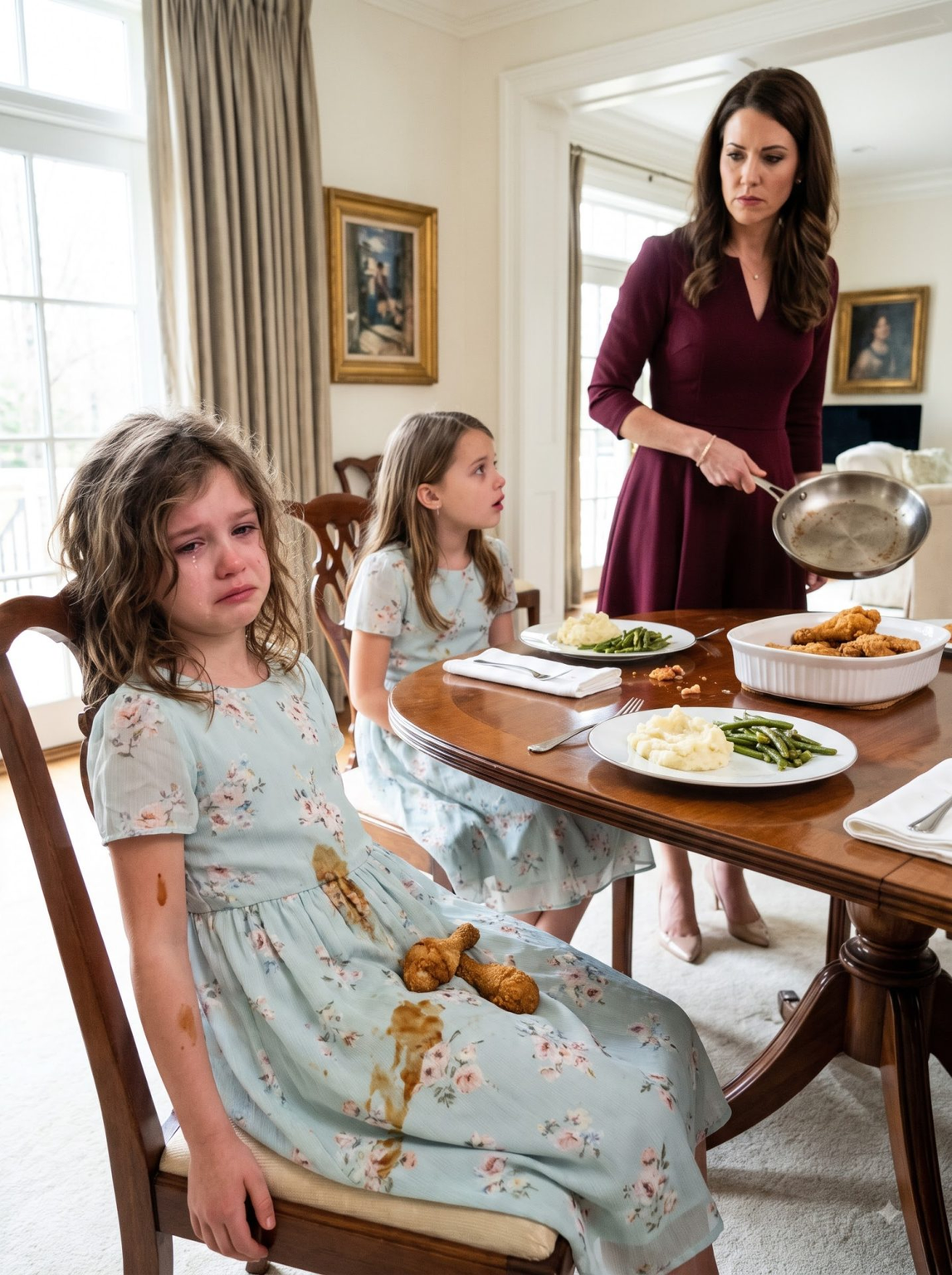
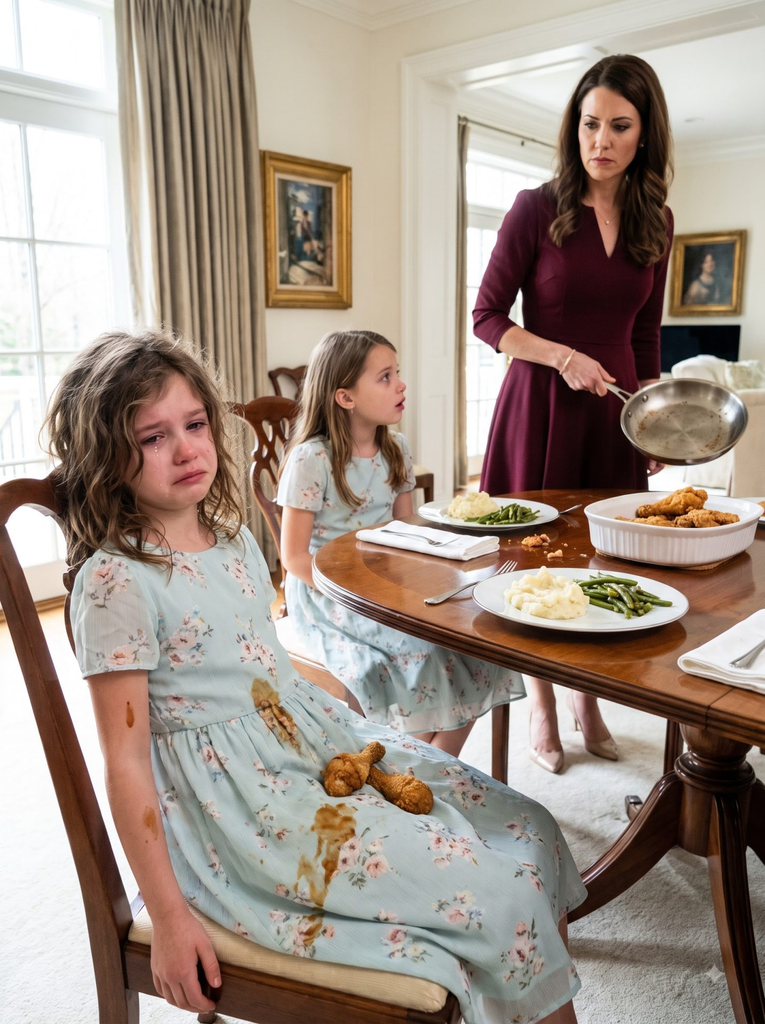
  • My four-year-old daughter and my niece accidentally wore almost identical dresses to Sunday dinner, and both girls were delighted. My older sister wasn’t. She demanded that I change my daughter, then lost her temper at the table and hur:led a skiIIet of fri:ed chicken toward her. But while my terri:fi:ed little girl clung to me covered in sauce, my mother didn’t blame my sister. She looked at me and said, “I told you to change her dress.”

    My four-year-old daughter and my niece accidentally wore almost identical dresses to Sunday dinner, and both girls were delighted. My older sister wasn’t. She demanded that I change my daughter, then lost her temper at the table and hur:led a skiIIet of fri:ed chicken toward her. But while my terri:fi:ed little girl clung to me covered in sauce, my mother didn’t blame my sister. She looked at me and said, “I told you to change her dress.”

    Part 1 – My Sister Hated That Our Daughters Were Dressed Alike

    My four-year-old daughter and my six-year-old niece showed up to Sunday dinner wearing almost identical dresses. Everyone thought it was adorable—except my sister, who stared at Emma as if my little girl had walked into the house wearing something she had stolen from Lily.

    The matching outfits had been completely accidental. Emma wore a pale-blue dress with tiny white flowers that I had bought during a clearance sale two weeks earlier, while Lily arrived twenty minutes later in almost the same style, right down to the white cardigan and matching bow in her hair.

    Emma noticed immediately.

    “Mommy, Lily looks like me!”

    She ran toward her cousin, delighted. Lily looked down at their dresses, laughed and grabbed Emma’s hands so they could spin together in the living room.

    My aunt pulled out her phone.

    “Look at those two. They could almost be twins.”

    “They are not twins,” Vanessa said.

    The room went awkwardly quiet.

    Vanessa was my older sister and Lily’s mother. For years, she had treated every compliment involving our daughters like a competition, especially if Emma received the same attention as Lily.

    Mom usually encouraged it in smaller ways.

    If both girls wanted the same toy, Emma was expected to surrender it because Lily had “seen it first.” If relatives brought identical gifts, Mom somehow found a reason Lily should choose hers first, and when Emma once wore a red coat similar to Lily’s, Vanessa accused me of copying her.

    I had always dismissed it as ridiculous adult insecurity.

    That afternoon, I finally understood how far it had gone.

    Vanessa followed me into the dining room while the girls continued playing.

    “Change Emma’s dress.”

    I thought she was joking.

    “Why?”

    “You know why.”

    “No, I really don’t.”

    “She looks exactly like Lily.”

    “They’re wearing similar dresses. They’re children.”

    Vanessa lowered her voice.

    “You keep doing this, Rachel. Every time Lily has something special, Emma suddenly needs the same thing.”

    I reminded her that I had purchased Emma’s dress before knowing what Lily would wear. Vanessa did not care; she insisted I had another outfit in Emma’s overnight bag and told me to change her before dinner.

    “No.”

    Her expression hardened.

    “Then don’t complain when this turns into a problem.”

    I should have paid more attention to that sentence.

    Dinner began about half an hour later. Mom brought mashed potatoes and vegetables to the table while Vanessa carried in a large skillet filled with fried chicken coated in a thick reddish-brown sauce.

    The girls sat beside each other.

    Lily leaned toward Emma and whispered, “I like that we match.”

    Emma smiled.

    Vanessa heard her.

    She placed the skillet on the table harder than necessary.

    Mom immediately looked at me.

    “Rachel, couldn’t you have just changed her? You know how Vanessa feels.”

    I stared at her.

    “Why should a four-year-old change clothes because a grown woman doesn’t like two children wearing similar dresses?”

    Vanessa pushed her chair back.

    “This isn’t about dresses. It’s about you constantly trying to make Emma equal to Lily.”

    I could not believe what I had heard.

    “They are equal.”

    Something changed in Vanessa’s face.

    She reached for the skillet.

    At first, I thought she was moving it away from the edge of the table.

    Instead, she lifted it with both hands.

    “Then maybe you’ll finally understand why I’m tired of seeing your daughter copy mine.”

    Before I could reach Emma, Vanessa hurled the skillet toward her side of the table.

    Fried chicken scattered across the floor and table as sauce splashed across Emma’s pale-blue dress, cardigan, arms and neck. Emma screamed and toppled sideways from her chair while Lily began crying beside her.

    I rushed toward my daughter.

    Behind me, Mom did not shout at Vanessa.

    She shouted at me.

    “I told you to change Emma’s dress!”

    I turned around with my terrified four-year-old clinging to me, her matching dress now covered in sauce.

    That was when I realized my sister’s jealousy was only half the problem.

    My mother believed Emma had caused this simply by looking too much like Lily.

    Part 2 – My Mother Blamed Emma Before Asking If She Was Hurt

    Emma was screaming before I could fully understand where the sauce had landed. I pulled the cardigan away from her skin as carefully as I could, while my aunt grabbed clean towels and Lily remained frozen beside the table, crying and repeatedly saying she had wanted to match Emma.

    Vanessa did not come near us.

    She stood behind her chair and insisted she had only meant to throw the food onto the table in front of Emma to make a point. The skillet itself had struck the edge of the table before falling, she claimed, and Emma had toppled from her chair because she panicked.

    I did not argue about details I had not yet processed. I knew only that I had watched my sister lift a skillet with both hands and deliberately hurl it toward the side of the table where my four-year-old daughter was sitting.

    “Rachel, just take her upstairs and clean her off,” Mom said.

    I stared at her.

    “She needs a doctor.”

    “For sauce?”

    “For having a skillet of hot food thrown at her.”

    Mom lowered her voice and glanced toward the relatives watching us. She said Vanessa had obviously lost her temper, but reminded me that I had been warned repeatedly to change Emma’s dress before dinner.

    That was the moment I stopped listening.

    I carried Emma outside and called for medical help. My aunt followed with Emma’s shoes and overnight bag, while my father finally came out of the kitchen and offered to drive us.

    I refused.

    At the hospital, Emma was examined for the effects of the hot food and for injuries from falling out of the chair. The doctor told me she would recover, but because she was four and the injury had resulted from an adult deliberately throwing something toward her, hospital staff needed a clear account of what had happened.

    I gave them one.

    I did not soften Vanessa’s actions, and I did not exaggerate them. I explained the argument over the dresses, Vanessa’s demand that I change Emma, Mom’s repeated insistence that I comply, and exactly what I had seen at the table.

    Emma remained beside me wrapped in a hospital blanket.

    After a while, she looked down at the stained dress folded inside a plastic belongings bag.

    “Mommy?”

    “What, sweetheart?”

    “Was Aunt Vanessa mad because I looked like Lily?”

    The question hurt more than anything Vanessa had said.

    “No. You didn’t do anything wrong by wearing your dress.”

    “But Grandma told you to change me.”

    I had no good explanation for that.

    My phone had been vibrating almost continuously since we left the house. Vanessa called twice, Dad called three times, and Mom sent a series of messages asking me not to turn “one terrible moment” into something that could destroy Vanessa’s family.

    Then another message arrived.

    Tell the hospital she dropped the skillet. Vanessa has Lily to think about.

    I took a screenshot.

    A hospital social worker named Denise was already speaking with me because of Emma’s age. When I showed her the message, she asked whether my mother had witnessed the incident.

    “She was sitting at the table.”

    “And she’s asking you to give a different account?”

    “Yes.”

    Denise asked me to preserve every message.

    A few minutes later, Dad called again.

    This time I answered.

    “Rachel, Emma is okay, right?”

    “She will be.”

    He exhaled.

    Then came the sentence I had been expecting.

    “Your mother thinks involving authorities will make everything worse.”

    “Did Vanessa throw the skillet?”

    Dad went silent.

    “Dad.”

    “I saw her pick it up.”

    “And?”

    “I looked toward Lily when she started crying.”

    It was not enough.

    But before I could press him further, I heard Mom speaking behind him.

    “Tell Rachel it wasn’t about Emma. Vanessa was upset with her.”

    I froze.

    “What does that mean?”

    Dad did not answer.

    Mom apparently realized the call was still connected because the line suddenly went dead.

    Less than a minute later, a message appeared from her.

    She deleted it almost immediately.

    But not before I read the notification preview.

    I warned Vanessa before dinner that you were deliberately dressing Emma like Lily again. I told her she needed to put a stop to it.

    I stared at the screen.

    Until that moment, I had believed Vanessa saw the matching dresses and simply lost control.

    Now I knew Mom had been feeding that anger before we ever sat down to eat.

    And I needed to know what else she had told my sister about my four-year-old daughter.

    Part 3 – The Matching Dresses Were Never the Real Problem

    I showed Denise the notification before opening the message thread. Mom had deleted the newest text, but the preview was still visible in my notifications, and Denise asked me to photograph the screen before anything else changed.

    Then I searched my conversation with Mom for Lily’s name.

    What I found made the argument over the dresses look much less spontaneous.

    Three months earlier, Mom had complained after Emma and Lily received matching winter coats from my aunt. She told me Vanessa was upset because Emma was “always being presented as Lily’s equal,” and when I responded that they were cousins, not competitors, Mom told me I needed to be more sensitive.

    There were other examples.

    After a family wedding, Mom had asked me not to post a photograph of the girls standing together because several relatives had commented on how much Emma resembled Lily. Another time, she suggested I return a pair of shoes because Vanessa had already purchased the same style for her daughter.

    I had dismissed every incident separately.

    Together, they showed a pattern.

    Denise asked whether Vanessa had ever physically hurt Emma before. I said no, but admitted there had been smaller moments when Vanessa excluded her, took toys away or became visibly irritated whenever relatives gave both girls equal attention.

    The strangest part was that Lily herself had never seemed to care.

    The competition existed almost entirely between the adults.

    That became even clearer when my aunt called.

    She had remained at Mom’s house after I left because Lily was hysterical and refused to let Vanessa near her. Once Lily calmed down, she kept asking the same question.

    “Why did Mommy get mad? I wanted Emma to match me.”

    My aunt also told me something I had not heard before dinner.

    While I had been helping Emma wash her hands, Mom and Vanessa had been talking in the kitchen.

    Vanessa had complained that I dressed Emma like Lily intentionally.

    Mom replied, “Then stop letting Rachel do it. She only keeps pushing because nobody makes her stop.”

    My aunt had assumed they were discussing me.

    After what happened at dinner, she was no longer sure.

    I asked whether she had actually seen Vanessa throw the skillet.

    “Yes.”

    The answer came immediately.

    “She picked it up with both hands and threw it toward Emma’s side of the table. It wasn’t dropped.”

    I closed my eyes.

    That was the first clear eyewitness account I had received from anyone besides myself.

    “Would you tell that to someone officially?”

    “Yes.”

    There was no hesitation.

    My father called again that evening.

    This time, his voice sounded different.

    He admitted Mom had been complaining about Emma’s dress before we arrived. Vanessa had sent her a photograph I posted that morning, and Mom had responded that I was once again trying to make Emma “compete” with Lily.

    “Why didn’t you tell me?”

    “I thought it was ridiculous, Rachel. I didn’t think Vanessa would do anything.”

    “That isn’t what I asked.”

    Dad went quiet.

    For years, he had handled Mom and Vanessa the same way. He stayed out of disagreements until everyone calmed down, then privately admitted they had gone too far without ever challenging them when it mattered.

    I was finished accepting that as neutrality.

    “If you saw anything at that table, you need to tell the truth. Not for me. For Emma.”

    “I know.”

    “No, Dad. Knowing isn’t enough anymore.”

    After we hung up, Denise helped me organize the messages chronologically. What emerged was not evidence that Mom had ordered Vanessa to throw anything, and I refused to claim that it was.

    But it did show that Mom had encouraged the resentment.

    Before dinner, Vanessa had written:

    Rachel did it again. Look at Emma’s dress.

    Mom replied:

    I see it. Make her change it before everyone gets here. Lily shouldn’t have to share every special thing with that child.

    Vanessa responded:

    Rachel will say no. She always does.

    Mom’s final message was shorter.

    Then put a stop to it yourself.

    I read those words several times.

    Denise did not tell me what they meant legally. She simply preserved them with the rest of the messages and reminded me that investigators would determine what significance they had.

    For me, their meaning was already devastating enough.

    My mother had looked at a four-year-old child wearing a blue dress and seen competition.

    She had treated Emma’s clothes, compliments and presence beside Lily as things Vanessa needed to defend her daughter against.

    Then my phone rang.

    Dad again.

    When I answered, he did not ask me to calm down.

    “I need to correct what I told you earlier,” he said.

    I waited.

    “I saw Vanessa throw it.”

    My hand tightened around the phone.

    Dad explained that when Vanessa stood, he had been watching her, not Lily as he previously claimed. He saw her grip the skillet, heard me tell her to put it down, and watched her throw it toward Emma.

    “Why did you lie?”

    His answer came quietly.

    “Because your mother told me before you left that if Vanessa got arrested, Lily could lose her mother.”

    I could barely speak.

    “So you decided Emma could lose the truth instead?”

    Dad began crying.

    But I did not comfort him.

    For the first time, someone from that house was finally admitting exactly what had happened.

    And Dad had one more thing to tell me.

    After I carried Emma outside, Mom had gathered everyone remaining in the dining room and told them what they were supposed to say if anyone asked:

    Vanessa dropped the skillet. Emma fell because she got scared.

    The lie had been created before I even reached the hospital.

    Part 4 – My Mother Tried to Turn What Happened Into an Accident

    Dad’s admission changed the investigation. Until then, my aunt and I were the only adults willing to say Vanessa had deliberately thrown the skillet toward Emma, but now someone who had been sitting at the table from beginning to end was prepared to confirm it too.

    I asked Dad to stop telling me details over the phone and give his account directly to the investigator. If he was finally going to tell the truth, I wanted it documented without Mom or Vanessa having another opportunity to persuade him to change it.

    The following morning, Emma was discharged with instructions for follow-up care. She was sore and frightened, but the doctors expected her injuries to heal, and I took her home with strict instructions that nobody from my parents’ house was allowed to visit.

    Emma asked about Lily before she asked about anyone else.

    “Is Lily mad at me?”

    “No, sweetheart.”

    “Because we wore the same dress?”

    “No.”

    She thought for a moment.

    “I liked matching her.”

    That simple answer made the entire situation feel even uglier. Emma and Lily had never been competing; two adults had created a rivalry between children who had been perfectly happy spinning around the living room in similar blue dresses.

    Later that afternoon, Dad gave his statement.

    He confirmed that Vanessa had complained about Emma’s clothes before dinner and that Mom had repeatedly encouraged me to change her. He also admitted that after Vanessa threw the skillet, Mom immediately began insisting everyone describe it as something Vanessa had accidentally dropped.

    Dad had initially agreed.

    When the investigator asked why, he gave the same explanation he had given me.

    He was afraid Lily could lose her mother.

    Nobody apparently considered what Emma might lose if every adult in that room lied.

    My aunt provided her statement separately. She confirmed Vanessa had lifted the skillet with both hands and thrown it toward Emma’s side of the table after becoming angry during our argument.

    The messages added another layer.

    They did not prove Mom had ordered Vanessa to hurt Emma, and I refused to claim otherwise. What they did establish was that Mom knew Vanessa was angry before dinner and actively encouraged her to “put a stop” to what she considered my attempt to make Emma compete with Lily.

    Then investigators found something even more revealing in the messages Vanessa voluntarily provided while trying to defend herself.

    For months, she and Mom had been discussing our daughters.

    There were complaints about matching Christmas pajamas my aunt bought both girls. Complaints about relatives giving Emma the same doll Lily owned, and even complaints about a photograph in which Emma stood beside Lily while both children wore their hair in similar braids.

    One message from Vanessa read:

    Rachel needs to understand Lily doesn’t have to share everything that makes her special.

    Mom replied:

    Then stop letting her.

    It was never really about one dress.

    Vanessa had convinced herself that whenever Emma received something similar to Lily, my daughter was taking something away from hers. Mom had repeatedly reinforced that belief instead of reminding her that children did not lose value because another child received equal affection.

    Vanessa called me that evening from a number I did not recognize.

    I almost disconnected when I heard her voice.

    “Rachel, please don’t hang up.”

    “You shouldn’t be calling me.”

    “I need you to understand that I never meant to seriously hurt Emma.”

    I looked toward the living room, where my daughter was coloring at the coffee table.

    “You threw a skillet toward a four-year-old.”

    “I was angry at you.”

    “Then why was Emma the one you threw it at?”

    Vanessa began crying.

    She said watching Emma and Lily dressed alike had made her feel as though I was deliberately trying to erase the differences between our daughters. She admitted that Mom had spent years agreeing with her whenever she complained, until she stopped questioning whether her resentment made sense.

    Then she said something that ended any sympathy I might have felt.

    “If you had just changed Emma’s dress, none of this would have happened.”

    I ended the call.

    There it was again.

    My daughter was still being made responsible for an adult’s decision.

    That evening, Mom sent me a long email. She said she loved both granddaughters, insisted Vanessa needed help rather than punishment, and accused me of allowing one terrible mistake to tear the family apart.

    I replied with only two sentences.

    Emma did not tear this family apart by wearing a dress. Vanessa made a choice, and you made another choice when you tried to hide it.

    Neither of you will see my daughter.

    Mom did not respond.

    Three days later, Dad came to my house alone.

    He brought Emma’s overnight bag, her white cardigan and the little shoes that had been left beneath my parents’ dining table. He placed them beside the door and told me he had moved into a hotel after refusing to retract his statement.

    Then he handed me his phone.

    Mom had sent him a message that morning.

    If Rachel would stop treating Emma like a victim, maybe Vanessa wouldn’t have to pay for one moment of anger.

    I read it twice.

    My mother still believed Vanessa was the person who needed protecting.

    And that finally answered the only question I had left about whether Emma could ever safely return to her house.

    Part 5 – My Daughter Would Never Be Punished for Someone Else’s Jealousy

    The investigation continued for several months, but I stopped allowing every development to control our lives. Vanessa faced consequences for deliberately throwing the skillet toward Emma, while the messages and witness statements documented Mom’s attempts to influence how the family described what happened.

    I did not need the harshest possible outcome to feel that Emma had been protected. What mattered was that nobody could officially reduce the incident to a dropped skillet or a frightened child falling from her chair, because my aunt and father had both given statements confirming what they witnessed.

    Vanessa was ordered to have no contact with Emma while the case proceeded. She also began counseling, and although I heard through Dad that she was finally confronting the resentment she had built around our daughters, I made it clear that treatment did not automatically restore access to my child.

    Mom found that harder to accept.

    She sent letters explaining that she had never wanted Emma hurt and had only been trying to protect Lily from feeling overshadowed. In every version, however, she continued describing two little girls receiving equal attention as though Lily had somehow been losing something.

    I eventually returned the letters unopened.

    Dad remained separated from Mom and began visiting Emma on his own. I did not immediately forgive him for lying, but he stopped asking me to excuse his silence and acknowledged that protecting Vanessa from consequences had briefly mattered more to him than telling the truth about what happened to his granddaughter.

    That distinction mattered.

    Several weeks later, Lily sent Emma a drawing through Dad.

    It showed two little girls holding hands beneath an enormous blue sky. Both wore matching dresses, and above them Lily had written in uneven six-year-old handwriting:

    ME + EMMA

    Emma immediately asked whether she could call her cousin.

    I hesitated.

    Lily had witnessed something frightening, but she had not caused it. Separating Emma from adults who had endangered her did not mean teaching her that Lily was responsible for her mother’s behavior.

    With appropriate boundaries, I allowed a short video call while Dad stayed nearby.

    The moment Lily appeared, she started crying.

    “I’m sorry my mommy threw the chicken.”

    Emma looked confused.

    “You didn’t throw it.”

    “No.”

    “Then you don’t have to say sorry.”

    I had to turn away for a second.

    Two children understood something the adults around them had spent months refusing to accept.

    Responsibility belonged to the person who made the choice.

    By Emma’s fifth birthday, most of the visible reminders of that Sunday dinner were gone. She had become nervous around loud arguments for a while and refused fried chicken for several months, but with patience and support, those reactions gradually eased.

    For her birthday, Emma chose a backyard party.

    When I asked what she wanted to wear, she selected a yellow dress covered in tiny daisies.

    Then she surprised me.

    “Can Lily have one too?”

    I looked at her.

    “You want matching dresses?”

    Emma nodded enthusiastically.

    “We look pretty together.”

    I eventually arranged for Lily to receive a similar dress through Dad. Whether Vanessa liked it was no longer a factor in decisions involving my daughter.

    The girls celebrated separately because the adults were not ready to safely share the same space. Later, Dad showed me a photograph of Lily wearing her yellow dress and holding Emma’s birthday drawing.

    Emma placed the photograph beside her bed.

    That was when I finally understood what had bothered me most about everything that happened.

    Vanessa and Mom had tried to turn two little girls into competitors before either child understood what competition meant. A dress, a hairstyle, a compliment or a photograph became evidence that one child was supposedly taking something from the other.

    I had tolerated the smaller incidents because they seemed petty.

    I would never make that mistake again.

    Dad once asked whether I thought Mom or Vanessa would ever be part of Emma’s life again.

    “I don’t know.”

    It was the only truthful answer.

    Forgiveness could happen someday.

    Contact required trust.

    And trust would depend on whether they could eventually look at Emma without seeing a child who needed to become smaller so Lily could feel special.

    Months later, I framed a photograph taken before that disastrous dinner.

    Emma and Lily were standing together in their nearly identical pale-blue dresses. Their arms were wrapped around each other, and both girls were laughing so hard that neither was looking at the camera.

    There was no jealousy in that photograph.

    No competition.

    No child stealing another child’s place.

    There were simply two cousins who had been delighted to look alike.

    I hung the photograph in Emma’s room.

    For years, my family had treated keeping Vanessa happy as the easiest way to maintain peace, and I had participated by overlooking comments that seemed too small to fight about. That ended the moment those comments became an excuse for an adult to direct her anger toward my four-year-old daughter.

    Emma would grow up learning to share.

    She would learn kindness, empathy and generosity.

    But she would never learn that loving someone meant dressing differently, accepting less attention or making herself smaller so another person could feel more important.

    My sister had thrown that skillet because she believed Emma was taking something from Lily simply by looking like her.

    She was wrong.

    There had always been enough room for both girls to be special.

    It was the adults who had refused to see it.

  • At our country house, my mother-in-law and sister-in-law were devouring fried chicken while my seven-year-old son sat alone in the corner eating a cold potato. “Children who aren’t really family need to learn their place,” they said. I didn’t yell.

    PART 1

    “That child will not sit at the table until he learns his place!”

    The loud, mean voice came right from the kitchen just as Clarissa pushed open the heavy door of her lake house with her shoulder. She was holding two big grocery bags filled with fresh meat, cheese, fruit, and yogurt. She had been given Friday off after working long hours all week, so she decided to surprise her son and her husband’s family. She did not tell anyone she was coming. That was why she walked right into a sad scene she never expected to see in her own home.

    Sitting comfortably around the dining table were her mother-in-law, Alana, her sister-in-law, Ellie, and Ellie’s eight-year-old son, Mason. On the table in front of them was a big meal of fried chicken, warm rice, soft bread rolls, cheese, and the sweet chocolates Clarissa had bought.

    Over in a dark corner, sitting all alone on an old, ugly armchair far away from everyone, was her seven-year-old son, Dustin. His head was down, and his little hands were holding a cheap plastic plate. On the plate was one cold, hard potato, cut in half. No butter. No salt. Nothing at all.

    Clarissa felt her whole body go cold. Dustin looked up when he heard the door, saw his mother, and quickly hid the plastic plate behind his back. He did not even run to hug her. That scared little movement hurt her heart more than any words could.

    Alana stood up fast from the table, looking nervous. “Oh, Clarissa! We didn’t expect you today. Why didn’t you call us? We would have helped you carry those heavy bags.”

    Ellie put her phone down on the table with a bored look. Mason kept eating his fried chicken leg without looking up.

    Clarissa walked past them straight to the old armchair. She knelt down on the floor in front of her son and took the plastic plate from his hands. The potato was stone-cold and looked completely unappetizing.

    “Why is he sitting over here by himself?” Clarissa asked in a low, calm voice. “And why do you have fried chicken while my son only gets this?”

    The room became very quiet and uncomfortable.

    “He is grounded,” Alana said in a harsh tone. “He stepped on my flowers in the garden, took toys from other kids, and slammed the doors. He needs to learn discipline.”

    Dustin pressed his lips together and spoke softly. “I didn’t step on the flowers on purpose, Mom. My ball rolled into the garden. Grandma Alana said I was a burden and didn’t want to see my face while they ate.”

    “What a liar!” the old woman yelled, waving her hands. “Look at how he makes up lies!”

    Clarissa looked at Mason. “Was Mason punished too?”

    Ellie let out a short, mean laugh. “My son knows how to behave. Dustin is always restless and bad. Besides, my mom is doing you a big favor by watching him all summer. You should thank her instead of complaining.”

    Two weeks ago, Alana had begged Clarissa to let her watch Dustin at the lake house for the summer. Clarissa had bought lots of food, left spending money, and bought fun new games for both boys. Now she finally saw who all that money was really for.

    Without saying a word, Clarissa threw the hard potato into the trash can and dropped the plastic plate into the sink. “You have two hours to pack your bags and leave.”

    Alana turned pale. “What are you talking about?”

    “You are leaving,” Clarissa said firmly. “The train back to Columbus leaves at 3:10 PM. At 2:30 PM, I am locking every door and turning on the security alarm.”

    Ellie stood up so fast her chair fell over onto the floor. “This house belongs to my brother Parker too! You can’t just throw us out!”

    “I bought this house five years before I ever met your brother,” Clarissa said coldly. “The house is in my name only.”

    Ellie pointed at Dustin with anger. “Are you really going to destroy your marriage just because that kid didn’t get a piece of fried chicken?”

    Clarissa held her son’s small, cold hand tightly. “No, Ellie. You destroyed everything the moment you decided to treat my son like garbage in my own house.”

    As Clarissa walked upstairs with Dustin to help him pack, she heard Ellie yelling from the hallway that she was going to call Parker so he could put his wife in her place. Clarissa pulled out her phone. She knew this call might end her marriage, but she had no idea that before the day was over, she would find out something much worse than a cold potato on a plate.

    PART 2

    Parker answered his phone from a busy construction site in Dublin. “Clarissa, what happened? I am very busy right now.”

    “Your mom and sister are packing their bags,” Clarissa said directly. “I just kicked them out of our lake house.”

    There was a long pause on the phone. “Clarissa, not again,” Parker sighed. “My mom is old and has high blood pressure. Please be smart and don’t turn every small problem into a huge fight.”

    Clarissa closed her eyes to stay calm. “I came home and found Dustin sitting alone on a couch, eating a cold potato. Your mom, Ellie, and Mason were sitting at the dining table eating chicken, cheese, and meat that I paid for. They punished him by taking away his food.”

    Parker stopped talking completely.

    “Dustin told me they call him a burden and say he doesn’t belong here,” Clarissa continued. “They have less than an hour to leave. If they don’t, I am calling the police.”

    Clarissa expected Parker to make excuses for his mother, but he just let out a heavy breath.

    “Let them go,” Parker finally said quietly. “I am not going to defend what they did.”

    His answer surprised Clarissa, but it did not make her feel better.

    When she walked downstairs with Dustin, she saw five big suitcases in the hallway. Alana was holding her chest, pretending to be sick. Ellie was standing in front of the mirror putting on red lipstick.

    “Parker is going to leave you for this,” Ellie said with a mean smile. “Husbands come and go, but family stays forever.”

    “I just spoke to Parker on the phone,” Clarissa replied coldly. “He said you both need to leave right now.”

    Ellie’s smile disappeared, and Alana instantly stopped pretending to be sick. They grabbed their bags and walked out down the gravel path.

    As soon as the gate closed behind them, Clarissa went into the kitchen. She threw away the leftover food, washed the dishes, and cooked a warm meal of pasta, sausages, and salad for Dustin. The little boy ate the food very fast.

    “Mom,” Dustin said quietly after finishing his plate, “can I tell you something without you getting mad at me?”

    Clarissa sat down right next to him. “Of course, sweetie.”

    Dustin pulled an old school notebook out of his backpack. Many pages had messy pencil lines, circles, and dates written on them.

    “Grandma Alana told me that every line was something I owed her money for,” Dustin whispered. “A glass of milk, a warm bath, or watching cartoons on TV. She said since I wasn’t her real grandson, everything cost money.”

    Clarissa felt tears burn her eyes. “How long have you been writing these lines?”

    “Since Monday,” Dustin said. “She also took my food away if I cried. And Aunt Ellie took videos of me on her phone. She said she was going to send them to Dad to show him I am a bad boy.”

    Clarissa picked up the old spare phone she gave Dustin to play games on. She checked the videos and found a short recording by accident. Ellie’s voice was clear on the speaker: “Make him cry again. If Parker sees how annoying this kid is, he will finally agree that Clarissa should send him away to live with his real father.”

    Then Alana’s voice said: “When she gets tired of fighting for him, she will give us this lake house. She doesn’t need two houses anyway.”

    Clarissa put the phone down on the table. This was not just bad discipline. They were hurting her son on purpose to break up her marriage and take her property.

    That night, Clarissa drove Dustin to his paternal grandparents’ house in a quiet town near Zanesville. His grandparents, Teresa and Raymond, welcomed him with big hugs, sweet bread, and promises to go fishing the next morning.

    Before driving back home to Columbus, Clarissa looked at the notebook again. On the very last page, Alana had written: “If your mother wants to keep Parker , she will have to choose.”

    When Clarissa unlocked her apartment in Columbus late that night, she saw Parker sitting alone in the dark living room. Ellie’s phone was sitting on the coffee table, and Parker had just finished listening to the entire recording.

    PART 3

    Parker did not look up when Clarissa walked in. His head was down, and he held his hands tight. The recording was still playing softly in the background, with Alana saying clearly: “Don’t give him chicken. Let him learn that in this family, our own blood comes first.” Then came Ellie’s loud laugh.

    Clarissa put her keys on the table. “Where did you get her phone?”

    “She left it in Mom’s car,” Parker said quietly. “When they got back to Columbus, they called me to pick them up. Ellie got in my truck and kept saying bad things about you. When she got out, she forgot her phone. I wanted to give it back, but a notification popped up on the screen. The recording was sent to our family group chat.”

    Clarissa looked at him without emotion. “I didn’t send it. Dustin must have pressed something when he showed me the file.”

    Parker rubbed his face with his hands. “I saw the videos too.”

    There were six videos on the phone. In one video, Dustin stood at the table while everyone else ate fried chicken. Alana asked him if he understood that good kids don’t ask for things. In another, Ellie made him say he was a bad boy. In a third, Mason held candy in front of Dustin and laughed while Alana said treats were only for real grandchildren.

    Clarissa felt her anger rising again. “Now do you see why I won’t accept a simple apology?”

    Parker nodded slowly. “Yes, I see it now.”

    “It’s not enough for you to just say you are on my side,” Clarissa said firmly. “I want to know what you are going to do about it.”

    Parker put the phone on the table. “I already called my mom. I told her she is never coming to this house or the lake house again. I told Ellie I don’t want to see her while she acts like this.”

    “And what happens when your mom calls you crying?” Clarissa asked. “What happens when she says she is sick, or when your whole family calls you a bad son for leaving her?”

    Parker stayed quiet for a moment. “I will just have to stand my ground.”

    Clarissa crossed her arms. “No, Parker. You can’t just try. Either you protect my son completely, or you go live with them. Dustin is not going to live in a house where he has to wonder if his stepdad will stand up for him.”

    Her words hit him hard. Parker lowered his head. “You are right.”

    Parker had always tried to avoid fights, and Clarissa used to think that was just him being nice. Now she realized that people who avoid conflict end up letting innocent people get hurt just to keep things easy for themselves.

    “There is something else,” Parker said, opening a text chat on Ellie’s phone.

    Clarissa read the messages between Ellie and Alana. Alana wrote: “If the kid goes to live with his real father, Clarissa will be free.” Ellie replied: “And Parker always wanted his own kids anyway. Then we can convince her to sell the lake house. The money would be much more useful for us.”

    There were also pictures of the house deed, tax papers, and messages where Ellie asked how to take a house that belonged to someone else.

    Clarissa felt sick to her stomach. “They went into my private office and took pictures of my papers.”

    “Yes,” Parker said softly. “Ellie admitted she did it last week.”

    Clarissa looked right into his eyes. “Did you know anything about this?”

    “No! I swear I had no idea,” Parker said quickly.

    “Don’t swear to me. Prove it,” Clarissa said. She forwarded all the videos, pictures, and messages to her email and saved them on a memory drive. Parker did not try to stop her.

    “I am meeting a lawyer tomorrow,” Clarissa said. “They went through my private papers, hurt my son, and tried to trick us to steal my house.”

    “I will come with you,” Parker said.

    “I don’t need you to come to protect me,” Clarissa replied. “I need you to come as a witness and tell the truth, even if your mother gets into big trouble.”

    Parker swallowed hard. “I will do it.”

    The next day, Clarissa met with Eleanor Patel, a lawyer who deals with family problems. Eleanor looked at all the evidence carefully.

    “This is systematic emotional abuse of a child,” Attorney Patel said. “Taking away food, isolating him, and making him feel worthless is very serious. He should see a child psychologist to help him heal.”

    “I left him with them for two weeks,” Clarissa said, feeling very guilty.

    “You trusted your family,” the lawyer told her gently. “The fault belongs entirely to the people who hurt him.”

    That same day, Clarissa filed an official police report. Parker went with her and told the police everything without lying or hiding anything to protect his mother.

    When Alana found out, she sent Parker crying voice messages: “I am your mother! How can you let that woman put me in trouble? I was just teaching the boy discipline! Kids today get traumatized by everything!”

    Parker answered her only once. “Never call my wife ‘that woman’ again. Clarissa is my wife, and Dustin is my son. What you did was abuse, not discipline.”

    “Are you really choosing a kid who isn’t even your own blood over your mother?” Alana cried.

    “I am choosing to do the right thing,” Parker said, and hung up the phone.

    Ellie got angry and wrote in the big family group chat that Clarissa was crazy and ruining an old woman’s life over a small fight about food. Some relatives started saying bad things about Clarissa.

    Then Parker posted one of the videos directly into the group chat. He didn’t write any angry words. He just typed: “This is what actually happened. Anyone who thinks this is okay should never call me again.”

    The group chat went completely silent. One cousin sent a message apologizing. Alana’s sister admitted that Alana had treated another child the same way years ago, but everyone stayed quiet back then to avoid drama.

    On the weekend, Clarissa drove down to the country town to see Dustin. She found him by the river with old Raymond. Dustin was wearing a big hat, rubber boots, and holding a small fishing rod. When he saw his mother, he dropped his pole and ran to her as fast as he could.

    This time, he did not hide anything behind his back.

    He hugged her tight around her waist. “Mom! Grandpa says he is going to teach me how to clean a fish tomorrow!”

    “You have to catch one first, buddy!” Raymond joked from the riverbank.

    Inside the house, Teresa cooked a big warm meal of chicken soup, rice, and tortillas. Dustin sat right between his grandparents at the main table. Nobody counted his food, and nobody made him feel like a burden.

    After lunch, Clarissa walked with Dustin under the shade of an orange tree. “Dustin, we are going to see a nice doctor soon. She is someone who talks to children when scary or mean things happen to them.”

    Dustin picked up a leaf from the ground. “Did I do something wrong because I cried?”

    “No, sweetie. Crying is never wrong,” Clarissa said gently.

    “Grandma Alana said kids who cry are just trying to trick adults,” Dustin whispered.

    Clarissa held his small hand. “She was completely wrong. You can cry, you can say when you don’t like something, and you can ask for help anytime. If any adult tells you to keep a secret that makes you feel scared, you come tell me right away.”

    Dustin nodded. “Is Dad mad at me?”

    “No, he is not mad at you at all.”

    “Aunt Ellie said he wanted me to leave.”

    “Parker has to show you with his actions that he loves you,” Clarissa explained. “You don’t have to trust him right away. Nobody will force you.”

    When they walked back to the porch, Parker was standing there waiting. He had driven down alone. Dustin froze and held Clarissa’s hand.

    Parker did not rush over. He crouched down on the grass a few feet away so he wasn’t standing over the boy. “Hi, Dustin. I came to tell you how sorry I am.”

    Dustin looked up at his mother. Clarissa stayed quiet, letting Parker speak for himself.

    “I didn’t know what was happening to you,” Parker said softly. “But I should have paid better attention. I let my mom say mean things to you before, and I was wrong. I promise it will never happen again.”

    “Are you going to bring her back to our house?” Dustin asked in a small voice.

    “No, never,” Parker said firmly. “She will never come back, and you will never have to see her.”

    Dustin squeezed his mother’s hand. “Okay.”

    It wasn’t a big hug or a full fix right away, but it was a good start. Parker accepted it humbly.

    Over the next few months, Parker changed all the locks on the doors, installed security cameras at the lake house, blocked Ellie’s phone number, and went to therapy. He let Dustin decide when he wanted to talk or play together.

    The legal case went forward. Alana had to go to court, and the judge signed a legal paper ordering her to stay far away from Dustin. Ellie was investigated by the police for taking pictures of private legal documents and recording the videos. They didn’t go to jail, but everyone in the town found out what kind of people they really were.

    A few months later, the child doctor asked Dustin to draw a picture of a safe place. Dustin drew a big dining table with lots of food. Sitting around the table were Clarissa, Teresa, Raymond, and Parker. There was no old armchair in the corner of his picture. Clarissa saved that drawing in a special folder.

    In August, when summer vacation started, Clarissa and Dustin went back to the lake house. On the first morning, they opened all the windows to let the fresh air in, cleaned the kitchen, and walked over to the old armchair in the corner.

    “Can we throw this away, Mom?” Dustin asked.

    Clarissa looked at the old chair where her son had sat with a cold potato. “Yes, let’s throw it out.”

    Parker and Raymond loaded the heavy chair onto the back of a truck and took it to the dump. Dustin watched the truck drive away down the road with a smile. Later that day, Clarissa bought a nice new wooden bench with soft blue cushions to put by the window instead.

    That afternoon, they cooked fried chicken, salad, beans, and fresh bread. Dustin helped cut lemons for the drinks. When the food was ready, Clarissa put the warm plates on the table.

    Dustin looked at the empty corner for a second, then looked at his mother. “Mom, can I really eat here at the main table even if I got dirty playing outside?”

    Clarissa almost cried, but she held his hands and smiled. “You can eat at this table anytime, sweetie. Even if you make a mistake, even if you break something, or even if you are upset. Adults can correct your behavior, but no one should ever make you feel like you don’t belong.”

    Parker sat down across from him. “And if any adult ever treats you like that again, you can tell us right away, even if that adult is part of this family.”

    Dustin picked up a warm piece of bread. “So family isn’t just people who have the same blood.”

    Raymond smiled warmly from his chair. “Family are the people who never make you feel like you don’t have a place at the table.”

    Everyone sat together eating happily. Outside, the sun was shining, the birds were singing, and the house smelled of good food. Clarissa thought about how she used to stay quiet just to avoid fights. Now she knew that keeping quiet while a child gets hurt is never real peace.

    Alana never returned to the lake house. Months later, she sent a letter saying she was sorry, but the letter was mostly about how lonely she felt, not about how much she had hurt Dustin. Clarissa did not write back.

    Ellie kept telling people that Clarissa had overreacted over a simple dinner. But her own husband ended up leaving her after he realized she was using food and shame to control him too.

    It took Parker a long time to earn back Dustin’s trust, but he did it step by step by being a good, reliable father every single day.

    A year later, during another fun weekend at the lake house, Dustin reached for the last piece of fried chicken on the plate.

    “Go ahead, buddy, it’s yours,” Parker said with a smile.

    Dustin picked up the piece of chicken, walked over, and put it on Clarissa’s plate instead. “This piece is for my mom. She came through the door first when I was all alone.”

    Clarissa hugged her son tightly. She knew that on that scary day a year ago, she had saved something far more important than her house or her marriage. She had saved her son’s belief that he deserved to be loved and protected.

    A child might forget an old toy or a bad day, but a child never forgets who left him in a dark corner, and he never forgets who walked through the door to make sure no one would ever take his place at the table again.

  • My mother declared she was in charge of my home. She never expected my response.

    PART 1

    “In this house, I am the one who makes the rules, and your wife is only good for popping out babies and washing dishes,” my mother said loudly as she handed out glasses of bourbon and plates of pulled pork to nearly twenty relatives sitting on my back patio in Nashville.

    Nobody knew I had arrived home early from the job site because I wanted to surprise my family. My name is Connor Bradley, I work as a civil engineer, and that Friday was my son Frederick’s first birthday.

    I had left work early to buy a birthday cake, a small silver pendant with the letter F for the baby, and a summer dress my wife had been eyeing online for weeks. Every single month, I transferred three thousand dollars to my mother, Betsy, who had been living with us since my wife gave birth.

    Betsy always claimed she handled the groceries, paid the bills, and helped with the baby, while my wife, Amy, always assured me over the phone that everything was fine. When I turned onto my street, I noticed dozens of pickup trucks blocking the driveway while loud country music blasted from the backyard.

    Inside, the tables were overflowing with prime rib, expensive liquor, and trays of fancy desserts, while my mother showed off her new dress and sparkling gold jewelry.

    “My son earns a massive salary, so he gives me all his money to take care of this family the way we deserve,” Betsy boasted to her sister.

    When my aunt asked where Amy was, Betsy scoffed and gestured toward the back porch.

    “She is in the kitchen where she belongs because I ordered her to clean up after everyone,” Betsy said with a laugh. “She thinks she is special just because she had a baby, but a free-loader needs to earn her keep.”

    I walked quietly around the house and slipped through the side entrance into the kitchen.

    Amy was sitting on a hard wooden stool surrounded by dozens of greasy pots, holding our feverish baby with one arm while scrubbing a heavy iron skillet with the other. She had a piece of stale bread tucked between her lips, her shirt was soaked with sweat, and her thin wrists looked terribly frail.

    “Connor, your mom said I cannot stop working yet because we still have to brew coffee for everyone,” Amy whispered as she dropped the bread in shock.

    I immediately took Frederick into my arms and felt his burning skin, noting his rapid breathing and glassy eyes before reaching out to grab Amy’s trembling hand.

    “We are leaving right now,” I said firmly as I pulled her toward the door.

    “Your mother is going to be so angry with us,” Amy stammered while staring toward the dining room in pure terror.

    That single sentence broke my heart more than any insult could have, so I quickly escorted my wife and son out the back door, loaded them into my truck, and dialed nine-one-one.

    I told the dispatcher that unauthorized people were occupying my home, my wife was being abused while caring for a sick infant, and I needed an ambulance immediately. Within minutes, police cruisers and paramedics pulled into the driveway, bringing the loud party to a sudden halt.

    My mother stormed out front screaming that the house belonged to her, pushing an officer before refusing to show her identification. At the same time, my cousin Mason tried to bolt past the front gate with a thick leather folder tucked under his coat, but the deputies tackled him on the lawn.

    When the police recovered the folder, they discovered the original deed to my house sitting inside.

    I watched the officers place my mother in handcuffs as she continued to scream obscenities at Amy, and I realized this party was not just a humiliation. It was a calculated scheme to rob us of everything we owned, and I could not believe what was about to unfold next.

    PART 2

    I rushed Frederick to the emergency room where the pediatrician diagnosed him with a severe respiratory infection and dehydration. While the medical team treated our son, Amy changed her clothes, revealing dark purple bruises covering her arms and back.

    “I just kept bumping into the door frames and counters because I was clumsy,” Amy lied softly at first before breaking down in tears.

    She finally confessed that my mother locked away all the fresh groceries I bought, sold the baby formula to keep the cash, and forced Amy to eat stale crusts and dry canned beans. Whenever Amy tried to stand up for herself, Betsy pinched her tightly or hit her in places where her clothing would hide the marks.

    “Last week Frederick had a high fever, and when I begged your mother for doctor money, she refused,” Amy sobbed. “I had to pawn my grandmother’s wedding ring just to pay for his medicine.”

    While I was weeping from guilt and anger, my phone rang with a call from the police station where my mother demanded I drop the charges immediately and accused Amy of stealing her jewelry. I asked to speak with the investigating officer and confirmed that Mason had no permission to hold my property deeds or enter my home.

    When the detectives searched Mason’s belongings, they uncovered a power of attorney document carrying my forged signature, which authorized using my home as collateral for a massive commercial loan. Betsy fainted right in the interrogation room when the detective confronted her with the forgery.

    That night, I checked the security cameras I had installed months ago, which my mother assumed were disconnected. The footage clearly showed Betsy verbally abusing Amy, snatching jewelry from our bedroom, and handing sensitive legal documents over to Mason.

    Three days later, Betsy gathered the extended family in her hospital room to demand that I sell my house, pay off Mason’s gambling debts, and divorce the woman who had ruined our family. Instead of arguing, I plugged a flash drive into the hospital television and played the security footage for everyone to see.

    “You promised us that you were investing our savings into that new suburban housing development in Phoenix,” my uncle shouted as the relatives turned on my mother in rage.

    The entire real estate project was a complete scam, but before I could process their arguments, a loan officer from a local bank called my cell phone. He informed me about a three million dollar business loan taken out under Mason’s company name, secured by my residential property with a signature matching mine.

    Security images from a local notary office showed my mother, my cousin, and an unknown man dressed in clothes identical to mine signing the papers. I filed a full criminal report with the district attorney’s office, but that same afternoon, Amy collapsed with severe dizziness, leading hospital staff to find high levels of sedatives in her blood.

    I searched our medicine cabinet and found prescription sedatives hidden inside a bottle of daily vitamins my mother had given Amy to help her recover after childbirth. Betsy did not just want to weaken my wife; she wanted to frame her as mentally unstable so she could take full custody of Frederick, throw Amy onto the street, and control all my financial assets.

    The district attorney asked me to cooperate in a sting operation to catch the corrupt loan sharks and the crooked notary red-handed by pretending I was willing to settle the debt.

    “I will do whatever it takes to protect my family,” I agreed without hesitation.

    Right before the operation, my mother called me from jail and uttered the final phrase that destroyed whatever loyalty I had left.

    “You can always find another wife, Connor, but you can never replace your own blood,” she sneered through the phone.

    At that exact moment, I understood that someone was going to lose everything the next day, and nobody in that family realized who it was going to be.

    PART 3

    The meeting took place at a private dining room inside a steakhouse on the outskirts of Atlanta, where federal agents had already planted hidden microphones and wiretaps. I walked into the room carrying a leather briefcase packed with prop money beneath a thin layer of genuine hundred-dollar bills.

    Betsy entered first with a cold look in her eyes, followed by Mason and three heavy-set men led by a notorious loan shark named Frank Hunt.

    “You pay us the full amount today and we leave your little family alone,” Frank said as he spread the forged loan papers across the mahogany table. “Otherwise, your house belongs to my firm by tomorrow morning.”

    “I want the absolute truth first,” I demanded, keeping my hand on the briefcase clasp. “Where is the half a million dollars my mother stole from my personal savings account?”

    “I lost it all at the casino in Biloxi,” Mason stammered, looking down at his shoes. “I took loans from Frank to win it back, but I lost that too, so your mom gave me your property deeds and found a guy who looked like you to fake the signatures.”

    “Why did you put sedatives in Amy’s daily vitamins?” I asked, turning my gaze directly toward my mother.

    “Because that girl asked too many questions and stuck her nose where it did not belong,” Betsy replied coldly without a hint of remorse. “If she was sedated, I could handle Mason’s financial troubles in peace, and it would be easier for you to take the baby once she was declared unfit.”

    “Did you even care that those drugs could have stopped her breathing permanently?” I asked, my voice trembling with rage.

    “Do not be so dramatic, Connor,” Betsy sneered. “I just wanted her quiet, and I will say it again, you can easily get another wife, but Mason is your real family.”

    Frank slammed his fist onto the table and yelled, “Enough with the family soap opera, hand over the money right now!”

    I slid the briefcase forward slowly and said, “Three million covers the principal debt, but I am not paying a single cent of your illegal interest.”

    “Then we will just take your house and everything inside it,” Frank chuckled darkly.

    “Do not throw me to the wolves!” Mason suddenly screamed, jumping up from his chair. “Take my aunt instead, she has a pension, gold jewelry, and rich sisters with land!”

    “Mason, I sacrificed everything for you and gave you my own son’s money!” Betsy gasped in total horror.

    “That was your own foolish choice, and I am not going to prison for you,” Mason spat back.

    For decades, my mother insisted that blood was thicker than water, yet the very nephew she protected was instantly throwing her to the sharks to save his own skin. The moment Frank grabbed the briefcase, federal agents smashed through the doors, ordering everyone to the ground at gunpoint while seizing all evidence.

    In a coordinated raid across town, officers arrested the crooked notary alongside the man who had impersonated me at the bank. The court declared the loan, the property lien, and the forged power of attorney completely null and void, securing my home permanently.

    During the court hearing two weeks later, Amy insisted on testifying in person while wearing a simple white long-sleeved blouse.

    “For years, other people decided what I could eat, when I could sleep, and what I was allowed to say,” Amy declared bravely to the judge. “Today, I am using my own voice to demand justice.”

    When my aunt confronted Amy in the hallway claiming this issue should have been kept within the family to save my mother’s reputation, Amy stood tall.

    “I was scarred for life inside that house too,” Amy replied calmly. “The only difference is my scars were hidden beneath my clothes where none of you bothered to look.”

    Mason received a long prison sentence for fraud and forgery, Frank was indicted on extortion charges, and the notary lost his license permanently. Betsy was convicted of domestic abuse, grand larceny, and poisoning, though her legal team managed to secure conditional house arrest due to her age.

    Months later, Betsy showed up at our front gate in the pouring rain, carrying a small trash bag of clothes and weeping loudly.

    “Please let me sleep in the basement, Connor, I will cook and clean and do whatever Amy tells me to do,” she begged through the iron bars.

    “This is the home of the woman you poisoned and the child you starved,” I said through the intercom. “You will never step foot on this property again.”

    “I am your mother!” she screamed hysterically.

    “And I am a husband and a father first,” I replied before turning off the system for good.

    To ensure I did not become as heartless as she was, I set up a modest apartment rental for her in a neighboring town and paid for a basic grocery allowance through an attorney, under the strict legal condition that she never contact my family again.

    A year later, we celebrated Frederick’s second birthday on our quiet patio with just my in-laws and a few true friends.

    “For the very first time, this house actually feels like our home,” Amy whispered as she rested her head gently against my shoulder.

    I looked at my healthy son laughing with his grandparents, feeling a profound sense of relief wash over me. I learned that true family is not defined by shared blood or blind obedience, but by the love and protection you provide when nobody else is watching.

  • My wife’s will gave my son the villa and me the old beach cabin. He laughed too soon.

    Bradley chuckled when the attorney slid the cabin keys across the desk, and in that instant I realized my son no longer looked at me as his father.
    Not because he seemed angry. Anger would have been easier to face. Anger still has warmth, and warmth means something is still alive beneath it. Bradley looked entertained. He lounged in the leather chair beside me in Mr. Thompson’s office, one ankle resting over his knee, his expensive watch catching the afternoon sun, flipping through the final pages of his mother’s will as though he were reading a dinner menu. When he reached the section listing the properties, a smile spread across his face unlike any I had ever seen when he was a boy.

    “A beach cabin,” he said, nearly laughing. “Dad gets some old shack on the coast, and I get the villa in Italy.”

    Mr. Thompson, who had represented our family for fifteen years, cleared his throat. “Your mother left very specific instructions.”

    “Clearly.” Bradley turned toward me, satisfaction shining in his eyes. “Well, that’s just perfect. Even now, Mom knew who deserved what.”

    Silence settled over the room.

    I had barely spoken since the reading began, my hands folded neatly in my lap, my black suit suddenly feeling too tight across the shoulders because grief makes even familiar clothes feel unfamiliar. Helen had been gone for eight days. The house still carried the scent of her face cream and the lavender sachets she tucked into every drawer. Her robe still hung behind our bedroom door. I still hadn’t figured out how to sleep on my side of the bed without listening for her breathing.

    And my son was smiling over property.

    Mr. Thompson glanced back at the file. “The coastal property is fully paid off, Eugene. No mortgage. No outstanding lien. The deed transfers directly to you.”

    Bradley let out a short laugh. “Great. Dad can retire with the seagulls.”

    I stayed silent.

    For thirty-two years I solved problems built on pressure and weight. I worked as a construction engineer, the man contractors called when expensive structures refused to cooperate. I studied collapsing bridges, shifting foundations, worn steel, storm damage. I trusted numbers. Load distribution. Blueprints. If you understood where pressure traveled, you could understand why something stood or why it failed.

    But there was no equation for the weight of your only child looking at you like discarded material.

    Mr. Thompson slid a small envelope across the desk. Inside were two old keys, one brass, the other darkened with age.

    “The address is 127 Driftwood Lane, Clearwater Beach,” he said. “It has been unoccupied for some time, as far as I understand.”

    “As far as you understand?” I asked.

    He hesitated. “Helen was private about that property.”

    That was putting it mildly.

    I had been married to Helen Miller for thirty years, yet until that afternoon I had never known she owned a cabin by the coast.

    Bradley tucked his copy of the papers into a leather portfolio and rose. His tailored suit fit him perfectly, just as everything in his life always had, because someone else had always covered the cost before he ever noticed it. “This has been fun,” he said, already heading for the door. “But I have a flight to arrange. The villa needs appraising.”

    “Bradley,” Mr. Thompson said quietly.

    My son paused with one hand on the doorframe. “You should probably pack, Dad.”

    I looked up.

    He smiled again. “I’m putting the house on the market next week.”

    For a second I thought grief had distorted what I heard. “This is my home too.”

    “Not according to the will.” His voice remained light, almost cheerful. “Mom left the house and everything else that matters to me. You’ve got your beach cabin.”

    “Your mother would not want you to force me out.”

    “My mother made her wishes very clear.” He glanced at the envelope in my hand. “You have forty-eight hours.”

    The door shut behind him.

    Mr. Thompson remained quiet for a moment. He removed his glasses, rubbed the bridge of his nose, and suddenly looked ten years older.

    “Eugene,” he said, “there may be more to Helen’s decisions than it appears.”

    “What does that mean?”

    “It means she asked me to carry out the will exactly as written. She didn’t explain everything.”

    “That sounds like Helen.”

    He leaned toward me. “Go to the cabin before you decide what you think she did.”

    I looked down at the keys.

    They rested in my palm like two tiny pieces of a life I had never been allowed to see.

    That evening I sat in the living room of the house I had called home for thirty years while movers carried away the furniture my wife had picked and my son had already claimed. The grandfather clock, the china cabinet, the walnut sideboard from Helen’s aunt, the cream sofa we bought after Bradley left for college because Helen finally wanted something “grown-up.” Everything had already been labeled, wrapped, or boxed. Bradley had arranged it all before the funeral flowers had even finished fading.

    I grabbed our wedding photograph from the mantel before one of the movers packed it away.

    Helen wore a satin dress she had bought secondhand and altered herself. I stood beside her in a rented tuxedo, smiling like the luckiest fool in Ohio. We were twenty-five and twenty-eight, sunburned from our honeymoon at Lake Michigan, broke enough to count every restaurant bill, and happier than we knew how to protect.

    When had that woman become someone who secretly owned a cabin, left our son a villa, and handed me nothing but keys to peeling paint and salt air?

    Or had I become the stranger first?

    I didn’t know.

    At sunrise I loaded my pickup with the things that clearly belonged to me. My tools. My clothes. Three boxes of books Helen never cared about. My drafting table because Bradley had called it “too ugly to stage around.” A metal lockbox full of work records. The wedding photo. By noon I sat in the driveway with the engine idling, staring at the front window where Helen used to stand with her coffee while I mowed the lawn.

    Bradley stood on the porch scrolling through his phone.

    He never looked up.

    The drive to Clearwater Beach took a little over two hours. The farther south I traveled, the softer the landscape became. Strip malls gave way to causeways, blue water, bait shops, seafood shacks, stucco homes, palm trees bending over parking lots, and tourists in rental cars driving as if the ocean itself had confused them. I kept the windows cracked, letting the salty breeze fill the truck.

    Driftwood Lane wasn’t the kind of street people stumbled onto. It was narrow, sandy, and half hidden beneath sea oats. Some homes had been rebuilt into bright vacation rentals with glass balconies and outdoor showers. Others looked like they had been waiting decades for someone to decide their fate.

    Number 127 belonged to the second group.

    I parked where a driveway had probably existed once. Sand had reclaimed most of it. Weeds pushed through broken shells. The cabin sat behind a leaning fence, its faded blue paint curling away, porch steps sagging, roofline warped by years of weather. Two front windows were boarded shut. A rusted mailbox hung open like a weary mouth.

    Bradley’s words echoed in my mind.

    A shack.

    For a moment I stayed behind the wheel, feeling embarrassed. Helen had left me this. A forgotten cabin on a sandy road while our son inherited the house, the furniture, and a villa overseas that somehow became the family prize despite the fact I had never liked it.

    But Helen had never been careless.

    She could be distant. She could keep secrets. She could wound people with silence more accurately than others could with shouting. But she was never careless.

    I took the keys from my pocket and stepped out.

    The brass key fit the lock.

    It turned easily.

    Too easily.

    For a place that was supposedly abandoned, the door opened as if it had been waiting for me.

    I stepped inside and froze.

    The smell wasn’t mildew. Not decay. Not damp wood surrendering to time.

    Lavender.

    Soft but unmistakable.

    The front room was modest, with worn hardwood floors and a faded couch beneath the window. But the floors had been swept. A blue throw was folded neatly over one arm of the couch. Fresh yellow and white flowers sat in a mason jar on the coffee table, their stems freshly trimmed. A stack of mail rested beside a pair of reading glasses. Sunlight slipped through a gap in the curtains and stretched across a braided rug without a trace of dust.

    Someone lived here.

    I slowly set down my toolbox.

    In the kitchen, two plates rested in the drying rack. Two mugs. Silverware neatly arranged on a dish towel. A refrigerator hummed quietly in the corner. When I opened it, I found milk, soup in a plastic container, eggs, half a lemon, and several prescription bottles lined up on the top shelf.

    The labels all read Carol Martinez.

    The address was 127 Driftwood Lane.

    I closed the refrigerator and stood there with one hand on the handle, trying to force the facts together. Helen had left me a cabin. The cabin was occupied. Someone named Carol Martinez received mail here. Mixed into the stack were Helen’s own letters, including an envelope from an oncology clinic dated two months before she died.

    My wife had been coming here.

    Not once.

    Not occasionally.

    Regularly.

    I picked up the clinic envelope and stared at the return address. Clearwater Medical Center. Oncology Services. Appointment Confirmation.

    Helen had told me those appointments were routine.

    She had looked exhausted, yes, but blamed grief, age, sleepless nights, the weather—everything except illness. Fifteen years earlier, when cancer first entered our lives, we fought it together. The appointments. The nausea. The scarves folded neatly on the dresser. The nights she cried in the bathroom so Bradley wouldn’t hear. I believed we had survived it side by side.

    Now I held proof that she had faced its return without me.

    A photo album rested on the coffee table.

    It was open to the first page, as though someone had been looking through it only recently.

    I lowered myself onto the couch and pulled it into my lap.

    The first photograph stole my breath.

    Helen sat on the beach outside the cabin wearing a straw hat and the blue cardigan I remembered buying her in Maine. Her arm rested around a young woman with dark hair and gentle eyes. They laughed together, leaning toward each other with the ocean sparkling behind them. Helen didn’t just look happy.

    She looked free.

    I turned the page.

    Helen and the woman cooking together in the little kitchen.

    Helen reading aloud on the porch while the woman rested beneath a blanket.

    The woman in a wheelchair beside the window while Helen knelt to adjust something near her foot.

    Helen holding birthday cupcakes with candles shaped like the number thirty-two.

    The woman alone, leaning on forearm crutches, smiling shyly at the camera.

    The same face appeared again and again.

    Kind.

    Tired.

    Loved.

    Who was she?

    The answer arrived before I had time to prepare.

    Footsteps crossed the porch.

    A key slid into the lock from outside.

    I stood too quickly, the album slipping from my lap onto the couch. The door opened, and the woman from the photographs stepped inside carrying a small paper grocery bag against her hip.

    “Helen?” she called softly. “They had the crackers you like. The doctor said your appetite might—”

    She stopped the moment she saw me.

    For several long seconds we simply stared at one another across the room.

    She was smaller than she appeared in the pictures, or maybe illness made her seem more fragile in person. Her dark hair was tied back at the nape of her neck. She wore a pale green sweater and loose pants, forearm crutches tucked carefully beneath each arm. A canvas tote hung from one shoulder, and a medical bracelet circled her wrist. Surprise crossed her face, then fear, confusion, and finally something even stranger.

    Recognition.

    “You’re Eugene,” she said.

    Not a question.

    My mouth felt dry. “And you are Carol Martinez.”

    She nodded slowly.

    “How do you know me?”

    Her eyes shifted toward the photo album, then back to me. “Helen said you might come here eventually.”

    Hearing my wife’s name spoken by this stranger almost shattered something inside me.

    “She said that?”

    “She hoped you would.”

    I glanced around the cabin. “Did she know you were living here?”

    Carol carefully placed the grocery bag on the kitchen counter. “This is my home.”

    “No,” I said, more sharply than I intended. “Helen left this property to me.”

    “I know.”

    “Then why is your medicine in the refrigerator? Why is your mail here? Why are there photographs of you and my wife everywhere?”

    Carol lowered herself into the chair across from the couch. The movement clearly took effort, though she tried not to show it.

    “She bought it for me four years ago,” she said. “But she kept the deed in her name.”

    “That is impossible.”

    “It isn’t.”

    “We didn’t have money for secret houses.”

    “She used her mother’s inheritance.”

    I stared at her.

    Helen’s mother had left her an inheritance years before, and Helen always told me she had donated most of it to medical charities after beating cancer the first time. I had admired her for that. I had proudly told friends at dinner parties that my wife understood gratitude better than anyone.

    Carol’s expression softened in a way that somehow made me resent her kindness.

    “She wanted to tell you. She was afraid.”

    “Afraid of what?”

    Carol reached to the side table and picked up a thick manila envelope. Its corners were worn, and it was sealed with a red string clasp. Helen’s handwriting was across the front.

    For Eugene.

    Carol held it carefully in both hands before extending it toward me.

    “She was afraid of how much truth there was.”

    I didn’t reach for it immediately.

    In less than forty-eight hours, I had already lost my home, my furniture, and any certainty I thought I had. Whatever waited inside that envelope felt capable of taking whatever remained.

    Eventually, I accepted it.

    Inside was a birth certificate.

    The document was old but protected inside a clear plastic sleeve.

    Name: Carol Helen Miller.

    Mother: Helen Marie Miller.

    Father: Not Listed.

    I read it three times before the words finally settled into meaning.

    Then I looked up.

    Carol’s eyes glistened, but her voice stayed calm.

    “She was seventeen,” she said. “Her parents made it clear she could not bring me home. She placed me for adoption. She said it was the decision that shaped every silence in her life afterward.”

    Beyond the cabin walls, the ocean rolled in steady, quiet waves.

    “Helen had a daughter,” I whispered.

    “Yes.”

    “And she never told me.”

    “No.”

    I eased myself back into the chair.

    The cabin seemed to tilt around me, though nothing actually moved. Not the flowers. Not the photo album. Not the curtains stirring in the sea breeze. Only my understanding of the last thirty years shifted into something completely different.

    “She found me four years ago,” Carol continued. “She hired someone to help locate me. I was already sick then. I have a progressive neuromuscular condition. Some days are better than others. Insurance paid for parts of my care, but not the life around it. Helen wanted to help.”

    I thought about Helen’s “charity donation.” The checkbooks she always handled herself. The weekends she claimed were women’s retreats, follow-up appointments, or quiet trips to think. The distance I had blamed on grief, aging, marriage, and time.

    “You were her retreat,” I said.

    Carol’s face tightened with emotion. “No. I was her regret.”

    That single sentence broke me in a way Bradley’s cruelty never had.

    My eyes filled with tears.

    I looked back at the photographs. Helen laughing. Helen stirring soup. Helen sitting beside Carol beneath a blanket on the porch. Helen looking like someone trying to make up for an entire lifetime through ordinary afternoons.

    “She talked about you,” Carol said.

    I shook my head. “She lied to me.”

    “Yes.” Carol didn’t soften the truth. “She did.”

    Oddly enough, I appreciated that honesty more than comfort.

    “She also loved you,” she added. “She said you were the only man who ever made her feel safe enough to become better, and then she spent too many years ashamed of the parts of herself she had hidden from you.”

    Behind the lamp on the side table sat a small wooden box.

    I recognized it instantly.

    I had built that box in high school shop class. Walnut wood, rough joints, a lid that never sat quite straight. I gave it to Helen the first summer we dated with a note inside that read, for everything we’ll keep. I hadn’t seen it in decades. I assumed it had disappeared during one of our moves or been thrown away during one of Helen’s relentless cleaning sprees.

    Carol noticed where I was looking.

    “She kept it here,” she said. “She told me you made it for her when both of you still believed forever was simple.”

    I opened the box.

    Inside were letters.

    Dozens of them.

    Every one addressed to me.

    Helen’s familiar handwriting covered each envelope, slanted and precise, just like the grocery lists, sympathy cards, and birthday notes she always wrote. The letter on top was dated two weeks before she died.

    My hands shook as I unfolded it.

    My dearest Eugene,

    If you are reading this, then you have met Carol, and you know the truth I was too ashamed to speak while I was alive.

    I am sorry.

    Those three words blurred before my eyes.

    I wiped them with the heel of my hand and continued.

    I am sorry for making you live beside secrets. I am sorry for letting you believe my distance was your failure. It was mine. I was a frightened girl before I was your wife, and I carried that frightened girl into our marriage without ever giving you the chance to know her.

    Carol is my daughter. She is not your betrayal. She is my first wound and my last chance to heal something I broke.

    Please be kind to her if you can.

    I stopped reading and looked at Carol.

    She was crying without making a sound.

    The letter continued.

    There is more, Eugene. I wish there were not, but there is. Before I died, I learned things about Bradley that you must know before he comes to you asking for help.

    The air in the room seemed to change.

    Carol saw me freeze.

    “What about Bradley?” I asked.

    She folded her hands together. “Keep reading.”

    So I did.

    Bradley is in serious financial trouble. He has borrowed heavily against the villa using documents that appear to include my approval. I did not approve them. I discovered this when a lender contacted me directly. I also learned he has taken money from accounts connected to your retirement and savings, using unauthorized signatures and small repeated transfers he hoped would not be noticed.

    I know this will hurt you. I am sorry I did not tell you sooner. I was tired, Eugene. Tired in my body, tired in my soul, and ashamed of how badly our son had learned to treat love as something he could spend.

    I lowered the letter.

    “How much?” I asked.

    Carol reached beneath the side table and pulled out another folder.

    “Helen gathered records,” she said.

    I opened it.

    Bank statements. Copies of checks. Withdrawal slips. Transfer confirmations. My name appeared again and again beneath signatures that looked convincing at first glance, but once I noticed the pattern, every one of them made my stomach turn.

    Seventy thousand dollars from my retirement account.

    Twenty-seven thousand from savings.

    Several smaller withdrawals from an emergency fund I had nearly forgotten existed.

    Ninety-seven thousand dollars.

    Money I had earned through early mornings at construction sites, standing in the rain with inspectors, answering work calls during dinner, and solving everyone else’s structural problems while my own family quietly collapsed around me.

    “Bradley did this?”

    Carol nodded. “Helen’s investigator believed the total was even higher once older transfers were included.”

    I remembered Bradley laughing in Mr. Thompson’s office.

    Hope you like the smell of low tide.

    He had expected me to end up with nothing.

    Not merely expected it.

    Planned it.

    I picked up another letter from the wooden box.

    Eugene,

    The cabin is not the worthless property Bradley believes it to be. I let him believe that. I encouraged it in small ways. I am not proud of that, but I was trying to protect what was left.

    The properties along Driftwood Lane were being purchased for a redevelopment and research initiative. The cabin and its land had been valued at roughly 1.4 million dollars. If the paperwork remained in order, the sale would close the following month.

    From the proceeds, Carol would receive 900,000 dollars through a protected medical trust. I would receive the remaining 500,000 dollars directly.

    Bradley would receive nothing from the property.

    Not because Helen had stopped loving him, but because she had finally realized that more money would never rescue him. It would only create a larger space for his worst decisions to grow.

    I stared at the figure again.

    1.4 million.

    The weathered cabin. The drooping porch. The faded blue paint peeling beneath years of salty wind.

    Bradley had dismissed it as a shack.

    Helen had given him the villa because it was already damaged, trapped beneath loans, debt, and reckless choices. She had left me the cabin because, under the rotting boards and worn exterior, it was the only stable thing still standing.

    My phone began to ring.

    The sound startled both Carol and me.

    Bradley.

    His name lit up the screen.

    Carol glanced at the phone, then at me.

    “Helen said he would call,” she whispered.

    I answered.

    “Hello, Bradley.”

    “Dad, thank God.” His voice sounded tense, without any of the polished arrogance he had shown in Thompson’s office. “I need to talk to you.”

    “I’m listening.”

    “There’s been some kind of paperwork issue with the villa. A lender says I owe them money. It’s a mistake.”

    “What kind of money?”

    Silence followed.

    “Eight hundred fifty thousand.”

    I shut my eyes.

    Carol turned toward the window.

    Bradley continued quickly. “They’re saying I signed documents. That Mom approved things. But I didn’t know it was structured like that. Dad, I’m in trouble.”

    “Are you?”

    “These people are serious. They’re threatening to take the villa, and if that happens, I don’t know what else they’ll do. I need help.”

    Help.

    Coming from him, the word carried a different meaning.

    Not family. Not remorse. Not responsibility.

    Help.

    I pictured the movers removing my belongings. Bradley’s grin during the will reading. His forty-eight-hour deadline. His forged signature on the withdrawals. Helen weeping alone in this cabin while using the last of her strength to build a plan.

    “Come to the cabin tonight,” I said.

    “The cabin?”

    “Yes.”

    “Why?”

    “Because your mother left me more than keys.”

    He fell quiet.

    I allowed the silence to press against him.

    “Come alone,” I said. “Bring every loan document you have. And Bradley?”

    “Yeah?”

    “Do not come here planning to lie.”

    He arrived shortly after sunset in a black BMW that looked completely out of place on the sandy road.

    Through the kitchen window, I watched him remain inside the car for several minutes. The Gulf sky had turned gold and pink. The cabin windows caught the fading sunlight. Carol had gone to her bedroom, not because she feared Bradley, she explained, but because Helen had intended for me to confront him first.

    When he finally knocked, I made him wait.

    Not long enough to punish him.

    Only long enough for him to understand that he would not control this meeting.

    I opened the door.

    My son looked as though several layers of confidence had been stripped from him since the attorney’s office. His hair was untidy. His costly shirt was creased. Dark circles rested beneath his eyes. He entered and immediately surveyed the room with mild disgust, though he attempted to conceal it.

    “This place is smaller than I expected.”

    I almost smiled at the instinct. Even while terrified, Bradley still needed to measure everything and decide where it ranked.

    “Sit down.”

    His attention moved to the photo album lying open on the coffee table. Helen with her arm around Carol. The birthday cupcakes. The beach.

    “Who’s that woman with Mom?”

    “Someone she loved.”

    His forehead tightened. “What does that mean?”

    “It means sit down.”

    He lowered himself into the chair opposite me, holding a manila folder against his chest like protection.

    “Dad, before anything else, I need you to know I didn’t understand the villa documents. I thought Mom had already authorized—”

    I pushed the first bank statement toward him.

    “Let’s begin with my retirement account.”

    Bradley looked at the page.

    His expression shifted at once.

    First recognition.

    Then calculation.

    Then fear.

    “I can explain.”

    “Good. Start with the unauthorized signatures.”

    “I borrowed some money.”

    “You borrowed ninety-seven thousand dollars without asking me?”

    “I was going to pay it back.”

    “With what?”

    He opened his mouth but produced no answer.

    I leaned against the back of my chair. The wood groaned beneath my weight.

    “Your mother hired a very thorough investigator.”

    His gaze jumped to mine.

    “She knew?”

    “She knew more than you hoped.”

    His grip tightened around the folder. “I have a problem.”

    “I know.”

    “I mean a real problem. Compulsive betting. Debt. It got away from me. I was going to fix it.”

    “By using my savings.”

    “I panicked.”

    “By using your mother’s name.”

    Tears gathered in his eyes. Once, that might have been enough to move me. Some part of me was still affected. He remained my son. I had held him through childhood fevers. I had taught him to balance a bicycle in our old driveway. I paid for his braces and struggled beside him through algebra lessons neither of us liked. A father never fully loses sight of the little boy hidden inside the adult.

    But Helen’s letters sat beside my hand.

    And the adult had caused genuine harm.

    “Tell me about the villa loan,” I said.

    He dragged both palms over his face. “It was supposed to be temporary.”

    “Eight hundred fifty thousand dollars is not temporary.”

    “The people I owed were pressing me. I needed collateral. The villa was going to appreciate, but then the market shifted. There are environmental reviews, repair issues, some zoning dispute. It’s worth less than I thought.”

    “How much less?”

    He kept his gaze on the floor.

    “About four hundred thousand.”

    “So you are short nearly half a million dollars before interest.”

    His expression collapsed. “Dad, please.”

    There it was.

    Please.

    There was no forty-eight-hour deadline now.

    No jokes about seagulls.

    No laughter over a broken-down cabin.

    Only my son sitting inside the room he had ridiculed, slowly understanding it might be the last place where anyone could protect him from the consequences he had created.

    I unfolded Helen’s final letter.

    “She wrote something for this moment,” I said.

    Bradley became motionless.

    I read aloud.

    My dearest Eugene,

    By the time Bradley comes to you, he will be frightened. The villa will not save him. His creditors will be demanding payment. He will cry. He will promise to change. He may even mean it while he says it.

    Do not mistake fear for transformation.

    Bradley recoiled slightly.

    I kept reading.

    He has taken from us for longer than you know. Not only money, though that is part of it. He has taken patience, attention, forgiveness, and used each one as proof that consequences can be delayed forever.

    I do not want our son destroyed by his own choices. But I refuse to let him destroy you, Carol, or what little peace I can still leave behind.

    Bradley murmured, “Stop.”

    I lowered the page.

    “You asked me for help. This is what help looks like now.”

    His breaths had become short and shallow.

    “There is one more person you need to meet.”

    I turned toward the hallway. “Carol?”

    The bedroom door opened.

    Carol emerged using her forearm crutches, advancing slowly but keeping her head raised. She had changed into a navy sweater and pulled her hair back. Nervousness showed in her face, but there was nothing weak about her. Bradley watched her enter the living room.

    “Who is she?”

    I placed the birth certificate into his hands.

    “Your sister.”

    He looked down at the document. “No.”

    “Yes.”

    “Mom never—”

    “Your mother had Carol when she was seventeen. She placed her for adoption. She found her again four years ago.”

    Confusion distorted Bradley’s features, followed by something that resembled jealousy.

    “So that’s where the money went.”

    Carol dropped her gaze.

    My voice turned cold. “Careful.”

    Bradley looked at me in surprise.

    “That woman,” I said, “was here with your mother while you were calculating inheritance. She sat beside her through treatments you knew about and ignored when they became inconvenient. She gave Helen a place to be honest before she died.”

    “I didn’t know about her.”

    “No. But you knew about the illness.”

    The expression vanished from Bradley’s face.

    I had not intended to reveal it at that moment, but the truth had already entered the room.

    “You knew the cancer had returned.”

    He turned toward the window.

    “How?”

    “Helen heard you in the hospital parking lot.”

    His eyes shut.

    “She heard you say you wished things would hurry along so the estate could be settled.”

    Carol raised a hand to cover her mouth.

    Bradley shook his head. “I was upset. I didn’t mean—”

    “You said it.”

    The room went quiet, broken only by the waves beyond the porch and the low hum of the refrigerator.

    For the first time since childhood, Bradley looked genuinely young. Not innocent. Not forgiven. Young in the way someone appears after finally reaching the limit of who they have become and realizing no one else can retreat for them.

    I pulled another document from Helen’s box.

    “Your mother left provisions.”

    His head rose. Hope flashed across his face too quickly.

    “She arranged for your immediate debts to be paid directly through a trust administered by Mr. Thompson.”

    Bradley released a breath as though he had been holding it for hours.

    “But the money does not go to you,” I said.

    His relief faded.

    “The payments go straight to verified creditors. Carol receives a protected medical fund. I receive the remaining proceeds from the cabin sale. You receive a chance to rebuild your life, and only if you accept treatment for your compulsive betting and financial misconduct.”

    He stared at me. “Treatment?”

    “A residential program in Colorado. Ninety days minimum. Continued counseling after. If you complete it and stay accountable, the trust will provide a modest monthly allowance for basic needs. If you refuse, the trust does not pay your debts.”

    His face flushed. “So I get nothing.”

    “You get your life.”

    “That’s easy for you to say.”

    “No,” I said. “It is the hardest thing I have ever had to say to my son.”

    He rose suddenly, then dropped back into the chair as though his body could not decide whether fear or pride was stronger. His gaze moved from Carol to the photographs, the letters, and the cabin walls that contained more of his mother’s truth than the villa ever had.

    “She really planned all this?”

    “Yes.”

    “Even after what I said?”

    Carol answered before I could.

    “She cried after she heard you. But she still made sure you had a way out.”

    Bradley leaned forward, elbows on his knees, his face buried in his hands.

    For several minutes, none of us spoke.

    When he finally looked up, his eyes were red.

    “I’m sorry,” he said.

    The words were quiet.

    Not enough.

    But perhaps sincere.

    I wanted to cross the room and comfort him. Every instinct pulled me toward the boy who once ran into my arms after nightmares. But Helen’s letter felt heavy in my hand, almost like a warning.

    Love without limits had helped lead us here.

    So I remained seated.

    “Being sorry is a beginning,” I said. “Not a payment.”

    Bradley nodded as tears slipped silently down his face.

    Carol turned toward the darkening beach outside the window. I wondered what she had imagined this family might be when Helen first found her. Whether she had hoped to be welcomed. Whether she had feared exactly this. Whether she already understood that grief and money could turn people connected by blood into strangers.

    That night, Bradley slept on the couch inside the cabin he had mocked.

    Carol prepared tea in the kitchen while I sat on the porch with Helen’s wooden box beside me. The moon hung low above the water, and the tide moved steadily in and out. I opened another letter I had not yet read.

    Eugene,

    If I did one thing right at the end, I hope it is this: I gave you the truth in a place quiet enough to receive it.

    I know the cabin looks poor from the road. I wanted it that way. Bradley sees shine before substance. You always saw structure.

    This little house has held my shame, my love, my fear, and my peace. It held Carol when I could not give her my name. It held me when I could no longer carry all my lies alone. Now I hope it holds you long enough to understand that I did love you, even when I failed you.

    I pressed the letter against my chest and finally cried for my wife.

    Not the restrained tears I had allowed myself during the funeral.

    Not the measured grief of a man packing boxes while strangers removed his life from his home.

    I wept for the frightened girl Helen once was, the mother she had been denied the chance to become, the wife who concealed too much, and the dying woman who tried to repair her family through legal documents because she no longer had time to do it aloud.

    And I cried for myself.

    For everything I had never known.

    For everything I had been protected from and everything I had been denied.

    Three months later, the cabin no longer looked the way it had when I first arrived.

    Not because it had been restored. It was gone. The redevelopment group completed the purchase, but before that happened, Carol and I walked through every room, packed every photograph, saved every letter, and carried away one final jar of flowers from the coffee table. I kept the old brass key after the deed was transferred. Some keys stop opening doors but still serve as reminders.

    Carol purchased an accessible home twenty minutes inland, with wide doorways, a screened porch, and a bright kitchen that made her smile the moment she entered it. I bought a smaller place two streets away. Not from duty. From choice. After thirty years of learning that the family I believed I had was only part of the truth, I found unexpected comfort in discovering I had a daughter who enjoyed coffee on the porch, old films, and gentle arguments about whether soup qualified as dinner.

    Bradley entered the program in Colorado.

    During the first week, he called twice and tried to bargain. By the third week, his voice sounded different. Less rehearsed. More exhausted. By the sixth week, he apologized without offering excuses. By the ninth, he asked whether Carol might ever speak to him again.

    “She gets to decide that,” I told him.

    “I know,” he said.

    That was new.

    I learned that progress rarely arrives dramatically. Sometimes it is simply a selfish man asking a question without insisting on the answer he wants.

    The villa was gone before Christmas.

    Most of Bradley’s former life disappeared with it.

    But he was alive, separated from the behaviors that had controlled him, and learning to follow a routine that did not bend around his excuses. The trust paid only what Helen had authorized. Nothing more. Nothing placed directly into his hands. Nothing easy enough to vanish.

    On New Year’s Day, Carol arrived at my house carrying a pie she claimed to have baked herself, though the crust looked suspiciously professional. We sat at my kitchen table beneath a framed photograph of Helen laughing on the beach in her straw hat, one arm around Carol.

    I had placed our wedding photograph beside it.

    For a long time, I believed those two pictures could not exist in the same room. One showed the wife I had known. The other showed the woman who had lived an entire life beyond my view.

    Eventually, I understood they were both Helen.

    Not innocent.

    Not a villain.

    Human.

    Carol noticed me studying the photographs.

    “Do you forgive her?” she asked.

    I breathed deeply.

    Outside, palm leaves shifted in the January wind. Down the street, someone was taking down holiday lights. My new home smelled of coffee, pie, and the faint cedar oil I had rubbed into Helen’s wooden box that morning.

    “I don’t know yet,” I said honestly. “But I understand her more than I did.”

    Carol nodded.

    “That might be enough for today.”

    It was.

    That evening, I opened the wooden box and placed the cabin key inside. Beside it, I added Bradley’s first letter from Colorado. Not because everything had been forgiven. Not because a tidy conclusion had appeared and repaired what secrecy, pride, and money had damaged.

    Because rebuilding begins by preserving the right evidence.

    Helen had left me a cabin that appeared worthless.

    Inside, I discovered a daughter, a warning, a future, and the truth.

    Bradley had laughed at the coastal shack because he could not recognize worth unless it was polished, valued, and placed directly into his hands.

    Helen understood me better.

    She knew I would unlock the door.

    She knew I would examine the structure beneath the damage.

    And somehow, she knew that if I survived the first impact of everything she had concealed, I might find my way toward the life she had desperately and imperfectly tried to leave for me.

    It was not the family I had expected.

    But sitting at my kitchen table with Carol’s pie cooling between us, Helen’s letters in the next room, and the ocean only twenty minutes away, I understood it was still a family with a chance.

    For the first time since the reading of the will, I no longer felt discarded.

    I felt chosen.

    Late.

    Imperfectly.

    Painfully.

    But chosen.

  • I came back for some confidential documents and found my 8-month pregnant wife kneeling, crying while washing my mother’s feet. “This house belongs to my children, not to you,” she said. I held my breath, gathered two suitcases, and showed her bank statements revealing who had been stealing from us for months.

    PART 1
    “If you spill that water one more time, I’ll make you stay on your knees until that baby is born!“

    I heard my mother’s voice before I had even stepped fully into the house.

    I had come home unexpectedly around noon to retrieve a confidential file I needed for a board meeting. I hadn’t called ahead. I assumed my wife, Emma Brooks, was resting upstairs. She was eight months pregnant and her doctor had ordered her to stay off her feet whenever possible.

    What I saw through the glass wall stole the air from my lungs.

    Emma was kneeling on the cold marble floor.

    Her maternity dress was soaked, her swollen hands submerged in a basin of steaming water mixed with ginger slices.

    Across from her, my mother, Margaret Brooks, lounged comfortably in a leather armchair, casually eating pecan pie while forcing my pregnant wife to wash her feet.

    “Harder,” my mother ordered without looking up.

    “You’re living off my son’s money. The least you can do is show some gratitude.”

    Emma tried to shift her weight, but she lost her balance.

    Instead of helping her…

    My mother lifted one foot and kicked her squarely in the side of her belly.

    I don’t remember dropping my briefcase.

    I only remember hearing it slam against the hardwood floor.

    Emma cried out.

    A wave of rage unlike anything I had ever felt rushed through me.

    I crossed the room in seconds and shoved my mother away.

    She stumbled backward into the basin, splashing water across the floor before collapsing in stunned disbelief.

    In thirty-six years…

    I had never yelled at my mother.

    I had certainly never laid a hand on her.

    But the woman standing before me no longer resembled the mother I had brought from our hometown in Kentucky to live with us in Franklin, Tennessee.

    She looked like a complete stranger.

    I dropped to my knees beside Emma.

    Her lip was split.

    She was trembling uncontrollably.

    “How long has this been happening?”

    She lowered her eyes.

    “I didn’t want you caught between us.”

    “You were so happy when your mom moved in…”

    Her answer shattered me.

    Emma had been beside me for twelve years.

    Back when we were broke college students sharing instant noodles inside a tiny apartment near campus.

    She sold the gold necklace her grandmother left her so I could start a small medical equipment distribution company.

    When we couldn’t afford employees…

    She kept the books.

    Delivered orders.

    Cleaned the warehouse herself.

    She worked every job we couldn’t afford to hire someone else to do.

    Together…

    We built Brooks Medical Supply into a company worth tens of millions of dollars.

    And because I had spent my entire life believing a good son always put his mother first…

    I had invited Margaret into our home.

    I had handed her an unlimited household credit card with nearly $12,000 every month for expenses.

    Without asking a single question.

    I walked upstairs.

    Packed two large suitcases with my mother’s clothes, jewelry, and personal belongings.

    Then carried everything outside.

    The July Tennessee heat felt suffocating.

    I set the luggage on the sidewalk.

    “You’re not coming back into this house.”

    My mother stared at me.

    At first she looked shocked.

    Then furious.

    “You ungrateful boy!”

    “This house belongs to me too!”

    “You only have that company because of me!”

    “When your brother Ryan gets here…”

    “…we’re taking everything.”

    “Even the Brooks name.”

    I said nothing.

    I closed the front gate.

    Locked it.

    And walked away.

    That evening Emma was admitted to the hospital for observation.

    After she finally fell asleep, I returned home alone.

    Something kept bothering me.

    I opened the wall safe inside my office.

    My blood ran cold.

    It was empty.

    Five gold bars were gone.

    Nearly $80,000 in emergency cash had disappeared.

    Even worse…

    The original incorporation papers for Brooks Medical Supply were missing.

    Before I could process it, my phone rang.

    The caller ID read:

    Ryan Brooks.

    I answered.

    My younger brother laughed before I even spoke.

    “Hey, big brother.”

    “I guess tomorrow we’ll finally talk about making me the new CEO.”

    As I stood staring into the empty safe…

    I realized I had no idea how much my own family had already stolen from me.

    Or how far they were willing to go next.

    PART 2

    I spent the rest of the night reviewing every security recording from my home office.

    By sunrise, I wished I hadn’t.

    The footage showed my mother sneaking into the study whenever Emma and I were away.

    She forced open one of my desk drawers, copied the backup code to the wall safe, and calmly helped herself to cash, gold bars, and confidential company files.

    It wasn’t a one-time theft.

    She had been doing it for months.

    I thought that was the worst part.

    I was wrong.

    When I reviewed the bank records, the truth became even uglier.

    Every month I transferred money into the household account for Emma’s groceries, prenatal care, vitamins, and anything she or the baby might need.

    Within hours…

    Most of those funds were transferred into Ryan’s personal account.

    The transaction descriptions made me sick.

    Sportsbook Payment.

    Truck Down Payment.

    Casino Marker.

    Business Opportunity.

    While my eight-months-pregnant wife survived on instant ramen because my mother kept the pantry locked…

    My younger brother was burning our money in casinos, bars, and sports betting apps.

    I closed my laptop.

    For the first time in my life, I understood that betrayal wasn’t always loud.

    Sometimes it happened one transfer at a time.


    The next morning, my mother returned.

    She wasn’t alone.

    Ryan stood beside her wearing an expensive designer suit that I knew he couldn’t afford.

    Behind them were several relatives holding signs that read:

    HEARTLESS SON THROWS HIS MOTHER OUT.

    Several people were already recording with their phones.

    Ryan smiled the moment he saw me.

    “Morning, brother.”

    “I think it’s time we settle this.”

    Standing beside him was an attorney carrying a thick notarized folder.

    Ryan folded his arms.

    “Mom contributed the family property that helped you launch your business.”

    “Either you make me CEO today…”

    “…or we’ll go public with what you did.”

    “What exactly did I do?” I asked.

    Ryan’s smile widened.

    “Abused your own mother.”

    “Committed financial fraud.”

    “And stole the family business.”

    He spoke with complete confidence.

    As if he actually believed his own lies.

    I bent down and tossed a stack of papers onto the driveway.

    Bank transfers.

    Photographs from the security cameras.

    Screenshots from the safe.

    Copies of every stolen transaction.

    “Here’s your mother’s version of family love.”

    “She stole hundreds of thousands of dollars from my home.”

    “And gave it to a compulsive gambler.”

    The crowd fell silent.

    My mother didn’t even bother denying it.

    She looked me straight in the eye.

    “A son’s money belongs to his mother.”

    “You owed me everything.”

    Before I could answer…

    Emma stepped outside.

    She should have been resting.

    The doctor had specifically ordered bed rest.

    Her face was pale.

    One hand rested protectively beneath her stomach.

    Still…

    She walked until she was standing beside me.

    “You also hit me,” she said quietly.

    Everyone turned toward her.

    “You refused to let me eat.”

    “You locked the kitchen.”

    “You demanded the code to the safe.”

    “And yesterday…”

    She looked directly at my mother.

    “…you kicked your own grandchild.”

    My mother’s face twisted with rage.

    “How dare you—”

    She never finished.

    Emma suddenly doubled over.

    She gasped.

    A dark red stain spread across the front of her light-colored maternity dress.

    Everything stopped.

    “Emma!”

    I caught her before she collapsed.


    The drive to Vanderbilt University Medical Center became a blur of sirens, red lights, and desperate prayers.

    Doctors rushed Emma into surgery within minutes.

    Placental abruption.

    Emergency C-section.

    No guarantees.

    I sat outside the operating room for nearly five hours.

    My hands were stained with dried blood.

    The only words I could repeat were:

    “Please let them both survive.”

    Finally…

    The obstetrician walked toward me.

    Mrs. Brooks is stable.”

    I nearly collapsed from relief.

    “Our son was born premature.”

    “He weighs just over four pounds.”

    “He’s in the neonatal intensive care unit.”

    “But…”

    She smiled gently.

    “You got here in time.”

    I broke down right there in the hallway.


    Several hours later, Emma finally woke up.

    Her voice was weak.

    “There’s… something I need you to get.”

    She looked toward the window where our tiny son lay inside an incubator.

    “In the baby’s nursery.”

    “Inside the closet.”

    “There’s a canvas bag.”

    “Bring it.”

    I drove home immediately.

    The bag was exactly where she’d described.

    Inside were documents I had never seen before.

    The certified original incorporation papers for Brooks Medical Supply.

    The pawn receipt for the necklace she’d sold twelve years earlier.

    Bank statements showing every dollar she had invested when we were struggling.

    And one more document.

    A shareholder agreement.

    I read it twice.

    Then a third time.

    Emma owned forty percent of Brooks Medical Supply.

    She had been a legal co-founder since the very first day.

    Not because I gave it to her.

    Because she had earned it.

    Tucked beneath the paperwork were several flash drives.

    Each one contained audio recordings.

    Dozens of them.

    Threats.

    Insults.

    Confessions.

    Months of conversations in which my mother and Ryan openly discussed forcing Emma out of the company—and out of our lives.

    Before I could even begin listening to them, my phone rang.

    It was Olivia Grant, our longtime corporate attorney.

    “Daniel,” she said without preamble.

    “Your brother just filed paperwork attempting to seize control of Brooks Medical Supply.”

    I closed my eyes.

    “I figured he would.”

    “There’s more.”

    One of the signatures appears to be forged.”

    She paused.

    “I have an idea.”

    “If they agree to meet tomorrow at the law office…”

    “…we can let them expose themselves.”

    I looked through the nursery window toward the NICU.

    Emma lay exhausted in her hospital bed.

    Our tiny son fought for every breath inside his incubator.

    For the first time since walking into my house the day before…

    The anger no longer controlled me.

    Now…

    I had something far more powerful.

    Evidence.

    And none of them had the slightest idea who would be waiting in that conference room when they arrived to claim my company.

    FINAL PART

    The following morning, I walked into the offices of Franklin Legal Group wearing a charcoal suit and a face that hadn’t slept in over thirty hours.

    My mother and Ryan were already there.

    Margaret wore black from head to toe, looking every bit the grieving victim.

    Ryan leaned back in his chair with the confidence of a man convinced he’d already won.

    Spread across the conference table were several documents.

    A stock transfer agreement.

    A notarized statement claiming my late father had provided the original capital to launch Brooks Medical Supply.

    And a letter—supposedly signed by me—admitting the company had always belonged to the Brooks family.

    Every page was fake.

    Olivia had warned me not to argue.

    The Tennessee Bureau of Investigation already had copies of the security footage, the bank records, the recordings Emma had made, and a preliminary handwriting analysis confirming multiple forged signatures.

    The entire meeting was being audio and video recorded with everyone’s consent.

    Ryan slid a pen across the table.

    “Sign.”

    “I become CEO.”

    “You keep a minority stake.”

    “And you can go back to playing nurse for your wife.”

    I looked at my mother.

    “And what do you get?”

    She smiled.

    “A new house.”

    “A driver.”

    “A monthly allowance.”

    “Exactly what I deserve.”

    Then she leaned toward me.

    “It’s not too late.”

    “Apologize to me.”

    “Tell everyone that woman turned you against your own family.”

    I took a slow breath.

    “You really believe Emma had nothing to do with building this company?”

    Ryan laughed.

    “Emma?”

    “She brought you coffee.”

    “The business belongs to the men in this family.”

    Without saying a word, Olivia placed another document on the table.

    The official corporate charter.

    The raised state seal caught the light.

    “Gentlemen,” she said calmly.

    “This certified filing shows that Emma Brooks has owned forty percent of Brooks Medical Supply since the day it was incorporated.“

    “The initial investment is fully documented.”

    “So are every subsequent capital contribution she made.”

    Ryan’s smile disappeared.

    My mother lunged for the paperwork.

    “That’s impossible!”

    “No,” I said quietly.

    “The impossible part…”

    “…is how Dad supposedly signed a document dated three years after he died.“

    Silence filled the room.

    The attorney representing Ryan slowly lowered the forged paperwork.

    Someone knocked.

    The conference room door opened.

    Two TBI agents entered alongside a forensic document examiner.

    Ryan shot to his feet.

    “What is this?”

    Olivia folded her hands.

    “You are both under investigation for grand theft, forgery, attempted corporate fraud, and financial extortion.”

    “And everything you’ve said in this room…”

    She glanced toward the ceiling camera.

    “…has been recorded.”

    For the first time in my life…

    My mother looked afraid.

    She turned toward me with tears streaming down her face.

    “Daniel…”

    “I’m your mother.”

    For years those four words had controlled every decision I made.

    Not anymore.

    “Being my mother,” I said softly, “never gave you the right to abuse my wife.”

    The agents collected every forged document.

    Ryan tried to leave.

    He didn’t make it past the hallway.

    As they placed him in handcuffs, he screamed back at me.

    “You set us up!”

    I looked him straight in the eye.

    “No.”

    “I simply turned on the lights.”

    The investigation lasted several months.

    The security footage proved my mother had emptied the safe.

    The financial records showed every stolen dollar flowing directly into Ryan’s gambling accounts.

    Forensic analysts confirmed he had forged signatures, corporate seals, and legal documents in an attempt to steal Brooks Medical Supply.

    The investigation uncovered even more.

    Ryan had promised investors ownership shares he never possessed.

    He owed casinos, payday lenders, and private bookmakers hundreds of thousands of dollars.

    At trial, the evidence was overwhelming.

    Ryan was convicted of fraud, forgery, money laundering, and attempted corporate theft.

    He received an eleven-year prison sentence.

    Because of her age and declining health, my mother avoided immediate incarceration, but she was ordered to repay every recoverable asset, surrender the property purchased with stolen money, remain under court supervision, and stay permanently away from Emma and our son.

    Some relatives called me heartless.

    Others insisted a mother should always be forgiven.

    I asked them one question.

    “Would you forgive someone who kicked your pregnant wife and nearly killed your child?”

    No one answered.

    The case made local headlines.

    Most outlets simplified it into one sensational story.

    CEO Has His Own Mother Arrested.

    Almost no one mentioned Emma’s bruises.

    The locked kitchen.

    The months she spent going hungry while pregnant.

    Or the money stolen from our family.

    Olivia advised me to stay silent.

    Emma disagreed.

    She gave one interview.

    Just one.

    She looked directly into the camera and said,

    “Setting boundaries with an abuser doesn’t destroy a family.”

    “Silence does.”

    Her words spread farther than the headlines ever had.

    Within weeks, women from across the country began writing to her.

    Many had survived similar abuse.

    Those letters became the inspiration for a nonprofit she would later create.

    Emma recovered slowly.

    Our son, Ethan, spent twenty-three days in the NICU.

    The first time I held him…

    He was so tiny he fit across both of my forearms.

    His eyes remained closed.

    Every breath looked like hard work.

    “I’m sorry,” I whispered.

    “I was too late to protect you.”

    “But I never will be again.”

    Emma heard me from her hospital bed.

    “I don’t want you living with hatred.”

    I looked at her.

    “It’s not hatred.”

    “Then make sure it’s justice.”

    “Not revenge.”

    She changed me with that sentence.

    I had imagined ruining Ryan.

    Taking everything from him.

    Making him suffer.

    Instead…

    I handed every piece of evidence to law enforcement and let the legal system do its work.

    Brooks Medical Supply changed too.

    Emma officially joined the Board of Directors.

    No one introduced her as “the CEO’s wife” ever again.

    She was recognized for what she had always been—

    A founding partner.

    The woman who kept the company alive when we couldn’t even afford rent.

    A year later she founded The Emily House, a nonprofit supporting survivors of domestic abuse and families with premature babies.

    Our lives slowly healed.

    My mother never accepted the boundaries.

    Six months after the trial, she appeared outside the children’s hospital during one of Ethan’s follow-up appointments.

    She looked years older.

    The jewelry was gone.

    So was the expensive clothing.

    She fell to her knees in front of Emma.

    “Please.”

    “Let me hold my grandson once.”

    “I’ve lost everything.”

    Emma held Ethan closer.

    “You didn’t lose your family.”

    “You pushed them away.”

    Then my mother looked at me.

    “You still have a heart.”

    “Exactly.”

    “Which is why I have to protect them.”

    I handed her an envelope.

    Inside were brochures for a senior living community, information about a public health clinic, and the phone number of a social worker.

    There wasn’t a single dollar inside.

    “I’ll make sure your medical care is covered.”

    “But you will never live with us again.”

    “And you won’t have contact with Emma or Ethan unless therapists and the courts agree it’s safe.”

    She tore the envelope into pieces.

    “Then I’d rather die!”

    For the first time…

    I didn’t chase after her.

    “That’s your decision.”

    We walked away.

    Years passed.

    Ryan was released early after serving most of his sentence.

    One afternoon he showed up at company headquarters.

    The arrogance was gone.

    He looked tired.

    Older.

    Defeated.

    “Give me a job.”

    “Anything.”

    I shook my head.

    “I’ll recommend you for a workforce reentry program.”

    “But you’ll never work here.”

    “And you’ll never touch these accounts again.”

    He laughed bitterly.

    “You still think you’re better than me.”

    “No.”

    “I’ve simply learned that helping someone doesn’t mean handing the knife back to the person who already stabbed you.”

    He accepted the program.

    Three months later he moved away.

    I never heard from him again.

    Fifteen years later, Ethan had grown into a thoughtful young man.

    One evening he found an old photograph of my mother holding me when I was little.

    “Is this Grandma?”

    “Yes.”

    “She made choices that put you and your mom in danger.”

    “So we had to walk away.”

    He studied the picture.

    “Do you hate her?”

    The question caught me off guard.

    “No.”

    “For a long time I was angry.”

    “Now I just understand something.”

    “Loving someone doesn’t mean allowing them to hurt the people you love.”

    He thought quietly.

    “Were you a bad son?”

    I sat beside him.

    “Maybe some people think so.”

    “But I would have been a much worse husband…”

    “…and a much worse father…”

    “…if I’d stayed silent.”

    Years later my mother passed away in an assisted living facility.

    I went alone.

    She looked so small beneath the white sheet.

    On the nightstand rested an unsent letter.

    It read:

    “I lost both my sons because I wanted to control them.”

    “I confused being a mother with having power.”

    “By the time I understood the difference…”

    “…no one trusted me anymore.”

    I cried.

    Not because I wanted to erase the past.

    But because every person is capable of choosing another path.

    She simply chose hers too late.

    I arranged a modest funeral.

    Emma didn’t attend.

    I never asked her to.

    Ethan quietly placed a single white rose on the grave.

    As we walked back to the car, he slipped his hand into mine.

    “Is it finally over?”

    I looked at Emma waiting beside the car.

    Then at the clear Tennessee sky.

    “Yes.”

    “But the lesson isn’t.”

    That night we had dinner together.

    No shouting.

    No fear.

    No secrets.

    Emma talked about opening another shelter through her foundation.

    Ethan shared his dream of becoming a neonatal physician.

    I listened to both of them and realized that the greatest thing we’d ever built wasn’t our company…

    or our wealth…

    or our success.

    It was our home.

    A place where no one would ever have to kneel…

    to earn the right to belong.

  • When my salary was raised to 12,000 dollars, my husband decided to hand every penny he earned to his mother. Then he brought her into our home demanding a special dinner. I served them two cups of instant noodles and said, “If you don’t contribute, you don’t get to make demands.”

    PART 1
    “Starting this month, I am going to give my entire paycheck to my mom because you already make enough money to pay for everything,” Keaton said while putting more stew on his plate, acting like he had just said it might rain tomorrow.

    I sat there with my spoon in midair, completely shocked by what he had just said.

    That exact afternoon, I got promoted to regional finance director at work. After seven long years of working late on weekends, finishing audits late at night, and working even when I was sick, my monthly pay was raised to twelve thousand dollars.

    I came home so happy. I stopped by the store to buy steak, fresh bread, and Keaton’s favorite cake. I wanted to celebrate and tell him we could finally pay extra on our house loan and save up for a baby.

    Instead of being happy for me, he immediately started planning how to spend my money on his family.

    “Your whole salary?” I asked. “Then who is going to pay the house loan, the electric bill, the gas, and the groceries?“

    “You can pay for all of that,” he said with a simple shrug. “My mom knows how to manage money better than us. Besides, it is for the family.“

    His mother, Bernice, was sitting right next to him. She had been eating dinner at our place almost every night for months, and she often stayed over, saying she felt lonely at her house.

    “A wife who makes good money should be happy to help her husband’s family,” Bernice said with a smile. “Don’t let a pay raise make you arrogant.“

    For two years, I had been paying almost all our rent, buying all the food, paying the power bills, buying Bernice’s heart medicine, and even buying gifts for her relatives. Keaton helped a little at first, but then he kept saying his job was not safe and that he had too many costs, promising he would pay me back later.

    He never gave me back a single cent.

    Even so, that night they called me greedy and selfish.

    The next day after work, I did not go to the nice grocery store. I went to a small corner shop and bought two cheap packs of instant noodles.

    When Keaton and Bernice walked in that evening, they saw two bowls of noodles on the table.

    “Where is the real food?” Keaton yelled. “I come home tired and you give me this?“

    I looked at him and smiled. “You don’t pay a single dollar, but you expect a big dinner every night. From now on, if you want good food, pay for it yourself.“

    Bernice hit the table hard with her hand. “You make twelve thousand dollars a month and you disrespect your husband with cheap noodles!“

    I walked into the office, picked up a blue folder, and brought it out. Inside were bank statements, receipts, and transfer proofs from the past eighteen months.

    “The house loan is three thousand a month. Groceries cost fifteen hundred. Utilities and medicine take another thousand. I paid for every bit of it,” I said clearly.

    Then I showed Bernice receipts for over thirty thousand dollars that I had sent directly to her bank account for her supposed doctor visits, house repairs, and treatments.

    Her face went pale as she looked at the papers.

    “I needed that money for other important things,” she said, trying to defend herself.

    “What important things?” I asked.

    Before she could answer, her phone buzzed on the table. The screen showed the name of Keaton’s younger brother, Austin. I saw his text message before she grabbed her phone away: Mom, answer me, they are coming for us.

    Keaton went completely pale. Bernice put her phone in her bag with shaking hands and told me to stop asking questions.

    I looked at the cold noodles and knew they were hiding something much worse than a few small expenses.

    I had no idea what was about to happen next.

    PART 2

    Later that night, I heard Bernice talking quietly on the balcony.

    “Austin, do not come to your brother’s house,” she whispered into her phone. “Hide somewhere. If Jennifer finds out, we are all in trouble.“

    I stood behind the kitchen door, staying quiet so she wouldn’t hear me.

    Austin was twenty-nine years old and had failed at many small businesses: a coffee shop that lasted three months, a phone shop that ended with angry customers, and a bar that never got real permits. Every time he asked for money, Bernice said he just needed one more chance. Keaton always took his side, so I ended up paying just to keep the peace.

    When I checked my bank records again, I saw a clear pattern. The ten thousand dollars for Bernice’s medical test went out the same week Austin bought a new motorcycle. The fifteen thousand dollars for her roof repair went out right when he opened his bar.

    The next morning, I called my best friend, Erinwho works as a risk expert at a bank.

    “This is not just helping family,” she told me after looking at the numbers. “They are taking your money on purpose. Hide your important papers and make sure they didn’t use your assets to get loans.“

    Her words made me really scared.

    At noon, an unknown number called my phone. A man with a cold voice told me that Austin had to pay his debt this week, adding that my new salary was more than enough to cover it. They knew my name, my company, and even knew about our noodle argument from the night before. Someone in my house was giving them information.

    Two years ago, when we bought our house, Keaton asked me to sign a legal permission paper so he could handle the house paperwork while I was busy at work.

    “We are husband and wife, you can trust me,” he told me back then.

    I ran to check our property file. The paper was still there, but it gave him much more power than I had thought.

    I called Keaton right away. “How much money does Austin owe?“

    He stayed quiet for a moment. “It is not that bad. We can fix it together.“

    “Did you use my legal paper to back his debt?” I asked.

    He hung up the phone.

    Two days later on Saturday, the doorbell rang. Bernice jumped up in fear.

    “Don’t open it!” she cried.

    On the door camera, I saw three men in suits and a woman with a black file. They looked like professional debt collectors. That scared me even more.

    Keaton came out of the bathroom, looked at the screen, and said, “How did they find this address?“

    I opened the door.

    The woman spoke politely. “We are here for Austin Miller’s unpaid loan. The total amount with interest is eight hundred thousand dollars.“

    I felt like the ground was shaking.

    Bernice immediately pointed at me. “Talk to Jennifer! She makes a lot of money and handles all the funds here.“

    The woman opened her file. Austin was the debtor. Keaton was listed as the person backing the loan.

    “What did they use as security for this loan?” I asked.

    Keaton looked down at the floor.

    The woman handed me a paper copy. “This house.“

    “This house is under both our names, and I never agreed to this loan,” I said.

    “Your husband brought a legal paper signed by you,” the woman replied.

    I took the paper with cold hands. On the last page was my name, my address, and a rule I never thought my husband would use against me.

    Then the woman pulled out another paper and said, “And here is the worst part. These notes show that his family had already picked who would pay if Austin couldn’t.“

    PART 3

    The paper was a loan application form. Under the section for backup payment, someone wrote: Income of wife, finance director. Below that was my exact salary, my company name, and the month of my promotion.

    This was not a mistake. They planned this all along.

    They made me pay for the debt before I even knew it existed.

    “Who gave you this information?” I asked.

    The woman looked at Keaton.

    He sat down on a chair, looking defeated. “I only said we had enough money at home.“

    “You gave them my salary, my job, and my promotion date!” I raised my voice.

    “Austin needed the loan approved!” Keaton shouted back.

    Bernice spoke up like she did nothing wrong. “Don’t make a big deal out of it. If we all help, it will be paid off. You make more in one month than most people make in a year.”

    I looked at her and felt completely clear about what was happening.

    “How long have you been planning to use my money for this?” I asked.

    No one answered.

    The collector left copies of the papers and said if we didn’t pay, they would take legal action to take the house from Austin and Keaton.

    When they left, Bernice shut the door and changed her tone. “What is done is done. Take out a personal loan, we will pay part of it, and Austin can pay you back little by little.”

    “You want me to take a loan?” I asked. “So you admit you planned to take my money from the start?”

    “Why would a woman want to make so much money if not to help her husband’s family?” Bernice said back.

    Keaton said nothing to stop her.

    His silence destroyed what was left of our marriage.

    I went to the office, put the main papers in a safe, and called a lawyer named Eve Hansen. After looking at the legal paper I signed years ago, she said the situation was bad, but we could fight it.

    “The paper exists,” lawyer Hansen said, “but we can prove in court that it was only meant for buying the house, not for taking on someone else’s debt. We will cancel it today, notify the land office, and ask the court to stop them from taking your house.”

    “Could I lose my house?” I asked.

    “It will not be easy,” Hansen said. “But you have proofs that you paid for the house, you never got any loan money, and you didn’t agree to this. Also, that paper listing your salary proves they planned to trick you.”

    That afternoon, I signed the cancellation paper. The next day, lawyer Hansen filed everything with the court. She also told me to record any talk where they tried to force me to pay.

    It didn’t take long for them to try again.

    That night, Bernice walked into my office without knocking. “Stop bringing lawyers into this! If you lock the house papers, you will ruin Keaton!”

    I turned on the sound recorder on my phone. “And who cared about ruining me?”

    “Nobody wanted to hurt you!” she yelled. “We just knew that if Austin failed, you could pay for it. With your high salary, you can clear this debt in a few years!”

    “Is that why you lied to me about fake doctor bills?” I asked.

    Bernice bit her lip. “Austin had a hard time. A mother will do anything to help her son!”

    “Even by tricking your daughter-in-law?”

    “Don’t be dramatic! That money stayed in the family!”

    Keaton walked in then. “Mom, stop talking!”

    He didn’t stop her to protect me. He stopped her because he realized she was admitting to everything on tape.

    “Did you know about the fake bills?” I asked Keaton.

    Keaton took too long to answer. “I knew some of it.”

    “Did you know she made up fake illnesses to get my money?”

    “I thought we would pay you back later,” he mumbled.

    “With whose money?” I asked.

    He stayed quiet.

    “With my money,” I said for him.

    Bernice held her head up. “Don’t forget that because of us, you have a husband and a home!”

    I felt sad, but I was not broken anymore. “I paid for this home. And the husband you gave me used my trust to ruin my life.”

    The next morning, lawyer Hansen listened to the recording and added it to our evidence. Then she called a meeting with the loan company, Keaton, Austin, and Bernice at an office near the courthouse.

    Austin came in wearing a hat and looked very tired. His nice motorcycle was gone, and his bar was closed.

    “Sister, please help me this time,” he said as soon as he sat down. “I promise I will get a real job.”

    “Where is the eight hundred thousand dollars?” I asked.

    He looked at his mother.

    Bernice answered for him. “It was used for business. We lost it. I also had personal needs.”

    Lawyer Hansen put down bank records, photos of the motorcycle, bar bills, and payments sent to a woman named Erin.

    Austin went completely pale. “That has nothing to do with this!”

    “It has everything to do with this,” the lawyer said. “Jennifer was tricked into paying for personal things disguised as medical needs. Also, her house was used as security without her real consent.”

    The loan company lawyer spoke up. “We just want our money back, not a long fight over a house. If the borrower and guarantor sign an agreement to pay us back from their own money, we will leave the house out of this.”

    Keaton looked at Austin. “You have to take responsibility.”

    Austin hit the table. “You signed it with me! Mom said Jennifer would pay!”

    The room went quiet.

    Bernice tried to deny it, but lawyer Hansen played the recording: We just knew that if Austin failed, you could pay for it. With your high salary, you can clear this debt in a few years.

    Bernice’s own voice filled the room. She could not pretend anymore.

    Lawyer Hansen gave Austin a paper to sign. In it, he admitted he took the money, that I had nothing to do with it, and that Keaton acted without telling me. Austin agreed to give up his remaining assets and equipment. Keaton agreed to have money taken directly from his monthly salary to pay the debt. Bernice had to put up a small piece of land she owned as security.

    “I am not giving up my land!” Bernice shouted.

    “But you were happy to give up my house,” I said.

    Bernice had nothing left to say.

    Austin didn’t want to sign, but the loan lawyer warned him that if he didn’t, they would take him to court for fraud.

    “Sign it,” Keaton said quietly. “We have dragged too many people into this.”

    Austin looked at him with anger. “Are you leaving me behind now?”

    “No. I am making you do what you should have done from the start,” Keaton said.

    Austin finally signed.

    I did not feel happy. Seeing them lose didn’t fix my marriage or bring back the long hours I worked to build a good life. But when lawyer Hansen put the papers away, I felt like I could breathe again.

    The house was safe. The debt stayed with Austin and Keaton.

    That night, I went home and packed a suitcase.

    Keaton followed me into the bedroom. “I know I was wrong. Please don’t leave. We can try again.”

    I folded my clothes without looking at him. “Your mistake was not helping your brother. It was deciding you could use my house, my job, and my future without asking me.”

    “My mom pressured me! Austin was desperate!” he begged.

    I looked at him. “You were not stuck in the middle. You chose your side when you signed those papers. You only care now because your side is losing.”

    Bernice stood at the door, no longer shouting. “Don’t end your marriage over money.”

    I closed my bag. “I am not leaving because of money. I am leaving because you only saw me as a bank.”

    I put a folder on the table. It had the divorce papers and the legal notices inside.

    Keaton covered his face and cried. “Don’t you love me anymore?”

    The question hurt, but I knew the answer. “I loved the man I thought you were. But I cannot live with the man who betrayed me.”

    He tried to hold my hand, but I pulled away.

    “I gave you many chances every time I paid the bills without complaining, every time your mother was mean to me, and every time your brother took money,” I told him. “Chances don’t last forever. They run out.”

    Before leaving, I looked at the dining table. I remembered the two cheap bowls of noodles, his angry words, and how it all started. The noodles didn’t break us; they just showed how bad things already were.

    “Money can be made back,” I said. “Trust cannot.”

    I left and did not look back.

    For the first few months, I rented a small, nice apartment near my office. My first dinner there was simple vegetable soup and bread. No one yelled, no one made demands, and no one made me feel bad. I ate in peace and realized how good it feels to be safe.

    The divorce took some time, but it finished cleanly. We sold the old house, paid off the remaining loan, and I got my fair share of the money based on what I had paid. With that money, I bought a nice place of my own.

    Austin sold his equipment to pay his debts. Erin, the woman he sent money to, left him when he had no money left. Bernice had to use her own land to cover the loans. Keaton spent years paying off his share from his salary.

    It was not revenge. It was just the consequences of their actions.

    A year later, Keaton  came to my new home. He looked thin and tired.

    “I know it has been a long time,” he said. “I have changed. Can we try again?”

    I looked at him without anger.

    “You didn’t need a wife, Keaton. You needed someone to pay for your family’s bad choices. I don’t do that job anymore.”

    I shut the door gently.

    That night, I had dinner by myself, but I did not feel lonely. I learned that a real family does not force one person to suffer for everyone else. Helping someone is a choice, but taking advantage of someone is wrong. And when people use the word “family” to steal your money and your peace, leaving them is not selfish.