hen I Saw the Company Paying for the Wedding and Discovered a Secret That Changed Everything
PART 1
Eight months after he walked out on our marriage, Julian called to invite me to his wedding and brag that his fiancée was pregnant while my newborn daughter slept beside me.
“I’m finally marrying a woman capable of giving me a real family,” he sneered over the line.
I didn’t argue. I simply forwarded his digital invitation to my attorney.
Then I looked at the corporate name printed in the fine print at the bottom of the card—the company paying for part of his lavish wedding—and I realized my newborn daughter wasn’t the only secret sitting in the dark.
My name is Genevieve Sterling, and I had just become a mother when the man who had spent years convincing me that my body was broken decided to call for one last humiliation.
It was barely 7:00 a.m. in the maternity wing of Seattle Grace Hospital. I hadn’t slept in hours. My hair was pulled back into a messy knot, my back ached, and my baby girl was resting in the transparent bassinet beside my bed.
My phone buzzed on the tray.
Julian Vance.
We had signed our divorce papers eight months ago. I hesitated before sliding the screen to answer.
“Come to my wedding,” Julian said without even a greeting. He let out a short, arrogant chuckle. “Victoria is pregnant.”
I looked over at the tiny, breathing blanket in the bassinet. “I’m happy for you both.”
“You should come,” Julian sneered. “It’ll help you realize that the problem was never me.”
The silence on my end weighed heavier than the physical pain of childbirth.
For five years, I had endured endless fertility treatments, two miscarriages, and an exhausting battery of medical tests. Julian had accompanied me at first. Then he started arriving late. Eventually, he stopped coming altogether. He turned every medical failure into a weapon against me. His mother, Eleanor, had even remarked during a family dinner that her son deserved “a house filled with children, not a permanent waiting room.”
Victoria Hayes, Julian’s executive assistant, appeared shortly after. First came the late-night work messages. Then the weekend business trips. Finally, a photo sent by mistake confirmed everything I had suspected.
The divorce was quick.
What Julian never knew was that four days before I signed those papers, I discovered I was pregnant.
I didn’t tell him.
Not after hearing him tell his attorney in the hallway that being married to me had been “a waste of his best years to start a family.”
Now, my daughter was sleeping less than three feet away from me.
“I’ll send you the address,” Julian continued over the speaker. “Try not to make a scene.”
I gently stroked my daughter’s blanket. “Don’t worry.”
“Do you still have something to prove, Genevieve?”
I turned my eyes toward a brown folder sitting on my bedside table. “More than you can imagine.”
Julian stopped laughing.
Minutes later, the digital invitation arrived on my phone. The wedding was scheduled for seven weeks later at an exclusive coastal estate in Malibu.
I zoomed in on the fine print at the bottom:
Event hosted in collaboration with Vance Global Enterprises.
I sat up slowly, despite the sharp ache in my abdomen.
I recognized that company name. It was listed on six major wire transfers originating from the private trust fund I had inherited from my late grandmother.
And Julian had just invited everyone who could recognize it to a single celebration.
PART 2
That same morning, I called Eleanor Thorne, the attorney who had spent months auditing my personal accounts.
Eleanor arrived at the hospital room before noon. We spread bank statements, printed emails, and notarized trust documents across my hospital bed.
Vance Global Enterprises wasn’t just a third-party vendor. It had received over $420,000 originating from the trust my grandmother had established to manage three rental properties and two commercial buildings. During our marriage, Julian had been granted limited authorization to manage property expenses while I was undergoing heavy fertility treatments. That authorization had been exploited far beyond its intended scope.
“We thought Victoria was just using her administrative access,” Eleanor said, holding up a bank printout.
I searched through the pages until I found an email I had never linked to the wire transfers.
Date: 8 days before the divorce.
Sender: Julian Vance
Recipient: Victoria Hayes
Message: Genevieve won’t check the accounts until after the ink is dry on the divorce papers.
I laid the paper back down on the bed. It was no longer a suspicion; Julian knew exactly what he was doing.
Eleanor pulled out another file. The company listed on the wedding invitation had also financed part of the luxury renovations on the home where Julian and Victoria were currently living.
And there was something worse: the registered managing director of Vance Global Enterprises was Richard Vance—Julian’s older brother.
I looked over at my newborn daughter. For months, I believed my marriage had dissolved over a simple affair. I had just discovered that my ex-husband’s entire family had been using my trust to fund their lives.
“I don’t want a public scene,” I said quietly.
Eleanor closed her folder. “Then don’t make one.”
I looked at the wedding invitation on my phone screen one last time. “I’ll let them make it themselves.”
PART 3
The next seven weeks completely redefined what that wedding meant to me.
While Julian chose floral arrangements, confirmed guests, and posted pictures alongside Victoria, I learned to sleep in two-hour increments, distinguish hunger cries from tiredness, and hold my daughter with one arm while signing legal affidavits with the other.
I named my daughter Hazel.
I chose the name during my pregnancy because, after so many dark months, I needed something that signaled a clear, golden morning. No Vance surname appeared on her birth certificate. She was Hazel Sterling. I had no intention of using a newborn child as a weapon for cheap revenge.
My attorney organized everything through proper legal channels.
First, we filed emergency court orders to freeze all accounts linked to my grandmother’s trust. Next, we submitted the email logs, wire transfers, and bank records. A forensic audit reconstructed fourteen unauthorized transactions executed over the final eighteen months of my marriage.
The pattern was clear. Money flowing out of my trust passed through two shell vendors before landing in accounts controlled by Vance Global Enterprises. Part of it covered corporate debts for Julian’s firm; another part paid for high-end custom interiors for the Malibu estate.
There was even an invoice for $17,800 for a chef’s kitchen. I recognized the address—Julian had shown it to me months ago during a video call regarding the divorce, claiming the property belonged entirely to Victoria’s family.
That was a lie. It had been funded with my money.
The most painful discovery involved Julian’s mother. Eleanor Vance had denied knowing anything about Julian’s finances, always claiming that business was “men’s work.” Yet, among the documents was a $64,000 transfer directly to an LLC owned by Eleanor Vance, which paid the down payment on a beachfront condo in Oregon.
Julian had discovered his family firm was facing bankruptcy two years before our divorce. When bank loans fell through, they targeted my trust. My grandmother, Amalia, had built that estate over decades, intending to ensure I would never be financially dependent on anyone.
The money meant to protect me had ended up funding the very people who held me in contempt.
The wedding day arrived—a clear, sunny Saturday in Malibu. Over two hundred guests gathered on the manicured lawns of the oceanfront estate, including prominent business figures, university alumni, and Julian’s corporate partners.
Victoria wore an ivory dress that barely concealed her five-month pregnancy. Julian looked thrilled, converting the event into a showcase of his perceived success. He had even set up a private display highlighting a new real estate project backed by Vance Global Enterprises.
I arrived alone, wearing a dark navy dress, simple pearl earrings that had belonged to my grandmother, and carrying a single manila folder under my arm. I had left Hazel in the safe, loving care of my sister.
When I walked onto the estate grounds, the conversations around me ebbed into murmurs. Julian’s mother, Eleanor, was the first to approach me.
“I didn’t think you’d have the nerve to show up,” Eleanor sneered, sipping her champagne.
I looked at her. I had spent five years trying to please this woman, but now I felt absolutely nothing. “Julian invited me.”
“Only out of politeness,” Eleanor scoffed. “Do yourself a favor: eat, congratulate them, and leave quietly.”
“That depends entirely on them,” I replied.
Julian spotted me from across the patio and walked over, a champagne flute in his hand. “Genevieve. Is that a gift?”
“Something like that,” I said calmly.
Victoria joined his side, her expression far less secure. She stared directly at the brown folder in my hands, clearly sensing danger.
“I’m glad you came,” Victoria said, her voice tight.
Julian wrapped an arm around Victoria’s waist, pulling her close. “I assume you’ve realized Victoria and I are expecting a boy. The Vance name finally gets an heir.”
I felt a sharp sting—not for myself, but for Hazel. A seven-week-old child had been erased by her own father’s family before they even knew she existed. But I remained silent.
The moment came during Julian’s toast. Taking the microphone on the main terrace, he thanked his guests and spoke of new beginnings, family, and honesty. Then, he turned his gaze toward me.
“I also want to thank certain people from the past for having the maturity to join us today,” Julian announced with a smug smile. “We all make mistakes in choosing who we share our lives with. What matters is having the courage to correct them.”
Mutterings rippled through the crowd. I didn’t flinch. I stepped forward and accepted the microphone when Julian offered it, thinking he was putting me on the spot in front of his peers.
“Just two things,” I said into the microphone, my voice echoing clearly over the speaker system.
I looked first at Victoria, then directly at Julian.
“First, eight months ago, you told me you were divorcing me because I was incapable of giving you a child.”
Julian’s smug smile faded. I opened my folder, pulled out a photograph, and handed it directly to him.
It was Hazel, fast asleep in her yellow blanket.
Julian stared at the image, his brow furrowing. “Who is this?”
I handed him the second paper. “Your daughter. A certified paternity report with a 99.99% match.”
Victoria stumbled back. Eleanor gasped aloud in the front row.
“That’s impossible!” Julian stammered, his face losing all color. “Why didn’t you tell me?!”
“Because the last time we spoke,” I said, my tone icy and steady, “you told me you wasted the best years of your life waiting for my body to work.”
The terrace went dead silent. No one clapped. No one spoke.
“And second,” I continued, pulling the final set of documents from the folder, “Vance Global Enterprises.”
Julian’s brother, Richard, turned pale from across the patio.
“Over the last eighteen months of our marriage, more than $420,000 was diverted from my grandmother’s trust into companies controlled by your brother, your mother, and this house. My attorney filed formal criminal and civil fraud charges this morning. The accounts are officially frozen by court order, and federal auditors are reviewing the books as we speak.”
Chaos erupted. Victoria turned on Julian, screaming about the frozen accounts. Richard tried to push his way through the crowd to confront Julian, while Eleanor panicked over her Oregon property. The picture-perfect wedding dissolved into an ugly, screaming match in front of two hundred high-society guests.
I set the microphone on a table, turned my back on the ruin of their making, and walked quietly toward the exit.
EPILOGUE
The investigation took eleven months to fully resolve.
Julian and Richard were forced to liquidate corporate assets to repay the diverted funds to my trust, along with massive civil penalties. Victoria’s relationship with Julian collapsed under the weight of the legal proceedings and financial ruin, and she moved back to her parents’ home before her son was born. Eleanor Vance was forced to surrender her Oregon property to satisfy her portion of the restitution.
I reclaimed full control of my grandmother’s estate, using a portion of the recovered funds to launch a non-profit foundation providing legal and financial assistance to mothers facing domestic and financial abuse.
When Hazel turned one year old, I took her to my grandmother’s old beach house in Washington. Standing on the sunlit porch overlooking the Pacific Ocean, I held my daughter close, listening to her joyful laughter.
Julian was eventually granted court-monitored visitation rights, but he had to build his relationship with Hazel entirely from scratch. He was no longer the arrogant man who believed he held all the power; he was simply a man living with the permanent consequences of his own deceit.
I looked out at the ocean, feeling no bitterness or lingering anger—only an overwhelming sense of freedom. I had not only protected my daughter and restored my grandmother’s legacy; I had proved that my worth was never defined by the men who tried to break me.
Evelyn Montgomery had worked for many years for the Kensington family. Every day she cleaned the wide halls of the sprawling mansion, cared for the antique furniture, cooked, and made sure everything was spotless. She was quiet, respectful, and deeply trustworthy to everyone in the house. Over time, she had grown exceptionally fond of little Toby, the youngest son of Marcus Kensington. Having lost his mother at a tender age, Toby loved Evelyn like a second mother.
Marcus, his father, was a serious, emotionally distant man who had lost his wife years earlier. He had been raised by his own mother, Beatrice—a cold, strict, and controlling woman who had never shown any sympathy toward Evelyn, treating her like disposable labor despite her years of loyal service.
One afternoon, a priceless Kensington family heirloom—a diamond and sapphire necklace that had been passed down through generations—mysteriously disappeared from Beatrice’s dressing room.
Beatrice immediately pointed her finger at Evelyn, arguing that as the only non-family member with access to the master suite, she had to be the thief. Evelyn was stunned, completely unable to comprehend the cruel accusation. Beatrice did not wait for an internal investigation; she went straight to Marcus, insisting that Evelyn was guilty and declaring that her modest financial background must have finally driven her to steal.
Marcus, though initially hesitant, ultimately yielded to his mother’s firm, persuasive authority. Evelyn begged them to search the mansion again, pleading with tears in her eyes to be heard, but no one gave her a chance. With no high-priced legal defense on her side, Evelyn was told by a cold-faced Marcus that her employment was terminated and she was to leave the property immediately. Heartbroken, Evelyn realized that after a decade of total devotion to that family, they saw her as nothing more than a common thief.
The police were called to the estate. Evelyn was escorted off the grounds while the surrounding staff and neighbors looked on with contempt. She walked in tears, feeling utterly humiliated and betrayed. Her only “crime” had been working honestly for a family that threw her away the moment suspicion arose.
At the station, officers interrogated her like a hardened criminal. Though not formally charged that evening, she was treated as the prime suspect. She had no expensive lawyer, no wealth, and no powerful voice to speak on her behalf. Her entire world was collapsing around her.
When she returned to her modest apartment, she wept for hours. Days later, a formal court summons arrived—the Kensingtons were taking her to trial to make an example of her. News of the indictment spread quickly across the city, and her name became instantly dragged through the dirt. Neighbors who once greeted her warmly now avoided her in the street.
Evelyn felt crushed by the public shame, but what hurt her most was not the impending trial or the vicious rumors—it was little Toby’s absence. She missed his warm smile, his innocent questions, and his loving hugs. She had raised him as her own son, and now she didn’t know if she would ever hold him again.
One rainy afternoon, to her overwhelming shock, a small knock came at her door. It was little Toby, having slipped away from his driver outside. He threw his arms around Evelyn’s neck, crying, telling her how much he missed her and swearing he never believed a word his grandmother said. He handed her a crayon drawing of the two of them holding hands under a rainbow, reminding her that even though she had lost her job, her income, and her standing, she still had his unshakeable love.
That tiny embrace ignited a fire inside her.
Determined not to go down without a fight, Evelyn gathered employment records, character references, and house logs, seeking help from a sharp, young legal intern named Daniel Vance. Facing the Kensingtons’ top-tier corporate attorneys, Evelyn prepared to walk into the courtroom—not as a helpless, defeated maid, but as a woman who refused to let the wealthy crush her truth.
PART 2
The day of the trial arrived, and the courtroom was packed with reporters, society elites, and curious onlookers.
Marcus Kensington sat at the front table in a bespoke dark suit, looking stoic and grim, while Beatrice sat beside him in tailored silk, her eyes fixed on Evelyn with cold disdain. Across the aisle, Evelyn sat next to Daniel Vance, wearing a simple gray dress, her posture straight despite the terrifying weight of the world pressing against her.
The prosecution opened with a blistering attack. The Kensingtons’ lead attorney painted Evelyn as a desperate, scheming woman who had leveraged her access to steal a fortune. He presented security footage showing her entering the master wing on the morning of the disappearance and brought forward house staff who hesitantly admitted she was the last person seen near Beatrice’s suite.
When Daniel Vance stood to cross-examine, he fought valiantly, pointing out the complete lack of physical evidence, the absence of the stolen jewel on Evelyn’s person or in her apartment, and her flawless ten-year record. But the judge and jury seemed visibly swayed by the prestige and absolute authority of the Kensington name. Beatrice’s tearful testimony about “breached trust” appeared to seal Evelyn’s fate.
By the second day of arguments, the prosecution closed its case. The jury looked ready to deliberate, and whispers of an inevitable guilty verdict rippled through the gallery. Evelyn closed her eyes, gripping Daniel’s hand under the table, praying for a miracle.
Then, the heavy wooden doors at the back of the courtroom slammed open.
The entire courtroom gasped.
Little Toby, breathless and trembling, broke free from his nanny’s grasp in the hallway and ran straight down the center aisle toward the judge’s bench.
“Stop!” Toby cried out, his young voice echoing off the high ceilings. “She didn’t do it! Evelyn is innocent!”
Marcus leapt from his chair. “Toby! What are you doing here?! Nanny, grab him!”
“No! Let me speak!” Toby shouted, tears streaming down his face as he reached the wooden barrier before the judge. He held a small velvet box tightly in his hands. “Grandma lied! Evelyn never touched the necklace!”
The judge banged his gavel repeatedly, demanding order, but the courtroom was already erupting into chaos. Reporters leaned forward, cameras flashed, and Beatrice’s face went completely ghost-white.
“Young man,” the judge said, lowering his spectacles and softening his tone. “What do you have there?”
Toby held the velvet box high above his head. “I found it! I found it hidden behind the loose brick in Grandma’s vanity fireplace! She put it there herself the night before Evelyn was fired!”
A collective gasp echoed through the gallery.
Marcus stared at his mother in absolute horror. “Mother… what is he talking about?”
Beatrice stood up frantically, her voice shrill and trembling. “The boy is confused! He’s being manipulated by that woman! Your Honor, disregard this nonsense!”
“I am not confused!” Toby screamed, turning toward his father with tears running down his cheeks. “I watched her through the cracked door that night, Dad! She hid the necklace and whispered that this was the only way to get rid of Evelyn so you would finally hire a proper governess from Europe! I was scared to tell you because Grandma said she’d send me away to boarding school if I spoke!”
Daniel Vance instantly stood up. “Your Honor! The defense requests an immediate recess and a forensic examination of the item brought forward by the witness!”
The judge banged the gavel down hard. “Court is in recess! Counsel and Mr. Kensington, step into my chambers immediately—and bring that box.”
PART 3 + FINAL
The examination in the judge’s chambers was swift and undeniable.
The necklace inside the box was indeed the missing Kensington heirloom. A forensic officer lifted clear, sharp fingerprints from the underside of the velvet lining—fingerprints that matched Beatrice Kensington, and Beatrice Kensington alone. Furthermore, digital logs from Beatrice’s private tablet were uncovered, showing she had placed calls to a high-end European nanny agency two days before the necklace was even declared stolen.
Thirty minutes later, the courtroom reconvened. The atmosphere had completely inverted.
The judge sat solemnly at his bench and addressed the courtroom. “In light of newly presented, undisputed physical evidence and eyewitness testimony, all charges against Evelyn Montgomery are dismissed with prejudice. Miss Montgomery, you are fully exonerated.”
The gallery erupted into applause.
Beatrice Kensington sat frozen in her seat as two bailiffs stepped forward to serve her with formal warrants for perjury, filing a false police report, and framing an innocent person. She looked wildly toward her son for help, but Marcus wouldn’t even look her in the eye.
Marcus sat frozen as his mother was escorted out of the courtroom through a side door. The proud, untouchable millionaire looked entirely hollowed out by the realization of what his blind obedience to his mother had almost cost an innocent woman.
Evelyn collapsed into her chair, weeping tears of profound relief as Daniel Vance smiled and shook her hand.
Before she could process her freedom, a tiny pair of arms wrapped tightly around her waist from behind.
“I told you, Evelyn,” Toby sobbed into her dress. “I told you I wouldn’t let them hurt you.”
Evelyn dropped to her knees, pulling the little boy into a fierce, tearful embrace, holding him as if she would never let go. “Thank you, my sweet boy… thank you.”
Marcus walked slowly over to where Evelyn and Toby stood. The arrogant, cold billionaire who had ordered her off his property weeks ago now looked utterly broken.
“Evelyn…” Marcus began, his voice raspy and choked with shame. “I… I don’t even know what to say. There are no words in the English language that can undo the nightmare my mother and I put you through.”
Evelyn stood up, holding Toby’s hand tightly in hers, her face calm and dignified.
“You listened to cruelty because it wore a familiar face, Mr. Kensington,” Evelyn said softly, her tone carrying the absolute weight of a woman who had reclaimed her dignity. “You chose status over the woman who raised your son when you were too consumed by grief to look at him.”
Marcus swallowed hard, tears welling in his eyes. “I know. And I will spend the rest of my life regretting it. I want to make this right. The mansion, your position… a full public apology, a financial settlement, anything you want—”
Evelyn gently raised her hand, stopping him mid-sentence.
“I don’t want your mansion, Mr. Kensington. And I don’t want to work in a house built on suspicion.” She looked down at Toby, her expression softening into pure warmth. “I only want to be in Toby’s life. As his family. Not his maid.”
Marcus looked at his son, then back at Evelyn, bowing his head in quiet surrender. “Whatever you need, Evelyn. Whatever you ask for… it’s yours.”
Six months later.
The morning sun poured through the wide windows of a bright, beautiful bakery in downtown Chicago—Evelyn’s Kitchen.
Funded through the substantial civil settlement paid out by the Kensington estate, the bakery was Evelyn’s dream brought to life. The air smelled of sweet vanilla, fresh cinnamon rolls, and dark roast coffee.
Evelyn stood behind the glass counter in a clean white apron, laughing as she handed a fresh pastry to a regular customer. She was no longer the quiet maid who swept floors in silence; she was an independent, respected business owner who greeted everyone with a radiant, unshakeable smile.
The bell above the front door chimed cheerfully.
Little Toby came bursting inside, wearing his school uniform, carrying his backpack in one hand and a giant drawing in the other.
“Evelyn!” Toby shouted, running straight around the counter to hug her waist.
“Slow down, tiger!” Evelyn laughed, kneeling to hug him tight and kissing his cheek. “How was third grade today?”
“Awesome! I drew a picture of our grand opening for art class!” Toby proudly displayed the paper, which showed Evelyn standing in front of her bakery with Toby beside her, both wearing golden crowns.
Marcus walked in quietly behind his son. He looked vastly different than he had six months ago—he wore no sharp corporate power suits, his posture was humbler, and his eyes held a warmth that had been missing for years. Since the trial, Marcus had stepped back from executive corporate life, committed himself to family therapy, and spent every day trying to be a real, present father to his son.
“Afternoon, Evelyn,” Marcus said respectfully, setting Toby’s sports bag near the counter.
“Good afternoon, Marcus,” Evelyn smiled, handing him a mug of fresh coffee. “How was the board meeting?”
“Quiet,” Marcus smiled faintly. “I handed the daily management over to the new chief executive this morning. I’m taking Toby to the coast for his little league tournament this weekend.”
“As you should,” Evelyn said warmly.
Toby grabbed a warm cinnamon roll from a baking sheet and sat on a stool beside the counter, happily babbling about his baseball team while Evelyn straightened his shirt collar.
They were no longer master and servant. They were no longer rich millionaire and penniless maid.
Through the fire of a terrible trial, the lies had been burned away, leaving behind only the truth: that love, loyalty, and family are built not by blood or wealth, but by the hands that hold you when the whole world tells you to fall.
Evelyn looked out the sunlit window at the bustling city street, holding Toby’s hand, entirely whole, entirely free, and finally home.
I drove to Lake Norman on a gray Tuesday morning because the porch roof on my late wife’s cabin had started leaking.
Margaret had been gone three years. The cabin was the one place I had barely changed. Her coffee mug still hung beside the sink. Her blue raincoat remained on the hook by the mudroom.
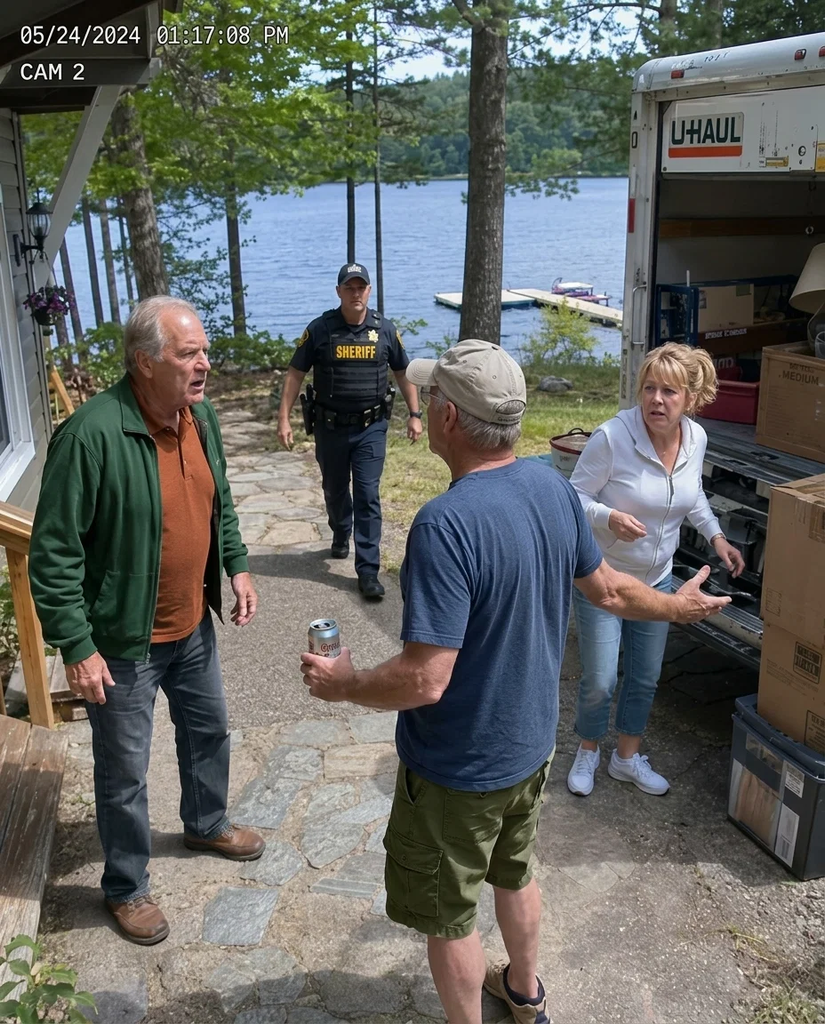
So when I turned down the gravel drive and saw a U-Haul backed up to the porch, I thought I had the wrong house.
Then I saw my son-in-law’s parents carrying boxes inside.
Ron Mercer set down a lamp, opened a beer, and smiled.
“Morning, Tom.”
“What are you doing in my house?”
His wife, Linda, froze with a box marked KITCHEN.
Ron took another drink.
“Derek gave us the door code. This cabin will be ours anyway.”
I stared at him.
“My daughter’s husband gave you permission to move into property he doesn’t own?”
Ron shrugged.
“Claire inherits it. Derek says they’re signing everything over. We’re retiring up here.”
I walked to the keypad.
The code had been changed from Margaret’s birthday to the last four digits of Derek’s phone number.
That was when I stopped arguing.
At 10:26 a.m., I called the Iredell County Sheriff’s Office and reported people occupying my property without permission.
Ron laughed.
“You’re really calling the cops on family?”
“No,” I said. “I’m calling them on trespassers.”
Eleven minutes later, a sheriff’s SUV pulled into the driveway.
Deputy Aaron Mills asked everyone to step outside.
I showed him my license, the property-tax statement, and the certificate for the Hale Family Trust.
Margaret and I had placed the cabin in the trust twelve years earlier.
I was the sole trustee.
Claire would inherit only after my death.
Linda looked at Ron.
Ron stopped drinking.
Then he pulled a folded document from his pocket.
“Your son-in-law said this proves the cabin belongs to them.”
Deputy Mills read it and frowned.
It was a quitclaim deed transferring the cabin from the Hale Family Trust to Derek and Claire Mercer.
My signature was at the bottom.
So was Margaret’s.
I stared at the date.
Margaret had supposedly signed it six months earlier.
She had been dead for three years.
My phone rang.
It was my attorney, Rebecca Shaw.
“Tom,” she said, “do not let anyone leave with those papers. We have a much bigger problem.”
Rebecca arrived before Derek.
She photographed the deed, sent a copy to the county recorder, and asked Deputy Mills to preserve Ron’s copy as evidence.
Then she pulled me aside.
“Someone recorded this deed last Friday. Yesterday, a lender received an application to borrow against the cabin.”
“How much?”
“Three hundred twenty thousand dollars.”
For a moment, all I heard was lake water against the dock.
Derek arrived twenty minutes later with Claire.
My daughter stepped out crying.
“Dad, please don’t do this in front of everyone.”
I held up the deed.
“Did you sign this?”
She looked at Derek.
That answered enough.
Claire admitted Derek had brought her a stack of papers two weeks earlier. He said they confirmed she would eventually inherit the cabin. She signed one affidavit without reading the attachments.
“I thought it was estate planning,” she whispered.
Rebecca turned to Derek.
“And Margaret Hale’s signature?”
He folded his arms.
“Margaret wanted Claire to have the cabin.”
“That wasn’t my question.”
Deputy Mills asked whether Derek had changed the keypad code.
He admitted he had because his parents needed access “for maintenance.”
Maintenance did not require a sectional sofa, three suitcases, and a U-Haul.
Then Rebecca’s phone buzzed.
The lender had frozen the $320,000 loan before funding.
But the title package contained something worse.
A trustee certification claimed I had resigned because of cognitive decline and appointed Derek in my place.
Attached was a physician’s letter.
I recognized the doctor immediately.
Dr. Steven Marks had been Margaret’s oncologist.
He had died eighteen months earlier.
Claire covered her mouth.
Derek said, “I didn’t prepare that.”
Rebecca opened her laptop.
“The metadata says it was created on your office computer.”
Then Linda looked at her son.
“Tell them why you needed the money.”
Derek’s face hardened.
“Mom.”
“You said it was temporary until the development deal closed.”
Rebecca turned toward her.
“What development deal?”
Linda pulled a glossy brochure from her purse.
A luxury lakefront developer had offered $1.8 million for the cabin and adjoining acreage.
Closing was scheduled for the following Monday.
The seller listed on the contract was not me.
It was Derek Mercer, Trustee.
Then Claire showed me a message Derek had sent Ron that morning:
Get moved in today. Once Tom sees people living there, he’ll be easier to pressure into signing.
The next message was from Ron:
If he refuses, we use the competency papers.
I had expected entitlement.
I had not expected a plan to erase me from my own life while I was still living.
The sheriff did not arrest everyone immediately.
He separated us, took statements, photographed the U-Haul, copied the documents, and told Ron and Linda to remove themselves and their belongings.
They were gone before sunset.
Derek did not leave with Claire.
She came home with me.
The next morning, Rebecca filed an emergency action to void the deed and block any sale or lien.
The county recorder flagged the title.
The lender preserved the loan application, emails, identification records, and electronic signatures.
Within a week, investigators searched Derek’s office.
They found draft versions of Margaret’s signature, the false physician’s letter, the trustee certification, and emails with the notary who had stamped the deed.
They also found messages between Derek and Ron discussing how older homeowners could be declared incompetent if relatives “documented enough confusion.”
That part stayed with me.
They had not simply wanted the cabin.
They were creating a story in which I was too old to control my own property.
The notary admitted Derek paid him $6,500 to certify signatures he had never witnessed.
Ron admitted he knew the development contract could not close without my cooperation.
He claimed moving into the cabin was only meant to “encourage a family discussion.”
The forged deed was voided.
The $320,000 loan never funded.
The $1.8 million development deal collapsed because Derek had no authority to sell the property.
Derek pleaded guilty to forgery, attempted real-estate fraud, identity theft, and conspiracy. He received prison time, probation after release, restitution, and legal costs.
Ron pleaded guilty to conspiracy and attempted fraud. He received probation, community service, and restitution.
Linda was not charged after investigators concluded Derek had lied to her about the ownership.
Claire filed for divorce before Derek was sentenced.
But our relationship did not instantly recover.
She had signed documents without reading them because trusting Derek had been easier than asking me a difficult question.
For months, I struggled to separate her mistake from his plan.
We started counseling.
Slowly, Claire learned that apologizing did not guarantee immediate forgiveness.
And I learned that protecting myself did not require punishing her forever.
I kept the cabin.
The following spring, Claire came up alone and helped me repair the porch roof I had originally driven there to fix.
When we finished, she found Margaret’s old blue mug and placed it on the table between us.
“Mom would hate what happened here,” she said.
“Yes.”
“She’d also hate it if we let them take this place from us twice.”
That was when I decided to keep it in the family.
I rewrote the trust.
After I’m gone, the cabin will pass into a family trust for Claire and any future grandchildren, managed by an independent trustee.
Not because I stopped loving her.
Because love and safeguards can exist in the same document.
People remember Ron standing in my driveway with a beer, telling me the cabin would be theirs anyway.
They remember the sheriff arriving eleven minutes later.
They remember the forged signature of a woman who had been dead for three years.
But the moment that mattered most came months later, when I stood on Margaret’s repaired porch listening to the lake through the trees.
An inheritance is not something you take because you expect it.
It is something another person chooses to leave behind.
Seeing my mom laugh, dress up, and fall in love again after so many lonely years should have been enough to silence my doubts. Instead, one question grew louder every time Richard came to dinner.
My mom hadn’t hummed in 11 years.
Not since Dad passed away.
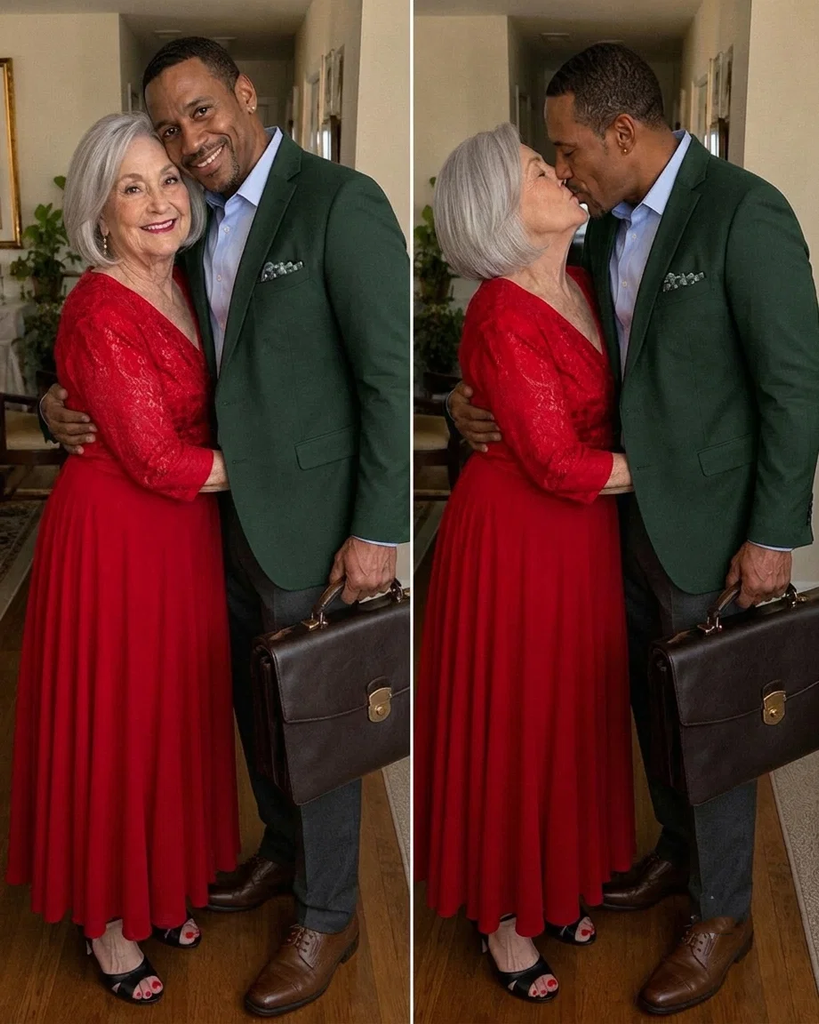
But there she was one Sunday afternoon, standing in front of her bedroom mirror and humming an old Sinatra tune while fastening the pearl earrings Dad had given her for their 30th anniversary.
I leaned against the doorway with my arms folded, trying not to get emotional.
“Mom, you look beautiful!”
“Oh, stop,” she said, waving me away with a smile. “It’s just dinner, Avery.”
“You’re even wearing the red dress!”
“I’m allowed to wear the red dress.”
“You bought that red dress recently, and it’s already been out of the closet more than my winter coat!”
Mom laughed.
It was such a wonderful sound that for a moment, I forgot why I had come upstairs.
Which, admittedly, was to snoop.
My mother had been alone for 11 years, and now she moved around the house like someone had turned the lights back on.
The reason was Richard.
He was 52, apparently lived alone, and had met Mom through the community gardening club after complimenting her tomato plants.
Within a month, he was bringing her sunflowers.
Within two months, he had repaired her porch railing without being asked.
He even remembered that my 15-year-old daughter, Chloe, loved mint chocolate chip ice cream and often brought her a pint.
After a few months, Mom seemed like a version of herself I thought we had lost when Dad died.
She bought the red dress.
She started wearing perfume again.
Sometimes she smiled at her phone like a teenager.
I wanted to like Richard.
I really did.
“So, what time is he coming?” I asked.
“Five. And he’ll need to leave by 7:30 p.m. again, so let’s eat by six.”
I stopped halfway toward the stairs.
“Seven-thirty again?”
“Avery.”
“I didn’t say anything.”
“You said it with your face.”
Downstairs, Chloe was setting the table with Mom’s good plates, the ones she only used when company came over.
My daughter had her grandmother’s cheekbones, her father’s stubborn chin, and lately she’d been watching Richard with increasing suspicion.
“Cinderella’s coming to dinner,” Chloe announced while folding a napkin into something that only vaguely resembled a swan.
“Be nice.”
“I’m being nice. I’m just saying. The man runs on a Cinderella schedule.”
“Chloe.”
“What?! He does! Every Sunday, boom, 7:30 p.m., out the door like the pumpkin’s about to blow.” She examined the crooked napkin. “I’m only half joking, by the way.”
I nearly defended him.
Then I stopped.
Because she wasn’t wrong.
For six months, Richard had joined us for Sunday dinner, and not once had he stayed beyond 7:30 p.m.
He was always polite about leaving.
And he always had an explanation.
The problem was that the explanations changed every week.
“Set out the water glasses,” I said.
“Deflection…”
I gave her a look.
Mom came downstairs, and Chloe let out a low whistle.
Mom swatted at her, blushing like a teenager, then asked whether her lipstick was too much.
It wasn’t.
She looked nearly ten years younger than she had at Christmas.
Richard arrived precisely at 5 p.m. carrying daisies and a bottle of sparkling grape juice for Chloe.
He shook my hand, kissed Mom’s cheek, and asked Chloe about her history project.
On paper, he was wonderful.
But I already knew that by 7:29, he’d be preparing to leave.
While Richard and Mom talked in the living room, Chloe caught my eye from across the kitchen.
She tapped her wrist, silently mouthed seven-three-zero, then raised one eyebrow.
I turned toward the stove and stirred gravy that didn’t need stirring.
Somewhere inside me, the doubt had started tightening into a knot.
The following Sunday, I watched Richard more carefully.
He was carving the roast beautifully while repeatedly checking his watch.
“Big plans tonight, Richard?” I asked, passing him the potatoes.
“Oh, nothing exciting. I’ve got a client in Singapore, believe it or not. Eight o’clock call.”
Chloe’s fork stopped halfway to her mouth.
“Singapore? On a Sunday?”
“Markets never sleep, kiddo.”
“Cool,” she said. “Neither do plumbers, apparently.”
I nearly choked.
Two weeks earlier, Richard had hurried away because, according to him, a plumber was coming to his house at 9 p.m.
Even Mom had looked confused about that one.
Richard laughed, but something around his eyes tightened.
The next Sunday, his leather tote was already under his arm by 7:25.
This week’s reason was his neighbor.
“Mr. Mendez can’t get his blood pressure pills open. Arthritis. I told him I’d swing by.”
“That’s so sweet of you,” Mom said warmly.
“So sweet,” I echoed.
Chloe kicked me beneath the table.
Five minutes later, Richard was gone.
Same time.
Same tote tucked under his arm.
Every Sunday.
Exactly like clockwork.
After we finished the dishes, I cornered Mom at the sink.
“Mom, can I ask you something without you getting mad?”
“That’s usually a great start, Avery.”
“Six months you’ve been dating this man. Have you been inside his house? Even once? Have you seen his kitchen? His couch? His mailbox?”
She turned the faucet higher.
“He’s private.”
“He’s evasive.”
“There’s a difference.”
“Is there? Because Chloe says twice now she’s watched him turn south after dinner, and he supposedly lives 20 minutes north.”
Mom’s shoulders stiffened.
She placed a plate down with a sharper clink than necessary.
“I trust him, Avery.”
“Mom, I want to trust him too. I want that for you. But a grown man with no wife, no kids, no roommate, and no reason to be anywhere at 7:30 p.m. on a Sunday…”
“Maybe he has reasons I don’t need to know yet.”
“That’s exactly the problem.”
She finally looked at me.
Beneath her defensiveness, I saw something else.
She had noticed it too.
She simply didn’t want to admit it.
“Please,” she said softly. “Let me have this. Even if it turns out badly, let me have the part where I still get to hope.”
I had no answer.
So I dried another plate.
Later, Chloe and I sat together on the porch steps.
“Grandma knows something’s up,” she said. “She’s just scared.”
“Chloe. Whatever you’re thinking, don’t.”
“I’m not thinking anything.”
“You’re always thinking something. Your face has a thinking setting, and it’s currently on.”
She smiled faintly.
“Richard has another woman. Doesn’t he?”
“We don’t know that.”
“Or another family. A whole secret family in a house with a plumber that only works at night.”
“Chloe.”
“What? I’m just saying what everyone is thinking. Grandma is thinking so, too. She just won’t say it because if she does, it might be true.”
I wrapped an arm around her shoulders.
“Her birthday is next Sunday,” I said. “I’m asking you, as your mother and as a coward, to please just let us get through dessert. We’ll deal with Richard afterwards.”
Chloe stayed quiet long enough that I thought she might agree.
Then she said calmly, “I’m tired of watching Grandma be lied to.”
“Chloe.”
“I love her too, Mom. That’s all I’m saying.”
She stood, kissed the top of my head as if I were the child, and went inside.
I remained on the porch, watching the street where Richard’s taillights disappeared every Sunday.
The following week was Mom’s 72nd birthday.
She adjusted her hair in the hallway mirror for the third time.
“You look gorgeous,” I told her.
“I look like a woman who’s trying too hard.”
From the couch, Chloe called, “Grandma, you look like a woman who’s trying just enough. There’s a difference.”
The doorbell rang at six.
Richard stood there holding a dozen roses, a wrapped present, and the same leather tote tucked beneath his arm.
“Happy birthday, sweetheart!”
Mom’s whole face lit up.
It was difficult to remain suspicious when she looked at him that way.
Dinner went beautifully.
Richard told a ridiculous story about accidentally mistaking a zucchini for a cucumber at the gardening club.
Mom laughed so hard she snorted.
I hadn’t heard her laugh like that since Dad was alive.
Then she brought out dessert.
“Chocolate pie,” she announced. “I made it because my boyfriend said it was his favorite.”
Something shifted in Richard’s expression.
Gratitude.
Guilt.
Maybe both.
Then he looked at his watch.
7:26 p.m.
“Grace, I am so sorry, sweetheart. I have to go.”
The room fell silent.
Mom’s smile faded slowly.
“Can’t you stay for 10 minutes? It’s my birthday, Richard.”
“I really can’t. I’m so sorry.”
He kissed her cheek, picked up the tote, and left before anyone could stop him.
The chocolate pie remained untouched in the middle of the table.
Mom lowered herself into her chair.
She picked up her fork, then placed it down again.
“Mom, are you okay?”
“I’m fine, honey.”
She wasn’t.
We both knew that.
Chloe stared out the window after Richard.
A moment later, she stood abruptly.
“I need to run out. I’ll be right back.”
“Chloe, wait, it’s dark out.”
“Don’t worry, Mom.”
Before I could stop her, the door slammed behind her.
I looked at the door.
Then at Mom.
Then at the untouched birthday pie.
“Well,” Mom said with a brittle laugh. “That’s one way to end a birthday.”
“He’s an idiot.”
“Avery.”
“He is! Whatever he’s hiding, he’s an idiot for hiding it tonight.”
I began clearing dishes simply to keep my hands occupied.
Ten minutes passed.
Then fifteen.
Then twenty.
I looked through the window.
Nothing.
“Do you think I should call her?”
Mom glanced up.
“Maybe give it a little more time. She probably needed to clear her head. She’ll be back.”
I paced between the kitchen and living room.
Chloe had been wearing that particular expression when she left—the one that usually meant I would be lecturing her for the next week.
Nearly forty minutes later, footsteps thundered up the porch.
The front door flew open.
Chloe stood there breathing hard, tears running down her cheeks.
Pressed tightly against her chest was Richard’s leather tote.
“Chloe?”
She wouldn’t look at me.
“Chloe, where did you get that?”
She shook her head.
“Don’t ask how I got it.” Her voice broke. “You need to see what he hides in here. And why he never stays past 7:30 p.m.”
She carried the tote into the dining room and placed it beside the birthday pie.
Mom slowly stood.
“Where did you get that?”
“Chloe, honey, whatever’s in there, maybe we should…”
“Grandma, look,” she said, opening it.
Mom’s hands trembled as she reached toward the bag.
I moved closer, expecting exactly what every suspicious daughter would expect.
Lipstick.
Hotel receipts.
Photographs of another woman.
Something ugly.
Instead, Mom’s hand flew to her mouth.
“Oh, my God!”
Inside were old family photographs with worn edges.
A small wooden music box with faded paint.
And a stack of laminated cards printed in large letters beside pictures of ordinary objects.
A spoon.
A comb.
A smiling man’s face labeled “son.”
On top was another laminated card written carefully by hand:
“My name is Evelyn. Richard is my son. I am safe with him.”
Chloe wiped her tears with the back of her hand.
“Grandma, that’s not even the worst part. I saw who he takes this to.”
Then she began speaking quickly.
“I asked Cindy, my best friend’s sister, to come wait outside so we could follow Richard’s car. He drove south to that memory care facility. He left the tote on the passenger seat and ran inside. The door wasn’t even locked.”
My expression must have alarmed her because she immediately added, “I’ll give it back, I swear. I saw an aide wave him in, as if he lives there. There’s a cot, Mom. A folded cot next to a hospital bed.”
Grace pressed the laminated card to her chest.
“Evelyn,” she whispered. “He’s mentioned she’s his mother, but didn’t tell me more.”
She grabbed her coat.
“Avery, drive. Now. And don’t lecture me about seatbelts; I’ll put it on.”
We found Richard inside a small room at the memory care facility.
He sat beside a tiny elderly woman, holding her hand while slowly reading from one of the picture cards.
When he looked up and saw us, all the color drained from his face.
“Grace, please! I was going to tell you! My last partner left when she found out. I couldn’t. I’m sorry. I’m so sorry.”
Mom walked past him and sat beside the bed.
Richard looked down.
“My mom is 86 and has dementia. It gets really bad after dark. She becomes disoriented, and the only way to calm her down is for me to be right here. I’ve been sleeping here for months. That’s why you’ve never seen my house. There’s barely a house to see.”
After months of suspicious excuses, the real answer turned out to be the gentlest possibility none of us had considered.
Mom looked at him.
“Richard. You don’t have to choose between taking care of your mother and loving me.”
Evelyn turned toward Grace and studied her carefully.
“Are you the pretty lady my Richard keeps telling me about?”
Mom laughed through her tears.
“That’s me.”
A few weeks later, Sunday dinners moved to 5 p.m.
On Evelyn’s better days, Richard brought her along.
Chloe, still embarrassed about the “borrowed” leather tote, appointed herself official keeper of the picture cards.
Mom managed to repair Evelyn’s old music box, and its soft melody played while I set the dinner table.
I had been so certain Richard was lying.
And technically, he was.
But he wasn’t hiding another woman.
He was protecting the story of the one person who needed his love just as much as my mother did.
The call came at exactly 3:17 on a weekday afternoon while I was sitting in the middle of a budget meeting, staring at numbers projected across a conference-room screen. My coffee had already gone cold when my phone vibrated against the table, and I almost silenced it until I saw my ten-year-old daughter Chloe’s smartwatch calling me.
Chloe knew she wasn’t supposed to call during work unless something was genuinely wrong. Normally, she sent me little messages or ridiculous voice notes from the school bus, but this time all I heard when I answered was rapid, trembling breathing.
“Mom, please help. Come home right now.”
I was out of my chair before I’d even processed the words.
“Chloe? What happened?”
There was a slow scraping noise somewhere behind her. When Chloe finally answered, her voice sounded weaker than I’d ever heard it.
“Dad fell down. And I feel weird.”
Daniel worked from home several days a week, and Chloe normally arrived from school shortly after three. For eight years, my husband had been the calm, cautious person in our family, the man who checked smoke detectors, labeled the breaker box, and taught Chloe what to do during emergencies.
I rushed from the office and drove home while repeatedly trying to call Chloe and Daniel. Neither answered, and by the time I reached our neighborhood, the ordinary sight of school buses, trash cans, and familiar houses somehow made my fear worse.
The front door was unlocked when I arrived. The moment I stepped inside, I noticed a strange sweet chemical odor hidden beneath the smell of cinnamon, and the air inside the house felt unusually heavy.
Nobody answered.
I ran into the kitchen and nearly slipped on pieces of a shattered coffee mug. Daniel was lying unconscious beside the island with one arm underneath him, while Chloe was collapsed several feet away near the den, still wearing her school jacket with her pink backpack hanging from one shoulder.
“Baby, stay with me.”
Chloe was breathing, although her breaths were shallow and uneven. Daniel also had a weak pulse, so I called 911 and told the dispatcher that my husband and daughter were both unconscious and that there was an unexplained chemical smell inside the house.
Within minutes, police officers and paramedics filled our kitchen. Chloe and Daniel were placed on stretchers while officers began examining everything around them, including the broken mug, the cinnamon plug-in near the hallway, the unlocked front door, and Daniel’s laptop still open on the kitchen island.
One officer asked whether anyone else had access to our house. I explained that my mother had a key but was out of state, while the garage camera had been offline for two weeks because Daniel had said our router needed replacing.
“No obvious forced entry.”
Those words immediately made my stomach tighten. If nobody had broken into the house, then whoever had caused this might have entered without needing to.
Then an officer searching near the laundry room suddenly stopped. His flashlight moved toward the interior garage door before another officer returned holding a small evidence bag containing something I immediately recognized.
Daniel’s spare car fob.
We kept it hidden beneath the felt lining of the brass key dish for emergencies. Only three people knew where it was: Daniel, Chloe, and me.
The officers exchanged looks before one of them leaned closer.
“Ma’am, you may not believe the reason…”
Before he could finish, the mechanical hum behind the garage door suddenly changed. An officer cautiously lifted the door several inches and shined his flashlight through the opening.
Inside, his beam caught Daniel’s car, several storage boxes, and a folded sheet of paper taped to the garage door where nobody inside the kitchen could have noticed it. He pulled on gloves before carefully removing the page.
Then a dark SUV stopped behind the police cruiser outside.
The driver’s door opened, and my stomach dropped when I recognized the woman climbing out.
It was Lauren.
My younger sister.
Lauren had been staying at our house several nights a week for the previous two months after claiming she was struggling financially and having problems with her apartment. Daniel had welcomed her into our home, while Chloe adored the aunt who painted her nails and brought her strawberry gum.
Lauren knew our routines.
She knew when Chloe’s school bus arrived.
And she knew exactly where Daniel kept that spare car fob.
“I can explain.”
An officer ordered Lauren to remain near her SUV, but she immediately began crying. Then she looked through the open doorway at Daniel and Chloe being treated by paramedics and said something that made everyone around her go silent.
“I didn’t know Chloe would come in.”
I stared at my sister.
“What did you do?”
Lauren looked toward Daniel before lowering her eyes.
“I only meant for him to sleep.”
The officer holding the paper from the garage unfolded it and began reading. His expression hardened almost immediately.
Whatever had happened inside my house hadn’t been an accident.
And my sister already knew why.
Part 2: Three Minutes Changed Everything
Police moved Lauren away from the house while paramedics prepared Daniel and Chloe for transport. I wanted to follow my daughter immediately, but officers needed to determine whether the strange air inside the house was still dangerous and understand what Lauren had just admitted.
“I didn’t know Chloe would come in.”
Those words kept repeating in my head. Lauren hadn’t said she didn’t know what happened; she’d said she hadn’t expected my daughter to be there.
“What did you do?”
Lauren looked through the doorway at Daniel, who was receiving oxygen, and then at Chloe lying motionless on the stretcher. Her composure finally collapsed.
“I only meant for him to sleep.”
An officer unfolded the paper recovered from inside the garage while another began questioning Lauren separately. Piece by piece, the explanation emerged, and every detail made the betrayal harder to comprehend.
Lauren owed money and had become involved with a man who convinced her Daniel could solve her problems. When Daniel refused to give her money two days earlier, the man suggested another way: get inside our house, incapacitate Daniel, and access his work laptop.
Daniel had never told me Lauren had asked him for money. According to her, he’d refused because helping her would require lying to me and potentially using financial accounts connected to my name.
“He told me he loved me but would not lie to you or open accounts in your name.”
I stared toward my unconscious husband. Daniel had tried to protect me from a problem I didn’t even know existed, but by keeping it secret, neither of us had realized how desperate Lauren had become.
The plan was disturbingly simple. Lauren used the hidden spare fob to access the garage and left Daniel’s car running long enough for fumes to accumulate before allowing some of them to enter the house, claiming she only wanted to make him dizzy enough to get to his laptop.
The cinnamon plug-in had been used to disguise the unusual smell. The paper taped inside the garage wasn’t a confession either; it contained instructions from the man Lauren had been seeing.
Use the fob.Keep the door closed.Get the laptop.Leave before the bus.
That final instruction shattered whatever composure Lauren still had.
“Leave before the bus.”
Chloe’s school bus had arrived three minutes early that afternoon. Instead of entering an empty house after Lauren was gone, my ten-year-old daughter walked directly into the situation she’d never been meant to witness.
Three minutes had changed everything.
Lauren folded forward and began sobbing, but I couldn’t comfort her. Whatever she had intended, my daughter and husband were now being rushed to a hospital because someone we’d trusted with our home had decided desperation justified betrayal.
At 4:26 p.m., an officer drove me to the hospital because my hands were shaking too badly to drive myself. Daniel and Chloe were both receiving treatment, and doctors eventually told me something I desperately needed to hear.
They were alive.
Daniel had suffered greater exposure because he’d been inside longer, while Chloe had apparently moved toward the den after calling me. The doctor described both of them as fortunate, a word I initially hated until I realized he was trying to give me something hopeful to hold onto.
Daniel regained consciousness shortly after six. His first word wasn’t my name or a question about where he was.
“Chloe?”
“She’s alive.”
Only then did he begin crying. I held his hand and told him enough about Lauren for him to understand what police believed had happened.
Daniel turned his face away.
“I should have told you she asked for money.”
“Yes.”
He nodded slowly.
“I thought I was keeping it from becoming your burden.”
There were a thousand things I could have said, but only one mattered.
“Never do that again.”
Daniel reached for my hand, and this time I let him hold it.
Chloe woke less than an hour later. She became frightened when she saw the IV and cried even harder when she remembered watching her father collapse.
“I called you.”
“You saved your dad.”
Her lower lip trembled.
“I was scared.”
“I know.”
Then she asked the question that finally broke through everything I’d been holding inside.
“Did I do it right?”
I leaned over her hospital bed and pressed my face into her hair.
“You did everything right.”
Two days later, police gave us the report. The evidence confirmed the timeline, including Chloe’s smartwatch call, the school bus arriving early, the spare fob, the garage setup, and the instructions Lauren had received.
Lauren was charged.
So was the man who had given her those instructions.
But when investigators showed me the final evidence recovered from our house, I realized something even more painful than the crime itself.
Lauren hadn’t chosen our home randomly.
She had been living with us long enough to study exactly how our family worked.
Part 3: The Investigation, Consequences, and Recovery
The investigation eventually revealed how carefully Lauren had studied our household during the months she stayed with us. She knew when I left for work, which days Daniel worked from home, when Chloe’s bus normally arrived, where we kept the spare car fob, and even which scent we used in the hallway.
None of those details had seemed dangerous because Lauren was family. We had given her access to our lives because we believed she needed somewhere safe to recover, never imagining she was quietly learning the routines that would later make her plan possible.
Detectives also recovered messages between Lauren and the man she’d been seeing. He had pressured her about her debts and repeatedly told her that Daniel’s work laptop could provide access to financial information valuable enough to solve their problems.
One message from Lauren was especially difficult to read.
Daniel trusts me. He won’t suspect anything.
Another message had been sent shortly before she entered our garage.
Chloe doesn’t get home until after 3:20. We have enough time.
But they hadn’t had enough time. Chloe’s bus arrived three minutes earlier than expected, and those three minutes were the reason my daughter walked into the house while Daniel was already unconscious.
Lauren eventually admitted that when she realized Chloe had arrived, she panicked and fled instead of calling for help. She convinced herself that Chloe would notice something was wrong, leave the house, and find a neighbor.
She was wrong.
Instead, my ten-year-old daughter entered the kitchen, found her father collapsed beside the island, and tried to help him. By the time she realized she was becoming dizzy too, she barely had enough strength left to use her smartwatch.
“Mom, please help. Come home right now.”
That call probably saved both their lives.
Daniel remained hospitalized longer than Chloe, but both eventually recovered. When we finally brought Chloe home, she stopped at the front door and stared inside for several seconds before reaching for my hand.
“Is Aunt Lauren here?”
“No.”
“Is she coming back?”
“No, sweetheart.”
Chloe looked up at me.
“Promise?”
“I promise.”
Only then did she step inside.
The weeks afterward were harder than the doctors had prepared us for. Chloe became frightened whenever she smelled cinnamon, refused to stay home alone even for a few minutes, and checked repeatedly to make sure Daniel was breathing whenever he fell asleep on the couch.
Daniel struggled with guilt of his own. He kept replaying the moment Lauren had asked him for money and wondering whether telling me immediately might have prevented everything.
“I should’ve told you.”
“Yes, you should have.”
“I thought I was protecting you.”
“I know.”
I took his hand.
“But protecting someone doesn’t mean deciding what they’re allowed to know.”
Daniel nodded, and that became one of the hardest lessons our marriage had ever learned. Secrets intended to protect a family could still create blind spots large enough for someone else to exploit.
Lauren eventually accepted responsibility for what she’d done. The man who had helped plan it faced charges as well, and the digital messages recovered from their phones made it impossible to portray what happened as an accident.
Months later, I received a letter from Lauren. She apologized to Daniel and me, but most of the letter was addressed to Chloe.
I didn’t give it to my daughter.
Not yet.
Maybe one day Chloe would want to read what her aunt had written, but forgiveness belonged to her, and I wasn’t going to turn Lauren’s guilt into another burden my daughter had to carry.
Nearly a year later, I was making breakfast when Chloe came downstairs wearing her backpack. She grabbed a piece of toast, kissed Daniel on the cheek, and headed toward the door before suddenly stopping.
“Mom?”
“What?”
“Remember when I called you from my watch?”
My chest tightened.
“I remember.”
“I thought you wouldn’t answer because you were working.”
“I’ll always answer.”
She smiled.
“I know that now.”
Then she ran outside toward the school bus.
I stood at the window watching her leave while Daniel came up beside me. Neither of us said anything for a while because we both understood how differently our lives could have ended that afternoon.
Lauren had known our schedules, our house, and almost every detail of our routine. She had calculated when Daniel would be alone and exactly how much time she had before Chloe returned.
But there was one thing she hadn’t calculated correctly.
She thought three minutes wouldn’t matter.
Those three minutes nearly destroyed our family.
And they were also the reason my daughter was able to save it.
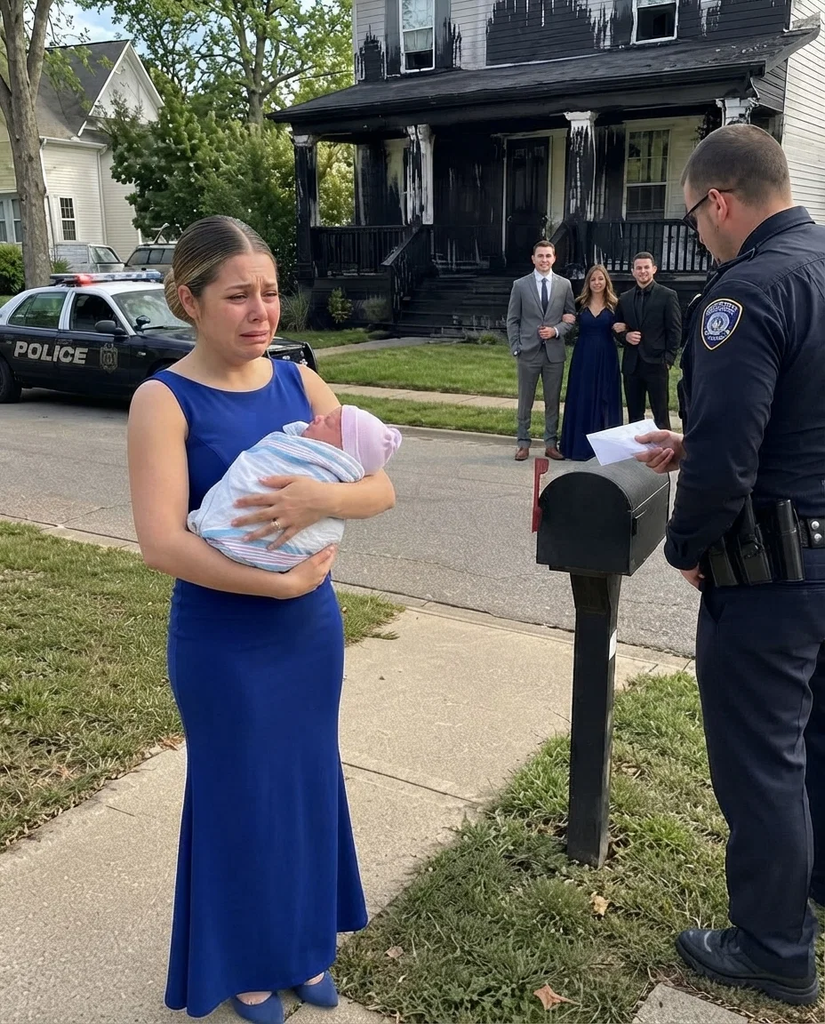
I became a widow while I was still pregnant. Three days after giving birth, I brought my newborn daughter home—and found my entire house painted black.
Then a police officer discovered an envelope inside my mailbox.
My daughter’s name was written across the front.
What was inside changed everything I thought I knew about my husband’s death.
I was seven months pregnant when Daniel died.
One evening, we were arguing over baby names and laughing about how stubborn we both were.
The next, a state trooper stood at my front door and told me there had been an accident.
I remember very little about the funeral or the weeks afterward.
Everything blurred together.
People brought food.
Relatives hugged me.
Someone handled flowers.
Someone else talked about insurance.
I nodded whenever people spoke because I didn’t have enough strength to do anything else.
There was only one thought keeping me upright.
I had to survive for my baby.
When my daughter was finally born two months later, she became the reason I got out of bed every morning.
The hospital discharged us after three days.
I remember sitting in the passenger seat with her tiny body strapped into the car seat beside me, thinking how strange it felt to bring her home without Daniel.
He had spent months preparing that house for her.
He painted the nursery.
Assembled the crib.
Restored the porch columns himself because he said he wanted everything perfect before his daughter arrived.
But when I turned onto our street, something felt wrong.
Neighbors stood outside their houses.
Nobody waved.
Nobody smiled.
They were all looking toward my home.
Then I saw it.
The entire front of my house was black.
The porch.
The door.
The railing.
Even the white columns Daniel had spent an entire summer sanding and repainting.
Everything had been covered overnight in thick black paint.
I stopped breathing.
For a moment, I honestly wondered whether I had turned onto the wrong street.
Then my daughter began fussing behind me.
I climbed out of the car and held her against my chest while tears filled my eyes.
Who would do something like this?
My husband had been dead for two months.
I had just given birth.
Someone had waited until the exact day I brought his daughter home to destroy the front of the house he loved.
There was no message painted on the walls.
No broken windows.
Nothing stolen.
Just black paint.
Neighbors had already called the police.
Two officers arrived within minutes.
One spoke with me while another walked around the property.
Then the second officer stopped beside my mailbox.
“Ma’am?”
Something in his voice changed.
I walked toward him, my daughter still against my chest.
Inside the mailbox was a small white envelope.
No stamp.
No address.
Only one name written neatly on the front.
Nora.
My daughter’s name.
She was three days old.
Almost nobody even knew what I had decided to call her.
The officer looked at me.
“I think you should open that.”
My hands shook so badly that I could barely slide a finger under the flap.
I didn’t recognize the handwriting.
That frightened me more than anything.
Who writes the name of a three-day-old baby on an envelope and leaves it outside her mother’s vandalized house?
Inside was one folded sheet of paper.
I opened it.
The officer stood beside me.
The message began:
I am sorry about your house.
I kept reading.
I didn’t know another way to make you stop before it was too late.
My heart started pounding.
Then came the sentence that made my knees weak.
Daniel did not die in an accident.
I tightened my arm around Nora.
The rest of the message was even worse.
Do not sign anything.
Do not trust the man who is coming to your house with papers.
I painted your house black so every person on this street would be looking at it—and looking at you—when he arrives.
He will not do in front of witnesses what he planned to do privately.
I am watching too.
You are not alone.
Trust your neighbors. Trust the officer reading this beside you.
And then the final warning:
Do not trust family.
There was no signature.
I read the note twice.
When I finally looked up, the officer’s expression had changed completely.
He was no longer handling a vandalism complaint.
He looked alert.
Concerned.
Serious.
“Ma’am,” he said quietly, “I need you and the baby to sit in my patrol car for a few minutes. I’m going to make some calls.”
Part 2:
I stared at him.
He softened his voice.
“And I want you to understand something. From this moment on, you are not dealing with this alone.”
I didn’t understand what was happening.
But I understood that sentence.
So I followed him.
His name was Officer Reyes.
As I sat in the back seat holding Nora, I tried to understand what the note could possibly mean.
Daniel had supposedly died in a single-car accident.
Late at night.
On a rural road.
His car had left the pavement and hit a tree.
That was what I had been told.
But even then, something about the story had bothered me.
Daniel was the most careful person I knew.
He wore his seat belt when moving the car from our driveway to the garage.
He never drove after drinking.
He rarely sped.
And nobody had ever explained why he had been driving on that particular road at eleven o’clock at night.
Whenever I asked, Daniel’s older brother Marcus gave me the same vague answer.
“He was probably running an errand.”
Marcus had taken charge of everything after Daniel died.
The funeral.
Insurance calls.
Estate paperwork.
Bank forms.
At the time, I was grateful.
I was heavily pregnant and barely functioning.
Marcus constantly told me:
“Don’t worry about any of this. You focus on the baby.”
So I did.
He brought papers for me to sign.
He said they were formalities.
Things that needed to be completed so Daniel’s estate could be processed smoothly.
And I signed some of them without reading carefully.
That fact suddenly terrified me.
Do not sign anything.
Do not trust family.
Officer Reyes returned fifteen minutes later and climbed into the front seat.
He turned toward me.
“I need to tell you some things,” he said. “I’m going to try not to scare you unnecessarily, but I’m also not going to hide information from you.”
I nodded.
“I pulled your husband’s accident report.”
My stomach tightened.
“There are things in it I don’t like. Apparently, the responding officer had questions too, but the case was closed very quickly.”
He paused.
“Was there life insurance?”
“Yes.”
“How much?”
“A lot. Daniel and I both took policies out after I became pregnant. He said if something happened to one of us, the other parent and the baby needed protection.”
“Who is Daniel’s beneficiary?”
“Me. Then Nora.”
Officer Reyes became very still.
“And if something happened to you before Daniel’s estate was settled, who would control that money on behalf of your daughter?”
I opened my mouth.
Then stopped.
The answer arrived before I wanted it to.
“Marcus.”
My entire body went cold.
“He’s been handling everything.”
Officer Reyes listened silently.
“He had me sign papers. I don’t even know exactly what I signed.”
My voice began shaking.
“If something happened to me and he had guardianship…”
I couldn’t finish.
Officer Reyes leaned toward me.
“Breathe. You and the baby are safe right now.”
Then he asked me to tell him everything Marcus had done since Daniel died.
So I did.
Every document.
Every visit.
Every reassurance.
Every moment that had seemed strange but that I had ignored because grief had left me too exhausted to question anything.
By the time I finished, Officer Reyes looked even more concerned.
He made another phone call.
This time, a detective was coming.
He told me not to sign another document.
Not to let Marcus inside the house.
Not to be alone with him.
And under no circumstances was I to let him near Nora without someone else present.
Then, that afternoon, Marcus arrived.
Exactly as the anonymous note had predicted.
His car pulled up in front of my house.
He stepped out carrying a leather folder.
From inside, I watched him look at the scene.
My house painted black.
Neighbors standing outside.
A police cruiser in the driveway.
Officer Reyes inside.
And now Detective Alvarez, who had arrived to review everything.
Marcus stopped walking.
Just for a second.
But I saw it.
He had expected to find a grieving woman three days after childbirth sitting alone inside a quiet house.
Instead, he found an audience.
Then he forced himself forward and knocked.
Officer Reyes answered.
Marcus sounded surprised.
“What happened here?”
“Active investigation,” Reyes said.
“Is she okay? I came to see my sister-in-law and the baby.”
“She’s resting.”
“I only need a few minutes.”
Marcus lifted the folder.
“There are some documents she needs to sign. Time-sensitive estate issues.”
From the next room, I felt sick.
He continued.
“If she doesn’t sign today, she could lose certain protections. I’m only trying to look after her and the baby.”
Time-sensitive.
Today.
For her protection.
Those were exactly the kinds of phrases he had used for two months.
Except now I heard them differently.
Detective Alvarez stepped outside and spoke with him.
Marcus eventually left.
But he took the leather folder with him.
That mattered.
Detective Alvarez came back inside and sat across from me.
“I asked him to leave the documents so we could review them.”
“He wouldn’t?”
“No.”
She paused.
“I did see the top page.”
I held Nora tighter.
“What was it?”
“A designation of guardianship and financial authority.”
My stomach dropped.
“Naming Marcus.”
“Yes.”
She leaned forward.
“And he wanted your signature today.”
I couldn’t speak.
Detective Alvarez continued carefully.
“I don’t want to frighten you more than necessary. But based on what we know right now, somebody may have saved your life by painting this house black.”
I stared at her.
“And I don’t think you and your daughter should sleep here tonight.”
The police arranged a hotel under another name.
That night, Nora slept in a bassinet beside my bed while I stared at the ceiling.
Who wrote that note?
Who knew Marcus was coming?
Who knew about the papers?
Who knew enough to believe I was in danger?
And why paint the house?
Why not call?
Why not knock?
Months passed before I got the full answer.
Daniel’s accident was reopened.
And under serious examination, the original story began falling apart.
Investigators discovered evidence that his car had been struck from behind before it left the road.
There was paint transfer that had been overlooked.
Damage inconsistent with a simple accident.
Then detectives obtained Daniel’s phone records.
Two hours before he died, Marcus had texted him.
He asked Daniel to meet him on that rural road.
Late at night.
To discuss money.
That was when everything started making sense.
Marcus was drowning in debt.
Daniel knew it.
Apparently, Daniel had helped his brother before, but shortly before his death, he had finally refused to keep rescuing him.
Marcus knew about Daniel’s life insurance.
He knew I was the beneficiary.
He knew Nora came after me.
And after Daniel died, Marcus immediately positioned himself inside our financial life.
He became the helpful brother.
The man handling paperwork.
The person telling the pregnant widow to rest.
Slowly, he worked toward controlling the estate.
All he needed was one final document giving him guardianship and financial authority.
And after that, there would have been only one person standing between him and everything Daniel had left behind.
Me.
The anonymous note had warned:
He will not do in front of witnesses what he was going to do in private.
Somebody had understood exactly what Marcus was preparing to do.
And they had turned my house into a spectacle so he could not do it quietly.
Marcus was arrested.
Investigators built the case using phone records, financial evidence, vehicle damage, accident reconstruction, and the papers he had attempted to make me sign.
Eventually, he was charged with Daniel’s murder, fraud, and several related crimes.
But one question still haunted me.
Who painted my house?
Months into the investigation, I finally got my answer.
Her name was Eleanor.
She lived directly across the street.
She was an elderly woman I had known for years in the casual way people know neighbors.
We waved.
Talked about the weather.
Occasionally discussed her flowers.
Nothing more.
Then one afternoon, after Marcus had already been arrested, Eleanor came to my house.
By then, I had repainted it white.
She sat at my kitchen table and confessed everything.
Eleanor had insomnia.
“I’m old,” she told me. “Old people don’t sleep much.”
Most nights, she sat in a chair beside her front window drinking tea.
She had lived on that street for forty years.
Watching it had become her nighttime routine.
After Daniel died, Eleanor began noticing Marcus.
He came to my house at unusual hours.
Once, while I was at the hospital because doctors thought I might be going into early labor, Eleanor saw Marcus unlock my front door around midnight.
He stayed inside for nearly two hours.
When he left, he carried a box.
She thought it was strange.
But like me, she blamed grief.
Then, three days before I came home with Nora, Eleanor saw something that frightened her.
At roughly two in the morning, Marcus parked across from my house.
He didn’t get out.
He simply sat inside his car.
Watching.
For a long time.
Eleanor couldn’t explain exactly why, but she became convinced he meant me harm.
She had no evidence.
Only instinct.
And she knew the police probably couldn’t act on an elderly neighbor saying a man had made her uncomfortable.
So Eleanor spent two nights trying to decide what to do.
Then she came up with something extraordinary.
She couldn’t force police to believe her suspicion.
But she could force the entire neighborhood to pay attention.
If something shocking happened to my house, everyone would stare.
Neighbors would come outside.
Someone would call the police.
And Marcus would arrive expecting privacy but instead find dozens of witnesses.
So, during the night before I came home, eighty-year-old Eleanor crossed the street carrying black paint.
She painted my porch.
My door.
The railings.
Even Daniel’s beautiful white columns.
She worked for hours.
She told me she cried while doing it because she feared she was making a terrible mistake.
“What if I’m wrong?” she kept thinking.
“What if I destroy this poor widow’s house because I’m a paranoid old woman?”
But she kept painting.
Then she wrote the note.
She addressed it to Nora because she knew a new mother would immediately open anything with her newborn’s name on it.
She didn’t sign it.
If she was wrong, she was ashamed for me to know who had vandalized my home.
But if she was right?
The paint wouldn’t matter.
And Eleanor had been right.
Detective Alvarez later told me plainly that the black paint probably saved both my life and Nora’s.
Everything investigators eventually learned suggested Marcus intended to secure control first.
Then another “accident” would follow.
Mine.
I sat across from Eleanor at my kitchen table while she apologized through tears.
“I’m so sorry about those columns,” she said. “Daniel worked so hard on them.”
That broke something inside me.
I stood up.
Walked around the table.
And hugged her.
She kept apologizing.
I held her tighter.
“Daniel spent one summer making those columns white,” I told her.
My voice cracked.
“But I’ll spend the rest of my life being grateful you painted them black.”
Because Daniel’s white columns were something my husband had built.
Eleanor’s black paint was something that saved his daughter.
There was nothing to forgive.
Nora is four years old now.
And there is one strange coincidence I still think about.
I chose her name alone while lying in a hospital bed.
I had no idea that Nora was also the name of Eleanor’s mother.
When Eleanor learned that, she cried.
She called it a sign.
I’m not sure I believe in signs.
But I believe in elderly women with insomnia who trust their instincts.
Eleanor is Nora’s godmother now.
She still lives across the street.
Nora runs over to her house almost every afternoon.
Eleanor keeps cookies waiting.
Part 3:
The two of them often sit together in the same chair beside the window where Eleanor once watched Marcus sitting in the darkness outside my house.
An eighty-four-year-old woman.
A four-year-old girl.
Watching the street together.
And I honestly cannot imagine anywhere safer for my daughter.
Marcus is in prison.
He will spend the rest of his life there.
I attended every day of the trial.
By the end, I expected to feel hatred.
Instead, I felt something colder.
Pity.
I pitied a man who could value money more than his own brother.
A man who could sit in darkness watching the home of a pregnant widow and calculate what she was worth dead.
I do not forgive him.
Daniel’s murder is not mine to forgive.
But I eventually let go of hatred.
Hatred is another house you have to keep repainting.
I would rather spend that energy raising my daughter.
Sometimes I still remember the afternoon I came home from the hospital.
I remember turning onto the street.
Seeing my neighbors standing outside.
Seeing Daniel’s beautiful white house covered in black.
At that moment, I believed someone had done the cruelest possible thing to me.
A widow brought her newborn home, and someone had vandalized the last place where she still felt connected to her husband.
It looked like cruelty.
It looked like hatred.
It looked like the world kicking someone who was already on the ground.
But it was exactly the opposite.
That black paint was one of the greatest acts of love anyone has ever shown me.
Because sometimes protection doesn’t look gentle.
Sometimes love is desperate.
Sometimes it doesn’t have the perfect words or the perfect tools.
Sometimes love is an eighty-year-old woman standing outside at three in the morning with a paintbrush, terrified that she might be wrong but even more terrified of what might happen if she does nothing.
So if there is one thing I learned from all of this, it is this:
Look again.
Before deciding what something means, look again.
The frightening thing might be protecting you.
The stranger you barely notice might be the person watching over you.
And something that appears to be an act of cruelty may turn out to be the reason you survived.
Someone painted my home black the day I brought my newborn daughter back from the hospital.
I thought it was hatred.
It turned out to be love.
And because one sleepless old woman was brave enough to trust what she saw, my daughter still has a mother who gets to walk across the street every evening and call her home for dinner.
“Your children don’t sit at the main table, Brandon. They aren’t our blood.”
My sister-in-law Mindy said that with a twisted smile as we entered the private dining room I had personally paid for to celebrate my father-in-law Walter’s 70th birthday.
My name is Brandon Miller. I’m 38 years old, I’m a systems engineer, and for years I made the mistake of believing that if you quietly supported a family, that family would eventually respect you.
I was wrong.
The party had been my wife’s idea. Her father had suffered a health scare the previous year, and everyone in her family kept repeating the same thing.
“We have to do something special for Dad,” my wife Courtney had insisted weeks ago. “He deserves a grand celebration.”
But in that family, when they said “we have to do something,” what they really meant was: Brandon pays, Brandon organizes, Brandon handles everything.
So I did.
I bought flights for 11 people, booked rooms at an elegant hotel overlooking the oceanfront in San Diego, reserved a private dining room at a high-end seafood restaurant with a view of the Pacific, hired an acoustic guitar trio because Walter loved bragging that he had grown up listening to classic American folk and jazz, and had custom golden menus printed with the words: “Celebrating Walter Lawson’s 70th Birthday.”
And because Courtney insisted it was a family dinner, I included my children in everything: Lucas, 9, and Paige, 7.
That matters.
Because that same night, Courtney’s family was going to try to seat them in the back, right beside the kitchen door, as if they were second-class guests.
The first sign came at the hotel lobby during check-in.
My mother-in-law, Shirley, hugged Courtney warmly, kissed her cheeks, and then barely glanced at me while handing her coat to a bellhop.
“Good thing you already took care of the rooms, Courtney,” Shirley said, looking around the polished marble lobby.
Not “thank you, Brandon.”
Not “hello, Brandon.”
Nothing at all.
Then Mindy appeared, Courtney’s younger sister, wearing oversized designer sunglasses, dragging two ridiculously expensive suitcases, and sporting the expression of someone who believed the whole world owed her VIP treatment.
She looked at Lucas and Paige as if they were inconvenient bugs in her path.
“I thought this was supposed to be an elegant, sophisticated celebration,” Mindy muttered under her breath.
Lucas was wearing a sharp navy blazer that I had tailored for him. Paige wore a lovely white dress with little pink flowers that she had chosen herself because she wanted to look pretty for her grandfather Walter.
Courtney clearly heard the snide comment.
I know she did because her shoulders tensed immediately.
“Mindy, not now, please,” Courtney said softly.
She didn’t say, “Apologize to my kids.”
She didn’t say, “They’re my children, show some respect.”
She only said, “Not now.”
That was Courtney.
She didn’t defend anyone when things got uncomfortable. She managed conflicts by smoothing them over and rug-sweeping.
She cared about appearances, not true family dignity.
The second sign came an hour before dinner was scheduled to start.
I walked into my in-laws’ luxury suite to deliver the finalized itinerary and found Mindy laughing with Lance, Courtney’s older brother, over a handwritten paper on the coffee table.
Lance was 41 years old and still lived as if some miraculous business deal was going to save him from his chronic unemployment.
I had lent him money for apartment rent, traffic fines, credit card debts, and even repairs on a luxury SUV that was almost repossessed last winter.
And yet he treated me like a low-level servant who had simply gotten lucky in the tech boom.
“What are you two laughing about?” I asked, stepping into the living room.
Mindy quickly flipped the paper over on the table.
“Nothing that concerns you, Brandon,” Mindy replied casually.
I walked straight past her, picked up the paper, and unfolded it.
It was the official seating chart for our private dining room.
At the main long table near the oceanfront windows were Walter, Shirley, Courtney, Mindy, Lance, Mindy’s husband Greg, two of my father-in-law’s wealthy golfing buddies, and several distant cousins who had flown in from Denver.
At a small round table in the far corner, completely obscured behind a thick stone pillar, were four names: Brandon, Lucas, Paige, Kids.
I looked up from the paper, my jaw tightening.
“Why are my children seated in the back corner?” I asked, keeping my voice steady.
Shirley answered without blinking, adjusting her gold necklace in the mirror.
“It’s much more appropriate, Brandon,” Shirley said smoothly. “Children get restless during long formal toasts, and we want the head table to look balanced.”
“They came all the way here to celebrate their grandfather,” I said, pointing at the sheet.
Mindy gave a cruel little laugh and crossed her arms.
“Their grandfather?” Mindy scoffed. “No, Brandon. He is Courtney’s father. Let’s not exaggerate their connection here.”
I felt the blood drain completely from my face.
I turned to my wife, who was standing by the balcony door.
“Say something, Courtney,” I said, looking her in the eye.
Courtney lowered her eyes and smoothed down her silk dress.
“Brandon, please don’t make a scene right now,” Courtney murmured quietly. “It’s just a seating arrangement for dinner.”
That was the precise second when I finally understood everything.
My wife wasn’t confused or caught in the middle.
She was making an active choice.
I quietly slipped the seating chart inside my suit jacket.
“Understood,” I said softly.
Courtney breathed a visible sigh of relief, fully believing that I was going to swallow the humiliation like I had done so many times over the past decade.
But that night, I wasn’t going to swallow anything.
When we arrived at the oceanfront restaurant, the setup looked absolutely picture-perfect.
Warm flickering candles lined the dark wood walls.
Crisp white linen tablecloths covered every surface.
Crystal glasses sparkled under the dim chandeliers.
Soft acoustic guitar music filled the ambient space.
Outside, the dark Pacific Ocean stretched far beyond the floor-to-ceiling glass windows.
Walter smiled proudly at the setup, taking in the luxury.
Then the head waiter began guiding Lucas and Paige toward the small round table in the shadowed back corner.
Paige looked up at me, her eyes wide and confused.
“Dad, aren’t we sitting with you and Mom at the big table?” Paige asked in a small voice.
Before I could answer my daughter, Mindy leaned toward her with a fake, condescending smile.
“Sweetheart, the important adults sit in front,” Mindy said loudly.
Lucas frowned, holding his sister’s hand tightly.
“But Mom said this was a family dinner for Grandpa,” Lucas protested firmly.
Mindy straightened up, tossed her hair back, and spoke clearly enough for the entire private room to hear.
“Your children don’t sit at the main table, Brandon. They aren’t our blood.”
Shirley, my mother-in-law, slowly nodded in agreement, taking her seat at the center.
Paige started crying silently, tears slipping down her cheeks.
Lucas placed his small arm over his sister’s shoulder, trying his best to look strong for her.
And Courtney…
Courtney simply looked away toward the ocean window, completely ignoring her own daughter’s tears.
That was the exact moment my marriage officially ended.
I crouched down in front of my children, taking both of their cold hands.
“Go with the waiter to that table for just one minute, okay?” I told them softly. “Order whatever you want. Get a cherry soda, extra fries, and the big chocolate sundae. I’ll be right over to get you.”
Lucas asked quietly, his eyes searching mine.
“Did we do something wrong, Dad?” Lucas whispered.
I smiled at him warmly, brushing a hair from his forehead.
“You did nothing wrong, champ,” I said. “Absolutely nothing.”
When the kids walked away toward the waiter, I picked up my crystal wine glass, raised it high, and gently tapped the side with a silver fork.
The sharp ring echoed, and the entire room instantly fell silent.
Walter smiled broadly, fully expecting that I was about to deliver a warm, flattering toast in his honor.
I raised my left wrist and looked at my wristwatch.
“Twenty seconds,” I said loudly to the room.
Mindy blinked in confusion, holding her wine glass mid-air.
“What are you talking about?” Mindy snapped.
“At five seconds, Lance is going to cover his mouth in horror,” I said calmly. “At ten seconds, Walter is going to stand up in a panic. At twenty seconds, Shirley is going to turn to him and ask if it’s true.”
Courtney went deathly pale, stepping toward me.
“Brandon, please don’t do this here,” Courtney begged in a frantic whisper.
I looked at my wife for the very first time without an ounce of fear or hesitation in my heart.
“You had your chance to speak up for our kids,” I told her cold and clear.
And then I started counting down out loud.
They had no idea what was about to hit them.
PART 2
“I paid for every single flight, every hotel suite, this entire private dining room, the musicians, the custom cake, and even the expensive reserve wine package Shirley demanded because she said we couldn’t look cheap in front of her friends,” I announced loudly, still holding my glass high. “I did all of it because Courtney swore to me that this was a unified family.”
Nobody moved a muscle in the entire room.
“And after bringing every single one of you here, after spending tens of thousands of dollars so you could all parade around and show off a perfect evening, you seated my innocent children in the back behind a concrete pillar and told them they didn’t belong with you.”
The silence in the room became agonizingly heavy.
Shirley pressed her painted lips together tightly.
“Brandon, this is utterly disrespectful to Walter on his milestone birthday,” Shirley hissed.
I looked down at my watch.
“Five,” I said softly.
At that exact second, Lance’s smartphone vibrated violently on the tablecloth.
Then it vibrated again.
And a third time.
He picked it up with an annoyed frown, but the moment his eyes scanned the notifications on the screen, every drop of natural color completely drained from his face.
He slapped his right hand firmly over his open mouth.
Just as I had predicted.
Three days prior, while doing my quarterly routine audit on my tech firm’s corporate expenses, I had flagged several suspicious charge spikes: a luxury wine merchant, two online sports gambling accounts, and an emergency wire withdrawal.
It totaled over 180,000 dollars.
They weren’t my business expenses.
They weren’t Courtney’s expenses either.
They belonged entirely to Lance.
He had managed to steal an archived copy of my digital authorization signature from a shared document folder Courtney had casually sent him two years ago, using it to add himself as an authorized spender on my firm’s secondary credit line.
He had been quietly leeching off my hard work for months to fund his gambling habit.
I hadn’t confronted him at home.
I had simply turned over the digital trail to my corporate fraud attorney, the bank, and the local authority’s financial crimes division earlier that afternoon.
At that very moment, Lance was reading the official bank notification that the account was frozen and a formal criminal investigation had been initiated against him.
“Hello, Lance,” I said across the table.
He stared back at me as if he were looking directly at a ghost.
Courtney stepped closer to me, trembling.
“Brandon, stop this right now, please,” Courtney whispered, tears forming in her eyes.
“Ten,” I counted aloud.
Walter suddenly stood up from his central chair.
The legs of his heavy wooden chair scraped violently against the floorboards.
His phone had lit up on the table right next to his plate.
Three hours before dinner, I had sent a secure, encrypted PDF file directly to his personal tablet.
Not to the rest of the family.
Only to Walter.
Inside that document were itemized receipts, wire logs, email transcripts, and bank statements proving that Courtney hadn’t contributed a single cent of her own money toward his grand birthday trip, despite Shirley bragging to everyone that Courtney was funding the entire event out of her own earnings.
But that wasn’t even the worst part of the file.
There were also screenshots of private group chat messages in which Shirley, Mindy, and Courtney discussed how they were planning to pressure Walter into altering his living trust right after this birthday weekend.
They wanted to modify his real estate holdings so that only Mindy’s children would be named as primary beneficiaries.
In one particularly vivid text message, Shirley had explicitly written: “Brandon’s children carry his common blood, not our family lineage. We must ensure the family assets stay where they belong.”
Walter stared down at his glowing screen with severely trembling hands.
“What on earth is this?” Walter asked, his voice shaking with sudden dread.
Courtney opened her mouth to speak, but no sound came out of her throat.
Mindy, who was no longer smiling, tried to step in and regain control.
“Dad, Brandon is obviously lying and manipulating documents to cause trouble,” Mindy claimed loudly. “He has always felt insecure around our family.”
I let out a short, dry laugh.
“Insecure men beg for a seat at a table that doesn’t want them,” I replied firmly. “I came here tonight to claim my children’s dignity.”
Shirley stood up beside her husband, her face twisted in anger.
“This is absolute madness!” Shirley shouted. “You are destroying an entire family over a seating arrangement!”
I looked down at my watch one last time.
“Twenty,” I said.
Shirley immediately leaned sideways toward Walter, grabbing his suit sleeve.
Her voice came out as a desperate, panicked whisper.
“Is that true, Walter?” Shirley asked softly.
Exactly as I had predicted.
But she wasn’t asking him about the dinner seating.
She was asking about the content inside the second hidden folder on that drive.
6 months ago, Courtney had accidentally left her cloud account logged in on our kitchen family tablet.
I hadn’t been looking for secrets.
I was simply trying to double-check our flight reservations when a notification popped up on the screen.
It was a message from her mother: “Make sure Brandon keeps those children out of the main pictures tonight. They ruin the family aesthetic.”
I should have closed the browser window.
Instead, I scrolled up through months of saved conversations.
I found dozens of messages mocking my background, claiming I was merely a “useful provider” who was good for paying off their mortgages, that I was convenient as a husband, but that my children “didn’t share the Lawson look.”
There were disgusting comments about Lucas’s slightly darker hair, about my mother’s small-town upbringing, and about how Paige was pretty “but clearly not one of us.”
And hidden among those texts was something far worse.
Shirley served as the primary treasurer for a registered charitable foundation established in Walter’s name, which was supposed to fund medical supplies for low-income pediatric clinics.
While pulling tax records for my own firm, my forensic accountant had caught massive irregularities: personal boutique purchases disguised as operational expenses, Mindy’s vacation flights booked as “charity outreach,” and direct cash transfers into an off-shore account managed by Lance.
Courtney knew all about it.
She hadn’t just known about the embezzlement.
She had actively helped her mother doctor the internal digital balance sheets to hide it from Walter.
I pulled a thick white envelope from the inside pocket of my jacket and placed it firmly on the center table.
“Yes, Shirley,” I said quietly. “It is all completely true.”
The acoustic guitar trio stopped playing mid-song.
A terrified waiter quietly backed out of the private room, pulling the heavy doors closed.
Walter picked up the white envelope with hands that were shaking uncontrollably.
“Where did you obtain these documents, Brandon?” Walter asked, his face looking hollow.
“From your wife’s carelessly shared drive, from your son’s logged transactions, and from an accountant who refused to sign off on fraud,” I answered directly.
Shirley’s face went completely pale, all her composure evaporating.
“You had no right to dig into our private affairs!” Shirley shrieked.
“And you had no right to humiliate my innocent children,” I retorted without flinching.
Courtney collapsed into a nearby chair, bursting into hysterical tears.
“I only wanted to protect my father from stress!” Courtney cried out.
I looked down at my wife with pure pity.
“No, Courtney,” I told her. “You wanted to protect your family’s greed even if it meant stepping on me and erasing our own children.”
The word “our” seemed to hit her like a physical blow.
At that moment, Lucas and Paige walked back toward the edge of the dining room.
Paige’s eyes were still brimmed with tears.
Lucas was holding her hand tightly, his young posture showing a protective strength far beyond his nine years.
I walked straight over to them and crouched down to their eye level.
“Grab your coats, kids,” I said gently. “We are leaving right now.”
Courtney scrambled out of her chair and ran after us toward the exit.
“Brandon, please don’t do this in front of the children!” Courtney sobbed, reaching for Paige.
I stood up straight and blocked her path.
“You allowed your sister to tell them they didn’t belong right in front of their faces,” I said sharply.
When Courtney extended her hand toward Paige, my seven-year-old daughter shrank back and hid directly behind my leg.
That tiny, instinctive movement broke Courtney far more than any legal document ever could.
Mindy began weeping loudly, the kind of dramatic tears that don’t come from actual remorse, but from the sudden terror of facing real consequences.
“You completely ruined my father’s 70th birthday!” Mindy screamed at me.
Walter turned around slowly and glared at Mindy with a terrifying level of rage.
“Shut up, Mindy!” Walter roared.
Just three words.
But the force of his voice made the entire room freeze in silence.
I took Lucas’s hand in my left, Paige’s hand in my right, and looked Courtney in the eye one last time.
“My attorney will contact you first thing Monday morning,” I said calmly.
Her eyes widened in absolute shock.
“An attorney?” Courtney gasped. “Are you seriously divorcing me over a bad dinner?”
I took a deep, steady breath.
“I am divorcing you because tonight proved who you truly are when you assume I will never walk away,” I told her.
And I turned around, walking out of the restaurant into the night with my kids before the full impact of the truth had finished demolishing their table.
The worst of the fallout had only just begun.
PART 3
The crisp Pacific ocean breeze hit us the second we stepped out of the restaurant onto the San Diego boardwalk, smelling strongly of salt water. Lucas was holding my hand tightly, his knuckles white, while Paige kept her small head tucked against my hip as if trying to hide from the memory of that room.
I knelt down on the wooden planks of the pier, ignoring the damp sea air that misted over my suit jacket.
“Dad?” Lucas whispered, his voice trembling as he looked at me. “Are we going home now?”
“We are going to get ice cream first, buddy,” I said softly, looking directly into his earnest eyes. “Then we are going back to the hotel, packing our bags, and flying home to Austin. Just the three of us.”
Paige looked up at me, her eyes red. “Is Mommy coming with us on the plane?”
The weight of that question hit my heart hard, but I knew I owed my daughter total honesty. “No, sweetheart. Mommy is staying here with her family for a while. Maybe for a long time.”
She didn’t cry any harder. She simply rested her face against my shoulder, accepting the reality with that quiet strength children show when they have been sensing hidden family tension for months.
Behind us, the glass doors of the restaurant flew open.
It wasn’t Courtney. It was Lance.
His face was bright red, his tie pulled loose, his eyes wide with the desperate anger of someone who knew he was caught. He came rushing down the steps, pointing a trembling finger at me.
“You piece of trash!” Lance shouted over the sound of the ocean waves. “You froze my credit cards! You reported me to the police? You set me up!”
I stood up slowly, putting my body directly between Lance and my kids. Lucas instantly pulled Paige a step behind him, attempting to protect her.
“I didn’t set you up, Lance,” I said, my voice completely flat and calm. “You committed grand fraud and identity theft using a stolen signature. I simply stopped funding your lifestyle.”
“It was just a temporary loan!” Lance yelled, taking another step closer. “Courtney said it was fine! She said you had millions from your software contracts!”
“Courtney doesn’t own my company, Lance. And you certainly don’t.”
He lunged forward to grab my jacket, but before his fingers could touch me, two heavy hands grabbed his shoulders and threw him backward onto the deck.
It was Walter.
The 70-year-old man was breathing heavily, his white hair messy from the coastal wind. Standing right behind him were two hotel security guards I had spoken with earlier that day.
“Don’t you dare put your hands on him!” Walter commanded, his voice deep and raspy with anger.
“Dad, he called the cops on me!” Lance whined, his aggressive posture disappearing into a desperate whimper. “He filed fraud reports!”
Walter didn’t even acknowledge his son. He turned his eyes toward me, looking at Lucas and Paige. His face looked aged, bearing the realization that his entire family dynamic was built on greed and lies.
“Brandon,” Walter said quietly, his voice catching in the breeze. “Is the information about the charity foundation real?”
I reached into my inner jacket pocket and pulled out a small silver flash drive, offering it to him.
“The paper copies in the room were just the executive summary,” I explained clearly. “On this drive are the audited bank logs from the main account. For over three years, Shirley has been transferring funds designated for pediatric medical supplies directly into a holding company registered under Mindy’s husband. It totals over 4.2 million dollars, Walter.”
Walter stared down at the metal drive in my hand, his chest rising and falling heavily.
“And Courtney?” Walter asked, his voice breaking down. “Did my daughter know about this?”
I looked past him toward the restaurant entrance. Courtney was standing by the glass doors, wrapped in her expensive designer coat, watching us from afar. She looked tiny and broken out there, but I knew better now.
“She approved the internal bookkeeping overrides,” I answered directly. “When the foundation’s independent auditor flagged missing receipts last autumn, Courtney used your administrative password to mark those transfers as verified equipment expenses. She covered it up. She helped them steal money meant for sick children, Walter. Just like she stood by while her sister made my kids feel worthless.”
Walter closed his eyes tightly as a single tear ran down his cheek. He reached out with a trembling hand, took the flash drive from my palm, and gripped it in his fist.
He looked down at Lucas and Paige. Slowly, he lowered himself onto one knee, struggling with his bad joint, and looked at my son.
“Lucas,” Walter whispered softly. “Look at me, mijo.”
Lucas stood his ground, holding his sister’s hand, but didn’t take a step forward.
“I am so sorry,” the old man choked out, tears overflowing. “I am so sorry, kids. I didn’t know what they were doing to you at that table.”
Lucas looked at his grandfather with a serious, calm expression. “You let Aunt Mindy talk to us like that, Grandpa. You always let them say mean things.”
The simple truth hit Walter like a physical blow. He bowed his head, resting one hand on the wooden deck to steady himself. He couldn’t offer a defense because my son was entirely correct. Staying silent during cruelty is giving permission.
Walter stood up slowly, looking older than he ever had. He turned to face Lance, who was standing awkwardly between the security guards.
“Gather your things from the hotel,” Walter told him in a freezing tone. “You, your sister, and your mother are checking out tonight on your own credit cards.”
“Dad, you can’t leave us stranded here!” Lance yelled. “Brandon canceled the master billing group! The front desk wants full payment for all eleven luxury suites!”
Walter glared at him with complete detachment. “Then I suggest you find a cheap motel down the highway. Because as of right now, the foundation accounts are locked, my will is being rewritten, and if the authorities arrest you for corporate fraud, do not bother calling my legal team.”
Walter turned back to face me, holding out his hand. “Brandon.”
I looked down at his outstretched hand. For years, I would have taken it instantly, desperate to feel accepted by this family of old money and proud titles. But looking at him now, I felt only clarity.
I did not shake his hand.
“Goodnight, Walter,” I said respectfully. “Happy birthday.”
I took Lucas and Paige by the hand, turned my back on the Lawson family, and walked down the illuminated pier toward a bright ice cream shop near the plaza.
Courtney came to my hotel room suite an hour later.
She didn’t knock softly. She pounded on the door frantically, breathless and sobbing.
I opened the door just enough to step out into the quiet hallway, closing it behind me so the kids wouldn’t have to witness the mess. Inside, they were sitting on the large bed, happily eating ice cream and watching animated movies.
Courtney looked ruined. Her makeup was smeared across her cheeks, her hair messy from the ocean wind.
“Brandon, please!” Courtney cried out, grabbing my suit sleeves tightly. “Please talk to me! You can’t just abandon me here like this!”
“I am not abandoning you here,” I said calmly, stepping back so her hands dropped from my arms. “I am divorcing you.”
“It was just a stupid seating arrangement!” she screamed in a hushed tone. “Mindy was wrong, I know that! My mother is old-fashioned! But they are my family, Brandon! What was I supposed to do? Ruin my father’s big 70th party over where the kids sat?”
I stared at her, amazed at how she could still minimize what had happened.
“It was never about the seating arrangement, Courtney,” I said softly. “It was never about the physical table.”
“Then what is this about? The money? Lance is an idiot, but he will pay you back! I will force him to pay you back!”
“It is about the fact that you stood there and watched your sister tell our nine-year-old son and seven-year-old daughter that they didn’t belong,” I told her, my voice dropping to a cold, steady tone. “It is about the fact that your mother referred to my children as having common blood, and you didn’t even defend them. You nodded.”
Courtney froze, her eyes widening in absolute horror. “You… you read those text messages?”
“I read every single message on that drive,” I said. “I saw how you laughed when Mindy made fun of my mother’s small-town background. I saw how you apologized to your mother because Lucas inherited my features instead of yours. I saw how you promised them that once your father passed away, you would make sure my hard-earned income was funneled into their accounts so Mindy’s children could go to elite private academies while our kids got whatever crumbs were left over.”
She backed away against the hallway wall, all color draining from her face.
“I… I didn’t mean any of that,” she stammered, fresh tears falling down her cheeks. “It was just petty talk! You know how my mother is, Brandon! If I don’t agree with her, she cuts me off emotionally! I was just trying to keep the peace!”
“You kept the peace with them by declaring war on your own children,” I told her directly. “You traded your kids’ dignity just to get a fake smile from your mother.”
“Brandon, I love you!” she sobbed, reaching out for me again. “I love our family!”
“No, you don’t,” I replied softly. “You love the comfortable lifestyle my engineering firm provides, and you love the status your family name gives you. But you do not love me, and you certainly do not love those children enough to protect them from your own relatives.”
I pulled a thin manila folder from my jacket and handed it to her.
“What is this?” she asked, her hands shaking as she took it.
“Emergency temporary custody filings and separation documents,” I said clearly. “My family attorney submitted them electronically an hour ago. Given the evidence of financial fraud and emotional neglect, the court in Austin will process them immediately. The kids are flying home with me tomorrow morning. You will communicate only through my legal team.”
“You cannot take my children away from me!” she shrieked in the hallway. “I am their mother!”
“A mother protects her children from harm,” I said, looking her straight in the eye. “You sat at a head table while yours were pushed into a corner by the kitchen doors. You stopped acting like their mother the moment you let Mindy hurt them and asked me to stay quiet about it.”
I turned the door handle, stepped inside the room, and locked it behind me.
Through the heavy door, I could hear her sobbing and beating her palms against the wood, calling my name, calling for Lucas, calling for Paige.
Inside the suite, the movie played quietly. Lucas looked up from his dessert, his eyes meeting mine. He didn’t ask what was happening in the hall. He simply reached over, took his sister’s small hand, and pulled her closer to him on the bed.
“Is everything going to be okay, Dad?” Lucas asked softly.
I walked over, sat down on the edge of the bed, and wrapped both of my arms around them, holding them tight against my chest.
“Everything is going to be wonderful,” I said, kissing the top of Paige’s head. “Better than it has ever been.”
The legal and personal fallout over the following six months was total, swift, and completely devastating for the Lawson family, executed with the exact precision of a systems engineer.
I didn’t destroy them out of petty revenge. I simply stopped supporting them financially, stepped back, and let their own actions collapse on them.
Without my corporate line of credit to hide behind, Lance’s massive debt caught up with him immediately. The bank refused to drop charges after reviewing the digital forensic audit proving he had forged my signature. Facing multiple felony counts of grand larceny and wire fraud, he was arrested six weeks later at his luxury rental apartment. To avoid severe prison time, he signed over his assets and accepted a plea deal requiring long-term probation and mandatory restitution payments that would consume his wages for the rest of his life.
Shirley’s foundation dissolved within two months. Once Walter turned over the audited digital files to the board, a state authority opened a formal criminal inquiry into the missing 4.2 million dollars. To keep his wife and daughter Mindy from going to prison, Walter made a tremendous sacrifice: he liquidated his entire personal investment portfolio, sold his beloved golf estate, and paid back every single dollar stolen from the pediatric charity accounts.
The grand Lawson family name, which Shirley and Mindy had been so desperate to protect from my common background, was thoroughly ruined, becoming notorious gossip across their social circles.
Mindy’s husband, realizing that the family fortune was completely gone and that Mindy’s social standing was destroyed, filed for divorce three months after the events in San Diego.
As for Walter, he moved into a tiny, modest townhouse in a quiet suburb. The proud patriarch was gone, replaced by a quiet old man who spent his days alone. He called my office once a month. He never asked to speak with Courtney, and he never asked me for financial assistance. He only asked if he could mail birthday cards to Lucas and Paige. I permitted it, on the condition that the cards contained no excuses, no guilt trips, and no mention of the rest of the Lawson family.
Courtney’s decline was quiet, but deeply painful.
When our divorce was finalized, she received no spousal support, as our premarital agreement, combined with clear evidence of her involvement in covering up charity fraud, negated her claims. She was forced to sell her luxury vehicle and move into a small two-bedroom rental apartment.
For the first time in her life at age thirty-six, Courtney had to secure a real full-time job, working as an entry-level office coordinator for a corporate firm. The wealthy friends who had once filled her schedule stopped calling the moment she was no longer hosting expensive parties funded by my salary.
The court granted me full primary custody of Lucas and Paige. Courtney was awarded limited supervised visitation rights for two hours every second Sunday at a neutral family center in Austin.
One year after that night in San Diego, I took Lucas and Paige on a vacation to the coast.
Not to a luxury resort, but to a quiet, beautiful beach town in Oregon, where my mother lived. The coastal air smelled of ocean salt, fresh pine trees, and fried seafood from the local docks.
My mother was sitting on the porch of a cozy wooden beach house I had built for her years ago, a place the Lawson family had always looked down upon as simple.
Lucas was ten now, growing taller every day, running across the firm sand with a giant red kite soaring high in the blue sky. Paige, eight, was sitting right beside her grandmother on the wooden porch steps, laughing happily as my mother taught her how to weave coastal grasses into small decorative crafts.
I stood by the wooden porch railing, holding a warm cup of black coffee, watching the ocean waves crash gently against the shore.
My phone vibrated softly in my suit pocket. It was an email from my family lawyer, attaching the final court decrees for the custody arrangements. Attached was a short personal message from Courtney, sent through her attorney’s portal: “Brandon, please. It has been a whole year. Can we please sit down together for a simple coffee? The kids miss having a real family table.”
I stared at the phone screen for a long moment. I looked out at Lucas, whose bright laughter rang over the sound of the ocean wind as his kite caught a strong updraft. I looked over at Paige, sitting proudly beside my mother, showing off her finished grass craft with a huge, genuine smile.
They didn’t miss that toxic table at all. They had finally found a real one. A table where they were cherished unconditionally, where their identity was honored, and where their rightful place was always at the very center, never pushed to the back behind a pillar.
I didn’t reply to the email message. I simply deleted it from my inbox.
I locked my phone screen, slid it back into my pocket, and walked down the wooden steps into the warm sand to help my son fly his kite.
For almost four years, my six-year-old daughter, Lily, and I had been a family of two.
After my husband died, I stopped making long-term plans. I focused on things I could control—school lunches, dentist visits, Friday movie nights.
Then Derek came into our lives.
He never tried to replace Lily’s father, and maybe that was why she trusted him so quickly.
Once, she asked him, “If you marry Mom, do I have to call you Dad?”
Derek put down his spoon.
“Nope. You already had a dad.”
Lily thought about it.
“So what do I call you?”
“Derek is fine. Your Majesty also works.”
She frowned.
“I’ll stick with Derek.”
That was the kind of relationship they had.
So when Derek proposed, I said yes without hesitation.
For the first time in years, I allowed myself to believe that our family might grow instead of fall apart.
There was only one complication.
Derek’s mother, Patricia.
Patricia never openly said she disliked the fact that Derek was marrying a widow with a child.
She was too polished for that.
Instead, she delivered criticism in perfectly pleasant sentences that sometimes took ten minutes to recognize as insults.
She was also obsessed with perfection.
Her house looked like a magazine spread. Towels were folded evenly. Pillows sat at matching angles. Family photos were displayed in identical silver frames.
And once wedding planning began, Patricia became even more demanding.
She obsessed over flowers, napkins, seating arrangements, centerpieces—and especially photographs.
“Photos last forever,” she constantly reminded us.
At first, I thought it was annoying but harmless.
Then Lily became part of the problem.
Lily has vitiligo.
There are pale patches across her fingers, elbows, knees, and one side of her neck. To me, they were simply part of her—no different from her brown eyes or the gap between her front teeth.
Recently, however, Lily had started realizing that other people sometimes noticed them.
One afternoon, she asked me whether someone could “catch” her spots because a boy at school had called them weird.
I told her the truth.
“No. They’re not contagious. And your skin isn’t weird.”
A few weeks before the wedding, Lily asked if she could have a special job.
“You mean be the flower girl?”
Her entire face lit up.
“I want to throw petals so everyone knows you’re coming!”
Finding her dress took three stores.
Finally, she tried on a soft pink dress covered in tiny embroidered flowers.
She spun in front of the mirror.
“Mom, I look like a princess.”
Then she looked down at her bare arms.
“Do my spots look okay with pink?”
My heart tightened.
“Do you love the dress?”
“Yes.”
“Then that’s your answer.”
We bought it.
A few days later, Lily wore the dress at home to show Derek.
Patricia happened to be visiting.
Derek dramatically announced that Lily looked like “the boss of all flower girls.”
Lily laughed and twirled.
But Patricia didn’t smile.
Her eyes moved from Lily’s dress to the pale patches on her arms.
Then her knees.
Then her neck.
“The dress is lovely,” she finally said.
Then she asked:
“Does it come with a jacket?”
Derek immediately looked suspicious.
“A jacket? Why?”
“Churches can be chilly.”
“In June?”
Patricia hesitated.
Then she said quietly:
“It might be useful for the photographs.”
I understood exactly what she meant.
So did Derek.
But I convinced myself not to start a family argument over one comment.
That was my mistake.
PART 2
On our wedding day, Lily was thrilled.
She wore her pink flower-girl dress and carried a little basket filled with petals.
Before the ceremony, she needed to wait in a small room near the aisle.
Patricia volunteered to stay with her.
Something inside me hesitated.
Before leaving, I looked directly at Patricia.
“Her dress stays on.”
She gave me an offended smile.
“Obviously.”
Ten minutes later, the ceremony music began.
I waited behind the church doors.
Then they opened.
A murmur moved through the guests.
And my heart dropped.
Lily was standing at the beginning of the aisle wearing a GRAY TRACKSUIT.
Long sleeves.
Long pants.
Her pink dress was gone.
Her flower basket trembled in her hands.
“Mommy…”
I rushed toward her.
“What happened?”
Tears filled Lily’s eyes.
“Grandma Patricia made me change.”
Derek immediately came down from the altar.
“She did WHAT?”
Then Patricia appeared carrying Lily’s pink dress.
“Please,” she said. “Don’t make a scene.”
I stared at her.
“You changed my daughter five minutes before my wedding?”
Patricia sighed.
“I solved a problem.”
“What problem?” Derek demanded.
She glanced at Lily.
Then she finally said it.
“I looked at the rehearsal photographs. Her spots draw attention.”
Lily pressed herself against me.
Patricia lowered her voice.
But not enough.
“They ruin the photos.”
Everything inside me went cold.
I took the pink dress from her hands.
“You’re right about one thing.”
Patricia raised her eyebrows.
“Photographs last.”
I brought Lily back into the room and helped her change into the dress she loved.
When we returned, Derek crouched beside her.
“Ready, flower girl?”
Lily wiped her eyes.
“Even like this?”
He looked directly at her uncovered arms.
“Exactly like this.”
Her smile returned.
The ceremony went ahead.
But afterward, while guests congratulated us, I watched Patricia carefully posing for the photographer and correcting the angle of her bouquet.
That was when I got an idea.
I found the venue coordinator, Vanessa.
“Can I change something about tonight?”
She looked at her schedule.
“How much?”
I glanced at Patricia.
“Just one thing.”
By the time the reception began, Patricia had recovered completely.
She walked around greeting relatives, fixing flowers, and reminding the photographer that her “good side” was the left one.
Then Vanessa quietly approached me.
“Patricia wants individual portraits in the garden before the family photos.”
Of course she did.
I looked outside.
Then at the clock.
“When do the sprinklers come on?”
Vanessa’s eyebrows rose.
“In about eight minutes.”
I smiled.
“Don’t warn her.”
A few minutes later, Patricia walked into the garden with the photographer.
Through the glass doors, I watched her pose beside the roses.
She adjusted her dress.
Smoothed her hair.
Checked the pictures.
Then—
The sprinklers exploded to life.
“CLAIRE!”
Patricia came storming back inside completely soaked.
Her carefully styled hair was plastered against one side of her face.
Her pale-blue dress clung to her shoulders.
Water dripped from her earrings.
And every step she took made one shoe squeak.
Squeak.
Squeak.
Squeak.
“Not. One. Word,” she warned.
Derek immediately turned away because he was laughing too hard.
Patricia pointed at me.
“You knew about those sprinklers!”
I tried to look innocent.
“You asked for garden portraits.”
Then the photographer hurried inside.
“Family pictures in five minutes.”
Patricia stared at him in horror.
“I can’t take pictures like THIS!”
She touched her ruined hair.
“My dress is soaked!”
I looked across the room.
Lily stood beside Derek in her pink dress.
Her vitiligo was completely visible.
Then I looked back at Patricia.
“You still look like yourself.”
She understood immediately.
“Don’t make this about Lily.”
I answered calmly.
“You already did.”
PART 3
Patricia crossed her arms.
“I was only trying to make the wedding photographs look beautiful.”
“And now you think the pictures won’t look beautiful because YOU don’t look perfect?”
“That’s different.”
“Why?”
She had no answer.
I stepped closer.
“We’re taking the family photos now. You can join us exactly as you are, or we’ll take them without you.”
Patricia stared at me.
“You would leave the groom’s mother out?”
“No. You’d be choosing to leave yourself out.”
Derek nodded.
“We’re taking the picture, Mom.”
Then Lily walked toward Patricia.
She studied her wet hair.
“You still look pretty, Grandma. Just wet.”
Patricia looked down at her.
Lily touched one of the pale patches on her own arm.
“I still looked pretty before too.”
Patricia’s expression changed.
Then Lily asked the question no adult in the room could have asked as simply.
“Did you think my spots would make the pictures ugly?”
Patricia swallowed.
“No, sweetheart.”
She paused.
“I was wrong.”
Five minutes later, we all stood beneath the trees.
Patricia’s hair was still damp.
My veil was crooked.
Lily’s pink dress had wrinkled.
Her vitiligo was completely visible.
The photographer lifted his camera.
“Everybody smile.”
Patricia shifted her foot.
SQUEAK.
Lily giggled.
Derek laughed.
I started laughing too.
Patricia tried to remain serious.
Then her shoe squeaked again.
“Oh, for heaven’s sake.”
Even Patricia began laughing.
Click.
The photographer looked at his camera.
“That’s the one.”
We gathered around the screen.
Nobody looked perfect.
But everyone looked happy.
I looked at Patricia.
“You spent all day trying to make everything perfect. And somehow, this is the best photo.”
She stared at the screen.
“Maybe perfection isn’t what makes people want to look at a photograph again,” I said. “Maybe it’s seeing people exactly as they are.”
For once, Patricia didn’t argue.
A week later, the wedding previews arrived.
Everyone chose the same picture as their favorite.
Patricia was soaked.
My veil was crooked.
Derek was laughing.
Lily stood proudly in her pink dress, every pale patch completely visible.
I ordered the largest print available.
Three days later, Patricia called.
“Claire?”
“Yes?”
“Could you order me a copy?”
I smiled.
“Of the perfect one?”
She sighed.
“No.”
Then she said quietly:
“The real one.”
For years, I had believed keeping the peace was what held families together.
But Lily taught me something better.
Sometimes love means refusing to stay quiet when someone you care about is made to feel smaller.
And sometimes the most beautiful family picture is the one where nobody is hiding.
MY FATHER forced me to change every banking PIN minutes after my divorce was finalized; I obeyed without asking. Hours later, my ex-husband’s $998,000 night d:ied in one waiter’s sentence—why did Dad see it coming?
The judge had barely signed the decree when my father’s hand closed around my wrist outside Courtroom 6B.
“Emily,” he said, his voice low and hard, “change every PIN. Right now. Do not wait until tonight. Do not trust grief. Do not trust guilt. And never trust a man who smiled while taking half your life.”
I almost laughed. My hands were still shaking from hearing my marriage officially pronounced dead.
But Richard Hayes didn’t spend thirty-two years investigating financial fraud for the state of New York to make small talk. When he spoke like that, people listened.
So I sat on the cold bench and changed every PIN in one go. Business checking, personal savings, emergency credit lines, travel card, corporate card, and even the old black card tucked behind my driver’s license. Ten cards. New codes. Done.
Daniel walked past me then, Vanessa Cole hanging on his arm like a trophy. She wore a cream silk blouse and the smug expression of a woman who believed she had won.
Daniel slowed down just enough to whisper, “Try not to cry too hard, Em. Some women simply don’t know how to keep a man.”
Vanessa giggled.
I looked up from my phone and smiled. “Some men don’t know how to read a bank statement.”
His expression flickered, but only for a second. He walked away believing he was still the smartest person in the room. He had no idea that the woman he’d just mocked was the one who had changed all the rules.
At 8:40 p.m., Daniel and Vanessa were at Aurum House, a private luxury club in Manhattan where champagne cost more than rent and privacy was sold by the bottle. Daniel reserved the Sapphire Room under my company’s membership, which he had once used as my spouse.
He ordered imported oysters, Wagyu towers, two bottles of 1982 Bordeaux, diamond-dust cocktails, and a private performance for Vanessa’s birthday.
Then came the jewelry tray. Aurum House had a boutique inside for members who wanted to make expensive mistakes without leaving the building.
Vanessa chose a sapphire necklace priced at $640,000.
Daniel, drunk on revenge and borrowed status, handed over my matte-black business card.
The waiter returned three minutes later, face pale, posture stiff.
“Mr. Whitmore, I’m sorry… the payment failed.”
Daniel frowned. “Run it again.”
“We did.”
“Then use the backup card.”
The waiter swallowed. “Sir… all linked cards have been cancelled or restricted.”
Vanessa’s smile vanished. Daniel snatched the receipt. The total was $998,000.
Across town, my phone buzzed with fraud alerts like fireworks. I sat at my father’s kitchen table, staring at the screen. The man who told me I couldn’t keep a man had just tried to spend nearly a million dollars of my own money in front of his mistress.
Dad poured coffee into my mug and said, “NOW the real divorce begins.”
I thought I had won that moment. I hadn’t. Daniel wasn’t just careless. He was part of something bigger than our broken marriage. And my father’s voice on that courthouse step was the only thing standing between me and a trap I couldn’t see yet. What kind of trap?
PART 2
The black screen stared back at me like an open wound.
“Come alone if you want to learn why Daniel married you.”
The words repeated inside my head until they became deafening.
I turned toward my parents.
“Who is Claire?”
Neither answered.
“She’s your daughter, isn’t she? Your real daughter.”
Mom opened her mouth, but no words came.
Dad looked like a man watching floodwater reach his front door.
“Tell me.”
Outside, the rain had turned into a storm.
Maybe it had been raging for hours.
I hadn’t noticed.
Mom stepped toward me slowly.
“Claire was the child of a witness we protected,” she said.
“In the case. The one that collapsed.”
“Yes.”
“And you raised her? With me?”
Dad finally spoke.
“We tried.”
“Tried?”
“She was difficult.” His voice cracked. “Wild. Angry.”
“A sleepy suburban rebellion or something worse?”
Mom winced.
“We sent her to private schools. Therapists. She burned through all of it.”
Dad looked toward the window.
“When she was seventeen, she found out about the witness protection.”
“What part?”
“That her father was the informant. That we took her in to protect her from the people he exposed.”
“And she hated you for it.”
“She hated everyone,” Mom said. “Including you.”
That hit harder than I expected.
“Why would she hate me?”
“Because you had the life she wanted. The company. The name. The future.”
“And she had a shadow identity that could never come into the light.”
Dad turned back to me.
“We hid her for nineteen years. We gave her every resource except visibility. We thought that was love.”
“But it wasn’t,” I said.
“No,” he whispered. “It was control.”
I thought about Daniel and the way he had gradually convinced me to distance myself from my family—to see Dad as paranoid and Mom as cold.
“Daniel knew.”
Mom nodded.
“He somehow found out.”
“And he used it.”
“Just as Claire used him.”
I tightened my grip on the phone.
“She’s using him now.”
Dad reached for my shoulder.
“Emily, you don’t have to go tomorrow.”
“Yes, I do.”
“It could be a trap.”
“It is a trap,” I said. “But if I don’t show up, she wins. Daniel wins. And the company collapses under a lie.”
Mom straightened.
“What are you going to do?”
I thought about the flash drive.
The recordings.
The hidden accounts.
The authorization Claire had forged.
“I’m going to dismantle them,” I said.
The night passed like a fever.
I didn’t sleep.
Instead, I sat in my childhood bedroom—the room I hadn’t entered in years—and examined every file on the flash drive.
Letters.
Emails.
Signed NDAs.
Bank statements linked to a small offshore account.
Then I found a photograph that stopped me cold.
It showed me as a baby in Dad’s arms.
Beside him stood a young woman wearing a trench coat.
Her face was pale, her eyes sharp.
Claire.
On the back, someone had written:
“Protect her from the world. She is the only future we have left.”
I flipped the photograph over again.
My infant face was round and innocent.
But the words on the back weren’t about me.
They were about Claire.
Suddenly, I understood something I hadn’t been prepared for.
I had never been the daughter they were hiding.
I had been the shield.
The decoy.
The child placed in the spotlight so Claire could remain invisible.
And now that shield was the only thing standing between Claire and everything Dad had built.
At 7:15 the next morning, my phone lit up with a text from an unknown number.
“Don’t wear your grandmother’s ring. It doesn’t belong to you.”
I hadn’t worn that ring in years.
The message hurt anyway.
At 8:50 a.m., I entered the lobby of Hayes Capital.
The corporate tower smelled of ozone and polished glass.
It smelled like the place my grandfather had built with a handshake.
I had spent most of my life in that building.
That morning, I felt like a stranger walking into my own home.
A security guard gave me a cautious nod.
“Ms. Hayes, the boardroom has been prepared.”
“By whom?”
“Your guest has arranged coffee and pastries.”
I didn’t ask which guest.
I already knew.
The elevator climbed in silence.
In the mirror, I barely recognized myself.
Blue blouse.
Black trousers.
A single gold necklace Dad had given me for my twenty-fifth birthday.
I hadn’t worn it in years.
I had removed it the day Daniel left the house for the final time.
That morning, I put it back on.
As armor.
As a warning.
The elevator opened onto the executive floor.
The boardroom doors were closed.
Behind the frosted glass, I heard a voice I had never heard in person but knew from the recordings.
Claire.
I took a breath and pushed the doors open.
The room fell silent.
Daniel sat on the right, his tie loosened and dark circles beneath his eyes.
Vanessa sat beside him, still wearing the sapphire necklace.
Claire occupied the head of the table.
She wore the red coat, buttoned all the way up.
Her dark hair was pulled tightly back.
She looked at me with Dad’s eyes and Mom’s cheekbones.
“Emily,” she said.
“Claire.”
She gestured toward the chair opposite her.
“Sit.”
I remained standing.
“You wanted to tell me why Daniel married me.”
Claire smiled.
Thin.
Practiced.
“He married you because I told him to.”
Daniel tensed but said nothing.
“That old story,” I said.
“Is it old?” Claire leaned forward. “Because he didn’t fall in love with you. He never loved you. He loved the idea of having the key to Hayes Capital.”
I looked at Daniel.
He couldn’t meet my eyes.
“And you?” I asked Claire.
“I loved the idea of watching you walk into a room and believe you owned it. When all along, you were holding something that belonged to me.”
“Belonged to you?”
“My father’s money built this company.”
The room seemed to freeze.
“Your father was a witness.”
“My father was the whistleblower who exposed a network of corruption. And Richard Hayes took the evidence, buried it, and rebuilt his reputation on top of it.”
Pressure built behind my temples.
“That’s not what happened.”
“Isn’t it? Ask him.”
Dad wasn’t there.
I had left him sitting at the kitchen table, pale and silent.
But his silence had already answered more than I wanted to know.
“He used those funds to create Hayes Capital,” Claire continued. “He told everyone it was family money. It was not. It was evidence money. Tainted money. My father’s blood money.”
“If that were true, regulators would have discovered it years ago.”
“They would have, if Richard Hayes hadn’t buried it so deep that even the trustees didn’t know where it came from.”
She pulled a folder from her bag.
“I have the original ledger.”
My heart pounded.
“You can’t prove that.”
“I don’t need to prove it,” she replied. “I only need enough doubt to trigger an audit. And once the audit begins, the whole tower of cards will fall.”
She slid the ledger across the table.
I left it untouched.
“What do you want?”
“The company.”
“I’d rather burn it.”
“You won’t.”
“Why not?”
Claire looked at Daniel, then back at me.
“Because you love it too much. And because the company is the only thing your father ever gave you that meant anything.”
Her voice softened with a kind of deliberate cruelty.
“Don’t worry, Emily. I won’t destroy it. I’ll restore its true name. The one my father fought for.”
A strange calm settled over me.
“You have this all planned.”
“For twenty years.”
“Then why wait until now?”
For the first time, her smile flickered.
“Because I needed Daniel to get inside. And the only way to get inside was to be the devoted husband of the heiress.”
Daniel finally spoke.
“It was never about you and me.”
“Shut up,” I said.
He flinched.
I looked at Claire.
“You used my grandmother’s ring. And you used my family’s name.”
“I used what was mine.”
“It was never yours.”
Claire’s eyes hardened.
“It was mine more than it was yours.”
She stood.
The red coat opened, revealing a white blouse and a faint scar near her collarbone.
“You had a childhood,” she said. “I had a hiding. You had parents who tucked you in. I had handlers who watched me. You had a company waiting for you. I had a box of backdated documents. And then they used you as bait to draw out my father’s enemies.”
She stepped closer.
“You think you were protected?”
She touched my chin.
Anger surged through me, and I stepped away.
“I was protected from people like you.”
“People like me?”
“People who keep secrets while pretending to love you.”
“Once Emily is arrested, the board will remove her.”
Daniel’s voice followed.
“And then?”
“Then the assets will be frozen. And you, Daniel, will be her hero.”
The words echoed through the boardroom speakers.
Claire froze.
“Where did you get that?”
“From a safe-deposit box opened under your mother’s name.”
Her lips parted.
“That’s impossible.”
“It was in the box we retrieved last night,” I said. “Along with correspondence between you and a lawyer named Arthur Barlowe.”
Her confidence cracked.
“Those discussions were privileged.”
“Did you know Arthur Barlowe has been recording his own meetings for over twenty years?”
Her face lost color.
“He’s been cooperating with federal investigators for the last six months.”
“You’re lying.”
“Am I?”
I opened a message from one of Dad’s former colleagues.
Attached was a scanned plea agreement.
Signed by Claire Whitmore.
Her married surname.
Using Daniel’s name.
Claire stared at the screen.
Her shoulders dropped.
“That’s a forgery.”
“That is your signature.”
“I never signed anything.”
“You signed when you registered your marriage in the Cayman Islands.”
The room fell silent.
Daniel turned pale.
“What?” he whispered.
I looked at Claire.
“You married him. In a private ceremony three months after my wedding. He never told you I knew.”
Daniel stared at me.
“You knew?”
“Hard to miss the certificate when you use my grandmother’s ring as a prop in the photographs.”
Claire took half a step backward.
“This is over,” she whispered.
“Yes, it is.”
Vanessa reached up, removed the sapphire necklace, and placed it on the table.
Then she looked at Daniel with disgust.
“You’re finished, Whitmore.”
She stood and walked out.
Nobody stopped her.
Claire looked at me.
“Congratulations,” she said quietly.
“For what?”
“For winning.”
“I didn’t win,” I said. “I survived.”
She tilted her head.
“They’ll take everything you have.”
“Maybe. But they haven’t taken everything I am.”
Claire pressed a hand against her chest.
For one moment, she seemed less like an enemy and more like a wounded person.
“You know what I wanted most?”
I waited.
“Not the company. Not the money. I wanted him to look at me the way he looked at you. Just once.”
Tears appeared in her eyes.
“But he never did. Even on our wedding day, he was thinking about you.”
She gave a hollow laugh.
“And that hurt more than every year in hiding combined.”
I said nothing.
Some pain doesn’t need an answer.
The boardroom doors opened.
Arthur Barlowe entered.
He was older than I remembered.
Gray hair.
Gray suit.
Sharp, restless eyes.
“Good morning, Claire,” he said gently.
Claire looked at him, then at me.
“You handed me over.”
“I handed you a chance,” he said. “A fair trial. An open accounting.”
Her expression fell.
Dad appeared behind Arthur in the doorway.
He looked tired.
Broken.
Claire walked past him without speaking.
Dad didn’t reach for her.
He didn’t say her name.
He simply watched her leave.
And in that moment, I finally understood what decades of “protecting” her had cost him.
The silence afterward was enormous.
Dad released a long breath.
“She was never going to come home.”
“She was never yours to bring home,” I said.
He looked at me.
For the first time, his eyes were wet.
“I’m sorry, Emily.”
“For which part?”
“All of it.”
For one second, I considered forgiving him.
Then I remembered the photographs.
The lies.
The way he had used my life without ever asking.
“I’ll think about it.”
Soon the boardroom began filling with lawyers, investigators, and the machinery that follows when secrets become evidence.
By noon, the paperwork was underway.
By three, the board had voted to place Claire under investigation.
By five, auditors had arrived.
Daniel was escorted from the building in handcuffs.
He looked at me as they took him past.
There was no anger in his face.
No apology.
Only the expression of a man finally realizing that the game was over.
I didn’t watch him leave.
Instead, I stood at the window and looked over the city.
The storm had cleared in the distance.
Sunlight broke through the clouds, one narrow beam crossing the boardroom table.
I thought about the photograph of Claire standing beside baby me.
The same family.
The same name.
And one secret buried for far too long.
At six, a messenger arrived with an envelope.
Cream-colored paper.
Wax seal.
No return address.
Inside was one sentence:
“You are the daughter they chose to protect. Now protect yourself.”
Signed:
A. B.
Arthur Barlowe.
I sat down.
For the first time since everything began, I allowed myself to feel what I had been holding back.
Relief.
Fear.
Grief.
Hope.
The sunlight rose higher over the city.
And the next chapter began.
PART 3
Arthur Barlowe’s letter felt heavier than paper.
I read the sentence again.
“Now protect yourself.”
But from what?
The city below had already returned to its normal rhythm.
I slipped the letter into my blazer pocket.
The boardroom was empty now, except for the lingering smell of burnt coffee.
Then my phone buzzed.
Private number.
“Ms. Hayes? This is Arthur Barlowe.”
His voice was calm and measured, exactly as it had been that morning.
“I need to see you tonight. Alone.”
“About what?”
“About the second ledger.”
My grip tightened.
“There’s a second ledger?”
“Claire’s father kept two sets of records. The first one I gave you showed the original deposits. The second one lists the names of everyone who profited from that money. Including your father.”
The city noise beyond the glass seemed to disappear.
“If my father’s name is in it, why would you help me?”
“Because my name is in it too.”
He paused.
“That’s why I buried the case twenty-nine years ago.”
The call ended.
I stood there holding the phone, feeling his confession settle over me.
Arthur Barlowe—the same lawyer who had drafted my grandfather’s trust—had also helped bury the crime behind the fortune.
At 9:00 that night, I stood outside a brownstone in Brooklyn.
The street was quiet and lined with trees.
One light glowed in an upstairs window.
I rang the bell.
A housekeeper led me into a study lined with law books.
Arthur sat behind a mahogany desk.
Beside him was a glass of whiskey he hadn’t touched.
“You came.”
“I need answers.”
He gestured toward the chair opposite him.
We sat.
The fireplace crackled.
For a long moment, Arthur stared into the flames.
Then he opened a drawer.
Inside was a black leather-bound ledger.
Its spine was worn.
Its pages yellow with age.
He placed it on the desk.
“Your grandfather asked me to hide this,” he said. “He trusted me to keep it safe until someone was strong enough to face the truth.”
“Strong enough?”
“The people named in this ledger are not just corrupt bankers. They are senators, judges, and one man who served as deputy director of the FBI.”
The fire warmed my skin.
My blood felt cold.
“Claire’s father discovered this network,” Arthur continued. “He was going to expose them. Then he disappeared. Your father took his daughter in not just to protect her, but to control the only evidence she carried.”
“She knew about the ledger?”
“She knew it existed. She never found it.”
Arthur pushed the book toward me.
“I’m giving it to you.”
“Why now?”
“Because Claire found another way to reach the evidence. She planned to use Daniel to access the file in your father’s private vault. When that failed, she tried to use the courts.”
“And when I stopped her?”
“Now the network knows their secret is exposed. They will come after you.”
The fire popped behind us.
I looked at the ledger without touching it.
“What do you want in return?”
Arthur met my eyes.
“Justice for the people my silence destroyed.”
I reached for the book.
“Then we start tonight.”
The first name belonged to a former state treasurer.
The second to a federal appellate judge.
The third stopped my breathing.
My grandfather.
Richard Hayes Sr.
According to the records, he had laundered stolen funds through shell companies disguised as family investments.
The empire I had spent ten years rebuilding had been founded on stolen money.
I closed the ledger.
“You knew my grandfather was involved.”
Arthur nodded slowly.
“I wrote the documents that protected him.”
“Then why help me now?”
“Because I have cancer.”
His bluntness hit harder than any careful explanation could have.
“I have months left. I wanted to die knowing someone in your family finally learned the difference between inherited wealth and inherited shame.”
The study suddenly felt smaller.
I stood and walked toward the window.
Outside, the city glittered, indifferent to everything being revealed inside that room.
“When my father hears about this, he’ll try to bury it again.”
“Perhaps.”
“I won’t let him.”
Arthur lifted his glass.
“Then you are the daughter he should have protected.”
I drove back toward the apartment I had received in the divorce.
The same apartment Daniel had entered the previous night.
I pulled into the garage and sat in the dark car with the ledger on the passenger seat.
My phone buzzed.
Unknown number.
“You took something that belongs to us. Return it by Friday, or the next investigation will be yours.”
I stared at the message.
They already knew.
Someone inside Arthur’s house had reported our meeting almost immediately.
I drove out of the garage without going upstairs.
I couldn’t stay there.
Not that night.
Instead, I went to Dad’s house.
The kitchen light was still on.
He sat at the table with cold coffee and the folder from the previous night spread in front of him.
He looked up when I entered.
“Emily.”
“Did you know?”
“Know what?”
“That Grandfather built the company with stolen money.”
His face went pale.
“Where did you hear that?”
I placed the black ledger on the table.
He stared at it like it was an explosive device.
“Arthur Barlowe gave it to me.”
Dad’s hands started trembling.
“Emily, you don’t understand what that book will do.”
“I understand it will destroy my grandfather’s legacy.”
“No. It will destroy us.”
“It already has.”
For several seconds, neither of us spoke.
Then Dad’s voice came out hollow.
“I inherited this secret when your grandfather died. I thought if I kept it buried, I could protect you.”
“At the cost of what, Dad? Claire’s life?”
His eyes glistened.
“Claire found the ledger when she was nineteen. She tried to blackmail your grandfather’s old partners. They sent her away. We couldn’t protect her because she refused to stay hidden. And then Daniel found her, and she found him, and they used you to get to me.”
I stepped closer.
“Tell me the truth. Did you ever love me as your daughter?”
“From the first moment I held you,” he answered immediately.
“Then tell me the truth now. Is Claire going to testify?”
Dad looked down.
“I don’t know.”
The answer hung between us.
Heavy.
Incomplete.
At two in the morning, my phone rang.
Arthur’s housekeeper.
“Ms. Hayes, Mr. Barlowe has been taken to the hospital. He had a heart attack in his study. They found him collapsed beside his desk.”
I tightened my grip on the phone.
“The ledger is gone?”
“No, ma’am. He hid it before they arrived. But someone else was there.”
“Who?”
“A woman with dark hair and a red coat.”
Claire.
She was out.
I looked at the ledger sitting on Dad’s kitchen table.
If Claire wanted it, she would come here.
I ended the call.
Dad saw my expression.
“What happened?”
“Claire is free.”
His face changed as though something inside him had slammed shut.
“She was released because the judge ruled the Cayman marriage certificate was improperly obtained,” I said. “Daniel’s attorney spun it into a clerical error.”
“But you had proof.”
“She had a better lawyer.”
I pulled the ledger closer.
“She knows I have this. She’ll come for it.”
Dad stood.
“Then we don’t stay here.”
“Where do we go?”
“There’s a place your grandfather built in the Catskills. An old hunting lodge. No records, no cameras.”
I grabbed the ledger and my keys.
“Then let’s go.”
We drove through the night.
The city lights disappeared behind us, replaced by dark trees and empty highways.
Dad didn’t speak.
Neither did I.
The silence carried years of things neither of us knew how to say.
At dawn, we reached a gravel road leading to a weathered cabin.
The door creaked when we opened it.
Inside, everything was covered with dust, but the structure was still solid.
I placed the ledger on an old wooden table.
“Now what?”
Dad looked at it.
“Now we find out who really runs the network.”
He walked to the old kitchen stove, removed part of the cover, and reached inside.
When his hand emerged, he was holding another set of original records.
I stared at him.
“You think I didn’t have a backup?” he said wearily. “All these years, I kept my own copies. I never knew who to trust.”
He laid the papers beside Arthur’s ledger.
“So we build our case. From the ground up.”
I opened the first page.
The name at the top stopped me.
Vanessa Cole.
She wasn’t simply Daniel’s mistress.
She was the daughter of the man who had disappeared alongside Claire’s father.
The woman who had sat in the boardroom watching everything collapse had been playing a completely different game of her own.
I looked at Dad.
“We need to bring her down.”
“No,” he said.
“We need to bring her to our side.”
Before I could answer, my phone buzzed.
Unknown number.
The message contained a photograph.
Dad’s cabin.
Taken from the ridge above us.
Someone was already watching.
Below the photograph was a single sentence:
“Bring the ledger to the bridge at noon, or you’ll never see your mother again.”
“Your daughter needs to learn how to control her body before it’s too late!” my mother-in-law snapped at me, as if she were talking about a grown woman instead of a six-year-old child.
I heard that sentence later, though. Before I drove to her house, before I slipped my phone into my coat pocket with the voice recorder running, before I discovered just how far Victoria was willing to go when she believed no one would ever stand up to her, my daughter, Elena, walked into our bedroom, closed the door behind her, and whispered:
“Mom, promise you won’t get mad at me.”
It was December 27th. In our suburban home, the Christmas lights were still twinkling and gift boxes remained stacked beneath the tree. My husband, Julian, and I had worked long shifts all day, so Victoria had offered to watch Elena. I had hesitated. Months earlier, I had asked her to stop making comments about how much Elena ate, whether she asked for seconds on dessert, or if she was “getting a little chubby.” Victoria had simply laughed and said I was being overly sensitive.
Even so, we had given her one last chance.
When Elena came home that afternoon, she didn’t run to show me the crafts she had made. She walked stiffly, her arms pinned tightly to her sides. She said she was tired and immediately went into her bedroom.
I followed her.
Elena lifted her red sweater.
Beneath her t-shirt, she was wearing a black heavy-duty trash bag that had been cut into a makeshift garment—a hole for her head and two for her arms. The plastic was stuck to her skin with sweat. As I gently peeled it away, I saw red, chafed skin around her shoulders and waist. Then she raised her arm, revealing severe bruising along her ribs. Across her lower back were several straight, dark red welts—far too uniform to have been caused by a fall.
“Who put this on you?” I asked, my blood running cold.
“Grandma,” Elena whispered.
“Why?”
Elena swallowed hard. “Because I ate cookies. She said I had to sweat them out so I wouldn’t get fat.”
I felt something inside me shatter.
“And these marks?”
Elena looked down at the floor. “I tried to take the bag off because I was too hot. Grandma got angry… and she pulled out her belt.”
Julian appeared in the doorway right as she said those words.
I had never seen my husband turn so pale.
He dropped to his knees in front of Elena, his voice shaking. “You didn’t do anything wrong, sweetie.”
I immediately took clear, high-resolution photographs of her injuries, sealed the trash bag and shirt in separate plastic containers to preserve evidence, and wrote down the exact time Elena had arrived home. Julian called pediatric urgent care to get an emergency appointment.
Then I grabbed my car keys.
“Where are you going?” Julian asked.
“To your mother’s house.”
“Chloe, you’re furious—”
“Yes,” I said coldly. “Which is why I’m not going to argue. I’m going to ask her what she did before she realizes Elena talked.”
Twenty-five minutes later, I stood on Victoria’s front porch. I pressed record on my phone and slipped it into my pocket.
Victoria opened the door wearing a beige Christmas sweater and a gold cross necklace.
I held up the plastic bag. “Why was this under my daughter’s clothes?”
Victoria didn’t even pretend to be surprised. She folded her arms. “She consumed far too much sugar today. I taught her that choices have consequences.”
“She is six years old!”
“And six is a great age to learn discipline.”
“Did you strike her with a belt?”
Victoria’s lips tightened into a thin line. “I gave her a few licks with the belt because she got defiant. It’s nothing I didn’t do to Julian and Sarah growing up. And they turned out just fine.”
In that single second, I realized my daughter hadn’t experienced a rare outburst.
Victoria had just admitted that she had spent decades calling something far worse “discipline.”
And what Julian was about to discover that very night was going to break our entire family apart.
PART 2
When I arrived at the medical clinic, Julian was sitting beside Elena, who was wearing a small hospital gown and holding a cup of water with trembling hands. The doctor documented severe heat friction and chafing, mild dehydration, deep bruising, and welt patterns consistent with a heavy leather belt. A hospital social worker then entered the room and explained that, because a minor was involved, mandatory child protection protocols were being activated.
Julian didn’t argue. He just stared at the wall, completely hollowed out.
Later, while a nurse was double-checking Elena’s vitals, I handed Julian an earbud.
“Your mother admitted to everything,” I whispered.
I hit play on the recording.
Victoria’s voice came through with terrifying confidence—talking about the heavy trash bag, forcing Elena to run up and down the basement stairs, the forced exercise, and the belt.
Then came the sentence that froze Julian in his tracks:
“I used to do the exact same thing to Julian whenever he put on weight. And look at him—he turned out perfectly fine.”
Julian paused the audio.
“Play that part again,” he whispered.
He listened to the entire recording a second time. Then he stood up, walked over to the window, and leaned his forehead against the glass.
“I remembered the basement stairs,” he said, his voice barely audible. “But I pushed the trash bags out of my mind.”
I stared at him, unsure of what to say. “How old were you, Julian?”
“Seven or eight. My father knew about it. He always said Mom was in charge of discipline.”
In that moment, I finally understood why Julian had always made excuses for Victoria’s overbearing behavior. It wasn’t just a fear of confrontation. Since childhood, he had been conditioned to believe that keeping the peace meant never calling abuse by its real name.
By the time we left the clinic, we had fourteen missed calls.
Victoria had already spun her version of events to the extended family group chat: claiming Elena had participated in a “fun summer workout game,” that I had stormed over screaming, and that the marks on Elena’s back were from a fall in the yard. An uncle sent a text telling Julian to “get his wife under control” before I ruined Victoria’s reputation at her church. A cousin chimed in saying children always exaggerate when they want attention.
Then came a text from Sarah, Julian’s sister:
“Please don’t make this public. Mom made a mistake, but we can handle this privately within the family.”
Julian read the text twice. “No,” he said quietly.
The next morning, Julian recorded a voice message and sent it to the entire family group chat. No yelling. No insults.
He stated calmly that Elena had told the truth. He explained that he had listened to his mother’s full confession on tape. And for the very first time in his life, he revealed that Victoria had punished him as a child using plastic trash bags, forced physical exhaustion, and leather belts.
Then he left the family group chat.
That evening, Sarah arrived at our front door.
“You’re turning Mom into a criminal!” she demanded the moment I opened the door.
“She whipped a six-year-old child with a belt, Sarah,” I replied flatly.
“You don’t understand how she talks when she feels attacked—”
Julian stepped out from behind me. “Then listen to how she talks when she thinks she’s entirely justified.”
He played the section of the recording where Victoria explicitly named both of her children.
Sarah stood completely frozen. When she heard her own name come out of her mother’s mouth, she lowered her phone.
“She didn’t do that to me all the time…” Sarah whispered.
Julian looked at her intently. “Did she do it to you too, Sarah?”
Sarah didn’t answer right away. She sat down heavily on our front porch step, burying her face in her hands.
“I used to change my clothes in the middle school bathroom so no one would see the marks,” she sobbed softly.
Then she looked up at us, horror washing over her face, and said something that changed everything:
“My eight-year-old son stayed at her house last month.”
Sarah stared at us, terrified. “For weeks, Mom has been telling him that he’s getting too big…”
The next morning, Sarah called the child protective investigator assigned to our case.
But before she hung up, she told us there was something else. Something neither Julian nor I had ever known.
And when she revealed it, Victoria ceased to be just a grandmother who had crossed a line.
PART 3
It took Sarah nearly a full minute to get the words out.
“Mom didn’t start with us,” Sarah said quietly. “She did similar things to young girls when she taught dance.”
Decades ago, Victoria had run a youth dance program. Sarah recalled helping out at the studio as a teenager and watching her mother force certain young dancers to wear heavy plastic wrap or trash bags under their leotards during practice to “sweat off weight” before competitions. She remembered extreme food restrictions and cruel public weigh-ins.
Sarah didn’t claim to have witnessed physical beatings at the studio, and none of us wanted to turn assumptions into facts. She simply gave the investigator the names she remembered and recounted what she had personally seen.
It was more than enough to prove that Victoria’s obsession with body image and physical punishment had not started with Elena.
Elena underwent a specialized, child-friendly forensic interview at a advocacy center. Julian and I waited outside. The specialists had instructed us not to ask her leading questions or force her to repeat her story, and we followed their guidance completely. We wanted her to know she didn’t need to perform or convince us.
When she came out of the room, she was holding a small box of crayons.
“Can we go home now, Mommy?” she asked softly.
“Yes, baby,” I said, pulling her close. “We’re going home.”
That afternoon, Julian gave his official statement to law enforcement. He detailed the trash bags, the forced stair runs, the belts, and the times Victoria had withheld dinner if she decided he had eaten too much at lunch. He also spoke about his late father, who had turned a blind eye and turned up the volume on the TV to ignore the noise.
When Julian finished signing his statement, he broke down in tears in the police station parking lot.
He wasn’t crying as a son. He was crying as a father.
“I left her alone with my mother,” he sobbed.
“Victoria is the one responsible, Julian,” I told him, holding his hand.
“But you warned me.”
“And you grew up in a house where you were brainwashed into thinking her behavior was normal.”
Julian wiped his face, taking a deep breath. “That explains why it took me so long to see it. But it doesn’t excuse it.”
It was the first time I heard him take responsibility without trying to shoulder the weight of his mother’s crimes.
The following weeks were exhausting. Some family members reached out with genuine concern for Elena; others demanded that we drop the report to protect Victoria’s standing in the community. One cousin even had the audacity to ask to see Elena’s medical photos.
“My daughter’s medical records are not up for family debate,” I replied, blocking her number immediately.
From that day on, anyone who doubted Elena, tried to pass messages from Victoria, or pressured us to stay silent was cut off completely. Our family circle grew much smaller—but infinitely safer.
The first major sign of Elena’s healing happened at breakfast a few weeks later.
She looked up from her plate and timidly asked for permission to eat a whole slice of toast.
“The whole thing?” she asked softly.
“Of course, sweetie,” I said gently.
“Won’t it make me fat?”
Julian closed his eyes, swallowed hard, and dropped to his knees beside her chair.
“Food gives your body energy to grow, play, and run around,” he told her, looking her straight in the eye. “You never, ever have to earn your food. Ever.”
Elena looked at her father. “Really?”
“Really,” Julian promised. “Grandma told you things that were completely wrong.”
Elena took the toast, but she still tore it into tiny, microscopic pieces before taking a bite.
Seeing that broke my heart all over again. The deepest bruises weren’t the ones documented in the medical photos.
For months, she would ask for permission before opening the refrigerator. She would leave half of her dessert untouched and carefully watch our facial expressions while she ate. One afternoon, when Julian pulled a black trash bag out of the box to clean the kitchen, the crinkling sound made Elena drop her glass.
We didn’t push her or make a scene. Julian simply put the bag away, threw the box in the garage, and went out to buy clear, white trash bags instead.
He also stopped wearing leather belts around the house. He never made a grand speech about it; he simply observed what triggered his daughter’s fear and adapted his habits to make her feel safe.
Meanwhile, Victoria kept changing her story to anyone who would listen.
First, she claimed the trash bag was part of a “fun fitness game.” Then she claimed Elena had insisted on wearing it. When the audio recording proved she had explicitly spoken about punishment, Victoria claimed she had exaggerated because I had provoked her. When the official medical report confirmed the welts on Elena’s back, Victoria claimed the belt had hit her once by accident.
Then came the official statements from Julian and Sarah.
Victoria lashed out, claiming her children were ungrateful and that I had “implanted fake memories” in their heads.
But she couldn’t undo the evidence. Her original, unvarnished confession was captured on tape—recorded on her own front porch before she knew the police were involved. She had admitted to forcing Elena to “burn off the cookies.” She had acknowledged the forced exercise. She had admitted to using the belt. And she had bragged about raising her own children the exact same way.
The court issued a permanent protective order: Victoria was legally prohibited from coming near Elena, visiting her school, contacting her, or reaching out through third parties.
Victoria responded by telling relatives that I had stolen her granddaughter from her. Some family members swallowed her lies. Others finally started asking uncomfortable questions.
Sarah sat down with her eight-year-old son and had an open, gentle conversation. The boy revealed that Victoria had already started serving him tiny portions and telling him that “strong boys don’t ask for seconds.” Thankfully, there had been no physical abuse or trash bags, but it was a chilling warning sign. Sarah immediately cut off all unsupervised visits and enrolled her son in counseling.
Both Julian and Sarah began attending therapy together to process their childhood trauma. They began untangling memories they had spent decades rationalizing as “strict parenting.” They remembered hiding bruises under long sleeves at school. They remembered their father walking past the basement door while Julian was crying on the stairs and choosing to walk away.
Sarah carried a heavy burden of guilt. “I saw things growing up,” she confessed to me one afternoon. “I thought keeping quiet was how you protected a family.”
“You’re doing something different now,” I told her gently.
“I should have done it sooner.”
“You’re doing it now,” I repeated firmly. Guilt that doesn’t lead to change is just another way of staying frozen.
Two former dance students eventually came forward, confirming that Victoria had used humiliating weight-control tactics and forced plastic wrap workouts at her studio. While their experiences were different from Elena’s, it established a clear lifelong pattern: Victoria believed she had the right to control children’s bodies through shame, pain, and physical distress, calling it “discipline.”
Victoria was removed from her volunteer positions at her church and community center. I never posted the recording or photos online. My energy belonged entirely to my daughter’s recovery.
Elena began seeing a specialized pediatric therapist. They worked through drawings, play therapy, and rebuilding her sense of autonomy. The therapist explained to us that healing didn’t mean Elena would instantly forget her grandmother or stop loving her overnight.
That was a difficult truth to navigate. Elena missed her grandmother. She missed making crafts at her kitchen table. She missed the twinkling Christmas lights. She missed having her hair braided.
One evening, Elena looked up at Julian and asked, “Can Grandma come over if she promises not to use the belt?”
Julian sat down beside her, taking her small hand in his. “No, sweetie.”
“Because she’s in trouble?”
“Because she hurt you, and she still doesn’t understand that what she did was wrong.”
“What if she says sorry?” Elena whispered.
Julian took a deep breath. “A real apology only counts when someone understands the harm they caused and changes their behavior. We haven’t seen that happen.”
Elena fell silent for a moment. “Is she all alone?”
“Maybe,” Julian said softly.
“Is it my fault?”
“No, baby. Absolutely not. It is the consequence of her own choices.”
Protecting Elena didn’t erase the affection she had felt for her grandmother. It simply ensured that affection would never be used as a doorway for further abuse.
Eventually, the legal case was resolved through a formal plea agreement. Victoria accepted legal responsibility for child abuse, agreed to court-mandated psychological intervention, yielded to strict protective restrictions regarding minors, and accepted a permanent, legally binding no-contact order with Elena.
Before the sentencing was finalized, the prosecutor asked if we wanted to submit a Victim Impact Statement.
I wrote about my daughter.
I didn’t call Victoria a monster. I didn’t pretend our family had ever been perfect. I simply described who Elena was before December 27th.
She was a little girl who ate without fear.
She was a child who asked for a cookie without searching an adult’s face for anger.
She was a girl who could hear the sound of a rustling trash bag without freezing in terror.
Then I described who she became afterward.
A child who tore her bread into microscopic crumbs before eating.
A little girl who asked if telling the truth meant her grandmother was lonely.
A six-year-old child who was forced to carry heavy adult emotions long before her time.
Julian submitted his own statement. He wrote that surviving childhood abuse does not make the abuse right. He wrote that for years, he had confused blind obedience with respect and toxic silence with family loyalty. He admitted that by making excuses for his mother, he had allowed her to believe she was untouchable.
He ended his statement with one powerful line:
“My delay in seeing the truth was my failure. But the abuse she inflicted was entirely her choice.”
When the legal process finally concluded, I didn’t feel a sense of grand victory. I felt a profound, exhausting relief.
We lost family members along the way. Julian lost the illusion of the mother he had spent decades trying to protect. Sarah lost her role as the family peacekeeper. And Elena lost a grandmother she had loved.
The legal system didn’t erase those losses. It simply allowed us to process them without ever putting a child in danger again.
Almost a year later, Christmas arrived once again.
We didn’t host a massive, chaotic family gathering. We decorated our home slowly and peacefully. Elena placed three ornaments on the exact same tree branch, and Julian didn’t move them. Sarah came over with her son to make paper snow stars. No one mentioned Victoria in front of the children. No one turned the holiday into a court case.
On Christmas morning, the house was filled with quiet warmth. Elena opened her presents wearing a soft cotton t-shirt she had chosen herself.
That afternoon, she played music while taping paper snowflakes to the window. On the kitchen counter sat a plate of sugar cookies with white frosting and red sprinkles.
I was folding wrapping paper when I saw her walk toward the kitchen counter.
For months, whenever she wanted a sweet treat, she would stop, hesitate, and ask:
“Am I allowed?”
“Have I eaten too much today?”
“Will this make me big?”
That afternoon, she didn’t ask anything at all.
She walked up to the plate, picked up a cookie, took a joyful bite, and walked right back over to her snowflakes.
Julian looked at me from across the kitchen island. Neither of us said a word.
We didn’t need to.
The deepest wounds hadn’t completely vanished, but something precious inside our daughter was finally returning to her.
Her appetite.
Her voice.
Her body.
Her absolute right to say no.
Her right to speak the truth, even if it made an adult uncomfortable.
I realized then that a family isn’t broken when someone exposes the abuse. A family is broken when everyone knows the abuse is happening and forces the smallest, most vulnerable person to stay silent to protect the abuser.
We had lost a family that demanded toxic silence.
But Elena had reclaimed something far more important: the unshakeable certainty that whenever she called for help, her parents would always believe her.