• At my daughter’s baby shower, I gave her a quilt I stitched for 9 months. Her husband dropped it like trash: “Your mom’s just a lunch lady, babe.” I picked it up and left. The next morning, I called my attorney. His secretary went pale: “Mr. Harmon… you need to come out here. Now.”

    At my daughter’s baby shower, I gave her a quilt I stitched for 9 months. Her husband dropped it like trash: “Your mom’s just a lunch lady, babe.” I picked it up and left. The next morning, I called my attorney. His secretary went pale: “Mr. Harmon… you need to come out here. Now.”

    Lauren looked lovely in a soft green dress, one hand resting under her belly, smiling a little too broadly, as she always did when she was nervous. Grant stayed close by, greeting guests, kissing her temple, playing the role of the attentive husband. Her mother, Celeste, drifted around the room directing the caterers as if kindness were just another event detail she could arrange. When the presents started, I waited until the end. I wanted the flashy, expensive gifts to come first: the luxury stroller, the imported crib, the diaper subscription, Grant’s aunt’s silver rattle. Then I carried my white box with the tissue paper I’d ironed myself. Lauren smiled as soon as she saw my handwriting on the tag. “Mommy.” I lifted the lid and unfolded the comforter for everyone to see. For a brief second, the room fell silent. It was beautiful. I can say that now without apologies. Even Celeste’s expression changed.
    Lauren touched the embroidery and her eyes immediately lit up. “Did you make this?” SAY YES IF YOU WANT TO READ

    I spent nine months making that quilt.

    I did not buy it, order it online, or pull it from some family trunk and pretend it mattered just because it was old. I stitched it myself, one square at a time, beneath the yellow light over my kitchen table after double shifts at Jefferson Middle School, where I had worked in the cafeteria for twenty-three years. These same hands that opened milk cartons, wiped spills, counted lunch tickets, and slipped extra fruit into backpacks for children I knew were going home hungry sewed every inch of that quilt for my first grandchild.

    Pink, cream, pale sage, and tiny blue stars, because my daughter Lauren once said no baby should have to sleep in a room that looked like bubble gum. In one corner, I stitched the same words my own mother embroidered into my blanket in 1987: You are loved before you arrive.

    I never told anyone how long it took me. Not Lauren, not her husband, not even my sister. I wanted the gift to arrive quietly and fully, the way real love often does.

    The baby shower was held at a country club outside Columbus, the kind of place where the napkins felt richer than the towels in my apartment. Everything about it radiated money in that polished, effortless way designed to make ordinary people feel out of place. Lauren’s husband, Grant, belonged to that world. His family owned dealerships, a construction company, and seemed connected to half the charity boards in town. They had strong opinions about wine, schools, and presentation. They also had a talent for making people feel lesser without ever needing to raise their voices.

    For two years, I tried to convince myself Grant’s arrogance was harmless. Just a few careless comments. Too much confidence. Maybe he was simply one of those men who had confused wealth with character because nobody had ever taught him the difference. But the baby shower stripped away every excuse I had made for him.

    Lauren looked lovely in a soft green dress, one hand resting beneath her belly, smiling a little too brightly in the way she always did when she was nervous. Grant stayed close beside her, greeting guests, kissing her temple, playing the role of the attentive husband. His mother, Celeste, drifted through the room directing caterers as if kindness were another event detail she could arrange.

    When the gifts began, I waited until the end. I wanted the loud, expensive presents to go first: the luxury stroller, the imported bassinet, the diaper subscription, the silver rattle from Grant’s aunt. Then I carried over my white box with the tissue paper I had ironed smooth myself.

    Lauren smiled as soon as she saw my handwriting on the tag. “Mom.”

    I lifted the lid and unfolded the quilt so everyone could see it. For one brief second, the room actually fell silent. It was beautiful. I can say that now without apology. Even Celeste’s expression changed.

    Lauren touched the embroidery and her eyes filled immediately. “You made this?”

    “Every stitch,” I said.

    Then Grant laughed.

    Not loudly. Just enough.

    Lauren froze.

    He took the quilt from her hands, pinched the edge between two fingers as if he were testing the quality of a cheap napkin, and said with a thin smile that pretended to be humor, “Your mom’s just a lunch lady, babe.”

    A couple of women laughed the way people do when wealthy men have trained a room to follow their lead.

    Then Grant let the quilt fall.

    Not onto a chair. Not back into the box.

    Onto the floor.

    Like garbage.

    My daughter gasped. Celeste said, “Grant,” in that weak tone mothers use when they want to correct a scene rather than a son.

    I looked at the quilt pooled near his loafers and felt something inside me go completely still.

    I bent down, picked it up carefully with both hands, folded it once against my chest, and walked out without saying a word.

  • My son h!t me 30 times in front of his wife… so the next morning, while he sat in his office, I sold the house he thought was his.

    My son h!t me 30 times in front of his wife… so the next morning, while he sat in his office, I sold the house he thought was his.

    I counted every single blow.

    One.
    Two.
    Three.

    By the time my son struck me for the thirtieth time, my lip was torn, my mouth tasted like blood, and whatever denial I still held as a father… was gone.

    He thought he was teaching me a lesson.

    His wife, Emily, sat on the couch watching, wearing that quiet, cruel smile people have when they enjoy someone else’s humiliation.

    My son believed youth, anger, and a mansion in Beverly Hills made him powerful.

    What he didn’t realize?

    While he was acting like a king…

    I had already decided to take everything back.

    My name is Arthur Hayes. I’m 68.

    I spent forty years building roads, towers, and commercial projects across California. I’ve negotiated through crises, survived recessions, and watched too many people confuse money with character.

    This is how I sold my son’s house… while he sat in his office thinking his life was secure.

    It was a cold Tuesday in February when I went to his birthday dinner.

    I parked two blocks away. The driveway was full of leased luxury cars—perfect on the surface, owned by people who loved the image of success more than the work behind it.

    In my hands was a small gift wrapped in brown paper.

    It was Daniel’s 30th birthday.

    From the outside, the house looked flawless.

    It should have.

    I paid for it.

    Five years earlier, after closing one of the biggest deals of my life, I bought that property in cash. I let Daniel and Emily live there and told them it was theirs.

    What I never told them?

    The title was never in their names.

    The house belonged to an LLC.

    And I was the only owner.

    To them, it was a gift.

    To me, it was a test.

    And they failed.

    The signs had been there for years.

    Daniel stopped calling me Dad.

    Emily insisted I “call ahead.”

    They were embarrassed by my old car, my worn coat, my hands—hands that built everything they enjoyed.

    At gatherings, they introduced me like I was irrelevant.

    “The guy who got lucky.”

    That always made me smile.

    Because I didn’t get lucky.

    I built the world they were pretending to understand.

    That night, everything collapsed over something small.

    I gave Daniel a restored antique watch—something his grandfather once dreamed of owning.

    He barely looked at it.

    Tossed it aside.

    Then, in front of everyone, he said he was tired of me showing up expecting gratitude in a house that had nothing to do with me.

    So I told him calmly:

    “Don’t forget who built the ground you’re standing on.”

    That was enough.

    He stood up.

    Shoved me.

    Then started hitting me.

    And I counted.

    Not because I was weak.

    Because I was finished.

    Each strike stripped something away—love, hope, excuses.

    By the time he stopped, he was breathing like he had won.

    Emily still looked at me like I was the problem.

    I wiped the blood from my mouth.

    Looked at my son.

    And understood something most parents learn too late:

    Sometimes you don’t raise a grateful son.

    Sometimes you just fund an ungrateful man.

    I didn’t yell.

    Didn’t threaten.

    Didn’t call the police.

    I picked up the gift…

    And walked away.

    The next morning at 8:06 a.m., I called my lawyer.

    At 8:23, I called my company.

    By 9:10, the house was listed privately.

    At 11:49—

    while my son sat in his office thinking everything was secure—

    I signed the papers.

    Then my phone rang.

    Daniel.

    I already knew why.

    Someone had knocked on the door of that mansion—

    and they weren’t guests.

    I answered.

    “Who’s at my house?” he shouted.

    I leaned back calmly.

    “The new owner’s representatives,” I said.
    “You shouldn’t keep them waiting.”

    Silence.

    Then panic.

    “You can’t do this! That’s my house!”

    I almost smiled.

    “My house,” I repeated. “Interesting.”

    Then I told him the truth.

    “I had every right to sell it—the same right I had when I paid for it. The same right I had yesterday… when you hit me thirty times in a house that was never yours.”

    He went quiet.

    “You wouldn’t,” he said.

    “I already did.”

    And I hung up.

    By afternoon, everything unraveled.

    Locks were changed.

    Staff confused.

    The illusion gone.

    But the house was only the beginning.

    Because once the truth surfaced, everything else followed.

    He had been using that house to impress investors—claiming it as his own.

    Without it?

    Everything collapsed.

    That night, he came to my apartment.

    Angry. Desperate.

    “What’s wrong with you?” he demanded.

    I looked at him.

    “You hit me thirty times,” I said.
    “And you think I’m the problem?”

    He tried to justify it.

    Said I provoked him.

    That was when something inside me finally shut down.

    “What do you want?” he asked.

    I met his eyes.

    “I want you out by Friday. I want you to face what you’ve done. And remember every number from one to thirty… before you ever raise your hand again.”

    A week later, his life was in ruins.

    His job suspended.

    His wife gone.

    The house—gone.

    His image—gone.

    Three weeks later, he came back.

    Not as the man he thought he was.

    Just someone with nothing left.

    “Help me,” he said.

    Not “I’m sorry.”

    Just “help me.”

    So I gave him the only help that mattered.

    “A job,” I said. “Construction site. 6 a.m. No shortcuts.”

    He looked insulted.

    Maybe he was.

    But it was the first honest offer I’d given him.

    He walked away.

    At first.

    Then one morning, he came back.

    Hard hat in hand.

    “Where do I start?”

    And for the first time in his life—

    he listened.

    This isn’t a story about revenge.

    It’s about reality.

    Because a house can make you look important—

    but life shows you who you really are.

  • My Ex-husband Got Our House, Car and All Our Money After Divorce – I Laughed Because That Was Exactly What I Planned

    My Ex-husband Got Our House, Car and All Our Money After Divorce – I Laughed Because That Was Exactly What I Planned

    After a bitter marriage marked by Mike’s obsession with material wealth, Nicole shockingly agrees to give him everything in their divorce. But as Mike revels in his “victory,” Nicole’s laughter reveals a secret plan in motion. What Mike doesn’t know is that she’s about to make her final move.

    Advertisement

    I stepped out of the lawyer’s office with a blank expression, my shoulders slumped, looking every bit the defeated ex-wife. The rain was coming down hard, and the gray sky matched my mood — or at least the mood I wanted people to think I was in.

    A woman walking past a window | Source: Midjourney

    A woman walking past a window | Source: Midjourney

    Inside, I was buzzing. My hands clenched the cold steel of the door handle as I headed toward the elevator. No one was around. Good.

    The elevator door closed behind me with a soft ding, and as soon as I was alone, I let out a little giggle. It wasn’t something I planned; it bubbled up from deep inside like champagne finally uncorked.

    Advertisement

    The more I thought about what I’d just done the more it built up until I was cackling in the elevator like a lunatic.

    A woman laughing in an elevator | Source: Midjourney

    A woman laughing in an elevator | Source: Midjourney

    If anyone saw me right then, they’d think I had finally snapped, gone over the edge from all the stress, but oh no, this was just the beginning. Everything was falling perfectly into place.

    The house, the car, the savings — Mike could have them all. It was exactly what I wanted. He thought he’d won, and that was the best part. He didn’t have a clue what was coming.

    Advertisement

    The elevator stopped with a jolt, and I pulled myself together. I glanced at my reflection in the elevator’s mirrored wall: messy hair, tired eyes, and a faint smile still lingering on my lips. I didn’t even care. This was going to be fun.

    A woman in an elevator | Source: Midjourney

    A woman in an elevator | Source: Midjourney

    A few weeks earlier…

    Mike and I hadn’t been happy for years, but it wasn’t just the regular kind of falling out of love. Mike was obsessed with his image. He was all about the flashy cars, having the biggest house on the block, and wearing only designer clothes.

    Advertisement

    All of it was a performance, and I had played my part for too long. The cracks had started to show, and when the arguments became more frequent, I knew it wasn’t long before the inevitable happened.

    A thoughtful woman | Source: Midjourney

    A thoughtful woman | Source: Midjourney

    The thing is, I wasn’t scared of the divorce. I knew Mike, and I knew exactly how this would play out.

    He didn’t care about saving the marriage. No, what he wanted was to win — win the house, win the money, win the divorce.

    All I wanted was to be free of this pretentious lifestyle. But that didn’t mean I was going to let him screw me over, either. So, I’d let Mike have what he wanted, but with a catch as sharp as a fishhook.

    Advertisement

    A thoughtful woman | Source: Midjourney

    A thoughtful woman | Source: Midjourney

    It happened on a Tuesday. Mike came home late, again. I was in the kitchen, pretending to scroll through my phone, not bothering to look up when he stormed in.

    “We need to talk.”

    I sighed, barely masking the boredom in my voice. “What now?”

    He slammed his keys on the counter, and I could practically feel the frustration radiating off him. He always got like this when things didn’t go his way at work, and of course, I was the easiest target.

    Advertisement

    An irritated man | Source: Midjourney

    An irritated man | Source: Midjourney

    “I’m done,” he said, his voice low and tight. “I want a divorce.”

    I blinked up at him. Finally. I nodded slowly, like it was sinking in, but really, I had been prepared for this moment for weeks.

    “Okay,” I said simply.

    He frowned, clearly taken aback. “That’s it? No fight? No begging?”

    I shrugged. “What’s the point?”

    Advertisement

    A woman staring ahead | Source: Midjourney

    A woman staring ahead | Source: Midjourney

    For a second, he looked confused, like I had taken the wind out of his sails. He was expecting resistance, expecting me to plead with him to stay.

    But I just needed to give him enough rope to hang himself with.

    The divorce negotiations were as awful as I expected. We sat across from each other in a sterile conference room, lawyers flanking us, as Mike outlined every little thing he wanted. The house, the car, the savings; it was like he was reading off a grocery list.

    Advertisement

    Close up of a man's eyes | Source: Midjourney

    Close up of a man’s eyes | Source: Midjourney

    And the entire time, he had this smug little grin on his face, like he thought I’d break down and cry at any moment.

    “Fine,” I said, barely listening. “You can have it all.”

    My lawyer shot me a look, one that clearly said, “Are you sure?” But I just nodded.

    Mike blinked. “Wait, what?”

    “I said, you can have it. I don’t want any of it, except for my personal possessions.”

    Advertisement

    A woman | Source: Midjourney

    A woman | Source: Midjourney

    He looked stunned. “You… you don’t want the house? Or the money?”

    “Nope,” I said, leaning back in my chair. “It’s all yours.”

    His shock quickly morphed into glee. “Great. Then take this afternoon to pack up your belongings. It’s not much, so that should be plenty of time.” Mike glanced at his watch. “I’ll expect you to be out by six.”

    “No problem,” I replied.

    A smiling woman | Source: Midjourney

    A smiling woman | Source: Midjourney

    Advertisement

    He sat up straighter, his chest puffing out like he’d just won the lottery. And I let him think it.

    And that brings me back to that moment when I stepped into the elevator in the lawyer’s office building, and couldn’t contain my laughter anymore.

    As I stepped out of the elevator, I pulled out my phone. My fingers hovered over the screen for a second before I typed out a quick message: I’m heading to the house to pack up my things. I’ll call you when it’s time to make your move.

    I hit send and smiled. Time for the real fun to begin.

    A cell phone | Source: Pexels

    A cell phone | Source: Pexels

    Advertisement

    Packing up the house was easier than I thought it would be. I didn’t want much, just a few personal things, mostly items that held memories that weren’t tainted by Mike. The house was too big for just the two of us anyway, and it always felt more like his house than mine.

    I was taping up the last box when I picked up the phone to make the call. My mom, Barbara, answered on the second ring.

    “Hey,” I said, keeping my voice light. “It’s time.”

    A woman making a phone call | Source: Midjourney

    A woman making a phone call | Source: Midjourney

    Advertisement

    There was a pause, and then Mom’s familiar, no-nonsense tone came through. “Finally. I’ve been waiting for this moment.”

    Mom couldn’t stand Mike. She saw right through his flashy facade the day I introduced them. But the best part? She had helped us buy this house. She was the reason Mike thought he had scored such a great deal on it, and now she was going to be the reason he lost it.

    I hung up, feeling a strange sense of relief as I looked around. I was done pretending.

    A woman holding her phone | Source: Midjourney

    A woman holding her phone | Source: Midjourney

    Advertisement

    The next morning, I was making breakfast in my new little apartment when my phone rang. I smirked as Mike’s name flashed across the screen.

    “Hello?” I answered sweetly.

    “You set me up!” Mike’s voice was furious, practically frothing at the mouth.

    I put the phone on speaker, grabbing a piece of toast as I leaned against the counter. “I’m sorry, what are you talking about?”

    A slice of toast | Source: Midjourney

    A slice of toast | Source: Midjourney

    Advertisement

    “Your mother!” he spat. “She’s… she’s in my house! She’s taken over everything!”

    “Oh, right,” I said, biting into my toast. “Remember that agreement we signed when she gave us the down payment? The one that lets her live there whenever she wants, for as long as she wants?”

    There was a long pause, and I could practically hear the gears turning in his brain. I could imagine the look on his face, realization dawning.

    A woman speaking on the phone | Source: Midjourney

    A woman speaking on the phone | Source: Midjourney

    He had signed that paper years ago, too blinded by the allure of a fancy house to even think twice about the fine print.

    Advertisement

    “You! You cheated me! This isn’t over. I’m getting my lawyers—”

    Before he could finish, I heard Mom’s voice in the background, sharp and cutting through the phone. “Michael, you better get your feet off that coffee table! And stop hogging the remote!”

    There was a muffled sound as if Mike had turned away from the phone, trying to whisper. “Barbara, this is my house—”

    A smiling woman on a phone call | Source: Midjourney

    A smiling woman on a phone call | Source: Midjourney

    “Oh, hush,” Mom interrupted, louder now. “It’s my house just as much as yours. And another thing, what’s with all these cheap snacks? Do you know how to grocery shop? I’m not living off frozen dinners!”

    Advertisement

    I had to bite my lip to keep from laughing. Mike mumbled something incoherent, his frustration barely contained, but before he could get another word in, I heard her again.

    “And turn down that TV! You think I want to listen to that nonsense all day? If you’re going to watch those ridiculous car shows, at least mute it!”

    A woman smiling | Source: Midjourney

    A woman smiling | Source: Midjourney

    There was a loud crash, followed by some more muttering, and then the phone clicked off abruptly. I took a deep breath, smiling as I sat down at the table.

    Advertisement

    Freedom never tasted so sweet.

    Here’s another story: When I overheard my husband advising his friend to deliberately botch household chores, I felt a surge of anger. That moment marked the beginning of a transformation in our marriage, one where I decided to confront his weaponized incompetence by treating him like the child he was pretending to be. Click here to read more.

    This work is inspired by real events and people, but it has been fictionalized for creative purposes. Names, characters, and details have been changed to protect privacy and enhance the narrative. Any resemblance to actual persons, living or dead, or actual events is purely coincidental and not intended by the author.

    The author and publisher make no claims to the accuracy of events or the portrayal of characters and are not liable for any misinterpretation. This story is provided “as is,” and any opinions expressed are those of the characters and do not reflect the views of the author or publisher.

  • She planned their dream wedding, only to become invisible on the biggest day.

    She planned their dream wedding, only to become invisible on the biggest day.


    When my son, Daniel, got engaged to Vanessa, I was genuinely happy for them.

    Daniel had always been kind, thoughtful, and quiet—the type of man who held doors open and remembered birthdays. Vanessa was… different. Confident. Demanding. The kind of person who walked into a room expecting it to revolve around her.

    Three weeks after the engagement, she came to my house with a binder nearly two inches thick.

    “I need help planning the wedding,” she said, setting it on my table.

    I smiled. “Of course. I’d love to help.”

    “Perfect,” she replied. “Because hiring a wedding planner for 300 guests is insanely expensive.”

    I laughed nervously. “Well, I can help organize things, but—”

    “No,” she interrupted. “I mean you can do it.”

    I blinked.

    “You don’t work anyway,” she added casually, sipping my coffee. “You have time.”

    I had retired early after years as a school secretary and helping care for my late husband through cancer. But apparently, to Vanessa, retirement meant being free labor.

    For six months, my life became that wedding.

    I toured venues, argued with caterers, fixed seating disasters, calmed down florists, mailed invitations, and answered Vanessa’s calls at midnight because the napkin colors looked “cheap.”

    Not once did she offer to pay me.

    Daniel noticed how exhausted I was sometimes, but every time he asked if I was okay, I forced a smile.

    “I’m fine, sweetheart.”

    Because I loved him.

    The wedding day finally arrived, beautiful and enormous. Crystal lights hung from the ceiling like stars. Every centerpiece was exactly where it belonged because I made sure of it.

    Guests kept complimenting Vanessa.

    “This wedding is incredible!”

    “It’s perfect!”

    She accepted every compliment like a queen receiving praise from her kingdom.

    Then came the reception speeches.

    Vanessa stood with a champagne glass in her hand, glowing beneath the lights.

    “I just want to thank the people who made this day possible,” she announced.

    I sat up straighter.

    She thanked her maid of honor. The photographer. Her college roommate. The DJ. Twelve people in total.

    Not me.

    Not once.

    I looked toward Daniel, waiting for him to say something. Anything.

    But he stayed silent.

    That hurt more than Vanessa’s cruelty ever could.

    I quietly left before dessert was served.

    The next morning, my phone rang.

    Daniel.

    His voice sounded strange. Tight. Angry.

    “Mom,” he said, “if you ever let someone disrespect you like that again—even if it’s me—you walk away. Do you understand?”

    I froze.

    “What?”

    “I heard Vanessa talking to her bridesmaids after you left,” he said bitterly. “She said you were useful because ‘older women are desperate to feel needed.’”

    My chest tightened.

    “And I realized something horrible,” he whispered. “I let her treat you that way.”

    There was silence on the line before he spoke again.

    “I filed for an annulment this morning.”

    I nearly dropped the phone.

    “What?”

    “I love her,” he admitted. “But I can’t marry someone who humiliates my mother after everything you did for us.”

    Tears filled my eyes instantly.

    “I should’ve defended you yesterday,” he said. “I’m sorry I didn’t.”

    For the first time in months, I cried.

    Not because my son’s wedding had fallen apart.

    But because, in the end, he remembered who had spent his entire life putting him first.

  • A DNA test destroyed my family… but three years later, the truth destroyed me instead

    A DNA test destroyed my family… but three years later, the truth destroyed me instead

    …the hospital had made a mistake.

    I found out completely by accident.

    Three years after the divorce, I was sitting in my doctor’s office while he reviewed some genetic screening results for a medical issue. He frowned at the file, then looked at me strangely.

    sure you’re not your son’s biological father?” he asked.

    My stomach dropped.

    “What?”

    He turned the monitor toward me and explained that based on my rare blood markers, there was almost no way the original paternity test had been accurate.

    I felt the room spin.

    For three years, I had hated my ex-wife.
    For three years, I had ignored a little boy who used to call me Daddy.

    And suddenly, I couldn’t breathe.

    I drove straight to the lab that handled the original test. After hours of arguing and demanding answers, an older technician finally admitted something horrifying.

    Three samples had been processed that same day.

    One had been mislabeled.

    My hands shook so badly I could barely hold the paperwork.

    “You’re telling me,” I whispered, “that I destroyed my family over your mistake?”

    The technician looked sick. “We are… deeply sorry.”

    Sorry.

    That word meant nothing now.

    I sat in my car for nearly an hour before finally calling my ex-wife, Elena. She answered cautiously.

    “What do you want?”

    My voice cracked. “The test was wrong.”

    Silence.

    Then I heard her breathing change.

    “What?”

    “I’m his father.”

    For several seconds, neither of us spoke.

    Then she started crying.

    Not loud sobs. Quiet, exhausted crying—the kind that comes after carrying pain for too long.

    “I told you,” she whispered. “I begged you to trust me.”

    Guilt hit me so hard I thought I’d throw up.

    I remembered the day I walked out. The way she held our baby while pleading with me not to leave. The way I refused to even look at him.

    And worst of all… the smirk I thought meant she was guilty.

    Now I realized it had probably been hurt. Anger. Disbelief that her husband could doubt her so easily.

    “Can I see him?” I asked weakly.

    She didn’t answer immediately.

    “You don’t get to walk back into his life because a paper changed,” she finally said. “You abandoned him.”

    Every word was deserved.

    Still, a week later, she agreed to meet at a park.

    I saw him near the swings wearing a little blue jacket. He looked so much like me it hurt. Same dark eyes. Same stubborn expression.

    He peeked at me shyly from behind his mother’s leg.

    “That’s him,” Elena said quietly.

    I dropped to my knees, tears already falling.

    For three years, I had convinced myself I felt nothing for that child.

    But the moment I saw him, something inside me broke open.

    He tilted his head. “Are you really my dad?”

    I couldn’t speak at first.

    Finally, I nodded.

    “If you’ll let me be.”

  • We bought a multi-million dollar fortress to keep the monsters out, only to realize we had hired them to watch our kids. True loyalty doesn’t have a resume—it has instincts.

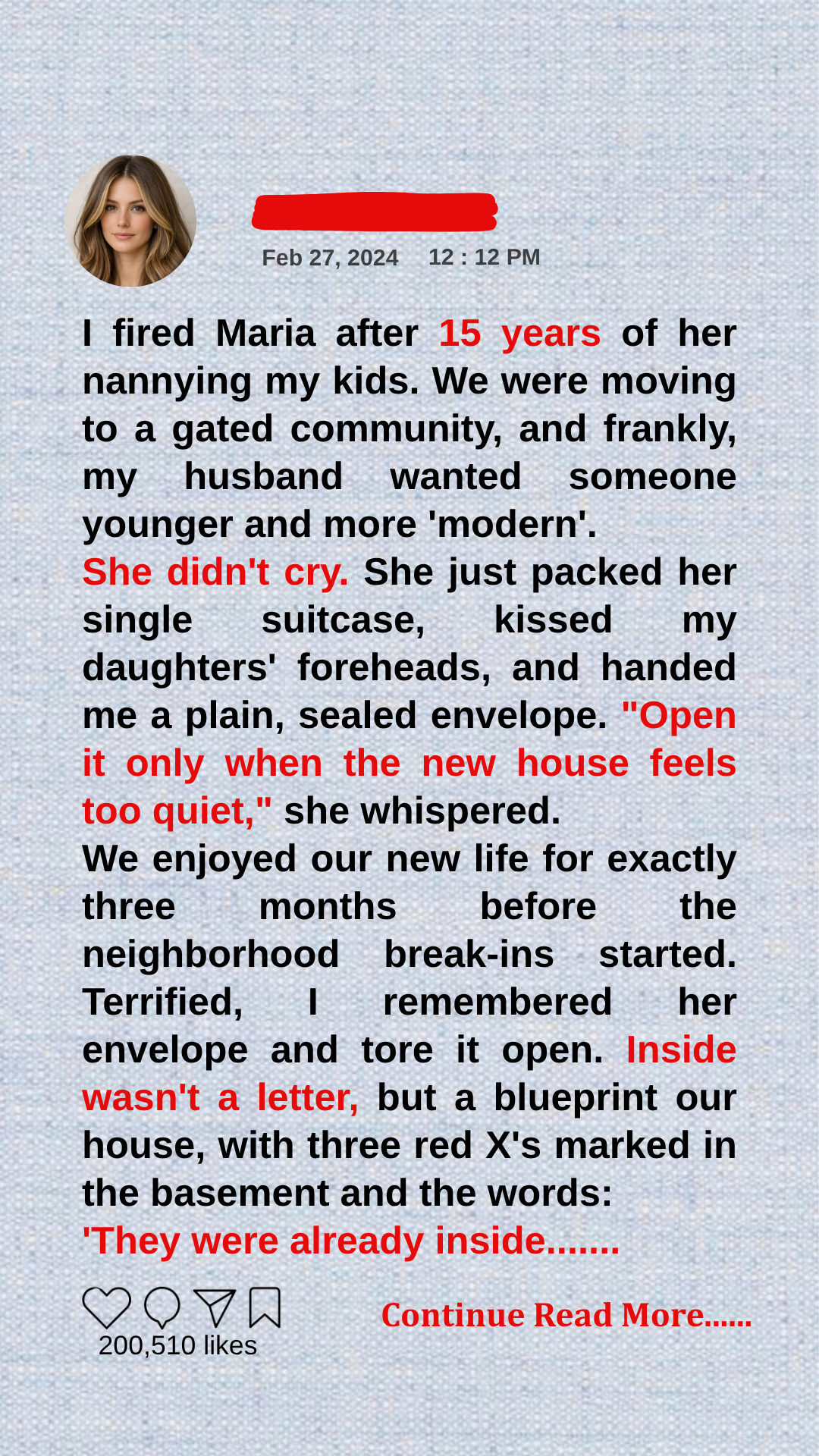
    My blood turned to ice, the heavy silence of the house suddenly pressing against my eardrums. Open it only when the new house feels too quiet. It was a Tuesday afternoon. My husband, Greg, was at the firm. Our new, ‘modern’ nanny, a twenty-two-year-old named Chloe, had supposedly taken my daughters to the community clubhouse for a swim. But standing in the center of my immaculate, sun-drenched kitchen, I realized the hum of the refrigerator was the only sound I could hear.

    No splashing from the backyard. No echoes of laughter from the street.

    My hands trembled as I flattened the blueprint against the marble island. The three red X’s were clustered around the perimeter of our sprawling finished basement: one behind the custom wine rack, one in the utility room, and one at the back of the walk-in storage closet.

    I grabbed the heaviest thing within reach—a solid cast-iron meat tenderizer from the drawer—and crept toward the basement door. Every step on the plush carpet felt deafening.

    The basement was cool and dark, smelling faintly of fresh paint and cedar. I turned on the flashlight on my phone, moving first toward the utility room. The furnace hummed a low, steady rhythm. I held the blueprint up. The first X was marked directly behind the massive water heater.

    I squeezed past the cylindrical tank, my breath catching in my throat. There, flush against the concrete foundation, the drywall had been cleanly cut and refitted on a set of subtle, recessed hinges. It wasn’t a wall. It was a door.

    Before I could reach out to touch it, a sound froze me in place.

    Scrape. Thud. Scrape.

    It wasn’t coming from outside. It was coming from behind the drywall.

    My mind raced back to the neighborhood break-ins. The police had been baffled. No shattered glass, no forced doors, no tripped alarms. The thieves were bypassing millions of dollars in state-of-the-art neighborhood security because they never had to cross the perimeter. The developer of this exclusive, gated community had built a network of maintenance tunnels connecting the homes—tunnels that someone had clearly repurposed.

    And Maria, observant, quiet, fiercely protective Maria, had noticed the discrepancies in the floor plans during our walk-throughs. She had seen what Greg’s arrogance and my complacency had blinded us to.

    Suddenly, I heard the heavy thud of the front door closing upstairs, followed by muffled voices.

    “The husband’s at work until six,” a voice said. It was Chloe, the new nanny. Her tone wasn’t the bubbly, high-pitched chirp she used with my girls. It was cold, flat, and professional. “Are the basement guys in position? We need to clear out the safe before she gets back from her yoga class.”

    My daughters. “Where are the kids?” a rough, male voice replied.

    “Locked in the clubhouse media room with a movie,” Chloe answered dismissively. “They’re fine. Just give the signal to the walls.”

    Panic and pure maternal adrenaline flooded my veins. I didn’t wait to see the utility room panel open. I scrambled out from behind the water heater, bolted silently up the back staircase, and slipped out the patio door just as the basement hinges began to squeal.

    I ran. I didn’t stop to grab my purse or my car keys. I sprinted barefoot across the manicured lawns of our ‘perfect’ neighborhood, the irony of the towering iron gates mocking me. We had paid a premium to lock out the dangers of the world, never realizing we had invited them directly into our foundation—and handed them our children.

    I reached the clubhouse, shattered the media room window with a landscaping rock when I found the door padlocked from the outside, and pulled my terrified daughters into my arms. We didn’t stop running until we reached the main road and flagged down a passing patrol car.

    By the time the police raided the house, Chloe and the men in the walls were gone, leaving behind an empty wall safe and a network of tunnels that snaked beneath every multi-million-dollar mansion in the development.

    We moved into a modest apartment across town the next week. Greg complained about the lack of square footage and the dated appliances. I didn’t care. The walls were solid. And the next morning, when a knock came at the door, I opened it to find Maria standing there, a single suitcase by her side.

    She didn’t smile, and she didn’t say I told you so. She just walked past me, took my daughters into a fierce hug, and began making them breakfast.

  • Two months after the divorce, I was sh0cked to see my ex-wife wandering aimlessly in the hospital. When I learned the truth, I completely collapsed.

    Two months after the divorce, I was sh0cked to see my ex-wife wandering aimlessly in the hospital. When I learned the truth, I completely collapsed.

    PART 1

    The envelope arrived on a Tuesday morning in October, slipped beneath my apartment door while I was asleep. My name was written on cream-colored paper in handwriting I did not recognize, but the return address made my stomach tighten: Riverside Memorial Hospital. Inside was a short note that shattered the careful distance I had built from my past. “Mr. Davidson, your ex-wife Rebecca listed you as her emergency contact. She has been admitted and is asking for you.”

    Three months had passed since our divorce became final. Three months since I had walked out of the courthouse believing I was free from a marriage that had slowly drained both of us. Rebecca and I had spent our final year together like strangers under the same roof, speaking mostly through lawyers and cold conversations about bills, furniture, and what each of us would take.

    The drive to the hospital felt like moving backward through time. Every mile brought back memories I had tried to bury: Rebecca laughing on our first date, the way she used to wake me with coffee and terrible singing, and the silence that eventually settled over our home like dust on furniture no one touched anymore.

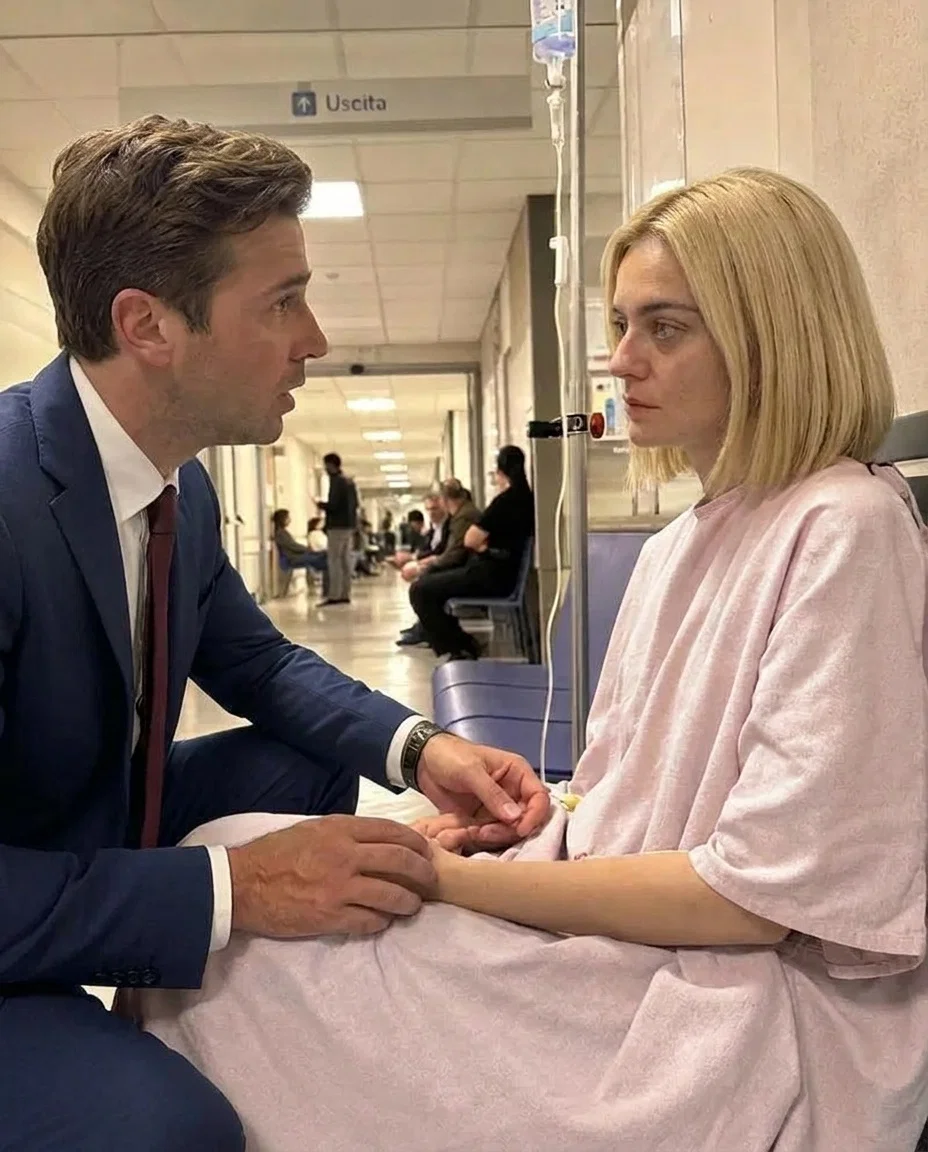
    I found her in the cardiac unit, sitting near the window in a hospital gown that made her look smaller than I remembered. Her dark hair, once carefully styled, hung loose around her shoulders. The confidence that had drawn me to her seven years earlier seemed gone, replaced by someone fragile, tired, and uncertain.

    “You came,” she said when she noticed me in the doorway.

    Her voice carried both surprise and relief.

    “The hospital contacted me,” I said. “They told me you were asking for me.”

    I stayed near the door, unsure whether I had the right to come closer. Rebecca nodded slowly, fidgeting with the edge of her blanket.

    “I didn’t know who else to put down as an emergency contact,” she said. “My parents are gone, my sister lives across the country… I guess old habits stay longer than we expect.”

    The awkwardness stretched between us like a wall. We were two people who had once shared everything, now struggling to manage even the simplest conversation.

    “What happened?” I asked, finally taking a few steps toward her bed.

    She stayed quiet for so long that I thought she might not answer. When she finally spoke, her voice was barely above a whisper.

    “My heart stopped, David. I had a medical crisis at work. The doctors think it was connected to the way I’d been using my prescriptions.”

    The words hung between us. I stared at her, trying to understand what she was telling me.

    “What prescriptions?”

    Rebecca looked out the window instead of at me.

    “Different medications. Too many. The doctors are still sorting out everything.”

    Over the next hour, Rebecca began telling me pieces of her life that I had never known during our marriage. At first, she spoke carefully, as if each sentence had to be pulled from somewhere deep inside her. Then the words came faster, like they had been trapped for years.

    She told me about anxiety that had started in college and had grown worse over time. She told me about panic attacks at work, nights without sleep, and mornings when her mind was already exhausted before the day even began. She told me how she had first sought help, then slowly began depending too much on medication when fear became louder than reason.

    “At first, it helped,” she said. “Then the fear kept coming back, and I kept trying to quiet it. When one thing stopped working, I looked for another answer.”

    I listened with growing shock as she described how alone she had been. She had been seeing different doctors, collecting different prescriptions, and hiding the truth from almost everyone. What had nearly taken her life was not one dramatic moment, but the result of years of fear, shame, secrecy, and trying to survive without real support.

    “The morning I collapsed, I was already overwhelmed,” she said. “I kept thinking about the divorce, about how I had failed at the most important relationship in my life. I made a terrible choice because I didn’t know how to stop the panic.”

    Her voice was calm, but that made it worse. This was not the Rebecca I thought I had known. This was someone who had been quietly breaking while I stood beside her and saw only distance.

    “Why didn’t you tell me?” I asked before I could stop myself. “Why did you go through all of that alone?”

    Rebecca finally looked at me. In her eyes, I saw years of pain and shame.

    “Because I was afraid you would leave,” she said. “And then I was afraid you would stay only because you felt sorry for me. Either way, I thought I would lose you.”

    As Rebecca continued speaking, our marriage began rearranging itself in my mind. The emotional distance I had believed was proof that love had faded, the small arguments that grew into walls, the way she stopped wanting to see friends or go places—all of it looked different now.

    I remembered mornings when she said she felt sick and stayed in bed long after I left for work. I had thought she was avoiding responsibility. Now I wondered if those were days when anxiety had made ordinary life feel impossible. I remembered inviting her out with friends and feeling frustrated when she made excuses. I had thought she no longer cared. Now I understood that social situations may have felt unbearable to her.

    “There were signs,” I said quietly, more to myself than to her. “I just didn’t know how to read them.”

    Rebecca gave a sad smile.

    “I became good at hiding it,” she said. “Too good, maybe. I told myself that if I looked normal long enough, maybe I would eventually feel normal.”

    PART 2

    That was the cruel irony. She had hidden her pain to protect the marriage, but hiding it had helped destroy the connection between us. I had lived with someone who was drowning, but she had learned to sink quietly enough that I never reached for her.

    Sitting in that hospital room, guilt settled over me like weight. How had I missed the suffering of someone I once loved so deeply? How had I been so focused on my own frustration that I failed to see she was fighting a battle inside herself every day?

    I thought about our fights during the last year of marriage. I had accused her of not caring, of giving up, of pulling away. She had become defensive and distant, and I had taken that as proof that she wanted out. Now I understood that her withdrawal had not meant she stopped loving me. It meant she was trying to survive while pretending everything was fine.

    “I kept hoping you would notice,” she said softly. “Part of me wanted you to ask the right question. But another part of me was relieved when you didn’t, because then I didn’t have to admit how bad it had become.”

    That confession cut deeply. She had been sending quiet signals I did not understand. When she had needed support, I had been measuring her failures as a wife instead of seeing her pain as a person.

    Later, Dr. Patricia Chen explained privately that Rebecca had been through a serious medical emergency and was extremely lucky to be alive. The medical team was treating not only her heart condition but also the consequences of medication misuse. Her recovery would need careful supervision, mental health care, and a strong support system.

    “She will need steady help,” Dr. Chen said. “Not just medically, but emotionally. Does she have family or close friends who can support her?”

    I realized I did not know. During our marriage, Rebecca had slowly drifted away from most people. I had assumed it was part of her changing personality. Now I understood it was part of her illness and her shame.

    I spent that first night in the hospital’s family waiting area, unable to leave even though I had no legal reason to stay. We were divorced. She was no longer my responsibility. But the woman in that hospital bed was not just my ex-wife. She was someone I had loved, someone whose pain I had failed to recognize when it might have mattered most.

    Over the next few days, as Rebecca became physically stronger, we began having the conversations we should have had years earlier. She told me about the first panic attack she had experienced during our second year of marriage and how she convinced herself it was just stress. She described how ordinary things—answering calls, going to the store, attending gatherings—had slowly become overwhelming.

    “I kept telling myself I only had to get through one more day,” she said. “Then one more week. I thought if I held on long enough, whatever was wrong with me would fix itself.”

    The tragedy was that help had been available. Her condition could be treated. But shame, fear, and my own ignorance had kept her from reaching for support in time.

    Rebecca’s recovery required more than medical treatment. It required education for both of us. I attended therapy sessions where I learned about anxiety disorders, dependency, shame, and the ways untreated mental health struggles can damage relationships from the inside.

    Dr. Michael Roberts helped me understand that many of Rebecca’s behaviors during our marriage had not been about rejecting me. They had been symptoms of a serious condition that kept growing worse in silence.

    “Fear of judgment can keep people from seeking help,” he explained. “Then the condition worsens, and the fear grows stronger. Rebecca was trapped in that cycle.”

    Through those sessions, I began to see our marriage from her side. Every event she avoided, every responsibility she seemed to neglect, every argument we had about her behavior had been filtered through anxiety she did not know how to name out loud.

    I also began to see my part in the pattern. My frustration had become criticism. My criticism had made her fear worse. Without meaning to, I had helped create a home where she felt even more pressure to hide.

    Rebecca’s recovery was not quick. There were difficult days, setbacks, and moments when she wanted relief more than anything else. But there were also small victories: the first calm conversation, the first full night of sleep with proper medical support, the first walk down the hospital corridor without panic stopping her halfway.

    I became her advocate in ways I had not been during our marriage. I went to appointments, helped her remember questions, and learned about anxiety and recovery. It was exhausting for both of us, but it was also honest. We were finally seeing each other as people, not as the roles we had played in a damaged marriage.

    Six months after that first hospital visit, Rebecca and I had built a relationship unlike anything we had shared before. We were not trying to repair our romantic marriage. That chapter had ended too completely. Instead, we were building something different: a friendship based on truth, compassion, and a shared commitment to her healing.

    PART 3

    She found a therapist who specialized in anxiety disorders and joined support meetings where she met people who understood her experience. Slowly, the Rebecca I remembered began to return, but she was also different. She was more honest with herself. More aware. Less willing to hide behind performance.

    “I spent so many years afraid people would think I was broken,” she told me one afternoon as we walked through the park near her apartment. “Now I think pretending to be fine when you’re falling apart is what really breaks you.”

    Her healing was not perfect. Some days were still hard. Anxiety still came. But now she had tools, treatment, and people who knew the truth. She no longer had to perform wellness for everyone around her.

    Looking back, I see how many chances we missed. I learned that mental health struggles can be invisible even to the people closest to someone. Rebecca had become skilled at hiding her symptoms, but I also should have asked better questions. I should have noticed the changes instead of only resenting them.

    I learned that untreated mental health conditions do not affect only one person. They can reshape a whole relationship. Without understanding what was happening, I blamed our problems on lack of effort, when the deeper issue was pain neither of us knew how to face.

    Today, Rebecca and I remain friends. She has been in recovery for more than a year. She manages her anxiety with therapy, medical guidance, and a support system that knows the truth. She has returned to work in a healthier way and has slowly rebuilt relationships with people she once pushed away.

    I have changed too. I pay more attention now. I ask better questions. When someone’s behavior shifts, I try to wonder what might be happening beneath the surface before deciding what it means.

    The guilt I once felt has become a commitment to be more present in my relationships. I cannot undo what happened in our marriage, but I can let it make me more compassionate, more aware, and more willing to speak honestly about mental health.

    The end of our marriage was necessary. We had been too damaged by misunderstanding and silence to rebuild a healthy romantic life together. But learning the truth about Rebecca taught me that love can take different forms. Sometimes loving someone means supporting their healing without expecting to become the center of their recovery.

    Rebecca’s medical crisis forced both of us to face truths we had avoided for years. Her decision to confront her anxiety and dependency began her healing. My recognition of what I had missed began mine.

    We often wonder how different things might have been if we had spoken this honestly while we were still married. But maybe we were not ready then. Maybe we were too busy pretending the marriage was still fine to admit how much both of us were hurting.

    That hospital room changed both our lives. It was where I learned that the woman I thought I understood had been fighting battles I never saw. It was where I learned that relationships can fail not from lack of love, but from lack of understanding.

    Rebecca’s story eventually became part of my work in mental health awareness. I began speaking at community events about warning signs, shame, and the importance of creating safe spaces for people to ask for help. I learned that mental illness does not mean weakness. It does not care how intelligent, successful, or capable someone appears.

    Rebecca’s recovery inspired me because she survived, but also because she chose honesty afterward. She rebuilt her life on truth instead of hiding. She began using her story to help others feel less alone.

    The divorce I thought was the end of our story became only one chapter in something larger: healing, growth, and a different kind of love. We could not save our marriage, but in some ways, we helped save each other.

    Sometimes the most important discoveries happen after we believe the story is over. Sometimes understanding arrives too late to protect what we wanted, but just in time to protect what matters more: our humanity, our ability to grow, and our willingness to care for one another through life’s hardest moments.

    Rebecca’s second chance at life became my second chance to understand what it means to truly support someone. The marriage we lost was replaced by something quieter, more honest, and more lasting: a bond built on seeing each other clearly, accepting each other’s struggles, and choosing to stand together not as husband and wife, but as two human beings committed to each other’s wellbeing.

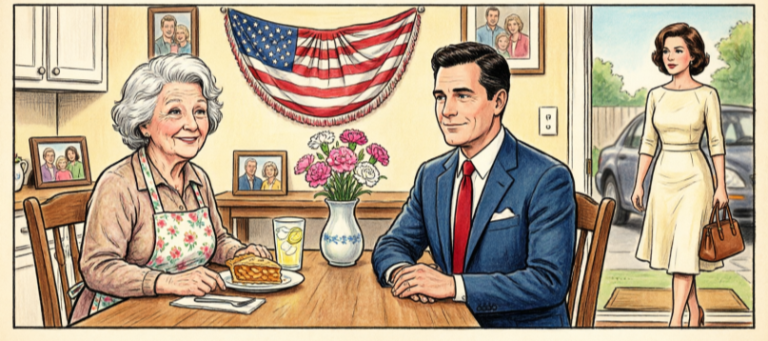
  • On Mother’s Day, my millionaire son came to visit and asked, “Mom, are you living comfortably with the $5,000 Clara sends you every month?” I froze, then answered softly, “Son, the church has been helping me get by.” Right then, my daughter-in-law walked in wearing a silk dress, a strand of pearls, and expensive perfume, smiling sweetly — not realizing what was about to happen next…

    On Mother’s Day, my millionaire son came to visit and asked, “Mom, are you living comfortably with the $5,000 Clara sends you every month?” I froze, then answered softly, “Son, the church has been helping me get by.” Right then, my daughter-in-law walked in wearing a silk dress, a strand of pearls, and expensive perfume, smiling sweetly — not realizing what was about to happen next…

    He placed the flowers on my old wooden table, looked at me with a gentle but distant expression, and said, “Mom, my wife still sends you five thousand dollars every month, right? I just want to make sure you’re comfortable.”

    I froze.
    My heart began pounding so hard I could hear it over the soft hum of the ceiling fan. Five thousand dollars?
    For the past eight months, I had been living on food packages from St. Mary’s Church and small donations from kind neighbors who knew enough not to ask too many questions. I had been stretching canned soup over two meals, waiting until the last possible week to refill my blood pressure medication, and pretending the leaking roof was only a small inconvenience.
    I looked at my son, the boy I had once rocked to sleep in this very house, and whispered, “Son, the church is helping me get by.”
    His smile vanished.
    Before he could answer, my daughter-in-law appeared in the doorway like she had stepped out of a glossy magazine instead of my narrow front hall. Clara wore a pearl-colored silk dress, shiny silver heels, and a cloud of expensive perfume that drifted through the room like mockery. Her smile was dazzling, but her eyes were colder than any winter I had ever known in Texas.
    She did not realize that on that very day, the last light of her elegance would begin to fade.

    My name is Margaret Hayes. I am a sixty-seven-year-old widow living alone in a small house on the outskirts of Dallas, Texas. This house used to be filled with laughter. It was where my husband, Frank, and I raised our only son, David. After Frank passed away from a heart attack ten years ago, I learned to live quietly. I tended my garden, cooked simple meals, and sometimes taught Bible classes at St. Mary’s Church down the street.
    I did not have much, but it was enough for a while. Then old age came knocking, and everything grew more expensive with each passing month.
    David, the boy I once carried in my arms, was now a millionaire. He owned a chain of tech companies, drove a brand-new Tesla, and lived in a mansion in the Park Cities, where the annual property tax alone could have swallowed what I had earned in several years of honest work. I was proud of him. Of course I was. I had raised him with these two hands, believing he would grow into a good, kind, grateful man.
    So when he walked into my house that afternoon and sunlight spilled across his tired, handsome face, my heart warmed the way it always did when I saw him.

    Then he asked about the money.

    “Five thousand?” I repeated, my voice catching. “Son, the church is helping me survive.”

    David’s eyes widened. He glanced toward Clara, who had just entered the room and was standing there as if the floor itself should be grateful for her shoes.

    The scent of Chanel No. 5 filled my small living room, overpowering the apple pie I had just baked to welcome my son home.

    Clara smiled lightly, a smile that could melt a room if it were not so cold.

    “Oh, Mother, you must have forgotten,” she said sweetly, her voice like honey poured over ice. “I stop by every month to bring the money. Remember?”

    I looked at her calmly.

    “If you did bring it,” I said, barely above a whisper, “then it must have gotten lost somewhere.”

    The room fell silent. I could hear the ticking of the wall clock, the hum of cars passing outside, and the pounding of my own heart. David looked from me to Clara and back again, his brow furrowed.

    “Clara,” he said, “you have been bringing the money, right? I transfer it to you every month.”

    Clara tilted her head. Her smile did not move.

    “Of course, David. I come here every month. Maybe Mother just forgot. You know how old age can be. The memory isn’t what it used to be.”

    The words were soft as feathers, but they landed on my heart like stones.

    Old age.

    I had heard that phrase too many times since Frank died, usually from people who thought an old widow was nothing but a fading memory in a cardigan. But I knew my memory. I remembered every bill, every prayer, every face at church, every loaf of bread that had been left on my porch when I could not afford groceries.

    And I knew, without a shadow of doubt, that Clara had never given me a single penny.

    I nodded slightly, choosing silence. Some battles are not meant to be fought right away. Some are meant to be observed.

    David stood and placed a hand on my shoulder.

    “Mom, it’s probably just a misunderstanding,” he said. “I’ll check the accounts. I just want you to live comfortably, without worry.”

    I smiled faintly, but something inside me had awakened, something quiet and strong. I said nothing more. I cleared the table and placed a glass of orange juice in front of him.

    Clara moved gracefully to his side and rested a possessive hand on his shoulder. Her gaze swept over me, cool and dismissive, the look of someone who believed money could buy not only comfort, but innocence.

    The room turned cold, even though the Texas sun outside was blazing.

    Clara glanced around the living room, her eyes brushing over the old photo frames on the wall. David as a little boy, golden hair, bright eyes, a carefree smile. Frank standing beside him with his arm around my shoulder. A birthday party. A fishing trip. A life that had once felt whole.

    “You’ve done such a great job keeping the house clean, Mother,” Clara said. “Even at your age.”

    I smiled faintly.

    “Old, yes,” I said. “But not so old that I forget who comes through my door, Clara.”

    David shifted uneasily.

    “Mom, come on. It’s Mother’s Day. Don’t get upset.”

    “I just want you to be happy, my son,” I said, my eyes still on Clara. “So do I. But happiness doesn’t come from what people say they have done for you. It comes from what they have actually done.”

    David froze. Clara’s smile tightened, then disappeared altogether.

    After they left, I sat alone in the living room while the afternoon sunlight spread across the old wooden table. Five thousand dollars a month. Eight months. Forty thousand dollars.

    That money could have fixed my leaking roof. It could have replaced the broken refrigerator that rattled like it was begging to die. It could have helped me live out my later years with some dignity instead of counting cans from the church pantry and thanking God for every loaf of donated bread.

    I pressed a hand to my chest, not out of anger, but from the ache rising inside me. A silent, bone-deep ache.

    That night, I opened my old notebook, the one where I used to write grocery lists and prayers. This time I wrote something different.

    Find the truth.

    Under it, I added another line.

    Do not trust fake tears.

    I closed the notebook and took a deep breath. I was not weak. I had survived loss, loneliness, debt, and the slow humiliation of needing help after a lifetime of giving it. I would survive this too.

    David might have been fooled, but I had not.

    If Clara thought I would sit quietly while she played perfect wife and generous daughter-in-law, she had chosen the wrong woman to underestimate.

    The next morning, I pulled out my old accounting ledger, the one I had kept from my years as treasurer of the women’s committee at St. Mary’s. The pages were neat, even after all that time. Twelve dollars for blood pressure medicine. Twenty-four for utilities. Ten for community dinner supplies. Every little expense, every little gift, recorded in blue ink.

    There was no transfer from David Hayes.

    Nothing.

    Later that morning, I went to First Texas Community Bank, where I still kept my small savings account. I sat across from a young teller named Molly and handed her my passbook.

    “Please check whether there have been any transfers from David Hayes,” I said. “He says he has been sending me five thousand dollars each month for the past eight months.”

    Molly looked surprised. She typed for a while, then shook her head gently.

    “I’m sorry, Mrs. Hayes. There’s nothing. The only activity was a dollar and thirty-five cents of interest back in February.”

    I thanked her and stood.

    Outside, the Texas morning wind swept through my gray hair. I stood on the sidewalk with my purse clutched in both hands, feeling as if a stone had fallen straight through my chest.

    No transfers. No envelopes. No letters. Nothing.

    For eight months, I had clipped coupons from the local paper, bought canned soup instead of fresh vegetables, and quietly thanked God whenever the church delivered food. I was used to eating alone. I was used to counting change before heading to the store.

    But never, not once, had I imagined that behind my son’s silence was a lie wearing perfume.

    That afternoon, I went to St. Mary’s Church as usual. Reverend Cole, who had known me for over twenty years, found me sitting quietly in the last pew after the service. He walked over, his voice kind.

    “Mrs. Hayes, are you all right? You look tired today.”

    I smiled faintly and hid my trembling hands in my lap.

    “I’m just trying to understand why my son’s letters never arrived.”

    Reverend Cole placed a hand on my shoulder.

    “The Lord has a way of bringing truth to light. Don’t lose faith.”

    I nodded, but inside, faith alone was no longer enough. I needed action.

    That night, I opened the brown leather notebook David had given me for my sixtieth birthday. On the first page, instead of a prayer, I wrote, If they are lying, I will make them tell the truth through the law.

    The words glowed under the lamp like a vow.

    From that day forward, I began documenting everything. Every time Clara visited, I recorded the date, time, and her exact words.

    Thursday, June 14. Clara stopped by with a cake. Said, “The money has been sent. Maybe the bank is delayed.” No envelope. No proof.

    Saturday, July 12. Called and said she could not come because of a charity meeting. I heard restaurant music in the background.

    Line by line, I wrote it all down. No anger. No hatred. Just the precision of a woman who had spent a lifetime balancing numbers and knew they never lied.

    The weeks that followed were almost theatrical. Clara kept visiting, always flawless, always perfumed, always dressed as if every room were waiting for her entrance. Designer dresses. Expensive handbags. Sparkling heels. Each time she brought a small gift: flowers, cookies, scented candles, a jar of marmalade. Pretty things. Empty things. Never an envelope.

    One afternoon in August, while I was watering the garden, her white Mercedes pulled into the driveway. Clara stepped out carrying lavender wrapped in brown paper.

    “I brought you flowers to help you relax,” she said. “Stress isn’t good for the memory.”

    I set the watering can down and wiped my hands on my apron.

    “My memory is just fine, Clara. Fine enough to remember that the last time you brought me money was never.”

    Her face twitched, but she recovered quickly.

    “Oh, Mother, you must be mistaken. I’ve been sending it. Your bank must be at fault.”

    I began arranging the flowers.

    “Maybe. But I already asked the bank. They said nothing has come through for eight months.”

    Silence.

    Even the sparrows on the fence seemed to stop chirping.

    Clara fidgeted with her necklace.

    “I’ll double-check,” she said quickly, then hurried back to her car, leaving behind the scent of expensive perfume and panic.

    I stood in the yard watching the car disappear, a mix of bitterness and clarity filling my chest. She had lied. Now she knew that I knew.

    That evening I wrote: Clara, August 22. Lied. Nervous. Left early.

    Each line felt like a hammer striking the hurt inside me. I was no longer the frail mother praying in silence. I was Margaret Hayes, the woman who had survived loss, debt, empty promises, and grief sharp enough to cut through bone.

    And I would survive this too.

    In the weeks that followed, I contacted David’s bank, pretending to ask about family gift transfers. They could not share private information, but one kind employee hinted at what I needed to hear.

    “If funds were transferred,” she said carefully, “they would have to land in an account under your name. If you never received them, someone may have used a different account connected to your name.”

    A chill moved down my spine.

    Another account bearing my name, but not mine.

    I closed my notebook and exhaled deeply. I knew what I was up against. Clara was charming, smart, manipulative, and capable of bending David’s trust until it served her. But I had been an accountant for three companies before retirement. I had managed thousands without losing a cent. If someone had dared to forge my name, I would find them.

    That night, I reread every note I had written. Between the lines, I could almost hear Frank’s voice.

    “Margaret, if someone underestimates you, don’t shout. Let them hear the sound of the truth instead.”

    The next morning, I went back to church carrying a small envelope filled with copies of my notes. I handed it to Reverend Cole and said softly, “Father, if one day I cannot come to service, please keep this safe for me.”

    He looked worried.

    “Margaret, what are you doing?”

    I smiled gently but firmly.

    “I’m just preparing for the truth to be heard.”

    As I walked home, my heart felt lighter. I knew the road ahead would be long. There would be tears, pain, betrayal, and perhaps a fracture that never fully healed. But I was not afraid anymore. I would get back every dollar they had stolen from me, but more than that, I would reclaim the respect they thought I had lost with age.

    As the sun set behind the oak trees, I sat on my porch and watched the horizon burn red.

    “Clara,” I whispered, “you picked the wrong woman to fool.”

    Then I opened my notebook and wrote one final line at the bottom of the page.

    The first step toward justice is memory.

    A few weeks later, the Texas air was warmer than usual. The wind carried the scent of dry grass and jasmine from the vine behind my porch. I was trimming my lavender bushes when I heard the low, smooth sound of an expensive engine approaching.

    A brand-new silver Lexus stopped at the gate, its polished paint so bright I had to squint. Clara stepped out looking as if she had walked straight out of a fashion spread. Cream linen dress. Oversized sunglasses. Mirror-bright heels. In her right hand, she carried a large gift basket wrapped with a golden ribbon.

    “Mother, I brought you a little something,” she said. “David has been in meetings all morning, so I came in his place.”

    “How thoughtful,” I said softly, without smiling.

    Her gaze drifted across the garden.

    “Oh my, your garden is still beautiful. I don’t know how you manage it all by yourself.”

    “With these hands and a little patience,” I replied, tucking my shears into the potting soil.

    She placed the basket on the patio table. Fancy cookies, orange marmalade, a small bottle of wine. Everything neatly wrapped, expensive, and empty.

    I poured two glasses of iced tea and looked her straight in the eye.

    “Clara, where is this month’s money? The five thousand dollars you said you would bring.”

    For a split second, her smile froze.

    Then she laughed, a sharp, hollow sound like glass tapping glass.

    “Oh, Mother, I must have left it in the car.”

    Her voice had gone slightly higher. I glanced toward the driveway, where the Lexus gleamed under the sun, temporary plates still fixed to the back.

    “Nice car, Clara. Must have cost quite a bit.”

    She shrugged.

    “Not really. I upgraded for convenience. My boutique work requires a professional image.”

    “Of course,” I said calmly. “A new car for work and old envelopes that keep getting left in the car. How odd.”

    Her face stiffened.

    “Oh, Mother, you don’t trust me anymore.”

    “Trust,” I said, “usually comes with receipts.”

    She stood first, pretending to check her watch.

    “I have to run. I have a client meeting. But don’t worry. I’ll remind David to resend the money through the bank. I’m sorry for the small mix-up.”

    I nodded.

    “Go on, then. And don’t forget the envelope in your car this time.”

    She paused on the steps, smiling thinly.

    “You’re very sharp, Mother.”

    I watched her walk away, the sound of her heels striking the wooden steps steady and cold, like a clock ticking down. When the Lexus disappeared down the road, I went back inside, opened the brown leather notebook, and wrote every detail.

    September 10. Clara came alone. Gift basket. Claimed she left the money in the car. New Lexus. No proof. Voice unsteady. Avoided eye contact.

    That afternoon, I walked to the post office down the road where the public phone still worked. I did not want to call from home. Not when I suspected Clara might be watching, listening, or waiting for me to make a mistake.

    I dialed David’s company and spoke politely.

    “Hello. This is Margaret Hayes, David Hayes’s mother. I would like to speak with someone in accounting. It is a personal matter.”

    After a short hold, a middle-aged woman answered.

    “This is Sandra Miller, head accountant. Mrs. Hayes, how can I help you?”

    I gripped the receiver tightly.

    “Thank you, Sandra. I need to confirm something small. My son said his company has been deducting five thousand dollars each month from his personal account to send to me. I need to know if that is correct.”

    There was a pause.

    “Mrs. Hayes, I cannot disclose personal financial details, but let me check what I’m allowed to confirm.”

    I heard typing.

    “Yes,” she said finally, her tone hesitant. “I recall seeing automated transfers on the same day every month for that amount. It does appear the money was sent, but I am not sure to whom.”

    “To whom?” I repeated. “It was not sent to me.”

    “I’m not certain, Mrs. Hayes. The recipient name matches yours, but the account number is different. I assumed it was yours.”

    A chill ran through me.

    “Thank you, Sandra. That is all I needed for now.”

    I hung up and stood motionless in the phone booth. My heart raced, but my mind was clear as glass.

    There it was.

    Someone had created a fake account under my name, and only one person close enough had the access and nerve to do it.

    Clara.

    On the walk home, my shadow stretched long across the road. The wind carried the scent of scorched grass and dry earth. It reminded me of poor Texas summers long ago when my father used to say, “If you want to know who is honest, look at their hands.”

    Honest hands always show the marks of work.

    I thought of Clara’s hands. Long manicured fingers. Diamond rings. No calluses. No trace of real labor. Just polished nails signing papers that did not belong to her.

    That night I skipped dinner. I made peppermint tea and sat at the kitchen table under the warm yellow light. The house was so quiet I could hear the cicadas outside fading into the dark. I opened a new page in my notebook.

    September 10. Called David’s company. Confirmed money is being transferred but not to my account. Tomorrow the truth begins to surface.

    Then I turned off the lamp and stepped onto the porch. Moonlight fell on the old wooden bench where Frank and I used to sit and talk after supper.

    I touched the worn armrest and whispered, “Frank, if you were still here, you would tell me to do what is right, wouldn’t you?”

    Only the wind answered beneath the eaves, but I understood.

    The next morning, while I was cutting lavender stems to dry, a firm knock echoed at the door. Not the soft tap of a mail carrier or neighbor. This knock was steady and deliberate.

    I wiped my hands on my apron and opened the door.

    A tall, middle-aged man stood on the porch. He had graying hair and wore a charcoal suit that looked a little travel-worn. He smiled politely and gave a small nod.

    “Mrs. Margaret Hayes? I’m Bennett, chief accountant at your son’s company, Hayes and Partners.”

    I narrowed my eyes.

    “You’re Bennett? I only know Sandra, the accountant I spoke with yesterday.”

    He nodded.

    “Yes. Sandra is my assistant. She told me about your call, and I thought you should know a few things.”

    His voice was calm, but serious, tinged with regret. I invited him inside and poured a glass of water. Morning light streamed through the window, catching the lines on his face, the look of a man who had seen more than he wished to.

    He set a leather briefcase on the table and opened it. Inside was a thick folder, neatly clipped and organized. I recognized the sharp printed text, the rows of numbers, the language of accounting. It had been my world for nearly forty years.

    He slid the folder toward me.

    “These are copies of eight transfers,” he said. “Each for five thousand dollars. Forty thousand total. The recipient is an account under the name Clara Hayes.”

    It felt like ice water had been poured over me.

    My hands shook as I flipped through the pages. The papers were clear. Sender: David Hayes. Recipient: Clara Hayes. Verified by the bank. Same date every month, steady as clockwork.

    I looked up, my voice hoarse.

    “Mr. Bennett, who opened that account?”

    He sighed, removed his glasses, and wiped them with a cloth.

    “Your daughter-in-law. Every document for the sub-account bears her signature and a signed authorization from David.”

    I froze.

    “Authorization? You mean David gave her permission to use my name?”

    “Most likely he did not read the forms carefully,” Bennett said. “She presented an ID copy of you, which I suspect was forged. Sophisticated, but forged. The system automatically registered it as a support account connected to your name, even though the funds were routed under her control.”

    I pressed a hand to my forehead. The room spun slightly.

    It was not only betrayal. It was humiliation.

    For eight months, Clara had used my name, a mother’s name, to siphon money from my own son.

    “And David?” I asked quietly. “Does he know?”

    Bennett hesitated.

    “Honestly, I do not think so. David is a hard-working man, but he trusts people too easily. He lets Clara handle most of the paperwork.”

    Then he paused and looked at me.

    “She has also been using the company credit card for personal expenses.”

    “The company card?”

    “Yes. The corporate secondary card of Hayes and Partners. It is supposed to be for client entertainment and business expenses. Recently we found irregular charges. Spa visits, jewelry, clothing, first-class flights to New York, even charges connected to the Lexus. More than thirty thousand dollars in three months.”

    I sat in silence. Spa. Jewelry. Flights. Lexus.

    Each word struck like a hammer.

    I turned to the window and looked at the wooden bench where Clara and I had once sat drinking tea while she chatted about her work.

    “David is so busy,” she had said. “I handle everything for him.”

    Now I understood what everything meant.

    Every dollar.

    I turned back to Bennett.

    “Mr. Bennett, if I want to expose this, will you help me?”

    He met my eyes.

    “Mrs. Hayes, I believe in justice, but I also believe in evidence. We need to prepare carefully, otherwise she will twist the narrative and turn David against you. Clara is not an easy opponent.”

    “I know,” I said. “I have seen her smile while she lies.”

    “I’ll help,” Bennett said. “Give me time to gather everything. I need transaction histories, related documents, and written confirmation from the bank that the account is not yours. It will take a few days, but I promise we will have the truth.”

    For the first time in months, I saw something in another person’s eyes that steadied me.

    Integrity.

    “Thank you,” I said softly. “You have no idea how much this means to me.”

    He closed the folder and stood.

    “I am just doing what is right, Mrs. Hayes. And I am sorry to say this, but cases like yours happen more often than people think. Many are betrayed by those closest to them.”

    After he left, the house went quiet again. I stared at the stack of papers on the table, each transfer line a piece of evidence, each dollar a mark of betrayal. I placed everything into a small metal box and slid it under the cabinet. When I turned the key, it felt like I was locking the last door of my trust.

    As afternoon faded, I brewed black tea and sat at the table, watching lavender sway in the garden. Everything outside looked peaceful, but inside me a quiet fire burned.

    I opened my notebook.

    September 11. Mr. Bennett came. Eight transfers, five thousand each, routed to Clara. Company card abused. David deceived. I have an ally. The fight begins.

    I set down the pen and looked toward the window.

    “Clara,” I said in a low voice, “you forgot I worked as an accountant for forty years. I can read lies and numbers, and this time the numbers will speak for me.”

    Three days later, with every fact lined up in my head like rows on a balance sheet, I called David.

    His voice was warm and familiar, but I heard exhaustion beneath it.

    “Mom, I’m sorry I’ve been swamped lately. Clara says she has been visiting you regularly, right?”

    “She has,” I said lightly. “Clara is very thoughtful. I was thinking of inviting you both to dinner this Sunday. It has been a while since we had a proper meal together.”

    David agreed happily, never noticing the thin wire hidden in that invitation.

    I spent all Sunday morning preparing, not because I wanted a perfect dinner, but because I wanted it to feel completely ordinary. Honey-roasted chicken, mashed potatoes, apple walnut salad, and apple pie. David’s childhood favorites. I polished Frank’s old silverware and set the dining table with candles. Everything was warm, sincere, and just enough to make a liar lower her guard.

    At six, I heard the familiar engine at the gate. The silver Lexus slid into the driveway. Clara stepped out first, flawless as always, soft waves in her hair, jade silk dress, faint trail of Dior. David followed with white lilies.

    “Mom, you look great,” he said, placing the flowers on the table.

    “I’m better than ever,” I said. “Thanks to God’s grace. And the two of you.”

    Clara smiled, her lips curling in that smug way I had learned to recognize.

    I poured wine and tea. We talked about the weather, the lavender, the new neighbors down the street. Everything flowed as though no shadow had ever crossed this house. I let the room warm. I let her relax.

    When the main course was served, I looked up and smiled.

    “I truly appreciate you both,” I said. “Especially for this month’s five thousand dollars.”

    Clara paused only a fraction of a second before flashing a bright smile.

    “Oh, Mother, please don’t be so formal. I’m just doing what I should.”

    I nodded, pretending to be shy.

    “I’m thrilled. I just bought a new heater. Texas gets chilly early, and thanks to that money, I feel much more at ease.”

    Clara’s smile widened. She tilted her head toward David as if to say, See, everything is fine.

    I watched her slowly.

    “Oh, Clara,” I said, as if the thought had just occurred to me, “I’m curious. What day do you usually send it?”

    She answered instantly.

    “The tenth every month, Mother.”

    David looked up, puzzled.

    “Wait,” he said. “Not the tenth, honey. I set the auto transfer for the fifteenth.”

    The room went silent.

    The faint clink of a knife against a plate sounded harsh. Clara stared at him. David stared back.

    “Really?” she said with a strained laugh. “I thought you said the tenth.”

    “No,” David said slowly. “I’m sure it’s the fifteenth. I picked that date because payroll hits then.”

    I set my fork down gently.

    “Oh, wonderful. I’ll go to the bank on the fifteenth and check, just to make sure the system is not having issues.”

    Clara gave a brittle laugh.

    “Mother, you are so careful. Don’t worry. I’ve been sending it regularly.”

    David nodded, but his eyes had shifted. A thin new line of doubt had appeared.

    After dinner, I brought out dessert. The apple pie was crisp, cinnamon drifting through the room. David praised it. Clara barely ate, glancing at her watch as if the walls had moved closer around her.

    At the door, I said softly, “Thank you both for coming. I haven’t laughed this much in a long time. Remember, I’ll check the account on the fifteenth.”

    Clara forced a smile.

    “Yes, Mother. I’m sure there won’t be any problem.”

    David kissed my cheek. His eyes were gentle, but I saw something else there now.

    Doubt.

    When their car pulled away, I went straight to the small office off the kitchen and turned on the computer. The glow from the screen caught Frank’s photograph on the desk. His smile felt like a quiet push forward.

    I opened my email and wrote to the only two people I trusted now: Bennett and Amelia Row, an old college friend who specialized in financial fraud.

    Subject: It is time to begin.

    Bennett, Amelia, everything is ready. Clara lied about the transfer date. They contradicted each other at my table. Please move forward with the plan. By the fifteenth, I want every piece of evidence lined up. It is time for the truth to come from her own mouth.

    I hit send and leaned back. Outside, the night breeze stirred the curtains with the scent of jasmine and damp soil. The clock ticked steadily, counting down to the day the truth would begin to crack through.

    Two days later, Bennett replied.

    I obtained confirmation from the bank. The account under your name was opened with forged documents. Amelia will handle the legal side. Everything is moving in the right direction.

    I read the message and felt my chest tighten, then loosen, like an old iron gate swinging open.

    I was not cruel. I did not want revenge for the sake of watching someone fall. I wanted the truth spoken so my son could wake up. I wanted David to understand that trust was not a blank check for someone to drain until nothing was left.

    That night, I opened my notebook and wrote another line.

    September 13. Dinner went perfectly. Clara exposed herself. David began to doubt. Justice is coming, soft as a breeze.

    On the morning the evidence arrived, the Texas sky was startlingly clear. I sat by the window with jasmine tea, strangely calm. Around eight o’clock, the phone rang.

    It was Bennett.

    “Mrs. Hayes, it’s all done,” he said. “I sent the full statements and related invoices. Amelia has reviewed them. With your signature, we can open a legal case.”

    Fifteen minutes later, the mail carrier knocked. A large sealed manila envelope lay in his hand, stamped confidential.

    I set it on the table and stared at it before opening it.

    Inside were dozens of clean printouts. Eight transfers. Five thousand dollars each. Forty thousand dollars in total. Sender: David Hayes. Recipient: Clara Hayes.

    I read them twice and still felt disbelief, as if the numbers were laughing at my faith.

    At the bottom was Bennett’s blue-ink note.

    Mrs. Clara Hayes used this as a personal account. In addition to the eight transfers, there are other charges through the secondary card: spa, shopping, travel, and vehicle expenses. Total spending over eight months: $47,800.

    I sat still. Morning light slipped through the blinds and laid pale gold across the pages. The color of truth.

    There was a spa receipt in Houston for twelve hundred dollars. Cancun travel for two. First-class flights. Clothing. Jewelry. A down payment on the Lexus.

    Each receipt was a small knife.

    I remembered Clara walking into my house with gifts, smiling softly, saying, “Mother, I care for you like my own.”

    Now I understood what care meant to her.

    It meant draining every dollar under my name.

    I reached for the notebook I had begun calling my justice journal and wrote carefully.

    September 17. Bennett’s records received. Eight transfers. Clara’s hands. Spa, travel, Lexus. $47,800. The price of trust.

    That afternoon, Amelia called. Her voice was firm and precise, the voice of someone seasoned by hard courtrooms.

    “Margaret, I reviewed everything. It is solid. This is financial exploitation of an elder, plus fraud. We can go criminal or civil. Your call.”

    I paused.

    “Not yet. I do not want the court to see it before David does. He needs to witness it with his own eyes. Only then will justice mean something.”

    Amelia was silent for a moment.

    “You’re right,” she said. “Nothing cuts deeper than a son realizing his wife exploited his mother’s trust.”

    “I’d like Reverend Cole to help me,” I said. “A small charity dinner. A reason for everyone to come.”

    Amelia gave a soft, knowing laugh.

    “A staged evening to expose the truth. Smart, Margaret. I’ll ask Bennett to condense the file. Give David a summary he cannot ignore.”

    Near dusk, I drove to St. Mary’s. Reverend Cole was lining up wooden chairs in the hall. After I explained the plan, he thought for a moment and smiled kindly.

    “Sometimes the Lord does not need thunder to reveal sin, Margaret. He only needs a small light of truth.”

    “I just want David to see that light,” I said. “Not for revenge. So he stops being blind.”

    That evening, I spread every statement and receipt across the dining table. With a red pen, I marked the large withdrawals and slipped them into a thick beige envelope. On the front, I wrote: Donation documents. Senior Assistance Fund.

    Only I knew there was not a single donation inside.

    Only guilt.

    Only deceit.

    I never loved a Sunday evening more than the one that followed. The late Texas sunlight poured over the garden, turning the lavender gold. In the kitchen, red wine beef stew simmered softly, filling the house with herbs and memory. It had been David’s favorite dish since childhood. He used to ask for it every birthday because, as he said, “Mom’s stew tastes better than any restaurant.”

    This time I was not cooking only out of love. I was preparing a final dinner for my son to see the truth I had hidden too long.

    On the table, I laid a crisp white cloth, antique porcelain dishes, and three small wine glasses. In the center rested the beige envelope like an invisible guest waiting to be acknowledged.

    At seven, David and Clara arrived. He wore a simple white shirt. She, as always, appeared overdressed in pale pink silk, new heels, and pearls at her throat.

    “Mom,” David said, hugging me tightly. “I missed this smell. Your stew smells like home.”

    “I made it for you,” I said, resting a hand on his shoulder. “Just like old times.”

    Clara stood behind him, her polished smile fixed in place.

    “Oh, how cozy,” she said. “You always make dinner feel so special, Mother.”

    “Yes,” I said softly. “Tonight will be very special.”

    Fifteen minutes later, Reverend Cole arrived holding a large wrapped envelope.

    “Sorry I’m late,” he said. “Here are the donation papers you asked me to bring.”

    Clara tilted her head, her voice syrupy.

    “Oh, so this really is a charity dinner. Mother, I thought you were joking.”

    I poured everyone wine and smiled gently.

    “Yes. A dinner to talk about trust, giving, and honesty.”

    The words made Clara stiffen slightly, but she smoothed her expression. David smiled, unaware of the tension rising beneath the table.

    When everyone was seated, I opened the envelope Reverend Cole had brought. The papers inside were neatly arranged, Bennett’s precision visible in every line. I pulled out the first sheet and spread it on the table.

    “Son,” I said slowly, “this is the list of all the donations for your mother over the past eight months. I think you should take a look.”

    David frowned.

    “Donations? Mom, I’ve been sending the transfers every month.”

    I slid the statement toward him.

    The bold print was unmistakable.

    Recipient: Clara Hayes. Amount: $5,000. Date: Fifteenth of each month.

    David went silent. His eyes dropped to the page and widened from confusion to shock.

    Clara jumped in, her voice sweet but pitched too high.

    “Oh, that must be some mix-up. Banks make mistakes with names all the time.”

    “Is that so?” I asked. “Then how about this spa bill in Houston? Twelve hundred dollars charged to the secondary card under your name. Was that the bank’s mistake too?”

    Her face stiffened.

    “Maybe someone used my name by accident.”

    Before she could continue, a deep male voice came from the doorway.

    “No, Mrs. Hayes. No one used your name by accident.”

    Everyone turned.

    Bennett stood at the threshold holding more printed pages. I had asked him to come but told no one else.

    Clara’s face went pale.

    David looked at him. “Who are you?”

    “I’m Bennett,” he said firmly. “Chief accountant at your firm, and the person your mother authorized to investigate the transfers made under her name.”

    The air froze.

    I rose and faced Clara.

    “Bennett can verify every amount, every signature, every transaction. Eight transfers. Five thousand dollars each. Not once did they reach me.”

    David turned to his wife, voice breaking.

    “Clara, what is this?”

    She grabbed his hand, tears welling up instantly.

    “I just borrowed it. That’s all. I was going to pay it back. I didn’t want to upset your mother.”

    I sighed softly.

    “Eight months of borrowing? With forged bank papers under your mother-in-law’s name?”

    Clara sobbed harder, but her tears carried no guilt. Only desperation.

    David pulled his hand away, eyes burning.

    “What did you do to my mother?” he said, his voice shaking. “I sent that money so she could live comfortably. You used it for cars, spas, vacations, and lied to my face.”

    “You don’t understand,” Clara said.

    “Enough.”

    David slammed his palm on the table. The glasses rattled sharply. The room fell silent except for Clara’s ragged breathing and my own pounding heart.

    Reverend Cole, who had been quiet the whole time, folded his hands and spoke in a low voice.

    “Sometimes God does not need to punish the guilty. He only lets them see their true reflection.”

    I sat back down and looked at Clara.

    “I did not need that money as much as I needed respect. You took that not only from me, but from your husband too.”

    “Mother, I’m sorry,” Clara stammered. “I just wanted to help David manage things better.”

    I shook my head.

    “Stop lying. You did not manage. You stole.”

    Bennett placed the final file in front of David.

    “These are the originals, Mr. Hayes. Forged authorizations, bank records, receipts. Keep them. You will need them to protect what is yours.”

    David stared at the numbers, then lifted his eyes to me. In them I saw pain, shame, and the first spark of awakening.

    “Mom,” he whispered. “I am so sorry. I didn’t know. I was such a fool to trust her.”

    I laid a hand on his shoulder.

    “No, son. The mistake is not in trust. It is in those who betray it.”

    Clara burst into sobs and stood abruptly.

    “I can’t take this anymore. I don’t need anyone’s pity. If you want to believe her, go ahead.”

    She snatched her purse and stormed out. Her heels struck the wooden floor, each step sounding like the end of something.

    David did not stop her.

    The door slammed. Silence fell. No crying. No excuses. Only the fading smell of stew and the heavy presence of truth.

    When everyone left, I stayed behind and cleared the table. The half-eaten plates. The wine glasses. The chair where Clara had sat, still faintly warm. I gathered the fallen pages and placed them back in the envelope. My hands trembled, not from fear, but because I had finally reclaimed my dignity.

    Outside, wind lifted the curtains. Moonlight streamed through the window and shone on the envelope like a seal of truth.

    Every lie eventually comes to light.

    That night, it had happened in my own home.

    The court notice arrived sooner than I expected. Texas County Court. Margaret Hayes, plaintiff, versus Clara Hayes, defendant. Elder financial exploitation and family fraud.

    Amelia had moved quickly. Her message was short.

    All evidence filed. Preliminary hearing next Monday.

    Justice was close, yet I felt no satisfaction. The morning of the hearing, the sky was gray and the wind sharp, like something about to break. I arrived early with Amelia. She wore a brown coat and carried herself with steady resolve.

    “You holding up?” she asked.

    “I am,” I said. “I just wish it did not have to come to this.”

    The courthouse hallway smelled faintly of coffee, paper, and tension. When we entered the courtroom, Clara was already there in a black suit, her hair tied back, her face pale but pretending calm. Beside her sat a young lawyer who looked nervous enough to chew through his own pen.

    David sat behind them, alone and silent. He did not look at me. He did not look at her. His eyes were tired and hollow.

    The judge struck the gavel.

    “The court is now in session for the case of elder financial exploitation. Margaret Hayes versus Clara Hayes.”

    Amelia stood first. Her voice was clear and steady.

    “Your Honor, for eight consecutive months, the defendant, Mrs. Clara Hayes, used a fraudulent bank account connected to her mother-in-law’s name to misappropriate a total of forty thousand dollars. Additionally, she used a company secondary credit card belonging to Hayes and Partners for personal expenses, including spa services, travel, and a private vehicle purchase.”

    The courtroom went silent except for the rustle of paper as Amelia laid out the evidence. Bank statements. Spa receipts. The Lexus invoice. Cancun tickets. Each piece placed neatly before the judge.

    “The defendant did not merely take money,” Amelia continued. “She concealed it by falsifying documents and using forged identification. This was deliberate and systematic.”

    Clara’s lawyer stood quickly.

    “Your Honor, my client maintains that this was a misunderstanding in household financial management. Mrs. Margaret Hayes is elderly and may have misremembered the transfers.”

    I felt my blood heat, but Amelia placed a hand lightly on my shoulder.

    Clara lowered her head, feigning fragility, then lifted her trembling voice.

    “Your Honor, my mother-in-law has been forgetful lately. I brought her money many times. She just does not remember. I never meant to hurt anyone.”

    Those words cut through me.

    Forgetful.

    Again that word. Again the soft cruelty of using age as a weapon.

    Amelia stepped forward, her voice sharp as steel.

    “Your Honor, Mrs. Hayes’s memory is sharp enough to document every visit, every date, and every statement the defendant made over eight months. Here is her journal.”

    She held up my brown leather notebook.

    “In this notebook, Mrs. Hayes recorded exact dates, times, and the defendant’s repeated explanations, including the claim that money was left in the car. These entries match the bank transaction data. If this is memory loss, then it is the sharpest memory loss I have ever seen.”

    A murmur rippled through the courtroom.

    The judge peered over his glasses and flipped through the pages. Then he turned toward Bennett, who had been called as an expert witness.

    “Mr. Bennett, do you confirm the figures in this report?”

    Bennett stood.

    “Yes, Your Honor. I am the chief accountant at Hayes and Partners. I confirm that all statements and reconciliations are authentic. Each transfer was made from Mr. David Hayes’s personal account to an account opened under the name Margaret Hayes, but that account was controlled by the defendant, Mrs. Clara Hayes.”

    The judge’s expression hardened.

    Amelia continued.

    “We request that the court order full repayment of the forty thousand dollars, including relevant fees, and restrict the defendant from managing or accessing financial accounts connected to Mr. David Hayes.”

    No one spoke.

    The judge lifted his head.

    “After reviewing the documents, testimonies, and evidence, the court rules that the defendant, Mrs. Clara Hayes, shall repay the full forty thousand dollars to Mrs. Margaret Hayes. The defendant is stripped of access to and management rights over Mr. David Hayes’s financial accounts. She must also complete a mandatory financial rehabilitation program. This court is adjourned.”

    The gavel struck, dry and cold, like a steel door closing.

    Clara sank into her chair. Tears spilled down her cheeks. She turned toward David.

    “You have to believe me. I didn’t mean to.”

    David said nothing. He looked at her with empty eyes, then turned away.

    The sight broke something in me.

    I did not feel joy. I did not feel triumph. I felt only a dull ache, because to reclaim justice, I had to watch my son lose his marriage.

    Amelia placed a hand on my shoulder.

    “You did the right thing, Margaret. You did not just protect yourself. You saved your son.”

    I nodded, but I could not smile.

    Justice, I realized, is a double-edged sword. It cuts through deceit, but sometimes it also severs the fragile threads of family.

    When I left the courthouse, rain had begun to fall. Heavy drops splashed onto the stone steps and broke apart into hundreds of smaller ones. I stood under the awning, feeling the cold mist against my face.

    There was no applause. No cheers. No sense of victory. Only the quiet peace of someone who had walked the full circle of truth.

    “David,” I whispered into the rain, “I do not know if you can forgive me. But I held on to the one thing I could never afford to lose.”

    The truth.

    After the trial, my house returned to an eerie stillness. No unexpected knocks. No hurried phone calls. Only the ticking of the wall clock and sunlight slipping through the curtains, lighting dust in the air.

    Months passed, and David did not call. No messages. No emails. No “How are you, Mom?”

    I did not blame him. He was trying to clean up the wreckage of his marriage. Still, on quiet nights, when moonlight crossed the windowpane, I often found myself holding the phone, staring at his name in my contacts, never pressing call.

    Being a mother, I learned, sometimes means knowing when silence is the only way to let your child grow.

    The restitution payment arrived one morning in June. Forty thousand dollars. I opened the bank email and read the words: Deposit completed successfully.

    I thought I would feel joy. Instead, I felt hollow.

    Then a thought came. If that money had once been used as a tool of deceit, now it had to become something good.

    I used a small portion to repair the roof, replace the curtains, and finally buy a proper heater. With the rest, I reached out to Reverend Cole and Amelia.

    “I want to start a small foundation,” I said as we sat in the parish office. “I’ll call it Grace Hands Foundation. I want to help elderly people who have been financially exploited by their own children or family.”

    Reverend Cole looked at me for a long moment, then smiled gently.

    “Margaret, this is how God turns pain into the seed of something good.”

    Amelia opened her notebook.

    “We will register it as a nonprofit. I’ll handle the legal side. Reverend Cole can represent the community group, and you will be the founder.”

    I chuckled softly.

    “I don’t want to be a founder, Amelia. I’m just a mother who learned how to stand up again.”

    Three months later, Grace Hands Foundation officially opened in the basement of St. Mary’s Church. We had three desks, an old printer, and a wooden sign carved with the words: Helping the forgotten find their voice again.

    Each week, Reverend Cole and I met people who came to share their stories. An old woman tricked by her daughter into signing away her home. A seventy-year-old man whose grandson drained his pension account. An eighty-year-old widow whose signature was forged for a bank loan.

    Each story was a wound, but I had learned how to listen without breaking.

    I held their hands and told them what I had lived: that truth does not save you instantly, but it always arrives right on time.

    Amelia worked tirelessly, reaching out to legal organizations, applying for grants, and training volunteers. I oversaw what we called the heart work: listening, writing letters, comforting people, documenting their journeys.

    One afternoon, while we were tidying the desks, Reverend Cole said quietly, “Margaret, isn’t it strange? Pain has become light for others.”

    I smiled.

    “Maybe that is how God rewrites the ending for those who were betrayed.”

    As the foundation grew, reporters began reaching out. They wanted interviews with the brave mother who sued her millionaire daughter-in-law. One newspaper even offered a book deal.

    I declined them all.

    I did not want to become a story people gossiped about. I wanted peace. Justice can be public, but healing has to be private.

    At night, I developed a new ritual. I placed a small candle on the table by the window. Its glow fell across the photo of David and me. I would light the candle and whisper, “Where are you, David? I’m not angry. I just hope you have learned something from all this pain.”

    The flame would flicker over his childhood smile, the one untouched by betrayal.

    I realized forgiveness is not forgetting. It is choosing not to let the wound define the rest of your life.

    Sometimes Reverend Cole asked, “Margaret, have you truly forgiven her?”

    I would answer, “Maybe I have, because I no longer want her to suffer. But forget? No. The betrayed can forgive, but they never forget.”

    One crisp autumn morning, Amelia arrived with a new envelope.

    “The foundation just received funding from the Elder Justice Fund,” she said. “They want a long-term partnership.”

    I looked at the envelope and felt humbled. Who would have thought a woman who once survived on canned food from the church would now help others reclaim their dignity?

    Still, on quiet nights, I sometimes heard the wind brushing the door and thought it sounded like my son’s voice.

    I knew David was not ready. Maybe he was still trying to forgive himself. Maybe he was paying his penance through silence. I did not blame him. I waited not because I needed him, but because I needed the truth to come full circle.

    I believed that one day, when my son knocked on my door, I would open it. Not because I had forgotten everything, but because I had learned to love without letting myself be broken again.

    That night, rain poured steadily from dusk until midnight. Wind lashed against the windows. The yellow lamp in the living room reflected on the wet glass, glimmering like fragments of memory.

    I was reviewing donation files for the next Grace Hands meeting when I heard a knock, soft but insistent, carrying the chill of the storm.

    It was past ten.

    At my age, few people knock that late unless something in their life has cracked open.

    I walked to the door, my hand trembling as I turned the latch. The door swung open. Wind rushed in. Rain splattered onto the floor.

    And there, under the downpour, stood David.

    He was drenched, his hair plastered to his forehead, his eyes red and weary. In that instant, time froze. The boy I had once taught to tie his shoelaces now stood before me, trembling like a lost child.

    “Mom,” he said, his voice cracking. “I’m sorry. I have been so stupid.”

    Before I could answer, he stepped inside and sank to his knees on the wet floor. A broken sob escaped him, raw and unguarded. He buried his face in his hands, shoulders shaking.

    I stood there looking at my son, the man who once thought he understood everything, now crumbling in the house where he had been raised to value honesty.

    I knelt beside him and placed a hand on his shoulder.

    “David, get up, son. Everyone stumbles. Forgiveness is not forgetting. It is saving yourself.”

    He lifted his head, tears mixing with rain on his face.

    “I don’t deserve your forgiveness. I doubted you. I let her manipulate me. I stayed silent while you suffered. Mom, I lost everything.”

    I guided him to the sofa and dried his hair with a towel the way I had when he was little. Each motion was slow, tender, careful.

    “I don’t need your apology,” I said quietly. “I need you to remember that truth never arrives late. It only waits until we are brave enough to face it.”

    He stared at the flickering fireplace.

    After a long pause, he whispered, “Clara’s gone, Mom.”

    I stopped drying his hair.

    “She drained the savings account,” he said. “She took what was left from the company and disappeared. They say she ran off with a man she knew before we were married. She left one message.”

    He swallowed hard.

    “You trusted the wrong person.”

    I closed my eyes. No anger. No surprise. Only a quiet sadness settling in like the rain.

    I took his hand.

    “No, son. You realized the truth too late. But even when trust is broken, it is still what separates us from those who deceive.”

    He rested his head on my shoulder like a child who had finally found his way home.

    “I lost everything,” he whispered. “My career. My money. My dignity.”

    I stroked his hair.

    “No, my son. What you found tonight is far greater. You found the heart that knows how to admit its mistakes.”

    The rain lasted until almost midnight. I brewed ginger tea while he sat by the fireplace. Steam rose into the scent of burning wood.

    “I don’t understand how you can stay so calm after everything,” he said.

    I smiled faintly.

    “Because justice is not about making someone pay. It is about restoring balance. Clara reaped exactly what she sowed.”

    He nodded, staring at the flames.

    “I only have you left now, Mom.”

    “No,” I said. “You still have yourself. What you choose to do from this moment on will decide whether you truly stand again.”

    After a while, he said, “Can I help with your foundation? I want to do something meaningful. Maybe start this weekend.”

    I looked at him. His eyes were sincere enough that I had to fight the emotion rising in my chest.

    “Are you sure?”

    “I am. I don’t want to live the way I used to anymore. I want to learn how to use money to heal instead of hurt.”

    “Then come Saturday,” I said. “Reverend Cole will be happy to see you.”

    From that day on, David came to help at the foundation every weekend. He arrived early with coffee, organized files, wrote thank-you letters to donors, helped Reverend Cole move chairs, and went with Amelia to meet elderly victims and record their stories.

    People say time heals everything. For me, it was not time. It was watching my son change.

    One morning, I saw him sitting at a desk, focused on fixing a spreadsheet, sunlight catching his brown hair. In that moment, I saw my little David again, the boy who used to help me wash dishes and once asked, “Mom, what does honesty mean?”

    “David,” I called softly.

    He looked up.

    “You have crossed your own pain, son. Not everyone has the courage to do that.”

    He smiled, a rare, genuine smile I had not seen in months.

    “If it were not for you, Mom, I don’t know how long I would have drowned in guilt.”

    I placed a hand on his shoulder.

    “I did not save you, David. You saved yourself.”

    Outside, a gentle rain began to fall. The door he had once knocked on during the storm now stood open. No more rain pouring in. Only wind carrying the scent of damp earth and lavender.

    In that quiet moment, I understood. Life, no matter how broken, always leaves a door open for those who wish to return.

    One autumn morning, I sat at my desk staring at a blank sheet of paper. The breeze carried lavender from the porch. I picked up my pen.

    Clara, thank you.

    Because of you, I learned the true value of honesty and the strength of self-respect.

    I paused. There was no anger in me, only quiet peace.

    If not for you, I might still believe truth is obvious and kindness is always repaid in kind. You taught me something different. Truth only has meaning when we are brave enough to defend it. You took my money, but in return you gave me something money could never buy: freedom.

    I do not know where you are now or whether you have found peace. If one day you read this, I want you to know I forgave you, not because you deserve it, but because I refuse to stay chained to the darkness you left behind.

    I folded the letter and slipped it into a cream envelope, then placed it inside the wooden box where Frank used to keep old birthday cards. Among the photos was a note he had once written me.

    Margaret, truth does not need to be shouted. Only lived.

    I closed the box. The click of the wood sounded like a chapter gently closing.

    In the months that followed, Grace Hands Foundation grew faster than I could have imagined. New people came every week, some in tears, some with messy folders, some needing nothing more than a place to tell the story they had buried in silence. I saw myself in them: people deceived, belittled, and still clinging to the belief that justice existed.

    Every time we helped someone reclaim their rights, I felt like I was reclaiming another fragment of my own past.

    One day, David stopped by with two cups of coffee. He sat beside me and looked around the office, now filled with posters, charts, and thank-you cards.

    “I can’t believe how big your foundation has become,” he said. “You really did turn pain into light.”

    I chuckled softly.

    “Not only the light of God, my son. The light of justice. God forgives, but justice never forgets.”

    David nodded slowly.

    “I think I’m finally learning that.”

    I looked at him and saw the man he had become, not the one who ran from truth, but someone who now bowed to what was right.

    I was no longer afraid of being poor. The days of standing in line for canned food at church were gone, but I did not feel shame remembering them. If anything, I was grateful. Those days taught me endurance.

    I had learned there is something worth far more than money.

    Self-respect.

    When a person holds on to self-respect, they cannot truly be defeated, even when they lose everything else.

    Every morning, I still wake early, brew tea, and open the windows to let the light in. Sunlight spills across the photo of Frank and me. He is wearing a white shirt, his arm around my shoulders, his eyes gentle and kind.

    “If only you could see this,” I whisper. “You would be proud of me, wouldn’t you?”

    I know he would smile. Not because of the money I recovered, but because I kept the strength he once loved in me.

    The strength to never let anyone else define my worth.

    One evening after David left the office, I opened the old journal that had followed me through the whole journey and wrote the final line.

    The thief is gone, but the lesson remains.

    Outside, the sky turned pale orange. Raindrops tapped softly on the roof. Distant church bells rang slow and deep, like time breathing.

    I closed the journal. No need for revenge. No need for applause. Only the peace of knowing that even in a cruel world, honesty still has a place to stand.

    A year later, Texas bloomed into spring. Lavender flourished by the porch, and the morning sky turned the soft blue of silk. I was brewing tea when the phone rang from Austin.

    A cheerful woman spoke.

    “Mrs. Margaret Hayes, congratulations. You have been selected as Texas Woman of the Year. The council honors those who have contributed to social justice and senior rights. We would love for you to speak at next week’s ceremony.”

    For a moment, I froze. Not from pride, but disbelief.

    A year earlier, I had been a sixty-seven-year-old widow living off church aid. Now they called me a symbol of peaceful justice.

    Life, it seems, turns when you keep believing in the truth.

    The ceremony was held in the grand hall of the city courthouse. I chose a simple light-blue dress. No glamour. No pretense. When I stepped onto the stage, applause filled the room. In the second row, I saw David wearing a white shirt, his eyes glowing with pride I had not seen since he was a boy.

    The host smiled.

    “Mrs. Margaret Hayes, founder of Grace Hands Foundation, a woman who turned personal pain into a force for justice and helped dozens of seniors reclaim their dignity.”

    I walked to the podium, hands trembling slightly, voice steady.

    “Thank you,” I began. “But today I am not telling my story. I am telling the story of an unnamed mother who was deceived by her own daughter-in-law, who lost both her money and her trust.”

    The hall went silent.

    “I once thought that when someone betrays you, the best revenge is silence. But I learned something else. When someone steals your trust, reclaim it with truth. No shouting. No hatred. Just truth. Because truth holds a power no punishment ever could.”

    Applause rose, long and heartfelt.

    I paused and saw David wiping his eyes. The look on his face almost broke me, not from pity, but because I knew he finally understood.

    When I spoke again, my voice softened.

    “Justice is not only what happens in court. It begins the moment you find the courage to say enough, even when the person who wronged you is someone you love. That is the bravest act any mother, any father, any human being can do.”

    After the ceremony, there were photos, handshakes, bouquets. I did not remember every face, but I remembered the feeling: deep peace. No bitterness. No resentment. Quiet fulfillment.

    As I stepped outside, light rain began to fall. Texas skies always knew how to remind me that even in rain, there could be light.

    David came up beside me and draped his jacket over my shoulders.

    “Mom,” he said softly, “I have never seen you shine like this.”

    I smiled and held his hand.

    “It is not because of the award, son. It is because you are here, like the old days. Only now you truly understand what honesty means.”

    He smiled back, eyes misty.

    “I do, Mom. And I promise I will live by it.”

    The rain still fell, but it no longer felt cold. Inside me rose a small light: faith, freedom, and new beginnings.

    That night, back home, I sat at my desk and opened my worn journal. I wrote one final line.

    A mother’s greatest victory is not winning in court. It is teaching her child the value of honesty.

    I closed the book and listened to the wind outside. The faint scent of rain still clung to the roof. On the table, a small candle flickered over the family photo: Frank, me, and little David. Three faces in one frame. Three moments in time, bound by one truth.

    Love never dies.

    It only changes form.

    I smiled.

    My life was no longer loud, rich, or grand. But it was full in its own quiet, peaceful way.

  • My sister-in-law called me from a resort to ask me to feed her dog, but when I opened her house, there was no dog. There was a five-year-old boy locked inside, dehydrated, trembling, and whispering: “Mom said you weren’t going to come.” I only brought dog food. I ended up carrying my nephew to the emergency room. And when Chloe sent me that threatening text, I understood that this was no accident.

    My sister-in-law called me from a resort to ask me to feed her dog, but when I opened her house, there was no dog. There was a five-year-old boy locked inside, dehydrated, trembling, and whispering: “Mom said you weren’t going to come.” I only brought dog food. I ended up carrying my nephew to the emergency room. And when Chloe sent me that threatening text, I understood that this was no accident.

    Then her voice came through, clear and calm, as if she were talking about the weather. —Leo needed to learn. That boy thinks that just because he gets sick, everyone is going to come running. I left him water. Don’t overreact. Besides, if Paula goes in and doesn’t find him, that’s no longer my problem. I did tell her to go to the house.
    The doctor said nothing. The social worker, who had just walked in with a blue folder, stopped writing. I felt the hospital floor open up beneath my feet.
    The voice of my friend Elena, the one who worked at the resort’s front desk, followed immediately in another audio clip. —Pau, she’s here. She’s at a table by the pool with Sophia and the dog. She just said that in front of another woman. I recorded her because you told me it was an emergency. And listen: she’s also saying that Richard doesn’t know Leo didn’t come.Sophia. My eight-year-old niece.
    Until that moment, I had only thought about Leo, because seeing him hooked up to an IV had driven every other thought from my mind. But Sophia was with Chloe too. Sophia, who always smiled without showing her teeth and stayed perfectly still whenever her mother spoke.—Can you forward that audio? —the social worker asked. —I already have it —I said, my voice cracking.
    The doctor stepped closer to Leo. He gently touched his forehead and checked the IV. My nephew barely opened his eyes, as if returning to the world took too much effort. —Auntie —he whispered. I leaned over. —I’m right here. —Was I bad?
    I couldn’t take it. I covered my mouth, but the crying came anyway, hot and heavy. —No, my love. You didn’t do anything wrong.
    The social worker introduced herself as Maricela. She had a firm voice, the kind that doesn’t ask for permission to protect. She explained that she was going to notify the Department of Child Safety and that the District Attorney’s office would have to step in. I nodded without fully understanding. I just kept looking at Leo.His thin fingers tightly gripped Rex, the green dinosaur. There was a purple mark on his wrist, as if someone had grabbed him forcefully. When a nurse offered him a small cup of electrolytes, he asked for permission before drinking. That was what completely broke me. A child shouldn’t have to ask for permission to be thirsty.
    My phone buzzed again. Chloe. “Where are you?” Then another text. “Paula, answer me.” And one more. “I know you went into the room.”
    Maricela looked at me. —Don’t delete anything. —I don’t plan on deleting anything.
    Then the call came in. I let it ring once. Twice. Thrice. Maricela signaled to the police officer who had just arrived in the hallway. He turned on his phone’s recorder and nodded.
    I answered. —What do you want, Chloe? Her voice no longer sounded cheerful. It sounded sharp. —What did you do? —I took him to the hospital.
    There was a silence. In the background, I heard a bark. Buddy. Then Sophia’s voice saying something softly. —You’re crazy —Chloe said—. I asked you to go feed the dog, not to kidnap my son. —Buddy is with you. —You don’t know what you’re talking about. —Elena saw you.

    Another silence. This time longer. —You are a piece of garbage, Paula. Always nosy. I gripped the phone until my fingers ached. —You locked Leo up since Friday. —Leo lies. He always lies. Just like you. And if you think Richard is going to believe you over me, you’re stupider than I thought. —Richard is going to see his son. Chloe let out a dry laugh. —Richard sees whatever I tell him to see.

    That sentence hung in the hallway like black smoke. The officer looked up. Maricela closed her folder. —Chloe —I said—, the doctors, social services, and the police are already involved.

    Her breathing hitched. —Listen to me very carefully. If you ruin my life, I’ll ruin yours. You broke into my house. You had the key. You were the last adult with access to Leo.

    Right then, I understood everything. She hadn’t called me for Buddy. She had called me to put my name in the story. If Leo died, she would say that I went over, I went in, I saw him, and I left. That the house was under my care. That she was far away, at a resort, surrounded by witnesses, photos, and wristbands on her arm. I felt nauseous.

    —It didn’t work out for you —I said. —You still don’t know what I’m capable of pulling off. She hung up.

    For a few seconds, no one spoke. Then Maricela said: —Mrs. Paula, we need to locate the other child. The officer was already radioing it in.

    I called Richard again. Voicemail. I sent him the photos. The audio clips. A voice note where I could barely speak. “Richard, your son is at the Phoenix Children’s Hospital. Chloe locked him up. Sophia is with her. Answer me, for God’s sake.”

    Then I called his office. An assistant told me that Richard was indeed in Dallas, at an industrial plant, and that he had been in a meeting all morning without his cell phone because Chloe had insisted that he “disconnect because of stress.” —Tell him it’s a matter of life and death —I told her—. I’m not just saying that. It’s literal.

    Leo fell asleep. The hospital smelled of bleach, machine coffee, and parental fear. Outside, Scottsdale was still Scottsdale, with its bright white sun bouncing off the windows, cars driving toward Old Town, and people who were surely eating brunch or buying pastries, entirely unaware that on a gurney, a child was learning all over again that the world could give him water.

    An hour later, Richard came running in. His shirt was wrinkled, he had his suitcase in one hand, and he looked like a man who had aged ten years on a single flight. —Where is he? —he asked.

    I didn’t answer him right away. I looked at him with a rage that physically hurt me. —How did you not see? He swallowed hard. —Paula… —How did you not see that your son was fading away?

    His eyes filled with tears. —Chloe said Leo was difficult. That he didn’t want to eat. That he threw tantrums when I wasn’t around. I… I thought we needed therapy, not this. —A five-year-old child doesn’t get dehydrated from a tantrum, Richard.

    He covered his face with his hands. —Let me see him.

    We walked in together. Leo opened his eyes upon hearing his voice. Richard approached as if the bed were made of glass. —Son. Leo looked at him for a moment. Then he said something that tore all of us apart. —I’m sorry for throwing up in the truck, Dad.

    Richard fell to his knees beside the bed. —No, my boy. No. You forgive me. Leo touched his hair with weak fingers. —Mom said if I told you, you wouldn’t want to come back anymore. Richard sobbed silently.

    I went out into the hallway because I needed to breathe. That was when I heard barking. It wasn’t coming from inside. It was coming from the parking lot. Buddy was barking like crazy. I looked through the large hallway window and saw a white SUV stopped near the emergency room entrance. It had tinted windows. The engine was off.

    Standing next to the automatic sliding door was Chloe. Perfect. Dark sunglasses, a linen dress, expensive sandals, a beige purse slung over her arm. She looked like a worried mom who had just stepped out of a magazine. She was walking toward the entrance with a rehearsed expression of anguish.

    But the barking continued. One after another. Desperate. My body reacted before my head did. I ran. —Sophia! —I screamed.

    Chloe spun around. For the first time, I saw her lose her composure. —Paula, no!

    That confirmed everything. I burst through the emergency doors, and a wave of heat hit me in the face. The afternoon was heavy and dry, with that Arizona air that scrapes your throat. I reached the SUV and slammed my hands against the glass.

    Inside was Sophia. She was sitting in the backseat, sweating, pale, with Buddy moving desperately beside her. The girl’s eyes were open, but she wasn’t responding. In her lap, she held a pink backpack.

    —She’s locked inside! —I screamed—. Help!

    A security guard ran toward me. Chloe arrived right behind him. —Don’t touch her! She’s my daughter! —You left her in the car! —It was for two minutes. —The engine is off!

    Chloe tried to shove me, but the officer who had followed me from the hallway held her back. —Ma’am, calm down. —This woman is sick! —she screamed—. She wants to take my children away from me. She broke into my house without permission. She took Leo. Now she wants to do the same with Sophia.

    Her voice was so steady and confident that for a second, I understood how she had fooled everyone. Chloe didn’t lie with nerves. She lied with authority.

    The guard struck the window with a tool. Once. Twice. On the third strike, the glass shattered into a brilliant rain. Buddy scrambled out first, panting and crying. Then I pulled Sophia out. She was heavier than Leo, but she was limp, burning hot, and drenched in sweat. A nurse caught her in her arms and ran back toward the ER.

    Chloe started screaming. She was no longer the perfect woman from Instagram. She was something else entirely. —Let me go! I am her mother! You can’t do this to me!

    Richard walked out at that exact moment. He saw Chloe detained by the officer. He saw the shattered glass. He saw Buddy trembling beside me. He saw Sophia in the arms of a nurse. His face went entirely blank. —What did you do? —he asked.

    Chloe switched her mask in a split second. —Sweetheart, listen to me. Your sister is crazy. She always hated me. She wants to destroy us…………

    Richard looked at her as if he were finally seeing a complete stranger. —Leo apologized to me for throwing up. Chloe pressed her lips together. —He’s manipulative. Richard took a step back. —He is five years old. —Which is exactly why he learns fast.
    No one moved. Even the police officer seemed frozen in place. Chloe realized she had said too much. But it was already too late.|
    Sophia, from the gurney they had just positioned near the entrance, opened her eyes and said in a broken voice: —Mom said if I talked, she was going to leave me just like Leo.
    The silence that followed was worse than any scream. Maricela walked over to the girl, knelt down, and took her hand. —Not anymore, sweetheart. Not anymore.
    Chloe tried to break free. —She doesn’t know what she’s saying!
    The officer ordered her to put her hands forward. Chloe looked around, searching for allies. She looked at me, at Richard, at the doctors, at the guards, at the hospital cameras. She found no one.

    The perfect wife disappeared right there, under the parking lot sun, amid broken glass and the barks of a dog that had protected a little girl better than her own mother ever did. They put her in a police cruiser. Before getting inside, she looked at me. —This doesn’t end here.
    I had Buddy pressed against my legs and my hands were bloody from the glass. I wasn’t afraid anymore. —For you, it does —I told her.
    Things didn’t move quickly after that. Real life never closes out like the movies. There were depositions, medical examinations, photographs of injuries, interviews with psychologists, calls to the District Attorney’s office, and legal documents filled with harsh words: child neglect, domestic violence, abandonment, endangerment. Child Protective Services took emergency measures that very night. Leo and Sophia never went back to that house in the gated community. Neither did Richard.

    When the police went to the home, they found the guest room exactly as Chloe had left it: the empty bottle, the napkin with crumbs, the stale smell, the key left on the outside of the door. In the kitchen, the bag of dog food I had dropped while running out was still lying on the floor. On the table, the family photo smiled with an absurd cruelty.
    Chloe’s phone contained scheduled text messages. One meant for me: “Thanks for stopping by, Pau. Buddy is happy.” Another for Richard: “Leo is with your sister, he got a bit overwhelmed and she wanted to take him for a while.” Another for a friend: “You have no idea how much you can relax when you get a break from difficult kids.” The mask didn’t just slip; it was ripped away from her piece by piece.

    Richard gave statements for hours. He didn’t try to defend her. He didn’t try to defend himself too much either. He told the truth, even when it painted him as a blind, absent, comfortable man. He said Chloe controlled the schedules, the meals, the visits. He said he had believed that keeping the peace was protecting his children.
    The doctor told him something I haven’t forgotten. —Sometimes peace in a house just means that the fear has learned how to not make any noise.
    Leo spent two days in the hospital. Sophia recovered faster from the heat stroke, but she spoke less. She slept with the light on and woke up every time a door closed loudly. Buddy never left their side; if anyone raised their voice, he would position himself right in the middle like a clumsy, golden guard.

    The first time Leo asked for food without asking if he was allowed to, we all cried. It was just cherry Jell-O. Nothing extraordinary. But he held it with both hands as if it were proof that he was still alive.

    Weeks later, when the protective orders were firmly in place and Chloe was facing her legal trial far away from them, I took Leo and Sophia to Old Town Scottsdale. Richard came with us, quiet, holding Buddy’s leash. He still didn’t know how to be a father again, but at least he was no longer pretending that he knew.

    We walked past the main plazas, where the patios were filled with families and servers with trays of coffee. On one corner, it smelled of roasted corn and fresh bread. Later, we bought Mexican food at a local market, because Sophia said she was hungry and then looked utterly surprised to have said it out loud.

    Leo ate slowly. Carefully. But he ate everything.

    Afterward, we sat where we could see the old historic buildings silhouetted against the wide desert sky. I told Leo stories about the old town, how people used to come from miles away just to find a safe place to rest. He stared at the horizon for a long time. —A safe place for everyone? —he asked. My throat tightened. —Yes, my love. So that no one would ever be left out.

    Leo hugged Rex. —Then they are good.

    Richard lowered his head. Sophia took her brother’s hand.

    I looked at the city lights and thought about how a place can hold so many things: legends, beautiful streets, tourist photos, golden afternoons. But it also hides closed doors, quiet children, and neighbors who hear something but prefer not to get involved. I was almost one of those people. I almost just left the dog food and walked away. That thought still wakes me up some nights.

    But then I remember Leo’s voice behind that door. “Mom said you weren’t going to come.”

    And I remember what I told him later, when he was finally able to understand it, when he no longer had a fever, when he no longer apologized just for breathing. I told him: —She lied to you, Leo. I did come.

    He hugged me with his tiny, thin arms. And for the first time, he didn’t tremble.

  • PART1: When my husband told me he was going to “work in Canada for two years,” I sobbed as I drove him to the airport. However, as soon as I got home, I moved the $720,000 into my account and filed for divorce.

    PART1: When my husband told me he was going to “work in Canada for two years,” I sobbed as I drove him to the airport. However, as soon as I got home, I moved the $720,000 into my account and filed for divorce.

    The smell of jet fuel was sharp in the air, mingling with the scent of freshly brewed coffee and the expensive perfume of a thousand hurried travelers. JFK International Airport, Terminal 4, was a frenetic dance of people and their hurried stories. And yet, in that moment, everything seemed to slow down. The bustle of the crowd became a distant murmur, and the world was nothing more than Daniel and I, standing at the threshold of what seemed like the end of everything we knew.

    We were there, standing in front of the security checkpoint, and he was about to walk away. He was about to disappear from my life for two whole years.

    “Hey,” Daniel said softly, pulling me into his arms. His embrace was warm, steady, like a promise I never wanted to hear. He was tall, broad-shouldered, and the kind of man who always seemed to have everything under control. At least, that’s what I believed.

    “Everything’s going to be fine,” he murmured, his breath tickling my ear. “I promise, Emma. Two years. Just two years, and then we’ll be able to live the way we’ve always dreamed of. You’ll see. This promotion, it’s a huge step for us. I’ll make everything work. And when I come back, we’ll finally have it all.”

    His words sounded so reassuring, so confident, like they were carved from stone. I could feel his heartbeat against my cheek, steady and strong, and for a moment, I almost believed him. But there was a tight knot in my chest—one I couldn’t quite explain.

    “Promise me you’ll take care of yourself,” I said, my voice trembling as I pulled back slightly to look at him, needing him to understand the weight of my words. “Promise me you won’t forget about me over there. Call me every day.”

    Daniel gave me a soft smile, his hands gently cradling my face. “Never. You’re my home, Emma. I’ll think about you every single day. Just hold things together here, okay? We’ll be fine.”

    The words felt like a balm on my wounded heart. I nodded, though the lump in my throat made it hard to swallow. He turned to walk toward the security line, his figure tall and assured against the sea of strangers. Before he disappeared into the crowd, he turned back and waved one last time.

    I waved back, my heart breaking just a little more as the gap between us widened. Tears blurred my vision as I watched him walk away, disappearing into the crowd, like a man walking toward a future I was no longer a part of.

    But as soon as he vanished from sight, something changed.

    I stopped crying.

    Completely.

    I stood there for a moment, surrounded by the hum of the airport, feeling nothing but a strange sense of clarity. It wasn’t heartbreak I felt. It wasn’t sorrow. It was something cold, something steady, something more dangerous than the ache of a broken heart.

    I turned slowly and made my way out of the terminal, my footsteps echoing in the vast space. I wasn’t sure when it had happened, but I knew it was over. There was no more room for tears. There was only room for action.

    Three nights before his flight, when the idea of Daniel going to London for a promotion had seemed so real, I had stumbled upon something that would change everything. I had been walking into the study to grab my phone charger when I noticed his laptop open on the desk. I wasn’t one to snoop—at least, not openly—but something about that night, something about the way he had been acting so secretive, made me pause.

    I walked closer, and the faint glow of his laptop screen caught my eye.

    A notification. An unread email.

    Out of curiosity, I hovered over the mouse and clicked it open.

    What I found made my stomach churn.

    There was no mention of London. No international contract, no company relocation paperwork. Instead, there was a lease agreement—one for a luxury penthouse in Miami Beach.

    It was signed by two names: Daniel Carter and Olivia Bennett.

    Olivia.

    The name sent a jolt through me. But it wasn’t just the name. It was the attached ultrasound image, dated just a few weeks ago.

    My hand trembled as I read the email thread. Daniel’s words were a punch to the gut.

    “I’ll be free soon. We’ll finally live together without her in the way.”

    Her. Me.

    He was planning to leave me. To disappear into a new life with his mistress, with Olivia. And all the while, I had believed his lies. I had believed he was moving to London for a promotion.

    But that wasn’t what was happening.

    And as if that weren’t enough, he had been siphoning money from our joint account, preparing for his new life.

    $720,000.

    It was the money from my parents’ estate, money I had worked for, money I had grown through smart investments. It wasn’t just our money. It was mine. I had put every cent into our future, believing he was doing the same.

    But I was wrong. So wrong.

    I got into my car and drove home, the sound of the engine a low hum in the background. The knot in my chest was gone. My hands were steady on the steering wheel. There was no panic. No fear. Only the quiet rush of revenge.

    When I got home, I didn’t hesitate. I walked straight to the home office. My fingers moved with purpose as I logged into our joint bank account.

    The balance was there. $720,000.

    It was the last piece of his plan. But it wouldn’t be his anymore. Not now. Not after everything he had done.

    I hesitated for only a moment, just long enough to collect my thoughts.

    And then I transferred the money into an account under my name—one he didn’t know about. One I had opened years ago, on the advice of my financial advisor. He would never find it.

    The transfer was complete.

    I looked at the remaining balance: $0.00.

    I exhaled slowly, a sense of calm sweeping over me. It was done.

    I pulled out my phone and dialed my attorney, my voice steady as I gave the instructions.

    “Mr. Thompson, he’s already left. I need you to file for divorce immediately. And send the papers to the Miami Beach address. Not London.”

    There was a brief pause on the other end of the line before he responded, “Understood, Mrs. Carter. I’ll take care of everything.”

    The next two hours felt like a lifetime.

    Then, my phone rang.

    Daniel.

    Right on schedule.

    I answered it, sweetly, as though nothing had changed.

    “Hi, love. Did you land in London safely?” I asked, my tone light and casual, as if I had no idea what was really happening.

    His voice was sharp with panic. “Emma! What happened to our account? My card was declined! It says there’s no money!”

    I leaned back in my chair, a small smile tugging at my lips. “Oh. That. I transferred it.”

    “You did WHAT?” His voice rose in outrage. “Where is it?! Emma, that’s our money!”

    “No,” I corrected him, my voice cold and calm. “It’s my inheritance. And I’ve decided to keep it.”

    Silence.

    Then, his breathing—heavy, uneven.

    “I—I don’t understand.”

    I almost laughed. Almost. But I kept my composure.

    “I know you’re not in London,” I said, my voice even. “I know about the penthouse in Miami. And I know about Olivia. Congratulations, by the way.”

    There was a long pause. He didn’t say anything for a moment, as though the weight of my words had crushed him.

    “Emma, I can explain—”

    “There’s nothing left to explain,” I interrupted, my voice icy. “The man I married would never have done this. The tears you saw at the airport were real. They were for the version of you I thought existed.”

    I heard his voice crack. “Please…”

    But I didn’t listen. “Get a job,” I said. “You’re good at creating stories. Maybe try writing fiction.”

    “Emma—”

    “Good luck in London,” I said softly. Then I added, “Or should I say… Miami?”

    And with that, I ended the call.

    For a long moment, I stared at my phone, the finality of it all sinking in. I pulled the SIM card from the phone and snapped it in two.

    The sound was small. Final.

    I walked through the house—the house that would never again be home to him. The sunlight streamed through the windows, warm and golden, filling the empty spaces he would never walk through again. I had never felt so alone in my life, but in that loneliness, I found a peace I hadn’t known existed.

    I wasn’t broken.

    The cheater was gone.

    And for the first time in months, I felt free.

    It had been three days since the phone call. Three days since the last time I heard Daniel’s voice—the same voice that once soothed me with promises of love, now reduced to a desperate, pleading cry.

    I had given myself time to breathe, time to think, but there was no relief from the storm inside me. What I had learned about him, about the lies, about the betrayal, it all simmered within me like a pressure cooker. It was one thing to be deceived, to be left behind, but it was another to have everything you once believed to be true shatter in an instant.

    The penthouse in Miami Beach wasn’t just a symbol of Daniel’s infidelity. It was the physical manifestation of his complete disregard for me, for everything we had built together. He didn’t even have the decency to tell me the truth before leaving. No, instead, he had planned everything with Olivia—his new life, his new family, paid for by the money I had worked tirelessly to grow. The same money he was now scrambling to find.

    But that wasn’t the worst part. The worst part was how I had fallen for his lies. How I had cried at the airport, watched him walk away, believing he was doing it all for us. I had let him break my heart only to find that it had all been a farce, a game of manipulation. The part of me that had trusted him so completely was now gone. But I had also discovered something much stronger in its place: my power.

    The money was safe, and so was my future. But what about him? What about Daniel?

    I wasn’t sure how long it had been, but the silence in my house was deafening. I had once found comfort in it. The quiet hours when Daniel would come home after a long day, when we would sit together and share our thoughts, our plans. Now, the silence felt suffocating. It wasn’t just his absence that weighed on me, it was the life I had thought I was living. Everything about it had been a lie.

    I had called my lawyer, Mr. Thompson, and made it clear that I was moving forward with the divorce. There was no going back. But as the days passed, I realized that the next step wasn’t just about severing ties with Daniel. It was about reclaiming my life, about taking back the control that had been so easily taken from me.

    I stared out the window, watching as the golden light of early evening cast long shadows over the city. The world outside seemed unaffected by the upheaval I was experiencing. Life moved on, indifferent to the wreckage Daniel had left in his wake.

    I was trying to gather the strength to meet with my lawyer again, to discuss the next steps in the divorce proceedings, when the phone rang.

    I didn’t need to look at the caller ID to know who it was. The number had been burned into my memory.

    “Emma,” Daniel’s voice crackled through the line. “Please, you need to listen to me. We need to talk.”

    My pulse quickened, but I didn’t let him see my reaction. I took a deep breath, steadying myself. I had to stay in control, even now.

    “I’m listening,” I said coldly, my voice devoid of emotion.

    “I—” He paused, as if gathering his thoughts. “I’ve been trying to fix this. I know I made a terrible mistake. But we can work through this, Emma. I love you, I always have.”

    The words were the same. They were empty, meaningless. I had heard them all before, and they no longer had the power to sway me. But I couldn’t help myself. I couldn’t resist the pull of his voice, the remnants of the man I had once trusted. So I let him speak, knowing it would only solidify my resolve.

    “I’m sorry for everything, okay? I’ve made mistakes, but we can start fresh. We can go to therapy. We can work it out.”

    I laughed softly, the sound bitter in my throat. “You think a few apologies are going to fix this? You think a few sessions with a therapist will make up for the fact that you’ve been living with her in Miami while I was left here, believing you were working in London?”

    “Emma, I was confused. I didn’t know how to leave you. I thought I could do it without hurting you. But I was wrong. I know I was wrong.”

    I pressed the phone tighter to my ear, my mind racing. I could feel the old emotions beginning to stir—the love I once had for him, the memories of us, the good times we shared. But I crushed those feelings down. They had no place here, not anymore.

    “You don’t get to decide how this ends, Daniel,” I said firmly. “You made your choice. You’ve already shown me who you are. And now, you’ll deal with the consequences.”

    There was a long silence on the other end of the line. I could hear him breathing heavily, the weight of my words sinking in.

    “Emma, please. I’m begging you. Don’t do this.”

    “You already did it,” I replied coldly. “You already decided. Now it’s my turn.”

    I hung up the phone before he could say anything else. The finality of the action felt good, like a weight being lifted from my shoulders. But as I stood there, holding the phone in my hand, I realized that the real work was just beginning.