
For one suspended second, I almost let the phone ring. Seattle was where they lived now, far from the Portland life they had once shared with me. Seattle was where Graham had taken Sophie and Ruby after the judge declared me unfit, that ugly word still turning to ash on my tongue every time I remembered it.
But something deep in my chest tightened, and before I could talk myself out of it, I picked up the phone. “Ms. Hayes?” The voice belonged to a woman. Calm, careful, but carrying that quiet urgency doctors always have when they are trying not to frighten you too soon.
“This is Dr. Sarah Whitman from Seattle Children’s Hospital. I’m calling about your daughter Sophie.”
My daughter.
Those two words hit me so hard I had to grip the edge of the table.
I had not been allowed to say them out loud for 732 days.
“What happened?” I asked, though my throat had gone dry. “Is she hurt?”
“Sophie was admitted to our emergency department early this morning,” Dr. Whitman said. “Her blood counts are dangerously abnormal. Her white blood cell count is very low, and additional testing has revealed immature cells in her blood. We are concerned that she may have acute myeloid leukemia.”
The blueprints blurred in front of me until the careful black lines became nothing but streaks.
Leukemia.
My ten-year-old daughter, the little girl I had once rocked through fevers and nightmares, might have cancer.
“I need you to come to Seattle immediately,” Dr. Whitman continued. “We are beginning treatment planning, and we need to test close relatives as potential bone marrow donors. Time is very important.”
“I’m in Portland,” I said, already standing, already reaching for my keys with shaking fingers. “I can be there in three hours.”
“Good. Ask for me at the pediatric oncology unit when you arrive. And Ms. Hayes…”
She paused just long enough for dread to crawl up my spine.
“I know the custody situation is complicated, but right now Sophie needs her mother.”
When the call ended, I stood there staring down at the Morrison Tower plans spread neatly across my desk.
Six months of work lay in front of me.
A 2.8-million-dollar contract.
The project that could rescue my struggling architecture firm from the edge of collapse.
My business partner, Marcus, had scheduled the final presentation for nine that morning. The clients were already flying in from San Francisco, expecting confidence, precision, and a future built in steel and glass.
I called Marcus before my courage could break.
“I need you to cancel the Morrison meeting,” I said.
“What? Isabelle, this is our biggest project in two years. If we don’t present today, we may not get another chance.”
“My daughter has cancer,” I said, and the words tore through me all over again. “I’m going to Seattle.”
Silence stretched across the line.
Marcus knew about the custody battle.
He had seen me become a ghost of myself after Graham took Sophie and Ruby away, after the judge accepted a psychiatric report that painted me as unstable, dangerous, and unworthy.
“Go,” Marcus said finally, his voice lower now. “I’ll handle Morrison.”
“I’m sorry.”
“Don’t apologize. Just go bring your daughter home.”
I grabbed my bag and ran out without looking back.
Interstate 5 north became a long gray tunnel of wet pavement, blurred headlights, and dark green pine trees sliding past the windows.
I drove ten miles over the speed limit, my hands locked so tightly around the steering wheel that my knuckles turned white.
Dr. Whitman’s words repeated in my mind like a punishment.
Acute myeloid leukemia.
Bone marrow transplant.
Time is very important.
I had not seen Sophie since the last custody hearing, the day Graham walked out with both girls and I walked out with nothing.
She had been eight then, small for her age, with Graham’s dark eyes and my stubborn chin. She had stood in the courthouse hallway clutching Ruby’s hand while trying to be brave in a building full of strangers.
“Mommy, are you coming home with us?” she had asked.
Before I could answer, Graham’s attorney stepped between us.
“That’s enough,” he said.
Graham guided the girls toward the elevator.
I called Sophie’s name, but the elevator doors closed on her frightened face.
The judge had granted Graham sole custody based on a psychiatric evaluation claiming I suffered from bipolar disorder, alcohol dependency, and emotional instability severe enough to endanger my children.
Every word had been a lie.
I had never been diagnosed with bipolar disorder.
I rarely drank.
The worst thing I had done was collapse from exhaustion during the most brutal year of my life.
My mother had died.
My architecture firm was nearly bankrupt.
Graham was disappearing overnight and refusing to explain where he went.
I had developed anxiety and insomnia. I had seen a therapist because I was trying to stay healthy for my daughters.
Graham turned that attempt to get help into a weapon.
He produced photographs of prescription bottles that were not mine.
He presented statements from neighbors I had never met.
Then Dr. Edwin Pike, a court-approved psychiatrist, testified that I had admitted to hearing voices, threatening Graham, and driving with the girls while intoxicated.
I had never said any of those things.
But lies printed on official paper had more power than a mother sobbing the truth.
My appeals failed.
My supervised visitation was suspended after Graham claimed I had attempted to abduct Ruby from school.
I had been in San Francisco giving a presentation on the day he claimed it happened.
I proved it with airline receipts, hotel records, and photographs.
It did not matter.
By the time the court reviewed the evidence, Graham had moved the girls to Seattle.
For two years, every birthday gift I mailed was returned.
Every letter disappeared.
Every phone call went unanswered.
And now the same system that had helped Graham bury me was calling me back because my blood might be the only thing that could save Sophie.
By the time I reached Seattle Children’s Hospital, my hands were trembling so badly I could barely sign my name at the front desk.
The pediatric oncology unit smelled like sanitizer, plastic tubing, and quiet fear.
Dr. Sarah Whitman met me outside a room with a clipboard pressed to her chest and kindness in her eyes that nearly made me fall apart.
She was in her early forties, with auburn hair pulled into a loose knot and faint shadows beneath her eyes.
“Ms. Hayes,” she said softly. “Thank you for coming so quickly.”
“I want to see her.”
“You will,” she promised. “But first, I need to explain what we know.”
She led me into a consultation room.
“Sophie’s bone marrow test confirmed acute myeloid leukemia,” she said. “We have started supportive treatment, and we are developing a chemotherapy plan. Depending on her response and the specific genetic features of the leukemia, a stem-cell transplant may offer her the best chance.”
“Is she going to die?”
The question came out in a whisper.
Dr. Whitman did not insult me with false certainty.
“She is very sick,” she said. “But we have treatments, and children can recover from this. Right now, we focus on the next necessary step.”
“I’ll do anything.”
“I believe you.”
They drew my blood.
They took my medical history.
They asked about illnesses, pregnancies, medications, and family background while I answered like a machine.
My mind remained fixed on the room down the hall where my daughter was lying sick without me.
When the tests were finished, Dr. Whitman finally opened Sophie’s door.
The child in the bed looked too small to be my bold, laughing daughter.
Her face was pale against the pillow.
A clear tube ran from a machine into her arm.
Dark circles rested beneath her closed eyes.
Her hair, once impossible to tame, had been braided loosely over one shoulder.
I recognized the faded purple blanket covering her legs.
I had bought it for her sixth birthday.
Graham had told the court she had thrown away everything that reminded her of me.
I took one step into the room.
Sophie’s eyes opened.
For several seconds, she stared at me as though I were an illusion created by fever.
Then her lower lip trembled.
“Mom?”
The sound broke something inside me.
I crossed the room and stopped beside the bed, afraid to touch her without permission.
“Yes, sweetheart.”
“You came.”
“Of course I came.”
Her hand moved across the blanket.
I took it carefully.
Her fingers were warm and frighteningly thin.
“Dad said you didn’t want us anymore,” she whispered.
My eyes filled with tears.
“I wanted you every minute of every day.”
“He said you were sick in your head.”
“I was sad, Sophie. I was frightened and tired. But I was never too sick to love you.”
She studied my face, searching for something.
Then she squeezed my hand.
“I kept your blanket.”
“I see that.”
“He tried to throw it away. I hid it under Ruby’s bed.”
A broken laugh escaped me.
“That sounds like you.”
She smiled weakly.
For one beautiful second, she was eight years old again, standing in our Portland kitchen with flour on her nose, insisting she could bake a cake without instructions.
Then her expression changed.
“Is Ruby here?”
“I haven’t seen her yet.”
“She’s with Mrs. Carver.”
“Who is Mrs. Carver?”
“Our neighbor. Dad said she couldn’t come to the hospital because she might get germs.”
That was reasonable, but the fear in Sophie’s voice was not.
“Is Ruby safe with her?”
Sophie glanced toward the door.
Before she could answer, footsteps approached.
Graham appeared in the doorway wearing an expensive charcoal coat.
He had more gray at his temples than I remembered, but his expression was the same—controlled, polished, irritated by anything he could not dominate.
“What is she doing here?” he demanded.
Sophie flinched.
I felt her fingers tighten around mine.
Dr. Whitman stepped between Graham and the bed.
“I contacted Ms. Hayes because she is Sophie’s biological mother and a potential donor.”
“She has no parental rights.”
“This is a medical decision, Mr. Carter.”
“I’m Sophie’s legal guardian.”
“And I am Sophie’s physician. Please lower your voice.”
Graham looked at me.
“You need to leave.”
“I’m not leaving.”
His jaw tightened.
“You don’t belong here.”
Sophie began to cry silently.
Dr. Whitman noticed.
“Mr. Carter, I need you to step outside.”
“This is ridiculous.”
“Outside. Now.”
Perhaps Graham understood that causing a scene in a children’s cancer ward would damage the image he guarded so carefully.
He turned and walked away.
Before following him, Dr. Whitman looked at me.
“Stay with Sophie.”
I remained beside the bed until medication made her sleepy.
Just before closing her eyes, she whispered, “Don’t disappear again.”
“I won’t.”
It was a promise I had no legal power to make.
I made it anyway.
An hour later, Dr. Whitman asked me to return to the consultation room.
At first, her expression was professional.
Then her eyes moved across the page in her hand, and something shifted.
“Is something wrong?” I asked.
“We received preliminary tissue-typing results,” she said. “You are an unusually strong match for Sophie. That is encouraging.”
I nearly collapsed with relief.
“Then I can donate?”
“Possibly. We need additional testing. But another issue has come up.”
“What issue?”
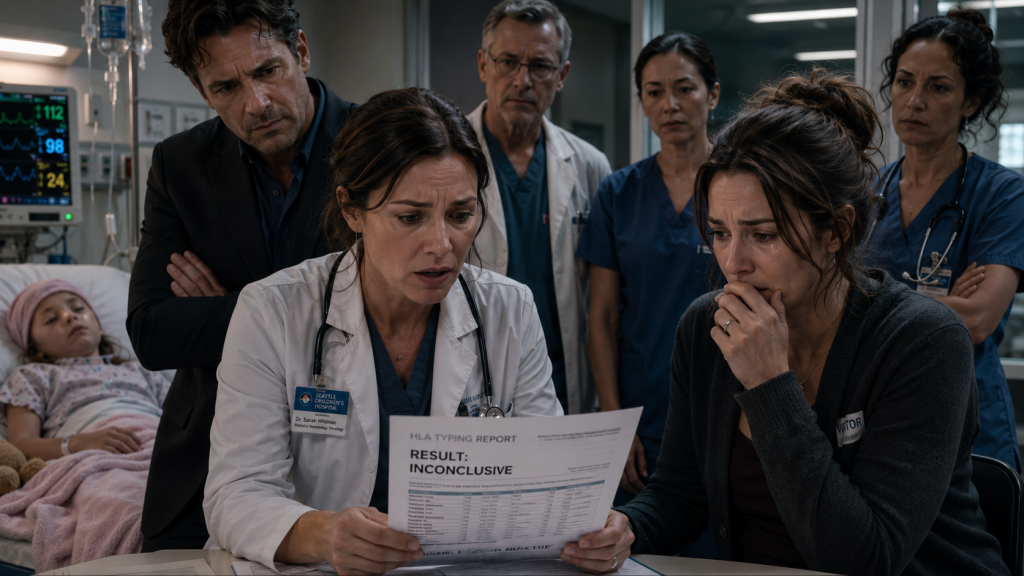
She hesitated.
“The medical history Mr. Carter provided contains inconsistencies. Some of Sophie’s inherited markers do not align with the information we were given about her biological father.”
I stared at her.
“I don’t understand.”
“These tests are not designed as paternity tests,” she explained. “They cannot establish paternity on their own. But the discrepancy is significant enough that we need accurate biological information before proceeding.”
Graham entered before she finished.
He was accompanied by a hospital administrator and a man who introduced himself as the transplant specialist.
“What is this about?” Graham demanded.
Dr. Whitman faced him.
“Mr. Carter, are you Sophie’s biological father?”
His face twitched.
“Of course I am.”
“Was assisted reproduction used?”
“No.”
“Was a sperm donor involved?”
Graham went pale.
I looked from him to the doctors.
“What is she talking about?”
“This is absurd,” Graham said. “That woman has been here for two hours and is already creating chaos.”
Dr. Whitman remained calm.
“We need the truth because Sophie’s life may depend on complete and accurate genetic information.”
“I gave you the truth.”
“Then we will request confirmatory genetic testing with your consent.”
Graham stepped backward.
“No.”
The room went silent.
“Why not?” I asked.
He did not answer.
“Graham, why not?”
His gaze moved toward the door.
I recognized that look.
It was the same one he had worn whenever I came too close to discovering where he had spent our money or why he returned home smelling like antiseptic.
“Because it’s unnecessary,” he said.
The transplant specialist folded his arms.
“It may be medically necessary.”
Graham’s control cracked.
“I said no.”
Dr. Whitman looked at the administrator.
“We also need to discuss Ruby.”
Graham’s eyes widened.
“What does Ruby have to do with this?”
“She is Sophie’s full sibling according to the family history you submitted. Siblings are often tested as potential donors. We need her brought to the hospital.”
“No.”
“Why are you refusing every test that might help our daughter?” I asked.
“She is not your daughter anymore.”
The words landed hard.
Dr. Whitman’s expression sharpened.
“Mr. Carter, legal custody does not alter biology. And it certainly does not excuse withholding medically important information.”
Graham’s composure vanished.
He pointed at me.
“She destroyed our family. She was unstable. She threatened the girls.”
“That is a lie.”
“The court agreed with me.”
“The court believed documents you paid someone to fabricate.”
For the first time, something like fear appeared in his eyes.
Dr. Whitman noticed it too.
“Fabricated documents?” she asked.
I opened my mouth, but Graham cut me off.
“This conversation is over.”
He turned toward the door.
The hospital administrator blocked his path.
“Not yet. Sophie is a patient in our care. If there is reason to believe her medical history has been falsified, we are required to address it.”
Graham laughed, but the sound was hollow.
“You think I would hurt my own child?”
No one answered.
That frightened him more than an accusation would have.
He left the room without signing the testing consent.
An hour later, Dr. Whitman told me the hospital’s legal team had contacted child protective services because Graham had refused to provide necessary medical information and would not bring Ruby in for testing.
I should have felt satisfaction.
Instead, I felt terrified.
“What if he takes Ruby and runs?”
“We have alerted the appropriate authorities.”
“You don’t know him.”
“No,” Dr. Whitman said gently. “But I am beginning to understand why you are afraid.”
That evening, a social worker named Elena Ruiz arrived.
She had kind brown eyes and the patient manner of someone accustomed to hearing stories that sounded impossible.
I told her everything.
I told her about Graham’s secret financial accounts.
I told her about Dr. Pike’s false evaluation.
I showed her copies of the airline records proving I had been in California during the alleged school abduction.
I showed her emails from my therapist stating that she had never diagnosed me with bipolar disorder or addiction.
I showed her photographs of unopened packages returned from Seattle.
Elena read quietly.
“Why wasn’t this enough to overturn the custody order?”
“Because Graham’s attorney argued that I had manufactured evidence during a manic episode. Dr. Pike supported him. Every time I defended myself, they called the defense another symptom.”
Elena’s face tightened.
“That is a very effective trap.”
“Yes.”
My phone rang.
It was Marcus.
I nearly ignored it, but then remembered the Morrison presentation.
“How did it go?” I asked.
“I told them the truth.”
My heart sank.
“Marcus—”
“They postponed the meeting.”
“They did?”
“The client’s chief executive has a daughter who survived leukemia. She said architecture could wait.”
I covered my mouth.
Marcus continued, “The contract is not gone, Isabelle. Forget about the firm for now.”
“I don’t know how to thank you.”
“Bring Sophie home. That will be enough.”
After the call, I returned to Sophie’s room.
She was awake, staring at the rain sliding down the window.
“Does your head hurt?” I asked.
“A little.”
“Do you want me to call the nurse?”
“No.”
I sat beside her.
For several minutes, neither of us spoke.
Then she asked, “Did Dad lie about you?”
I could have poured every bitter truth into that room.
I could have told her about forged documents, stolen years, and a father who had built his victory from cruelty.
But she was ten years old and fighting cancer.
“The adults made choices that hurt you,” I said. “None of it was your fault.”
“He told us you stopped calling.”
“I called every week.”
Her eyes filled with tears.
“He said your letters were dangerous.”
“They were mostly stories about Portland and pictures of the garden.”
“Ruby remembers you.”
My breath caught.
“She does?”
“She pretends she doesn’t because Dad gets angry. But sometimes she sleeps with the stuffed rabbit you gave her.”
“Basil?”
Sophie nodded.
“He has one eye now.”
“He always was brave.”
She smiled faintly.
Then her face became serious.
“Dad scares Ruby.”
My body went still.
“How?”
“He yells. He locks her in her room when she asks about you. Once she found a box in his office with your letters. He grabbed her arm really hard.”
“Did he hurt you?”
“Not like that.”
“Has he ever hit either of you?”
She looked away.
That was answer enough.
I pressed the call button.
Elena returned within minutes and spoke with Sophie privately.
Before leaving the room, Sophie looked at me.
“You’re staying, right?”
“I’m staying.”
Police found Ruby shortly before midnight.
Graham had not taken her to Mrs. Carver’s house.
He had left her alone in his Seattle condominium with instructions not to answer the door.
She was eight years old.
When Elena brought her into the family room, Ruby stopped in the doorway.
She had grown taller, and her curly brown hair hung to her shoulders.
Basil, the one-eyed rabbit, was clutched beneath her arm.
She looked at me without moving.
“Hi, Ruby,” I whispered.
Her face crumpled.
She ran across the room and threw herself into my arms.
The force nearly knocked me from the chair.
“You came back,” she sobbed.
I held her so tightly that Elena had to remind me to let her breathe.
“I never left you in my heart.”
“Dad said you hated us.”
“No. Never.”
“Are you taking us home?”
“I’m going to do everything I can.”
Ruby was placed in emergency protective care at the hospital while authorities investigated.
Graham was furious.
He arrived the following morning with two attorneys and demanded Ruby’s immediate release.
Then the hospital produced Sophie’s statement, the evidence that Ruby had been left alone, and the records showing he had withheld medical information.
His attorneys stopped speaking.
By noon, a judge issued a temporary order preventing Graham from removing either child from the hospital.
For the first time in 732 days, both my daughters were under the same roof as me.
But Sophie was getting weaker.
Her treatment began that afternoon.
The chemotherapy made her nauseated and exhausted.
Her hair started coming out in clumps eleven days later.
She stared at the strands on her pillow and cried.
“I don’t want Ruby to see me ugly.”
“You could never be ugly.”
“That’s something moms have to say.”
“No,” I told her. “Moms have to tell the truth when the world is cruel enough to lie.”
I brought clippers from the nurses’ station.
“Would you like me to shave it?”
She looked afraid.
Then Ruby climbed onto the chair beside us.
“Do mine first.”
“No,” Sophie said quickly.
“Not all of it. Just one side.”
Despite everything, Sophie laughed.
We compromised by cutting Ruby’s hair into a short bob.
Then I shaved Sophie’s head while Ruby told jokes so terrible that even the nurse groaned.
When the last dark lock fell, Sophie touched her bare scalp.
I wrapped a blue scarf around her head.
She examined herself in the mirror.
“I look like a pirate.”
“A dangerous one,” Ruby said.
That night, both girls fell asleep holding my hands.
I sat between their beds and understood that no court could ever measure motherhood correctly.
It was not paperwork.
It was not a surname.
It was staying awake when every part of you was breaking.
The genetic mystery unraveled slowly.
After the court authorized testing, the doctors confirmed that Graham was not Sophie’s biological father.
He was not Ruby’s biological father either.
I demanded an explanation.
Graham refused to speak to me, but police executed a search warrant at his condominium after investigators discovered evidence that the custody case might involve fraud.
Inside a locked cabinet, they found financial records from a fertility clinic in Vancouver.
They also found my missing medical files.
Eleven years earlier, while Graham and I were trying to have children, he had told me that my tests were normal and his were inconclusive.
He said we only needed “a little assistance.”
I remembered the clinic visits.
The injections.
The forms Graham always took from my hands, claiming he had already reviewed them.
I believed we were using his sperm through standard fertility treatment.
We were not.
Graham had learned that he was infertile.
Terrified that I would leave him, he secretly authorized donor sperm.
He forged my signature on multiple consent forms.
The clinic had since closed after its director was convicted of fraud.
But that was not the worst discovery.
Among Graham’s records was a series of payments to Dr. Edwin Pike.
The first payment occurred three months before the custody evaluation.
The next came immediately after Pike testified against me.
There were also drafts of the psychiatric report on Graham’s computer, written before Dr. Pike had interviewed me.
Graham had not simply exaggerated my condition.
He had helped write the report that destroyed my life.
When Elena showed me the evidence, I could not speak.
For two years, I had wondered whether I had failed my daughters.
I had replayed every anxious moment and every tearful argument, asking whether I had somehow given the court a reason to believe him.
Now I held proof that the decision had been purchased.
“Dr. Pike has been arrested,” Elena said. “Graham is being investigated for fraud, perjury, child endangerment, and obstruction of medical care.”
“What happens to the original custody order?”
“The state is moving to vacate it.”
I looked through the glass at Sophie sleeping.
“I don’t care what happens to him right now. Will any of this help her?”
“The donor clinic records might.”
The clinic had preserved partial information about the anonymous donor.
With a court order, investigators located him.
His name was Daniel Mercer.
He was forty-three, a high school science teacher living outside Vancouver with a wife and two teenage sons.
When authorities contacted him, he could have refused involvement beyond the legally required questions.
Instead, he drove to Seattle the next morning to be tested.
I met him in a hospital conference room.
He was tall, nervous, and gentle-eyed.
“I didn’t know there were children,” he said. “The clinic told donors the process was anonymous.”
“I didn’t know either.”
He looked at the floor.
“I’m sorry.”
“You didn’t do this.”
“Is Sophie—”
“She’s very sick.”
“I’ll be tested. My sons too, if it is safe and they agree.”
His kindness was almost unbearable.
Daniel was not a close enough match.
Neither of his sons was eligible to donate.
Ruby was tested next.
We waited two days for her results.
Dr. Whitman entered Sophie’s room holding the report against her chest.
Her eyes were shining.
“Ruby is a full match.”
I covered my face and began to cry.
Ruby looked alarmed.
“Is that bad?”
“No,” Dr. Whitman said, kneeling in front of her. “It means your cells may be able to help Sophie get better.”
Ruby looked at her sister.
“Will it hurt?”
“There will be medicine so you are asleep during the collection. You may feel sore afterward. But you do not have to do it unless you understand and agree.”
Ruby did not hesitate.
“Sophie gave me her last cookie when Dad forgot my birthday. She can have my cells.”
Sophie burst into tears.
“You’re so annoying,” she said.
“I know.”
They hugged carefully around the tubes and wires.
Before the transplant could happen, Sophie needed additional chemotherapy.
The weeks that followed became the longest of my life.
Some days she talked about returning to school.
Other days she could barely lift her head.
She developed a fever that sent a team rushing into her room.
I stood in the corner as nurses worked, feeling useless and terrified.
At three in the morning, Dr. Whitman found me crying in the stairwell.
“What if I came back too late?” I asked.
“You came when she needed you.”
“I should have fought harder.”
“You fought a system that had been manipulated against you.”
“I’m her mother.”
“Yes,” she said. “And you are here.”
The morning of the transplant, Ruby wore bright yellow pajamas beneath her hospital gown.
Sophie wore the blue pirate scarf.
“I’m scared,” Ruby admitted.
“So am I,” Sophie said.
I held both their hands.
“Courage does not mean you aren’t scared. It means you love someone more than you fear the next step.”
Ruby’s collection went smoothly.
Later that day, her donated stem cells traveled through a clear tube into Sophie’s body.
There was no dramatic flash of light.
No instant transformation.
Just a small bag of cells and a family holding its breath.
Dr. Whitman called it Sophie’s new beginning.
Recovery was not immediate.
Her body had to accept the transplant.
Every fever frightened us.
Every blood test became a verdict.
Days passed.
Then weeks.
Slowly, Sophie’s counts began to rise.
One morning, Dr. Whitman entered with a smile she did not try to hide.
“The early results are very encouraging.”
“Does that mean it worked?” Sophie asked.
“It means Ruby’s cells are beginning to build a new immune system inside you.”
Ruby lifted both arms in victory.
“I’m building Sophie!”
Sophie rolled her eyes.
“You’re going to brag forever, aren’t you?”
“Absolutely.”
While Sophie recovered, the legal case moved rapidly.
The original custody order was vacated.
I was granted temporary full custody of both girls.
Graham was prohibited from contacting them without court approval.
He was later charged with multiple crimes connected to the falsified psychiatric evaluation, forged fertility documents, perjury, and child neglect.
Dr. Pike lost his medical license and faced criminal charges of his own.
Graham sent me one letter from jail.
He wrote that everything he had done was because he loved the girls and feared losing them.
I read the letter once.
Then I gave it to my attorney.
Love did not isolate children from their mother.
Love did not purchase lies.
Love did not leave an eight-year-old alone to protect a secret.
Six months after the transplant, Sophie walked out of the hospital wearing a red coat and carrying the purple blanket over one arm.
The nurses lined the hallway and applauded.
Ruby walked beside her, announcing to anyone who would listen that part of her now lived inside her sister.
Outside, Seattle sunlight broke through the clouds.
Sophie stopped on the sidewalk.
“Are we going to Portland?”
“Yes.”
“All three of us?”
“All three of us.”
She looked uncertain.
“What if the judge changes his mind again?”
I knelt in front of her.
“The evidence has been corrected. The order is final. You are coming home with me.”
Ruby hugged my neck.
Sophie joined her.
For a moment, we became one tangled, crying shape on the hospital sidewalk.
Marcus had kept the architecture firm alive.
The Morrison clients waited.
When I finally returned to the office, I found the tower plans exactly where I had left them.
A note rested on top.
Some structures can wait. Families cannot.
The company awarded us the contract.
I redesigned one floor of the tower to include a family support center for parents of seriously ill children.
The client approved it without changing a single line.
Sophie returned to school the following year.
Her hair grew back softer and slightly lighter than before.
Ruby refused to let anyone forget she was the donor.
Daniel Mercer remained in our lives, but carefully.
The girls called him Daniel, not Dad.
He never asked for a title.
He simply came to birthdays, science fairs, and medical checkups when invited.
His wife sent Sophie books during recovery, and his sons taught Ruby how to build a homemade telescope.
We became something without a simple name.
Not the family Graham had pretended to protect.
Something more honest.
On the second anniversary of Sophie’s transplant, we returned to Seattle Children’s Hospital with flowers and a box of terrible homemade cookies.
Dr. Whitman met us in the hallway.
Sophie ran to hug her.
“You’ve grown,” Dr. Whitman said.
“My cells did that,” Ruby announced.
Sophie sighed.
“She still says that every day.”
Dr. Whitman laughed.
Then she turned to me.
“How are you doing?”
For years, that question had terrified me.
People had used my grief as evidence and my fear as a diagnosis.
But now I looked at my daughters standing together beneath the bright hospital lights.
“I’m healing,” I said.
That evening, we drove south toward Portland.
Rain tapped gently against the windshield.
Sophie sat in the passenger seat choosing music while Ruby slept in the back with Basil tucked beneath her chin.
For a moment, I remembered the drive I had made two years earlier—the gray highway, my shaking hands, the certainty that I might arrive too late.
Then Sophie reached over and rested her hand on mine.
“Mom?”
“Yes?”
“Thank you for answering the phone.”
I looked at her.
There were so many things she could have thanked me for.
The hospital nights.
The donor search.
The legal fight.
The life we had rebuilt piece by piece.
But everything had begun with one ringing phone and one choice not to let fear silence it.
“Thank you for waiting for me,” I said.
She smiled and turned back toward the road.
Ahead of us, the clouds began to open.
The evening sun poured across the highway, warm and golden, touching the wet pavement until it seemed we were driving over light.
For 732 days, Graham had tried to erase me from my daughters’ lives.
He had taken my name from their home.
He had hidden my letters.
He had convinced a court that my love was dangerous.
But he had never managed to remove me from their hearts.
And in the end, the truth did not return like thunder.
It returned through a doctor’s phone call.
Through a little girl’s hidden blanket.
Through one sister’s donated cells.
Through records locked inside a cabinet.
Through two children brave enough to remember the mother they had been ordered to forget.
I had once believed losing custody meant I had lost everything.
I was wrong.
A mother’s love could be delayed.
It could be slandered, buried, and forced behind locked doors.
But it did not disappear.
It waited.
It survived.
And when the door finally opened, it came home.
Leave a Reply