The clock on my nightstand glowed 5:02 AM.
Thanksgiving morning.
I had been awake for nearly an hour. The pies were cooling. Coffee sat beside the sink. Ice tapped against the kitchen windows.
Then Marcus called.
He did not say hello.
“Come pick up your garbage.”
For one second, I thought I had misheard him.
“Marcus. Where is Chloe?”
“Downtown bus terminal. She had another hysterical episode. I’m hosting my CEO today, Eleanor. I don’t have time for this.”
Behind him, I heard Sylvia laugh.
“Tell her to take that pathetic girl home,” she called. “And she owes me five thousand dollars for my Persian rug.”
I held the counter.
Chloe was twenty-eight. She was an engineer. She made lists before vacations and kept spare batteries in labeled drawers. She could become upset like anyone else, but the phrase hysterical episode did not fit the daughter I knew.
“What happened?”
Marcus sighed.
“Ask her. Just don’t bring her back here.”
He hung up.
I had spent most of my career listening carefully when someone wanted me to react quickly.
Anger makes people careless.
Facts do not.
I put on my coat.
Before leaving, I opened the hall closet and took down the lockbox I had not touched in years.
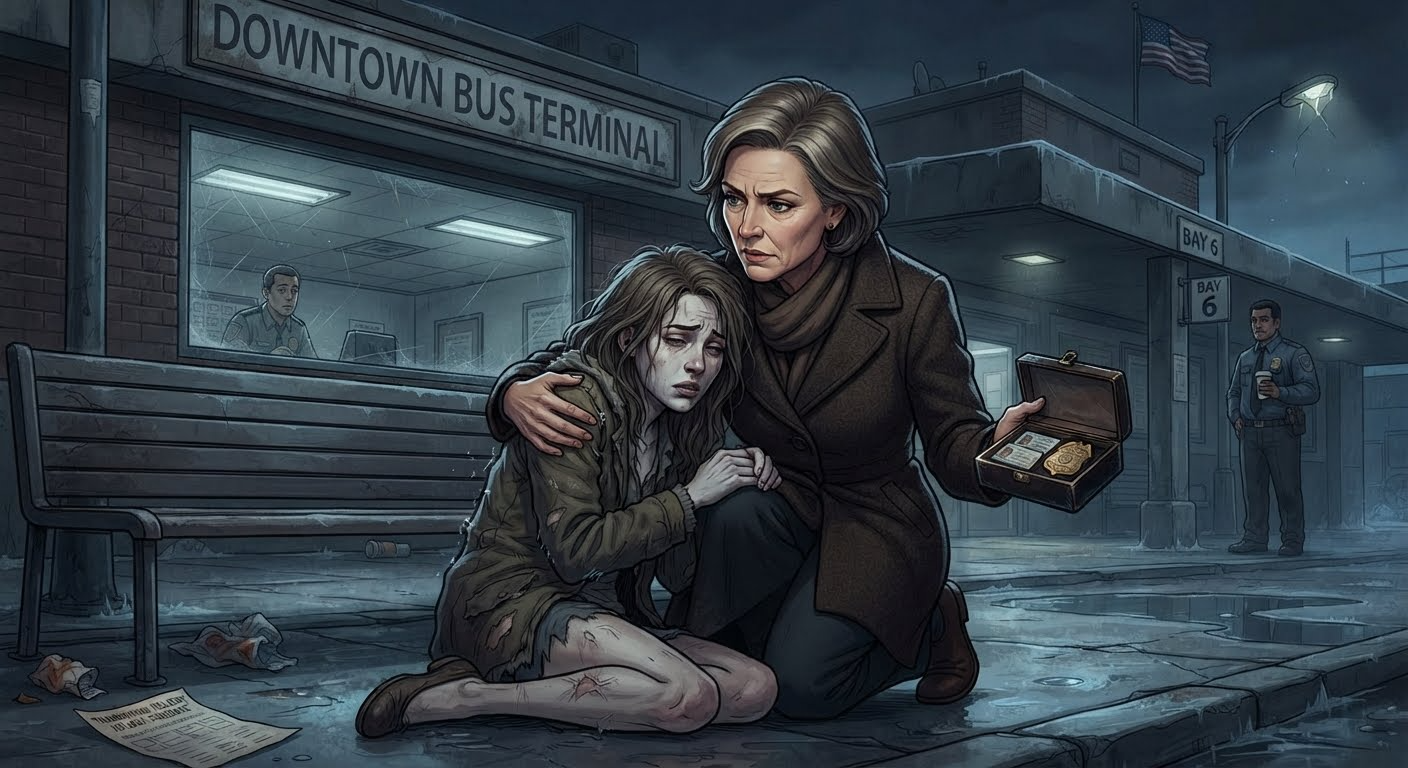
Inside were old credentials, a few photographs, and the federal badge Marcus had never known existed.
I did not carry it because I intended to wave it around.
I carried it because I suddenly had the terrible feeling that whatever I found at the bus station would need to be documented correctly from the first minute.
I reached the terminal at 5:43.
The building looked half asleep.
A security guard sat behind scratched glass. A driver stood near a vending machine with coffee in one hand. The automatic doors opened and shut, releasing weak bursts of warm air into the freezing morning.
I found Chloe outside Bay 6.
She was curled on a metal bench.
No coat.
One shoe missing.
Her fingers were blue.
There were injuries I will not describe in detail because they belonged to my daughter before they ever belonged to a police report.
I dropped beside her.
“Baby. Look at me.”
Her eyelids lifted.
“Mom.”
“I’m here.”
She gripped my sleeve.
“They hurt me.”
“Who?”
“Marcus. Sylvia.”
I kept my voice even.
“Tell me only what you can.”
“He has someone else.”
She swallowed.
“Sylvia said she was coming for dinner. Said I had to get out so she could take my place.”
I felt something cold settle behind my ribs.
“Who brought you here?”
“Marcus.”
“Did anyone else see you arrive?”
“I don’t know.”
Her eyes closed.
“Chloe?”
No answer.
I called 911 at 5:47.
I gave the dispatcher the location, Chloe’s condition, the cold exposure, and the fact that I believed she had been assaulted.
Then I asked for police.
The dispatcher wanted my name.
“Eleanor Grace Whitmore.”
I looked at the lockbox beside me.
“I’m a retired federal prosecutor. I am not acting in any official capacity. I’m telling you because I know the importance of preserving evidence, and I need officers to treat the terminal and my daughter’s clothing accordingly.”
That distinction mattered.
Retirement had not turned me into a police officer.
My old title did not allow me to order anyone arrested.
But it did mean I knew how quickly evidence could disappear when frightened people changed clothes, showered, cleaned rooms, deleted messages, or tried to be helpful.
The security guard stepped outside.
“I saw her come in,” he said.
“Do not tell me the whole story yet.”
He blinked.
“Why?”
“Because the responding officer needs your statement in your own words. Can you preserve your cameras?”
“Yes.”
“Please do.”
The ambulance arrived first.
Paramedics covered Chloe with warmed blankets. They cut away nothing they did not need to. One asked whether she had allergies.
I answered until Chloe woke enough to answer herself.
A police cruiser arrived less than two minutes later.
The first officer was a woman named Patel.
I showed her the badge only long enough to identify my background.
Then I put it away.
“My daughter is the victim,” I said. “I’m her mother. I don’t want my former job contaminating how this is handled.”
Officer Patel nodded.
“That helps.”
She took the security guard’s name.
The guard pointed toward the ceiling.
“Camera covers the entrance and Bay 6.”
Officer Patel asked him not to overwrite anything and called for a supervisor.
I rode with Chloe.
At the emergency department, nurses took over.
They placed her in a private room. A physician evaluated her for hypothermia, dehydration, and other injuries. A forensic nurse was contacted.
I sat outside while Chloe decided what examinations she would consent to.
That part was hers.
Not mine.
When she finally asked me to come back in, her hair had been brushed away from her face and she wore a hospital gown.
She looked smaller.
“Mom.”
I took her hand.
“I’m here.”
“I should’ve told you.”
“Told me what?”
“About him.”
She stared at the blanket.
“Things have been bad for months.”
I wanted to ask why she had stayed.
I did not.
That question could wait until it sounded like concern instead of accusation.
“Tell the nurse everything you remember.”
Chloe nodded.
Her phone had been missing when I found her.
That mattered.
Marcus had access to their shared home, several devices, and at least one joint account.
I asked Officer Patel whether someone could help Chloe secure her online accounts once she was stable.
She said yes.
“Also,” I added, “Marcus called me at 5:02.”
“Do you still have the call log?”
“Yes.”
“Save it. Screenshot it. Don’t edit anything.”
I almost smiled despite myself.
It had been years since someone had given me evidence-preservation instructions.
Now I was grateful for them.
By seven, Chloe had told enough of the story to make the outline clear.
Marcus had brought Celeste to the house the evening before.
Yes.
Celeste.
The same woman he had been telling Chloe was “just a colleague.”
Sylvia had arrived early to help prepare Thanksgiving dinner.
Chloe confronted Marcus privately.
He denied the affair.
Then Celeste came downstairs wearing one of Chloe’s robes.
That ended the denial.
Chloe told Celeste to leave.
Sylvia told Chloe she was ruining Thanksgiving.
The argument became physical.
Marcus took Chloe’s phone.
Sylvia tried to pull a bracelet from Chloe’s wrist because she claimed it had been purchased with Marcus’s money.
Chloe pushed her hand away.
A glass fell.
Red wine spilled across Sylvia’s Persian rug.
That was the five-thousand-dollar damage Sylvia had shouted about.
Not deliberate destruction.
A glass knocked over during an argument.
Chloe said Marcus and Sylvia forced her out through the garage sometime after midnight.
She did not remember every minute after that.
She remembered being in Marcus’s SUV.
She remembered him stopping at the terminal.
She remembered Sylvia saying, “Your mother can deal with you now.”
Then cold.
A lot of cold.
The hospital physician entered while she was talking.
“We’re admitting you for observation.”
Chloe looked frightened.
“For how long?”
“At least today. We need to monitor you.”
That ended the interview for the moment.
Officer Patel closed her notebook.
“I’m going to take this to the domestic violence unit.”
I followed her into the hallway.
“Officer.”
She turned.
“I know what I used to do,” I said. “I also know this case cannot become mine.”
“It won’t.”
“If someone remembers me from the U.S. Attorney’s Office, I want it documented that I asked for ordinary procedure.”
Patel studied me for a second.
“That may be the most prosecutor thing anyone has ever said to me.”
I let out a breath that almost became a laugh.
Then my phone rang.
Marcus.
I stared at his name.
Officer Patel looked at the screen.
“You don’t have to answer.”
“I know.”
I declined the call.
A text arrived immediately.
Where is Chloe?
Then another.
Tell her she needs to come back and apologize before my boss arrives.
I showed Patel.
She photographed the screen.
At 7:26, another message came.
And tell her I expect that rug paid for.
I sat beside Chloe’s hospital bed and read it twice.
Marcus still thought this was about dinner.
About embarrassment.
About a carpet.
He had no idea that the terminal footage was already being preserved, that Chloe’s injuries were being documented, or that his own call to me had fixed a timeline he could no longer casually rewrite.
I did not feel triumphant.
I felt sick.
Because underneath every professional instinct was one much simpler fact.
My daughter had been left in freezing weather without a coat.
And the man who had promised to love her was worried about Thanksgiving seating.
PART 2 – Hospital Records, Missing Phones, and the Thanksgiving Table Marcus Still Intended to Host
By eight o’clock, the hospital smelled like coffee, disinfectant, and reheated breakfast.
Chloe slept.
I sat in the chair beside her with my coat folded across my lap.
Every few minutes, I looked at the monitor even though I did not understand half the numbers.
The nurse did.
That was enough.
My phone buzzed again.
Marcus.
Then Sylvia.
Then a number I did not recognize.
I silenced all three.
A social worker named Renée came in shortly after eight-thirty.
She did not begin with police.
She began with Chloe.
“Do you feel safe returning home?”
Chloe’s face changed.
“No.”
“Do you want him to know where you go after discharge?”
“No.”
“Are there children in the home?”
“No.”
“Any pets you are worried about?”
Chloe closed her eyes.
“Our dog. Penny.”
That was the first detail that made her cry.
Not the house.
Not the marriage.
Penny.
A seven-year-old beagle who slept on Chloe’s feet whenever she worked from home.
Renée wrote it down.
“We can discuss safe options for retrieving her.”
Chloe wiped her face.
“Marcus will use her to make me come back.”
I believed that.
So did Renée.
We spent the next hour on practical things.
Who could enter Chloe’s medical information.
Who should be removed from emergency contacts.
Whether Marcus knew her passcodes.
Which credit cards were joint.
Whether she had access to cash.
Whether she had a safe place to stay.
“My mother,” Chloe said.
I squeezed her hand.
That answer hurt in a different way.
Not because she chose me.
Because she had apparently spent months believing she could not.
At nine-fifteen, Detective Jordan Hale arrived.
He was in his forties, wearing a plain suit and carrying a paper cup he never drank from.
He introduced himself to Chloe first.
Then me.
“I know your name,” he said quietly.
“That was a long time ago.”
“I was a rookie when your office handled the Weller procurement case.”
“I remember the case.”
He waited.
I understood the question he was not asking.
“I am her mother today,” I said.
He nodded.
“Good.”
He asked if Chloe wanted me present.
She said yes.
The interview lasted almost ninety minutes.
Hale slowed her down whenever she tried to skip ahead.
He asked where everyone stood.
Which door was open.
What time Celeste arrived.
Whether Chloe had consumed alcohol.
Whether she remembered being struck.
Whether she had struck anyone.
Whether she had lost consciousness.
Chloe answered when she knew.
“I don’t remember” when she did not.
I was proud of that.
People think credibility means certainty.
Often it means refusing to invent certainty you do not have.
When Hale asked about the phone, Chloe said Marcus had taken it from the kitchen island.
“Could he unlock it?”
“He knew the old code. I changed it last month.”
“Biometric?”
“Face ID.”
“Did he hold it up to your face?”
Chloe stared at the blanket.
“Yes.”
I kept my hands still.
Hale’s expression did not change.
“What did he access?”
“I don’t know.”
That widened the case.
Not because every bad act automatically became a federal crime.
It did not.
But because unauthorized access to devices, financial accounts, and communications could create separate evidence.
Hale explained that specialists would examine what was appropriate after warrants or consent were obtained.
No shortcuts.
No badge magic.
At ten, a second detective called from the house.
Marcus had opened the door.
So had Sylvia.
Celeste was there.
The CEO had not yet arrived.
Neither had most guests.
The detective had not arrested anyone at the scene.
That surprised Chloe.
“He’s still there?”
“For now,” Hale said. “An investigation isn’t a television episode.”
I almost thanked him.
Chloe looked at me.
“So he gets to have Thanksgiving?”
I chose my words carefully.
“What he gets today is not the point.”
“It feels like the point.”
“I know.”
Hale leaned forward.
“We’re collecting evidence. The terminal video matters. Your medical records matter. Your statement matters. The condition of the house matters. If officers rush and do something they can’t support, that helps nobody.”
Chloe looked away.
She understood.
Understanding did not make it easier.
At ten-thirty, I received a call from someone named Rebecca Lin.
She introduced herself as counsel for Marcus’s employer.
That got my attention.
“Why are you calling me?”
“Mr. Hale gave my number to Detective Soto because we are trying to locate company devices assigned to Mr. Bell.”
Marcus Bell.
Hearing his full name in that context felt strangely formal.
“What devices?”
“A laptop and phone. We received an internal report this morning.”
“From whom?”
“I can’t discuss personnel details with you.”
“Then don’t.”
There was a pause.
“I understand you were a prosecutor.”
“Retired.”
“Then you know why I’m being careful.”
“I do.”
She asked whether Chloe had possession of any company equipment.
“No.”
That was all I could honestly give her.
After the call, Hale explained that Marcus’s CEO had apparently received a message from an employee overnight about inappropriate conduct involving Marcus and Celeste.
Not the assault.
The affair.
More specifically, allegations that Marcus had used company travel and expense accounts in connection with it.
That was separate.
Potentially important.
But separate.
I refused to let the stories blend simply because they involved the same man.
At eleven, Chloe’s phone was located.
Not through some miraculous tracking trick.
A patrol officer found it inside Marcus’s SUV after Marcus consented to a limited search for Chloe’s missing property.
The screen was cracked.
The device was bagged because Hale wanted to document its condition before returning it.
Penny was still inside the house.
Renée arranged for an animal-control officer and a neutral police standby later that afternoon if Chloe wanted someone to retrieve the dog.
“I want Mom to go.”
“No,” I said.
Chloe blinked.
“Why?”
“Because I am too angry.”
Renée gave me a surprised look.
I continued.
“I want Penny safe. I do not want my presence creating a confrontation in your driveway. We’ll send someone neutral.”
Chloe stared at me for a moment.
Then nodded.
At noon, Marcus finally left a voicemail instead of another text.
“Eleanor, this has gone too far. Chloe is making accusations that could ruin my career. You know how emotional she gets. Call me before she makes a mistake she can’t take back.”
I saved it.
Then I gave it to Hale.
He listened once.
No expression.
“Do not respond,” he said.
“I wasn’t planning to.”
At one-thirty, Marcus’s Thanksgiving guests started arriving.
I knew because Sylvia texted me a photograph.
A long table.
Crystal glasses.
White plates.
A turkey waiting beneath foil.
The message beneath it read:
This is the family Chloe chose to humiliate.
I stared at the picture.
Then I noticed Celeste.
She was seated two places from Marcus.
Not hiding.
Not ashamed.
At the head of the table sat a silver-haired man I recognized from business pages.
Marcus’s CEO.
That did not make sense.
If his employer was investigating him, why was the CEO at his home?
I showed the photograph to Hale.
He frowned.
“Can you send me that?”
“Yes.”
At two-ten, the answer arrived.
The CEO had gone to the house deliberately.
Not for dinner.
His company’s counsel had advised him not to confront Marcus privately, but he had already been en route when he learned there was a police investigation.
So he did something awkward but lawful.
He arrived with his wife, sat down, waited until witnesses were present, and then told Marcus he was being placed on administrative leave pending review of expense reports and company communications.
It did not bring the dining room to a halt because I made a magical phone call.
It stopped because Marcus’s separate choices had begun colliding at the same table.
Minutes later, detectives returned with authorization to collect specified electronic evidence.
Hale did not tell me the details until afterward.
He did tell me there had been shouting.
Mostly Sylvia.
Apparently she accused the police of ruining Thanksgiving.
Celeste left through the front door carrying her purse and coat.
Marcus’s CEO left through the same door five minutes later.
No turkey had been carved.
When I told Chloe, she did not smile.
She said, “Good.”
Then she cried.
That evening, Penny arrived at the hospital entrance with a volunteer from a local domestic violence organization.
The hospital could not allow the dog into Chloe’s room.
So I went downstairs.
Penny nearly pulled free of the leash when she saw me.
I sat on a bench and let her climb halfway into my lap.
For the first time all day, I cried hard enough that I could not hide it.
Not because Marcus’s dinner had fallen apart.
Not because his boss had learned what he was doing.
Because Penny smelled like Chloe’s house.
The house where my daughter had tried for three years to build a marriage.
I pressed my face into the dog’s neck.
Then I whispered the only promise I was willing to make.
“We are not sending her back there.”
Leave a Reply