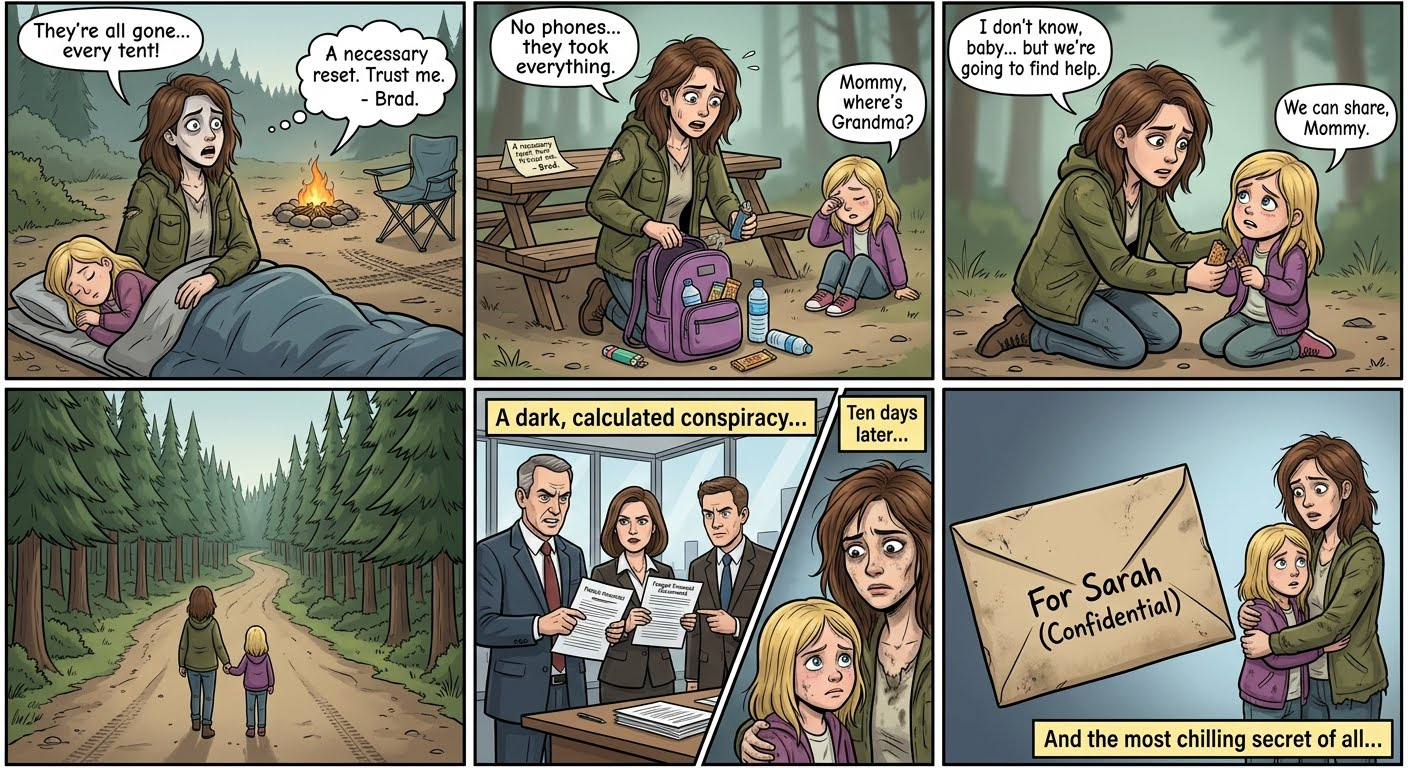
I opened my eyes in the heart of the Olympic Mountains, my ten-year-old daughter, Lily, resting quietly against my chest.
Immediately, something felt wrong.
The campfire had completely extinguished, leaving only gray, cold ash. A biting autumn frost blanketed the ground, and the ancient forest was eerily, unnaturally silent.
I sat up and glanced around.
Every single tent was gone. Both family SUVs had vanished without a trace. So had the coolers, camping gear, blankets, food supplies, and all of our mobile phones. My parents, my brother Nolan, his wife Brooke, and their son Mason had all slipped away during the night.
On the wooden picnic table rested a single handwritten note:
“THIS IS A NECESSARY RESET. TRUST US.”
I recognized Nolan’s jagged handwriting instantly.
Right beside my chair, someone had left Lily’s purple backpack. Inside were two bottles of cold water, three granola bars, a cheap plastic lighter, a rain poncho, and her favorite stuffed rabbit, Mr. Buttons.
Nothing more.
“Mom?” Lily murmured, her eyes fluttering open. “Where is everyone?”
I looked down the empty, winding forest road. “I don’t know, sweetheart.”
I kept my voice steady, hiding the icy panic gripping my chest. Ten days later—after carrying my gravely ill daughter toward an abandoned fire tower—I would learn that my family had already held a formal memorial service for us, telling everyone we were gone forever, while my mother concealed a letter written by my late husband that exposed a secret Nolan would kill to keep hidden.
My name is Claire Mercer. Eight weeks before that terrifying morning, my husband, Ethan, had succumbed to cancer at the age of forty-one.
We had built a life together from nothing. In 2013, Ethan and I launched Cedar & Steam Coffee using our meager savings and a battered secondhand espresso machine. Our first winter was brutal; we sometimes slept on the shop floor because we couldn’t afford heat or an apartment. But we persevered. By the time Ethan passed away, Cedar & Steam had expanded to twenty-six successful locations across Washington, Oregon, and Idaho, supporting hundreds of employees.
Nine days after his funeral, I forced myself back to work. I wasn’t emotionally ready, but the business required my presence. My family, however, met my return with fierce disapproval.
Mom claimed I was simply avoiding my grief. Dad insisted I needed a man to take over corporate responsibilities. And my older brother, Nolan, claimed he only wanted to help.
Three days after the funeral, I walked into company headquarters and found Nolan sitting behind Ethan’s desk, already boxing up my late husband’s personal belongings.
“What are you doing?” I demanded.
“Taking care of things,” Nolan replied smoothly. “You’re exhausted, Claire. Let me manage the business.”
Reluctantly, I granted him temporary access for two weeks. But our operations director soon discovered Nolan had quietly raised his corporate spending limit from $5,000 to $25,000. I immediately revoked his authority.
When Nolan complained to our parents, they closed ranks. At the next family dinner, they insisted I had approved the change.
“You’ve been under immense stress,” Mom said gently. “Grief can cloud your memory.”
“I remember precisely what I agreed to,” I countered.
That evening, uneasy and suspicious, I bought a small digital voice recorder. My father had invested $40,000 in the business years ago; after Ethan died, he demanded a board seat and wanted Nolan appointed chief operating officer. When I refused, they accused me of being unreasonable.
Days later, a child-protection investigator arrived at my home, following an anonymous tip claiming I was too unstable to care for Lily. The case was closed immediately, but the damage was done.
Worse still, when Nolan later dropped by under the guise of concern, I caught a glimpse of a text message on his phone from Brooke: “Did she believe us?”
For most of my life, I had excused Nolan’s behavior. When I was eleven, he had abandoned me on a family hike by telling different relatives I was riding home with someone else; a ranger eventually found me, and the family later laughed it off as a harmless Christmas joke. I had also loaned him thousands, paid his mortgage, and financially supported his family, always forgiving him because Mom insisted family came first.
Now, I wondered if their sudden concern for my mental state was just a smoke screen to seize control of my company.
The camping trip was Mom’s idea. She claimed we needed a weekend away from corporate stress, and Nolan knew a secluded spot in the Olympic Mountains. I initially declined, but Lily begged to go, reminding me that Ethan had promised to take her somewhere she could see the Milky Way.
“Please, Mom,” Lily pleaded. “Dad really wanted us to go.”
Nolan smiled warmly. “Do it for Lily.”
That broke my resolve. I left my Subaru at home because Nolan insisted we travel together. We drove far into the wilderness, reaching a locked forest gate that Nolan unlocked with a key.
The campsite was stunning, surrounded by towering evergreens. For one evening, I let myself believe my family genuinely cared about our healing.
After dinner, Brooke pulled out a black container. “Phones go in here,” she announced brightly. “Proper digital detox.”
I hesitated, but Nolan laughed. “You can survive one weekend without checking emails.”
I handed over my phone. Later, Brooke brought herbal tea around the campfire. Mine tasted oddly sweet, and within twenty minutes, bone-deep exhaustion dragged me down. Lily climbed onto my lap, whispering, “Wake me when the stars come out.”
Mom tucked a blanket around us, leaning close to whisper, “I’s sorry, sweetheart.”
Then everything went black.
Part 2: The Wilderness
When I woke up, the campsite was empty.
I searched frantically. The tents, the food, the vehicles, and our phones were all gone. Only Lily’s purple backpack remained.
“Maybe they went to get breakfast,” Lily suggested bravely.
I forced a smile, but my instincts screamed that we were in mortal danger. We began walking along the gravel road, eventually crossing a mountain creek. Remembering survival lessons from my grandmother June—who had taken me camping after Nolan abandoned me decades ago—I decided to follow the creek toward lower ground.
By the third day, hunger was a constant ache. We shared a single granola bar, rationing every bite. The rain arrived on the fourth day, soaking our clothes. That evening, Lily began coughing. By the fifth morning, she spiked a fever.
We sheltered in an abandoned logging shed. I built a small fire, boiled creek water in an old tin, and cooled it for her to drink.
“Mom, I’m cold,” she whispered.
“I know, sweetheart.”
“Can we call someone?”
“Not yet.”
“Okay.”
That blind trust nearly broke my heart. By the sixth day, her breathing quickened, and she slept for long stretches, occasionally murmuring Ethan’s name—or asking for Uncle Nolan. That stung. She remembered the kind uncle who took her to baseball games, unable to fathom why he would leave her behind to die.
“Do you think Dad knows where we are?” she asked softly.
“If there’s any way he can, I believe he does.”
“Tell him I’m mad. Tell him he should’ve stayed.”
That was when my control finally shattered. I wept openly, confessing my own anger—not just at Ethan for getting sick, but at the cruel reality we were trapped in.
Miraculously, after resting through a severe mountain storm, Lily’s fever broke on the eighth day. On the tenth afternoon, exhausted and weak, we reached the base of an old fire lookout tower rising above the tree line.
“Climb onto my back,” I told her.
“Mom, you’re exhausted.”
“Do you trust me?”
She wrapped her arms around my neck. “Always.”
I carried her up the weathered stairs to the summit. Down below, I gathered branches and built a smoky signal fire. Twenty minutes later, the rhythmic chop of rotor blades cut through the mountain air. An orange-and-white rescue helicopter crested the valley.
I waved my jacket. Lily hoisted her purple backpack.
The aircraft circled back, a crew member pointing directly at us. I fell to my knees in the dirt, weeping in sheer relief.
Part 3: The Truth Unfolds
At a hospital in Port Angeles, doctors treated Lily for severe pneumonia and exhaustion. Soon after, Special Agent Victor Hale of the state police entered our room. He showed me a photograph of the note left at the campsite: THIS IS A NECESSARY RESET. TRUST US.
“Did you write this?” Hale asked.
“No. Nolan did.”
Hale scrutinized me. “Your brother claims you wrote it.”
My blood ran cold. Nolan had reported us missing two days after we vanished, claiming I had suffered a psychological break after Ethan’s death and intentionally led my daughter into the wilderness. Worse, he had intentionally directed search teams toward the wrong coordinates.
And that wasn’t all. My family had already filed paperwork to seize control of my finances, backed by a $1.5 million life insurance policy Dad held on my life, alongside forged will documents transferring my business interests to them if we died.
To top it all off, they had already held a formal memorial service for us, mourning us with flowers and photographs while we were still fighting for our lives in the mountains.
“The evidence suggests your family may not have anticipated your return,” Agent Hale noted grimly.
With the help of a sharp Seattle attorney named Martin Shaw, we began unravelling their conspiracy. Investigators located a notary who admitted Nolan had pressured him to certify fraudulent paperwork using signatures I had scrawled on visitor authorizations in the hospice hallway while my husband was dying.
Furthermore, forensic audits revealed Nolan owed private lenders over $600,000 and had previously embezzled $400,000 from Cedar & Steam. Ethan had discovered the theft just before his death, forcing Nolan to resign—a secret my parents had helped cover up.
Yet Ethan had protected us. Before he grew too weak, he had quietly transferred his company shares into an irrevocable trust for Lily, naming me and our operations director, Julian, as co-trustees. Nolan’s forged documents were legally powerless against it.
Three weeks after our rescue, investigators arranged a secret confrontation in a courthouse conference room. My family sat unaware until I walked through the door wearing the gray suit I had worn to Ethan’s funeral.
Nolan’s face drained of color. Mom dropped her purse.
“Hello, Nolan,” I said smoothly. “Sorry I missed the memorial.”
For a few minutes, they tried to maintain their lie, but as Martin laid out the notary’s confession, bank records, and digital evidence, their defense collapsed. Dad claimed they were just trying to protect the business; Brooke sobbed, admitting she helped collect the phones; and Nolan lashed out in bitter resentment over his own financial failures.
Then, trembling, my mother reached into her purse and pulled out a folded envelope.
“I need Claire to read this,” she whispered.
It was addressed in Ethan’s handwriting. Mom explained that Ethan had handed it to her after Nolan brought those hospice papers to me, instructing her to give it to me only if Nolan crossed the line.
I opened it. Ethan’s words washed over me:
“Claire, if your family ever asks you to choose between keeping the peace and telling the truth, choose the truth. You’ve spent too many years forgiving people who mistake your kindness for weakness… Please take Lily somewhere she can see the stars. I left a map in my blue notebook. All my love, Ethan.”
I looked up at my mother. “You knew about Nolan’s theft. You knew Dad helped him. You knew they were lying about my mental state. And you still helped them abandon a child in the wilderness.”
Mom wept uncontrollably. “I thought I could keep the family together.”
“No,” I said quietly. “You just wanted to protect Nolan from accountability.”
Part 4: The Stars
Legal proceedings moved swiftly. Brooke cooperated and received a reduced sentence. Dad and Nolan were arrested, and Nolan ultimately pleaded guilty to multiple felony charges, including attempted murder and fraud, receiving a lengthy prison sentence. Mom pleaded guilty to lesser charges and faced strict court-ordered restrictions preventing her from contacting Lily.
Months later, a reformed ordinary life slowly returned. Cedar & Steam weathered the scandal, and Julian and I established an employee hardship fund to ensure the business stood for something meaningful. Lily slowly healed from her trauma, returning to school and keeping her stuffed rabbit close.
One year after our rescue, while sorting through Ethan’s belongings, I found his old blue notebook. Tucked inside was a hand-drawn map of the Olympic Peninsula featuring a crooked star and the words: For Lily — so she can see what Tacoma is hiding.
That August, I packed my Subaru with more survival gear than two people could ever need. This time, we drove to a fully developed, safe campground with a ranger station and marked sites.
After sunset, we carried our sleeping bags out to a quiet meadow and unfolded Ethan’s map.
Lily traced the little star with her finger. “Dad planned this before he died?”
“Yes.”
For a long time, we sat in companionable silence. Then Lily looked up at me. “Mom, do you forgive Grandma?”
I thought carefully before answering. “I don’t think forgiveness is the most important thing.”
“What is?”
“Understanding what happened. Keeping ourselves safe. And not becoming cruel just because someone else was cruel to us.”
She considered that thoughtfully. “So you don’t hate Grandma?”
“No.”
“But you don’t want to see her?”
“That’s right.”
The sky above us gradually darkened until the first brilliant stars emerged. Soon, thousands of glittering points of light—including the magnificent ribbon of the Milky Way—stretched across the velvet night.
Lily stared upward, breathless. “Dad was right. The sky really does look different up here.”
“He was right about many things,” I whispered, pulling her close against my shoulder.
All around us in the campground, families laughed softly around their fires, safe and warm. One year earlier, I had walked through a freezing nightmare, terrified we wouldn’t survive the night.
Now, we were whole. We had uncovered the truth, survived the wilderness, and built a peaceful life where our happiness no longer depended on people who had betrayed us.
Love cannot erase someone’s cruel choices, and sharing blood doesn’t mean sacrificing your child to protect the guilty.
Lily eventually drifted off to sleep against my chest. I stayed awake a little longer, watching the stars Ethan had wanted her to see—not out of fear, but because I simply wasn’t ready for that beautiful moment to end.
For the first time in our lives, nobody had left us behind.
We had simply chosen to go somewhere without them.
Leave a Reply