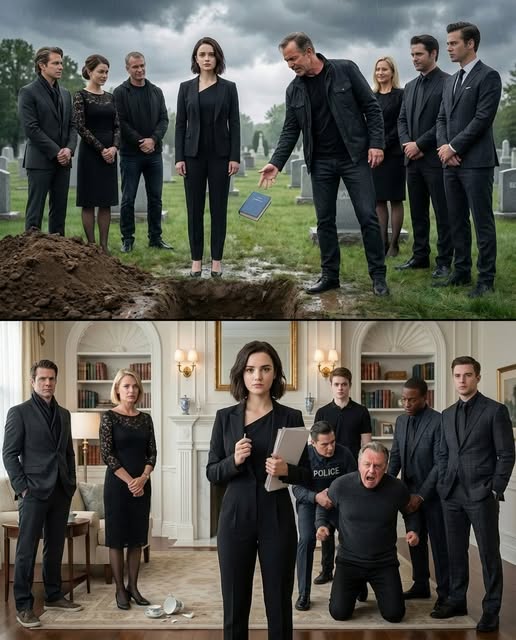

The bank was unusually quiet when I stepped inside, the kind of silence that made even the smallest sound feel amplified. Outside, the rain had not eased. It clung to my clothes and dripped steadily from the hem of my coat, leaving a faint trail of water across the polished marble floor beneath my feet.
A young clerk in a neatly pressed navy suit noticed me almost immediately. He straightened slightly behind the counter, offering a polite and professional smile that suggested routine and predictability.
“Good morning,” he said. “How may I assist you today?”
I didn’t respond right away. Instead, I carefully reached into my bag and placed a small, worn savings book onto the counter. The edges were soft from age and use, the cover slightly faded, as though it had survived decades of handling.
Inside, printed in elegant but aging ink, was my grandmother’s name: Margaret Rose Hale.
Beneath it were decades of financial history. Stamps, signatures, and deposit records stretched back nearly forty years—evidence of a life of careful saving, discipline, and quiet planning. The book represented more than money. It represented a lifetime of trust.
The clerk’s expression remained friendly at first. He took the book gently and began typing the account number into his system.
At first, nothing seemed unusual.
Then his fingers paused.
He looked at the screen again.
And then once more.
The smile that had been on his face moments earlier disappeared completely. It was as if someone had wiped it away without warning. His posture stiffened, and a flicker of confusion crossed his features, quickly replaced by something closer to alarm.
He leaned forward slightly, squinting at the monitor, then pulled back as though the information had physically startled him.
“Miss Hale…” he said quietly, his voice suddenly tense. “Please… don’t leave just yet.”
A strange unease settled in my chest.
“Why?” I asked, my voice lower than I expected.
Instead of answering, he reached for the telephone beside him. His hand was trembling slightly as he lifted the receiver.
“We need assistance immediately,” he said urgently. “Security, legal department… and police if possible.”
Those words shifted the entire atmosphere in the room.
From somewhere behind me, I heard movement. Two security guards, previously stationed near the entrance, were now walking toward us with measured steps, their attention focused entirely on the counter.
My eyes dropped back to the savings book resting between us.
“What exactly is going on?” I asked, struggling to keep my voice steady.
The clerk swallowed hard before speaking.
“This account,” he said carefully, “was officially recorded as closed seventeen years ago.”
He paused again, as if choosing his next words with extreme caution.
“But it was never actually closed. It was hidden.”
My heart gave a sharp jolt.
“And,” he continued, “someone attempted to access it earlier today.”
My breath caught.
“This morning?” I repeated.
He nodded slowly, eyes still fixed on the screen as though he didn’t entirely believe what he was reading.
“Yes,” he confirmed. “Under the name Victor Hale.”
The name struck me like a physical impact.
My father.
Before I could fully process what I had just heard, the bank manager arrived.
She moved quickly, her heels clicking against the marble floor with purpose. She was an older woman with silver hair neatly tied back and sharp, analytical eyes that immediately assessed the situation.
“I’m Diana Cross,” she introduced herself firmly. “Let’s step somewhere private.”
Without waiting for a response, she guided me toward a secured office at the side of the banking hall. The room had glass walls, allowing partial visibility into the main area. From where I sat, I could already see a subtle increase in activity—uniformed police officers had begun entering the bank.
Diana closed the door behind us and placed a tablet on the table between us.
“I need you to understand what we’re dealing with,” she said calmly, though her expression suggested urgency.
She tapped the screen and turned it toward me.
“Your grandmother held a protected deposit account,” she began. “Alongside multiple certificates and a trust-linked savings portfolio.”
She paused briefly.
“The current estimated value is approximately two point eight million dollars.”
For a moment, I couldn’t process the number. It felt detached from reality, as if it belonged to someone else’s life entirely.
“That’s not possible,” I said quietly.
Diana didn’t react emotionally. She simply continued.
“It becomes more complicated,” she said. “Seventeen years ago, there was an attempt to transfer control of this account. Documents were submitted claiming your grandmother was mentally unfit and that legal authority should be transferred to her son.”
My stomach tightened.
“But the transfer failed,” she added, “because your grandmother had placed a fraud protection lock on the account.”
I stared at her, stunned.
“She knew?” I whispered.
Diana nodded once.
“She anticipated the risk.”
The room felt colder somehow.
“Since then,” she continued, “there have been multiple attempts to override that protection. The most recent was submitted today.”
My throat tightened. “Today?”
“Yes,” she confirmed. “It included a death certificate and a power of attorney document.”
I felt the world tilt slightly.
“My grandmother died three days ago,” I said slowly, still trying to accept the reality.
“I understand,” Diana replied gently. “But the power of attorney document is dated yesterday.”
Silence filled the room.
It became painfully clear what that meant.
My father had not only moved quickly—he had prepared forged documentation before my grandmother was even laid to rest.
Something inside me hardened at that realization. The grief I had been carrying began to transform into something colder, sharper, and far more focused.
It no longer felt like sorrow.
It felt like clarity.
Outside the office, the investigation continued. Officers moved through the bank, speaking quietly with staff. Phones rang intermittently. Papers were being reviewed.
Eventually, I was asked to provide statements. I answered every question with surprising calmness, as though a part of me had detached just enough to function.
After some time, I stepped away and made a single phone call.
Within half an hour, Mr. Bell arrived.
He was slightly out of breath, his presence calm but deliberate. Rainwater glistened on his head and shoulders as he entered, carrying a sealed envelope.
“Elise,” he said gently, recognizing me immediately. “Your grandmother left something with me. She instructed that it be given to you only after you came to the bank.”
My hands shook slightly as I accepted it.
Inside was a letter written in my grandmother’s familiar handwriting—slanted, uneven, but unmistakably hers.
My darling girl,
If Victor ever tries to erase what I built, don’t let him succeed. He has always feared what he could not control. That is why he destroys it instead.
The account is real. So are the documents stored in the safe deposit box.
Do not show your tears to those who would use them against you. Let the law speak where I no longer can.
My vision blurred briefly, but I kept reading.
Diana later accompanied me, along with two officers, to open the safe deposit box.
Inside, everything my grandmother had preserved came into view.
There were property deeds carefully stacked and labeled. Old letters tied with faded ribbon. Photographs capturing moments I had never fully understood at the time. Audio recordings stored on a flash drive. And a thick handwritten ledger filled with records of financial abuse, forged documents, and threats.
Each page told a story I had never been fully allowed to see.
Every stolen payment.
Every manipulated signature.
Every attempt my father had made to force her out of her own financial life.
At the very bottom of the box lay a final envelope.
The handwriting on it was different—slower, more deliberate.
“For Elise,” it read, “when she is ready to stop being afraid.”
Something shifted inside me as I held it.
A strange calm replaced everything else.
I finally allowed myself a small smile.
Not because the situation was simple.
But because it was no longer uncertain.
My father had assumed that wealth hidden away in legal shadows would remain untouchable, buried forever under his control and intimidation. He had believed I would be too passive, too uncertain, too broken by grief to challenge anything he had set in motion.
He had been wrong.
He had placed his confidence in fear.
And he had misjudged the one person who had inherited neither his greed nor his weakness.
I was no longer afraid to pick up what he had tried to bury.
And this time, I would not be putting it down again.
Leave a Reply