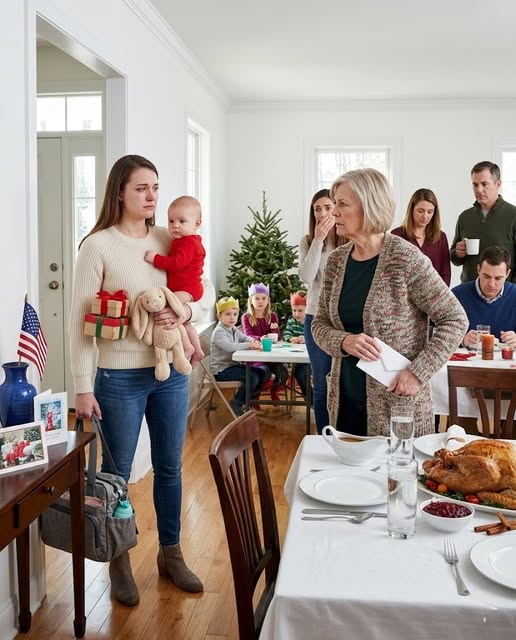
My daughter’s presents were the smallest pile under my mother’s Christmas tree.
They sat tucked so low beneath the lower branches that the pine needles almost swallowed the ribbon.
A soft book from my sister.
A little bunny from my aunt.
Two uneven boxes I had wrapped myself after midnight in my apartment, when my eight-month-old finally fell asleep and the dryer down the hall kept thumping through the wall like somebody knocking who had given up being let in.
I had used last year’s wrapping paper.
There was a strip down the side of one box where the pattern did not quite match.
I remember feeling embarrassed about that in the car.
That is what still makes me ache.
I had been worried about crooked wrapping paper.
I had not been worried enough about the room I was carrying my baby into.
Her name was Lily.
She was eight months old on Christmas Day, with soft brown wisps of hair, cheeks that flushed pink when she was warm, and a habit of curling her fist into my sweater whenever a room got too loud.
She had slept through most of the drive to my mother’s house.
When we turned onto the familiar street, she woke up and blinked at the Christmas lights in the windows like the world had decided to sparkle for her personally.
For one minute, I let myself believe the day might be gentle.
I had packed extra formula.
Two clean onesies.
A pacifier clip.
A little jar of sweet potatoes she liked.
I had even packed the tiny red bow my mother had bought and then complained I never used because, according to her, “little girls should look like little girls.”
I put it in Lily’s hair in the parking lot.
Not because I wanted to.
Because I was tired.
Divorce makes you tired in obvious ways.
Bills.
Lawyers.
Shared calendars.
An apartment too small for all the things you lost and all the things you had to start again with.
But family tired is different.
It is the exhaustion of predicting every comment before it lands and still pretending not to brace for impact.
My mother’s house was bright from the outside.
Warm windows.
Wreath on the door.
A little American flag in a blue ceramic vase on the hallway table, the same one she put out for every holiday no matter what the holiday was.
Her mailbox had a red bow on it.
My stepfather’s old pickup was parked crooked near the curb, one tire pressing into the brown winter grass.
Inside, I could already hear voices.
My cousin laughing.
The kids at the folding table arguing over paper crowns.
My mother’s party voice rising above everyone else, polished and loud and full of cheer she could turn off like a faucet.
I sat in the driveway for one extra breath.
Lily looked up at me from her car seat.
Her bow had already slid sideways.
“You and me,” I whispered.
She kicked once.
I carried her inside wanting only one quiet holiday.
That was the whole wish.
Not an apology.
Not understanding.
Not some movie-scene moment where my mother finally saw me clearly.
Just turkey, presents, a few photos, and home before Lily got overtired.
The dining room looked exactly the way my mother wanted it to look.
Polished glasses.
Turkey steam lifting into the chandelier light.
Cranberry sauce in the good bowl.
Cinnamon candles burning too sweetly on the sideboard, trying too hard to make the room feel warm.
The tablecloth had been ironed.
The napkins were folded into little shapes.
My mother believed appearance was a form of morality.
If the table looked right, the family must be right.
If the photo looked happy, the day must have been happy.
If someone cried, they were ruining the evidence.
My sister Rachel met me first.
She kissed Lily’s forehead and took the diaper bag from my shoulder before I could ask.
“You made it,” she said softly.
There was relief in her voice.
Not joy.
Relief.
Rachel knew.
She had grown up in the same house I did.
She had learned to survive it differently.
She smoothed things over.
I absorbed them.
Neither of us had called that damage for years.
My aunt Linda waved from the dining room.
My uncle kept carving turkey like the knife required all his attention.
My cousin stopped in the doorway, made the expected baby face, then returned to her plate.
And my mother came out of the kitchen wearing a red sweater, pearl earrings, and the expression she saved for hosting.
“There’s my granddaughter,” she sang.
She reached for Lily.
Lily tucked her face into my neck.
My mother’s smile tightened.
“She’s shy today.”
“She just woke up,” I said.
My mother looked at the bow.
“At least she looks festive.”
It was not the worst thing she would say that day.
It was just the first small cut.
Dinner began with too much noise.
The children at the folding table ripped open paper crowns from Christmas crackers.
My uncle asked about traffic.
Rachel’s husband folded his napkin into a square and then unfolded it, the way he always did when he could sense tension and wanted no part of it.
My mother fussed over the gravy.
She asked if my apartment had enough heat.
Not kindly.
Like she was proving a point.
She asked whether Lily was sleeping through the night yet.
When I said not always, she made a sympathetic sound that somehow blamed me.
“You hold her too much,” she said.
Rachel gave me a quick look.
I let it pass.
I had let a thousand things pass.
That was the problem.
For years, I had let my mother talk to me that way.
My clothes were wrong.
My job was disappointing.
My apartment after the divorce was too small.
My ex had left because I was “hard to reassure.”
My way of feeding Lily was too soft, too nervous, too modern, too much.
She called it advice.
I called it peace because I was tired.
But peace should not cost a child her dignity.
At 3:18 p.m., I had signed my name in the visitor notebook by the front door.
My mother had started keeping one that year, supposedly because she wanted to remember “who came by during the holidays.”
It sat beside the Christmas card basket and the little flag in the vase.
I thought it was strange, but not strange enough to fight over.
At 3:41, she corrected how I buckled Lily into the high chair.
At 4:07, she asked whether the pediatrician had “said anything yet,” then pretended she meant teething.
At 4:22, she asked if I was still “watching her eyes.”
I said, “What does that mean?”
She waved one hand.
“Nothing. Mothers notice things.”
That sentence sat in my stomach like a stone.
I had documented nothing because I thought Christmas would be different.
That was my mistake.
Lily was healthy.
Small, yes.
Late on a few milestones, maybe.
The pediatrician had told me not to panic.
Babies developed at different speeds.
We had a follow-up appointment scheduled after New Year’s, mostly because I wanted reassurance and because divorce had made every small uncertainty feel enormous.
My mother knew just enough about that appointment to weaponize it.
She did not know enough to be useful.
Halfway through dinner, Lily began blinking at the chandelier.
She was sitting against my chest in her red Christmas onesie, one hand on my sweater, fascinated by the lights above the table.
She made a small happy sound.
Rachel smiled.
“That’s cute.”
My mother set down her fork.
The sound was not loud.
But it had intention in it.
“She looks… off,” she said, loud enough for every plate to hear. “Are you sure that baby is even healthy?”
The silence came in pieces.
My cousin stopped chewing.
My aunt stared into her casserole.
Rachel’s husband folded his napkin once, then twice, like cloth could save him from choosing a side.
Even the children at the folding table quit rustling their paper crowns.
Lily did not understand the insult.
She only felt me go still.
I waited for my mother to laugh.
That fake little laugh she used whenever cruelty slipped out too cleanly.
She did not.
She lifted her wineglass instead.
“I’m just saying what everyone’s thinking. Some babies are not… normal.”
Rachel breathed, “Mom, stop.”
But my mother kept that careful, proud look, the one that said she believed concern made her innocent.
My hand moved to the back of Lily’s head.
I felt the soft warmth of her hair.
Her fist curled in my sweater.
Trusting me.
Completely.
It is a terrible thing to realize your child is watching you learn.
Not with words.
Not with memory she can name yet.
But with her nervous system.
With her body.
With the way she will someday decide what love is allowed to sound like.
I looked around the table.
My uncle would not meet my eyes.
My aunt pressed her lips together.
My cousin looked down.
Rachel looked furious and afraid.
My mother sat there waiting for me to shrink into the daughter she preferred.
For one ugly heartbeat, I pictured knocking every polished glass from that table.
I pictured cranberry sauce across the white tablecloth.
I pictured my mother’s perfect Christmas photo ruined by the truth of who she was.
Then Lily made a tiny questioning sound against my chest.
Rage was not the thing she needed from me.
Movement was.
So I stood up.
The chair legs scraped across the hardwood.
That sound did what my words had never done.
It made everyone look up.
I tucked Lily tighter against my side.
I grabbed the diaper bag beside the china cabinet.
Then I crossed to the Christmas tree while my mother watched me like I had missed my mark in a play she had written.
I bent down and picked up Lily’s gifts one by one.
The soft book.
The bunny.
The two crooked boxes.
“What are you doing?” my mother asked.
Her voice had changed just enough for me to hear the fear under it.
The gravy cooled.
A candle bent beside the cranberry sauce.
My uncle’s hand stayed locked around his coffee mug.
Nobody reached for me.
Nobody defended Lily either.
I put the gifts into the diaper bag.
The zipper caught once on the bunny’s ear.
I freed it carefully.
Then I zipped the bag.
That small sound felt like a door shutting.
“Don’t be dramatic,” my mother said, pushing back from the table. “I didn’t mean it like that.”
I turned with Lily on my hip and the presents under my arm.
“This is her last Christmas here.”
For the first time all day, my mother had nothing ready.
Her eyes jumped from face to face, searching for the person who would call me sensitive, emotional, difficult.
My aunt looked down.
My uncle looked away.
Rachel stared at our mother with one palm flat on the table, her wedding ring flashing in the candlelight.
No one rescued her.
I walked toward the hallway.
The Christmas cards sat in a basket beside the tiny American flag in the blue ceramic vase.
Lily pressed her warm cheek into my neck.
My hand shook on the doorknob.
I kept it there anyway.
Then Rachel whispered from behind me.
“Mom… you didn’t tell her about the letter, did you?”
The whole house seemed to hold its breath.
I turned slowly.
“What letter?”
My mother’s color drained so fast it scared even her.
Not guilty-in-front-of-family pale.
Caught pale.
Rachel covered her mouth like she had not meant to say it.
My mother’s hand slid toward the pocket of her cardigan.
That was when I understood this was not a Christmas insult that had gone too far.
It had been prepared.
My mother’s fingers closed around a folded envelope hidden there.
For the first time all night, nobody at that table looked away.
Lily lifted her head from my shoulder and looked straight at her grandmother.
Then she smiled.
Not because she understood.
Not because she forgave anything.
She smiled because she was eight months old, because the chandelier lights were soft, because she still believed every face looking at her might be safe.
That was the part that broke Rachel.
She pushed back from the table so hard her chair hit the wall.
“Give it to her, Mom.”
My mother pressed the envelope deeper against her cardigan pocket.
“This is not the time.”
“No,” Rachel said, voice shaking. “You made it the time when you called her baby abnormal in front of everyone.”
The room stayed frozen.
My uncle looked at his coffee mug.
My aunt’s lips trembled.
Rachel’s husband finally stopped folding that napkin and stood halfway, like his body had chosen a side before his mouth could.
I shifted Lily higher on my hip and held out one hand.
“Give me the letter.”
My mother looked at Lily, then at me.
“I was trying to protect you.”
That sentence is how controlling people dress up a locked door.
Rachel reached into her purse and pulled out her phone.
“I took a picture of it,” she whispered. “Last week. When Mom left it on the kitchen counter.”
My mother turned on her so fast the candlelight jumped across her face.
“You had no right.”
Rachel’s eyes filled.
“Neither did you.”
She unlocked the phone with shaking fingers.
She opened a photo.
Then she turned the screen toward me.
At the top of the page was Lily’s name.
Under it was a clinic letterhead, a date from two months earlier, and one sentence my mother had circled twice in blue ink.
Recommended follow-up evaluation.
That was all.
Not a diagnosis.
Not a tragedy.
Not proof that my baby was broken.
Just a recommendation for a follow-up, sent after a routine developmental screening that I had already scheduled.
My mother had circled it like evidence.
Like ammunition.
I looked at the date.
October 28.
She had known for almost two months.
My stomach dropped.
“How did you get this?”
My mother’s mouth tightened.
“I was helping.”
“How did you get it?”
Rachel answered before Mom could.
“She called the clinic pretending to be you.”
The room changed shape around me.
Not visibly.
The table was still there.
The candles still burned.
The turkey still sat carved and cooling.
But something old and rotten opened under the floorboards of that house.
My mother said, “That is not what happened.”
Rachel wiped her cheek.
“You used the old emergency contact information. You told them your number had changed. You had them mail a copy here.”
My hand tightened on the doorknob until my fingers hurt.
The envelope in my mother’s pocket was no longer just a letter.
It was a document she had taken.
A boundary she had crossed.
A plan she had carried into Christmas dinner and hidden beside her napkin.
My mother lifted her chin.
“You were overwhelmed. Someone had to pay attention.”
“I pay attention,” I said.
My voice sounded strange.
Too calm.
Too clear.
“I am her mother.”
My mother looked at Lily again.
“Then why didn’t you tell us?”
“Because there was nothing to tell.”
“She needs help.”
“She has a pediatrician.”
“She needs a family that sees the truth.”
“No,” I said. “She needs a family that does not turn a follow-up appointment into a Christmas performance.”
My aunt made a small sound.
My uncle set down his coffee mug.
Rachel’s husband finally spoke.
“Maybe we should all just take a breath.”
Rachel turned on him.
“No. We’ve been taking breaths for thirty years.”
That sentence landed almost as hard as the letter.
My mother’s eyes flashed.
“Rachel.”
“No,” my sister said. “You don’t get to do that voice right now.”
I had never heard Rachel speak to her that way.
Neither had anyone else.
The kids at the folding table were quiet, watching with wide eyes.
I hated that.
I hated that another generation was being taught the shape of silence.
I looked at my cousin.
“Can you take the kids to the living room?”
She blinked, then nodded quickly.
Chairs scraped.
Paper crowns rustled.
Small feet disappeared down the hall.
When the children were gone, I turned back to my mother.
“Give me the envelope.”
She hesitated.
Then, finally, she pulled it from her pocket.
She did not hand it to me.
She placed it on the hallway table beside the Christmas cards, like touching my hand would mean admitting I had the right to receive it.
I picked it up.
The envelope had been opened and resealed badly.
My name was not on it.
Lily’s was.
My mother had written notes on the outside in blue pen.
Call specialist?
Ask about delays.
Do not let her ignore this.
Underlined twice.
Do not let her.
That was the sentence that did it.
Not the insult.
Not even the stolen letter.
The ownership in that line.
Do not let her.
As if my daughter belonged to a committee.
As if I was an obstacle between my baby and my mother’s preferred story.
I folded the envelope once and put it in the diaper bag.
My mother watched me.
“What are you going to do with that?”
“Keep it.”
“For what?”
“Records.”
That word made her blink.
Records.
People like my mother prefer conversations that leave no paper trail.
They prefer kitchens.
Hallways.
Holiday tables.
Places where cruelty can be denied later as tone, worry, humor, misunderstanding.
But she had created a document.
She had circled it.
She had written on it.
She had carried it into dinner.
At 4:49 p.m. on Christmas Day, she had exposed herself more clearly than any argument could have.
I opened the front door.
Cold air moved into the hallway.
Lily tucked her face back into my neck.
My mother stepped forward.
“You are not leaving like this.”
I looked at her.
“Yes, I am.”
“She is my granddaughter.”
“She was your granddaughter when you called her abnormal.”
My mother flinched.
Good.
Some words should not be allowed to leave a room unchanged.
Rachel reached for my coat from the closet and draped it over my shoulders.
Her hands shook.
“I’m sorry,” she whispered.
I looked at her.
“For what?”
“For not saying more sooner.”
There was so much history inside that sentence that I could not answer it at the door.
So I nodded.
That was all I had.
I carried Lily out to the car.
The cold hit her cheeks pink.
The night smelled like chimney smoke and wet pavement.
Behind me, nobody followed except Rachel.
She stood on the porch in her Christmas sweater, crying silently.
“I’ll send you the photo,” she said.
“Send everything.”
She nodded.
“And Rach?”
She looked at me.
“Don’t let her make you think this is your fault.”
That made her cry harder.
I drove home with Lily asleep in the back seat, her crooked bow finally fallen into her lap.
At the first red light, I pulled over and cried so hard my chest hurt.
Not because I regretted leaving.
Because I had almost stayed.
Because some part of me had still walked into that house hoping my mother could be better if the day was pretty enough.
My apartment was dark when we got home.
The dryer in the hallway was still thumping.
I laid Lily in her crib.
I put the little bunny beside her.
Then I sat at the kitchen table and took the envelope out of the diaper bag.
I photographed everything.
The envelope.
The clinic letterhead.
The circled sentence.
My mother’s handwritten notes.
The date.
The resealed flap.
Rachel sent her photo at 7:36 p.m.
Then she sent three more.
One showed the letter on Mom’s kitchen counter beside a glass of wine.
One showed my mother’s notes.
One showed the visitor notebook by the front door with my name already written on a sticky note underneath, as if she had been waiting for me to arrive and perform my part.
I saved every image.
At 8:12 p.m., my mother texted.
You embarrassed me in front of everyone.
Not: I am sorry.
Not: I should not have said that.
Not: How is Lily?
You embarrassed me.
I took a screenshot.
At 8:17, she sent another.
You are too emotional to handle medical information rationally.
I took a screenshot of that too.
At 8:21, Rachel called.
She told me what she knew.
My mother had been talking about the letter for weeks.
Not openly at first.
Little comments.
Questions about whether I was “in denial.”
A suggestion that Lily might need “real help.”
Then, on Christmas Eve, Rachel had overheard Mom tell Aunt Linda, “If she won’t face it, I’ll make her face it.”
That was the part that turned my stomach.
Make her.
Not help me.
Not support Lily.
Make me.
Christmas had not triggered my mother’s cruelty.
Christmas had given her an audience.
The next morning, I called the clinic.
I asked to speak to the office manager.
My voice shook, but I stayed clear.
I explained that my child’s medical correspondence had been sent to someone who was not her parent or guardian.
I provided dates.
I provided screenshots.
I asked for a copy of all contact notes on Lily’s file.
The office manager went quiet in the way people do when they realize a small administrative mistake has entered the world of family damage.
By noon, she called back.
There had been a phone call in late October.
The caller had identified herself as me.
She knew my old address.
She knew Lily’s date of birth.
She knew the name of Lily’s pediatrician.
She changed the mailing address for one document.
One document.
That was all it took.
The clinic corrected the file.
They added a password.
They sent me a written statement confirming the change had been made improperly.
I printed it.
Clinic contact log.
Address correction statement.
Screenshots.
Envelope photos.
Christmas texts.
Rachel’s witness statement, written in an email at 11:03 p.m. because I asked her to put it in her own words before guilt softened the edges.
Records.
By December 27, my mother had called twelve times.
I did not answer.
She left voicemails.
The first was angry.
The second was wounded.
The third was soft.
Soft was always the most dangerous.
She said she had only been worried.
She said motherhood made people overreact.
She said I would understand someday when Lily grew up and shut me out.
She said family should not keep score.
I saved every voicemail.
Not because I wanted revenge.
Because memory is too easy for controlling people to edit.
Paper is harder.
Audio is harder still.
Rachel came over on New Year’s Eve.
She brought soup, diapers, and the soft book from under the tree because in all the chaos, I had packed the wrong little box and left that one behind.
She stood in my apartment doorway looking nervous.
“I can go if you’re not ready.”
I stepped aside.
She came in.
Lily was on the floor on a blanket, smacking a plastic ring against her knee and laughing at the noise.
Rachel watched her for a moment.
“She’s perfect,” she said.
I looked at my sister.
She meant it.
Not as denial.
Not as performance.
As correction.
I sat on the couch.
Rachel sat beside me.
For a long time, neither of us said anything.
The dryer thumped down the hall.
Lily babbled at the ceiling light.
Finally Rachel said, “I should have told you when I saw the letter.”
“Yes,” I said.
She nodded.
No defense.
No excuse.
“I was scared of her.”
“I know.”
“I’m still scared of her.”
“I know that too.”
She wiped her face.
“But I’m more scared of becoming her.”
That was the first honest thing either of us had said about our mother without dressing it up as concern, personality, or family tradition.
Rachel stayed for two hours.
She fed Lily sweet potatoes.
She got orange mush on her sleeve and laughed.
When she left, she hugged me carefully, like she knew trust was no longer something she could demand.
It was something she would have to earn.
My mother missed Lily’s first birthday.
Not because I forgot to invite her.
Because I chose not to.
She sent a card anyway.
Inside, she wrote, I hope you are done punishing everyone soon.
I put it in the folder.
By then the folder was thick.
The clinic had tightened Lily’s privacy settings.
My attorney had sent a letter making clear that my mother was not to access medical, daycare, or personal information about my child.
It was not dramatic.
It was not theatrical.
It was one page, dated, signed, and mailed certified.
My mother hated that most.
Boundaries spoken in kitchens can be mocked.
Boundaries written on legal letterhead have a different sound.
Lily’s follow-up evaluation came and went.
She needed some supportive therapy for mild delays.
Nothing catastrophic.
Nothing shameful.
Nothing my mother had any right to turn into a holiday indictment.
The specialist was kind.
She gave Lily blocks.
Lily tried to eat one.
We all laughed.
Normal did not mean what my mother thought it meant.
Normal was not a narrow hallway children had to walk through perfectly or be shamed for touching the walls.
Normal was appointments.
Questions.
Support.
Patience.
Growth.
Normal was loving the child in front of you instead of auditioning her for the family image.
Months later, Rachel asked if I would ever go back for Christmas.
I thought about the dining room.
The polished glasses.
The turkey steam.
The candle bending beside the cranberry sauce.
My daughter’s tiny hand curled in my sweater while my mother called her off.
I thought about my hand on the doorknob.
The envelope.
The letter.
The way Lily smiled at a grandmother who had come prepared to humiliate her.
“No,” I said.
Rachel nodded.
“I don’t blame you.”
That Christmas, Lily and I stayed home.
Rachel came in the morning with cinnamon rolls and coffee in paper cups.
Aunt Linda sent a gift but did not ask to visit.
My uncle sent nothing.
My mother sent a text at 6:02 a.m.
Merry Christmas. I hope you’re happy with what you’ve done.
I looked at Lily sitting under our small apartment tree, wearing pajamas with candy canes on them, tearing tissue paper with the delighted seriousness of a tiny scientist.
I was not happy with what had happened.
But I was at peace with what I had done.
There is a difference.
I put the phone face down.
Rachel handed Lily the soft bunny from the year before.
Lily grabbed it by one ear and squealed.
No one commented on her size.
No one watched her eyes like evidence.
No one used concern as a knife.
No one made my baby carry the weight of an adult’s need to be right.
The room was small.
The tree leaned slightly.
The cinnamon rolls were a little burned on the bottom.
The dryer down the hall thumped through the wall again.
And it was the warmest Christmas my daughter had ever had.
My mother once believed a perfect table could hide an ugly room.
She was wrong.
A polished glass does not make cruelty gentle.
A cinnamon candle does not make humiliation love.
And a holiday does not obligate a child to sit where her dignity is treated like dessert conversation.
That day at the door, when I said, “This is her last Christmas here,” I thought I was making a threat.
I was not.
I was making a promise.
And this time, I kept it.
Leave a Reply