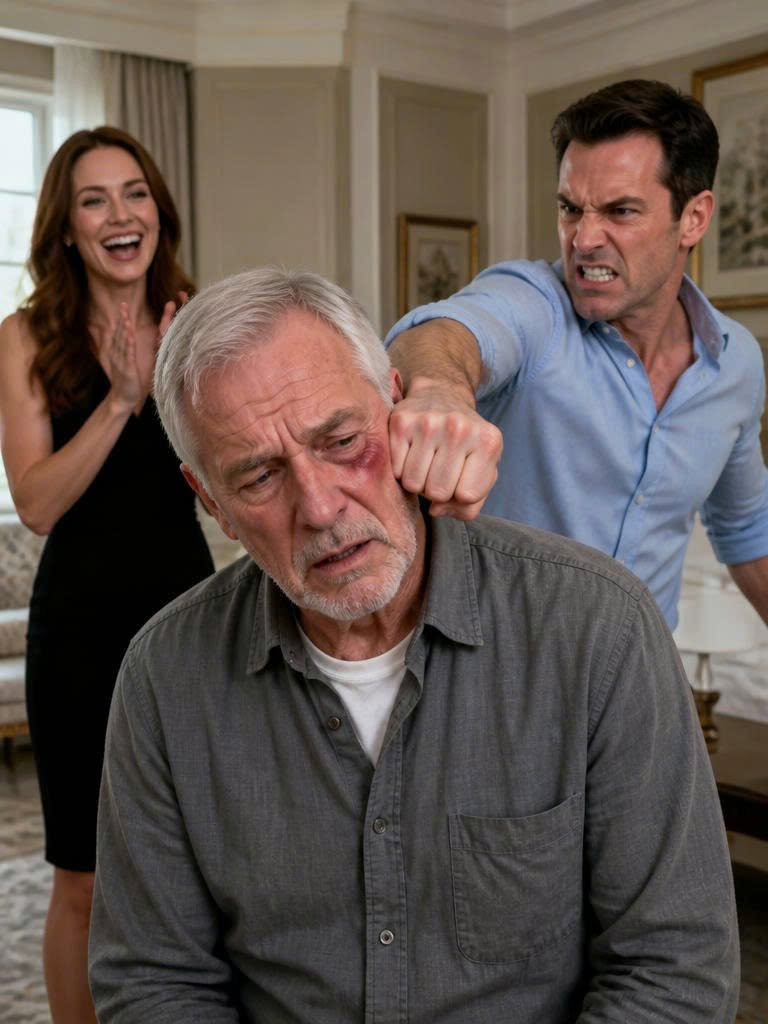
By the time my son’s hand hit my face for the thirtieth time, my lip was split, my mouth tasted like blood and metal, and whatever denial I had left as a father… was gone.
He thought he was teaching me a lesson.
His wife, Emily, sat on the couch watching, wearing that small, poisonous smile people have when they enjoy someone else being humiliated.
My son believed youth, anger, and a massive house in Beverly Hills made him powerful.
What he didn’t know?
While he was playing king…
I was already evicting him in my head.
My name is Arthur Hayes. I’m 68 years old.
I spent forty years building highways, office towers, and commercial projects across California. I’ve negotiated with unions, survived recessions, buried friends, and watched too many people mistake money for character.
This is the story of how I sold my son’s house… while he was still sitting at his desk thinking his life was untouchable.
It was a cold Tuesday in February when I drove to his birthday dinner.
I parked two blocks away. The driveway was already full of leased luxury cars—polished, perfect, and owned by people who loved the image of success more than the work behind it.
In my hands, I carried a small gift wrapped in brown paper.
It was my son Daniel’s 30th birthday.
From the outside, the house looked magnificent.
It should have.
I paid for it.
Five years earlier, after closing one of the biggest deals of my life, I bought that property in cash. I let Daniel and Emily move in and told them it was their home.
What I never told them?
The deed was never in their names.
The house belonged to an LLC.
And I was the sole owner.
To them, it was a gift.
To me, it was a test.
And they were failing it.
The signs had been there for years.
Daniel stopped calling me Dad.
Emily insisted I “call before visiting.”
They were embarrassed by my old car, my worn coat, my hands—hands that built everything they lived on.
At parties, they introduced me like I was some outdated relic.
“The guy who got lucky.”
That always made me smile.
Because I didn’t get lucky.
I built the world they were pretending to understand.
That night, everything fell apart over something small.
I gave Daniel a restored antique watch—something his grandfather had once dreamed of owning.
He barely looked at it.
Tossed it aside like it meant nothing.
Then, in front of everyone, he said he was tired of me showing up “expecting gratitude” in a house that had nothing to do with me anymore.
So I told him, calmly:
“Be careful not to forget who built the ground you’re standing on.”
That was enough.
He stood up.
Shoved me.
Then started hitting me.
And I counted.
Not because I was weak.
Because I was done.
Every strike stripped something away—love, hope, excuses.
By the time he stopped, he was breathing like he had won.
Emily still looked at me like I was the problem.
I wiped the blood from my mouth.
Looked at my son.
And understood something most parents learn too late:
Sometimes you don’t raise a grateful son.
Sometimes you just finance an ungrateful man.
I didn’t yell.
Didn’t threaten.
Didn’t call the police.
I picked up the gift box…
And walked out.
The next morning, at 8:06 a.m., I called my attorney.
At 8:23, I called my company.
At 9:10, the house was quietly listed for a private sale.
At 11:49…
While my son sat in his office thinking his life was secure—
I signed the papers.
Then my phone rang.
Daniel.
I already knew why.
Because someone had just knocked on the front door of that mansion.
And they weren’t there to visit.
I answered on the fourth ring.
“Who the hell is at my house?” he shouted.
I leaned back in my chair.
Those papers were still drying beside me.
“Those are the new owner’s representatives,” I said calmly.
“You shouldn’t keep them waiting.”
Silence.
Then panic.
“You can’t do this!” he said. “That’s my house!”
I almost smiled.
“My house,” I repeated. “Funny word.”
Then I told him the truth.
“I had every right to sell it. The same right I had when I paid for it. The same right I had yesterday… when you hit me thirty times in a house that was never yours.”
He went quiet.
“You wouldn’t,” he said.
“I already did.”
And I hung up.
By that afternoon, everything started collapsing.
The locks were being changed.
The staff was confused.
The illusion was gone.
But the house was only the beginning.
Because once the truth came out, so did everything else.
He had been using that house to impress investors… listing it as his asset… building a fake image of success on something he didn’t own.
And without it?
Everything started falling apart.
That night, he showed up at my apartment.
Angry. Desperate.
“What is wrong with you?” he demanded.
I looked at him calmly.
“You hit me thirty times,” I said.
“And you think I’m the problem?”
He tried to justify it.
Said I provoked him.
That’s when something inside me finally died for good.
“What do you want?” he asked.
I looked him straight in the eyes.
“I want you out by Friday. I want you to face everything you’ve done. And I want you to remember every number from one to thirty… before you ever raise your hand again.”
A week later, his life was in ruins.
His job suspended him.
His wife left.
The house was gone.
The image he built?
Gone with it.
Three weeks later… he came back.
Not as the man he thought he was.
Just a man with nothing left to hide behind.
“Help me,” he said.
Not “I’m sorry.”
Just “help me.”
So I gave him the only help that mattered.
“A job,” I said. “Construction site. 6 a.m. No titles. No shortcuts.”
He looked at me like I’d insulted him.
Maybe I had.
But it was the first honest offer I’d given him in years.
He walked away.
At first.
But one morning… he came back.
Hard hat in hand.
“Where do I start?” he asked.
And for the first time in his life…
He actually listened.
People think this story is about revenge.
It’s not.
It’s about weight.
Because a house can make you look important…
But only life can show you what you’re really made of.
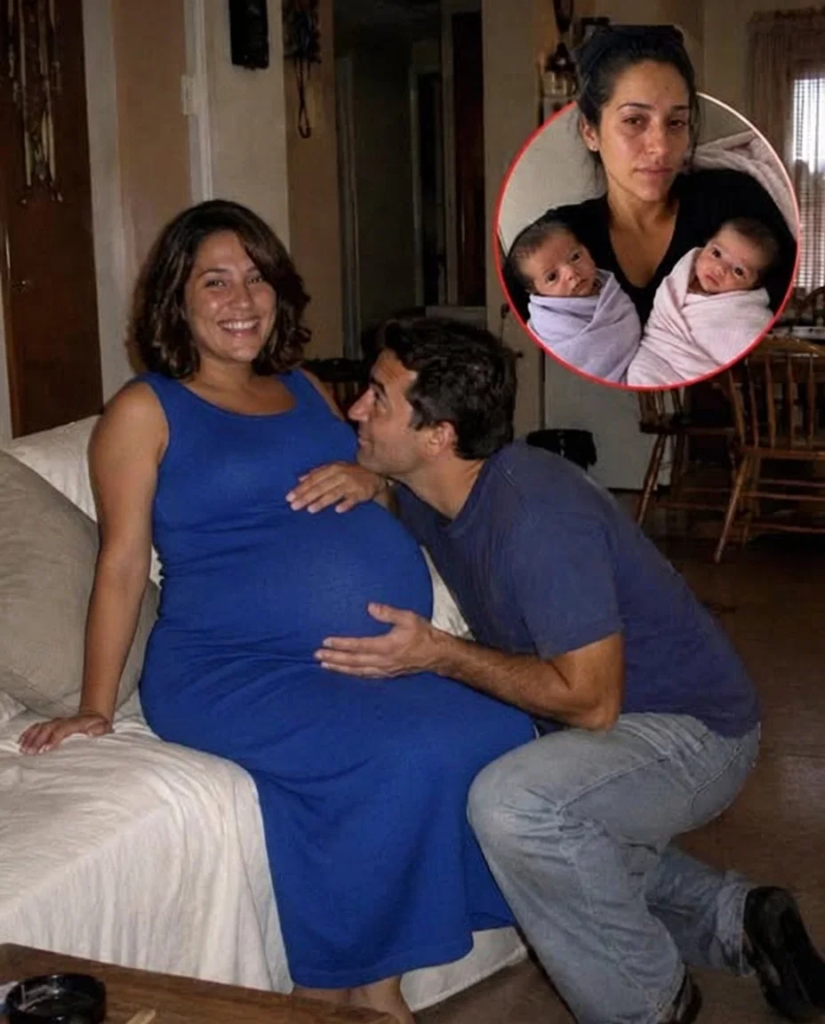
When I showed Daniel the positive pregnancy test, he stared at it for three seconds before his face lit up.
“Are you serious?”
I nodded, laughing from the kitchen floor.
He lifted me into his arms and shouted, “We’re having a baby!”
Three weeks later, the ultrasound gave us another surprise.
“There are two,” the technician said.
Daniel blinked. “Two what?”
“Two babies.”
For a moment, neither of us spoke.
Then he grinned.
“Twins?”
On the drive home, he started counting everything we would need.
“Two cribs. Two car seats. Two college funds.”
“Please stop.”
“And a bigger coffee machine.”
I laughed.
Back then, I thought we had decades ahead of us.
Daniel was always the calm one. Whenever I worried about premature labor, money, or whether we knew how to raise two babies, he gave me the same answer.
“We’ll handle it.”
Our apartment slowly filled with cribs, clothes, diapers, and baby furniture.
Daniel’s mother, Carol, visited often.
She brought food, folded clothes, and offered endless advice.
Looking back, she also watched Daniel more carefully than I understood.
One afternoon, while painting the nursery, Daniel climbed down from a ladder and suddenly grabbed a chair.
“You okay?” I asked.
“Fine.”
Carol immediately looked up.
“Daniel.”
“I’m fine, Mom.”
He smiled at me, and I believed him.
Over the next few months, he grew tired more easily.
He blamed work.
Then stress.
Then preparing for twins.
I accepted every explanation.
One evening, late in my pregnancy, I found him sitting alone in his car with papers on his lap.
When he saw me, he quickly folded them and pushed them into the glove compartment.
“What’s that?”
“Work stuff.”
“Since when do you work in the car?”
“Since my wife covered every table in our apartment with baby things.”
I laughed.
Again, I believed him.
Soon, Daniel stopped driving. Carol began taking us to appointments.
He joked that my stomach was so big the twins could steer the car themselves.
Even when he looked pale or needed to rest halfway through ordinary chores, he still found ways to make me laugh.
Then, three weeks before Mia and Owen were born, Daniel died.
Everything changed instantly.
One day, his shoes were beside the door and his jacket hung over a chair.
The next, I was preparing to give birth without him.
Mia and Owen never met their father.
Carol moved into our spare room and stayed after they were born.
She handled late-night bottles, laundry, meals, and the moments when grief suddenly crushed me.
For an entire year, she helped me survive.
And all that time, she was keeping one enormous secret.
PART 2
By the twins’ first birthday, I had learned how to function around the grief.
I planned a small party at home with balloons, cake, relatives, friends, and neighbors.
Mia and Owen covered themselves in frosting while everyone laughed.
For a while, it felt like a normal first birthday.
But every celebration after Daniel’s death contained another version in my imagination.
The version where he was still there.
After the guests left, I started cleaning.
Carol stopped me.
“I need to get something.”
She went outside and returned carrying a large box.
The moment I saw the handwriting on the lid, I froze.
**For my family. Open on their first birthday.**
Daniel.
Carol placed the box on the table.
“He gave this to me the week he stopped driving,” she said. “He made me promise not to give it to you early.”
I reached for the latch.
Carol stopped me.
“Bianca, sit down first.”
Her expression frightened me.
“What is this?”
She lowered herself into a chair.
Then she told me the truth.
Daniel had known he was seriously ill.
The papers I had seen in his car weren’t work documents.
They were medical results.
He had known before the twins were born.
I stared at Carol.
“You knew?”
She nodded.
“When?”
“March.”
My chair scraped against the floor as I stood.
“You knew all that time?”
“He asked me not to tell you.”
My anger came instantly.
“I was his wife!”
“I know.”
“I deserved to know!”
“I know.”
Carol didn’t defend herself.
She explained that Daniel had met her at a diner after receiving his results.
He made her promise not to tell me.
“He said you deserved those months to be happy about the babies without spending every day afraid of losing him.”
My hands shook.
“He had no right to decide that.”
“You’re right.”
“And neither did you.”
“You’re right.”
That answer stopped me.
Carol wasn’t asking to be forgiven.
She was simply admitting what she had done.
I looked back at the box.
However angry I was, I needed to know what Daniel had left behind.
I opened it.
Inside were two smaller boxes and an envelope with my name.
The first box contained Daniel’s watch.
A note read:
**For our son.**
The second held a necklace that had belonged to his grandmother.
**For our daughter.**
Beneath them were twelve sealed envelopes.
I picked them up one by one.
**For your first day of school.**
**For when you turn sixteen.**
**For graduation.**
**For the day you fall in love.**
Then I found the envelope that broke me.
**For the day you need your dad and I’m not there.**
I bent over the table and cried.
Daniel had known he might never see any of those days.
While I had been decorating the nursery and complaining about swollen ankles, he had been preparing pieces of himself for a future he knew he might never share.
PART 3
Finally, I opened the envelope addressed to me.
Daniel apologized for keeping his illness secret.
He admitted that he had made a decision about our pregnancy and our marriage that should have belonged to both of us.
He wrote that I might hate him for it.
For several minutes, I did.
Then I reached the part that changed everything.
He explained that because he couldn’t give the twins a lifetime with their father, he had tried to leave pieces of himself wherever they might someday need him.
That was what the envelopes were.
He had imagined the moments he might miss and written himself into them.
Their first day of school.
Their sixteenth birthdays.
Graduation.
Love.
Heartbreak.
The days when they might desperately want advice from their father.
At the bottom of the letter was one final message:
Don’t spend their birthdays staring at the man missing from the photographs. Look at the children. I’m still there.
I read it again.
Then I looked toward the floor.
Mia and Owen were still covered in cake, fighting over a ribbon from Daniel’s box.
Owen smiled.
It was Daniel’s exact crooked smile.
Mia frowned while concentrating, creating the same tiny crease between her eyebrows that Daniel used to have.
For the first time since his death, I looked at my children without thinking only about what Daniel had missed.
Carol sat quietly beside me.
“I’m sorry,” she whispered.
I was still angry.
Daniel’s beautiful letters didn’t make his decision fair.
Carol’s loyalty to her son didn’t erase the fact that she had hidden the truth from me.
But she had also spent the last year helping me raise the children Daniel never got to hold.
“I wish you’d told me,” I said.
“I know.”
“I might wish that for a long time.”
She nodded.
“I know.”
I looked at the envelopes.
“But I’m glad Mia and Owen have these.”
“So am I.”
A few days later, Carol told the relatives closest to Daniel what had happened.
She didn’t defend herself or pretend the secrecy had been right.
She simply explained what Daniel had asked of her and admitted that she had agreed.
For the first time, the secret no longer belonged only to me.
The twins’ birthday photographs stayed on my table.
Daniel wasn’t standing beside us in any of them.
But the empty space no longer felt exactly the same.
He had left his watch for Owen.
His grandmother’s necklace for Mia.
Letters for birthdays, milestones, heartbreaks, and moments he knew he would never see.
He couldn’t stay.
But before he left, he tried to make sure his children would never have to wonder what their father would have wanted to say.
For months, I believed Daniel’s story had ended three weeks before our twins were born.
I was wrong.
Somewhere inside twelve sealed envelopes, an old watch, a necklace, Owen’s crooked smile, and Mia’s serious little frown, pieces of him were still waiting for them.
Daniel had wanted his children to have their father whenever they needed him.
And in the only way he had left, he had made sure they would.
The first time my own front door refused to open for my son, Daniel called me screaming.
“Mom, what did you do?”
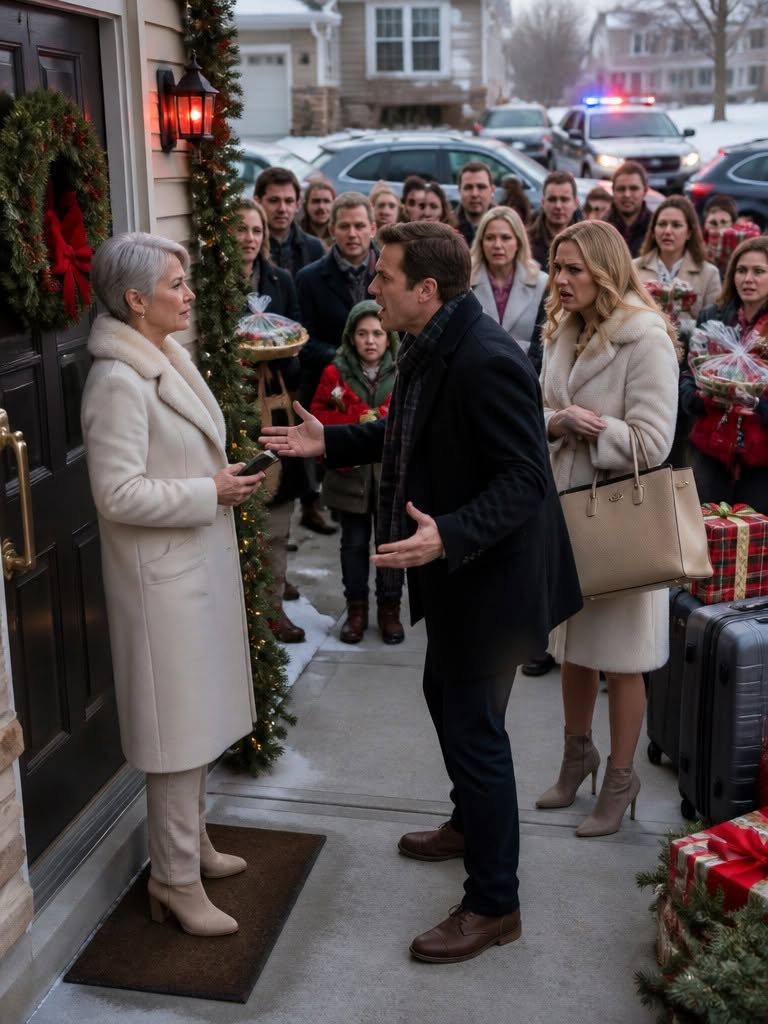
Behind him, the alarm was blaring, Melissa was shouting for a locksmith, and nearly twenty-five members of her family were standing outside my house on Christmas morning.
I was thousands of miles away in Lisbon.
“Why is the house locked?” Daniel demanded.
“Because I locked it.”
He sounded stunned.
“You knew we were having Christmas there!”
“No. Melissa informed me that you were using my house for Christmas.”
That distinction mattered.
My home had slowly stopped being the place where my son visited me. It had become a free venue for his wife’s family.
I had spent thirty-two years paying for that modest house on Hawthorne Lane. After my husband James died when Daniel was nine, I worked extra hospital shifts, cleaned offices at night, and learned to repair almost everything myself just to keep the mortgage paid.
That house was proof that grief had not defeated us.
Then Daniel married Melissa Hale.
At first, I thought she simply loved old homes. She inspected the fireplace, the oak floors, and the original molding. Soon she was rearranging furniture, moving photographs, and hosting Thanksgiving, Easter, birthdays, and family gatherings at my house without asking me.
Daniel always said the same thing.
“Mom, she means well. Don’t create conflict.”
So I stayed quiet.
Then, at Thanksgiving, I met Melissa’s father, Victor Hale, a wealthy property developer.
He stood in my living room studying the walls and said, “This place must be worth a fortune.”
“It isn’t for sale.”
His smile changed.
“Everyone sells eventually.”
Later that evening, I caught Melissa coming up from my basement. She claimed she had been looking for the bathroom.
The next morning, I moved my couch and discovered a fresh scratch across the oak floor. One section of molding had been disturbed.
Behind it was a hidden cavity containing a brass key wrapped in paper.
The handwriting belonged to James.
FOR RUTH ONLY.
Beneath those words was an address to a storage facility and a warning:
If Victor Hale or anyone connected to him enters this house, take the key and call Evelyn Shaw. Do not confront them. Do not tell Daniel until you know whom he trusts.
James had been dead for twenty-seven years.
I called Evelyn immediately.
She told me something that shattered everything I believed about my husband.
James had secretly been a confidential source in a federal investigation into Victor Hale’s company. He had discovered evidence involving fraudulent property deals, bribes, insurance schemes, and money laundering.
Then he died in what authorities called a highway accident.
Evelyn had never believed it was accidental.
She came to my house with retired investigator Marcus Reed. He searched my car and found a tracking device beneath the bumper.
Then we used James’s brass key to open storage unit 317.
Inside were ledgers, property records, old checks, photographs, and a tape recorder.
When we pressed Play, James’s voice filled the room.
“If Ruth is hearing this, something has gone wrong.”
I nearly collapsed.
He explained that Victor Hale had someone inside the investigation warning him whenever evidence was about to surface. James had hidden copies of everything and said the complete records were stored somewhere outside the United States.
Then the tape ended.
Beneath the recorder was an envelope containing one word:
LISBON.
Suddenly Melissa’s obsession with my house made sense.
She had not been decorating.
She had been searching.
And when she texted days later announcing that twenty-five relatives would use my home for Christmas, Evelyn immediately understood.
“This isn’t a party,” she said. “They want enough people inside the house to search every room.”
So we made a plan.
I bought a ticket to Lisbon, removed my valuables, upgraded the security system, activated monitored alarms, and left Daniel a note.
A home is not something you inherit while its owner is still alive.
Ask Melissa what she was looking for behind the couch.
Ask why her father knew your father.
Then decide whose son you intend to be.
I locked the door.
And left.
PART 2 — THE MAN I BURIED WAS STILL ALIVE
In Lisbon, Evelyn, Marcus, and I opened a secure bank box James had arranged decades earlier.
Inside were records, microfilm, photographs, and several tapes.
Then I saw a passport.
The man in the photograph had gray hair and deep lines across his face, but I knew him instantly.
James.
The name on the passport was Samuel Mercer.
I insisted it had to be fake.
After all, I had buried my husband.
But then I remembered something I had spent twenty-seven years avoiding.
His coffin had been closed.
Authorities told me the accident had badly damaged him. I had identified his wedding ring, watch, and wallet.
I had never actually seen his face.
One tape was dated nineteen years after James’s supposed death.
We played it.
His voice was older.
But unmistakably alive.
James explained that after an attempt on his life, investigators staged his death because Victor Hale’s people were following me and Daniel. When James tried contacting us months later, he received a photograph of nine-year-old Daniel leaving school with a warning that the boy would disappear if James surfaced again.
So he stayed dead.
For twenty-seven years.
“I remained gone because I believed my absence was the only thing keeping you alive,” he said.
The tape ended.
I could barely breathe.
Then the bank manager revealed that Samuel Mercer had accessed the box only three months earlier.
James had been in Lisbon.
And he might still be there.
Before we could search for him, Daniel called from my house.
Police had arrived because the alarm company reported unauthorized entry.
I finally told him the truth.
“Melissa’s family has been searching my house for evidence connected to your father.”
Then Daniel whispered something worse.
Melissa already knew I had flown to Lisbon.
She had seen my flight confirmation.
“Mom,” Daniel said urgently, “don’t tell anyone where you’re staying.”
Then Victor grabbed the phone.
There was shouting.
A struggle.
The call ended.
Minutes later, Daniel sent me a photograph of Victor inside my basement holding a crowbar.
The timestamp showed they had entered the night before Christmas.
Daniel had known.
At first, I thought my own son had betrayed me.
Then security footage revealed what really happened.
Daniel had gone into the basement with Victor while secretly recording him. Victor tore into walls and cabinets looking for anything James had left behind.
Daniel had been investigating Melissa for months.
He had found documents on her computer about my property, fake signatures, and a file titled CALLAHAN ASSET RECOVERY.
After a private investigator Daniel hired suddenly disappeared, someone left a photograph of me beneath his windshield wiper.
Daniel became terrified.
So he pretended to cooperate with Melissa while secretly copying her files.
Then I told him the impossible truth.
“Your father survived.”
Daniel began crying.
“Why didn’t he come back?”
“I don’t know everything yet.”
Then Daniel revealed something that changed the investigation again.
Months before meeting him, Melissa already possessed copies of his university records, my mortgage history, and James’s death certificate.
She had chosen Daniel deliberately.
The marriage itself had been a way into our family.
Daniel had also copied a video in which Victor told Melissa she had made a mistake by “bringing Samuel back to Lisbon.”
Melissa knew where James was.
PART 3 — THE FAMILY THAT HAD TO BE REBUILT
We located James’s apartment in Lisbon, but it was empty.
Inside were photographs of Daniel’s graduation, my house at Christmas, newspaper clippings about our lives, and James’s real wedding ring.
Then I found another letter.
James explained that Melissa had found him two years earlier. She claimed she wanted to expose her father, but her real goal was to gain control of the evidence and use it against everyone involved.
At the bottom, James drew a small angel.
I immediately understood.
The old ceramic Christmas angel I had brought from home.
But when I called the embassy, someone had already collected my suitcase using Evelyn’s identification.
Security footage revealed the thief.
Lorraine Hale.
Melissa’s mother.
She had flown to Lisbon while the rest of the family created chaos outside my house.
Police eventually found my suitcase in her hotel.
The angel was gone.
In the trash were broken ceramic pieces. Its repaired wing had been opened, revealing a hidden compartment.
Empty.
Then detectives recovered a note:
Pier 17. Midnight. Bring Samuel.
James was alive.
And the Hales had him.
Daniel flew to Lisbon under protection.
That night, police surrounded the pier.
At midnight, Lorraine appeared.
Then Melissa.
Finally, two men brought out an elderly prisoner with gray hair, a scar across his forehead, and a limp.
James.
Daniel and I stared at the man we had mourned for twenty-seven years.
Melissa produced a strip of microfilm taken from the angel.
Another man arrived.
Thomas Vane, the former federal official who had protected Victor Hale’s criminal network and kept James trapped under a false identity for decades.
The exchange began.
Then Vane examined the microfilm and realized something was wrong.
It was fake.
Police moved in.
Melissa tried to use a weapon as Daniel ran toward his father. James intervened and was wounded protecting him.
Officers arrested Melissa, Lorraine, and Vane.
Then the shattered angel fell to the ground.
Its base cracked open.
A tiny memory card rolled across the pier.
James smiled weakly.
“The real evidence.”
For decades, everyone had searched the repaired wing.
James had hidden the truth in the base.
The memory card contained financial records, videos, bank transfers, and evidence identifying the judges, developers, police officials, insurance executives, and federal agents connected to Victor Hale.
Victor was charged.
Lorraine was charged.
Vane faced the consequences of decades of corruption.
Melissa’s marriage to Daniel was exposed as calculated fraud. She had never been merely helping her father—she intended to control the evidence herself and blackmail the entire network.
Daniel sought an annulment.
James survived.
But surviving did not magically restore our family.
For weeks, James and I talked about the twenty-seven years we had lost. I told him about Daniel growing up, paying off the mortgage, and every Christmas morning he had missed.
James told me about false identities, threats, intercepted messages, and years spent believing that staying away kept us safe.
“I don’t know whether I can be your wife again,” I finally told him.
“I understand.”
“And Daniel isn’t the nine-year-old boy you remember.”
“I know.”
“I’m not the woman you left either.”
He looked at me.
“I can see that.”
Months later, the three of us returned to Hawthorne Lane.
Daniel stood beside me on the porch.
“Whose home is this now?” he asked.
“Mine.”
“And if I come inside?”
“You come as my son. Not as an owner.”
James remained at the bottom of the steps.
“What about me?”
I looked at the husband I had buried and the stranger who carried his memories.
“You come as a guest.”
He nodded.
“That’s more than I deserve.”
That Christmas, Daniel came with homemade cinnamon rolls. James waited outside until I invited him in.
Nothing returned to the way it had been.
We were not restoring the old family.
We were building another one.
Slowly.
Honestly.
Without secrets.
Daniel eventually gave me the brass storage key mounted inside a wooden frame.
Beneath it were the words:
A HOME OPENS ONLY FOR THOSE WHO HONOR THE PERSON INSIDE IT.
A year earlier, Daniel believed my locked door had been punishment.
It wasn’t.
It was the first honest boundary our family had known.
Sometimes love means welcoming someone inside.
Sometimes it means forgiveness offered carefully.
And sometimes it means standing inside the home you built with your own hands and deciding, for yourself, who has earned the right to enter.
Three days after my wedding, my mother-in-law humiliated me in front of the entire family because I refused to serve my sister-in-law.
“Are her hands broken?” she snapped, while my husband sat there saying nothing.
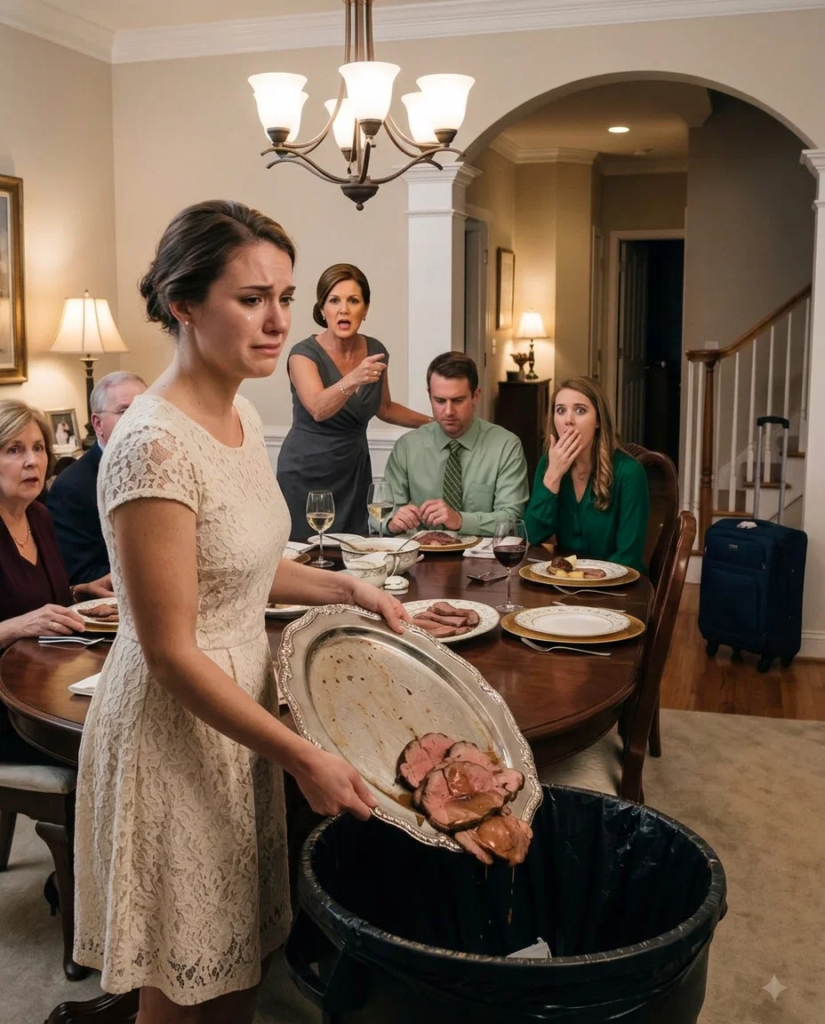
I stared at the tray of expensive roast beef in my hands, smiled, and dumped it straight into the trash.
“She can serve herself.”
Then I packed my suitcase and left.
But several days later, my husband appeared at my mother’s door with news I never expected.
Three days after my wedding, I dumped an entire tray of roast beef into the trash in front of my husband’s family.
It was not how I imagined my first week as Mrs. Emily Carter.
My husband, Ryan, and I had delayed our honeymoon because his mother, Patricia, insisted on hosting a post-wedding family dinner at her home outside Nashville.
I agreed because I wanted to begin our marriage peacefully.
By six o’clock, I realized Patricia had something very different in mind.
While Ryan watched football with his father and his sister, Madison, Patricia kept ordering me around the kitchen.
“Emily, set the table.”
“Emily, bring the wine.”
“Emily, Madison needs another napkin.”
At first, I helped without complaining.
Then dinner started.
Everyone sat down except me.
Patricia handed me a heavy tray of roast beef.
“Serve Madison first.”
Madison was twenty-seven years old and sitting three feet away.
I laughed because I assumed Patricia was joking.
She wasn’t.
“Madison can serve herself.”
Patricia’s expression hardened.
“Excuse me?”
“I’ve been helping for three hours. I’d like to sit down and eat too.”
She looked dramatically around the table.
“Ryan, is this how your wife speaks to me?”
Ryan stared at his plate.
“Emily, just do it. Please.”
That hurt more than anything Patricia had said.
I set the tray on the counter.
Patricia immediately grabbed it and pushed it back toward me.
“Are Madison’s hands broken?”
Nobody said a word.
Then Patricia added,
“In this family, wives take care of people. Maybe your mother never taught you that.”
My face burned.
I looked directly at Ryan.
“Are you going to say anything?”
He sighed.
“Don’t make a scene.”
Something inside me snapped.
I took the tray, walked to the trash can, lifted the lid, and dumped every slice inside.
Patricia screamed.
“What the hell are you doing?”
I smiled.
“Madison can serve herself.”
Then I went upstairs, packed my suitcase, and called my mother.
Ryan followed me.
“You’re seriously leaving over dinner?”
“No, Ryan. I’m leaving because you’ve shown me what our marriage is going to look like.”
I removed my wedding ring and placed it on the dresser.
His face immediately went pale.
“Emily, don’t do this.”
But I picked up my suitcase.
And walked out.
My mother opened her front door before I even reached the porch.
She looked at my suitcase and pulled me inside.
“What happened?”
I told her everything.
Mom listened without interrupting.
When I finished, she asked only one question.
“Did Ryan defend you?”
“No.”
“Then the roast beef isn’t the problem.”
She was right.
Ryan called eleven times that night.
Patricia sent three messages accusing me of humiliating the family.
Madison posted a vague social-media comment about “women who aren’t ready to be wives.”
I ignored all of them.
The next morning, Ryan finally sent something different.
**I’m sorry. Can we talk without my family involved?**
I agreed to meet him at a coffee shop.
Ryan looked exhausted.
“I screwed up.”
“Yes.”
“I should’ve defended you.”
“Yes.”
He rubbed his forehead.
“My mother has always been like this.”
“That doesn’t make it acceptable.”
“I know.”
Then he admitted something that stunned me.
Before our wedding, Patricia had given him **$25,000** toward the down payment on the condo we planned to buy.
But the money came with expectations.
She wanted her own key.
She wanted to stay whenever she visited.
And she expected us to host every family holiday.
“You agreed to that?”
Ryan looked down.
“I didn’t think it would matter.”
“You didn’t think your mother having unlimited access to our home would matter?”
“I was going to tell you.”
“When?”
He couldn’t answer.
I stood.
“Our marriage is three days old, Ryan, and you’re already hiding agreements that affect both of us.”
He reached for my hand.
“Give me one chance to fix this.”
I pulled away.
“Fix it without asking me to come back first.”
For the next four days, I heard nothing.
Then, on Sunday afternoon, someone knocked on Mom’s door.
It was Ryan.
And he wasn’t alone.
Patricia stood behind him with her arms crossed.
Mom stepped beside me.
Patricia immediately said,
“I suppose you’re expecting an apology.”
I stared at her.
“Actually, I wasn’t expecting you at all.”
Ryan turned toward his mother.
“Mom.”
Patricia rolled her eyes.
“Fine. I’m sorry you were offended.”
I almost laughed.
Ryan didn’t.
“No,” he said.
Patricia froze.
Ryan pulled an envelope from his jacket.
“I returned your twenty-five thousand dollars this morning.”
Her expression changed.
“What?”
“And you’re not getting a key to our home.”
Patricia stared at him.
Then at me.
“You did this.”
Ryan stepped between us.
“No, Mom.”
His voice remained calm.
“I did.”
Patricia left without apologizing. In a way, that was probably the best thing she could have done.
It forced Ryan and me to deal with the real problem instead of pretending one uncomfortable conversation had solved everything.
He didn’t ask me to come home that afternoon.
Instead, he said,
“I need to earn that.”
For the first time since the dinner, I believed he understood.
We started marriage counseling the following week.
I learned something uncomfortable about myself too.
Throughout our relationship, I had avoided conflict with Patricia because I wanted her approval.
Whenever she made a disrespectful comment, I laughed it off.
Ryan had interpreted my silence as tolerance.
That did not excuse him.
But it helped explain how we had ended up at that dinner table.
Ryan began setting firm boundaries with his family.
No unannounced visits.
No financial agreements affecting both of us unless we both agreed.
And no allowing his mother to insult me before dismissing my reaction as “drama.”
Patricia hated every boundary.
Madison stopped speaking to us for nearly two months.
I lost no sleep over either one.
Three weeks after I left, I moved back in with Ryan.
But I didn’t put my wedding ring back on immediately.
That happened two months later.
We were having dinner at a restaurant when Patricia unexpectedly approached our table.
She had been dining nearby with friends.
She looked at me.
For once, none of her relatives were standing around to watch.
“I owe you a real apology,” she said.
I waited.
“I treated you like joining our family meant accepting a position beneath us. That was wrong.”
I glanced at Ryan.
He remained silent.
Not because he was afraid to speak.
Because the apology belonged to Patricia.
“I appreciate you saying that,” I replied.
We never became best friends afterward.
We didn’t need to.
Respect was enough.
A year later, Ryan and I finally took the honeymoon we had postponed.
For our anniversary, we rented a cabin in Colorado, switched off our phones, and cooked dinner together.
Ryan placed a tray of steak on the table.
“Should I serve you?”
I stared at him.
Then we both burst out laughing.
That ridiculous tray of roast beef had nearly ended our marriage.
But the food had never truly been the issue.
The real question was whether my husband could stop being his mother’s obedient son long enough to become my partner.
If you had been sitting at that dinner table, would you have kept the peace—or dumped the tray and walked out like I did?
And if your spouse failed to defend you in front of their family, what would they have to do before you trusted them again?
For me, an apology wasn’t enough.
Change was.
And thankfully, Ryan finally learned the difference.
For six years, I quietly paid the water bill for the elderly woman who lived next door.
I believed she never knew.
I was wrong.
My name is Helen Mercer. I’m sixty-one, retired after nearly three decades as a high school librarian, and I’ve lived alone on Parcel Street since 1997.
The house beside mine belonged to Ada Holloway.
Ada had lived there since 1972. After her husband, Leonard, passed away in 2009, the house slowly began showing its age.
The roses grew wild.
The porch steps sagged.
A light near the front door stopped working and was never replaced.
But Ada refused to leave.
That house contained nearly her entire adult life, and she intended to stay there as long as she could.
In the spring of 2019, when Ada was eighty-three, I noticed an orange notice taped to her front door.
It was a warning from the water company.
Her account was overdue, and service was about to be disconnected.
I knew Ada well enough to understand that she would rather sit in a house without running water than admit she couldn’t afford a small utility bill.
So I removed the notice before she saw it.
That afternoon, I called the utility company and paid what she owed.
Then I kept paying.
Month after month.
Usually, it was around twenty-nine dollars.
Not enough to affect my life.
But telling Ada would have affected hers.
She had lost her husband, many of her friends, and much of the independence she once took for granted.
I didn’t want to turn our friendship into something built around gratitude or obligation.
So I said nothing.
For six years, I believed my secret remained mine.
Then Ada died.
The morning after her funeral, her only son, Philip, arrived at my door with an attorney.
Philip lived across the country and had visited rarely during his mother’s final years.
The man beside him introduced himself as Nathan Price.
“May we come inside?” he asked.
“You can stand on the porch,” I replied.
Philip looked angry.
He pulled an old water bill from his coat.
My name was printed at the top as the person who had paid it.
Underneath, Ada had written a note in her careful handwriting:
**Helen has paid this since 2019. She will deny doing anything special. Do not embarrass her by arguing.**
I stared at those words.
She knew.
Not recently.
Not accidentally.
Ada had apparently known for years.
Philip watched my face.
“Three days before the funeral,” he said, “I received a copy of my mother’s revised will.”
“I knew she changed it,” I said. “I didn’t know what was in it.”
He gave a bitter laugh.
“Please don’t pretend you’re surprised.”
Nathan opened his folder.
“We are considering whether Mrs. Holloway’s final estate decisions were influenced improperly,” he explained. “Secret financial assistance to an elderly person could be relevant.”
I almost laughed.
“I paid her water bill.”
“You made her dependent on you,” Philip snapped.
I looked directly at him.
“When did you last speak to your mother?”
His expression hardened.
“That has nothing to do with this.”
“June eighteenth. Her birthday. You called at 7:12 and hung up four minutes later. I was sitting beside her.”
His jaw tightened.
“I was traveling.”
“She fell in February,” I continued. “Did you know?”
The anger disappeared from his face.
“No.”
“She lay on her kitchen floor for almost forty minutes before I found her.”
He stared at me.
“Why didn’t anyone call me?”
“Because she begged me not to.”
“Why?”
“Because you had been pressuring her to move into assisted living. She knew the fall would give you another reason.”
Philip looked stunned.
“She was eighty-four,” I said. “That was her age. It wasn’t her entire identity.”
Nathan shifted uncomfortably.
“We’re only trying to understand the circumstances surrounding her final decisions.”
“Then you should understand all of them.”
I walked inside and returned with a sealed manila envelope.
Ada had given it to me two weeks before she died.
Written across the front were the words:
**For the attorney Philip hires if he challenges my decisions.**
Philip went pale.
“So you planned this together.”
“No. Ada planned it. I was told to hold an envelope.”
I handed it to Nathan.
He opened it.
Inside were several pages, bank statements, legal documents, and a sealed letter addressed to Philip.
Nathan read the first page.
Then he read it again.
His entire expression changed.
He turned toward Philip.
“Did you have access to your mother’s bank accounts?”
Philip stiffened.
“What does that have to do with Helen?”
“Answer the question.”
Philip finally admitted that after Ada’s hip surgery in 2020, she had temporarily authorized him to manage her finances.
Nathan studied another document.
“That authority was revoked in August 2021.”
“I know.”
“It says it was revoked after your mother discovered unauthorized transfers.”
Philip’s face tightened.
“She was getting confused.”
Nathan pulled out several highlighted bank statements.
“The transfers total eighteen thousand six hundred dollars. The money went from your mother’s savings account to Northline Renovations.”
Silence.
Nathan looked up.
“You own Northline Renovations.”
Philip swallowed.
“They were loans.”
“Where are the loan agreements?”
“She was my mother. We didn’t put everything in writing.”
“Did she authorize those transfers?”
Philip stared toward the street.
“She knew my business was struggling.”
“That isn’t what I asked.”
Philip said nothing.
Suddenly, the accusation against me looked very different.
Philip had arrived intending to prove that twenty-nine dollars a month had allowed me to manipulate his vulnerable mother.
Instead, Ada had left behind evidence that thousands of dollars had disappeared from her savings while her son controlled her finances.
Philip tried one last time.
“My mother was confused.”
“No,” I said.
He looked at me sharply.
“Ada sometimes left her reading glasses in the refrigerator. She hated oatmeal, loved old detective shows, and cheated at cards so consistently that I’m convinced she enjoyed being caught. She was lonely. She was stubborn. She was old.”
I paused.
“But she was not confused about her money, her house, or how people treated her.”
“You barely knew her,” Philip said.
I looked toward the house next door.
I knew why the shutters were blue.
I knew why she kept birdseed near the porch.
I knew she feared thunderstorms after Leonard died because there was no longer anyone beside her when they woke her at night.
I knew she kept peppermints by the door because she believed people carrying bad news sometimes needed something sweet.
And I knew things her own son apparently did not.
“You’re right,” I said quietly.
Philip looked almost relieved.
Then I finished.
“I didn’t know her the way a son should know his mother.”
He flinched.
Nathan reached into the envelope and removed the final item.
Ada’s letter.
He handed it to Philip.
Philip opened it.
After reading only a few lines, he lowered himself onto my porch step.
And as he continued reading, I realized Ada had left behind something far more powerful than evidence.
She had left her son the truth.
PART 2 — ADA’S FINAL MESSAGE
Philip sat on my porch for several minutes without speaking.
I never read over his shoulder.
The letter belonged to him.
But every so often, he whispered a sentence aloud without seeming to realize it.
The first was:
**I am not angry with you. I want you to understand that before anything else.**
He kept reading.
Then:
**I know your business was struggling. I understand why you were ashamed to ask me for help. But what you took belonged to me, and it was mine to give or refuse. You took away that choice.**
Philip’s hands began to shake.
Then he reached the part about me.
Ada explained that I had not been her daughter, caretaker, or savior.
I had simply been present.
I had known when she needed help and when she wanted to be left alone.
Most importantly, I had never treated being elderly as the most important thing about her.
Then Ada wrote about the house.
She had placed it in a trust.
It would not go to Philip.
Instead, it would be transferred to a local historical preservation organization so it could remain much as it had been during her life with Leonard.
She made it clear that this was not revenge.
Philip would still receive a fair inheritance.
But the house belonged to a story larger than money.
Near the end of the letter, Philip stopped breathing for a moment.
Then I heard him read:
**You were a good child, Philip. I want you to try to become a good man. Those are not always the same thing, but you still have time to make them one.**
He remained on the porch step long after finishing.
Finally, he folded the letter carefully and placed it inside his jacket.
He looked toward his mother’s blue shutters.
Then toward the empty bird feeder.
When he looked back at me, his anger was gone.
“She changed the will three months ago.”
“I know.”
“You really didn’t know what was in it?”
“She told me not to open the envelope.”
He studied me.
“She trusted you.”
“Yes.”
Philip turned toward Nathan.
“What happens with the undue influence claim?”
Nathan gathered the documents.
“With what your mother documented here, I don’t believe you have a viable case. There is an independent attorney’s certification, a medical evaluation confirming her capacity, and extensive financial records.”
He paused.
“The transfers to Northline Renovations, however, are something we need to discuss privately.”
Philip understood.
He stood.
Before leaving, he looked at me.
“Mrs. Mercer… I’m sorry I came here like this.”
I thought about Ada’s words.
*You still have time.*
“I know,” I said.
Two weeks later, Ada’s estate attorney called me.
His name was Robert Fenn.
He told me Ada had left me the contents of her front room.
Not the expensive furniture.
The meaningful things.
Her framed photographs.
Her detective novels.
A misshapen pottery bowl Leonard had made in 1975.
The peppermint tin beside her front door.
And dozens of shoeboxes filled with Christmas cards.
Ada had saved every Christmas card she had received since 1971.
Every year had its own labeled box.
I began reading them slowly.
One year at a time.
The earliest boxes showed Ada and Leonard building their life together.
Later came cards congratulating them on Philip’s birth.
Then cards from friends who slowly disappeared as the decades passed.
In one box, I found a card from Gerald, the man Ada had nearly married before Leonard.
It contained only a few words:
**I hope you are happy.**
She had saved it for more than fifty years.
In December, Philip called me.
He said he wanted to apologize.
Not the vague kind.
A real apology.
He apologized for arriving at my house with an attorney.
He apologized for suggesting his mother could no longer make her own decisions.
He apologized for not knowing about her fall.
Then he became quiet.
“She kept that water bill in her desk,” he said.
“Yes.”
“She wanted me to find it.”
“I think she wanted you to understand what it meant.”
Another pause.
“She wasn’t dependent on you.”
“No.”
“You were simply there.”
“Yes.”
“That’s different.”
“Very.”
Then Philip told me something else.
He was going to repay all eighteen thousand six hundred dollars to the estate.
It might take time, but he intended to repay every cent.
He had also researched the historical preservation organization receiving Ada’s house.
“They do good work,” he said. “I’m going to volunteer with them when restoration starts.”
I smiled.
“She would have liked that.”
“I think that’s why she arranged it.”
After our call, I sat beside the window looking toward Ada’s dark house.
Philip’s words stayed with me.
**You were simply there.**
That was exactly right.
People often confuse helping someone with standing beside them.
Ada didn’t want someone to take over her life.
She wanted someone close enough to notice when something was wrong, but respectful enough not to make her feel incapable.
The water bill had only been twenty-nine dollars.
The important part was never the money.
It was knowing someone was paying attention.
Months later, Philip returned to town and asked to visit.
He sat in my front room with coffee and pulled Ada’s letter from his jacket.
“I want you to read something,” he said.
He folded the pages so that only two paragraphs were visible.
Ada had written about me.
She called a neighbor a witness to ordinary life.
Someone who notices whether your kitchen light turns on in the morning.
Someone who knows what your yard looks like in February.
Someone who sees you on days when nothing important happens.
Then she wrote:
**Helen will deny that what she did mattered because she underestimates ordinary things. But ordinary things are the weight of a life. She wanted nothing from me. That is rare.**
I read the paragraphs twice.
Philip watched me silently.
“She knew about the water bill the whole time,” he said.
“So I’ve learned.”
“She said she considered telling you.”
“Why didn’t she?”
Philip almost smiled.
“Because she knew you’d be embarrassed.”
I looked toward the old utility bill I still remembered so clearly.
**Do not embarrass her by arguing.**
Ada had protected my dignity while I thought I was protecting hers.
That realization stayed with me.
Then Philip noticed the peppermint tin on my mantel.
“You kept it.”
“I did.”
“And you fill it?”
“Always.”
His expression softened.
“She had a whole philosophy about those peppermints.”
“I know.”
“Some problems sit better with something sweet.”
“Exactly.”
For the first time, Philip smiled.
Then he told me something about his mother I hadn’t understood.
“She wasn’t very demonstrative,” he said. “She didn’t say everything she felt.”
“No.”
“She kept things instead. She made notes. She arranged things so people would find them later.”
He looked down at his coffee.
“I used to think she hid things because she didn’t trust me.”
“And now?”
“Now I think she was trying to tell me things in the only language she knew, and I wasn’t paying attention.”
He paused.
“In the letter, she said maybe we both chose the wrong ways to love each other.”
“That sounds exactly like Ada.”
Philip nodded.
Before leaving, he made one request.
“When I come back in the spring, I want to fill her bird feeder.”
I smiled.
“You should.”
PART 3 — WHAT ADA REALLY LEFT BEHIND
The Parcel Street Heritage Project officially took ownership of Ada’s house.
Their director, Diane, came to inspect it.
She walked through every room, taking careful notes.
When she reached the front room, she stopped beside the crooked pottery bowl Leonard had made nearly fifty years earlier.
“That belonged to the original owner?”
“Leonard made it in 1975.”
Diane examined it.
“We’re keeping it.”
I laughed.
“Ada would be very pleased.”
The organization planned to turn the house into a living history site.
Not a museum exactly.
Something more intimate.
A house preserved with enough personal objects to remind visitors that actual people had lived there.
Diane eventually asked me to help with the project.
“You knew Ada,” she said.
I thought about that.
I knew the stories she told beside the mailbox.
I knew she cheated at gin rummy.
I knew about the morning she fell.
I knew when she wanted company and when she wanted silence.
But there were entire parts of her life hidden inside those Christmas-card boxes that I was only beginning to discover.
“I knew her as a neighbor,” I finally said.
“Which is its own kind of knowing.”
That spring, Philip returned.
Just as he promised.
He spent several Saturdays helping the restoration crew repair the porch, gutters, railing, and window trim.
He wasn’t particularly skilled with tools, but he worked hard.
One afternoon, I saw him from my yard.
He saw me too.
He lifted one hand.
I lifted mine.
Neither of us walked over.
There was still a conversation between us that would happen eventually.
But it didn’t need to happen that day.
Ada had left both of us things that required time to understand.
After the workers went home, I crossed into Ada’s yard and filled the bird feeder.
The shutters had recently been repainted.
The same blue Leonard had chosen decades earlier.
A cardinal landed nearby.
I stood there until the evening light changed.
Then I went home to my yellow-doored house and opened another box of Ada’s Christmas cards.
I had reached 1979.
The year Philip was born.
The cards were filled with congratulations.
New baby.
New family.
A future expanding in every direction.
Many were signed:
**Ada and Leonard.**
Years later, the signatures changed.
Then came only Ada.
You could trace an entire life through those boxes.
Marriage.
Parenthood.
Friendships.
Loss.
Age.
People disappearing one by one while Ada continued saving every card.
She had kept them all.
The final box was from the year she died.
I still hadn’t opened it.
I wasn’t ready.
And for once, I knew Ada would have approved of waiting.
Philip later sent me a Christmas card.
Inside, he had written:
**Thank you for what you were to her. I mean that plainly.**
I placed it inside a new shoebox.
Perhaps that was how traditions began.
I often think about the afternoon Ada gave me the envelope.
It had been two weeks before she died.
She was sitting outside wearing her good gray coat.
“Sit with me,” she said.
I sat on the porch step.
For several minutes, neither of us spoke.
Ada understood silence better than anyone I knew.
Then she went inside and returned with the manila envelope.
“I need you to hold this.”
“What is it?”
“An envelope.”
“Ada.”
She gave me that familiar impatient look.
“Philip will hire a lawyer when he sees the new will.”
“Why would he think I had anything to do with it?”
“Because he won’t want to think his own behavior caused it.”
She told me not to open the envelope.
Only give it to the lawyer Philip brought.
“And if he never comes?”
“Then keep it.”
“What’s inside?”
“What needs to be.”
That was Ada.
Precise.
Stubborn.
Always three steps ahead.
I told her I didn’t want to be involved in a family dispute.
“You won’t be,” she said. “The envelope will do the arguing.”
Then she leaned back in her chair.
“I’m tired.”
I looked at her.
“Are you all right?”
“I’m not dramatically tired, Helen. I’m eighty-four-years-old tired.”
I laughed.
She smiled.
We stayed there for another hour.
It was one of the last long conversations we ever had.
Only later did I understand that Ada had spent her final months arranging things.
Not controlling people.
Not punishing Philip.
Arranging things.
The house.
The records.
The letter.
The water bill.
The envelope.
The Christmas cards.
Even the ugly pottery bowl.
Ada loved by keeping things.
She loved by remembering.
She loved by placing something exactly where the right person would eventually find it.
She had kept the card from Gerald for fifty-three years.
She kept Leonard’s terrible pottery bowl for nearly half a century.
She kept my water bill in her desk.
She preserved evidence of what Philip had done without humiliating him publicly.
She left him a letter that condemned his actions without telling him he was beyond redemption.
And she left me a peppermint tin.
It sits on my mantel now.
I keep it filled.
Whenever someone comes to my door upset or worried, I offer them one.
Because Ada used to say that some problems become slightly easier to carry when there is something sweet in your mouth.
The bird feeder remains outside her house.
Philip fills it when he visits.
I fill it when he doesn’t.
The blue shutters remain blue.
The preservation society is restoring the house slowly and carefully.
And I continue reading one box of Christmas cards at a time.
Sometimes I think the greatest thing Ada left behind wasn’t a house or an inheritance.
It wasn’t even the letter that stopped Philip from challenging her will.
It was the realization that presence matters.
The small things matter.
A light in a kitchen window.
A conversation beside a mailbox.
A twenty-nine-dollar bill quietly paid.
A peppermint offered without asking why someone needs it.
A bird feeder that remains full after the person who loved the birds is gone.
Philip once told me:
“She wasn’t dependent on you. You were just present.”
That sentence has stayed with me.
Because that was what Ada had been for me too.
Present.
She had witnessed my ordinary life while I witnessed hers.
And perhaps that is what a good neighbor really is.
Not someone who saves you.
Not someone who owns your problems.
Simply someone who notices.
Someone who stays close enough to recognize when your light doesn’t come on in the morning.
Someone who knows when to knock.
And just as importantly—
someone who knows when not to.
For six years, I believed I had secretly been looking after Ada Holloway.
Only after she was gone did I understand the truth.
I smiled, packed one suitcase, and left without arguing. On the dining table, I placed a sealed envelope with his name on it. Hours later, he opened it—and the color drained from his face when he saw what I had left behind.
Part 1
My husband came home carrying a diaper bag and another woman’s future. Behind him, his secretary, Victoria Vance, held two sleeping newborns while my mother-in-law walked in as if she had arranged a luncheon instead of the destruction of my marriage.
I stood beneath the glass chandelier in our Austin home and watched Julian kiss one baby’s forehead. “Elena,” he said, without shame, “these are my sons.”
Victoria lowered her eyes, but her smile survived. Margaret Sterling set her crocodile handbag on my dining table and produced a check. Eighty million dollars, signed in her precise blue ink.
“Take this, disappear, and never come back,” she said. “The Sterling family finally has heirs.”
For twelve years, I had helped Julian turn Sterling Meridian from his father’s failing investment office into a national real-estate fund. I had negotiated the lenders, built the compliance team, and quietly held fifty-one percent of the voting shares through the trust my late father created. Margaret still introduced me as “Julian’s wife.” Julian had recently begun introducing Victoria as “the most efficient person in the company.”
I looked at the twins. They were innocent, warm bundles in matching cream blankets. Whatever their mother had done, I would not make them props in an argument.
“Congratulations,” I said.
Julian blinked. He had prepared for tears. Margaret had prepared for bargaining. Victoria had prepared to look victorious.
I slid the check back across the marble. “Keep it.”
Upstairs, I packed one navy suitcase: clothes, my mother’s watch, my passport, and the encrypted drive my attorney had told me never to leave behind. I ignored Julian’s laughter floating through the atrium. For three months, I had known about the penthouse he rented for Victoria, the company card paying her medical bills, and the forged consulting invoices used to hide both. I had waited because evidence mattered more than outrage.
Before closing the suitcase, I removed a sealed medical envelope from my safe. Two years earlier, after eighteen months of trying to conceive, Julian and I had undergone fertility testing. He skipped the follow-up appointment and ordered me never to mention it again. I had kept the report exactly as the clinic delivered it.
I wrote only his name on the envelope and placed it beside Margaret’s check.
When I reached the open front door, Julian finally noticed it. He tore the seal with an irritated laugh. Then he read the first page, dropped to his knees on the limestone floor, and whispered, “No. That isn’t possible.”
Part 2
The report documented two analyses and the specialist’s conclusion: Julian had non-obstructive azoospermia. No sperm had been found in either sample, and a Y-chromosome deletion made natural conception extraordinarily unlikely. The clinic had recommended counseling and further treatment. Julian had refused both.
From the doorway, I watched his eyes move over the date, his patient number, and the physician’s signature. The twins began crying at the same time.
“What does it say?” Margaret demanded.
Julian looked at Victoria. “Who is their father?”
Her confident expression cracked. “You are. We were together constantly.”
“That wasn’t my question.” His voice broke on the last word.
Margaret snatched the report and read it. Her face emptied. Victoria stepped backward, tightening both babies against her chest. I wanted the truth to hurt the adults, never the children, so I kept my voice level.
“Get a proper paternity test,” I said. “And use your personal account this time.”
I rolled my suitcase into the bright afternoon and entered the SUV waiting at the curb. My attorney, Sarah Sterling, sat in the back with a banker’s box between us. As we drove away, she handed me a tablet. The emergency filing was ready: preservation of company records, suspension of unauthorized transfers, and an injunction preventing Julian from borrowing against assets he did not own.
“Are you certain?” Sarah asked.
I signed. “Completely.”
By sunset, Sterling Meridian’s independent directors had received the audit package. The forged invoices totaled $6.4 million. Some paid for Victoria’s penthouse and private nurses; others flowed through a shell company controlled by Margaret’s longtime accountant. Julian had also drafted a board resolution claiming I had voluntarily surrendered my voting rights in exchange for Margaret’s check.
There was one problem: I had never signed it, and the dining-room camera recorded Margaret trying to buy my disappearance.
Julian called forty-three times that night. His messages moved from rage to pleading. At midnight, he wrote, We can fix this. At 12:07, he wrote, The babies still need a father. At 12:19, he threatened to tell the board I was unstable.
I forwarded every message to Sarah.
The next morning, Julian arrived at headquarters with Victoria and ordered security to remove me from the executive floor. Instead, the board’s outside counsel met him in the lobby. His access card was disabled, his company devices were collected, and he was placed on paid administrative leave pending the forensic audit.
Margaret called me from her car. “Cash the check, Elena. We can add another twenty million.”
“Your check is evidence now.”
She went silent.
The paternity test took six days. During those six days, Victoria claimed the infertility report was fabricated, Julian accused the clinic of switching samples, and Margaret pressured a lab technician through an intermediary. Sarah documented all of it.
On the seventh morning, Julian requested a private meeting. He believed he was coming to negotiate my exit. He did not know the board, the auditors, Victoria, and Margaret would all be waiting when the laboratory courier arrived.
Part 3
We met in Sterling Meridian’s conference room above downtown Austin. Julian wore his investor-interview suit, but his collar was damp. Margaret sat rigidly beside him. Victoria waited near the window; the twins were safely with her sister.
Julian pushed a settlement folder toward me. “Eighty million, the house, and no public statements. You resign today.”
I did not touch it. “You still think this is a divorce negotiation.”
The courier delivered reports based on Julian’s independent sample and supervised cheek swabs from both babies. Outside counsel opened them. Julian was excluded as the biological father of both twins.
For several seconds, only the ventilation system made a sound.
Julian turned toward Victoria. “Tell me his name.”
She began crying. The biological father was Daniel Price, a married director at one of Sterling Meridian’s lenders. When Victoria became pregnant, Daniel refused to leave his family. Julian, wealthy and desperate for an heir, had been easier to convince.
Margaret slapped the table. “You trapped my son.”
Victoria looked at her with sudden fury. “You offered me five million dollars to bring the babies into that house before Elena could stop the trust amendment.”
That sentence ended Margaret’s performance.
The auditor projected Margaret’s payment schedule, Julian’s false invoices, and an amendment shifting shares to any biological son of Julian. It could not touch my father’s trust without my consent, but they planned to use the twins and the fraudulent buyout to pressure me into signing.
I stood. “You mistook my silence for permission.”
The board removed Julian as chief executive for cause. Margaret lost her advisory position. The company referred the forged records, coercion, and diverted funds to investigators. I filed for divorce and made no claim against the twins. They were not my enemies.
Victoria cooperated, testified truthfully, and surrendered what remained in her accounts. Daniel’s bank fired him, and a court ordered him to support his children.
Julian fought everything. The judge rejected his claim that I had abandoned our home because the camera showed why I left. The unauthorized $80 million check became the cleanest exhibit in the fraud case. After auditors uncovered more transactions, Julian and Margaret pleaded guilty. They received restitution orders, prison sentences, and reputations no check could repair.
I sold the Austin house, changed the company’s name, installed an independent chair, and recovered most of the diverted money. Eighteen months later, I opened our annual meeting overlooking the Colorado River. Profits were up, employee ownership had expanded, and nobody introduced me as anyone’s wife.
That evening, I returned to a smaller home filled with books, music, and quiet. My mother’s watch rested against my wrist as I poured a glass of wine on the balcony.
Julian once believed the sealed envelope had destroyed his future. It had only destroyed his lie. Walking away from that doorway had not cost me a family; it had returned me to myself.
My ex-husband invited his “childless” former wife to Christmas dinner at his family estate, certain everyone would see the lonely woman he had left behind.
He expected me to arrive alone.
What he never imagined was a military helicopter landing outside the estate—and me stepping out with four eight-year-old children.
The moment he got a clear look at their faces, the smile vanished from his face.
## The Invitation He Thought I Would Refuse
When my former husband invited me to Christmas dinner at his family’s estate outside Colorado Springs, I knew exactly why.
Major Grant Ashford had recently become engaged, and his family was planning an elaborate holiday gathering to welcome his new fiancée.
The Ashfords were the kind of military family whose history seemed built into every wall—framed photographs in uniform, polished medals, flags folded inside glass cases, and generations of men whose lives revolved around discipline, reputation, and duty.
Grant expected me to come alone.
For years, he had portrayed me as the bitter former wife who never rebuilt her life after he left.
Worse, he had convinced almost everyone in his family that I had invented the pregnancy I told him about shortly before our divorce became final.
So when his invitation appeared in my inbox, I understood the message beneath the polite wording.
Come see how well I am doing without you.
I nearly deleted it.
Then my oldest son, Carter, walked into the kitchen.
He was eight, thoughtful, observant, and far too skilled at recognizing when adults were hiding something.
“Mom, is that from him?”
I looked at the screen.
“Yes.”
Carter glanced toward the living room, where his brothers Mason, Reid, and Owen were building an enormous fort from couch cushions.
Then he asked the question I had avoided for years.
“Does his family know about us?”
I hesitated.
That hesitation answered him.
His expression changed.
“Then maybe they should.”
That was when I accepted the invitation.
## Four Boys Walked Into the Ashford Estate
Snow was falling when we reached the Ashford property on Christmas Eve.
The estate stood beyond a long private road lined with pine trees and small American flags. White lights framed the stone entrance, and through the tall windows I could see dozens of guests gathered around a twelve-foot Christmas tree.
My sons stared outside.
Mason whistled.
“This place looks like a museum.”
“Please do not touch anything that looks older than Grandma,” Reid whispered.
Owen giggled.
I tried not to.
My hands were shaking.
Not because I still loved Grant.
That part of my life had ended long ago.
I was shaking because four children were about to meet a family that should have known them from the beginning.
When the front doors opened, Grant’s mother, Evelyn Ashford, appeared first.
Her smile disappeared.
She looked at me.
Then Carter.
Mason.
Reid.
Owen.
All four boys had Grant’s unmistakable gray eyes.
For several seconds, Evelyn said nothing.
Behind her, conversations slowly faded.
Grant appeared at the far end of the hall in his dress uniform.
His fiancée, Natalie, stood beside him in an elegant dark green dress.
Grant smiled when he first saw me.
Then he noticed the children.
The smile vanished.
Carter looked at me once.
I nodded.
He stepped forward.
“Are you Grant Ashford?”
Grant swallowed.
“Yes.”
Carter studied his face.
Then he asked calmly,
“Are you the man who told everyone we weren’t real?”
The entire room went silent.
## The Letters He Claimed Never Existed
Grant recovered quickly.
He always had.
His entire adult life had taught him how to remain composed while everyone around him became emotional.
“Lauren,” he said sharply, “what exactly are you doing?”
My name was Lauren Mercer now.
I had returned to my maiden name after our divorce and never regretted it.
I placed my briefcase on a nearby table.
“Answering a question our sons have been asking for years.”
Natalie stared at him.
“Sons?”
Grant looked at me.
“You never proved anything.”
That was when I opened the briefcase.
I removed four certified birth certificates.
Four DNA reports.
Copies of medical records.
Photographs from the neonatal unit.
And seventeen certified letters sent over almost three years.
Several envelopes carried the same postal marking.
**REFUSED.**
Evelyn picked one up.
Her hands began trembling.
“Grant, what is this?”
He shook his head.
“I never saw those.”
I pulled another envelope from the stack.
It had been addressed directly to him at his military office.
Someone had signed for it.
Grant himself.
I met his eyes.
“You can tell people whatever makes your story easier to live with. But do not stand in front of these boys and pretend I never tried to tell you.”
Natalie slowly removed her hand from Grant’s arm.
He noticed immediately.
“Natalie, this is complicated.”
She looked at the photographs of four tiny newborn boys.
“No. I think you made it complicated because the simple truth didn’t benefit you.”
## The Grandmother Who Never Received the Truth
Evelyn lowered herself into a chair.
Tears filled her eyes as she studied one photograph.
Four premature babies lay in separate incubators.
Carter had weighed barely four pounds.
Owen had been even smaller.
I remembered those weeks far too clearly.
Sleeping upright beside hospital bassinets.
Driving home in silence because no one was waiting for me.
Choosing between a medical bill and replacing a broken washing machine.
And most of all, writing letters.
Not angry letters.
Desperate ones.
I had written to Evelyn too.
Three times.
She had never answered.
Now she looked at me.
“Lauren, I swear I never saw any of these.”
For years, I had believed she deliberately ignored me.
But something in her expression made me believe her.
Before I could answer, Carter stepped closer.
Evelyn looked at him as though she feared one wrong movement might make him disappear.
“What is your name?”
“Carter James Mercer.”
She nodded carefully.
Mason stepped forward.
“I’m Mason.”
Reid raised a hand.
“Reid.”
Owen frowned.
“And I’m Owen, but I’m hungry.”
A few people laughed through their tears.
Evelyn did too.
“I have Christmas cookies.”
Owen immediately looked at me.
“Can she be Grandma if she has cookies?”
For the first time that evening, I smiled.
“That decision is yours.”
## The Family Secret Hidden in an Old Office
Dinner never truly started.
Instead, the Ashford family spent the next hour asking questions.
Where had the boys grown up?
What schools did they attend?
What did they like?
Why had nobody known?
Grant answered almost nothing.
Eventually, his uncle—retired Brigadier General Wesley Ashford—asked what nobody else had dared.
“Grant, did you know?”
Grant stared toward the fireplace.
“I believed Lauren was trying to stop my transfer.”
“That was not my question,” Wesley replied.
Grant’s jaw tightened.
Before he could answer, Evelyn disappeared into the back hallway.
Nearly twenty minutes later, she returned carrying an old leather ledger.
Her expression had changed.
“I found the household mail records.”
Grant turned.
Evelyn opened the book.
For decades, the Ashford estate had employed a private secretary, and every important delivery had once been recorded.
My name appeared repeatedly.
Lauren Mercer.
Lauren Ashford.
Certified.
Urgent.
Family matter.
But beside several entries was a handwritten instruction:
**Do not deliver to Mrs. Ashford.**
**Authorized by H. Ashford.**
Harrison Ashford.
Grant’s father.
A retired general who had died five years earlier.
Evelyn stared at the page.
“Your father kept these from me.”
Grant immediately grabbed onto the explanation.
“Then you see? Dad handled it. I didn’t know.”
I shook my head.
“He prevented your mother from knowing. That does not explain the letters you personally refused.”
Grant looked away.
And suddenly I understood.
He wanted his father’s shadow to carry the blame because shadows could not answer back.
## The One Truth Grant Finally Admitted
Later that evening, I found Grant alone in the library.
His uniform jacket was gone, his tie loosened.
For the first time, he looked less like the decorated officer everyone admired and more like an exhausted man who had nowhere left to hide.
“Did you ever see their pictures?” I asked.
He remained silent.
That silence told me everything.
“Grant.”
His answer was barely audible.
“Yes.”
Something inside me became perfectly still.
“When?”
He sat down.
“About two months after they were born.”
For years, I had told myself Grant simply refused to believe me.
That had been painful enough.
This was worse.
“You saw four babies.”
He nodded.
“Your father showed you?”
“He had the hospital packet.”
I could barely speak.
“And you still left?”
Grant covered his face with both hands.
“My next assignment had already been approved. Dad told me that if I opened the door to custody disputes and family hearings, everything I had worked for could disappear.”
I stared at him.
“So you decided your children should disappear instead.”
His eyes filled.
“I was afraid.”
“So was I.”
He flinched.
“I was twenty-seven years old with four newborn babies, medical bills, no sleep, and no idea whether I could hold our lives together. You were afraid of losing a promotion.”
Grant had no answer.
That was when I understood something I should have realized years earlier.
Sometimes people search endlessly for complicated explanations because the simplest one hurts the most.
Grant had known.
And he had chosen himself.
## When Four Boys Were Finally Allowed to Choose
I found the boys in the kitchen with Evelyn.
Owen had frosting on his nose.
Mason was explaining the difference between military helicopters he had seen online.
Reid had discovered an old family atlas.
Carter sat quietly at the far end of the counter.
When he saw me, he immediately knew something had changed.
“He knew?”
I sat beside him.
I had promised myself I would never protect my children with lies.
“Eventually, yes.”
Carter stared down at his hands.
“And he didn’t come?”
“No.”
He swallowed.
Then he said,
“I don’t want him to be my dad.”
I placed my hand over his.
“You do not have to decide anything tonight.”
Mason looked toward the hallway.
“Can Grandma Evelyn still be Grandma?”
Evelyn’s eyes filled with tears.
I looked at her.
Then at my sons.
“If that is what all of you want.”
Owen answered immediately.
“She has cookies, so yes.”
Evelyn laughed and cried at the same time.
Carter took longer.
But eventually, he nodded.
That was enough.
## Grant Learned That Being a Father Was Not a Rank
Grant asked to speak with the boys before we left.
I allowed it only because they agreed.
He entered the kitchen carefully.
No uniform.
No medals.
No authority.
Just Grant.
He stood several feet away.
“I don’t expect any of you to call me Dad.”
Carter crossed his arms.
“Good.”
Grant accepted it.
“I made choices that hurt your mother and hurt all of you.”
Reid asked,
“Why?”
Grant looked at me once before answering.
“Because I cared too much about the life I wanted and not enough about the people who needed me.”
Mason frowned.
“That sounds selfish.”
“It was.”
Owen stared at him.
“Are you still selfish?”
For the first time, Grant almost smiled.
“Sometimes. But I’m trying to notice it sooner.”
Carter remained quiet.
Finally, he asked,
“If Mom hadn’t come here, would you ever have told us?”
Grant’s face collapsed.
“I don’t know.”
Carter nodded.
“Then I don’t trust you yet.”
Grant closed his eyes.
“That’s fair.”
It was the first answer he gave that night that I respected.
## The Life We Built After Christmas
Nothing became perfect afterward.
Real families rarely change overnight.
Evelyn began visiting us in Denver every few weeks.
She attended school plays.
Learned birthdays.
Discovered Mason hated mushrooms, Reid loved astronomy, Owen could talk for thirty minutes without breathing, and Carter needed time before trusting anyone.
She never demanded affection.
She earned it slowly.
Grant entered counseling and stepped away from several leadership responsibilities while his family situation was reviewed.
He established financial accounts for the boys without attaching conditions.
Most importantly, he stopped asking for forgiveness.
Instead, he started asking what would make the children feel safe.
At first, Carter refused to see him.
Grant respected that.
Months later, Carter agreed to a short supervised visit.
Grant arrived fifteen minutes early.
Carter noticed.
Afterward, he climbed into my car.
“He stayed the whole time.”
I nodded.
“Yes.”
“Even when I was mad?”
“Yes.”
Carter looked out the window.
“That’s better than leaving.”
It wasn’t forgiveness.
But healing does not always begin with forgiveness.
Sometimes it begins when someone finally behaves differently.
## The Man Who Never Asked Me to Forget
Two years after that Christmas, I met Dr. Miles Calloway at a children’s charity event in Denver.
Miles was a pediatric physician with a quiet sense of humor and almost unreasonable patience.
He knew about Grant.
He knew about the Ashfords.
He knew I had spent years teaching myself never to depend on anyone.
He never tried to compete with my past.
He simply showed up.
When Mason had a science competition, Miles came.
When Reid needed help with a solar-system model, Miles stayed until midnight.
When Owen became nervous before a school performance, Miles sat in the front row.
And when Carter finally asked him the question I knew would eventually come, Miles did not pretend the answer was simple.
“Are you going to leave too?”
Miles set down his coffee.
“I cannot prove the future with a speech, Carter. But I can keep showing up when I say I will, and you can decide what that means over time.”
Carter actually made a chart.
Miles never missed a box.
## The Christmas That Finally Felt Like Home
Three years after the night we first entered the Ashford estate, Evelyn invited us back for Christmas.
This time, the house felt completely different.
The old portrait of Harrison Ashford had been removed from the staircase.
In its place hung a photograph of Evelyn beneath an oak tree with four laughing grandsons around her.
Grant was there too.
He no longer wore his uniform to family gatherings.
His relationship with the boys remained complicated, but he had learned not to demand a place that had to be earned.
Miles stood beside me on the back terrace while the boys launched snowballs at Grant.
Owen hit him squarely in the chest.
Grant dramatically dropped into the snow.
“I surrender!”
Carter stared down at him.
Then threw another snowball.
“That one was for eight missing birthdays.”
Grant nodded from the ground.
“Fair.”
Carter tried not to smile.
He failed.
Miles squeezed my hand.
I turned toward him.
He looked nervous.
Very nervous.
“Lauren, there’s something I wanted to—”
I laughed.
“You have been carrying a ring in your coat pocket for six weeks.”
His mouth opened.
Behind us, Reid shouted,
“I told you she knew!”
The boys came running.
Miles dropped to one knee anyway.
“I’m not asking to replace anyone,” he said. “I’m asking to keep being part of the life we have already built together, for as long as you’ll have me.”
I looked at Carter.
He shrugged.
“He hasn’t missed a box.”
That was all the approval I needed.
“Yes.”
The boys cheered.
Evelyn cried.
Miles stood and wrapped his arms around me.
Across the terrace, Grant watched silently.
There was sadness in his face.
But there was something else too.
Acceptance.
He finally understood that losing his place in my life had never been punishment.
It was consequence.
Sometimes the strongest response to someone who erased your truth is not revenge. It is building such a steady, honest life that their version of you can no longer survive beside reality.
A respected family name, impressive career, polished reputation, or powerful title can never replace the simple responsibility of showing up when the people who depend on you are frightened and need to know they matter.
Children do not measure love through speeches, gifts, promises, or biology. They remember who sat beside them when they were scared, who arrived when promised, and who remained when staying became inconvenient.
Forgiveness is not a debt someone earns simply by admitting what they did. Genuine change is proven by consistent actions long after the apology is over.
The truth can be delayed by pride, fear, family pressure, or silence, but every hidden letter, unanswered question, and selfish decision leaves something behind that eventually must be faced.
Protecting children does not always mean hiding painful facts from them. Sometimes it means giving them the truth gently enough that they understand what happened without ever believing they caused it.
A person can regret the past and truly change, but growth does not automatically restore the place they lost. Trust must be rebuilt according to the needs of the people who were hurt—not the wishes of the person asking to be forgiven.
Real love does not demand immediate access to every wounded part of your life. Sometimes it arrives quietly, respects the locked doors, and proves through patience that you can open them whenever you are ready.
Healing rarely means restoring everything to what it should have been.
Sometimes the healthiest ending is creating an entirely different future—with stronger boundaries, clearer truth, and people who choose to stay.
In the end, my greatest victory was never watching Grant confront what he had lost.
It was watching four boys grow up knowing they had always been real, always been worthy of love, and never needed another person’s denial to decide their value.
I said nothing. Seven days later, she stormed into my house and screamed, “Who do you think you are, abandoning your own family?” But she never imagined I had quietly prepared something that would leave her completely speechless the moment she saw it…
I brought my daughter into this world in the sterile silence of a military hospital. My husband was stationed a thousand miles away, bound by federal orders he couldn’t break. So, I labored alone.
After fourteen agonizing hours, when the nurses finally laid Iris’s slick, warm body against my bare chest, the brutal marathon faded. My mind, usually a chaotic battlefield of anxieties and obligations, was blissfully empty. But that fragile peace lasted exactly ten minutes—until I reached for my phone.
There was no inquiry about my survival. No acknowledgment of the harrowing labor. No mention of her new granddaughter. Just a single text message from my mother, Diane:
“Rachel’s kids are begging for new gaming consoles for their birthdays. I need you to wire me $3,000 tonight before the holiday sale ends.”
I stared at the glowing screen. For a decade, my military salary had been quietly treated as the official slush fund to cover my older sister Rachel’s chaotic, irresponsible life. I used to naively believe I was being a dutiful daughter, holding the roof up. But lying there, trembling, exhausted, and stitched up from childbirth, a profound shift occurred within me. The fog of obligation burned off.
I wasn’t their savior. I was a hostage funding my own captivity. For the first time in my thirty-two years of life, I turned the phone facedown on the plastic tray. I did not reply.
My absolute silence triggered a war.
Exactly one week later, I was pacing the worn living room rug, desperately bouncing a colicky Iris against my shoulder. I was running on four hours of sleep. My phone was vibrating endlessly. Rachel had shifted from pleading to weaponized guilt: “Don’t punish innocent children just because you are feeling stressed out by your new life. After everything mom and I have sacrificed for you, is this really the cold, arrogant person you’ve become?”
After everything they had sacrificed for me? What was that, exactly? Allowing me to pay off Rachel’s maxed-out credit cards? I shoved the bitter thoughts away, focusing on Iris. She was finally drifting to sleep.
Suddenly, without a single knock.
The heavy front door was violently thrown open, slamming against the drywall with a noise like a gunshot. My stomach dropped into my knees. My mother stomped across the threshold, not bothering to remove her wet shoes. She looked like a ruthless CEO preparing to fire a subordinate, not a grandmother meeting her newborn grandchild for the first time.
She didn’t glance at the tiny blanket swaddled against my chest. Instead, she pointed a manicured finger directly at the bridge of my nose.
“What on God’s green earth is wrong with you, Elena?” she bellowed, her harsh voice echoing off the vaulted ceiling.
Iris violently jerked against my collarbone. Her tiny face crumpled, and she unleashed a piercing, terrified shriek.
And right there, standing on the faded living room rug, the absolute final frayed thread holding my obedience together for thirty-two years… snapped.
Part 2
The rupture inside me wasn’t an explosive, screaming meltdown. It was the exact opposite. It was a sudden, terrifying drop in temperature.
I didn’t yell back. That clearly threw her off balance. I stood perfectly straight, ignoring the agonizing pull in my lower abdomen. I cradled my wailing daughter closer to my chest, shielding her ears, and locked my eyes directly onto my mother’s.
“You need to lower your voice right this second,” I stated. My voice was a dead, flat monotone. “Or you will leave my house immediately.”
Diane blinked. Her mouth opened, but no sound came out. She stared at me as though I had just spoken to her in dead Latin. She had genuinely believed that my boundaries were mythical constructs, easily trampled with enough volume.
“I am your mother, and I will speak in whatever tone I damn well please,” she finally hissed, attempting to reclaim her high ground. “Do you have any idea how much grief you are causing Rachel? She is drowning. Those children deserve better. You are the one with the stable government paycheck. It is your fundamental duty to keep this family afloat!”
She was screaming these mandates at a woman who was still physically bleeding from childbirth. She viewed my postpartum vulnerability not as a state requiring care, but as a temporary inconvenience to her financial extraction plan.
“I am not sending you a single cent,” I replied, the words dropping like heavy stones onto the floorboards between us. “Not today. Not tomorrow. Never again.”
Part 3
Diane stood frozen, her manicured finger hovering in the air like a broken compass. For three decades, her rage had been an invincible force, a tidal wave that consistently flattened every boundary I attempted to erect. She had conditioned me to believe that her anger was a fatal storm, and that my only survival strategy was absolute compliance. But watching her face contort—not with genuine concern for my well-being or her crying newborn granddaughter, but with the raw, ugly fury of an entitled landlord losing a passive income stream—the illusion completely disintegrated.
“Never again?” Diane echoed, her voice dropping into a dangerous, weaponized octave. “Do you hear yourself, Elena? You are standing there talking to your mother like I am some stranger off the street! After thirty-two years of raising you, feeding you, and putting up with your endless coldness, this is how you repay me? Because you had a baby? Women have babies every single day! You are not special!”
Iris continued to scream against my chest, her tiny fists balling into tight knots, her face flushed dark red. The sheer volume of Diane’s shouting vibrated through my ribs, but strangely, my heart rate began to slow down. The frantic adrenaline that usually accompanied her outbursts dissipated, replaced by a crystalline, icy clarity.
“I am giving you five seconds to walk out that door,” I said, my voice dangerously calm. “If you take one more step toward me or raise your voice again, I will dial security.”
“Security?” Diane sneered, taking a deliberate step forward, her heavy boot coming down hard on my clean rug. “This is base housing, Elena! What are you going to tell the military police? That your poor, heartbroken mother came to see her grandchild and you had her dragged off? Go ahead! Call them! Let everyone know what an ungrateful, malicious monster you really are!”
She stepped closer, her perfume—thick, floral, and suffocating—filling my lungs. She leaned in, her eyes narrowed into slit-like daggers, targeting the exact insecurity she had spent my entire childhood constructing. “Penny is your sister. Her children are your flesh and blood. You sit here in your warm house with your officer husband’s military benefits, holding back money that could give those innocent kids a decent birthday. You think you’re better than us now? You think because you wear that uniform you’re above this family?”
“I am above being robbed,” I replied.
Diane gasped, a dramatic, performative gasp that lacked any real weight. “Robbed? We are a family! Family shares! Family supports each other!”
“Family doesn’t text a woman ten minutes after she almost bleeds out on an operating table asking for three thousand dollars for gaming consoles,” I said, every word delivered like a precise, surgical cut. “Family doesn’t burst into a home without knocking, screaming at a seven-day-old infant, because their monthly stipend was cut off. You didn’t come here to see Iris. You didn’t even bring a blanket, or ask if I was breathing. You came here to collect a tax.”
Diane’s face paled, then turned a mottled, furious purple. She looked around the modest living room as if searching for an audience, for someone to validate her indignation. But there was no one—just me, my wailing child, and the dead silence of a boundary finally held tight.
“You’ve changed,” Diane spat out, her tone souring into pure contempt. “Ever since you married Marcus, you’ve acted like you’re too good for the people who made you. He turned you against us. He told you to do this, didn’t he?”
“Marcus didn’t turn me against you, Mom,” I said softly, calling her ‘Mom’ for what I knew would be the last time. “You did that all by yourself. Marcus just showed me what actual love looks like. It doesn’t come with an invoice.”
“Fine!” Diane snapped, clapping her hands together with a sharp, violent sound that made Iris flinch again. “Fine! Keep your precious money! See if I care! But don’t you dare come crawling back to us when Marcus is deployed and you’re stranded all alone with a child you clearly can’t handle! Don’t call me when you realize what a cold, lonely life you’ve built for yourself!”
She spun around on her heel, her heavy coat whipping through the air, and marched toward the door. She didn’t offer a single glance at Iris. She didn’t drop a blessing, a touch, or a word of affection. She paused at the threshold, her hand gripping the brass knob, looking back over her shoulder with an expression of pure malice.
“Rachel was right about you,” Diane hissed. “You don’t have a heart, Elena. You have an iceberg where your soul should be.”
She slammed the front door so hard the framed photographs along the hallway rattled on their hooks.
The silence that followed was heavy, almost physical. Iris’s cries gradually tapered off into breathless, hitching sobs, her tiny nose buried against the warm skin of my neck. I stood completely still in the middle of the room for a long moment, waiting for the wave of guilt, shame, or regret to wash over me. I waited for the familiar, painful knot in my stomach to tighten, telling me to chase after her, to apologize, to wire the money just to keep the peace.
It never came.
Instead, a profound, deep breath filled my chest—the first full, unobstructed breath I felt like I had taken in years. The air in the room felt lighter, cleaner. The oppressive weight that had rested on my shoulders since I was a teenager—the burden of managing adults who refused to grow up—simply evaporated.
I walked slowly over to the front door, pushed it shut, and engaged the heavy deadbolt with a firm, decisive click.
I walked back to the nursery, sat down in the gliding armchair, and began to gently rock my daughter. I rocked her until her frantic breathing synchronized with mine, until her tight little fists uncurled and rested softly against my collarbone.
“I’ve got you,” I whispered into the soft fuzz of her head. “Nobody is ever going to use you. Nobody is ever going to make you feel like you owe them your life.”
My phone, resting on the coffee table in the living room, began to vibrate again. I could hear it buzzing against the wood—a continuous, desperate rhythm. I knew what it was. Rachel calling to enforce the damage control, followed by texts from aunts, cousins, and distant relatives who had been mobilized into Diane’s flying monkey brigade.
I didn’t rush to answer it. I didn’t feel a single prick of panic.
Once Iris was sound asleep in her crib, I walked back to the living room, picked up the phone, and unlocked the screen. There were twelve missed calls from Rachel, four from Diane, and a essay-length text message accusing me of treason against my own blood.
I opened the contact settings. Methodically, deliberately, I pressed Block Contact on Diane’s number.
Then I went to Rachel’s contact. Block Contact.
I opened my banking app, pulled up the recurring monthly transfers I had set up five years ago to cover Rachel’s car insurance and my mother’s rent subsidies, and canceled every single one of them. The total savings flashed on the screen: $1,850 a month. Money earned through long deployments, dangerous training exercises, and sleepless shifts—money that would now build my daughter’s future instead of enabling my family’s paralysis.
Finally, I drafted a single group email to the remaining family members who might be dragged into the crossfire.
To everyone,
Effective immediately, I am cutting off all financial support to Diane and Rachel. Do not contact me regarding their expenses, their debts, or their personal conflicts. I am focusing entirely on my health, my career, and my daughter. Any attempts to harass me on their behalf will result in an immediate block. I wish you all the best.
Elena.
I hit send. Then I logged into my social media accounts, deactivated my profiles, and set my phone to Do Not Disturb.
Final: The Horizon
Six months later.
The early morning sun broke over the horizon, painting the coastal waters near the base in brilliant shades of amber and rose. A cool, crisp breeze rustled the palm trees along the waterfront path.
I sat on a wooden bench overlooking the bay, a thermos of hot coffee resting beside me. In front of me, sitting happily in her stroller, Iris was babbling cheerfully at a flock of seagulls gathering on the grass. She was thriving—chubby-cheeked, bright-eyed, and entirely unburdened by the generational trauma that had haunted my own youth.
The crunch of gravel announced someone approaching behind me. I turned to see Marcus walking down the path, wearing his crisp dress whites, his uniform immaculate, his face lit up with a smile that reached all the way to his eyes. His long deployment had finally ended forty-eight hours ago, and the relief of having him home was a warm, steady anchor in my soul.
“Hey,” he said softly, stepping over to lean down and kiss the top of my head before scooping Iris into his arms. She let out a squeal of pure delight, her tiny hands immediately grabbing at his brass buttons. “How are my girls doing?”
“We’re perfect,” I said, handing him the thermos. “Just enjoying the quiet.”
Marcus sat down beside me, wrapping one arm around my shoulder, holding Iris securely in his lap. He looked at me carefully, his dark eyes searching my face with the deep, quiet intuition that made him such an incredible husband.
“Did they try to reach out again?” he asked gently.
Two weeks ago, a letter had arrived in the mail—a handwritten plea from Rachel, sent through an unblocked mutual acquaintance, claiming that she was facing eviction and that Diane was heartbroken over missing Iris’s first milestones. It had contained all the classic triggers: guilt, nostalgia, performative sorrow, and subtle threats of public shame.
Six months ago, that letter would have plunged me into a spiral of anxiety, leaving me tossing and turning for nights on end.
“They tried,” I replied calmly, watching the sunlight dance across the water. “I threw it in the trash without finishing it.”
Marcus smiled, squeezing my shoulder tightly. “No regrets?”
“Not a single one,” I said, taking a sip of coffee. “In fact, I’ve never felt lighter.”
It was the absolute truth. In the six months since I locked that door and blocked their numbers, my life had completely transformed. The physical healing from Iris’s birth had accelerated once the toxic stress was gone. My postpartum checkups were flawless. My sleep, though still fragmented by a infant’s schedule, was deep and restorative because my mind was finally at peace.
Without the constant drain on my finances, Marcus and I had officially started Iris’s college fund and put a down payment on a piece of land where we planned to build our dream home once his active duty service concluded.
More than that, I had discovered a fundamental truth about family: blood is merely a biological fact, but family is a choice. Family is built on respect, mutual care, and unconditional love—not leverage, extortion, and emotional servitude.
“She has your eyes, you know,” Marcus said softly, holding Iris up so she could catch the morning breeze. “That same sharp, unstoppable look.”
“I hope she keeps it,” I said, standing up and brushing off my jeans. “I hope she never lets anyone make her feel small.”
“With a mother like you?” Marcus laughed gently, bringing Iris down to kiss her soft cheek. “She doesn’t stand a chance of being anything less than fierce.”
I looked at my husband, then down at my daughter, whose laughter echoed bright and clear over the quiet sound of the waves. The battlefield of my past was behind me, buried under six months of silence and unshakeable boundaries. The road ahead was wide open, quiet, and entirely ours.
I took Marcus’s hand, took hold of the stroller handle with the other, and together, we walked into the morning sun.
I didn’t argue; I pulled out a folder with 18 years of receipts.. and my husband ran to me without knowing what was inside.
Part 1
“I’m not going to make it on time. Leo’s school meeting is just as important. Ethan’s event is only an award ceremony.”
Those were my husband’s exact words over the phone while our eighteen-year-old son, standing a few yards away from me, waited to walk onto the stage to be recognized as the valedictorian of his high school class.
I was sitting in a crowded auditorium in suburban Denver, surrounded by parents holding flowers, cameras, and gift bags. My husband, Marcus, on the other hand, was sitting in a middle school gymnasium across town, perched beside Evelyn—his high school sweetheart—for her son’s parent-teacher conference.
Before I could even formulate a response, a woman’s soft voice echoed through the background of the call.
“Marcus, come here. The teacher wants a photo of the parents.”
My hands went completely numb against my purse.
“The parents?” I asked, my voice barely a whisper.
Silence stretched across the line.
“Audrey, we’ll talk about this later,” Marcus finally rasped. “Evelyn is by herself, and Leo needs a father figure present. You’re with Ethan.”
“You’re with Ethan.”
For eighteen long years, that single phrase had been his favorite shield. It was as if our son, simply by having me in his life, was born under an unspoken obligation never to need his father.
When Ethan was five, Marcus promised to run with him in a father-son kindergarten race. That morning, Evelyn called crying because Leo had a fever. Marcus turned the car around in our driveway and rushed to take them to the emergency room instead.
Ethan ran the race holding the hand of his gym teacher.
When Ethan was eight, he received his first academic excellence ribbon. Marcus didn’t show up then either—Leo had gotten into a playground scuffle, and Evelyn “couldn’t handle the school administration alone.”
When he was eleven, Ethan qualified for the state science olympiad. He had woken up before 6:00 AM, meticulously organizing his presentation boards. Marcus was supposed to drive him, but Evelyn called because Leo had forgotten a school project at home.
“I’ll just ride with Mom,” Ethan had said softly back then, looking down at his sneakers. “You go ahead, Dad.”
That was the exact day my son stopped asking if his father was coming.
It took me much longer to stop waiting for him.
Over the years, Marcus’s engineering firm grew rapidly. He moved from a cramped home office to an executive suite downtown. In public, we were hailed as the perfect self-made power couple. At home, he knew Leo’s exact birthday, which subjects the boy struggled with, and his severe peanut allergy. Of Ethan’s life, he barely remembered what grade he was in.
Then, the principal’s voice boomed through the auditorium speakers: “And now, presenting our Class Valedictorian, Ethan Vance!”
Ethan walked onto the stage wearing a crisp white shirt, his shoulders back and his spine straight. He accepted the trophy, shook his principal’s hand, and delivered a flawless, articulate speech.
At the end, the master of ceremonies smiled warmly into the microphone. “Who would you like to give a special thanks to today? I assume your mom and dad?”
Ethan looked past the sea of cheering faces toward the back door of the auditorium—the empty door.
Then his eyes met mine in the third row.
“My mother,” Ethan said clearly into the microphone.
The announcer, completely unaware of the nerve he was stepping on, pushed a little further with a warm chuckle. “And your dad? What role did he play in this incredible milestone?”
Ethan held his heavy glass trophy with both hands.
“My father died a long time ago.”
A sudden, suffocating hush fell over the entire auditorium.
I felt my heart drop into my stomach.
Ethan added, his voice carrying a calm, cold weight that cut deeper than any scream: “He’s physically alive, but for me, he died every single time he promised to show up and chose to be with another woman’s family instead. Today was simply the final time.”
As hundreds of guests began to whisper nervously in their seats, the phone in my lap vibrated violently.
It was Marcus.
Part 2
Marcus arrived forty minutes after the ceremony ended, drenched in sweat and furious. He barged into the empty holding area behind the stage where Ethan and I were gathering his diploma files.
He didn’t even attempt to hug his son.
“What kind of humiliating garbage did you say on that stage?!” Marcus demanded, his face red. “Do you have any idea how many prominent community members and clients of mine were sitting in that audience?!”
Ethan looked at his father without flinching. “You’re more concerned about losing face with strangers than you are about having abandoned me your entire life.”
Marcus whipped his head around toward me. “You fed him those poisonous ideas, Audrey!”
For the first time in eighteen years, I didn’t bother defending myself. I opened my tote bag, pulled out a thick accordion folder I had been assembling for months, and set it on the table between us.
“Do you remember his first science competition?” I asked quietly. “His appendectomy? His middle school graduation? His tenth birthday party?”
Marcus set his jaw tight. “We are not going to stand here and list out old, petty mistakes.”
“We absolutely are.”
I opened the folder, revealing years of meticulous receipts: private school tuition, tutoring sessions, medical bills, summer science camps, and therapy sessions—every single one paid entirely from my separate personal account.
Then I flipped to the second tab: bank statements from our joint family account.
Page after page highlighted years of direct wire transfers to Evelyn: her apartment rent, Leo’s private school fees, luxury dinners, weekend trips to Aspen, private medical specialists, and personal stipends.
“You always claimed you worked eighty-hour weeks so you could provide for us,” I said, looking him dead in the eye. “You had plenty of time and plenty of money, Marcus. You simply chose to spend both on another household.”
Marcus reached out to snatch the financial statements from my hands, but Ethan stepped directly between us, his taller frame completely blocking his father.
“Don’t touch my mother,” Ethan said, his voice deadly quiet.
It was in that exact second that Marcus seemed to realize the little boy who used to sit on the porch waiting for his car was officially gone. In his place stood a grown man.
“Ethan… son, I love you,” Marcus stammered, his voice suddenly wavering.
Ethan let out a bitter laugh. “You know Leo’s favorite food, what he’s afraid of, and when his midterm exams are. You don’t even know what major I applied for in college. You don’t know my birthday without checking your phone calendar. You didn’t arrive late today, Dad. You simply never planned on putting me first.”
That night, after Ethan went to his room, I placed the formal divorce petition on the kitchen island.
Marcus glanced at the legal documents and let out a scoff. “This is ridiculous, Audrey. There’s nothing romantic between Evelyn and me. I’ve only ever helped her out as a friend!”
“And that is precisely the problem,” I replied. “In order to play the hero for her son, you completely abandoned yours.”
The following afternoon, Evelyn asked to meet me at a quiet coffee shop in downtown Denver. She arrived looking polished and soft-spoken, placing her hands neatly on the table.
“Audrey, please don’t ruin your marriage out of baseless jealousy,” Evelyn said softly. “Marcus has only ever been a father figure to Leo. Nothing more.”
Then she dropped a sentence onto the table like a winning card: “Besides, Marcus and I were going to get married years ago before you came into the picture. He never stopped loving me.”
I had gone to that meeting fully prepared to hear that exact brand of manipulation.
What I wasn’t prepared for occurred two hours later inside the office of my family law attorney, Paula Mendez.
Paula was reviewing our joint asset ledgers when her eyes suddenly locked onto a series of recurring wire transfers dating back over a decade.
“Audrey,” Paula asked, turning her monitor toward me. “Do you recognize this specific high-yield account number?”
I leaned in to look at the screen.
My stomach churned. I recognized it immediately.
It was the college trust fund we had opened the week Ethan was born.
For years, Marcus had been making systematic, unauthorized withdrawals from that trust. A massive chunk of those funds had gone directly toward funding Leo’s private academy tuition and extracurriculars.
Paula pulled up the complete transaction history and looked up at me, her face grave.
“Audrey, this isn’t just emotional neglect or marital infidelity anymore,” Paula said firmly. “If these forensic accounting logs match the bank’s master records, your husband has actively embezzled marital assets and stolen money legally designated for his own son’s future.”
A high-pitched ringing filled my ears. “How much did he take?”
Paula turned the screen fully toward me, pointing at the bottom line.
And when I saw the cumulative total built up over eighteen years, I realized we hadn’t even uncovered half of his betrayals.
Part 3
The total amount drained from the family reserves was $184,000.
Not all of it had been wiped from Ethan’s college trust, but a substantial portion had. The remainder had been siphoned from our shared investment portfolio, secondary credit lines, and cash withdrawals that Marcus had routinely classified as “corporate entertainment expenses” for his engineering firm.
I stared at the six-figure sum on the paper, completely speechless.
For nearly two decades, I had meticulously clipped coupons, skipped personal vacations, and taken on freelance accounting contracts from home specifically so we wouldn’t have to touch our son’s educational savings. Meanwhile, Marcus was presenting himself to the world as the noble, generous benefactor rescuing Evelyn from her financial struggles.
Paula made our legal strategy crystal clear. “The divorce proceeding is one matter. The liquidation of marital assets and the legal accounting of these unauthorized transfers is another entirely. We will demand every single dollar drained from Ethan’s trust be fully credited back to you from Marcus’s share of the marital estate.”
When Marcus arrived home that evening, I laid the forensic financial audit flat on the dining table.
“Are you going to claim this was just ‘charity’ too?” I asked.
His face drained of all color. “I… I intended to replace every cent before Ethan started college, Audrey!”
“When? After he graduated? After he took out student loans while you paid for Leo’s private prep school?”
“He was never going to go without!” Marcus yelled defensively.
“He went without a father!” I fired back.
He closed his mouth, entirely out of excuses for the first time in his life.
Two days later, Evelyn tried calling me directly, her soft-spoken mask completely slipping. “You’re making a massive mistake, Audrey! Marcus was only trying to help a boy who had no one else!”
“Helping a child using money stolen from your husband’s own son doesn’t make him a good man, Evelyn,” I said coldly. “It makes him a thief.”
“He gave us that money because he cared about us!” she shouted.
“And I was his legal wife. That money belonged to our family. You were more than happy to enjoy the lifestyle he stole from my son.”
Evelyn spat into the phone, “You always knew he loved me more!”
“No,” I replied evenly. “What took me eighteen years to realize is that Marcus needed to feel indispensable. With you, he got to play the grand, heroic savior without any real accountability. In our home, he was expected to be an actual husband and father—and that required daily consistency, not grandstanding.”
The line went completely dead.
The truth had shattered her narrative. Evelyn didn’t just want financial help; she had turned Marcus into her personal cash machine. If Leo needed a private tutor, Marcus paid; if her rent went up, Marcus wired the difference; if she felt lonely, Marcus ran to her side. And Marcus fed his own ego on her dependency.
In our home, however, Ethan had learned never to ask for his father’s time.
I had learned to fix every problem alone.
And Marcus had mistaken our strength as a green light to abandon us.
When my mother-in-law tried to intervene, begging me to call off the divorce because Marcus was “just a bit naive and scatterbrained,” I stopped her instantly.
“Naive?” I asked. “He remembered every single one of Leo’s doctor appointments, allergies, and soccer games, but couldn’t remember his own son’s birthday without a calendar reminder. Ethan succeeded in spite of his father’s absence, not because of him.”
She lowered her head and never brought up reconciliation again.
Marcus didn’t realize I was completely serious until the sheriff served him with the divorce papers and a court order freezing his personal business accounts pending the forensic financial audit.
Then came the desperate wave of grand gestures.
Flowers arrived at the house daily. Dozens of frantic text messages flooded my phone. He made surprise visits with expensive takeout dinners.
One evening, he left a brand-new, top-of-the-line gaming laptop on the desk in Ethan’s bedroom. “For your college dorm,” a note on the box read.
Ethan didn’t even unwrap the plastic seal. He carried the box downstairs and set it on the front porch.
“I already bought a laptop using my academic scholarship funds and money from my summer job,” Ethan told his father coldly through the screen door.
“But this is a gift from your dad!” Marcus pleaded, standing on the porch.
Ethan looked at him with complete detachment. “That’s exactly why I don’t want it. A expensive gift doesn’t buy back an entire childhood.”
Marcus stood on the porch as if he had been struck across the face.
I watched him stand motionless in the driveway from the window, thinking about all the cold evenings Ethan had stood by the front door waiting for a car that never pulled up. The only difference was that my son had been a helpless child back then. Marcus was a grown man finally facing the consequences of his choices.
As the court proceedings progressed, Evelyn began pressuring Marcus to finalize his personal divorce settlements so he could support her full-time. During the discovery phase, Marcus’s own attorneys submitted recorded phone calls to explain his financial transfers, revealing a frantic voicemail from Evelyn: “You can’t abandon us now, Marcus! Leo considers you his real father!”
Marcus’s recorded response was exhausted and defeated: “That’s the whole damn problem, Evelyn. My real son doesn’t consider me his father at all anymore.”
If I had heard him say those words ten years earlier, I might have believed our marriage could be saved. But remorse that only arrives after everyone has grown tired of waiting cannot rebuild what has already been burnt to the ground.
The divorce was finalized several months later. Under the court-approved settlement, Marcus was forced to reimburse Ethan’s college trust in full out of his share of the marital home equity, alongside paying substantial spousal support.
As we walked down the courthouse steps after the final hearing, Marcus caught up with me near the sidewalk.
“Audrey… did eighteen years of marriage really have to end like this?” he asked, his eyes hollow.
I turned to look at him. “I deeply valued those eighteen years, Marcus. You were the one who gave them away, one missed promise at a time.”
He looked down at his shoes. “Can I at least talk to Ethan?”
“He’s eighteen years old,” I said calmly. “Ask him yourself.”
“He won’t answer my calls or texts.”
“Then he’s already given you his answer.”
Ethan and I moved into a sunlit two-bedroom condo near the university campus. It had large bay windows, hardwood floors, and a bright living room where the afternoon light poured in.
On the day we unpacked the last box, Ethan stood in the doorway looking out at the city skyline.
“Are you feeling sad about leaving the old house?” I asked gently.
He shook his head. “When I was little, I thought a house was only complete if Dad came home. Now I know home is simply anywhere you don’t have to sit around waiting for someone who isn’t coming.”
I had to turn my head so he wouldn’t see the tears in my eyes.
I needed to internalize that lesson just as much as he did.
I had spent half my life defined as “Marcus’s wife” and “Ethan’s mother.” Before Ethan was born, I had worked as a corporate financial auditor. I had stepped back from my career when Marcus’s first business venture nearly went under, spending years managing his company’s books and maintaining our household while he promised he would “make it up to me someday.”
A month after the divorce was finalized, I reached out to a former colleague at a major accounting firm in Denver. Three weeks later, I signed a contract as a senior financial consultant.
When I signed my employment offer, I texted a photo of the contract to Ethan.
“Your mom is officially back in the corporate world.”
He texted back instantly: “It’s about time, Chief. Proud of you.”
Ethan thrived during his freshman year studying Applied Physics. During his second semester, he invited me to an honors reception on campus.
“You’re sure you want your mom hanging around your college event?” I teased as we walked toward the hall.
“I’d be embarrassed if I had to pretend I got here all by myself,” he replied smoothly.
During the reception, one of his professors asked Ethan where he got his incredible work ethic and focus.
Ethan put his arm around my shoulders. “From her. She taught me that being strong doesn’t mean enduring mistreatment. It means knowing exactly when to stop accepting less than you deserve.”
It had taken me over forty years to learn that lesson. My son, thankfully, had mastered it at eighteen.
Marcus tried to reach out periodically over the next year—sending holiday texts, restaurant invitations, and even a late birthday cake to Ethan’s dorm.
One afternoon, he sent me a photo of our old dining room table with a birthday cake set in the middle.
“Tell him to come over. I want to fix everything I broke.”
I showed the message to Ethan. “Do you want to see him?”
“No,” Ethan said without hesitation.
“Then you don’t have to.”
Ethan stared at the photo for a moment. “Mom, he doesn’t actually want to celebrate me. He just wants to stop feeling guilty for what he did.”
He was spot on.
Without us sitting around waiting for him, the dynamic between Marcus and Evelyn disintegrated rapidly. Once the divorce was finalized, Evelyn expected Marcus to step into a full-time husband and provider role for her household. But with his assets tied up in court settlements and his legal obligation to reimburse our son’s trust, Marcus drastically cut back his financial support to her.
Evelyn eventually showed up at his engineering office, creating a massive public scene over missed payments. When an associate asked Marcus in front of the entire staff what Evelyn’s official role in his life was, Marcus couldn’t even answer.
That was the ultimate irony: he had sacrificed his family for a relationship he never possessed the courage to publicly claim. Evelyn wanted a personal savior, and Marcus wanted an easy ego boost. Once the money dried up, the fantasy evaporated.
A year later, Ethan presented his research project at a statewide university science exposition. He had been allocated a single VIP guest pass.
He gave it to me.
When we arrived at the convention center, I spotted Marcus standing near the main entrance holding a bouquet of flowers, arguing with the security guard at the turnstiles.
“I’m Ethan Vance’s father!” Marcus was insisting loudly. “I just want to see his presentation!”
The guard checked his digital guest list. “I’m sorry, sir. The student explicitly registered only one guest: Audrey Vance.”
Marcus turned and spotted us walking up the steps. “Audrey! Please, help me get inside. I won’t cause a scene!”
“Did Ethan invite you, Marcus?” I asked calmly.
“No, but I’m his father!”
“Then respect his decision.”
His face hardened. “I just want to make things right!”
“Making things right doesn’t mean forcing your way into someone’s life after you pushed them out,” I said. “Sometimes making things right means accepting that you are no longer welcome.”
We walked past him into the hall.
Ethan presented his instrumentation project with a quiet, commanding confidence that made my heart swell with pride. His team won first place in their division. When he walked off the stage, he placed the heavy glass award directly into my hands.
“Another one for your collection, Mom.”
When we exited the venue hours later, Marcus was still sitting on a concrete bench near the parking garage. The flowers in his hand were wilted from the afternoon heat.
“Ethan,” Marcus called out, standing up awkwardly.
Ethan stopped walking.
“I… I was a little late,” Marcus stammered, his eyes desperate.
It was a phrase that summed up our entire shared history.
Ethan looked at his father with no anger left in his eyes—only pure, absolute indifference.
“You weren’t late, Dad,” Ethan said softly. “You missed my entire childhood.”
Marcus swallowed hard, tears welling in his eyes. “I know I failed you. Just give me a chance to be there from now on.”
Ethan adjusted his backpack on his shoulder. “I don’t hate you, Dad. Hating you would take up energy I’m not willing to waste anymore. I simply refuse to organize my life around the slim possibility of you showing up.”
“I’m your father…”
“And that’s precisely why it hurt so much,” Ethan replied gently. “And that’s precisely why I had to learn how to live without you.”
Ethan offered his arm to me. “Let’s go, Mom.”
We walked to the car, never looking back.
Months later, Paula called to confirm that the financial restructuring was complete. Marcus had officially signed off on the court-ordered asset distribution, fully restoring Ethan’s college fund alongside my portion of the marital estate.
When Evelyn called my phone one final time to scream at me about the legal judgment against her received funds, I didn’t get angry.
“I used that money for Leo!” she shrieked. “What was I supposed to do?!”
“Use your own money,” I said coldly. “Find your child’s biological father. Get a job. Stop treating another woman’s husband and family savings as your personal property.”
“You turned Ethan against Marcus!”
“No, Evelyn,” I replied. “Marcus absenting himself eighteen years in a row did that all on its own.”
I blocked her number permanently.
The financial settlement closed a legal account, but no court order could ever retroactively give us back missed birthdays, hospital visits, or family holidays. Money cannot buy memories that were never created.
Over time, Marcus stopped reaching out. I saw him once from afar at a bank in downtown Denver. He looked noticeably older, his hair graying, his posture slumped.
He noticed me and walked over hesitatedly. “Does… does Ethan ever talk about me?”
“Almost never,” I answered honestly.
Tears filled his eyes. “So he doesn’t miss me at all?”
I thought carefully before answering. “To miss someone, Marcus, you need to have good memories you want to return to. Most of his memories of you are just him sitting by a door, waiting.”
He stood in complete, stunned silence.
“I finally understand what I destroyed,” he whispered.
“I’m glad you understand,” I said gently. “But understanding too late doesn’t obligate the people you hurt to come back.”
I walked out into the afternoon sun without a single tremor in my hands.
I had changed too.
In our new condo, I set up my consulting office by the large bay window. I filled the balcony with fresh flowers and herbs. I accepted new corporate clients, rebuilt my professional identity, and learned to enjoy quiet evenings without checking the clock.
One Sunday evening, Ethan came home from the university library, dropped his laptop bag by the couch, and took a deep breath.
“This place feels so good, Mom.”
“It’s a lot smaller than the old house,” I chuckled, handing him a glass of iced tea.
“No,” Ethan smiled, leaning against the counter. “It feels peaceful.”
As I watched my son laugh and tell me about his upcoming research internship, I realized that we hadn’t lost a family.
We had simply stopped pretending we had one.
Marcus had believed for eighteen years that there would always be time to make it up to us. He believed he could miss a race, a ceremony, a birthday, or a hospital visit, and make it all disappear with a late gift.
He never understood that a child doesn’t tally up absences one by one.
A child accumulates them.
Until one day, they simply stop waiting.
And when that day finally arrives, the harshest punishment an absent father can face isn’t the divorce, or the lost money, or the public judgment of his peers.
It is finally standing at the door he promised for years to walk through, only to discover that on the other side, his son has already learned how to live a complete, happy life without him.
Behind Michael, a soft metal sound cut through the backyard.
The back-door lever dipped, returned to place, then shifted a second time before the door eased open barely a couple of inches.
Michael Carter did not turn around immediately.
His ten-year-old daughter was still halfway over the fence, clinging to him with the kind of desperate strength that told him more than any explanation could have.
Mrs. Harris had both arms extended from the other side, trying to help without pulling Emily away from the one person she had decided was safe.
Michael could hear the dispatcher through his phone, but the words seemed farther away than the faint creak behind him.
A few minutes earlier, he had found Emily locked inside a dog cage in her mother’s backyard.
Now someone inside the house appeared to know he was there.
The moment had begun three days earlier with something so ordinary that Michael almost missed what it meant.
At 8:12 Friday morning, Emily’s school marked her absent.
One absence would not normally have terrified him.
Children got sick, parents forgot to call, schedules changed, and divorced families sometimes communicated badly even when everyone had good intentions.
But Emily had already been changing.
After Michael and Sarah divorced, their daughter divided her time between his house and the suburban home Michael and Sarah had once owned together.
Sunday exchanges had once been simple.
Emily would climb into Michael’s SUV with her backpack, a library book, and a story she could barely tell without interrupting herself.
Sometimes it was about recess.
Sometimes it was about a classmate.
Sometimes it was about something so small that Michael forgot it by dinner, but he never forgot the sound of her talking because that sound meant she felt safe enough to take up space.
Then those Sunday pickups began changing.
Emily started asking whether they could sit in Michael’s driveway for a little longer before he took her back.
She never gave him a clear reason.
She would sit with the seat belt across her chest and rub her thumb against it until the skin around her nail became red.
Michael noticed.
He asked questions.
Emily usually answered with a shrug, a quiet “I’m fine,” or a request to talk about something else.
The biggest change happened whenever Jason’s name entered the conversation.
Jason was Sarah’s new husband.
According to Sarah, he was strict.
According to Sarah, Michael simply disliked another man having authority in the house where his daughter lived.
Michael asked her twice whether anything was wrong.
Both conversations ended badly.
Sarah accused him of trying to turn Emily against her.
She said Jason was not cruel.
She said Michael was jealous.
She told him he was still angry about losing the house and wanted an excuse to play the hero.
For longer than Michael would later be comfortable admitting, those accusations worked.
Not because he completely believed them.
Because believing Sarah was easier than considering the alternative.
If Sarah was right, Michael was an insecure ex-husband reading too much into a difficult adjustment.
If Sarah was wrong, then every time Michael had driven away after dropping Emily off, he might have been leaving his daughter somewhere she was learning to be afraid.
That possibility demanded action.
And action demanded admitting he might already have waited too long.
So when the school office recorded Emily absent Friday morning, the small fact landed differently.
Michael texted Sarah.
No answer came.
He tried to remain reasonable.
He told himself there could be a simple explanation.
He told himself Sarah might be busy.
He told himself Emily might have left her phone somewhere.
By 6:47 Friday evening, Emily’s phone went straight to voicemail.
The reasonable explanations stopped feeling reasonable.
Michael requested a welfare check.
He wrote the incident number on the back of a gas receipt because his hands were trembling too badly for him to trust himself typing it into his phone.
That receipt became one of those meaningless objects that suddenly carries the weight of an entire day.
He kept checking it even though the numbers did not change.
Saturday passed.
No call from Emily.
No picture.
No careless message from Sarah telling him he was overreacting.
No ordinary explanation at all.
By Sunday afternoon, Michael had gone three full days without hearing his daughter’s voice.
He drove to Sarah’s house under a white-hot sky.
The neighborhood looked normal enough to make his fear feel almost ridiculous.
Lawns sat under the sun.
Somewhere beyond a fence, a lawn mower coughed, stopped, and started again.
Nothing on the street announced that one father was arriving with the feeling that the world had shifted without telling him.
Sarah’s house looked neglected.
The front step was cracked.
The flower beds were dead.
The curtains were closed.
Then Michael noticed the gate.
A heavy chain stretched across it.
He grabbed it, and the heated metal pressed against his palm.
When the chain scraped the post, the sound went through him.
Michael rang the bell.
He rang it again.
He kept pressing until his thumb hurt.
No one answered.
That was when Mrs. Harris came hurrying from next door.
She wore house slippers and had a rosary twisted tightly around one hand.
Her knuckles looked white around it.
The first thing she said was Michael’s name.
The second was, “Thank God you’re here.”
The relief in her voice frightened him more than the locked gate.
Mrs. Harris told him she had been hearing things for weeks.
Arguments.
Crying.
Something heavy hitting a wall.
She had called twice because she was worried.
Each time, Sarah came to the screen door smiling and refused to let anyone inside.
Michael listened while every excuse he had repeated to himself over the previous months began collapsing at once.
Then Mrs. Harris told him what she had seen the previous night.
Jason had carried several black contractor bags into the backyard.
“He threw them into the pool,” she said.
Michael stopped trying to fit the situation into any version of normal family conflict.
Mrs. Harris opened her side gate.
The two yards shared a fence, and Michael climbed over it.
Rusted metal tore his palm.
He barely registered the pain.
The backyard smelled of wet leaves, sour chlorine, and rust under the Sunday heat.
Patio chairs had been turned upside down.
Toys were stacked against a wall instead of scattered where a child might have left them.
The pool had gone green.
Its surface looked thick and strangely still.
Dark shapes were visible underneath.
Michael knew Mrs. Harris had mentioned contractor bags, but seeing those shapes beneath the water changed the fear from an idea into something physical.
He did not approach the pool first.
Something behind the shed had caught his attention.
A blue tarp.
One corner was torn.
A brick and a plastic bucket weighed it down.
The wind lifted the damaged edge just enough for Michael to see metal bars underneath.
He crossed the yard and pulled the tarp away.
A large dog cage sat on the concrete.
Emily was inside it.
She had curled herself onto a filthy blanket with her knees drawn to her chest.
She wore a pale blue hoodie.
Her hair was tangled around her face.
Her lower lip was split.
What frightened Michael most was not that she was crying.
She was not crying at all.
Her eyes looked painfully dry, as if whatever tears had been available to her had been used up before he arrived.
Michael had spent years imagining how his daughter would react if she ever truly needed him.
He imagined running.
He imagined sobbing.
He imagined Emily throwing herself into his arms before he even had time to kneel.
Instead, she stared at him through the bars.
For several seconds, Michael understood that she was trying to decide whether the man in front of her was real.
Then she said one word.
“Daddy?”
Michael dropped to his knees.
He grabbed the padlock.
The metal was hot and his fingers kept slipping.
He pulled once, then again, even though he knew strength alone would not open it.
Near a flowerpot, he found an old pair of pliers.
He clamped them around the lock.
The cage rattled against the concrete.
Emily flinched at the sound.
Michael immediately slowed himself down.
Fear was telling him to smash everything between him and his daughter.
Another thought was telling him to run to the house and find Jason.
For one heartbeat, Michael imagined the back door opening and Jason appearing.
He imagined dropping the pliers.
He imagined going after him.
Then he looked at Emily.
She did not need Michael to prove that he could become the angriest man in the yard.
She needed the cage open.
So Michael stayed with the lock.
He squeezed the pliers again.
The metal resisted.
He repositioned them.
Emily watched his hands.
Michael kept speaking to her in the calmest voice he could produce.
He told her he was there.
He told her he was getting her out.
He did not make promises about what would happen afterward because, in that moment, he only trusted one promise.
He would not leave without her.
At 3:26 p.m., the padlock finally snapped.
Emily moved so quickly that Michael barely had time to pull the cage door wide.
She launched herself forward, struck his chest with both fists, then locked both arms around his neck.
The force of it nearly knocked him backward.
Michael wrapped her against him.
She felt terrifyingly light.
All elbows.
Shaking breath.
A child’s body trying to make itself small even after the door was open.
Michael lifted her and started toward the fence.
He told her he had her.
He told her she was safe with him.
He told her he was sorry he had not understood sooner.
Emily did not answer.
Then her entire body stiffened against his chest.
Michael felt the change before he saw where she was looking.
She was not staring toward the house.
She was staring at the pool.
The water remained green and almost perfectly still.
Under the surface sat the black bags Mrs. Harris had described, uneven shapes tied tightly at their tops.
Near the shallow end, a strip of silver duct tape floated on the water.
Emily grabbed the back of Michael’s shirt.
She pulled hard enough to turn his shoulder.
Her voice dropped to a whisper.
“Daddy, please don’t look at the pool.”
Michael felt cold despite the heat.
He did not ask what was inside the bags.
He did not ask what Emily had seen.
Questions could wait.
Getting her out of that yard could not.
Then something shifted upstairs behind the closed curtains.
Michael saw movement and immediately knew they were not as alone as the silence had suggested.
He tightened his grip around Emily.
He backed toward the fence without offering the house his unprotected back.
Emily buried her face into his shoulder.
One fist stayed twisted in his shirt.
Michael took out his phone and called 911.
He reported the facts he could state without guessing.
His daughter had been locked in a dog cage.
She was injured.
There might be someone inside the house.
Sealed bags were sitting in the pool.
He gave the address.
He repeated the welfare-check incident number he had written on the gas receipt Friday.
He forced his voice to slow down enough for the dispatcher to understand him.
The instruction that mattered most was simple: do not approach the house, and do not touch the water.
Michael intended to follow it.
Confronting whoever was inside might have satisfied every furious instinct he had, but it could also have trapped Emily in the middle of another confrontation.
He had already spent too long wondering whether his fear was reasonable.
Now he chose the action that protected her instead of the action that would make him feel powerful.
Mrs. Harris waited on the other side of the fence with both arms raised.
Michael tried lifting Emily toward her.
The instant his grip loosened, Emily panicked.
Her hands seized his shirt again.
Michael stopped.
“I’m right here,” he told her. “I’m not leaving.”
Only then did he notice that one of Emily’s sneakers was gone.
The dirty white sock on that foot was soaked through.
When she shifted against him, Michael saw a red pressure line circling her ankle.
He did not ask how it happened.
He did not ask who had done what.
He stopped asking questions entirely.
Whatever answers Emily carried would belong to a moment when she was no longer being held beside the house where she had been locked away.
Mrs. Harris climbed onto a lawn chair so she could reach farther over the fence.
Michael kept one arm around Emily’s waist while Mrs. Harris helped guide her across.
The movement had to be slow because Emily refused to lose contact with him for more than a second.
Michael still had the dispatcher in his ear.
The phone felt slippery in his injured hand.
The backyard remained bright, almost offensively ordinary.
Sunlight hit the concrete.
The green pool did not move.
The tarp lay crumpled beside the cage.
That cage door now stood open.
For Michael, the open door should have meant the worst part of the afternoon was over.
It did not feel that way.
His daughter was almost across the fence, but he was still inside the yard.
The house was behind him.
The closed curtains were behind him.
And whoever had moved upstairs had not shown a face.
Michael adjusted his stance and kept Emily supported while Mrs. Harris pulled her closer from the other side.
He listened for footsteps.
He listened for a voice.
He listened for anything that would tell him whether the person inside intended to stay inside.
For a few seconds, there was only the neighborhood noise beyond the fences and Emily’s uneven breathing beside his ear.
Then came the sound Michael had been waiting for without wanting to hear.
A faint metallic click sounded behind him.
His shoulders tightened.
He did not release Emily.
The handle on the back door shifted downward once and returned.
Michael kept his body between the house and his daughter as much as the fence allowed.
The handle moved again.
This time, the latch released.
The door slowly separated from the frame.
Not wide enough for Michael to see who was on the other side.
Not wide enough for anyone to step through.
Just two inches.
And with Emily still gripping his shirt while Mrs. Harris reached for her from safety, Michael watched that narrow black gap appear between the door and the house.