Category: Uncategorized

  • My Granddaughter Said My Son’s Car Felt Strange So I Took a Taxi Home and Everything Changed

    I picked up my eight-year-old granddaughter in my son’s car because it seemed the most practical thing to do that afternoon.

    That was what I kept telling myself as I waited in the line of cars in front of the ballet academy, the sun pressing down on the windshields, a slow procession of mothers and grandmothers and older siblings waiting for girls in pink backpacks with half-undone buns. Daniel had left the car at my house in the morning and taken the bus to a client meeting. He would collect it later, or I would drop it somewhere convenient. It was a simple errand in a straightforward day.

    Daniel’s car was clean on the outside. On the inside, it had the smell of something being covered rather than cleaned. Not unpleasant exactly. Just too sweet, in the way of vanilla layered over something wet and closed-in, the way a room smells when the windows have been shut too long.

    I did not think about it then.

    My granddaughter came out of the academy with her sneakers hanging from one hand and her backpack over one shoulder. Her bun was loose and her cheeks were flushed from the heat and from movement. She smiled when she saw me raise my hand, and that smile always made me feel useful, even now at sixty-three, even when the world had largely reorganized itself to no longer require me.

    I hugged her carefully so as not to crush the ballet ribbons, tucked a strand of hair back behind her ear, and asked how class had been.

    “Good,” she said.

    Nothing else.

    That was unusual. She ordinarily came out of ballet talking continuously, about her teacher, about the girl who could not follow the steps, about a song she liked, about the ache in her toes from standing on them incorrectly. That afternoon she looked at Daniel’s car and went quiet.

    “Your mom is coming for you later,” I told her. “We’ll go to my house in the meantime.”

    She nodded.

    She did not ask about cookies. She did not ask about cartoons. She simply opened the back door, climbed in, fastened her seatbelt, and looked around at the interior with an expression I could not name then but would be able to name later.

    I started the engine and checked the mirrors. The radio was off. The clock read five thirty-eight. There was a half-empty water bottle in the cup holder that was not mine. A corner of a receipt jutted from the glove compartment. I registered these things the way one registers unimportant details, filing them in the back of the mind where things go when there is no reason yet to look at them directly.

    We had barely turned the first corner when I noticed she was not moving.

    Not the normal stillness of a tired child. Tired children slump, scratch themselves, look for things in their bags, or ask how much longer. My granddaughter was doing none of that. She was looking at the floor mat with both hands pressing her backpack against her chest as though someone were about to take it.

    “Are you all right, my love?” I asked.

    She did not answer immediately.

    In the rearview mirror I watched her eyes move from the floor to the back door beside her, and there was something in her face I did not want to interpret.

    “Grandma,” she said finally, very quietly. “This car feels strange.”

    I smiled, which is what adults do when they want the world to remain ordinary.

    “Strange how?” I asked.

    She swallowed.

    “Like I’ve been here before.”

    “Of course you have,” I told her. “It’s your dad’s car.”

    The answer came out automatically, the kind of response people give to end a question rather than pursue it. But she shook her head, and the denial was not hesitant. It was firm.

    “Not with Dad.”

    Something small and cold settled in my chest.

    I kept my eyes on the road but let the car slow down.

    “Then with whom?”

    She looked at the floor mat again.

    “I don’t know.” Her voice had become very small. “But there was a lady crying here.”

    The car kept moving forward. I felt as though it had stopped.

    “What lady?” I asked carefully.

    “I don’t know.” She leaned slightly away from the door, as if the space beside her had weight. “But I was scared.”

    I looked at her in the mirror. She was eight years old, and she did not look like a child making a scene. She looked like someone trying not to remember something that was pressing in anyway.

    I said perhaps she had heard something on television. Perhaps she had dreamed something. She shook her head again.

    “No, Grandma. It smelled the same here.”

    I did not ask what she meant by the same. I think part of me already knew I did not want the answer yet.

    I pulled over beside a pharmacy, turned on the hazard lights, and cut the engine.

    The silence inside the car was too complete. She already had one hand on her seatbelt before I said anything.

    I helped her out. When her feet found the sidewalk, she took two quick steps toward me and pressed against my side. I locked the car, and the click of the lock made me jump in a way I could not account for. I looked around at the ordinary afternoon, the people going in and out of the pharmacy, a delivery person arranging a box, a man talking into a phone beside a parked motorcycle. Everything was exactly as it should be.

    I ordered a taxi from my phone. Arrival in six minutes.

    “My love,” I said while we waited, “do you want to tell me what you felt in there?”

    She held her backpack against her chest.

    “I don’t want to get back in,” she said.

    “We’re not getting back in.”

    “Promise?”

    “I promise.”

    She looked at me with the careful attention of a child who has learned that adults frequently promise things they mean at the time and then reconsider. I held her gaze until she seemed satisfied.

    The taxi arrived. The driver asked my name, then looked past us at Daniel’s car parked a few meters back.

    “Did it break down?” he asked.

    I said yes, something like that. My granddaughter got into the taxi without waiting for me to fully open the door, and she positioned herself on the side of the seat facing away from the parked car.

    I sat beside her and closed the door.

    During the first part of the ride, no one spoke. The city moved past the windows with its customary indifference. I could feel the weight of Daniel’s car keys in my bag, heavier than keys should be, or perhaps it was only that I had started paying attention to them.

    I tried calling Daniel once. The phone rang until voicemail. I did not leave a message.

    I looked at my granddaughter.

    “Do you want to call your mom?” I asked.

    “No.”

    “Why not?”

    She took a moment.

    “Because if Mom worries, Dad gets angry.”

    I turned to look at her properly.

    “Your dad gets angry when your mom worries?”

    She looked down at her backpack.

    “Sometimes.”

    It was not an accusation. It was a description, offered without drama, the kind of statement a child makes when a pattern has simply become part of the furniture of their world. That was why it went through me the way it did. Not because of what it said about Daniel’s temper, which I was not entirely unprepared for, but because of what it said about my granddaughter: that she already knew, at eight years old, how to account for the moods of adults when deciding what to say and to whom.

    Daniel was my son. The boy I had nursed through fevers and scraped knees and the particular terror of nighttime thunderstorms. You raise a child believing that love makes you expert in them. It does not. Sometimes love only makes you slower to see what others see sooner, because seeing it clearly requires admitting things that the love has spent years making comfortable to avoid.

    When the taxi turned onto my street, the evening light was settling over the houses in a way that made everything look calmer than it was. My granddaughter took my hand as we walked to the door. Her fingers were cold despite the warm evening.

    My husband Gerardo was home. I could tell before I rang the bell, because the living room curtain moved in the particular way it always moved when he checked who was coming. In forty-one years, he had never stopped doing that. I found it endearing most of the time.

    He opened the door in an old shirt with his reading glasses hanging around his neck. I was about to say something about being late, one of the small jokes we had traded so many times they had become a kind of language between us.

    But he said nothing.

    He looked at me. Then at my granddaughter. Then past us at the street, at the empty space where Daniel’s car was not.

    His face changed.

    I have had forty-one years to study my husband’s face, and I know the difference between surprise and recognition. What crossed his expression was not surprise. It was recognition of a kind that contained dread, the look of someone who has been anticipating a thing they hoped would never arrive and now understands that it has.

    “Where is Daniel’s car?” he asked.

    His voice came out low and measured, the voice he used when he was controlling himself.

    I told him I had left it near the pharmacy.

    “Alone?” he asked.

    The word came out as though the car were a person. As though what was inside it might disappear.

    My granddaughter moved behind my leg.

    I watched Gerardo look at her, and in that brief look I saw that her fear did not surprise him either. Something in his shoulders acknowledged it, the way a person’s body acknowledges a thing the mouth has not yet admitted.

    “What do you know?” I asked him.

    He looked at my bag.

    “Do you have the keys?”

    I did not extend my hand.

    In four decades of marriage, a person learns the difference between practical urgency and panic with a practical face.

    “Tell me first,” I said.

    He swallowed.

    Behind him the room was lit warmly, a cup of coffee on the side table, the evening news running silently on the television. Everything around us looked like an ordinary evening.

    “Not here,” he said.

    “Yes, here.”

    My granddaughter pressed against my dress.

    “Grandma,” she whispered. “Don’t give him the keys.”

    Gerardo closed his eyes.

    He closed them slowly, the way a person closes their eyes when five words have just confirmed something they have been denying for a long time.

    My phone vibrated.

    Daniel’s name on the screen.

    Gerardo saw it, and he took one step back. Not much, just one step. But it was enough to tell me that he was not afraid of the call itself. He was afraid of what Daniel might say before he could redirect it.

    I answered.

    “Daniel.”

    No greeting on the other side. Just breathing. Then his voice, low and pulled tight.

    “Mom. Where’s my car?”

    He did not ask about his daughter. He did not ask whether we were safe.

    He asked about the car.

    Gerardo put a hand over his mouth.

    My granddaughter went still.

    “I left it parked near a pharmacy,” I said carefully. “Your daughter got frightened.”

    The silence that followed had mass to it. I could hear the refrigerator in the kitchen.

    “What did she say?” Daniel asked.

    “She said the car felt strange.” I kept my voice even. “She said there was a woman crying there.”

    Something on his end of the line struck a hard surface. A glass, perhaps, or the phone itself against a table.

    Gerardo said my name quietly, not to calm me but to warn me.

    Daniel spoke again. His voice had changed. It was smaller now.

    “Did she say anything else about the woman?”

    My granddaughter made a small broken sound, as though one part of her had been waiting to hear that question confirmed and another part had been praying not to.

    I looked at Gerardo.

    “What woman, Daniel?” I asked.

    Neither of them answered.

    The whole house seemed to lean toward that silence.

    “Daniel,” I said, “I am going to ask you once. What happened in that car?”

    He breathed as if he had been running.

    “Mom, I need you to tell me exactly where you left it.”

    “No.”

    The word came out before I had decided on it.

    Gerardo looked at me.

    For the first time in what felt like a very long time, I was not speaking as Daniel’s mother. I was speaking as the grandmother of the child pressed against my side.

    “Before I tell you anything, you are going to tell me why your daughter is afraid of your car.”

    A long pause.

    “It wasn’t supposed to be remembered,” he said.

    The room went cold around me.

    My granddaughter lifted her face.

    Gerardo lowered himself into the chair by the entrance as if his legs had decided on it without consulting him.

    “Remember what?” I asked.

    Then Gerardo’s phone rang. It was on the small table in the entryway beside the house keys. The screen lit up with a single initial.

    M.

    My granddaughter pointed at it, and her finger was trembling.

    “That voice was in the car,” she said.

    I told Daniel to hold on and I looked at my husband.

    “Pick it up,” I said.

    He shook his head.

    “Gerardo. Pick it up.”

    He looked at the phone the way a person looks at something they have been rehearsing for.

    He answered it on the fourth ring. I watched his face. He said hello once, and then he said yes, and then he said she’s here with me. His eyes came to my granddaughter when he said it, and then he said I know, and then he was quiet for a long time, listening.

    When he hung up, he sat with the phone in both hands.

    “Tell me,” I said.

    He set the phone on the side table. He removed his glasses from around his neck and placed them beside the phone. Then he looked at my granddaughter and said, very gently, if she could go to the kitchen and pour herself a glass of juice. She looked at me, and I nodded, and she went.

    Gerardo waited until we heard the soft click of the kitchen door.

    Then he told me.

    Her name was Mónica. She was twenty-nine years old. She had been seeing Daniel for fourteen months, a relationship that had begun as something neither of them had planned and had become something Daniel could not find a way to end. Three weeks earlier, in Daniel’s car, parked at the edge of a neighborhood neither of them lived in, the relationship had ended badly. Not violently, but badly enough. Mónica had wept for a long time in that car. Daniel had driven home afterward and left the car in front of my house because he could not stand being inside it.

    And Gerardo had known.

    Not because Daniel had told him. Because Daniel had called him the morning after and asked him to talk to Mónica, who was threatening to call my son’s wife, who was my daughter-in-law, who was my granddaughter’s mother. Gerardo had spoken to Mónica, not once but several times in the three weeks since. He had listened to her and he had tried to help manage the situation, he said. He used those words. Manage the situation. He had tried to manage the situation so that Daniel’s family would not come apart.

    He looked at me when he finished speaking.

    I did not say anything for a moment.

    “Manage the situation,” I said finally.

    He looked at his hands.

    “Forty-one years,” I said. “You knew for three weeks and you said nothing.”

    “I was trying to protect the family.”

    “Which part of the family?”

    He did not answer that.

    I thought about my granddaughter in that car, her hands pressing her backpack to her chest, her eyes moving to the door as though something in the air of that closed space had found her. I thought about her saying the car felt like somewhere she had been before. I thought about her saying please, with a tone that had nothing to do with whims and everything to do with a child’s bone-deep understanding that some places are wrong.

    Children are not psychic. But they read rooms. They read tension. They read the particular quality of the silence of adults who are carrying things they have not named, and something in them responds to the residue of those silences even when the adults believe nothing has been left behind.

    My granddaughter had not sensed a ghost. She had sensed a secret. And a secret, when it has been carried by people you love, leaves a specific kind of residue.

    I went to the kitchen.

    My granddaughter was at the table with her glass of juice, drawing small shapes on the tablecloth with one finger. She looked up when I came in.

    “Are you and Grandpa fighting?” she asked.

    “No,” I said. “We’re talking about some grown-up things.”

    She considered this.

    “Is Dad in trouble?”

    I pulled out the chair across from her and sat down.

    “Your dad made some mistakes,” I said. “Grown-ups do that sometimes.”

    “Will Mom be upset?”

    “I don’t know yet.” I folded my hands on the table. “But I want you to know something.”

    She waited.

    “What you felt today in the car, whatever it was you sensed, that was real. You were not imagining it. And you were right to tell me.”

    She looked at me carefully.

    “Is the lady okay?”

    The question sat between us.

    I thought about Mónica, whom I had never met, who had wept in a car for a long time and whose initial was sitting on a phone in my entryway. I thought about her calling Gerardo, and about what it means to be twenty-nine years old and have no one to call but the father of the man who has made you feel small and discarded.

    “I don’t know yet,” I said. “But I’m going to find out.”

    My granddaughter nodded as though this was an acceptable answer, which perhaps it was.

    I went back to the entryway.

    Gerardo was still in the chair.

    “I’m going to call her,” I said. “Mónica.”

    He looked startled.

    “Elena.”

    “If she has been calling you for three weeks, she needs someone to talk to. Not someone who is managing a situation. Someone who actually listens to her.”

    “What are you going to say to her?”

    “I don’t know yet.” I picked up his phone from the side table and found the number. “But I know what I am not going to say. I am not going to tell her to be quiet. I am not going to ask her to keep protecting Daniel’s comfort.”

    He opened his mouth and then closed it.

    I called the number.

    She answered on the second ring, and her voice was careful, the voice of someone who has been waiting for a call and is not sure whether to be relieved or more afraid.

    “Mónica,” I said. “This is Elena. Daniel’s mother.”

    A silence.

    “I am not calling to threaten you,” I said. “I am not calling to ask you to stay quiet or to protect anyone. I am calling because my granddaughter sat in that car today and was frightened by something she did not have words for, and I think you deserve to know that what happened to you in that car was real enough to leave a trace. And I think you deserve to have someone say that to you plainly.”

    A longer silence.

    Then she started crying, quietly, with the particular sound of someone who has been waiting to cry in front of someone who was not going to use it against them.

    I sat down on the bottom step of the staircase.

    She talked for a long time.

    I listened.

    Not everything she said was comfortable to hear. Some of it was about my son, about things he had said and not said, about the gap between the person he presented to the world and the person he had been to her. I did not defend him. I did not interrupt to offer context or repair. I let her finish.

    When she was done, I said that I was sorry she had been treated as a secret.

    She said she was sorry, too, for the situation, for the family.

    I told her that she did not owe anyone an apology for having been involved with someone who had not told her the truth about his life.

    She was quiet for a moment.

    Then she said thank you.

    After I hung up, I sat on the step for a while.

    Gerardo was watching me from the chair.

    “What are you going to do?” he asked.

    “I’m going to call Lucía,” I said. Lucía was Daniel’s wife. My daughter-in-law. My granddaughter’s mother.

    “Elena,” he said.

    “She has a right to know.”

    “It will destroy their marriage.”

    “Their marriage may already be what it is,” I said. “What I know is that my granddaughter should not have to sit in cars that smell of secrets and wonder why she is frightened. She should not have to learn, at eight years old, to hold her mother’s worry hostage to her father’s anger. That is what I know.”

    Gerardo looked at his hands again.

    He was a good man. He had been a good husband in most of the ways that mattered. He had loved me steadily and without performance for four decades. He had also just spent three weeks participating in a quiet conspiracy that was meant to protect his son and had instead been building a structure of concealment around a small child who was already learning the weight of the things adults pretended had no weight.

    “I’m not angry with you,” I said. “But I am not going to manage this situation. That is not the same thing.”

    He nodded.

    I called Lucía.

    That conversation was harder than the one with Mónica, and longer, and there were moments in it that I would not choose to revisit. Lucía was not surprised in the way that completely unprepared people are not surprised. She was surprised in the way that people are surprised when the thing they have feared is confirmed, when the evidence they have been collecting internally finally has a name.

    She cried. She asked questions. She asked about our granddaughter, about what the child had said and whether she was all right. That was the first question she asked, before any question about Daniel, before any question about Mónica or what had happened. She asked about her daughter.

    That told me what I needed to know about Lucía.

    When we finished talking, I sat in the kitchen with my granddaughter for a while. She had fallen asleep at the table with her head on her arms, which was something she had done since she was very small, finding sleep in the middle of things without ceremony. I sat across from her and watched her breathe.

    Children carry more than they should.

    They carry what the adults in their lives have not found a way to put down, and they carry it in the way water carries salt, dissolved and invisible until someone boils it away.

    My granddaughter would not carry this.

    Not if I had anything to say about it.

    Daniel arrived at eleven that night.

    He came alone. He had left the pharmacy where I had abandoned his car and taken a bus, which seemed fitting. He rang the bell and Gerardo let him in and they looked at each other in the entryway with the particular awkwardness of men who have been collaborating on something they cannot now discuss in front of the relevant person.

    I was in the kitchen.

    Daniel came and stood in the doorway.

    He looked like my son. He also looked like someone who had spent several hours understanding that the thing he had been managing had stopped being manageable.

    “I spoke to Lucía,” I said.

    He closed his eyes briefly.

    “I know.” He pulled out a chair and sat down. “She called me.”

    We were quiet for a moment.

    “I’m not going to tell you what to do next,” I said. “You’re a grown man. But I want you to hear something.”

    He looked at me.

    “Your daughter sat in your car today and was frightened by something she could not name. She pressed herself against my side on a sidewalk and begged me to promise we would not get back in. She told me, on the way to my house, that she does not tell your mother things because if your mother worries, you get angry.”

    Daniel’s jaw worked.

    “She is eight years old,” I said. “She should not know how to protect herself from your anger. She should not be absorbing the residue of what you carry. Whatever you decide to do about your marriage, about Lucía, about all of it, your daughter does not deserve to be the container for the things you cannot face.”

    He was crying.

    Quietly, with his hands flat on the kitchen table and his face not trying to control itself the way it usually did.

    I recognized something in it. He had cried like that as a boy, when he was genuinely undone rather than simply frustrated.

    “I know,” he said.

    “Knowing is not the same as doing.”

    “I know that too,” he said.

    We sat for a while longer.

    My granddaughter slept on in the next chair, her breathing steady and even, her ballet ribbons still wound around her wrist where she had tied them herself at some point in the afternoon and forgotten.

    I did not have an answer for what the weeks ahead would look like. I did not know whether Daniel and Lucía’s marriage would survive, or whether it deserved to, or what repair looked like for a family that had been organized around a silence. I did not know whether my granddaughter would carry anything from that afternoon in the car for the rest of her life or whether children’s bodies release what they have sensed when the adults around them finally stop asking them to hold it.

    What I knew was this.

    The secret was out of the car.

    And whatever came next would be faced in the open air, where things could be named and where my granddaughter would not have to wonder why she was frightened.

    That would have to be enough for tonight.

    I got up and made tea, because that was something I could do, and the sound of the kettle and the warm smell of the kitchen felt like the most honest things available to me. Daniel sat at the table. Gerardo came in and sat down without being asked. My granddaughter slept.

    Outside, the city went on with its customary indifference, cars and voices and the ordinary machinery of other people’s lives moving past the windows.

    And inside my kitchen, for the first time since five thirty-eight that afternoon, the air felt clean.
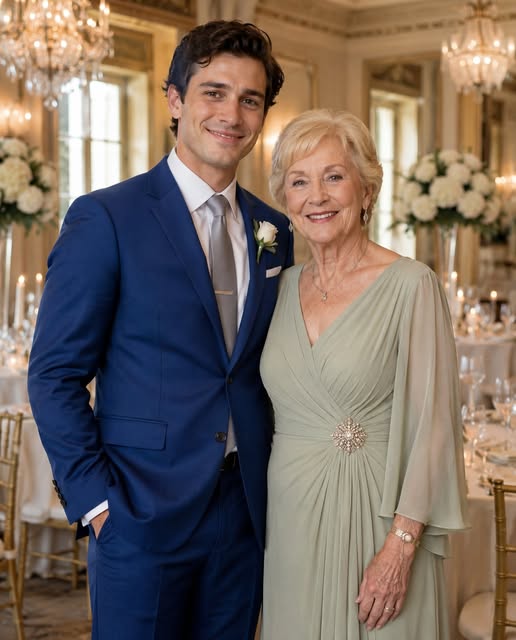

  • I returned home from my trip without warning—and found my wife alone in the living room, crying

    I returned home from my trip without warning—and found my wife alone in the living room, crying

    The Unannounced Arrival: When Family Business Turns Into a Crime Scene

    I came home two days earlier than planned, a bottle of red wine and a box of pastries lying haphazardly on the passenger seat and the carpet. That was the kind of surprise I thought I’d bring home. A small one.

    The transportation conference had ended earlier than expected. Instead of staying alone in the hotel room for two more nights, I changed my ticket and took the first flight home. I didn’t call Sarah. I didn’t text Michael. I didn’t tell anyone, because after more than twenty years of marriage, I still loved the feeling of seeing my wife’s expression change when I walked into the room she thought would be empty until Sunday.

    At 5:18 p.m. that Friday, I drove into the yard and saw Michael’s SUV parked by the curb. That should have made me smile. It didn’t.

    There are little things you notice before your mind lets you grasp the bigger picture. The porch lights were still on even though the sun hadn’t set. The front door wasn’t fully latched. The house smelled of lemon-scented floor cleaner, warm carpet, and something sharp underneath.

    Copper.

    Two Truths in One House

    I pushed the door open with my shoulder, one hand holding a bottle of wine, the other a box of pastries. Then I saw my wife lying on the floor.

    Sarah was sitting up against the beige sofa, one hand on her right eyebrow. Blood had trickled down her temple and soaked into the collar of her cream-colored shirt. It had dripped onto the rug we bought for our 20th wedding anniversary—the rug she always made me step over whenever my shoes got wet. Her knees were pressed together and her shoulders were hunched forward. She looked as if she were trying to take up as little space as possible in the living room she had spent half her adult life making cozy for everyone.

    The bottle slipped from my hand onto the entryway table, but thankfully didn’t break. The box of cookies fell to the floor. Sarah looked at me, her mouth agape as if to explain before I could ask anything.

    That was the first thing that broke my heart. It wasn’t the blood; it was the look of deep remorse etched on her face. I knelt beside her.

    “Sarah, what happened?”

    She tried to shake her head, then grimaced.

    Right then, laughter came from the kitchen. My son’s laughter. Michael had a loud laugh, the kind that used to echo through our garage when he was sixteen and pretended to know more about carburetors than I did. I heard Olivia’s soft chuckle beneath his, followed by David’s voice, deep and satisfied. Then Jessica said something I couldn’t quite make out, and another wave of amusement erupted from the table.

    A house can hold two truths at once, and sometimes that’s what makes it unbearable. In the same room, a woman can be hurt and humiliated, while feet away, everyone can still laugh because they’ve decided her pain doesn’t matter.

    The Price of an Inheritance

    I gently touched Sarah’s wrist. “Who did this?”

    She swallowed, her gaze drifting toward the kitchen. That was all the answer I needed, but she still whispered the rest. “I tried to get rid of them. I won’t sign.”

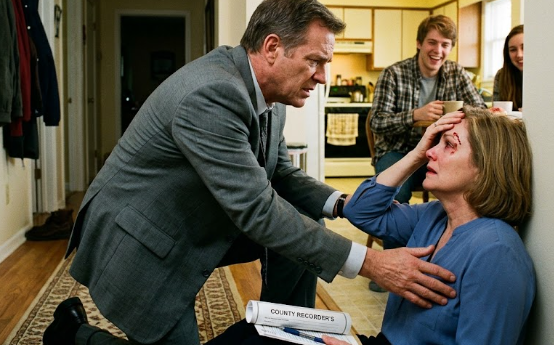
    It was then that I noticed the stack of documents on the coffee table, left open beside a black pen. These papers weren’t bills or family photos. They were ownership transfer forms: a county recorder cover sheet, a notary acknowledgment page, and a draft packet for the little beach house Sarah’s mother had left her.

    That house had been a sore spot for weeks. Michael had started by asking politely. He said David’s restaurant only needed a little bridge money, that selling the beach house made more sense than letting it sit half the year, and that Sarah was just being emotional because the place had belonged to her mother.

    I said no. Sarah said no.

    Michael had acted wounded, as if a parent’s boundary were a betrayal. After that, the calls got shorter and the messages got colder. Olivia stopped sending Sarah photos from Sunday dinners. David began calling the house an “asset,” which told me everything I needed to know about how he saw my wife’s inheritance.

    Sarah had given Michael more chances than he deserved because he was our son. She remembered him as a boy with scraped knees and a crooked grin. She remembered school pickup lines, baseball practices, late-night fevers, and the summer he slept on our floor after his first bad breakup because he didn’t want to be alone.

    That was the trust signal he had counted on: a mother’s memory. He had walked into her living room with papers because he believed she would rather bleed quietly than make him feel ashamed.

    “He grabbed my arm,” Sarah said, her voice sounding embarrassed. “I pulled away. I hit the table.”

    I saw the corner of the coffee table then—a small smear where her eyebrow must have struck.

    Anger is Easy, Evidence is Harder

    Behind me, the kitchen erupted again. David laughed like a man who thought pressure was just negotiating with better posture. For one ugly heartbeat, I wanted to become the kind of man who solved things with his hands. I wanted to walk into that kitchen and make every person at that table feel one-tenth of what Sarah had felt on the floor.

    Instead, I took out my phone. Anger is easy. Evidence is harder. Evidence is what stays when liars start practicing their voices.

    I took three photos first: Sarah’s injury, the blood on the rug, and the open folder with the county recorder form and the notary page visible. The phone recorded the time automatically: 5:20 p.m.

    Then, keeping my voice low, I called 911. I gave the dispatcher our address, stated that my wife had a head injury, that there had been an argument over property documents, and that the people involved were still inside the house.

    The dispatcher told me to stay on the line. I said I would.

    Sarah caught my sleeve when I started to stand. For a second, I thought she was trying to stop me, but instead she whispered, “Don’t let them take it.”

    Not “don’t let them hurt me.” Not “don’t make a scene.” Simply: “Don’t let them take it.”

    That was when I understood how long they must have been wearing her down before I opened that door. I squeezed her hand once. “They won’t.”

    Confrontation in the Kitchen

    I stood up. The doorway between the living room and kitchen was wide enough that I could see the edge of the table before they saw me. There were plates out, glasses, and a twisted napkin near Michael’s elbow. Olivia had her phone facedown beside her fork. David sat in my chair—a small detail that almost set me off more than it should have.

    When I stepped into the kitchen, Michael looked up with a grin still on his face. It disappeared slowly.

    That is the moment I will remember longer than the blood. Not because I enjoyed seeing fear in my son, but because I saw recognition arrive. He knew I was not supposed to be there. He knew his mother was supposed to have time to clean herself up, hide in the bedroom, or swallow whatever story they had planned to tell me.

    Olivia’s fork stopped halfway to her mouth. Jessica’s fingers tightened around the stem of her glass. David leaned back, trying to decide whether to be friendly or offended.

    I put my phone faceup on the counter, the active 911 call filling the screen.

    “Nobody moves,” I said.

    Nobody did. David tried first, because men like that always mistake age and volume for authority. “Now hold on,” he said. “This is family business.”

    I looked at him. “Sit down.”

    Something in my voice made him obey before his pride could catch up. Michael stood halfway up. “Dad, you’re overreacting.”

    The dispatcher’s voice came through the phone speaker, asking whether everyone was safe. I didn’t take my eyes off my son. “My wife is injured,” I told the line. “The people who were pressing her to sign property papers are in front of me.”

    Olivia started to cry then, but it was not the kind of crying that comes from compassion. It was panic. There is a difference. Panic looks for exits; compassion looks toward the person on the floor.

    From the living room, Sarah’s hoarse voice cut through the tense silence. “Check the second page.”

    The entire energy of the kitchen shifted instantly. Michael’s eyes snapped toward the living room folder, and Olivia muttered his name once under her breath.

    I walked back to the coffee table slowly, controlling the urge to move fast. Beneath the deed draft was a clipped witness page—with Olivia’s name already typed neatly beside a blank signature line.

  • My Daughters Forgot My 70th Birthday but Used My Card for a Luxury Vacation Until the Police Showed Up

    Where Safety Is

    I never expected my seventieth birthday to be the day I stopped apologizing for existing.

    I had spent twelve years as a widow and I was good at it, which is not a thing people say directly but which is understood in the way that certain kinds of competence are understood. I paid my own bills and maintained my own house and built my own life from the wreckage of losing a forty-one-year marriage, and I did it without much visible drama. What I was less good at, what I had in fact been quite bad at for more than a decade, was saying no to my daughters.

    That morning in May, I made my coffee the way I had always made it, strong and black, no sugar, the way Richard used to tease me about, and carried it to the sunroom where the rain was doing what it does in Portland, which is tap against everything softly and without apology. The maple tree in the yard bent under the wet weight of the morning. I had nowhere to be. I told myself Jennifer would probably call. I told myself Stephanie might remember.

    At seventy, you learn not to construct too much scaffolding around other people’s obligations.

    I was halfway through the cup when my phone lit up on the wicker side table.

    A credit card alert.

    Four thousand eight hundred and ninety-two dollars charged to the Monarch Bay Resort in Maui.

    I sat with that for a moment.

    The last time I had been to Hawaii was with Richard, our thirtieth anniversary, when he was still strong enough to walk the beach at sunrise and complain with affection about sand getting into his loafers. I had not charged anything to that card in over a year. The card was my emergency reserve, the one I kept in the false bottom of my jewelry box, the one I had mentioned once, years ago, to Jennifer during her divorce when I wanted her to understand that a genuine crisis would not leave her without options.

    I had meant a medical emergency.

    I opened my banking app with fingers that did not quite feel like mine.

    There it was, charge after charge stacked on top of each other like someone had opened a door into my private life and simply helped herself. First-class flights. A luxury suite. Spa treatments. Room service. Resort fees. The full inventory of a vacation that cost more than some people earn in a year.

    All charged to my emergency card.

    The card my daughters knew about.

    While I was staring at the screen, my phone pinged again. Instagram. Stephanie had posted a photo.

    My two daughters, Jennifer and Stephanie, stood beside an infinity pool under an achingly blue Hawaiian sky, their hair blown back, their sunglasses pushed up, each holding a drink so colorful it looked like a prop. They were smiling the specific smiles of women who believe they are exactly where they deserve to be.

    The caption read: Sisters’ getaway. Sometimes you just need to treat yourself. Hawaii, no regrets. Living our best life.

    Posted twenty minutes ago.

    I set my coffee mug down very carefully so it made no sound against the saucer.

    Living our best life.

    On my stolen credit card.

    On my seventieth birthday.

    Something settled in my chest, not cold exactly, not the hot kind of anger either. Quieter. More permanent. Like concrete finding its final form.

    I thought about twelve years of small loans that never came back. Twelve years of my daughters looking at me less like their mother and more like a resource with a heartbeat. The gradual drift from asking to expecting, from asking to simply taking. The way I had let each act of financial generosity go unacknowledged because the alternative was conflict, and conflict felt too much like risking the last pieces of the family I still had.

    I walked to my bedroom and lifted the velvet tray in the jewelry box and pressed the small release under the lining.

    Empty.

    They had not even replaced the false bottom to cover what they had done.

    I picked up my phone and called the bank.

    “I need to report a stolen credit card,” I said. My voice sounded strange to me, very calm. “I need all my accounts frozen immediately.”

    While the representative walked me through the verification questions, another notification appeared. Jennifer had posted a spa selfie. Hotel robe, cucumber water waiting in a glass dish, face soft with pampered satisfaction. The caption said: Day one of total relaxation. Self-care deserved.

    Deserved.

    That word, that specific word, was the one that finally crystallized everything.

    I called my attorney.

    Gordon Whitaker had been Richard’s friend before he became mine, and in the years after the funeral he had helped me do something my daughters did not fully understand. Using the life insurance, the investment accounts Richard had maintained, and a portion of the sale of our family home, I had spent a decade quietly building a real estate portfolio that had grown into something considerably larger than anyone in my immediate circle knew. To Jennifer and Stephanie, I was their comfortable but modest widowed mother who occasionally worried about heating bills. They had no reason to look closer. I had given them no reason.

    “Barbara,” Gordon said when I finished explaining. “This is theft.”

    “I know.”

    “You should file a police report.”

    “Not yet. I want the hotel to handle payment first.”

    A pause.

    “You want them to encounter the consequences in real time.”

    “Yes.”

    He was quiet for a moment. I could picture him in his downtown office, leaning back, thinking it through.

    “Happy birthday, Barbara. I’m sorry this is how it’s unfolding.”

    “I’m not,” I said, and surprised myself by meaning it. “I think this might be exactly what we’ve all needed for a long time.”

    I spent the rest of the morning on the phone with Gordon, with my financial team, with the bank. By noon, every account was secured. Every automatic transfer connected to my daughters had been flagged. I asked Gordon to freeze the trust distributions and flag the estate documents for review pending my decisions.

    Then I sat in Richard’s old armchair, the one I kept in the living room because it was still the most comfortable chair I had ever owned, and I waited.

    The call came at twenty-three minutes past four.

    The Monarch Bay Resort manager, a man named Marcus Reeves, had a professionally pleasant voice that was working harder than usual.

    “We’re having an issue with the credit card on file for your daughters’ stay,” he said.

    “I imagine you are,” I replied.

    He explained the card had been declined and that my daughters were insisting it must be a bank error.

    “There is no error, Mr. Reeves. That card was stolen from my home. I reported it as fraud this morning.”

    A silence.

    “You were not aware they were booking this stay?”

    “No. Nor did I authorize it. Nor did they acknowledge that yesterday was my seventieth birthday.”

    Another silence, this one different in quality. Something human came through the professional voice.

    “I’m very sorry to hear that, Mrs. Collins. Happy birthday.”

    “Thank you. Whatever your standard policy is for nonpayment, please proceed with it.”

    He said that would likely involve hotel security and potentially local authorities. I told him I understood. I thanked him for his time and ended the call.

    For a while I sat in the quiet house. Outside, the rain had settled into that steady Portland rhythm that feels less like weather and more like the city’s resting state. I looked at Richard’s photograph on the side table.

    He had always known when love needed gentleness and when it needed spine. He had tried to teach our daughters accountability, consequences, the connection between choices and outcomes. After he died, I had loosened every standard he had set because I was afraid that grief plus strictness would be too much for them. What I had actually given them was grief plus no floor, and they had been falling slowly ever since, and I had been catching them before they felt the landing.

    That was my mistake.

    Not loving them. Loving them in a way that taught them they did not need to grow.

    The next morning, my phone exploded before I had finished making coffee.

    Twelve missed calls from Jennifer. Seventeen from Stephanie. Thirty-four text messages, beginning with confusion, accelerating through indignation, arriving at panic.

    The card isn’t working.

    This is humiliating.

    Fix this.

    They’re saying the card was reported stolen.

    Are you trying to ruin us?

    Not one said happy birthday.

    Not one said we should not have taken your card.

    The first voicemail was Jennifer, sharp and breathless, telling me to call her immediately, the hotel was threatening police action, it was ridiculous, there had to be a mistake. The second was Stephanie, insisting I fix it now. The third was Jennifer again, her command voice stripped away. They had been asked to leave their room. They were in the lobby. Security was watching. The police had been called.

    Please, Mom. Help us.

    The same pattern, laid completely bare. They created the crisis. They expected me to dissolve it. The only difference this time was that I had created this particular crisis on purpose, and I did not intend to dissolve it.

    My phone rang. Gordon.

    “The hotel video is online,” he said. “Have you seen it?”

    I had not. He sent the link.

    The footage was shaky, clearly taken from across the lobby by another guest. Jennifer stood at the front desk in resort wear that still looked expensive despite her distress, pointing a manicured finger at the manager while Stephanie stood beside her with mascara tracking down her face.

    “Do you know who we are?” Jennifer said. “Our mother is Barbara Collins. She has accounts worth millions. This is obviously a bank error.”

    The manager, Mr. Marcus Reeves, remained composed. “I’ve spoken with Mrs. Collins personally,” he said. “She confirmed you were not authorized to use her credit card.”

    Jennifer’s face changed. Below the outrage, I could see it, something real finally breaking through.

    Then she said it.

    “She’s probably confused. She’s old.”

    I watched the video twice.

    Old.

    Not hurt. Not betrayed. Not their mother.

    Old.

    The word was supposed to mean inconsequential. Manageable. Someone whose perceptions could be explained away, whose card could be quietly borrowed, whose birthday could be forgotten while her money funded someone else’s best life.

    A stranger in the comments had written: Imagine doing this on her birthday.

    I turned the phone face down.

    My doorbell rang midmorning. My neighbor Grace stood on the porch holding a small cake with a single candle.

    “Happy belated birthday,” she said. “I thought you might be celebrating with your girls.”

    That simple kindness broke something in me that the theft and the video had not managed to break. I stepped aside and let her in and started crying in my own kitchen, which was not something I had planned to do that day.

    Grace was a retired nurse and a widow like me, and she understood without requiring an explanation why I was crying while also feeling, somewhere underneath the tears, a peculiar steadiness. She listened to the whole story over tea without interrupting. When I finished, she sat with it for a moment.

    “My Frank used to say that sometimes the most loving thing you can do is let people face the music they chose to play,” she said.

    I smiled. “Richard would have said something like that.”

    Grace looked at me with the clear, tired wisdom of someone who has cared for many people over many years. “What is best for Jennifer and Stephanie right now? Another bailout? Or finally understanding that their choices have weight?”

    After she left, I called Detective Alana Kelihoa with the Maui Police Department, who had called while Grace and I were talking.

    The detective walked me through the situation. The charges amounted to more than twelve thousand dollars when the full stay was tallied. My daughters were maintaining it was a misunderstanding. She asked whether I wanted to press charges.

    I asked what that would mean for them practically. Criminal records were possible. Jennifer’s marketing career, Stephanie’s design clients. The reputations they had cultivated so carefully.

    “I need to consider,” I said. “But regardless of my decision on charges, I will not be paying for their hotel stay or their return flights.”

    Three days later, their car appeared in my driveway.

    They looked like people who had been through something. Jennifer, who had never left her house without armor, was wearing a wrinkled blouse and no makeup. Stephanie’s eyes were swollen. The polished surfaces were gone. What was left was something more honest.

    I let them in.

    In the living room, I let them speak first. Jennifer demanded to know how I could have done this to them. Stephanie said it was humiliating. They had been treated like criminals. The internet video was everywhere. Jennifer’s boss had called.

    I waited until they ran down.

    “It was my seventieth birthday,” I said. “You did not acknowledge it. Instead, I discovered through social media that you were in Hawaii on my stolen credit card.”

    “We were going to pay you back,” Jennifer said.

    “With what money?”

    She stopped.

    “Jennifer, you have borrowed over eighty thousand dollars from me in the past five years. Stephanie, sixty-three thousand. Neither of you has repaid a dollar. Your credit cards are at their limits. You both live beyond your means while treating me as the difference between what you earn and what you want.”

    Their faces changed as they processed the fact that I had been paying attention.

    “How do you know about our credit cards?” Stephanie asked.

    “Because I am not the confused old woman you apparently believed I was,” I said.

    I put a folder in front of each of them. Inside were the new terms. Financial counseling with advisers I had selected. A formal repayment schedule for everything borrowed over the years, with a complete accounting of every transaction I had documented. Fifty hours of community service with organizations supporting elderly victims of financial exploitation. Weekly family therapy with Dr. Elaine Matthews for a minimum of six months.

    Meet the conditions and we could rebuild. Refuse them and they would remain financially cut off permanently.

    Jennifer’s face hardened. She asked what would happen if she went to the media, told them I had abandoned my daughters in Hawaii, accused me of financial abuse.

    “If you choose that path,” I said, “I will release the complete financial records of twelve years of transactions, along with the evidence of how this vacation was funded. I do not think that is the story you want told.”

    The silence that followed was the kind that changes rooms.

    Stephanie broke it. “Did you ever really love us?” she asked in a small voice.

    The question hit harder than anything else she had said.

    “I have always loved you both,” I said. “Enough to finally stop doing things that were harming you. That is what real love looks like sometimes.”

    After they left, I sat in Richard’s chair and let myself feel the full weight of it. The trembling that had been waiting all morning.

    Then I made tea and called Gordon and gave him my instructions.

    The weeks that followed were not simple. They rarely are when patterns that have been building for twelve years begin to change.

    Stephanie enrolled in financial counseling first. She sent flowers five days after the confrontation, a modest arrangement of daisies with a card that said only I’m sorry. No paragraph of explanation, no attempt to reframe herself as the injured party. Two words. For once, the simplicity gave them the weight they needed.

    Jennifer took longer. She missed one therapy session without explanation. She sent a furious text after Jennifer’s ex-husband mentioned seeing me on a local news segment. She called once to argue that the repayment schedule was unrealistic.

    Then, six weeks in, she appeared on my porch unannounced with an envelope.

    “My first repayment,” she said. “Five thousand dollars. It’s a start.”

    I looked at the cashier’s check.

    “I sold some things,” she said, not looking at me. “The Peloton. Some designer bags. And I’ve taken on freelance work.”

    Jennifer had always defined herself by those possessions. They were part of how she communicated that she had arrived somewhere she felt she deserved to be. Selling them to make amends was not easy for her, and I could see that it was not easy, and I appreciated it more for that.

    She looked out at the garden rather than at me.

    “I saw you on the morning show.”

    “Oh?”

    “You were good. Articulate. You seemed sure of yourself.”

    From Jennifer, this was significant praise.

    “I’ve been thinking about why I’ve been so angry,” she said. “Dr. Matthews has been helping with that.” A pause. “I think I’m jealous. All these people are suddenly seeing this accomplished woman with things worth saying. And I spent years dismissing you.” She swallowed. “It’s uncomfortable to understand how wrong I was.”

    We sat in silence for a moment.

    “There’s something else,” she said. “My company is developing financial literacy programs. Given what you’ve been doing publicly, I thought you might consult on the curriculum. As a paid professional. Not as my mother doing me a favor.”

    I looked at her.

    Jennifer was asking to learn from me. Asking to pay me for my expertise. Treating me as someone with value that existed entirely outside of what she could extract.

    “I’d be happy to discuss it,” I said. “Though my calendar has become quite full.”

    A small smile crossed her face.

    “So I’ve heard. Stephanie and I ordered you a birthday mug.”

    “What does it say?”

    “Boundary Barbara.”

    I groaned.

    “Please don’t.”

    “Too late,” she said.

    I laughed despite everything.

    After she left, I sat with the cautious warmth of that moment. Not naive. Not restored to some previous state before the theft and the video and the lobby in Maui. Something more honest. Something that had been built from the actual material of who we all were, rather than from what I had wanted us to be.

    In therapy, Dr. Matthews did not let any of us avoid the harder questions.

    In the fourth session, she said that dynamics like ours are rarely created by one person.

    “Barbara, you received something from this arrangement,” she said, “or it would not have continued for twelve years.”

    It stung. It was true.

    I had wanted their love. I had been afraid of becoming irrelevant, of being left at the edges of their lives rather than needed at the center. Each loan had purchased me a guaranteed role.

    “The financial support gave you a place in their lives,” Dr. Matthews said.

    “A place that came at a cost,” Stephanie said quietly.

    “To Mom,” she continued. “And to us. We never had to fully grow up. There was always someone to catch us.”

    Jennifer said nothing, but I saw recognition move through her face.

    The public dimension of what followed was something I had not anticipated and did not seek. The local interview Gordon had arranged became a longer segment. That led to a radio program. Then a podcast, then a national morning show interested in women’s financial independence. The comments and emails that came in afterward were not about me specifically. They were from women who recognized something in the story. Mothers and widows who had been quietly drained for years. Women who had spent their whole lives making everyone else comfortable and were trying to figure out how to stop.

    I answered as many as I could.

    A publisher approached Gordon about a book. I told Gordon I was a seventy-year-old retired teacher who preferred quiet mornings and her garden to public attention, and he said that was exactly why people wanted to hear from me.

    I turned down the reality television offer. I turned down anything that seemed to want spectacle rather than substance. I kept the conditions in place with my daughters and did not relax them when things became uncomfortable.

    What I did do was write.

    The book took shape slowly, not as a self-help prescription but as an honest account of how a woman disappears inside her own generosity, and what it takes to find herself again. I wrote about Richard, about the particular loneliness of widowhood, about the ways grief can make you generous past the point of wisdom. I wrote about the morning of my seventieth birthday and the Instagram photo and the false bottom of the jewelry box.

    I wrote about sitting in Richard’s armchair asking him what he would do and knowing, in some wordless way, that he would tell me to stand up.

    Stephanie completed thirty hours at the senior center and told me, somewhat shyly, that she found the work more meaningful than anything she had done in years. Jennifer enrolled in the counseling, kept most of her therapy appointments, and consulted with me twice on the curriculum project. We still had difficult conversations. Some of them were quite hard. But they were real conversations, between real people, without the buffer of my money smoothing over every rough edge.

    On a Saturday in late September, I took the book manuscript to the coffee shop near Hawthorne Boulevard where Grace and I had started meeting every other week. I was three chapters from finishing.

    On the table beside my coffee was the mug my daughters had given me. I had left it in the cupboard for two months. Then one morning I had taken it out and used it.

    Boundary Barbara.

    Not the name I would have chosen for myself.

    But perhaps the name I had earned.

    Grace arrived and looked at the mug and smiled.

    “How do you feel?” she asked.

    “Tired,” I said. “And more like myself than I have felt in years. Both at the same time.”

    She ordered her tea and looked at me across the table with the directness she had always used.

    “Richard would be proud of you.”

    “Gordon keeps saying that.”

    “Because it’s true.”

    I looked out the window at the September street, at the yellow leaves beginning to come down from the maples, at the ordinary Portland morning going about its business.

    I had spent a long time making myself small enough to keep the peace. I had called that love, and some of it was, but some of it was fear, and the two look very similar from the inside. The fear of being alone. The fear that love requires earning, and that the price of a mother’s love is unending convenience.

    What I knew now, at seventy, imperfectly and still learning, was that the love worth having is the kind that asks something real of both people. Not money. Not blind loyalty. Not the performance of perfect family photographs.

    Something harder and more durable.

    Honesty. Accountability. The willingness to be uncomfortable for the sake of someone’s actual growth.

    Richard had understood that. He had tried to pass it on to our daughters and I had undone his work after his death out of grief and loneliness and the terrible fear that I could not afford to love them in a way that cost them anything.

    I could not give them back the years of habits I had let grow unchallenged. I could not undo the morning of my seventieth birthday.

    What I could do was show them, one difficult conversation at a time, what a different kind of love looked like.

    And perhaps, in whatever years I had left, I could show a few thousand strangers the same thing.

    I closed my laptop and finished my coffee and let Grace talk about her granddaughter’s new school, and I listened, and the morning moved gently around us, and I was grateful for all of it.

    The rain came in around noon.

    I walked home through it without hurrying.

  • After The Divorce Bradley Said There Was Nothing To Divide Then I Left The Penthouse Keys And Two Passports On The Table

    The gold pen felt strangely heavy in my hand when I lifted it.

    When I finished signing the divorce papers, the grandfather clock in the mediator’s office struck nine in the morning. I had spent weeks telling myself I did not know what to expect when this moment came. The honest answer was that I expected pain. Sharp and physical, the kind that breaks you open and leaves you on the floor. Maybe tears, maybe something that would have to be controlled with visible effort in front of Bradley and his family.

    What arrived instead was emptiness.

    Not the soft emptiness of peace, not yet. Just the specific, neutral emptiness of a space where something has been removed, the way a room feels different after furniture is moved and before anything replaces it.

    My name is Sarah. I am thirty-four years old, a mother of two, and eight minutes after I placed that pen on the mediator’s table I was legally finished with a marriage that had been unraveling for years and definitively broken for three.

    Before the ink dried, Bradley’s phone rang.

    He answered without stepping outside the room or lowering his voice.

    “Yes, babe,” he said, and the softness in the word was something I had never heard him direct at me in ten years. “I’m almost done here. Don’t worry, I haven’t forgotten the ultrasound. Mom and everyone will meet you there. Your baby is the heir, after all.”

    The mediator looked somewhere between uncomfortable and professionally exhausted.

    She pushed the final asset documents toward Bradley.

    He barely looked at them. He signed with the confidence of a man who has already decided none of it matters and tossed the papers back.

    “There’s nothing to divide,” he said. “The penthouse is mine. The SUV is mine. If she wants the kids, she can take them.”

    His sister Brittany was in the corner of the room and she smiled at this in the particular way of someone who enjoys witnessing the diminishment of another person.

    “He’ll be marrying a real woman soon anyway. One who’s actually carrying his son.”

    An aunt near the window contributed, without looking up from her phone, that I would come crawling back within a month. That no one wanted a woman with two children.

    These sentences floated through the mediator’s office. I noticed them. I catalogued them with the mechanical precision I had developed over the preceding three years, the same discipline that had allowed me to hold myself together through late-night discoveries, through the specific humiliation of being lied to by someone who had looked you in the face daily, through the long and careful process of building something that could not be dismantled by surprise.

    I stood, reached into my purse, and placed the penthouse keys in the center of the table.

    “These are yours,” I said.

    Bradley smirked. “Good. You’re finally learning your place.”

    I took out two navy-blue passports.

    “The visas were approved last week,” I said. “I’m taking the children to study in London.”

    The room went quiet in the way rooms go quiet when the shape of a conversation has been unexpectedly altered.

    Brittany recovered first. “Are you insane? Do you have any idea what that costs? You don’t have money.”

    I looked at her evenly.

    “That is no longer your concern.”

    The office doors opened. A uniformed chauffeur stepped inside.

    “Miss Sarah, the car is ready.”

    Through the lobby windows, a black Mercedes waited at the curb.

    Bradley was on his feet. “Who is paying for this?”

    I took my children’s hands. Madison on the left, Connor on the right.

    “From this moment on,” I said, “the children and I will not interfere with your new life.”

    Then I walked out.

    I want to tell you how I got there, because leaving is never the whole story, and the part that came before is what gave the departure its particular weight.

    I had met Bradley when I was twenty-three. He had a specific kind of confidence in those years, the kind that looks like certainty when you are young and tired of uncertainty. When you are young and tired of uncertainty, certainty in another person can present itself as something you have been waiting for without knowing you were waiting, a kind of shelter. What I did not understand at twenty-three was that some shelters are cages built to a more generous dimension, and that the generous dimension is what keeps you from noticing the bars for a long time.

    Bradley’s confidence was real in the sense that his belief in his own authority was genuine and consistent. What it was not was security. It was control presented as protection, and it arrived slowly enough that by the time I could feel the difference, I had organized my entire life around the person exerting it.

    I gave up a career I had been building to support his, which was framed as a practical decision given his earning potential and which I accepted because I was twenty-five and believed that practical decisions made in service of a shared future were what adults did. I moved entirely into his world. His family, his social circle, his framework for what mattered and what could be disregarded. Brittany had made her assessment of me visible from the first month: I was adequate, at best, and only temporarily so. Bradley had never protected me from it. He had occasionally noted that she could be difficult, which was a different thing entirely.

    I had believed him for longer than I should have.

    The discovery arrived the way the most significant things arrive: quietly, sideways, when I was doing something else. A bank statement that passed through my hands because I managed the household accounts, which Bradley considered administrative rather than consequential. A transfer in the wrong column for an amount that was not small. A discrepancy between the statement and the corresponding company records I had access to as a co-owner of two of Bradley’s business structures, a status I had not thought much about until that afternoon.

    I have a degree in English literature and I am the kind of person who reads every contract before signing it and balances her accounts to the cent. People underestimate what close reading teaches you. Every text has a subtext. Every set of numbers tells a story if you know what you are looking for.

    I read the statement twice. Then I looked at the corresponding records. Then I called Harrison.

    Harrison was my father’s attorney, a man in his late fifties who wore unremarkable suits and had the patience of someone who understood that haste in his profession almost always produced worse outcomes than the delay it was trying to avoid. He had handled my father’s estate and had, during that process, developed respect for the way I managed difficult information without losing my clarity. When I called him I was not emotional. I was factual. I presented him with the statement and four months of additional documentation I had been quietly assembling since the first discrepancy, and I asked him to tell me what I was looking at.

    He told me to gather everything I could find and to do it without announcing what I was doing to anyone.

    I spent the next two and a half years gathering.

    I had access, through the household accounts and my co-ownership position, to patterns of spending that accumulated into a story. Every discrepancy noted. Every transfer cross-referenced. Every pattern identified and documented with dates and amounts and corresponding evidence. I did this the way I had done every difficult thing in my adult life: methodically, without self-pity, with the understanding that precision was the only advantage available to me and that I should not waste it.

    The condo my parents had helped us buy as a wedding gift appeared in a transfer record eighteen months into my investigation. The name attached to the account receiving funds was one I recognized from other documents.

    Tiffany had entered Bradley’s life at least two years before the divorce, though the prior proximity was longer than that, and I had suspected something for a year before I confirmed it. The confirmation, when it arrived, did not produce the explosion of grief I might have expected. By then I had been preparing for long enough that confirmation was simply the last piece of evidence, the one that made the file complete rather than the one that broke me open.

    I called Harrison. I told him the file was complete. I told him I wanted to choose the day.

    We chose the day of the ultrasound, which Brittany had announced to anyone who would listen, because it was the day Bradley had organized the most people around his new life, and the collapse of that day would be legible to everyone who had been watching him construct it.

    The passports had been obtained three months in advance. Harrison had handled the financial preparations through proper channels: a private account established in my name alone, funded through a portion of the assets I was legally entitled to as a co-owner of two of Bradley’s company structures. The law, applied carefully and patiently, is a precise instrument. Most people apply it in anger, which is when it is least precise and most expensive.

    Inside the Mercedes, the driver handed me a sealed envelope containing bank records, transfer receipts, and photographs of Bradley and Tiffany signing papers for a luxury condo that had originally been purchased with a down payment my parents had provided when we were first married. My phone buzzed.

    Harrison: The trap is set. They just arrived at the clinic.

    I put the phone face down and turned to my children.

    Connor was already half asleep against the window, his head finding the angle it found in every car, every journey that had a rhythm he could trust. Madison was eight and was watching the city move past with the attentiveness of a child who has learned that environments change without warning and that watching carefully is how you stay ready.

    “Where are we going, Mom?” she asked.

    “To the airport first,” I said. “And then to a quieter place.”

    She considered this.

    “Will there be a garden?”

    I thought of what William had described when I called him, the townhouse with the red door and the small garden behind it.

    “Yes,” I said. “There will definitely be a garden.”

    She accepted this and returned to the window, and I looked at her profile in the early light and thought about the signed documents left on the mediator’s table and the life waiting across the ocean.

    The fear that had lived in my stomach for three years was not there.

    Its absence had a specific quality: not joy yet, but the clean neutral feeling of a weight removed, the sensation of walking normally after something heavy has been taken off your back.

    While we drove to the airport, Bradley was heading toward what he believed was the beginning of everything he had traded a decade of marriage for.

    He did not know that the judge had signed the injunction.

    He did not know that his three largest business partners had received, through anonymous channels Harrison had been careful to make properly anonymous, documentation about specific financial irregularities in the company accounts. He did not know that by the time he was sitting in the waiting room at Hope Reproductive Health Center, watching Tiffany accept expensive organic juices from Brittany, his accounts had already begun to freeze.

    His mother, Margaret, had arrived with the energy of a woman attending a coronation. Tiffany sat in a designer maternity dress looking exactly as Bradley’s mother wanted her to look: young, healthy, glowing, the bearer of continuity. Bradley stood by the window with the specific pride of a man who has fully convinced himself that what he has done is not destruction but construction, that the life he has built on the ruin of another one is a legitimate act of will.

    The ultrasound room was small and quiet.

    The doctor moved the probe across Tiffany’s stomach with the methodical attention of a professional doing a job, and then he stared at the monitor with an expression that had gone neutral in the specific way that neutral is not reassurance.

    He measured once. Then again.

    Bradley grew impatient. “What is it? Is my son healthy?”

    The doctor reached for the intercom. “Security to Ultrasound Suite 3. Send legal as well.”

    Bradley froze.

    The doctor’s voice remained entirely calm. “Mr. Bradley, are you confident you are the father of this child?”

    The timeline, the doctor explained, did not match. The fetus’s development placed conception at least five weeks earlier than the date Tiffany had provided. The room went cold in a way that had nothing to do with temperature. Margaret pushed inside demanding answers. Brittany followed. The doctor repeated the finding plainly, the way doctors state facts that are not his fault or his problem to manage: the timeline did not match Mr. Bradley.

    Bradley turned to Tiffany.

    Before she could speak, his phone rang.

    His CFO. Three major partners pulling their accounts simultaneously. Documents about internal financial irregularities. His face had gone from flushed to white.

    Then another notification. Asset freeze. Then a declined card. Then a banker confirming the injunction.

    Harrison, when Bradley called him, was calm.

    “My client kept records for three years. Misused marital funds. Company money moved into real estate purchases connected to your mistress. The IRS has been notified. I would suggest going to your office. Federal investigators arrived approximately forty minutes ago.”

    By the time Bradley had absorbed all of this, I was thirty thousand feet above the Atlantic.

    Connor was asleep against my shoulder. Madison had her face against the window, watching the clouds.

    “Mommy,” she whispered, “are we going back to the loud house?”

    I put my hand on her hair.

    “No, sweetheart. We’re going to a quiet house with a garden.”

    She smiled the smile of a child who has been waiting for exactly that answer.

    “Good,” she said. “I didn’t like when Daddy yelled.”

    Her words hurt, because the true things children say about their childhoods always hurt the parents who were trying to protect them from exactly that. But they also confirmed what I had known and had acted on. The fear that had lived in my stomach for three years was gone. What replaced it was not yet joy, not yet. But the absence of fear has its own specific quality, like stepping into open air after a long time indoors.

    In New York, the federal investigators were boxing up files and seizing hard drives. Bradley’s lawyers declined to take his calls when the retainer payment bounced. Without money to deploy, Bradley had no leverage. Without leverage, every relationship built on his ability to provide or intimidate dissolved with remarkable speed.

    Harrison visited him that evening with a formal settlement offer.

    “Sign over your remaining company equity as part of the divorce settlement,” Harrison said, “and Sarah will classify certain transfers as marital disputes rather than pursuing every federal complaint individually.”

    “You want my company,” Bradley said.

    Harrison had a very small smile.

    “She already has it. The board removed you an hour ago.”

    Bradley’s phone buzzed. The DNA results from the clinic.

    Probability of Paternity: 0.00%.

    Everything he had dismantled his marriage for, the heir, the new beginning, the woman who was carrying his son, had been a lie. He was left with the consequences of a destruction he had performed in service of something that was not real.

    He signed.

    The legal proceedings took weeks to complete. By the end, Bradley had lost the penthouse, the cars, the company, and most of the relationships that had defined his social world. He moved into a small apartment and took a mid-level accounting job. The arc of that fall is significant only as context.

    London was practical and demanding in the way that new beginnings always are. The first weeks were full of schools to register for, accounts to open, the specific administrative labor of establishing a life in a city that does not know you yet. I welcomed the labor. Work has always been where I go when I need to be only myself, without the performance of a role someone else has written.

    I had spent years before Bradley working as a literary translator, before I was guided toward a more suitable domestic arrangement. I returned to it the way you return to something you were good at before circumstances interrupted you: with the feeling of putting on clothes that still fit. The work was quiet and precise and entirely my own, requiring the same close reading that had served me well during the three years of documentation. I was paid to understand what a writer meant and render it faithfully in a different language, which turned out to be exactly the kind of work I needed to be doing.

    Within six months I had a small roster of reliable clients. Within a year I had a reputation for precision and sensitivity that attracted better commissions. Publishers began seeking me out for difficult texts, the ones where the translator’s judgment mattered as much as their technical skill. I was not rebuilding myself around this work. I was discovering what I had put down before Bradley made it inconvenient and finding it intact, waiting exactly where I had left it.

    Connor and Madison filled the townhouse with the sounds of childhood lived without anxiety. Schoolbooks on every flat surface. Football cleats by the front door. The specific productive chaos of children who have been told the house is theirs. Arguments about television. Laughter at dinner that sometimes ran so long the food went cold. The ordinary and irreplaceable evidence of children who have been removed from an environment where the emotional weather was controlled by one person’s moods.

    The improvements in both of them arrived quietly and took time to name. Madison stopped waking in the night with the worried expressions I had been seeing for two years. Connor stopped flinching at sudden sounds. These were not dramatic recoveries. They were the gradual subsidence of a state of vigilance that children develop when the environment they inhabit is unpredictable, and their subsidence confirmed what I had known and acted on.

    I met Ethan through a publishing connection in the second year. He was a quiet man with the specific considerateness that shows up in small choices: asking what I thought and waiting to hear the answer, paying attention to the details I mentioned without making a display of having done so. He had no interest in arranging my life and strong interest in understanding it. I did not fall in love the way I had fallen in love at twenty-three, with a rush of certainty about someone I had not yet had reason to doubt. I arrived at it slowly, with considerably more information and considerably less fear. It was, I thought, a better way to do it.

    There is something that happens to a person after they have spent three years preparing for a departure in secret. The act of preparation changes you, partly in the obvious ways but also in subtler ones. You develop a specific relationship with your own judgment. You make a decision without outside validation, you act on it methodically and over a long period, and then the decision proves sound, and you discover that you can trust yourself in a way that was not available to you before. You understand that the patience required was worth what it cost. You understand that precision, applied to your own life, produces different results than passion, which is not to say passion has no value but that in certain situations it is the less useful instrument.

    I had been passionate at twenty-three. I had believed in Bradley with the unreserved conviction of someone who had not yet accumulated much evidence about how people behave when their interests conflict with their stated values. I had organized my life around that belief and paid for it over a decade. And then I had gathered my evidence, made my preparations, chosen my day, and walked out of a mediator’s office into a car that was already waiting.

    I thought about this sometimes in the evenings in London, after the children were in bed and the house was quiet in the specifically good way that quiet houses are quiet. I thought about the woman who had signed those divorce papers and the woman who had stood in an apartment on the Upper West Side ten years earlier believing the gold pen in her hand meant something durable. I did not feel contempt for that earlier version of myself. She had believed what she believed in good faith and had learned what she learned through experience, which is the only reliable teacher.

    What I felt for her was something closer to tenderness.

    She had survived the learning and ended up here, in a townhouse with a red door, with children who laughed freely and work she had chosen and a man who stood beside her without trying to stand in front of her. The path between those two women had been steep and had cost more than it should have. But it had been walked.

    One afternoon in the second year, the doorbell rang while I was in the kitchen.

    Tiffany stood on the step in the drizzle, looking older than I remembered and tired in a way that had nothing to do with the weather. She said she knew she had no right to be there. She said she wanted to say she was sorry.

    I studied her for a moment.

    “Your apology is heard,” I said.

    I meant it genuinely. There was nothing left in me of the anger I had felt at various points during the three years of documentation and preparation. What remained was simply distance, the natural distance between two people whose lives had intersected destructively and who were now occupying entirely separate worlds.

    “You didn’t destroy my marriage,” I added, because it was true and she should know it. “You exposed what was already broken.”

    Then I closed the door.

    Inside, the children were setting the table and Ethan was pulling dinner from the oven, and the sounds of the house were exactly the sounds I had imagined when I sat in the mediator’s office with that gold pen in my hand and felt the emptiness before I understood what it was making room for.

    On the counter sat a letter that had been forwarded from an address I no longer lived at. I recognized Bradley’s handwriting.

    I held it for a moment without opening it.

    I thought about what it might contain. Justification, perhaps. Or its opposite, some form of acknowledgment that had arrived too late to matter. Perhaps simply a practical communication about something administrative I had not fully closed.

    I thought about what I would have needed from him at various points in the previous years and whether any letter could provide it retroactively.

    Then I dropped it into the fireplace.

    I watched the paper curl at the edges, blacken at the center, and reduce to ash in the way that all paper eventually does when it meets sufficient heat.

    I did not need to read his ending.

    I had been writing my own for three years, sentence by careful sentence, and the one I was living in now was good. It was not the story I had expected to be writing at thirty-four. It was not the story I had planned at twenty-three, standing in a borrowed dress at a borrowed beginning, believing that the confidence of the person beside me was a form of protection I could rely on.

    It was mine. That was the thing about it that mattered most.

    Not perfect, not painless, not without the marks of everything it had cost to arrive at.

    Mine.

    The fire settled. Ethan called everyone to the table. Connor and Madison appeared from their rooms in the particular noisy rush of children answering the call to dinner, and I put down the glass I was holding and went to sit with my family in the quiet house with the garden.

    Outside, London rain moved through the streets. Inside, the lights were warm and the table was full.

    I was not writing an ending. I was writing what comes after endings, which is harder and takes longer and is worth every word.

    Lila Hart is a dedicated Digital Archivist and Research Specialist with a keen eye for preserving and curating meaningful content. At TheArchivists, she specializes in organizing and managing digital archives, ensuring that valuable stories and historical moments are accessible for generations to come.

    Lila earned her degree in History and Archival Studies from the University of Edinburgh, where she cultivated her passion for documenting the past and preserving cultural heritage. Her expertise lies in combining traditional archival techniques with modern digital tools, allowing her to create comprehensive and engaging collections that resonate with audiences worldwide.

    At TheArchivists, Lila is known for her meticulous attention to detail and her ability to uncover hidden gems within extensive archives. Her work is praised for its depth, authenticity, and contribution to the preservation of knowledge in the digital age.

    Driven by a commitment to preserving stories that matter, Lila is passionate about exploring the intersection of history and technology. Her goal is to ensure that every piece of content she handles reflects the richness of human experiences and remains a source of inspiration for years to come.

    Categories: Stories
    Lila Hart

    Written by:Lila Hart All posts by the author

    Lila Hart is a dedicated Digital Archivist and Research Specialist with a keen eye for preserving and curating meaningful content. At TheArchivists, she specializes in organizing and managing digital archives, ensuring that valuable stories and historical moments are accessible for generations to come. Lila earned her degree in History and Archival Studies from the University of Edinburgh, where she cultivated her passion for documenting the past and preserving cultural heritage. Her expertise lies in combining traditional archival techniques with modern digital tools, allowing her to create comprehensive and engaging collections that resonate with audiences worldwide. At TheArchivists, Lila is known for her meticulous attention to detail and her ability to uncover hidden gems within extensive archives. Her work is praised for its depth, authenticity, and contribution to the preservation of knowledge in the digital age. Driven by a commitment to preserving stories that matter, Lila is passionate about exploring the intersection of history and technology. Her goal is to ensure that every piece of content she handles reflects the richness of human experiences and remains a source of inspiration for years to come.
  • “My billionaire ex-husband sat beside me on a flight just to shame me—then three little boys stepped out of a Bentley and ran toward me, calling, “Mom!”

    Part 1 of 3

    PART 1

    Five years after our divorce, my billionaire ex-husband chose the seat beside me in first class just to remind me of everything he thought I had lost. He believed I was alone. He believed I had spent years regretting him.

    What he didn’t know was that when we landed in Chicago, three little boys would run from a waiting Bentley straight into my arms—and the truth he had ignored for five years would break everything he thought he knew.

    My name is Chloe Vance, and Harrison Sterling was the last person I expected to see that morning.

    The moment he entered the first-class cabin, I knew him immediately. Five years had passed since our divorce, but some people leave marks time does not fully erase.

    For one brief second, our eyes met. Then his face hardened.

    “You’ve got to be kidding me,” he said.

    I closed the book in my lap. “Trust me, Harrison. If I had known you were on this flight, I would have driven.”

    A few passengers glanced our way. Harrison seemed to enjoy being watched.

    The flight attendant checked his ticket. “Mr. Sterling, your seat is—”

    “I know where my seat is.”

    To my disbelief, he sat right beside me, even though there were empty seats elsewhere.

    “There are other places you could sit,” I said.

    “I know.”

    “Then why here?”

    A cold smile touched his mouth. “Five years of silence. I thought we should catch up.”

    I turned back toward the window. “You always confused cruelty with confidence.”

    “And you always confused secrets with innocence.”

    My stomach tightened. There it was. The accusation that had destroyed us.

    Five years earlier, Harrison and I had been one of New York’s most admired couples. He was the billionaire founder of a clean-energy empire. I was the environmental scientist who helped build the technology behind much of it.

    Together, we were everywhere. Magazine covers. Charity events. Business conferences. People called us unstoppable.

    Then everything fell apart. Harrison found messages on my phone. Messages he misunderstood. Messages I never got the chance to explain.

    I still remembered standing in our penthouse while Manhattan glittered beyond the windows.

    “Who is he?” Harrison demanded.

    “There is no affair.”

    “Then explain these messages.”

    But he did not want an explanation. He wanted proof for the story already forming in his mind.

    Within months, lawyers stepped in. Trust disappeared. And our marriage ended.

    Now, five years later, we were sitting side by side thirty thousand feet in the air.

    “You vanished,” Harrison said suddenly.

    “I moved on.”

    “Without taking a dollar.”

    “I didn’t want your money.”

    That seemed to bother him more than it should have.

    For hours, we drifted between silence and old pain. Neither of us admitted how much it still mattered.

    When the plane finally landed in Chicago, I felt relieved. I grabbed my bag and walked toward the terminal. Behind me, I could feel Harrison watching.

    Outside the airport, black SUVs lined the curb. Executives. Drivers. Security teams. The kind of world Harrison still belonged to.

    Then a black Bentley pulled forward. The rear door opened. Three little boys jumped out.

    “Mom!”

    Their voices rang across the pickup area. Before I could even breathe, they were running toward me.

    One wrapped his arms around my waist. Another grabbed my hand. The youngest nearly knocked me backward with his hug.

    I laughed through sudden tears. “Hey, my sweet boys.”

    Then I looked up.

    Harrison had not moved. He stood frozen near the curb, his face completely pale.

    Because all three boys had my eyes. But they had his face. The same dark hair. The same smile. The same unmistakable Sterling features.

    For several long seconds, no one spoke.

    Then Harrison took one slow step forward. His voice barely came out.

    “Chloe…”

    I turned toward him. And for the first time in five years, I saw real fear in his eyes.

    Because he had just understood the impossible.

    The messages that ended our marriage had never been about another man. And from the way he stared at those boys, he was finally beginning to realize what he had truly lost…

    Part 2: For a moment, the old Harrison seemed to flicker through—the man she had loved before pride and suspicion destroyed them. Then his mask returned.

    “I want to talk.”

    “I want to take my sons home.”

    His eyes flashed. “Our sons.”

    The air changed.

    Leo looked up. “Our?”

    Harrison realized his mistake too late.

    “Mom,” Leo asked carefully, “is he our dad?”

    Chloe knelt in front of them, wishing she could undo the moment.

  • I gave him two weeks, but he was gone that very night. ??


    A week later, I panicked when I got an email saying that he had been sleeping in his car and working night shifts at a warehouse across town.

    My heart dropped.

    I sat there staring at the screen, reading the message over and over again. He wrote that he didn’t want to ask for help because he wanted to prove he could finally stand on his own. He said my words hurt, but they also woke him up.

    “I know you’re disappointed in me,” he wrote. “But I promise I’m trying now.”

    I felt a heavy weight in my chest. I thought kicking him out would force him to grow up—but I never imagined he’d be struggling like that alone.

    For years, I had watched him waste time, sleeping late, playing games, and ignoring every chance to build a future. I was frustrated and scared he would never change. That’s why I gave him those two weeks. I thought it was the only way.

    But now, all I could think about was my son sitting alone in a cold car somewhere.

    I immediately called him.

    He didn’t answer.

    I tried again and again until finally he picked up. His voice sounded tired but calm.

    “Hey, Mom.”

    I could barely speak. “Why didn’t you tell me you were sleeping in your car?”

    He paused for a moment.

    “Because you were right,” he said quietly. “I needed to grow up.”

    Tears rolled down my face. I told him he didn’t have to prove anything like that. I told him he could always come home.

    But he surprised me again.

    “I’m okay,” he said. “I already saved enough for a small room near work. I start training for a better position next week.”

    For the first time in years, I heard confidence in his voice.

    In that moment, I realized something: the boy I thought would never change was finally becoming a man.

    And while my heart still hurt thinking about that night he left, a small part of me knew that maybe… just maybe… that tough love gave him the push he needed to start his

  • I found my daughter and my six-year-old granddaughter sleeping on a freezing park bench, and when I asked what happened to the apartment I had spent my entire life paying for, she looked at me through tears and whispered, “THEY TOOK EVERYTHING FROM US.”

    Part 1: The Bench Outside the Church

    “My daughter and granddaughter weren’t missing. They were sleeping on a park bench like they had nobody left in the world.”

    That realization shattered me on a cold Sunday morning outside the San José parish in Puebla. I had just finished Mass and was walking slowly toward the plaza with my shopping bag hanging from my arm when I saw Lucía curled protectively around little Sofía beneath an old blanket beside the kiosk.

    I am Mercedes Rojas, a retired nurse who spent forty years working for the Mexican Social Security Institute. Throughout my career, I witnessed illness, accidents, and families collapsing under grief, but nothing prepared me for seeing my own daughter sleeping outside with my six-year-old granddaughter as if they had been abandoned completely.

    Sofía looked nothing like the cheerful little girl who usually ran through my kitchen wearing pink ribbons and a perfectly pressed school uniform. Her shoes were dirty, her lips cracked from the cold, and her tangled hair made her look exhausted despite her age. Lucía looked even worse.

    When she saw me, she whispered “Mom” so softly it barely sounded like a voice at all. What I saw in her eyes wasn’t embarrassment anymore. It was defeat.

    I sat beside them slowly and asked where her apartment and car were, because I personally paid for both when she married Adrián. After decades of double shifts, night duty, and sacrifices, I bought that apartment so my daughter would never depend financially on a man.

    Lucía held Sofía tighter before finally telling me the truth.

    Adrián and his family had taken everything.

    At first, I refused to believe it was possible because the apartment had always been in Lucía’s name. Then she explained that Adrián and his mother, Beatriz, convinced her to sign documents they claimed were connected to a banking procedure. Later she discovered those papers actually transferred ownership of the apartment directly to Adrián.

    That wasn’t the only thing they stole.

    They emptied her savings account, sold the car, and eventually used legal connections to portray Lucía as unstable and aggressive once she started protesting. Beatriz, who worked as a lawyer and always considered Lucía socially inferior, handled everything personally.

    When I asked how long they had been sleeping outside, Lucía hesitated before answering quietly.

    Four nights.

    Four nights while Adrián remained inside the apartment I paid for, already living there with another woman. My chest tightened so hard I could barely breathe imagining my granddaughter exposed to cold sidewalks while those people enjoyed comfort built from fraud and manipulation.

    I immediately took them to a nearby restaurant and ordered hot broth, sandwiches, and hibiscus water. Sofía ate hungrily but silently, while Lucía barely touched her food before revealing something even worse. Adrián planned to request full custody of Sofía by arguing Lucía no longer had stable housing or financial security.

    Lucía believed she had already lost.

    She told me Adrián’s family had lawyers, money, and connections while she had nothing left. I looked directly at her and reminded her that she still had me.

    She immediately worried they would use my age and health against her too. According to Beatriz, an elderly retired woman supposedly could not help raise a child responsibly. Hearing that insult almost made me laugh because I spent four decades caring for patients, supporting families through disasters, and building relationships money could never purchase.

    Lucía kept insisting the Robles family was too powerful to fight.

    I corrected her immediately. They were not powerful. They were abusive, and abusive people only appear untouchable while everyone around them stays afraid.

    That afternoon, I brought Lucía and Sofía home with me. Sofía took a hot bath, hugged an old teddy bear Lucía once loved as a child, and finally fell asleep safely for the first time in days. Meanwhile, my daughter cried in the kitchen until exhaustion replaced the tears.

    Then she told me the final humiliation.

    Adrián had already moved his new girlfriend, Camila, into the apartment and allowed her to post photos online showing off the kitchen, living room, and even the stolen car as if they built that life honestly together.

    Before bedtime, Lucía received a message from Adrián.

    “Sign the custody agreement voluntarily,” he warned, “or tomorrow you’ll learn what it really means to lose everything.”

    Reading those words filled me with a kind of fury I had not felt in years.

    And deep down, I already sensed the worst was still coming.


    Part 2: The Old Address Book That Started Destroying Them

    The morning after finding Lucía and Sofía on that park bench, I pulled out an old notebook where I kept decades of phone numbers from hospital workers, social services, police contacts, and families who once promised they owed me favors. During forty years at the hospital, I helped people through the worst moments of their lives, and that kind of gratitude does not disappear as quickly as rich people assume.

    The first person I called was Don Julián, a retired social worker whose son nearly died from pneumonia years earlier. The moment he heard my voice, he immediately understood something serious had happened. After I explained the apartment transfer, the custody threats, and Beatriz’s involvement, he became very quiet before admitting he already knew the Robles family by reputation.

    According to him, Beatriz Robles had a habit of winning legal disputes too easily.

    That sentence alone told me enough.

    Next, I contacted Tomás, a retired private investigator whose wife passed away in the same hospital where I worked. During her illness, I often brought him coffee during long nights in the waiting room, and he never forgot the kindness. The second I gave him the names Adrián, Beatriz, Ernesto, Diego, and Camila, he immediately recognized the type of family we were dealing with.

    “People who think they’re untouchable always get careless eventually,” he told me.

    Within only a few days, cracks began appearing everywhere.

    Don Julián discovered that the supposed witnesses who signed Lucía’s apartment transfer papers actually worked directly for Beatriz’s law office. Meanwhile, Tomás uncovered suspicious financial activity tied to Ernesto’s import company involving inflated invoices and hidden money transfers routed through third parties. Diego, Adrián’s brother, handled much of the accounting personally.

    But the discovery that truly changed everything involved Lucía’s signature.

    Tomás obtained official copies of the apartment transfer documents and noticed the paperwork claimed Lucía signed them on March 12th at eleven in the morning. That detail seemed ordinary until Lucía suddenly remembered exactly where she had been that day.

    She was sitting in the emergency room with Sofía.

    Her daughter had a severe throat infection, and Lucía still had the hospital receipts, medical tests, wristband, and messages from Sofía’s teacher asking why she missed school that day. There was no physical way Lucía could have signed those documents at the time listed.

    “They forged your signature,” Tomás told us bluntly. “This wasn’t manipulation anymore. It was outright fraud.”

    For the first time since this nightmare began, I saw something different in Lucía’s face. Not fear. Anger.

    She realized they stole her home while she was caring for her sick child, and suddenly the shame they forced onto her began turning back toward the people who deserved it.

    Armed with the evidence, we met a young lawyer named Renata Martínez whose father once worked alongside me at the hospital. After reviewing the forged signatures, fake witnesses, and hospital records, Renata closed the folder slowly and admitted Beatriz became overconfident. According to her, proving fraud and procedural abuse could completely destroy the Robles family’s legal position.

    Less than a week later, Adrián showed up outside my house personally.

    He arrived driving Lucía’s stolen car while wearing expensive clothes and sunglasses like a man still convinced he controlled the situation completely. In his hands, he carried another legal envelope demanding Lucía voluntarily surrender custody of Sofía in exchange for fifty thousand pesos.

    Lucía opened the paperwork and immediately turned pale.

    The document required her to waive nearly all parental rights permanently. Adrián insisted it was the “best option” because Sofía deserved stability instead of living inside an elderly woman’s house. Hearing him insult my home after everything he stole made my blood boil instantly.

    Lucía tore the papers apart directly in front of him.

  • The bank called me during my hospital shift and said I was three months behind on a $623,000 mortgage. I told them they had the wrong person — I had never owned a house in my life.

    My name is Heather Wilson. I am twenty-nine years old. Before that phone call, I thought betrayal looked loud — screaming, slamming doors, obvious hatred you could see coming from across the room. I was wrong. Sometimes betrayal wears a cream blouse. Brings chocolate mousse cake. Calls you “sis” with genuine warmth in its voice. And destroys your entire financial life in less than a year while smiling over the lasagna it made for you.

    Advertisement

    I was working a Tuesday shift in the pediatric ward when everything started. Room 214. A seven-year-old boy named Tyler had just asked me if taking off his bandage would hurt. I told him the truth: “A little. But I’ll be fast.” That was who I was. A nurse. Calm hands. Steady voice. The person other people trusted when they were scared and the hospital felt too big and too cold. My phone vibrated in my scrubs pocket. I normally never answered during patient care, but my elderly neighbor had been admitted the night before and I thought it might be news about her. So I stepped into the hallway. A man’s voice — professional, flat, cold: “Miss Wilson, this is Craig Donovan from Washington Mutual Bank. I’m calling about your missed mortgage payments.” I frowned. “My what?” “Your mortgage. You are currently three months behind.” I actually laughed. Not because it was funny. Because it made no sense. “I don’t have a mortgage.” There was a pause. “Our records show you took out a mortgage for six hundred and twenty-three thousand dollars in January.” The hallway seemed to tilt. “I’m sorry, that’s impossible. I rent a one-bedroom apartment.” “The property is on Highland Drive.”

    Highland Drive. I knew that street. My sister lived there. Amanda — my older sister, my perfect sister, the one who had given us a tour of her new craftsman house eight months earlier, touching marble counters and saying: “Someday you’ll have something like this too, Heather. You just need to aim higher.” When the banker read the address, my blood went cold. It was Amanda’s house. Not near it. Not on the same street. Her house. The one with the sunroom. The city view. The one she posted online with captions about hard work, blessings, and building the life you deserve.

    Advertisement

    After my shift, I walked into the bank branch still wearing scrubs and a jacket thrown on in the locker room. The branch manager, Richard Peterson, had a folder waiting. Too thick. Loan application, credit authorization, income verification, closing documents — page after page, all of it bearing my name at the bottom. Heather Wilson. A signature that almost looked like mine. Almost. The H was too controlled. The W too careful. My real signature had a lazy loop in the middle when I was tired. This one looked rehearsed. Practiced. Copied by someone who had seen it many times. And the income listed: one hundred ninety-two thousand dollars per year. I was a nurse. A good nurse. A hardworking nurse. But I did not make one hundred ninety-two thousand dollars a year. Not even close. “Miss Wilson,” Richard said carefully, “if you did not sign these documents, I strongly recommend you contact the police.”

    I drove home with the folder on the passenger seat. It felt alive. Like something dangerous was breathing beside me. My apartment in Ballard had always been my safe place — small, full of plants, secondhand furniture, a tiny kitchen with chipped cabinets. Nothing impressive. Nothing Amanda would ever have posted online. But it was mine. That night, I spread the documents across my kitchen table under the yellow light and stared at what they said. Then I called the credit bureaus. One by one. Equifax. Experian. TransUnion. By the time I finished, my hands were shaking. The mortgage was not the only account. A home equity line of credit — one hundred fifty thousand dollars. Three credit cards with limits between twenty and thirty thousand each. A personal loan — forty-five thousand dollars. All opened in my name. All connected to Amanda’s new life. All rotting in default. My credit score had fallen from respectable to wrecked: five hundred forty-six. I had spent my entire adult life paying bills on time, saving carefully, never buying what I could not afford. And my sister had burned it down in less than a year.

    Advertisement

    I did not call her that night. Because deep down I was afraid she would lie so well I would want to believe her. Amanda had always been better at everything — better grades, better confidence, better timing. She entered rooms like she owned them. I entered rooms and looked for the exit. Growing up, I had adored her. She protected me in middle school when girls made fun of my glasses. She taught me how to curl my hair before my first school dance. She helped me study for chemistry. She called me “kiddo” long after I stopped being one. I had trusted her completely. That was the worst part.

    A financial adviser named Diane confirmed it immediately: identity theft, organized and deliberate. A handwriting expert named Marcus Bell compared the mortgage signatures to my passport, my hospital paperwork, my rental agreement. “These are forgeries,” he said. “Good ones — but forgeries. A person who knows your signature may have practiced this.” He pointed to hesitation marks, pressure changes, letters copied rather than written naturally. I already knew who had practiced. Then I started looking carefully into Amanda’s life. Her real estate commissions had slowed. Brian’s financial advisory firm had collapsed under circumstances nobody wanted to explain fully. Their lifestyle had not changed — if anything, it had grown louder. New boat. New Mercedes. Country club membership. Luxury vacations. I remembered Amanda at family dinner two months earlier, raising a glass of wine and saying: “People who play small stay small.” I had smiled politely. Now I wondered if she had already known I was paying for the glass in her hand.

    Advertisement

    Detective Harris called two days after I filed the police report. “The IP address used to submit part of the loan application logs into a private network registered to an address on Highland Drive.” Then: “The notary stamp on the closing documents is fake. But the seal number matches a notary who used to work with your brother-in-law.” Brian. Of course. The perfect couple. The perfect house. The perfect life — built like a pyramid, each piece balanced on something rotten underneath.

    That night I drove to Highland Drive and parked half a block away. Warm lights glowed through the windows. Shadows moved inside like a painting of a happy life. A life I had unknowingly financed. At 9:14 p.m., Amanda stepped onto the balcony holding a wine glass. She laughed at something inside. Then she looked down and saw me. I watched her smile falter — not with fear, not with guilt, but with recognition. She knew I was no longer just her sister visiting for dinner. I was a problem that had arrived ahead of schedule.

    The family dinner invitation came the next evening. “Come over. We need to talk. No drama.” No apology. No explanation. Just control, as always. The house felt like a stage set when I arrived — everything too perfect, too intentional. Amanda greeted me at the door in a cream blouse. The same calm smile. Brian was already at the table, relaxed, smiling like nothing in the world had ever gone wrong for him. Lasagna was served. Wine poured. Normal family dinner sounds filled the air. For five minutes, no one mentioned the truth. Then I placed the folder on the table. Not loudly, not dramatically — just gently. The sound it made was enough. Amanda’s fork stopped mid-air. Brian’s smile faded slightly. “What’s that?” I opened it. The mortgage papers. The forged signature. The credit accounts. The police report. “I got a call from the bank,” I said quietly. “You bought a house in my name.”

    Advertisement

    Amanda laughed — short, sharp, defensive. “That’s insane. Heather, what are you talking about?” Brian leaned back. “She’s stressed. Hospitals are hard. You know how she gets.” I turned to him slowly. “No. This is not stress.” I slid the first page forward. Amanda didn’t look at it. She looked at me. Her voice softened with practiced concern. “Someone stole your information. That’s all. You think I would do that to you?” That was the moment something inside me shifted permanently. Because she didn’t deny it with shock. She denied it with performance. Like she had rehearsed this exact conversation many times. “The IP address came from your house,” I said. A flicker crossed her face. Just a flicker. Then gone. Brian cleared his throat. “That proves nothing legally.” “I don’t care about legal,” I said, my voice shaking for the first time. “I care about the fact that I owe six hundred thousand dollars for a house I’ve never lived in.” Amanda finally set her glass down, her tone sharpening. “You were always bad with money,” she said. The words hit harder than I expected — not because they were true, but because she believed they excused everything else. “You forged my signature.” She sighed like I was being difficult. “We were going to fix it. Brian had a plan. We just needed time.” Brian didn’t correct her. He watched me. Evaluating. Like I was a risk they hadn’t fully priced in yet. That was when I realized something worse than betrayal: they weren’t ashamed. They were inconvenienced.

    Advertisement

    I gave Detective Harris everything the next morning. He said: “This is bigger than family fraud. This is organized financial fraud.” Brian had done this before — smaller frauds, hidden debts, manipulated loans across multiple victims. Amanda was the face. The charm. The access point. My identity was just one of several they had tested. Mine was the one that stuck because I trusted her. Trust first. Then exploit. Then disappear into the lifestyle built from the damage.

    The arrests were quiet. Brian leaving his office building in a suit, still checking his phone. Amanda at home, in the kitchen that wasn’t hers in any legal sense. Detective Harris called afterward. “She didn’t resist. She asked one question.” My throat tightened. “What question?” “If Heather was going to testify.” I didn’t answer for a long time, because part of me still saw her in every childhood memory. Braiding my hair. Helping me study. Calling me “kiddo” with real tenderness. But memory is not evidence. And love is not immunity from consequences.

    The day I testified, Amanda didn’t look at me at first. She stared straight ahead, composed and perfect, until I described the moment I saw my forged signature on the mortgage papers. That was when she finally turned her head. Our eyes met. For the first time, I didn’t see my sister. I saw someone I didn’t recognize at all. Not monster. Not victim. Just consequence — the natural conclusion of choices made over a very long time. Amanda was sentenced. Brian too. No final apology that fixed anything. No emotional reconciliation. Just silence where a family used to be.

    Advertisement

    I didn’t get the house back directly. The debt took time to unwind legally and financially, and those months were exhausting in ways I hadn’t predicted. But I was no longer responsible for it. The court recognized what I had been afraid to claim at first: I was not the author of that destruction. Just the person who discovered it too late and refused to pretend otherwise.

    Months later, I went back to the pediatric ward. Room 214. A new child asked me if something would hurt. I smiled and said: “A little. But I’ll stay right here with you.” And I realized something strange. Betrayal hadn’t ended my ability to care. It had only ended my ability to pretend. Because now I understood something I hadn’t before: betrayal doesn’t always arrive loudly. Sometimes it arrives in a cream blouse, pours the wine, and serves the lasagna. The most dangerous lies are the ones told by people who once taught you how to tie your shoes.

  • My Daughter Called From the Hospital Whispering “They Hurt Me” Then the Powerful Family Behind It Laughed at My Rank

    My daughter called me in tears and whispered, “Mom, come get me. They hurt me.”

    For three seconds, I heard only her breathing.

    Not crying. Not anger. Breathing, thin and hidden, like she had pressed herself into a corner and was afraid the walls themselves could hear her.

    I was still at Fort Liberty, still in my Army dress uniform, still holding a paper coffee cup that had gone cold beside my desk an hour earlier. The late afternoon light caught my ribbons through the office window, and the starch in my jacket suddenly felt too tight across my shoulders, like the uniform itself understood before I did.

    “Emily?” I said.

    Her answer came in pieces, each one costing her something.

    “Mom. Please. Come get me.”

    My daughter was twenty-six years old. Old enough to have a marriage, an apartment, a life she had told me, kindly but firmly, that I needed to respect. She had survived my deployments, my missed birthdays and recitals, the years when I had to love her through crackling phone calls from places I couldn’t name. She had grown up strong in spite of all of it, or maybe partly because of it, and when she married Jason Bennett, I told myself she was grown. I told myself not every polished family was dangerous. I told myself that Evelyn Bennett’s little corrections at dinner, Derek’s smug jokes, and Jason’s quiet habit of answering questions that had been asked of Emily were just things I noticed because I was a soldier and a mother, trained to see threats in tall grass.

    Mothers of adult daughters learn a hard discipline. You keep the porch light on, but you do not drag them home. You make sure they know the door is unlocked. And then you pray, every single night, that they remember it before the house they chose becomes a cage.

    “Where are you?” I asked.

    “Mercy General,” she whispered.

    “In Charlotte?”

    “Yes.”

    “Are you alone?”

    The pause told me the answer before her words did.

    “I don’t know.”

    I stood up so fast my chair hit the wall behind me.

    “Listen to me very carefully. Stay where the nurses can see you. Do not let anyone move you to a private waiting area. Tell them you want everything documented. Every mark, every statement. Do you understand me?”

    “They took my phone,” she whispered. “I got it back for one minute.”

    “Who took it?”

    “Jason.”

    There are names that don’t surprise you when you hear them in a sentence like that. They only punish you for having suspected them too long and said too little.

    “I’m coming,” I said. “Stay visible. Stay documented. I’m coming.”

    At 6:18 p.m., I left Fort Liberty, still in uniform.

    I have spent thirty years learning what to do with fear, and the answer is always the same. You give it a job. So while half of me drove through the dark with my hands locked at ten and two, the other half went to work.

    At 6:41 p.m., stopped at a red light, I recorded a voice-note timeline: daughter called in distress at approximately 5:50 p.m., reported injury, reported phone confiscated, husband named. Date, time, my location, her location.

    At 7:03 p.m., I called a military family liaison I trusted with my life, because people who understand violence understand documentation, and people who understand powerful families understand speed.

    At 7:26 p.m., I called Mercy General directly and asked the intake desk, politely and in the specific language that makes hospitals pay attention, to preserve every nurse observation, every medical note, and every patient property entry connected to Emily Hart.

    At 8:11 p.m., I made one more call, to someone whose job exists precisely so that things like this do not get quietly buried, and I gave them three words and a number.

    Observation room seven.

    The emergency room smelled like disinfectant, old coffee, and rain-soaked coats when I walked through the doors. A small American flag was mounted on the wall near the nurses’ station, hanging quiet and still while real battles happened behind curtains all around it.

    A nurse lifted a clipboard as I approached. “Ma’am, you can’t go back there.”

    “My daughter,” I said. “Emily Hart. Observation room seven.”

    She looked at my uniform, then at my face, and whatever she saw in the second one mattered more than the first.

    “Straight down. Second left.”

    The hallway seemed longer than it could possibly have been. Every fluorescent light hummed. Every footstep sounded too loud against the tile. I have walked toward bad news on three continents, and no walk has ever been longer than that one.

    When I pushed open the curtain, the first thing I saw was the white dress.

    Emily had put it on that morning because Jason’s family had invited her to what they called a private reconciliation lunch. She had probably stood in front of her mirror choosing it, wanting to look like someone worth reconciling with.

    Now it was torn at the shoulder seam and stained near the hem. One of her eyes was swollen nearly shut. Her lower lip was split. Dark bruises wrapped both her arms in the unmistakable pattern of fingers that had gripped too hard and not let go. A hospital wristband hung loose on her wrist, and she was holding herself the way people hold themselves when they’ve learned that taking up less space is safer.

    For one second, I did not see the adult woman who had built a careful life away from me. I saw the little girl who used to mail crayon drawings to deployed soldiers she’d never met, because she had decided, at age six, that lonely people deserved color.

    “Mom,” she whispered.

    I crossed the room and gathered her up carefully, working around the bruises, and her whole body shook against my uniform. Not from cold. Not even from pain.

    From terror.

    And here is what I know about that kind of fear, from a career spent around violence. It is not born in one bad minute. It is trained into a person, lesson by lesson, until she apologizes for bleeding on the floor.

    “They locked me in the guest house,” she whispered into my shoulder. “After lunch. They took my phone. They said if I left Jason, they’d ruin me. They said no one would believe—”

    Laughter came from the doorway.

    Jason Bennett stood there in a dark suit, one hand in his pocket, wearing the expression of a man who had been inconvenienced on his way to something better. His mother, Evelyn Bennett, stood beside him in pearls and a cream coat that had never been rained on. His older brother Derek leaned against the doorframe with the loose, lazy confidence of a man who had never once been told no by anyone he feared.

    They were immaculate. My daughter was bruised.

    That contrast told me everything I would ever need to know about the Bennett family.

    Evelyn tilted her head, studying Emily like a stain on upholstery. “She’s always been dramatic,” she said.

    Emily’s hand found my sleeve and clutched it. “No. Mom, they locked me in the guest house. They took my phone. They said if I left Jason, they’d destroy my reputation.”

    Jason rolled his eyes. “She’s exaggerating.”

    Derek laughed softly from the doorframe. “Some women marry into families they’re not equipped to handle.”

    The room froze around those sentences. A monitor beeped its steady, indifferent rhythm. A paper cup sat untouched on the tray table. The privacy curtain breathed gently in the air from the vent. And in the hallway, a nurse slowed her walk by exactly enough to become a witness, God bless her.

    I stood up, keeping Emily’s hand in mine.

    For one ugly heartbeat, I pictured crossing that room. I have been trained, extensively and at government expense, in exactly what to do to men like Jason Bennett, and for one heartbeat I let myself imagine teaching him what fear feels like from the inside.

    Then Emily’s fingers trembled against mine, and I remembered the mission.

    My daughter did not need my rage. Rage was a gift to the Bennetts. Rage would become a story they told, the unhinged military mother, the apple and the tree, you see where Emily gets it. My daughter needed my control.

    People misunderstand control. They think it’s weakness, or coldness. Sometimes control is the last wall standing between your child and people who are waiting, hoping, for you to make one mistake they can use.

    “Let’s not make this unpleasant, Colonel Hart,” Evelyn said. She pronounced my rank the way you’d identify a knockoff handbag. “Our family has friends everywhere. Courts. Media. State government. You do understand that, don’t you?”

    Derek smirked. “Take your daughter home and be grateful we’re not filing a lawsuit against her.”

    Jason folded his arms and delivered his contribution. “You should think about what this could do to your career.”

    And Emily looked down when he spoke.

    That reflex, that automatic lowering of her eyes at the sound of his voice, broke something in me that the bruises hadn’t reached. Her body had memorized consequences. Somewhere in three years of marriage, her spine had been taught a curriculum, and I was looking at the final exam.

    I looked at Jason. Then Derek. Then Evelyn. I said nothing at all.

    They mistook my silence for surrender, because people like the Bennetts always do. They believe money is proof. They believe volume is power. They believe a frightened woman in a hospital bed is the end of a story rather than the middle of one.

    They were wrong on all three counts.

    Evelyn stepped closer, scenting victory. “You should understand something, Colonel. The Bennett family always wins.”

    I reached into my uniform pocket.

    Three pairs of eyes followed my hand, and I watched all three of them brace for a weapon or a tantrum, the only two moves they could imagine.

    I pulled out my phone and placed it face down on the bedside table, beside Emily’s medical forms. Gently. Like setting down a card in a game they didn’t know we were playing.

    Jason frowned. Derek’s smirk thinned by a degree. Evelyn’s smile held, but it had to work now.

    “What are you doing?” Derek asked.

    “My daughter called me three hours ago,” I said. “She wasn’t the first person I contacted.”

    The room went quiet enough that the heart monitor suddenly sounded loud.

    Jason glanced toward the hallway, fast, involuntary. “What calls?”

    At that exact moment, as if the evening had been choreographed, several dark-suited people appeared in the corridor outside observation room seven. One took up a position near the nurses’ station. One carried a plain folder. The third stepped into the doorway, looked past the Bennetts as though they were furniture, and nodded to me.

    “Colonel Hart.” He said my rank without a trace of mockery, which made it land very differently than it had in Evelyn’s mouth.

    Then he turned to the Bennett family.

    “Nobody here is discussing reputations anymore.”

    The folder opened. Inside, visible to everyone in that small room, was the hospital’s first intake note, time-stamped 6:52 p.m. Emily’s preliminary statement was clipped beneath it. And behind that sat a patient property form with one line that made Jason Bennett stop breathing through his nose.

    Cell phone missing on arrival.

    The nurse in the doorway drew in an audible breath. Beside me, Emily made a tiny sound, not relief, not yet, but the first hairline crack in the walls that had been built around her.

    Jason recovered first, because men like Jason always have one more performance in them. “This is ridiculous. My wife is emotional. We brought her here. We were trying to help her.”

    The man with the folder did not blink. “Then you can explain why she arrived injured, without her phone, and afraid to identify the people who brought her.”

    Derek pushed off the doorframe, going for size and volume. “Who exactly are you?”

    “Someone asked to make sure this doesn’t get buried.”

    That answer did more damage than any title would have. A title can be called, leaned on, outranked by a phone call to a friend. Someone asked to make sure this doesn’t get buried is a door with no handle on their side.

    Evelyn lifted her chin, retreating to high ground. “My attorney will be here in twenty minutes.”

    “Good,” I said. “Tell him to bring a pen.”

    Her eyes narrowed. “Excuse me?”

    “Because every person in this room who threatened my daughter tonight is going to make a choice. Speak truthfully now, or explain the inconsistencies later, under circumstances you control far less than this one.”

    Jason laughed. It came out thin, a sound with no floor under it. “You don’t have anything.”

    I picked my phone back up but didn’t unlock it. I just held it.

    “You took her phone,” I said. “You did not take mine. You did not take the hospital intake log, the nurse’s observations, the property form, or the timeline I recorded at 6:41 p.m., before I ever walked through those doors. You planned for a frightened girl, Jason. You did not plan for her mother.”

    Derek looked at Jason then. Just a glance, half a second, but it was the first crack between the brothers, the first time one Bennett had silently asked another Bennett what did you actually do.

    Jason saw it too. “Don’t look at me like that,” he snapped.

    “Jason,” Evelyn warned, one word, and he shut his mouth instantly.

    A mother’s control over her son can be tender or it can be poisonous. I was watching the second kind, and I understood in that moment exactly where Jason Bennett had learned everything he knew.

    The man with the folder turned to the bed, and his voice changed, dropping every ounce of its official weight.

    “Mrs. Hart,” he said to Emily, deliberately using her name and not Bennett, “do you want your husband and his family removed from this room?”

    Her hand tightened around mine until it hurt.

    Everyone watched her. And that was the cruelest part of the whole night, crueler than the bruises in some ways, the fact that a simple sentence had been turned into a cliff for her. Abuse does that. It rigs every exit with a toll.

    Jason softened his voice into the one I imagine had worked a hundred times before. “Em. Think about this.”

    Emily flinched at the gentleness more than she had at anything else.

    I did not answer for her. Every instinct I owned was screaming to answer for her, and I held my tongue, because there are doors a mother cannot walk through on her child’s behalf. The handle was on Emily’s side. It had to be her hand.

    She swallowed. Her voice came out cracked and small.

    “I want them out.”

    Jason’s face hardened. “Emily.”

    She said it again, louder, and this time it had bones in it.

    “I want them out.”

    The nurse stepped fully into the doorway. The man with the folder turned to the people behind him. “Please clear the room.”

    Derek started up. “You can’t just—” Then he saw the nurse lift the phone at the nurses’ station, calmly, the way people do when they are entirely prepared to make a call, and he stopped talking.

    The Bennett family always wins, Evelyn had said. But in observation room seven, winning suddenly required them to leave, and they all felt the demotion.

    Jason backed out first. Derek followed, jaw working. Evelyn went last, pausing in the doorway long enough to look at me with naked hatred.

    “You have no idea what you’ve done,” she whispered.

    I looked at my daughter’s swollen face, at the torn white dress she’d chosen for a reconciliation lunch.

    “I know exactly what I’ve done,” I said. “Twenty minutes ago is when I didn’t.”

    When the door closed behind them, Emily broke.

    Not loudly. She folded inward, both hands over her mouth, shoulders shaking with sobs that came from somewhere below language, somewhere that had been sealed for a long time. I sat on the edge of the bed and held her while the nurse quietly drew the curtain and gave us the only privacy that hospital had to offer.

    “I’m sorry,” Emily whispered, when she could speak.

    That was her first full sentence after they were gone. Not thank you. Not I’m scared.

    I’m sorry.

    There are apologies that should never exist in this world, and a daughter apologizing to her mother for surviving is at the top of the list.

    “You do not apologize for being hurt,” I said. “Not to me. Not to anyone. Ever.”

    “But I went back. After the first time, I went back.”

    “I know.”

    “I thought if I just tried harder, marriage would get easier. Everyone says marriage is hard.”

    I took her chin gently and turned her face toward mine, careful of the swelling.

    “Hard is bills,” I said. “Hard is grief. Hard is two tired people trying to be kind to each other at the end of a long day. Hard is not being locked in a guest house. Do you hear me? They stole the word hard from you and made it cover crimes.”

    Her face crumpled, and she nodded, and we sat with that for a while.

    The next hour became paperwork, which sounds cold and was actually the opposite. Hospital intake form. Patient property statement. Injury documentation with photographs, taken gently by a nurse who narrated everything she was doing before she did it. A written timeline. A restricted visitor request.

    Emily answered what she could. When her voice failed, she pointed. When her hand shook too badly to sign, the nurse set the pen down and waited, no sighing, no clock-watching, and we tried again in a minute. Nothing was rushed. And I watched my daughter learn, fact by recorded fact, that every line on every form was a brick, and the bricks were becoming a wall, and the wall faced outward for once.

    At 10:38 p.m., Jason tried to come back.

    He didn’t get past the nurses’ station. I heard his voice rise out there, then Evelyn’s, smooth and reasonable, then Derek’s, less smooth. Then a security supervisor said something low and final, and the hallway went quiet.

    Emily stared at the curtain. “He sounds so normal when other people are around,” she whispered. “That’s the part that makes you feel crazy.”

    “I know,” I said. “That’s not an accident, baby. That’s the skill.”

    She turned toward me. “Did you know? About them?”

    I owed her the truth, so I gave it to her. “I knew something was wrong. The way he answered for you. The way you got quieter every year. I did not know how bad. I told myself you were grown and it wasn’t my place. I will carry that.”

    Her eyes filled. “I kept trying to make it look okay because you’re you. You’re a colonel. You’ve survived everything. I thought if I told you I was drowning in a marriage, it meant I’d failed you.”

    That one hurt, because I understood exactly how it had happened. I had raised her to stand straight, keep receipts, know her worth. Somewhere in there, she had heard a second message I never meant to send, that fear was failure, that struggle was something you confessed.

    I took her hand.

    “Listen to me. Strength is not staying where you are being destroyed. Strength is that sentence you said tonight with a split lip in front of four witnesses. That was the strongest thing I have ever seen anyone do, and I have seen soldiers do remarkable things.”

    She looked away, and I let the words sit. Some truths need room to land.

    After midnight, the man with the folder came back and laid out next steps in plain language. No promises. No speeches. Just process, which is its own kind of mercy. Statements would be taken. The medical record was preserved. The missing phone would be in the report. If Emily wanted protective orders, the path could begin tonight, and the choice was hers at every step.

    For the first time all evening, someone spoke to her like a person who owned her own decisions, and I watched it change her breathing.

    At 12:17 a.m., Emily asked for the first phone call to be made.

    Not to a lawyer. Not to a reporter. To a locksmith.

    “I don’t want him getting into my apartment,” she said.

    Jason had a key, of course. He had a key, the garage code, her old passwords, her calendar, and an entire family trained to make control sound like concern. That is how cages get built in ordinary American life. Not with chains. With access. With shared accounts and spare keys and Sunday dinners and the word dramatic placed over a woman’s mouth so many times that she stops trusting her own pain.

    A locksmith at midnight was Emily taking back the first door. I could have wept at the practicality of it. Instead I wrote down the time.

    By morning, Emily’s phone had still not been returned. Jason claimed he’d never had it. Derek suggested she must have lost it. Evelyn called the entire evening a misunderstanding, a word wealthy families use the way janitors use sawdust.

    But the patient property form existed. The intake notes existed. The nurse’s observations existed, in careful clinical handwriting. My timeline existed, time-stamped from a red light on the way out of Fort Liberty.

    And Emily finally existed in an official record as something other than someone else’s difficult wife.

    That was the beginning, not the ending. I want to be honest about that, because families like the Bennetts do not collapse just because one room stopped obeying them. They test doors. They make calls to friends. They send messages through cousins. They wrap threats in concern and say things like we just want what’s best for her while trying to locate the woman they cornered.

    But Emily had said the first real sentence, the one with bones in it. I want them out. Everything else grew from that root.

    By the second day, she gave a full formal statement, start to finish, in her own words, no one finishing her sentences. By the third, the visitor restrictions were expanded. By the end of the week, her locks were changed, her important papers were moved, and she had a new phone account with no Bennett anywhere near it. A good local attorney helped her file the first protective paperwork.

    I stood in the hallway while she signed it. I did not sign for her. I did not tell her what to say or hover at her shoulder. I watched through the doorway as my daughter wrote her name, slowly and deliberately, like a woman taking it back one letter at a time.

    There is a kind of victory that doesn’t look like triumph. It doesn’t come with verdicts or headlines. It looks like a woman sleeping four uninterrupted hours for the first time in a month. It looks like a nurse saying you’re safe here and the body almost believing it. It looks like a daughter asking for scrambled eggs after two days of being unable to eat, and her mother making them with shaking hands and a steady face.

    The Bennetts did not laugh in front of me again. Evelyn tried once, weeks later, to stare me down across a courthouse hallway, pearls and posture and all. I let her stare. I held her eyes and offered nothing back. There is no need to perform power for people who can only recognize it when it’s loud. She looked away first, and pretended she hadn’t.

    Jason sent exactly one message, routed through a mutual acquaintance, the coward’s postage. Tell Emily we can fix this privately.

    Emily read it. She stared at the screen for a long moment, and I watched three years of training try to activate in her, all those old reflexes pulling at her like hooks.

    Then she handed the phone to her attorney.

    “Add it to the file,” she said.

    I will remember that sentence for the rest of my life. Not because it was dramatic. Because it was calm. Because privately is where the Bennetts had won every battle of her marriage, and she had just declined the venue in four flat words.

    Weeks later, Emily came to stay with me for a while, and one evening she stood on my front porch at sunset. There was a small flag by the railing, stirring a little, and grocery bags by the door, because I had stopped on the way home and bought everything she’d loved as a child without letting myself think too hard about why. Chicken noodle soup. Peaches. The cheap cinnamon cereal she’d been pretending to have outgrown since she was nineteen.

    She looked out at the driveway, the mailbox, the quiet ordinary street, and then at me.

    “I kept thinking I had to win,” she said. “Beat them somehow. Prove it all. And I haven’t won anything yet, not really. Court takes forever. People believe what they want.”

    I set the bags down.

    “You survived,” I said.

    She nodded slowly, turning that over. “Is that enough?”

    I thought about observation room seven. The white dress, torn at the shoulder. Evelyn Bennett saying the Bennett family always wins in a voice like cream over a blade. And then I thought about my daughter, one eye swollen shut, saying I want them out twice, the second time louder.

    “Yes,” I said. “For tonight, that is enough. Winning is a process. Surviving was the part they bet against.”

    She cried then, standing on my porch in the last of the light. But not the way she had cried in the hospital, folded inward, hands over her mouth, apologizing. This time she stood upright and let the tears come, face open to the street, hiding nothing.

    And that was when I finally understood the lesson I wish I could hand to every mother of every grown daughter, free of charge, before they ever need it.

    You cannot fight your child’s whole battle for her, no matter what rank you hold or what you have survived yourself. You can answer the phone at 5:50 on an ordinary evening. You can drive through the dark making voice memos at red lights. You can stand in the room in your dress uniform and refuse to blink. You can put the evidence on the table and make sure the people who hurt her are not the only ones in the building with power.

    But the sentence that opens the cage has to come from her. It can only ever come from her.

    Emily said it. I want them out. Four words from a hospital bed, and everything that followed grew from them.

    And when she said it, the family that believed money could buy silence learned the thing they should have understood before they ever put their hands on my daughter.

    A mother who has spent her whole life fighting impossible battles does not need to shout to become dangerous.

    She only needs the truth. A timeline. A witness.

    And one phone call, answered at exactly the right time.

  • Grandma Was Banned From The Birthday Until The Blue Folder Opened-hihehu

    Posted June 11, 2026

    At 2:07 in the morning, Nancy Adams learned that a mother could give a family almost everything and still be treated like an inconvenience.

    The message came while rain tapped steadily against the kitchen windows.

    The house around her was silent except for the refrigerator’s low hum and the occasional scrape of a branch against the porch railing.

    Image

    Nancy sat at the kitchen table with her phone in one hand and a paper cup of coffee cooling beside her.

    She had not been sleeping well lately, though she had not admitted that to anyone.

    At fifty-eight, she had learned that mothers were expected to be steady even when the people they loved kept leaning their full weight on them.

    The screen lit up with Kyle’s name.

    For a second, Nancy thought it might be about Liam, her grandson.

    Maybe he had a fever.

    Maybe Rachel needed something for the party.

    Maybe Kyle had finally remembered to ask whether Nancy was still bringing the little wooden train set Liam had been talking about for weeks.

    Then she read the text.

    “Mom, I know you bought this house for $10 million to secure the family’s future… but Rachel’s mom doesn’t want you at Liam’s birthday tomorrow. She says your presence makes the guests uncomfortable.”

    Nancy held the phone very still.

    The rain sounded louder after that.

    She read the message once, then again, then a third time with the strange hope that rereading it might change the shape of it.

    It did not.

    There was no defense of her in Kyle’s words.

    No apology that belonged to him.

    No memory of what that house had cost her.

    Only a request wrapped in politeness, asking a grandmother to make herself disappear because another woman had decided the guest list needed to be cleaner.

    Nancy had never been a loud woman.

    She had never believed that generosity required an audience.

    When Kyle’s first business collapsed five years earlier, she had not shamed him.

    She had sat across from him in a diner, watching him stare into burnt coffee while he talked about lender calls, private debt, and the feeling that he had ruined his life before he had properly begun it.

    Kyle had looked young that day in a way that hurt her.

    Not young like a boy.

    Young like someone who had discovered too early that adulthood did not care how tired he was.

    So Nancy stepped in.

    She paid the down payment on the property that would become Kyle and Rachel’s family home.

    She covered the private debts that had been closing around him.

    She helped keep him out of bankruptcy court.

    She worked with her attorney, Peter, to place the property under a family holding company that Nancy managed because Kyle’s heart had always been larger than his judgment.

    The property was worth $10 million.

    To Dorothy, Rachel’s mother, it became a stage.

    To Kyle and Rachel, it became home.

    To Nancy, it was supposed to be a shield.

    She never mentioned the money at Christmas.

    She never corrected Dorothy in front of guests.

    She never used the deed records like a weapon when the hallway greetings became colder and the invitations became thinner.

    Dorothy had been erasing her slowly for years.

    It was never dramatic enough for Kyle to call it cruelty.

    That was part of the trick.

    Dorothy wore soft cream sweaters and spoke in a careful voice that made insults sound like seating preferences.

    She had opinions about preschool, neighbors, holiday photos, and which relatives made the family look stable.

    At Thanksgiving, she placed Nancy at the far end of the table near a sideboard and then acted surprised when Nancy noticed.

    At Christmas, she opened the front door with a gentle smile and said the afternoon was “just immediate family.”

    Nancy had been holding wrapped gifts that day.

    She remembered the feel of the ribbon cutting into her fingers.

    She remembered the porch light glowing over Dorothy’s shoulder.

    She remembered Kyle standing somewhere behind Rachel and not saying one word.

    That was the part Nancy had carried home.

    Not Dorothy’s smile.

    Kyle’s silence.

    Now, at 2:14 a.m., with the birthday only hours away, Nancy typed two words back to her son.

    “I understand.”

    She looked at the message after she sent it.

    It was calm.

    It was small.

    It was the last small thing she intended to give them.

    Nancy rose from the kitchen table and felt the cold hardwood under her bare feet.

    For one moment, anger ran through her so hard that she almost called Kyle.

    She imagined asking him when his mother had become less welcome than the woman who had never paid a dime toward the roof above him.

    She imagined asking Rachel whether cupcakes looked prettier when a grandmother was humiliated out of the room.

    She imagined asking Dorothy whether “immediate family” included the operating agreement.

    But Nancy did not call.

    She had spent too many years letting other people turn her restraint into permission.

    Instead, she walked to the study.

    The room smelled faintly of paper and lemon oil.

    She switched on the desk lamp, and the yellow light spread across the polished wood.

    Behind the lower cabinet, tucked where she had left it, sat a small fireproof safe.

    Nancy unlocked it.

    Inside was the blue folder.

    She had kept it untouched since 2019.

    The folder was heavier than it looked.

    Inside were the holding company documents, the private occupancy agreement, the wire transfer confirmations, the asset protection clauses, the bank payoff letters, the deed records, and a payment ledger that told a story nobody at that birthday party would want to hear.

    There was also a signed note from Kyle dated March 18, 2021.

    The handwriting was rushed.

    The pressure of the pen had nearly torn the paper in places.

    “Without you, Mom, I have nothing.”

    Nancy set that page on the desk and sat down.

    She did not cry.

    That surprised her.

    Some grief arrives too cleanly for tears.

    By 3:02 a.m., every document had been sorted into stacks.

    Deed records on the left.

    Company documents in the center.

    Payment ledger and emails on the right.

    Nancy photographed every page with the care of someone building a bridge she knew she would never uncross.

    She labeled each file.

    She attached them all to an email to Peter.

    The subject line was simple.

    FULL CONTROL REVIEW.

    At 4:11 a.m., she called him.

    Peter answered on the fourth ring, his voice rough with sleep.

    “Nancy?”

    “It’s time,” she said.

    There was a pause.

    In that pause, Nancy heard rain, the quiet house, and every holiday where she had swallowed a sentence for the sake of peace.

    “You’re sure?” Peter asked.

    “I want full control of the property restored under the company terms,” Nancy said. “Today.”

    Peter had known her long enough not to rush.

    “Nancy, if we start this, there’s no pretending at Sunday dinner afterward.”

    Nancy looked down at Kyle’s text again.

    The words looked smaller now.

    “That is exactly what I need.”

    By morning, Dorothy was decorating the porch.

    Blue balloons were tied along the railing.

    The wet driveway shone under a pale gray sky.

    A small American flag near the mailbox snapped in the wind.

    Inside the $10 million house, Rachel was arranging cupcakes across the kitchen island while Liam waited for a birthday party that should have been simple.

    A child’s birthday should have been about candles, paper plates, frosting, and a little boy waiting for people to sing his name.

    Instead, the adults had turned it into a test.

    Who mattered.

    Who could be erased.

    Who had to stand outside the door.

    Nancy arrived with Peter behind her.

    The black SUV pulled to the curb at 8:38 a.m.

    Peter’s sedan stopped behind it.

    A third car followed, carrying two court officers and a county notary.

    Nancy did not step out quickly.

    She watched the front window first.

    Dorothy saw the cars and stopped adjusting the balloons.

    Her smile did not disappear all at once.

    It tightened by degrees, like a string being pulled.

    Kyle opened the front door wearing a button-down shirt and the strained expression of a man preparing to manage a misunderstanding.

    Then he saw Nancy.

    Then he saw Peter.

    Then he saw the blue folder under Peter’s arm.

    Rachel appeared behind him with a cupcake liner in her hand.

    Dorothy moved closer to the doorway, but she did not speak.

    For once, the room owed her no better lighting.

    Peter walked up the driveway.

    The officers remained near the steps.

    The notary opened her case on the hood of the SUV.

    Nancy stood behind Peter with her hands folded, not because she felt peaceful, but because she did not trust herself to do anything else.

    Kyle looked from her face to the folder.

    “Mom,” he started.

    Peter raised one hand slightly.

    “Kyle, before this party continues, your mother needs you to understand one thing.”

    The porch became very quiet.

    Even the balloons seemed loud as they bumped softly against the railing.

    Peter opened the blue folder.

    The first page was the family holding company’s control agreement.

    The second was the occupancy clause.

    The third was the payment ledger.

    Kyle’s expression changed as each document appeared.

    At first, he looked embarrassed.

    Then annoyed.

    Then afraid.

    Dorothy tried to regain the room.

    “This is a child’s birthday party,” she said.

    Peter did not turn toward her.

    “Yes,” he said. “And this should have been handled with dignity before anyone chose humiliation.”

    Rachel’s fingers tightened around the cupcake liner until it collapsed.

    The officers said nothing.

    That silence did more than any raised voice could have done.

    Peter placed the first document where Kyle could see it.

    Under the company terms, Nancy retained control authority over the property.

    The occupancy arrangement had been conditional.

    The protection of the home had never meant that Kyle could hand moral authority to Dorothy while Nancy paid the cost.

    It had never meant that the woman who secured the family’s future could be barred from the family’s front porch.

    Kyle reached for the paper, then stopped before touching it.

    “You wouldn’t do this today,” he said.

    Nancy looked at him then.

    Not at Dorothy.

    Not at Rachel.

    At her son.

    “I answered you at two in the morning,” she said. “You understood exactly what today was when you sent the message.”

    It was not a speech.

    It was not a performance.

    It was the first true sentence Nancy had allowed herself in years.

    Peter removed the smaller page from the back pocket of the folder.

    Kyle recognized it immediately.

    Nancy saw it happen.

    The blood seemed to drain from his face before the paper was even unfolded.

    Peter placed it on top of the ledger.

    “Without you, Mom, I have nothing.”

    Rachel covered her mouth.

    Dorothy stared at the note as though handwriting could be argued with if she looked hard enough.

    The county notary lifted her stamp from the case.

    One of the court officers shifted his weight near the steps.

    Peter turned to the next clause.

    “This is the section your mother never enforced,” he said. “Until now.”

    Kyle gripped the doorframe.

    The party decorations behind him suddenly looked childish in the worst possible way.

    Blue balloons.

    Cupcakes.

    A child waiting somewhere inside for grown-ups to remember he was not supposed to be the excuse for cruelty.

    Peter explained the process without raising his voice.

    The holding company would restore Nancy’s full control under the terms already signed.

    The occupancy privilege would be reviewed.

    Access, costs, and responsibilities would be documented properly from that day forward.

    There would be no more quiet assumption that Nancy’s money could be used while Nancy herself was treated as an embarrassment.

    Kyle tried to say the exclusion had not been his idea.

    Peter looked at the text message printed in the packet.

    “It came from your phone,” he said.

    That was the whole answer.

    Rachel whispered Kyle’s name again.

    This time, he looked at her.

    Something passed between them that Nancy did not try to read.

    Dorothy finally spoke, but the polish was gone from her voice.

    “You can’t punish everyone over a party.”

    Nancy thought of the porch at Christmas.

    She thought of the gifts in her hands.

    She thought of the Thanksgiving chair at the far end of the table.

    She thought of Kyle’s silence standing behind Rachel while Dorothy decided who counted.

    “This was never about one party,” Nancy said.

    The words landed softly.

    That made them worse.

    Peter continued with the documents.

    The notary verified signatures.

    The officers witnessed the service of the paperwork.

    No one was dragged out.

    No one screamed.

    No one needed to.

    The consequences were written in black ink, and that made them harder to dismiss than anger.

    Kyle asked whether Liam had to see this.

    Nancy’s face changed at her grandson’s name.

    “No,” she said. “He should have had cake. He should never have been used as the door you closed on me.”

    Rachel began to cry then, quietly and without drama.

    Dorothy did not comfort her.

    She was still staring at the folder.

    For years, Dorothy had acted as though rooms became hers when she arranged them well enough.

    But a room is not ownership.

    A seating chart is not sacrifice.

    A smile at the door is not authority.

    Nancy had learned too late that love becomes dangerous when only one person remembers what it cost.

    Now everyone on that porch was being made to remember.

    Peter gave Kyle a copy of the packet.

    He explained what would happen next in plain terms.

    Any continued occupancy would require compliance with the company agreement.

    Financial responsibility would be documented.

    Access decisions could no longer be made by Dorothy.

    And Nancy, as managing authority, would not be excluded from a family property she had protected.

    Kyle looked smaller with every sentence.

    Not ruined.

    Not destroyed.

    Just stripped of the comfort of pretending he had been powerless.

    That was the truth Nancy needed him to face.

    He had not been powerless when Dorothy pushed her to the edge of the family.

    He had been quiet.

    There is a difference.

    Inside the house, Liam called for his father.

    The sound cut through Nancy more sharply than any insult Dorothy had ever made.

    Kyle turned toward the hallway, then back to Nancy.

    For a second, he looked like the exhausted young man in the diner again.

    The one who had believed his life was over.

    The one she had helped because she loved him.

    Nancy did not regret helping that man.

    She regretted teaching him that help had no boundaries.

    Peter closed the blue folder, but he kept it in his hand.

    The notary finished her verification.

    The officers returned to their car after confirming the service was complete.

    The rain began to thin.

    Dorothy stepped back from the doorway as if the porch itself had become unfamiliar.

    Rachel moved toward the kitchen without speaking, still holding the crushed cupcake liner.

    Kyle stayed in the doorway with the packet pressed against his side.

    “Mom,” he said again.

    This time, the word sounded different.

    Nancy waited.

    He looked at the paperwork, then at the balloons, then toward the room where his son was waiting.

    “I didn’t think you’d really do it,” he said.

    Nancy nodded once.

    That was the problem, after all.

    He had mistaken her silence for emptiness.

    He had mistaken her patience for permission.

    He had mistaken his mother’s love for something that could be spent endlessly without consequence.

    Nancy looked past him into the house she had helped save.

    The cupcakes were still lined on the island.

    The birthday plates were still stacked neatly beside them.

    Life had not stopped because the truth arrived.

    It had only become impossible to decorate over it.

    “I came for my grandson,” Nancy said. “Not for a fight.”

    Kyle lowered his eyes.

    Dorothy said nothing.

    That silence, finally, belonged to someone else.

    The party did not continue the way Dorothy planned.

    There were no speeches about family image.

    There was no performance of graciousness at the door.

    Nancy gave Liam his gift later that morning, away from the porch, away from the adults’ embarrassed faces.

    He tore the wrapping off the wooden train set and smiled like the day had not already been bruised by people older than him.

    Nancy smiled back.

    For his sake, she let that moment be clean.

    The legal review continued after that day.

    Peter handled the terms.

    Kyle had to sit with documents he had once signed in desperation and later tried to forget in comfort.

    Rachel had to face the fact that her mother’s preferences had been allowed to outrank the woman who had secured the home.

    Dorothy lost the one thing she had been using most freely.

    Control of the doorway.

    Nancy did not take pleasure in watching the house change hands on paper.

    It had never been about pleasure.

    It had been about refusing to be erased from a story her sacrifice had made possible.

    Weeks later, Nancy found the printed copy of Kyle’s old note still in the blue folder.

    “Without you, Mom, I have nothing.”

    She did not frame it.

    She did not throw it away.

    She placed it behind the company documents where it belonged.

    Not as a weapon.

    As a reminder.

    A mother’s sacrifices may not need a receipt.

    But when a family decides to humiliate the person who paid the cost, sometimes the receipt is the only language they still understand.