• My husband left me for a younger woman

    My husband left me for a younger woman

    The convoy arrived on a bright Saturday afternoon.

    Interesting For You

    Richard stepped out of the rental SUV wearing sunglasses, one arm around Valerie’s waist. Behind them, Dylan and Chloe climbed out sleepily, dragging suitcases covered in airport stickers. Richard’s parents laughed as they admired the neighborhood.

    “Wait until you see how I’ve remodeled things,” Richard said confidently. “Alex finally understood she couldn’t fight reality.”

    But as they turned onto the street, his smile faded.

    The house wasn’t there.

    Not damaged.

    Not boarded up.

    Gone.

    Only a perfectly leveled lot remained, covered with fresh soil and neat rows of newly planted grass. A small white survey stake stood near the sidewalk.

    Richard stopped walking.

    “What…?”

    Valerie frowned.

    “Is this the wrong address?”

    “No.”

    His voice cracked.

    “No… this is it.”

    Even his father looked confused.

    “There was a two-story house here.”

    Across the street, Mrs. Hernandez watered her roses.

    She waved politely.

    “Oh, you’re back.”

    Richard hurried over.

    “What happened to my house?”

    She blinked.

    “Your wife’s house.”

    “What?”

    “The crews worked for almost two weeks. They dismantled it piece by piece. Quite impressive, really.”

    Richard laughed nervously.

    “No. That’s impossible.”

    Mrs. Hernandez shrugged.

    “She had permits. Police came by once to direct traffic. Everything was legal.”

    Richard’s stomach twisted.

    He dialed Alexandra.

    Straight to voicemail.

    He called again.

    Nothing.

    Then his phone buzzed.

    An email.

    Subject: Final Notice

    Attached were documents from Attorney Gloria Miller.

    His smile vanished as he opened the first page.

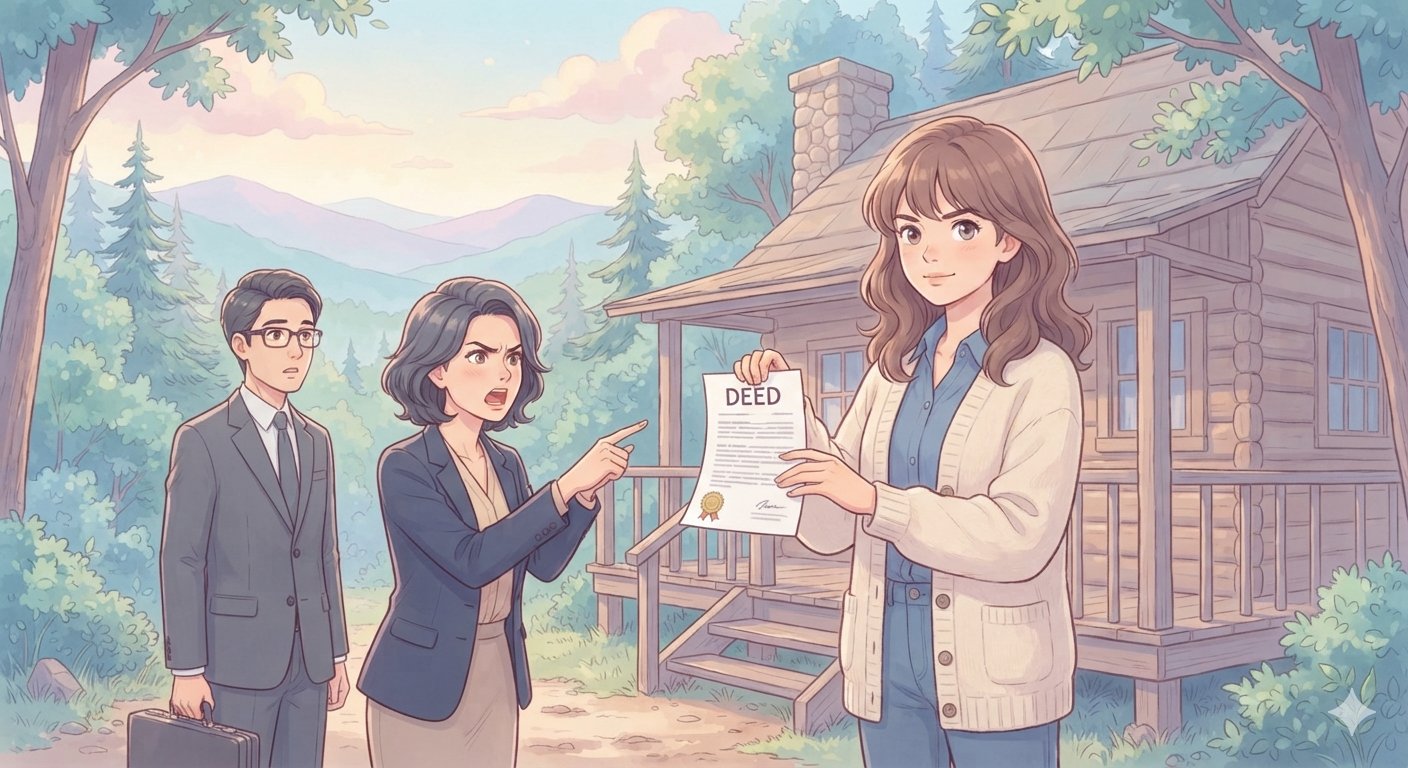
    The property deed.

    Owner: Alexandra Reed.

    The second attachment contained the divorce petition.

    The third listed temporary financial orders freezing several shared accounts pending the court’s decision.

    The fourth attachment was only one page.

    At the bottom was Alexandra’s signature.

    Above it, one sentence.

    “You asked me to disappear. I simply took what belonged to me.”

    Valerie slowly stepped away from him.

    “You told me you owned the house.”

    “I…”

    “You said everything was yours.”

    “I thought—”

    “You thought?”

    Richard looked around desperately.

    His parents refused to meet his eyes.

    His father finally spoke.

    “Richard… did you even read the deed when you married?”

    Silence.

    His mother whispered the answer herself.

    “He never bothered.”


    Three months later, the divorce hearings concluded.

    The judge was unmoved by Richard’s arguments.

    The land had always belonged to Alexandra.

    The house had been legally classified as a prefabricated structure that could be relocated.

    Every permit had been approved.

    Every notification had been filed.

    Every financial transaction documented.

    Richard had no claim to the property.

    Worse still, years of financial records showed Alexandra had quietly paid many household expenses from an inheritance Richard had dismissed as “old family money.”

    His attempts to hide bonuses and move assets into separate accounts did not impress the court.

    The settlement reflected that.

    When Richard left the courthouse, reporters weren’t waiting.

    Neither were friends.

    Only Valerie.

    She handed him a small envelope.

    “My apartment key.”

    He looked confused.

    “I’m moving out.”

    “Valerie—”

    “You didn’t leave your wife because you found love.”

    She shook her head.

    “You left because you thought life should always be newer, younger, easier.”

    She smiled sadly.

    “One day I’ll be older too.”

    Then she walked away.

    She never looked back.


    Meanwhile, fifty miles outside the city, Alexandra stood on the porch of the home that had once sat in Oak Brook.

    It looked different now.

    The walls had been painted warm white.

    A wraparound porch overlooked a small lake.

    Flower beds surrounded the entrance.

    The moving company had rebuilt every room exactly as she wanted—not as it had once been.

    Better.

    Brighter.

    Peaceful.

    She had renamed the property.

    Reed House.

    Her father’s weathered wooden sign hung beside the front door.

    “Land lasts longer than pride.”

    Dylan and Chloe arrived every other weekend at first.

    The visits were awkward.

    Children notice more than adults think.

    One evening, Dylan quietly asked,

    “Mom… did Dad really tell you to disappear?”

    Alexandra looked at her son.

    She could have lied.

    Instead, she nodded.

    “He did.”

    Chloe’s eyes filled with tears.

    “Why didn’t you tell us?”

    “Because I never wanted you to choose between your parents.”

    There was a long silence.

    Finally Chloe stood up and hugged her.

    “So… can we choose where we feel safe?”

    Alexandra wrapped both children in her arms.

    “Always.”


    Over the next year, something unexpected happened.

    The weekends became weeks.

    The weeks became requests to stay longer.

    Richard missed school concerts.

    Forgot birthdays.

    Canceled visits because of work.

    Alexandra never criticized him.

    She simply kept showing up.

    Homework.

    Soccer practice.

    Science fairs.

    Late-night fevers.

    College planning.

    Everything she had always done.

    One afternoon the family court approved an updated custody arrangement reflecting the children’s wishes.

    As they left the courthouse, Dylan smiled.

    “Can we go home now?”

    Alexandra looked at him.

    “You mean my house?”

    He grinned.

    “No.”

    He pointed toward the tree-lined road leading to Reed House.

    “I mean ours.”


    Two years later, Reed House became more than a home.

    Alexandra converted part of the property into a retreat for women rebuilding their lives after divorce and financial abuse. She hosted workshops on budgeting, legal rights, and starting over. Every guest who arrived carried a story of loss; every guest left with a plan for tomorrow.

    One autumn afternoon, while volunteers prepared a community picnic, a delivery truck stopped at the gate.

    The driver handed Alexandra a small package.

    There was no return address.

    Inside lay a single photograph.

    It showed the old Oak Brook house exactly as it had once stood.

    On the back, in familiar handwriting, were four words.

    “I was terribly wrong.”

    There was no signature.

    She looked at the photograph for a long moment.

    Then she smiled—not with triumph, but with peace.

    She walked to the fireplace, placed the picture into the flames, and watched it curl into ash.

    Some memories deserved gratitude.

    Others deserved release.

    As the fire faded, laughter echoed from outside.

    Dylan was helping Chloe hang lights across the porch. Friends and neighbors filled the yard, children chased one another through the grass, and music drifted across the lake.

    Alexandra stepped onto the porch, breathing in the cool evening air.

    Her father had been right.

    The house could be moved.

    The land could be protected.

    But the greatest thing she had saved was herself.

    And this time, no one could ever ask her to disappear again.

  • My in-laws sent my 6-year-old daughter a cute brown teddy bear for her birthday. She smiled for a second, then suddenly froze and asked, “Mommy, what is it?

    My in-laws mailed my 6-year-old daughter an adorable brown teddy bear for her birthday. She smiled for a moment, then suddenly went still and asked, “Mommy, what is it?” When I leaned in and looked closer, my face drained of color. I did not scream. I took action—and three days later, police were standing at their door.

    You may like

    For my daughter’s sixth birthday, my in-laws sent her a sweet brown teddy bear wrapped in gold paper and finished with a satin pink ribbon.

    Lily squealed the second she saw the box waiting on our porch.

    “Grandma and Grandpa remembered!” she said, bouncing barefoot across the living room carpet.

    I smiled, even though my stomach tightened slightly. My husband, Daniel, had not spoken to his parents in almost eight months. Not since the fight about boundaries, unexpected visits, and the way his mother, Margaret, kept telling Lily that “Mommy was too strict” every time I refused something.

    You may like

    Still, it was Lily’s birthday. I did not want to darken the day.

    “Go ahead,” I said. “Open it.”

    She ripped through the wrapping paper, lifted out the bear, and hugged it right away. It was soft, brown, and almost ridiculously cute, with shiny black eyes, a stitched smile, and a small red bow around its neck.

    For three seconds, Lily looked delighted.

    Then she went rigid.

    You may like

    Her arms loosened around the bear. Her smile vanished.

    “Mommy,” she whispered, holding it away from herself. “What is it?”

    I moved closer.

    At first, I thought she meant the tag. A small white gift tag was tucked under the bow. But then I saw the bear’s left eye. It did not match the right one. The right eye was glossy and flat. The left eye had a tiny dark circle at the center, too deep, too exact, like a pinhole.

    My mouth went dry.

    I carefully took the bear from Lily.

    “Sweetheart,” I said, keeping my voice steady, “go help Daddy put candles on the cake.”

    She frowned. “Is it broken?”

    “Maybe,” I said. “I’ll check it.”

    Daniel looked over from the kitchen, saw my face, and immediately walked toward me. I turned the bear over in my hands. There was a seam along the back, but near the battery compartment, I felt something solid. Not a music box. Not stuffing. A square.

    Daniel whispered, “Claire?”

    I did not answer.

    I carried the bear into our bedroom, closed the door, and set it on the dresser. Then I switched off the lights. The left eye faintly glimmered.

    Daniel’s face changed.

    “No,” he breathed.

    I searched the bear carefully and found a hidden switch under the stitched fabric near its leg. My fingers trembled, but I did not scream. I did not call Margaret. I did not accuse anyone.

    I took pictures. I put the bear in a drawer. Then I called my brother, Aaron, a detective in another county.

    He listened without cutting me off.

    Then he said, “Claire, do not open it yourself. Do not destroy it. Put it in a paper bag, not plastic. I’m calling someone.”

    Three days later, police were at my in-laws’ door.

    PART 2

    By the time police reached Margaret and Richard Whitmore’s white colonial house in West Hartford, I already understood the bear was not some innocent toy with a faulty part.

    A technician had come to our house the morning after Lily’s birthday. He wore plain clothes, carried a black case, and introduced himself only as “Evan from digital forensics.” Aaron stayed beside him the entire time, not as a detective on the case, he reminded me, but as my brother.

    Evan placed the teddy bear on our dining table as though it belonged in an evidence room. Because, apparently, it did.

    Lily was at school. Daniel had called out of work and sat beside me, pale and silent, one hand wrapped around a mug of coffee he never touched.

    Evan used a small blade to cut open the seam along the bear’s back. Inside, hidden behind the stuffing, was a compact wireless camera module with a microphone, battery pack, and microSD card. The lens had been positioned perfectly behind the bear’s left eye.

    Daniel stood so quickly his chair scraped against the floor.

    “My parents didn’t do this,” he said, but his voice carried no certainty.

    Evan did not look up. “Someone did.”

    He removed the card, slid it into a reader, and opened the files on his laptop. There were short recordings, each marked with dates and times. The first file had been created two weeks earlier, long before the bear ever reached our home.

    That was when Daniel stopped trying to defend them.

    The footage showed Margaret’s kitchen table. Her hands appeared in the frame, thin and manicured, turning the bear’s head toward herself.

    Then Richard’s voice came from somewhere off camera.

    “Are you sure this is legal?”

    Margaret answered, “It’s our granddaughter. We have a right to know what goes on in that house.”

    Daniel covered his mouth.

    I felt something icy slide down my spine.

    There were more clips. Margaret testing the sound. Richard complaining that the battery would not last long. Margaret saying, “Claire has poisoned him against us. If we can prove she screams at Lily, or neglects her, or says something unstable, we’ll have what we need.”

    “What she needs for what?” I asked.

    Evan’s face stayed professional, but his eyes softened. “Custody pressure. Family court. Maybe blackmail. That’s for investigators to determine.”

    Police did not storm in that same day. They documented everything first. They took the bear. They interviewed Daniel and me separately. They asked about the history with his parents, whether they had keys to our house, whether they had ever threatened us.

    Daniel told them about the last argument.

    Margaret had appeared at Lily’s school months earlier and tried to sign her out early without permission. The office called me. I refused. Margaret later screamed at Daniel that we were “keeping Lily hostage.”

    Richard had not screamed. He rarely did. He simply stood behind his wife and said, “Your mother is heartbroken.”

    That was always how he took part. Quietly. Completely.

    Three days after the birthday party, two officers and one detective went to the Whitmore house with a warrant.

    Daniel and I were not there, but Aaron later told me what happened.

    Margaret opened the door smiling, clearly assuming they were neighbors or church volunteers. When Detective Hollis identified himself, her smile disappeared. Richard came out from the den and asked, “What’s this about?”

    The detective said, “We’re here regarding electronic surveillance equipment sent to a minor child.”

    Margaret’s first words were not, “What equipment?”

    They were, “Claire is behind this.”

    That sentence told everyone enough.

    PART 3

    Detective Hollis later called the search “productive,” which sounded far too neat for what it actually was.Doors & Windows

    Inside Margaret and Richard Whitmore’s house, police found packaging for the camera module in a drawer under takeout menus. They found printed instructions with highlighted sections about motion detection, night vision, and remote viewing. They found a second device still unopened in Richard’s desk.

    But the laptop mattered most.

    It was Margaret’s laptop, the silver one she used for church newsletters, recipes, and long emails to relatives about how Daniel had “changed” since marrying me. In a folder hidden under the name “Lily Memories,” investigators found downloaded clips from the teddy bear.

    There was no footage from inside our home because I had noticed the camera before it had been activated in Lily’s room. But there were test recordings, screenshots of our social media pages, a scanned copy of Lily’s school calendar, and a document titled “Concerns About Claire.”

    When police showed us that document two days later, Daniel read only the first page before pushing it away.

    I read every page.

    It was a plan.

    Margaret had written down dates, incidents, and accusations, most of them distorted beyond recognition. One note said, “Claire isolates Lily from paternal family.” Another said, “Daniel appears afraid to contradict wife.” A third said, “Need proof of emotional instability.”

    There were blank spaces under some claims, as though she had been waiting to fill them in later.

    The hidden camera had been intended to give her that “proof.”

    “She was building a case,” I said.

    Detective Hollis nodded. “That appears to be the direction.”

    Daniel sat beside me in the interview room, looking as if the floor had opened beneath him. He had always known his mother was controlling. He knew she could be vicious when challenged. But knowing someone is difficult is not the same as seeing proof that they planned to spy on your child.

    “Our child,” he said quietly. “She put a camera in our child’s toy.”

    No one corrected him. No one softened the words.

    The legal process moved slowly at first, then suddenly all at once.

    Margaret and Richard were questioned separately. Richard tried to shrink himself inside every sentence.

    He said Margaret had ordered the camera. He said Margaret had sewn it into the bear. He said he had only “helped with the technical part” because she did not understand the setup.

    But the receipts told a more complete story. The camera had been bought with Richard’s credit card. The software account had been created using his email. His phone had been used to test the live feed.

    Margaret, meanwhile, gave a performance.

    She cried. She shook. She told Detective Hollis she was “a concerned grandmother.” She said she was afraid for Lily. She said I had a temper, though she could not give one example that did not involve me telling her no. She said Daniel was being controlled. She said the bear was only meant to “protect” Lily.

    Detective Hollis asked, “Protect her from what?”

    Margaret answered, “From being taken away from us.”

    That was the sentence that followed me home.

    Not “from danger.”

    Not “from abuse.”

    From being taken away from us.

    As if Lily were a family heirloom. As if my daughter’s life was a room Margaret believed she had been shut out of.

    After the charges were filed, Daniel stopped sleeping properly. He would wake at two or three in the morning and check the windows, the back door, the garage. Sometimes I found him standing in the hallway outside Lily’s room, arms crossed, staring at the teddy bear-shaped nightlight she had picked out herself from Target after the police took the other one.Doors & Windows

    “I should have cut them off sooner,” he said one night.

    I leaned against the wall beside him. “You were raised to think their behavior was normal.”

    “That’s not an excuse.”

    “No,” I said. “But it’s an explanation.”

    He nodded, although I could tell it gave him little comfort.

    Lily only knew part of the truth. We told her the bear had a camera inside it, and that adults were not allowed to hide cameras in children’s toys. We told her Grandma and Grandpa had made a very serious mistake and that we would not be seeing them for a while.

    She asked if they were angry with her.

    Daniel dropped to his knees in front of her so quickly I thought he might fall apart.

    “No, baby,” he said, holding her hands. “You did nothing wrong. Nothing.”

    “Then why did they do it?”

    He looked at me.

    I answered because he could not.

    “Because sometimes grown-ups make selfish choices when they want control. That does not make it your fault.”

    Lily thought about that for a long time.

    Then she said, “I don’t want any more surprise presents.”

    And just like that, my six-year-old had learned something she never should have had to learn.

    The first court hearing took place in early October. The leaves outside the courthouse had started turning red and gold, and the air smelled like rain on pavement. Daniel wore a navy suit. I wore a gray dress and flats because I wanted to feel steady.

    Margaret arrived with Richard and a lawyer. She looked smaller than usual, but not weaker. Her hair was sprayed perfectly. Her pearls rested neatly against her throat. When she saw Daniel, her face collapsed.

    “My son,” she whispered.

    Daniel did not step toward her.

    Her expression hardened for half a second before she remembered where she was. Then she started crying again.

    The prosecutor presented the evidence: unlawful surveillance, attempted invasion of privacy, use of an electronic device to intercept audio, and the aggravating factor that the target was a minor inside a private home. The exact charges depended on state statutes, the prosecutor explained, but the court understood the seriousness.

    Margaret’s lawyer argued that no footage had been captured inside our home, that the device had never successfully recorded Lily in her bedroom, and that Margaret had acted out of “misguided concern.”

    The judge looked down over her glasses.

    “Misguided concern does not require hidden recording equipment,” she said.

    I remember that clearly.

    I also remember Margaret turning her head to stare at me after the judge said it, as if I had somehow put those words into the judge’s mouth.

    A protective order was issued that day. Margaret and Richard were forbidden from contacting us directly or indirectly. No calls. No letters. No gifts. No messages through relatives. No showing up at Lily’s school, our home, Daniel’s workplace, or any of Lily’s activities.

    When the order was read aloud, Margaret made a small sound, like an injured animal.

    Daniel closed his eyes.

    I wanted to feel victorious. I did not. I felt exhausted.

    The family fallout arrived fast.

    Daniel’s aunt Patricia called first. She left a voicemail saying, “Your mother is devastated, and Claire needs to stop escalating this.”Parenting books

    Daniel deleted it.

    Then his cousin Mark texted: “Was it really necessary to involve police? They’re old. They made a mistake.”

    Daniel answered with one sentence: “They hid a camera in my daughter’s teddy bear.”

    Mark did not respond.

    For weeks, relatives tried to shrink the crime by making Margaret seem delicate. They talked about her loneliness, her anxiety, her fear of losing her granddaughter. They mentioned Richard’s heart medication. They spoke of forgiveness as if forgiveness meant pretending evidence did not exist.

    But Daniel did not bend.

    One evening, after another cousin sent a message suggesting a “family meeting,” he typed a reply and showed it to me before sending.

    “My daughter’s privacy and safety are not family discussion topics. Anyone who minimizes what happened will not have access to us.”

    He stared at the screen for a long time after he sent it.

    “That sounded harsh,” he said.

    “It sounded like a father,” I replied.

    The case did not become a dramatic trial. Margaret and Richard eventually accepted a plea agreement. They avoided jail time, which angered me at first, but the conditions were strict: probation, fines, mandatory counseling, surrender of surveillance equipment, no contact with us, and a permanent record tied to what they had done.

    The judge also extended the protective order.

    Margaret tried to speak at sentencing. She stood with a folded tissue in both hands and said she had only wanted to make sure Lily was safe.

    The judge asked whether she understood why hiding a camera inside a child’s toy was a violation.

    Margaret hesitated.

    That hesitation answered the question.

    Richard spoke next. His voice was low. “I should have stopped it.”

    Daniel, sitting beside me, whispered, “Yes, you should have.”

    Richard looked toward him, but Daniel stared straight ahead.

    After court, Margaret attempted one last scene in the hallway. She stepped toward us, forgetting or ignoring the order, and said, “Danny, please. I’m your mother.”

    Detective Hollis, who had attended the hearing, immediately moved between them.

    “Mrs. Whitmore,” he said, “step back.”

    Her face flushed. “I just want to talk to my son.”

    Daniel finally looked at her.

    “No,” he said. “You wanted access. That’s different.”

    For once, Margaret had nothing to say.

    Life did not return to normal quickly. It came back in pieces.

    We changed locks, passwords, school pickup permissions, pediatrician privacy settings, and every emergency contact form. We checked smoke detectors, nightlights, stuffed animals, and picture frames. I hated that we did. I hated that every innocent object looked suspicious for a while.

    Lily began asking before accepting gifts.

    “Who sent it?”

    “Did you check it?”

    “Can it see me?”

    Every question cut into me. But little by little, she asked less often. Children heal unevenly. One day she refused to sleep with any stuffed animals. A month later, she carried a purple rabbit everywhere and named it Waffles.

    Daniel started therapy. Not because he was broken, but because he finally understood that growing up with Margaret had trained him to question his own boundaries. He learned to say out loud the things he used to bury.

    “My mother confuses love with possession.”Parenting books

    “My father enables harm by staying quiet.”

    “I don’t owe access to people who hurt my family.”

    Those sentences changed him. Not instantly, but steadily.

    As for me, I stopped replaying Lily’s birthday quite so often. For a while, I kept seeing the bear’s left eye, that tiny black circle staring out from a toy meant to be pressed against my daughter’s chest. I kept wondering what might have happened if Lily had not noticed something strange.

    But she had.

    That mattered.

    Lily had seen what the adults tried to hide.

    On her seventh birthday, she asked for a backyard party with cupcakes, bubbles, and a bounce house shaped like a castle. We invited her classmates, our neighbors, my brother Aaron, and Daniel’s aunt Patricia was not included.

    Near the end of the party, Lily opened presents at the picnic table while Daniel and I stood close by.

    There were art supplies, books, a glittery backpack, and a box with a stuffed fox inside.

    Lily lifted it, studied its face, then looked at me.

    “Mommy?”

    I stepped closer. “Want me to check it?”

    She nodded.

    I checked the seams, the eyes, the tag, and the battery compartment that did not exist. Then I handed it back.

    “All clear.”

    She hugged the fox.

    For the first time in a year, I watched her hold a stuffed animal without fear passing across her face.

    Daniel took my hand under the table.

    Across the yard, children screamed with laughter as bubbles drifted above the grass. The late afternoon sun turned everything warm and golden. Lily ran toward the bounce house with the fox tucked under one arm, her ponytail swinging behind her.

    Daniel squeezed my hand.

    “I think we’re okay,” he said.

    I watched our daughter climb into the castle and vanish among laughing children.

    “No,” I said softly. “We’re better than okay.”

    Because the truth was, the teddy bear had not destroyed our family.

    It had revealed the part of it that had already been dangerous.

    And once we saw it clearly, we finally locked the door.

  • I Moved My $3 Million Inheritance Into A Trust On My 18th Birthday Before My Family Could Touch It

    On the evening I turned eighteen, my father lifted a crystal glass in the ballroom of the Graystone Hotel and told two hundred guests I was finally ready to become a woman. Everyone applauded. I smiled because that was what Kingsley daughters were expected to do in public.

    My name is Evelyn Kingsley. My grandfather, Robert Hale, had died six months earlier and left me a three million dollar inheritance under my own name. He had always said, money doesn’t make you safe, Evie. Control does. I had heard him say it a dozen times over the years, usually while we sat on his porch overlooking the lake, usually right after he had watched some acquaintance of his lose everything to a relative who called themselves family right up until the moment they needed something. I never fully understood what he meant until the year he was dying, when I began to notice how differently my parents spoke about my future depending on who was listening.

    My grandfather had built his fortune slowly, through decades of unglamorous work in commercial real estate, buying buildings other people considered too old or too far from downtown to matter, and holding onto them long after anyone else would have sold. He used to say that patience was the only advantage ordinary people had over rich ones, because rich people rarely had the stomach for waiting quietly while something appreciated in value. He taught me to read a balance sheet before I could legally drive. He taught me that anyone who called money vulgar to talk about was usually the same person hoping you would never ask them a direct question about theirs.

    EzoicHe was different with me than he was with my father, his own son. With Grant and me, he was warm in a careful, watchful way, the way people are who have learned that warmth can be taken advantage of if you hand it out without paying attention to who is receiving it. With my father, something had gone cold between them years before I was born, some old disappointment neither of them ever fully explained to me, though I sometimes caught fragments of it in the way my grandfather’s jaw would tighten whenever my father mentioned a new investment.

    So two hours before my birthday party, I sat inside a lawyer’s office in downtown Chicago, my hands folded over my black dress, while Nora Whitman, my grandfather’s longtime attorney, pushed documents across a polished table.

    EzoicYou’re sure, she asked. Once the trust is executed, neither of your parents can access the principal. Only you and the independent trustee can authorize distributions under the terms we discussed.

    I’m sure, I said, and I meant it more than I had meant almost anything in my life up to that point.

    EzoicBy seven that evening, my inheritance was no longer resting in an account my parents could pressure me into touching. It had been placed inside the Hale Education and Independence Trust, protected for tuition, housing, medical needs, and future investments. My mother called it dramatic. My father laughed when he found out.

    At eighteen, he said, squeezing my shoulder too tightly while we posed for photos. Sweetheart, you’ve been watching too many legal dramas.

    My mother, Cynthia, tipped her champagne glass in my direction. You’ve embarrassed us. Nora should know better than to encourage childish paranoia.

    EzoicBut my older brother, Grant, did not laugh. He watched me from across the room as though I had locked a door he had planned to walk through, and something in that look stayed with me for the rest of the night, a small cold thread running under all the noise and the music and the toasts.

    The party went on. The cake was served. My father gave a speech about family loyalty, the same speech he gave every year at some function or another, the same cadence, the same practiced pauses for applause. My mother shed pretty tears for the cameras. Grant vanished before midnight with his girlfriend, Paige, who was wearing my grandmother’s diamond bracelet without permission, a detail I noticed and filed away without quite understanding why it mattered yet.

    At one ten in the morning, I found my father in the hotel corridor arguing into his phone.

    She moved it, he hissed. All of it. No, I can’t reverse it. It’s locked.

    He turned and saw me. His expression shifted instantly, from panic to performance, the way a light changes color when you flip a switch.

    EzoicGo to bed, Evelyn, he said.

    The next morning, I came downstairs and found my parents waiting in the breakfast room. No coffee. No smiles. No servants moving quietly in the background the way they always did on ordinary mornings. My mother’s eyes were red, but not from grief. My father stood at the head of the table and said the words that proved I had saved my entire future.

    Since you clearly don’t trust this family, he said coldly, you can pack your things and leave this house by noon.

    For a moment I thought I must have heard him wrong. Leave the house by noon. Not because I had committed a crime. Not because I had harmed anyone. Not because I had dragged the family name into some scandal my mother would whisper about for years at her luncheons. Because I had protected what my grandfather had left me.

    EzoicI looked from my father to my mother. Cynthia Kingsley sat perfectly straight in her cream silk robe, one hand curled around the stem of an untouched mimosa. She looked annoyed, not devastated, as if I had spilled something valuable on her good rug.

    You’re serious, I asked.

    My father’s jaw tightened. You made an adult decision. Adults live with adult consequences.

    I almost laughed. It rose like a cough, then died in my throat before it could become anything.

    Grandpa left that money to me, I said.

    He left it to the family, my mother snapped.

    No, I said. He left it to me. His will was very clear.

    My father slammed his palm onto the table. The silverware jumped. Do not lecture me about clarity. Do you know what you’ve done? Do you understand what kind of position you’ve put us in?

    There it was. Not pain. Not betrayal. Position.

    I remembered the phone call in the corridor. I remembered Grant’s stare. I remembered Paige wearing my grandmother’s bracelet, the one my mother always said was locked in a safe deposit box downtown.

    EzoicWhat position, I asked quietly.

    My mother looked at my father, warning him with her eyes, the particular look she used when she wanted him to stop talking without having to say so out loud.

    But he was too angry to stop.

    We had obligations, he said. Temporary obligations. Your brother needed help with the restaurant investment, and your mother’s charity gala deposits were due, and I had a bridge loan structured around incoming family liquidity.

    Incoming family liquidity. That was what I was. Not a daughter. Liquidity.

    You planned to use my inheritance, I said.

    My mother stood abruptly. We planned to manage it until you were mature enough not to be manipulated by some old lawyer.

    EzoicNora was Grandpa’s lawyer for twenty years.

    Nora is a meddling woman who never liked your father.

    My father pointed toward the stairs. Pack. I’m not debating this. You wanted independence, Evelyn. Enjoy it.

    I went upstairs without crying, which surprised me. Maybe some part of me had started grieving them the night before, standing in that hotel corridor listening to my father’s voice change the moment he saw me. My room looked untouched, soft, expensive, and suddenly foreign, as though I had already moved out of it in every way that mattered. Framed riding ribbons from summers I barely remembered anymore. Private school photographs of a girl smiling the way she’d been taught to smile. A silver music box from my grandfather that had sat on my dresser since I was nine years old. I packed clothes, my documents, my laptop, the music box, and three framed photos, one of me with Grandpa at Lake Geneva, one of me alone on graduation day, and one of my grandmother before she became ill, back when she still laughed with her whole face.

    At eleven forty two, I rolled two suitcases down the staircase.

    Grant leaned near the front door with his arms crossed, watching me the way you watch someone who has inconvenienced you rather than someone you love.

    Ezoic

    You really screwed us, he said.

    I stopped on the landing. Us?

    He gave me a flat smile. Don’t act innocent. Dad was going to fix everything.

    With my money.

    You weren’t even using it.

    I was going to college, I said.

    He stepped closer. You think a trust makes you untouchable?

    Before I could respond, the front door opened. Nora Whitman stood outside in a navy coat, carrying a leather folder. Behind her waited a black car with its engine already running, as though she had known exactly what time to arrive down to the minute.

    EzoicEvelyn, she said, glancing past me at my family. Your grandfather anticipated this possibility. I’m here to take you to your new apartment.

    My mother went pale. My father opened his mouth, but nothing came out.

    Nora looked at him calmly. Also, Richard, I would advise you not to interfere. The trust owns the lease, the vehicle, and the legal retainer. Any attempt to coerce Evelyn financially or physically will be documented.

    For the first time in my life, my father had no space to perform. I watched the realization move across his face, slow and unwelcome, like weather he couldn’t outrun.

    EzoicI picked up my suitcases and walked past them. No one hugged me goodbye. No one apologized. But as Nora opened the car door, I heard my mother whisper behind me, Robert knew. And Nora said, just loudly enough for them to hear, Robert knew everything.

    The apartment was not what I had imagined. I had pictured a temporary studio with rented furniture, maybe a place where I would sit on a mattress and convince myself I was brave. Instead, Nora drove me to a quiet building in Evanston, twelve floors of brick and glass overlooking a tree lined street. The lobby smelled of cedar and fresh paint. The doorman greeted Nora by name, as though this had all been arranged long before that morning ever happened.

    The trust has prepaid the lease for eighteen months, Nora said as we rode the elevator. Utilities are covered. There’s a modest monthly allowance for food, transportation, and personal expenses. Your tuition account is separate.

    EzoicI stared at the elevator numbers climbing. He really planned this, I said.

    Your grandfather hoped he was wrong, she said. But he planned for the possibility that he wasn’t.

    The apartment was on the seventh floor. One bedroom. Clean white walls. A small balcony. A desk already set near the window, as though someone had imagined me sitting there before I ever arrived. In the kitchen, the refrigerator had been filled with groceries. On the counter was a note in my grandfather’s handwriting.

    My knees nearly gave out before I even touched it.

    Evie, it began. If you are reading this, then the adults who were supposed to protect you have made you pay for protecting yourself. Do not go back just because loneliness feels like guilt. You are not responsible for rescuing people who saw you as a resource. Build your life. That will be answer enough. Grandpa.

    I sat on the floor and cried then. Not because I had been thrown out. Not even because my parents had looked at me with more anger than sorrow. I cried because my grandfather had known me well enough to leave words for the exact moment I would need them, months before he died, before he could have known exactly how or when I would read them, only that I eventually would.

    EzoicFor the first week, I moved like a machine. I unpacked. I answered Nora’s calls. I ignored calls from my mother, then Grant, then numbers I did not recognize. I made toast. I forgot to eat it. I slept with the lights on, though I never quite admitted to myself why.

    On the eighth day, my father came to the apartment building. The doorman called upstairs. Miss Kingsley, there is a Richard Kingsley here asking to see you. My stomach folded inward. Nora had warned me this might happen. She had also instructed the building not to send visitors up without my approval.

    Tell him no, I said.

    A minute later, my phone buzzed. Dad. Then again. Then a text. Evelyn, this has gone far enough. Come downstairs. I did not answer. Another text came. Your mother is ill over this. Then another. You are destroying your family over money.

    EzoicI sat at the desk by the window and watched tiny figures move along the sidewalk below. I could not see him from that angle, but I could picture him perfectly, expensive coat, hard face, one hand tucked in his pocket, making strangers believe he was simply a worried father standing outside his daughter’s building.

    I forwarded the texts to Nora. Her reply came quickly. Do not engage. Document everything.

    So I did. That became my new education before college had even begun. How to document. How to keep records. How to separate emotion from evidence. How to read a bank statement. How to understand a contract. How to recognize when someone calls control concern.

    Three weeks after my birthday, Nora invited me to her office. There are things you should know, she said.

    I sat across from her at the same polished table where I had signed the trust papers. This time I did not feel like a child pretending to understand adult business. I felt like someone who had survived the first blow and was waiting for the next.

    EzoicYour grandfather began reviewing family financial activity approximately fourteen months before he died, she said. He became concerned after your father asked him to co sign a loan. Robert refused.

    My father never told me that.

    No, Nora said. I imagine he did not.

    She turned a page toward me. Account summaries, loan documents, and printed emails sat in neat stacks. Your father’s real estate company has been overleveraged for years, she said. Several projects failed quietly. He used new loans to cover old losses. Your mother’s charity events were also not as clean as they appeared. Large vendor payments were routed through companies connected to her friends.

    I felt cold. Were they stealing, I asked.

    I can’t make that allegation casually, Nora said. But your grandfather suspected misuse of funds. He also believed your parents expected to gain access to your inheritance once you turned eighteen.

    EzoicThey couldn’t just take it.

    No, she agreed. But they could pressure you. Guilt you. Ask you to invest. Ask you to loan. Ask you to sign. Ask you to prove loyalty.

    I thought of my father’s speech. Family loyalty. The words felt filthy now, like something I would have to scrub off my memory for a long time.

    Why didn’t Grandpa tell me, I asked.

    Because you were seventeen, Nora said gently. And because he was ill. He wanted your last months with him to belong to you, not become a financial briefing.

    EzoicI looked down at the papers. My hands were trembling, but not from fear this time. What happens now, I asked.

    That depends partly on them, she said.

    They made their choice within a month. My parents filed a petition challenging the trust. Their argument was offensively simple. I had been unduly influenced by Nora Whitman, emotionally unstable after my grandfather’s death, and unable to understand the legal consequences of what I had signed on my birthday. My mother signed an affidavit claiming I had always been impulsive and easily manipulated by older authority figures. My father claimed he had only wanted to guide my inheritance responsibly. Grant submitted a statement saying I had bragged about hiding money from the family.

    When Nora showed me the filings, I read every word in silence. Then I asked, can we fight it? Nora’s smile was small but sharp. We can do more than fight it, she said.

    EzoicThe hearing took place in Cook County probate court on a gray October morning. I wore a navy dress and my grandmother’s pearl earrings, the pair she had left me in a separate letter my mother never knew existed. My parents sat across the aisle. My mother dabbed at her eyes with a tissue before the judge entered. My father stared straight ahead. Grant looked bored until he noticed the court reporter typing every word, and then he stopped looking bored at all.

    Their lawyer argued that the trust had been created under suspicious circumstances. He said I had signed it on the same day as my birthday party, under emotional stress, with an attorney who had a personal relationship with my deceased grandfather.

    Then Nora stood. She did not raise her voice. She didn’t need to. She presented the timeline. My grandfather’s will. The inheritance transfer. My signed trust documents. A recorded video from three months before his death, in which my grandfather sat in his study, thinner than I remembered but fully himself.

    EzoicIn the video, he looked directly into the camera. My granddaughter Evelyn is to receive her inheritance without interference from her parents, Richard and Cynthia Kingsley, he said. I have reason to believe they may attempt to gain access to her funds through emotional pressure, family obligation, or legal intimidation. My instructions to counsel are clear. Protect Evelyn’s assets and her independence.

    My mother stopped crying. My father turned red.

    Nora then submitted copies of my father’s text messages, including the ones saying I was destroying the family over money. She submitted evidence that he had attempted to call the trust administrator twelve times in two days. She submitted the hotel corridor timeline, confirmed by a sworn statement from a hotel employee who had overheard my father saying, she moved it, all of it.

    The judge leaned back and looked at my parents for a long, quiet moment before saying anything at all.

    By the end of the hearing, the petition had been denied.

    But Nora was not finished. The attempted challenge opened doors my parents had wanted kept shut. Once they claimed concern over my finances, Nora requested discovery related to their alleged family liquidity plans. Their own filings had made their intentions relevant, and there was no way to un-ring that particular bell.

    EzoicWhat emerged over the next four months destroyed the version of the Kingsley family that had existed in society pages and charity photographs for as long as I could remember. My father’s company was drowning. He had promised investors returns from developments that were delayed, underfunded, or already pledged to other lenders under different names. My mother’s charity board discovered vendor irregularities and quietly removed her as chair, a fact that made its way into a small item in a local paper that my mother never once mentioned to me directly. Grant’s restaurant investment had not been a promising opportunity. It was debt with lighting and a bar menu, propped up by borrowed optimism and other people’s money.

    And my inheritance was the number they kept returning to. Three million dollars would not have made them rich forever. It would have bought time. It would have paid angry lenders, covered bad checks, saved appearances through winter, and kept everyone smiling at holiday parties for one more year. Without it, the performance collapsed, all at once, the way things do when they’ve been held together by nothing but momentum for far too long.

    My father called me once after the petition failed. I answered because Nora was sitting beside me and recording the call with proper notice. This call is being recorded, I said.

    EzoicSilence. Then my father laughed once, bitterly. You’ve become very sophisticated, he said.

    I’ve become careful.

    You think you won.

    No, I said. I think Grandpa protected me.

    His voice hardened. You have no idea what you’ve cost us.

    I looked around Nora’s office, at the shelves of law books, at the rain streaking the window, at my own reflection in the glass. I looked older than I had at my birthday party. Not exactly happier. Not yet. But clearer. You cost yourselves, I said. He hung up.

    After that, the fallout arrived in pieces. The house went on the market in January. My mother moved into a condo owned by one of her sisters. My father rented an apartment near his office, though rumors said the office itself might not survive the year. Grant’s girlfriend, Paige, disappeared from his social media the week after the restaurant closed, along with, presumably, my grandmother’s bracelet, though nobody in the family ever mentioned it again.

    I started college in the spring instead of the fall. I chose Northwestern because it was close enough to my apartment and far enough from the girl I used to be. I studied economics first, because I wanted to understand every word people had once used to confuse me. Later I added public policy, because numbers explained systems, but policy explained who became trapped inside them.

    Proof Caught On Camera

    Real underwater footage scientists can’t explain. See the verified evidence yourself.

    Ezoic

    EzoicI did not become fearless. That would be a lie. There were nights I stood in my kitchen holding my phone, tempted to call my mother just to hear her voice, some old muscle memory of wanting her approval flaring up even after everything. There were mornings when I missed the illusion of family so badly it felt physical, a real weight sitting low in my chest. I missed birthday breakfasts, even though I now knew they had been staged for whoever happened to be watching. I missed Christmas photographs, even though everyone in them had been posing for an audience none of us had ever agreed to.

    College itself became its own quiet education, separate from anything I learned in a classroom. I watched my roommate Allison call her parents every Sunday without any of the calculation I had grown used to, just easy conversation about classes and boys and whether she should get bangs, and I found myself studying those calls the way I studied economics textbooks, trying to understand a language I had never actually been taught. I did not resent her for it. If anything, her ordinary family taught me more about what I had lost than my own family ever could have, because she never had to think twice before answering the phone.

    But missing something does not mean it was safe to return to it. That distinction took me longer to fully understand than I would like to admit.

    EzoicNora became more than my lawyer. She became the person who taught me how to ask questions without apologizing first. She taught me that signatures matter, that silence can be strategy, and that people who benefit from your confusion will often call your clarity cruel. She never once told me how to feel about my family. She only ever helped me see clearly what they had actually done, and let me arrive at my own conclusions from there.

    On my nineteenth birthday, I did not have a ballroom party. I had dinner at a small Italian restaurant with Nora, my roommate Allison, and Marcus Reed, a graduate student who helped tutor me through statistics and later became one of my closest friends. There were no speeches about family loyalty. No photographers. No champagne tower. Just pasta, laughter, and a chocolate cake Allison carried in crookedly while singing too loudly, half the candles blowing out before she even reached the table.

    After dinner, Nora handed me a small envelope. Your grandfather asked me to give you this one year after the trust was activated, she said.

    EzoicI opened it carefully. Inside was another note. Evie, it read. One year free. Now make it two. Grandpa.

    I laughed and cried at the same time, right there at the table, and nobody at that dinner thought it was strange.

    Years later, people would still ask whether I regretted moving the money into a trust. They usually asked gently, as though they expected a complicated answer, as though maybe losing my parents balanced the scale against saving the money. But I never saw it that way. The trust did not cost me my family. It revealed what my family had already decided I was worth. That was the hardest truth and also the cleanest one, and I have never once found a way to make it sound softer than it actually is.

    By twenty five, I had graduated, begun working for a nonprofit that helped young adults understand financial abuse, and bought a modest condo with funds properly distributed from the trust. I kept my grandfather’s note framed near my desk, the ink slightly faded now but still perfectly legible, still exactly as he had left it.

    EzoicOne afternoon, after a workshop, a seventeen year old girl stayed behind. Her eyes were glossy, and she clutched a folder to her chest the way you hold something you’re afraid someone might try to take from you. My aunt says I’m being dramatic, she whispered. But my stepdad keeps asking about the settlement money from my accident.

    I saw myself in the way she held that folder like a shield.

    I did not tell her what to do. I did not promise her everything would be fine, because I had learned by then that promises like that rarely survive contact with real families. I gave her the name of a legal aid clinic, explained which questions to ask, and told her to keep copies of every document somewhere safe, somewhere no one else had a key to.

    Before she left, she asked, does protecting yourself always make people angry?

    I thought about my father in the breakfast room, his palm slamming against the table. My mother’s cold eyes over an untouched mimosa. Grant’s accusation in the front hall. Nora standing calmly in the doorway with a leather folder and a car already waiting. My grandfather’s careful handwriting on a note left on a kitchen counter for a girl he wouldn’t live to see read it.

    EzoicNot always, I said. Only the people who were counting on you not to.

    That night, I went home, unlocked my condo, and placed my keys in the blue ceramic bowl beside the door. The city lights glowed beyond the windows, steady and ordinary and entirely mine. My life was quiet now, unremarkable in the best possible way, the kind of life that never makes headlines and never needs to.

    At eighteen, I thought I had moved money. What I had really moved was the boundary between the future they planned to take from me and the future I was finally allowed to build for myself, one document, one quiet decision, one locked door at a time.

    Laura Bennett writes about complicated family dynamics, difficult conversations, and the quiet moments that change everything. Her stories focus on real-life tensions — inheritance disputes, strained marriages, loyalty tests — and the strength people find when they finally speak up. She believes the smallest decisions often carry the biggest consequences.

    Categories: Stories
    Laura Bennett

    Written by:Laura Bennett All posts by the author

    Laura Bennett writes about complicated family dynamics, difficult conversations, and the quiet moments that change everything. Her stories focus on real-life tensions — inheritance disputes, strained marriages, loyalty tests — and the strength people find when they finally speak up. She believes the smallest decisions often carry the biggest consequences.
  • At My Ex-Husband’s Memorial, His Wife Dismissed Me—Then the Lawyer Handed Me an Envelope

    The wind off the parking lot carried that particular winter-clean smell that only exists in the space between a hard frost and a slow thaw—cold air sharpened by distance, the sweetness of funeral flowers still sealed in their cellophane, and the faint warmth of brewed coffee drifting from the church foyer where volunteers in sensible shoes arranged cups on folding tables with the quiet efficiency of people who have done this too many times before. A small American flag stood near the guest book on a brass stand, its colors muted in the gray morning light, and beside it someone had placed a framed photograph of a man I once knew better than anyone alive and hadn’t spoken to in over a decade.

    I kept my gloves on. Not because of the cold, though the February air in Chesapeake, Virginia had a bite to it that sank straight to the bone, but because my hands hadn’t stopped trembling since I’d read the obituary two days earlier in a coffee shop in Richmond, sitting alone at a corner table with a latte going cold while the words rearranged themselves in my mind like furniture being moved in a room I thought I’d locked for good. Thomas Andrew Hargrove. Beloved husband, father, entrepreneur, and philanthropist. Passed peacefully at home surrounded by family. He was fifty-one years old.

    Fifty-one. We had been married when he was twenty-six and I was twenty-four, and in the algebra of grief, my mind kept doing the math—how many years since the wedding, how many since the divorce, how many since the last time I heard his voice on the phone telling me he was sorry, that he wished things had been different, that he hoped I’d find someone who deserved me. I never did, as it turned out, though not for lack of trying. What I found instead was a career in nursing that kept my hands busy and my heart occupied, a small house in Richmond with a garden that bloomed whether or not I remembered to tend it, and a kind of solitary peace that I had learned to stop apologizing for.

    EzoicI almost didn’t come. The obituary listed a memorial service at Grace Harbor Church in Chesapeake, and for two full days I argued with myself about whether showing up was an act of closure or masochism. Thomas and I had ended our marriage not with the dramatic combustion that makes for good stories but with the slow, exhausted surrender of two people who had loved each other deeply and discovered that love, by itself, was not enough to bridge the distance that ambition and timing and sheer bad luck had carved between them. He wanted to build an empire. I wanted to build a family. Neither of us was wrong. We were simply pointed in directions that diverged more sharply with every passing year until the distance became permanent and we signed the papers with the same quiet sadness with which we had once signed our vows.

    There was no bitterness in our divorce. No lawyers sharpening knives across a conference table. Thomas had not yet made his fortune when we separated—he was still in the early stages of the defense contracting firm that would eventually make him one of the wealthiest men on the Eastern Seaboard—and our settlement was modest and fair. I asked for nothing beyond what was reasonable, and he offered nothing beyond what was required, and we parted with the mutual understanding that whatever we had built together was over and that whatever came next belonged to each of us alone.

    EzoicI didn’t know about the forty million dollars until years later, when a college friend sent me a magazine article with his photograph on the cover and a headline about the meteoric rise of Hargrove Defense Solutions. I read the article in bed on a Sunday morning, studied the photograph of a man who looked like Thomas but sharper, more polished, more distant, and felt a strange mix of pride and sorrow that I couldn’t quite untangle. I was happy for him. I was also aware, in the honest, unsparing way that arrives uninvited at three in the morning, that the life he had built was the life he had chosen over me.

    I never contacted him. He never contacted me. The silence between us was not hostile—it was simply complete, the way silence is between two people who have said everything there is to say and have made their peace with the echo.

    EzoicAnd then he died, and I drove two hours to stand in a church parking lot with my gloves on, trying to decide whether walking through those doors would be the bravest thing I’d done in years or the most foolish.

    I walked in.

    The sanctuary was larger than I expected, with high ceilings and stained glass windows that threw colored light across the pews in shifting patterns that made the room feel alive even in mourning. The seats were nearly full—business associates in dark suits, military contacts with rigid posture and close-cropped hair, local politicians who attended funerals the way they attended fundraisers, with practiced solemnity and a keen awareness of who was watching. Thomas had moved in powerful circles by the end, and the room reflected that power—expensive fabrics, hushed voices calibrated to project grief without surrendering composure, the particular atmosphere of people who are accustomed to controlling rooms and are momentarily unsettled by the one thing they cannot control.

    I sat near the back, in the second-to-last pew, beside an elderly woman in a navy coat who patted my hand without introduction and whispered, “He was a good man.” I nodded, because he was, and because the simplicity of her statement undid something in my chest that I had spent two days trying to keep fastened.

    EzoicThe service was elegant and impersonal in the way that memorial services for wealthy men often are—heavy on accomplishments, light on intimacy, a curated highlight reel of a life reduced to its most presentable moments. Speakers praised his business acumen, his charitable contributions, his vision for American defense innovation. One man described him as “a titan of industry.” Another called him “irreplaceable.” A retired general spoke about Thomas’s commitment to veterans’ causes with the polished cadence of someone reading from notes that had been reviewed by a communications team.

    No one mentioned his laugh—that specific, helpless laugh that overtook him without warning and made his whole body shake, the one that had surfaced on our third date when I accidentally knocked a glass of red wine into his lap and he laughed so hard the waiter thought he was choking. No one mentioned the way he sang off-key in the shower every morning, or how he cried during nature documentaries, or the time he drove three hours in a snowstorm to bring me soup when I had the flu because, he said, nobody should be sick alone. The man they eulogized was impressive. The man I had married was tender. They were the same person, but only one of them was in that room.

    After the service, the reception moved to a large adjoining hall with catered food and the subdued hum of conversations that hover between grief and networking. I stayed near the back wall with a cup of coffee I wasn’t drinking, watching the room the way you watch a play when you know the characters but aren’t part of the cast. I recognized no one. Thomas’s world had grown far beyond the borders of the life we’d shared, and the people filling this room belonged to chapters I had never read.

    EzoicThat was when she found me.

    I had seen her during the service—seated in the front pew, flanked by two teenagers who shared Thomas’s jawline and her dark hair. Victoria Hargrove, née Kessler. Thomas’s second wife. They had married four years after our divorce, and from what I had gathered through the occasional headline and the unavoidable osmosis of social media, she had stepped into the role of wealthy entrepreneur’s spouse with the seamless confidence of someone who had been preparing for it her entire life. She was beautiful in the cultivated, intentional way that requires an infrastructure of stylists, trainers, and dermatologists—every detail considered, every surface polished, every angle managed.

    She moved through the reception hall like a hostess at a gala rather than a widow at a wake, accepting condolences with a smile that was just warm enough to be appropriate and just bright enough to suggest she was not, in fact, devastated. She shook hands, touched arms, tilted her head at sympathetic angles. She performed grief the way one performs a concerto—technically flawless, emotionally curated, and designed to be admired.

    I was refilling my coffee when she materialized beside me. She had crossed the room with a directness that suggested she had been tracking my position since I arrived, and when she stopped, she stood close enough that I could smell her perfume—something expensive and floral that clashed with the lilies on every table.

    EzoicShe looked me over from head to toe with the quick, appraising efficiency of a woman who categorizes other women the way an auctioneer categorizes lots—value assessed, threat level calculated, dismissal prepared. My black dress was simple and ten years old. My shoes were practical. My hair was pulled back in a way that prioritized function over aesthetics. I watched her reach her conclusion in real time, and I watched the conclusion relax her.

    “You must be Claire,” she said, her voice carrying the bright, artificial warmth of someone speaking for an audience rather than a person. Several heads nearby turned—just slightly, just enough. “Thomas mentioned you. Once or twice.”

    Once or twice. The phrase was designed to minimize, and she delivered it with the precision of someone who had practiced this particular brand of casual cruelty until it sounded effortless.

    Ezoic“I’m here to pay my respects,” I said. “That’s all.”

    She tilted her head, and her smile widened into something that looked less like grief and more like a gate closing. “Well, I hope you didn’t come about his forty-million-dollar estate, because it’s already been handled.”

    The words landed in the space between us like a slap administered with a velvet glove. She said it loudly enough that the cluster of people nearest to us fell silent, and in that silence I could feel the room recalibrating—attention shifting, narratives forming, the particular electricity that crackles through a crowd when someone says something that everyone will discuss in the parking lot.

    I didn’t raise my voice. I didn’t step back. I didn’t give her the flinch she was waiting for—that small, involuntary contraction of a woman who has been reminded of her place. I simply met her eyes and held them with a steadiness that had been forged not by wealth or status but by fifteen years of night shifts, difficult patients, impossible hours, and the quiet, unglamorous discipline of building a life that didn’t depend on anyone else’s money or approval.

    Ezoic“I told you,” I said. “I’m here to pay my respects.”

    Her smile stayed fixed, but something behind it shifted—a flicker of uncertainty, quickly suppressed, like a candle flame that bends in a draft it didn’t expect. She had written the script for this encounter in advance, and my refusal to play the role she’d assigned me was an error her performance couldn’t absorb.

    She opened her mouth to say something else—something that would have been clever and cutting and designed to seal her victory in front of the watching room—when a man stepped between us with the unhurried confidence of someone who does not need to raise his voice to command attention.

    He was perhaps sixty-five, silver-haired, with a lean, angular face and the kind of impeccable tailoring that communicates authority without advertising it. His cufflinks caught the light as he adjusted his sleeve, and when he spoke, his voice carried the quiet, unassailable certainty of a man who has spent decades in rooms where words carry legal weight and precision is not optional.

    Ezoic“Mrs. Whitfield,” he said, looking at me—not at Victoria, at me—with an expression that was formal but not unkind. “I’m Gerald Ashford, the family attorney. I’ve been looking for you.”

    Victoria’s smile fractured by a degree. “Gerald, what is this? Why would you need to speak with her?”

    He didn’t turn to face her. He didn’t acknowledge the question. He simply reached into the interior pocket of his jacket and produced a thick envelope sealed with red wax—actual red wax, pressed with an insignia I didn’t recognize, the kind of anachronistic formality that belongs to a different century and carries, by its very existence, a weight that modern correspondence cannot replicate.

    “I was instructed to deliver this to you here,” he said, “at the memorial service, and to have it opened in the presence of witnesses. Those were Mr. Hargrove’s explicit instructions, written into his final directives eighteen months ago.”Ezoic

    The room had gone quiet. Not the respectful quiet of a memorial service, but the taut, anticipatory quiet of people who sense that the script has changed and something unrehearsed is about to happen. Conversations trailed off mid-sentence. Coffee cups paused between table and lip. Even the catering staff stopped moving, caught in the gravitational pull of a moment they didn’t yet understand but could feel approaching.

    Victoria stepped forward. “Gerald, this is completely inappropriate. Whatever that is, it should be handled privately, through proper channels, not at my husband’s memorial—”

    “Mrs. Hargrove,” Gerald said, and now he did turn to face her, and the calm in his voice carried an edge that was not hostile but was absolutely immovable, “your husband’s instructions were specific. This document is to be delivered to Mrs. Whitfield at the memorial service and opened in the presence of no fewer than ten witnesses. I am his attorney. I am following his wishes. If you have concerns, you may raise them with my office on Monday.”

    EzoicVictoria’s composure cracked. Not dramatically—she was too practiced for that—but visibly, like a hairline fracture in porcelain that you can’t unsee once you’ve noticed it. Her lips pressed together. Her chin lifted. Her eyes moved from the envelope to Gerald to me and back again with the rapid calculation of someone who is accustomed to controlling situations and has just discovered that this one was designed, deliberately and from beyond the grave, to be outside her control.

    I took the envelope. It was heavier than paper should be, as if the words inside carried a physical density proportional to their importance. The red wax seal was smooth beneath my thumb. The room felt closer now—chairs scraping softly as people shifted for a better view, breaths held, someone’s perfume cutting through the perennial scent of funeral lilies.

    I slipped a finger beneath the seal and broke it.

    Inside were three documents. I unfolded the first—a letter, handwritten in Thomas’s familiar script, the same slightly cramped handwriting I had watched fill grocery lists and birthday cards and, once, a set of wedding vows that he’d written on hotel stationery the night before our ceremony because he’d been too nervous to write them earlier.

    EzoicThe letter was addressed to me.

    “Claire,” it began, “if you’re reading this, then I’m gone and Gerald has done what I asked. I need you to know something I should have told you a long time ago, and I need the people in this room to hear it.”

    I read the next lines silently, and then I read them again, and then the room blurred for a moment because my eyes had filled with tears before my brain fully processed what I was seeing.

    Gerald’s voice cut through the silence. “With your permission, Mrs. Whitfield, I’d like to read the relevant portions aloud, as Mr. Hargrove requested.”

    EzoicI nodded. I couldn’t speak.

    Gerald took the letter from my hands with the care of a man handling something irreplaceable, adjusted his glasses, and read in a voice that carried to every corner of the hall.

    “To my first wife, Claire Whitfield. When we divorced, I had nothing. You knew that. What you didn’t know—what I never told you—was that six months before our separation, I received the seed investment that launched Hargrove Defense Solutions. The investor required confidentiality, and I honored that agreement, but the truth is that the foundation of everything I built was laid during our marriage, with your support, your sacrifice, and your belief in me when no one else believed. You worked double shifts so I could pursue contracts. You sold your grandmother’s jewelry so I could make payroll. You held our life together with both hands while I chased something I couldn’t even name yet. And when the marriage ended, you asked for nothing. You walked away with dignity and grace and never once demanded what you were owed. I was too proud to offer it then. I am not too proud now.”

    Gerald paused. The room was so quiet I could hear the hum of the overhead lights.

    He continued. “I am therefore directing that the following be executed upon my death. First, forty percent of my total estate—the precise proportion that represents the period during which Claire’s sacrifices directly enabled the growth of my business—is to be transferred to Claire Whitfield in a protected trust, with full discretionary access and no conditions. At the current valuation, this represents approximately sixteen million dollars.”

    EzoicA sound moved through the room—not a gasp exactly, but a collective exhale, the kind of involuntary response that happens when a large number of people absorb the same shock simultaneously. I heard someone whisper, “Oh my God.” I heard a chair creak as someone leaned forward. I heard Victoria say “No” in a voice so quiet it might have been involuntary.

    Gerald read on. “Second, the house on Willowbrook Lane—the first home Claire and I purchased together during our marriage, which I retained after the divorce and which currently serves as a rental property—is to be transferred to Claire’s name, free and clear of any encumbrance. This house was bought with her savings and should never have left her possession. Third, a college trust of five hundred thousand dollars is to be established for any children or dependents Claire may have or may choose to designate, to be administered at her sole discretion.”

    He lowered the letter and looked at me. “There is a personal addendum, Mrs. Whitfield. Shall I read it aloud, or would you prefer to read it privately?”

    Ezoic“Read it,” I whispered.

    He nodded and lifted the page again.

    “Claire, I know this will come as a shock, and I know it comes too late to undo the years you spent building your life without the help you deserved. But I want you to understand something. Every building I put up, every contract I won, every dollar I earned—you are in the foundation of all of it. Not metaphorically. Literally. The seed money that started my company came from a contract I secured using a proposal you helped me write at our kitchen table at two in the morning while you were still in your scrubs from a twelve-hour shift. You proofread every page. You made the coffee. You told me it was good enough when I wanted to throw it away. That proposal won the contract. That contract became the company. That company became everything. I should have told you. I should have shared it. I didn’t, and that failure is the one I regret most. This is not charity, Claire. This is restitution. You earned every cent. I’m just sorry it took me dying to say it. —Thomas.”

    The room erupted.

    Not with applause—this wasn’t that kind of moment—but with the sudden, uncontainable release of dozens of people reacting at once. Voices overlapped in a cascade of shock and emotion. An older woman near the front pressed both hands to her mouth. A man in a military uniform shook his head slowly, his jaw tight. Thomas’s business partner, a man I recognized vaguely from the magazine article, stared at the floor with his hands clasped behind his neck as though absorbing a blow. Someone was crying. Several people were speaking into phones. The teenagers in the front—Thomas’s children with Victoria—sat frozen, their young faces caught between confusion and something that might have been the beginning of understanding.

    And Victoria.

    Victoria stood exactly where she had been standing when Gerald began reading, but everything about her had changed. The composure was gone. The bright, weaponized smile was gone. The cultivated calm that she wore like couture had crumbled, and beneath it was something raw and exposed—not grief, exactly, but the particular devastation of a person who has built their identity on a narrative that has just been publicly, irrevocably dismantled.

    EzoicShe turned to Gerald with the desperate energy of someone reaching for a handrail on a collapsing staircase. “This is fraudulent. This is— He was ill. He wasn’t in his right mind when he wrote this. I’ll contest every word—”

    Gerald’s expression did not change. “Mrs. Hargrove, these directives were executed eighteen months ago, reviewed by two independent attorneys, witnessed by three parties, and accompanied by a comprehensive medical evaluation confirming Mr. Hargrove’s full cognitive capacity. They are legally unassailable. Any attempt to contest them will be met with the full resources of this firm, as Mr. Hargrove specifically instructed.”

    She stared at him. Then she stared at me. And in her eyes I saw something I hadn’t expected—not fury, though fury was there, but recognition. The sudden, involuntary recognition that the woman she had dismissed, the woman she had looked over from head to toe and found lacking, the woman she had publicly humiliated with a remark about forty million dollars—that woman was the reason the fortune existed in the first place.

    EzoicI didn’t say a word to her. I didn’t need to. Thomas had said everything that needed to be said, and he had said it in the one way that could not be argued with, contradicted, or rewritten—in writing, in front of witnesses, sealed with red wax and delivered by a man whose entire career was built on making certain that the truth, once spoken, could not be taken back.

    I folded the letter carefully and held it against my chest, and for the first time since I’d read his obituary in that coffee shop in Richmond, I let myself cry. Not the controlled, dignified tears of a woman performing composure at a public event, but the real, unguarded tears of someone who has carried a weight so long she forgot it was there until the moment it was lifted.

    Gerald placed his hand on my elbow and guided me to a chair near the window, away from the murmuring crowd. He sat beside me and waited with the patient silence of a man who understands that some moments cannot be rushed.

    Ezoic“He talked about you often,” Gerald said quietly when my breathing steadied. “More than you’d think. More than was probably appropriate, given the circumstances. But he never forgot what you did for him. He carried that knowledge like a debt, and this was his way of paying it.”

    “Why didn’t he tell me while he was alive?”

    Gerald was quiet for a moment. “Pride, I think. And perhaps shame. He knew he’d built his success on your sacrifice, and acknowledging that meant acknowledging that the way he left you was worse than he’d allowed himself to believe. It’s easier to carry guilt privately than to confess it publicly. But when he got the diagnosis—the cancer, eighteen months ago—something shifted. He called me the same week and said, ‘Gerald, I need to make this right. Not eventually. Now. Because eventually might not come.’”

    I looked down at the letter in my hands. Thomas’s handwriting stared back at me—familiar and foreign at once, like a voice you haven’t heard in years that still knows exactly how to say your name.

    Real Deep-Sea Footage Revealed

    Scientists confirm these underwater discoveries. Watch verified footage you’ve never seen.

    Ezoic“He also asked me to tell you something that he didn’t include in the letter,” Gerald said. “He said, ‘Tell Claire that the night she helped me with that proposal was the best night of my life. Better than the IPO. Better than the Pentagon contract. Better than any of it. Because that was the night I knew it was going to work, and she was the reason I knew.’”

    I pressed the letter tighter against my chest and closed my eyes, and behind my eyelids I saw it—our kitchen table, two in the morning, the overhead light casting a yellow circle on the scattered pages, Thomas in a T-shirt with coffee stains on the collar, me in my hospital scrubs with my hair still pinned up from a shift that had ended two hours earlier than it should have. I saw myself leaning over his shoulder, pen in hand, circling a paragraph that needed tightening. I saw him look up at me with that expression—half gratitude, half wonder, wholly present—and say, “Do you think this is good enough?” And I saw myself put my hand on his shoulder and say, “It’s better than good enough. Send it.”

    That proposal won the contract.

    That contract became the company.

    That company became forty million dollars and a funeral attended by generals and senators and a second wife who had smiled at me like I was nothing.

    EzoicAnd now, sixteen million of those dollars—and the house, and the truth—were mine. Not because I had asked. Not because I had fought. But because Thomas, in the end, had remembered what I had done and had found, in death, the courage that had eluded him in life.

    The weeks that followed were disorienting in the way that any sudden, seismic shift is disorienting—the ground beneath your feet is technically the same ground, but your relationship to it has changed so fundamentally that you have to relearn how to walk. Gerald’s firm handled the legal mechanics with the smooth efficiency of an operation that had been meticulously planned. The trust was established within ten days. The house on Willowbrook Lane—a modest Cape Cod in a quiet neighborhood where Thomas and I had spent two years painting rooms and arguing about curtains and falling asleep on the couch watching movies we’d both already seen—was transferred to my name within three weeks.

    Victoria contested the will, as Gerald had predicted. Her attorneys filed challenges alleging undue influence, diminished capacity, and a half-dozen other legal theories that collapsed under the weight of the documentation Thomas had assembled with the same methodical thoroughness he had once applied to defense contracts. The independent attorneys confirmed the directives. The medical evaluation confirmed his cognition. The witnesses confirmed his intent. One by one, her challenges were dismissed, and with each dismissal the distance between the narrative she had constructed and the reality she was forced to accept grew wider and more irreversible.

    EzoicI didn’t follow the legal proceedings closely. Gerald kept me informed, but I had no appetite for the details of Victoria’s unraveling. Whatever satisfaction might have existed in watching her lose was eclipsed by something larger and quieter—the simple, overwhelming fact that Thomas had seen me. Not at the end, when guilt made him generous, but at the beginning, when we were young and broke and sitting at a kitchen table at two in the morning building something neither of us fully understood.

    He had seen me, and he had remembered, and he had made certain that the record would reflect what the world had overlooked.

    I went back to work. That surprised people—colleagues, friends, the handful of distant relatives who had heard the news and called with the peculiar mix of congratulations and curiosity that accompanies any sudden change in someone’s financial circumstances. Sixteen million dollars was more money than I could spend in several lifetimes, and the assumption was that I would retire immediately, buy something extravagant, transform myself into a version of Claire that matched the number in the trust account.

    EzoicBut I didn’t want a transformation. I wanted what I’d always wanted—useful work, a steady rhythm, the satisfaction of ending a shift knowing that my hands had done something that mattered. So I kept working. I reduced my hours to four days a week, not because I needed the money but because nursing was the structure around which I had built my identity for fifteen years, and dismantling that structure felt more dangerous than any amount of wealth could justify.

    What I did change was this: I paid off my house in Richmond. I set up a scholarship fund for nursing students, endowed generously enough that it would outlast me by decades. I donated to the veterans’ causes Thomas had supported, because his commitment to them had been genuine even if other parts of his life had been complicated. I established a trust for my niece, who was fourteen and wanted to be an engineer and reminded me, in her stubborn, curious intensity, of the girl I had been before life taught me to make myself smaller.

    And I drove to Willowbrook Lane.

    The house was smaller than I remembered, the way childhood places always are when you return to them as an adult. The paint was different—someone had chosen a pale blue that I wouldn’t have picked but didn’t mind—and the garden I’d planted along the front walk had been replaced with low-maintenance shrubs that required less love and produced less beauty. But the bones were the same. The front door still stuck slightly when you pushed it. The kitchen window still faced east, catching the morning light in a way that made the whole room glow gold. The floorboard in the hallway still creaked in the spot where Thomas had once tried to fix it and made it worse, and we had laughed about it for years, stepping on it deliberately every time we passed just to hear the sound and smile at each other like people who understood that imperfection was not a flaw but a signature.

    EzoicI stood in the kitchen for a long time. The countertop where we’d spread out that proposal was still there—different surface, same shape. I placed my hand flat against it and closed my eyes and let the memory come without resisting it. Two in the morning. Coffee stains. Scrubs and scattered pages. His voice asking if it was good enough. My hand on his shoulder. The certainty, shared between us in that yellow-lit kitchen, that something was beginning.

    I didn’t cry this time. I had done my crying at the memorial service, and what remained was not grief but gratitude—deep, complicated, bittersweet gratitude for a man who had loved me imperfectly, left me incompletely, and redeemed himself in the only way that was left to him.

    I locked the front door, walked to my car, and drove home to Richmond with the windows down despite the February cold, letting the sharp air fill the car the way it had filled the church parking lot on the morning of his memorial—clean and bracing and carrying the faint, unmistakable scent of something ending and something else, quietly and without ceremony, beginning.

    EzoicMonths later, on a warm evening in early June, I sat on my back porch in Richmond with a glass of wine and the letter unfolded in my lap. I had read it so many times that the creases were soft and the ink had begun to fade at the folds, but I read it again anyway, the way you return to a song that says something you need to hear repeated.

    “You are in the foundation of all of it.”

    I thought about Victoria’s smile at the reception—that bright, dismissive, perfectly calibrated smile—and I realized I no longer felt anything about it. Not anger, not vindication, not even the quiet satisfaction of having been proved right. What I felt was something closer to release. She had looked at me and seen a woman in a ten-year-old dress with practical shoes and no claim to anything that mattered. Thomas had looked at me across twenty years of silence and separation and seen the truth—that the woman in the scrubs at two in the morning, the woman who proofread proposals and sold jewelry and worked double shifts so that a dream she would never benefit from could survive its infancy, was the foundation on which everything rested.

    He couldn’t say it while he lived. He said it when he died. And the saying of it, however late, however imperfect, had given me something I hadn’t known I was missing—not money, though the money was life-changing, and not vindication, though the moment in that reception hall would live in the memories of every person present for the rest of their lives. What it gave me was the knowledge that I had not been invisible. That the years I spent pouring myself into someone else’s future had been witnessed, recorded, and ultimately honored by the one person whose acknowledgment I had never allowed myself to want but had needed more than I understood.

    EzoicI folded the letter along its familiar creases, slipped it back into the envelope with the broken red wax seal, and set it on the table beside my wine glass. The garden was blooming—roses and lavender and the stubborn hydrangeas that came back every year regardless of whether I remembered to prune them. The evening light was golden. Somewhere down the street, a neighbor’s child was laughing, and the sound carried through the warm air like a promise that the world, for all its cruelty and complication, was still capable of moments so purely good that they required nothing but your presence to be complete.

    I had spent fifteen years believing that my chapter in Thomas’s story was a footnote—a brief, early passage that the later chapters had rendered irrelevant. I was wrong. I was the first page. I was the foundation. And the man who built the tower had spent his final eighteen months making certain that everyone who stood in its shadow would know exactly whose hands had laid the first stone.

    I picked up my wine, leaned back in my chair, and watched the last of the sunlight settle over the garden like a benediction.

    EzoicFor the first time in longer than I could remember, I felt not just at peace, but recognized.

    And that, it turned out, was worth more than any fortune.

    Lila Hart is a dedicated Digital Archivist and Research Specialist with a keen eye for preserving and curating meaningful content. At TheArchivists, she specializes in organizing and managing digital archives, ensuring that valuable stories and historical moments are accessible for generations to come.

    Lila earned her degree in History and Archival Studies from the University of Edinburgh, where she cultivated her passion for documenting the past and preserving cultural heritage. Her expertise lies in combining traditional archival techniques with modern digital tools, allowing her to create comprehensive and engaging collections that resonate with audiences worldwide.

    At TheArchivists, Lila is known for her meticulous attention to detail and her ability to uncover hidden gems within extensive archives. Her work is praised for its depth, authenticity, and contribution to the preservation of knowledge in the digital age.

    Driven by a commitment to preserving stories that matter, Lila is passionate about exploring the intersection of history and technology. Her goal is to ensure that every piece of content she handles reflects the richness of human experiences and remains a source of inspiration for years to come.

    Categories: Stories
    Lila Hart

    Written by:Lila Hart All posts by the author

    Lila Hart is a dedicated Digital Archivist and Research Specialist with a keen eye for preserving and curating meaningful content. At TheArchivists, she specializes in organizing and managing digital archives, ensuring that valuable stories and historical moments are accessible for generations to come. Lila earned her degree in History and Archival Studies from the University of Edinburgh, where she cultivated her passion for documenting the past and preserving cultural heritage. Her expertise lies in combining traditional archival techniques with modern digital tools, allowing her to create comprehensive and engaging collections that resonate with audiences worldwide. At TheArchivists, Lila is known for her meticulous attention to detail and her ability to uncover hidden gems within extensive archives. Her work is praised for its depth, authenticity, and contribution to the preservation of knowledge in the digital age. Driven by a commitment to preserving stories that matter, Lila is passionate about exploring the intersection of history and technology. Her goal is to ensure that every piece of content she handles reflects the richness of human experiences and remains a source of inspiration for years to come.
  • I Lost My Job for Helping a Hungry Girl—What Happened Next Restored My Faith in People

    It was late afternoon, that slow hour when the shop feels heavy and quiet, when the air smells like bread and dust and tired feet. I was behind the counter, counting change, when I noticed her hovering near the shelves. A teenage girl. Maybe sixteen. Thin jacket. Hair pulled back too tightly, like she didn’t want it to be noticed.

    You may like

    She kept glancing toward the door.

    I watched as she reached for a loaf of bread, hesitated, then slipped it into her bag with movements so careful it hurt to watch. Her eyes darted around, panic already settling in, like she was bracing for something terrible.

    You may like

    For illustrative purposes only

    My coworker noticed before I could even say a word.

    “Hey!” he barked, loud enough to freeze the room. “Call the cops. These trash beggars should rot.”

    You may like

    The girl froze completely.

    Her face went pale, lips trembling, eyes wide with fear. She looked like a trapped animal. I could almost hear her heart pounding from across the counter.

    You may like

    Something in me snapped—but not with anger. With clarity.

    I walked around the counter before anyone could stop me. I gently took the bread from her bag, placed it back on the counter, and wrapped my arms around her. She stiffened at first, then collapsed against me, sobbing so hard her knees nearly gave out.

    “I’ll pay,” I said, loud enough for everyone to hear. “All of it.”

    I paid for the bread. I paid for milk, fruit, and a small pack of noodles. I slipped the bag into her hands and whispered, “You’re okay. Go.”

    She nodded over and over, tears streaking down her face as she rushed out the door.

    I thought that would be the end of it.

    I was wrong.

    The next morning, my boss called me into his office. He didn’t look at me when he spoke.

    “You embarrassed the store,” he said flatly. “You broke protocol.”

    I tried to explain. I didn’t even get halfway through my sentence.

    “You’re fired,” he said. “And the cost of what you paid for comes out of your final paycheck.”

    I walked home in a daze, shame and anger twisting in my chest. I replayed the moment again and again. Had I ruined everything over one impulse?

    For illustrative purposes only

    A few days later, there was a knock on my door.

    Police.

    My stomach dropped straight through the floor.

    I thought, This is it. I tried to help someone and now I’m screwed.

    But they weren’t there for me.

    They were there for my boss.

    After he fired me, something unexpected happened. My coworkers—people I barely spoke to, people I thought didn’t even know my name—filed reports. Multiple ones. Labor violations. Wage theft. Intimidation. Some of them had been quietly collecting evidence for months.

    It was enough.

    Enough to open an investigation. Enough to get him in serious trouble.

    When I found out, I sat on my kitchen floor and cried like an idiot.

    But it didn’t stop there.

    They tracked down the girl.

    Someone remembered seeing her leave with a distinctive backpack. Someone else recognized her from the neighborhood. Within days, they organized a small charity drive—food, clothes, school supplies—for her family.

    No cameras. No posts. No praise.

    Just people quietly doing the right thing.

    For illustrative purposes only

    We have a new boss now.

    I’m back at the shop.

    And I’ve never worked with a kinder group of people in my life.

    Even the coworker who shouted that day has changed. He barely meets my eyes now. He speaks softly, double-checks himself. Afraid, maybe, of losing his job—or maybe afraid of seeing himself the way he did that afternoon.

    I don’t know.

    What I do know is this:

    One decent thing can quietly start a whole chain of better ones.

    And sometimes, when you think you’re standing alone, you’re not.

  • A Simple Conversation That Revealed the Truth About My Best Friend

    You may like

    We were inseparable, my best friend and I. Like sisters, people always said. Not just close, but woven into the fabric of each other’s lives. She was there for every milestone, every breakdown, every silly dream I ever dared to whisper. She was the one who celebrated loudest when I finally found him, my partner, the man I truly believed was my soulmate.

    Our life together felt like a storybook. We talked about forever. A house with a garden, lazy Sundays, the kind of quiet, deep happiness that settles into your bones. We even started picking out baby names, just for fun, sketching out a future that felt so tangible, so real. And she, my best friend, was always right there, cheering us on. She’d tease us about our domestic bliss, but her eyes held a genuine warmth, a shared excitement for our future. She was family, our chosen third.

    Then, it shattered. Not with a bang, but with a whimper. He just… left. Said he couldn’t do it anymore. That he wasn’t the man I deserved, that he needed to figure things out. No real explanation, just a vague, painful goodbye that left me gasping for air. My world imploded. The garden, the house, the baby names – all turned to ash. I cried for weeks. Months. And guess who held me through every single tear? Her. My best friend. She was my rock, my anchor in a sea of grief. She listened, she comforted, she validated every raw, broken feeling. She understood my pain better than anyone.

    A cunning woman smiling | Source: Pexels

    A cunning woman smiling | Source: Pexels

    You may like

    It’s been almost a year since then. I’ve picked up the pieces, slowly. The jagged edges are still there, but they don’t cut quite as deep anymore. I’m learning to breathe again. I was even starting to imagine a future that didn’t involve him, a future just for me.

    That’s when it happened. A simple conversation.

    I was at the old coffee shop, the one we used to frequent, when I ran into an acquaintance from years ago. Someone I hadn’t seen since before I met my partner. We exchanged pleasantries, talked about work, the weather, the usual small talk. Then, she mentioned seeing my best friend.

    “Oh, it’s so good to see her thriving,” she said, taking a sip of her latte. “After all the stress, you know?”

    Stress? I tilted my head. “What stress?” My best friend had been perfectly fine, always composed, always strong.

    “Oh, you know,” she waved her hand vaguely. “Around the time… you and your partner broke up. She was always so worried about everything. About how it would all look. And then, well, the timing of it all.”

    A chill snaked down my spine. Worried about how it would look? The timing of what? My best friend had never mentioned any particular stress around that time, beyond empathizing with my heartbreak. My stomach clenched. “What are you talking about?” I asked, trying to keep my voice light, casual.

    She laughed, a little too brightly. “Oh, you’re funny. Playing coy. I mean, it’s not like she could just keep it quiet forever, is it? Especially with… well, you know.” Her eyes widened slightly, a flicker of something in them – surprise? Pity?

    A partial view of a woman looking down | Source: Pexels

    A partial view of a woman looking down | Source: Pexels

    My heart began to pound a frantic rhythm against my ribs. No. This isn’t happening. There’s a misunderstanding. My mind raced, trying to find a benign explanation. Maybe she was talking about a work project? A family issue I didn’t know about? But the way she kept looking at me, searching my face…

    “I honestly don’t know what you mean,” I insisted, a desperate edge creeping into my voice. “What couldn’t she keep quiet forever?”

    She paused, then her smile faltered. “Oh. OH. You really don’t know, do you?” Her voice dropped to a conspiratorial whisper, as if she were revealing a minor gossip item, unaware she was plunging a knife into my chest. “She and your partner. They’re together. Haven’t you seen them? They’re practically inseparable now.

    The air left my lungs in a ragged gasp. My coffee cup clattered against the saucer, thankfully not spilling. No. NO. My best friend? My partner? The world tilted. The betrayal, sharp and sudden, cut me deeper than the breakup itself. All those tears I cried, all those hours she spent comforting me, all those promises of loyalty – a cruel, elaborate lie. My anchor had been a wrecking ball.

    I could feel a scream building in my throat, but nothing came out. Just a strangled, silent gasp. My vision blurred. She watched me, her face now etched with genuine horror as she realized her mistake.

    “I am so, so sorry,” she stammered, reaching out a hand, then pulling it back. “I thought… everyone knew. I heard they even told their families weeks ago.”

    An unhappy woman | Source: Pexels

    An unhappy woman | Source: Pexels

    My best friend. And him. Together. A secret affair, blossoming while I withered. The pain was so intense, it felt physical. Like every nerve ending was on fire. I wanted to run, to vanish, to rewind time to before this conversation. Before this simple conversation ripped open the wound that was just beginning to heal and poured salt into it.

    I swallowed, forcing myself to speak. My voice was a thin, reedy whisper. “They’re… together?”

    She nodded slowly, her face pale. “Yes. And… and the baby.”

    THE BABY.

    The word hit me like a physical blow, reverberating through my skull. My heart stopped. BABY? What baby? Whose baby? My mind screamed, trying to make sense of the nonsensical. This couldn’t be happening. This couldn’t be real.

    “Yes,” she continued, her voice barely audible, as if she was afraid to utter the words that were clearly destroying me. “They’re having a baby. Your best friend and your ex-partner. They just announced it. Due in a few months.

    The world went silent. Utterly, deafeningly silent. All the sounds of the bustling coffee shop, the chatter, the clatter, faded into oblivion. All that remained was the ringing in my ears, a high-pitched whine of pure, unadulterated devastation. Their baby. Not ours. Not the one we had planned. But theirs. Conceived, I now realized with sickening clarity, while my world was still intact. While she was pretending to be my confidante. While he was pretending to love me.

    Two ornaments on a piano | Source: Midjourney

    Two ornaments on a piano | Source: Midjourney

    The simple conversation ended, but my life, the one I thought I knew, crumbled into dust. All that’s left is the ringing. And the hollowness. The absolute, crushing hollowness where my future used to be.

  • My parents ignored nine emergency calls from my hospital bed because they were helping my sister unpack her new suburban home.

    My parents ignored nine emergency calls from my hospital bed because they were helping my sister unpack her new suburban home.

  • My husband shoved my nine-month-pregnant body off an icy cliff, believing a $50 million life insurance payout was worth my death. At my “funeral,” he stood beside his mistress and smirked. “They both froze to death,” he sneered.

    My husband shoved my nine-month-pregnant body off an icy cliff, believing a $50 million life insurance payout was worth my death. At my “funeral,” he stood beside his mistress and smirked. “They both froze to death,” he sneered.

    Then the cathedral doors exploded open. Every head turned. I walked slowly down the aisle, arm-in-arm with my father—the billionaire CEO of the insurance empire…
    He pushed me when the snow was loud enough to swallow my scream.

    Promoted Content

    One second, I was begging my husband to take me home; the next, I was falling backward off Blackthorn Cliff, nine months pregnant, my fingers clawing at empty air while Victor Hale laughed above me.
    “Don’t worry, Elena,” he called down, his voice bright with cruelty. “The baby won’t suffer long.”
    The world shattered into white.

    I hit a ledge halfway down. Pain burst through my ribs, my cheek, my belly. I tasted blood and ice.
    Above me, Victor’s shadow leaned over the cliff, phone in hand, recording nothing but darkness.
    Then came another voice. His mistress, Serena. “Is she dea//d?”

    Victor laughed softly. “For fifty million dollars? She’d better be.”
    They left me there.
    For two hours, I did not move. I listened to my own breath turning thin. I pressed both hands over my belly and whispered to my unborn son, “Stay with me. Please. Just stay.”
    A light swept across the snow. Not Victor. A rescue helicopter.

    The man who climbed down to me wore a black coat, not a uniform. Silver hair. Steel eyes. A face I had seen once in an old photograph my mother had hidden behind her wedding certificate.
    Adrian Cross. CEO of Cross Atlantic Insurance Group.

    The company holding my life insurance policy. And, according to the letter my mother left me before she died, my biological father.
    He knelt beside me, his expression breaking when he saw my face. “Elena?” he said.

    I tried to answer, but only blood came out. His gloved hand covered mine over my belly. “You are not dying here.”
    At the hospital, they cut my clothes from my frozen body. My cheek was torn. My wrist broken. My ribs cracked.
    My son’s heartbeat flickered on the monitor like a candle refusing to go out.

    Adrian stood beside my bed while I drifted between pain and darkness.
    “Victor filed the claim already,” he said quietly. “He says you slipped. He says both you and the baby froze to de//ath.”
    My mouth was too dry to speak. Adrian leaned closer. “He also requested fast settlement approval.”

    That made my eyes open.
    Victor thought I was dea/d. Victor thought my baby was dea//d. Victor thought grief had a signature and fifty million dollars had no memory.
    I touched my scarred cheek. Then I smiled….

    “He requested that the final, fifty-million-dollar settlement check be hand-delivered to him at the memorial service,” Adrian sneered, his hands balling into fists.
    “He wants the payout quickly before any thorough investigation can be launched. He genuinely thinks he’s untouchable.”
    I didn’t cry.

    The fear that had once chained me to Victor, the constant anxiety of pleasing an abusive narcissist, was entirely eradicated.

    I looked at my sleeping son, and then I looked back at the screen showing my husband’s fake tears.

    “Give it to him,” I whispered, my voice hoarse but completely steady.

    Adrian stopped pacing. He looked at me, his icy blue eyes widening slightly in surprise.

    “Authorize the fast-track settlement, Adrian,” I commanded, the realization of the trap locking into place in my mind.

    “Let him think he won. Let him sign the final, fraudulent payout documents in front of God, the press, and every single one of his elite friends.”

    A slow, terrifying, deeply proud smile spread across Adrian’s face. He recognized his own ruthless corporate DNA running through my veins.

    “Let him commit massive, documented, undeniable federal wire fraud and perjury on camera,” I finished, handing the tablet back to him.

    “And then… we attend my funeral.”

    Chapter 1: The Freezing Abyss

    The world shattered into a blinding, deafening explosion of white.

    I didn’t hear my own scream as I fell. The rushing wind tore the sound from my throat, replacing it with the terrifying, roaring silence of terminal velocity.

    For three seconds, there was only the suffocating sensation of weightlessness. Then came the impact.

    I hit the jagged, snow-covered stone ledge roughly forty feet down the face of Blackthorn Cliff. The agony was instantaneous, a brilliant, white-hot supernova of pain that radiated from my spine, fracturing my ribs and tearing the breath violently from my lungs. My skull slammed backward against the ice, a sickening crack echoing inside my head, instantly muddying my vision with dark, swirling patches of gray.

    I lay broken, twisted awkwardly on a narrow outcropping of rock, dangling perilously above a four-hundred-foot drop into the freezing, churning ocean below. The biting, relentless winter wind howled around me, immediately beginning to freeze the blood seeping from the deep laceration on my cheek.

    But the physical agony of my shattered ribs was eclipsed entirely by a blinding, primal, all-consuming terror.

    I was nine months pregnant.

    I desperately, frantically curled my body inward, wrapping my arms tightly around my swollen belly, praying to a God I hadn’t spoken to in years. Please, I begged silently, the cold stealing my voice. Please, let my baby be okay. Let him hold on.

    Through the roaring wind, I heard the crunch of boots on the snow above me.

    My husband, Victor, stood at the very edge of the cliff. He didn’t lean over with a rope. He didn’t scream for help. He stood tall, his silhouette a dark, menacing shadow against the gray winter sky.

    Beside him stood Serena.

    She was Victor’s “executive assistant.” She was also the woman he had been sleeping with for the last two years. She wore a bright red, designer ski jacket, entirely unbothered by the freezing temperature.

    I strained to listen, praying for a sign of regret, a flicker of human empathy, a frantic realization that he had made a terrible mistake when he shoved me backward.

    Instead, the chilling, sociopathic reality of their conversation drifted down to me like poison.

    “Is she dead?” Serena’s voice floated down, laced with an impatient, grotesque curiosity. She sounded as though she were asking if a pest exterminator had finished a job.

    Victor let out a soft, echoing laugh. It was a sound infinitely more terrifying than the howling wind or the deadly drop below me. It was the sound of a predator admiring his kill.

    “For fifty million dollars?” Victor sneered, his voice dripping with absolute, unadulterated greed. “She’d better be. The insurance policy explicitly covers accidental death while hiking. The payout triggers the moment the search and rescue teams find her frozen corpse.”

    “Good,” Serena replied, her tone completely devoid of a soul. “Let’s go back to the lodge. I’m freezing.”

    I listened to the crunch of their boots fading into the distance. They walked away, leaving a heavily pregnant woman to freeze to death on a desolate mountain, all for a payout.

    For two excruciating, agonizing hours, I lay on that freezing ledge. The snow began to bury me, a slow, white shroud creeping up my legs. The pain in my ribs was agonizing with every shallow breath. I kept my freezing, numb hands pressed firmly over my stomach. I felt a faint, fluttering kick against my palm.

    He’s alive.

    The maternal instinct, ancient and unstoppable, roared to life inside me. It pushed back against the hypothermia. It fought the encroaching darkness. I forced my eyes to stay open, staring into the swirling snow, refusing to let my son die in the dark.

    Just as my vision began to narrow into a tiny, pinpoint tunnel of black, the world suddenly erupted into blinding, brilliant light.

    A massive, high-intensity searchlight cut through the storm, illuminating the cliff face like midday. The deafening, heavy thrumming of a helicopter rotor beat against the stone, blowing the loose snow away.

    It wasn’t a standard, orange Coast Guard rescue chopper. It was a sleek, matte-black, multi-million-dollar private helicopter.

    A figure clad in heavy, professional alpine rescue gear repelled down a thick synthetic line, dropping directly onto the narrow ledge beside me.

    He unclipped his harness and knelt beside me. The blinding light of the chopper illuminated his face. He possessed sharp, aristocratic features, silver hair at his temples, and eyes that were a striking, piercing, icy blue.

    I didn’t recognize him. But he recognized me.

    It was Adrian Cross, the legendary, ruthless billionaire CEO of Cross Atlantic Insurance—the very company holding my life insurance policy.

    Adrian looked at my broken, bleeding face. He looked at my swollen belly. The cold, calculating demeanor of a corporate titan instantly crumbled, replaced by an expression of profound, earth-shattering emotion. Tears sprang to his icy blue eyes.

    He reached out, his gloved hand trembling as he gently touched my bruised, freezing cheek.

    “I finally found you,” Adrian whispered, his voice cracking with a mixture of immense relief and agonizing horror. “Thirty years I’ve searched, and I find you like this.”

    He was my biological father. The father my mother had hidden me from.

    Adrian’s sorrow vanished in a fraction of a second, entirely replaced by a terrifying, lethal, apocalyptic rage. He looked up at the cliff where Victor had stood.

    “You are not dying here, Elena,” Adrian vowed. His voice wasn’t a whisper of comfort; it was a low, thunderous promise of absolute war. “I am going to get you out of here, and then I am going to burn the world down to find the man who did this.”

    Chapter 2: The Fast-Track Fraud

    The sterile, quiet hum of the VIP recovery wing in Adrian’s private, heavily guarded corporate hospital was a stark contrast to the howling wind of Blackthorn Cliff.

    I lay in a plush, comfortable bed, my chest wrapped tightly in compression bandages, an IV delivering a steady stream of necessary fluids and pain medication into my arm. The jagged, terrifying laceration on my cheek had been expertly stitched by the city’s top plastic surgeon, though I knew it would leave a permanent, visible scar.

    But none of the pain mattered. None of it.

    I turned my head to the right. Resting in a state-of-the-art, climate-controlled bassinet right beside my bed, sleeping peacefully, was my newborn son, Leo.

    The emergency C-section had been terrifying, but the pediatric team Adrian had assembled was flawless. Leo was healthy. His tiny chest rose and fell in perfect, steady rhythms.

    I was alive. I was a mother.

    And the terrified, subservient wife who had walked up that mountain with Victor was entirely, permanently dead. She had frozen on the ledge.

    In her place was an apex predator.

    The door to the private suite clicked open softly. Adrian walked in. He looked exhausted, having spent the last seventy-two hours ensuring the hospital staff signed ironclad non-disclosure agreements, establishing a complete blackout on any information regarding my rescue. To the outside world, to the local police, and to Victor, I was simply “missing, presumed dead.”

    Adrian approached the bed. He didn’t treat me like a fragile victim. He treated me like a sovereign who had just survived an assassination attempt.

    He handed me a slim, encrypted tablet.

    “Look at this,” Adrian said, his voice dropping into a low, rumbling growl of absolute disgust.

    The screen displayed a high-definition news broadcast from a local Chicago station.

    Standing in front of a bank of microphones, wearing a sharp black suit and looking appropriately disheveled, was Victor. He was dabbing at his perfectly dry eyes with a silk handkerchief, playing the role of the grieving, devastated widower to absolute perfection. Serena stood slightly behind him, wearing a somber black dress, looking appropriately solemn.

    “Elena was the light of my life,” Victor wept into the cameras, his voice cracking with manufactured grief. “The tragic accident on the cliff… it has destroyed my world. My wife, and my unborn child… they are gone. We are holding a public memorial service this Saturday at St. Jude’s Cathedral to celebrate her life.”

    I stared at the screen. The sheer, staggering, sociopathic audacity of his performance made my blood run cold.

    “He’s not just playing the grieving husband for the cameras,” Adrian stated, pacing the length of the room. “He is actively, aggressively pushing my corporate adjusters to bypass the standard ninety-day waiting period for missing persons. He has filed a sworn, signed affidavit claiming he witnessed your accidental fall, establishing legal grounds for immediate death in absentia.”

    I looked up at my father, the man who controlled the very vault Victor was trying to rob.

    “He requested that the final, fifty-million-dollar settlement check be hand-delivered to him at the memorial service,” Adrian sneered, his hands balling into fists. “He wants the payout quickly before any thorough investigation can be launched. He genuinely thinks he’s untouchable.”

    I didn’t cry. The fear that had once chained me to Victor, the constant anxiety of pleasing an abusive narcissist, was entirely eradicated. I looked at my sleeping son, and then I looked back at the screen showing my husband’s fake tears.

    “Give it to him,” I whispered, my voice hoarse but completely steady.

    Adrian stopped pacing. He looked at me, his icy blue eyes widening slightly in surprise.

    “Authorize the fast-track settlement, Adrian,” I commanded, the realization of the trap locking into place in my mind. “Let him think he won. Let him sign the final, fraudulent payout documents in front of God, the press, and every single one of his elite friends.”

    A slow, terrifying, deeply proud smile spread across Adrian’s face. He recognized his own ruthless corporate DNA running through my veins.

    “Let him commit massive, documented, undeniable federal wire fraud and perjury on camera,” I finished, handing the tablet back to him. “And then… we attend my funeral.”

    Chapter 3: The Cathedral of Lies

    The atmosphere inside St. Jude’s Cathedral was stiflingly opulent and suffocatingly hypocritical.

    The massive, gothic stone walls echoed with the soft, mournful strains of a master organist playing a somber requiem. The air was thick with the scent of hundreds of towering, expensive arrangements of white lilies and orchids, strategically placed to maximize the dramatic, tragic aesthetic of the memorial service.

    The cathedral was packed to capacity. Three hundred guests—city politicians, wealthy investors, and local socialites—filled the wooden pews, wearing designer black mourning attire, dabbing their eyes with lace handkerchiefs, entirely oblivious to the fact that they were attending a celebration of a successful murder.

    Victor stood at the very front of the cathedral, positioned perfectly near the altar.

    He was the star of the show. He wore a custom-tailored, immaculate black suit, looking appropriately haggard and utterly devastated. He shook hands, accepted condolences, and accepted the sympathetic hugs of wealthy widows, his face a mask of profound sorrow.

    Sitting in the front pew, mere feet behind him, was Serena. She wore a wide-brimmed black hat with a delicate mourning veil, partially obscuring her face, but she was practically vibrating with barely contained excitement. She was staring at a specific spot on the altar, waiting for the final act of their sociopathic play to conclude.

    At exactly 2:00 PM, a man in a sharp gray suit stepped out from the side aisle.

    He wasn’t a priest. He was the Senior Executive Adjuster from Cross Atlantic Insurance, acting under the direct, classified orders of his billionaire CEO. He carried a sleek, silver, heavy-duty briefcase.

    The murmurs in the cathedral died down slightly as the executive approached the altar.

    Victor turned, his fake tears instantly vanishing, his eyes locking onto the silver briefcase with an intensity that bordered on feral.

    The executive placed the briefcase onto a small wooden podium near the altar. He popped the latches. He pulled out a thick, heavy stack of legal documents and a sleek, platinum pen.

    “Mr. Hale,” the executive stated, his voice hushed but carrying a professional, detached tone. “On behalf of Cross Atlantic Insurance, we extend our deepest condolences for your tragic loss. As requested by the expedited claim process you initiated, we have the final settlement authorization ready.”

    Victor took a deep, shaky breath, putting the mask back on for the surrounding guests who were watching the exchange. “Thank you. It’s… it’s all been so overwhelming. I just want to put this tragedy behind me and try to heal.”

    “Understandable, sir,” the executive nodded, tapping the bottom line of the document. “I need you to sign here, swearing under penalty of perjury and federal fraud statutes, that the details of the accidental death of your wife, Elena Hale, and your unborn child, are accurate to the best of your knowledge.”

    Victor’s hand didn’t tremble.

    He reached out and took the platinum pen. He looked over his shoulder, making quick, deliberate eye contact with Serena in the front pew. For a microscopic fraction of a second, the mask slipped. He flashed her a terrifying, arrogant, victorious smirk.

    “They both froze to death on that ledge,” Victor whispered, his voice low but perfectly caught by the small microphone on the podium. “It’s an unimaginable tragedy.”

    He turned back to the document. With a sharp, aggressive, arrogant flourish, Victor signed his name on the dotted line.

    He set the pen down. He believed he had just successfully executed the perfect crime. He believed he was now a multi-millionaire, free to live his life with his mistress, entirely unbothered by the blood on his hands.

    The executive slid a massive, certified check for fifty million dollars across the podium.

    But as Victor’s hand reached out to grasp the paper, a sound shattered the quiet, mournful atmosphere of the cathedral.

    It wasn’t a cough, or a crying guest.

    It was the explosive, deafening, violent crash of the massive, solid oak double doors at the back of the cathedral being battered inward with tremendous force.

    Chapter 4: The Corpse Returns

    The heavy oak doors slammed against the stone walls of the cathedral vestibule with a sound like a bomb detonating.

    The organ music ground to a sudden, screeching, discordant halt.

    Three hundred heads turned in absolute, terrified unison, staring toward the back of the massive room. The bright, blinding afternoon sunlight poured through the open doorway, casting long, dramatic shadows down the center aisle.

    I stepped into the cathedral.

    I was not wearing a white burial shroud. I was not a broken, freezing, terrified victim.

    I was wearing a sharp, impeccably tailored, jet-black designer suit. My posture was rigid, my spine perfectly straight. I didn’t try to hide my face. The jagged, ugly, red scar tracking across my cheek was fully visible—a terrifying, undeniable badge of my survival and a brutal testament to his crime.

    I didn’t walk in alone.

    I walked arm-in-arm with Adrian Cross.

    The billionaire CEO of Cross Atlantic Insurance moved with the predatory, unstoppable gravity of a man who owned the world and was actively seeking a target to destroy. His presence instantly caused a ripple of shocked recognition to spread through the pews. Senators and CEOs gasped, realizing that the most powerful man in the city had just crashed a funeral.

    The silence in the cathedral was absolute, suffocating, and heavy with impending doom.

    We walked slowly, deliberately, down the long center aisle. Our footsteps echoed off the stone floors, a steady, rhythmic drumbeat marking the final seconds of Victor’s freedom.

    Up on the altar, Victor stood frozen.

    The arrogant, victorious smirk had completely, violently melted off his face. The blood drained from his skin so rapidly he looked like the very corpse he was attempting to bury. His mouth hung open in a silent, horrified scream. He stared at me as if a demon had just clawed its way out of hell to drag him back down.

    “Elena?” Victor shrieked. His voice cracked, rising an octave into a pathetic, high-pitched, hysterical squeal that shattered his dignified facade entirely. “You’re… you’re dead! I saw you fall! You’re dead!”

    I stopped exactly ten feet away from him, standing at the base of the altar stairs. I looked at the terrified man I had once thought I loved.

    “I’m sorry to ruin your payday, Victor,” I stated. My voice was no longer the trembling, subservient whisper of a terrified wife. It echoed through the silent cathedral, cold, booming, and absolutely lethal. “But as the CEO of the company you just defrauded can attest, you are terrible at closing deals.”

    Victor staggered backward, his legs hitting the wooden podium, nearly knocking the $50 million check onto the floor.

    Serena, sitting in the front pew, let out a feral, guttural scream of pure, unadulterated panic. The realization that they hadn’t committed the perfect crime, that the woman they left to freeze had survived, completely broke her brain. She hiked up her designer black dress and bolted toward the side exit door, desperately trying to flee the cathedral.

    She didn’t make it five steps.

    “FEDERAL AGENTS! NOBODY MOVE!”

    A dozen men and women who had been sitting quietly in the back pews, posing as mourners in dark suits, suddenly stood up. They ripped open their jackets, revealing FBI badges and tactical gear.

    They swarmed the aisles with terrifying, synchronized speed.

    Two massive agents intercepted Serena, violently grabbing her arms and tackling her to the stone floor of the side aisle. She shrieked hysterically as cold steel handcuffs were snapped around her wrists.

    On the altar, Adrian stepped forward, releasing my arm. He looked at Victor, his icy blue eyes blazing with an apocalyptic, fatherly fury.

    “You shoved my daughter off a cliff,” Adrian roared, his voice a low, terrifying thunder that shook the front rows. He pointed a long finger directly at the paper resting on the podium. “And then you just signed a federal affidavit claiming she was dead to steal my money.”

    Adrian looked at the lead FBI agent rushing the altar.

    “Arrest him.”

    Two federal agents hit Victor simultaneously. They didn’t gently ask him to comply. They violently tackled the groom to the hard marble floor of the altar. The impact knocked the wind out of him with a loud grunt.

    “Victor Hale, you are under arrest for attempted murder, conspiracy to commit murder, massive federal wire fraud, and perjury,” the lead agent barked, driving a heavy knee into Victor’s spine.

    The sharp, metallic zip-click of handcuffs ratcheting shut echoed over the screams of the terrified guests in the pews. The agents hauled Victor to his feet by his armpits. His immaculate black suit was ruined. His face was a mask of sheer, unadulterated terror and snot.

    “Elena! Please! It was an accident! I slipped! I didn’t mean to push you!” Victor sobbed hysterically, completely abandoning his dignity in front of the city’s elite.

    I looked at him. I didn’t feel a shred of pity. I didn’t feel the paralyzing fear that had defined our marriage. I felt only a profound, breathtaking sense of absolute sovereignty.

    “Enjoy the cold, Victor,” I whispered softly. “I hear federal prison gets very chilly this time of year.”

    Chapter 5: The Fortress of the Heir

    Six months later, the contrast between our realities was so absolute, so staggeringly vast, it felt as though the universe had finally corrected a massive, cosmic error.

    Victor and Serena were no longer wearing custom-tailored suits or designer mourning dresses. They were sitting side-by-side in a stark, heavily guarded, concrete federal courtroom, wearing matching, faded orange jumpsuits.

    The trial had been an absolute massacre.

    Faced with my living, breathing testimony, the undeniable forensic evidence of the signed fraudulent insurance documents, and the testimony of the federal agents who witnessed the perjury, their high-priced defense strategy had crumbled into microscopic dust. They were entirely, comprehensively destitute. The federal judge, absolutely disgusted by the sheer, staggering, sociopathic cruelty of attempting to murder a pregnant woman for a payout, denied bail entirely.

    They were convicted on all counts. The judge handed down consecutive life sentences for attempted murder and massive federal insurance fraud. They were mathematically guaranteed to die behind cold steel bars. Their assets were entirely seized by the government to pay restitution and massive legal fines. They had absolutely nothing left.

    Across the city, miles above the grime, desperation, and despair of the justice system, brilliant morning sunlight poured into the massive, open-concept nursery of the sprawling, highly secure Cross family estate.

    The room was a sanctuary of peace, warmth, and absolute safety.

    I sat in a plush, comfortable velvet rocking chair in the center of the room. The physical healing from the fall had been grueling, but the emotional healing was a daily, intoxicating victory. The jagged scar across my cheek had faded to a thin, silver line—a proud badge of my survival.

    In my arms, wrapped in a soft cashmere blanket, was my healthy, giggling, robust baby boy, Leo.

    He was safe. He would never know the cold darkness of the cliff, and he would never know the cruelty of the man who shared his DNA.

    I was thriving. The crushing, anxious, paralyzing terror of being trapped in an abusive marriage was entirely replaced by the fierce, unapologetic, white-hot relief of absolute freedom.

    Standing in the doorway, watching us with profound, unshakeable, fierce pride, was Adrian.

    The trauma of the cliff had not broken me; it had reunited me with a fiercely protective father who surrounded me with unconditional love and limitless resources. He didn’t view me as a fragile victim to be pitied. He viewed me as a survivor, a warrior, and his rightful heir.

    Adrian held a thick, leather-bound legal document in his hand. He walked over and handed it to me.

    “It’s finalized, Elena,” Adrian smiled gently, looking down at his grandson. “The trust documents are completely secure. The entire multi-billion-dollar portfolio of Cross Atlantic Insurance, the estates, the liquid assets—it is all legally bound in an irrevocable trust. You are the sole executor, and Leo is the sole beneficiary.”

    I looked at the document, the sheer magnitude of the power and security resting in my hands. The heavy, suffocating shadow of Victor’s cruelty had been completely, permanently eradicated, replaced by an impenetrable fortress built on truth and unyielding protection.

    As I kissed Leo’s warm forehead, my secure, encrypted smartphone buzzed on the side table.

    It was an automated email alert from the district attorney’s office. They utilized a secure portal to keep victims of violent crimes informed of their abusers’ legal status and any incoming correspondence.

    I tapped the screen, opening the email.

    The notification informed me that Victor Hale’s public defender had formally submitted a desperate, begging request on his behalf. Victor was currently being held in solitary confinement due to security risks, and the isolation was rapidly breaking his mind. He was begging me to submit a formal letter to the judge, asking for mercy and requesting a transfer to the general population.

    Chapter 6: The Silence of the Abyss

    One year later.

    The late afternoon sun cast long, golden shadows across the sweeping, manicured lawns of my father’s estate. The air was warm, carrying the sweet scent of blooming jasmine and the faint, salty breeze from the nearby lake.

    I stood on the massive, elevated stone terrace, wearing a comfortable, elegant sundress, looking out over the sprawling, peaceful grounds.

    In my hand, I held my smartphone. The email containing Victor’s desperate, pathetic plea for mercy—the request to be moved out of solitary confinement—was still sitting in my inbox.

    I had kept it unopened for a full year.

    I hovered my thumb over the screen. For a fraction of a second, the harsh, biting cold of the winter wind and the terrifying, deafening silence of the cliff flashed in my memory. I remembered the jagged stone, the agonizing pain in my ribs, and the sheer terror of believing my son was going to die in the snow.

    But as the memory surfaced, my heart rate didn’t increase. My hands didn’t tremble. The familiar cold sweat of panic did not manifest on my skin.

    I waited for a pang of residual trauma, a spike of righteous, lingering anger, or perhaps even a fleeting, pathetic sliver of societal guilt—the pressure that tells victims they must eventually show mercy to their abusers to “move on.”

    But looking at his name on the screen, staring at the letters that spelled out Victor Hale, I felt absolutely nothing.

    No anger. No sadness. No vengeance. I felt only an absolute, untouchable, permanent apathy. Victor Hale was a ghost. He was a tactical error I had long since corrected and permanently neutralized. He was a bad investment that had been liquidated. He had absolutely zero relevance to my existence, my future, or my son’s bright happiness.

    With a calm, steady tap of my thumb, I didn’t write a scathing reply. I didn’t offer him the closure of my forgiveness or the satisfaction of my hatred.

    I didn’t contact the judge to ask for leniency.

    I tapped ‘Delete.’

    I ensured that Victor Hale would remain exactly where he was. He had pushed me into the freezing dark, hoping the isolation would kill me. Now, he would spend the rest of his natural life rotting in a windowless, concrete box, drowning in the very isolation he had intended for me.

    I turned my phone off entirely, slipping the black rectangle into the pocket of my dress.

    I turned my back on the digital ghost of my past and walked back through the heavy glass doors into the bright, sunlit living room of the mansion.

    Leo, now a toddler, was sitting on the plush rug, giggling happily as he tried to stack wooden blocks. He looked up, his bright eyes shining when he saw me, and held out his chubby arms.

    I swooped him up, holding him tightly against my chest, breathing in the sweet, clean scent of his hair.

    I smiled, a genuine, profound, powerful expression of absolute peace.

    Victor had shoved me off a cliff, fueled by an arrogant, sociopathic belief that the cold abyss would silence me forever, leaving him free to steal my life’s value.

    But as I looked around the impenetrable fortress of my father’s empire, holding the undisputed heir to a billionaire’s legacy securely in my arms, I realized the most terrifying truth for monsters everywhere.

    When you throw a fierce, protective woman into the dark abyss, you shouldn’t be surprised when she doesn’t break on the rocks.

    You should be terrified, because she is going to come back leading the very forces that own the mountain.


  • Chapter 1: The Trap in Paradise

    Chapter 1: The Trap in Paradise

    The sharp, metallic crack of the heavy brass belt buckle striking the ceramic base of the bedroom lamp echoed like a gunshot through our oceanfront Hawaiian suite. It was a violent, jarring sound that instantly severed the fragile, sun-drenched facade of my two-week honeymoon.

    I stood near the open balcony, the warm, salt-laced Pacific breeze violently contrasting with the sudden, freezing drop in the room’s atmospheric pressure.

    Derek, the man I had vowed to love and cherish just fourteen days ago, stood between me and the heavy mahogany door. The charming, attentive suitor who had swept me off my feet at my father’s funeral was completely gone. In his place stood a stranger. He smiled—a chilling, dead-eyed, reptilian grin—as he methodically wrapped the thick leather strap of his designer belt around his knuckles, testing the tension.

    “Now that the honeymoon is over, Maya,” Derek said, his voice dropping the gentle cadence he had faked for a year, replacing it with a guttural, terrifying authority. “You need to learn the rules of being a wife.”

    For two weeks in this tropical paradise, I had watched the mask slip. It hadn’t happened all at once; it was a methodical, terrifying erosion of my autonomy. He had started by subtly critiquing the clothes I packed, claiming they were “inappropriate for a married woman.” Then, he had demanded the passwords to my personal banking apps, framing it as “financial transparency.” He had mistaken my quiet, suffocating grief over my late father’s sudden fatal heart attack for submissive stupidity. He thought I was a broken, isolated heiress, entirely dependent on his sudden, overwhelming presence.

    He thought he had trapped a dove. He had no idea he had just locked himself in a cage with a wolverine.

    I didn’t scream. I didn’t cower. The primal part of my brain, forged in the fires of a dozen national championship boxing rings, immediately recognized a hostile combatant. My heart rate didn’t spike; it steadied, settling into the cold, clinical rhythm of a fighter analyzing distance and timing.

    I looked at the leather wrapped around his fist. Then, I looked at his eyes.

    “Put the belt down, Derek,” I said, my voice eerily calm, devoid of the hysterical panic he was so desperately hoping to provoke.

    Derek laughed, a harsh, abrasive sound fueled by wild, unearned male arrogance. “Or what? You’ll call your daddy? Oh wait, he’s dead. It’s just you and me now, sweetheart. And you’re going to learn respect.”

    I didn’t argue. I slowly reached up and unbuttoned my loose, floral linen travel shirt, letting it slide off my shoulders and pool onto the rattan chair beside me. Underneath, I wasn’t wearing expensive lingerie. I wore a tight, black athletic compression top and reinforced training shorts.

    I reached into the side pocket of my open suitcase and pulled out my red, sixteen-ounce leather training gloves. I slipped them on, tightening the heavy Velcro straps with my teeth.

    “Perfect timing,” I whispered, stepping away from the balcony, rolling my shoulders to loosen the joint capsules. “I really needed a training partner today.”

    Derek’s arrogant grin faltered for a fraction of a second, confusion flashing across his features. But his ego wouldn’t let him back down. He lunged at me, raising the brass buckle like a whip, putting his entire, clumsy body weight into the strike.

    He didn’t know I was a former two-time national Golden Gloves champion. My father hadn’t just left me a fifteen-million-dollar commercial real estate empire; he had left me a legacy of unyielding physical discipline.

    I didn’t just dodge the belt. I stepped cleanly inside its arc, slipping my head offline with millimeter precision. I planted my lead foot, pivoted my hips, and drove a controlled, bone-rattling left hook directly into his liver, immediately followed by a devastating right cross to his sternum.

    The impact sounded like a baseball bat hitting a side of beef.

    Derek’s eyes bulged from their sockets. The belt dropped from his paralyzed fingers. Before he could even register the agonizing pain shutting down his organs, I swept his lead leg. He hit the plush hotel carpet with a pathetic, heavy thud, the wind violently knocked from his lungs. He curled into a fetal position, gasping for air like a landed fish, his face turning a mottled shade of purple.

    I stood over him, my breathing perfectly even. I pressed the emergency bypass button on my phone, ready to dial hotel security.

    But the physical victory meant absolutely nothing compared to the psychological horror that unfolded next.

    Humiliated, terrified, and wheezing, Derek scrambled backward against the bed frame. He didn’t apologize. He didn’t beg for mercy. Instead, he blindly grabbed his cell phone from the nightstand, frantically tapping the screen with a shaking, sweaty finger. He hit the speakerphone button.

    “Mom,” he gasped, his voice a pathetic, high-pitched wheeze. “Mom, it’s a disaster. She’s… she’s gone crazy. She hit me.”

    Evelyn’s voice answered instantly, echoing through the quiet hotel room. There was no maternal shock, no concern for his well-being. Her voice was cold, calculating, and dripping with venomous strategy.

    “Stop whining, Derek,” Evelyn snapped, the audio crisp and clear. “Did you secure her compliance? I told you not to push her too hard until the ink is dry. Just follow the plan. Act like the loving husband, apologize, do whatever it takes before she realizes what you married her for. We need her signature tomorrow when you land. Once the real estate assets are transferred to the holding company, nobody will care what happens inside your marriage. Just secure the money.”

    My blood turned to liquid nitrogen.

    This was not a crime of passion. This was not a bad temper. This was a highly coordinated, family-run extortion ring. They had hunted me at my father’s casket.

    I stood over my husband, my face a mask of absolute, impenetrable stone. I didn’t say a word. I didn’t reveal my presence to his mother. I just stared at the small, flashing red light of the microscopic security camera I had embedded inside the hotel room’s smoke detector on our first day—a paranoid habit from my father that had just paid the ultimate dividend.

    Every single syllable of their felony conspiracy was currently uploading to a secure cloud server.

    Derek ended the call, scrambling to his feet, holding his ribs. He looked at me, a fake, desperate apology already forming on his lips, blaming his “temper,” promising he would never do it again, trying to keep the peace until the documents were signed.

    He had absolutely no idea that my thumb was currently hovering over the ‘send’ button, forwarding the high-definition audio and video file directly to my late father’s ruthless, predatory estate attorney.

    Chapter 2: The Forensic Evisceration

    The next morning, the tropical sun baked the tarmac of the Honolulu airport, but I felt nothing but a freezing, clinical detachment.

    I poured Derek a cup of expensive Kona coffee in the first-class lounge, keeping my eyes lowered, my shoulders slightly hunched. I was playing the role of the traumatized, broken woman he so desperately needed me to be.

    “I’m sorry about last night,” I whispered, staring into my black coffee, feeding his massive, fragile delusion. “I was just… stressed from the travel. And missing my dad. I overreacted to the belt. We can look at the paperwork for the holding company today when we get back.”

    Derek puffed out his chest, his bruised ego instantly healing, inflating with toxic hubris. He took the coffee, giving me a magnanimous, patronizing smile.

    “It’s fine, Maya. I forgive you,” he said smoothly, the lie rolling off his tongue with sickening ease. “Marriage is an adjustment. My mother is coming over to the estate at noon with the notary. It’s for our future. I just want to take the burden of the business off your shoulders.”

    We landed in Los Angeles three hours later. We took a private car back to my father’s sprawling estate in the Hollywood Hills—a house Derek already acted like he owned.

    The absolute moment Derek dragged his luggage upstairs and stepped into the marble shower, I was out the back door.

    I slipped through the manicured hedges and slid into the back seat of an unmarked, heavily tinted black Lincoln Navigator waiting idling in the alleyway.

    Sitting in the back was Marcus Vance, my father’s fiercely protective, notoriously cutthroat estate litigator. Marcus was a man who wore five-thousand-dollar suits and viewed the law not as a shield, but as a scalpel to dissect his enemies.

    I slid the encrypted flash drive across the leather seat.

    “They are trying to extort the commercial properties,” I said, my voice stripped of any grief, replaced by a forensic chill. “Evelyn is bringing a notary to the house at noon. I need to know exactly why they are doing this. I need their leverage.”

    Marcus didn’t offer empty condolences. He opened his laptop, plugging in the drive, instantly tapping into deep-background federal financial databases, offshore registries, and dark-web credit networks. His fingers flew across the keyboard.

    For ten minutes, the only sound in the SUV was the hum of the air conditioning and the rapid clicking of keys. Then, Marcus stopped. A terrifying, predatory smile spread across his face.

    “They are parasites, Maya,” Marcus said quietly, turning the screen toward me. “They put on a good show at the country club, but they are drowning. Derek’s so-called ’boutique investment firm’ is a hollow shell company. He is three million dollars in debt to a syndicate of unregulated offshore creditors in Macau. Very dangerous people.”

    Marcus tapped another window. “And Evelyn… her aristocratic facade is crumbling. Her estate in Bel-Air has three liens against it. She is exactly ninety days away from a public bank auction and total foreclosure. They are penniless frauds.”

    I stared at the red numbers on the screen. The betrayal settled deep into my marrow. “They targeted me at my father’s funeral,” I whispered, the final puzzle piece locking into place. “This wasn’t a whirlwind romance. It was a targeted, hostile acquisition to liquidate my inheritance and save their miserable lives.”

    “Exactly,” Marcus confirmed, his eyes hardening. “They want you to sign over the fifteen-million-dollar commercial real estate portfolio to a joint holding company they control. Once the ink dries, they will leverage the properties, pay off the offshore syndicate, save Evelyn’s house, and leave you financially gutted.”

    My blood ran entirely cold, but my hands remained perfectly steady. The wolverine was out of the cage.

    “Draft the transfer papers, Marcus,” I commanded, my voice vibrating with absolute authority. “Make them look identical to the ones Evelyn is bringing. Replicate the legal jargon perfectly. But I want you to encode them with a tracing watermark. And I need a wire.”

    Marcus raised an eyebrow, a spark of genuine respect in his eyes. “You’re going to sign them?”

    “I want them to commit federal wire fraud, conspiracy, and extortion on high-definition video,” I said, pulling a sleek, expensive-looking fountain pen from my purse. I clicked the top, activating the micro-lens camera hidden in the clip. “I don’t just want to divorce him, Marcus. I want to annihilate them.”

    Marcus smiled, snapping his laptop shut. “I’ll have the FBI white-collar crimes task force on standby at the perimeter. Let them take the bait.”

    I slipped out of the SUV and back into my house just as the water shut off upstairs. I quickly brewed a pot of chamomile tea, setting out expensive porcelain cups. I sat demurely at the massive mahogany dining room table just as the doorbell rang.

    Derek hurried downstairs, kissing my cheek with a Judas smile, and opened the door.

    Evelyn walked in, radiating a venomous, fake warmth. She was followed by a sleazy, sweating man clutching a notary stamp. Evelyn smiled her predatory smile, holding a thick manila folder to her chest, completely unaware that the ink pen resting on the table beside my teacup was currently broadcasting her impending federal felony in real-time.

    Chapter 3: The Trap Snaps Shut

    The atmosphere inside the dining room was tense, oppressive, and thick with unsaid threats.

    Evelyn bypassed the guest chairs and took the head of the long mahogany table—my father’s chair. She arranged the skirts of her designer dress, acting entirely like the new matriarch of the estate. The bribed notary stood nervously by the credenza, refusing to make eye contact with me.

    Derek hovered directly behind my chair. He didn’t sit. He stood close enough that I could feel the heat radiating from his body, attempting to use his physical presence as a suffocating blanket of intimidation.

    “It’s so wonderful to see you looking better, Maya,” Evelyn lied smoothly, her eyes darting greedily around the opulent dining room. She placed the thick stack of documents onto the polished wood, smoothing the crisp white pages with a manicured hand.

    She slid them toward me.

    “Sign here, here, and here on the back page, dear,” she instructed, her voice dripping in saccharine poison. “This irrevocably transfers the holding company and the commercial warehouse deeds to Derek’s management firm.”

    I looked down at the papers. I didn’t reach for the pen. I let my hands rest in my lap, purposefully making them tremble slightly.

    “I don’t know, Evelyn,” I whispered, feigning deep reluctance, staring at the lines of legalese. “My father built these properties from nothing. He wanted me to run the gyms. He wanted me to keep the properties in my name.”

    Evelyn sighed, a harsh, patronizing sound. “Oh, Maya. Grief makes women so terribly scatterbrained. The commercial real estate market is vicious. It’s a man’s world. You need a strong man to manage your father’s legacy so you can focus on healing… and on being a good, obedient wife.”

    I shook my head slowly, pulling the documents a fraction of an inch closer to me, swapping them seamlessly with the watermarked duplicates Marcus had slipped into a matching folder beneath the table.

    “I just… I think I need my lawyer to look at this first,” I murmured.

    Derek’s patience, thin as spun glass and fueled by the panic of his three-million-dollar debt, snapped instantly.

    He leaned heavily over my shoulder. His fingers dug painfully into my collarbone, a physical reminder of the violence he was capable of. He lowered his head, pressing his lips practically against my ear.

    His voice dropped to a vicious, guttural whisper, completely unfiltered, perfectly captured by the hidden microphones in my pen and the room.

    “Sign the damn paper, Maya,” Derek hissed, the venom unmistakable. “If you make me look like a fool in front of my mother, or if you try to delay this, I swear to God, what I did with the belt last night will look like a warm-up. Sign it, or you won’t be walking tomorrow.”

    There it was. Extortion under explicit threat of severe physical violence. The federal legal requirement for duress was now locked, loaded, and digitally archived.

    “Okay,” I whimpered, letting a single tear fall onto the mahogany table. “I’ll sign. Please don’t hurt me.”

    I picked up the camera-equipped fountain pen. I dragged the nib across the three signature lines, signing my name with perfect, legible precision.

    The absolute second the ink dried on the final page, the atmosphere in the room violently inverted. The mask of familial concern melted off their faces like wax in a furnace.

    Evelyn snatched the documents off the table so fast she nearly tore the paper. She let out a sharp, hysterical laugh of pure, unadulterated greed. The relief of avoiding bankruptcy washed over her features, replaced instantly by supreme arrogance.

    She looked at Derek, her eyes gleaming with dark triumph. “Call the offshore brokers in Macau, Derek. Tell them we have the collateral secured. Tell them to wire the first two million to my shell account by tomorrow morning to clear the house.”

    Derek stepped back from my chair, the charming husband evaporating completely. A cruel sneer twisted his handsome face. He adjusted his expensive watch, looking down at me as if I were a piece of garbage he had just stepped in.

    “You really are as stupid as you look,” Derek mocked, his voice echoing in the large room. “I can’t believe you bought the whole ‘grieving shoulder to cry on’ routine. Pack your bags, Maya. You’re moving out of the master suite. You can take the guest room by the laundry. I’ll be needing the space.”

    He turned to the bribed notary, snapping his fingers. “Stamp them and get to the county clerk’s office immediately. I want these filed before the banks close.”

    Evelyn gleefully handed the documents to the sweating man, a victorious, wicked smile plastered across her face.

    I didn’t cry. I didn’t beg.

    I slowly stood up from the table. I smoothed the wrinkles out of my linen trousers. I looked at my watch, noting the exact time, entirely unbothered by the insults hurled at me.

    “I wouldn’t bother filing those,” I said softly, my voice slicing through their celebration with surgical precision.

    Derek frowned, pausing mid-step. “What did you say?”

    I looked directly into Derek’s eyes, the terrified victim vanishing, replaced by the apex predator. “I said, I wouldn’t bother filing those. The ink is about to expire.”

    Just as the words left my mouth, the heavy, rhythmic, terrifying pounding of fists struck the solid oak of my front door.

    Chapter 4: The Execution

    BOOM. BOOM. BOOM.

    The sound reverberated through the Hollywood Hills estate like a battering ram.

    “What is that?” Evelyn shrieked, clutching the fraudulent documents tightly to her chest, her eyes darting frantically toward the foyer.

    The front door didn’t just open; it was forced wide by a tidal wave of uncompromising federal authority. Marcus Vance marched into the dining room, his expensive suit pristine, his face an unreadable mask of legal fury. He was flanked by six heavily armed FBI agents in navy blue tactical windbreakers, backed up by four uniformed local police officers securing the perimeter.

    The quiet luxury of the dining room shattered into absolute chaos.

    “What is the meaning of this?!” Evelyn screamed, her aristocratic composure disintegrating into shrill panic. She backed away toward the far wall. “I demand you leave my son’s house immediately! Do you know who I am?!”

    “This is not your son’s house, Mrs. Vance,” the lead FBI agent barked, flashing a gold badge that caught the light of the chandelier. “And those documents you are holding are legally worthless.”

    Derek stepped forward, his face pale, sweat beading on his forehead, but he still clung desperately to his arrogance and the illusion of his manipulation.

    “Officers, please, calm down,” Derek said, raising his hands in a placating gesture, attempting his most charming, reasonable tone. “There has been a huge misunderstanding. My wife… she’s unwell. She is having a severe bipolar episode due to the grief of losing her father. She’s confused and prone to lying. I am the legal owner of this estate, and we are handling a private family matter.”

    I didn’t yell. I didn’t argue with him. I simply picked up my smartphone from the table and tapped a single button on the screen.

    The crystal-clear, amplified audio of Derek’s threat from exactly three minutes ago blasted through the room, silencing his lies instantly.

    “Sign the damn paper, Maya. If you make me look like a fool… I swear to God, what I did with the belt last night will look like a warm-up. Sign it, or you won’t be walking tomorrow.”

    The color drained entirely from Derek’s face, leaving him a sickly, chalky white. He looked at my phone, then his eyes darted to the fountain pen resting on the table, realizing with catastrophic clarity that he had been walking through a minefield blindfolded.

    “Derek Vance and Evelyn Vance,” the lead FBI agent stated coldly, unholstering a pair of heavy steel handcuffs from his tactical belt. “You are both under arrest for Conspiracy to Commit Extortion, Federal Wire Fraud, and Aggravated Domestic Assault.”

    Two agents moved in, grabbing the bribed notary, slamming him against the credenza, and reading him his Miranda rights as he openly wept.

    Evelyn collapsed into one of the dining chairs, hyperventilating, the watermarked dummy documents spilling across the floor. “No, no, no! The house! The creditors!” she babbled hysterically, her entire world burning to ash before her eyes.

    Derek, realizing his life was over, that his massive debts were now inescapable, and that he was going to federal prison, experienced a total narcissistic collapse. In a final, pathetic display of unhinged, violent rage, he let out a guttural, animalistic scream.

    He lunged across the mahogany table directly toward me, his hands reaching desperately for my throat, wanting to inflict one last moment of pain.

    “Gun!” an officer shouted, reaching for his holster.

    But I didn’t need the FBI to protect me.

    As Derek vaulted the table, his arms outstretched, I stepped smoothly into his centerline. I dropped my center of gravity, caught his leading wrist, grabbed the lapel of his expensive jacket, and executed a devastating, textbook Ippon Seoi Nage—a one-armed shoulder throw.

    I used his entire, frantic momentum against him.

    Derek was launched through the air. He crashed violently through the heavy glass coffee table in the adjacent living room area. The thick glass shattered into a thousand jagged pieces with an explosive crash.

    Derek hit the floor hard, groaning in absolute agony, entirely incapacitated.

    Before he could even twitch, I was on top of him. I pinned his chest beneath my knee, twisting his arm securely behind his back in a joint lock that threatened to snap his shoulder if he moved a millimeter.

    An FBI agent rushed forward, snapping the steel cuffs brutally around Derek’s wrists, securing him.

    I stood up slowly, stepping over the shattered glass. I looked down at his bleeding, weeping face pressed against the ruined carpet.

    “I told you in Hawaii,” I whispered coldly, adjusting the cuffs of my shirt. “I needed a training partner.”

    I turned my back on him entirely. As the agents dragged a violently sobbing Evelyn and a broken, groaning Derek out of my dining room, their pathetic cries echoing down the driveway, I brushed a small sliver of glass off my shoulder.

    I walked over to Marcus Vance, who was casually reviewing a file on his tablet amidst the wreckage.

    “Marcus,” I said calmly, the silence of the house finally returning. “Are the annulment papers ready?”

    Marcus smiled, a terrifyingly proud grin. “Sign right here, Maya. You’re officially a free woman.”

    Chapter 5: The Ashes of Tyrants

    Over the next six months, the names Derek and Evelyn Vance transitioned rapidly from fixtures in the Los Angeles high-society pages to pathetic cautionary tales whispered in federal courtrooms.

    The legal and financial fallout was apocalyptic, a masterclass in systematic destruction.

    Presented with the high-definition video and audio of the violent extortion, perfectly corroborated by the financial logs of their massive offshore debt Marcus had secured, the federal prosecutor offered absolutely zero leniency. There were no plea deals.

    Because of the offshore syndicate connections and the severe flight risk, they were both denied bail. Derek sat in a violent, overcrowded federal holding cell in downtown LA, stripped of his tailored suits and his unearned arrogance, forced to survive in a predator’s cage where he was securely at the bottom of the food chain.

    Evelyn’s aristocratic delusions were shattered completely. Without the stolen funds to save her, her Bel-Air estate was immediately seized by the bank. It was auctioned off to the highest bidder to pay her myriad of creditors. She was left entirely penniless, her country club memberships revoked, her fake friends vanishing into the ether.

    When the trial concluded, they were both convicted of Federal Conspiracy, Extortion, and Wire Fraud. The judge, disgusted by the cold-blooded nature of the con, sentenced them each to fifteen years in a federal penitentiary without the possibility of early parole. They were utterly, profoundly isolated in concrete boxes, forced to live the terrifying nightmare they had so carefully designed for me.

    My reality, however, was anchored in absolute, intoxicating freedom.

    I finalized the annulment, erasing the thirty-six-hour marriage from my legal history entirely. He was a ghost, a statistical error in my life’s ledger.

    But I did not return to being the quiet, grieving daughter hiding in the shadows of her father’s empire. The fire ignited in that Hawaiian hotel room had burned away the disguise I wore to survive my grief.

    I officially took the helm of my father’s commercial real estate portfolio, but I did not just collect rent. I integrated his legacy with my deepest passion.

    I refused to renew the leases on three of his massive, unused industrial warehouses in the city. Instead, I poured millions of dollars into converting them into elite, state-of-the-art combat sports and self-defense academies. I named them the Vanguard Initiative. They were highly secured, fully funded training facilities specifically designed for women escaping domestic abuse, human trafficking, and violent circumstances.

    I stood in the center of the pristine blue training mat of our flagship gym, the air smelling of fresh canvas, leather, and hard work. My hands were wrapped in white tape, sweat dripping from my brow. I smiled a genuine, radiant smile as I walked fifty women through the proper mechanics of throwing a devastating cross punch.

    I watched these women—women who had been told they were weak, who had been cowed by belts and raised voices—learn how to plant their feet, pivot their hips, and realize the immense, explosive power hidden within their own bodies.

    I had spent months shrinking my intellect, minimizing my physical strength, and hiding my capabilities, falsely believing that making myself smaller would somehow cure my grief and earn me genuine love.

    Derek’s belt strike didn’t break me. It shattered the illusion, saving me from a lifetime of quiet subjugation. I was using my physical power not for violence, but to empower an army of survivors, turning my darkest, most terrifying moment into a blinding beacon of light.

    As I finished the training session, wiping my face with a towel, my assistant manager walked onto the mat. She looked hesitant, holding out a crumpled, heavily stamped envelope forwarded from the federal supermax prison system.

    It was a ghost from the past, forcing me to make one final, defining choice.

    Chapter 6: The Apex Protector

    I stood in my glass-walled office overlooking the bustling gym floor, holding the cheap, lined paper visible through the thin, heavily inspected envelope.

    The return address belonged to a federal women’s penitentiary in Aliceville, Alabama. The handwriting, jagged and frantic, was unmistakably Evelyn’s.

    I stared at it resting on my pristine mahogany desk. It was undoubtedly a sprawling, desperate manifesto. It was a pathetic attempt to invoke the memory of a daughter-in-law who no longer existed, likely begging for a financial bailout to pay for frivolous legal appeals, or perhaps groveling for commissary funds to make her concrete cell slightly more bearable for her and her son.

    A year ago, the mere sight of her name might have elicited a sharp spike of anger, a phantom echo of the betrayal, or a desire to read her words just to revel in her misery.

    Today, looking at it, I felt absolutely nothing. It was just a minor administrative annoyance, a piece of trash cluttering my clean workspace.

    I didn’t open the flap. I didn’t read a single word she had written. To read her words would be to acknowledge her existence, to grant her a sliver of the power she so desperately craved.

    I picked up the envelope, walked over to the heavy-duty industrial cross-cut shredder beside my desk, and dropped it into the slot. I listened to the satisfying, mechanical whine of the steel blades as her words, her excuses, her apologies, and her entire existence were sliced into thousands of meaningless pieces of confetti.

    The trauma bond was permanently, unequivocally severed.

    Three years later, I stood in the center ring of my flagship academy. The bleachers were packed with strong, confident women cheering. The walls surrounding us were lined with my national championship belts, alongside corporate awards for philanthropic excellence.

    I was at the absolute zenith of my life, completely successful, deeply respected, and entirely immune to the kind of parasitic manipulation that had once threatened to cage me.

    Society dangerously conditions women to forgive. We are taught to compromise, to de-escalate, and to swallow our humiliation in order to maintain the illusion of a perfect partnership or a peaceful home. Predators rely on this conditioning. Men like Derek believe that grief makes us fragile. They believe that a woman with wealth, lacking a man to protect her, is an easy target. They believe that the threat of a raised fist or the crack of a leather belt will instantly force our terrified compliance.

    But what Derek, Evelyn, and monsters exactly like them will never understand is the lethal, uncompromising anatomy of a fighter who finally realizes she is in the ring.

    When you attempt to steal a woman’s empire, when you prey upon her darkest grief, and when you attempt to assert your dominance by wrapping a belt around your fist, you do not break her spirit. You do not assert control.

    You simply ring the bell. You lock the cage doors. And you teach her how to methodically, legally, and mercilessly beat you to death with your own hubris.

    I smiled, slipping my red leather training gloves back onto my hands, the familiar weight grounding me in the present. I stepped out of the office and back onto the mats, walking into the brilliant, limitless light of my future. I was completely at peace with the profound knowledge that the greatest revenge is not fearing the monster who tried to strike you; it is proving to the entire world that he was never anything more than a punching bag.

  • My Sister Kicked My Daughter at Our Family Party…

    My Sister Kicked My Daughter at Our Family Party…

    PART 3
    The attorney didn’t sound surprised.
    “I understand.”
    Sarah folded her arms and laughed.
    “Oh, please.”
    She looked around at the guests.
    “Who are you trying to impress now?”
    Several relatives chuckled with her.

    My uncle Daniel shook his head.
    “Still pretending to be important.”
    “She always does this,” my cousin Melissa whispered loudly enough for everyone to hear.
    “Every family event has to become about Elena.”
    I ignored them.
    The attorney spoke again.
    “Would you like me to proceed?”
    “Yes.”
    A tiny crease formed between my mother’s eyebrows.

    “Proceed with what?”
    I didn’t answer her.
    Instead, I asked,
    “Has the deed been officially transferred?”
    “Not yet.”
    “And the final registration?”
    “Scheduled for tomorrow morning at nine.”
    I closed my eyes for one brief second.
    Perfect.
    “Then stop everything.”
    The attorney paused.

    “To confirm…”
    “I am instructing Vance & Howell Legal to suspend the transfer of the Vance Mansion.”
    Several guests frowned.
    Someone laughed nervously.
    Sarah rolled her eyes.
    “This is embarrassing.”
    She looked toward the crowd.
    “My sister watches too many courtroom dramas.”
    A few people laughed.
    The attorney continued.
    “Understood.”
    “Should I also notify the bank?”
    “Yes.”

    “And the restoration trust?”
    “Immediately.”
    My mother’s expression changed.
    “What bank?”
    “What trust?”
    She stepped closer.
    “What is she talking about?”
    The attorney answered before I could.
    “The Heritage Restoration Trust.”

    Promoted Content

    Silence.
    My grandfather’s oldest friend, Mr. Collins, frowned.
    “I’ve heard of that.”
    He looked toward me.
    “They only finance historic properties.”
    “Correct,” the attorney replied.
    “They financed the reacquisition of the Vance Mansion.”
    Sarah scoffed.

    “Exactly.”

    Promoted Content

    She spread her arms proudly.

    “My project.”

    The attorney hesitated.

    “I’m sorry…”

    His voice became noticeably confused.

    “…who is speaking?”

    “I’m Sarah Vance.”

    “Oh.”

    A pause.

    “I’m afraid our records list only one client.”

    Sarah smiled smugly.

    “Yes, me.”

    Another pause.

    Then…

    “No.”

    The attorney spoke carefully.

    “Our sole client has always been Ms. Elena Vance.”

    The room froze.

    Sarah stopped smiling.

    “What?”

    My mother laughed.

    “A misunderstanding.”

    “There must be another Elena.”

    “There isn’t.”

    The attorney’s voice remained perfectly composed.

    “The purchase contract, escrow account, restoration financing, insurance policies, architectural approvals, and ownership documents have all been signed exclusively by Ms. Elena Grace Vance.”

    No one breathed.

    Sarah stared at me.

    Then burst into laughter.

    “No.”

    She laughed harder.

    “No.”

    She pointed at me.

    “Her?”

    “Yes.”

    “The unemployed single mother?”

    Several heads slowly turned toward me.

    My uncle looked confused.

    “But…”

    He turned to Sarah.

    “You said you bought the house.”

    Sarah opened her mouth.

    Nothing came out.

    The attorney continued.

    “Ms. Elena requested complete confidentiality.”

    “She specifically instructed us never to disclose her involvement unless legally necessary.”

    Every guest looked back at me.

    I hadn’t moved.

    I was still kneeling beside Mia, gently rubbing her back.

    My mother shook her head repeatedly.

    “That’s impossible.”

    The attorney asked politely,

    “May I ask who is speaking?”

    “I’m Margaret Vance.”

    “The homeowner’s mother.”

    “I’m afraid…”

    Another pause.

    “Our client instructed us not to discuss confidential financial matters with family members.”

    Margaret’s face turned red.

    “I’m her mother!”

    “That does not alter attorney-client privilege.”

    Several guests exchanged awkward glances.

    Sarah suddenly grabbed the phone from my hand.

    “This is ridiculous.”

    She held it to her ear.

    “I’m Sarah Vance.”

    “I’ve handled every payment.”

    “I supervised every contractor.”

    “I approved every invoice.”

    The attorney replied calmly.

    “No.”

    “You attended several meetings.”

    “But only as a guest.”

    Sarah’s smile disappeared.

    “What?”

    “Our records indicate that every invoice was paid from Ms. Elena’s investment account.”

    My cousin Melissa frowned.

    “Investment account?”

    Sarah’s breathing became uneven.

    “She’s lying.”

    The attorney spoke again.

    “We do not tolerate false statements regarding legal ownership.”

    “I can provide copies of every wire transfer.”

    “No!”

    Sarah shouted so loudly several guests flinched.

    “Don’t send anything!”

    Too late.

    The attorney had already emailed them.

    My phone vibrated.

    One email.

    Forty-seven attached documents.

    Purchase agreement.

    Wire confirmations.

    Bank statements.

    Property tax receipts.

    Insurance.

    Architectural contracts.

    Every single page carried one signature.

    Mine.

    Mr. Collins stepped forward.

    “May I see them?”

    I silently handed him the phone.

    As the oldest surviving friend of my late grandfather, everyone trusted his judgment.

    He adjusted his glasses.

    Read the first page.

    Then the second.

    Then another.

    His hands began trembling.

    “My God…”

    He whispered.

    “It’s all real.”

    The whispers spread through the ballroom.

    “Elena bought the house?”

    “I thought Sarah inherited money.”

    “I donated fifty thousand dollars to Sarah’s restoration campaign.”

    “So did I.”

    “I volunteered every weekend.”

    “I bought furniture.”

    People started looking at Sarah differently.

    Not with admiration.

    With suspicion.

    My mother still refused to believe it.

    “No.”

    She pointed at me.

    “She has no money.”

    I finally looked at her.

    “Do you remember ten years ago…”

    “When I left home?”

    “You ran away.”

    “I accepted a job in Singapore.”

    “You abandoned your family.”

    “I was offered an engineering position.”

    “You chose strangers over us.”

    “I sent money every month.”

    Margaret blinked.

    “No, you didn’t.”

    “I did.”

    She frowned.

    “We never received anything.”

    I looked at Sarah.

    Very slowly.

    Sarah lowered her eyes.

    My stomach tightened.

    “You…”

    I whispered.

    Sarah said nothing.

    I remembered every birthday.

    Every Christmas.

    Every message.

    “I sent something.”

    Her reply had always been the same.

    “Mom says we’re fine.”

    “They don’t need your charity.”

    “You should keep building your own life.”

    Every transfer.

    Every gift.

    Every check.

    I had trusted Sarah to pass them on.

    She never had.

    The attorney interrupted quietly.

    “Ms. Elena…”

    “There is one more matter.”

    “What?”

    “The forensic accountants completed their review yesterday.”

    Sarah’s head snapped up.

    “No.”

    The attorney continued anyway.

    “We discovered that approximately $2.8 million intended for family expenses was diverted into accounts controlled by Ms. Sarah Vance.”

    The ballroom erupted.

    “What?”

    “Two point eight million?”

    “She stole it?”

    My mother’s face turned completely white.

    Sarah backed away.

    “I can explain.”

    No one listened.

    Just then…

    Mia tugged gently on my sleeve.

    “Mom?”

    I looked down.

    She was still holding her chest.

    “It hurts.”

    Every protective instinct inside me roared to life.

    I scooped her into my arms.

    The room, the mansion, the lies…

    None of it mattered anymore.

    Only my little girl.

    I turned toward the entrance.

    “I’m taking my daughter to the hospital.”

    Before I reached the doors, the attorney said one final sentence.

    “Ms. Elena…”

    “The bank has already received your cancellation order.”

    I stopped.

    “What happens now?”

    “Unless you reverse your decision…”

    He answered calmly.

    “…the foreclosure process resumes tomorrow morning.”

    Behind me…

    Two hundred guests slowly turned toward Sarah.

    Because for the first time all evening…

    Everyone understood the truth.

    The woman they had spent months calling the family’s savior…

    Had never saved the mansion at all.

    And in less than twenty-four hours…

    She was about to lose it forever.

    PART 4

    The silence in the ballroom didn’t last.

    It detonated.

    “What do you mean she loses it?” someone shouted.

    “Sarah said it was already secured!”

    “She told us the restoration was complete!”

    Voices collided into panic, disbelief, and anger all at once. Guests who had been applauding Sarah minutes ago now looked at her like she was standing on a sinking floor.

    Sarah’s composure cracked.

    “No—no, this is a misunderstanding,” she stammered, turning to me. “Elena, tell them! You’re doing this to punish me!”

    I paused at the door with Mia in my arms.

    Her breathing was shallow. Her small hand gripped my shirt tightly.

    “I didn’t do anything to you,” I said quietly.

    My mother rushed forward again, grabbing my arm.

    “Fix this!” she hissed through her teeth. “You always ruin everything the moment you come back!”

    I looked at her hand on my arm.

    Then at her face.

    Still no concern for Mia.

    Still no question about why her granddaughter was in pain.

    Only rage.

    Only embarrassment.

    Only the mansion.

    I gently removed her hand.

    “I’m taking my daughter to the hospital.”

    “You selfish—”

    I didn’t wait for the rest.

    I walked out.

    The emergency room lights were too bright.

    Too clean.

    Too quiet after what we had just left behind.

    A doctor examined Mia within minutes.

    “She’s going to be okay,” he said finally. “Bruised ribs. No internal damage.”

    My knees nearly gave out in relief.

    Mia lay on the bed, half-asleep, her tiny fingers wrapped around mine.

    “Mom… are we still going home?”

    That question hit harder than anything Sarah had done.

    I smoothed her hair.

    “Yes,” I whispered. “But not there.”

    My phone rang.

    Unknown number.

    I almost ignored it.

    Then I answered.

    “Elena Vance.”

    A different voice this time.

    Lower.

    Older.

    Controlled.

    “Ms. Vance. This is Judge Harrington’s office.”

    My stomach tightened.

    “I wasn’t expecting a call from the court.”

    “You’re expected in a hearing tomorrow morning.”

    I frowned.

    “For what?”

    There was a pause.

    Then—

    “Your sister has filed an emergency petition.”

    My grip tightened on the phone.

    “What kind of petition?”

    “She is claiming fraud in the transfer of the Vance Mansion.”

    I closed my eyes.

    Of course she had.

    “She’s claiming,” the voice continued, “that you coerced elderly trustees, manipulated financial records, and unlawfully transferred ownership without family consent.”

    A humorless breath left my chest.

    “She didn’t sign a single document in her life,” I said quietly.

    “I understand,” the clerk replied. “But she has gathered testimony from multiple guests at tonight’s event.”

    I almost laughed.

    “Guests who just watched her kick a child?”

    A pause.

    “That matter is also being reviewed.”

    I looked at Mia.

    Sleeping now.

    Finally safe.

    “Fine,” I said.

    “I’ll be there.”

    The courthouse smelled like cold metal and old paper.

    Sarah was already there.

    Hair perfect.

    Eyes swollen—but strategically so.

    My mother stood beside her like a shield.

    And behind them…

    Half the guests from last night.

    I realized then:

    They hadn’t come for truth.

    They had come for a story.

    The judge entered.

    “Case regarding the Vance Estate ownership dispute—begin.”

    Sarah stood immediately.

    “Your Honor,” she said, voice trembling just enough to sound innocent, “my sister has fabricated documents to steal our family home.”

    She turned toward me dramatically.

    “I saved that mansion. I rebuilt it. I paid contractors. I kept our legacy alive while she disappeared for years.”

    A murmur of approval moved through the room.

    She was good.

    Always had been.

    She knew exactly how to perform suffering.

    Then my mother stood.

    “My daughter Elena has always been unstable,” she added firmly. “Jealous. Detached from reality.”

    That one stung—but didn’t break me.

    I had survived worse.

    The judge turned to me.

    “Ms. Vance?”

    I stepped forward.

    “No theatrics,” I said calmly. “Just records.”

    I placed a folder on the table.

    “Every payment. Every contract. Every signature. Every wire transfer. Verified by three independent financial institutions.”

    Sarah scoffed.

    “Fake.”

    The judge raised a hand.

    A clerk began reviewing the documents.

    Minutes passed.

    The room grew quieter.

    Less certain.

    Then—

    The clerk stopped.

    He looked at the judge.

    Then at Sarah.

    “There is no financial record supporting Ms. Sarah Vance’s claims.”

    A shift.

    In the room.

    In the air.

    The judge leaned forward.

    “None?”

    “None, Your Honor.”

    Sarah’s face tightened.

    “That’s because I used private funding channels.”

    The clerk shook his head.

    “All funding channels are traceable.”

    Silence.

    Then the judge asked the question that changed everything.

    “Ms. Vance,” he said, looking directly at Sarah, “if you did not finance the purchase… how did you gain access to the property before ownership was finalized?”

    Sarah froze.

    Just for a second.

    But it was enough.

    I saw it.

    So did everyone else.

    A crack.

    A mistake.

    The judge noticed too.

    “Answer the question.”

    Sarah swallowed.

    “I… managed the transition period.”

    The judge’s eyes narrowed.

    “That is not a legal term.”

    My mother suddenly stood again.

    “She helped stabilize the property!” she insisted. “Elena wasn’t here! She abandoned us!”

    The judge raised a hand again.

    “Sit down, Mrs. Vance.”

    My mother hesitated.

    Then sat.

    For the first time.

    Then the judge turned to me.

    “Ms. Vance. Do you have anything further to present?”

    I hesitated.

    Just once.

    Then I said,

    “Yes.”

    I reached into my bag.

    And placed a final envelope on the table.

    “This is the final audit.”

    Sarah’s eyes flickered.

    Something changed in her posture.

    Fear.

    Real fear.

    The clerk opened it.

    Read.

    Stopped.

    Looked up.

    “…Your Honor.”

    The judge leaned forward.

    “What is it?”

    The clerk hesitated.

    Then said the words that ended everything.

    “The audit confirms intentional misappropriation of funds.”

    A pause.

    Then—

    “By Ms. Sarah Vance.”

    The room exploded.

    Gasps.

    Shouting.

    Denial.

    Sarah stepped back.

    “No—no, that’s wrong!”

    But no one was listening anymore.

    Not the judge.

    Not the guests.

    Not my mother.

    Because the truth no longer needed permission.

    The judge banged his gavel.

    “Order!”

    Silence returned slowly.

    He looked at Sarah.

    “Based on evidence presented, temporary control of the property is revoked.”

    Sarah’s knees nearly buckled.

    The judge continued.

    “And all assets tied to the Vance Estate will be frozen pending criminal investigation.”

    My mother whispered,

    “This can’t be happening…”

    But it already was.

    I gathered my things.

    No triumph.

    No smile.

    Just exhaustion.

    Sarah suddenly stepped toward me.

    “Wait—Elena—please—”

    I stopped.

    She was shaking now.

    The performance gone.

    The mask cracked completely.

    “You can’t take everything,” she whispered. “This is my family too.”

    I looked at her.

    For a long moment.

    Then said quietly,

    “No.”

    “You made sure it wasn’t.”

    I turned away.

    And this time…

    No one stopped me.

    The mansion stood quiet.

    No guests.

    No music.

    No lies dressed in champagne glasses.

    Just restoration crews working under official supervision.

    I stood at the gate holding Mia’s hand.

    She looked up at me.

    “Are we going inside?”

    I smiled softly.

    “No, sweetheart.”

    “We already did what we needed to do here.”

    She squeezed my hand.

    “Are we okay now?”

    I looked at the house.

    At everything it had taken from me.

    And everything I had taken back—not for revenge, but for truth.

    “Yes,” I said.

    “We’re okay.”

    Behind us, my phone buzzed.

    A message.

    From the attorney.

    Ownership officially confirmed in your name. All legal challenges dismissed.

    I turned the phone off.

    For the first time in years…

    I didn’t feel like someone who had been erased.

    I felt like someone who had finally been seen.

    And this time…

    I didn’t need anyone else to say it.