“By midnight, she’ll barely be able to stand,” my husband said. “I’ll take her onto the aft deck. One pu:sh, and everyone will believe she went overboard.”
I gripped the stair rail to keep from falling. Three days into our honeymoon, I had come out of our suite looking for medicine because I felt too sick to sleep. Lucas was downstairs with his parents, discussing how to get rid of me.
A champagne glass clinked against another. Then his father, Roderick, asked, “And her money?”
Lucas answered without hesitation. “The paperwork is signed. We’ll handle the trust once she’s declared dead.”
I pressed my hand over my mouth. The yacht was a wedding gift from my father, and somewhere beyond its windows lay miles of dark water. I had no idea who among the crew might hear me if I called for help.
Only that morning, Lucas had sat beside my bed and brushed the hair from my forehead. He told me the dizziness was seasickness and promised it would pass. I had wanted to believe him. Since we left San Diego, I had slept through most afternoons and struggled to remember conversations from the night before.
Every evening, Lucas gave me two small white pills. He said a doctor had recommended them for nausea and sleep. I never saw a prescription bottle.
On the lower deck, his mother spoke next. “Are you certain she’ll take them tonight?”
“She already did,” Lucas said. “I put more in her soup.”
My stomach lurched. At dinner, he had brought a tray to the suite himself. I had eaten half the soup before giving up because the room would not stop spinning.
Roderick asked whether the captain would notice if Lucas took me outside during the approaching squall.
“The crew will be busy securing the decks,” Lucas replied. “I’ll say she wanted air. By the time anyone realizes she’s missing, there won’t be anything to see.”
I tried to step backward. My foot caught the edge of the stair tread, and I held my breath until the voices below continued. Lucas and his parents were still talking as if the plan were settled.
Then his mother mentioned my parents.
“Her father will demand an investigation,” she said.
Lucas gave a short laugh. “He’ll have other problems soon enough.”
Roderick told him to lower his voice. I strained to hear, but someone moved a chair across the deck and covered their next words. I had heard enough to know my parents might be in danger too.
I had trusted Lucas when we married. I had signed documents before the wedding because he said they would make travel and household decisions easier. He had assured me my family’s attorneys had reviewed everything. Now I could not remember whether I had asked them myself.
I turned toward our suite, using the wall to steady me. My thoughts moved slowly, but I knew I could not confront Lucas or wait until midnight. I needed to tell someone beyond the yacht what I had heard.
My father had insisted on installing an emergency satellite communicator in a concealed compartment beneath the suite’s vanity. I had teased him for worrying too much when he showed me how to use it. Lucas didn’t know it was there.
I reached the suite and closed the door gently behind me. The pills were on my bedside table, beside a glass of water. I left them untouched and knelt in front of the vanity.
The compartment opened. Inside, the communicator’s screen was dark. I pressed the power button and waited while a signal indicator appeared.
Before I could enter the emergency code, the handle of the suite door began to turn.
Part 2: The Message I Sent From the Suite
The door opened while I was still kneeling beside the vanity. I pu:shed the compartment shut and reached for the wastebasket, pretending I had dropped something behind it.
Lucas came in carrying a glass of water.
“There you are,” he said. “I thought you were asleep.”
“I woke up feeling sick.”
He looked at the untouched pills on my bedside table. “You should take those. They helped last night.”
“I’ll try in a minute.” I sat on the edge of the bed, hoping he would blame my shaking hands on nausea.
Lucas set the water beside the pills and watched me. Until that afternoon, I had found his attention comforting. Now I remembered his voice below deck: By midnight, she’ll barely be able to stand.
“Dad wants us downstairs for a drink,” he said. “But I told him you needed rest.”
“That was kind of you.”
He leaned down to kiss my forehead. I held still. When he left, I waited until his footsteps faded before opening the compartment again.
The communicator connected to a satellite after two attempts. I entered the emergency code my father had taught me and selected maritime threat. Then I typed as carefully as I could: Lucas and his parents discussed drugging me and pushing me overboard tonight. They also mentioned a threat to my parents. Do not contact the yacht. Alert authorities and verify my parents are safe.
I added the yacht’s name and my cabin number. When the screen showed message sent, I pressed it against my chest for a moment. Someone outside the yacht knew where I was, but I had no idea when help could reach us.
I called my father through the device. He answered on the fourth ring.
“Are you hurt?” he asked.
“I’m dizzy. Lucas has been giving me pills, and I heard him say he put something in my dinner.” My voice shook as I told him what I had overheard.
Dad wanted to call the captain immediately. I asked him not to contact anyone aboard until he had spoken with the authorities. I didn’t know whether the captain was involved, but Lucas had expected the crew to be occupied when he took me outside.
“I’m calling for help from shore,” Dad said. “Keep the communicator with you. Don’t take anything else he gives you.”
I ended the call before Lucas could return. I hid the device beneath a folded sweater and took a photograph of the two pills beside the water glass. I had no proof of what was in them, but I wanted a record of what he had asked me to swallow.
A soft knock came at the suite door. I froze, then heard Valery, one of the yacht’s stewards, ask whether she could clear the dinner tray. I let her in. She lifted it from the table, then paused when she saw me holding onto the bedpost.
“Should I get the ship’s medic?” she asked.
I wanted to say yes. But I had no idea what Lucas would do if he learned I had asked for help.
Part 2 of 3
Before I could answer, Valery looked at the pills. “Mr. Lucas brought those to you himself?”
I nodded. Her expression tightened.
“I cleaned this suite yesterday,” she said quietly. “You were difficult to wake. I told him I thought you needed a doctor.”
“What did he say?”
“He told me you’d taken something for seasickness and didn’t want to be disturbed.” She glanced toward the closed door. “I’ve been worried about you since.”
I told her, in a whisper, what I had heard below deck. Valery set the tray down. For a moment, she looked as frightened as I felt, but she did not tell me I was mistaken.
“We need the captain,” she said.
“I’ve sent a message to shore. I don’t know who Lucas has spoken to aboard.”
Valery thought for a moment. “There’s a camera over the lower-deck stairwell. If it recorded them talking, the captain can secure the footage before anyone knows why.”
She had barely finished speaking when footsteps stopped outside the suite. Lucas’s voice came through the door.
“Valery? Open up. I need to speak to my wife.”
Part 3: The Camera Above the Stairwell
Valery picked up the dinner tray before opening the door. Lucas glanced at her, then looked past her to the bed.
“Feeling any better?” he asked me.
“A little.” I kept one hand on the bedpost. “Valery was asking whether I needed anything.”
“I can take care of my wife.” His smile stayed in place until Valery left the suite.
Lucas crossed to the bedside table. The pills were still there. He picked one up and held it out to me with the glass of water.
“You’ll sleep better if you take it now.”
I looked at his hand. Refusing too sharply might tell him I knew something. I took the pill and brought it toward my mouth, then coughed into my other hand. When I lowered the glass, the pill was caught between my fingers.
Lucas hadn’t moved. “Did you swallow it?”
“Yes.” I set down the water. “Would you mind closing the curtains? The light’s making my head worse.”
He turned toward the windows, and I slipped the pill under my pillow. He stayed another minute, talking about the weather forecast and a quiet morning we could spend together. Then his phone rang. He checked the screen and left to answer it.
I put the pill in an empty tissue wrapper and tucked it into my bag. A few minutes later, Valery returned with the ship’s medic. She had told him I seemed confused and unsteady, which was true.
The medic checked my pulse and asked what I had taken. I told him about the pills Lucas had given me and said I did not know what they were. When he asked to see one, I handed him the wrapped pill.
“I want a medical evaluation as soon as we reach port,” I said. “For now, I don’t want my husband giving me any more medication.”
The medic agreed and asked Valery to stay while he spoke to the captain. Once he was gone, Valery told me she had also asked the security officer to preserve the stairwell footage. The camera had no sound, but it might show who had gathered below deck and whether Lucas had been near our suite while I was asleep.
My communicator vibrated inside my bag. Dad had sent a short message: Authorities notified. Your mother is with me. Stay with crew members you trust. A patrol vessel is being directed to your position.
I showed Valery. We both let out a breath, but the yacht was still at sea and Lucas was still aboard.
The captain came to the suite with the medic and security officer. I told them exactly what I had overheard, including Lucas’s plan for the aft deck and his remarks about my parents. I gave the security officer the time as closely as I could remember it and asked that the camera footage, dinner tray, and medication be preserved.
“We’re returning to port,” the captain said. “You can remain here with Valery and the medic while I secure the decks.”
His radio crackled before he could say more. The security officer answered it, listened, and looked at me.
Lucas was asking the crew to search the yacht. He claimed I was confused, had disappeared from our suite, and might hurt myself near the water.
“I’m right here,” I said.
The captain’s expression hardened. He told the officer to inform Lucas that I was with the medic and was not to be approached. Then he asked Valery to lock the suite door after they left.
Outside, rain began striking the windows. I heard hurried footsteps in the corridor and the captain giving orders over the radio. The medic remained with me, writing down my symptoms while Valery stood near the door.
Then the security officer’s voice came over his radio again. He had reached the stairwell camera system—but the recordings from the past three hours were missing.
Part 4: The Missing Three Hours
The security officer repeated his report over the radio. The stairwell camera was working now, but the recordings from the previous three hours had been deleted.
The captain asked him to preserve the system exactly as it was. He also ordered him to check who had accessed it. I watched the medic write down the time of the call. Even without the footage, someone had left a record of its disappearance.
Lucas knocked on the suite door a few minutes later. Valery stayed beside me while the medic spoke to him through it.
“She needs rest,” the medic said. “The captain has ordered us back to port.”
“Then let me in. I’m her husband.”
“I’ve asked him not to,” I said, loud enough for Lucas to hear.
The silence outside lasted several seconds. When Lucas answered, his voice had changed.
“You’re frightened because you’re confused. I’m trying to help you.”
“After I gave birth, I brought my baby to meet the grandpa who raised me — but the moment he saw her face, he burst into tears and said, “This is impossible. You have no idea what you’ve done.”
My grandpa, Bruno, was the only father I ever had after my parents died in a car crash when I was four years old.
So when I got pregnant at twenty-seven and the man I loved disappeared the exact same night I told him, Grandpa was the one who held me together.
He had never met Luke. I had kept putting off introducing them, telling myself there would be plenty of time once things between us became more serious. But after Luke vanished without so much as a text message or a goodbye, part of me was almost relieved they had never met. It saved me the embarrassment of explaining how a man I loved could run so fast from a positive pregnancy test.
“You bring that baby into this world, sweetheart. We’ll figure out the rest together,” Grandpa had said, squeezing my hand on his porch that night.
And he meant every word. He built the oak crib himself in his workshop, drove me to every single prenatal appointment, and cried tears of pure joy when the ultrasound revealed I was having a baby girl.
Then my delivery went wrong. Two days in the hospital turned into nearly two weeks of agony as little Brucie fought for her life in the NICU.
But from the moment the nurses finally laid her against my chest, one thing was impossible to miss.
She looked painfully, undeniably like Luke.
Same thick, dark curls. Same tiny, distinct cleft in her chin.
And those eyes—her most striking feature. One was a bright, piercing ocean blue. The other was so dark brown it looked almost black. Heterochromia. It was the exact same unusual eye pattern that had mesmerized me the first time Luke smiled at me in a coffee shop two years prior.
When the doctors finally gave us clearance to leave, I drove straight to Grandpa’s cottage at the edge of town.
Grandpa was sitting in his porch rocker when I pulled into the gravel driveway. The moment he saw me step out of the car, he jumped up so fast his morning coffee spilled across the wooden floorboards.
“There are my girls!” he cheered, his voice trembling with emotion.
I walked up the steps and gently placed a swaddled little Brucie into his arms.
His radiant smile vanished instantly.
He stared down at her tiny face—first at the blue eye, then at the dark brown eye. The color completely drained from his cheeks, leaving him a ghostly, hollow white.
“Grandpa?” I whispered, taking a cautious step forward.
His arms began to shake so hard I instinctively reached out to steady Brucie.
“Who is her father, Clover?” he asked, his voice barely a raspy whisper.
I froze, caught off guard. “What?”
“The man you were seeing. The one who left. What was his real name?”
“Luke. Luke Sterling. Why?”
Grandpa looked up at me with an expression I had never seen on his face in twenty-seven years. It wasn’t just shock. It was sheer, unadulterated terror mixed with profound grief.
“Oh God,” Grandpa choked out, tears suddenly welling in his eyes. “You don’t even understand what you’ve done. Why didn’t you tell me who he was?”
He pulled little Brucie closer against his chest, staring at her eye condition as if he were looking at a ghost from a past he had spent decades trying to bury.
The worst, most sickening thoughts started racing through my mind…
(Part 2 gets even more sh0cking… Comment “TRUTH” if you want the next chapter
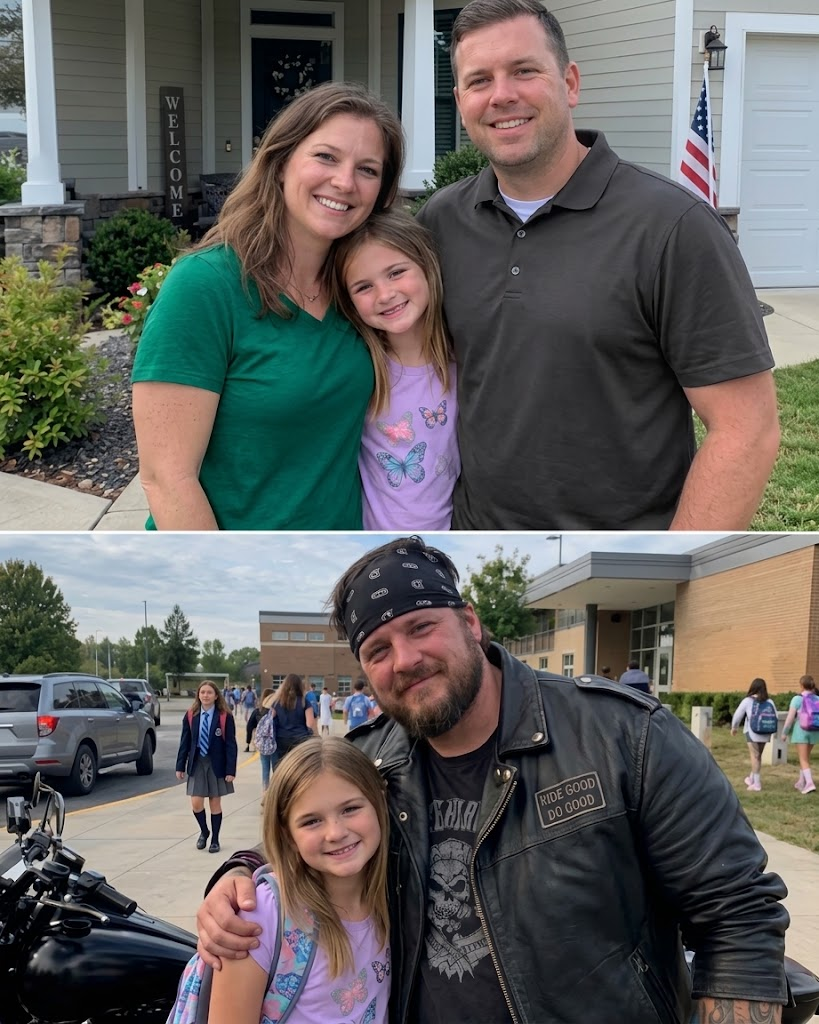
My husband hated that our intimidating biker neighbor walked our seven-year-old home from school. I trusted Travis completely—until Emma’s teacher called me at work and said, “Come here right now. It’s about the man who picks her up.” When I reached the principal’s office, Travis wasn’t alone.
I’d known Travis for so long that I sometimes forgot what he looked like to people who didn’t know him.
He was thirty-six, six-foot-four, tattooed from wrists to shoulders, usually dressed in black, and played bass in a local band.
If you saw Travis walking toward you in a dark parking lot, you might cross the street.
I sometimes forgot what he looked like
But I saw the guy who fixed my first car for free and showed up to help my mom after my dad died. He’d lived near my family for most of my life.
I trusted him.
My husband, Ryan, did not.
The problem started when my work schedule changed.
I trusted him.
Our daughter, Emma, was seven and got out of school at three.
I used to leave work early enough to get her, then finish whatever I needed from home. After I moved to a different department, that stopped being possible.
Ryan worked across town and usually didn’t get home until after six.
For about two weeks, we pieced things together with after-school care, favors from other parents, and me burning through every ounce of patience I had.
The problem started when my work schedule changed.
One night, Ryan said, “Maybe Melissa can handle it?”
I stared at him. He stared back.
Then we both said, “No.”
Emma adored Ryan’s sister, Melissa.
Melissa was also the kind of person who could be forty minutes late because she stopped for coffee on the way to somewhere she was already late to.
“Maybe Melissa can handle it?”
There was also the babysitting incident.
Melissa had let Emma watch IT because, according to Melissa, Emma had promised she “wouldn’t get scared.”
Emma slept between Ryan and me for four nights. She still deeply distrusted balloons.
So we kept looking.
There was also the babysitting incident.
Then one afternoon, Travis found me standing beside my car in our driveway, complaining to my mother on the phone about after-school care.
When I hung up, he was leaning against his fence.
“What time does Emma get out?”
“Three.”
“My rehearsal finishes at two-thirty on Tuesdays through Fridays. Place is two blocks from her school. I can walk her home.”
He was leaning against his fence.
I actually laughed. “You want to pick up a seven-year-old from elementary school dressed like that?”
He looked down at his leather vest.
“Good point. I’ll wear a tiara.”
I smiled for what felt like the first time all week.
We did everything properly. The school copied his ID. I filled out the authorization forms. Travis was officially added to Emma’s pickup list.
“I can walk her home.”
Emma thought it was the greatest thing that had ever happened to her.
Ryan did not.
“I don’t want our daughter depending on some biker every afternoon,” he said the first night.
I was washing dishes. “He’s not some biker. He’s Travis.”
“I know who he is.”
“Then what’s the problem?”
“I don’t want our daughter depending on some biker.”
Ryan’s jaw tightened.
“You trust people too easily.”
I told myself he was being an overprotective father. I understood that. Emma was our only child. Ryan worried about everything from strangers to school buses.
So I let it go.
For three weeks, everything was great.
“You trust people too easily.”
Every afternoon, Travis walked Emma home.
Every afternoon, she was there when I got back.
She loved those walks. At dinner, she would talk about them constantly.
“Travis showed me how motorcycle engines work.”
“Travis says crows remember faces.”
“Travis knows how to whistle with two fingers.”
The call that changed everything came on a Tuesday.
She loved those walks.
I was sitting at my desk when my phone rang.
“Ma’am, can you come to school right now?”
I stood up. “Is Emma okay?”
There was a pause.
“Emma is okay…” Then her voice dropped. “It’s about the man who picks her up.”
“Ma’am, can you come to school right now?”
Every argument Ryan had made rushed back at once.
I barely remember the drive. By the time I reached the school, my hands hurt from gripping the steering wheel.
Emma’s teacher met me near the front office.
“Come with me. The principal will explain.”
That answer made everything worse.
“It’s about the man who picks her up.”
She opened the office door.
Emma was inside, so was Travis, and another person, someone I hadn’t expected to see there at all.
Melissa.
The principal sat behind his desk.
Emma looked furious and close to tears. Travis was standing in the corner with his arms crossed. He looked angrier than I’d seen him in years.
Someone I hadn’t expected to see there at all.
I went straight to Emma.
“Baby, are you okay?”
She wrapped both arms around me. “I’m fine.”
I looked at Travis. “What happened?”
The principal stood. “Ma’am, there seems to be some confusion about pickup today. Your sister-in-law arrived to collect Emma this afternoon.”
I went straight to Emma.
I turned to Melissa.
She raised both hands. “Ryan told me to.”
The principal continued.
“She told our staff that Emma’s father had authorized her pickup. Emma refused to leave with her. Shortly afterward, Mr. Travis arrived for his regular pickup.”
Travis finally spoke.
“Ryan told me to.”
“They didn’t know who they were supposed to release her to, so I asked them to call you.”
The principal nodded. “Which is what we did.”
I could feel a headache forming behind my eyes. I turned back to Melissa.
“I never approved you picking her up. I don’t understand why you’re here.”
“What?”
Her face changed.
I turned back to Melissa.
“I didn’t know anything about this, Mel.”
“Ryan said you did. He told me you guys decided Travis wasn’t picking her up anymore.”
My anger arrived so quickly it almost cleared my fear completely. “We didn’t decide anything.”
Melissa looked genuinely hurt. “Why would he tell me you did?”
I didn’t know.
Whatever Ryan was afraid of, he’d gone behind my back to act on it.
“I didn’t know anything about this, Mel.”
Emma tugged my sleeve.
“I want to stay with Travis.” She stared at the floor. “I trust Travis. I don’t trust Daddy anymore.”
Until that moment, I’d thought the fight was about Travis.
Everything inside me stopped.
“What?”
Emma’s eyes filled. “I don’t trust Daddy.”
“I trust Travis. I don’t trust Daddy anymore.”
I looked at Travis.
His face gave him away. He knew something.
“Why would my daughter say that?”
Travis looked toward Emma. “Talk to Ryan.”
My temper snapped.
“No. If you know something about my daughter, you tell me.”
He knew something.
His jaw tightened.
“She told me something on our walks. I talked to Ryan about it.”
“You talked to my husband about my daughter?”
“Yes.”
“And neither one of you thought I should know?”
“I thought he was going to handle it.”
“She told me something on our walks.”
I could barely believe what I was hearing.
“Handle what?”
Travis shook his head. “Talk to Ryan first. Then if you still want to talk to me, we will.”
I hated him a little in that moment.
Because apparently two men had been having conversations about my child while I was walking around completely unaware.
“Talk to Ryan.”
I took Emma home.
Ryan walked through the door shortly after six. I was waiting in the kitchen.
He saw my face and stopped.
“Why was Melissa at Emma’s school today?”
Ryan put his keys down slowly. “I changed the arrangement.”
“Without telling me?”
I was waiting in the kitchen.
“You weren’t listening.”
I stared at him. “So you lied to your sister and told her we both agreed?”
“You changed Emma’s routine without telling me. You lied to Melissa. You created conflicting pickup instructions. Emma was standing at school today wondering which adult she was supposed to believe.”
“I was trying to protect her.”
“From what?”
“Give me a reason.”
“From him.”
“What has he done?”
Ryan said nothing.
Then I said, “Emma told me she doesn’t trust you anymore.”
His face went pale. “She said that?”
“Yes.”
“Emma told me she doesn’t trust you anymore.”
“She’s seven. She doesn’t understand what she’s saying.”
“Don’t decide she doesn’t mean it because you don’t like hearing it.”
He went still.
I asked, “What did Travis confront you about?”
Ryan’s eyes shifted.
“What did Travis confront you about?”
“He stuck his nose into our parenting.”
“How?”
“Do you always have to do that?” Ryan snapped. “Is it really asking so much to expect you to trust me, your husband?”
I stared at him for a long time.
Then I pulled out my phone and made a call.
“Do you always have to do that?”
“I need you to come over, please. Now,” I said.
Then I hung up.
“Who was that?” Ryan asked, his voice laced with urgency.
“Someone who I hope will give me the answers you won’t.”
***
Ten minutes later, Travis was standing inside our doorway while Ryan glared at him.
“I need you to come over, please. Now,”
I folded my arms.
“Tell me what Emma told you.”
He looked uncomfortable. “She started asking why Ryan didn’t like me.”
Ryan scoffed.
Travis ignored him. “At first I told her adults don’t always get along. Then she said Ryan kept asking her questions about me.”
“Tell me what Emma told you.”
I looked at my husband. “What questions?”
Travis answered.
“Whether I ever took her somewhere else. Whether I bought her things. Whether I let her do things you wouldn’t allow. Whether I told her to keep secrets.”
My stomach tightened.
“Whether I told her to keep secrets.”
Ryan said, “Those are normal questions.”
“The questions weren’t the problem,” Travis replied. “At least, not the first time you asked them, but then you kept pushing after she answered you.”
I looked at Ryan. He wouldn’t meet my eyes.
Travis said, “She told me you kept bringing it up. Eventually you told her, ‘You don’t have to protect Travis. You can tell me if he hurt you.’”
“Those are normal questions.”
My chest hurt. “Ryan… what the heck?”
He turned to me.
“I was making sure!”
Travis’s voice hardened. “She said, ‘Daddy keeps asking like I’m saying it wrong.’”
I covered my mouth. Suddenly Emma’s behavior made sense.
‘You don’t have to protect Travis. You can tell me if he hurt you.’
Travis continued.
“I talked to him a few days ago. Told him if he had a problem with me, he should talk to me. Stop putting Emma in the middle.”
Ryan laughed bitterly. “You told me how to parent my daughter.”
“I told you to stop making her think she’s lying because she won’t give you the answer you want.” Travis glanced between us. “He said he’d handle it.”
“Stop putting Emma in the middle.”
And Ryan had handled it by removing Travis.
Ryan pointed toward him. “This proves exactly what I’ve been saying. Why is my seven-year-old discussing me with you?”
Travis stared at him. “Because you kept asking her about me.”
That shut Ryan up. But it didn’t answer the question that mattered anymore: what was Ryan really afraid of?
Ryan had handled it by removing Travis.
I turned on Travis. “You should have told me.”
He nodded immediately.
“You’re right. I thought he’d fix it,” Travis said. “I was wrong.”
Ryan started pacing.
“You don’t understand.”
“What don’t I understand?” I asked.
“I was wrong.”
He turned toward me.
“He’s always there.” Ryan’s words started coming faster. “Your car broke down when you were a teenager? Travis fixed it. Your dad died? Travis helped your mom. Something breaks? Travis can fix it. You need help with Emma? Travis is available.”
His face twisted.
“Every time I can’t be there, somehow HE is.”
“He’s always there.”
Ryan glanced at Travis. Then he looked at me.
“Sometimes I think you’ve been in love with him this whole time.”
The room went silent.
Even Ryan seemed shocked by his own words.
And finally, I understood.
“You’re jealous of him.”
Finally, I understood.
Ryan stared at me.
“No. This is about Emma.”
“No, it isn’t. Because if it were about Emma, you wouldn’t replace a reliable, authorized adult with someone we already agreed couldn’t manage regular pickup. You wouldn’t question Emma until she felt like she was lying.”
His face fell. Ryan sat down at the kitchen table like his legs had given out.
“You’re jealous of him.”
For a long moment, nobody spoke.
Then he said quietly, “I hate hearing her talk about him.”
I waited.
“I get home late. She’s already eaten half the time. She tells me Travis showed her something, Travis taught her something, Travis said something funny.” He swallowed. “I feel like I’m missing everything.”
“I hate hearing her talk about him.”
His voice cracked. “And he’s just… there.”
The anger drained out of me, but the hurt didn’t.
Travis shifted beside the door.
“She talks about you the whole walk,” he said. “What you taught her. What you packed in her lunch. Last Thursday, she wished you were outside school because she wanted to show you some stupid leaf she’d found.”
“It wasn’t stupid,” Emma called from the hallway.
“And he’s just… there.”
All three of us froze.
She was standing there in pajamas.
Ryan’s face crumpled. He walked toward her but stopped a few feet away.
“Em. I’m sorry. You told me the truth, and I should have listened.”
Emma didn’t rush into his arms. She just nodded.
That hurt him. I think it needed to.
All three of us froze.
An apology was a start. It wasn’t going to erase what he’d done.
I looked at Ryan. “And this doesn’t happen again. You don’t change Emma’s arrangements behind my back, and you don’t keep questioning her until she gives you the answer you want. If you’re worried, you come to me — not our seven-year-old.”
Ryan nodded. “You’re right.”
The next day, Ryan went to the school.
It wasn’t going to erase what he’d done.
He told the principal that Travis had done nothing wrong.
Ryan also admitted he had created the confusion by changing the plan without telling me.
He apologized to Melissa, then went to Travis’s house alone. When he came back, he told me he’d apologized there too, without blaming anyone else.
Travis still didn’t resume pickup right away.
He said Emma needed a few days without adults turning the school gate into a battlefield.
“You’re right.”
For the next week, Ryan and I rearranged our hours.
On Friday, he left work early and picked Emma up himself. When they came home, she was talking a mile a minute about their walk.
Ryan looked at me over her head, shame still in his face, but relief there too.
A few weeks later, we added Travis back to the pickup list.
For the next week, Ryan and I rearranged our hours.
There had never been a competition except the one Ryan had created in his own head.
Things between Ryan and me are still complicated.
Trust doesn’t repair itself because someone finally admits the truth. But he’s listening to Emma now instead of asking questions until he hears what he expects.
For eighteen years, I believed love could survive almost any disappointment.
I believed that if I stayed patient enough, defended my husband enough, and worked hard enough to hold our family together, Patrick would eventually stop looking at me as though I had stolen the life he was supposed to have.
I was wrong.
Every year that passed made the distance inside our home a little wider.
And our son was the one paying the highest price.
My name is Serena.
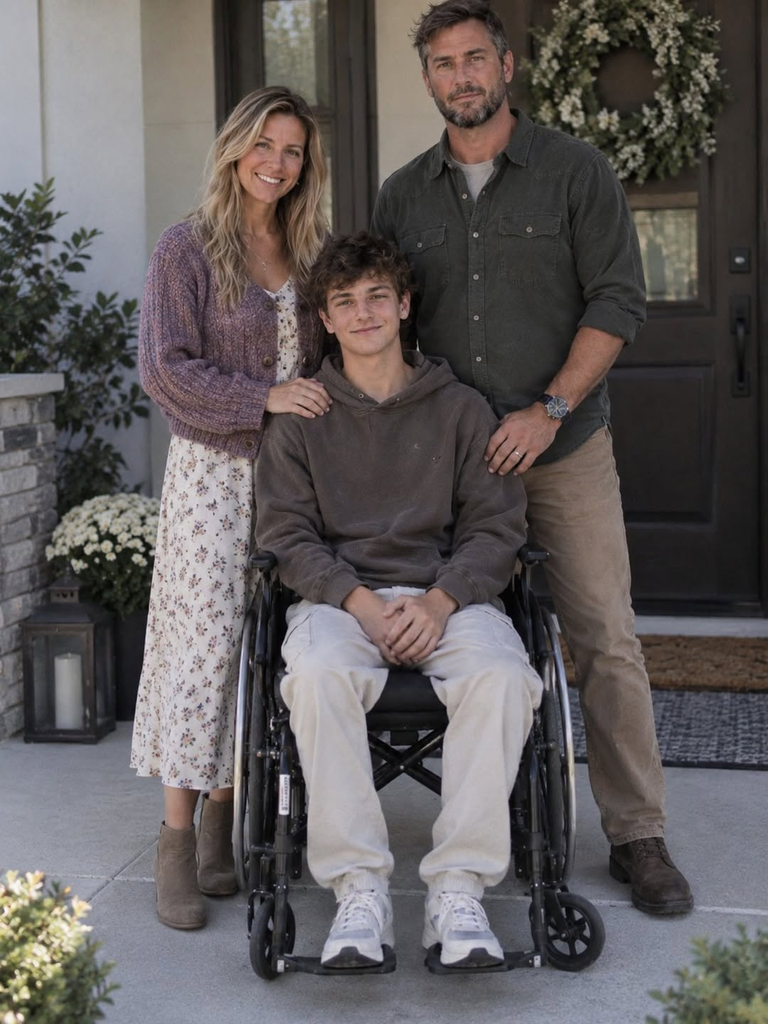
My son, Connor, has used a wheelchair since he was a little boy.
Not once did I look at him and wish he had been someone else.
Connor was funny.
Thoughtful.
Ridiculously intelligent.
The sort of kid who could solve a problem adults had been arguing about for twenty minutes and then act confused when everyone stared at him.
He remembered birthdays.
Noticed when another child was sitting alone.
Fixed computers for neighbors without charging them.
At twelve, he designed a simple attachment for his wheelchair so he could carry his school backpack without it sliding into the wheels.
At thirteen, he modified the design for another boy at his adaptive basketball program.
To me, Connor was never a tragedy.
He was my son.
Patrick never seemed able to separate Connor from the son he had imagined before Connor was born.
Patrick grew up in Ohio in a family where football was almost a religion.
His father had coached high school football for years.
Patrick could describe Friday nights from his childhood in perfect detail.
The stadium lights.
The marching band.
The wet smell of the field after rain.
The sound of his father shouting from the sideline.
Before we married, Patrick once told me:
“When we have a boy, I’m teaching him everything Dad taught me.”
At the time, I thought it was sweet.
I pictured Patrick throwing a football with a little boy in our backyard.
Neither of us knew life would look different.
Connor was three when specialists finally confirmed that the mobility problems we had been investigating were related to a genetic condition.
We had spent years hoping someone would tell us it was only a developmental delay.
It wasn’t.
I remember the examination room.
Connor playing with a plastic truck on the floor.
The doctor speaking carefully.
I looked at my little boy and could not understand how anyone could hear that information and see anything except the same child we had walked in with.
Patrick barely spoke during the drive home.
At first, I thought he needed time.
So I gave it to him.
Then he started missing Connor’s therapy appointments.
He stopped asking what the specialists said.
He buried himself in work.
Eventually, his sadness changed into something else.
Blame.
During one argument, he looked at me and said:
“If you had noticed sooner, maybe things would be different.”
I stared at him.
“The doctors told us this is genetic.”
“You should have pushed harder.”
“For what?”
“More testing. Other doctors. Anything.”
“We did everything they asked.”
He walked away.
Patrick rarely said directly:
You caused this.
He did not need to.
He said everything around it.
If you had noticed.
If you had pushed.
If you had known.
If you had done more.
And after enough years, I started answering questions nobody should have asked me.
Maybe I should have.
Maybe I missed something.
Maybe I failed Connor.
Logically, I knew better.
Emotionally, guilt is not logical.
And when the person you love repeats the same accusation long enough, sometimes the accusation becomes part of the furniture.
You stop noticing how ugly it is.
PART 2 — THE JOKES
As Connor grew older, Patrick learned to hide resentment inside humor.
That made it worse.
When neighbors talked about their sons making varsity teams, Patrick would laugh.
“Well, at least I’m saving money on football equipment.”
People smiled awkwardly.
Nobody knew what to say.
I usually changed the subject.
Connor usually looked down.
Once, at a neighborhood barbecue, another father said:
“My son’s coach thinks he might start next season.”
Patrick lifted his beer.
“Must be nice.”
The father’s smile disappeared.
Connor sat beside me.
He was fourteen.
I reached for his shoulder.
He moved slightly away.
Not because he was angry with me.
Because he did not want everyone to see that he needed comforting.
That night, I confronted Patrick.
“You embarrassed him.”
“I made a joke.”
“It wasn’t funny.”
“You’re too sensitive.”
“No.
Connor heard you.”
“He knows I love him.”
“Does he?”
Patrick’s face hardened.
“What is that supposed to mean?”
“It means you keep assuming Connor knows things you almost never say.”
He walked away.
That became our marriage.
I raised concerns.
Patrick interpreted them as attacks.
I softened them.
He dismissed them.
Then I apologized for the argument.
PART 3 — COACH CALLAHAN
Connor found adaptive basketball when he was twelve.
I did not even know the community center had a program.
Connor discovered it through school.
One afternoon after practice, I walked into his room and found him smiling.
Patrick had made another comment at dinner.
Something about never needing to buy football cleats.
I sat beside Connor.
“I’m sorry.”
He frowned.
“For what?”
“For everything.”
He stared at me.
Then:
“Mom, that is a very large category.”
Despite myself, I laughed.
He took my hand.
“Coach Callahan says people spend too much time thinking about what they can’t do.”
“Who is Coach Callahan?”
“My basketball coach.”
“You have a coach?”
“I told you.”
“You told me the community center had basketball.”
“That usually involves coaching.”
“Smart mouth.”
He grinned.
“What else did she say?”
“She said when everybody is staring at the thing you can’t do, they miss everything you can.”
I pulled him into a hug.
“That is a very smart coach.”
“Yes.”
Then:
“You should meet her.”
I did.
Patrick didn’t.
For years.
PART 4 — THE SON PATRICK MISSED
Connor’s life became full.
Adaptive basketball.
Science competitions.
Coding club.
Volunteer tutoring.
Student council.
Then engineering.
He once spent an entire summer helping a local nonprofit map accessibility problems around public buildings.
He measured curb heights.
Ramp slopes.
Door widths.
Then built a simple online map that helped wheelchair users identify accessible entrances.
The city council recognized him.
Patrick missed the ceremony.
Work meeting.
Another time Connor won a statewide academic award.
Patrick attended.
Left early.
“Big client call.”
Connor never complained.
That worried me more than anger would have.
He became skilled at expecting nothing.
Children should not have to learn that skill from a parent.
PART 5 — THE COLLEGE LETTERS
During Connor’s senior year, our mailbox began filling with envelopes.
Universities.
Scholarships.
Engineering programs.
One afternoon, I spread everything across the dining table.
“Connor!”
He rolled in from the living room.
“What happened?”
“Look.”
He stared.
“No way.”
“Yes way.”
One university offered full tuition.
Another included housing support.
A California school with a nationally respected engineering and assistive-technology research program offered him a substantial scholarship and a place in an undergraduate innovation lab.
Connor held that letter like it was made of glass.
“This one.”
“You haven’t even visited.”
“I know.”
“Then how do you know?”
“The lab.”
Of course.
Patrick arrived home twenty minutes later.
I practically ran toward him.
“You need to see this.”
He glanced at the table.
“What?”
“Connor’s acceptances.”
Patrick loosened his tie.
“Good.”
Connor held out the California letter.
“Dad, look.”
Patrick glanced.
“California is expensive.”
“They offered a scholarship.”
“Still expensive.”
Then he went upstairs.
Connor watched him leave.
I looked at my son.
He gave me a little smile.
“I guess good is technically positive.”
That broke something in me.
PART 6 — “I DIDN’T ASK FOR THIS”
I followed Patrick upstairs.
“Could you have acted any less interested?”
He sighed.
“Serena.”
“Your son just got into some of the best engineering programs in the country.”
“I said congratulations.”
“You said good.”
“Same thing.”
“No.”
Patrick sat on the edge of the bed.
“What do you want from me?”
“Joy.”
He stared.
“Excitement.”
“Serena.”
“Pride.”
“I am proud.”
“Then why does Connor never get to see it?”
Patrick stood.
“You always turn everything into a trial.”
“Because you treat every achievement like a consolation prize.”
“That isn’t true.”
“If he had scored a touchdown instead of winning an academic award, would you have said good and gone upstairs?”
His face tightened.
“Don’t start.”
“I am starting.”
He pointed toward the hallway.
“I did not ask for this life.”
Silence.
Neither of us noticed Connor had stopped outside his bedroom down the hall.
Patrick continued.
“I had plans.”
“So did I.”
“You don’t understand.”
“I understand perfectly.”
I lowered my voice.
“You imagined a son.
Then Connor arrived, and instead of changing the dream, you spent eighteen years punishing the people who did.”
Patrick turned away.
I left.
Neither of us knew Connor heard everything.
PART 7 — GRADUATION
Connor graduated first in his class.
His principal described him as one of the most intellectually curious students he had taught in thirty years.
The audience stood.
I cried.
Coach Callahan shouted from several rows behind us.
Valerie cried louder than I did.
My brother Marcus recorded almost the entire ceremony vertically despite everyone repeatedly telling him to rotate the phone.
Patrick clapped politely.
Afterward, Connor posed with teachers.
Friends.
Coach Callahan.
Me.
Patrick stood near the edge of the group.
Looking like a guest.
I remember thinking:
Maybe university will change everything.
Maybe Patrick will finally see the man Connor is becoming instead of the child he imagined losing.
Hope can survive ridiculous amounts of evidence.
PART 8 — THE PARTY
Connor’s eighteenth birthday came a few weeks later.
My sister Valerie insisted on a real celebration.
“He is eighteen once.”
“I know how birthdays work.”
“Then stop trying to make it six people and a cake.”
It was supposed to be a perfect day. I’d spent weeks planning it. Balloons, decorations, the exact shade of blue my son liked most. I even custom-ordered a cake with his favorite dinosaur on top. The one he draws over and over again in his sketchbook like it’s his imaginary friend. My wife, Emma, was in charge of the goodie bags, and I handled the playlist because I knew all the songs that made him dance around the kitchen in his Spider-Man pajamas.
We were doing it at my parents’ house like we always did. That was the plan. That’s how it had always been. Birthdays, anniversaries, holidays, it all went down at Mom and Dad’s place. That house was supposed to mean family, but this time something snapped.
I’m Zane. I’m 34, husband, dad of two. Noah is seven, Ellie’s four. I’m not one for drama. I’ve always been the let-it-go kind of guy. Bite my tongue, laugh it off, make peace, not war. You know the type.
But before I tell you what happened at that party, you need to understand the thirty-four years of accumulated pattern that finally cracked in that living room, because none of what I did afterward makes sense without it.
I grew up in a house where keeping the peace meant swallowing your pride and not asking too many questions. Especially when it came to my younger sister, Maddie. Maddie was the golden child. Still is. Honestly, she’s thirty-one now. A single mom of two adorable kids. And she somehow turned that into a full-time identity that grants her immunity from consequences.
Growing up, she could do no wrong. Wrecked the car at seventeen. She was under so much stress. Blew all her student loan money on a spontaneous trip to Ibiza. She needed to find herself. Meanwhile, I once got grounded for bringing home a B in calculus.
The double standard wasn’t new. But I guess I thought that once we were adults, things would even out. Spoiler alert, they didn’t.
I should have seen it coming. Honestly, there had been warning signs. Last Christmas, my mom forgot to put Noah’s name on the gift tags and handed him a generic board game that clearly came from the dollar store bin. Meanwhile, Maddie’s kids got a Nintendo Switch and personalized stockings. At Easter, Noah asked why the Easter Bunny skipped Grandma’s house and only left baskets for his cousins. I brushed it off. Said maybe the bunny got tired and missed a stop. Emma gave me that look. That “you know what this is” look. But I wasn’t ready to admit it. Not yet.
I want to describe our own household a little more fully, because I think it matters for understanding how much I wanted the vineyard of ordinary things I’d never quite gotten as a kid to feel different for my own children. I met Emma nine years ago at a friend’s engagement dinner, and she has this particular clear-eyed steadiness that I’d never had much exposure to growing up in a house that ran on unspoken rules and shifting favor. We married four years later, and Noah came a couple years after that, followed by Ellie. I work as a freelance web designer, not glamorous, not always stable, but I’d built a decent client list over the years, and Emma had been staying closer to home with the kids while occasionally picking up freelance graphic design work herself.
This year for Noah’s birthday, I wanted it to be special. We were already feeling tight on space at our place, so hosting it at my parents’ house made sense. Bigger yard, more room to run around. Familiar territory. I called ahead, asked if we could do the party there, and Mom said, “Of course. We’d love to host.” She said, “Family is everything.” Her words.
I even offered to bring everything. Food, drinks, decorations, the whole deal. I wasn’t asking for anything except the space and maybe a helping hand.
The morning of the party, Noah was up at 6:00 a.m. He ran into our room and jumped on the bed, grinning from ear to ear. He was already wearing the dinosaur T-shirt we got him. Wouldn’t take it off since Tuesday. I helped him pack his new toy cars, the ones he wanted to show his cousins.
“I bet Grandma made pancakes,” he said on the way over, practically vibrating in the back seat.
My heart ached in the best way. That innocent, hopeful joy. I didn’t know it could be cracked in an instant, but it can.
We pulled into the driveway a little early. Emma had the cake on her lap, and Ellie was humming the happy birthday song off key. I remember feeling good. Like really good. That warm kind of happiness that bubbles up when you see your kid genuinely excited.
That was the last time I felt it that day.
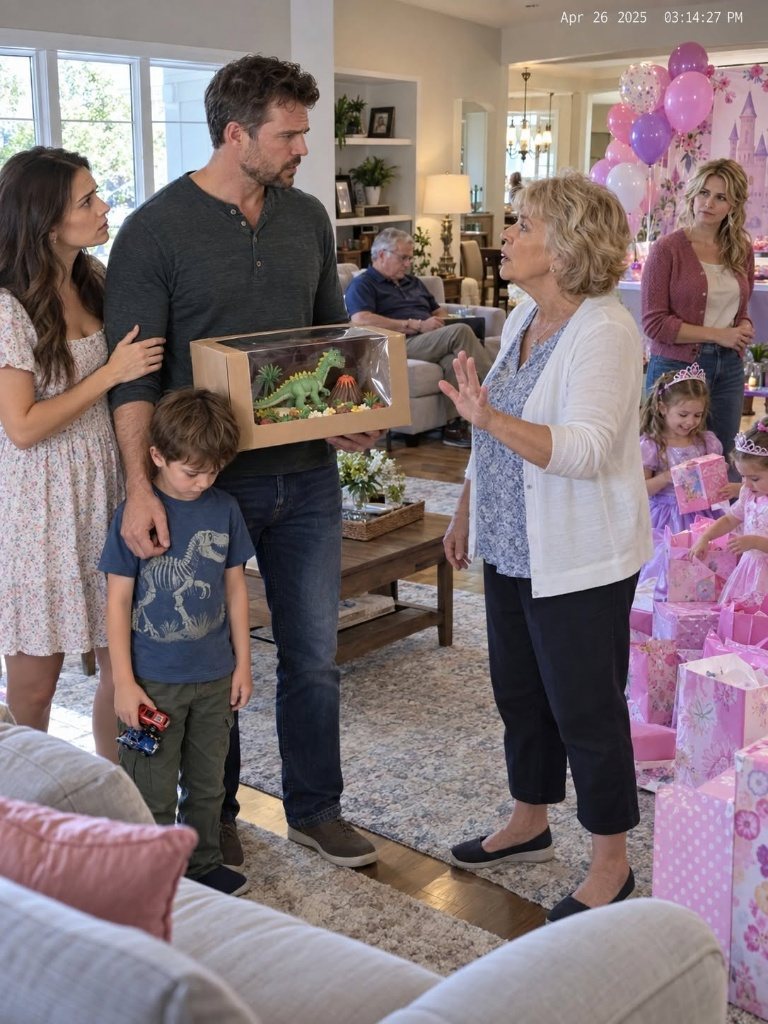
When we stepped inside, the first thing I noticed was the color scheme. Pink and purple streamers. A huge glittery happy birthday sign with Maddie’s daughter’s name on it. At first, I thought I was seeing things. Maybe they were recycling decorations from a past party. But then the balloons came bouncing down the hallway, also pink and purple, with Princess printed on them.
Noah froze beside me, looking around confused. His grip tightened on my hand.
And then Maddie walked in, smiling like this was the best surprise ever. “Oh, good. You’re here early. We figured we’d just do a little combo celebration since everyone’s already coming. Two birds, one stone, right?”
I didn’t know what to say. I blinked at her, stunned. Combo celebration. Her daughter’s birthday was three weeks ago. Noah’s was today. Today.
Before I could speak, my mom swooped in from the kitchen carrying two gift bags, both covered in sparkly wrapping paper. “Look who’s here,” she said in that sugary voice she uses when she’s putting on a show. “Hi, sweetie.”
She bent down and handed the bags to Maddie’s kids. Gifts. Big ones, by the look of them. One of the kids squealed and tore into it on the spot. A Barbie Dreamhouse.
My heart dropped. Noah just stood there holding the toy cars we brought. My mom looked right at him. Didn’t say a word. No hug. No happy birthday. Not even a smile. It was like he wasn’t even there.
“Mom,” I said, forcing a smile, trying not to cause a scene. “Did you forget today’s Noah’s birthday?”
She blinked like I’d asked her if she wanted tea or coffee. “Of course not,” she said. “But Maddie had such a hard week with work and the kids. We thought it’d be nice to let her little ones feel special, too. They don’t get as much attention lately. You know how it is.”
I didn’t. I really didn’t. Because I couldn’t wrap my head around how you host a party for one kid and ignore the one whose birthday it actually is.
I looked at Emma, who was clutching the cake box like it might shatter. Her mouth was set in a tight line. And I could see the fire behind her eyes.
Noah was quiet. Too quiet. He wasn’t looking at anyone now, just staring down at his feet like maybe if he stood still enough, he’d disappear.
I knelt down next to him and said, “Hey, bud. You okay?”
He nodded barely. “Do I still get to blow out the candles?” he whispered.
That’s when I knew something was really, really wrong.
I stood up and looked around the room. No decorations for him. No presents. No candles. No chairs set up for a party. This wasn’t a combo celebration. It was Maddie’s party again, as usual. And my son, on his seventh birthday, was invisible.
I tried. Really tried to keep it together. I gave my mom one last chance.
“Did you get Noah anything?” I asked, voice low. Not angry yet. Just sad, desperate, maybe.
She waved her hand like I was being dramatic. “We figured we’d do his next time. It’s just a birthday. He’s a boy. He won’t remember this stuff.”
I felt something crack. Something deep. I looked down at Noah again, and the smile he’d had that morning, the one that made my whole week, was gone. Just gone. Replaced by that hollow look kids get when they’re trying not to cry in public.
And that was it. That was the moment something inside me shifted. But I didn’t yell. Not yet. Instead, I reached for the cake in Emma’s hands and said, “We won’t be staying.”
My mom blinked, saying, “Don’t be like that. You’re overreacting.”
Overreacting. I didn’t say anything. Just looked around one last time. Took in the sight of my sister laughing with her kids. My dad sitting quietly in the corner like always. The presents. The streamers. The total absence of anything for my son.
And then I turned and walked out. Cake in one hand. My son’s in the other. I didn’t say goodbye.
But this, this was just the beginning.
We didn’t talk much in the car. Emma sat in the passenger seat, holding the cake on her lap like it might explode. Noah stared out the window, his reflection in the glass more expressive than his face. He didn’t ask why we left. He didn’t say anything about the presents. He just looked out at the street lights flickering past like they were more interesting than any of us.
We ended up back home before noon. The dinosaur balloons I’d ordered were still tied to the banister. The banner Emma and I hung that morning still said, “Happy 7th, Noah,” in giant bubble letters. The table was set with matching plates and napkins, little plastic figurines lined up along the edge like parade watchers. The goodie bags were untouched in the corner.
“I’m sorry, buddy,” I said as we walked in. “I know that wasn’t what we planned.”
He just nodded, setting his toy cars down on the floor. “It’s okay,” he mumbled. “Maybe they just forgot.”
Emma crouched beside him. “Hey, listen to me.” Her voice was soft but firm, the way it gets when she’s about to say something important. “They didn’t forget. They chose not to, and that’s not okay.”
He looked up at her. “But they love me, right?”
That question wrecked me.
We tried to salvage the day. I called up two of Noah’s school friends. Thankfully, their parents were free, and they came over with cupcakes and Nerf guns. We lit the candles on the cake, sang happy birthday, and even played a few rounds of pin the tail on the T-Rex. For a while, it worked. His smile crept back slowly, cautiously, like it didn’t quite trust the air around it.
But that night, after we tucked him in, Emma came into the living room and closed the door behind her. “We’re done with them,” she said.
I didn’t argue. Still, a small part of me hoped it was a misunderstanding. Maybe next time would be different. Maybe this was just some bizarre miscommunication. I told myself that. Lied to myself, really.
But then the texts started. Maddie messaged me the next day. “Hey, what was that yesterday? Mom’s really upset.”
Me: “You hijacked my son’s birthday.”
Maddie: “No one hijacked anything. We just thought it would be easier. Don’t make a scene. It’s not that deep.”
It wasn’t just that deep. It was the depth. It was the final proof that everything we’d been feeling for years wasn’t just in our heads. It was real, documented, gaslit, and glossed over.
But Mom took it further. She called me the next night. “Zane, I need to talk to you.”
“Now’s not a good time,” I said.
“It’ll only take a minute. I just think you overreacted. Maddie’s been going through a lot.”
“She always is, isn’t she? And Noah,” I asked, “what’s he going through, Mom?”
A pause. “He’s a child. He’ll bounce back. He’s not going to remember one birthday.”
“Funny,” I said. “Because I do. I still remember my eighth birthday when you canceled the party because Maddie had the flu and you never rescheduled it. You said the same thing back then. You’ll bounce back.”
She went quiet again. “Zane, don’t hold grudges. It’s not healthy.”
I hung up.
Over the next few weeks, Emma and I tried to go about our lives. We stayed busy. Work, school runs, dinners, life. But the distance from my parents started to ache like a dull bruise I kept bumping into.
And then came the real blow. Noah had his school’s fall showcase. Some kind of art and science fair hybrid where the kids showed off projects they’d spent weeks on. He made a papier-mâché volcano. And I’m not just saying this because I’m his dad. It was epic. The thing smoked. He worked on it every night with Emma. He even made a little flag with his name and dinosaur doodles to stick in the lava like a conqueror.
Each kid was allowed to invite up to four guests. He picked Emma, me, and his grandparents. When I saw their names on the form, my stomach dropped.
“Are you sure you want to invite them?” I asked.
He nodded. “They’ll come this time. I want to show them.”
I didn’t have the heart to say no, so we sent the invite. Emma even followed up with a text. “Hey, Noah’s showcase is this Friday at 5:00 p.m. He’s really proud of his project. Would mean a lot if you came.”
Mom: “We’ll see.”
We’ll see. That’s what she said when I asked if she’d come to my college graduation. She didn’t come to that either.
Still, Noah was hopeful. He wore his little button-down shirt and fixed his hair just right. When we got there, he kept looking at the doors, scanning for familiar faces. I stood behind him pretending not to notice every time his smile slipped a little more.
They didn’t come. They didn’t even text.
That night, Noah didn’t eat dinner. He just picked at his mac and cheese and asked to go to bed early. When I tucked him in, he said, “Maybe they forgot.”
“No,” I said, kneeling beside him. “They didn’t forget. They chose not to come. And that’s not your fault.”
His eyes shimmered. “Do they not like me?”
That sentence, that one tiny, gut-wrenching sentence, shattered whatever illusions I had left about my parents.
I sat there holding his hand, wondering how I ever let it get to this point. How many times had I excused their behavior? How many birthdays, holidays, visits had I let slide because I didn’t want to rock the boat?
Emma didn’t say, “I told you so.” She just sat next to me on the couch after he fell asleep and handed me a glass of wine. We didn’t talk. We didn’t need to.
A few days later, the real betrayal hit. Emma got a call from her friend Lindsay, another mom from school, someone who floats between social circles and always seems to know everything.
“Hey, you guys okay?” she asked.
“Oh, yeah. What?”
“I just heard something weird. Maddie’s throwing a huge party next weekend for her daughter at your in-laws’ place.”
Emma blinked. “Wait, again?”
“Yep. Bounce house, cotton candy machine, clown show, the works. Everyone’s invited. Well, not everyone. Your name’s not on the list.”
Emma thanked her and hung up. Then she turned to me. “They’re doing it again,” she said.
I stared at her. “You mean another party? After the stunt they pulled on Noah’s birthday?”
She nodded. “And they didn’t invite us.”
I didn’t even know what to say anymore. It was like the universe had doubled down just to see how much we’d take.
Out of morbid curiosity, I checked Facebook. Sure enough, there it was. Photos from the backyard. Our old backyard. Maddie’s daughter in a sparkly dress, gifts piled high. My mom smiling in every frame, holding cotton candy like it was a torch of maternal pride. My dad even wore a “#1 Grandpa” shirt. The same man who hadn’t said a word to Noah on his birthday.
That was it. That was the breaking point. Not just because they threw another party. Not just because they excluded us. But because they made it loud, public, intentional. They wanted everyone to see who they showed up for and who they didn’t.
I closed the laptop and sat there staring at the wall. My hands were shaking. Not from anger. Not really. From clarity. Because for the first time in my life, I saw it all clearly. Every quiet slight. Every unspoken dismissal. Every time I’d been told to let it go. While Maddie got the world handed to her in pink wrapping paper and glitter bows.
Emma sat next to me. “So what now?”
I looked at her. My voice was calm when I said it. “We’re done pretending.”
She nodded. “Good.”
I didn’t call them right away. For the first time in my life, I let the silence stretch. Not out of spite. Out of self-preservation. See, when you grow up in a house where love feels conditional, where affection is measured by your ability to stay quiet, stay useful, stay low-maintenance, you don’t learn how to protect yourself. You learn how to perform. You learn how to shrink to fit the mold. You learn how to smile through disappointment so the room stays calm.
But eventually, something cracks. And when it does, the silence isn’t a punishment. It’s a boundary.
That week after Maddie’s second birthday blowout, I felt hollow, like someone had scooped something out of my chest and left me walking around with a hole no one could see. I stopped opening texts. I didn’t answer calls. I muted the group chat my mom used to send memes and passive aggressive reminders about family dinners.
Instead, I threw myself into work. At night, I’d sit with Noah while he colored. He didn’t talk about Grandma anymore or the party or the volcano. But every once in a while, I’d catch him glancing toward the front door like he was expecting someone to show up and explain everything. Like maybe the silence would eventually come with an apology.
It didn’t. Not from them.
But something strange happened in that silence. We started talking more, Emma and me. I mean, real talks. Not just about school lunches or bills. Deeper stuff. About boundaries. About family. About what kind of parents we wanted to be.
One night, I told her about something I hadn’t thought about in years. “When I was thirteen,” I said, “Mom forgot to pick me up from soccer practice. It was raining. Everyone else left, and I waited outside for almost two hours.”
Emma frowned. “Didn’t you call her?”
“I didn’t have a phone back then. And the coach left before I could ask to use his. She finally pulled up like it was nothing. Said Maddie needed help with a school project.”
Emma reached for my hand. “You never told me that.”
“Because back then it didn’t feel unusual. It just felt normal.”
And that was the hardest part. Realizing how much of my childhood I’d normalized as just the way things are. Realizing I had spent decades trying to earn love that should have been unconditional.
The fall wasn’t dramatic. No fights. No screaming matches. Just distance. Heavy, invisible distance. Until Maddie sent the message.
“So you’re just going to ghost the whole family now?” That was her opening line. No hi. No checking in. Just accusation.
Me: “Not ghosting, just protecting my kid.”
Maddie: “From what? He’s a child, not a victim of war.”
She always did have a flare for minimizing things.
Me: “He’s a child. That’s exactly why I’m protecting him.”
Maddie: “You’re being dramatic and selfish. Mom says you’re breaking her heart.”
Me: “Mom broke his first.”
I stared at the screen for a while after that. Maddie never replied. She didn’t have to. She wasn’t the point anymore.
By now, I had started journaling again, just for myself. Stuff I hadn’t unpacked in years started to surface. Childhood memories I’d buried. Unfair moments I’d brushed off. At first, it felt like self-pity. But over time, it started feeling more like healing.
One night, Emma peeked over my shoulder. “That’s really good,” she said.
I laughed. “It’s not for anyone.”
“Maybe it should be.”
And that planted a seed. A few days later, I took one of those entries and reworked it into a blog post. Nothing fancy. Just a Medium account. A simple post titled, “When Grandparents Aren’t Grand.” I didn’t name names. I just told the story. My story.
By the end of the week, it had 5,000 views. By the end of the month, 50,000. Messages started rolling in from strangers, parents, adult children, even therapists, thanking me for saying something out loud they hadn’t been able to.
“You helped me realize it wasn’t just me.” “I thought I was being too sensitive.” “I haven’t spoken to my mother in three years. I still feel guilty.” “Your post made me feel human.”
That was the beginning of something I never saw coming. A small publisher reached out a few weeks later. Said they liked my voice. Asked if I’d consider writing a collection of essays about fatherhood and family dynamics. I said I’d think about it. But the truth, I’d already started.
Emma encouraged me every step of the way. She helped me organize the essays, gave feedback, cheered me on when I doubted myself. I worked early mornings and late nights, sometimes during lunch breaks, sometimes while the kids were at school. For the first time in years, I felt like I was building something that mattered not just to me, but to people like me. People who grew up being told, “You’re overreacting,” when their hearts were breaking. People who had to become parents just to realize how badly they were parented.
In the middle of all this, Noah started changing, too. He joined a kids art club at the community center. Started bringing home little clay sculptures and watercolors. One day, he painted a picture of a volcano. Red and orange swirls exploding from a paper mountain with a little flag that said, “I did it anyway.” I hung it on the fridge.
One Saturday, he asked if we could bake cookies. “Sure,” I said. “What kind?”
“Not for us,” he said. “For the neighbors.”
That’s when I realized he wasn’t just healing. He was thriving. We were.
By the time the new school year rolled around, he’d been selected as class ambassador. Ellie started preschool and immediately became queen of the snack table. Emma took a chance on a side business she’d been dreaming about, an Etsy shop selling handmade kids party supplies, balloons, banners, themed kits. She called it Bright Spots because that’s what we were learning to look for and create.
We hosted Thanksgiving that year, our first time doing it without my parents. It was small. Just us, the kids, Emma’s sister, and a couple of close friends. But the food was warm, the music was loud, and the laughter was real. Noah helped make the mashed potatoes and announced to the table that he was officially a chef.
Now, at one point during dessert, Emma leaned over and whispered, “Look at us.” I looked. And for the first time in a long time, I didn’t feel like something was missing.
A few days later, I got a letter in the mail. Not an email. A letter from my mom. It was written on that thick floral stationery she only used for condolences or church thank you notes. It was short. Three paragraphs. No apology. No accountability. Just a vague acknowledgement that feelings were hurt and that families shouldn’t let misunderstandings come between them. She ended it with, “We’d love to see the kids before Christmas. Let’s put the past behind us.”
I read it twice. Then I folded it up and slid it into the drawer beside my desk. I didn’t respond because it wasn’t just a misunderstanding. It was a pattern. A legacy of silence and favoritism and weaponized guilt. And until that was acknowledged, I wasn’t opening the door again.
The truth is, hitting rock bottom wasn’t the fall I thought it would be. It was a turning point. I lost something when I walked out of my parents’ house that day with the cake in my hands. But I gained more. Clarity. Strength. Purpose. And my son, he gained a father who finally learned how to stand up. Not just for him, but for himself.
When you grow up in a family like mine, you’re taught not to call it revenge. You’re taught to call it forgiveness. You’re taught to be the bigger person, to not air dirty laundry, to let things go for the sake of peace. But here’s what they never tell you. Forgiveness without accountability isn’t noble. It’s erasure. It’s how cycles continue. It’s how people like my mother get to smile at church, wave at neighbors, and pretend they’re saints while the people they hurt clean up the mess in private.
And I was done cleaning.
It all started with that letter, the one Mom sent after Thanksgiving. I kept it not because it meant anything to me emotionally. It didn’t. But because it was proof. Proof that she knew something was broken and that she wanted to pretend it wasn’t. She never used the words, “I’m sorry.” She never mentioned Noah. She never acknowledged the birthday, the art show, the party we weren’t invited to. It was a letter crafted not to heal, but to protect her image. To say, “Look, I tried,” if anyone ever asked.
And that’s when I realized something important. My mother cared deeply about appearances more than anything else. She could dismiss my hurt in private. But the idea that other people might see her in a negative light? That was her Achilles heel.
And suddenly, all the pieces started falling into place. Every decision she’d ever made. Who got praised. Who got punished. Who got invited. Who didn’t. It was all curated, controlled. Maddie got the spotlight because Maddie played the part. I didn’t. I was too independent, too questioning, too inconvenient. So, she sidelined me. Kept me close enough to call on when she needed a man to move furniture or fix a printer, but far enough to discard when I asked uncomfortable questions.
And now that I was gone, truly gone, she couldn’t control the narrative anymore. So, I decided to write my own.
I finished the essay collection. All twelve chapters. Each one focused on a different theme. Fatherhood. Boundaries. Generational trauma. Favoritism. Conditional love. Silent sons. I wrote the truth, but I changed names and some details. I wasn’t trying to smear anyone. I was trying to free myself. But I didn’t pull punches either because what’s the point of surviving something if you have to keep pretending it didn’t happen?
The publisher loved it. They offered me a modest advance, enough to feel like a win, not enough to change our lives. But I didn’t care about the money. I cared about the message.
Emma cried when she held the first printed copy in her hands. “You did this,” she said. “You turned something awful into something real.”
And that’s when I got the idea. The setup didn’t require lies or tricks or drama. Just truth. Amplified.
It started with a simple email to the school board. Nothing dramatic. Just a recommendation that the district include more mental health resources for children dealing with strained or toxic family dynamics. I attached one of my essays. A week later, they invited me to speak at a local parent engagement night.
I almost said no. But then I remembered the look on Noah’s face when he whispered, “Do they not like me?” So, I said yes.
The night of the event, I stood in a multi-purpose room filled with PTA moms, tired dads, and teachers with clipboards. I told my story. I didn’t name names. But I told the truth. Afterward, people lined up to thank me. One woman said her daughter hadn’t spoken to her parents in a decade because of how they treated her son. A man admitted he still flinched when his father texted. A teacher asked if she could share my essay with her staff.
It was like pulling a thread and watching a whole curtain come down. Suddenly, I wasn’t alone anymore. None of us were.
So I went bigger. I created a website, uploaded a few essays, added resources, started a small newsletter. Emma helped with design. Noah drew the header logo, a cartoon volcano with a smiley face and a flag that said, “I did it anyway.” It went viral within a month. Articles popped up on parenting blogs. Podcasts asked me to come on. I told my story over and over again. Not for sympathy. But for solidarity.
And that’s when they started noticing. First came the email from Maddie. No subject line. Just two sentences. “Wow, you really had to make yourself the victim, huh? Hope it was worth it.”
I didn’t respond. Then Mom called. I let it go to voicemail. “Zane, I saw what you’re doing. I don’t appreciate being painted as some kind of monster. I have always done what I thought was best. You might not agree, but that doesn’t give you the right to slander me in public.”
That was her word. Slander. Even now, it was about her image. So, I posted a new essay. Titled it, “When the People Who Hurt You Say They’re the Victims.” I didn’t name her. I didn’t have to. People knew.
But I still wasn’t done because the next opportunity was too perfect to ignore. Our town does a yearly Voices of the Valley series. Local authors get to do a public reading at the community center, usually paired with a Q&A. And guess who was on the planning committee? Her church friend, Carol. The one who always asked, “How’s your lovely son? The quiet one, not Maddie, the other one.”
I sent in my name. Carol replied within an hour. “We’d love to have you.” The reading was scheduled for mid-February, right after Maddie’s daughter’s birthday. Poetic, right?
I chose three essays to read. One of them was called, “The Day My Son Stopped Believing in Grandparents.” That one hit a nerve.
The room was packed. Emma sat in the front row. Noah was next to her, holding Ellie’s hand and sipping hot chocolate. Halfway through my reading, I saw them. My parents. Standing in the back near the exit. My mom had that tight smile she wore at funerals. My dad looked like he wanted to be anywhere else. Maddie wasn’t there.
I didn’t stop. Didn’t flinch. When it was over, people clapped. A few stood. Someone even whistled.
And then slowly, my mother approached. “Can we talk?” she asked, her voice brittle.
I looked at her. Then at Noah. And then back at her. “No,” I said. “Not yet.” And I turned away.
Because this setup wasn’t about confrontation. It was about clarity. About building something so strong that I never had to beg for love again. And about teaching my son that real family doesn’t ignore your birthday. Real family doesn’t show up when it’s convenient and vanish when it counts. Real family sees you, celebrates you, shows up every time.
They didn’t show up at the next reading. I wasn’t surprised. After the Voices of the Valley event, the local paper ran a piece on me. A small write-up. Nothing sensational. Just a headline that read, “Local dad’s essays on family and forgiveness strike a chord.” But it was enough. Enough for my mother’s church friends to start whispering. Enough for Maddie’s co-workers to start googling. Enough for people to start seeing the cracks.
And that, that was the beginning of the end. Not for me. For them.
After my book started gaining traction, I got an invitation to speak at a regional parenting conference. It wasn’t huge. Just a few hundred attendees, mostly educators, counselors, and young parents. But it was the kind of place where reputations were built. And more importantly, it was being hosted in my hometown. The one where my mother chaired the charity board. Where Maddie was a substitute teacher at a private preschool. Where our last name still carried weight in all the right social circles.
So, when the promotional flyer went out with my face on it and the title of my talk, “Breaking the Cycle: How to Parent Without Repeating the Pain,” well, let’s just say it didn’t go unnoticed. Two days later, I got a message from my dad. Just a single line. “Is this really necessary?” I didn’t respond.
Instead, I walked into Noah’s room, sat beside him on the floor where he was drawing, and said, “I’m going to talk to a bunch of parents. About you. About what it means to protect your kid.”
He looked up. “Are you going to tell them about Grandma?”
I paused. “Yes. But not just her. I’m going to tell them about how strong you are, about how proud I am to be your dad.”
He smiled and went back to drawing. That smile. That was all the permission I needed.
At the conference, I didn’t hold back. I told the full story. Noah’s seventh birthday. The party that wasn’t for him. The forgotten art show. The silence. The letter. The manipulation. The gaslighting. I didn’t use names. But I didn’t have to.
By the time I finished, the room was still. And then the applause came. Slow. Rising. Real. And later, during the Q&A, a woman in the back raised her hand and said, “What would you say to people who think you’re airing dirty laundry?”
I looked her dead in the eyes and said, “I’d say I’m not airing dirty laundry. I’m airing out the house before it kills someone.”
That clip went viral. Shared on TikTok, Instagram, even Reddit. Ironically, the comments poured in. “This is the kind of dad I want to be.” “I feel seen for the first time.” “My mom said the same thing to me. You’re overreacting.” “Screw that.”
And with that attention came opportunity. A bigger publisher offered to re-release my book under a national imprint. A podcast producer reached out about adapting the essays into a limited series. A mental health nonprofit offered me a consulting gig. And every time someone asked me why I started writing, I told them the truth. “My son smiled on his birthday, and then he stopped. And I promised myself I’d never let that happen again.”
But here’s where the real revenge came in. Remember Emma’s Etsy shop? Bright Spots? Well, all that attention meant orders started pouring in. Party kits. Custom banners. Balloons. Her dinosaur-themed birthday set for boys aged five to eight. It became the number one seller. We reinvested the profits. Turned it into a proper business. Rented a small warehouse. Hired help. By spring, she was making more in one month than Maddie had ever made in a year.
Meanwhile, Maddie, she was struggling. Turns out being the favorite only works when your image is intact. When your reputation is squeaky clean. But after the book came out, things changed. Parents at her preschool started asking questions about the stories, about her role. She didn’t get fired. But she did get quietly pushed out of the spotlight. No more Christmas pageant MC gigs. No more parent-of-the-month nominations. Just awkward silences in the breakroom and polite nods at pickup time.
And my mom? She tried to spin it. Tried to host a charity gala that spring, an event she used to run annually. Sent out glossy invites. Booked the country club. Called in favors. Except this time, something was different. Half the guests RSVP’d no. A few even sent copies of my book with highlighted passages. One donor wrote, “We don’t support organizations led by people who silence their own children.”
She called me again that night. I picked up this time. “Zane,” she said, “I don’t understand. Why are you doing this to us?”
I was calm. “I’m not doing anything to you. I’m doing something for me, for my son.”
“You’re tearing this family apart.”
“No,” I said. “You did that years ago. I’m just refusing to tape it back together with silence.”
She started crying. Real tears. Maybe. Maybe not. “I don’t know how to fix this,” she said.
“You don’t,” I replied. “You listen. You sit with the truth, and you stop pretending I’m the problem.”
She hung up. That was the last time we spoke. No legal drama. No public fights. Just silence. But this time it was mine.
Noah turned eight last month. We threw the biggest party our backyard could hold. Forty kids. A magician. Two bounce houses. And enough snacks to feed a minor army. But the best part? When it was time to blow out the candles, he looked around at all his friends, all the laughter, all the decorations with his name on them, and said, “This is my party. I love it.”
I kissed the top of his head. Then I stepped back and watched him dance in the sun with chocolate on his face and frosting on his shirt. And in that moment, I didn’t feel bitter. I didn’t feel angry. I just felt free.
Because the best revenge isn’t destruction. It’s creation. It’s building the life they said you didn’t deserve. It’s giving your child the love you never got. It’s turning your pain into a platform, your scars into a message, and your silence into a roar.
I never went back to that house. Never sent another letter. Never showed up to another dinner. Never begged to be seen. Because now I see myself. And that’s enough. That’s everything.
They made my son feel invisible, so I made sure the world would never forget.
I thought the hardest part of losing my daughter would be learning to live without her.I was wrong.
The hardest part came later, when my eight-year-old son started acting strangely. He began putting every dollar and coin he owned into an old glass jar, believing that if he saved enough, he could somehow bring his baby sister home.
Then, one quiet afternoon, he told me something I was completely unprepared to hear.
It made me question what had really happened the night everything changed—and what my husband had kept from me.
“Mom, she’s not gone.”
My eight-year-old son said it so softly I almost didn’t hear him.
I stood in his bedroom holding a glass jar packed with coins, crumpled bills, and even the $50 Grandma Tracy had given him for his birthday.
For days, I’d watched it slowly fill.
That afternoon, I caught Willie adding his lunch money.
I looked at him.
“Who’s not gone?”
He stared at me as if the answer were obvious.
“Claudia.”
My grip tightened around the jar.
Our daughter had died two weeks earlier.
For months, Willie had talked to my stomach. He’d even picked out a stuffed rabbit for her because, as he put it, “every little sister needs somebody to sleep next to.”
He had counted down the days until he could meet her.
Then the delivery went wrong.
I remembered that night only in flashes: Robert gripping my hand, Tracy leading Willie away, blood, glaring hospital lights, and a mask lowering over my face.
When I woke hours later, Robert sat beside me, both hands wrapped around mine.
His eyes were swollen from crying.
“Claudia?”
The instant I said her name, his mouth folded inward.
“I’m sorry, Mel.”
I screamed until the pain from my incision became unbearable and someone had to help me breathe.
Claudia hadn’t survived.
Somehow, I had.
For the next two weeks, I barely left my bedroom.
My body constantly reminded me I’d given birth.
My empty arms reminded me there was no baby to hold.
Robert cleaned things that were already spotless. Tracy handled laundry, brought food, and spent afternoons with Willie.
My son grew quiet, and I assumed he was grieving.
Standing in his room now, I realized something else was happening.
I slowly put the jar down.
“Honey, I know you miss her.”
“No.”
His face tightened.
“If I save enough, we can get her back.”
My chest tightened.
“Willie, people don’t work like that. You can’t just save money and get someone back. Claudia is with God now.”
He looked at me.
“Then why did Daddy use money?”
For a moment, I couldn’t breathe.
“What money, baby?”
His gaze shifted toward the bedroom door.
Robert was downstairs. Something scraped against the kitchen sink.
“The money he gave that lady.”
I sat on the edge of Willie’s bed.
“Start at the beginning.”
He rubbed his hands against his shorts.
“The first night you were sleeping at the hospital, Grandma Tracy went to get coffee. I was trying to sleep on the chair. I was supposed to stay there.”
“Supposed to?”
He lowered his eyes.
“I went looking for Dad.”
“Where did you find him?”
“Near the elevators.”
“Was he alone?”
Willie shook his head.
“He was talking to a lady.”
“What lady?”
“I’m not sure, Mommy. Daddy gave her a thick envelope.”
My stomach tightened.
“How do you know what was inside?”
“She opened it. I saw money.”
“What happened after that?”
“She took the bundle away.”
“What bundle?”
Willie swallowed.
“The crying one.”
I stared at him.
“You heard a baby crying?”
He nodded.
“The lady picked the baby up. I couldn’t see her face at first. Then Daddy touched the baby’s head.”
I gripped the mattress.
“Willie, did you know her?”
He nodded again.
“You know her too, Mommy.”
“Who?”
“She came to see you the next day.”
Faces flashed through my mind, but I couldn’t place who he meant.
“Willie. Who was she?”
His lip trembled.
“You know her too, Mommy.”
“Who?”
Finally, he whispered:
“Aunt Claire.”
I went still.
Claire was Robert’s younger sister.
Her daughter, Ivy, had been born only weeks before Claudia was due. Everyone had joked that the girls would grow up together—sharing birthdays, attending school together, eventually becoming inseparable cousins.
Claire visited me the day after Claudia died.
She barely looked at me before whispering, “I’m so sorry, Mel.”
At the time, I assumed she was simply grieving with us.
Now I wasn’t sure.
I looked at Willie.
“Mom?”
“Go downstairs for me.”
He hesitated.
“Are you going to ask Dad?”
“Yes.”
He nodded.
I waited until he left, took a deep breath, and went downstairs.
Robert stood at the kitchen sink scrubbing an already spotless pan.
“Robert.”
He didn’t turn.
“Hey.”
“Stop.”
He kept scrubbing for another second.
“Put the sponge down and look at me.”
His hand slowed.
Then he turned.
His expression changed the moment he saw my face.
“What happened?”
“Why was Claire at the hospital that night?”
For half a second, fear crossed his face.
Then it vanished.
“She came to check on us.”
“At night?”
“Everything from that night runs together, Mel. I don’t even know what time it was.”
“It doesn’t for Willie.”
His fingers tightened around the sponge.
“What does Willie have to do with Claire?”
“He saw you near the elevators.”
Robert froze.
“He saw the envelope.”
His expression shifted again.
“What was in it?”
“Nothing that matters.”
“It matters to me.”
“Melanie…”
“What was in the envelope?”
He exhaled.
“Money.”
“Why?”
“Rent. Groceries. Her separation has been rough.”
I stared at him.
“He saw Claire leave with a crying baby.”
Robert’s face collapsed.
“Oh, God.”
“Whose baby was it?”
He looked down.
“Claire’s.”
“Ivy?”
“Yes.”
“Was Ivy there that night?”
“Yes.”
“Why didn’t you tell me?”
“You’d just come out of surgery. Claire needing money didn’t seem like something you needed to carry too.”
The answer came too quickly.
I stared at him.
“Willie thinks you gave your sister money and she walked away with Claudia.”
Robert dropped into a chair.
“No. No, Mel…”
“He saw you touch the baby.”
Robert covered his mouth.
His shoulders shook.
“Did you hold Ivy?”
He looked up sharply.
“Who told you that?”
“Did you?”
“Willie saw you.”
Robert shut his eyes.
“Yes.”
“Why?”
“I don’t know.”
“Try.”
His mouth twisted.
“I needed to hold a baby.”
He swallowed.
“I needed a moment to put my grief on hold.”
I knew Robert had lost Claudia too.
But something still felt wrong.
“Why couldn’t Claire look at me the next day?”
“Maybe she was embarrassed about the money.”
“She gets to hold her daughter every night.”
My voice broke.
“I don’t.”
“Mel, not today.”
Something inside me hardened.
For two weeks, everyone had decided what I could handle.
He started to speak again.
I stopped him.
“You don’t get to do that anymore.”
His hands tightened around the table.
That told me enough.
I turned toward the stairs.
“Where are you going?”
“To get dressed.”
My body still hurt. I had to sit just to put on my shoes.
Then I grabbed my keys.
I was going to Claire’s.
Claire opened the door with Ivy against her shoulder.
The sight froze me.
Ivy made a tiny complaining sound and turned toward Claire’s neck.
Alive.
Warm.
Breathing.
Everything Claudia wasn’t.
Claire stepped back.
“I didn’t know you were coming.”
“I know she’s Ivy.”
Her expression shifted.
“What?”
“Willie saw you at the hospital.”
Claire’s eyes widened.
“What?”
“He saw Robert give you money.”
“Melanie…”
“He saw you leave with a crying baby.”
Her shoulders dropped.
“For two weeks, he’s been saving money because he thought he could buy Claudia back.”
“The money was for me,” Claire said.
“What else are you relieved I know?”
“I’m not relieved.”
“You are.”
Claire looked down at Ivy.
The baby shifted against her chest, and my gaze followed.
Claire noticed.
Her expression changed.
“Mel, I didn’t come to the hospital to take anything from you.”
“I know Ivy is yours.”
“I know you know that now.”
She adjusted the baby’s blanket.
“But you’re still looking at her like you’re trying to understand what Willie saw.”
I swallowed.
“Then help me understand it.”
Claire nodded slowly.
“Robert gave me the money for rent and groceries. I asked him not to tell anyone. I was ashamed.”
“And Ivy?”
“I had nobody to leave her with. Mom was with Willie, so I brought her.”
“And Robert held her.”
Tears filled Claire’s eyes.
“I’d never seen him like that.”
She paused.
“Then Ivy started crying, and he asked if he could hold her.”
My throat tightened.
“And you let him?”
“Of course.”
She looked down at her daughter.
“The second I put her in his arms, he just… broke.”
Claire briefly pressed her cheek to Ivy’s hair.
“He kept saying Claudia’s name. He kept saying Claudia and Ivy were supposed to grow up together.”
I stared at the baby.
Two cousins.
Two birthday cakes.
Two backpacks beside a door.
A future we had imagined before either girl could even hold up her head.
“And you let him?”
I looked away.
“He didn’t do anything wrong with Ivy, Mel.”
“I know.”
Willie had connected two separate events because he was frightened and only eight.
But Claire still wouldn’t meet my eyes.
“He didn’t do anything wrong.”
“What happened after Robert gave Ivy back?”
Claire hesitated.
“Mel…”
“No.”
My voice hardened.
“I’ve had enough people choosing which truth I’m allowed to hear.”
Her eyes filled.
“Robert needs to tell you.”
“Then give me the question I need to ask.”
Claire looked down at Ivy.
Finally, she whispered:
“Ask him if he said goodbye to Claudia.”
I drove home in silence.
Fifteen minutes later, I walked through the front door.
Robert stood as soon as he saw me.
“Did you hold Claudia?”
He froze.
“Yes.”
I grabbed the back of a chair.
“How long?”
He wiped his face.
“Maybe 20 minutes.”
“How long?”
“Twenty minutes.”
Twenty minutes.
More time than I had ever gotten.
“What did she look like?”
Robert began crying.
My throat tightened.
“What did our daughter look like?”
“Mel…”
“I don’t know her face, Robert.”
He lowered his head.
“She had your mouth.”
His voice broke.
“And the shape of your eyes.”
I pressed my fist against my lips.
He stepped toward me.
“Don’t.”
He stopped.
“Why didn’t you tell me?”
“You were still in surgery when they asked if I wanted to see her.”
He wiped his cheeks.
“It was too late, but they thought maybe…”
“And you said yes.”
“I couldn’t let her go without one of her parents holding her.”
The words hurt because I understood them.
“Then why did you tell me you hadn’t seen her?”
He stared at the floor.
“When you woke up, you were confused. You were in pain. I thought if I told you…”
“You thought what?”
“That you’d want every detail.”
“I did.”
His face crumpled.
“I was terrified it would destroy you.”
I stared at him.
“You asked if she was already gone.”
“I thought if I told you…”
“And what did you tell me?”
He fell silent.
“I said yes.”
My stomach dropped.
“Was she?”
Robert didn’t answer.
“Robert.”
He finally looked at me.
“Could I still have seen her?”
“Yes.”
I stepped away.
“Then you didn’t just hide your goodbye from me.”
My voice shook.
“You took mine.”
He closed his eyes.
“What exactly did you protect me from, Robert?”
I could barely speak.
“I woke up with milk for a baby who wasn’t here. I can’t walk past her nursery.”
His face crumpled.
“I made the wrong choice.”
“You made it again every day you kept lying.”
He sat down.
“I made the wrong choice.”
I remained standing.
“Did they give you anything? Any keepsakes?”
Silence.
“Robert.”
He said nothing.
“What did they give you?”
“A card.”
“Where?”
His eyes moved toward the stairs.
“Go get it.”
A moment later, he returned with a small envelope.
He placed it between us on the table.
“You’ve had this for two weeks?”
“Yes.”
“Do you look at it?”
His face folded.
“Every night.”
While I had been upstairs trying to remember whether Claudia had made a sound, Robert had spent every night looking at something that belonged to her.
I opened the envelope.
Inside was a small card bearing two tiny footprints.
For a moment, I couldn’t process their size.
Tiny heels.
Tiny toes.
My daughter had been here.
Not merely as a thought.
Not only as a pregnancy.
Not as a tragedy people discussed in lowered voices.
Claudia had existed.
I touched one footprint with my fingertip.
“Hi, baby girl.”
My voice barely worked.
“You were here. You existed.”
Robert made a broken sound behind me.
I turned toward him.
“I understand why you held Ivy.”
I looked back at the footprints.
“And I understand why you held Claudia. I was in surgery.”
I swallowed.
“What I don’t know how to forgive yet is everything you chose after I woke up.”
Robert nodded through his tears.
“You need to sleep downstairs tonight.”
“I will.”
I looked at Claudia’s footprint card.
“And we need to talk to Willie.”
His face tightened.
“He thinks she’s alive.”
“I know.”
“No, Robert.”
I looked directly at him.
“He thinks Claire has her. He’s been saving money to bring his sister home.”
Robert covered his eyes.
“I should’ve noticed.”
“He thinks she’s alive.”
“So should I.”
That stopped him.
For two weeks, I had been buried so deeply in grief and trapped inside my recovering body that I hadn’t noticed what was happening to my son.
I sat across from Robert.
“I’m still angry.”
He looked at me.
“You made choices that belonged to both of us.”
“I know.”
“But Ivy wasn’t one of them.”
His eyes filled.
“I didn’t hold her because I wanted another baby.”
“I know that now.”
“I heard her cry and I…”
He pressed a hand to his chest.
“I needed to remember what life sounded like.”
That sentence broke something inside me.
Understanding why he did it didn’t make everything okay.
But I could finally see the grief behind it.
“We can’t keep guessing what the other person needs,” I said.
Robert nodded.
“We’re getting help.”
“Counseling?”
“Yes.”
I looked at him.
“We need help with this. Willie needs parents who are available to him, and we need to tell him the truth.”
Later that evening, Willie sat between us on the couch.
Robert took a deep breath.
“So Aunt Claire has Ivy?”
“Yes,” he said. “Ivy is her baby.”
Willie looked at him.
“And Claudia?”
I took his hand.
“Claudia died at the hospital.”
His eyes immediately filled.
“So I can’t get her back?”
I squeezed his hand.
“No, sweetheart.”
He leaned against me and cried.
Robert wrapped an arm around us both.
For once, nobody tried to fix anything.
We simply stayed there.
A week later, Robert and I sat outside our first grief-counseling appointment.
He looked at me.
“Ready?”
“No.”
He gave me a tired little smile.
“Me neither.”
I reached for his hand.
“Good.”
He looked at me.
“Then we can stop pretending we have to be.”
Together, we walked inside.
That evening, I stopped outside Claudia’s nursery.
For two weeks, I had passed the closed door.
This time, I opened it.
The pale yellow walls remained exactly as we’d left them.
The crib stood beneath the window.
Willie’s stuffed rabbit waited on the shelf.
My chest tightened as I stepped inside.
Then I heard footsteps behind me.
Willie appeared with his money jar.
“Mom?”
He looked at the rabbit.
Then down at the jar.
He picked up the stuffed rabbit.
“Can Claudia still keep him?”
My eyes filled.
“Yes, she can.”
I placed Claudia’s footprint card beside the rabbit.
Willie slipped his hand into mine.
For the first time in two weeks, I left the nursery door open.
I stood there with my son, surrounded by everything we had prepared for a baby who never got to grow up.
The grief remained.
So did the anger.
So did the questions.
But Claudia remained too.
Not alive the way we had wanted.
Not coming home.
But real.
Loved.
Remembered.
And finally, no longer hidden behind a closed door.
My father left me with his aunt and built a new life without me. Twenty years later, he called from a hospital bed and asked me to hear the one thing he had never explained.
I stood in front of the mirror preparing for my birthday party when something clattered in the kitchen.
“Nothing broke!” my husband called.
A home where people expected me to be there.
“That means something definitely broke!” his mother shouted back.
At thirty, I finally had what I’d spent most of my childhood wanting without knowing how to name it: a home where people expected me to be there.
My gaze wandered to the framed photograph on my dresser. Mom was laughing in it, one hand shielding her eyes from the sun.
It hadn’t always been this easy to feel wanted.
For a moment, the sounds downstairs faded.
It hadn’t always been this easy to feel wanted.
Mom died suddenly when I was little, leaving Dad and me alone.
“You’ve still got me, sweetheart,” he’d say whenever I cried for her.
I believed him.
I was ten when he married Linda. Her son, Ben, was eight.
“You’ve still got me, sweetheart.”
At first, I tried hard to like having a brother. Then Dad started leaving work early for Ben’s games while I sat outside school beside the secretary, watching every car that turned into the parking lot.
One afternoon, I came home and found my stepmother carrying boxes out of my bedroom.
“What are you doing?”
“Ben’s moving in here.”
“A growing boy needs space.”
“But this is my room.”
She barely looked at me. “A growing boy needs space.”
My things went into the sewing room. Once the narrow bed was squeezed inside, it blocked the closet door from opening completely.
Dad hardly seemed to notice. He stopped hugging me. Our conversations became reminders to finish homework or move my shoes.
“He’s younger. Let it go.”
When Ben tore Mom’s photograph from my locket during an argument, I ran straight to Dad.
“He’s younger. Let it go.”
So I did.
Or at least I tried.
Then, one Saturday, Dad stuffed several of my shirts and a pair of jeans into a grocery bag. “We’re going to visit Aunt Ruth.”
I was almost embarrassingly happy. Linda and Ben weren’t coming, which meant I might finally have Dad to myself again.
“We’re going to visit Aunt Ruth.”
Aunt Ruth lived forty minutes away in a small house that always smelled faintly of furniture polish. Dad carried my grocery bag inside and placed it beside her front door.
Then he turned toward the car.
My stomach tightened. “Is Ben coming, too?”
“No. Ben’s staying home.”
I grabbed his coat. “I want to go home too.”
Dad never came.
He gently pulled my fingers away. “I’ll be back tomorrow, sweetheart.”
I believed that too.
The next day, I sat by Aunt Ruth’s front window until it was too dark to see the road.
Dad never came.
For months, I kept my clothes inside that grocery bag so I could leave the second his car appeared.
Eventually, I stopped asking.
Aunt Ruth was stern and distant, never the sort of woman who tucked me into bed or asked what I was feeling, but she fed me, sent me to school, and raised me.
At first, I asked every evening whether Dad had called.
Then every few days.
Eventually, I stopped asking.
Then my phone rang.
Twenty years later, I was standing in my own bedroom while people downstairs argued over how many candles belonged on my cake.
I had nothing to remember my real family by except for my Mom’s photograph.
Then my phone rang. The number wasn’t saved.
“Hello?”
For several seconds, all I heard was uneven breathing.
Then a voice I hadn’t heard since childhood said, “It’s Dad.”
I couldn’t speak.
My hand tightened around the phone.
His breathing rattled through the speaker. “I’m dying, sweetheart. Please come. There’s something you need to know.”
I couldn’t speak.
My thumb hovered over the red button.
Twenty years without a call, and now he expected me to come running because he was dying?
One look at my face wiped his smile away.
“I don’t expect you to forgive me,” Dad said before I could hang up. “But you deserve to know why I left you with Ruth.”
My husband appeared in the bedroom doorway. One look at my face wiped his smile away.
“Who is it?”
I lowered the phone. “My father.”
His eyebrows rose. “Your father?”
“You don’t owe him anything.”
Dad gave me the hospital name and told me to come.
After I ended the call, my husband crossed the room. “You don’t owe him anything.”
“I know.”
“Then don’t go.”
Downstairs, his family was still laughing. Someone called that dinner was ready.
I looked toward the sound, then at my phone. “I spent twenty years wondering why he chose them. If there’s an answer, I want to hear it.”
“Wait here.”
***
We went the following afternoon.
When we reached Dad’s floor, I stopped before the last turn in the corridor.
“Wait here.”
My husband frowned. “You sure?”
I approached Dad’s room alone.
“If Linda sees us together, I’ll spend the whole time wondering whether she’s watching what she says because you’re there.”
He didn’t like it, but he nodded and took a seat farther down the hall.
I approached Dad’s room alone.
Linda stood beside his bed. Ben sat in the visitor chair. Age had changed them, but not enough that I needed introductions. Linda managed a tight smile. Ben looked at the floor.
“Out. Both of you.”
“Everyone out,” Dad said the moment he saw me.
Linda reached for his arm. “We agreed you wouldn’t—”
“Out. Both of you.”
Linda’s lips tightened, but she followed Ben into the corridor.
Only after the door shut did Dad reach for my hand.
“You need to know why I really did it.”
I pulled mine away. “You kept her son. You didn’t keep me. And now you want to see me?”
His mouth trembled. “I know you’ve hated me all these years. But you need to know why I really did it.”
“Then tell me.”
He swallowed.
He told me that after Mom died, there had been debts I knew nothing about. Bills he couldn’t meet. The house had nearly been lost. Linda had money. More importantly, she had connections and a stable income.
“So you got rid of me?”
“She told me the fighting between you and Ben couldn’t continue.”
“So you got rid of me?”
“No.” Dad’s voice sharpened, then softened. “Ruth offered to take you temporarily. I thought I could fix everything and bring you home.”
“Tomorrow,” I said bitterly. “That’s what you told me.”
His eyes closed. “I know.”
“That’s what you told me.”
He claimed Linda began covering some of my schooling and other expenses. Whenever he talked about taking me back, she threatened to stop helping altogether.
“You expect me to believe you stayed with her for me?”
“I was terrified that if I walked away from Linda, you’d lose the little stability you had.”
“What about calling me?”
“I asked Ruth about you.”
“That was cowardice.”
“Letters?”
His face crumpled. “That was cowardice. Every year I waited made it harder to explain the year before.”
I wanted to hate every word.
The problem was that some of it made sense.
Aunt Ruth had never struggled to keep food on the table. Somehow, school trips and books had always been paid for even when I knew she complained about money.
“Everything I did was for you.”
Dad leaned toward me. “You thought I chose Linda over you. I stayed with her because I thought that was the only way I could still do something for you.”
My throat tightened despite myself.
“Everything I did was for you.”
For the first time in twenty years, I didn’t know what to believe.
I stiffened.
Then Dad glanced toward the closed door. “There’s something else.”
I stiffened.
“I put some money aside over the years. It was always meant for you. There are a few papers to deal with, but we can talk about those when you’re ready.”
He said it so casually that I almost missed the way his eyes lingered on my face afterward.
I had arrived expecting to hate him.
Almost.
When I stood to leave, I had arrived expecting to hate him.
Instead, I walked toward the door wondering whether the worst thing my father had ever done had really been his clumsy attempt to protect me.
I didn’t yet know that someone sitting unnoticed farther down that corridor had heard something Dad hadn’t meant for me to hear.
“You haven’t even asked what he said.”
When my husband saw me, he rose immediately from the chair down the hall. “We need to leave.”
I frowned. “You haven’t even asked what he said.”
“I will. Just not here.”
The elevator doors opened. He waited until we were inside before continuing.
“Linda and Ben came down the hall while you were talking to your father. They sat maybe ten feet from me.”
“They had no idea who I was.”
I turned toward him. “And?”
“They had no idea who I was. I think they assumed I was waiting for an appointment or visiting someone.”
A chill crept across my shoulders. “About me?”
“Yes,” he whispered.
“What did they say?”
A chill crept across my shoulders.
“Did your father mention any papers?”
Only once we were outside did my husband finally tell me exactly what he had overheard.
What he said changed my perspective entirely.
Still, I wasn’t ready to confront Dad or decide that his explanation had been false. After twenty years, he had finally opened the door to a conversation I had once believed I would never get.
“Did your father mention any papers?”
Maybe there was more to it. Maybe Linda and Ben’s words had another explanation.
I wanted to believe there was.
So instead of marching back upstairs with accusations, I made a different decision.
I would look into a few things myself first.
And then I would give Dad another chance to explain.
I made a different decision.
***
Once we were home, my husband finally told me what Linda and Ben had said.
He hesitated. “Then Linda said your dad knew exactly what would bring you there. And after that…” He exhaled. “She said, ‘Once she signs, we can stop worrying about it.’”
For several seconds, neither of us spoke.
“It sounds bad,” he said.
“It sounds strange,” I corrected. “That isn’t the same thing.”
“It sounds bad.”
Maybe the papers really were connected to Dad’s estate. After twenty years, I wasn’t going to condemn him over half a conversation.
So I started checking.
Linda was easy to find. Her hospital profile showed that she had spent years climbing through administration and now held a senior operations position.
I stared at the screen. “So Dad was right about that. She had money. Connections. Stability.”
My husband leaned against the desk. “That doesn’t prove the rest.”
“Dad was right about that.”
“No. But it doesn’t disprove it either.”
Then I called Aunt Ruth.
Her voice had grown thinner with age, but she remembered the day Dad left me clearly.
“He said he was drowning financially,” she told me. “Said you’d only stay with me until he got back on his feet.”
“And did he ever send money?”
Aunt Ruth paused.
She remembered the day Dad left me.
“There was help for school sometimes. I assumed some of it came from him.”
That word bothered me. Assumed.
***
The following morning, I started making calls.
By afternoon, I had my answer.
Some expenses had come from Aunt Ruth herself. The rest came from a scholarship program.
“One part doesn’t fit.”
None of it had come from Dad.
“One part doesn’t fit,” I told my husband. “I want to know why.”
So I called Dad.
He sounded almost relieved when I said I’d been thinking about what he told me.
When I casually asked about the money, he explained that I only needed to sign a few routine documents so certain assets could temporarily be placed in my name.
So I called Dad.
“Linda understands all of it,” he said. “She can walk you through the details.”
That was enough to make me look deeper.
Dad’s name appeared beside failed businesses, unpaid debts, dissolved companies, and complaints stretching back years.
Worse, the papers he wanted me to sign would attach my name to one of his current ventures.
“Linda understands all of it.”
That time, I didn’t call Dad. I took everything to the authorities.
After reviewing it, one investigator looked at me. “We need something clearer connecting him directly to what he intends to do.”
“I’ll go back.”
My husband turned sharply. “And if he lies again?”
I thought of the ten-year-old girl who had once clung to Dad’s coat and begged him not to leave.
I took everything to the authorities.
I wasn’t going back to beg for anything. I was going back to get my revenge.
***
When I returned to the hospital, my husband stayed near the elevators.
Two officers waited farther down the hall.
Linda was nowhere in sight. Hospital management had called her into a meeting about her involvement, though Dad didn’t know that.
His shoulders relaxed.
He smiled when I entered. “I knew you’d come back.”
“I’ve been thinking,” I said quietly. “I just want to understand everything before I sign anything.”
His shoulders relaxed.
I asked about the money. He repeated the same story about protecting assets and transferring them into my name.
Then I sighed.
“I knew you’d come back.”
“I spoke to Aunt Ruth,” I finally said.
Dad’s smile faltered.
“She confirmed you were struggling financially.”
“There. You see?”
“But the school money never came from you.”
His expression hardened. “Records from twenty years ago aren’t perfect.”
Dad stiffened.
“Maybe Linda handled all of it.”
Dad stiffened.
I kept my voice mild. “Maybe she was the one keeping everything together while you just went along with whatever she decided.”
“Linda never controlled me.”
“Then sending me away was your idea?”
That did it.
I kept my voice mild.
He sat straighter. “She wanted you gone, yes. But I agreed.”
“Why?”
“Because Linda was useful. She had money, connections, business sense. People trusted her.”
“And Ben?”
“Ben came with Linda.”
Something inside me went cold.
Dad kept talking, almost proudly now.
“You just didn’t want me.”
He told me about businesses that disappeared before creditors could catch up, investors he had misled, people whose names he had used when his own became inconvenient.
I deliberately laughed. “So you weren’t protecting me. You just didn’t want me.”
“You were ten. You cried constantly, asked questions, needed things. Linda offered me a better life, and Ruth was willing to take you.”
“Why call me after twenty years?”
The words hurt less than I expected. Maybe because I had finally stopped hoping for a different answer.
“And now?” I asked. “Why call me after twenty years?”
His mouth twisted into a smile. “Because twenty years away from me made you perfect.”
He explained that his name was tied to too many failed companies. Nobody trusted him anymore. But I had a clean record. A clean name.
“Are you going to sign?”
He needed my signature.
The illness was real, but he wasn’t dying. Linda had simply helped make everything look urgent enough to bring me running.
Dad leaned back. “So now you understand. Are you going to sign?”
I reached inside my jacket and pressed the button.
“What was that?”
“She set me up!”
“Thanks, Dad. That’s all I needed.”
The door opened. Two officers walked in.
Dad shot upright. “She set me up!”
I stood. “You called me here to use me. I just let you explain how.”
As they led him out, he shouted for Linda. In the corridor, she was already standing with hospital executives and investigators.
“Thanks, Dad.”
And as I looked at them, my only regret was that I hadn’t investigated this years sooner.
I’d spent decades convincing myself that some people belong in your past, no matter how much you once wanted them in your future. Then a voice I hadn’t heard in 41 years said my name.
The hospital room was at the end of the hall. I stood outside it with my hand on the door, trying to understand how I’d gotten there. Forty-one years.
That’s how long it had been since I’d seen Jeffrey.
I stood outside it with my hand on the door.
Forty-one years since his last letter and since he’d asked me not to contact him again.
And now his son, Peter, stood beside me, saying, “He’s been asking if you’re here yet.”
I looked at him.
Peter had Jeffrey’s eyes.
“Is he awake?”
“He’s been trying to stay awake for you.”
That almost made me turn around.
Peter had Jeffrey’s eyes.
I was 60 years old. I’d spent most of my life learning how to live without Jeffrey.
Then, 40 minutes earlier, my childhood landline had rung. Now I was about to see him again.
I pushed open the door. Jeffrey lay in the hospital bed. He was thinner than the boy I remembered. His hair had gone white. His face had changed.
But he was still Jeffrey.
He was thinner.
His eyes found mine.
“Ruthie.”
My throat closed. Then I noticed the chair beside his bed.
Something was waiting on it.
And the second I saw it, I gasped and stopped breathing.
Something was waiting on it.
***
Jeffrey and I became best friends when we were 17. Not boyfriend and girlfriend. Just Jeffrey and Ruth.
He dated other girls. I went out with other boys. I even went to prom with someone else, though my best friend ended up driving me there after my date’s car broke down.
Everyone thought we were ridiculous.
They all believed we’d eventually realize we belonged together, but we laughed.
He dated other girls.
My mother, Erica, used to watch us at the kitchen table arguing over homework and say, “One day, the two of you are going to figure this out.”
Jeffrey would grin.
“Figure out what?”
“You know exactly what.”
Then he’d look at me. I’d roll my eyes.
“We’re friends, Mom.”
That was the truth. Or at least it was what we were willing to admit.
“Figure out what?”
Losing my best friend scared me more than dating him ever excited me. I think he felt the same way. So we kept things simple.
Until one summer night when we were 19.
We’d both had terrible dates. Mine spent two hours talking about himself.
Jeffrey’s date left early after arguing with him about a movie.
Losing my best friend.
We met at our old high school football field afterward. The gates were open, so we climbed under the bleachers and sat on the grass.
Jeffrey leaned back against a metal support.
“We’re bad at this.”
“Dating?”
“Choosing people.”
I laughed.
“We’re bad at this.”
He was quiet for a moment. Then he said, “What if we never get it right?”
“We’ll survive.”
“What if we’re both single forever?”
I looked at him. Then Jeffrey held out his pinky.
“If we’re both single at 60, we’ll stop being idiots and find each other.”
I stared at his hand.
He wasn’t laughing anymore.
“Jeffrey.”
“I’m serious.”
“What if we never get it right?”
“Why 60?”
“Because if we haven’t figured things out by then, we obviously need help.”
I hooked my pinky around his.
“Deal.”
He smiled.
“Deal.”
For one second, neither of us moved.
I remember thinking I should say something. I didn’t.
Two months later, Jeffrey left for college three states away.
“We obviously need help.”
***
At first, we wrote constantly.
Long letters and birthday cards.
Jeffrey told me about his roommate who never cleaned anything. I told him about working at the library while taking classes.
He complained about the cafeteria food. I complained about customers returning books with coffee stains.
We wrote constantly.
For the first year, I knew more about Jeffrey’s life than people living down his street.
Then the letters became less frequent. Every week became every other week. Every other week became once a month.
I thought college was changing him.
The truth was, my life was changing, too.
I knew more about Jeffrey’s life.
I started training to become a teacher. I made new friends. I went on dates.
But every time something important happened, Jeffrey was still the first person I wanted to tell.
Then, during his second year, he wrote about a girl named Margaret. She was studying nursing.
He said she was funny, challenged him, and he thought I’d like her.
That’s when I finally understood something I should’ve known years earlier.
I went on dates.
I was in love with Jeffrey.
I sat on my bedroom floor with his letter in my lap and cried because I’d waited too long to understand my own feelings.
That night, I started writing to him. I got several pages in.
I told him I loved him and thought I always had.
Then I tore it up.
I started writing to him.
If he were happy, I didn’t want to ruin it. So I kept being his friend for a while.
***
In the summer of 1986, a final letter arrived.
I knew something was wrong before I opened it. Jeffrey’s letters usually started with a joke.
This one didn’t.
I didn’t want to ruin it.
“Ruth,
Margaret and I are getting married. The ceremony is in August.”
I sat at our kitchen table staring at the sentence. I kept reading.
My best friend told me the wedding would be small and Margaret’s family was helping them get settled.
Then I reached the bottom. There was one more thing.
Jeffrey asked me not to contact him again.
I kept reading.
He said Margaret knew how close we’d been and that he wanted to give his marriage a fair start. Jeffrey said our friendship mattered too much to him to let it become something that hurt someone else.
Then he wrote:
“I hope you have a wonderful life, Ruthie.
I’m sorry.
Jeffrey.”
I cried for weeks.
But I respected his choice. I didn’t write back, call, or try to see him.
Margaret knew how close we’d been.
I heard pieces of his life through people who still knew his family. He and Margaret had a child, and he built a career.
Eventually, the updates stopped too.
I have never been married. I dated and had relationships.
Some were good.
One almost became serious.
The updates stopped too.
But whenever people asked why I never settled down, I gave them the easiest answer.
“I just never met the right man.”
However, that wasn’t entirely true. I had met him at 17.
***
Last Tuesday, I turned 60.
I live in my childhood home now.
I never settled down.
After my parents died, I kept the house. I’d spent so many years moving from one apartment to another that coming back felt right.
That evening, I had dinner alone and cut myself a piece of birthday cake.
At 9:17 p.m., the old landline rang.
Almost nobody called on it anymore.
I nearly ignored it, but decided to answer.
I kept the house.
“Hello?”
A man said, “Is this Ruth?”
“Yes.”
“My name is Peter. I’m Jeffrey’s son.”
I sat down. For a second, I couldn’t speak.
“Jeffrey’s son?”
“Yes.”
“What happened?”
Peter paused.
“My father wants to speak with you. He… doesn’t have much time.”
My hand tightened around the receiver.
“I’m Jeffrey’s son.”
Before I could answer, I heard movement. Then a weak voice came through the phone.
“Ruthie.”
Tears sprang to my eyes.
Then came a small, weak laugh.
“Jeffrey? You remembered.”
“Of course, I remembered every birthday.”
I covered my mouth.
I heard movement.
Forty-one years disappeared in one sentence.
Then his voice broke.
“Ruthie, I need you to know something before I die.”
I closed my eyes.
“What?”
“I was in love with you when we made that promise.”
I couldn’t move.
I closed my eyes.
“Jeffrey…”
“And I’d already bought the ring.”
My eyes opened.
“What ring?”
“The one I was going to give you before I left for college.”
The room seemed to tilt. I stood up.
“Then why did you marry someone else?”
He started crying.
“That’s what I’ve spent 40 years wishing I could explain.”
“What ring?”
My best friend’s voice dropped.
“I need you to come here.”
“Jeffrey…”
“Please come to the hospital.”
His breathing was uneven.
“There’s one thing you need to see. Once you do, you’ll understand why I walked away.”
“Jeffrey… I…”
“Please, Ruth. Hurry.”
I grabbed my coat.
“Where are you?”
“Please come to the hospital.”
***
Forty minutes later, I walked into his hospital room. Jeffrey looked at me and smiled.
“Hey, Ruthie.”
I cried before I could stop myself.
“Hey, idiot.”
Then I saw the chair beside his bed.
There was a wooden box I knew.
It had belonged to my father, Thomas.
I cried before I could stop myself.
He used to keep important papers in it. But after he died, I searched the house for it and never found it.
I looked at Jeffrey.
“Why do you have my father’s box?”
“Open it.”
My hands shook as I lifted the lid.
Inside were letters. My father’s letters. Years of them.
“Open it.”
Beneath the letters was a small ring box. I opened it.
Inside was a simple diamond ring. I looked at Jeffrey.
“You bought this?”
He nodded.
“Why didn’t you give it to me?”
He nodded toward another envelope. That one had his name on it.
The handwriting belonged to my father.
“You bought this?”
I unfolded the letter.
“Jeffrey,
Ruth will be accepted into a teaching program here. She has a real future ahead of her. If you ask her to follow you, she will. Please don’t make her choose between you and the life she can build here. If you care about her, give her room to become her own person.
Thomas.”
“She has a real future.”
Tears ran down my face. I looked up.
“My father sent this?”
“Before I left for college. He knew about the ring. I showed it to him, because I asked for his blessing.”
I sat down.
“What did he say?” I asked, although I had an idea.
“I showed it to him.”
“That we were too young. That you’d give up anything if I asked because you were loyal to me.”
I looked at the letters in the box.
“So you eventually started a new life?”
“I tried to hold on, but eventually I thought I was helping you.”
“You never even asked what I wanted.”
“I know.”
His voice was quiet.
I felt angry, but mostly I felt tired.
“I tried to hold on.”
Jeffrey looked toward the window.
“When your letters slowed down, I thought your father had been right. I thought you were moving on.”
“My letters slowed down because yours did.”
My friend nodded.
“I know that now. I actually knew before the wedding.”
I stared at him.
“I know that now.”
He continued.
“Your father visited me.”
“What?”
“He came to tell me he’d been wrong.”
My father had died the following year after a long illness.
Jeffrey said that my father began regretting what he’d done. He gave Jeffrey the wooden box as an apology; it included letters he’d sent to my mother before they married.
“Your father visited me.”
My father was also in love with someone whose parent thought they were making a mistake. But if he had listened then, I wouldn’t be here.
“Why didn’t you just come back?” I asked.
“Because I’d already promised my life to Margaret by then. I loved her too, Ruth.”
Strangely, that didn’t hurt as much as I expected.
“I loved her.”
“What you had with her was real?”
“Yes.”
“Then I’m glad.”
He looked surprised.
“I wouldn’t want another woman’s whole life turned into a mistake just because we were afraid to speak when we were teenagers.”
Jeffrey reached for my hand.
He looked surprised.
“I wrote that final letter because I knew if we continued talking, I might run back to you.”
“And you thought cutting me off was better?”
“No.”
A sad smile crossed his face.
“I thought it was responsible. I was wrong.”
“I wrote that final letter.”
I took his hand.
“Margaret knew?”
“Eventually.”
“What did she say?”
“She said we were two of the stupidest people she’d ever heard of.”
I laughed. Jeffrey laughed too. Peter smiled.
“She sounds smart,” I said.
“She was.”
He told me Margaret had died several years earlier.
“Margaret knew?”
Afterward, he’d considered calling me many times. He never did.
“I didn’t know if I had the right,” he said.
“You could’ve tried.”
“I know.”
I shook my head.
“So we lost over four decades because everybody kept deciding what was best for somebody else.”
“Pretty much.”
“That’s incredibly stupid.”
“Also true.”
We sat in silence for a moment.
He never did.
Then I remembered. I looked at him.
“Jeffrey.”
“What?”
“I’m 60.”
His eyes widened. Then he smiled.
“So you are.”
“We had a deal.”
My friend slowly raised his pinky.
His hand shook.
“So you are.”
“If we’re both single at 60…”
I hooked mine around his.
“We stop being idiots and find each other.”
Tears ran down his face.
“Still single?”
“Yes.”
“Me too.”
I glanced at the ring.
Tears ran down his face.
***
I stayed with my best friend through the next day. We talked more in those hours than I thought possible. He told me about Peter and his daughter, Anna. I told him about my students and the years I’d spent teaching.
We talked about my mother, about Margaret, and even about my father.
I was angry with my father, but I also understood something I hadn’t understood at 19.
He told me about Peter.
My father had been scared for me the way my maternal grandfather had been scared for my mother. Dad had made the wrong choice because he thought he was protecting my future.
Jeffrey had done the same thing.
So had I.
We’d all stayed silent because we thought silence was kinder.
It wasn’t.
My father had been scared.
***
Jeffrey came home from the hospital two days later.
Peter arranged for him to stay with family and receive care there. Nobody knows exactly how much time he has. But I’m not measuring it.
***
Yesterday, Peter drove his father to my house.
We sat on the porch where Jeffrey and I used to do homework as teenagers.
He held my hand.
Jeffrey came home.
Jeffrey placed the wooden box next to me.
“I never actually officially asked you.” He smiled. “Ruth, would 19-year-old you have said yes?”
I thought about it. Then I looked at the man beside me.
“Yes.”
He smiled.
“And 60-year-old you?”
I squeezed his hand.
I thought about it.
“She’s smarter.”
Jeffrey laughed.
“So that’s a no?”
“It means she knows we don’t need 40 more years to prove what we already know.”
Then he slipped the ring onto my finger.
It fit.
I looked at him.
He leaned his head against mine.
“So that’s a no?”
For most of my life, I thought our story had ended in 1986.
It hadn’t.
We’d simply stopped writing it.
Now we call each other every morning. Peter comes by often. Anna has already started calling me Aunt Ruth, even though I told her she doesn’t have to.
I thought our story had ended in 1986.
Jeffrey and I won’t get back the years we lost. I’ve accepted that.
But I also won’t waste the time we have by grieving for time we can’t change.
For years, I thought meeting the right person at the wrong time meant you’d lost your chance.
Now I know timing isn’t always the whole story. Sometimes life gives you another door.
Then I fell in love with the nurse who helped me rebuild my life.
For two years, I believed I had been given a second chance. I believed Richard had entered my life when I had nothing left to hold on to. He helped me learn how to walk again, remember the little things about myself, and eventually believe that I could be happy despite everything I had lost.
I believed he was the man who had saved me.
On our wedding night, however, one drunken sentence made me question everything.
And the following morning, when I found something hidden inside his tuxedo pocket, I realized that the man I had just married had been carrying a secret for years.
The string lights above the terrace had gone soft and blurry by the time the wedding reception began winding down.
My wedding dress felt heavier than it had at the altar, and my left leg—the same leg that had spent months in a cast after the accident—was aching beneath the table.
Around me, guests laughed, drank champagne, and slowly said their goodbyes.
Across the dance floor, Richard was laughing with the caterer.
I watched him for a moment and still couldn’t quite believe he was my husband.
My husband.
Two years earlier, I hadn’t even known who I was.
Now I had a wedding ring on my finger and a man beside me whom I thought I knew better than anyone.
My parents had died when I was nineteen, so the two chairs I’d reserved for them at the wedding remained painfully empty.
I tried not to look at them.
Instead, I reached into my clutch and touched the small leather notebook I carried everywhere.
I had carried that notebook since the day I woke up in a hospital with stitches across my forehead, a cast on my leg, and two years of my life completely missing.
Retrograde amnesia.
That was what Dr. Whitaker called it.
Maybe temporary.
Maybe permanent.
No one could tell me for certain.
“Write things down,” she’d told me.
“Don’t rely on anyone else to tell you who you are.”
So I wrote.
Everything.
Even the smallest details.
Coffee: oat milk, one sugar.
Allergic to penicillin.
Best friend: Megan.
That name had eventually been crossed out, with no explanation written beside it.
I didn’t know why I’d done it.
I only knew that when I saw the name, something inside me tightened.
Richard had been there almost every day after I woke up.
He was a nurse, which explained why he always seemed to know what I needed before I even asked.
“You take your coffee with oat milk,” he’d said once.
I had looked at him suspiciously.
“I never told you that.”
“Lucky guess.”
Another time, he carried a vase of lilies out of my hospital room before I could ask him what he was doing.
“They give a lot of people headaches,” he explained.
I accepted that answer too.
There were dozens of little moments like that.
He knew when I was getting tired.
He knew which foods I disliked.
He knew when my leg was hurting even when I tried to hide it.
He seemed to understand me at a time when I didn’t even understand myself.
When I was finally discharged from the hospital, Richard offered me his spare room.
I had no family waiting for me.
No home that felt familiar.
No clear memory of the person I’d been before the crash.
So I accepted.
Somewhere between physical therapy sessions, doctor appointments, relearning how to live with what I’d lost, and slowly building a new routine, I fell in love with him.
And now, two years later, I was standing in a wedding dress, preparing to spend the rest of my life with him.
Or at least, that’s what I believed.
That morning, while we were getting ready for the wedding, I’d asked Richard a question I should have asked much earlier.
“Where are your friends from before?”
He adjusted his cufflinks.
“Most of us drifted apart.”
He smiled faintly.
“The few I still talk to know what you’ve been through. I didn’t want today turning into people asking you questions you can’t answer.”
At the time, it sounded thoughtful.
Protective.
Even loving.
Now I wonder whether it was something else entirely.
Because from the terrace doorway that evening, I noticed Richard’s hand trembling around his champagne glass.
His smile had disappeared.
He looked nervous.
But this wasn’t wedding-day nervousness.
Something was wrong.
When he saw me watching him, he turned away and walked toward the dark garden.
I followed.
“Richard?”
He stopped at the railing.
“I’m sorry, Claire.”
Wine ran unnoticed over his fingers.
He was far more drunk than I’d realized.
When he shifted his weight, he stumbled against the railing and caught himself with one hand.
“Richard, what are you talking about?”
He stared out into the darkness.
Then he looked at me as though I were standing on the other side of a river he couldn’t cross.
“If you knew what I really did,” he whispered, “you wouldn’t be wearing that ring.”
My heart started pounding.
“What wouldn’t matter?”
“I should have told you before we got married.”
His voice cracked.
“I was selfish. I thought if I waited long enough, it wouldn’t matter anymore.”
“What wouldn’t matter?”
He wouldn’t look at me.
“I’m sorry, Claire.”
“For what?”
He opened his mouth.
But before he could answer, his knees suddenly folded beneath him.
He slid down against the terrace wall, champagne and confession disappearing into the same drunken silence.
A bellhop helped me get Richard upstairs.
In our suite, I laid him carefully on his side and made sure he was breathing normally.
Then I sat beside the bed and opened my notebook.
My hands were shaking.
I wrote only one sentence.
If you knew what I really did.
I stared at the words for a long time.
Then I closed the notebook.
I still hadn’t slept when dawn began creeping through the curtains.
Richard hadn’t moved.
I started gathering the scattered pieces of our wedding night from around the room.
His tuxedo jacket was hanging over a chair where the bellhop had left it.
I picked it up to hang it properly.
Then I felt something shift inside one of the inner pockets.
It wasn’t fabric.
It was something solid.
Something with weight.
I slid two fingers into the pocket and pulled it out.
A thin gold chain fell into my palm.
I knew the pendant before I even turned it over.
My breath caught.
It was my mother’s necklace.
The small oval pendant I’d been wearing on the night of the accident.
The same necklace the hospital had told me was lost at the scene.
I stared at it.
Then I looked at Richard.
Then back at the necklace.
He had never told me he was there that night.
I closed my fist around the gold.
For two years, I’d treated my notebook as proof of who I was.
A record of the things I knew.
A collection of facts that could keep me anchored whenever my missing memories made me feel like a stranger in my own life.
But suddenly I wondered how much of that life I’d actually discovered for myself.
And how much had Richard taught me to believe.
For the first time since the accident, I wasn’t afraid of what I’d forgotten.
I was afraid of what I thought I knew.
Richard stirred when the mattress shifted.
His eyes opened slowly.
Then they landed on the necklace in my hand.
His face changed immediately.
“Claire.”
He sat up too quickly.
“Let me explain.”
The answer sounded rehearsed.
“Please do.”
He rubbed his face as though buying himself time.
“I was nearby that night.”
I said nothing.
“I heard the crash and got there before the ambulance.”
My heart pounded harder.
“You were there?”
“Yes.”
“You always told me you first saw me in the hospital.”
He blinked.
“I didn’t want to remind you of the accident.”
“You were there.”
“You were so fragile when you woke up.”
I stared at him.
He continued.
“I pulled you out of the car. The chain caught on my sleeve and broke. I kept it. I meant to have it repaired and give it back to you today.”
He swallowed.
“As a symbol of the night we met.”
I wanted to believe him.
Desperately.
But something about his explanation didn’t feel right.
I found myself remembering something else.
The night before, he’d said he had been selfish.
That he’d waited because he was afraid it wouldn’t matter anymore.
What exactly had he been waiting to tell me?
I decided not to confront him further.
Not yet.
I forced myself to lean over and kiss his cheek.
“Get some sleep,” I said softly. “You have a shift at noon.”
He exhaled as though a man who had just been reprieved.
I walked out of the room.
Then I started searching.
I opened my memory notebook to the pages where I’d kept documents.
Behind the medical statements, I found two old utility bills.
They were from the months before my accident.
Both listed an address I’d never seen before.
I’d lived there before the crash.
That realization hit me harder than I expected.
If I’d lived there, someone might remember the life I couldn’t.
Someone might know who I had been.
Someone might know who Richard had been.
A few hours later, Richard’s phone rang.
The hospital was short-staffed and needed him to come in early.
The moment his car disappeared from the parking lot, I grabbed my coat.
I took the documents and left.
Forty minutes later, I stood in front of a brick walk-up on Halsted.
I showed the address to the building manager.
He stared at me for a few seconds.
Then his face brightened.
“Claire?”
My stomach dropped.
“You remember me?”
“Of course I remember you. It’s been a minute.”
I glanced at the badge on his shirt.
“Mr. Alvarez?”
He smiled.
“You were the one I dealt with.”
Then he looked behind me.
“How’s the new place treating you two?”
I froze.
“You two?”
His smile faded.
“You and the guy you lived with.”
“What guy?”
Mr. Alvarez studied my face.
“Claire, are you okay?”
“I had an accident,” I said carefully. “I don’t remember living here.”
His expression changed.
“Oh.”
“How long did I live here?”
“Almost three years.”
Three years.
The number echoed in my head.
“I mostly dealt with you,” he continued. “Not him.”
“Do you remember his name?”
He frowned, thinking.
“Rick. Ryan. Something like that.”
My pulse quickened.
“As I said, you were the one I dealt with.”
“Who lives there now?”
“No one.”
I stared at him.
“No one?”
He shook his head.
“But you’ve kept paying the rent.”
I felt cold.
“I have?”
“Not you personally.”
He looked confused.
“The rent’s been coming from another account every month.”
“Whose account?”
“I don’t know.”
He shrugged.
“As long as it cleared, I never had a reason to check.”
Someone had been paying to keep my old life exactly where I’d left it.
Why?
Why had Richard never told me about the apartment?
Why had he never told me I’d lived there for almost three years?
And who had I lived with?
I looked toward the stairs.
“Do you still have a spare key?”
Five minutes later, Mr. Alvarez’s spare key turned in the lock of apartment 3B.
The door opened.
The apartment looked as though someone had left in a hurry.
Dust covered most of the surfaces.
A few boxes remained.
There was no obvious explanation waiting for me.
But there were photographs.
I started searching through them.
The first photograph showed me standing knee-deep in the surf on a beach.
I was wearing a white sundress.
My hair was longer.
My left leg was completely healthy.
I stared at the woman in the photograph, waiting for a memory to return.
Nothing happened.
I turned over another photograph.
Nothing.
Then another.
Still nothing.
But one photograph gave me something worse than a memory.
It showed another person who had been part of this life.
I turned it over.
Richard was on one knee.
I was standing in front of him with both hands over my mouth.
An engagement ring caught the light on my left hand.
I stared at the picture.
The same ring Richard had given me eighteen months ago.
The same ring he’d told me he had chosen himself.
My hands began to tremble.
I looked at the date written on the back.
It was from two years before the accident.
He hadn’t met me in the hospital.
We had already been together.
We had already been planning to get married.
The man I’d believed had entered my life after the accident had actually been in it long before.
Underneath the photographs, I found an old phone.
It was dead.
I plugged it in.
While I waited for it to power on, I stared at the engagement photograph.
Then I whispered to myself:
“I need you to tell me.”
When the phone finally came alive, I began scrolling through old messages.
Most of them meant nothing.
Then one name stopped me.
Megan.
The same name I’d crossed out in my notebook.
My heart started racing.
I copied the number into my current phone.
Then I pressed call before I could change my mind.
She answered on the fourth ring.
“Hello?”
“Megan?”
Silence.
“It’s Claire.”
Another silence.
Then I heard her gasp.
“Oh my God.”
“I didn’t think I’d ever hear from you again.”
“I don’t remember what happened between us,” I said. “But I need you to tell me.”
Megan hesitated.
“Does Richard know you’re calling?”
“No.”
She went quiet again.
Then she exhaled.
“A few days before the accident, Richard and I got drunk at a party.”
My stomach twisted.
“We were alone.”
Her voice began shaking.
“And… it happened once, Claire.”
I closed my eyes.
“You slept with him?”
“Yes.”
My throat tightened.
“We were supposed to tell you together,” she continued. “But neither of us did.”
“Why?”
“The night of the accident, you found our messages.”
Until that moment, I’d thought the accident was simply the night my old life ended.
Now I understood it had been the night Richard’s secret began.
I sank into a chair.
“And then what?”
“You called me screaming.”
Megan’s voice broke.
“You got in the car.”
She paused.
“I begged you not to drive.”
I stared at the floor.
“He followed me.”
“What?”
“Richard followed me.”
For one second, there was nothing.
Then something happened.
Not a full memory.
Pieces.
Rain.
Water hammering against a windshield.
Headlights filling my rearview mirror.
A horn behind me, long and desperate.
Richard’s car.
My hands tightening around the steering wheel.
Then metal.
A flash of pain.
And something pulling hard against my throat.
My eyes opened.
My mother’s necklace was still clenched in my hand.
“Megan,” I whispered.
“He was there.”
“What?”
“Richard.”
I could barely speak.
“He followed me.”
Megan was silent.
Then she said:
“I know.”
“He told the police he was trying to get you to pull over.”
I looked down at the broken clasp on my mother’s necklace.
That was enough.
I didn’t remember everything.
Maybe I never would.
But I finally understood something fundamental.
Richard hadn’t met me in that hospital.
We had already been together.
We had already been planning a wedding.
He had known what happened that night.
And for two years, he’d allowed me to build a completely new version of my life around a lie.
The question was no longer whether Richard had hidden something from me.
The question was why he’d kept hiding it for so long.
And what else he hadn’t told me.
That night, I sat at the kitchen table waiting for him.
The photographs, the old phone, the necklace, and my notebook were spread out in front of me.
It was late when his car finally pulled into the driveway.
The front door opened.
Richard stepped inside.
Then he stopped.
For a long moment, neither of us spoke.
His eyes moved across the table.
The photographs.
The necklace.
The old phone.
He knew.
“Claire.”
“You didn’t meet me in that hospital.”
His face went completely still.
“We were already together.”
Richard closed his eyes.
“Yes.”
He looked at the engagement photograph.
“We were going to get married.”
I stared at him.
“You were planning to marry me before the accident.”
“Yes.”
“You let me believe you were a stranger who came into my life after I lost my memory.”
Richard slowly set his bag down.
“Let me explain.”
“You’ve had two years to explain.”
“I didn’t plan this.”
I almost laughed.
“You let me believe we met in a hospital.”
“At first, I was waiting.”
“For what?”
“For your memories.”
His voice cracked.
“The doctors said not to force them. Then weeks passed. You were sleeping again. You were laughing again.”
He looked at me.
“You looked at me without knowing what I’d done to you.”
I felt my chest tighten.
“So you decided I was better off not knowing.”
“I told myself I was protecting you.”
“No.”
I shook my head.
“You were protecting yourself.”
Richard didn’t answer.
My fingers closed around the necklace.
“Why did you keep this?”
His eyes dropped to it.
“I picked it up beside your car.”
“You knew what it was.”
“Your mother gave it to you.”
“You knew.”
“Yes.”
“Then why didn’t you give it back?”
“Because you remembered wearing it that night.”
His voice became quieter.
“If I gave it back, you’d ask how I had it. I’d have to tell you I was there.”
I stared at him.
“So you hid it.”
“At first.”
He looked at my wedding ring.
“I brought it with me yesterday because I was going to tell you everything after the ceremony.”
I felt something inside me break.
“After?”
“I kept thinking if I could just get through the wedding…”
“You wanted me legally tied to you before you told me the truth.”
Richard said nothing.
His silence was worse than an answer.
“I didn’t know the truth,” I said.
“I know.”
“No. You don’t.”
I looked at the ring on my hand.
“You took away my choice.”
“What happened after was real.”
“I know.”
“You chose me again.”
I hated that he was right about one thing.
I had chosen him again.
I had fallen in love with him.
I had trusted him.
I had said yes when he proposed.
“I didn’t make you fall in love with me,” he said quietly.
“No.”
“You chose me.”
“I did.”
“You said yes.”
“I did.”
Richard took a step closer.
“We were happy.”
I looked at him.
“Because I didn’t know the truth.”
He stopped.
“And what happens when happiness depends on someone keeping you ignorant?”
His face crumpled.
“I was terrified that if I told you, I’d lose you again.”
“You should have.”
“You gave yourself another chance.”
I shook my head.
“Before the accident, I had the right to decide whether I could forgive you.”
My voice trembled.
“After the accident, I had that right too.”
Richard stared at me.
“You took it from me both times.”
He didn’t speak.
I continued.
“Maybe the last two years were real to you. They were real to me too.”
I swallowed hard.
“The mornings over coffee. The nights you held me when I woke up frightened. The way you helped me walk again. The way I trusted you.”
My eyes filled with tears.
“I loved you.”
Richard looked at me.
“And that’s what makes this worse.”
He lowered his head.
“I was trying to give us another chance.”
“No.”
I slid the wedding ring off my finger.
“You were giving yourself another chance.”
I placed the ring on the table.
“You just decided I didn’t need to know what I was forgiving.”
Richard’s face went pale.
“Claire, please.”
I picked up my mother’s necklace.
It was the one thing in that room that had belonged to me before the accident.
Before Richard’s version of my life.
Before the lies.
“Someday,” I told him, “you might understand that loving someone doesn’t give you the right to decide which truth they can survive.”
He stared at me.
I walked away.
That night, I opened my notebook one more time.
For two years, I’d used those pages to record facts about my past.
Things other people told me.
Things I remembered.
Things I was afraid I’d forget.
But for the first time, I turned to a completely blank page.
I didn’t write about my childhood.
I didn’t write about the accident.
I didn’t write about Richard.
I wrote about my future.
I may never remember everything.
Maybe there will always be pieces of those two missing years that remain out of reach.
But whatever life came next, I would be the one choosing it.
No one else would decide what I was allowed to know.
My nine-year-old son had been getting his hair cut at the same barbershop for nearly two years.
Then one Saturday, a new barber stopped halfway through the haircut, stared behind Ethan’s ear, and quietly told me,
“Check that when you get home. Somewhere private.”
Ten minutes later, I found a tiny black object hidden against my son’s skin.
Twenty minutes after that, two police cars were parked outside my house.
And before the day was over, I learned that someone had been using my son’s grief over his dead father to set up something far worse than I could have imagined.
It began like any other Saturday morning.
Tony had been cutting Ethan’s hair since he was seven.
Ethan trusted him, which mattered because my son has never been quick to warm up to people.
We arrived a little before ten.
Tony was still working on another customer when Ethan dropped dramatically into a waiting chair.
“Mom, I’m starving.”
“You ate two waffles an hour ago.”
“That was basically yesterday.”
Another barber laughed.
I hadn’t seen him before.
He was younger than Tony, maybe around thirty, with tattoos covering both forearms.
“I can take him,” he said. “Before he starves to death in the lobby.”
I hesitated.
Tony noticed.
“He’s good, Megan,” he said. “That’s Marcus. He’s been helping out here for a few weeks.”
Ethan shrugged.
“Fine.”
So I nodded.
“Okay.”
Marcus settled him into the chair, fastened the cape, and started cutting.
Everything was normal.
For about fifteen minutes.
Ethan talked nonstop.
Soccer.
School.
A boy in his class who had eaten a crayon on a dare.
Marcus joked with him and asked all the usual questions.
I sat nearby answering emails on my phone.
Every few minutes, I glanced up.
Then Marcus began trimming behind Ethan’s left ear.
The clippers stopped.
At almost the same moment, Ethan stopped talking.
That was what caught my attention.
Marcus moved Ethan’s hair aside with his fingers.
Then he stared.
Not the quick look someone gives a mole or a scratch.
He was studying something.
Finally, he looked at me through the mirror.
His expression had completely changed.
“What?” I asked.
Marcus gave the smallest shake of his head.
Then he finished the haircut.
But the joking was over.
He worked quietly.
Quickly.
And something uncomfortable started growing in my chest.
When he was finished, Ethan jumped down and immediately ran toward the door.
“Mom! Can I get a quarter for the candy machine?”
Before I could answer, he was already outside staring at the machine through the glass.
Marcus brushed loose hair off the chair.
Then, without looking directly at me, he said quietly,
“Check behind his left ear.”
I frowned.
“For what?”
A customer had just entered the shop.
Marcus lowered his voice even more.
“When you get home. Somewhere private. Look carefully.”
My stomach tightened.
“Marcus, what did you see?”
He shook his head.
“Not here.”
That was all he would say.
I paid.
Took Ethan home.
And spent the entire drive watching him through the rearview mirror.
He looked completely normal.
He was talking again at full volume, thrilled because the candy machine had apparently given him two gumballs instead of one.
Ten minutes later, we were in our kitchen.
“Hold still,” I said.
Ethan immediately looked worried.
“Did he mess up my haircut?”
“No. I just want to check something.”
I moved the hair behind his left ear.
At first, I saw nothing.
Then I noticed a small flesh-colored patch tucked into the crease behind the ear.
It blended almost perfectly with his skin.
I touched it.
Something hard was underneath.
Every instinct in my body changed at once.
I carefully lifted the edge.
Underneath was a tiny black disc.
Smooth.
Hard.
Barely larger than a grain of rice.
It looked like a tiny piece of black glass.
I had no idea what it was.
But I knew one thing.
It did not belong behind my child’s ear.
“Ethan.”
I forced myself to stay calm.
“Who put this here?”
His whole expression changed.
The bright, talkative boy standing in my kitchen disappeared.
“I don’t know.”
“Ethan. Look at me.”
He stared at the floor.
“Who put it there?”
His voice became tiny.
“Maybe the man from school.”
My blood went cold.
“What man?”
He still wouldn’t look at me.
“The one who knew Dad.”
Everything around me seemed to tilt.
Because Ethan’s father, Ryan, had been dead for three years.
Ryan died when Ethan was six.
It happened quickly.
He became sick in the spring.
By the end of summer, he was gone.
Ethan understood death in the fragmented way six-year-olds do.
He understood his father was gone.
Then, every few months as he grew older, he understood it again in a different way.
For three years, I had been the person keeping Ryan alive for him.
Pictures.
Videos.
Stories.
Little memories.
But something happens when a child loses a parent that young.
Their memories begin fading.
Ethan once remembered Ryan’s laugh.
The way he smelled.
How he tickled him.
Specific moments.
Over time, those memories softened.
Eventually I could no longer tell whether Ethan remembered things himself or remembered me telling him about them.
During the previous month, he had started asking about Ryan more often.
What food did Dad like?
Was Dad good at soccer?
What did Dad want to be when he grew up?
And several times that week, Ethan had asked me about the storage unit where I kept Ryan’s belongings.
“There are boxes of Dad’s things there?”
“Lots.”
“Can we go?”
“We will. I promise.”
I had thought it was heartbreaking but sweet.
My son wanted to know his father.
Standing in my kitchen with a strange object behind his ear, it no longer felt sweet.
I stopped touching the disc.
“Ethan, I need you to tell me everything about this man.”
His eyes widened.
“But first, I’m calling someone.”
I called the police.
The dispatcher’s calm voice was probably the only reason I stayed functional.
I told her what I had found.
That a stranger had apparently placed it behind my son’s ear.
That the stranger had been talking to him near school.
“Don’t remove the object,” she told me. “Leave it exactly where it is. Are you inside your home?”
“Yes.”
“Are the doors locked?”
I looked toward the front door.
“Not the front.”
“Lock it. Keep your son beside you. Stay away from the windows. Officers are on the way.”
I locked the door with Ethan holding my hand.
Then we sat at the kitchen table.
“Am I in trouble?” he whispered.
“No.”
His chin began trembling.
“You did nothing wrong.”
“He told me not to tell you.”
“I know.”
“He said it was a secret.”
“Ethan, you can always tell me the truth. You will never be in trouble for telling me something like this.”
About twenty minutes later, two police cars pulled up.
The lead officer introduced herself as Officer Patel.
She had a calm voice and kind eyes.
She examined the object behind Ethan’s ear without touching it.
Then she crouched in front of him.
“That’s a serious soccer jersey,” she said. “You any good?”
Ethan shrugged.
But some of the tension left his shoulders.
Then she asked him about the man.
Slowly, Ethan started talking.
He had first seen him down the block from school.
Not directly at the gate.
Closer to the corner where I normally picked him up after soccer practice.
The man had shown Ethan a photograph.
An old one.
In the picture, he stood beside Ryan.
Both younger.
Both smiling.
Arms over each other’s shoulders.
“He knew Dad,” Ethan said.
To a nine-year-old child desperate for memories of his dead father, the photograph had been enough.
The man told him stories.
Things about Ryan that I had apparently never told him.
“He knew stuff you didn’t know,” Ethan said.
That hurt.
Not because Ethan had done anything wrong.
Because someone had discovered the exact empty place inside my child.
And stepped into it.
Officer Patel asked,
“Did he ever follow you home?”
“I don’t think so.”
“Did he try to get you into a car?”
“No.”
“Did he give you anything?”
Ethan hesitated.
Only for a second.
But everyone noticed.
“Ethan?” I said.
He grabbed my hand.
Then pointed toward the front door.
“I hid it.”
My stomach dropped.
“Hid what?”
He pointed at the umbrella stand beside the coat closet.
One officer immediately moved Ethan and me back into the kitchen.
Patel and her partner went toward the closet.
I heard the door open.
Boxes moving.
Then silence.
A few minutes later, Officer Patel returned.
Her expression had become unreadable.
“We found a black case hidden behind some winter boots.”
She held her hands about a foot apart.
“Does it belong to you?”
“No.”
“I’ve never seen it before.”
After that, everything changed.
They stopped touching anything.
More officers were called.
The word “evidence” entered the conversation.
Suddenly my home was no longer simply my home.
Officer Patel sat Ethan down again.
This time, she asked me not to answer for him.
And the rest came out slowly.
The man had approached Ethan four times over two weeks.
He knew real things about Ryan.
He knew Ryan had coached Ethan’s soccer team.
He knew Ryan used to call him Buddy.
He knew about a fishing trip Ryan had promised Ethan someday.
Those weren’t details from an obituary.
Whoever this man was, he had really known my husband.
Two days earlier, he had given Ethan the case.
“He said to hide it somewhere you wouldn’t find it.”
Ethan looked at me nervously.
“He said it was important.”
Then the man stuck the black disc behind his ear and covered it with the skin-colored patch.
He called it their secret key.
“He said not to tell anyone.”
Ethan swallowed.
“Especially you.”
Then he said something else.
“He said he’d see me Monday.”
Officer Patel leaned forward.
“Why Monday?”
“To talk again.”
Then Ethan added,
“He said the key belonged to Dad.”
I could barely breathe.
“He said you might throw Dad’s stuff away.”
That sentence broke something in me.
I dropped to my knees in front of him.
“Ethan, look at me.”
He did.
“I would never throw away your father’s things. Ever. Do you understand?”
He nodded.
“I kept everything.”
But the uncertainty in his face told me the damage had already been done.
For two weeks, somebody had been teaching my son to doubt me.
Then Officer Patel asked,
“What did the man tell you to call him?”
Ethan answered,
“Uncle Derek.”
The kitchen became completely silent.
Derek.
Ryan’s older brother.
Ethan had met Derek when he was very young.
He wouldn’t have recognized him now.
And Derek clearly had not introduced himself honestly at first.
I sat down.
Officer Patel was watching me.
So I explained.
Derek had not attended Ryan’s funeral.
Ryan did not want him there.
In fact, during the last months of his life, Ryan had made me promise something.
“Keep Derek away from Ethan.”
He was weak then.
Barely strong enough to talk.
But he made me promise.
I did.
The brothers had stopped speaking roughly a year before Ryan became sick.
Whenever I asked why, Ryan dismissed it as family financial trouble.
He refused to drag me into it.
Then he got sick.
The feud seemed unimportant compared with everything else.
I assumed Ryan simply held a grudge.
Now Derek was standing near Ethan’s school.
Manipulating him.
Convincing him his own mother could not be trusted.
A few minutes later, Officer Patel’s partner asked her to step outside.
Then she returned.
“Can you come onto the porch?”
I followed her.
She pointed beneath the edge of the railing.
There, carefully hidden against the wood, was a tiny camera.
It was aimed directly at my front door.
“Is that yours?”
“No.”
My legs went weak.
The case.
The disc.
Now a hidden camera.
This was not an estranged uncle secretly trying to reconnect with his nephew.
Derek was watching us.
Planning something.
The police brought Ethan and me to the station while specialists examined everything.
At first, I assumed the black disc was some kind of tracker.
It wasn’t.
It was literally a key.
The black case had an electronic lock.
The disc behind Ethan’s ear opened it.
Derek had hidden the key on a place no mother would normally search.
Later, Ethan remembered exactly what Derek had told him.
“You’re going to need this when you take the box to your dad’s things.”
Then:
“If your mom finds the box first, she won’t be able to open it. So keep the key secret.”
When police opened the case, they found financial records.
Copies of checks.
Transfer papers.
And a flash drive.
At first glance, the documents made Ryan look guilty.
They appeared to show him moving money out of a small business he had once co-owned with Derek.
There were signatures that looked like Ryan’s.
Withdrawals.
Transfers.
Enough evidence to make my dead husband look like a thief.
I sat in a police station staring at those papers.
Then I noticed one date.
July 14.
Three years earlier.
I knew exactly where Ryan had been that day.
“This can’t be real.”
The detective looked at me.
“What?”
I pointed.
“Ryan was in intensive care on July fourteenth.”
The detective became very still.
“He was in the ICU that entire month. He could barely hold a spoon. He didn’t leave that hospital.”
That date changed everything.
Once investigators looked closely, the entire paper trail began falling apart.
Signatures were almost right.
Not completely.
Dates conflicted with hospital records.
Transactions did not match originals.
The documents were forged.
Planted evidence.
And suddenly, the plan became clear.
Derek was not using Ethan to take something out of my house.
He was using him to put something in.
The investigation into Ryan’s old financial records exposed the truth.
Years earlier, Ryan had discovered that Derek was stealing money.
Not only from their jointly owned business.
From their mother too.
Their mother had trusted Derek to help manage her finances.
Ryan discovered what he was doing.
He confronted him.
And Ryan being Ryan, he made copies of everything.
Derek responded by turning the accusation around.
When family members noticed missing money, he blamed Ryan.
That was the “family money problem” my husband had refused to explain.
Ryan had been trying to protect everyone from the ugliness.
Then he became sick.
And eventually died.
No case was ever filed.
But Derek knew Ryan had evidence.
Ryan had told him that.
For three years, Derek apparently lived with the possibility that those papers could still surface.
Then about a month earlier, I made an innocent comment to one of Ryan’s cousins.
I said I was finally planning to go through the storage unit.
Someone told Derek.
He panicked.
If I opened Ryan’s boxes, I might find the evidence.
So Derek came up with another plan.
What if I discovered different evidence instead?
Evidence showing Ryan had been the thief?
If forged documents were planted among Ryan’s genuine belongings, I would probably believe them.
After all, I would have found them myself.
Derek couldn’t enter my house.
He couldn’t access my storage unit.
But Ethan could.
And Ethan could convince me to take him there.
That was when the cruelty of the whole thing became unbearable.
Derek had studied my son’s grief.
He understood how desperately Ethan wanted to know his father.
And he turned that longing into leverage.
Then Ethan added one final detail.
“Uncle Derek said he’d see me Monday.”
“For what?” the detective asked.
“To see if Mom said yes.”
My stomach tightened.
“Yes to what?”
Ethan looked down.
“Taking me to Dad’s storage place.”
Suddenly everything made sense.
All week, Ethan had been asking me repeatedly to visit the storage unit.
I had thought it came from him.
It hadn’t.
“Derek told you to keep asking?”
Ethan nodded.
“He said if you said no, ask again the next day.”
His lip trembled.
“I really did want to see Dad’s things though.”
“I know.”
Then he explained the final part.
Derek told him that the papers in the case belonged to Ryan.
That they had been misplaced.
That when Ethan reached the storage unit, he needed to put them back inside his father’s boxes.
The forged evidence was supposed to be planted by my own nine-year-old son.
Someday, perhaps that same day or weeks later, I would discover the papers myself.
And believe my husband had been a criminal.
The camera outside our house made sense too.
Derek could watch our movements.
He could confirm the case had arrived.
He could know when we left for the storage unit.
He had thought through almost everything.
Almost.
He hadn’t anticipated a barber named Marcus noticing something strange behind Ethan’s ear.
And he hadn’t anticipated that Ryan had already left the real truth behind.
The police decided to use Monday.
That was the day Derek expected to meet Ethan near school.
Ethan never went near him.
An officer remained close to the school.
Detectives waited in unmarked cars.
I sat in one of them.
About ten minutes after school ended, Derek appeared.
I had not seen him since before Ryan died.
He looked older.
Grayer.
Otherwise, completely ordinary.
That was what disturbed me most.
He stood across the street smiling warmly as children came outside.
He looked exactly like a friendly uncle waiting for his nephew.
Two detectives approached him.
Derek immediately played innocent.
He was just there to see family.
He had only wanted to give Ethan a few things that had belonged to Ryan.
Then a detective showed him a photograph.
The hidden camera from my porch.
Derek looked at the image and immediately said,
“That doesn’t prove I put it there.”
The detective had never accused him of putting it there.
He had simply shown him a picture.
An innocent person might have asked what the camera was.
Derek defended himself against an accusation that had not yet been made.
That mistake mattered.
He was arrested that evening.
I expected watching him being taken away to feel satisfying.
It didn’t.
Mostly, I felt tired.
Sad.
Then, several days later, Ethan asked to speak to Derek.
“No.”
I answered before he even finished asking.
The detective later explained that, if allowed at all, it could be short and supervised.
Ethan kept asking.
Not whining.
Not begging.
Quietly.
Seriously.
Eventually I asked him why.
“I want to ask why he said you’d throw Dad’s things away.”
I looked at him.
Of everything Derek had done, that was what hurt Ethan most.
The lie about me.
So I agreed.
Under police supervision, with me sitting beside him, Ethan spoke to Derek one last time.
Derek tried that warm smile again.
“Hey, Buddy.”
Hearing Ryan’s nickname for Ethan in Derek’s mouth made my skin crawl.
“I never wanted to scare you. I just wanted to tell you about your dad.”
Ethan stared at him.
“You told me to lie to Mom.”
Derek shifted into a smooth explanation.
“Sometimes grown-ups have complicated situations and—”
Ethan interrupted.
“My dad wouldn’t make me lie to my mom.”
Derek stopped.
For once, he had nothing to say.
I squeezed Ethan’s hand.
And for a second, I saw Ryan inside him.
That was the last time Ethan ever saw Derek.
On the drive home, he asked,
“Was Dad really angry at Uncle Derek?”
This time, I didn’t avoid the truth.
“Yes.”
“Why didn’t you tell me?”
I gave him the easier answer first.
“You were six. Your dad had just died. I thought you were already carrying enough.”
Then I gave him the harder answer.
“Sometimes talking about your dad hurt me. So I avoided it. I told myself I was protecting you, but sometimes I was protecting myself.”
Ethan looked at me.
“I like hearing about him.”
“I know.”
“Even if it’s sad.”
I nodded.
“I’d rather be sad and hear about Dad than not hear about him.”
That sentence stayed with me.
Because I finally understood what my silence had created.
Every time I avoided talking about Ryan, I left another empty space inside Ethan.
And empty spaces get filled.
This time, Derek had tried to fill them.
That weekend, I took Ethan to the storage unit.
My decision.
Nobody else’s.
We pulled Ryan’s boxes down one by one.
The first contained his baseball glove.
His watch.
Old Father’s Day cards Ethan had made in preschool.
At the bottom was Ethan’s tiny hospital bracelet from the day he was born.
Beside it was Ryan’s bracelet marked FATHER.
Ethan stared.
“You really kept all this?”
I smiled through tears.
“I kept way too much.”
We spent hours sitting on the concrete floor.
Pictures.
Fishing gear.
Concert tickets.
Old birthday cards.
A terrible yellow tie Ryan had once worn to Christmas.
And stories.
So many stories.
I told Ethan how Ryan had been so terrified of holding a newborn that, before Ethan was born, he practiced carrying a five-pound bag of flour.
One day the bag split and dumped flour everywhere.
Ryan blamed the imaginary baby.
I told him about the time Ryan chased a raccoon off our porch in nothing but socks, locked himself outside, and had to throw pebbles at our window to wake me.
I told him how terrified Ryan had been the first time baby Ethan got a fever.
How he stayed awake all night checking the thermometer every twenty minutes.
Ethan laughed.
Then cried.
Then laughed again.
So did I.
Near the bottom of one box, inside an old tax folder, I found an envelope.
Inside were copies of bank statements.
Checks.
Financial records.
The actual proof Ryan had gathered against Derek.
Across the front, in Ryan’s handwriting, was one sentence:
Derek knows I kept copies. Don’t destroy these.
I sat on the storage-unit floor laughing and crying at the same time.
It was so Ryan.
Even while sick, he had understood his brother might not be finished.
Derek had spent weeks manipulating Ethan and planting fake evidence.
Meanwhile, the truth had been sitting only a few feet away.
Quiet.
Waiting.
I gave everything to the police.
Between Ryan’s original evidence, Derek’s forged documents, the camera outside my house, and the evidence that he had manipulated a child into planting false records, the case against him was overwhelming.
Derek had tried to use my son to bury Ryan’s truth.
Instead, he led investigators directly to it.
A few weeks later, Ethan needed another haircut.
“Tony?” I asked.
He shook his head.
“Marcus.”
I had already called Marcus to thank him.
His explanation was simple.
His brother worked in security systems.
Marcus had seen enough electronic components in his brother’s workshop to know the black disc behind Ethan’s ear was not normal.
But mostly, he said, he had noticed Ethan’s behavior.
“He kept touching his ear. And when I uncovered that thing, he looked scared. A kid shouldn’t look scared because somebody found something hidden behind his ear.”
Then Marcus said,
“I figured it was better to say something and be wrong than stay quiet and be right.”
“You may have saved both of us.”
Marcus paused.
“I just told his mom to look. You were the one who looked.”
When we returned to the shop, Ethan climbed into Marcus’s chair.
Marcus grinned.
“Back already?”
Ethan grinned back.
“Check behind both ears this time.”
Marcus laughed.
“Both ears. Every haircut until you’re forty.”
I laughed too.
Standing there watching my son act like a normal nine-year-old again nearly made me cry.
When we got home, we opened another box of Ryan’s things.
For three years, I had believed protecting Ethan meant helping him move forward without living too much in the shadow of his father.
Don’t dwell.
Don’t make him sad.
Keep life moving.
I had misunderstood him completely.
Ethan wasn’t trying to live in Ryan’s shadow.
He was trying desperately to remember his father’s face before the memory faded.
He wasn’t trapped in the past.
He was reaching for something that was slipping away.
And I had not always helped him hold onto it.
Derek understood that longing before I did.
He saw exactly where my son was vulnerable.
And he nearly used it to destroy us.
But now, when Ethan asks about Ryan, I answer.
Anything he wants.
When I don’t know, I say so.
Sometimes we watch old videos together.
Ethan studies his father’s face like he is memorizing it.
Because he is.
Sometimes we laugh.
Sometimes neither of us can speak.
Ryan is still gone.
Nothing changes that.
But his memory no longer belongs to whoever appears on a street corner with the most convincing story.
It belongs to us.
To the boxes on our living-room floor.
To the photographs.
To the stories I will keep telling until Ethan can tell them himself.
I cannot give my son his father back.
But I can make sure he knows who his father really was.
Completely.
Truthfully.
Deeply enough that nobody will ever be able to use Ryan’s memory against him again.