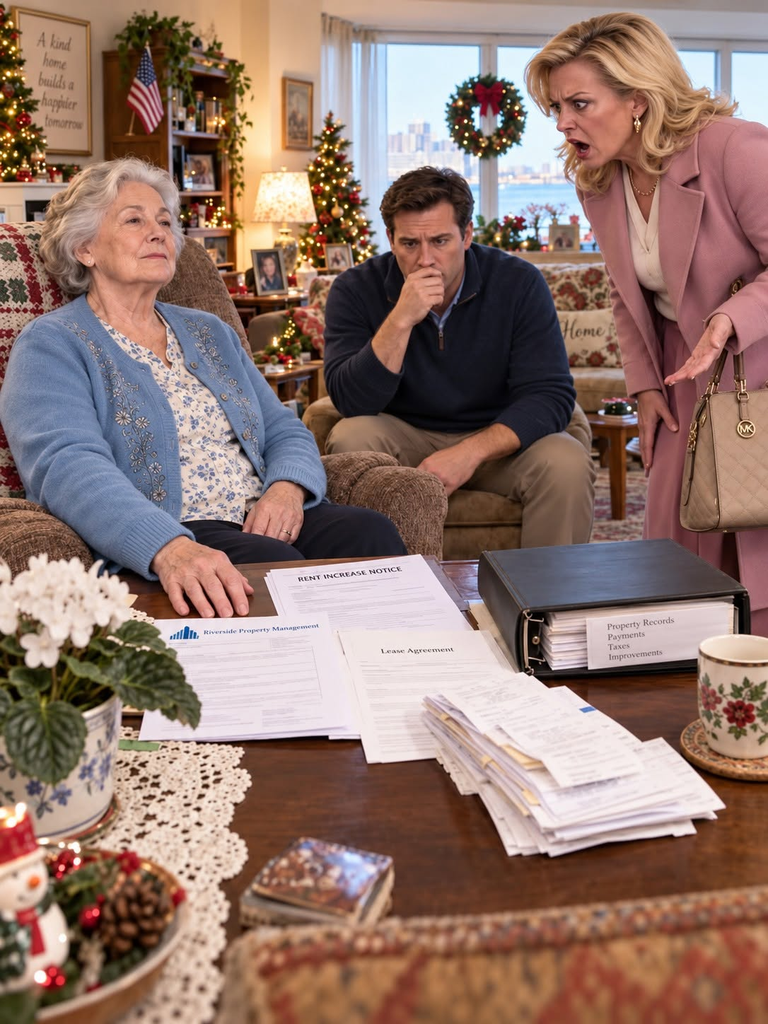
• Part 1 – On Mother’s Day, my rich son paid a visit and inquired, “Mom, are you living comfortably with the $5,000 Clara sends you every month?” I froze and responded softly, “Son, the church has been helping me get by.” My daughter-in-law entered wearing a silk dress, pearls, and costly perfume, smiling pleasantly. She had no idea what was going to happen…

    He placed the flowers on my old wooden table, looked at me with a gentle but distant expression, and said, “Mom, my wife still sends you five thousand dollars every month, right? I just want to make sure you’re comfortable.”

    I froze.
    My heart began pounding so hard I could hear it over the soft hum of the ceiling fan. Five thousand dollars?
    For the past eight months, I had been living on food packages from St. Mary’s Church and small donations from kind neighbors who knew enough not to ask too many questions. I had been stretching canned soup over two meals, waiting until the last possible week to refill my blood pressure medication, and pretending the leaking roof was only a small inconvenience.
    I looked at my son, the boy I had once rocked to sleep in this very house, and whispered, “Son, the church is helping me get by.”
    His smile vanished.
    Before he could answer, my daughter-in-law appeared in the doorway like she had stepped out of a glossy magazine instead of my narrow front hall. Clara wore a pearl-colored silk dress, shiny silver heels, and a cloud of expensive perfume that drifted through the room like mockery. Her smile was dazzling, but her eyes were colder than any winter I had ever known in Texas.
    She did not realize that on that very day, the last light of her elegance would begin to fade.

    My name is Margaret Hayes. I am a sixty-seven-year-old widow living alone in a small house on the outskirts of Dallas, Texas. This house used to be filled with laughter. It was where my husband, Frank, and I raised our only son, David. After Frank passed away from a heart attack ten years ago, I learned to live quietly. I tended my garden, cooked simple meals, and sometimes taught Bible classes at St. Mary’s Church down the street.
    I did not have much, but it was enough for a while. Then old age came knocking, and everything grew more expensive with each passing month.
    David, the boy I once carried in my arms, was now a millionaire. He owned a chain of tech companies, drove a brand-new Tesla, and lived in a mansion in the Park Cities, where the annual property tax alone could have swallowed what I had earned in several years of honest work. I was proud of him. Of course I was. I had raised him with these two hands, believing he would grow into a good, kind, grateful man.
    So when he walked into my house that afternoon and sunlight spilled across his tired, handsome face, my heart warmed the way it always did when I saw him.

    Then he asked about the money.

    “Five thousand?” I repeated, my voice catching. “Son, the church is helping me survive.”

    David’s eyes widened. He glanced toward Clara, who had just entered the room and was standing there as if the floor itself should be grateful for her shoes.

    The scent of Chanel No. 5 filled my small living room, overpowering the apple pie I had just baked to welcome my son home.

    Clara smiled lightly, a smile that could melt a room if it were not so cold.

    “Oh, Mother, you must have forgotten,” she said sweetly, her voice like honey poured over ice. “I stop by every month to bring the money. Remember?”

    I looked at her calmly.

    “If you did bring it,” I said, barely above a whisper, “then it must have gotten lost somewhere.”

    The room fell silent. I could hear the ticking of the wall clock, the hum of cars passing outside, and the pounding of my own heart. David looked from me to Clara and back again, his brow furrowed.

    “Clara,” he said, “you have been bringing the money, right? I transfer it to you every month.”

    Clara tilted her head. Her smile did not move.

    “Of course, David. I come here every month. Maybe Mother just forgot. You know how old age can be. The memory isn’t what it used to be.”

    The words were soft as feathers, but they landed on my heart like stones.

    Old age.

    I had heard that phrase too many times since Frank died, usually from people who thought an old widow was nothing but a fading memory in a cardigan. But I knew my memory. I remembered every bill, every prayer, every face at church, every loaf of bread that had been left on my porch when I could not afford groceries.

    And I knew, without a shadow of doubt, that Clara had never given me a single penny.

    I nodded slightly, choosing silence. Some battles are not meant to be fought right away. Some are meant to be observed.

    David stood and placed a hand on my shoulder.

    “Mom, it’s probably just a misunderstanding,” he said. “I’ll check the accounts. I just want you to live comfortably, without worry.”

    I smiled faintly, but something inside me had awakened, something quiet and strong. I said nothing more. I cleared the table and placed a glass of orange juice in front of him.

    Clara moved gracefully to his side and rested a possessive hand on his shoulder. Her gaze swept over me, cool and dismissive, the look of someone who believed money could buy not only comfort, but innocence.

    The room turned cold, even though the Texas sun outside was blazing.

    Clara glanced around the living room, her eyes brushing over the old photo frames on the wall. David as a little boy, golden hair, bright eyes, a carefree smile. Frank standing beside him with his arm around my shoulder. A birthday party. A fishing trip. A life that had once felt whole.

    “You’ve done such a great job keeping the house clean, Mother,” Clara said. “Even at your age.”

    I smiled faintly.

    “Old, yes,” I said. “But not so old that I forget who comes through my door, Clara.”

    David shifted uneasily.

    “Mom, come on. It’s Mother’s Day. Don’t get upset.”

    “I just want you to be happy, my son,” I said, my eyes still on Clara. “So do I. But happiness doesn’t come from what people say they have done for you. It comes from what they have actually done.”

    David froze. Clara’s smile tightened, then disappeared altogether.

    After they left, I sat alone in the living room while the afternoon sunlight spread across the old wooden table. Five thousand dollars a month. Eight months. Forty thousand dollars.

    That money could have fixed my leaking roof. It could have replaced the broken refrigerator that rattled like it was begging to die. It could have helped me live out my later years with some dignity instead of counting cans from the church pantry and thanking God for every loaf of donated bread.

    I pressed a hand to my chest, not out of anger, but from the ache rising inside me. A silent, bone-deep ache.

    That night, I opened my old notebook, the one where I used to write grocery lists and prayers. This time I wrote something different.

    Find the truth.

    Under it, I added another line.

    Do not trust fake tears.

    I closed the notebook and took a deep breath. I was not weak. I had survived loss, loneliness, debt, and the slow humiliation of needing help after a lifetime of giving it. I would survive this too.

    David might have been fooled, but I had not.

    If Clara thought I would sit quietly while she played perfect wife and generous daughter-in-law, she had chosen the wrong woman to underestimate.

    The next morning, I pulled out my old accounting ledger, the one I had kept from my years as treasurer of the women’s committee at St. Mary’s. The pages were neat, even after all that time. Twelve dollars for blood pressure medicine. Twenty-four for utilities. Ten for community dinner supplies. Every little expense, every little gift, recorded in blue ink.

    There was no transfer from David Hayes.

    Nothing.

    Later that morning, I went to First Texas Community Bank, where I still kept my small savings account. I sat across from a young teller named Molly and handed her my passbook.

    “Please check whether there have been any transfers from David Hayes,” I said. “He says he has been sending me five thousand dollars each month for the past eight months.”

    Molly looked surprised. She typed for a while, then shook her head gently.

    “I’m sorry, Mrs. Hayes. There’s nothing. The only activity was a dollar and thirty-five cents of interest back in February.”

    I thanked her and stood.


    Outside, the Texas morning wind swept through my gray hair. I stood on the sidewalk with my purse clutched in both hands, feeling as if a stone had fallen straight through my chest.

    No transfers. No envelopes. No letters. Nothing.

    For eight months, I had clipped coupons from the local paper, bought canned soup instead of fresh vegetables, and quietly thanked God whenever the church delivered food. I was used to eating alone. I was used to counting change before heading to the store.

    But never, not once, had I imagined that behind my son’s silence was a lie wearing perfume.

    That afternoon, I went to St. Mary’s Church as usual. Reverend Cole, who had known me for over twenty years, found me sitting quietly in the last pew after the service. He walked over, his voice kind.

    “Mrs. Hayes, are you all right? You look tired today.”

    I smiled faintly and hid my trembling hands in my lap.

    “I’m just trying to understand why my son’s letters never arrived.”

    Reverend Cole placed a hand on my shoulder.

    “The Lord has a way of bringing truth to light. Don’t lose faith.”

    I nodded, but inside, faith alone was no longer enough. I needed action.

    That night, I opened the brown leather notebook David had given me for my sixtieth birthday. On the first page, instead of a prayer, I wrote, If they are lying, I will make them tell the truth through the law.

    The words glowed under the lamp like a vow.

    From that day forward, I began documenting everything. Every time Clara visited, I recorded the date, time, and her exact words.

    Thursday, June 14. Clara stopped by with a cake. Said, “The money has been sent. Maybe the bank is delayed.” No envelope. No proof.

    Saturday, July 12. Called and said she could not come because of a charity meeting. I heard restaurant music in the background.

    Line by line, I wrote it all down. No anger. No hatred. Just the precision of a woman who had spent a lifetime balancing numbers and knew they never lied.

    The weeks that followed were almost theatrical. Clara kept visiting, always flawless, always perfumed, always dressed as if every room were waiting for her entrance. Designer dresses. Expensive handbags. Sparkling heels. Each time she brought a small gift: flowers, cookies, scented candles, a jar of marmalade. Pretty things. Empty things. Never an envelope.

    One afternoon in August, while I was watering the garden, her white Mercedes pulled into the driveway. Clara stepped out carrying lavender wrapped in brown paper.

    “I brought you flowers to help you relax,” she said. “Stress isn’t good for the memory.”

    I set the watering can down and wiped my hands on my apron.

    “My memory is just fine, Clara. Fine enough to remember that the last time you brought me money was never.”

    Her face twitched, but she recovered quickly.

    “Oh, Mother, you must be mistaken. I’ve been sending it. Your bank must be at fault.”

    I began arranging the flowers.

    “Maybe. But I already asked the bank. They said nothing has come through for eight months.”

    Silence.


    Even the sparrows on the fence seemed to stop chirping.

    Clara fidgeted with her necklace.

    “I’ll double-check,” she said quickly, then hurried back to her car, leaving behind the scent of expensive perfume and panic.

    I stood in the yard watching the car disappear, a mix of bitterness and clarity filling my chest. She had lied. Now she knew that I knew.

    That evening I wrote: Clara, August 22. Lied. Nervous. Left early.

    Each line felt like a hammer striking the hurt inside me. I was no longer the frail mother praying in silence. I was Margaret Hayes, the woman who had survived loss, debt, empty promises, and grief sharp enough to cut through bone.

    And I would survive this too.

    In the weeks that followed, I contacted David’s bank, pretending to ask about family gift transfers. They could not share private information, but one kind employee hinted at what I needed to hear.

    “If funds were transferred,” she said carefully, “they would have to land in an account under your name. If you never received them, someone may have used a different account connected to your name.”

    A chill moved down my spine.

    Another account bearing my name, but not mine.

    I closed my notebook and exhaled deeply. I knew what I was up against. Clara was charming, smart, manipulative, and capable of bending David’s trust until it served her. But I had been an accountant for three companies before retirement. I had managed thousands without losing a cent. If someone had dared to forge my name, I would find them.

    That night, I reread every note I had written. Between the lines, I could almost hear Frank’s voice.

    “Margaret, if someone underestimates you, don’t shout. Let them hear the sound of the truth instead.”

    The next morning, I went back to church carrying a small envelope filled with copies of my notes. I handed it to Reverend Cole and said softly, “Father, if one day I cannot come to service, please keep this safe for me.”

    He looked worried.

    “Margaret, what are you doing?”

    I smiled gently but firmly.

    “I’m just preparing for the truth to be heard.”

    As I walked home, my heart felt lighter. I knew the road ahead would be long. There would be tears, pain, betrayal, and perhaps a fracture that never fully healed. But I was not afraid anymore. I would get back every dollar they had stolen from me, but more than that, I would reclaim the respect they thought I had lost with age.

    As the sun set behind the oak trees, I sat on my porch and watched the horizon burn red.

    “Clara,” I whispered, “you picked the wrong woman to fool.”

    Then I opened my notebook and wrote one final line at the bottom of the page.

    The first step toward justice is memory.

    A few weeks later, the Texas air was warmer than usual. The wind carried the scent of dry grass and jasmine from the vine behind my porch. I was trimming my lavender bushes when I heard the low, smooth sound of an expensive engine approaching.

    A brand-new silver Lexus stopped at the gate, its polished paint so bright I had to squint. Clara stepped out looking as if she had walked straight out of a fashion spread. Cream linen dress. Oversized sunglasses. Mirror-bright heels. In her right hand, she carried a large gift basket wrapped with a golden ribbon.

    “Mother, I brought you a little something,” she said. “David has been in meetings all morning, so I came in his place.”

    “How thoughtful,” I said softly, without smiling.

    Her gaze drifted across the garden.

    “Oh my, your garden is still beautiful. I don’t know how you manage it all by yourself.”

    “With these hands and a little patience,” I replied, tucking my shears into the potting soil.

    She placed the basket on the patio table. Fancy cookies, orange marmalade, a small bottle of wine. Everything neatly wrapped, expensive, and empty.

    I poured two glasses of iced tea and looked her straight in the eye.

    “Clara, where is this month’s money? The five thousand dollars you said you would bring.”

    For a split second, her smile froze.

    Then she laughed, a sharp, hollow sound like glass tapping glass.

    “Oh, Mother, I must have left it in the car.”


    Her voice had gone slightly higher. I glanced toward the driveway, where the Lexus gleamed under the sun, temporary plates still fixed to the back.

    “Nice car, Clara. Must have cost quite a bit.”

    She shrugged.

    “Not really. I upgraded for convenience. My boutique work requires a professional image.”

    “Of course,” I said calmly. “A new car for work and old envelopes that keep getting left in the car. How odd.”

    Her face stiffened.

    “Oh, Mother, you don’t trust me anymore.”

    “Trust,” I said, “usually comes with receipts.”

    She stood first, pretending to check her watch.

    “I have to run. I have a client meeting. But don’t worry. I’ll remind David to resend the money through the bank. I’m sorry for the small mix-up.”

    I nodded.

    “Go on, then. And don’t forget the envelope in your car this time.”

    She paused on the steps, smiling thinly.

    “You’re very sharp, Mother.”

    I watched her walk away, the sound of her heels striking the wooden steps steady and cold, like a clock ticking down. When the Lexus disappeared down the road, I went back inside, opened the brown leather notebook, and wrote every detail.

    September 10. Clara came alone. Gift basket. Claimed she left the money in the car. New Lexus. No proof. Voice unsteady. Avoided eye contact.

    That afternoon, I walked to the post office down the road where the public phone still worked. I did not want to call from home. Not when I suspected Clara might be watching, listening, or waiting for me to make a mistake.

    I dialed David’s company and spoke politely.

    “Hello. This is Margaret Hayes, David Hayes’s mother. I would like to speak with someone in accounting. It is a personal matter.”

    After a short hold, a middle-aged woman answered.

    “This is Sandra Miller, head accountant. Mrs. Hayes, how can I help you?”

    I gripped the receiver tightly.

    “Thank you, Sandra. I need to confirm something small. My son said his company has been deducting five thousand dollars each month from his personal account to send to me. I need to know if that is correct.”

    There was a pause.

    “Mrs. Hayes, I cannot disclose personal financial details, but let me check what I’m allowed to confirm.”

    I heard typing.

    “Yes,” she said finally, her tone hesitant. “I recall seeing automated transfers on the same day every month for that amount. It does appear the money was sent, but I am not sure to whom.”

    “To whom?” I repeated. “It was not sent to me.”

    “I’m not certain, Mrs. Hayes. The recipient name matches yours, but the account number is different. I assumed it was yours.”

    A chill ran through me.

    “Thank you, Sandra. That is all I needed for now.”

    I hung up and stood motionless in the phone booth. My heart raced, but my mind was clear as glass.

    There it was.

    Someone had created a fake account under my name, and only one person close enough had the access and nerve to do it.

    Clara.

    On the walk home, my shadow stretched long across the road. The wind carried the scent of scorched grass and dry earth. It reminded me of poor Texas summers long ago when my father used to say, “If you want to know who is honest, look at their hands.”

    Honest hands always show the marks of work.

    I thought of Clara’s hands. Long manicured fingers. Diamond rings. No calluses. No trace of real labor. Just polished nails signing papers that did not belong to her.

    That night I skipped dinner. I made peppermint tea and sat at the kitchen table under the warm yellow light. The house was so quiet I could hear the cicadas outside fading into the dark. I opened a new page in my notebook.

    September 10. Called David’s company. Confirmed money is being transferred but not to my account. Tomorrow the truth begins to surface.

    Then I turned off the lamp and stepped onto the porch. Moonlight fell on the old wooden bench where Frank and I used to sit and talk after supper.

    I touched the worn armrest and whispered, “Frank, if you were still here, you would tell me to do what is right, wouldn’t you?”

    Only the wind answered beneath the eaves, but I understood.

    The next morning, while I was cutting lavender stems to dry, a firm knock echoed at the door. Not the soft tap of a mail carrier or neighbor. This knock was steady and deliberate.

    I wiped my hands on my apron and opened the door.

    A tall, middle-aged man stood on the porch. He had graying hair and wore a charcoal suit that looked a little travel-worn. He smiled politely and gave a small nod.

    “Mrs. Margaret Hayes? I’m Bennett, chief accountant at your son’s company, Hayes and Partners.”

    I narrowed my eyes.

    “You’re Bennett? I only know Sandra, the accountant I spoke with yesterday.”

    He nodded.

    “Yes. Sandra is my assistant. She told me about your call, and I thought you should know a few things.”

    His voice was calm, but serious, tinged with regret. I invited him inside and poured a glass of water. Morning light streamed through the window, catching the lines on his face, the look of a man who had seen more than he wished to.


    He set a leather briefcase on the table and opened it. Inside was a thick folder, neatly clipped and organized. I recognized the sharp printed text, the rows of numbers, the language of accounting. It had been my world for nearly forty years.

    He slid the folder toward me.

    “These are copies of eight transfers,” he said. “Each for five thousand dollars. Forty thousand total. The recipient is an account under the name Clara Hayes.”

    It felt like ice water had been poured over me.

    My hands shook as I flipped through the pages. The papers were clear. Sender: David Hayes. Recipient: Clara Hayes. Verified by the bank. Same date every month, steady as clockwork.

    I looked up, my voice hoarse.

    “Mr. Bennett, who opened that account?”

    He sighed, removed his glasses, and wiped them with a cloth.

    “Your daughter-in-law. Every document for the sub-account bears her signature and a signed authorization from David.”

    I froze.

    “Authorization? You mean David gave her permission to use my name?”

    “Most likely he did not read the forms carefully,” Bennett said. “She presented an ID copy of you, which I suspect was forged. Sophisticated, but forged. The system automatically registered it as a support account connected to your name, even though the funds were routed under her control.”

    I pressed a hand to my forehead. The room spun slightly.

    It was not only betrayal. It was humiliation.

    For eight months, Clara had used my name, a mother’s name, to siphon money from my own son.

    “And David?” I asked quietly. “Does he know?”

    Bennett hesitated.

    “Honestly, I do not think so. David is a hard-working man, but he trusts people too easily. He lets Clara handle most of the paperwork.”

    Then he paused and looked at me.

    “She has also been using the company credit card for personal expenses.”

    “The company card?”

    “Yes. The corporate secondary card of Hayes and Partners. It is supposed to be for client entertainment and business expenses. Recently we found irregular charges. Spa visits, jewelry, clothing, first-class flights to New York, even charges connected to the Lexus. More than thirty thousand dollars in three months.”

    I sat in silence. Spa. Jewelry. Flights. Lexus.

    Each word struck like a hammer.

    I turned to the window and looked at the wooden bench where Clara and I had once sat drinking tea while she chatted about her work.

    “David is so busy,” she had said. “I handle everything for him.”

    Now I understood what everything meant.

    Every dollar.

    I turned back to Bennett.

    “Mr. Bennett, if I want to expose this, will you help me?”

    He met my eyes.

    “Mrs. Hayes, I believe in justice, but I also believe in evidence. We need to prepare carefully, otherwise she will twist the narrative and turn David against you. Clara is not an easy opponent.”

    “I know,” I said. “I have seen her smile while she lies.”

    “I’ll help,” Bennett said. “Give me time to gather everything. I need transaction histories, related documents, and written confirmation from the bank that the account is not yours. It will take a few days, but I promise we will have the truth.”

    For the first time in months, I saw something in another person’s eyes that steadied me.

    Integrity.

    “Thank you,” I said softly. “You have no idea how much this means to me.”

    He closed the folder and stood.

    “I am just doing what is right, Mrs. Hayes. And I am sorry to say this, but cases like yours happen more often than people think. Many are betrayed by those closest to them.”

    After he left, the house went quiet again. I stared at the stack of papers on the table, each transfer line a piece of evidence, each dollar a mark of betrayal. I placed everything into a small metal box and slid it under the cabinet. When I turned the key, it felt like I was locking the last door of my trust.

    As afternoon faded, I brewed black tea and sat at the table, watching lavender sway in the garden. Everything outside looked peaceful, but inside me a quiet fire burned.

    I opened my notebook.

    September 11. Mr. Bennett came. Eight transfers, five thousand each, routed to Clara. Company card abused. David deceived. I have an ally. The fight begins.

    I set down the pen and looked toward the window.

    “Clara,” I said in a low voice, “you forgot I worked as an accountant for forty years. I can read lies and numbers, and this time the numbers will speak for me.”

    Three days later, with every fact lined up in my head like rows on a balance sheet, I called David.

    His voice was warm and familiar, but I heard exhaustion beneath it.

    “Mom, I’m sorry I’ve been swamped lately. Clara says she has been visiting you regularly, right?”

    “She has,” I said lightly. “Clara is very thoughtful. I was thinking of inviting you both to dinner this Sunday. It has been a while since we had a proper meal together.”

    David agreed happily, never noticing the thin wire hidden in that invitation.

    I spent all Sunday morning preparing, not because I wanted a perfect dinner, but because I wanted it to feel completely ordinary. Honey-roasted chicken, mashed potatoes, apple walnut salad, and apple pie. David’s childhood favorites. I polished Frank’s old silverware and set the dining table with candles. Everything was warm, sincere, and just enough to make a liar lower her guard.

    At six, I heard the familiar engine at the gate. The silver Lexus slid into the driveway. Clara stepped out first, flawless as always, soft waves in her hair, jade silk dress, faint trail of Dior. David followed with white lilies.

    “Mom, you look great,” he said, placing the flowers on the table.

    “I’m better than ever,” I said. “Thanks to God’s grace. And the two of you.”

    Clara smiled, her lips curling in that smug way I had learned to recognize.

    I poured wine and tea. We talked about the weather, the lavender, the new neighbors down the street. Everything flowed as though no shadow had ever crossed this house. I let the room warm. I let her relax.

    When the main course was served, I looked up and smiled.

    “I truly appreciate you both,” I said. “Especially for this month’s five thousand dollars.”

    Clara paused only a fraction of a second before flashing a bright smile.

    “Oh, Mother, please don’t be so formal. I’m just doing what I should.”

    I nodded, pretending to be shy.

    “I’m thrilled. I just bought a new heater. Texas gets chilly early, and thanks to that money, I feel much more at ease.”


    Clara’s smile widened. She tilted her head toward David as if to say, See, everything is fine.

    I watched her slowly.

    “Oh, Clara,” I said, as if the thought had just occurred to me, “I’m curious. What day do you usually send it?”

    She answered instantly.

    “The tenth every month, Mother.”

    David looked up, puzzled.

    “Wait,” he said. “Not the tenth, honey. I set the auto transfer for the fifteenth.”

    The room went silent.

    The faint clink of a knife against a plate sounded harsh. Clara stared at him. David stared back.

    “Really?” she said with a strained laugh. “I thought you said the tenth.”

    “No,” David said slowly. “I’m sure it’s the fifteenth. I picked that date because payroll hits then.”

    I set my fork down gently.

    “Oh, wonderful. I’ll go to the bank on the fifteenth and check, just to make sure the system is not having issues.”

    Clara gave a brittle laugh.

    “Mother, you are so careful. Don’t worry. I’ve been sending it regularly.”

    David nodded, but his eyes had shifted. A thin new line of doubt had appeared.

    After dinner, I brought out dessert. The apple pie was crisp, cinnamon drifting through the room. David praised it. Clara barely ate, glancing at her watch as if the walls had moved closer around her.

    At the door, I said softly, “Thank you both for coming. I haven’t laughed this much in a long time. Remember, I’ll check the account on the fifteenth.”

    Clara forced a smile.

    “Yes, Mother. I’m sure there won’t be any problem.”

    David kissed my cheek. His eyes were gentle, but I saw something else there now.

    Doubt.

    When their car pulled away, I went straight to the small office off the kitchen and turned on the computer. The glow from the screen caught Frank’s photograph on the desk. His smile felt like a quiet push forward.

    I opened my email and wrote to the only two people I trusted now: Bennett and Amelia Row, an old college friend who specialized in financial fraud.

    Subject: It is time to begin.

    Bennett, Amelia, everything is ready. Clara lied about the transfer date. They contradicted each other at my table. Please move forward with the plan. By the fifteenth, I want every piece of evidence lined up. It is time for the truth to come from her own mouth.

    I hit send and leaned back. Outside, the night breeze stirred the curtains with the scent of jasmine and damp soil. The clock ticked steadily, counting down to the day the truth would begin to crack through.

    Two days later, Bennett replied.

    I obtained confirmation from the bank. The account under your name was opened with forged documents. Amelia will handle the legal side. Everything is moving in the right direction.

    I read the message and felt my chest tighten, then loosen, like an old iron gate swinging open.

    I was not cruel. I did not want revenge for the sake of watching someone fall. I wanted the truth spoken so my son could wake up. I wanted David to understand that trust was not a blank check for someone to drain until nothing was left.

    That night, I opened my notebook and wrote another line.

    September 13. Dinner went perfectly. Clara exposed herself. David began to doubt. Justice is coming, soft as a breeze.

    On the morning the evidence arrived, the Texas sky was startlingly clear. I sat by the window with jasmine tea, strangely calm. Around eight o’clock, the phone rang.

    It was Bennett.

    “Mrs. Hayes, it’s all done,” he said. “I sent the full statements and related invoices. Amelia has reviewed them. With your signature, we can open a legal case.”

    Fifteen minutes later, the mail carrier knocked. A large sealed manila envelope lay in his hand, stamped confidential.

    I set it on the table and stared at it before opening it.

    Inside were dozens of clean printouts. Eight transfers. Five thousand dollars each. Forty thousand dollars in total. Sender: David Hayes. Recipient: Clara Hayes.

    I read them twice and still felt disbelief, as if the numbers were laughing at my faith.

    At the bottom was Bennett’s blue-ink note.

    Mrs. Clara Hayes used this as a personal account. In addition to the eight transfers, there are other charges through the secondary card: spa, shopping, travel, and vehicle expenses. Total spending over eight months: $47,800.

    I sat still. Morning light slipped through the blinds and laid pale gold across the pages. The color of truth.

    There was a spa receipt in Houston for twelve hundred dollars. Cancun travel for two. First-class flights. Clothing. Jewelry. A down payment on the Lexus.

    Each receipt was a small knife.

    I remembered Clara walking into my house with gifts, smiling softly, saying, “Mother, I care for you like my own.”

    Now I understood what care meant to her.

    It meant draining every dollar under my name.

    I reached for the notebook I had begun calling my justice journal and wrote carefully.

    September 17. Bennett’s records received. Eight transfers. Clara’s hands. Spa, travel, Lexus. $47,800. The price of trust.

    That afternoon, Amelia called. Her voice was firm and precise, the voice of someone seasoned by hard courtrooms.

    “Margaret, I reviewed everything. It is solid. This is financial exploitation of an elder, plus fraud. We can go criminal or civil. Your call.”

    I paused.

    “Not yet. I do not want the court to see it before David does. He needs to witness it with his own eyes. Only then will justice mean something.”

    Amelia was silent for a moment.

    “You’re right,” she said. “Nothing cuts deeper than a son realizing his wife exploited his mother’s trust.”

    “I’d like Reverend Cole to help me,” I said. “A small charity dinner. A reason for everyone to come.”

    Amelia gave a soft, knowing laugh.

    “A staged evening to expose the truth. Smart, Margaret. I’ll ask Bennett to condense the file. Give David a summary he cannot ignore.”

    Near dusk, I drove to St. Mary’s. Reverend Cole was lining up wooden chairs in the hall. After I explained the plan, he thought for a moment and smiled kindly.

    “Sometimes the Lord does not need thunder to reveal sin, Margaret. He only needs a small light of truth.”

    “I just want David to see that light,” I said. “Not for revenge. So he stops being blind.”

    That evening, I spread every statement and receipt across the dining table. With a red pen, I marked the large withdrawals and slipped them into a thick beige envelope. On the front, I wrote: Donation documents. Senior Assistance Fund.

    Only I knew there was not a single donation inside.

    Only guilt.

    Only deceit.

    I never loved a Sunday evening more than the one that followed. The late Texas sunlight poured over the garden, turning the lavender gold. In the kitchen, red wine beef stew simmered softly, filling the house with herbs and memory. It had been David’s favorite dish since childhood. He used to ask for it every birthday because, as he said, “Mom’s stew tastes better than any restaurant.”

    This time I was not cooking only out of love. I was preparing a final dinner for my son to see the truth I had hidden too long.

    On the table, I laid a crisp white cloth, antique porcelain dishes, and three small wine glasses. In the center rested the beige envelope like an invisible guest waiting to be acknowledged.

    At seven, David and Clara arrived. He wore a simple white shirt. She, as always, appeared overdressed in pale pink silk, new heels, and pearls at her throat.

    “Mom,” David said, hugging me tightly. “I missed this smell. Your stew smells like home.”

    “I made it for you,” I said, resting a hand on his shoulder. “Just like old times.”

    Clara stood behind him, her polished smile fixed in place.

    “Oh, how cozy,” she said. “You always make dinner feel so special, Mother.”

    “Yes,” I said softly. “Tonight will be very special.”

    Fifteen minutes later, Reverend Cole arrived holding a large wrapped envelope.

    “Sorry I’m late,” he said. “Here are the donation papers you asked me to bring.”

    Clara tilted her head, her voice syrupy.

    “Oh, so this really is a charity dinner. Mother, I thought you were joking.”

    I poured everyone wine and smiled gently.

    “Yes. A dinner to talk about trust, giving, and honesty.”

    The words made Clara stiffen slightly, but she smoothed her expression. David smiled, unaware of the tension rising beneath the table.

    When everyone was seated, I opened the envelope Reverend Cole had brought. The papers inside were neatly arranged, Bennett’s precision visible in every line. I pulled out the first sheet and spread it on the table.

    “Son,” I said slowly, “this is the list of all the donations for your mother over the past eight months. I think you should take a look.”

    David frowned.

    “Donations? Mom, I’ve been sending the transfers every month.”

    I slid the statement toward him.

    The bold print was unmistakable.

    Recipient: Clara Hayes. Amount: $5,000. Date: Fifteenth of each month.

    David went silent. His eyes dropped to the page and widened from confusion to shock.

    Clara jumped in, her voice sweet but pitched too high.

    “Oh, that must be some mix-up. Banks make mistakes with names all the time.”

    “Is that so?” I asked. “Then how about this spa bill in Houston? Twelve hundred dollars charged to the secondary card under your name. Was that the bank’s mistake too?”

    Her face stiffened.

    “Maybe someone used my name by accident.”

    Before she could continue, a deep male voice came from the doorway.

    “No, Mrs. Hayes. No one used your name by accident.”

    Everyone turned.

    Bennett stood at the threshold holding more printed pages. I had asked him to come but told no one else.

    Clara’s face went pale.

    David looked at him. “Who are you?”

    “I’m Bennett,” he said firmly. “Chief accountant at your firm, and the person your mother authorized to investigate the transfers made under her name.”

    The air froze.

    I rose and faced Clara.

    “Bennett can verify every amount, every signature, every transaction. Eight transfers. Five thousand dollars each. Not once did they reach me.”

    David turned to his wife, voice breaking.

    “Clara, what is this?”

    She grabbed his hand, tears welling up instantly.

    “I just borrowed it. That’s all. I was going to pay it back. I didn’t want to upset your mother.”

    I sighed softly.

    “Eight months of borrowing? With forged bank papers under your mother-in-law’s name?”

    Clara sobbed harder, but her tears carried no guilt. Only desperation.

    David pulled his hand away, eyes burning.

    “What did you do to my mother?” he said, his voice shaking. “I sent that money so she could live comfortably. You used it for cars, spas, vacations, and lied to my face.”

    “You don’t understand,” Clara said.

    “Enough.”

    David slammed his palm on the table. The glasses rattled sharply. The room fell silent except for Clara’s ragged breathing and my own pounding heart.

    Reverend Cole, who had been quiet the whole time, folded his hands and spoke in a low voice.

    “Sometimes God does not need to punish the guilty. He only lets them see their true reflection.”

    I sat back down and looked at Clara.

    “I did not need that money as much as I needed respect. You took that not only from me, but from your husband too.”

    “Mother, I’m sorry,” Clara stammered. “I just wanted to help David manage things better.”

    I shook my head.

    “Stop lying. You did not manage. You stole.”

    Bennett placed the final file in front of David.

    “These are the originals, Mr. Hayes. Forged authorizations, bank records, receipts. Keep them. You will need them to protect what is yours.”

    David stared at the numbers, then lifted his eyes to me. In them I saw pain, shame, and the first spark of awakening.

    “Mom,” he whispered. “I am so sorry. I didn’t know. I was such a fool to trust her.”

    I laid a hand on his shoulder.

    “No, son. The mistake is not in trust. It is in those who betray it.”

    Clara burst into sobs and stood abruptly.

    “I can’t take this anymore. I don’t need anyone’s pity. If you want to believe her, go ahead.”

    She snatched her purse and stormed out. Her heels struck the wooden floor, each step sounding like the end of something.

    David did not stop her.

    The door slammed. Silence fell. No crying. No excuses. Only the fading smell of stew and the heavy presence of truth.

    When everyone left, I stayed behind and cleared the table. The half-eaten plates. The wine glasses. The chair where Clara had sat, still faintly warm. I gathered the fallen pages and placed them back in the envelope. My hands trembled, not from fear, but because I had finally reclaimed my dignity.

    Outside, wind lifted the curtains. Moonlight streamed through the window and shone on the envelope like a seal of truth.

    Every lie eventually comes to light.

    That night, it had happened in my own home.

    The court notice arrived sooner than I expected. Texas County Court. Margaret Hayes, plaintiff, versus Clara Hayes, defendant. Elder financial exploitation and family fraud.

    Amelia had moved quickly. Her message was short.

    All evidence filed. Preliminary hearing next Monday.

    Justice was close, yet I felt no satisfaction. The morning of the hearing, the sky was gray and the wind sharp, like something about to break. I arrived early with Amelia. She wore a brown coat and carried herself with steady resolve.

    “You holding up?” she asked.

    “I am,” I said. “I just wish it did not have to come to this.”

    The courthouse hallway smelled faintly of coffee, paper, and tension. When we entered the courtroom, Clara was already there in a black suit, her hair tied back, her face pale but pretending calm. Beside her sat a young lawyer who looked nervous enough to chew through his own pen.

    David sat behind them, alone and silent. He did not look at me. He did not look at her. His eyes were tired and hollow.

    The judge struck the gavel.

    “The court is now in session for the case of elder financial exploitation. Margaret Hayes versus Clara Hayes.”

    Amelia stood first. Her voice was clear and steady.

    “Your Honor, for eight consecutive months, the defendant, Mrs. Clara Hayes, used a fraudulent bank account connected to her mother-in-law’s name to misappropriate a total of forty thousand dollars. Additionally, she used a company secondary credit card belonging to Hayes and Partners for personal expenses, including spa services, travel, and a private vehicle purchase.”

    The courtroom went silent except for the rustle of paper as Amelia laid out the evidence. Bank statements. Spa receipts. The Lexus invoice. Cancun tickets. Each piece placed neatly before the judge.

    “The defendant did not merely take money,” Amelia continued. “She concealed it by falsifying documents and using forged identification. This was deliberate and systematic.”

    Clara’s lawyer stood quickly.

    “Your Honor, my client maintains that this was a misunderstanding in household financial management. Mrs. Margaret Hayes is elderly and may have misremembered the transfers.”

    I felt my blood heat, but Amelia placed a hand lightly on my shoulder.

    Clara lowered her head, feigning fragility, then lifted her trembling voice.

    “Your Honor, my mother-in-law has been forgetful lately. I brought her money many times. She just does not remember. I never meant to hurt anyone.”

    Those words cut through me.

    Forgetful.

    Again that word. Again the soft cruelty of using age as a weapon.

    Amelia stepped forward, her voice sharp as steel.

    “Your Honor, Mrs. Hayes’s memory is sharp enough to document every visit, every date, and every statement the defendant made over eight months. Here is her journal.”

    She held up my brown leather notebook.

    “In this notebook, Mrs. Hayes recorded exact dates, times, and the defendant’s repeated explanations, including the claim that money was left in the car. These entries match the bank transaction data. If this is memory loss, then it is the sharpest memory loss I have ever seen.”

    A murmur rippled through the courtroom.

    The judge peered over his glasses and flipped through the pages. Then he turned toward Bennett, who had been called as an expert witness.

    “Mr. Bennett, do you confirm the figures in this report?”

    Bennett stood.

    “Yes, Your Honor. I am the chief accountant at Hayes and Partners. I confirm that all statements and reconciliations are authentic. Each transfer was made from Mr. David Hayes’s personal account to an account opened under the name Margaret Hayes, but that account was controlled by the defendant, Mrs. Clara Hayes.”

    The judge’s expression hardened.

    Amelia continued.

    “We request that the court order full repayment of the forty thousand dollars, including relevant fees, and restrict the defendant from managing or accessing financial accounts connected to Mr. David Hayes.”

    No one spoke.

    The judge lifted his head.

    “After reviewing the documents, testimonies, and evidence, the court rules that the defendant, Mrs. Clara Hayes, shall repay the full forty thousand dollars to Mrs. Margaret Hayes. The defendant is stripped of access to and management rights over Mr. David Hayes’s financial accounts. She must also complete a mandatory financial rehabilitation program. This court is adjourned.”

    The gavel struck, dry and cold, like a steel door closing.

    Clara sank into her chair. Tears spilled down her cheeks. She turned toward David.

    “You have to believe me. I didn’t mean to.”

    David said nothing. He looked at her with empty eyes, then turned away.

    The sight broke something in me.

    I did not feel joy. I did not feel triumph. I felt only a dull ache, because to reclaim justice, I had to watch my son lose his marriage.

    Amelia placed a hand on my shoulder.

    “You did the right thing, Margaret. You did not just protect yourself. You saved your son.”

    I nodded, but I could not smile.

    Justice, I realized, is a double-edged sword. It cuts through deceit, but sometimes it also severs the fragile threads of family.

    When I left the courthouse, rain had begun to fall. Heavy drops splashed onto the stone steps and broke apart into hundreds of smaller ones. I stood under the awning, feeling the cold mist against my face.

    There was no applause. No cheers. No sense of victory. Only the quiet peace of someone who had walked the full circle of truth.

    “David,” I whispered into the rain, “I do not know if you can forgive me. But I held on to the one thing I could never afford to lose.”

    The truth.

    After the trial, my house returned to an eerie stillness. No unexpected knocks. No hurried phone calls. Only the ticking of the wall clock and sunlight slipping through the curtains, lighting dust in the air.

    Months passed, and David did not call. No messages. No emails. No “How are you, Mom?”

    I did not blame him. He was trying to clean up the wreckage of his marriage. Still, on quiet nights, when moonlight crossed the windowpane, I often found myself holding the phone, staring at his name in my contacts, never pressing call.

    Being a mother, I learned, sometimes means knowing when silence is the only way to let your child grow.

    The restitution payment arrived one morning in June. Forty thousand dollars. I opened the bank email and read the words: Deposit completed successfully.

    I thought I would feel joy. Instead, I felt hollow.

    Then a thought came. If that money had once been used as a tool of deceit, now it had to become something good.

    I used a small portion to repair the roof, replace the curtains, and finally buy a proper heater. With the rest, I reached out to Reverend Cole and Amelia.

    “I want to start a small foundation,” I said as we sat in the parish office. “I’ll call it Grace Hands Foundation. I want to help elderly people who have been financially exploited by their own children or family.”

    Reverend Cole looked at me for a long moment, then smiled gently.

    “Margaret, this is how God turns pain into the seed of something good.”

    Amelia opened her notebook.

    “We will register it as a nonprofit. I’ll handle the legal side. Reverend Cole can represent the community group, and you will be the founder.”

    I chuckled softly.

    “I don’t want to be a founder, Amelia. I’m just a mother who learned how to stand up again.”

    Three months later, Grace Hands Foundation officially opened in the basement of St. Mary’s Church. We had three desks, an old printer, and a wooden sign carved with the words: Helping the forgotten find their voice again.

    Each week, Reverend Cole and I met people who came to share their stories. An old woman tricked by her daughter into signing away her home. A seventy-year-old man whose grandson drained his pension account. An eighty-year-old widow whose signature was forged for a bank loan.

    Each story was a wound, but I had learned how to listen without breaking.

    I held their hands and told them what I had lived: that truth does not save you instantly, but it always arrives right on time.

    Amelia worked tirelessly, reaching out to legal organizations, applying for grants, and training volunteers. I oversaw what we called the heart work: listening, writing letters, comforting people, documenting their journeys.

    One afternoon, while we were tidying the desks, Reverend Cole said quietly, “Margaret, isn’t it strange? Pain has become light for others.”

    I smiled.

    “Maybe that is how God rewrites the ending for those who were betrayed.”

    As the foundation grew, reporters began reaching out. They wanted interviews with the brave mother who sued her millionaire daughter-in-law. One newspaper even offered a book deal.

    I declined them all.

    I did not want to become a story people gossiped about. I wanted peace. Justice can be public, but healing has to be private.

    At night, I developed a new ritual. I placed a small candle on the table by the window. Its glow fell across the photo of David and me. I would light the candle and whisper, “Where are you, David? I’m not angry. I just hope you have learned something from all this pain.”

    The flame would flicker over his childhood smile, the one untouched by betrayal.

    I realized forgiveness is not forgetting. It is choosing not to let the wound define the rest of your life.

    Sometimes Reverend Cole asked, “Margaret, have you truly forgiven her?”

    I would answer, “Maybe I have, because I no longer want her to suffer. But forget? No. The betrayed can forgive, but they never forget.”

    One crisp autumn morning, Amelia arrived with a new envelope.

    “The foundation just received funding from the Elder Justice Fund,” she said. “They want a long-term partnership.”

    I looked at the envelope and felt humbled. Who would have thought a woman who once survived on canned food from the church would now help others reclaim their dignity?

    Still, on quiet nights, I sometimes heard the wind brushing the door and thought it sounded like my son’s voice.

    I knew David was not ready. Maybe he was still trying to forgive himself. Maybe he was paying his penance through silence. I did not blame him. I waited not because I needed him, but because I needed the truth to come full circle.

    I believed that one day, when my son knocked on my door, I would open it. Not because I had forgotten everything, but because I had learned to love without letting myself be broken again.

    That night, rain poured steadily from dusk until midnight. Wind lashed against the windows. The yellow lamp in the living room reflected on the wet glass, glimmering like fragments of memory.

    I was reviewing donation files for the next Grace Hands meeting when I heard a knock, soft but insistent, carrying the chill of the storm.

    It was past ten.

    At my age, few people knock that late unless something in their life has cracked open.

    I walked to the door, my hand trembling as I turned the latch. The door swung open. Wind rushed in. Rain splattered onto the floor.

    And there, under the downpour, stood David.

    He was drenched, his hair plastered to his forehead, his eyes red and weary. In that instant, time froze. The boy I had once taught to tie his shoelaces now stood before me, trembling like a lost child.

    “Mom,” he said, his voice cracking. “I’m sorry. I have been so stupid.”

    Before I could answer, he stepped inside and sank to his knees on the wet floor. A broken sob escaped him, raw and unguarded. He buried his face in his hands, shoulders shaking.

    I stood there looking at my son, the man who once thought he understood everything, now crumbling in the house where he had been raised to value honesty.

    I knelt beside him and placed a hand on his shoulder.

    “David, get up, son. Everyone stumbles. Forgiveness is not forgetting. It is saving yourself.”

    He lifted his head, tears mixing with rain on his face.

    “I don’t deserve your forgiveness. I doubted you. I let her manipulate me. I stayed silent while you suffered. Mom, I lost everything.”

    I guided him to the sofa and dried his hair with a towel the way I had when he was little. Each motion was slow, tender, careful.

    “I don’t need your apology,” I said quietly. “I need you to remember that truth never arrives late. It only waits until we are brave enough to face it.”

    He stared at the flickering fireplace.

    After a long pause, he whispered, “Clara’s gone, Mom.”

    I stopped drying his hair.

    “She drained the savings account,” he said. “She took what was left from the company and disappeared. They say she ran off with a man she knew before we were married. She left one message.”

    He swallowed hard.

    “You trusted the wrong person.”

    I closed my eyes. No anger. No surprise. Only a quiet sadness settling in like the rain.

    I took his hand.

    “No, son. You realized the truth too late. But even when trust is broken, it is still what separates us from those who deceive.”

    He rested his head on my shoulder like a child who had finally found his way home.

    “I lost everything,” he whispered. “My career. My money. My dignity.”

    I stroked his hair.

    “No, my son. What you found tonight is far greater. You found the heart that knows how to admit its mistakes.”

    The rain lasted until almost midnight. I brewed ginger tea while he sat by the fireplace. Steam rose into the scent of burning wood.

    “I don’t understand how you can stay so calm after everything,” he said.

    I smiled faintly.

    “Because justice is not about making someone pay. It is about restoring balance. Clara reaped exactly what she sowed.”

    He nodded, staring at the flames.

    “I only have you left now, Mom.”

    “No,” I said. “You still have yourself. What you choose to do from this moment on will decide whether you truly stand again.”

    After a while, he said, “Can I help with your foundation? I want to do something meaningful. Maybe start this weekend.”

    I looked at him. His eyes were sincere enough that I had to fight the emotion rising in my chest.

    “Are you sure?”

    “I am. I don’t want to live the way I used to anymore. I want to learn how to use money to heal instead of hurt.”

    “Then come Saturday,” I said. “Reverend Cole will be happy to see you.”

    From that day on, David came to help at the foundation every weekend. He arrived early with coffee, organized files, wrote thank-you letters to donors, helped Reverend Cole move chairs, and went with Amelia to meet elderly victims and record their stories.

    People say time heals everything. For me, it was not time. It was watching my son change.

    One morning, I saw him sitting at a desk, focused on fixing a spreadsheet, sunlight catching his brown hair. In that moment, I saw my little David again, the boy who used to help me wash dishes and once asked, “Mom, what does honesty mean?”

    “David,” I called softly.

    He looked up.

    “You have crossed your own pain, son. Not everyone has the courage to do that.”

    He smiled, a rare, genuine smile I had not seen in months.

    “If it were not for you, Mom, I don’t know how long I would have drowned in guilt.”

    I placed a hand on his shoulder.

    “I did not save you, David. You saved yourself.”

    Outside, a gentle rain began to fall. The door he had once knocked on during the storm now stood open. No more rain pouring in. Only wind carrying the scent of damp earth and lavender.

    In that quiet moment, I understood. Life, no matter how broken, always leaves a door open for those who wish to return.

    One autumn morning, I sat at my desk staring at a blank sheet of paper. The breeze carried lavender from the porch. I picked up my pen.

    Clara, thank you.

    Because of you, I learned the true value of honesty and the strength of self-respect.

    I paused. There was no anger in me, only quiet peace.

    If not for you, I might still believe truth is obvious and kindness is always repaid in kind. You taught me something different. Truth only has meaning when we are brave enough to defend it. You took my money, but in return you gave me something money could never buy: freedom.

    I do not know where you are now or whether you have found peace. If one day you read this, I want you to know I forgave you, not because you deserve it, but because I refuse to stay chained to the darkness you left behind.

    I folded the letter and slipped it into a cream envelope, then placed it inside the wooden box where Frank used to keep old birthday cards. Among the photos was a note he had once written me.

    Margaret, truth does not need to be shouted. Only lived.

    I closed the box. The click of the wood sounded like a chapter gently closing.

    In the months that followed, Grace Hands Foundation grew faster than I could have imagined. New people came every week, some in tears, some with messy folders, some needing nothing more than a place to tell the story they had buried in silence. I saw myself in them: people deceived, belittled, and still clinging to the belief that justice existed.

    Every time we helped someone reclaim their rights, I felt like I was reclaiming another fragment of my own past.

    One day, David stopped by with two cups of coffee. He sat beside me and looked around the office, now filled with posters, charts, and thank-you cards.

    “I can’t believe how big your foundation has become,” he said. “You really did turn pain into light.”

    I chuckled softly.

    “Not only the light of God, my son. The light of justice. God forgives, but justice never forgets.”

    David nodded slowly.

    “I think I’m finally learning that.”

    I looked at him and saw the man he had become, not the one who ran from truth, but someone who now bowed to what was right.

    I was no longer afraid of being poor. The days of standing in line for canned food at church were gone, but I did not feel shame remembering them. If anything, I was grateful. Those days taught me endurance.

    I had learned there is something worth far more than money.

    Self-respect.

    When a person holds on to self-respect, they cannot truly be defeated, even when they lose everything else.

    Every morning, I still wake early, brew tea, and open the windows to let the light in. Sunlight spills across the photo of Frank and me. He is wearing a white shirt, his arm around my shoulders, his eyes gentle and kind.

    “If only you could see this,” I whisper. “You would be proud of me, wouldn’t you?”

    I know he would smile. Not because of the money I recovered, but because I kept the strength he once loved in me.

    The strength to never let anyone else define my worth.

    One evening after David left the office, I opened the old journal that had followed me through the whole journey and wrote the final line.

    The thief is gone, but the lesson remains.

    Outside, the sky turned pale orange. Raindrops tapped softly on the roof. Distant church bells rang slow and deep, like time breathing.

    I closed the journal. No need for revenge. No need for applause. Only the peace of knowing that even in a cruel world, honesty still has a place to stand.

    A year later, Texas bloomed into spring. Lavender flourished by the porch, and the morning sky turned the soft blue of silk. I was brewing tea when the phone rang from Austin.

    A cheerful woman spoke.

    “Mrs. Margaret Hayes, congratulations. You have been selected as Texas Woman of the Year. The council honors those who have contributed to social justice and senior rights. We would love for you to speak at next week’s ceremony.”

    For a moment, I froze. Not from pride, but disbelief.

    A year earlier, I had been a sixty-seven-year-old widow living off church aid. Now they called me a symbol of peaceful justice.

    Life, it seems, turns when you keep believing in the truth.

    The ceremony was held in the grand hall of the city courthouse. I chose a simple light-blue dress. No glamour. No pretense. When I stepped onto the stage, applause filled the room. In the second row, I saw David wearing a white shirt, his eyes glowing with pride I had not seen since he was a boy.

    The host smiled.

    “Mrs. Margaret Hayes, founder of Grace Hands Foundation, a woman who turned personal pain into a force for justice and helped dozens of seniors reclaim their dignity.”

    I walked to the podium, hands trembling slightly, voice steady.

    “Thank you,” I began. “But today I am not telling my story. I am telling the story of an unnamed mother who was deceived by her own daughter-in-law, who lost both her money and her trust.”

    The hall went silent.

    “I once thought that when someone betrays you, the best revenge is silence. But I learned something else. When someone steals your trust, reclaim it with truth. No shouting. No hatred. Just truth. Because truth holds a power no punishment ever could.”

    Applause rose, long and heartfelt.

    I paused and saw David wiping his eyes. The look on his face almost broke me, not from pity, but because I knew he finally understood.

    When I spoke again, my voice softened.

    “Justice is not only what happens in court. It begins the moment you find the courage to say enough, even when the person who wronged you is someone you love. That is the bravest act any mother, any father, any human being can do.”

    After the ceremony, there were photos, handshakes, bouquets. I did not remember every face, but I remembered the feeling: deep peace. No bitterness. No resentment. Quiet fulfillment.

    As I stepped outside, light rain began to fall. Texas skies always knew how to remind me that even in rain, there could be light.

    David came up beside me and draped his jacket over my shoulders.

    “Mom,” he said softly, “I have never seen you shine like this.”

    I smiled and held his hand.

    “It is not because of the award, son. It is because you are here, like the old days. Only now you truly understand what honesty means.”

    He smiled back, eyes misty.

    “I do, Mom. And I promise I will live by it.”

    The rain still fell, but it no longer felt cold. Inside me rose a small light: faith, freedom, and new beginnings.

    That night, back home, I sat at my desk and opened my worn journal. I wrote one final line.

    A mother’s greatest victory is not winning in court. It is teaching her child the value of honesty.

    I closed the book and listened to the wind outside. The faint scent of rain still clung to the roof. On the table, a small candle flickered over the family photo: Frank, me, and little David. Three faces in one frame. Three moments in time, bound by one truth.

    Love never dies.

    It only changes form.

    I smiled.

    My life was no longer loud, rich, or grand. But it was full in its own quiet, peaceful way……….

    PART 1 — Mother’s Day

    The twist tie on the church pantry bag cut into my finger as I carried it into the kitchen.
    Inside the bag were two cans of peaches, a loaf of bread, and powdered soup packets from St. Mary’s Church. I set them carefully on the counter and checked the expiration dates the way poor people learn to do quietly.
    Outside, a black Mercedes rolled into the driveway.
    My heart lifted anyway.
    Because no matter how old your child becomes, part of you still reacts to their arrival like sunlight entering a room.
    I quickly slid the pantry bag beneath the counter just before the front door opened.
    “Mom?”
    David’s voice filled the little house warmly.
    I turned toward him smiling.My son looked handsome in the expensive, exhausted way successful men often do:

    • pressed white shirt
    • silver watch
    • tired eyes
    • phone still glowing in his hand

    He carried roses.
    Fresh cream-colored roses.
    “Happy Mother’s Day,” he said softly, kissing my cheek.
    The smell of the flowers mixed with old wood, cinnamon pie, and the faint scent of canned food still lingering in the kitchen air.
    “Sit down,” I told him. “I made apple pie.”
    David smiled immediately.
    “You still remember my favorite.”
    Always, I almost said.
    Instead, I poured him orange juice while he walked slowly through the living room looking at old photographs:

    • David at seven holding a fish
    • David at graduation
    • Frank standing beside me years ago smiling beneath the Texas sun

    For a moment, everything felt normal again.

    Then David turned toward me casually and asked:

    “Mom, Clara still sends you the five thousand every month, right?”

    The room stopped breathing.

    I stared at him.

    Five thousand dollars.

    Every month.

    My fingers tightened around the kitchen towel.

    That amount would have fixed the roof before winter.
    It would have replaced the broken heater.
    It would have meant I didn’t spend Thursday mornings standing in line beside struggling widows at the church pantry pretending I was only there to volunteer.

    David smiled gently, completely unaware of what he had just done.

    “I just want to make sure you’re comfortable,” he said.

    Comfortable.

    My throat burned.

    I looked down at my hands so he would not see my face change.

    Then quietly:

    “Son… the church has been helping me get by.”

    Silence.

    David blinked once.

    “What?”

    “The church,” I repeated softly.
    “They’ve been very kind.”

    His smile disappeared slowly.

    “Mom… what are you talking about?”

    Before I could answer, heels clicked against the hallway floor.

    Clara entered the kitchen like a woman arriving at a hotel lobby she owned.

    Pearl silk dress.
    Diamond earrings.
    Soft expensive perfume.

    She smiled the moment she saw David.

    Then she looked at me.

    “Oh good,” she said sweetly. “You already told her about the transfer increase.”

    My chest tightened instantly.

    David frowned.

    “Mom says the church has been helping her.”

    Clara laughed lightly.

    Not loudly.
    Not nervously.

    Smoothly.

    “Oh, Mother,” she said gently,
    “you must have forgotten again.”

    Again.

    Such a tiny word.
    Such a cruel one.

    I stood perfectly still.

    Clara moved beside David and rested one manicured hand against his shoulder.

    “I bring the money every month,” she said softly.
    “Sometimes she gets confused about dates.”

    David looked uncomfortable immediately.

    “Mom?”

    There it was.

    Not accusation.
    Not anger.

    Worse.

    Doubt.

    The kitchen suddenly felt smaller around me.

    I looked at my son—
    the boy I once stayed awake nursing through fevers,
    the teenager who cried after his father’s funeral,
    the young man who once promised:

    “I’ll always take care of you, Mom.”

    And now he was looking at me like he didn’t know which woman to believe.

    Clara tilted her head sympathetically.

    “Stress affects memory more than people realize at this age.”

    At this age.

    The sentence landed softly.
    Like poison poured into tea.

    David sighed quietly.

    “Mom… maybe there’s just some misunderstanding here.”

    Misunderstanding.

    I almost laughed.

    Instead, I nodded slowly and cut another slice of pie.

    Because women my age learn something important:
    sometimes silence reveals more than arguments ever do.

    So I served dessert.

    I listened while Clara described charity events and luxury hotels.
    I smiled while David talked about meetings and expansion plans.

    And beneath the counter beside my leg sat the church pantry bag.

    Hidden.
    Like evidence.

    At one point David looked around the kitchen and smiled.

    “I’m really grateful Clara takes care of everything while I’m busy.”

    That sentence hurt more than I expected.

    Not because he meant to wound me.

    Because he truly believed it.

    I glanced toward the pantry bag beneath the counter.

    Then toward Clara’s pearl bracelet glittering beneath the light.

    One woman bought jewelry.

    Another counted soup cans.

    And my son saw generosity in the wrong direction.

    After dinner, David hugged me tightly at the door.

    “Call me if you need anything, okay?”

    I almost said:

    I needed something eight months ago.

    Instead I kissed his cheek.

    “Drive safely.”

    Clara smiled as she adjusted her coat.

    “We’ll visit again soon, Mother.”

    I nodded politely.

    The Mercedes disappeared down the road.

    The silence afterward felt enormous.

    Slowly, I walked back into the kitchen.

    The roses sat bright and beautiful on the table.

    Beside them,
    I placed the church pantry bag.

    And suddenly the room told the truth better than words ever could.

    One gift came from strangers who owed me nothing.

    The other came from a son who thought I had already been saved.

    PART 2 — “Mom… Clara Would Never Do That”

    That night, I could not sleep.

    The old heater rattled weakly beside my bed, pushing out more noise than warmth. Outside, Texas wind brushed against the windows while moonlight stretched across the hallway floor.

    I lay awake staring at the ceiling stain above the closet.

    Five thousand dollars.

    Every month.

    Eight months.

    Forty thousand dollars.

    The number moved through my mind like something alive.

    Finally, around midnight, I got out of bed and walked quietly into the kitchen. The roses David brought sat in a glass vase beside the church pantry bag I still had not unpacked.

    Beautiful flowers.

    Bright.
    Fresh.
    Expensive.

    And somehow they made me feel lonelier.

    I opened the refrigerator.

    Half a carton of milk.
    Eggs.
    Leftover soup.
    Two apples.

    I closed it gently.

    Then I looked toward the small wooden drawer beside the stove and pulled out my blood pressure medication.

    Three pills left.

    My prescription refill wasn’t due for another ten days.

    I stared at the bottle for a long moment before quietly twisting it shut again.

    Tomorrow, I thought.
    I’ll just take half tomorrow.

    That’s how old women survive sometimes.

    Not dramatically.

    Quietly.


    The next morning, I was watering lavender beside the porch when my phone rang.

    David.

    My heart lifted automatically.

    “Mornin’, son.”

    His voice sounded tired.

    “Mom… about yesterday.”

    I stayed quiet.

    “I talked to Clara last night,” he continued carefully.
    “She said she’s been bringing the money personally because you don’t like online transfers.”

    I looked down at the cracked garden stones beneath my slippers.

    Interesting.

    Now the lie had structure.

    “I see.”

    “She was really upset, Mom.”

    Upset.

    Not me.
    Her.

    David sighed softly.

    “I think maybe there’s just confusion somewhere.”

    Confusion.

    Such a polite word for betrayal.

    I clipped a dying lavender stem slowly between my fingers.

    “David,” I asked quietly,
    “have you ever actually seen her give me the money?”

    Silence.

    Not long.

    But long enough.

    Then:

    “No, but Clara would never lie about something like this.”

    There it was.

    Readers would feel it here:
    that tiny emotional crack.

    Because David didn’t sound arrogant.

    He sounded certain.

    That hurt more.

    I sat slowly in the porch chair.

    “Son, I know what comes through my front door.”

    “And I know Clara,” he replied gently.

    Gently.

    That was the worst part.

    He wasn’t cruel.
    He wasn’t angry.

    He truly believed he was protecting peace between two women he loved.

    And that made the pain heavier somehow.

    “I just don’t want you stressing yourself,” David continued.
    “You’ve been alone a long time, Mom.”

    Alone.

    Not betrayed.

    Lonely.

    My chest tightened.

    He thought grief was confusing me.

    I looked toward the church pantry box sitting near the trash bin waiting to be broken down for recycling.

    “David,” I asked softly,
    “do you think I’d lie to you?”

    His answer came too fast.

    “No! Of course not.”

    But then—

    the hesitation.

    The tiny hesitation afterward.

    And I realized something heartbreaking:

    for the first time in his life,
    my son did not fully trust my word.

    Not completely.

    Because Clara had already started building doubt inside him carefully.
    Quietly.
    Politely.

    The way poison enters water.

    “Mom,” David said finally,
    “Clara has done so much for us. Please don’t accuse her unfairly until we understand what happened.”

    Us.

    Not you.

    Not me.

    Us.

    He and Clara had become a single emotional unit now.

    And I was standing outside it.

    I swallowed hard before answering.

    “I understand.”

    “You do?”

    “Yes.”
    I smiled faintly even though he couldn’t see it.
    “I understand more than you think.”

    He sounded relieved instantly.

    “Good. I’ll sort everything out, okay?”

    Sort.

    Like this was paperwork.

    Like betrayal could be filed neatly into folders.

    “I know you will,” I said softly.

    After we hung up, I stayed sitting on the porch for a long time.

    The lavender moved gently in the wind.
    Cars passed in the distance.
    A dog barked somewhere down the road.

    Ordinary sounds.

    Ordinary morning.

    But inside me,
    something had shifted quietly.

    Because I realized:
    if Clara could make my son doubt me once—

    she could do it again.

    And suddenly this was no longer only about money.

    It was about truth.

    I stood slowly and went back inside.

    Then I opened the kitchen drawer and pulled out the brown leather notebook David gave me years ago for my sixtieth birthday.

    Inside the cover, written in his younger handwriting, were the words:

    Love you forever, Mom.

    My vision blurred briefly.

    Then I turned to the first empty page and wrote carefully:

    May 13
    David believes Clara.
    But not completely.

    Underneath it, after a long pause, I added one more sentence.

    That small hesitation in his voice may be the only crack the truth needs.

    PART 3 — “At Your Age”

    Thursday mornings were pantry mornings at St. Mary’s Church.

    I arrived early carrying two reusable grocery bags and wearing the same blue cardigan I had owned for nearly ten years. The church basement smelled like canned vegetables, coffee, and old paper boxes.

    Familiar smells.

    Humbling smells.

    “Margaret!” Reverend Cole called warmly. “You’re early again.”

    “I like beating the crowd,” I answered with a smile.

    That part was true.

    It was easier collecting charity food before too many people arrived to witness it.

    I helped stack soup cans for nearly an hour before Mrs. Patterson from down the street touched my arm gently.

    “Sweetheart,” she whispered,
    “take an extra bread loaf today. You look thinner.”

    I almost told her I was fine.

    Instead, I quietly accepted it.

    That was another thing age teaches women:
    sometimes dignity means accepting kindness without pretending you don’t need it.

    As I packed the bread into my bag, my phone buzzed.

    Clara.

    For one foolish second, I thought:
    Maybe she wants to tell the truth.

    I answered softly.

    “Hello?”

    “Oh good,” Clara said brightly.
    “I was worried you might still be upset from Mother’s Day.”

    Upset.

    Like we had argued over dinner plans instead of forty thousand dollars.

    “I’m at church,” I said calmly.

    There was the tiniest pause.

    Then:
    “How lovely. You always did enjoy volunteering.”

    Volunteering.

    Not surviving.

    Interesting.

    I stepped farther from the others toward the supply shelves.

    “What do you need, Clara?”

    Her voice stayed smooth.

    “David’s worried about you.”

    That sentence immediately tightened something inside my chest.

    “Why?”

    “He thinks stress may be affecting your memory.”
    A soft sympathetic sigh.
    “At your age, these things happen sometimes.”

    There it was again.

    Not accusation.

    Erosion.

    Tiny careful erosion.

    I gripped the phone harder.

    “My memory remembers every month I struggled to buy medication.”

    Silence.

    Then Clara laughed quietly.

    “Oh, Mother. You really should stop thinking of everything as an attack.”

    Mother.

    She only called me that when she wanted to sound loving.

    Never naturally.

    Never sincerely.

    “I don’t think this is an attack,” I answered.
    “I think this is theft.”

    The silence afterward changed shape completely.

    Cold now.

    Sharp.

    When Clara spoke again, her sweetness had thinned.

    “You know what I think?”
    A pause.
    “I think loneliness has made you emotional.”

    Emotional.

    Not observant.
    Not truthful.

    Just emotional.

    I suddenly understood why manipulation works so well on elderly people.

    Because the manipulator doesn’t need to prove you’re lying.

    They only need to make you sound unreliable.

    “David trusts me,” Clara continued softly.
    “He knows I take care of things.”

    I looked down at the pantry bag hanging from my wrist.

    Inside it sat:

    • powdered soup
    • canned peaches
    • discounted rice

    Meanwhile Clara drove a new Lexus.

    Something inside me hardened quietly.

    Not rage.

    Clarity.

    “Clara,” I said carefully,
    “did you ever imagine I might actually check the accounts?”

    For the first time since the call began,
    she hesitated.

    Tiny hesitation.

    But real.

    Then:
    “I think this conversation is becoming unhealthy.”

    Interesting.

    People often call conversations unhealthy right before truth becomes dangerous.

    “I’ll speak with David tonight,” she added.
    “He doesn’t need unnecessary stress.”

    And suddenly I saw the entire strategy clearly.

    Protect David emotionally.
    Protect herself financially.
    Make Margaret sound unstable.

    Simple.

    Elegant.

    Cruel.

    Before hanging up, Clara lowered her voice almost tenderly.

    “You should really rest more, Margaret.”
    A pause.
    “Confusion can get worse very quickly.”

    The line disconnected.

    I stood frozen beside the pantry shelves while church volunteers moved around me quietly.

    Not confusion.

    Control.

    That was what Clara feared losing.

    “Mrs. Hayes?”

    I turned.

    Reverend Cole stood nearby holding another food box.

    “You all right?”

    I looked at the box.

    Macaroni.
    Cereal.
    Powdered milk.

    Then I smiled gently.

    “Yes.”
    A pause.
    “Actually… I think I’m beginning to understand things very clearly.”

    He studied my face carefully.

    “Do you want to talk about it?”

    I almost said yes.

    Instead, I shook my head softly.

    “Not yet.”

    Because something important had changed during that phone call.

    Before today,
    I was hurt.

    Now?

    I was watching.

    And women who quietly watch before speaking are often the most dangerous people in the room.

    That afternoon, I returned home and unpacked the pantry food carefully into my kitchen cabinets.

    Then I opened the brown leather notebook again.

    May 16
    Clara called while I was collecting church food.
    Said loneliness and age may be affecting my memory.
    Said David trusts her.
    Sounded nervous when I mentioned checking accounts.

    I stopped writing for a moment.

    Then slowly added:

    She is no longer trying to convince me.
    She is trying to control what David believes about me.

    PART 4 — “The Heater”

    The cold arrived early that year.

    Texas cold is different from northern cold. It doesn’t bury the world in snow. It slips quietly beneath doors and settles into old bones.

    By November, the heater in my hallway had begun making a grinding sound every time it turned on.

    I stood beside it one evening holding my cardigan tightly closed while the machine rattled like it was fighting to stay alive.

    Then—
    silence.

    The heater stopped completely.

    The house became still.

    I waited a few seconds and pressed the thermostat again.

    Nothing.

    For a long moment, I simply stood there listening to the quiet cold spread through the hallway.

    Repair costs immediately started calculating themselves in my head:

    • service fee
    • replacement parts
    • labor

    Too much.

    I walked slowly into the kitchen and opened the small envelope where I kept emergency cash.

    Thirty-two dollars.

    Not enough.

    My eyes drifted toward the framed photograph beside the window.

    Frank smiling at me twenty-five years ago.
    My wedding ring shining softly on my finger.

    That ring sat upstairs now inside the velvet box in my dresser drawer.

    I looked away immediately.

    No.

    Not yet.


    The next morning, David called while I was boiling water on the stove for instant oatmeal.

    “Mom! Guess what?”

    His voice sounded lighter than usual.

    “What?”

    “Clara organized a charity gala last night. Raised almost two hundred thousand for children’s hospitals.”

    I closed my eyes briefly.

    Of course she did.

    Women like Clara always loved public generosity.

    Private kindness was harder.

    “That’s wonderful,” I said softly.

    “She’s incredible,” David continued proudly.
    “I honestly don’t know how she manages everything.”

    The kettle whistled quietly behind me.

    I stared at the steam rising toward the ceiling.

    “David,” I asked carefully,
    “have you ever wondered why I never mention the money you send?”

    He laughed gently.

    “Mom, you’ve always been proud. Clara says she practically has to force you to accept help.”

    I nearly dropped the spoon in my hand.

    Practically force.

    Interesting.

    The lie was growing larger now.
    More detailed.
    More comfortable.

    David kept talking warmly.

    “She worries about you all the time.”

    I looked toward the dead heater in the hallway.

    Last night I slept wearing socks, a sweater, and two blankets.

    Meanwhile my daughter-in-law was hosting luxury charity events in silk dresses.

    And my son thought she was my protector.

    “Mom?”

    I realized David had asked something.

    “I’m sorry, son. What?”

    “I said maybe you should let Clara handle things more. She’s good at organizing help.”

    The sentence hurt so deeply I had to sit down.

    Because he wasn’t insulting me.

    He truly believed he was helping.

    “I’ve managed my life a long time,” I answered quietly.

    “I know.”
    His tone softened immediately.
    “I just worry about you being alone.”

    Again:
    alone.

    Not betrayed.

    Weakness looked more believable to him than deception.

    I stared down at the oatmeal packet in my hands.

    Discount brand.
    Expired last month.

    “David,” I asked softly,
    “do you think I can still take care of myself?”

    “Of course!”
    He sounded surprised.
    “Mom, come on. Don’t do that.”

    Do what?

    Ask whether my own son still trusted my judgment?

    “I’m just saying Clara and I want to make things easier for you.”

    Clara and I.

    Always together now.

    A united front.

    And suddenly I understood something painful:
    every time Clara lied to David,
    she strengthened the emotional wall between him and me.

    Not because David loved me less.

    Because he loved her too much to imagine she could be cruel.

    That kind of blindness is powerful.

    And dangerous.

    “Mom,” David said carefully,
    “are you upset with me?”

    I swallowed hard before answering.

    “No, sweetheart.”
    A pause.
    “I think you’re trying very hard to be a good husband.”

    The silence afterward felt strange.

    Then David laughed softly.

    “Well… Clara says marriage only works when you trust each other completely.”

    I looked toward the heater again.

    Dead.
    Cold.
    Silent.

    “Does she?”

    “Yeah.”
    He smiled through the phone.
    “She says doubt destroys families.”

    My chest tightened painfully.

    No, I thought quietly.

    Blindness does.

    But I didn’t say it aloud.

    Because mothers sometimes stay silent not from weakness—
    but because they know forcing truth too early can push their children farther away.

    After the call ended, I sat alone in the cold kitchen for a long time.

    Then finally,
    slowly,
    I walked upstairs.

    I opened the dresser drawer.

    And took out the velvet ring box.

    PART 5 — “The Ring Box”

    The velvet ring box felt heavier than jewelry should.

    I sat on the edge of my bed holding it in both hands while late afternoon light stretched quietly across the quilt Frank and I bought twenty years ago.

    For a long moment,
    I couldn’t open it.

    Because some objects stop being objects after enough years.

    They become:

    • promises
    • memories
    • pieces of your life

    Finally, slowly,
    I lifted the lid.

    My wedding ring rested inside on faded white fabric.

    Simple gold.
    Tiny diamond.
    Worn smooth around the edges from decades of dishes, laundry, gardening, budgeting, and holding a family together.

    Frank bought it when we had almost nothing.

    I still remembered the apology in his voice afterward:

    “I know it’s small, Margaret.”

    And my answer:

    “It’s enough because it came from you.”

    My throat tightened painfully.

    Downstairs, cold air drifted through the hallway where the heater sat dead and useless.

    I closed my eyes briefly.

    Then stood.


    The pawn shop smelled like dust, metal, and old cigarettes.

    A bell rang softly when I entered.

    The man behind the counter looked up from a newspaper.

    “You selling or borrowing?”

    Selling.

    The word stayed trapped inside my chest for a moment.

    Then finally:

    “Selling.”

    He held out his hand.

    I placed the ring in his palm carefully.

    Like handing over part of a person.

    The man examined it beneath a small lamp.

    “Vintage.”
    He squinted.
    “Not bad condition.”

    Not bad condition.

    Funny way to describe thirty-nine years of marriage.

    “How much?” I asked quietly.

    He named a number.

    Less than I hoped.
    More than I expected.

    Enough for:

    • heater repair
    • medication refill
    • groceries

    I nodded once.

    The transaction took less than three minutes.

    That was the cruel thing about losing important things:
    sometimes life changes completely in the time it takes to sign a receipt.

    When I stepped back outside,
    the cold wind hit my face sharply.

    And suddenly my left hand felt unbearably empty.


    That evening, David called again.

    I almost didn’t answer.

    “Hey Mom.”

    His voice sounded distracted tonight.
    Typing in the background.
    Office sounds.
    A man living inside constant motion.

    “How are you feeling?” he asked.

    I looked down at the pharmacy bag beside me.

    “Better.”

    “Good.”
    A pause.
    “Clara said you sounded emotional earlier this week.”

    Emotional.

    Again.

    I pressed my fingers gently against the empty place where my ring used to rest.

    “She worries too much.”

    David laughed softly.

    “That’s just how she loves people.”

    My chest hurt instantly.

    Because once upon a time,
    David used to describe me that way.

    I walked slowly into the kitchen while holding the phone.

    The repaired heater hummed softly now.
    Warm air drifted through the hallway again.

    Paid for by my marriage.

    “Mom?”

    “Yes?”

    “You know Clara means well, right?”

    There it was again.

    Not:

    “Did she steal from you?”

    Not:

    “Are you okay?”

    Only:

    Please don’t make me question my wife.

    And the heartbreaking thing?

    He didn’t even realize he was asking it.

    I looked toward the roses from Mother’s Day.
    They had started dying days ago.
    Brown curling edges.
    Drooping stems.

    I should throw them away.

    But I hadn’t.

    “David,” I asked quietly,
    “when was the last time you really looked at me?”

    Silence.

    Real silence this time.

    Then:
    “What do you mean?”

    “I mean looked.”
    A pause.
    “Not during phone calls or quick visits.”
    Another.
    “Actually looked.”

    He sounded confused now.

    “Mom… of course I look at you.”

    Do you?

    Did he notice:

    • the thinner face
    • the cheaper groceries
    • the colder house
    • the missing ring

    Or had Clara’s version of reality become easier to see than mine?

    “I’m fine,” I said softly before he could answer.
    “You don’t need to worry.”

    And immediately I heard relief enter his breathing.

    That hurt too.

    Because part of him wanted peace more than truth.

    “Okay.”
    He sounded calmer now.
    “I just want everyone getting along.”

    Everyone.

    As though this were mutual conflict instead of deception.

    After we hung up,
    I sat quietly in the warm kitchen.

    The heater worked again.

    The medicine sat refilled beside the sink.

    Everything should have felt better.

    Instead,
    I suddenly started crying.

    Not loudly.

    Just quietly enough that nobody would hear except the ticking wall clock and the soft hum of the heater bought with my wedding ring.

    An hour later,
    there was a knock at the door.

    Mrs. Patterson from church stood outside holding a casserole dish wrapped in foil.

    “Oh Margaret,” she smiled warmly,
    “I made too much chicken pie again.”

    People always say “too much” when helping poor neighbors.

    It protects dignity.

    “You didn’t have to do that.”

    “Nonsense.”
    Then her expression softened carefully.
    “You doing alright, sweetheart?”

    I looked past her toward the dark road stretching beyond the porch.

    Then smiled faintly.

    “My son loves me very much.”

    Mrs. Patterson nodded slowly.

    But her eyes drifted toward my bare left hand.

    And for one terrible second—

    I realized someone else had noticed the ring was gone before David did.

    PART 6 — “Please Don’t Make This Harder”

    Sunday dinner at David’s house used to feel warm.

    Back when Frank was alive, we would all sit together laughing over burned biscuits or football games while David stole extra pie before dessert.

    Now the dining room felt like a magazine photograph:

    • crystal glasses
    • perfect flowers
    • expensive candles
    • silence polished smooth

    Clara loved beautiful rooms.

    Beautiful rooms were easier places to hide ugly things.

    “Mother,” she smiled as she poured wine,
    “you look much better tonight.”

    I touched my cardigan sleeve lightly.

    “Thank you.”

    David looked relieved hearing that.

    Good.
    Calm.
    Peaceful.

    That was all he wanted anymore.

    Halfway through dinner, Clara began describing another charity fundraiser.

    “A luxury hotel downtown offered to sponsor the ballroom,” she said brightly.
    “We’re hoping to raise nearly half a million this year.”

    David smiled proudly.

    “That’s my wife.”

    My stomach tightened.

    Because somewhere between church pantry lines and missing money,
    Clara had still managed to become the generous one in David’s eyes.

    I looked around the enormous dining room:

    • marble counters
    • wine cabinet
    • imported chandelier

    Forty thousand dollars disappears very comfortably in a house like this.

    “Mother?” Clara tilted her head sweetly.
    “You’re quiet tonight.”

    David looked up immediately.

    “You okay, Mom?”

    There it was again.

    Concern.

    But the wrong kind.

    Not:

    “Were you betrayed?”

    Instead:

    “Are you emotionally fragile?”

    I folded my napkin carefully across my lap.

    “I’m just tired.”

    Clara gave David a tiny sympathetic look.

    The kind married people exchange silently.

    Then she reached over and squeezed his hand.

    “I told you she’s been overwhelmed lately.”

    Overwhelmed.

    Not deceived.

    I watched David absorb the sentence automatically.

    Not because he was foolish.

    Because trust makes people lazy with doubt.

    And Clara understood that perfectly.

    David turned toward me gently.

    “Mom… maybe you should stop worrying so much about the money situation.”

    I looked at him slowly.

    “What money situation?”

    “The transfer confusion.”
    He smiled carefully.
    “I’m sure everything will make sense eventually.”

    Eventually.

    Such an easy word when your heat always works.

    I reached for my water glass.

    My hand shook slightly from exhaustion.

    David noticed immediately.

    “See?”
    He looked toward Clara quietly.
    “She’s stressed.”

    Stress.

    Not betrayal.

    Always stress.

    Clara softened her voice instantly.

    “Margaret, sweetheart… nobody thinks less of you for needing help.”

    Sweetheart.

    I almost laughed.

    Because she was saying it like I was some frightened old woman confusing reality with loneliness.

    And my son—
    my beautiful, blind son—

    was beginning to believe her version of me more than the real one sitting in front of him.

    I set my glass down carefully.

    “David,” I asked softly,
    “do you remember what your father used to say about accounting?”

    He blinked.

    “What?”

    “Numbers don’t care about feelings.”
    A pause.
    “They only tell the truth.”

    The room shifted slightly after that sentence.

    Tiny shift.

    But real.

    Clara recovered first.

    “Well fortunately,” she smiled lightly,
    “we’re talking about family, not spreadsheets.”

    Wrong answer.

    I saw it immediately.

    And for the first time all evening—
    David noticed something too.

    Tiny hesitation crossed his face.

    Good.

    Very good.

    But then Clara touched his arm softly again.

    And the hesitation disappeared.

    “Mom,” David sighed gently,
    “please don’t make this harder than it needs to be.”

    The sentence landed harder than shouting ever could have.

    Because he sounded tired.

    Tired of tension.
    Tired of choosing.
    Tired of discomfort.

    And suddenly I understood the real reason Clara kept winning:
    she made life emotionally easier for him.

    Truth asks people to suffer before healing.

    Lies offer comfort immediately.

    I smiled faintly and picked up my fork again.

    “You’re right, son.”
    A pause.
    “I’m sure the truth will come out eventually.”

    Clara’s eyes flickered toward me sharply.

    Because she heard the difference.

    David didn’t.

    After dinner, while Clara cleared plates upstairs, David walked me to the front door.

    Cold wind drifted across the driveway.

    “You know I love you, right?” he asked quietly.

    Oh God.

    That nearly broke me.

    Because he meant it.

    Every word.

    I touched his cheek gently.

    “I know.”

    “Then trust me.”
    A pause.
    “Clara would never intentionally hurt you.”

    I looked into my son’s eyes and realized something devastating:

    he was asking me to trust the very woman stealing from me.

    Not because he was cruel.

    Because admitting the truth would destroy the life he believed he built.

    So instead,
    his mind protected itself.

    People do that more often than they admit.

    I kissed his forehead softly.

    “Goodnight, David.”

    As I walked toward my car,
    I heard Clara laughing inside the house.

    Warm.
    Beautiful.
    Comfortable.

    The sound followed me all the way home.

    And later that night,
    after sitting alone in my kitchen with only the ticking wall clock for company,
    I opened the brown leather notebook again.

    November 18
    David asked me to trust Clara.
    He still cannot see her clearly.
    But tonight he hesitated for the first time.

    I paused.

    Then slowly wrote one final line beneath it.

    The hardest thing about raising a good man is watching someone else teach him the wrong version of kindness………….

  • My Brother Said That My 9-Year-Old Daughter Was “N…

    My Brother Said That My 9-Year-Old Daughter Was “Not Up To Their Level” And Could Not Be In His Wedd


    My brother said that my 9-year-old daughter was not up to their level and could not be in his wedding photos. She was 9 years old. She asked me why her uncle said that. I told her she was perfect. Then I withdrew the $22,000 I had already transferred for his honeymoon rehearsal dinner and gifts for the groomsmen.

    His [music] best man called me. The cards were declined for everything. I said coldly, “I know.” My brother’s wedding day started at 7:18 a.m. in the bridal suite of the Hampton Inn in Durham, North Carolina with hairspray in the air and my daughter’s little patent shoes lined up like soldiers. “Mom, do I look fancy?” Pamela asked spinning once in the mirror.

    “You look perfect,” I said, pinning a loose curl behind her ear. The door was half open. People kept floating in and out like it was a train station. My brother Greg’s best man, Derek, walked past carrying garment bags. My mom hovered with a steaming travel mug. My brother’s fiance, Grace, sat in a white robe while a makeup artist stabbed under her eyes.

    Pamela clutched a tiny bouquet someone had made for her out of leftover baby’s breath. She’d been practicing her smile all week. Teeth showing, chin down, eyes bright. At 9:02 a.m. Greg walked in. He looked good. Trimmed beard, navy suit, the kind of confident posture he only had when he was being celebrated. He spotted Pamela and paused like he’d found a piece from the wrong puzzle.

    “Hey, kiddo,” [music] he said, not unkind, just careful. Pamela beamed. “Hi, Uncle Greg.” Grace’s sister, Tori, leaned toward me and whispered, “She’s adorable.” I mouthed, “Thank you.” The photographer, a woman named April with a camera harness and a clipboard, tapped her pen. “Okay, we’re doing family photos at 10 15.

    Immediate family first, then bridal party.” Greg adjusted his cufflinks. “Cool. One thing.” April looked up. “Yep.” Greg’s eyes slid to Pamela again. He didn’t look at her the way you look at a kid you love. He looked at her like a variable. “Pamela can’t be in the wedding photos,” he said. I blinked.

    “What?” Grace’s makeup brush stopped midair. The room went quiet in that specific way that means everyone heard and nobody wants to be the one to respond. Greg cleared his throat like he was about [music] to explain a budget line item. “She’s not up to their level.” My mouth went dry. “Their level?” Grace finally looked at me through the mirror.

    Her expression was neutral, practiced. [music] “It’s just the vibe,” she said, soft like she was offering a reasonable compromise. Pamela’s smile faded, [music] slow. She looked at me, then at Greg. “Uncle Greg?” she asked. “What level?” I felt my hands go cold. My brain started counting the way it does when it’s trying to stay functional.

    One child, one brother, one photographer, too many adults pretending this was normal. Greg kept his tone calm, almost [music] annoyed that feelings existed. “Pamela, sweetie, it’s not about you. It’s just important people are here.” Pamela’s fingers tightened around the little bouquet. She didn’t cry. She just got very still.

    I stepped closer to her and put my hand on her shoulder. Her skin was warm under my palm. Mine felt like ice. “She’s nine,” I said. Greg sighed like I was making this complicated. “Yeah. And this is our day.” Pamela whispered, barely audible. “Did I do something bad?” That sentence hit my ribs like a punch.

    My throat burned. I crouched so my eyes were level with hers. “No,” I said. “You didn’t do anything. You are perfect. Do you hear me?” Her eyes stayed on mine, searching. “Then why did he say that?” I stood up. I looked straight [music] at Greg, and I didn’t scream. I did math because 3 days earlier, on Wednesday, [music] February 19th at 6: 43 p.m.

    , I had transferred $22,000 from my checking account at Truist to cover his honeymoon deposit, the rehearsal dinner catering, and gifts for the groomsmen, because Greg texted me, “Sis, you’re literally saving us. I’ll pay you back after the wedding.” My hands were still cold when I pulled my phone out. Greg noticed and frowned. “What are you doing?” “Fixing something,” I said.

    I walked out of the bridal suite with Pamela, my heels clicking too loud in the hallway. “Mom?” she asked, small. “I’m right here,” I said. “Stay with me.” In the elevator, my fingers shook so hard I missed the button once. Pamela watched my face like it was a forecast. When we got to the lobby, I sat on a couch near the fake fireplace, opened my banking app, and stared at the transfer history.

    Pamela sat beside me, swinging her feet, quiet, too quiet. I withdrew the $22,000 I had already transferred for his honeymoon, rehearsal dinner, and gifts for the groomsmen. At 9: 27 a.m., my phone rang. Derek’s name lit up the screen. I answered on the first ring. His voice came out sharp and panicked. “Hey, uh so the cards were declined for everything.

    ” I stared at the hotel carpet pattern like it might tell me how to breathe. I said coldly, “I know. My name is Christina. I am 34 years old and work as a sales representative for a pharmaceutical supply company in Raleigh. I am not rich. I am simply an organized person and do not allow my life to drift along with the tide.

    Pamela is nine, third grade, loves chapter books and those tiny erasers shaped like fruit. She’s the kind of kid who says, “Excuse me.” to the dog when she needs to get by. Greg is 31, my little brother. Charming in a way that’s fun until it’s weaponized. He’s always had this gift of making his problems [music] sound like your responsibility.

    Our family language is full of soft words for hard things. Be flexible. Don’t make it a scene. Help him out. He’s under stress. Family helps. When Greg proposed to Grace last summer, my mom cried and said, “This is the fresh start he needed.” Greg immediately started texting me like I’d been promoted to wedding finance. The first time was August 3rd, 2025.

    Greg, can you spot me $1,500 for the venue deposit? Grace’s dad is weird about money and it’s embarrassing. Me, “Why are you paying the deposit if her family is the one with money?” Greg, “It’s just optics. I’ll pay you back.” He didn’t. September 14th, he called me while I was in the pickup line at Pamela’s school.

    “Hey.” he said, voice bright. “Quick favor.” There are two kinds of quick favors. The kind that means, “Can you grab ice?” >> [music] >> and the kind that means, “Can you set yourself on fire to keep me warm? I’m in the car line, I said. Perfect, Greg replied like that made it easier to manipulate me.

    So, we found a photographer we love. But they want half up front. Can you put it on your card and we’ll pay you back after we get wedding gifts? I stared at the dashboard. Pamela’s teacher waved as kids climbed [music] into cars. I felt my stomach tighten. I already gave you money, I said. Greg laughed. You’re my sister. Don’t be weird.

    That phrase, don’t be weird, is one he’s used since we were teenagers. It means, don’t set boundaries. [music] I swallowed it because Pamela was in the backseat listening to every word even when she looked like she wasn’t. Fine, I said. Send me the invoice. He did. 3,000. $200 paid. October 22nd, Grace texted me directly.

    Grace, Hey Christina, can you do the rehearsal dinner? Greg says you’re really good at planning. We want it nice but simple. Nice but simple is wedding code for expensive but don’t complain. I said yes anyway because I was still stuck in the old role. Keep it smooth. Don’t make it a scene. Then came the incident that should have snapped me awake.

    December 7th, we were at my mom’s house for an early Christmas dinner. Pamela wore a green dress with tiny gold stars. She’d picked it herself. Grace’s mom, Diane, looked Pamela up and down and said smiling, Ah, she’s cute. Not beautiful, not lovely. Cute like a puppy with muddy paws. Greg leaned over and whispered to me, Make sure Pamela doesn’t get too loud tonight.

    Grace’s family is particular. Pamela heard him. I know she did because her shoulders went stiff and she folded her hands in her lap like she was at a funeral. After dinner in the kitchen, I finally said it. Greg, you keep talking about Grace’s family like they’re judges. Greg rolled his eyes. You don’t get it.

    They’re on a different level. Different level. The phrase was already rehearsed in him months before the wedding day. I should have seen that. I thought it was temporary. It wasn’t. By January, Greg was sending me spreadsheets. Actual spreadsheets. Look, he said on a Sunday call. We’re just short-term cash flowing, but after the wedding we’ll have gifts and checks and we’ll settle up.

    I remember staring at my own kitchen table, Pamela coloring beside me, and thinking, he’s talking like a businessman, but I’m the one paying. I was swallowing it because I thought that’s what you do for family. Meanwhile, Pamela was learning to shrink. She’d started asking me questions before family events. Mom, she’d say, voice careful, what are the rules again? And I’d answer like I was training her for a high-stakes interview instead of a wedding.

    Say congratulations, don’t interrupt. Stay close to me. Don’t touch anything that isn’t yours. One night she asked, is Uncle Greg mad at me? I laughed too fast. No, of course not. But my chest hurt when I said it. After Derek’s call, I didn’t move from that lobby couch for a full 10 seconds. My brain did that thing where it tries to keep you from panicking by giving you tasks.

    Breathe, count. Hold your face still. Pamela watched me, rabbit still, bouquet in her lap like it had turned into a burden. Mom, she said, are we leaving? Yes, I said. We’re leaving. My phone buzzed immediately after I hung up with Derek. Greg, what the hell did you do? I didn’t reply. Then another buzz. Grace, Christina, this is not the time for drama.

    I stared at that message until the words stopped looking like words and started looking like proof. Receipts folder. That’s what I called it in my head. I opened a new note on my phone and started listing. 9:02 a.m. Greg, not up to their level. Excluded from photos. [music] 9:27 a.m. Derek called. Cards declined. I took screenshots of the bank withdrawal confirmation.

    The exact amount, >> [music] >> the timestamp, the transaction ID. Then my phone rang again. This time, it was my mother. I answered because part of me still had that reflex. Her voice came out low and urgent. Christina, what is going on? What’s going on? I said. Greg told my to their level. My mom exhaled like she was irritated at me for saying it out loud.

    He didn’t mean it like that. How did he mean it? I asked. Silence. Then she tried the family language. Honey, it’s his wedding. Don’t make a scene. I looked at Pamela. Her eyes were down. She was rubbing the baby’s breath between her fingers like [music] she was trying to disappear. I’m not making a scene, I said. I’m leaving.

    Christina, my mom started. I am not available for explaining my child’s worth to grown adults, I said. Tell Greg to stop calling me. I ended the call. Pamela swallowed. Am I embarrassing? She asked like she hated herself for even saying it. My heart did that heavy drop thing. I turned my whole body toward her. No, I said. You are not embarrassing.

    They are being cruel.” She blinked hard. “But Uncle Greg is family.” I nodded once. “Yes, and family doesn’t get a free pass to hurt you.” We walked out of that hotel together. I carried her little jacket. She carried nothing because she was nine, and she shouldn’t have to carry other people’s ugliness.

    Outside, [music] the sky was bright and cold. Wedding guests were arriving in heels and suits, [music] laughing, holding garment bags, acting like love was the only thing happening today. As I buckled Pamela into the backseat of my Honda CRV, my phone started lighting up like a slot machine.

    Derek, Christina, please call me back. Greg, answer me. Grace, you’re ruining Elia’s dream. Pamela whispered. “Are they going to be mad at us?” “They can be mad,” I said, starting the car. “They can feel whatever they want. We’re still leaving.” I drove to the nearest Truist branch because my brain wanted a physical receipt, not just a digital one.

    I wanted paper. I wanted a teller. I wanted the universe to understand this was real. The teller printed the transaction history without blinking. I folded [music] it and put it in my purse next to Pamela’s emergency snacks. Back in the car, I finally called Derek back because Derek wasn’t the enemy. Derek was just the guy stuck holding the bag. He answered immediately.

    “Christina, oh my god, what’s happening?” “We’re at the florist and the card got declined.” “Then the catering company called and Greg is freaking out.” [music] “I withdrew the money,” I said. Derek’s voice went thin. “Why?” “Because my brother told my nine-year-old she’s not up to their level.” “Up how is that?” “What did he say?” Derek asked, quieter now.

    I repeated it exactly. “Not up to their level. She can’t be in the wedding photos.” Derek exhaled hard. “Jesus, I’m not arguing about it.” I said. “I’m not negotiating. I’m not explaining.” [music] Greg said you promised. Derek said like he was trying to find the lever that would make me fold. “I did promise.” I said. “And then he showed me who he is.

    ” Derek tried again. Softer. “Christina, there are contracts, deposits, [music] people are going to be calling.” “They can call Greg.” I said. “He is the groom.” Then Derek said the line I’ll never forget because it was so [music] casually revealing. “Look.” he said. “Grace’s family is going to be embarrassed.

    ” I felt my mouth curve into something that wasn’t a smile. “Good.” I said. I ended the call. Then the [music] next wave hit. Greg called. I answered because I wanted him to hear my voice calm, even, not begging. “What did you do?” he snapped like I’d stolen from him. “I withdrew my money.” I said. “Your money?” Greg barked a laugh.

    “It was for my wedding.” “It was for your wedding.” I agreed. “Because you asked me to pay for things you couldn’t afford.” “You can’t do this today.” he said. “This is insane.” “What’s insane?” I said. “Is you humiliating a 9-year-old.” “I didn’t humiliate her.” he shot back. “I was protecting the aesthetic. These photos are forever.

    ” I looked in the rearview mirror. Pamela was staring out the window. Silent, shoulders [music] tight. “Greg.” I said. “Tell me exactly what you meant by not up to their level.” He didn’t answer directly. He tried to reframe. “You’re overreacting.” he said. “You always do this. You take something and make it into a moral crusade.

    I kept my voice steady. Where is Pamela in your wedding day? She’s with you. He said impatiently. No, I said. Where is she in your family? He got quiet. Then he said it, finally, like he thought honesty would end the conversation. She’s not part of it like that. He said. Grace’s family is paying attention. They don’t understand issues.

    Issues? >> [music] >> I repeated. She’s intense, he said. She asks too many questions. She doesn’t act like they’re kids. Pamela had asked Grace’s niece once, “Do you like [music] dogs?” That was her crime. I felt something click into place in me. Not rage. Clarity. “You are not safe for my child,” I said.

    Greg’s voice [music] went sharp. “Don’t be dramatic.” “I’m being exact,” I said. “You don’t get access to her if you talk about her like she’s a problem.” “So, you’re punishing me?” He said, changing tactics. “Over photos?” “I’m protecting my daughter,” I said. “And also, [music] yes, the money is gone.” Greg’s breathing got loud.

    “We already charged things.” “We already” “I know,” I said. “That’s why the cards declined.” “Christina!” He said. Voice suddenly pleading. “You can’t do this. You’re going to screw us.” I stared at the road and let my voice go colder. “You screwed yourselves when you decided my child was beneath you.

    ” Then I said the sentence I didn’t even know I’d been holding. “I’m done auditioning.” And I hung up. That’s when I stopped arguing and started documenting. I pulled into a parking lot, opened my email, and searched Greg’s messages. There it was. His text from Wednesday. “Transfer it today so we can run [music] the cards this weekend.” I screenshotted it.

    I opened Grace’s messages. We need the groomsmen [music] gifts by Friday. Screenshot. I opened the wedding group chat where Greg had sent the honeymoon link with Christina’s got us. Thank God. Screenshot. Then I created a folder in my phone called receipts and dropped everything in it like I was building a case file.

    Pamela from the [music] backseat finally spoke. Are we still going to the wedding? She asked, voice tiny. I turned to look at her. No, I said gently. We’re not. She nodded once like she’d expected [music] it. That part made me feel sick. That quiet acceptance [music] told me everything about what she’d already learned from being around them.

    I started the car again >> [music] >> and I made a quiet plan. I didn’t go home. I went to the place my sister-in-law to be controlled best, the family group chat. At 12:11 p.m. I pulled into a grocery store parking lot so I wouldn’t explode. Pamela sat beside me eating a granola bar. Mom, are you mad? I’m calm.

    I said. Calm isn’t the same as okay. I opened Greg and Grace wedding weekend and wrote one sentence. I attached three screenshots, the transfer, the withdrawal confirmation, >> [music] >> and Greg’s text telling me to send it so the cards could be run. Since Greg told my 9-year-old she’s not up to their level and can’t be in family photos, I withdrew the $22,000 I paid for the honeymoon, rehearsal dinner, and groomsmen gifts.

    Do not contact me or Pamela today. 30 seconds of silence. Then chaos. Mom. Christina. What is wrong with you? Dad, call me now. Grace. You’re lying. Greg. Delete that. Diane. Grace’s mom. We don’t appreciate being threatened. Threatened? I stared at the word. Derek called again. Unknown numbers followed. I ignored them. Mom texted privately.

    You are humiliating your brother. Fix this. I replied with one word. No. Then I made it irreversible. I opened my banking app and locked the card Greg had for emergencies. I removed him as an authorized user. I forwarded every vendor invoice I’d paid to Greg with one line. Per today’s decision to exclude my child, all future payments are your responsibility.

    I CC’d Grace and my mom. No emotions, just clarity. Voicemails started. Derek, Christina, please. Greg is losing it. Grace’s dad is screaming at the coordinator. They’re saying you stole. Please call me back. Stole what? I saved the voicemail. Pamela whispered, are we in trouble? No, I said, hand on her knee. We’re safe. They can be mad.

    They’re not allowed to be mean to you. At 12:41 p.m., Greg texted. If you don’t fix this, don’t ever talk to me again. A threat dressed as a boundary. >> [music] >> I wrote back, agreed. Do not contact me or Pamela. We won’t be attending. If you need money, ask the people whose level matters to you.

    Then I blocked Greg, blocked Grace, and muted the chat. The car felt quiet in a new way. Access removed. That night, we ordered pizza and ate in pajamas. Halfway through, Pamela asked, are you sad? I’m sad Uncle Greg chose that. I’m not sad about protecting you, I said. Then she asked, am I really not their level? Levels are something insecure adults invent so they can can cruel without admitting it, I told her.

    Sunday morning my mom showed up with a grocery store cake that said, “Congrats, Greg and Grace.” Like nothing happened. I didn’t invite her in. “You embarrassed the family.” She said. “Greg embarrassed himself.” I replied. “You ruined his wedding.” “He ruined his relationship with his niece.” “I’m not negotiating that.

    ” Mom tried the soft voice. “He didn’t mean it.” “He was stressed.” “Then he can apologize to Pamela.” “He won’t.” “He thinks you overreacted.” “Then this stays.” “So that’s it?” “You’re cutting off your brother.” “I’m cutting off access to my child.” I said. “That’s the difference.” “You’re teaching Pamela to be unforgiving.

    ” “I’m teaching her love doesn’t require auditions.” She left the cake on my porch like a punishment. After she drove off, Pamela asked, “Do we have to eat it?” “No.” I said. We threw it away together. Not dramatic, just done. Two weeks later, Greg emailed from a new address. “We should move on.” Three sentences. “I made a big deal out of nothing.

    ” “Grace’s family still talks.” “I owe them an apology.” Nothing for Pamela. Just reputation management. I didn’t answer. I printed it and filed it with my receipts. One night, Pamela climbed into my bed and whispered, “I like our level.” “Me, too.” I told her. If I were to draw conclusions, here’s what I can say.

    It was never about money. If someone can rank a child and call her not their level, they don’t deserve access to her at any level. I didn’t raise my voice once. I just stopped funding people who could look at my kid like she was a problem. Quiet doesn’t mean weak. It means final. For good, too. Ever. Ever. Ever.

  • I made it halfway across the reception hall before my mother finally found her voice.  “Meredith.”  Not my child.  Not sweetheart.  Not are you hurt? Just my name, sharp and embarrassed, like I had spilled wine on the carpet instead of been shoved into a fountain by my own father.

    I stopped near the terrace doors, water dripping from the hem of my emerald dress onto the polished marble floor. A waiter stood frozen beside a tray of champagne. His eyes flicked from my soaked hair to my bleeding elbow, then to the crowd behind me, as if he was silently asking whether anyone else was seeing what he was seeing.

    They were. They simply did not care. My mother crossed the room quickly, her face tight with fury. Not at him. At me. “Go upstairs,” she hissed. “Fix yourself before you ruin the photographs.” I looked down at my hands. They were trembling. Not from fear. From cold.

    “You watched him do it,” I said.

    Her lips thinned.

    “Don’t make this dramatic.”

    Something inside me almost laughed.

    A grown man had used a microphone to humiliate his daughter at a wedding, then shoved her into a fountain in front of two hundred guests, and I was the one making things dramatic.

    Behind my mother, Allison stood near the head table, one hand pressed delicately to her chest, her veil glowing under the chandelier light.

    Bradford Wellington IV stood beside her, looking uncomfortable but silent.

    Of course he was silent.

    Men like Bradford had been raised to avoid unpleasantness, especially when it did not threaten their inheritance.

    My father remained near the fountain, microphone still in hand.

    He looked irritated now.

    Not ashamed.

    I had ruined his timing.

    The crowd was beginning to shift uneasily, laughter dying into whispers. People could enjoy cruelty when it looked controlled. They became nervous when the target stopped behaving like a victim.

    “Meredith,” my mother said again, lowering her voice. “You will not ruin your sister’s wedding.”

    I lifted my eyes to hers.

    “Mom, he pushed me into a fountain.”

    “You embarrassed him.”

    There it was.

    The Campbell family constitution, spoken aloud at last.

    My pain was never the problem.

    My reaction to it was.

    A strange calm moved through me.

    Maybe it was shock.

    Maybe it was the cold.

    Maybe it was the knowledge that the life I had built outside their control was already crossing Boston in a black car with diplomatic plates.

    Whatever it was, it straightened my spine.

    “I’m going to change,” I said.

    My mother exhaled, relieved that I was finally obeying.

    Then I added:

    “And after that, I’m leaving.”

    Her expression hardened.

    “You will stay until the cake cutting.”

    “No.”

    The word was quiet.

    It landed harder than shouting.

    My mother stared at me as if I had spoken a foreign language.

    “You don’t tell me no.”

    “I just did.”

    For a moment, all I could hear was water dripping from my dress.

    Then my father’s voice cut through the room again.

    “Let her go, Patricia.”

    He was smiling once more, but this time the smile was thinner.

    “If Meredith wants to run away, let her. She’s always been better at disappearing than belonging.”

    A few nervous chuckles scattered through the room.

    Not many.

    Good.

    Some of them were finally sober enough to recognize ugliness without a punchline.

    I looked at him.

    My father.

    Robert Campbell.

    The man whose approval I had chased so long that I had mistaken exhaustion for love.

    “You’re right,” I said.

    That made him blink.

    “I am very good at disappearing.”

    I took one step toward him.

    My wet heels clicked softly against the marble.

    “But you should have wondered where I disappeared to.”

    His smile faded.

    Before he could answer, the ballroom doors opened.

    Not the terrace doors behind me.

    The main doors.

    The ones that led from the hotel lobby into the reception hall.

    At first, no one understood what they were seeing.

    A hotel manager entered quickly, pale-faced and nervous.

    Behind him came two security men in dark suits.

    Then a third.

    Then a fourth.

    The room shifted.

    Conversations stopped.

    The string quartet near the corner faltered mid-note.

    My father frowned, annoyed.

    “What is this?”

    The hotel manager ignored him.

    His eyes searched the room.

    Then he saw me.

    Soaked.

    Bleeding.

    Standing barefoot now because one heel had finally slipped from my foot.

    His face changed.

    “Mrs. Vale?”

    The name moved through the room like a match dropped into dry leaves.

    Mrs. Vale.

    Not Miss Campbell.

    Not poor Meredith.

    Not the disappointing daughter without a date.

    Mrs. Vale.

    My mother’s head snapped toward me.

    Allison’s smile vanished completely.

    And my father, for the first time that afternoon, looked uncertain.

    Before anyone could speak, another figure appeared in the doorway.

    Tall.

    Dark suit.

    No tie.

    Black overcoat open from the rush of travel.

    His hair was slightly disordered, like he had run his hands through it too many times on the drive from the airport.

    Beside him walked a woman in a navy federal uniform and two men wearing discreet earpieces.

    But I only saw him.

    Julian.

    My husband stopped at the entrance.

    His eyes found me instantly.

    The room disappeared from his face.

    All business, all control, all practiced diplomatic calm vanished.

    For one second, he looked like a man who had arrived too late to stop something unforgivable.

    Then he moved.

    Fast.

    The security men moved with him, but he was already ahead of them.

    “Meredith.”

    My name in his voice nearly broke me.

    Not because it was loud.

    Because it was gentle.

    He reached me in the middle of the ballroom, took off his overcoat, and wrapped it around my shoulders without asking permission, because he knew I was too cold to pretend I wasn’t.

    His hands paused at my arms.

    He saw the scrape near my elbow.

    The bruise already darkening at my shoulder.

    The water in my hair.

    His jaw locked.

    “What happened?”

    I could have lied.

    I could have protected them one last time.

    I could have said I slipped, because that was what Campbell women were trained to do.

    Make violence sound like an accident.

    But I was done.

    “My father pushed me into the fountain,” I said.

    The room went silent.

    Julian did not turn immediately.

    That was the frightening part.

    He looked at me first.

    Really looked.

    Checked my face, my arms, my eyes.

    “Are you dizzy?”

    “No.”

    “Did you hit your head?”

    “My shoulder and elbow. Not my head.”

    His hand rose to my cheek, then stopped just short, careful not to touch the streaked makeup or the cold water unless I wanted him to.

    That restraint was why I loved him.

    My family mistook control for power.

    Julian understood that power was knowing exactly when not to use it.

    Only after he was certain I could stand did he turn around.

    His gaze moved across the crowd and landed on my father.

    “Robert Campbell?”

    My father lifted his chin.

    He was trying to recover.

    I could see him assembling himself, piece by piece.

    The courtroom posture.

    The old Boston confidence.

    The sneer dressed as politeness.

    “And you are?”

    My mother made a small sound.

    She had begun to understand before he did.

    Julian did not answer immediately.

    The woman in the navy uniform stepped forward.

    “Ambassador Julian Vale,” she said clearly. “Special Envoy to the North Atlantic Security Council.”

    A ripple passed through the reception hall.

    Bradford Wellington IV straightened.

    His father, seated two tables away, slowly set down his wine glass.

    My father’s face changed.

    Not much.

    But enough.

    He knew the name.

    Of course he did.

    The Vale name did not appear in society pages often.

    It appeared in financial briefings, international policy reports, defense contracts, energy negotiations, and closed-door meetings where men like Robert Campbell only dreamed of being invited.

    Julian did not care about the ripple.

    His eyes stayed on my father.

    “I’m also Meredith’s husband.”

    This time, the sound in the room was not a ripple.

    It was a break.

    Aunt Vivian gasped.

    Cousin Rebecca whispered, “Husband?”

    Tiffany’s mouth fell open.

    Allison took one full step backward, as if the word had physically struck her.

    My mother looked at my left hand.

    The ring was there.

    It had always been there.

    A slender diamond band, elegant and old, worn beside a plain gold wedding ring.

    For three years, they had never asked.

    They had only assumed no one could have chosen me.

    My father stared at Julian.

    “That’s impossible.”

    Julian’s expression did not move.

    “It isn’t.”

    “I would have known.”

    “No,” I said quietly.

    Everyone looked at me.

    I pulled Julian’s coat tighter around my shoulders.

    “You would have used it.”

    My father’s mouth opened.

    Closed.

    Opened again.

    My mother stepped forward, face pale.

    “Meredith, what is this?”

    I looked at her.

    “My husband.”

    “But you never told us.”

    “No.”

    “Why?”

    That question almost made me laugh.

    Instead, I let the truth stand between us.

    “Because look what you did when you thought I had no one.”

    My mother flinched.

    Good.

    I hoped it hurt.

    Not enough to destroy her.

    Just enough to make denial uncomfortable.

    My father recovered first, as always.

    “This is absurd,” he said sharply. “Whatever private arrangement Meredith has made, it does not excuse her behavior today.”

    Julian’s eyes narrowed.

    “Her behavior?”

    “She caused a scene.”

    “She was assaulted.”

    “She was being hysterical.”

    Julian took one step forward.

    The security men did not move, but the air changed.

    My father noticed.

    So did everyone else.

    “My wife,” Julian said, each word controlled, “was publicly humiliated, physically shoved, injured, and left standing in freezing water while your guests applauded.”

    My father’s face reddened.

    “You don’t understand our family.”

    “No,” Julian said. “I understand it perfectly.”

    Then he looked at the photographer, who still had his camera hanging from his neck.

    “You took pictures?”

    The photographer went pale.

    “I—I was hired for the wedding.”

    Julian’s voice remained calm.

    “Do not delete anything.”

    The photographer nodded quickly.

    My father barked, “Those are private event photographs.”

    The woman in the navy uniform spoke again.

    “Any images documenting an assault may be requested by law enforcement or counsel.”

    That was when Allison finally moved.

    “Daddy,” she whispered.

    Not because she cared that I had been hurt.

    Because the word law enforcement had entered her wedding reception.

    My father turned toward her, and for one brief second I saw the panic beneath his fury.

    Image.

    Always image.

    Never love.

    Never truth.

    Just image.

    Bradford’s mother rose from her chair.

    She was tall, silver-haired, and severe in the way only very wealthy women can be when deciding whether another family has become socially contagious.

    “Robert,” she said coldly, “is there a reason your daughter’s husband was not seated with the family?”

    My mother’s face collapsed.

    The question was not moral.

    It was social.

    And somehow, that made it more dangerous to them.

    My father forced a laugh.

    “This is a misunderstanding.”

    I looked at the fountain.

    At the floating petals.

    At the champagne glasses.

    At the guests who had laughed because laughing had seemed safer than objecting.

    Then I looked back at him.

    “No,” I said. “It’s not.”

    Julian turned toward me.

    “We’re leaving.”

    I nodded.

    My mother reached for my arm.

    “Meredith, wait.”

    Julian’s hand moved instantly, blocking without touching her.

    “Do not grab her.”

    My mother froze.

    Her eyes filled with tears.

    For once, they did not work on me.

    “You can’t just walk out,” she said.

    “I can.”

    “But Allison is your sister.”

    I looked at Allison.

    Her white dress shimmered beneath the chandelier.

    Her face was tight with humiliation, but still beautiful.

    Still perfect.

    Still the daughter they had chosen.

    And yet, for the first time, she looked afraid of being left alone with what they had built around her.

    “Allison watched,” I said.

    My sister’s lips parted.

    “I didn’t know he was going to push you.”

    “But you smiled when he mocked me.”

    Her eyes flashed.

    “You always make everything about you.”

    There she was.

    The real Allison beneath the lace.

    I felt nothing.

    That was new.

    For years, her cruelty had hurt because I kept searching for a sister inside it.

    Now I understood that blood does not guarantee witness.

    Sometimes strangers see you more clearly than family ever will.

    “You’re right,” I said. “Today is about you.”

    Allison lifted her chin slightly, as if she had won.

    Then I continued.

    “So enjoy the wedding you laughed through while your sister stood bleeding in a fountain.”

    The color left her face.

    Julian placed his hand lightly at my back.

    Not pushing.

    Just there.

    A reminder that I no longer had to cross rooms alone.

    We started toward the doors.

    No one stopped us.

    Not my mother.

    Not Allison.

    Not my father.

    But when we reached the entrance, his voice followed me.

    “You’ll regret this.”

    I turned around.

    The whole room held its breath.

    My father stood near the fountain, still wearing his expensive tuxedo, still surrounded by flowers, money, and witnesses.

    But he looked smaller now.

    Not because Julian was powerful.

    Not because security stood between us.

    Because the truth had entered the room, and truth does not bow to men like Robert Campbell.

    “No,” I said.

    My voice was steady.

    “I regret waiting this long.”

    Then I walked out.

    The hallway outside the ballroom was quiet.

    Too quiet.

    The moment the doors closed behind us, my legs almost gave out.

    Julian caught me before I hit the wall.

    “I’m here,” he said.

    That was all.

    Not calm down.

    Not don’t cry.

    Not it’s over.

    Just:

    “I’m here.”

    And that was when I finally broke.

    Not in the ballroom.

    Not in the fountain.

    Not under the laughter.

    I broke in the quiet hallway, wrapped in my husband’s coat, while hotel staff rushed around us and security formed a careful wall between me and the family I had survived.

    Julian held me like something precious.

    Like something worth protecting.

    Like someone chosen.

    And behind the closed ballroom doors, the Campbell family began to understand that the woman they had spent a lifetime humiliating had not arrived alone.

    She had simply arrived before the consequences.

  • I Discovered My Husband Was Cheating – What I Found When I Came Home Two Hours Later Left Me Speechless

    I put laxative in my husband’s coffee before he left to see his lover. Two hours later I came home and found something that left me colder than his betrayal. Carolina stood at my door, pale as paper, holding a baby wrapped in a yellow blanket. For one second, I forgot the broken glass behind me.

    Advertisement

    I forgot Bruno’s open phone on the floor. I forgot the pharmacy bag on the bathroom sink with my name written across it by hand. All I could see was the baby. Tiny. Sleeping. One small fist pressed against her cheek. Carolina’s eyes were swollen from crying. The perfect secretary who used to smile at me in Bruno’s office looked like she had run through three nightmares before reaching my door.

    “Mariana,” she whispered. “Please. I know you hate me. You have every right. But I need to come in.” I laughed once. Not because anything was funny. “You came to my house with a baby after sleeping with my husband, and you want me to invite you in?” Her face crumpled. “I didn’t come because of Bruno.” My blood went colder.

    “Whose child is that?” Carolina’s mouth trembled. Before she could answer, the baby stirred and made a soft little sound. Not crying. Just breathing. That sound went through me like a needle. Because I had once imagined that sound in this house. For years. But after three failed treatments, one miscarriage, and a doctor who said my body needed “rest from disappointment,” Bruno had stopped wanting to talk about children. He said we should enjoy our marriage. He said maybe motherhood was not for everyone. He said it gently. With forehead kisses.

    Advertisement

    Now there was a baby on my doorstep, and the woman holding her looked terrified of the man who had once comforted me through my own empty crib. “Come in,” I said. The words surprised both of us.

    The house was too quiet. The broken glass still glittered on the table. Bruno’s phone lay on the floor with her message still glowing: I already did what you asked me to do. Now tell your wife the truth. I pointed at it. “What truth?” Carolina stared at the phone. “He didn’t tell you.” “No. Bruno has been busy lying about strategy meetings.” She flinched. “I know what this looks like.” “Good. Then start talking before I decide to throw both you and your yellow blanket out.”

    Carolina held the child closer. “Her name is Lucía.” The name landed softly. “Is she Bruno’s?” She looked at me. For one strange second, she looked almost sorry for me. Then she said, “No.” I blinked. “Then why are you here?” Carolina swallowed. “Because Bruno told me to bring her. He said today was the day. He said after he told you the truth, I should bring the baby here.”

    “What truth?” Carolina lowered her voice. “Mariana… Lucía is not mine.” The words did not make sense. “I carried her. I gave birth to her. But she’s not genetically mine.” A ringing sound began in my ears. “Say that again.” Carolina’s tears spilled over. “She’s yours.”

    Advertisement

    My body went completely still. The air left the room. The baby made a small sigh in her sleep. I looked at her — at the curve of her cheek, the dark hair at her forehead, the shape of her tiny mouth. My heart gave one violent, impossible beat. “No,” I whispered. “Mariana—” “No.” The word came out sharper. The baby startled.

    Carolina reached into the diaper bag and pulled out a thick folder. Medical papers. Lab reports. Consent forms. Clinic invoices. And on the first page, printed clearly beneath a fertility clinic letterhead, was my full name. Mariana Alejandra Torres. My knees weakened.

    “I didn’t know at first,” she said quickly. “Bruno told me you and he had embryos stored from your treatments. He said you were too emotionally fragile after the miscarriage to carry another pregnancy. He said you had agreed to a surrogate, but you couldn’t be involved until after the birth because it would break you.”

    My fingers went numb. Bruno had sat beside me through every injection, every scan, every blood test, every bill. He had held my hand when the doctor said there were embryos we could preserve. He had told me he would take care of everything. I had been too grief-stricken to read every document. Too tired. Too trusting.

    Advertisement

    “He told me it was a private arrangement. That you had signed. That after the baby was born, he would explain everything gently and bring her home.” I looked at the folder. I could not touch it. If I touched it, it would become real. “How old is she?” “Six weeks.”

    Six weeks. For six weeks, somewhere in this city, a baby who might be mine had existed while I was washing Bruno’s shirts and wondering why he no longer touched me with tenderness.

    “Where is Bruno?” “He was supposed to call me. He said he would tell you everything first. Then I got his message to come.” I picked up Bruno’s phone. It was unlocked. The message from Carolina was not the last one. There was another thread open beneath it, saved only as M. The last message had been sent at 1:03 p.m.: You failed to control the secretary. We are taking over now. My blood went cold.

    I showed Carolina. She went pale. “Who is M?” “I don’t know.” “Don’t lie to me.” “I’m not.” Then I noticed the pharmacy bag again. On the sink was a white pharmacy bag with my name written on it in black marker. Inside: a box of postpartum medication, a hospital bracelet, and a small plastic bottle from the fertility clinic with my name on it. I picked up the bracelet. It did not have my name. It had Lucía’s. Baby Girl Torres-Rivas. Torres — my last name. Rivas — Bruno’s. A sound came out of me. Not a cry. Not a scream. Something a body makes when the truth is too large for language.

    Advertisement

    Carolina stood in the doorway. “I asked him why the baby’s hospital band had your name. He said it was legal paperwork. He said you were the intended mother. I believed him until last week.” “What happened last week?” “I found messages. They wanted Bruno to transfer legal custody. Not to you. To someone else.” My head snapped up. “They said the baby was worth more than he understood.”

    Worth. They used that word about a baby. My baby. “Bruno told them no. He said he only agreed to the surrogacy lie because he thought he could manage everything after the birth. He wanted to bring the baby here and force you to forgive him.” My stomach turned. He thought my motherhood would become his ransom note.

    Then the doorbell rang. Once. Twice. Three times. Through my security camera: two men in dark suits with blank faces. One looked directly into the camera and smiled. My skin crawled. My phone rang — unknown number. “Mrs. Torres, we need to collect the child.” “Who is this?” “A representative of the legal party responsible for the arrangement. The child was not supposed to be delivered to you yet.”

    Advertisement

    I looked at Lucía. She blinked slowly, innocent of the fact that men outside my door were discussing her like a package. “If you think I’m handing a baby to strangers, you’re insane.” The man sighed. “Your husband created complications. We are here to resolve them.” “Where is Bruno?” A pause. Too long. “Unavailable.” I said, “Leave my property,” and hung up. Then I called the police. My voice did not shake when I gave the address. It shook afterward.

    Carolina and I locked ourselves in the master bedroom. I dragged the dresser in front of the door while Carolina sat on the bed whispering to Lucía. From downstairs came loud knocking. The men did not shout. That frightened me more. Patient men are worse than angry ones.

    My cousin called. She was already looking into Bruno’s bank statements. I told her everything in half-sentences. Her voice changed completely. “Lock yourself somewhere. Police?” “Called.” “I’m coming with two officers I know. Do not open the door. And Mariana — if that baby is connected to your embryos, this is not just infidelity. This is reproductive fraud, medical fraud, possibly trafficking.”

    Advertisement

    Trafficking. The word landed like ice water. Downstairs, glass shattered. The house alarm screamed to life. Lucía began wailing. I grabbed the lamp from the bedside table. We locked ourselves in the master bathroom and wedged a chair under the handle. Footsteps moved through the house. Slow. Methodical. A voice called out, almost politely: “Mrs. Torres, this is unnecessary.” My hands tightened around the lamp. Then, suddenly, sirens. Close. The footsteps stopped. “Police! Hands where I can see them!” When my cousin’s voice called from the bedroom, only then did I remove the chair.

    We spent the next seven hours in statements. Police. Child protection. Medical questions. The men outside had fake IDs and a rented car. One had a burner phone with Bruno’s number in it. Bruno remained missing.

    Carolina told the full story. Bruno had approached her at work with kindness at first — then favors, then compliments, then the affair. He told her his marriage was empty. He told her I was cold. He told her he wanted a child desperately but I had “given up.” Then came the proposal: carry an embryo, help him “save his family,” he would pay her, he would take care of her. Carolina had debts. A sick father. A younger brother in school. Bruno knew all of that. “He chose me because I was desperate,” she whispered. That did not absolve her. But it explained the shape of the trap.

    Advertisement

    “When she was born, they took her away for almost an hour. Bruno argued with someone in the hallway. I heard him say, ‘She is Mariana’s, and I decide when she knows.’ Then another man said, ‘That was not the agreement.’ Last night, I found messages about transferring the baby to a private adoption contact. I told Bruno I would go to the police. He panicked. He said he would tell you today.” I thought of the coffee. The laxative. His scream in the garage. I had thought I was ruining his romantic morning. Instead, I had disrupted whatever plan had already been moving beneath our house.

    The DNA results came five days later. I opened them in my cousin’s office. Probability of maternity: 99.999%. My daughter. My stolen daughter. Hidden and nearly sold because the man I married believed women, wombs, babies, and truth were all things he could arrange around his convenience.

    Bruno was arrested at a cheap motel outside the city. He had shaved his beard and dyed his hair badly. When he called from holding, I almost did not answer. “Mariana,” he said. “Where is Lucía?” Silence. Then softly, “So Carolina told you.” “She told me enough.” “I was going to explain.” I laughed. “When? After selling her? After letting me thank you for making me a mother?” “It got complicated.” “Babies are not business deals, Bruno.” His voice cracked. “I made mistakes.” “You created a child behind my back using embryos I thought were safely stored. You deceived a desperate woman into carrying her. You forged my consent. You hid my daughter for six weeks. Then men came to my house to collect her.”

    Advertisement

    He admitted the rest eventually. Investments had gone bad. Loans from men you don’t just ignore. They found out about the embryos. They knew a private adoption network. “I was trying to fix it,” he said. “I was going to bring her to you. Once you saw her, you would help me. You would pay anything.” That was the real confession. Not love. Not regret. Calculation. He thought my motherhood would become his ransom note. I hung up.

    In court, Bruno tried to say I had agreed to everything and later “forgot” due to emotional distress. That lasted until my cousin played the messages, until the clinic nurse testified, until Carolina testified, until the financial records showed debts, forged consents, and contact with illegal brokers. Carolina testified for two days. At one point, Bruno’s lawyer tried to paint her as a jealous mistress who had invented the baby scheme. Carolina looked at him and said, “I loved a man who lied to me. That made me foolish. It did not make those documents fake.”

    I looked at her then. Really looked. For the first time without only hatred. She was twenty-six. Tired. Ashamed. A woman who had made terrible choices and then, when the final choice came, had chosen to bring Lucía to me. That mattered. Not enough to erase. Enough to remember.

    Advertisement

    Bruno was convicted on multiple charges: fraud, forgery, reproductive coercion, child trafficking conspiracy. The clinic doctor lost his license. The private adoption network cracked open wider than anyone expected. Several babies were found. Several women came forward. Lucía, without knowing it, had pulled a thread that unraveled an entire hidden industry.

    She was nine months old when the custody order became final. I became her legal mother. Sole guardian. No contact with Bruno. Carolina requested one thing through the court — not custody, not rights, a letter placed in Lucía’s file for when she was old enough. It began: Dear Lucía, I carried you before I understood the truth. When I learned enough to be afraid, I chose the door that led to your mother. Even inside a lie, you were loved by more than one woman. I cried for an hour after reading it. Then I approved it.

    Lucía grew. She laughed before she crawled. She hated peas. She loved music. She had a stubborn little frown that looked unfortunately like Bruno, but I learned not to fear it. Children are not their fathers’ crimes.

    Advertisement

    One evening, when Lucía was four, she asked why there were only pictures of her as a baby after she was already big enough to smile. I touched her hair. “Because when you were very tiny, Mommy didn’t know where you were yet.” She frowned. “Was I lost?” “A little.” “Did you find me?” I looked at her — at those dark eyes, at the child who had been hidden from me, carried by another woman, nearly taken by strangers, and delivered to my door wrapped in yellow. “Yes,” I said. “You came home.”

    I will tell her one day that she was not born from shame. She was born through a crime, yes. Through lies, yes. Through betrayal, yes. But she herself was never the betrayal. She was the truth everyone tried to move around. The living proof. The heartbeat that refused to remain hidden.

    Sometimes I still think about that morning. The perfume. The coffee. The little bottle in my hand. Bruno swallowing without gratitude. I thought I had made him swallow his shame. I had no idea shame was only the smallest thing in that house. Behind it were forged papers, stolen embryos, debt, a baby hidden in another woman’s arms, and men waiting outside doors.

    Advertisement

    I once believed betrayal was the worst thing a husband could do. I was wrong. Betrayal can break a marriage. But stealing a woman’s chance to know her own child breaks the world. And yet, from that broken world came Lucía. My daughter. My miracle with dark hair and a laugh like bells. The child who taught me that truth can arrive wrapped in the arms of someone who hurt you. That love can begin with terror. That motherhood is not always clean, but it can still be sacred.

    Bruno left that morning perfumed for his lover. He thought he was the secret-keeper. The father. The man in control. But by nightfall, his phone was on the floor, his lies were in a folder, police were in my living room, and the baby he tried to use as leverage was asleep in my arms. The coffee had only delayed him. The truth destroyed him. And Lucía? She saved me.

  • My Son Called Me a Burden Without Knowing I Heard Him So I Sold the House He Was Counting On

    The key would not turn.

    Daniel stood on my front porch in his airport clothes with one hand resting on a hard shell suitcase and the other twisting that silver key again and again, as though the lock had simply made some stupid mistake. Melissa stood beside him in dark sunglasses with shopping bags looped over her wrist, still laughing the first time it jammed.

    A short, careless laugh, the kind that comes when you believe the world owes you smooth arrivals. Then Daniel tried harder. He leaned into it with his shoulder, his jaw tight, his wrist turning until the tendons stood out. The smile left his face. He pulled the key out and stared at it, then looked at the door the way a man looks at something he has always trusted and suddenly does not recognize.

  • On Mother’s Day, my millionaire son came to visit and asked, “Mom, are you living comfortably with the $5,000 Clara sends you every month?” I froze, then answered softly, “Son, the church has been helping me get by.” Right then, my daughter-in-law walked in wearing a silk dress, a strand of pearls, and expensive perfume, smiling sweetly — not realizing what was about to happen next…

    The truth exploded over dinner.
    My son’s eyes shifted, just once, and everything I’d been silently enduring finally surfaced. Months of hunger, sold wedding rings, cold nights, and a daughter-in-law who smiled while siphoning five thousand dollars a month under my name. She weaponized my age, my loneliness, my son’s trust. But numbers don’t lie. Neither does a mother’s mem… Continues…

    When the evidence finally landed on my kitchen table, it didn’t shout. It sat there in thin stacks of paper: eight transfers, forged signatures, spa bills, a Lexus, and the quiet record of my own suffering in a brown leather notebook. I watched my son read his way through my humiliation—cut pills, church pantry lines, the day I sold my wedding ring. Every line dismantled the story Clara had built around him. Every receipt stripped away the comfort of believing she was only “misunderstood.”

    Exposing her in front of him, our pastor, and his own company’s accountant was not vengeance. It was surgery. Painful, necessary, and irreversible. In court, the judge ordered restitution and stripped her of access to his accounts, but the real verdict fell inside my son’s eyes when he realized who had starved his mother.

    I used the returned money to repair my roof and then built something she could never touch: a foundation for exploited elders, a quiet army of truth. Months later, when David arrived at my door in the rain, broke and ashamed, I didn’t greet him with I told you so. I handed him a towel, a cup of tea, and work.

  • For two years, I brought food to my elderly neighbor, even though she never let me past the door. When she died and I finally entered her apartment, I found my name written on her bed… and I understood that every bowl of soup had kept a secret alive. Her family didn’t visit. The neighbors pretended not to see her. I just didn’t want her to dine alone.

    But in the corner of the photo, written in blue ink, was my full name.
    It was me.
    Not a little girl who looked like me.
    Not a coincidence.
    Me.
    On the back of the photo, it said:
    “Natalie Rios Morales. Three months old. Daughter of Raul. My granddaughter.”
    The room tilted.
    I had to sit on the edge of the bed to keep from falling. The manager asked if I was okay, but his voice reached me from far away, as if he were speaking from inside a bucket.
    My granddaughter.
    I read those two words once.
    Then again.
    Then a third time, hoping they would change.
    They didn’t.
    My name was Natalie Rios. I never used Morales. My mother, Carmen Rios, always told me that my father had left before I was old enough to remember him. She didn’t speak of him with hatred. She spoke with a closed-off sadness, like someone putting a lid on a pot so it wouldn’t boil over.
    “Your father didn’t know how to stay,” she would say.
    And I believed her.
    Because children believe what they need to in order to sleep at night.
    I opened the first envelope with trembling hands.
    “My dear Natalie:
    If you are reading this, I am already dead. Forgive me for not telling you this to your face. I was not a coward toward you. I was old, I was watched, and I was guilty.
    I am Helena Morales. Raul Morales, your father, was my son.”
    I felt my heart pounding against my ribs.
    Raul.
    That name rang a bell.
    Not from my childhood.
    From an old dream, from a word my mother once said while delirious with fever before she died:
    “Raul did want to come back.”
    I was twenty then and thought she was raving.
    I kept reading.
    “Your mother Carmen didn’t steal you. She saved you. When you were born, your father wanted to acknowledge you. My other children opposed it because your existence changed the inheritance. I was a foolish woman then. I believed that blood would never be capable of destroying blood.”

    The apartment door burst open.
    The elegant woman from the funeral walked in as if 302 belonged to her. Behind her came two men, a daughter-in-law with dark sunglasses, and the same scent of expensive perfume I had smelled at the funeral.
    “What are you doing in my mother’s room?” the woman asked.
    I squeezed the letter.
    “She asked me to read this.”
    Her gaze dropped to the envelopes tied with the red ribbon.
    The color drained from her face.
    “Give them to me.”
    She didn’t ask.
    She ordered.
    The manager cleared his throat.
    “Mrs. Rebecca, the family asked me to—”
    “Shut up, Chuy,” she said. “You only open doors.”
    Mr. Chuy lowered his gaze, ashamed.

    I stood up.

    “I’m not giving you anything.”

    One of the men took a step toward me.

    “Look, little girl, we don’t know what story you sold the old lady, but that belongs to the family.”

    “My name is written on all of them.”

    Rebecca let out a dry laugh.

    “My mother was senile.”

    The word set me on fire.

    I thought of every label stuck to my containers. “Broth when I had a cough.” “Birthday pastry.” “Rice pudding. Last one.”

    A senile woman doesn’t hoard love with a date attached.

    An abandoned woman does.

    “If she was senile, why were you coming for white envelopes?” I asked.

    Rebecca went still.

    The daughter-in-law muttered, “Don’t talk nonsense, Rebe. Let’s go for the important stuff.”

    The important stuff.

    They looked at the wooden box, the golden key, the photo.

    They didn’t look at the gray sweater hanging on the chair.

    They didn’t look at her slippers by the bed.

    They didn’t look at Mrs. Helena’s life.

    Only what they could carry.

    Rebecca tried to snatch the letter from me. I stepped back and bumped into the nightstand. The little box fell to the floor and opened.

    Inside was a USB drive, a Virgin of Guadalupe medal, and a second photo.

    In that photo was my mother, younger, holding me next to a man with light eyes and a tired smile.

    On the back:

    “Carmen, Raul, and Natalie. Griffith Park. 1990.”

    The air left my lungs.

    The man was my father.

    He had my mouth.

    The same small mole by his left eye.

    Rebecca saw the photo and lunged for the floor.

    “Give it to me!”

    Mr. Chuy stopped her.

    “That’s enough, ma’am.”

    She spun toward him in a fury.

    “My mother had no right to keep this!”

    I lifted my face.

    “Why?”

    The room went ice-cold.

    Rebecca gritted her teeth.

    “Because that story ended thirty years ago.”

    “For me, it’s just beginning.”

    The other man, perhaps her brother, finally spoke.

    “Natalie, you don’t know what you’re stirring up. Our mother was already unwell. She made things up. She said you were her granddaughter because you brought her soup.”

    “No,” I said. “She only let me to the door because she was afraid of you.”

    Rebecca laughed.

    “Of us? Please.”

    Then I remembered the USB drive.

    I took it before anyone could react and shoved it into my bag.

    “Let’s see what’s on it with a lawyer.”

    That changed their faces.

    Rebecca no longer looked like an offended daughter.

    She looked like someone trapped.

    “You aren’t leaving here with anything.”

    The manager took out his phone.

    “I already called Mr. Valdes. Mrs. Helena left instructions.”

    Rebecca turned as if she’d been bitten.

    “What lawyer?”

    Mr. Chuy lifted his chin for the first time.

    “The notary. And I also called a patrol car. I’m not losing my job just because you want to empty an apartment before reading a will.”

    The silence that followed tasted like fear.

    I sat by the bed with the letters on my lap. While we waited, I opened another envelope.

    “Raul didn’t abandon Carmen. They killed him slowly with lies. They made him believe I had disowned him for being with a poor girl. They told me Carmen had run off with someone else and that you weren’t his.

    By the time I finally knew the truth, it was too late.

    Raul died in an accident on Sunset Boulevard. Officially. But a mother knows when death gets a little push.”

    I felt nauseous.

    I remembered every time I passed by the subway station, by that transit line that roars under the avenue, never knowing that nearby, the history I was missing had been shattered.

    I read with a tight throat.

    “Carmen fled with you because Rebecca and Ernesto threatened her. They told her that if she tried to claim anything, they would take you away. Your mother preferred to be poor with you than rich without you. That is why I respect her more than anyone of my own blood.”

    My tears fell onto the paper.

    My mom.

    My mom who sold gelatins outside a middle school. My mom who walked with me to the farmers market to buy overripe fruit cheaper at the end of the day. My mom who told me, “We don’t have much, but we don’t owe our souls to anyone.”

    She wasn’t an abandoned woman.

    She was a woman in hiding.

    To save me.

    Mr. Valdes arrived half an hour later, with a rumpled suit and a black folder. Two police officers followed. They made no scene. They just stood at the entrance, looking at Helena’s family with a seriousness that finally knocked them off their thrones.

    The notary looked at me.

    “Are you Natalie Rios?”

    I nodded.

    “Mrs. Helena asked me to hand this to you only if you entered the apartment voluntarily after her death. If you never entered, everything was to be placed in a trust for an elderly day center.”

    Rebecca exploded.

    “That’s absurd! I am her daughter!”

    The lawyer looked at her over his glasses.

    “Which is precisely why you aren’t in the will.”

    The daughter-in-law let out a gasp.

    Ernesto, the silent brother, slumped into a chair.

    Rebecca approached the notary.

    “My mother was manipulated.”

    “Your mother recorded three videos in my office, underwent a medical evaluation, and signed every document with full capacity.”

    The lawyer opened the folder and pulled out a sheet.

    “She also documented the withdrawals you demanded. The white envelopes. The threats to put her in a home. The attempts to sell this apartment without her consent.”

    Mr. Chuy murmured, “Blessed woman.”

    Rebecca looked at me with hatred.

    “What do you want? Money? The apartment? A grandmother’s fantasy?”

    I looked at her.

    Suddenly, I saw in her the face of everyone who had ignored the brown door for years. The neighbors who didn’t ask. The children who only came for envelopes. The entire city walking fast while an old woman counted containers so she wouldn’t forget that someone loved her.

    “I want the truth,” I said.

    The notary plugged the USB drive into an old laptop Mrs. Helena kept in the living room.

    The video started.

    Mrs. Helena appeared sitting in her chair by the window. She looked thinner than ever, in her gray sweater with her hands clasped.

    “Natalie,” she said on the screen, “if you’re seeing this, I’ve finally managed to open the door for you.”

    I had to cover my mouth.

    Her voice filled the apartment.

    “I recognized you the first day I saw you on the stairs. Not by your face, although you have Raul’s mouth. I recognized you by your full name on a receipt you dropped: Natalie Rios. And because your mother, Carmen, before she went into hiding, sent me one single letter. It said: ‘If one day you find her, don’t take away her peace if you cannot give her love.’”

    Mrs. Helena breathed with difficulty.

    “I couldn’t give you peace while my children were still prowling around. That’s why I didn’t let you in. The proof was here. If they saw you inside, they would understand who you were. And I still had to finish this.”

    On the screen, she lifted one of my containers.

    “Every plate you brought me gave me another day. Another day to write. Another day to remember. Another day to put your name where it should have been all along.”

    Rebecca slammed the laptop shut.

    “Enough!”

    The officer took a step forward.

    “Ma’am.”

    “I’m not listening to any more lies!”

    I stood up.

    I am.”

    I turned it back on.

    Mrs. Helena continued speaking from the grave.

    “I am not leaving you this apartment as payment. Love is not paid for. I leave it to you because you are my granddaughter and because this house was already waiting for you before you even knew it. But if you don’t want to live here, do something good with it. Let no one else dine alone if we can prevent it.”

    I wept like a child.

    Without shame.

    Without strength.

    The notary placed a hand on my shoulder.

    “There are more documents. A pending recognition of paternity, evidence, photographs, letters from your mother. Mrs. Helena knew this wouldn’t be easy, but she left everything in order.”

    Rebecca stormed out.

    Before crossing the door, she turned to me.

    “Don’t think this makes you family.”

    I looked at her with wet eyes.

    “No. Two years of soup did that.”

    She didn’t answer.

    The following months were filled with paperwork, lines, copies, signatures, and pains I didn’t know where to store. The justice system moves slowly, with stamps, machine coffee, and windows where a copy is always missing. But it moved.

    The will was validated. An investigation was opened for financial abuse against Mrs. Helena. My father’s story was harder: many papers had disappeared, many witnesses had died, many silences had turned to stone. But at least his name returned to the table.

    Raul Morales.

    My father.

    Not the man who didn’t know how to stay.

    The man they didn’t let come back.

    One afternoon, I went to the cemetery where my mother was. I brought her flowers from the Portales market—simple daisies, because she used to say roses were too pretentious.

    “I know, Mom,” I said in front of her grave. “I know you didn’t abandon me to a lie. You hid me from one.”

    The wind moved the dry leaves.

    I cried, but not as an orphan.

    As the daughter of two brave women.

    I didn’t move into 302.

    I couldn’t.

    Mrs. Helena’s apartment was too much her. Her mugs, her curtains, her chair by the window. But I didn’t sell it, either.

    I opened the windows.

    I washed the tablecloths.

    I painted the brown door.

    With the help of Mr. Chuy and two neighbors who finally remembered that Mrs. Helena had existed, we turned the place into a small community table for the elderly in the building and the block.

    It wasn’t an elegant foundation.

    There were no plaques or speeches.

    Just a long table, mismatched chairs, spiced coffee, noodle soup on Tuesdays, rice pudding when it rained, and warm bread from the market on Saturdays.

    I put a hand-written sign by the door:

    “Helena’s Table.”

    On the first night, three people arrived.

    Mrs. Cecilia from 201, who pretended she didn’t need anyone.

    Mr. Ramiro from 105, a stubborn widower.

    And a lady from the next street over who said she only came “to look,” but ate two bowls.

    I served the soup in silence.

    Before sitting down, I placed a small bowl in front of the chair by the window.

    Mr. Chuy asked me, “Who is that for?”

    I looked at Mrs. Helena’s chair.

    “For the one who opened the door for us.”

    Over time, the containers she had kept were used again. The one for “broth when I had a cough” served a neighbor with the flu. The “birthday pastry” one held rolls for an eighty-year-old man. The “Rice pudding. Last one” one, I kept on a shelf.

    I didn’t touch that one.

    Some things deserve to remain as an altar.

    One night, while locking up 302, I found another envelope behind the dried-up potted plant by the mat. It had my name and a phrase:

    “For when it no longer hurts to enter.”

    I opened it carefully.

    Inside was one last note.

    “My dear girl:

    Forgive me for loving you from a crack in the door. It was the only thing I could do at first. But you gave me food without knowing who I was. That is worth more than blood.

    Blood explains where we come from. Care decides where we belong.

    Thank you for not letting me dine alone.

    Your grandmother,

    Helena.”

    I sat in the hallway and wept with my back against the brown door.

    Down below, along the main avenue, the subway passed with its usual thunder. In the building, someone put on an old bolero. On the street, a vendor yelled about Oaxacan tamales as if life hadn’t changed.

    But it had changed.

    I was no longer just Natalie Rios, the stationery store woman who climbed stairs with soup in a container.

    I was Natalie Rios Morales.

    Granddaughter of Helena.

    Daughter of Carmen.

    Daughter of Raul.

    And guardian of a table where no one, as long as I could prevent it, would ever eat again while staring at a closed door……….

  • My mother said, “Your brother is coming with his two kids to live with us, so you need to leave, you parasite.” I replied, “You’re joking, right?” My mom laughed. “No, I’m serious.” I said nothing and walked away. The next morning… 53 missed calls.

    My mother said, “Your brother is coming with his two kids to live with us, so you need to leave, you parasite.” I replied, “You’re joking, right?” My mom laughed. “No, I’m serious.” I said nothing and walked away. The next morning… 53 missed calls.

    PART 2 — When the Host Stops Providing

    I did not sleep that night.

    I sat in the parking lot behind a closed pharmacy, the blue glow of my laptop staining my hands, while the town I had spent three years saving slowly went quiet around me. Oak Ridge looked peaceful from a distance. Porch lights. Dark windows. The faint white steam of breath under streetlamps. A place where families were supposed to protect each other.

    But peace, I had learned, was often just silence with better lighting.

    I opened every folder I had built over the last three years.

    Household Utilities.

    Property Taxes.

    Mom Medical.

    Furnace Replacement.

    Emergency Plumbing.

    Insurance.

    Derek Loans.

    Ron Receipts.

    I had labeled everything because that was how my brain worked. At Carter Medical Supply, my job was to keep entire hospital networks from collapsing because one shipment of sterile tubing got delayed in Cincinnati. I tracked invoices, purchase orders, replacement windows, serial numbers, signatures, delivery confirmations, payment trails. I knew how systems failed.

    They did not usually fail all at once.

    They failed because one quiet person kept patching them.

    And that quiet person eventually stopped.

    At 1:17 a.m., I opened the household bank spreadsheet I maintained because my mother “hated numbers” and Ron “didn’t believe in online banking.” I stared at the rows until the story became so obvious I almost laughed.

    Mortgage arrears, paid by me.

    Property tax liens, paid by me.

    Water bill, paid by me.

    Gas bill, paid by me.

    Insurance premium, paid by me.

    Mom’s car insurance, paid by me.

    Ron’s “temporary phone line,” paid by me.

    Derek’s emergency airfare last spring, paid by me.

    I had not been living off my mother’s kindness.

    My mother had been living off my memory of who she used to be.

    At 1:43 a.m., I logged into my credit card portal and froze every card my mother had ever touched.

    At 1:52, I removed my payment method from the utilities.

    At 2:06, I changed the password to the shared household email and downloaded a full archive.

    At 2:31, I found the email thread that changed everything.

    It was not titled Room Setup.

    It was titled Closing Timeline — Oak Ridge Property.

    My pulse slowed in a dangerous way.

    The thread included my mother, Derek, Ron, and a woman named Melissa from Hawthorne Realty.

    I read it once.

    Then again.

    Then a third time, because betrayal has a strange way of making you question basic literacy.

    Ron had written:

    “Naomi is the only complication. Get her out before inspection. Buyer doesn’t want tenant issues.”

    Tenant.

    Derek had replied:

    “Tell her whatever you need to tell her. The kids will make it look normal. Once she’s gone, we can list this as vacant family-occupied. I need my share fast.”

    My share.

    My mother’s reply came last.

    “I’ll handle Naomi. She still thinks helping means she belongs here.”

    I sat completely still.

    The laptop fan hummed.

    Somewhere across the lot, a plastic grocery bag scraped against the curb like something trying to escape.

    For three years, my mother had watched me eat cheap lunches at work so I could pay her emergency bills. She had watched me sell my grandmother’s bracelet to cover the tax lien that would have put a public auction notice on the house. She had watched me work through the flu because the furnace died in January and she said the cold made her joints ache.

    And while I was doing all that, she had been planning to sell the roof I was holding up.

    Not to save herself.

    To cash out.

    To give Derek a share.

    To start over with Ron.

    Without me.

  • Their family secret was revealed when her brother needed her blood.

    My parents, Richard and Evelyn Moore, were not warm people, but they were practical, present, and proud of how stable they looked from the outside. Daniel was my younger brother, though nobody in our house ever treated him as younger. He was the son. The investment.
    The one whose mistakes were called pressure, whose wants were called potential, whose emergencies became family missions before anyone asked whether they were fair.
    I saw that pattern early, but I did not name it until I had a daughter. Emma changed the scale of everything.
    She was seven years old, small for her age, sharp-eyed, and stubborn enough to correct adults who skipped pages while reading aloud.
    Caleb and I built a quiet life in Philadelphia around her. Work.
    School. Sunday pancakes.
    Emma’s drawings taped to the refrigerator. A backyard tree she insisted was “hers” because she had watered it once with half a plastic cup.
    When Emma’s heart started failing, life narrowed into hospital rooms and numbers.
    The specialist spoke gently, but the facts were not gentle. Deposit to get her listed for transplant:
    $164,000.
    Time left if we could not move quickly: months.
    We did what parents do when hope becomes paperwork. We emptied savings, reviewed retirement accounts, maxed cards, called friends, and built a fundraiser with trembling hands.

    Strangers sent twenty dollars, fifty dollars, ten dollars with a message that read, “Praying for Emma.”
    Those small gifts still break my heart. People who had never held my daughter cared enough to give up lunch money, grocery money, coffee money.
    Blood relatives, we would later learn, had more than enough to help and chose not to.
    At first, I believed my parents were afraid. My father had always talked about money as if every dollar were a soldier guarding the family future.
    Retired now. Fixed income.
    Assets tied up. Bad time to liquidate.
    My mother said almost nothing during that first call.
    Her silence felt like a door left open just enough for me to believe she might still walk through it. I asked for savings, a credit line, help against their condo, anything.
    Every answer was no.
    “Emma is seven,” I said.
    “We have to think long-term,” my father replied.
    I wrote that sentence down later because I needed to know I had not imagined it.
    Money only sounds neutral when it is not measuring a child’s breath. The moment numbers start deciding who gets a future, they stop being math.
    They become a verdict.
    My parents still came to the hospital.
    That was the part that made the cruelty harder to understand. They sat by Emma’s bed, read her books, called her brave, kissed her forehead, and left without changing their decision.

    Emma smiled at them with an IV in her arm.

    She believed their visits meant something good was coming. I let her believe it because mothers lie when the truth would crush a child already carrying too much.

    A week later, we missed the deadline.

    The hospital did not say it cruelly. Nobody raised a voice.

    But the transplant listing process moved on without us, and suddenly every hallway seemed longer than it had the day before.

    By September, Emma was too tired to finish sentences without resting. Caleb slept in chairs.

    I learned the sound of machines in the dark. Before sunrise, with my hand wrapped around hers, my daughter stopped fighting a battle adults had made harder.

    At the funeral, my parents arrived in expensive black clothes and sat in the back row like distant relatives.

    My mother cried into a handkerchief. My father kept one hand on her shoulder, performing grief with perfect public timing.

    I might have carried that pain as simple abandonment if I had not seen the photographs two months later.

    My mother posted pictures from Daniel’s new waterfront home.

    Glass balcony. Gray water.

    Marble counters. Sunlight across rooms large enough to echo.

    The kind of place people buy when they want the view to announce who won.

    At first, I stared at the screen without understanding. Then I started pulling records.

    Public property filings. County deed transfers.

    Mortgage documents. Closing statements.

    Wire confirmations. Account summaries.

    Every page made the room colder.

    Purchase price: $590,000. Down payment: $130,000.

    Co-signers: Richard and Evelyn Moore. The contract had been signed while Emma was still alive, while I was begging for help, while my daughter was asking when she could go home.

    There was one email from my father that I printed twice because my hands were shaking so hard the first copy wrinkled.

    Family wealth stays in the family. Seven words, neat and calm, sent while Emma still had a chance.

    I put everything into a binder: the deed, the mortgage application, the bank transfer, the email chain, and the hospital deposit notice.

    Not because I thought proof would soften them. Because I needed their denial to have nowhere to hide.

    At dinner in Florida, I laid the pages out one by one.

    The room smelled like roast chicken, furniture polish, and my mother’s perfume. Daniel tried to look confused at first, then reasonable.

    A condo was a secure asset, he said.

    My father leaned back as if we were discussing investment strategy. Medical outcomes were not guaranteed, he said.

    Then he went further. Giving that money for Emma might have been a waste.

    The dining room froze.

    Forks hovered over plates. My mother’s wineglass stopped halfway to her mouth.

    Daniel stared at the stitched tablecloth. The ceiling fan clicked above us while everyone waited for me to protect the room from what he had said.

    Nobody moved.

    For one ugly heartbeat, I imagined overturning the table.

    Instead, I placed both hands flat on the wood, looked at my parents, and understood something final. That was the last night I had parents.

    I changed my number.

    I sent letters back unopened. I went to therapy, then back to work, then home to Caleb.

    We planted a tree for Emma in the yard, and every spring it bloomed like a quiet refusal.

    Four years passed. Grief did not disappear, but it changed shape.

    It became a room I knew how to enter without falling apart every time. Caleb and I learned to speak Emma’s name without breaking in half.

    Then my mother called.

    “Lillian, please,” she sobbed.

    “Don’t hang up. It’s Daniel.”

    I was in my Philadelphia office with a case file open, cold coffee on my desk, and rain hissing against the windows

    I had not heard her voice since the Florida dining room. My body recognized it before my heart did.

    “He has leukemia,” she said.

    There was no apology before it.

    No admission. No mention of Emma.

    Only Daniel, the son they had protected with money while my daughter died waiting for a chance.

    The hospital called too. A patient advocate explained that Daniel had aggressive leukemia and needed a transplant quickly.

    Close relatives had been tested. No match.

    I was his only sibling, and there was a chance I might be compatible.

    I gave blood because I wanted facts before I made a choice. The test was done on a Tuesday morning.

    Three days later, at 9:12 a.m., the result came back.

    Perfect match.

    I sat on the edge of my bed staring at Emma’s photo. Every ugly thought I had buried rose sharp and clean.

    Let them wait. Let my father hear time running out.

    Let my mother learn what silence costs.

    Caleb did not push me. He never once told me what a good person would do.

    He sat beside me in the dark with one hand on my back while I tried to decide what kind of person I could still live with.

    In the end, I got on a plane.

    The Seattle hospital smelled like sanitizer, burnt coffee, and overheated air. My mother looked older.

    My father looked smaller. Daniel looked like illness had stripped away every polished thing he had ever used to make himself untouchable.

    Nobody hugged.

    Nobody knew how. My mother shredded a tissue in her lap.

    My father stared at the floor. Daniel sat in a wheelchair by the window, pale and still, one hand over the blanket on his knees.

    Every few seconds, somebody glanced at me and looked away.

    It was not reunion silence. It was the kind of silence that sits in a room before a sentence changes everything.

    Then the treating doctor pushed through the swinging doors with a chart in his hand.

    The second his eyes landed on me, my mother grabbed my father’s arm so hard his whole body went rigid.

    “He needs the donor to sign today,” the doctor said.

    The words landed heavily, but the room had not finished changing. Behind him, the patient advocate entered with a second folder.

    Across the tab, in black marker, was written: EMMA MOORE – PRIOR FAMILY FINANCIAL CONTACTS.

    My mother saw it and made a sound too small to be a sob. My father’s face drained.

    Daniel looked from the folder to me, and for the first time in my life, he seemed to understand that his rescue had walked in carrying someone else’s grave.

    The advocate explained that during intake I had disclosed coercion concerns and prior family medical history. The ethics committee had reviewed the circumstances.

    They could not force me. They would not allow pressure.

    The choice had to be mine.

    Inside the folder were notes from five years earlier: hospital outreach logs, the transplant deposit notice, records of family contact attempts, and the documented refusal from Richard and Evelyn Moore to provide financial assistance.

    My father whispered, “Why is that here?”

    “Because,” I said, “this family has confused need with entitlement before.”

    Daniel lowered his head. My mother covered her mouth.

    My father opened his, but no argument came out. He had no spreadsheet language left for a room full of doctors, records, and the daughter he had once told to think long-term.

    I picked up the pen.

    My hand did not shake. That surprised me.

    I expected rage, but what I felt was colder and sadder: the knowledge that Emma was gone no matter what

    I did next.

    “I am not doing this for you,” I told my parents.

    My mother started crying harder.

    I looked at Daniel. “And I am not doing it because what happened was acceptable.

    It was not. You all made a choice.

    Emma paid for it.”

    Daniel’s voice cracked when he said, “I know.””

    I did not know whether he meant it fully. I did not know whether fear had made him honest or merely softer.

    But the admission mattered less than the truth behind it. Emma would never be saved by anyone’s regret.

    I signed because I could survive helping him better than I could survive becoming my father.

    That was the line I found in myself, and it was not clean. It did not make me noble.

    It made me able to sleep.

    The donation process was exhausting, clinical, and strange. There were more forms, more blood draws, more explanations.

    My parents tried to thank me several times. Each time, I told them the same thing: gratitude was not the same as repair.

    Daniel received the transplant.

    Recovery was uncertain for months, then cautiously hopeful. I did not visit often.

    When I did, I stayed for medical updates, not family healing ceremonies. Some wounds do not become bridges just because people regret building them.

    My father wrote me a letter six weeks later.

    For once, he did not mention security or assets. He wrote Emma’s name.

    He admitted the house. He admitted the email.

    He admitted that calling her care a waste was unforgivable.

    I read it twice, then put it in a box with the binder. I did not answer right away.

    Forgiveness, if it ever comes, is not a coupon people redeem because they finally understand the price.

    Caleb and I still have Emma’s tree. Every spring, it blooms.

    Some mornings I stand beneath it with coffee warming my hands, and I remember the waiting room in Seattle, the chart, the folder, my mother’s bruising grip on my father’s arm.

    I remember that the first time my mother called me after four years of silence, she was not calling to apologize for letting my little girl die. She was calling because the son they chose over her was suddenly the one running out of time.

    And I remember the lesson Emma left me, though she was too young to know she was teaching it: saving someone does not erase what they did.

    Sometimes it only proves you were never the person they tried to make you become.

  • Part 1: After I said no, my entitled brother sent his kids to my address in a taxi, unaware of my decision….

    After I said no, my entitled brother sent his kids to my address in a taxi, but he didn’t know I’d moved. And the person who did live there made one single phone call that unleashed the consequences my brother never saw coming. My name is Kendra, and at 34 years old, I am a senior risk analyst for one of the largest investment firms in Atlanta. My entire career is built on calculating probabilities, assessing threats, and mitigating damage before it happens. But the biggest liability in my life has never been a fluctuating market or an unstable merger. It was my older brother Marcus. Yesterday, Marcus decided to gamble with his own children’s safety because he refused to believe the word no. He packed his three kids into an Uber and sent them to my doorstep so he could jet off to Napa Valley for a luxury anniversary weekend. He definitely could not afford. He thought he was calling my bluff. He thought I would cave like I always used to. But what Marcus did not know was that I sold that house 3 months ago. He did not know that a 60-year-old Marine colonel with a zero tolerance policy lives there now. And he certainly did not expect that his arrogance would lead to him landing in handcuffs the moment his plane touched down in California. If you have ever been the family doormat who finally decided to become a concrete wall. The nightmare began at 500 a.m. on a humid Atlanta Thursday. I was already awake standing in my walk-in closet staring at my open tumi suitcase. My flight to London was scheduled to depart from Hartsfield, Jackson at 1 to0 p.m. This was not a vacation. I was leading the due diligence team on a $5 million merger that my firm had been courting for 8 months. My career hung on this weekend. The silence of my apartment was shattered by the aggressive buzzing of my phone on the Marble Island. I knew who it was before I even looked. Only one person in my life had the audacity to call before sunrise without a text first. Marcus. I let it ring three times, debating whether to ignore it. But my risk assessment brain kicked in. If I ignored him, he would just keep calling or worse, show up. I swiped answer and put it on speaker while I folded a silk blouse. Kendra, you are awake. Good. Marcus did not say hello. He never did. Listen, Becky and I finally booked that Nappa trip for our 10th anniversary. The flight leaves at noon, so I’m going to need you to take the kids for the weekend. We will drop them off around 400 p.m. Make sure you stock up on those organic snacks Ruby likes. She is going through a phase where she refuses to eat anything with red dye 40. I stopped folding. The sheer entitlement in his voice was not new, but it still had the power to stun me. He was not asking. He was informing me. This was the Marcus method. He created a crisis or a plan and then assigned roles to everyone else, assuming we would just fall in line to support the main character of the family. Marcus, I said, my voice calm and flat. I cannot watch the kids. I am leaving for London in a few hours for work. I will not be in the country. He laughed. A dismissive short sound that graded on my nerves. Stop lying, Kendra. Mom told me you finished that big project last week. You are just trying to get out of it because you hate Becky. Look, I do not have time for your little grudges. The tickets are non-refundable and this trip cost me $3,000. I am not losing that money just because you want to be difficult. I tightened my grip on the edge of the suitcase. $3,000. He had $3,000 for a wine tasting trip, but last month he had called me begging for $500 to fix the transmission on his lease because he was short on cash. I am not lying, Marcus, I said. And even if I was in Atlanta, the answer would still be no. I am not your nanny. You did not ask me in advance. You cannot just dump three children on me with zero notice. We did not ask in advance because we wanted to surprise each other, he said, as if that made sense. Look, it is just 3 days. You have that big house all to yourself. It is pathetic really. All those empty bedrooms and no family to fill them. The kids will bring some life into that mausoleum. Just do this for me. We are family. Family helps family. That word family. It was the weapon they always used to bludgeon me into submission. Growing up, I was always the one expected to sacrifice. When Marcus wanted to go to basketball camp, my parents drained my college fund to pay for it because he had potential. when he needed a car, they gave him theirs and told me to take the bus. Now, as adults, I was the one with a six-f figureure salary and the investment portfolio. While Marcus was bouncing between sales jobs he felt were beneath him, yet somehow I was still the one who owed him. I took a deep breath. Marcus listened to me very carefully. I am not at that house. I am going to the airport. Do not bring the kids there. There is no one home to let them in. He sighed loud and exaggerated. You are so dramatic. Fine. Play your games. I will just tell the kids to wait on the porch until you stop pouting and open the door. We are sending them in an Uber because we are running late for our flight. They will be there at 400 p.m. Do not make them wait outside too long, Kendra. It is supposed to rain. He hung up. I stared at the phone, feeling the familiar rise of blood pressure that only my family could trigger. He thought I was bluffing. He thought I was physically sitting in my four-bedroom colonial in the suburbs, holding a grudge. He had no idea that I had sold that house 3 months ago. I had not told anyone, not my parents, Otis and Biola, and certainly not Marcus. The decision had been made after the Super Bowl incident 6 months prior. I had been away at a conference in Chicago, and Marcus had used the emergency key I gave our parents to let himself into my house. He threw a party, a rowdy, drunken party for his fantasy football league. When I came home, my Italian leather sofa was stained with red wine, and a hole had been punched in the drywall of my guest bathroom. When I confronted him, he shrugged and said I was being materialistic. When I asked him to pay for the damages, my parents intervened. He is your brother Kendra. My mother Viola had scolded me. He just wanted to show off your success to his friends. You should be flattered. Besides, you have insurance. Why are you trying to bankrupt him over a couch? That was the moment the switch flipped. I realized they did not see me as a person. They saw me as a resource, an ATM with a pulse, a safety net that would always catch them no matter how recklessly they jumped. So, I quietly listed the house. In this market, it sold in 2 days to a cash buyer. I moved into a highsecurity penthouse in Midtown Atlanta. The building had a doorman biometric entry and a policy that required guests to be announced. It was a fortress, and I put the deed in the name of an LLC so my name would not appear on public records. I disappeared in plain sight. I continued to text them and email them as usual, but I never invited them over. I met them at restaurants or at their house. They were so self-absorbed. They never even asked why I stopped hosting Sunday dinners. And now Marcus was sending his children, Leo, who was 9, Maya, who was 7, and little Ruby, who was 5, a house I no longer owned. I looked at the clock. 5:15 a.m. I had a choice. I could call him backcream until he listened and save him from his own stupidity. Or I could let him touch the stove he insisted on touching. I chose the middle ground, the legal ground. I opened the family group chat, the one named Williams family unity that my mother had created. I typed a message clearly and precisely. Marcus, I am writing this so there is a record. I am currently at the airport flying to London for work. I do not live at the Maple Street address anymore. Do not send the children there. I am not available to watch them. If you abandon them at that location, you are solely responsible for whatever happens. This is my final notice. I hit send. Almost immediately, the bubbles appeared. My mother was the first to respond. Kendra stopped this nonsense. Your brother needs this break. Becky has been so stressed lately. Just cancel your little trip or whatever you are doing. Family comes first. You can go to London anytime. Then my father Otis, you are being incredibly selfish. We raised you better than this. Help your brother. He is the father of your niece and nephews. Do not be spiteful just because you are jealous of his family life. Jealous. That was their favorite narrative. That I, the career woman with the overflowing passport and the heavy 401k, was secretly dying of jealousy over Marcus’s life. Marcus, who was 37 years old and still asked our parents to pay his cell phone bill. Marcus, who was married to Becky, a woman who once told me that my job was cute but ultimately meaningless because I did not have a husband to validate me. I read their messages and felt a cold resolve settle in my chest. They did not believe me. They truly believed I was lying about being out of town just to spite them. They thought if they bullied me enough, I would magically materialize at the old house and open the door. I did not reply. I took a screenshot of the chat timestamped and saved it to my cloud drive. Then I finished packing. At 10:00 a.m., my car service arrived. As I rode in the back of the black SUV, watching the Atlanta skyline drift by. I checked the chat one last time. Marcus had posted a photo. It was him and Becky at the airport holding glasses of champagne in the Delta Sky Club. The caption read, “Aniversary mode activated Nappa. Here we come. Thanks to Auntie Kendra for holding down the fort with the kiddos. He was establishing his public narrative. He was making it look like I had agreed so that if anything went wrong, he could say I flaked. He was setting me up to be the villain. I turned off my notifications. I arrived at the international terminal, breezed through security thanks to my TSA pre-check, and settled into the lounge. I ordered a glass of Chardonnay and opened my laptop to review the merger files. At 12:03 p.m., my flight began boarding. I walked down the jet bridge, my phone in my hand. I had one moment of hesitation. Those were my niece and nephews. They were innocent. If Marcus actually went through with this, they would be terrified. But I could not save them from their parents forever. If I caved now, if I called the police myself or rushed back to intercept them, I would be proving Marcus right. I would be proving that his lack of planning was my emergency. I would be proving that no matter what I said, my no actually meant yes. If you push hard enough, I stepped onto the plane and found my seat in the business class cabin. The flight attendant offered me a hot towel. Can I get you anything to drink before we take off? She asked. Sparkling water, please, I said. I pulled out my phone one last time. No missed calls from Marcus. He was probably already in the air flying west while I flew east. He was confident. He was relaxed. He was probably telling Becky right now that I was a pain, but I always came through in the end. I switched my phone to airplane mode. The signal bars vanished. The connection was severed. At 400 p.m. Atlanta time, I would be somewhere over the Atlantic Ocean sipping champagne and reading a report on market volatility. And at 400 p.m. Atlanta time, an Uber driver would be pulling up to 452 Maple Street. Marcus thought he was sending his kids to their pushover auntie. He did not know he was sending them to Colonel Johnson. I had met the Colonel during the closing of the house sale. He was a man who ironed his jeans, a man who looked you in the eye and crushed your hand when he shook it. He had moved to Atlanta to be closer to the VA hospital and he valued two things above all else, order and discipline. He had told me specifically, “I bought this place because it has a fence and I don’t like uninvited guests.” I closed my eyes and leaned back as the plane taxied down the runway. The engines roared, pushing me back into my seat. There was no turning back now. The wheels lifted off the tarmac. I was gone, and Marcus was about to learn the most expensive lesson of his life. While I was settling into my lie flat seat over the Atlantic Ocean, enjoying the kind of peace that only comes from knowing you have done everything right, my brother Marcus was on the ground in Atlanta executing a plan so flawed it bordered on delusional. It was 400 p.m.


    the exact time he had threatened to drop off his children. According to the police report and the Uber driver statement I later read, Marcus and Becky were running late. Of course they were. They were always running late because they lived their lives assuming the world would wait for them. They stood on the curb of their rented townhouse in Buckhead, surrounded by luggage that looked expensive but was likely bought on credit. Becky was wearing a wide-brimmed sun hat and oversized sunglasses, looking every bit the part of a woman heading to Napa for a wine tasting she felt she deserved. The three children, Leo, Maya, and Ruby, stood next to them, clutching their backpacks. They looked small and confused. They knew something was wrong. Children always know. They had heard the arguments, the frantic phone calls, the way their father’s voice rose in octave when he was lying. Marcus checked his watch and cursed. The Uber he had ordered for himself and Becky to go to the airport was 5 minutes away, but the Uber he had ordered for the kids had just pulled up. It was a dark gray sedan driven by a college student named Tariq, who probably thought he was just picking up a standard fair. Marcus opened the back door of the sedan and started shoving the kids inside. “Get in,” he snapped. “Lo, you sit in the middle. Make sure Ruby is buckled. Becky stood by checking her makeup in her compact mirror, completely disengaged from the fact that she was sending her children across town to a house where she had been told exactly. And explicitly, no one would be. I still do not understand why Kendra has to be so difficult, Becky complained, snapping the compact shut. She knows we have been planning this for months. She makes everything about her. It is just 3 days. You would think we asked her to donate a kidney. She will get over it,” Marcus said, slamming the car door shut once Ruby was inside. “She always does.” Kendra likes to play the victim. She wants us to beg. But once the kids are there, she will cave. She is not going to leave her own flesh and blood on the porch. He leaned into the open window to talk to the driver. “Listen, man. The destination is 452 Maple Street. It is about 40 minutes out with traffic. My sister is waiting for them. Just drop them in the driveway. She will come out to get them. Here is a 20 for your trouble. He tossed a crumpled $20 bill onto the passenger seat. Tariq looked hesitant. He looked at the three kids in the back seat, then back at Marcus. You are not coming with them, sir. No, Marcus said, checking his phone again. We have a flight to catch. Their aunt is expecting them. Just drive. Tariq nodded slowly, not paid enough to argue with a man in a linen suit who looked like he was about to explode. He rolled up the window and pulled away from the curb. Inside the car, the atmosphere was heavy. Leo, the oldest, at 9 years old, stared out the window. He was a smart kid, too smart for his own good sometimes. He remembered the last time they went to Aunt Kendra’s house. He remembered the yelling. He remembered his dad breaking the wall. He had a knot in his stomach that felt like a stone. “Are we going to see Auntie Kendra?” Little Ruby asked, clutching her stuffed rabbit. “Yes,” Leo said quietly. But he did not sound sure. As the car navigated the snarled traffic of I 85, the sky above Atlanta began to bruise. It was that time of year when the heat and humidity collided to form violent afternoon thunderstorms. The clouds turned a menacing shade of charcoal gray and the wind began to whip the trees lining the highway. By the time the Uber turned onto Maple Street, the first drops of rain were hitting the windshield fat and heavy. Tariq slowed down, squinting at the house numbers. The neighborhood was quiet. It was a transitional area, the kind where older bungalows were being bought up and renovated by young professionals. 452 Maple Street looked different than the kids remembered. When I lived there, the lawn was soft and green, bordered by hydrangeas. I had a wreath on the door and a welcome mat that said, “Come in and cozy up. Now the house looked austere.” The grass was cut military short. The hydrangeas were gone, replaced by severe thorny hedges that lined the walkway like a security perimeter. The front windows were covered by heavy blackout blinds. There was no wreath. There was no welcome mat. There was just a sign on the gate that read, “No trespassing.” Tariq pulled into the driveway. “This is it, kids,” he said. He unlocked the doors. “Lo looked at the house. It was dark, completely dark neatly. There were no lights on the porch, no warm glow from the living room window. Is Auntie Kendra home?” Maya asked, her voice trembling.


    She must be Leo said, trying to be the big brother. Dad said she was. They climbed out of the car, dragging their little rolling suitcases behind them. The rain was falling harder now. A steady drum beat against the pavement. Tariq popped the trunk and set their heavier bags on the concrete. “You guys okay?” he asked, looking at the dark house. “Yeah,” Leo said. “We are fine. ” Tariq hesitated for a second, but he had another ride queued up, and the man in the linen suit had been so confident. He got back in his car and drove away, leaving three children standing on the sidewalk as the sky opened up. The storm broke with a crack of thunder that shook the ground. “Run to the porch,” Leo yelled, grabbing Ruby’s hand. They sprinted up the driveway, dragging their luggage, the wheels clattering loudly. They scrambled up the steps to the front porch, seeking shelter from the deluge. The overhang protected them from the worst of the rain, but the wind was blowing it sideways, soaking their clothes. Leo stepped up to the door. It was painted a high gloss black, now not the cheerful red I had chosen. He reached out and rang the doorbell. They waited. Silence. He rang it again. Longer this time. Nothing. Maybe she is in the shower. Maya suggested hugging her arms around herself. It was getting cold, the temperature dropping rapidly with the storm. Leo pounded on the door with his fist. Auntie Kendra, it is us. Open up. Inside the house. Colonel Johnson was in his study at the back of the house, cleaning his service pistol. He was a man who appreciated silence. He had spent 30 years in the Marine Corps, serving tours in places most people only saw on the news. He had seen things that made him value security above all else. He lived alone. He liked it that way. When he heard the pounding, he did not think visitors. He thought threat. He had bought this house specifically because the previous owner, a woman named Kendra, had installed the top-of-the-line security system. He checked the monitor on his desk. The camera feed showed three figures on his porch, but because of the heavy rain and the angle of the camera lens, which was obscured by water droplets, he could not make out details. He just saw shapes, and then he saw one of them reaching for something. Leo was reaching for the door handle, trying to see if it was unlocked. The colonel stood up. He did not grab the pistol. That was for life or death. He grabbed the aluminum baseball bat he kept by the door. He moved through the hallway with the silent grace of a predator. He did not turn on the lights. He wanted the element of surprise. On the porch, the kids were crying. Ruby was wailing full volume now terrified by the thunder. Maya was shivering her teeth, chattering. Leah was banging on the door with both fists, panic rising in his throat. Dad said she would be here. He shouted over the wind. He promised. Suddenly, the dead bull clicked. It was a loud mechanical sound that cut through the noise of the storm. The kids froze. The door swung inward. Leo looked up expecting to see his aunt Kendra, maybe in her pajamas, maybe angry, but there instead he saw a giant Colonel Johnson filled the doorway. He was 6’4″ with shoulders that blocked out the dim light from the hallway. A jagged scar ran down the left side of his face from his temple to his jaw, a souvenir from Fallujah. He wore a tight black t-shirt and tactical cargo pants, and in his right hand, he held a silver baseball bat, gripped tight, ready to swing. “Who goes there?” The colonel roared his voice like gravel in a mixer. The kid screamed. It was a primal terrified sound that echoed down the street. Maya dropped to her knees covering her head. Ruby tried to hide behind Leo. Leo, to his credit, stood his ground, though his legs were shaking so hard he could barely stand. Please, he squeaked. Please do not hurt us. The colonel blinked. He lowered the bat. His eyes adjusted to the gloom of the porch. He looked down. He did not see intruders. He did not see a threat. He saw three soaking wet, terrified children.


    One of them clutching a stuffed rabbit that was dripping water. He saw the suitcases. He saw the way the oldest boy was trying to shield his sisters. The colonel’s face changed. The warrior mask dropped away and was replaced by something else. Confusion. And then horror. What in God’s name? He muttered. He stepped back and flipped the porch light on. The sudden illumination revealed the children in stark relief. They were shivering, blue- lipped and looking at him like he was the boogeyman. “Who are you?” the colonel asked, his voice significantly softer, but still commanding. “I am Leo,” the boy stammered. “This is Maya and Ruby. We are looking for our aunt Kendra.” “Kendra,” the colonel repeated. “Kendra Williams?” “Yes, sir,” Leo said. “She lives here.” “Our dad sent us.” The Colonel looked at the suitcases, then out of the empty street where the Uber had long since vanished. He looked at the storm raging around them. Kendra Williams does not live here, son, he said grimly. I bought this house 3 months ago. The color drained from Leo<unk>’s face. But but dad said, “Your dad is wrong,” the colonel said. He stepped aside and opened the door wider. “Get in here now before you catch pneumonia.” The kids hesitated. They had been taught stranger danger, but the man had put the bat down, and the wind was howling like a banshee. “Move it, soldiers!” the colonel barked not unkindly. “Inside, double time!” They shuffled inside, dripping water all over the hardwood floors that Marcus had once stained with wine. The colonel kicked the door shut and locked it. He looked at the three of them standing in his foyer puddles forming around their feet. He was a man who hated disorder. He hated mess. But looking at these abandoned children, he felt a rage building in his gut that had nothing to do with wet floors. Someone had dropped three miners at a stranger’s house in the middle of a storm and drove away. “Where are your parents?” the colonel asked. They went to the airport, Leo whispered. They are going to Napa. The airport, the colonel repeated. He looked at the clock on the wall. 4:15 p.m. He did not ask for Kendra’s number. He did not ask to call their parents. He knew exactly what this situation was. In the core, they called it a dereliction of duty. In the civilian world, it was a crime. He walked over to the landline on the wall. He picked up the receiver and dialed three numbers. 9:1US one. Operator, this is Colonel Samuel Johnson at 4.52 Maple Street. He said his eyes never leaving the shivering children. I need police and child protective services at my location immediately. I have three abandoned minors on my premises. Their parents have fled the state. He hung up the phone and looked at Leo. “Sit down, son,” he said, pointing to the bench by the door. “The police are coming. You are safe now.” But he knew they were not safe. “Not really, because the real danger wasn’t the storm outside. It was the parents who had left them in it, and Colonel Johnson was about to make sure those parents paid for every single raindrop on his floor. The Atlantic Ocean was a vast, indifferent expanse beneath me. A perfect mirror to the calm I felt inside. At 35,000 ft, sipping sparkling water in a lie flat seat, I was disconnected from the chaos I had left behind in Atlanta. But on the ground, the storm I had predicted, the one Marcus had arrogantly assumed he could weather, was making landfall with devastating precision. It was 4. 30 30 p.m. in Atlanta. The sky had turned a bruised purple, unleashing a torrential downpour typical of Georgia summers. But the flashing blue lights reflecting off the wet pavement of Maple Street, weren’t from the storm. They were from two Atlanta Police Department cruisers and a child protective services van parked hap-hazardly in front of my old house. Colonel Johnson stood on his porch, a towering figure, even without the baseball bat he had set aside. His arms were crossed over his chest, his face set in a grim line as he spoke to the responding officers. Behind him, inside the dry warmth of the foyer, my niece and nephew sat on a wooden bench wrapped in thick wool blankets the colonel had pulled from his emergency supplies. They were shivering their eyes wide and red rimmed clutching mugs of hot cocoa he had hurriedly made. Officer Ramirez rained, dripping from the brim of her hat took notes as the colonel spoke. I found them at 16 to 15 hours. Johnson said, his voice clipping with military precision, banging on the door, soaking wet. No adults in sight.


    The boy Leo said they were dropped off by an Uber and they claimed their aunt lived here. Ramirez asked. Affirmative. Johnson nodded. Kendra Williams. I bought this property from her entity 3 months ago. I have never met the family, but the paperwork is clear. She vacated the premises in May. Inside, a CPS case worker named Mrs.

    Gable was kneeling in front of Leo. “Honey,” she asked gently. “Did your daddy say your aunt was inside?” Leo nodded, wiping his nose with the back of his hand. “He said, he said, Auntie Kendra was being difficult, but she was home.” He said, “Just wait on the porch and she’d open the door. He said he had to catch a plane.

    ” A plane? Mrs. Gable exchanged a dark look with Officer Ramirez. Tan Naba. Maya piped up her voice small for their anniversary. Ramirez stepped out to her cruiser. Dispatch, we have a confirmed abandonment. Three miners. Parents are Marcus and Rebecca Williams. They are reportedly on a flight to Napa Valley, California.

    I need you to contact the airlines immediately. Get me a flight number and a landing time. It didn’t take long. Marcus, in his infinite need for validation, had posted his boarding pass on Facebook hours earlier. Delta flight 452 to San Francisco. They’re in the air. Dispatch crackled back. Landing at SFO in 2 hours. Contact SFO police.

    Ramirez ordered her jaw tightening. Tell them to meet the welcoming committee at the gate. 3,000 mi away. The mood in the first class cabin of Delta flight 452 was celebratory. Marcus reclined his seat, a jin and tonic in hand, scrolling through the in-flight entertainment. Becky was flipping through a Vogue, already mentally planning her outfits for the vineyard tours.

    Do you think she let them in yet? Becky asked idly, not looking up. Marcus chuckled. Oh, definitely. She probably let them sit in the rain for 10 minutes just to prove a point. Kendra loves to play the martyr, but she’s soft. She’s probably making the mac and cheese right now and composing a long angry email to me. I’ll delete it when we land. Good.

    Becky sighed. I don’t want her drama ruining my trip. I need this, Marcus. The kids have been so exhausting lately. Relax, babe, Marcus said, patting her hand. It’s handled. We are untouchable. He turned on his phone as the pilot announced their descent. Let’s check in. Make the guys back home jealous. He opened Facebook and posted a selfie of them clinking glasses. Napa bound.

    Peace out. ATL. Hashach. Anniversary and Hashard. No kids. Hash living the life. As the plane taxi to the gate, Marcus stood up, stretching his back. He grabbed his carry-on, feeling like the king of the world. He had outsmarted his sister, dumped his responsibilities, and was about to enjoy a five-star vacation.

    They walked off the jet bridge and into the terminal. Marcus was busy typing a text to his mother. Landed safely. “Tell Kendra.” “Thanks again when he noticed the crowd at the gate wasn’t moving. There was a wall of blue uniforms blocking the exit.” “Excuse me,” Marcus said, trying to push past a TSA agent.

    “We have a car waiting.” Marcus Williams. A deep voice boomed. “Marcus looked up.” A sergeant from the San Francisco Police Department was staring directly at him. Two other officers flanked him, hands resting near their belts. “Yeah,” Marcus said. at his smile, faltering. “Who’s asking?” “Andre Rebecca Williams,” the sergeant asked, looking at Becky.

    “I’m Becky,” she said, confused. “Is this about the luggage?” “Turn around and place your hands behind your back,” the sergeant barked. “What?” Marcus laughed a nervous high-pitched sound. “Is this a joke? Did Troy set this up?” “Very funny, guys, sir. This is not a prank. You are under arrest.” The officer grabbed Marcus’ wrist, spinning him around and slamming him against the wall of the terminal.

    The cold steel of handcuffs clicked shut before Marcus could even process the sensation. “Ow, you’re hurting me.” Becky shrieked as another officer cuffed her. “What is going on? We didn’t do anything. You are being detained on a warrant from Fulton County, Georgia.” The sergeant announced his voice carrying over the stunned silence of the other passengers.

    Three counts of child abandonment in the second degree. Reckless endangerment. Child abandonment,” Marcus shouted, struggling against the cuffs. “Are you crazy? My kids are with my sister. She’s babysitting them.” “Your sister doesn’t live there, sir,” the sergeant said coldly. “You dropped your children off at the home of a Colonel Samuel Johnson.

    He called 911 when he found them shivering on his porch in a thunderstorm. The color drained from Marcus’ face.” “No, no, that’s a lie. She’s lying. Kendra is playing games. She’s inside. I know she is. The security footage says otherwise. The sergeant said, “And right now, your children are in the custody of child protective services because you fled the state.

    ” The crowd of passengers, initially annoyed by the delay, was now filming. Dozens of phones were raised, capturing Marcus’ face as it crumpled from arrogance to sheer panic. “Kendra!” Marcus screamed at the ceiling as if I could hear him from London. “You did this. You set me up. Officers call my sister. She’s watching them. It’s a mistake.

    The only mistake, the officer said, pushing Marcus forward, was thinking you could dump your kids like trash and go on vacation as they were marched through the terminal in handcuffs. Becky sobbing loudly about her reputation and Marcus yelling incoherent threats about lawsuits. The video was already being uploaded to Tik Tok.

    The caption read, “Parents arrested at SFO after ditching kids for wine trip. It had been less than 6 hours since I ignored his call, and Marcus was right about one thing. He was definitely going to learn a lesson this weekend. just not the one he expected. The moment the wheels of the British Airways jet touched the tarmac at Heithro airport, I felt a vibration in my handbag that did not stop.

    It was a relentless buzzing, a digital swarm of panic that signaled my peaceful disconnection was over. I had spent 8 hours in the air, suspended in the luxury of silence, believing that I had successfully drawn a boundary that my brother would be forced to respect. I believed he would see my message, see the dark house, and turn around.

    I underestimated his stupidity. I waited until the plane taxied to the gate before pulling my phone out. The screen lit up with a kaleidoscope of notifications. 37 missed calls from my mother, Viola. 22 from my father, Otis, 14 from Marcus, and then a string of text messages that escalated from confusion to rage to sheer unadulterated panic.

    But the notification that made my blood run cold was not from my family. It was a voicemail from a number I did not recognize with a generic area code for Atlanta government services. Miss Williams, this is Detective Miller with the Atlanta Police Department Special Victims Unit. We have three minors in protective custody who were abandoned at a residence on Maple Street.

    Your name and number were found in their possession listed as the guardian. We need you to contact us immediately regarding the location of the parents Marcus and Rebecca Williams. Failure to respond could have legal implications. I sat in my seat as the other passengers stood up to retrieve their overhead luggage.

    The $5 million merger, the meetings with the London partners, the career milestone I had worked toward for eight months, all of it evaporated in that instant. I was a risk analyst. I knew how to weigh costs. And I knew that if I stayed in London while my nieces and nephew were in the system and my brother was being arraigned, I would lose control of the narrative.

    My parents would spin this. Marcus would lie. I needed to be in the room. I stood up and walked to the front of the plane, but instead of exiting toward customs, I stepped to the side and called my boss. “I have a catastrophic family emergency involving the police,” I said, my voice steady despite the adrenaline coursing through my veins.

    “I cannot attend the closing. Send Jonathan.” “I have to fly back to Atlanta immediately. My boss was furious, but he heard the steel in my tone. He knew I never flaked. He knew I never made excuses. If I was walking away from $5 million, it was because the building was burning down. I booked the next flight back.

    It cost me $6,000 for a lastminut seat. I did not care. I spent the return flight not sleeping, but preparing. I called my personal attorney, David, calm, aggressive, and expensive, and told him to meet me at the Fulton County precinct. I organized my evidence, the screenshots, the emails, the deed transfer documents, proving I did not own the house.

    When I landed in Atlanta 14 hours later, I was exhausted, jet-lagged, and running on pure fury. David met me at baggage claim. He was a shark in a charcoal suit, and he looked at me with a kind of professional sympathy reserved for clients whose families were liabilities. They are holding Marcus and Becky at the precinct.

    David briefed me as we walked to his car. They were arrested at SFO the moment they landed. They are being flown back now in custody, but your parents are already at the station. They are trying to get access to the grandchildren, but CPS is blocking them because the investigation is ongoing. We drove in silence to the station. The Atlanta humidity hit me like a wet towel when I stepped out of the car.

    The precinct was a drab brick building that smelled of stale coffee and misery. I smoothed my blazer, took a deep breath, and walked through the double doors. The waiting area was chaotic, and in the center of the chaos were Otis and Viola Williams. My parents did not look like concerned grandparents.

    They looked like offended royalty who had been asked to wait in line. My mother was wearing her Sunday church hat and clutching her pearls pacing back and forth. My father was arguing with the desk sergeant, his voice booming with the entitlement of a man who had never been told no. When the heavy security door clicked open and I walked into the lobby, the noise stopped.

    My mother froze midstep, her eyes locked onto me, and for a second I expected relief. I expected her to run to me to hug me, to thank me for coming back to help sort out this nightmare. Instead, her face twisted into a mask of pure venom. “There she is,” my father shouted, pointing a trembling finger at me.

    “There is the reason for all of this.” “They did not ask about the kids. They did not ask about the kids who had stood in a thunderstorm, terrified and abandoned. They charged at me. You did this.” Viola screamed, rushing toward me. “You evil, selfish girl. You set him up. You knew they were coming, and you let this happen.” I stood my ground.

    My hands clasped in front of me. I told him not to come, mother. I told him I did not live there. I told him I was in London. You lied. Otis roared, lunging past my mother. You lied to trick him. You sold the house without telling us. Who does that? Who sells their home and hides it from their own flesh and blood? You wanted him to fail.

    You wanted him to get arrested. He was close now. Too close. I could smell the peppermint breath mints he always chewed to cover the smell of his cigars. He raised his hand. It was a reflex I remembered from childhood. A gesture of dominance meant to cow me into submission. He was going to slap me right there in the police station lobby. I did not flinch.

    I did not step back. I looked him dead in the eye, daring him to do it, but he never made contact. David stepped between us smoothly, catching my father’s wrist in midair. It was a gentle motion, but firm enough to stop Otis in his tracks. “Mr. Williams,” David said, his voice low and dangerous. “I am Kendra’s attorney.

    You are currently in a police station. If you touch my client or even raise your voice at her again, I will have you arrested for assault and witness intimidation before you can blink. Do you understand me? Otis snatched his arm back, looking shocked. He looked at the officers behind the desk who were now watching us with keen interest.

    He adjusted his jacket, trying to regain his dignity, but he was shaking. She ruined his life. Biola sobbed, clinging to Otis’s arm. Marcus is in handcuffs because of her. She is coldblooded. She has no heart. How could you do this to your brother Kendra? He just wanted a vacation. He worked so hard.

    He worked so hard. I repeated the irony tasting bitter on my tongue. He has been unemployed for 2 years. Mother, he lives off Becky’s credit cards and your pension. And he works so hard that he could not be bothered to verify if his children had a safe place to stay before he flew across the country to drink wine. Do not talk about him like that.

    Viola hist. He is a good father. A good father does not dump his children on a stranger’s porch in a storm, I said, my voice rising just enough to carry. A good father does not ignore three warnings. A good father does not get arrested at baggage claim because he was too busy taking selfies to answer the police.

    Detective Miller appeared at the doorway to the back offices. He was a tired-l looking man with a notepad and a skeptical expression. “Miss Williams?” he asked, looking at me. “Yes,” I said, stepping around my parents. We need a statement, the detective said, and we need to clarify the custody situation. Your brother and his wife have just arrived. They are being processed now.

    I turned to follow him. Otis grabbed my elbow. Kendra, listen to me. You have to fix this. You go in there and you tell them you made a mistake. Tell them you got the dates mixed up. Tell them you were supposed to be there, but your flight got delayed. If you take the blame, they will let Marcus go. It will be a civil dispute, not a criminal one.

    I stared at him. The sheer audacity of the request took my breath away even after everything. You want me to lie to the police? I asked. You want me to tell them that I agreed to watch the kids and then negligently abandon them? Do you know what that would do to me? I would be charged with child endangerment.

    I would lose my clearance. I would lose my job. I would lose everything I have built. Otis gripped my arm tighter, his nails digging in. Your job? Who cares about your job? Marcus is your brother. He is a man. He has a family. He cannot have a record. You are single. You can bounce back. You owe him this.

    I looked at his hand on my arm. Then I looked at my mother who was nodding eagerly, her eyes pleading with me to sacrifice myself on the altar of her golden child one last time. I owe him nothing, I said, pulling my arm free with a violent jerk. And I certainly do not owe you my future. I turned my back on them. I walked toward the secure doors, leaving them standing in the lobby, impotent and furious.

    Detective Miller swiped his badge and held the door open for me and David. As we walked down the hallway, the sounds of the station buzzed around me, phones ringing, radios crackling, the murmur of interrogations. We stopped in front of observation room B. Through the one-way glass, I saw them. Marcus was sitting at a metal table, still wearing his linen vacation suit, though it was now wrinkled and stained with sweat.

    His hands were cuffed to the table. He looked small. He looked terrified, but mostly he looked angry. He was muttering to himself, shaking his head. Becky was in the corner, huddled in a chair, mascara running down her face in black streaks. She wasn’t looking at Marcus. She was looking at the wall, rocking back and forth. They looked like exactly what they were.

    Two people who had spent their lives believing the rules did not apply to them, finally crashing into a wall they could not charm or bully their way through. Detective Miller looked at me. They are claiming you agreed to take the children verbally. They say you are lying about the text messages to cover your own negligence.

    They are sticking to that story. I reached into my bag and pulled out my tablet. I have the chat logs, detective, I said, unlocking the screen. I have the timestamps. I have the metadata showing I was in the international terminal when he called. And I have the deed of sale for the house on Maple Street dated 90 days ago. I never agreed.

    I explicitly refused and he sent them anyway. The detective nodded, taking the tablet. That is what I needed to hear. Are you ready to go in? I straightened my blazer. I thought about the little boy I had been the girl who was always told to wait, to give to understand. I thought about Leo, Maya, and Ruby sitting in a stranger’s house, soaking wet because their father gambled their safety on my compliance.

    I am ready, I said. David opened the door and I stepped into the interrogation room. Marcus’ head snapped up. When he saw me, his eyes lit up with a mix of relief and fury. Kendra,” he shouted, straining against the cuffs. “Tell them. Tell them. This is a misunderstanding. Tell them you forgot.

    ” I stood at the end of the table, looking down at him. I did not sit. “Hello, Marcus,” I said, my voice cool and detached. “I hope the flight was smooth. I hear the wine in Napa is to die for, but I suppose you will not be tasting any of it where you are going.” Becky stared at the tablet, her mouth a gape. Marcus squeezed his eyes shut, his head dropping to his chest and defeat.

    He knew I said, addressing the detective, but looking at Becky, he knew I was not there. He knew it was going to rain, and he explicitly instructed you to leave them on the porch. That is premeditation. That is reckless endangerment. Becky turned slowly to look at her husband. Her face was not sad anymore.

    It was twisted and fury. “You knew,” she whispered. “You knew she wasn’t there.” Marcus looked up, his eyes pleading. Babe, she is always lying. I thought she was bluffing. I thought she was just trying to ruin our trip. You idiot. Becky screamed, lunging at him, only to be jerked back by the handcuffs chained to the table. You moron.

    You told me she confirmed it. You showed me a text message. I faked it. Marcus mumbled. I changed the contact name on my burner phone and texted myself so you would stop worrying. I just wanted us to have a nice weekend. Becky let out a guttural scream of frustration, burying her face in her hands.

    But then, as the reality of her situation settled in, she lifted her head and her eyes locked onto me again. The fear was gone, replaced by a sudden sharp malice, the cornered animal was biting back. “This is your fault,” she hissed, her voice dripping with venom. “You set him up. You knew he would do this.

    You could have called us back. You could have called the police before we got on the plane. But you waited. You waited until we were in the air.” I did not flinch. I warned him. I said I told him the consequences. You wanted this Becky spat. You enjoyed this. You are jealous, Kendra. You have always been jealous. You sit in your fancy apartment with your expensive clothes and your lonely life and you hate us because we have what you can never buy. You have a family.

    You have love and you cannot stand it. So you orchestrated this whole thing to break us apart. I stared at her amazed by the delusion. Jealous? I repeated calmly. You think I am jealous of a marriage where the husband lies to the wife to get her on a plane? You think I am jealous of a mother who dumps her kids in an Uber so she can go wine tasting? Yes, she screamed.

    You are a bitter, sad woman. And you are punishing my children because you are miserable. That was it. The accusation that I was hurting the children. That was the line. I walked over to the table, leaning down until my face was level with hers. I could smell her expensive perfume mixed with the sour scent of fierce sweat.

    You want to talk about hurting children? Becky, let us talk about that. I tapped my tablet again, bringing up a new document. It was a spreadsheet, colorful and detailed, created by my firm’s forensic accounting software. Detective Miller, I said, not looking away from Becky. Since Mrs. Williams is claiming to be the mother of the year, I think you should see this.

    This is a financial breakdown of the Williams household for the last 12 months. As a risk analyst, I tend to notice irregularities, especially when my brother asks to borrow money every other week. I slid the tablet toward the detective, but made sure Becky could see the screen. Becky, you claim you cannot afford health insurance for the kids.

    I said, my voice cold. You told our parents last month that Leo missed his dental checkup because money was tight. You told me Maya couldn’t go to gymnastics because it was too expensive. I pointed to a column of red figures. Yet, here we have your credit card statements. $2,100 a month at Serenity Spa in Buckhead.

    $400 a month at a nail salon. $600 last month alone at a boutique for designer handbags. Becky’s face went white. Marcus looked up, his eyes bulging. $2,000. Marcus sputtered. You told me those were groups. And Marcus, I continued ignoring him. You are no better. $3,000 on online sports betting in the last quarter alone. Meanwhile, your children are on the free lunch program at school because you claim poverty.

    I turned back to the detective. They are not poor detective. They are negligent. They choose luxury for themselves and poverty for their children. They sent those kids to my house not because they were desperate, but because they did not want to pay for a babysitter. They wanted that money for Napa. The room felt incredibly small.

    The air was thick with the ugly truth of their lives laid bare. Becky looked like she was going to be sick. The narrative of the struggling young family had been shredded. They were just selfish people who had finally been caught. Detective Miller picked up the tablet, scrolling through the numbers.

    his expression darkening with every swipe. This goes to character, he muttered. And motive, he looked at the two of them with undisguised disgust. Marcus and Rebecca Williams, you are hereby remanded into custody. Given the flight risk you demonstrated by attempting to leave the state and the financial irregularities shown here, I am recommending no bail until the arraignment hearing on Monday.

    No bail? Marcus shouted, struggling against his cuffs again. Monday? That is 3 days away. I cannot stay in jail for 3 days. I have I have things to do. You should have thought of that before you got in the Uber, Detective Miller said, signaling for the uniformed officers outside. Take them to processing separate cells.

    Becky started screaming again, begging, pleading, looking at me with wild eyes. Kendra, help us. Please take the kids. Just take the kids and we will fix this. Do not let them take my babies. I watched as the officers hauled them to their feet. I watched as they were marched out of the room, Marcus weeping openly now.

    Becky cursing my name. When the door closed, the silence that rushed back into the room was heavy. Detective Miller looked at me, handing back my tablet. That was brutal, Miss Williams, but necessary. Where are the children? I asked, my voice finally trembling now that the adrenaline was fading.

    They are being transported to a temporary foster care facility, the detective said gently. Since the parents are in custody and there is no other approved guardian immediately available, it is procedure foster care. The words hit me harder than any of the insults Becky had thrown. Leo, Maya, and Ruby sleeping in a strange place with strangers because their parents were monsters and their aunt had to prove a point. Can I take? I asked.

    The detective shook his head. Not tonight. You are a witness in a criminal investigation against their parents. Conflict of interest until the judge clears it. And honestly, Miss Williams, you might want to prepare yourself. Given what you just showed me about their finances and the abandonment charge, this is not going to be a short stay for those kids.

    I nodded, feeling a tear slide down my cheek. I had won. I had proven I was right. I had exposed them. But as I walked out of the police station into the humid Atlanta night alone, I did not feel like a winner. I felt like the survivor of a car crash, standing in the wreckage of my family, knowing that the only way to save myself was to let them burn.

    As David drove us away from the precinct, the silence in the car was heavy, but for the first time in my life, it did not feel like a burden. It felt like armor. I leaned my head against the cool glass of the passenger window, watching the Atlanta street lights blur into streaks of amber and gold.

    My phone lay face down on my lap, silent. I did not need to look at it to know that my parents were currently blowing up my inbox, probably alternating between begging for money to bail Marcus out and cursing me for being an unnatural daughter. They called me cold. They called me calculating. They asked how I could turn my back on my own flesh and blood.

    But they never asked what it cost me to become this way. They never asked about the day the warmth finally drained out of me, leaving only the ice they now feared. My mind drifted back 5 years ago to the day I bought the Colonial on Maple Street. It was the proudest moment of my life. I had just been promoted to senior analyst.

    I had saved every bonus, every tax return, every penny that did not go to rent or student loans. standing on that porch holding the keys. I felt like I had finally arrived. I had done it alone without a husband, without a trust fund, and certainly without help from Otis and Viola. I invited them over for a housewarming dinner. I cooked a roast.

    I bought expensive wine. I wanted them to be proud. I wanted my father to look at the crown molding and say, “Good job, Kendra.” I wanted my mother to touch the granite countertops and smile. Instead, Marcus walked in through his keys on my entry table and said, “Nice place, sis. A bit big for just one person, isn’t it? Maybe I should move into the basement.

    Save you some money on security. He was joking, but he wasn’t. My father walked around tapping the walls as if checking for defects. It is a good investment, Kendra, he said. But you know, property taxes in this zip code are murder. I hope you did not overextend yourself just to show off. My mother simply asked, “Where is the guest room? Your brother might need a place to crash if he and Becky have a fight.

    You know how she gets.” That was the beginning. They did not see 452 Maple Street as my home. They saw it as the Williams family annex, a communal asset that I paid for, but they controlled. For 4 and 1/2 years, I tolerated it. I tolerated Marcus dropping by unannounced to raid my fridge because Becky forgot to go grocery shopping.

    I tolerated my parents hosting their church committee meetings in my living room because your house is so much more presentable than ours, Kendra. I tolerated the way they treated my sanctuary like a public park. I was the black sheep, not because I was bad, but because I was useful. I was the sheep they shared whenever they needed wool and then left out in the cold.

    Marcus was the golden child. He could do no wrong. His failures were just bad luck. My successes were just luck. But the breaking point, the moment I decided to burn the bridge while I was still standing on it, happened 6 months ago. The Super Bowl incident. I had been sent to Chicago for a risk assessment conference.

    It was a huge opportunity networking with international partners. I had told my parents explicitly, I will be gone for 4 days. The alarm is set. Do not go over there. I came home a day early. The conference had ended at noon and I caught an earlier flight wanting nothing more than to take a hot bath and sleep in my own bed.

    When my Uber pulled up to the house, there were four cars in the driveway. I did not recognize any of them. The front door was unlocked. I walked into my foyer and the smell hit me first. stale beer, marijuana smoke, the heavy cloying scent of cheap cologne. My living room, which I kept pristine, was a disaster zone. There were red plastic cups everywhere.

    Pizza boxes were stacked on my coffee table, grease soaking into the wood. And there in the center of the room was Marcus. He was sitting on my custom Italian cream leather sofa, holding a beer, laughing with three men I had never seen before. They were watching a rerun of the game on my television with the volume turned up to the max.

    Marcus looked up when I walked in. He did not look guilty. He looked annoyed. Kendra, he said, “You are back early. You ruined the vibe. I looked at the sofa.” There was a dark purple stain spreading across the cream leather cushion. A wine stain. It was massive. It looked like a gunshot wound. That sofa cost $8,000.

    I had saved for 6 months to buy it. It was the first piece of furniture I bought just because I loved it, not because it was practical. Get out, I whispered. Relax, Marcus said, standing up. It is just a little spill. Becky has some club soda. She can get it out. These are my boys from the gym. We were just unwinding. Get out.

    I screamed. I had never screamed at him before. Not like that. His friends scrambled, grabbing their jackets and hustling out the door, mumbling apologies. Marcus stood his ground, his jaw tight. You are embarrassing me, he hissed. You broke into my house, I said shaking with rage. How did you even get in? Dad gave me the key, he said casually.

    I told him I needed a place to host the guys since Becky was cleaning the townhouse. He said it was fine. He said you wouldn’t mind because you are family. I kicked him out. I physically shoved him out the door and locked it behind him. Then I called my parents. I expected an apology. I expected outrage. I was naive. Oh, Kendra, stop crying.

    My mother, Biola said when I told her about the sofa, it is just furniture. Things can be replaced. People cannot. He broke into my home. I said he violated my privacy. He is your brother, my father. Otis chimed in on the speaker phone. He is a man, Kendra. Men need a place to socialize.

    He cannot bring his friends to that cramped townhouse with the kids screaming. He needed a space to network. You should be happy you could provide that for him. You have so much and he has so little. Why are you so calculating? Why do you count every penny when it comes to your brother? Calculating. The word hung in the air. I looked at the ruined sofa.

    I looked at the grease stains on the table. I looked at the life I had built the sanctuary I had created. And I realized it would never be safe. As long as they knew where I lived, as long as they had a key, as long as they felt entitled to my existence, I would never be safe. “You are right,” I said to my parents. My voice suddenly calmed.

    I have been too calculating. I need to let it go. They thought I meant I was forgiving him. They thought I was going back to my role as the doormat. Good. Viola said, “We knew you would see reason. We will tell Marcus you calm down. I hung up the phone. I did not clean the living room. I called a cleaning crew to do it the next morning.

    Then I called a real estate agent. I want to sell.” I told her cash offers only, quick closing, and I want it done quietly. The market was hot. The house sold in 3 days to a developer who paid 50,000 over asking. While the paperwork was going through, I started looking for my new home. But this time, I did not look for a house with a porch and a guest room.

    I looked for a fortress. I found the penthouse in Midtown. It was on the 25th floor. It had a doorman who looked like a linebacker. It had elevators that required a key card. It had no guest parking, but I did not buy it in my name. I was a risk analyst. I knew how to hide assets. I formed a limited liability company.

    I named it Cberus Holdings LLC after the three-headed dog that guarded the gates of the underworld. When I signed the deed, I signed it as the manager of the LLC. My name, Kendra Williams, appeared nowhere on the public tax records. If anyone searched for me, they would find a PO box at a UPS store in a strip mall. I moved out on a Tuesday while my parents were at their weekly bridge game and Marcus was at a job interview.

    He probably tanked on purpose. I hired high-end movers who packed everything in 4 hours. I left the house on Maple Street empty and clean. I left the keys on the counter for the new owner, Colonel Johnson. I had met him once during the final walkthrough. I value privacy, he had told me, looking around the neighborhood with suspicious eyes.

    I do not like solicitors, and I do not like surprises. Neither do I, Colonel the First had replied, “Neither do I.” I did not tell my family I moved. I simply stopped inviting them over. When they asked to come by, I told them I was busy with work or the house was being fumigated or I was traveling.

    I met them at restaurants. I went to their house. I kept the illusion alive because I knew I needed to buy time. I needed them to believe the safety net was still there right up until the moment they tried to jump. I sat in David’s car, blinking back the memory. The anger I felt now was not the hot explosive rage of the Super Bowl. It was cold. It was hard.

    It was a diamond formed under the pressure of 34 years of neglect. Marcus had not just dropped his kids off at a house. He had dropped them off at the scene of his previous crime. He assumed the door would open because it always had. He assumed I would be there to clean up the mess because I always did.

    But the Kendra who cleaned up Weinsteains was gone. The Kendra who sat in this car was the manager of Cerberus Holdings and she was done negotiating with terrorists. David turned onto the highway heading toward the juvenile court detention center where the emergency hearing would be held the next morning.

    You okay? He asked glancing at me. I am fine, I said. I was just thinking about my old sofa, the Italian leather one. Yes, I said. It was beautiful, but it taught me an expensive lesson. What is that? that you cannot get wine out of leather, I said, staring at the city lights. Sometimes you just have to throw the whole thing out and buy something new, something stain resistant. Marcus was the stain.

    And tomorrow morning, in front of a judge, I was going to scrub him out of my life for good. I checked into the Four Seasons in Midtown Atlanta under my corporate account, hoping that the high walls and higher price tag would buy me a few hours of silence. I should have known better.

    My parents, Otis and Viola Williams, did not understand the concept of boundaries. They viewed a locked door not as a barrier, but as a personal challenge. It was 900 p.m. I was sitting in the armchair by the window, looking out at the city lights, trying to force myself to eat a club sandwich I had ordered from room service.

    My stomach was in knots. The image of Marcus in handcuffs and Becky screaming was burned into my retinas. But what haunted me more was the look of my father’s face in the police station lobby. The way he had moved to strike me. The way he had looked at me, not as his daughter, but as an enemy combatant.

    A knock at the door shattered the quiet. It was not the rhythmic, professional knock of housekeeping. It was a frantic, heavy pounding. I walked to the door and looked through the peepphole. Otis and Viola. Of course, I debated not opening it. I could call security. I could have them escorted off the premises, but I knew that would only delay the inevitable.

    They would scream in the hallway. They would cause a scene. And frankly, I needed to hear what they had to say. I needed to know exactly how far they were willing to go. I pulled my phone from my pocket and tapped the voice memo app. I hit record and slid it into the deep pocket of my silk robe. Then I opened the door.

    They did not storm in this time. The rage that had fueled them at the precinct had burned out, leaving behind a desperate, pathetic exhaustion. My mother looked smaller than I had ever seen her. Her church hat was gone, and her hair, usually sprayed into a helmet of perfection, was loose and frazzled. My father looked old.

    His shoulders were slumped, his eyes bloodshot. They carried with them the smell of rain and desperation. “May we come in?” Kendra Otis asked, his voice rough. “I stepped aside.” They walked into the suite and stood in the middle of the room, looking out of place among the modern art and velvet furniture. Viola was holding a Tupperware container.

    I brought you some peach cobbler, she said, holding it out with trembling hands. I know you did not eat dinner. You never eat when you are stressed. It was a peace offering, a weaponized dessert. It was the same move she used after she forgot to pick me up from school or after she let Marcus blow out my birthday candles.

    Food meant love, even when the actions showed indifference. “Put it on the table,” I said. She set it down next to my untouched sandwich. We need to talk, Kendra Otis said, sinking onto the sofa without waiting for an invitation. We need to find a way to fix this mess. There is no fixing this, I said, remaining standing.

    I wanted the height advantage. Marcus and Becky are in jail. The children are in state custody. The hearing is tomorrow morning. The only thing left to do is let the legal system work. The legal system will destroy him. Viola whispered tears welling in her eyes. You know what happens to black men in the system, Kendra? If he gets a felony record, his life is over.

    He will never get a good job. He will never be able to vote. He will lose everything. He should have thought about that before he abandoned his children. I said, my voice steady. He did this, mother. Not me. Not the police. Him. We know, Otis said quickly, holding up a hand to stop Viola from arguing.

    We know he made a mistake. A terrible, stupid mistake. He is impulsive. He always has been. But he does not deserve to have his life ruined over a misunderstanding. A misunderstanding, I repeated. Is that what we are calling it now? Yes, Otis said, leaning forward, his eyes locking onto mine with an intensity that made my skin crawl.

    Because that is what it can be. If you help us, I crossed my arms. How exactly am I supposed to help him, Dad? I gave the police the evidence. The truth is out. Evidence can be interpreted, Otis said, his voice dropping to a conspiratorial whisper. Text messages can be misread. Timestamps can be confusing. Look, I spoke to a lawyer friend of mine, a criminal defense attorney.

    He said, “There is a way out of this, a way that brings the kids home and keeps Marcus out of prison. I waited, letting the silence stretch, knowing he was about to dig his own grave. You just have to change your statement,” Otis said. I stared at him. “Change my statement?” Yes, you go to the prosecutor tomorrow morning before the hearing.

    You tell them that you made a mistake. You tell them that you and Marcus did speak on the phone and you did agree to watch the kids, but in the rush of your business trip, you simply forgot. You got the dates mixed up. You thought they were coming next weekend. I felt a cold numbness spread through my limbs.

    You want me to lie? I said it is not a lie. It is a reinterpretation. Otis insisted. You tell them it was a family miscommunication. You say you feel terrible about it. If you say that the intent to abandon goes away, the felony charge gets dropped. It becomes a misdemeanor negligence case. Marcus pays a fine, maybe does some community service and it goes away.

    The kids come back to us because it was just an accident. No harm, no foul. I looked at my father. I looked at the man who had taught me to ride a bike. The man who had sat at the head of the table every Sunday and led us in grace. And I saw a stranger. Hey. I walked over to the window, looking down at the street 20 floors below.

    “Let me understand this clearly, Dad,” I said, keeping my back to them. “You want me to walk into a district attorney’s office and confess to child neglect? You want me to go on public records stating that I agreed to take responsibility for three children and then flew to another continent, leaving them to fend for themselves in a thunderstorm?” “Yes,” Otis said.

    “Just to save your brother.” “Just this once.” I turned around. “Do you have any idea what that would do to me?” I asked my voice rising. I work in high finance dad. I am a risk analyst. My entire career relies on my integrity, my reliability, and my background check. If I have a charge of child neglect on my record, even a misdemeanor, I will be fired.

    I will lose my security clearance. I will be blacklisted from every major firm in the country. I will lose my license. I took a step toward them. You are asking me to burn my career to the ground. You are asking me to destroy 15 years of hard work. You are asking me to become unhirable just so Marcus does not have to face the consequences of his own actions.

    Otis looked down at his hands. You are exaggerating, Kendra. It is a family matter. Your job does not have to know. My job monitors arrest records. I snapped. They will know before I even leave the courthouse. There was a long silence. The air in the room felt thick and suffocating. Then Viola spoke. She was sitting on the edge of the sofa, her hands clasped in her lap.

    She looked up at me and her expression was not one of pleading anymore. It was one of cold judgment. So what she said? I blinked. Excuse me. So what if you lose your job? Viola said, her voice steady and sharp. It is just a job, Kendra. You are a smart girl. You can find something else. You can work in administration.

    You can work in retail. You have plenty of money saved up. You will survive. I felt like I had been slapped. Just a job. My career was my life. It was the one thing I had built that they could not touch. But Marcus, she continued standing up now, her voice gaining strength. Marcus is a man. He is the head of his household. He has a wife.

    He has children who look up to him. He carries the Williams name. If he goes to prison, that stain never washes off. He will be broken. She took a step toward me, her eyes blazing with a twisted maternal ferocity. Your career. What is a career to a woman? Kendra, you do not have a husband. You do not have children.

    You come home to an empty apartment every night. Your job is all you have because you are too selfish to build a real life. But Marcus has a legacy. He is the pillar of this family. He cannot have a record. We cannot let the world see him like that. The words hung in the air, ugly and naked. There it was.

    The truth I had suspected my entire life, but never wanted to hear. In their eyes, I was disposable. My achievements, my millions, my penthouse, none of it mattered because I was just a woman without a husband. I was a spare part. My purpose was to be harvested to keep the golden boy alive. Marcus was the pillar, the unemployed gambler who lived off his wife and parents, was the pillar.

    And I, the one who paid the bills, the one who bailed them out, the one who actually succeeded. I was nothing more than collateral damage. I looked at Viola. I looked at the woman who had given birth to me, and I felt the last tether of attachment snap. It was a physical sensation, a sharp pain in my chest, followed by a profound hollowess.

    I looked at Otis, waiting for him to defend me, waiting for him to tell her she was wrong. But he just looked at the floor, refusing to meet my gaze. He agreed with her. He was willing to sacrifice his daughter to save his son. I reached into my pocket and touched the phone, ensuring it was still recording. “You really believe that, don’t you?” I asked softly.

    You believe that my life is worth less than his because I am a woman. Viola did not back down. I believe that family sacrifices for each other and right now you are the one who can afford to lose something. Marcus cannot. It is your duty, Kendra. If you have any love for us at all, you will do this. I nodded slowly. Duty.

    Love. They used these words like knives carving pieces off me until there was nothing left. Okay, I said. Otis’s head snapped up. Hope flooded his face. You will do it. You will take the blame. I walked to the door and opened it wide. I will be at the courthouse tomorrow morning, I said.

    Viola let out a sob of relief. Oh, thank you, Jesus. Thank you, Kendra. I knew you had a heart. I knew you would not let us down. She rushed over and tried to hug me. I stiffened, not returning the embrace. She smelled like peaches and betrayal. We will meet you there, Otis said, standing up and buttoning his jacket, looking 10 years younger than he had when he walked in.

    We will tell the lawyer to draw up the new statement. You are doing the right thing, honey. You are saving this family. They walked out into the hallway, buoy by their victory. They thought they had won. They thought they had bullied me into submission one last time. I watched them get into the elevator.

    As the doors closed, my mother waved at me a smile on her face that made my stomach turn. I closed the door to my suite and locked it. I leaned my forehead against the cool wood and let out a long shuddering breath. I pulled the phone from my pocket and stopped the recording. I pressed play. Your career. What is a career to a woman? Kendra Marcus is the pillar. It is your duty.

    The audio was crisp. Every word, every pause, every ounce of their disdain was captured forever. I walked back to the window. Atlanta was glowing below me. A city of steel and glass and ambition. I was not going to the prosecutor to confess. I was going to the prosecutor to hand them this recording.

    This was not just evidence of their character. This was evidence of witness tampering. This was evidence of conspiracy to commit perjury. This was evidence of obstruction of justice. They wanted me to save the family. I was going to save the family. All right. I was going to save the children from the people who raised them.

    I picked up the peach cobbler Viola had left on the table. I walked to the trash can and dropped it in. It landed with a heavy wet thud. I went to the bathroom and washed my face. I looked at myself in the mirror. I did not look like a victim. I did not look like a doormat. I looked like a risk analyst who had just identified a catastrophic threat and determined the only way to neutralize it was a total liquidation.

    I picked up my phone and dialed David. He answered on the second ring. Kendra, it is late. Is everything okay? I am fine, David. I said, my voice calm and cold. But I have something for you. My parents just left. Did they threaten you? Better, I said. They tried to suborn perjury, and I have it all on tape. David let out a low whistle.

    That changes everything. Yes, it does. I said, I want you to prepare a motion for the hearing tomorrow. I am not just a witness anymore, David. I am petitioning for emergency custody of the children, and I want an order of protection against my parents. There was a pause on the line.

    Are you sure, Kendra? Once you do this, there is no going back. They will never forgive you. I looked at the empty room at the trash can holding the cobbler. They never loved me, David. They only loved what I could do for them. I am done being their utility. Tomorrow, I become their judge. I hung up the phone. I turned off the lights. And for the first time in days, I slept.

    I slept the sleep of the just knowing that when the sun rose, I would burn their world to the ground. The Fulton County Family Court Building smelled a floor wax stale coffee and the distinct metallic tang of desperation. It was a place where the facade of happy families was stripped away, leaving only the ugly raw nerves of dysfunction exposed for a judge to adjudicate.

    I sat in the second row of the gallery. My hands folded neatly in my lap, wearing a charcoal powers suit that cost more than Marcus’ entire wardrobe. Next to me, David tapped his pen against his legal pad, a rhythmic sound that matched the ticking of the clock on the wall. At the defendant’s table, Marcus and Becky sat slumped in their chairs.

    They were not wearing their vacation clothes anymore. They were wearing standardisssue county orange jumpsuits. The transformation was jarring. Without his linen suit, and his arrogance, Marcus looked small, deflated like a balloon that had lost its air. Becky’s hair, usually blow-dried to perfection, was pulled back in a messy knot, and her face was scrubbed clean of makeup, revealing the dark circles of a woman who had spent the last three nights in a holding cell, listening to the sounds of real criminals.

    They refused to look at me. They stared straight ahead at the seal of the state of Georgia, hanging above the judge’s bench, terrified and angry. Judge Beverly Thornne swept into the room. She was a formidable woman with steel gray hair and eyes that had seen every lie a parent could possibly tell. She did not bang her gavvel.

    She simply sat down, opened the file in front of her, and the room fell into a terrified silence. In the matter of the state versus Marcus and Rebecca Williams regarding the custody of minors Leo Maya and Ruby Williams, she said her voice dry as parchment. We are here to determine temporary guardianship pending the outcome of the criminal charges against the parents.

    The attorney for child protective services, a young woman who looked overworked and underpaid stood up. Your honor, the state requests that the children remain in foster care. The parents have demonstrated a profound lack of judgment amounting to criminal negligence. Furthermore, our investigation into the family’s background has revealed a pattern of instability that makes them unfit guardians at this time.

    Marcus shifted in his seat, his chains rattling. His public defender put a hand on his arm to silence him. Judge Thorne looked over her glasses, elaborate on the instability. The CPS attorney nodded and picked up a document. It was the financial dossier I had provided to the police. Seeing it there in the hands of the state felt like watching a bomb I had built finally being detonated.

    Your honor, Mr. Williams has been unemployed for 26 months, she began. Despite this, the family maintains a lifestyle that burns through approximately $12,000 a month. This lifestyle is funded entirely by credit card debt, predatory loans, and cash infusions from the paternal grandparents. She flipped a page. Mrs.

    Williams claims to be a stay-at-home mother, yet records show she spends an average of 30 hours a week outside the home at various beauty and wellness appointments. While the children are largely unsupervised or left with neighbors, the children are not enrolled in any extracurricular activities due to alleged lack of funds. Yet, Mrs.

    Williams spent $4,000 on a handbag last month. The children are behind on vaccinations and dental care. Leo needs a root canal that has been put off for 6 months, while Mr. Williams purchased a season pass to a luxury golf range. The air in the courtroom grew thin. I watched Becky’s shoulders shake.

    She was crying again, but I felt nothing. This was just data. This was the math of their selfishness, finally being balanced. The CPS attorney looked directly at Marcus. Essentially, your honor, these children are accessories to their parents’ lifestyle. They are fed and clothed minimally, while the parents live like royalty on borrowed dimes.

    The abandonment incident this weekend was not an anomaly. It was the inevitable result of two people who view their children as inconveniences. That was the spark. Marcus slammed his hands on the table, the sound echoing like a gunshot. He stood up, dragging his chair with him, his face twisted in a snarl of wounded pride.

    That is a lie, he shouted. I am a good father. I love my kids. Sit down, Mr. Williams. Judge Thorne barked. No, I will not sit down. Marcus yelled, his voice cracking. You are listening to her. He pointed a shaking finger at me without turning around. You are listening to my vindictive sister. She gave you those numbers. She cooked the books.

    She is trying to steal my kids because she is jealous. I am their father. I have rights. You cannot take my children away because of one mistake. I am the man of the house. The baiff took a step forward, his hand resting on his taser. Judge Thorne did not flinch. She looked at Marcus with the kind of cold disdain usually reserved for insects. Mr.

    Williams, you are currently facing three felony counts of child abandonment,” she said, her voice deadly calm. “You were arrested at an airport 3,000 mi away from your children while a storm raged. You do not have rights right now. You have a very thin thread of liberty that I am about to snap.

    ” She banged her gavvel once. A sharp final sound. The court finds that Marcus and Rebecca Williams are currently unfit to care for these minors. Temporary custody is granted to the state. The parents are remanded to county jail without bail pending their arraignment on Tuesday. Given the flight risk established by their previous actions, Becky let out a whale that sounded like a wounded animal.

    Marcus slumped back into his chair, defeated his head in his hands. It was done. They had lost. But the play was not over. The second act was just beginning. From the front row of the gallery, my parents Otis and Viola stood up. They were dressed in their Sunday best. My father in a three-piece navy suit.

    My mother in a cream colored dress with a matching hat. They looked like the pillars of the community they pretended to be. They looked respectable. They looked safe. Your honor, Otis said, his deep baritone voice filling the room. He projected the aura of a patriarch stepping in to clean up a mess. Judge Thorne looked at them. “And who are you?” “I am Otis Williams.

    This is my wife, Viola. We are the paternal grandparents.” The judge’s expression softened slightly. Courts always preferred family placement. It was less trauma for the kids, less cost for the state. Mr. Williams, the judge said, you understand the gravity of this situation. We do your honor, Otis said, stepping into the aisle.

    We are devastated by our sons lapse in judgment. We do not excuse it. But these are our grandchildren. We have been part of their lives since they were born. We cannot let them go into the system with strangers. We are requesting emergency kinship guardianship. The CPS attorney looked through her files.

    We have not had time to vet the grandparents, your honor. However, they do have a clean record. No criminal history. Otis nodded his chest, puffing out slightly. We are upstanding citizens, your honor. I am a retired deacon. My wife is a retired educator. We have the means and the time to care for the children.

    We want to take them home today. We want to provide the stability they have been lacking. Judge Thorne looked thoughtful. She tapped her pen against her lip. Where do you reside, Mr. Williams? We live at 452 Maple Street. Otis said loudly, making sure his voice carried to the back of the room where I sat.

    It is a large colonial home in the historic district. Four bedrooms, large fenced yard. It is the family home, your honor. The children know it well. They have their own rooms there. It is a safe environment, a place of love and tradition. He turned his head slightly, casting a glare in my direction. It was a look of triumph.

    He was playing the hero. He was saving the day. He was proving that despite my betrayal, the Williams family, the real Williams family, was strong. We own the home outright. Otis continued lying with the ease of a man who had believed his own fiction for years. It is an asset valued at nearly $800,000. We have the financial stability to provide for all three children immediately.

    We can take them right now. Beside him, Viola dabbed at her dry eyes with a handkerchief. We just want our babies home, she whispered loud enough for the microphone to catch. We just want to heal this family. The courtroom seemed to sway with the emotional weight of their performance. It was perfect. The grieving grandparents stepping in to save the innocent children from the wreckage caused by their foolish son and their cold-hearted daughter.

    Judge Thorne nodded slowly. She looked impressed. Mr. and Mrs. Williams. The court appreciates your willingness to step forward. She said, “In cases like this, kinship placement is always our preference. If you have a stable home, adequate space, and the financial means to support three children, I see no reason to keep them in foster care for another night.

    ” Otis smiled. It was a benevolent smile. “Thank you, your honor. You will not regret this.” The judge picked up her pen, ready to sign the order that would hand Leo Maya and Ruby over to the very people who had created the monster that was Marcus. the people who had enabled his behavior, who had funded his negligence, who had tried to force me to commit perjury just 12 hours ago.

    “Wait, your honor,” David said, standing up. The judge paused, pen hovering over the paper. She looked at David annoyed. “Who are you, counselor?” “I am David Sterling, representing Kendra Williams, the aunt of the children and a witness in this case.” Otis rolled his eyes. “Your honor, my daughter is she has personal issues.

    She is trying to obstruct this process out of spite. Judge Thorne looked at me. I sat stone still my face a mask of calm. Miss Williams? The judge asked, “Do you have an objection to the grandparents taking custody?” I stood up. I smoothed my skirt. I walked to the railing that separated the gallery from the court floor.

    I looked at Otis and Viola who were staring at me with a mixture of hatred and fear. They knew I had the recording, but they thought I wouldn’t use it here. They thought I wouldn’t dare humiliate them in public. They were wrong. Your honor, I said my voice clear and steady. I do not object to the grandparents because of spite. I object because their petition is based on perjury.

    Perjury? Otis sputtered his face turning purple. How dare you, Mr. Williams, claimed to own the residence at 452 Maple Street. I continued ignoring him. He claimed it is a stable home. He claimed to have financial stability. I reached into my briefcase and pulled out a leather binder. The truth, your honor, is that Otis and Viola Williams do not own that house.

    They have not owned it for 2 years. It was foreclosed on due to unpaid taxes and a second mortgage they took out to pay for Marcus’ gambling debts. The room went silent. Otis looked like he had been punched in the gut. Biola grabbed his arm for support. The house was sold at auction, I said.

    And it was purchased by a private company to prevent my parents from being evicted. They are currently tenants. They pay zero rent. They have no lease and their tenure is entirely at the mercy of the landlord. And who is the landlord? Judge Thorne asked, her eyes narrowing. I opened the binder and pulled out the deed. I held it up.

    The landlord is Bluebird LLC, your honor. And I am the sole proprietor of Bluebird LLC. I looked at my parents. I owned the house, your honor. I paid their debts. I paid their taxes. I put a roof over their heads when they were bankrupt. And I did it anonymously so they could keep their dignity. I took a step closer to the railing.

    But last night, these two people came to my hotel room and tried to coersse me into lying to the police to save their son. They told me my career didn’t matter. They told me to commit a felony. And when I refused, they threatened me. I turned back to the judge. So, know your honor. They do not have a stable home because as of this moment, I am terminating their teny. They are being evicted.

    They have nowhere to take those children because by tonight they will have nowhere to go themselves. Otis looked at me, his mouth opening and closing soundlessly. The arrogance was gone. The triumph was gone. There was only the terrifying realization that the safety net he had been jumping on for years had just vanished.

    Judge Thorne looked from me to Otis, then back to me. She slowly set her pen down. “Is this true, Mr. Williams?” she asked, her voice, dropping to a dangerous register. “Do you live in a home owned by your daughter?” Otus couldn’t speak. He just nodded a jerky, spasmodic motion. The judge leaned back in her chair. “Then your petition is denied,” she said.

    She looked at the baleiff. “Remove the defendants and Mr. Sterling, please approach the bench with your client. We have a lot to discuss.” I looked at my parents one last time, and then I smiled. It wasn’t a happy smile. It was the smile of the wolf who had finally blown the house down. I sat in the witness chair, the wood hard against my back, my hands resting calmly on the railing.

    The courtroom air was stagnant, recycled, and heavy with the scent of old paper and anxiety. From my vantage point, I had a clear view of the entire theater of my life. To my left, Judge Thorne waited her pen hovering over the order that would hand three innocent children to the architects of my brother’s destruction. To my right, my parents, Otis and Viola, sat shouldertoshoulder, radiating a fragile, desperate dignity. They looked at me.

    Their eyes were wide, silently screaming a mixture of commands and please. Be a good daughter. Be silent. Do not ruin this. My father’s earlier confidence had evaporated, leaving behind a sheen of sweat on his forehead. He knew I had the recording from the hotel room. He knew I could prove witness tampering, but he was gambling that I would not use it.

    He was betting on the one thing he had relied on for 34 years, my desire to be loved by them. He thought that deep down I was still the little girl waiting for a pat on the head. He was wrong. That little girl died the day she realized her college fund had been liquidated to pay for Marcus’ basketball camp.

    The woman sitting in the witness chair was not looking for love. She was looking for a return on investment and today she was cashing out. David stood at the podium. He adjusted his cuff links a shark smelling blood in the water. Miss Williams, he began his voice projecting to the back of the room.

    You heard your father’s testimony regarding his fitness to serve as a guardian. He stated under oath that he owns the property at 452 Maple Street outright. He stated that he has the financial stability to provide for three children. Do you have any evidence that contradicts this statement? I leaned into the microphone. It made a small feedback wine before I spoke. Yes, I do. Otis flinched.

    Viola grabbed his hand, her knuckles white. Please elaborate, David said, stepping back to give me the floor. I looked directly at the judge. Your honor, I do not oppose my parents because I doubt their love for their grandchildren. I said my voice steady and devoid of emotion. I believe they love Leo Maya and Ruby in their own way.

    But love does not pay for dental work. Gambling addiction? Judge Thorne asked her eyebrows shooting up. Mr. Williams stated he is a retired deacon with a pension. Mr. Williams is a retired deacon, I acknowledged. But he is also a man who has systematically drained his entire net worth to cover the debts of his son Marcus.

    I opened the leather binder I had brought to the stand. The sound of the three metal rings snapping open echoed in the silent courtroom like a pistol cocking. “Three years ago, Marcus accumulated $50,000 in sports betting debt with an illegal bookmaker,” I said, pulling out a stack of bank statements. “He was threatened.” “To save him, my father took out a second mortgage on the family home.

    He drained his 401k. He liquidated his life insurance policy. I held up the documents. The red ink on the pages was visible even from the bench. They paid the debt, I continued, but they could not pay the mortgage. The house fell into foreclosure two years ago. The bank seized it. They were 2 weeks away from being evicted by the sheriff.

    They were packing boxes. They were going to move into a motel. Otis let out a strangled sound, a gasp that sounded like a dying engine. He tried to stand up, but his legs wouldn’t support him. He slumped back down his face, turning the color of ash. This is irrelevant. He croked his voice, shaking.

    That is private family business. We still live there. We have a home. Sit down, Mr. Williams. Judge Thorne barked her gavvel, hitting the wood with a crack. Miss Williams continue. If the house was foreclosed on, why are they still residing there? Because of Bluebird LLC. I pulled out the next document. It was a deed of sale stamped with the official seal of Fulton County.

    When the house went to auction, I said I knew my parents would not survive the humiliation of being homeless. Their reputation in the community is the only currency they have left. They could not bear the shame. So I intervened. I looked at my mother. She was staring at me. Her mouth opened. Her eyes filled with a dawning horror. She was starting to put the pieces together.

    I formed a holding company called Bluebird LLC. I explained. I used my corporate bonus and my savings. I bought the house at auction for $300,000 cash. I paid off the tax leans. I paid off the outstanding utility bills and I allowed the previous owners to remain in the residence as tenants. Tenants, Judge Thorne repeated, tenants at will your honor. They pay zero rent.

    They pay zero property taxes. They pay zero maintenance. The only condition was that they never asked who the owner was. The management company told them it was an anonymous investor who wanted to hold the property for future development. I paused, letting the information sink in. The courtroom was dead silent. The only sound was the hum of the air conditioning and the ragged breathing of my father.

    They believed it because they wanted to believe it. I said they believed they were lucky. They believed God had provided a miracle. But it wasn’t a miracle. It was me. I stood up and walked to the edge of the witness box holding the deed up for the court to see. I am Bluebird LLC, your honor. I am the sole proprietor. I am the investor.

    I am the landlord. The reaction was visceral. A collective gasp swept through the gallery. The court reporter stopped typing for a split second, her jaw-dropping. The CPS attorney looked from me to my parents, her eyes wide. But it was my parents’ reaction that I savored. Otis looked like he had been shot.

    He stared at me with a look of absolute betrayal, as if my saving them from homelessness was the crime and not his lies. He realized in that moment that the daughter he had dismissed, the daughter he had called selfish, the daughter he had tried to sacrifice to save his son, had been the only thing standing between him and the street for two years. Viola let out a whale.

    It was a high thin sound of pure despair. She covered her face with her hands rocking back and forth. No, she moaned. No, no, no. She knew what this meant. She knew the power dynamic had just shifted so violently that the earth beneath her feet had cracked open. Judge Thorne leaned forward, her face stern. Miss Williams, are you stating for the record that you own the residence at 452 Maple Street? Yes, your honor, I said.

    And I have the tax receipts to prove it. And these tenants, your parents are, they aware of this arrangement. They are now, I said. Then Mr. Williams lied under oath. The judge said, her voice turning to ice. He claimed to own the home. He claimed to have financial stability. He has neither, I said.

    He lives on social security checks that barely cover their food because Marcus steals half of it every month. If you give them these children, your honor, you are sending them to a home that is not theirs funded by a woman. They have disowned emotionally and overseen by a man who cannot say no to his son. I walked back to the defense table and picked up one last piece of paper.

    It was a single sheet, crisp and white. And there is one more thing, your honor. I turned to face my parents. I looked at the hat my mother wore to church to pray for a son who gambled away her security. I looked at the suit my father wore to lie to a judge last night. These two people came to my hotel room.

    I said, my voice ringing clear in the silence. They tried to coersse me into committing perjury to save Marcus from prison. They told me my career didn’t matter. They told me I was disposable. They threatened me. I handed the paper to the baiff to give to the judge. This is a notice to quit, your honor. It is an eviction notice.

    Viola screamed. It was a raw guttural sound. You can’t do this to us. We are your parents. I ignored her. I looked only at the judge. Per the terms of the teny agreement, any harassment or illegal activity by the tenant voids the lease immediately. Witness tampering is illegal. Harassment is illegal. I took a deep breath.

    I am evicting them, your honor. As of today, they are homeless. They have no address. They have no assets, and therefore they cannot take custody of these children. Chaos erupted. Otis stood up, knocking his chair over. “You ungrateful witch!” he shouted, lunging toward the railing. “After everything we did for you, I fed you. I clothed you. You owe me.

    That house is mine. I built this family.” Baleiff Judge Thorne shouted, banging her gavl furiously. “Order! Order! In this court!” Two deputies rushed forward, grabbing Otis by the arms as he tried to climb over the partition. He was foaming at the mouth, screaming obscenities that no deacon should ever know, let alone shout in a court of law.

    You stole it, he roared as they dragged him back. You stole my dignity. You gave it away, Dad. I shouted back my voice, finally breaking the calm facade. You gave it away when you chose a criminal over your own integrity. You gave it away when you asked me to lie. I didn’t steal anything.

    I bought the wreckage you left behind. Viola collapsed to the floor, sobbing uncontrollably. My babies, she wailed. My grandbabies, where will they go? Judge Thorne stood up, her black robes billowing like the wings of an avenging angel. Remove Mr. Williams from this courtroom immediately, she ordered. And Mrs. Williams, if you do not compose yourself, you will join him in a holding cell.

    The deputies hauled Otis out the double doors, his shouts fading into the hallway. Viola was helped into her chair by a sympathetic but firm female deputy. She sat there weeping, broken, a queen whose kingdom had been revealed to be made of cardboard. I stood there alone in the center of the storm I had summoned.

    My heart was pounding against my ribs like a trapped bird, but my hands were steady. “Judge Thorne looked at me. There was a new respect in her eyes mixed with a profound sadness.” “Mrs. Williams,” she said quietly. “The court acknowledges your ownership of the property, and the court acknowledges the perjury committed by the petitioner.

    ” She looked at the empty chair where Otis had been. “Petition for kinship guardianship is denied with prejudice. The grandparents are deemed unfit due to lack of stable housing, financial insolveny, and attempted fraud upon the court.” She looked at the CPS attorney. “The children will remain in the custody of the state until a suitable placement can be found.” I nodded. It was done.

    I had saved the children from the cycle of dysfunction. I had stopped Marcus. I had stopped my parents. But as I looked at my mother, a small broken figure in a big empty room, I didn’t feel triumph. I felt the crushing weight of the truth I had just spoken. I was Bluebird. I was the safety net.

    And I had just cut the ropes. The heavy oak doors swung shut behind my father, cutting off his screams and leaving a ringing silence in their wake. The courtroom felt like a vacuum where all the air had been sucked out, leaving only the raw, exposed nerves of a family finally dissected. My mother, Viola, sat slumped in her chair at the defense table.

    She was no longer the matriarch who commanded Sunday dinners. She was a small, trembling woman in a cream colored dress that suddenly looked like a costume from a play that had been cancelled. I stood at the witness stand, my hand resting on the leather binder. I was not done. I had taken their pride. Now I had to take their shelter, your honor, I said, my voice slicing through the quiet.

    The issue of ownership is established, but the issue of stability goes deeper than just a deed. It goes to the contract that governs their residence. Judge Thorne adjusted her glasses, looking from the closed doors back to me. Her face was stern, but I saw a flicker of curiosity. She knew I was a risk analyst.

    She knew I did not leave loose ends. “Proceed, Miss Williams,” she said. I opened the binder to the final tab. I pulled out a document stapled on blue legal paper. It was thick, dense with legal jargon and signed in blue ink on the last page. Two years ago, when Bluebird LLC purchased the property at foreclosure, I presented the tenants Otis and Viola Williams with a standard residential lease agreement, I explained.

    At the time, they believed it was paperwork from the bank allowing them to stay in the home as part of a restructuring deal. They did not read it. They never read the fine print. They assumed because they had been rescued that the rules did not apply to them. They signed it immediately. I looked at my