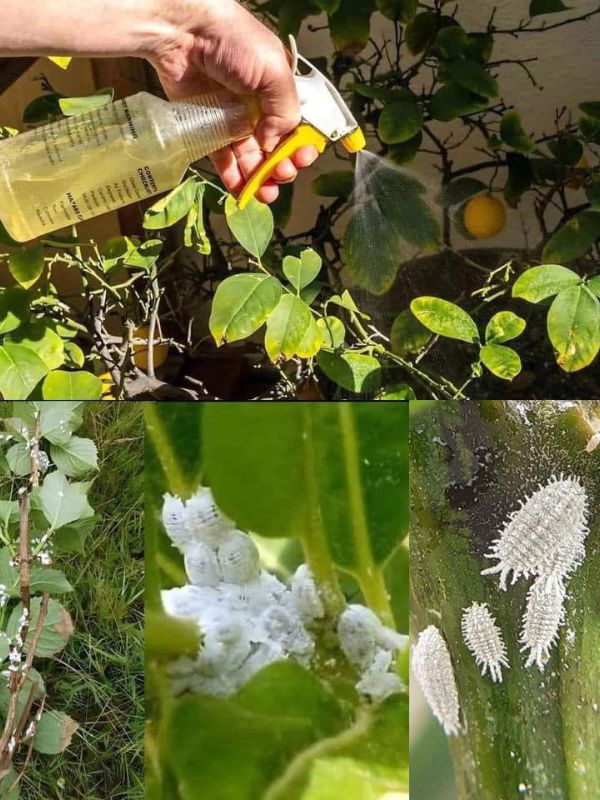
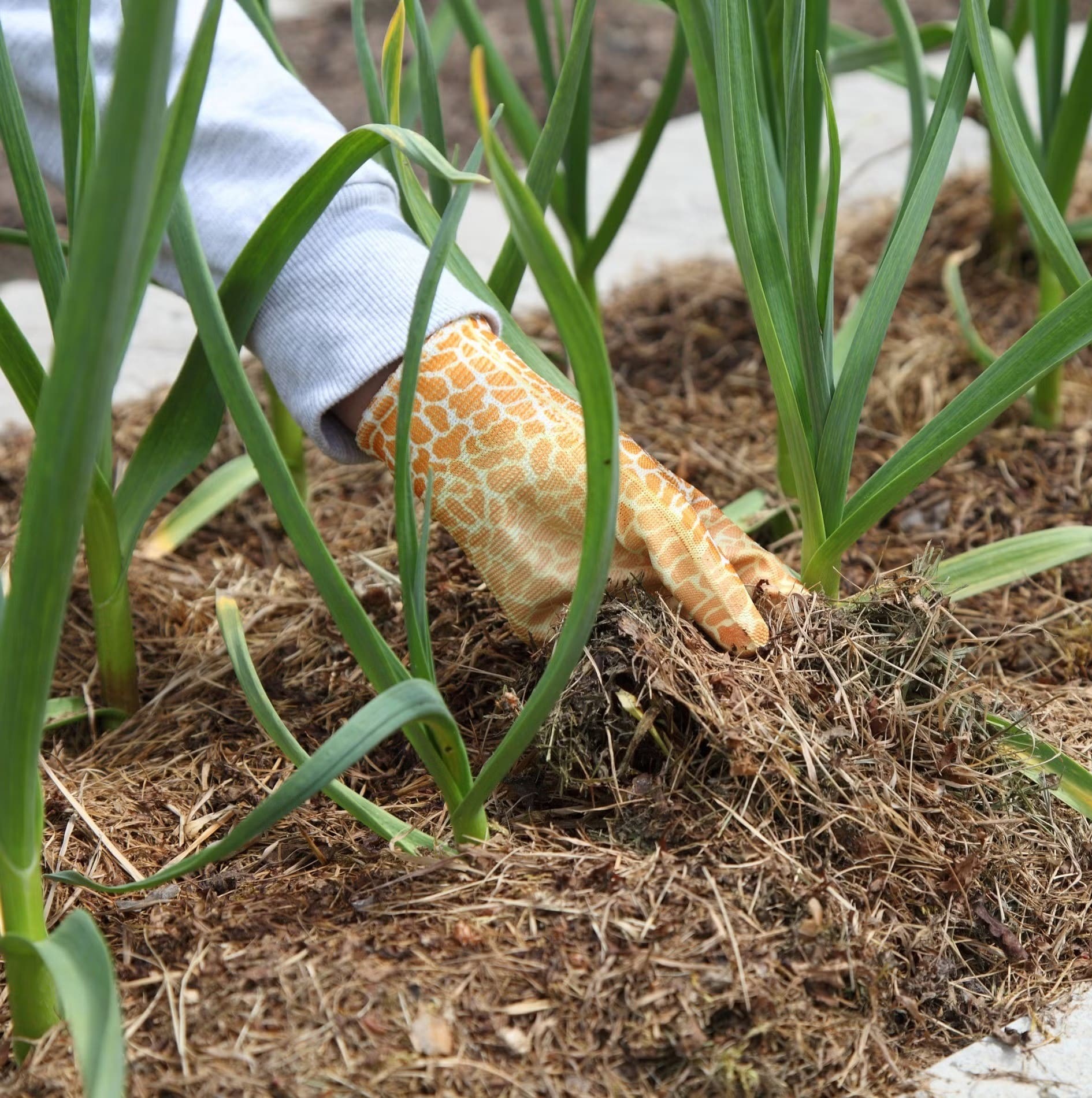
Are pests turning your beautiful garden into an all-you-can-eat buffet? Tired of battling aphids, caterpillars, and mites that won’t leave your plants alone?
Instead of dousing your garden with harmful chemicals, why not fight back with something you already have in your kitchen? Garlic alcohol spray is a powerful, natural pest deterrent that keeps bugs at bay without harming your plants.
This simple DIY solution harnesses the natural potency of garlic and alcohol, creating an eco-friendly pest control method that works wonders. Keep reading to learn why this spray is a must-have in your gardening arsenal!
Benefits of Garlic Alcohol Spray for Garden Pests
1. Repels Pests Without Harming Beneficial Insects
Unlike chemical pesticides that wipe out everything in their path, garlic alcohol spray primarily repels pests like aphids, whiteflies, and caterpillars while leaving pollinators like bees and butterflies unharmed.
Garlic contains sulfur compounds, particularly allicin, which emits a strong odor that insects despise. Over time, consistent application creates a protective barrier that keeps pests from returning.
Save
2. Kills Soft-Bodied Pests on Contact
Alcohol acts as a dehydrating agent, making it lethal to soft-bodied pests such as aphids, spider mites, and mealybugs.
When combined with garlic’s natural antimicrobial and antifungal properties, the spray not only repels but actively kills these garden invaders.
For best results, a few applications per week can significantly reduce infestations within days.
3. Prevents Fungal Diseases
Garlic isn’t just for bugs it also helps control plant diseases. Its antifungal properties combat common garden problems like powdery mildew and black spots.
Regular use of garlic alcohol spray can protect your plants from fungal infections while simultaneously keeping pests in check.
Discover more
Explore Entomology Kits
Discover Garden Tools
gardening
Save
4. Safe for Humans, Pets, and the Environment
Unlike chemical pesticides that introduce toxins into the soil and water, garlic alcohol spray is biodegradable and non-toxic. It’s safe to use around children, pets, and edible plants, making it a perfect alternative for organic gardening.
Plus, you don’t have to worry about chemical residues affecting the taste of homegrown fruits and vegetables.
5. Boosts Plant Immunity
Garlic is rich in sulfur, a key micronutrient that supports plant health. When applied regularly, it strengthens plants against pest damage, improves resilience, and encourages robust growth. Think of it as a natural immune booster for your garden!
Save
6. Budget-Friendly and Easy to Make
Forget expensive pesticides this DIY garlic alcohol spray costs next to nothing. You only need garlic, alcohol (like rubbing alcohol or vodka), and water.
Discover more
Garden
Find Chemistry Tutors
Insects
With just a few ingredients, you can create a powerful, long-lasting pest deterrent without breaking the bank.
7. Eliminates Unwanted Garden Odors
Here’s a surprising benefit: garlic’s natural antimicrobial properties can help neutralize unpleasant garden smells.
If you’re dealing with rotting plant matter or compost odors, a light misting of garlic alcohol spray can keep things fresh while doubling as a pest repellent.
Save
How to Make and Use Garlic Alcohol Spray
Ingredients
2 heads of garlic (about 20 cloves)
1 cup of rubbing alcohol (or vodka)
2 cups of water
1 teaspoon of dish soap (optional, for better adhesion)
Step-by-Step Instructions
Peel and crush the garlic cloves to release their natural oils. You can use a blender, mortar and pestle, or simply mince them finely with a knife.
Combine the garlic with alcohol in a jar or bowl. Let it sit for at least 24 hours to allow the garlic to infuse.
Strain the mixture using a fine mesh sieve or cheesecloth to remove solid bits.
Dilute with water (2 parts water to 1 part garlic-alcohol solution).
Add a teaspoon of dish soap if you want better adherence to plant leaves.
Pour the solution into a spray bottle and shake well before use.
How to Apply
Spray directly on affected plants, focusing on the underside of leaves, where pests often hide.
Apply in the early morning or evening to avoid leaf burn from the sun.
Use twice a week for active infestations and once every two weeks as a preventative measure.
Reapply after rain, as water can wash the spray off.
Save
Cautions and Precautions
Some plants, especially delicate ones like ferns, may be sensitive to alcohol. Spray a small section and wait 24 hours before applying it widely.
Discover more
Watch Expert Tutorials
Garlic
insects
Excessive spraying can dry out leaves or cause mild irritation to certain plants. Stick to recommended usage to prevent any damage.
The strong concentration of garlic and alcohol can cause irritation if it comes into direct contact with the skin, eyes, or open wounds.
Disclaimer
This article is for informational purposes only and does not replace professional gardening or agricultural advice. Always conduct a patch test before applying new solutions to plants, and consult an expert if dealing with severe pest infestations.
There is something extraordinary about the way people express who they are without saying a word. Before a single sentence is spoken, before a handshake or introduction takes place, your appearance already tells a story. The clothes you wear, the colors you choose, and even the smallest accessories form a visual language that speaks volumes about your personality, confidence, and creativity.
Personal style is much more than fashion. It’s a reflection of individuality—a form of art that reveals how someone feels, how they perceive themselves, and how they wish to be seen by the world. For women especially, style becomes an extension of identity, shaping not only how they present themselves but also how they experience life.
The Essence of Personal Style
At its core, personal style is not dictated by trends, designer labels, or what’s currently “in.” It’s about creating a visual harmony between your inner self and outer appearance. True style is deeply personal—it evolves from an awareness of who you are and how you want to show up in the world.
Every outfit you put together sends a message. A crisp blazer and tailored trousers might communicate professionalism and control, while a flowy dress in soft hues might express romance or openness. The same woman can convey different messages depending on her choices, reflecting how dynamic and multifaceted identity truly is.
Legendary designer Coco Chanel once said, “Fashion fades; only style remains the same.” Her words still resonate today because style isn’t temporary—it’s timeless. It lives in the details, in how you carry yourself, and in how confidently you wear what feels true to you.
When my parents saw my pregnancy test, my mom threw my backpack out into the yard and my dad said that from that night on, I was dead to them. Twenty years later, I returned to that very same gate just to look them in the eyes… but the girl who opened the door looked so much like me that I felt the air leave my lungs.
I didn’t know what to say for a few seconds.
The girl looked at me with impatience, but also with curiosity… as if something about me felt familiar to her without knowing why.
—Ma’am? —she insisted.
I swallowed hard.
—I… —my voice came out softer than I expected—. I’m looking for the owners of the house.
She hesitated.
—You mean Arthur and Rose?
My parents.
I nodded slowly.
—Yes… them.
The girl opened the door a bit wider, but she didn’t let me pass.
—And who are you?
That question.
So simple.
So heavy.
Twenty years summarized in a single answer.
I looked straight at her.
—Someone who lived here a very long time ago.
She furrowed her brow.
—Doesn’t ring a bell.
I offered a faint smile.
—No… it wouldn’t.
Silence.
She studied me for another moment.
Then she shouted inside:
—Grandma! Someone’s here for you!
Grandma.
That word pierced right through me.
Grandma?
Then… this girl…
Before I could think any further, I heard shuffling footsteps.
Slow.
Tired.
And then I saw her.
My mother.
Smaller.
More hunched over.
Her hair completely white.
But it was her.
Without a doubt.
She stopped at the door.
She looked at me.
Her eyes narrowed.
As if searching my face for something she couldn’t quite find.
—Yes? —she asked, dryly.
Time hadn’t changed her tone.
I took a deep breath.
—Good afternoon.
Silence.
She kept staring at me.
—Can I help you with something?
The girl looked back and forth between us.
—She says she lived here a long time ago…
My mother let out a short, hollow laugh.
—A lot of people have lived here.
I swallowed hard.
—Not that many.
A strange silence fell over us.
My father appeared behind her.
Thinner.
Older.
But with the exact same hard gaze.
—What’s going on? —he asked.
My mother pointed at me.
—I don’t know who she is.
My father looked at me.
And something in his expression changed.
Barely.
A flicker.
As if a memory were trying to force its way through.
But it didn’t.
—What do you want? —he asked.
I looked at him.
Dead-on.
For the first time in twenty years.
—I wanted to see you.
My mother furrowed her brow.
—What for?
There was no softness.
No emotion.
Nothing.
Just… distance.
I felt the thorn.
The one that had never gone away.
But this time…
it didn’t hurt the same.
Because I was no longer that sixteen-year-old girl in the rain.
—To close a chapter —I replied.
The girl was still watching everything.
Confused.
—Grandma… do you know her?
My mother shook her head.
—No.
Just like that.
So easy.
So clean.
As if I had never existed.
My chest tightened.
But I didn’t cry.
Not this time.
I smiled faintly.
—Of course.
I reached into my purse.
I pulled out an old photograph.
Crinkled by the years.
I extended it to her.
—Maybe this will help.
My mother hesitated.
But she took it.
She looked at it.
And then…
her hands began to shake.
My father leaned in close.
He looked at the photo.
And the color drained completely from his face.
It was a picture of me.
From middle school.
In my school portrait.
My hair down.
With the smile I used to have before everything.
The silence grew heavy.
Very heavy.
The girl leaned in closer.
—What is it?
My mother didn’t answer.
Her lips were moving, but no sound came out.
My father raised his eyes.
And finally…
he saw me.
Truly saw me.
—No… —he whispered.
I took a step forward.
—Yes.
The word hung in the air.
My mother backed away.
—You…
Her eyes filled with something I couldn’t quite name.
Fear?
Guilt?
Shame?
—No… you are…
She didn’t finish the sentence.
Because she herself had spoken it twenty years ago:
“You are dead to us.”
The girl looked at us, completely lost.
—What is going on here?
I looked at her.
And this time, I took her in completely.
Her age.
Her face.
The way she breathed.
My blood.
My daughter.
—What’s your name? —I asked her.
She hesitated.
—Mary.
My heart skipped a beat.
—How old are you?
—Nineteen.
Almost the exact amount of time that had passed.
I looked at my parents.
—Are you two raising her?
Silence.
My mother lowered her gaze.
That was enough.
Everything clicked into place.
The day they kicked me out.
The rain.
The loneliness.
The childbirth.
The hospital.
The moment they told me I couldn’t keep her.
The paperwork.
The decisions I made without truly knowing.
The hands that received her.
Them.
My own parents.
The girl—Mary—looked at us, bewildered.
—Can someone please explain to me what is happening?
I took a deep breath.
I looked her in the eyes.
—I… am your mother.
The world stopped.
Literally.
—What? —she whispered.
My mother began to weep.
My father stood frozen.
Mary shook her head.
—No… no… that doesn’t make any sense…
—I got pregnant at sixteen —I said—. I was kicked out of this house.
I pointed to the ground.
—Right here.
Her eyes filled with tears.
—And you…
—You were born shortly after.
Her breath caught.
—Then… them…
She looked at my parents.
—Are they my grandparents?
Nobody answered.
But it wasn’t necessary anymore.
The silence said it all.
Mary took a step back.
—Why…?
She looked at my mother.
—Why did you never tell me?
My mother wept, unable to speak.
My father lowered his gaze.
For the first time in his life.
Mary looked back at me.
—And you… why didn’t you come back?
That question…
that one did hurt.
But I didn’t run from it.
—Because I didn’t know where you were.
I paused.
—And because they told me I couldn’t keep you.
Her tears fell.
Silent.
—I… I always felt like something was missing…
I stepped a little closer.
Slowly.
—Me too.
Silence.
But this time…
it wasn’t heavy.
It was… different.
As if something were being rebuilt.
My mother finally spoke.
—We thought it was for the best…
Her voice was broken.
—We were wrong.
My father didn’t say a word.
But his eyes… they were no longer the same.
I nodded.
—Yes.
I looked at Mary.
—But I didn’t come to make a scene.
I paused.
—I came to see you.
She hesitated.
—And now what?
I smiled gently.
—Now… it’s up to you.
The wind swept through the yard, shifting the overgrown weeds, as if time itself were taking a breath.
Are pests turning your beautiful garden into an all-you-can-eat buffet? Tired of battling aphids, caterpillars, and mites that won’t leave your plants alone?
Instead of dousing your garden with harmful chemicals, why not fight back with something you already have in your kitchen? Garlic alcohol spray is a powerful, natural pest deterrent that keeps bugs at bay without harming your plants.
This simple DIY solution harnesses the natural potency of garlic and alcohol, creating an eco-friendly pest control method that works wonders. Keep reading to learn why this spray is a must-have in your gardening arsenal!
Benefits of Garlic Alcohol Spray for Garden Pests
1. Repels Pests Without Harming Beneficial Insects
Unlike chemical pesticides that wipe out everything in their path, garlic alcohol spray primarily repels pests like aphids, whiteflies, and caterpillars while leaving pollinators like bees and butterflies unharmed.
Garlic contains sulfur compounds, particularly allicin, which emits a strong odor that insects despise. Over time, consistent application creates a protective barrier that keeps pests from returning.
Save
2. Kills Soft-Bodied Pests on Contact
Alcohol acts as a dehydrating agent, making it lethal to soft-bodied pests such as aphids, spider mites, and mealybugs.
When combined with garlic’s natural antimicrobial and antifungal properties, the spray not only repels but actively kills these garden invaders.
For best results, a few applications per week can significantly reduce infestations within days.
3. Prevents Fungal Diseases
Garlic isn’t just for bugs it also helps control plant diseases. Its antifungal properties combat common garden problems like powdery mildew and black spots.
Regular use of garlic alcohol spray can protect your plants from fungal infections while simultaneously keeping pests in check.
Save
4. Safe for Humans, Pets, and the Environment
Unlike chemical pesticides that introduce toxins into the soil and water, garlic alcohol spray is biodegradable and non-toxic. It’s safe to use around children, pets, and edible plants, making it a perfect alternative for organic gardening.
Plus, you don’t have to worry about chemical residues affecting the taste of homegrown fruits and vegetables.
Discover more
Garden
Gardening
gardening
5. Boosts Plant Immunity
Garlic is rich in sulfur, a key micronutrient that supports plant health. When applied regularly, it strengthens plants against pest damage, improves resilience, and encourages robust growth. Think of it as a natural immune booster for your garden!
Save
6. Budget-Friendly and Easy to Make
Forget expensive pesticides this DIY garlic alcohol spray costs next to nothing. You only need garlic, alcohol (like rubbing alcohol or vodka), and water.
Discover more
Insects
Download Nature Guides
Commission Custom Prints
With just a few ingredients, you can create a powerful, long-lasting pest deterrent without breaking the bank.
7. Eliminates Unwanted Garden Odors
Here’s a surprising benefit: garlic’s natural antimicrobial properties can help neutralize unpleasant garden smells.
If you’re dealing with rotting plant matter or compost odors, a light misting of garlic alcohol spray can keep things fresh while doubling as a pest repellent.
Save
How to Make and Use Garlic Alcohol Spray
Discover more
insects
Watch Expert Tutorials
Explore Entomology Kits
Ingredients
2 heads of garlic (about 20 cloves)
1 cup of rubbing alcohol (or vodka)
2 cups of water
1 teaspoon of dish soap (optional, for better adhesion)
Step-by-Step Instructions
Peel and crush the garlic cloves to release their natural oils. You can use a blender, mortar and pestle, or simply mince them finely with a knife.
Combine the garlic with alcohol in a jar or bowl. Let it sit for at least 24 hours to allow the garlic to infuse.
Strain the mixture using a fine mesh sieve or cheesecloth to remove solid bits.
Dilute with water (2 parts water to 1 part garlic-alcohol solution).
Add a teaspoon of dish soap if you want better adherence to plant leaves.
Pour the solution into a spray bottle and shake well before use.
How to Apply
Spray directly on affected plants, focusing on the underside of leaves, where pests often hide.
Apply in the early morning or evening to avoid leaf burn from the sun.
Use twice a week for active infestations and once every two weeks as a preventative measure.
Discover more
Get Organic Produce
garlic
Discover Garden Tools
Reapply after rain, as water can wash the spray off.
Save
Cautions and Precautions
Some plants, especially delicate ones like ferns, may be sensitive to alcohol. Spray a small section and wait 24 hours before applying it widely.
Discover more
garden
solar lights
Choose Skincare Kits
Excessive spraying can dry out leaves or cause mild irritation to certain plants. Stick to recommended usage to prevent any damage.
The strong concentration of garlic and alcohol can cause irritation if it comes into direct contact with the skin, eyes, or open wounds.
Disclaimer
This article is for informational purposes only and does not replace professional gardening or agricultural advice. Always conduct a patch test before applying new solutions to plants, and consult an expert if dealing with severe pest infestations.
What began as an ordinary afternoon quickly turned into a scene that drew attention from bystanders nearby. A young woman was seen being escorted by law enforcement officers, her hands restrained as officials carried out what appeared to be a formal arrest. Witnesses described the atmosphere as tense but controlled, with officers maintaining professionalism throughout the process.Initial reports suggest that authorities responded to an incident that required immediate intervention. While details have not been fully disclosed, officials emphasized that the arrest followed established procedures. Situations like this often unfold rapidly, and what may look dramatic in a single image is usually the result of a longer chain of events.
The sheriff thought I was just a gray-haired janitor. He had no idea who I used to be.
PART 1
My name is Caleb Vance, and for seventeen years, I worked nights cleaning the Livingston County courthouse in a small Colorado town. To everyone who passed me in those halls, I was invisible—old boots, faded work shirt, mop bucket, tired eyes.
That was exactly how I wanted it.
Before I became a husband and father, I had another life. I spent nearly two decades leading elite military operations in places most Americans would never hear about, making decisions under gunfire and bringing men home from missions that were never supposed to exist.
Then I met Laura.
Then Ethan was born.
And I walked away from all of it.
That night, my phone buzzed while I was wringing out a mop.
Laura.
She never called during my shift.
The moment I heard her crying, my stomach dropped.
“Caleb,” she choked out. “It’s Ethan.”
My hand went numb. The mop hit the marble floor.
“What happened?”
“There’s been a shooting. Mercy General. Please… just hurry.”
I don’t remember the drive. I remember red lights, my hands crushing the steering wheel, and one thought repeating over and over in my head: Please let my son be alive.
When I burst into the emergency department, Laura was outside Trauma Bay Three, shaking so hard she could barely stand.
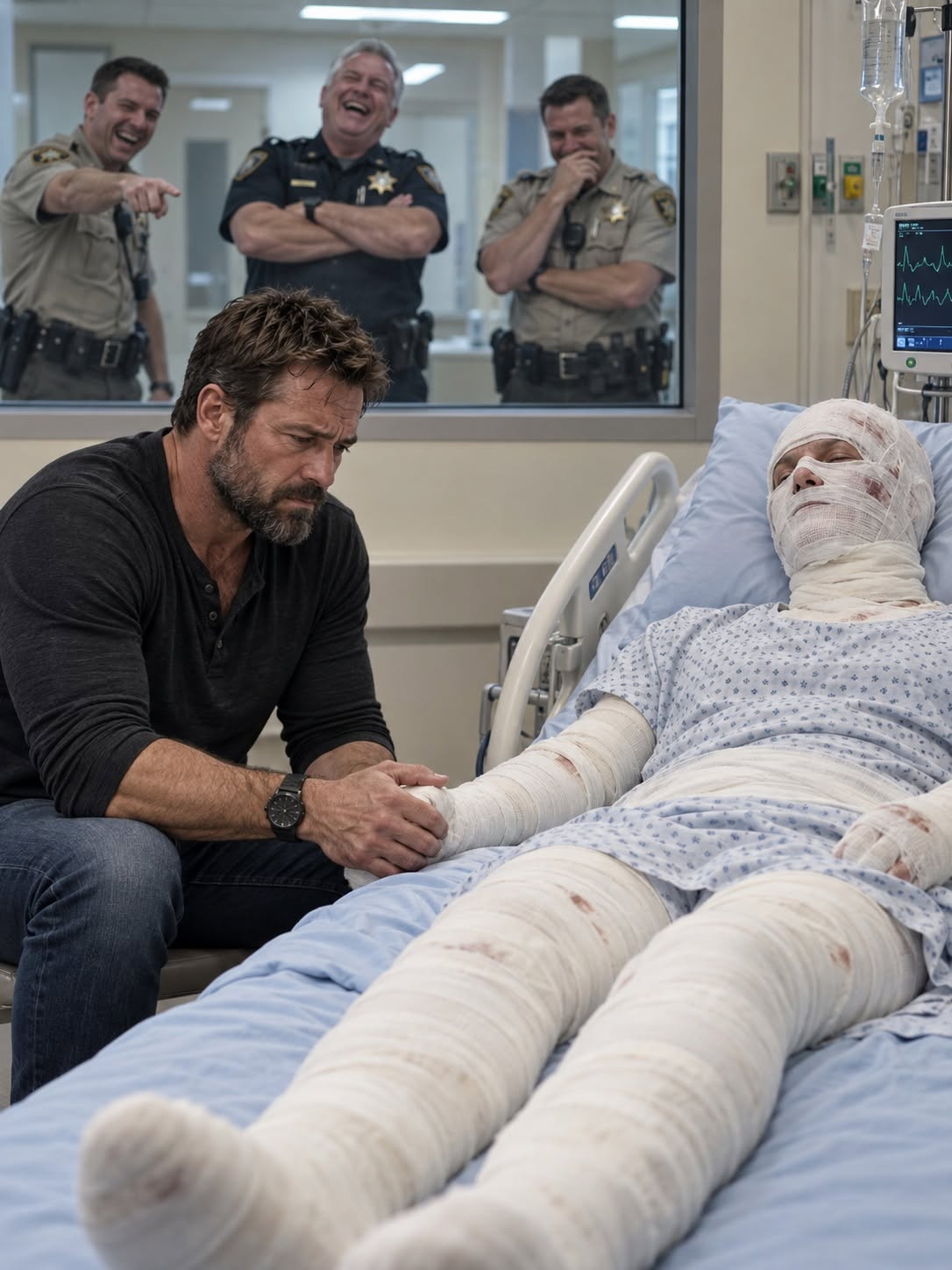
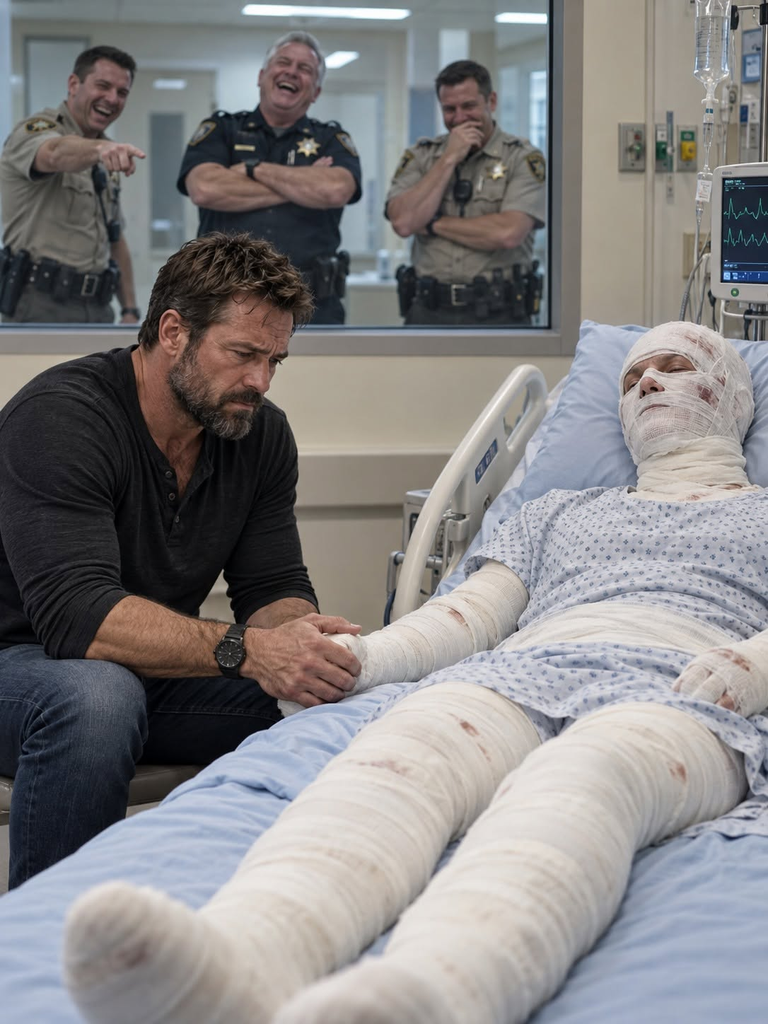
Then I looked through the glass.
Ethan was lying there.
My seventeen-year-old boy. Captain of his high school basketball team. The kid who left sneakers in the hallway and raided the refrigerator after midnight.
Now his face was white with pain.
Both legs were wrapped in thick bandages already soaked dark red.
A doctor stepped out, and I froze.
“Marcus?”
Dr. Marcus Vance stared at me.
We had served together years earlier overseas. Now he was one of the best trauma surgeons in Colorado.
“How bad?” I asked.
He hesitated.
That hesitation told me everything.
“Both kneecaps are destroyed,” he said quietly. “There are bone fragments everywhere. He’ll need multiple surgeries. Recovery could take months. Maybe years.”
Laura covered her mouth.
I grabbed the wall.
“Who did this?”
Marcus glanced down the hallway before leaning closer.
“Sheriff Vance Vance.”
The name landed like a hammer.
Everyone knew Sheriff Vance. Powerful. Connected. Protected. A man who carried his badge like it gave him ownership over everyone beneath him.
I walked into Ethan’s room and took his hand.
His eyes opened.
“Dad?”
Then he started crying.
“He shot me,” Ethan whispered.
I squeezed his fingers.
“He laughed.”
My jaw locked.
Ethan swallowed, fighting for breath.
“He said, ‘Shouldn’t have looked at me wrong, boy.’”
For a moment, all I could hear was the hospital monitor.
Then Ethan looked toward his bandaged legs.
“Dad… I can’t feel them.”
His voice cracked.
“I’ll never walk again.”
I kissed his forehead and told him I was going to take care of everything.
But somewhere inside me, something I had buried seventeen years ago opened its eyes.
Hours later, while Ethan was in surgery, I sat alone in the hospital parking lot with my phone in my hand.
Sheriff Vance believed his badge protected him.
He believed the county protected him.
He believed people like me were too weak to fight back.
I scrolled through contacts I hadn’t touched in nearly two decades until I found one number.
Then I pressed call.
The man answered after one ring.
“Reaper?”
I stared up at the hospital window where my son was fighting for his future.
“Get the team together,” I said.
The silence on the other end lasted three seconds.
And that was enough to tell me they understood exactly what kind of night this had become…
Part 2: The Gathering Shadow
Thirty-six hours after the call, four men who did not officially exist arrived in Livingston County.
They didn’t drive in together. They didn’t book rooms at the local motel. They pulled into an abandoned lumber storage facility four miles outside town—a rusted corrugated-steel warehouse Caleb had bought through an anonymous land trust a decade ago.
Caleb stood in the center of the dusty concrete floor, illumination provided by a single hanging LED work light. The air smelled of dry pine and engine oil.
The heavy metal door slid open. Four figures stepped out of the night.
First was Jackson, callsign Ghost—a former counter-surveillance specialist who could breach a state-level intranet from a burner phone. Next was Miller, Anvil—six-foot-four, a former breach-and-entry expert who had spent fifteen years blowing doors in Fallujah and Kandahar. Behind them came James, Doc—a tactical medic who had patched Caleb up twice in places that didn’t appear on maps. Finally came Miller’s younger brother, Scythe—a precision marksman who had once held a perimeter for seventy-two hours straight without sleeping.
None of them wore tactical gear or camouflage. They wore faded jeans, canvas jackets, and baseball caps. They looked like oil workers, long-haul truckers, or farmhands.
“Reaper,” Jackson said softly, stopping five feet away. He didn’t offer a handshake. He looked at Caleb’s grey hair, his calloused hands, the faded janitor’s boots. “We saw the local news. They’re calling it an officer-involved shooting following a suspected drug transaction.”
Caleb’s jaw tightened until a muscle twitched in his cheek. “Ethan was coming home from basketball practice. He stopped at a gas station. Vance pulled up behind him, claimed Ethan’s tail light was out, and demanded his phone. When Ethan reached for his wallet to show his license, Vance pulled him out of the cab, kicked him into the gravel, and put two rounds from his duty weapon through his knees.”
A heavy, suffocating silence fell over the warehouse.
“The dashcam?” James asked.
“Vance’s department claims the cruiser’s camera had an electrical malfunction,” Caleb replied, his voice terrifyingly calm. “The gas station owner turned over his security footage to Vance’s deputies thirty minutes after the shooting. An hour later, the station had a ‘grease fire’ in the back room that destroyed the digital video recorder.”
Miller spat on the concrete floor. “Local prosecutor?”
“In Vance’s pocket. They’re filing charges against Ethan for felony assault on a peace officer from his hospital bed.” Caleb looked up, his eyes cold as arctic ice. “The legal system here isn’t broken, boys. It’s working exactly the way Vance designed it. So we aren’t going to use the legal system.”
Jackson pulled a ruggedized military laptop from his canvas bag and set it on a wooden crate. “We pulled the county law enforcement network overnight. Sheriff Vance Vance isn’t just a dirty cop. He runs the local narcotics pipeline coming off Interstate 70. His deputies act as enforcers. He’s got three dummy accounts in the Cayman Islands holding just over four million dollars.”
“We aren’t here for his money,” Caleb said.
“No,” Jackson agreed, tapping the screen. “But his money is how we tear his house down. I’ve already mirrored his private phone, his department servers, and his personal residence security feeds. He thinks he’s invisible.”
Caleb walked over to a steel workbench against the back wall. He pulled away a faded blue tarp, revealing five locked pelican cases he had buried beneath the floorboards seventeen years ago. He unlocked the heavy latches one by one.
Inside lay suppressed SIG Sauer sidearms, short-barreled carbines, night-vision optics, encrypted comms units, and tactical breaching charges—greased, maintained, and pristine.
“We don’t kill him,” Caleb said, his voice dropping an octave. “Death is too clean. Death makes him a martyr to his corrupt union. We take his badge, we take his money, we take his freedom, and we leave him sitting in a federal cell for the rest of his life where every inmate he ever put away knows his name.”
Miller picked up a carbine, checked the bolt action with a satisfying mechanical clack, and looked at Caleb. “How do we start, Boss?”
“We start by taking away his shadows,” Caleb said.
Part 3: The Fall of an Empire
At 2:15 AM on Friday, Sheriff Vance Vance sat in his plush leather chair inside the Livingston County Sheriff’s Department. The building was quiet, save for a single dispatcher at the front desk.
Vance poured two fingers of bourbon into a crystal glass. He was a broad-shouldered man of fifty-five, with a thick mustache and eyes that had long since forgotten how to feel empathy. To him, the town of Livingston wasn’t a community; it was his personal fiefdom. The janitor’s kid was just another piece of dirt he’d stepped on to remind the locals who ruled the county.
His cell phone buzzed on the mahogany desk.
Vance picked it up. “This better be important.”
“Check your computer, Sheriff,” a deep, electronically distorted voice said through the speaker.
Vance frowned. “Who the hell is this? Do you know who you’re talking to—”
“Check the monitor, Vance.”
The line went dead.
Vance clicked his mouse. His dual monitors flickered once, then turned bright red.
File after file began opening automatically. Bank statements from the Grand Cayman National Bank detailing monthly $50,000 deposits. High-definition video footage from the back room of the gas station—the footage Vance thought his deputies had incinerated—showing him standing over a terrified Ethan Vance, shooting him in cold blood, and laughing as he walked back to his cruiser.
Vance’s heart slammed into his ribs. His hand flew to his desk phone to call his IT chief.
The desk phone didn’t work. The dial tone was gone.
Suddenly, the overhead lights in the entire station went pitch black.
The emergency backup generator clicked on three seconds later, bathing the hallway in an eerie red glow. Vance drew his Glock 21 from his holster, his boots thudding against the carpet as he marched toward the main corridor.
“Gomez! Miller!” he yelled toward the front desk.
Silence.
When Vance stepped into the dispatch lobby, his two night-shift deputies were lying flat on their stomachs on the tile floor, zip-tied, gagged, and unconscious. Sitting calmly on the front counter was a black USB drive next to a printed letter addressed to the United States Attorney for the District of Colorado and the FBI Special Agent in Charge in Denver.
Vance’s phone buzzed in his hand again. A text message.
Look out the front window.
Vance stumbled toward the glass double doors. Standing on the sidewalk, fifty yards away under the flickering amber light of a street lamp, was a lone figure.
The man wore a dark canvas jacket and heavy boots. He wasn’t holding a weapon. He was just standing there, looking directly at Vance through the glass.
Vance squinted, trying to recognize the face. Then the blood drained entirely from his head.
It was the courthouse janitor. The gray-haired man who pushed a mop bucket past his office door every Tuesday night. The man who had bowed his head whenever Vance walked past.
Except Caleb Vance wasn’t bowing his head now.
His posture was terrifyingly rigid. His eyes held a cold, predatory intelligence that made Vance’s breath catch in his throat. Caleb lifted his right hand, tapped his wrist—a universal gesture for time’s up—and turned into the darkness of the alley.
Vance slammed his hand against the door release, bursting out onto the street. “Stop! Sheriff’s Department! Stand where you are!”
He sprinted into the alley, raising his sidearm, his heavy boots echoing off the brick walls. “I’ll put you in the ground right next to your cripple son, you old bastard!”
Vance rounded the corner near the dumpster—and ran straight into a wall of solid muscle.
Before he could raise his gun, a gloved hand grabbed the slide of his Glock, locking the action out of battery. Another hand struck his throat with precise, terrifying force. Vance dropped his weapon, gagging, gasping for air as he crashed to his knees on the wet asphalt.
Miller disarmed him in a fraction of a second, kicking the sidearm into the darkness.
Caleb stepped out from the shadows, stepping slowly until he stood two feet from the kneeling sheriff.
“You…” Vance gasped, clutching his throat, his eyes wide with wild, unadulterated terror. “Who… who are you?”
Caleb dropped to one knee, bringing his face inches from Vance’s.
“Seventeen years ago, I was the man the United States government sent when they needed a monster put down,” Caleb whispered, his voice vibrating with an authority that made Vance tremble. “Then I retired. I cleaned floors. I picked up my son from basketball practice. I paid my taxes. I stayed quiet because I thought I was done with monsters.”
Caleb grabbed Vance by his tactical vest, pulling him up until their eyes were level.
“You took my son’s legs because he didn’t look at you with enough fear,” Caleb said softly. “So now, I am going to take everything you have ever touched.”
Final: The Reckoning
At 6:00 AM on Friday morning, the Livingston County Courthouse was surrounded by twenty-five federal vehicles.
FBI tactical teams, accompanied by state troopers from the Bureau of Investigation, swarmed the Sheriff’s Department. They seized every server, every physical file, and every cruiser. By 6:30 AM, federal agents had executed a search warrant at Vance’s lakefront home, discovering two million dollars in cash, three kilos of high-grade narcotics, and an unregistered firearm linked to a cold-case homicide from 2021.
At 7:00 AM, the local television stations aired the gas station security footage—broadcast simultaneously to every major network in the state after an ‘anonymous whistleblower’ uploaded the raw, unedited file directly to the Governor’s press portal.
The public outcry was immediate and deafening. The local prosecutor resigned by noon. The charges against Ethan Vance were dismissed with prejudice before lunch.
Sheriff Vance Vance was not shot. He was not beaten within an inch of his life.
Instead, he was led out of his own department in broad daylight, wearing heavy steel handcuffs around his wrists, flanked by four federal marshals. As he was led down the courthouse steps—the very steps Caleb had mopped for seventeen years—a crowd of local citizens stood at the barricades, cheering as the corrupt lawman was shoved into the back of a black SUV.
Vance looked frantically through the tinted window as the vehicle pulled away.
Standing near the corner of the block, leaning against a park bench, was Caleb Vance. He wore his faded denim jacket, his hands tucked casually into his pockets. His face was entirely devoid of emotion.
Vance locked eyes with him for three seconds before the SUV turned the corner, carrying the former sheriff off to a maximum-security federal holding facility where he would spend the rest of his life awaiting trial.
Two weeks later, the morning sun shone brightly through the window of Room 412 at Mercy General Hospital.
Ethan sat in a wheelchair near the foot of the bed. Both of his legs were heavily braced, crisscrossed with surgical incisions, but the color had returned to his face.
Dr. Marcus Vance stood beside him, reviewing an X-ray display on his tablet.
“The second surgery was a complete success, Ethan,” Marcus said, looking up with a warm smile. “The bone fragments are cleared, the quadriceps tendons are reattached, and the synthetic knee caps are holding perfectly. It’s going to be a long road—six months of intensive physical therapy, a lot of hard work—but you will walk. And if you put the work in, you’ll be back on the court for your senior year.”
Laura let out a tearful sob, pulling her son into a tight hug. Ethan grinned, wiping a stray tear from his cheek, before looking up at his father, who was standing quietly near the door.
“Dad,” Ethan called out softly.
Caleb walked over, resting a heavy, warm hand on his son’s shoulder. “Yeah, kiddo?”
“The news said the FBI found a whistleblower,” Ethan whispered, his voice filled with quiet wonder. “They said someone hacked the department, leaked the videos, and sent the evidence straight to the federal prosecutor. Nobody knows who did it.”
Caleb looked at his son—at the bright, hopeful eyes of the boy who had his entire life ahead of him.
“Sometimes, Ethan,” Caleb said gently, a faint smile touching his lips, “the right people are just watching out for you.”
Marcus caught Caleb’s eye from across the bed. The surgeon gave a subtle, respectful nod—a silent acknowledgment between two old soldiers who understood the cost of peace.
That evening, Caleb walked into the Livingston County Courthouse.
The building was empty and quiet. The federal agents were gone, the press had moved on, and the grand marble halls were silent once again.
Caleb walked into the janitor’s closet, pulled out his yellow mop bucket, and filled it with warm, soapy water. He grabbed his mop, stepped out into the grand foyer, and began his shift.
As he pushed the heavy cotton mop across the polished stone floor, listening to the rhythmic splash of the water, he looked up at the high, arched ceilings.
He was no longer the Reaper. He was just a father.
And as long as his family was safe, that was the only title he would ever need.
People were walking through the area, cars were moving along the nearby streets, and nothing about the scene suggested that anything unusual was about to happen.
A disturbance in a public area drew the attention of people nearby, and within minutes, police officers were responding to the situation as curious bystanders stopped to watch.
What happened next was the kind of strange, unexpected moment that can turn an otherwise normal afternoon into a story people cannot stop talking about.
At first, those who witnessed the incident reportedly had very little information.And they could sense that something unusual had happened.But without knowing the full circumstances, many were left trying to piece together what they were seeing.
Others stood at a distance, watching quietly as officers assessed the situation.
And, as is increasingly common in the age of smartphones, images from the scene soon began appearing online.
That was when the story took on a life of its own.
Photographs showing police activity and a crowd of spectators quickly attracted attention, with people online attempting to determine exactly what had happened.The images themselves offered few clear answers.
There was no obvious explanation that could immediately tell viewers what had caused the disturbance or why police had been called.
Instead, the photographs captured a moment frozen in time — officers responding, members of the public watching, and an atmosphere filled with uncertainty.
For people who had not been there, the lack of context only made the images more intriguing.
And perhaps most importantly, was the situation actually as serious as it appeared?
Those questions are often enough to send a relatively small local incident spreading far beyond the place where it happened.
A photograph can travel thousands of miles in seconds.
Someone sees it, shares it with friends, another person posts it to a community page, and suddenly an event that only a few dozen people witnessed becomes the subject of widespread online discussion.
As more people encountered the images, speculation began to grow.
Some viewers tried to identify the location.
Others attempted to determine what the officers were responding to.
A few offered explanations based purely on what could be seen in the photographs.
But without verified information, many of those theories remained exactly that — theories.
This is one of the most complicated aspects of modern viral stories.
An image can be completely genuine while the story surrounding it is incomplete.
A photograph may accurately show police officers responding to something, yet tell viewers almost nothing about what happened before the camera was raised or what happened afterward.
That distinction became particularly important as curiosity surrounding the incident continued to build.
For those actually present, the atmosphere was reportedly very different from the one created online.
Bystanders were not necessarily witnessing some dramatic event unfolding exactly as social media portrayed it.
Many were simply people who happened to be nearby when something unexpected occurred.
And, naturally, some recorded what they could.
Police officers, meanwhile, had a much more practical responsibility.
Rather than trying to understand the incident through the lens of social media, officers needed to establish what had happened, determine whether anyone was at risk, and bring the situation under control.
From the outside, however, a police response can create the impression that something enormous is happening.
The arrival of multiple officers, flashing lights, gathered crowds and people filming on their phones can make even a relatively contained incident appear dramatic.
And once photographs of that scene reach the internet, the cycle can become almost impossible to stop.
One person sees an image and asks a question.
Someone else challenges that explanation.
Then another post appears claiming to have additional information.
Before long, people who were nowhere near the scene are discussing the event as though they had witnessed it themselves.
That is why authorities routinely encourage people to wait for confirmed information before accepting claims circulating online.
In the immediate aftermath of an unexpected public disturbance, details can change quickly.
Witnesses may have seen only part of what happened.
And photographs can be interpreted in several different ways.
What looks frightening in one image may have a completely different explanation once the full circumstances are known.
Still, there is something undeniably fascinating about moments like this.
They remind us how unpredictable ordinary life can be.
One minute, a person can be going about their normal routine.
The next, police vehicles arrive and strangers begin gathering around a scene nobody expected to see.
For the people nearby, the experience becomes a story they will probably remember for years.
For everyone else, the story becomes something different: a mystery unfolding through photographs, comments and fragments of information.
And that mystery is often what makes people keep looking.
The internet has created an environment where curiosity can spread faster than facts.
A single photograph can become a conversation.
And a rumor can become a viral story before anyone has established exactly what occurred.
In this case, the police response and the unusual public scene were enough to capture widespread attention.
Yet perhaps the most important lesson is also the simplest one: an image rarely tells the entire story.
Behind every photograph is a moment that came before it.
There are conversations that were never recorded, decisions that were made outside the camera’s view, and details that may never appear in a viral post.
That is why the most compelling part of this incident may not ultimately be the image itself.
It may be the unanswered questions surrounding it.
What did officers discover when they arrived?
And what happened after the crowds began to disperse?
For now, those questions are precisely what have kept people talking.
The bystanders created a sense of mystery.
And social media did what social media does best — it turned a brief, unexpected public moment into something far larger than anyone standing there could have imagined.
Garlic might be one of the easiest crops to plant and one of the most satisfying to harvest. Pop a clove into the soil in autumn, and by the time summer rolls around, you’ll be digging up plump, fragrant bulbs ready for the kitchen.
But there’s a difference between a basic garlic harvest and a great one.
With the right prep, timing, and care, you can grow enough garlic to last through the year and maybe even share a few braids with friends.
Discover more
Soil
Recycling
Agriculture & Forestry
Start With the Right Garlic Variety
Before planting anything, decide what kind of garlic fits your climate and kitchen. There are two main types:
Hardneck garlic produces fewer but larger cloves with strong flavor. It grows best in colder climates (zones 3–7) and also offers delicious garlic scapes in late spring.
Discover more
Flora & Fauna
Holidays & Seasonal Events
Garlic
Softneck garlic stores longer and often has more cloves per bulb. It’s ideal for milder winters and works beautifully in braided bunches.
Skip grocery store garlic as it’s often treated to prevent sprouting. Instead, you should buy certified disease-free seed garlic from a nursery or garlic farm.
Garlic needs a head start before the ground freezes.
The ideal planting window is 4-6 weeks before your first hard frost. That gives each clove enough time to develop roots before going dormant for winter.
In most areas, that’s late September through early November. Once planted, garlic settles in and sleeps through the cold, quietly preparing for explosive growth when spring arrives.
Prepare Soil That Garlic Loves
Discover more
Time & Calendars
Geology
Fruits & Vegetables
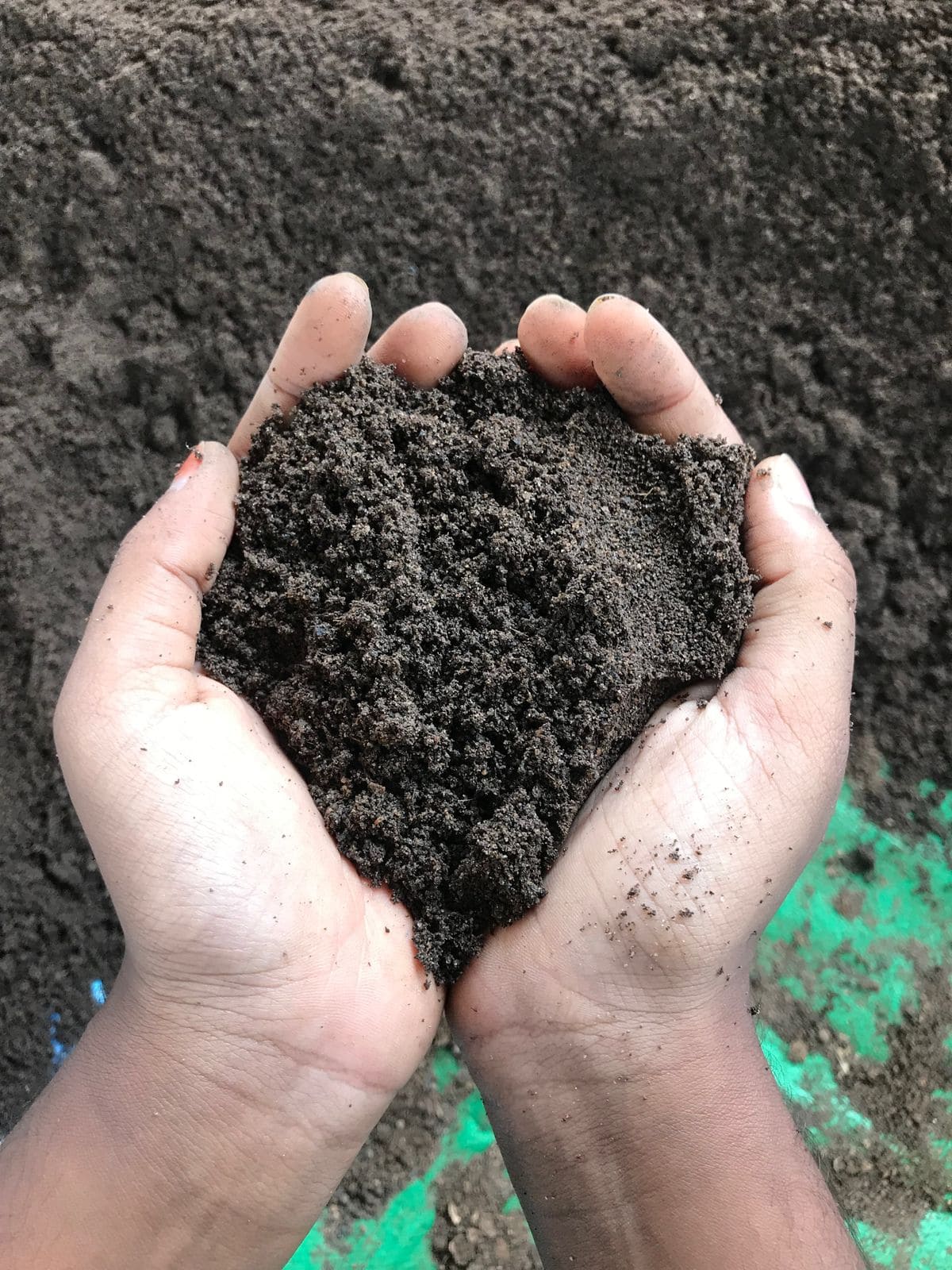
Garlic thrives in loose, well-drained soil rich in organic matter. Start by clearing weeds and loosening the soil down 8-10 inches.
If your soil is heavy clay, consider building raised beds or mixing in compost, leaf mold, and a little sand for texture.
Mix in a balanced organic fertilizer or aged compost before planting. Garlic is a heavy feeder, it needs a strong base of nutrients early on to bulk up those bulbs later.
Check the pH too as garlic prefers a range of 6.0 to 7.0. If your soil is too acidic, add some garden lime during preparation.
Plant Each Clove With Purpose
Firstly, break apart your garlic bulb into individual cloves, leave the papery skins on, and choose only the largest, healthiest ones. Each clove becomes a whole new bulb, so small or damaged cloves will only produce weak results.
Discover more
Garlics
soil
Herbs & Spices
Next, plant each clove pointy end up, about 2 inches deep, and space them 4-6 inches apart in rows that are 10-12 inches apart.
Consistent spacing allows for proper air circulation and bulb development. After planting, water thoroughly to settle the soil.
You won’t need to water much afterward, unless conditions are extremely dry.
Mulch Garlic Is Your Secret Weapon
As soon as your garlic is planted, cover the bed with a thick layer of mulch, about 3-6 inches of straw, shredded leaves, or even pine needles.
Garlic
This insulates the soil, prevents winter heaving during freeze-thaw cycles, and suppresses early weed growth.
Discover more
Writers Resources
GARDEN
Garden
In spring, once green shoots appear, gradually pull the mulch back a bit to allow sunlight in and keep moisture balanced.
Spring Care to Maximize Garlic Summer Harvest
When temperatures rise in spring, garlic wakes up fast. Keep the soil evenly moist, especially through May and June when bulbs are forming.
Also, top-dress with compost or feed with a nitrogen-rich organic fertilizer like fish emulsion once shoots are 4-6 inches tall. This boost powers foliage growth, which directly supports bulb development.
If you’re growing hardneck garlic, you’ll see curly green stalks, these are garlic scapes. Snip them off once they curl, so the plant can put its energy into bulb formation instead of flowering.
Garlic
Tips: the scapes are edible and taste amazing sautéed or blended into pesto.
Garlic is ready to harvest when about one-third to one-half of the leaves have turned yellow and dry, typically in mid to late summer (July for fall-planted garlic).
If you wait too long, the bulbs may split, which shortens their storage life. You can use a garden fork to gently lift each bulb, don’t yank it by the stem.
Flora& Fauna
Cure Garlic for Long-Term Storage
Discover more
Crafts
candles
Garlics
After harvest, garlic needs time to cure. Lay bulbs out in a shady, airy space for 2-4 weeks on a drying rack, screen, or even tied in small bundles and hung under a porch.
Agriculture& Forestry
Once the outer skins are fully dry and papery, trim the roots and cut stems back to about an inch above the bulb.
You store your cured bulbs in a cool, dry, well-ventilated space. Avoid plastic bags as they trap moisture and cause rot.
Properly cured garlic can store for 6 to 10 months, depending on variety.
Growing garlic is deeply rewarding and surprisingly simple once you know the seasonal rhythm.
Plant it right in the fall, feed it with care in spring, and by next summer, you’ll be pulling up fragrant, fat bulbs that put grocery-store garlic to shame.
Discover more
Herbs & Spices
Agriculture & Forestry
Soil
And once you taste the difference in your sauces, roasts, and salad dressings, you might just devote an entire garden bed to next year’s garlic crop.
I (78F) lived in the state-funded wing of our nursing home. I shared a cramped room, ate soggy food, and survived on a tiny pension. Harrison (82M) lived in a different universe. He occupied the VIP penthouse suite with a private chef and 24/7 nurses.
Despite the class divide, we met in the courtyard. Bonding over chess, we quickly became inseparable. We spent countless hours under the old oak tree, drinking imported tea, listening to jazz, and talking about our deepest regrets.
Harrison was a widower. Despite having three kids, his suite was painfully empty. “They don’t care about me. They’re just waiting for me to die,” he confessed one afternoon over the chessboard.
When Harrison’s health declined, his children abruptly appeared. They brought lawyers to seize his medical power of attorney and quietly hasten his end. Terrified, Harrison asked me to marry him so his family couldn’t dictate his final days. I agreed without hesitation.
We spent two beautiful years as husband and wife. He moved me into his lavish suite, and neither of us felt lonely. We spent his final months reading to each other and watching sunsets from his balcony. Last week, Harrison passed away peacefully, holding my hand.
At his funeral, his children barely acknowledged me as they whispered among themselves and watched me with open hostility.
A week after the funeral, Harrison’s lawyer came to see me. He handed me an envelope and looked at me with quiet concern.
“Please, sit down. The truth inside may be difficult to process.”
Part 2: The Secret Beneath the Seals
The attorney, Mr. Sterling, did not unbutton his suit coat as he sat across from me in the sitting room of Harrison’s suite. The penthouse, usually filled with the soft hum of miles-away traffic and the crackle of Miles Davis records, felt vast and hollow.
I smoothed the fabric of my black cotton dress—the only nice piece of clothing I owned before Harrison had pulled me out of the east wing—and stared at the heavy cream envelope resting on the mahogany coffee table between us. It was sealed with red wax, stamped with a monogrammed emblem I didn’t recognize.
“Is this his revised will, Mr. Sterling?” I asked, my voice thin and dry. “Because if it’s about the estate, I’ve already told Harrison’s children they can have the furniture, the private accounts, the art collection… all of it. I never asked him for a dime. I married him so his son wouldn’t turn off his oxygen to speed up probate.”
Mr. Sterling let out a long, heavy breath, resting his hands flat on his knees. “Evelyn, Harrison’s children—Julian, Beatrice, and Richard—have already filed three separate lawsuits in county court challenging the validity of your marriage. They are claiming undue influence, elder abuse, and mental incompetence on Harrison’s part.”
“He was sharp as a tack until the day he closed his eyes,” I said, a sudden flare of anger warming my chest. “He beat me in chess three nights before he died!”
“I know,” Mr. Sterling said softly. “I held his legal capacity evaluations on file. Harrison was entirely lucid. But what is inside this envelope is not a property deed, and it is not a standard trust agreement.” He slid the heavy envelope two inches closer to my side of the table. “This is a confession. And a set of instructions.”
My hands trembled as I picked up the silver letter opener Harrison always kept beside his brass reading lamp. I sliced through the thick paper.
Inside were two items: a handwritten letter on heavy parchment, written in Harrison’s sharp, slanted cursive, and a yellowed photograph from forty-five years ago.
I picked up the photograph first.
It showed a young man in a dark wool coat standing on the steps of a brick municipal building in Chicago, holding the hand of a young woman with dark hair and a wide, nervous smile. Beside them stood a little girl, no older than three, wearing a yellow raincoat.
The young man was undeniably Harrison—younger, thicker hair, but with the exact same soulful, heavy-lidded eyes that used to look at me across a chessboard.
The woman was not his late wife, Eleanor, whom I had seen in dozens of framed portraits around the suite.
And the little girl…
My heart did a violent, sickening flip in my chest.
The little girl was holding a tiny red plastic ragdoll—the exact same ragdoll that had sat on my grandmother’s mantle in South Chicago until the day she passed away. The exact same ragdoll I had buried in a shoebox under a willow tree when I was seven years old after my mother vanished overnight.
My lungs seized. The room spun around me.
“No…” I whispered, the paper shaking so violently in my grip that it made a rustling noise in the quiet room. “No, this is wrong. This is a mistake.”
“Read the letter, Evelyn,” Mr. Sterling said gently. “Harrison wanted you to read it before his children break down that door with a court injunction at five o’clock today.”
I unfolded the thick parchment, my eyes swimming through tears as I recognized Harrison’s voice in every stroke of the pen.
My dearest Evelyn,
If you are reading this, my heart has finally given out, and I am no longer there to shield you from the storm my selfishness created. I know you are looking at the photograph right now. I know your mind is racing, trying to reconcile the old man who shared your tea with the ghost standing on those courthouse steps in 1981.
I told you I was a wealthy man who made his fortune in commercial shipping. That was not a lie. But I never told you how I got my starting capital. I never told you what I abandoned to build an empire.
Your mother’s name was Clara. You were three years old when I left.
I stopped reading. The air left my body in a ragged gasp. I pressed a hand over my mouth, a sob tearing through my throat before I could stop it.
Forty-five years. Forty-five years of believing my father had died in an industrial accident, as my grandmother had always insisted. Forty-five years of growing up in state care, working thirty years as an assistant librarian, living on boiled soup and a tiny pension in a state-funded room while my father lived six floors above me in a penthouse suite wrapped in cashmere and silk.
I was young, arrogant, and terrified of poverty, the letter continued. When Eleanor’s father offered me a partnership in his shipping empire on the absolute condition that I sever all ties with my past, I chose the money. I chose the prestige. I let Eleanor’s family buy out my past, and I left you and Clara behind with a modest trust fund that your grandmother’s scoundrel of an attorney embezzled six months later—a crime I didn’t discover until decades too late.
I spent forty years living a lie with Eleanor. We had three children—Julian, Beatrice, and Richard. I gave them everything money could buy, and in return, I raised three hollow, ruthless monsters who looked at me not as a father, but as a vault waiting to be cracked.
When my health failed and Eleanor passed, I checked into this facility specifically because I learned you were living in the state-funded wing. I tracked your pension records two years ago, Evelyn. I knew you were here.
I was too much of a coward to walk up to your room in the East Wing and say, ‘I am the man who abandoned you.’ I knew you would despise me. I knew you would walk away, and you would have been right to do so.
So I set up the chessboard in the courtyard. I bought the tea you liked. I sat under the oak tree every afternoon for three weeks waiting for you to walk past. I wanted to know my daughter. I wanted to hear your voice. And in the two years we spent together, listening to jazz and watching the sunset, I found a grace I never deserved.
I didn’t ask you to marry me just to spite my children, Evelyn. I married you because under the law, a spouse inherits what a child cannot touch. Everything I built—the shipping holdings, the real estate, the private funds totaling seventy-four million dollars—was built on the blood money of the life I stole from you and your mother.
It was never mine. It was always yours.
Forgive me, my sweet girl.
Your father,Harrison.
Part 3: The Ambush
I sat frozen on the sofa, the letter resting on my lap, my tears dripping onto the heavy parchment and smudging the blue ink.
Seventy-four million dollars.
A father.
The man who had taught me how to counter a Sicilian Defense on a wooden chessboard, the man who had held my hand when his fever spiked, the man whose soft laughter had filled the darkest corners of my old age… was the same man who had left me to grow up in worn shoes and state-issued coats.
A wave of bitter, suffocating grief surged through me, mixed with a fury so deep it made my teeth chatter. He had used me. He had lied to me. He had orchestrated a grand redemptive play in the final act of his life, turning me into his unwitting accomplice.
“He knew?” I choked out, looking up at Mr. Sterling through blur of red-hot anger. “He knew who I was the entire time?”
“He spent six months verifying your identity through private investigators before he ever stepped foot in the courtyard,” Mr. Sterling replied quietly. “He watched you from the third-floor balcony for three weeks before he mustered the courage to set up that chess set. He told me that if you hated him, he would accept it. But when he saw how his other children treated this place like a waiting room for an execution, he realized they would leave you with nothing if he died without a legal bond between you.”
Before I could answer, the heavy double doors of the penthouse suite were thrown open with a violent bang.
“Get out of our way!” a sharp, aristocratic voice barked from the foyer.
Julian Vance—Harrison’s eldest son, fifty years old, wearing a tailored charcoal suit and a golden signet ring—marched into the living room, followed closely by his sister Beatrice and two men carrying leather briefcases.
Beatrice, draped in an expensive trench coat, stopped near the grand piano, her eyes sweeping over me with cold, aristocratic disgust.
“Still occupying the suite, I see,” she sneered, adjusting her diamond earring. “I told you, Julian. These state-wing opportunists have no shame. The body isn’t even cold in the ground and she’s already sleeping on the Egyptian cotton.”
Julian stepped up to the coffee table, ignoring Mr. Sterling entirely, and looked down at me as if I were a stain on the Persian rug.
“Pack your bags, Evelyn,” Julian said, his voice flat and commandingly cold. “We’ve filed an emergency motion with Judge Hollister. The marriage is being frozen pending a full psychiatric review of my father’s final medical records. You have thirty minutes to collect your personal belongings—and by personal belongings, I mean the cheap clothes you brought up from the East Wing. Anything bought with my father’s money stays here.”
I looked at Julian. I looked at the sharp, ruthless angle of his jaw, the cold arrogance in his eyes—the exact look Harrison had described in his letter.
For two years, I had watched this man visit his father once every three months, staying for precisely eight minutes, asking about tax shelters while Harrison lay hooked to an IV line. I had watched Beatrice complain about the smell of antiseptic in the room while her father struggled to sit up.
My grief didn’t vanish, but my anger solidified into something heavy, cold, and razor-sharp.
I slowly folded the letter, placed it inside my pocket, and stood up.
“Your father’s memory deserves more respect than this, Julian,” I said, my voice surprisingly steady.
Julian let out a cruel, barking laugh. “My father was an senile old man who was manipulated by a gold-digger in a nursing home! You think because you played a few games of chess and signed a justice-of-the-peace certificate that you’re entitled to a single dime of the Vance estate? You’re a charity case who got lucky!”
“Mr. Vance,” Mr. Sterling interrupted, standing up from his chair and opening his leather briefcase. “I suggest you check your tone. And I suggest your legal team review the filing I submitted to the probate court at eight o’clock this morning.”
Beatrice scoffed, crossing her arms. “What filing? Our lawyers have already issued an injunction against the primary trust!”
“The primary trust was dissolved eighteen months ago, Miss Vance,” Mr. Sterling said smoothly, pulling out a thick, court-stamped binder. “Executed by your father while he was under complete legal mental competence, verified by three independent board-certified neurologists.”
Julian’s eyes narrowed into slits. “What are you talking about?”
“Harrison didn’t leave Evelyn his fortune through a standard will that you could contest in probate,” Mr. Sterling explained, his voice ringing clearly through the quiet penthouse. “Eighteen months ago, he transferred seventy percent of his liquid holdings, the shipping equity shares, and the entirety of his real estate portfolio into an irrevocable inter-vivos trust.”
Mr. Sterling turned the binder toward Julian’s lawyers.
“The sole, unalterable beneficiary of that trust is his wife, Evelyn Vance. Under state law, an irrevocable inter-vivos trust does not pass through probate. It cannot be contested on grounds of familial inheritance. It belongs to her. Right now. Today.”
The room went dead silent.
One of Julian’s lawyers grabbed the binder, frantically flipping through the stamped pages. His face went completely pale. He leaned over and whispered three words into Julian’s ear.
Julian’s composure shattered. His face turned a deep, mottled red, his veins bulging against his collar.
“You…” Julian spat, stepping toward me with his fists clenched. “You manipulative old witch! You stole our inheritance! You coerced him!”
“I didn’t steal a single thing from you, Julian,” I said, stepping forward until I was standing two feet from him, looking him straight in the eye. “Your father gave it to me. And do you want to know why?”
I reached into my pocket and pulled out the yellowed photograph from 1981, holding it up so both he and Beatrice could see the young man holding the little girl in the yellow raincoat.
“Because before he was your father,” I whispered, my voice cutting through the room like a blade, “he was mine.”
Final: The Inheritance of Grace
Julian and Beatrice stood frozen, staring at the faded photograph in my hand.
For five long seconds, the only sound in the penthouse was the ticking of the grandfather clock in the corner.
“That’s… that’s impossible,” Beatrice stammered, her voice dropping an octave into pure, disbelieving panic. “He never… he didn’t have another family. Our mother was his only wife!”
“He left my mother and me forty-five years ago to marry your mother’s money,” I said, holding my head high. “He spent his whole life running away from that sin. And in the end, he realized that the three children he raised with all that stolen wealth turned out to be monsters who couldn’t even be bothered to hold his hand while he died.”
Julian’s lawyer pulled hard on his client’s arm. “Julian, we need to leave. Now. If this document is authentic and she is a direct biological heir as well as a lawful spouse, any challenge we file in court will not only fail, but it will open you up to counter-suits for malicious prosecution and civil fraud.”
“Get out,” I said, pointing toward the open oak doors of the foyer. “All of you. Get out of my father’s house.”
Julian opened his mouth to scream, to rage, to fight—but the cold, ironclad reality of the legal documents and the photograph held him paralyzed. He looked at me—really looked at me—and for the first time, he saw the exact same eyes, the exact same jawline, the exact same stubborn set of the chin that had built the empire he had spent his life expecting to inherit.
Without another word, Julian turned around and walked out of the suite, his head bowed. Beatrice hurried behind him, her designer heels clicking frantically against the marble floor, leaving their high-priced lawyers to gather their briefcases in silent defeat.
When the heavy oak doors clicked shut behind them, the suite fell into an absolute, sacred quiet.
Mr. Sterling let out a quiet sigh, shutting his briefcase. “They will try to appeal, Evelyn. But they have no legal standing. The money, the properties, the accounts… they are yours. You are a very wealthy woman.”
I walked over to the floor-to-ceiling glass windows overlooking the courtyard below.
Far down on the brick patio, sitting under the ancient, spreading branches of the oak tree, was the green metal table where Harrison and I had sat for two years. The wooden chessboard was still sitting there, left out in the cool autumn air.
I thought about the seventy-four million dollars. I thought about the state-funded wing six floors below me, where women my age were eating soggy soup and sharing cramped, drafty rooms because they had nowhere else to go. I thought about a young man in 1981 who had made a terrible, cowardly choice, and an old man in 2024 who had spent his final days trying to buy forgiveness with tea, chess, and a marriage certificate.
He hadn’t been a good man for most of his life. He had been weak, selfish, and ambitious. But in the end, he had tried to fix the one thing he had broken.
“Mr. Sterling?” I said, still looking out at the oak tree.
“Yes, Evelyn?”
“I want you to establish a foundation tomorrow morning,” I said, turning to face him. “The Harrison and Clara Vance Endowment. I want fifty million dollars placed into a permanent trust to fund full residential, medical, and private care for every single resident living in the state-funded wings of this city’s nursing homes.”
Mr. Sterling blinked, surprised. “Fifty million? Evelyn, you could live anywhere in the world. You could buy an estate in Europe, travel—”
“I am seventy-eight years old, Mr. Sterling,” I said with a soft, quiet smile. “I don’t need a mansion in Europe. I need to know that no old woman ever has to sit in a cold room feeling like the world forgot she existed.”
“And the rest?” he asked softly.
“The rest will stay right here,” I said, touching the letter in my pocket. “To keep this suite open for residents who need a place to watch the sunset.”
After Mr. Sterling left, I walked out onto the balcony. The autumn breeze was crisp, carrying the scent of fallen oak leaves and distant rain.
I sat down in Harrison’s velvet armchair, pulled his wool blanket over my knees, and opened the letter one last time. I looked at his handwriting, traced the loops of his name, and for the first time since he closed his eyes, I felt a deep, unshakeable peace settle over my heart.
He had been a terrible father for forty-five years. But for two years, he had been my friend. And in the end, he had brought his daughter home.
I looked up at the sky as the sun dipped beneath the horizon, casting brilliant streaks of gold and violet across the clouds.
“I forgive you, Harrison,” I whispered into the wind. “Rest now. The game is over.”
Our dogs may be quietly warning us more often than we realize. That awkward, sometimes embarrassing moment when your dog seems unusually fixated on sniffing your most private areas can feel invasive or even unsettling. Many people instinctively pull away, scold their dog, or laugh it off as odd behavior. But according to veterinarians and animal behavior experts, there may be more going on beneath the surface. In some cases, that intense interest could be a dog responding to subtle changes in your body that you haven’t yet noticed yourself.
Dogs experience the world primarily through scent. While humans rely heavily on sight and sound, a dog’s sense of smell is estimated to be tens of thousands of times more powerful than ours. Their noses are capable of detecting minute chemical changes in the human body—changes linked to hormones, immune responses, infections, and even emotional states. Sweat glands, particularly in areas like the groin and underarms, release pheromones and chemical signals that can shift when something internal changes. To a dog, those changes can stand out like a flashing warning sign.
This is why dogs are famously able to detect pregnancy, stress, fear, and in some documented cases, serious illnesses such as cancer or diabetic episodes. When your dog lingers or repeatedly sniffs a specific area, they may simply be processing new information. A hormonal fluctuation, a mild infection, or even changes caused by medication can alter your scent profile in ways that immediately grab their attention. What feels inappropriate to us may be deeply informative to them.
That said, it’s important not to jump to worst-case conclusions. Most persistent sniffing is not a medical emergency. Dogs are naturally curious, social animals, and scent investigation is a normal way they gather data about the people they love. New environments, guests, stress, or excitement can all intensify sniffing behavior. Puppies and younger dogs, in particular, often lack social boundaries and are still learning what is acceptable around humans.
However, context matters. If your dog’s behavior changes suddenly—especially if they become fixated on one specific spot and pair that behavior with unusual actions like whining, pawing, guarding, or refusing to leave your side—it may be worth paying closer attention. When such behavior coincides with physical symptoms like pain, fatigue, fever, or unexplained discomfort, consulting a medical professional is a sensible step. Dogs can’t diagnose illness, but they may be alerting you to something worth checking.
Respecting your dog’s instincts does not mean tolerating uncomfortable behavior. Boundaries are important for both humans and pets. Calm redirection, consistent commands, and positive reinforcement can teach your dog more appropriate ways to interact without punishing their natural curiosity. Harsh reactions or shame-based responses can confuse or stress a dog, potentially damaging trust. Instead, gently guiding them away and reinforcing polite behavior maintains respect on both sides.
Training also plays a role. Dogs that are mentally stimulated and well-exercised are less likely to fixate on intrusive behaviors. Providing outlets for their curiosity—such as scent games, puzzles, or structured walks—can help channel their instincts productively. If sniffing becomes excessive or compulsive, a veterinarian or professional trainer can help rule out anxiety or behavioral issues.
Ultimately, dogs have shared human lives for thousands of years, evolving alongside us in ways that make them remarkably attuned to our bodies and emotions. Their noses pick up stories we cannot smell, and sometimes those stories matter. While not every sniff is a warning, it’s worth remembering that dogs often notice changes long before we do.
Listening doesn’t mean panicking—it means staying aware. By combining respect for your dog’s instincts with healthy boundaries and attention to your own well-being, you create a relationship built on trust and understanding. Sometimes, the nose that follows you everywhere isn’t just being curious. It may be quietly looking out for you, in the only way it knows how.